Amos 2:10

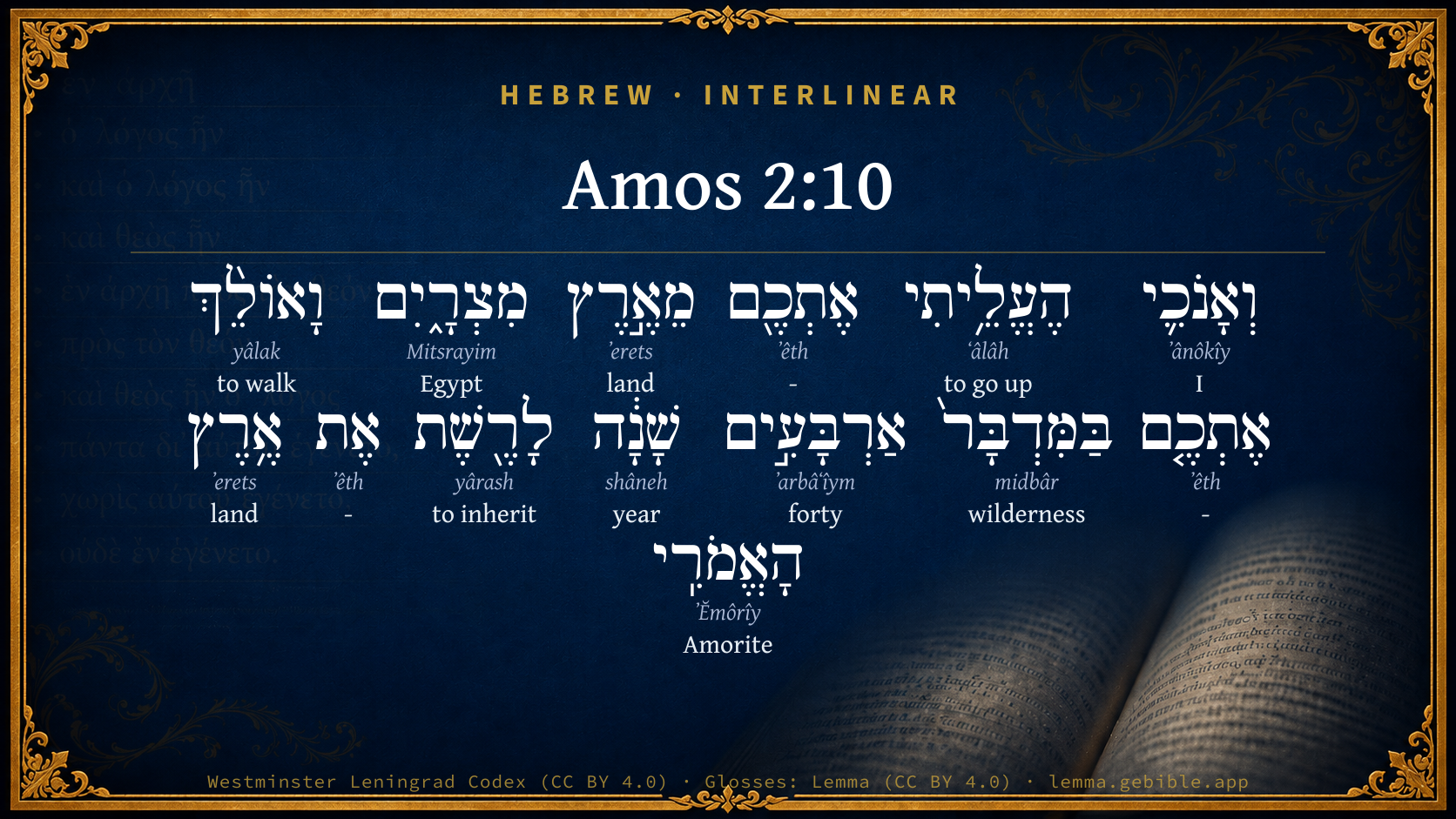
Hebrew (Westminster Leningrad Codex) Amos 2:10 appears in the Hebrew Old Testament. The text above is from the Westminster Leningrad Codex. Each word links to its Strong’s number, a concise gloss, and parsing drawn from the Open Scriptures Hebrew Bible morphology. Click any word for its full Brown-Driver-Briggs (BDB) entry.
Download image
Cite this verse

Amos 2:10 (World English Bible). Public Domain. Lemma interlinear Bible study tool, https://lemma.gebible.app/v/amos/2/10.

Show BibTeX & RIS
BibTeX
RIS
English Translation
Also I brought you up out of the land of Egypt, And led you forty years in the wilderness, To possess the land of the Amorite.
World English Bible · Public Domain
Download a study sheet

One document with this verse’s original text, its word-by-word gloss line, the meaning frame, cross-references with their text, attributed commentary, and full source and license credits — printable, and it pastes into notes with its structure intact.

This verse Autodidact and up

Study sheet (.html) Plain text (.txt)

A passage Seminary Student

Up to 50 verses in one chapter. A passage sheet keeps up to 6 commentary sources and 12 cross-references per verse, in the order this page ranks them, and says so on the sheet whenever that leaves anything out. Ask for a single verse and you get the Autodidact verse sheet above.

Everything on this page stays free to read, with no account — the sheet is a download of what is already on screen, not access to it.

Want to remove ads? Support Godless Engineer
Compare translations 3

The same verse in 3 English versions, stacked beneath the original-language interlinear above. Click any original word for its lexicon entry.

Each is an independent rendering of the whole verse — the interlinear is not word-aligned to these translations.

Highlighted words mark where these versions differ — a whole-verse word diff, not a word-by-word alignment.

  • World English Bible Public Domain
    Also I brought you up out of the land of Egypt, And led you forty years in the wilderness, To possess the land of the Amorite.
  • King James Version Public Domain
    Also I brought you up from the land of Egypt, and led you forty years through the wilderness, to possess the land of the Amorite.
  • unfoldingWord Literal Text CC BY-SA 4.0
    Also, I brought you up out of the land of Egypt and led you forty years in the wilderness to possess the land of the Amorites.

unfoldingWord Literal Text — © unfoldingWord, licensed CC BY-SA 4.0. Word-aligned USFM3 via Door43 (git.door43.org/unfoldingWord/en_ult).

Versions to compare (up to 4)

3 of 4 selected

Show all 18 translations

Every available English version of this verse, each an independent rendering of the whole verse.

  • World English Bible Public Domain
    Also I brought you up out of the land of Egypt, And led you forty years in the wilderness, To possess the land of the Amorite.
  • Berean Standard Bible Public Domain
    And I brought you up from the land of Egypt and led you forty years in the wilderness, that you might take possession of the land of the Amorite.
  • Majority Standard Bible Public Domain
    And I brought you up from the land of Egypt and led you forty years in the wilderness, that you might take possession of the land of the Amorite.
  • King James Version Public Domain
    Also I brought you up from the land of Egypt, and led you forty years through the wilderness, to possess the land of the Amorite.
  • American Standard Version (1901) Public Domain
    Also I brought you up out of the land of Egypt, and led you forty years in the wilderness, to possess the land of the Amorite.
  • Revised Version (1885) Public Domain
    Also I brought you up out of the land of Egypt, and led you forty years in the wilderness, to possess the land of the Amorite.
  • Geneva Bible (1599) Public Domain
    Also I brought you vp from the land of Egypt, and led you fourtie yeres thorowe the wildernesse, to possesse the land of the Amorite.
  • Douay-Rheims (1899) Public Domain
    It is I that brought you up out of the land of Egypt, and I led you forty years through the wilderness, that you might possess the land of the Amorrhite.
  • Young's Literal Translation Public Domain
    And I -- I have brought you up from the land of Egypt, And cause you to go in a wilderness forty years, To possess the land of the Amorite.
  • Literal Standard Version CC BY-SA 4.0
    And I have brought you up from the land of Egypt, || And cause you to go in a wilderness forty years, || To possess the land of the Amorite.
  • Unlocked Literal Bible CC BY-SA 4.0
    Also, I brought you up out of the land of Egypt and led you forty years in the wilderness to possess the land of the Amorites.
  • unfoldingWord Literal Text CC BY-SA 4.0
    Also, I brought you up out of the land of Egypt and led you forty years in the wilderness to possess the land of the Amorites.
  • Darby Bible Public Domain
    And I brought you up from the land of Egypt, and led you forty years in the wilderness, to possess the land of the Amorite.
  • World Messianic Bible Public Domain
    Also I brought you up out of the land of Egypt and led you forty years in the wilderness, to possess the land of the Amorite.
  • Webster's Bible Public Domain
    Also I brought you from the land of Egypt, and led you forty years through the wilderness, to possess the land of the Amorite.
  • Free Bible Version CC BY-SA 4.0
    It was I who brought you out of the land of Egypt and led you through the desert for forty years so that you could take the Amorites' land.
  • Bible in Basic English Public Domain
    And I took you up out of the land of Egypt, guiding you for forty years in the waste land, so that you might take for your heritage the land of the Amorite.
  • JPS Tanakh (1917) Public Domain
    Also I brought you up out of the land of Egypt, and led you forty years in the wilderness, to possess the land of the Amorites.

Literal Standard Version (2020), Covenant Press — licensed CC BY-SA 4.0. Text via the HelloAO Bible API (eBible.org). Unlocked Literal Bible (unfoldingWord) — licensed CC BY-SA 4.0. Text via the HelloAO Bible API (eBible.org). unfoldingWord Literal Text — © unfoldingWord, licensed CC BY-SA 4.0. Word-aligned USFM3 via Door43 (git.door43.org/unfoldingWord/en_ult). Free Bible Version, Dr. Jonathan Gallagher — licensed CC BY-SA 4.0. Text via the HelloAO Bible API (eBible.org).

Word by word

More ways to search: Search by grammar → Find every occurrence → Compare this word →

Practice this passage: Drill this verse → Learn its vocabulary →

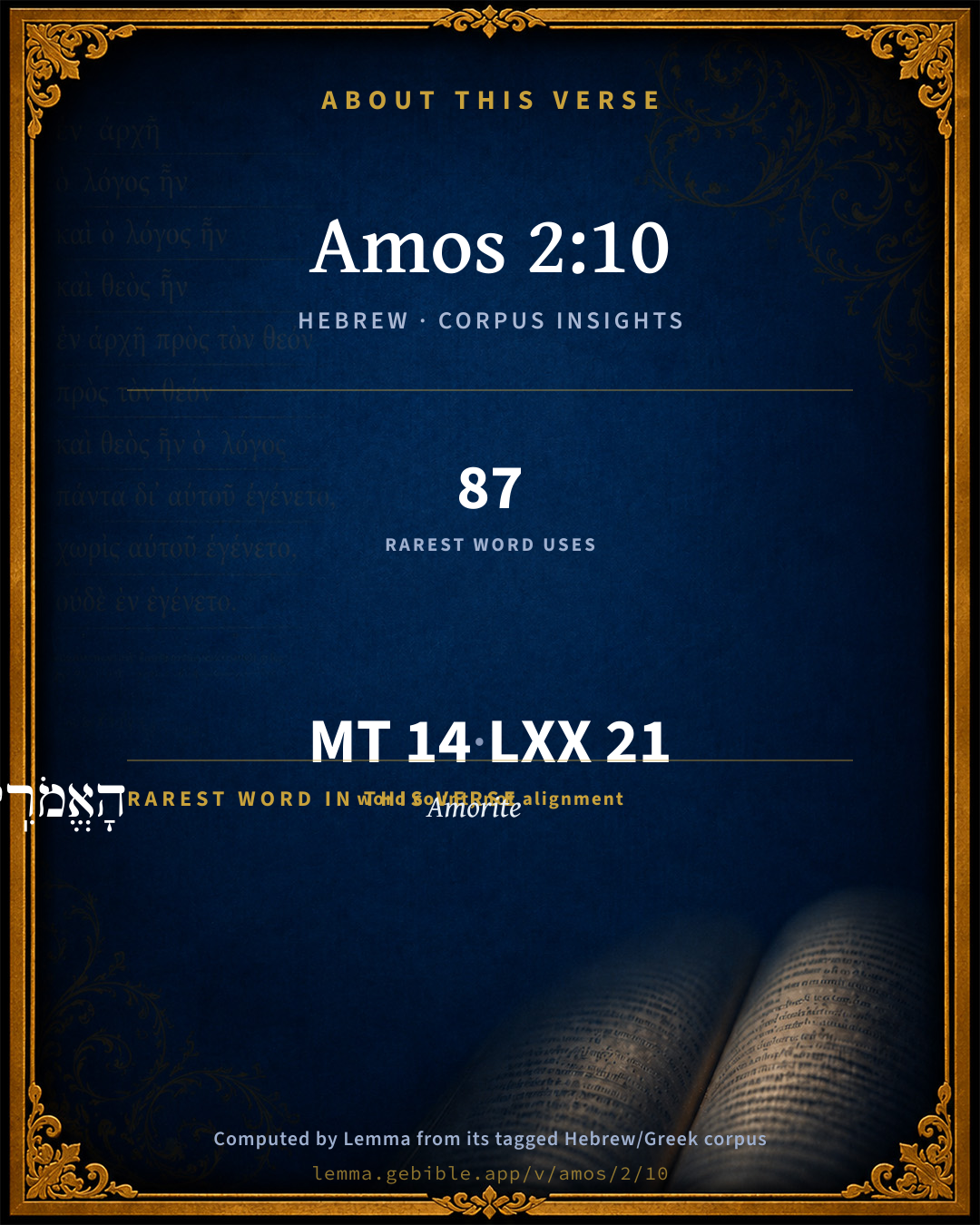
הָאֱמֹרִֽי
ʼĔmôrîy
H567
“the · Amorite”
Particle, Definite Article + Noun, Gentilic, Masculine, Singular, Absolute
Part of Speech
Particle + Noun
Type
Gentilic
Gender
Masculine
Number
Singular
State
Absolute
Full BDB Definition

Origin: probably a patronymic from an unused name derived from H559 in the sense of publicity, i.e. prominence

TWOT: 119

Amorite = "a sayer" - one of the peoples of east Canaan and beyond the Jordan, dispossessed by the Israelite incursion from Egypt
  1. וְאָנֹכִ֛י ʼânôkîy H595 “and · I” Conjunction + Pronoun, Personal, 1st Person, Common, Singular
  2. הֶעֱלֵ֥יתִי ʻâlâh H5927 “to go up” Verb, Hiphil, Perfect, 1st Person, Common, Singular
  3. אֶתְכֶ֖ם ʼêth H853 “- · you” Particle, Direct Object + Suffix, Personal, 2nd Person, Masculine, Plural
  4. מֵאֶ֣רֶץ ʼerets H776 “from · land of” Preposition + Noun, Common, Both, Singular, Construct
  5. מִצְרָ֑יִם Mitsrayim H4714 “Egypt” Noun, Proper
  6. וָאוֹלֵ֨ךְ yâlak H3212 “and · to walk” Conjunction + Verb, Hiphil, Sequential Imperfect, 1st Person, Common, Singular
  7. אֶתְכֶ֤ם ʼêth H853 “- · you” Particle, Direct Object + Suffix, Personal, 2nd Person, Masculine, Plural
  8. בַּמִּדְבָּר֙ midbâr H4057 “in/at the · wilderness” Preposition, Determined + Noun, Common, Masculine, Singular, Absolute
  9. אַרְבָּעִ֣ים ʼarbâʻîym H705 “forty” Adjective, Cardinal number, Both, Plural, Absolute
  10. שָׁנָ֔ה shâneh H8141 “year” Noun, Common, Feminine, Singular, Absolute
  11. לָרֶ֖שֶׁת yârash H3423 “to inherit” Preposition + Verb, Qal, Infinitive Construct
  12. אֶת ʼêth H853 “-” Particle, Direct Object
  13. אֶ֥רֶץ ʼerets H776 “land of” Noun, Common, Both, Singular, Construct

About this verse

These counts appear in no published source. They are computed here, from the morphology-tagged text and Lemma’s own curated glosses. What Lemma adds →

14
words
11
distinct lemmas
Prophets
section

Grammatical profile

  • 3 verbs
  • 6 nouns
  • 1 adjective
  • 1 pronoun
  • 3 particles

Verb forms

  • הֶעֱלֵ֥יתִי Hiphil · Perfect
  • וָאוֹלֵ֨ךְ Hiphil · Sequential Imperfect
  • לָרֶ֖שֶׁת Qal · Infinitive Construct

Repetition

A word recurs within this verse — often emphatic in Hebrew:

  • מֵאֶ֣רֶץ land H776 ×2

Hebrew & Septuagint length

In English translation the verse runs 26 words from the Hebrew and 29 from the Septuagint (LXX English) — closely comparable.

A rough comparison of the two English renderings, which tokenize alike — not a word-level alignment.

Word counts can differ between the Hebrew and the Greek without any difference in meaning — e.g. the Hebrew direct-object marker אֵת has no separate Greek word, and Greek often adds the article ὁ.

In the original languages it is 14 Hebrew tokens and 21 Greek tokens — but the two are counted differently (Hebrew bundles its prefixes and suffixes into one token; the Greek is in lemma form), so that isn’t a like-for-like length.

Cross-references

20

Topical passages linked to Amos 2:10 in the Treasury of Scripture Knowledge — connected by theme and wording, ordered by reader-vote popularity; previews shown in the World English Bible.

  • Deuteronomy 2:7 For Yahweh your God has blessed you in all the work of your hand; he has known your walking through this great wilderness: these forty years Yahweh your God has been with you; you have lacked nothing.
  • Exodus 12:51 It happened the same day, that Yahweh brought the children of Israel out of the land of Egypt by their hosts.
  • Amos 3:1 Hear this word that Yahweh has spoken against you, children of Israel, against the whole family which I brought up out of the land of Egypt, saying:
  • Acts 7:42 But God turned, and gave them up to serve the host of the sky, as it is written in the book of the prophets, 'Did you offer to me slain animals and sacrifices Forty years in the wilderness, O house of Israel?
  • Exodus 3:8 I have come down to deliver them out of the hand of the Egyptians, and to bring them up out of that land to a good and large land, to a land flowing with milk and honey; to the place of the Canaanite, the Hittite, the Amorite, the Perizzite, the Hivite, and the Jebusite.
  • Amos 9:7 Are you not like the children of the Ethiopians to me, children of Israel?" says Yahweh. "Haven't I brought up Israel out of the land of Egypt, and the Philistines from Caphtor, and the Syrians from Kir?
  • Micah 6:4 For I brought you up out of the land of Egypt, And redeemed you out of the house of bondage. I sent before you Moses, Aaron, and Miriam.
  • Acts 13:18 For a period of about forty years he put up with them in the wilderness.
  • Exodus 20:2 "I am Yahweh your God, who brought you out of the land of Egypt, out of the house of bondage.
  • Numbers 14:31–35 But your little ones, that you said should be a prey, them will I bring in, and they shall know the land which you have rejected.
  • Deuteronomy 1:20–21 I said to you, You are come to the hill-country of the Amorites, which Yahweh our God gives to us.
  • Deuteronomy 1:39 Moreover your little ones, whom you said should be a prey, and your children, who this day have no knowledge of good or evil, they shall go in there, and to them will I give it, and they shall possess it.
  • Deuteronomy 8:2–4 You shall remember all the way which Yahweh your God has led you these forty years in the wilderness, that he might humble you, to prove you, to know what was in your heart, whether you would keep his commandments, or not.
  • Nehemiah 9:8–12 and found his heart faithful before you, and made a covenant with him to give the land of the Canaanite, the Hittite, the Amorite, and the Perizzite, and the Jebusite, and the Girgashite, to give it to his seed, and have performed your words; for you are righteous.
  • Nehemiah 9:21 Yes, forty years did you sustain them in the wilderness, [and] they lacked nothing; their clothes didn't grow old, and their feet didn't swell.
  • Psalms 95:10 Forty long years I was grieved with that generation, And said, "It is a people that errs in their heart. They have not known my ways."
  • Psalms 105:42–43 For he remembered his holy word, And Abraham, his servant.
  • Psalms 136:10–11 To him who struck down the Egyptian firstborn; For his loving kindness endures forever;
  • Jeremiah 32:20–21 who performed signs and wonders in the land of Egypt, even to this day, both in Israel and among [other] men; and made you a name, as in this day;
  • Ezekiel 20:10 So I caused them to go forth out of the land of Egypt, and brought them into the wilderness.

Cross-references courtesy of OpenBible.info (CC BY 4.0).

Hebrew and Greek witnesses Masoretic Hebrew ↔ Greek Septuagint

The same verse in the two great witnesses to the Old Testament, shown verse-for-verse.

These are two independent witnesses, not word-aligned to each other, and the Septuagint is shown in lemma (dictionary) form.

Hebrew Amos 2:10 Masoretic · Westminster Leningrad Codex

וְאָנֹכִ֛י הֶעֱלֵ֥יתִי אֶתְכֶ֖ם מֵאֶ֣רֶץ מִצְרָ֑יִם וָאוֹלֵ֨ךְ אֶתְכֶ֤ם בַּמִּדְבָּר֙ אַרְבָּעִ֣ים שָׁנָ֔ה לָרֶ֖שֶׁת אֶת אֶ֥רֶץ הָאֱמֹרִֽי

Also I brought you up out of the land of Egypt, And led you forty years in the wilderness, To possess the land of the Amorite.

World English Bible · Public Domain

Greek LXX Amos 2:10 Septuagint · lemma form

καί ἐγώ ἀναἄγω σύ ἐκ γῆ αἴγυπτος καί περιἄγω σύ ἐν ὁ ἔρημος τεσσαράκοντα ἔτος ὁ κατακληρονομέω ὁ γῆ ὁ ἀμορραῖος

And I brought you up out of the land of Egypt, and led you about in the desert forty years, that you⌃ should inherit the land of the Amorites.

LXX2012 (modern English Septuagint) · Public Domain

Hebrew: Westminster Leningrad Codex (CC BY 4.0). Greek: Septuagint (public domain); English from LXX2012 (modern English Septuagint) (Public Domain). How the Septuagint differs from the Hebrew →

Targum (Aramaic paraphrase)

1

The Targum is the ancient Jewish Aramaic paraphrase of the Hebrew Scriptures — an interpretive translation, not the Hebrew text itself. Onkelos (literal) and Pseudo-Jonathan (expansive) render the Torah, and Jonathan the Prophets. Coverage is partial: where no permissively-licensed English translation exists for a verse, only the Aramaic is shown. This is verse-level text, not a word-by-word alignment to the Hebrew.

  1. Targum Jonathan Prophets (Joshua–Malachi)
    וַאֲנָא אַסְקֵית יַתְכוֹן מֵאַרְעָא דְמִצְרָיִם וְדַבְּרֵית יַתְכוֹן בְּמַדְבְּרָא אַרְבְּעִין שְׁנִין לְמֵירַת יַת אַרְעָא דֶאֱמוֹרָאָה:

    (no public-domain English translation for this verse)

    Targum Jonathan — Aramaic: “Mikraot Gedolot” (public domain). English: “Sefaria Community Translation” (CC0 1.0 (public-domain dedication)); “London "Chaldee Paraphrase," 1871” (public domain). Text via Sefaria.

Commentary

Notes on Amos 2:10 from classic Christian and Jewish commentators (each source and its license shown beneath its notes). The classic Christian expositions comment on the surrounding passage and are grouped to its opening verse, so a note may address several verses; the Jewish commentaries on the Tanakh (Rashi and others) are per-verse, so they appear only where the commentator wrote on this verse.

Lemma curates 59 commentaries, every one of them public domain or Creative Commons licensed, each selected and text-cleaned for this edition rather than reprinted as found. About our sources →

Trapp's Complete Commentary

John Trapp

Amo 2:10 Also I brought you up from the land of Egypt, and led you forty years through the wilderness, to possess the land of the Amorite.

Ver. 10. Also I brought you up from the land of Egypt] Which lies lower than Judea; as doth also mystical Egypt than Jerusalem, which is above, which is the mother of us all. To what great preferments and privileges God’s people are now brought up by Christ. See Heb 12:22-24, and cry out, with that noble Athenian, εξ, οιων εις οια, from how great miseries to what great mercies are we advanced! Even from darkness to light, from the power of Satan to God: that we may receive forgiveness of sins and inheritance among the saints, Act 26:18. And shall we then again break God’s commandments? Ezr 9:14, or say, "We are delivered to do all these abominations," Jer 7:10. Would not the heaven sweat over us, and the earth cleave under us, yea, hell gape for us upon such an entertainment of Divine bounty?

And led you forty years through the wilderness] Led you all along in my hand "as a horse in the wilderness," that ye "should not stumble," Isa 63:13. Led you, and fed you daily and daintily, sending you in angel’s food, and then setting the flint abroach that you might not pine and perish in that vast howling wilderness, Deu 32:10. Besides that, I there bore with your evil manners (ετροποφορησεν), Act 13:18, as a mother bears with her child’s frowardness; or as a husband bears with his wife’s crossness, which he knows he must either tollere or tolerare, cure or cover.

To possess the land of the Amorite] To fit you for such a mercy, to humble you, to prove you, and to do you good at the latter end, Deu 8:16. God knows the height of our spirits and the naughtiness of our natures, &c.; how ill able men’s brains are to bear a cup of prosperity; and how soon their hearts are lifted up with their estates, as a boat that riseth with the rising of the water. God, therefore, usually brings his people into the wilderness, and there "speaketh to their hearts," Hos 2:14; he holds them first to hard meat, and then puts them into full possession.

John Trapp, A Commentary or Exposition upon All the Books of the Old and New Testament (1647–1656) — public domain. Text from a community e-Sword module.

Jamieson, Fausset & Brown

Robert Jamieson, A. R. Fausset & David Brown

brought you up from . . . Egypt--"brought up" is the phrase, as Egypt was low and flat, and Canaan hilly.

to possess the land of the Amorite--The Amorites strictly occupied both sides of the Jordan and the mountains afterward possessed by Judah; but they here, as in Amo 2:9, stand for all the Canaanites. God kept Israel forty years in the wilderness, which tended to discipline them in His statutes, so as to be the better fitted for entering on the possession of Canaan.

Jamieson, Fausset & Brown — Commentary Critical and Explanatory on the Whole Bible (1871) — public domain (CC PDM 1.0). Text via the HelloAO Bible API.

John Calvin's Commentaries

He afterwards subjoins, I have made you to ascend from the land of Egypt; I have made you to walk in the desert for forty years, in order to possess the land of the Amorite. The circumstances here specified are intended to confirm the same thing, that God had miraculously redeemed his people. Men, we know, for the most part extenuate the favors of God; nay, this evil is innate in us. This is the reason why the Prophet so largely describes and extols the redemption of the people. Hence he says now that they had been led out of the land of Egypt. And they ought to have remembered what had been their condition in Egypt; for there they were most miserably oppressed. When therefore that coming out was set before them, it was the same as if God had reminded them how shamefully they had been treated, and how hard had been their bondage in Egypt. That beginning ought to have humbled them, and also to have stimulated them to the cultivation of piety. When now they proudly exulted against God, when no recollection of their deliverance laid hold on them, this vice is justly laid to their charge by the Prophet: “See,” he says, “I have brought you forth from the land of Egypt; what were ye then? what was your nobility? what was your wealth or riches? what was your power? For the Egyptians treated you as the vilest slaves; your condition then was extremely ignominious; ye were as lost, and I redeemed you: and now buried is the recollection of so illustrious a kindness, which deserved to be for ever remembered.”

He afterwards adds, I have made you to walk, etc. The Prophet here reminds them of the desert, that the Israelites might know that God might have justly closed up against them an entrance into the land, though he had promised it for an inheritance to Abraham. For how was it that the Lord led them about for so long a time, except that they, as far as they could, had denied God, and rendered themselves unworthy of enjoying the promised land? Then the Prophet indirectly blames the Israelites here for having been the cause why God detained them for forty years without introducing them immediately into the promised land; which might have easily been done, had they not closed the door against themselves by their ingratitude. This is one reason why the Prophet now speaks of the forty years. And then, as God had in various ways testified his kindness towards the Israelites, he had thus bound them the more to himself; but an ungodly forgetfulness had buried all his favors. God daily rained manna on them from heaven; he also gave them drink from a dry rock; he guided them during the day by a pillar of cloud, and in the night by fire: and we also know how often God bore with them, and how many proofs he gave them of his forbearance. The Prophet, then, by speaking here of the forty years, meant to counsel the Israelites to call to mind the many favors, by which they were bound to God, while they were miraculously led by him for forty years in the desert.

John Calvin's Commentaries (1540-1563) — public domain. Text from the Calvin Translation Society English edition (1840s-50s) via the Christian Classics Ethereal Library (ccel.org). Calvin's coverage is partial (roughly two-thirds of the Bible); uncommented books and verses are honest gaps, never fabricated. The 19th-century editor's footnotes and remarks are omitted so the notes are faithfully Calvin's own voice.

Ellicott's Commentary for English Readers

(10) Forty years.—The forty years’ wandering was a punishment for fickleness and cowardice, but during the incidence of this judgment, of which we have only one or two events recorded in the Book of Numbers, God was disciplining and organising a tribe of restless wanderers into a nation. (Deu_32:9-13.)

A Bible Commentary for English Readers, edited by Charles John Ellicott (1878–1897) — public domain. Text from a community e-Sword module.

The Cambridge Bible for Schools and Colleges

gen. ed. J. J. S. Perowne

10. Also I brought you up, &c.] as before, “And I (emph.)” &c. The providential guidance in the wilderness is instanced as a further motive to obedience, the appeal to it being made the more forcible and direct, by the change from the 1st to the 2nd person. Comp. the same motive, Deu_6:12, Hos_13:4 (R.V. marg.), and elsewhere.

forty years] Deu_2:7; Deu_8:2; Deu_29:5 (in nearly the same phrase) &c.

The Cambridge Bible for Schools and Colleges (gen. ed. J. J. S. Perowne; Cambridge University Press, 1878–1918) — public domain. Text from a community e-Sword module.

John Gill's Exposition

Also I brought you up from the land of Egypt,.... Where they were bond slaves, and in great affliction and distress, and unable to help themselves; but the Lord wrought deliverance for them, and brought them out of this house of bondage with a high hand and a mighty arm:

and led you forty years through the wilderness: going before them in a pillar of cloud by day, and in a pillar of fire by night; providing them with all things necessary, with food and raiment, and protecting them from all their enemies:

to possess the land of the Amorite; the whole land of Canaan, so called from a principal nation of it.

John Gill's Exposition of the Whole Bible (1746–1763) — public domain (CC PDM 1.0). Text via the HelloAO Bible API.

Albert Barnes' Notes on the Bible

Also I - (Literally, “And I,” I, emphatic; thus and thus did ye to Me; and thus and thus, with all the mercy from the first, did I to you,) I brought you up from the land of Egypt It is this language in which God, in the law, reminded them of that great benefit, as a motive to obedience; “I brought thee forth out of the land of Egypt, out of the house of bondage” Exo 20:2; Deu 5:6; Deu 6:12; only there, since God has not as yet “brought them up” into the land which He promised them, but they were yet in the wilderness, He says, “brought them forth;” here, “brought them up,” as to a place of dignity, His own land.

And led you forty years through the wilderness - These are the very words of the law (Deu 29:4, (5 English), and reminded them of so many benefits during the course of those “forty years,” which the law rehearsed; the daily supply of manna, the water from the rock, the deliverance from the serpents and other perils, the manifold forgivenesses. To be “led forty years through the wilderness,” alone, had been no kindness, but a punishment. It was a blending of both. The abiding in the wilderness was punishment or austere mercy, keeping them back from the land which they had shown themselves unqualified to enter: God’s “leading” them was, His condescending mercy. The words, taken from the law, must have re-awakened in the souls of Israelites the memory of mercies which they did not mention, how that same book relates “He found him in a desert land, and in the waste howling wilderness; He led him about; He instructed him; He kept him as the apple of His eye. The Lord alone did lead him” Deu 32:10, Deu 32:12. In the wilderness, where thou hast seen how that the Lord thy God bare thee, as a man doth bear his son, in all the way that ye went until ye came to this place” Deu 1:31; or that minute tender care, mentioned in the same place (Deu 29:4, (5, English)), “your clothes are not waxen old upon you, and thy shoe is not waxen old upon thy foot.” But unless Israel had known the law well, the words would only have been very distantly suggestive of mercy, that it must have been well with them even in the wilderness, since God “led them.” They had then the law in their memories, in Israel also , but distorted it or neglected it.

Albert Barnes' Notes on the Bible (1834–1885) — public domain. Text from a community e-Sword/MySword module.

Matthew Poole's English Annotations

You did not rescue yourselves out of the hands of your enemies, I did in mere mercy with a mighty arm save and rescue you, and brought you up from the land of Egypt, where you were oppressed servants, and exposed to ruin.

Led you, as a shepherd leads his flock: nay, miraculously conducting by the pillar of a cloud and fire, and feeding with manna from heaven.

Forty years, reckoning from their coming out of Egypt.

Through the wilderness: they passed through many wildernesses, named in Scripture according as they were then called, but all these lay so contiguous to each other, that they all made up one great wilderness, as the many names given to parts of the sea make us know what particular part is spoken of, but all make one sea.

To possess, as an heir possesseth that he hath a hereditary right to, the land of the Amorite, including all the rest of the accursed and dispossessed nations.

Matthew Poole's English Annotations on the Holy Bible (1683–1685) — public domain. Text from a community e-Sword/MySword module.

The Pulpit Commentary

The deliverance from Egypt and the guidance through the desert, though chronologically first, are mentioned last, as the great and culminating example of the favour and protection of God. First God prepared the land for Israel, and then trained them for possessing it. From the many allusions in this section, we see how familiar Amos and his hearers were with the history and law of the Pentateuch. Led you forty. (Deu_2:7 Deu_8:2-4)

The Pulpit Commentary (1880–1919), ed. H.D.M. Spence-Jones & Joseph S. Exell — public domain. Text from a community e-Sword module.

Lesson kit

Teaching starters — assembled from the data on this page, not authored interpretation. Every prompt links to the verse data it draws on. Edit before teaching.

Amos, in the Prophets, opens this verse with 14 words (11 distinct Hebrew lemmas). Its most distinctive word is ʼĔmôrîy (“Amorite”). A historical commentator’s framing appears above. Read the whole chapter for the surrounding context.

Discussion questions

  1. How does “Amorite” (ʼĔmôrîy) shape what this verse is saying?
  2. How does Deuteronomy 2:7, which shares this passage’s theme, read alongside this verse?
  3. What does the repetition of “land” (2× in this one verse) do in this verse?
  4. These translations render this verse differently; the difference is in the English rendering, not the original. What questions does that raise?
  5. «הֶעֱלֵ֥יתִי» is a Hiphil Perfect verb. How does that grammatical form shape the action described?
  6. Compare how Trapp's Complete Commentary and Jamieson, Fausset & Brown read this verse. Where do they agree or differ?

Things to notice

Reading settings

Reading text

Shown beneath each verse's original-language words.

Old Testament
Old Testament edition

Read the OT as the Masoretic Hebrew (MT) or the Greek Septuagint (LXX).

English shown for the Greek Septuagint (in the Hebrew ↔ Greek comparison).

Comparing translations? Open the Compare panel on any verse page to stack up to four side by side.