Isaiah 30:2

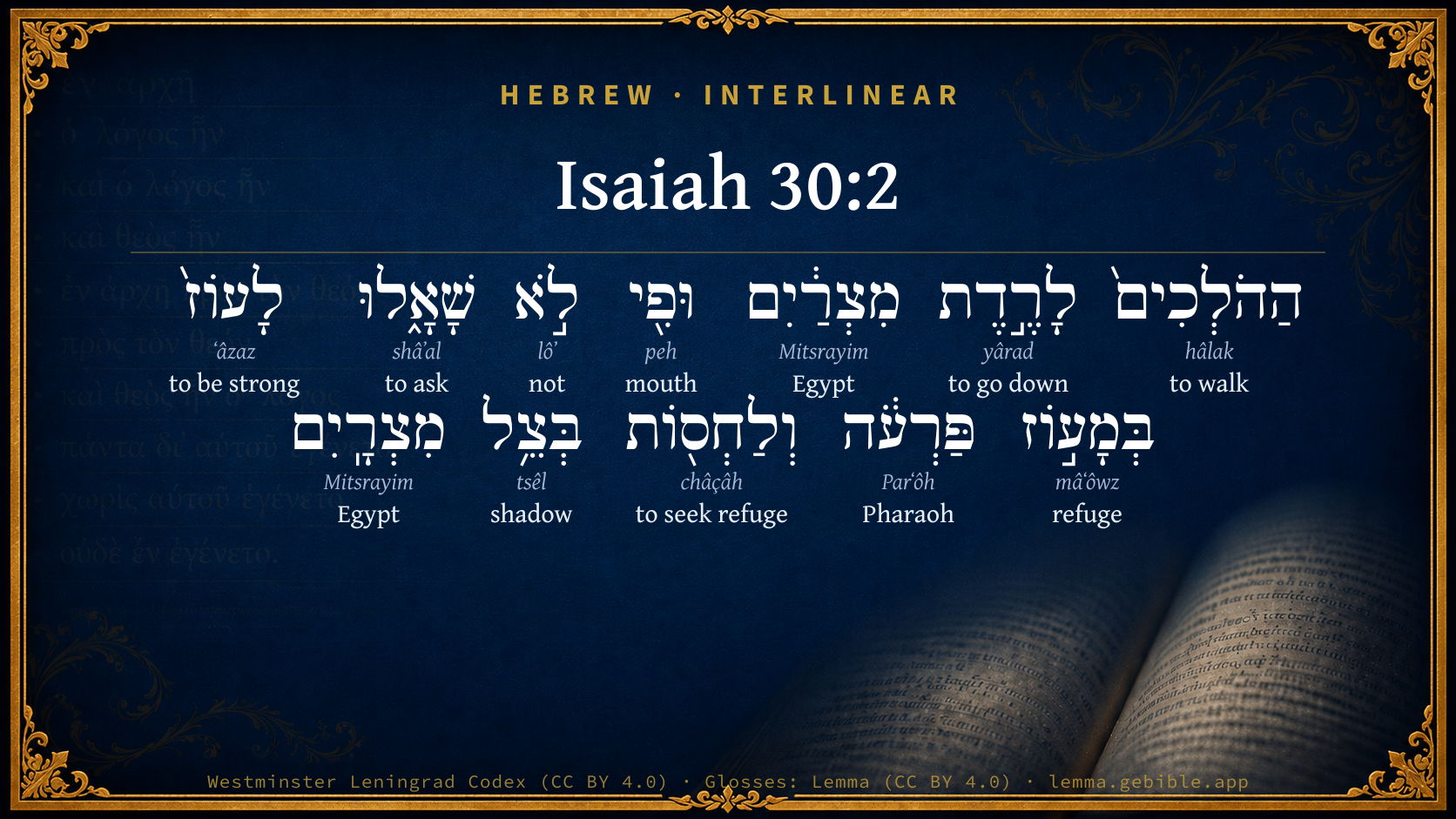
Hebrew (Westminster Leningrad Codex) Isaiah 30:2 appears in the Hebrew Old Testament. The text above is from the Westminster Leningrad Codex. Each word links to its Strong’s number, a concise gloss, and parsing drawn from the Open Scriptures Hebrew Bible morphology. Click any word for its full Brown-Driver-Briggs (BDB) entry.
Download image
Cite this verse

Isaiah 30:2 (World English Bible). Public Domain. Lemma interlinear Bible study tool, https://lemma.gebible.app/v/isaiah/30/2.

Show BibTeX & RIS
BibTeX
RIS
English Translation
that set out to go down into Egypt, and have not asked at my mouth; to strengthen themselves in the strength of Pharaoh, and to take refuge in the shadow of Egypt!
World English Bible · Public Domain
Download a study sheet

One document with this verse’s original text, its word-by-word gloss line, the meaning frame, cross-references with their text, attributed commentary, and full source and license credits — printable, and it pastes into notes with its structure intact.

This verse Autodidact and up

Study sheet (.html) Plain text (.txt)

A passage Seminary Student

Up to 50 verses in one chapter. A passage sheet keeps up to 6 commentary sources and 12 cross-references per verse, in the order this page ranks them, and says so on the sheet whenever that leaves anything out. Ask for a single verse and you get the Autodidact verse sheet above.

Everything on this page stays free to read, with no account — the sheet is a download of what is already on screen, not access to it.

Want to remove ads? Support Godless Engineer
Compare translations 3

The same verse in 3 English versions, stacked beneath the original-language interlinear above. Click any original word for its lexicon entry.

Each is an independent rendering of the whole verse — the interlinear is not word-aligned to these translations.

Highlighted words mark where these versions differ — a whole-verse word diff, not a word-by-word alignment.

  • World English Bible Public Domain
    that set out to go down into Egypt, and have not asked at my mouth; to strengthen themselves in the strength of Pharaoh, and to take refuge in the shadow of Egypt!
  • King James Version Public Domain
    That walk to go down into Egypt, and have not asked at my mouth; to strengthen themselves in the strength of Pharaoh, and to trust in the shadow of Egypt!
  • unfoldingWord Literal Text CC BY-SA 4.0
    The ones having gone to descend Egypt —but they did not ask my mouth— to be strong in the stronghold of Pharaoh and to take refuge in the shadow of Egypt.

unfoldingWord Literal Text — © unfoldingWord, licensed CC BY-SA 4.0. Word-aligned USFM3 via Door43 (git.door43.org/unfoldingWord/en_ult).

Versions to compare (up to 4)

3 of 4 selected

Show all 18 translations

Every available English version of this verse, each an independent rendering of the whole verse.

  • World English Bible Public Domain
    that set out to go down into Egypt, and have not asked at my mouth; to strengthen themselves in the strength of Pharaoh, and to take refuge in the shadow of Egypt!
  • Berean Standard Bible Public Domain
    They set out to go down to Egypt without asking My advice, to seek shelter under Pharaoh’s protection and take refuge in Egypt’s shade.
  • Majority Standard Bible Public Domain
    They set out to go down to Egypt without asking My advice, to seek shelter under Pharaoh’s protection and take refuge in Egypt’s shade.
  • King James Version Public Domain
    That walk to go down into Egypt, and have not asked at my mouth; to strengthen themselves in the strength of Pharaoh, and to trust in the shadow of Egypt!
  • American Standard Version (1901) Public Domain
    that set out to go down into Egypt, and have not asked at my mouth; to strengthen themselves in the strength of Pharaoh, and to take refuge in the shadow of Egypt!
  • Revised Version (1885) Public Domain
    that walk to go down into Egypt, and have not asked at my mouth; to strengthen themselves in the strength of Pharaoh, and to trust in the shadow of Egypt!
  • Geneva Bible (1599) Public Domain
    Which walke forth to goe downe into Egypt (and haue not asked at my mouth) to strengthen them selues with the strength of Pharaoh, and trust in the shadowe of Egypt.
  • Douay-Rheims (1899) Public Domain
    Who walk to go down into Egypt, and have not asked at my mouth, hoping for help in the strength of Pharao, and trusting in the shadow of Egypt.
  • Young's Literal Translation Public Domain
    Who are walking to go down to Egypt, And My mouth have not asked, To be strong in the strength of Pharaoh, And to trust in the shadow of Egypt.
  • Literal Standard Version CC BY-SA 4.0
    Who are walking to go down to Egypt, || And have not asked My mouth, || To be strong in the strength of Pharaoh, || And to trust in the shadow of Egypt.
  • Unlocked Literal Bible CC BY-SA 4.0
    They set out to go down into Egypt, but have not asked for my direction. They seek protection from Pharaoh and take refuge in the shadow of Egypt.
  • unfoldingWord Literal Text CC BY-SA 4.0
    The ones having gone to descend Egypt —but they did not ask my mouth— to be strong in the stronghold of Pharaoh and to take refuge in the shadow of Egypt.
  • Darby Bible Public Domain
    who walk to go down into Egypt, and have not asked of my mouth, -- to take refuge under the protection of Pharaoh, and trust in the shadow of Egypt!
  • World Messianic Bible Public Domain
    who set out to go down into Egypt without asking for my advice, to strengthen themselves in the strength of Pharaoh, and to take refuge in the shadow of Egypt!
  • Webster's Bible Public Domain
    That walk to go down into Egypt, and have not asked at my mouth; to strengthen themselves in the strength of Pharaoh, and to trust in the shade of Egypt!
  • Free Bible Version CC BY-SA 4.0
    You go to Egypt without asking me, looking to Pharaoh for protection, hoping to find safety hiding behind Egypt.
  • Bible in Basic English Public Domain
    Who make a move to go down into Egypt, without authority from me; who are looking to the strength of Pharaoh for help, and whose hope is in the shade of Egypt.
  • JPS Tanakh (1917) Public Domain
    That walk to go down into Egypt, and have not asked at My mouth; to take refuge in the stronghold of Pharaoh, and to take shelter in the shadow of Egypt!

Literal Standard Version (2020), Covenant Press — licensed CC BY-SA 4.0. Text via the HelloAO Bible API (eBible.org). Unlocked Literal Bible (unfoldingWord) — licensed CC BY-SA 4.0. Text via the HelloAO Bible API (eBible.org). unfoldingWord Literal Text — © unfoldingWord, licensed CC BY-SA 4.0. Word-aligned USFM3 via Door43 (git.door43.org/unfoldingWord/en_ult). Free Bible Version, Dr. Jonathan Gallagher — licensed CC BY-SA 4.0. Text via the HelloAO Bible API (eBible.org).

Word by word

More ways to search: Search by grammar → Find every occurrence → Compare this word →

Practice this passage: Drill this verse → Learn its vocabulary →

לָעוֹז֙
ʻâzaz
H5810
“to be strong”
Preposition + Verb, Qal, Infinitive Construct
Part of Speech
Preposition + Verb
Stem
Qal
Form
Infinitive Construct
Full BDB Definition

Origin: a primitive root

TWOT: 1596

to be strong - (Qal) to be strong, prevail - (Hiphil) to make firm, strengthen
  1. הַהֹלְכִים֙ hâlak H1980 “the · walking” Particle, Definite Article + Verb, Qal, Participle Active, Masculine, Plural, Absolute
  2. לָרֶ֣דֶת yârad H3381 “to go down” Preposition + Verb, Qal, Infinitive Construct
  3. מִצְרַ֔יִם Mitsrayim H4714 “Egypt” Noun, Proper
  4. וּפִ֖י peh H6310 “and · mouth · my” Conjunction + Noun, Common, Masculine, Singular, Construct + Suffix, Personal, 1st Person, Common, Singular
  5. לֹ֣א lôʼ H3808 “not” Particle, Negative
  6. שָׁאָ֑לוּ shâʼal H7592 “to ask” Verb, Qal, Perfect, 3rd Person, Common, Plural
  7. בְּמָע֣וֹז mâʻôwz H4581 “in/at · refuge of” Preposition + Noun, Common, Masculine, Singular, Construct
  8. פַּרְעֹ֔ה Parʻôh H6547 “Pharaoh” Noun, Proper
  9. וְלַחְס֖וֹת châçâh H2620 “and · to seek refuge” Conjunction + Preposition + Verb, Qal, Infinitive Construct
  10. בְּצֵ֥ל tsêl H6738 “in/at · shadow of” Preposition + Noun, Common, Masculine, Singular, Construct
  11. מִצְרָֽיִם Mitsrayim H4714 “Egypt” Noun, Proper

About this verse

These counts appear in no published source. They are computed here, from the morphology-tagged text and Lemma’s own curated glosses. What Lemma adds →

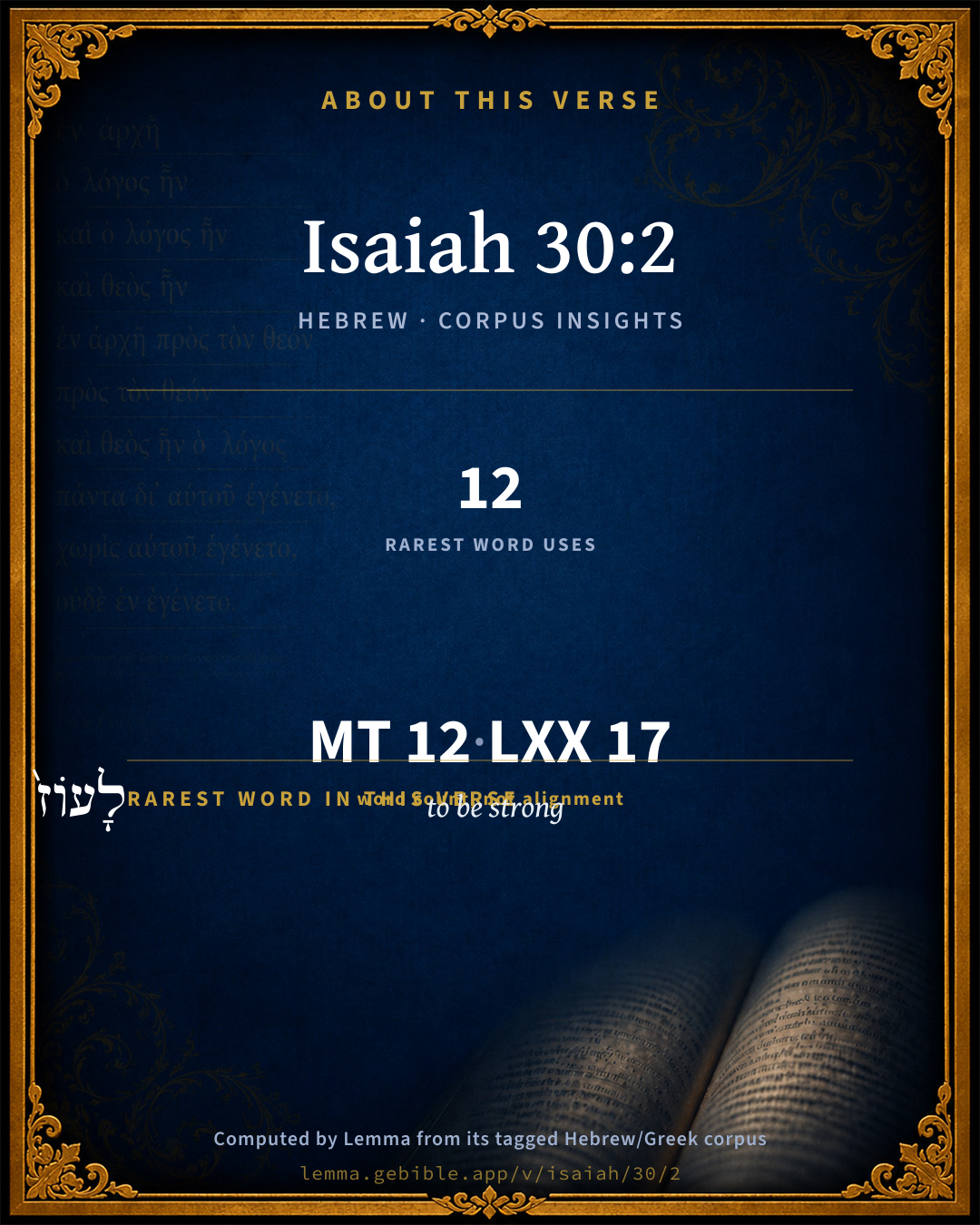
12
words
11
distinct lemmas
Prophets
section

Notable vocabulary

The rarest word here is לָעוֹז֙ to be strong H5810 — appearing just 12 times in the whole Hebrew Bible.

Shared distinctive vocabulary

לָעוֹז֙ to be strong H5810 occurs in 12 verses of the Hebrew Bible. Also found in:

Grammatical profile

  • 5 verbs
  • 6 nouns
  • 1 particle

Verb forms

  • הַהֹלְכִים֙ Qal · Participle Active
  • לָרֶ֣דֶת Qal · Infinitive Construct
  • שָׁאָ֑לוּ Qal · Perfect
  • לָעוֹז֙ Qal · Infinitive Construct
  • וְלַחְס֖וֹת Qal · Infinitive Construct

Repetition

A word recurs within this verse — often emphatic in Hebrew:

  • מִצְרַ֔יִם Egypt H4714 ×2

Hebrew & Septuagint length

In English translation the verse runs 32 words from the Hebrew and 28 from the Septuagint (LXX English) — closely comparable.

A rough comparison of the two English renderings, which tokenize alike — not a word-level alignment.

Word counts can differ between the Hebrew and the Greek without any difference in meaning — e.g. the Hebrew direct-object marker אֵת has no separate Greek word, and Greek often adds the article ὁ.

In the original languages it is 12 Hebrew tokens and 17 Greek tokens — but the two are counted differently (Hebrew bundles its prefixes and suffixes into one token; the Greek is in lemma form), so that isn’t a like-for-like length.

Cross-references

19

Topical passages linked to Isaiah 30:2 in the Treasury of Scripture Knowledge — connected by theme and wording, ordered by reader-vote popularity; previews shown in the World English Bible.

  • Isaiah 36:6 Behold, you trust on the staff of this bruised reed, even on Egypt, whereon if a man lean, it will go into his hand, and pierce it: so is Pharaoh king of Egypt to all who trust on him.
  • Numbers 27:21 He shall stand before Eleazar the priest, who shall inquire for him by the judgment of the Urim before Yahweh: at his word shall they go out, and at his word they shall come in, both he, and all the children of Israel with him, even all the congregation.
  • Deuteronomy 28:68 Yahweh will bring you into Egypt again with ships, by the way of which I said to you, You shall see it no more again: and there you shall sell yourselves to your enemies for bondservants and for bondmaids, and no man shall buy you.
  • Jeremiah 42:20 For you have dealt deceitfully against your own souls; for you sent me to Yahweh your God, saying, Pray for us to Yahweh our God; and according to all that Yahweh our God shall say, so declare to us, and we will do it:
  • Jeremiah 43:7 and they came into the land of Egypt; for they didn't obey the voice of Yahweh: and they came to Tahpanhes.
  • Lamentations 4:20 The breath of our nostrils, the anointed of Yahweh, was taken in their pits; Of whom we said, Under his shadow we shall live among the nations.
  • Ezekiel 29:6–7 All the inhabitants of Egypt shall know that I am Yahweh, because they have been a staff of reed to the house of Israel.
  • Joshua 9:14 The men took of their provision, and didn't ask counsel at the mouth of Yahweh.
  • Judges 9:15 The bramble said to the trees, If in truth you anoint me king over you, then come and take refuge in my shade; and if not, let fire come out of the bramble, and devour the cedars of Lebanon.
  • 1 Kings 22:7 But Jehoshaphat said, Isn't there here a prophet of Yahweh besides, that we may inquire of him?
  • 2 Kings 17:4 The king of Assyria found conspiracy in Hoshea; for he had sent messengers to So king of Egypt, and offered no tribute to the king of Assyria, as he had done year by year: therefore the king of Assyria shut him up, and bound him in prison.
  • Isaiah 16:3 Give counsel, execute justice; make your shade as the night in the midst of the noonday; hide the outcasts; don't betray the fugitive.
  • Isaiah 18:1 Ah, the land of the rustling of wings, which is beyond the rivers of Ethiopia;
  • Isaiah 20:5–6 They shall be dismayed and confounded, because of Ethiopia their expectation, and of Egypt their glory.
  • Isaiah 31:1–3 Woe to those who go down to Egypt for help, and rely on horses, and trust in chariots because they are many, and in horsemen because they are very strong, but they don't look to the Holy One of Israel, neither seek Yahweh!
  • Isaiah 36:9 How then can you turn away the face of one captain of the least of my master's servants, and put your trust on Egypt for chariots and for horsemen?
  • Jeremiah 21:2 Please inquire of Yahweh for us; for Nebuchadrezzar king of Babylon makes war against us: peradventure Yahweh will deal with us according to all his wondrous works, that he may go up from us.
  • Jeremiah 37:5 Pharaoh's army was come forth out of Egypt; and when the Chaldeans who were besieging Jerusalem heard news of them, they broke up from Jerusalem.
  • Jeremiah 42:2 and said to Jeremiah the prophet, Let, we pray you, our supplication be presented before you, and pray for us to Yahweh your God, even for all this remnant; for we are left but a few of many, as your eyes do see us:

Cross-references courtesy of OpenBible.info (CC BY 4.0).

Hebrew and Greek witnesses Masoretic Hebrew ↔ Greek Septuagint

The same verse in the two great witnesses to the Old Testament, shown verse-for-verse.

These are two independent witnesses, not word-aligned to each other, and the Septuagint is shown in lemma (dictionary) form.

Hebrew Isaiah 30:2 Masoretic · Westminster Leningrad Codex

הַהֹלְכִים֙ לָרֶ֣דֶת מִצְרַ֔יִם וּפִ֖י לֹ֣א שָׁאָ֑לוּ לָעוֹז֙ בְּמָע֣וֹז פַּרְעֹ֔ה וְלַחְס֖וֹת בְּצֵ֥ל מִצְרָֽיִם

that set out to go down into Egypt, and have not asked at my mouth; to strengthen themselves in the strength of Pharaoh, and to take refuge in the shadow of Egypt!

World English Bible · Public Domain

Greek LXX Isaiah 30:2 Septuagint · lemma form

ὁ πορεύομαι καταβαίνω εἰς αἴγυπτος ἐγώ δέ οὐ ἐπιἐρωτάω ὁ βοηθέω ὑπό φαραώ καί σκεπάζω ὑπό αἰγύπτιος

even they that proceed to go down into Egypt, but they have not enquired of me, that they might be helped by Pharao, and protected by the Egyptians.

LXX2012 (modern English Septuagint) · Public Domain

Hebrew: Westminster Leningrad Codex (CC BY 4.0). Greek: Septuagint (public domain); English from LXX2012 (modern English Septuagint) (Public Domain). How the Septuagint differs from the Hebrew →

Targum (Aramaic paraphrase)

1

The Targum is the ancient Jewish Aramaic paraphrase of the Hebrew Scriptures — an interpretive translation, not the Hebrew text itself. Onkelos (literal) and Pseudo-Jonathan (expansive) render the Torah, and Jonathan the Prophets. Coverage is partial: where no permissively-licensed English translation exists for a verse, only the Aramaic is shown. This is verse-level text, not a word-by-word alignment to the Hebrew.

  1. Targum Jonathan Prophets (Joshua–Malachi)
    דְאָזְלִין לְמֵיחַת לְמִצְרַיִם וּבְפִתְגָמֵי נְבִיֵי לָא שְׁאִילוּ לְאִתַּקָפָא בִּתְּקוֹף פַּרְעֹה וּלְאִתְרְחָצָא בִּטְלַל מִצְרָיִם:

    Who go to descend into Egypt, but ask not the words of my prophets: to strengthen themselves with the strength of Pharaoh, and to trust in the shadow of Egypt.

    Targum Jonathan — Aramaic: “Mikraot Gedolot” (public domain). English: “Sefaria Community Translation” (CC0 1.0 (public-domain dedication)); “London "Chaldee Paraphrase," 1871” (public domain). Text via Sefaria.

Commentary

Notes on Isaiah 30:2 from classic Christian and Jewish commentators (each source and its license shown beneath its notes). The classic Christian expositions comment on the surrounding passage and are grouped to its opening verse, so a note may address several verses; the Jewish commentaries on the Tanakh (Rashi and others) are per-verse, so they appear only where the commentator wrote on this verse.

Lemma curates 59 commentaries, every one of them public domain or Creative Commons licensed, each selected and text-cleaned for this edition rather than reprinted as found. About our sources →

Trapp's Complete Commentary

John Trapp

Isa 30:2 That walk to go down into Egypt, and have not asked at my mouth; to strengthen themselves in the strength of Pharaoh, and to trust in the shadow of Egypt!

Ver. 2. That walk to go down into Egypt.] This they were flatly forbidden to do. But state policy doth sometimes carry it against express Scripture, to the formalising and enervating of the power of truth, till at length they have left us a heartless and sapless religion, as one well observeth. This is no thriving course certainly; here we have a dreadful woe hanged at the heels of it. The Grecian Churches first called in the Turks to their help, who distressed them, and then, through fear of the Turks, A.D. 1438, sent and subjected themselves to the Bishop of Rome, that they might have the help of the Latin Churches; but shortly after they were destroyed, their empire subdued, &c., teaching all others by their example not to trust to carnal combinations, not to seek the association of others in a sinful way.

John Trapp, A Commentary or Exposition upon All the Books of the Old and New Testament (1647–1656) — public domain. Text from a community e-Sword module.

Jamieson, Fausset & Brown

Robert Jamieson, A. R. Fausset & David Brown

walk--are now setting out, namely, their ambassadors (Isa 30:4).

Egypt--See on Isa 19:1; Isa 20:1.

Pharaoh--the generic name of the kings of Egypt, as Cæsar was at Rome. The word in Egyptian means "king" [JOSEPHUS, Antiquities, 8.6,2]. Phra, "the sun," was the hieroglyphic symbol and title of the king.

shadow--image from shelter against heat: protection (Psa 121:5-6).

Jamieson, Fausset & Brown — Commentary Critical and Explanatory on the Whole Bible (1871) — public domain (CC PDM 1.0). Text via the HelloAO Bible API.

Ellicott's Commentary for English Readers

(2) To strengthen themselves in the strength of Pharaoh.—Literally, the fortress of Pharaoh, used as the symbol of his kingdom: This, then, was the course into which even Hezekiah had been led or driven, and it had been done without consulting Isaiah as the recognised prophet of Jehovah. For the “shadow of Egypt” see Note on Isa_18:1.

A Bible Commentary for English Readers, edited by Charles John Ellicott (1878–1897) — public domain. Text from a community e-Sword module.

The Cambridge Bible for Schools and Colleges

gen. ed. J. J. S. Perowne

2. and have not asked at my mouth] “have not consulted my prophet” (for the expression cf. Jos_9:14; Gen_24:57).

to strengthen themselves … Egypt] Rather: to take refuge in the refuge of Pharaoh, and to hide in the shadow of Egypt.

The Cambridge Bible for Schools and Colleges (gen. ed. J. J. S. Perowne; Cambridge University Press, 1878–1918) — public domain. Text from a community e-Sword module.

John Gill's Exposition

That walk to go down into Egypt,.... That walk out of their own land to go thither; who sent messengers thither to form an alliance, and get help and assistance, or went in person, to secure themselves from present danger. Jarchi refers this to the times of Hoshea, the son of Elah, king of Israel, who sent messengers to So, king of Egypt, Kg2 17:4. Jerom to the times of Jeremiah, to the history in his prophecy, Jer 41:17 and others to Zedekiah. Kimchi thinks it respects the time of Ahaz, though there is no account, either in the books of Kings or Chronicles, of sending then to Egypt for help; or else to the times of Hezekiah himself; which latter is right, as appears from the insults of Rabshakeh, when Sennacherib's army was before Jerusalem, Isa 36:6,

and have not asked at my mouth: or as the Targum,

"the words of my prophets they have not asked;''

they did not inquire of the prophets of the Lord, whether they should go down or not:

to strengthen themselves in the strength of Pharaoh; by making an alliance with him, and receiving men and horses from him, to assist them against the Assyrians; this Pharaoh was he whom the Scriptures call So, Kg2 17:4 and by other writers, Sevechus and Sethon:

and to trust in the shadow of Egypt; the protection that would afford them, in which they placed their confidence, and thought themselves safe from their other enemy, by having so powerful an ally; but this was but a shadow, as are whatsoever men trust in short of the Lord himself, be they riches or righteousness, or any creature or creature enjoyment.

John Gill's Exposition of the Whole Bible (1746–1763) — public domain (CC PDM 1.0). Text via the HelloAO Bible API.

Albert Barnes' Notes on the Bible

That walk to go down to Egypt - Hebrew, ‘Going in the descent to Egypt.’ That is, they do it by their ambassadors Isa 30:4. The journey to Egypt from Palestine is always represented as going down Gen 12:10; Gen 42:3; Gen 43:15; Num 20:15; Deu 10:22.

To strengthen themselves in the strength of Pharaoh - To form an alliance with Pharaoh, that thus they might be able to repel the threatened invasion. Pharaoh was the general name of the kings of Egypt, in the same manner as Caesar was the common name of the emperors of Rome.

To trust in the shadow of Egypt - A ‘shadow’ (צל tsêl) is an emblem of protection and defense, as a shade is a protection from the burning rays of the sun (see the note at Isa 4:6).

Albert Barnes' Notes on the Bible (1834–1885) — public domain. Text from a community e-Sword/MySword module.

Haydock's Catholic Bible Commentary

Down, with presents, ver. 6., and 4 Kings xviii. 20.

George Leo Haydock (1774–1849), Haydock's Catholic Family Bible and Commentary, 1859 edition — public domain. Excludes Psalms (Douay-Rheims chapter numbering differs from Protestant) and Deuterocanonical books (Catholic canon only).

Matthew Poole's English Annotations

That walk to go down into Egypt; that send ambassadors to Egypt for succour, as we read, Isa 30:4, which the Jews were forward to do upon all occasions, and did now upon the invasion of the king of Assyria, as is evident from Isa 20:5,6, and did the like against the king of Babylon, Jer 37:7; Eze 17:15.

Have not asked at my mouth; either by the priests or prophets, as they were to do in weighty cases; of which see Num 27:21; Jos 9:14; 1Sa 23:9,10; 1Ki 22:7; Jer 21:2; 42:2,20; or by studying my word, which plainly directs them to another course, and forbids them this practice.

In the shadow; in their power (as it is in the foregoing clause) and protection, which is oft signified by the shadow, as Jdg 9:15; Psa 17:8; 91:1,4.

Matthew Poole's English Annotations on the Holy Bible (1683–1685) — public domain. Text from a community e-Sword/MySword module.

Whedon's Commentary on the Bible

Daniel D. Whedon

2-4. That walk to go down into Egypt — “Going in the descent of Egypt,” by their ambassadors. Trusting in the shadow of Egypt — in her protection rather than in the protection of Jehovah — is most disgraceful. Their trust in Pharaoh’s protection shall, however, prove to be to them a shame, a confusion. The folly has already gone so far that ambassadors are already at Zoan, (the present Tsan,) the royal seat in lower northeastern Egypt, and at Hanes, (a name perhaps contracted from Tahpanhes, so Grotius thinks,) another royal seat in middle Egypt, to both of which it may be assumed applications were made.

Daniel D. Whedon (gen. ed.), Commentary on the Old and New Testaments (1874–1909) — public domain. Text from a community e-Sword module.

The Pulpit Commentary

That walk; or, are on their way. (comp. Isa_31:1) Either the Jewish ambassadors have already started, or the anticipatory vision of the prophet sees them as if starting. In the history (2Ki_18:13-37 Isa_36:1-22) it is not expressly said that Hezekiah made application to Egypt for aid; but the reproaches of Rabshakeh (2Ki_18:21, 2Ki_18:24) would be pointless if he had not done so. Have not asked at my mouth. As they ought to have done. (see Num_27:21 Jud_1:1 20:18 1Sa_23:2 1Ki_22:7, etc.) To strengthen themselves in the strength of Pharaoh. It is very uncertain who is the "Pharaoh" here intended. The supreme power over Egypt was probably, at the time, in the hands of Tirkakah; (2Ki_19:9) but Lower Egypt seems to have been ruled by various princes, the chief of whom was Shabatok, and any one of these may have been regarded by Isaiah as a "Pharaoh." To trust in the shadow of Egypt. Trust in the "shadow of God" was an expression very familiar to the Jews. (see Psa_17:8 Psa_36:7 Psa_63:7 Psa_91:1 Isa_25:4 Isa_32:2) To "trust in the shadow of Egypt" was to put Egypt in the place of God.

Trusting others than Jehovah.

Relying upon human aid, involving a distrust of the Divine promises, was a crying sin of the ancient Church, not at one time only, but throughout her history." It is quite as truly the crying sin of the modern Church, and of the Christian individual. In every time of pressure and need we first fly to some form of human help. It is either the expression of "first simplicity," or else of "cultured sanctity," to act on the words, "Our help is in the Lord our God.

I THE DELUSIONS ON WHICH OUR TRUSTING OTHERS REST. Some of these take shape, and we can recognize them. Others lie down in men"s souls, doing their mischievous work, but never getting put into propositions, which can be fairly dealt with. They are such as the following:

1. God is far away, and his help is not anything really practical.

2. God does not heed; he is so largely concerned in the great affairs of the universe that it is only an imagination that he can take interest in an individual life.

3. God is so long about his work; and impatient man cannot bear waiting if he is in any trouble, he wants it dealt with at once. Compare the King of Israel, in the famine-time, saying pettishly to Elisha, "What should I wait for the Lord any longer?

4. God makes such hard terms. He always wants repentance and submission, and letting our own hands hang down; he crushes human energy and enterprise. The very statement of these cherished delusions of men suggests their correctives. Surely to all who cherish them the great Father is an unknown God.

II THE FORMS WHICH OUR TRUSTING OTHERS MAY TAKE. The Jewish nation leaned on the help of another nation in her extremity. We, in our individual life and experience, are in danger of some form of sacerdotalism; we pin our faith to some sect-leader, some scientific teacher, some admired statesman, some popular preacher, some assertive priest. Thousands of people find individual responsibility in religion too heavy a burden for them to bear, and do not grasp the truth that God is with them in the bearing, and that it is their dignity to stand under the yoke only with God. Sacerdotalism is just the "man-trust" which prophets denounce. In public life and association the tendency is to lean on, and worship material strength. We seek the help of riches for the carrying out of all our religions schemes. We fly to men rather than to God.

III HISTORY AND EXPERIENCE ALIKE PROVE THE PRACTICAL FOLLY, AS WELL AS THE INGRATITUDE AND REBELLIOUSNESS, OF THUS FORSAKING GOD. Our trusts prove, like Egypt, only shebheth, inactive, do-nothings (see ver. 7). Egypt promised much, but failed utterly in the day of trial. R.T.

The Pulpit Commentary (1880–1919), ed. H.D.M. Spence-Jones & Joseph S. Exell — public domain. Text from a community e-Sword module.

John Wesley's Explanatory Notes

Asked - Either by the priests or prophets.

John Wesley, Explanatory Notes Upon the Whole Bible (1754–1765) — public domain. Text via the GEBible commentary corpus.

J. A. Alexander on Isaiah

Joseph Addison Alexander

“Those walking to go down to Egypt, and my mouth they have not consulted (literally asked), to take refuge in the strength of Pharaoh, and to trust in the shadow of Egypt.” Motion towards Egypt is commonly spoken of in Scripture as downward. To ask the mouth, or at the mouth, of the Lord is a phrase used elsewhere in the sense of seeking a divine decision or response.

Joseph Addison Alexander, The Prophecies of Isaiah (1846–1847; New York: Scribner, 1870–1878) — public domain. Text from a community e-Sword module.

Rashi

Rabbi Shlomo Yitzchaki (Rashi)

Those who go to descend to Egypt This alludes to Hoshea, son of Elah, who sent emissaries to So, king of Egypt (II Kings 17:4).

to descend to Egypt The land of Israel is higher than all the other lands. Alternatively, this is a degradation for them.

and to take shelter (lit.) to cover themselves, abrier in O. F. (This is the equivalent of sabriter in Modern French, to take shelter.)

Rashi on the Tanakh — English translations: “The Judaica Press complete Tanach with Rashi, translated by A. J. Rosenberg” (CC BY 4.0); “Pentateuch with Rashi's commentary by M. Rosenbaum and A.M. Silbermann, 1929-1934” (public domain); “The Metsudah Tanach series, Lakewood, N.J” (CC BY 4.0); and “The Book of Joshua, Metsudah Publications, 1997” (CC BY 4.0). Text via Sefaria.

Ibn Ezra

Rabbi Abraham ibn Ezra

That walk to go down, etc. This verse explains the preceding.

במעוז In the strength of. מ retains its vowel, although the word is in the construct state, because of the second and third letter of the root being the same. מָעוֹז strength, root מָקוֹם:עזז place, root קום; in the construct state, however, they differ; the former retains the Kamez under מ, the latter changes it into Sheva.

Ibn Ezra on the Tanakh — English translations: “Sefaria Community Translation” (CC0 1.0 (public-domain dedication)); “Yalkut, Sifsei Chachomim Chumash, Metsudah Publications, 2009” (CC BY 4.0); and “Commentary of Ibn Ezra on Isaiah - trans. by M. Friedlander, 1873” (public domain). Text via Sefaria.

Lesson kit

Teaching starters — assembled from the data on this page, not authored interpretation. Every prompt links to the verse data it draws on. Edit before teaching.

Isaiah, in the Prophets, opens this verse with 12 words (11 distinct Hebrew lemmas). Its most distinctive word is ʻâzaz (“to be strong”). A historical commentator’s framing appears above. Read the whole chapter for the surrounding context.

Discussion questions

  1. The word ʻâzaz carries the sense “to be strong.” How does it shape the verse?
  2. Judges 3:10 shares the word «to be strong» with this verse. How do the two illuminate each other?
  3. “Egypt” occurs 2× in this one verse. What is the effect of the repetition?
  4. The translations on this page render this verse differently — a whole-verse word diff, not a word-by-word alignment. What might account for the different wordings?
  5. The verb «הַהֹלְכִים֙» is Qal Participle Active. How does its form color the action?
  6. Reading how Trapp's Complete Commentary and Jamieson, Fausset & Brown read this verse, where do the two commentators agree and where do they part?

Things to notice

Reading settings

Reading text

Shown beneath each verse's original-language words.

Old Testament
Old Testament edition

Read the OT as the Masoretic Hebrew (MT) or the Greek Septuagint (LXX).

English shown for the Greek Septuagint (in the Hebrew ↔ Greek comparison).

Comparing translations? Open the Compare panel on any verse page to stack up to four side by side.