
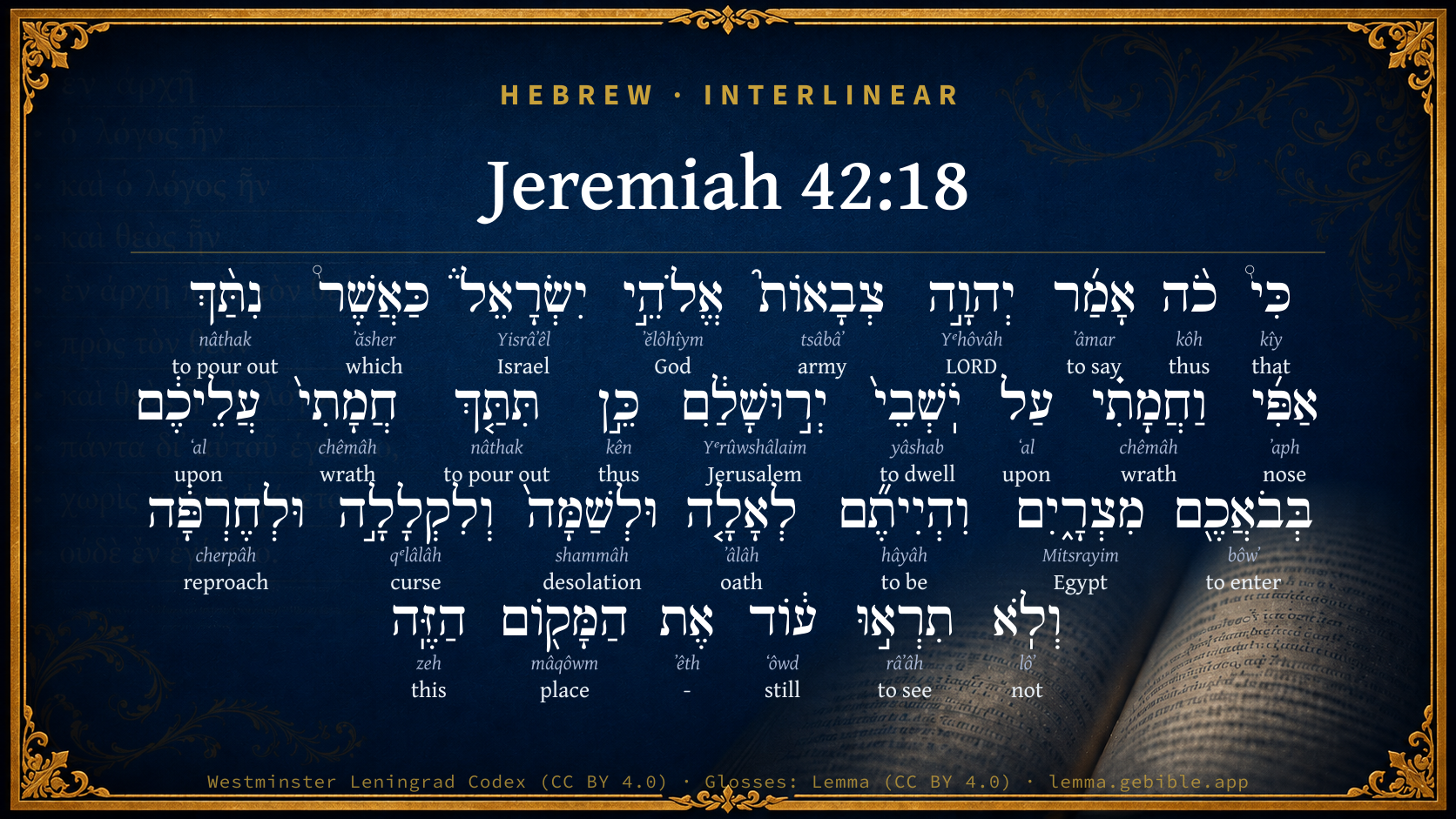
Jeremiah 42:18

Hebrew (Westminster Leningrad Codex) Jeremiah 42:18 appears in the Hebrew Old Testament. The text above is from the Westminster Leningrad Codex. Each word links to its Strong’s number, a concise gloss, and parsing drawn from the Open Scriptures Hebrew Bible morphology. Click any word for its full Brown-Driver-Briggs (BDB) entry.
Download image
Cite this verse

Jeremiah 42:18 (World English Bible). Public Domain. Lemma interlinear Bible study tool, https://lemma.gebible.app/v/jeremiah/42/18.

Show BibTeX & RIS
BibTeX
RIS
English Translation
For thus says Yahweh of Hosts, the God of Israel: As my anger and my wrath has been poured forth on the inhabitants of Jerusalem, so shall my wrath be poured forth on you, when you shall enter into Egypt; and you shall be an object of horror, and an astonishment, and a curse, and a reproach; and you shall see this place no more.
World English Bible · Public Domain
Download a study sheet

One document with this verse’s original text, its word-by-word gloss line, the meaning frame, cross-references with their text, attributed commentary, and full source and license credits — printable, and it pastes into notes with its structure intact.

This verse Autodidact and up

Study sheet (.html) Plain text (.txt)

A passage Seminary Student

Up to 50 verses in one chapter. A passage sheet keeps up to 6 commentary sources and 12 cross-references per verse, in the order this page ranks them, and says so on the sheet whenever that leaves anything out. Ask for a single verse and you get the Autodidact verse sheet above.

Everything on this page stays free to read, with no account — the sheet is a download of what is already on screen, not access to it.

Want to remove ads? Support Godless Engineer
Compare translations 3

The same verse in 3 English versions, stacked beneath the original-language interlinear above. Click any original word for its lexicon entry.

Each is an independent rendering of the whole verse — the interlinear is not word-aligned to these translations.

Highlighted words mark where these versions differ — a whole-verse word diff, not a word-by-word alignment.

  • World English Bible Public Domain
    For thus says Yahweh of Hosts, the God of Israel: As my anger and my wrath has been poured forth on the inhabitants of Jerusalem, so shall my wrath be poured forth on you, when you shall enter into Egypt; and you shall be an object of horror, and an astonishment, and a curse, and a reproach; and you shall see this place no more.
  • King James Version Public Domain
    For thus saith the LORD of hosts, the God of Israel; As mine anger and my fury hath been poured forth upon the inhabitants of Jerusalem; so shall my fury be poured forth upon you, when ye shall enter into Egypt: and ye shall be an execration, and an astonishment, and a curse, and a reproach; and ye shall see this place no more.
  • unfoldingWord Literal Text CC BY-SA 4.0
    For Yahweh of hosts, God of Israel, says this: Just as my wrath and my fury were poured out on the inhabitants of Jerusalem, in the same way my fury will be poured out on you if you go to Egypt. You will become an object of cursing and a horror, an object for speaking curses, and something dishonorable, and you will not see this place again.’”

unfoldingWord Literal Text — © unfoldingWord, licensed CC BY-SA 4.0. Word-aligned USFM3 via Door43 (git.door43.org/unfoldingWord/en_ult).

Versions to compare (up to 4)

3 of 4 selected

Show all 18 translations

Every available English version of this verse, each an independent rendering of the whole verse.

  • World English Bible Public Domain
    For thus says Yahweh of Hosts, the God of Israel: As my anger and my wrath has been poured forth on the inhabitants of Jerusalem, so shall my wrath be poured forth on you, when you shall enter into Egypt; and you shall be an object of horror, and an astonishment, and a curse, and a reproach; and you shall see this place no more.
  • Berean Standard Bible Public Domain
    For this is what the LORD of Hosts, the God of Israel, says: ‘Just as My anger and wrath were poured out on the residents of Jerusalem, so will My wrath be poured out on you if you go to Egypt. You will become an object of cursing and horror, of vilification and disgrace, and you will never see this place again.’
  • Majority Standard Bible Public Domain
    For this is what the LORD of Hosts, the God of Israel, says: ‘Just as My anger and wrath were poured out on the residents of Jerusalem, so will My wrath be poured out on you if you go to Egypt. You will become an object of cursing and horror, of vilification and disgrace, and you will never see this place again.’
  • King James Version Public Domain
    For thus saith the LORD of hosts, the God of Israel; As mine anger and my fury hath been poured forth upon the inhabitants of Jerusalem; so shall my fury be poured forth upon you, when ye shall enter into Egypt: and ye shall be an execration, and an astonishment, and a curse, and a reproach; and ye shall see this place no more.
  • American Standard Version (1901) Public Domain
    For thus saith Jehovah of hosts, the God of Israel: As mine anger and my wrath hath been poured forth upon the inhabitants of Jerusalem, so shall my wrath be poured forth upon you, when ye shall enter into Egypt; and ye shall be an execration, and an astonishment, and a curse, and a reproach; and ye shall see this place no more.
  • Revised Version (1885) Public Domain
    For thus saith the LORD of hosts, the God of Israel; As mine anger and my fury hath been poured forth upon the inhabitants of Jerusalem, so shall my fury be poured forth upon you, when ye shall enter into Egypt: and ye shall be an execration, and an astonishment, and a curse, and a reproach; and ye shall see this place no more.
  • Geneva Bible (1599) Public Domain
    For thus saith the Lord of hostes the God of Israel, As mine anger and my wrath hath bene powred foorth vpon the inhabitants of Ierusalem: so shall my wrath be powred foorth vpon you, when ye shall enter into Egypt, and ye shall be a detestation, and an astonishment, and a curse and a reproche, and ye shall see this place no more.
  • Douay-Rheims (1899) Public Domain
    For thus saith the Lord of hosts, the God of Israel: As my anger and my indignation hath been kindled against the inhabitants of Jerusalem: so shall my indignation be kindled against you, when you shall enter into Egypt, and you shall be an execration, and an astonishment, and a curse, and a reproach: and you shall see this place no more.
  • Young's Literal Translation Public Domain
    for thus said Jehovah of Hosts, God of Israel: As poured out hath been Mine anger and My fury on the inhabitants of Jerusalem, so poured out is My fury upon you in your entering Egypt, and ye have been for an execration, and for an astonishment, and for a reviling, and for a reproach, and ye do not see any more this place.
  • Literal Standard Version CC BY-SA 4.0
    for thus said YHWH of Hosts, God of Israel: As My anger and My fury have been poured out on the inhabitants of Jerusalem, so My fury is poured out on you in your entering Egypt, and you have been for an execration, and for an astonishment, and for a reviling, and for a reproach, and you do not see this place anymore.
  • Unlocked Literal Bible CC BY-SA 4.0
    For Yahweh of hosts, God of Israel, says this: Just as my wrath and my fury were poured out on the inhabitants of Jerusalem, in the same way my fury will be poured out on you if you go to Egypt. You will become an object of cursing and a horror, an object for speaking curses, and something dishonorable, and you will not see this place again.'”
  • unfoldingWord Literal Text CC BY-SA 4.0
    For Yahweh of hosts, God of Israel, says this: Just as my wrath and my fury were poured out on the inhabitants of Jerusalem, in the same way my fury will be poured out on you if you go to Egypt. You will become an object of cursing and a horror, an object for speaking curses, and something dishonorable, and you will not see this place again.’”
  • Darby Bible Public Domain
    For thus saith Jehovah of hosts, the God of Israel: As mine anger and my fury have been poured forth upon the inhabitants of Jerusalem, so shall my fury be poured forth upon you, when ye shall enter into Egypt; and ye shall be an execration, and an astonishment, and a curse, and a reproach, and ye shall see this place no more.
  • World Messianic Bible Public Domain
    For the LORD of Hosts, the God of Israel, says: ‘As my anger and my wrath has been poured out on the inhabitants of Jerusalem, so my wrath will be poured out on you, when you enter into Egypt; and you will be an object of horror, an astonishment, a curse, and a reproach; and you will see this place no more.’
  • Webster's Bible Public Domain
    For thus saith the LORD of hosts, the God of Israel; As my anger and my fury hath been poured forth upon the inhabitants of Jerusalem: so shall my fury be poured forth upon you, when ye shall enter into Egypt: and ye shall be an execration, and an astonishment, and a curse, and a reproach; and ye shall see this place no more.
  • Free Bible Version CC BY-SA 4.0
    This is what the Lord Almighty, the God of Israel, says: In the same way that my furious anger was poured out on the people living in Jerusalem, so will my anger be poured out on you if you go to Egypt. People will be horrified at what happens to you, and you will become a curse word, an insult, an expression of condemnation. You won't ever see your homeland again.
  • Bible in Basic English Public Domain
    For this is what the Lord of armies, the God of Israel, has said: As my wrath and passion have been let loose on the people of Jerusalem, so will my passion be let loose on you when you go into Egypt: and you will become an oath and a cause of wonder and a curse and a name of shame; and you will never see this place again.
  • JPS Tanakh (1917) Public Domain
    For thus saith the LORD of hosts, the God of Israel: As Mine anger and My fury hath been poured forth upon the inhabitants of Jerusalem, so shall My fury be poured forth upon you, when ye shall enter into Egypt; and ye shall be an execration, and an astonishment, and a curse, and a reproach; and ye shall see this place no more.

Literal Standard Version (2020), Covenant Press — licensed CC BY-SA 4.0. Text via the HelloAO Bible API (eBible.org). Unlocked Literal Bible (unfoldingWord) — licensed CC BY-SA 4.0. Text via the HelloAO Bible API (eBible.org). unfoldingWord Literal Text — © unfoldingWord, licensed CC BY-SA 4.0. Word-aligned USFM3 via Door43 (git.door43.org/unfoldingWord/en_ult). Free Bible Version, Dr. Jonathan Gallagher — licensed CC BY-SA 4.0. Text via the HelloAO Bible API (eBible.org).

Word by word

More ways to search: Search by grammar → Find every occurrence → Compare this word →

Practice this passage: Drill this verse → Learn its vocabulary →

נִתַּ֨ךְ
nâthak
H5413
“to pour out”
Verb, Niphal, Perfect, 3rd Person, Masculine, Singular
Part of Speech
Verb
Stem
Niphal
Form
Perfect
Person
3rd Person
Gender
Masculine
Number
Singular
Full BDB Definition

Origin: a primitive root

TWOT: 1442

to pour out or forth, drop (or rain), be poured, be poured out, be melted, be molten - (Qal) to pour forth - (Niphal) to be poured, be poured out - (Hiphil) to pour out, melt - (Hophal) to be melted
  1. כִּי֩ kîy H3588 “that” Conjunction
  2. כֹ֨ה kôh H3541 “thus” Adverb
  3. אָמַ֜ר ʼâmar H559 “to say” Verb, Qal, Perfect, 3rd Person, Masculine, Singular
  4. יְהוָ֣ה Yᵉhôvâh H3068 “LORD” Noun, Proper
  5. צְבָאוֹת֮ tsâbâʼ H6635 “armies” Noun, Common, Both, Plural, Absolute
  6. אֱלֹהֵ֣י ʼĕlôhîym H430 “God(s) of” Noun, Common, Masculine, Plural, Construct
  7. יִשְׂרָאֵל֒ Yisrâʼêl H3478 “Israel” Noun, Proper
  8. כַּאֲשֶׁר֩ ʼăsher H834 “like/as · which” Preposition + Particle, Relative
  9. אַפִּ֜י ʼaph H639 “nose · my” Noun, Common, Masculine, Singular, Construct + Suffix, Personal, 1st Person, Common, Singular
  10. וַחֲמָתִ֗י chêmâh H2534 “and · wrath · my” Conjunction + Noun, Common, Feminine, Singular, Construct + Suffix, Personal, 1st Person, Common, Singular
  11. עַל ʻal H5921 “upon” Preposition
  12. יֹֽשְׁבֵי֙ yâshab H3427 “dwelling” Verb, Qal, Participle Active, Masculine, Plural, Construct
  13. יְר֣וּשָׁלִַ֔ם Yᵉrûwshâlaim H3389 “Jerusalem” Noun, Proper
  14. כֵּ֣ן kên H3651 “thus” Particle, Demonstrative
  15. תִּתַּ֤ךְ nâthak H5413 “to pour out” Verb, Qal, Imperfect, 3rd Person, Feminine, Singular
  16. חֲמָתִי֙ chêmâh H2534 “wrath · my” Noun, Common, Feminine, Singular, Construct + Suffix, Personal, 1st Person, Common, Singular
  17. עֲלֵיכֶ֔ם ʻal H5921 “upon · you” Preposition + Suffix, Personal, 2nd Person, Masculine, Plural
  18. בְּבֹאֲכֶ֖ם bôwʼ H935 “in/at · to enter · you” Preposition + Verb, Qal, Infinitive Construct + Suffix, Personal, 2nd Person, Masculine, Plural
  19. מִצְרָ֑יִם Mitsrayim H4714 “Egypt” Noun, Proper
  20. וִהְיִיתֶ֞ם hâyâh H1961 “and · to be” Conjunction + Verb, Qal, Sequential Perfect, 2nd Person, Masculine, Plural
  21. לְאָלָ֤ה ʼâlâh H423 “to/for · oath” Preposition + Noun, Common, Feminine, Singular, Absolute
  22. וּלְשַׁמָּה֙ shammâh H8047 “and · to/for · desolation” Conjunction + Preposition + Noun, Common, Feminine, Singular, Absolute
  23. וְלִקְלָלָ֣ה qᵉlâlâh H7045 “and · to/for · curse” Conjunction + Preposition + Noun, Common, Feminine, Singular, Absolute
  24. וּלְחֶרְפָּ֔ה cherpâh H2781 “and · to/for · reproach” Conjunction + Preposition + Noun, Common, Feminine, Singular, Absolute
  25. וְלֹֽא lôʼ H3808 “and · not” Conjunction + Particle, Negative
  26. תִרְא֣וּ râʼâh H7200 “to see” Verb, Qal, Imperfect, 2nd Person, Masculine, Plural
  27. ע֔וֹד ʻôwd H5750 “still” Adverb
  28. אֶת ʼêth H853 “-” Particle, Direct Object
  29. הַמָּק֖וֹם mâqôwm H4725 “the · place” Particle, Definite Article + Noun, Common, Masculine, Singular, Absolute
  30. הַזֶּֽה zeh H2088 “the · this” Particle, Definite Article + Pronoun, Demonstrative, Masculine, Singular

About this verse

These counts appear in no published source. They are computed here, from the morphology-tagged text and Lemma’s own curated glosses. What Lemma adds →

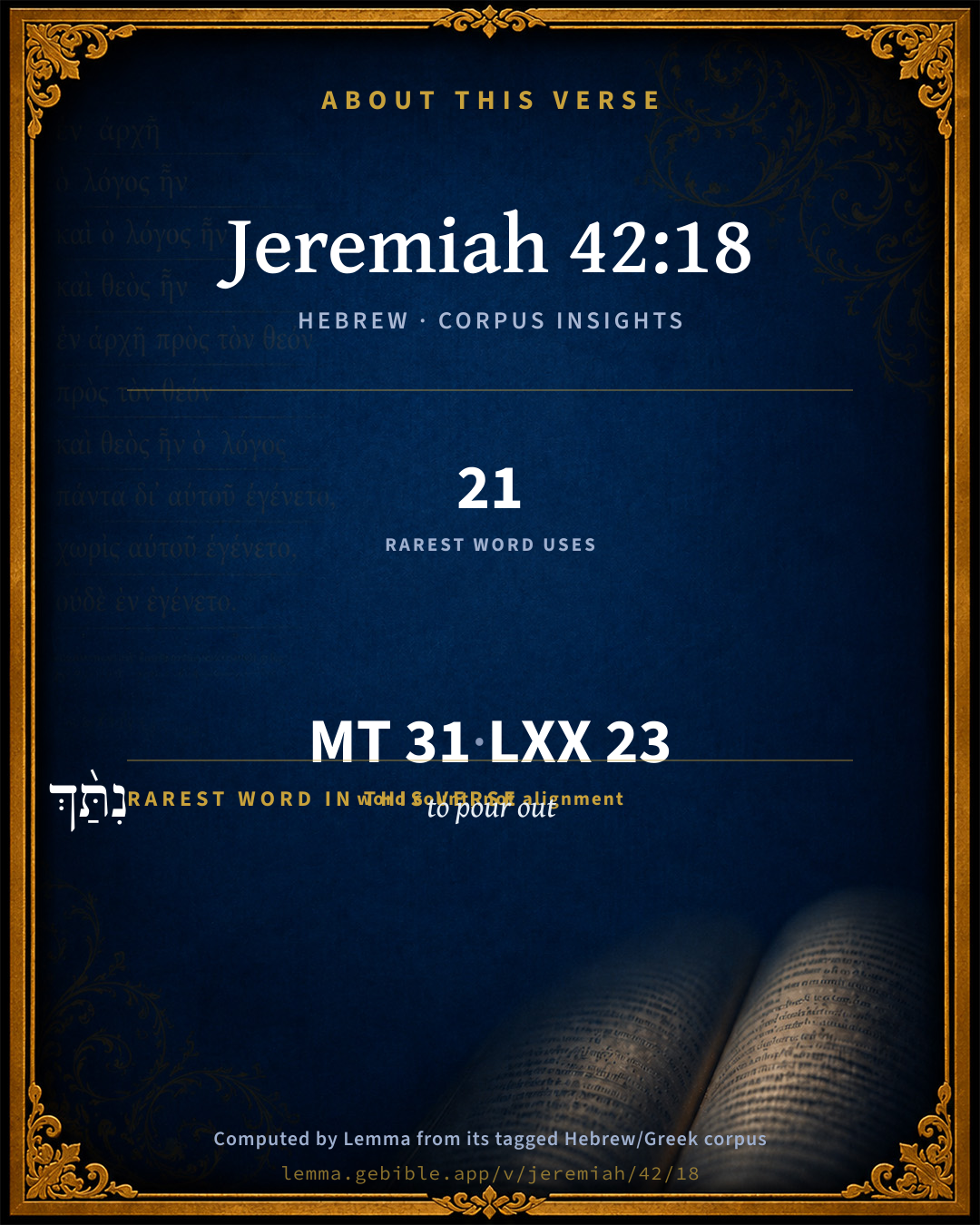
31
words
28
distinct lemmas
Prophets
section

Notable vocabulary

The rarest word here is נִתַּ֨ךְ to pour out H5413 — appearing just 21 times in the whole Hebrew Bible.

Shared distinctive vocabulary

נִתַּ֨ךְ to pour out H5413 occurs in 19 verses of the Hebrew Bible. Also found in:

Grammatical profile

  • 7 verbs
  • 14 nouns
  • 1 pronoun
  • 2 prepositions
  • 1 conjunction
  • 2 adverbs
  • 4 particles

Verb forms

  • אָמַ֜ר Qal · Perfect
  • נִתַּ֨ךְ Niphal · Perfect
  • יֹֽשְׁבֵי֙ Qal · Participle Active
  • תִּתַּ֤ךְ Qal · Imperfect
  • בְּבֹאֲכֶ֖ם Qal · Infinitive Construct
  • וִהְיִיתֶ֞ם Qal · Sequential Perfect
  • תִרְא֣וּ Qal · Imperfect

Repetition

Words recur within this verse — often emphatic in Hebrew:

  • נִתַּ֨ךְ to pour out H5413 ×2
  • וַחֲמָתִ֗י wrath H2534 ×2
  • עַל upon H5921 ×2

Hebrew & Septuagint length

In the original languages it is 31 Hebrew tokens and 23 Greek tokens — but the two are counted differently (Hebrew bundles its prefixes and suffixes into one token; the Greek is in lemma form), so that isn’t a like-for-like length.

Cross-references

28

Topical passages linked to Jeremiah 42:18 in the Treasury of Scripture Knowledge — connected by theme and wording, ordered by reader-vote popularity; previews shown in the World English Bible.

  • Jeremiah 7:20 Therefore thus says the Lord Yahweh: Behold, my anger and my wrath shall be poured out on this place, on man, and on animal, and on the trees of the field, and on the fruit of the ground; and it shall burn, and shall not be quenched.
  • Jeremiah 18:16 to make their land an astonishment, and a perpetual hissing; everyone who passes thereby shall be astonished, and shake his head.
  • Jeremiah 29:18 I will pursue after them with the sword, with the famine, and with the pestilence, and will deliver them to be tossed back and forth among all the kingdoms of the earth, to be an object of horror, and an astonishment, and a hissing, and a reproach, among all the nations where I have driven them;
  • Jeremiah 39:1–9 It happened when Jerusalem was taken, (in the ninth year of Zedekiah king of Judah, in the tenth month, came Nebuchadrezzar king of Babylon and all his army against Jerusalem, and besieged it;
  • Deuteronomy 29:21–22 Yahweh will set him apart to evil out of all the tribes of Israel, according to all the curses of the covenant that is written in this book of the law.
  • 2 Chronicles 36:16–19 but they mocked the messengers of God, and despised his words, and scoffed at his prophets, until the wrath of Yahweh arose against his people, until there was no remedy.
  • Isaiah 65:15 You shall leave your name for a curse to my chosen; and the Lord Yahweh will kill you; and he will call his servants by another name:
  • Jeremiah 22:27 But to the land whereunto their soul longs to return, there shall they not return.
  • Jeremiah 24:9 I will even give them up to be tossed back and forth among all the kingdoms of the earth for evil; to be a reproach and a proverb, a taunt and a curse, in all places where I shall drive them.
  • Jeremiah 44:12 I will take the remnant of Judah, that have set their faces to go into the land of Egypt to sojourn there, and they shall all be consumed; in the land of Egypt shall they fall; they shall be consumed by the sword and by the famine; they shall die, from the least even to the greatest, by the sword and by the famine; and they shall be an object of horror, [and] an astonishment, and a curse, and a reproach.
  • 1 Kings 9:7–9 then will I cut off Israel out of the land which I have given them; and this house, which I have made holy for my name, will I cast out of my sight; and Israel shall be a proverb and a byword among all peoples.
  • 2 Kings 25:4–7 Then a breach was made in the city, and all the men of war [fled] by night by the way of the gate between the two walls, which was by the king's garden (now the Chaldeans were against the city round about); and [the king] went by the way of the Arabah.
  • 2 Chronicles 34:25 Because they have forsaken me, and have burned incense to other gods, that they might provoke me to anger with all the works of their hands; therefore is my wrath poured out on this place, and it shall not be quenched.
  • Jeremiah 6:11 Therefore I am full of the wrath of Yahweh; I am weary with holding in: pour it out on the children in the street, and on the assembly of young men together; for even the husband with the wife shall be taken, the aged with him who is full of days.
  • Jeremiah 22:10–12 Don't you weep for the dead, neither bemoan him; but weep sore for him who goes away; for he shall return no more, nor see his native country.
  • Jeremiah 25:9 behold, I will send and take all the families of the north, says Yahweh, and [I will send] to Nebuchadrezzar the king of Babylon, my servant, and will bring them against this land, and against the inhabitants of it, and against all these nations round about; and I will utterly destroy them, and make them an astonishment, and a hissing, and perpetual desolations.
  • Jeremiah 26:6 then will I make this house like Shiloh, and will make this city a curse to all the nations of the earth.
  • Jeremiah 29:22 and of them shall be taken up a curse by all the captives of Judah who are in Babylon, saying, Yahweh make you like Zedekiah and like Ahab, whom the king of Babylon roasted in the fire;
  • Jeremiah 52:4–11 It happened in the ninth year of his reign, in the tenth month, in the tenth day of the month, that Nebuchadrezzar king of Babylon came, he and all his army, against Jerusalem, and encamped against it; and they built forts against it round about.
  • Lamentations 2:4 He has bent his bow like an enemy, he has stood with his right hand as an adversary, Has killed all that were pleasant to the eye: In the tent of the daughter of Zion he has poured out his wrath like fire.
  • Lamentations 4:11 Yahweh has accomplished his wrath, he has poured out his fierce anger; He has kindled a fire in Zion, which has devoured the foundations of it.
  • Ezekiel 22:22 As silver is melted in the midst of the furnace, so shall you be melted in the midst of it; and you shall know that I, Yahweh, have poured out my wrath on you.
  • Daniel 9:11 Yes, all Israel have transgressed your law, even turning aside, that they should not obey your voice: therefore has the curse been poured out on us, and the oath that is written in the law of Moses the servant of God; for we have sinned against him.
  • Daniel 9:27 He shall make a firm covenant with many for one week: and in the midst of the week he shall cause the sacrifice and the offering to cease; and on the wing of abominations [shall come] one who makes desolate; and even to the full end, and that determined, shall [wrath] be poured out on the desolate.
  • Nahum 1:6 Who can stand before his indignation? Who can endure the fierceness of his anger? His wrath is poured out like fire, and the rocks are broken apart by him.
  • Zechariah 8:13 It shall come to pass that, as you were a curse among the nations, house of Judah and house of Israel, so will I save you, and you shall be a blessing. Don't be afraid. Let your hands be strong."
  • Revelation 14:10 he also will drink of the wine of the wrath of God, which is prepared unmixed in the cup of his anger. He will be tormented with fire and sulfur in the presence of the holy angels, and in the presence of the Lamb.
  • Revelation 16:2–21 The first went, and poured out his bowl into the earth, and it became a harmful and evil sore on the people who had the mark of the beast, and who worshiped his image.

Cross-references courtesy of OpenBible.info (CC BY 4.0).

Hebrew and Greek witnesses Masoretic Hebrew ↔ Greek Septuagint

The same verse in the two great witnesses to the Old Testament, shown verse-for-verse.

These are two independent witnesses, not word-aligned to each other, and the Septuagint is shown in lemma (dictionary) form.

Hebrew Jeremiah 42:18 Masoretic · Westminster Leningrad Codex

כִּי֩ כֹ֨ה אָמַ֜ר יְהוָ֣ה צְבָאוֹת֮ אֱלֹהֵ֣י יִשְׂרָאֵל֒ כַּאֲשֶׁר֩ נִתַּ֨ךְ אַפִּ֜י וַחֲמָתִ֗י עַל יֹֽשְׁבֵי֙ יְר֣וּשָׁלִַ֔ם כֵּ֣ן תִּתַּ֤ךְ חֲמָתִי֙ עֲלֵיכֶ֔ם בְּבֹאֲכֶ֖ם מִצְרָ֑יִם וִהְיִיתֶ֞ם לְאָלָ֤ה וּלְשַׁמָּה֙ וְלִקְלָלָ֣ה וּלְחֶרְפָּ֔ה וְלֹֽא תִרְא֣וּ ע֔וֹד אֶת הַמָּק֖וֹם הַזֶּֽה

For thus says Yahweh of Hosts, the God of Israel: As my anger and my wrath has been poured forth on the inhabitants of Jerusalem, so shall my wrath be poured forth on you, when you shall enter into Egypt; and you shall be an object of horror, and an astonishment, and a curse, and a reproach; and you shall see this place no more.

World English Bible · Public Domain

Greek LXX Structure differs

In the Septuagint, Jeremiah is about an eighth shorter than the Hebrew and arranges its material differently — the Oracles Against the Nations (Hebrew chapters 46–51) appear in the middle of the Greek book, after 25:13. Because the chapter and verse boundaries do not line up, a verse-for-verse comparison with the Hebrew is not shown.

A verse-for-verse comparison isn’t shown here because the chapters and verses don’t line up. Switch to the LXX edition with the MT / LXX toggle above to read the Greek directly.

Hebrew: Westminster Leningrad Codex (CC BY 4.0). Greek: Septuagint (public domain); English from a public-domain English Septuagint. How the Septuagint differs from the Hebrew →

Targum (Aramaic paraphrase)

1

The Targum is the ancient Jewish Aramaic paraphrase of the Hebrew Scriptures — an interpretive translation, not the Hebrew text itself. Onkelos (literal) and Pseudo-Jonathan (expansive) render the Torah, and Jonathan the Prophets. Coverage is partial: where no permissively-licensed English translation exists for a verse, only the Aramaic is shown. This is verse-level text, not a word-by-word alignment to the Hebrew.

  1. Targum Jonathan Prophets (Joshua–Malachi)
    אֲרֵי כִדְנַן אֲמַר יְיָ צְבָאוֹת אֱלָהָא דְיִשְׂרָאֵל כְּמָא דְחַל רוּגְזִי וְחֵימְתִי עַל יַתְבֵי יְרוּשָׁלַםִ כֵּן יֵחוֹל רוּגְזִי עֲלֵיכוֹן בְמֵיעַלְכוֹן לְמִצְרָיִם וּתְהוֹן לְמוֹמֵי וּלְצָדוּ וּלְלוֹטָא וּלְחִסוּדִין וְלָא תֶחֱזוּן עוֹד יַת אַתְרָא הָדֵין:

    (no public-domain English translation for this verse)

    Targum Jonathan — Aramaic: “Mikraot Gedolot” (public domain). English: “Sefaria Community Translation” (CC0 1.0 (public-domain dedication)); “London "Chaldee Paraphrase," 1871” (public domain). Text via Sefaria.

Commentary

Notes on Jeremiah 42:18 from classic Christian and Jewish commentators (each source and its license shown beneath its notes). The classic Christian expositions comment on the surrounding passage and are grouped to its opening verse, so a note may address several verses; the Jewish commentaries on the Tanakh (Rashi and others) are per-verse, so they appear only where the commentator wrote on this verse.

Lemma curates 59 commentaries, every one of them public domain or Creative Commons licensed, each selected and text-cleaned for this edition rather than reprinted as found. About our sources →

Trapp's Complete Commentary

John Trapp

Jer 42:18 For thus saith the LORD of hosts, the God of Israel; As mine anger and my fury hath been poured forth upon the inhabitants of Jerusalem; so shall my fury be poured forth upon you, when ye shall enter into Egypt: and ye shall be an execration, and an astonishment, and a curse, and a reproach; and ye shall see this place no more.

Ver. 18. As mine anger and my fury hath been poured forth,] {a} scil., Like scalding lead or burning bell-metal, {b} which runneth fiercely, spreadeth far, and burneth extremely.

Upon the inhabitants of Jerusalem.] Out of which fire I have late pulled you as a brand; the smell thereof is yet upon your clothes, as it were: Cavete. Beware.

{a} Metaph. a metallis.

{b} The substance of which bells are made; an alloy of copper and tin, the tin being in larger proportion than in ordinary bronze.

John Trapp, A Commentary or Exposition upon All the Books of the Old and New Testament (1647–1656) — public domain. Text from a community e-Sword module.

Geneva Bible (1599)

Geneva Bible translators

Read Jer. 26:6 and 24:12, showing that this should come upon them for their infidelity and stubbornness.

Geneva Bible (1599) marginal notes — public domain. Text via Bolls.life.

Jamieson, Fausset & Brown

Robert Jamieson, A. R. Fausset & David Brown

As mine anger, &c.--As ye have already, to your sorrow, found Me true to My word, so shall ye again (Jer 7:20; Jer 18:16).

shall see this place no more--Ye shall not return to Judea, as those shall who have been removed to Babylon.

Jamieson, Fausset & Brown — Commentary Critical and Explanatory on the Whole Bible (1871) — public domain (CC PDM 1.0). Text via the HelloAO Bible API.

John Calvin's Commentaries

The Prophet confirms what he had already said, by an example of God’s vengeance, which had lately been shewn as to the Jews; for though the destruction of the city and the Temple had been often predicted to them, they yet had become torpid as to God’s threatenings. God, however, after having delayed for a long time, at length executed what he had threatened. They had titan seen that dreadful example, which ought to have filled them, and also their posterity, with fear. Then the Prophet, as he saw that they were so tardy and stupid that they thoughtlessly derided God’s threat-enings, reminded them of what they had lately seen. “Ye know,” he says, “how God’s fury had been poured forth on the inhabitants of Jerusalem, such also will be poured forth on those who will flee into Egypt.”

Now Jeremiah was able to speak with authority, as he had been the herald of that vengeance now mentioned. If any other had declared in God’s name what had happened, they might have objected and said, that they had indeed been justly punished by God, but that it did not hence follow flint what he said was true; but as the Prophet had for forty years often and constantly denounced on them what at length they had really and by experience found to have been predicted to them from above, he was able to repeat a similar judgment of God with the highest authority, as he now does.

Thus saith Jehovah, he says, as my fury was poured forth, etc. The similitude is taken either from water or from metals: hence some give this rendering, “As my fury flowed down;” but the verb used by Jeremiah means properly to pour forth. It may, however, as I have said, be applied to water, which spreads when poured out, or to metals, which being liquid spread here and there. He then means, that all who should go to Egypt would be wretched and miserable; for wheresoever they might try to withdraw themselves, the vengeance of God would yet find them though exiles, for it would spread like a deluge over all the inhabitants, so that they would in vain seek hiding-places. We now see the design of the Prophet. The meaning is, that as the Jews had by their calamity known him to have been a true and faithful servant of God in foretelling the destruction of the city and Temple, so would they find now, except they repented, that the message by which he threatened a second destruction, had come also from God. Poured forth, he says, shall be mine indignation on you when ye come into Egypt

He afterwards adds a passage from the Law, which often occurs in the Prophets, that they would be an execration, an astonishment, a curse, and a reproach The word אלה, ale, which we have rendered “execration,” means properly an oath; but as imprecation is often added, when we wish to be believed, it is also understood as an execration. He then says that they would be an execration, that is, a formula of execration, as we have elsewhere explained. Whosoever then had a wish to express a curse, they would, as the Prophet says, use this form as a common proverb, “May God curse thee as he did the Jews,” — “May I perish as the Jews perished.” In short, he intimates that the punishment would be so horrible that men would turn it to a common proverb, he adds, And an astonishment, that is, that God’s vengeance would be so dreadful, that all would be filled with amazement. He further adds, And a curse and a reproach The sum of what is said is, that God would inflict on the Jews not a common punishment, but such as would be remembered among all the heathens, in order that it might appear that their wickedness in obstinately rejecting the prophetic word was not light.

He lastly adds that they should never see their own land; for it was not the design of the Jews to dwell perpetually in Egypt; for they pretended that they remained firm and constant in their dependence on God’s promise, and boasted that they had a hope of a return, because God had fixed seventy years for their exile. As they then thus foolishly gloried, that they hoped in God for the promised favor, he says that they were shut out as to any hope of a return; for though God would restore the other captives dispersed throughout the East, yet the Egyptian guests were doomed to die in their exile. This then was to cut off from them every hope, in order that they might know that they were wholly rejected, and would have a place no more among- God’s people, however they might wish to be deemed the first. It follows, —

John Calvin's Commentaries (1540-1563) — public domain. Text from the Calvin Translation Society English edition (1840s-50s) via the Christian Classics Ethereal Library (ccel.org). Calvin's coverage is partial (roughly two-thirds of the Bible); uncommented books and verses are honest gaps, never fabricated. The 19th-century editor's footnotes and remarks are omitted so the notes are faithfully Calvin's own voice.

John Gill's Exposition

The Lord hath said concerning you, O ye remnant of Judah,.... Or, "unto you" (w); by the mouth of the prophet; or, "against you" (x); that which was contrary to their inclination and will, as follows:

go ye not into Egypt: this was the express command of God:

know certainly that I have admonished you this day; not to go into Egypt: or, "have testified unto you" (y); the will of God concerning this matter; and therefore they could not plead ignorance.

(w) "alloquitur vos", Junius & Tremellius; "ad vos", so some in Vatablus. (x) "Contra vos", Calvin. (y) "contestatus sum vos", Montanus, Piscator, Cocceius.

John Gill's Exposition of the Whole Bible (1746–1763) — public domain (CC PDM 1.0). Text via the HelloAO Bible API.

Albert Barnes' Notes on the Bible

A curse - contempt, or ignominy.

Albert Barnes' Notes on the Bible (1834–1885) — public domain. Text from a community e-Sword/MySword module.

Haydock's Catholic Bible Commentary

Kindled. Hebrew, "hath dropped," 2 Paralipomenon xii. 7. --- Curse. People can wish no greater misery to their enemies. (Calmet) --- They shall be execrated, Isaias lxv. 15. (Worthington)

George Leo Haydock (1774–1849), Haydock's Catholic Family Bible and Commentary, 1859 edition — public domain. Excludes Psalms (Douay-Rheims chapter numbering differs from Protestant) and Deuterocanonical books (Catholic canon only).

Matthew Poole's English Annotations

If you would see your doom in a glass, look upon Jerusalem, which according to my word I have dealt so severely with, that amongst men it would be called fury, though in me it was but deliberate justice, that my wrath declared against it (like liquid things melted) diffused itself into all the parts of it: I will deal so with you soon after you shall have entered into that land, where you promise yourselves so much ease, rest, and prosperity; and as I threatened to make Jerusalem a curse, an astonishment, and a reproach, Jer 24:9; 29:18, so I will deal with you; and in this I will (saith God) deal worse with you, that whereas those of your brethren that were carried from Jerusalem to Babylon shall some of them come back again after sixty years, you shall see this place no more. There was this aggravation of the Jews’ sin, to whom God was now by his prophet speaking, they had lately seen the words of the Lord spoken by the same prophet verified, and yet would take no warning, but ran into the same sin of unbelief.

Matthew Poole's English Annotations on the Holy Bible (1683–1685) — public domain. Text from a community e-Sword/MySword module.

unfoldingWord translationNotes

Door43 World Missions Community

Yahweh of hosts ... says this

Jeremiah often uses these words to introduce an important message from Yahweh. See how you translated this in Jeremiah 6:6.

my wrath and my fury were poured out on the inhabitants of Jerusalem

Yahweh punishing people because he is very angry is spoken of as if wrath and fury were liquids that he poured out on the people. This can be stated in active form. AT: "I became very angry and punished the people of Jerusalem" (See: Metaphor and Active or Passive)

my wrath and my fury

The words "wrath" and "fury" mean basically the same thing. Together they emphasize the intensity of his wrath. AT: "my terrible wrath" (See: Doublet)

in the same way my fury will be poured out on you

Yahweh punishing people because he is very angry is spoken of as if fury were a liquid that he pours out on the people. This can be stated in active form. AT: "I will became very angry and punish you" (See: Metaphor and Active or Passive)

You will become an object of cursing and a horror, an object for speaking curses, and something dishonorable

All of these statements mean basically the same thing and emphasize how badly the nations will treat the people of Judah after Yahweh punishes them. AT: "People will be terrified when they see what has happened to you. They will curse and mock you" (See: Parallelism)

I have been a witness against you

The phrase "been a witness against" is an idiom that means to give a warning. AT: "I have warned you" (See: Idiom)

translationWords

wrath

Jerusalem

curse

dishonor

testimony

unfoldingWord translationNotes — © Distant Shores Media and the Door43 World Missions Community, licensed CC BY-SA 4.0. Source: git.door43.org/Door43/en_tn.

Lesson kit

Teaching starters — assembled from the data on this page, not authored interpretation. Every prompt links to the verse data it draws on. Edit before teaching.

Jeremiah, in the Prophets, opens this verse with 31 words (28 distinct Hebrew lemmas). Its most distinctive word is nâthak (“to pour out”). A historical commentator’s framing appears above. Read the whole chapter for the surrounding context.

Discussion questions

  1. How does “to pour out” (nâthak) shape what this verse is saying?
  2. Exodus 9:33 shares the word «to pour out» with this verse. How do the two illuminate each other?
  3. “to pour out” occurs 2× in this one verse. What is the effect of the repetition?
  4. These translations render this verse differently; the difference is in the English rendering, not the original. What questions does that raise?
  5. The verb «אָמַ֜ר» is Qal Perfect. How does its form color the action?
  6. Reading how Trapp's Complete Commentary and Geneva Bible (1599) read this verse, where do the two commentators agree and where do they part?

Things to notice

Reading settings

Reading text

Shown beneath each verse's original-language words.

Old Testament
Old Testament edition

Read the OT as the Masoretic Hebrew (MT) or the Greek Septuagint (LXX).

English shown for the Greek Septuagint (in the Hebrew ↔ Greek comparison).

Comparing translations? Open the Compare panel on any verse page to stack up to four side by side.