
Ezekiel 29:3

Hebrew (Westminster Leningrad Codex) Ezekiel 29:3 appears in the Hebrew Old Testament. The text above is from the Westminster Leningrad Codex. Each word links to its Strong’s number, a concise gloss, and parsing drawn from the Open Scriptures Hebrew Bible morphology. Click any word for its full Brown-Driver-Briggs (BDB) entry.
Download image
Cite this verse

Ezekiel 29:3 (World English Bible). Public Domain. Lemma interlinear Bible study tool, https://lemma.gebible.app/v/ezekiel/29/3.

Show BibTeX & RIS
BibTeX
RIS
English Translation
speak, and say, Thus says the Lord Yahweh: Behold, I am against you, Pharaoh king of Egypt, the great monster that lies in the midst of his rivers, that has said, My river is my own, and I have made it for myself.
World English Bible · Public Domain
Download a study sheet

One document with this verse’s original text, its word-by-word gloss line, the meaning frame, cross-references with their text, attributed commentary, and full source and license credits — printable, and it pastes into notes with its structure intact.

This verse Autodidact and up

Study sheet (.html) Plain text (.txt)

A passage Seminary Student

Up to 50 verses in one chapter. A passage sheet keeps up to 6 commentary sources and 12 cross-references per verse, in the order this page ranks them, and says so on the sheet whenever that leaves anything out. Ask for a single verse and you get the Autodidact verse sheet above.

Everything on this page stays free to read, with no account — the sheet is a download of what is already on screen, not access to it.

Want to remove ads? Support Godless Engineer
Compare translations 3

The same verse in 3 English versions, stacked beneath the original-language interlinear above. Click any original word for its lexicon entry.

Each is an independent rendering of the whole verse — the interlinear is not word-aligned to these translations.

Highlighted words mark where these versions differ — a whole-verse word diff, not a word-by-word alignment.

  • World English Bible Public Domain
    speak, and say, Thus says the Lord Yahweh: Behold, I am against you, Pharaoh king of Egypt, the great monster that lies in the midst of his rivers, that has said, My river is my own, and I have made it for myself.
  • King James Version Public Domain
    Speak, and say, Thus saith the Lord GOD; Behold, I am against thee, Pharaoh king of Egypt, the great dragon that lieth in the midst of his rivers, which hath said, My river is mine own, and I have made it for myself.
  • unfoldingWord Literal Text CC BY-SA 4.0
    Declare and say, ‘The Lord Yahweh says this: Behold! I am against you, Pharaoh, king of Egypt. You, the great sea monster that lurks in the midst of the river, that says, “My river is my own. I have made it for myself.”

unfoldingWord Literal Text — © unfoldingWord, licensed CC BY-SA 4.0. Word-aligned USFM3 via Door43 (git.door43.org/unfoldingWord/en_ult).

Versions to compare (up to 4)

3 of 4 selected

Show all 18 translations

Every available English version of this verse, each an independent rendering of the whole verse.

  • World English Bible Public Domain
    speak, and say, Thus says the Lord Yahweh: Behold, I am against you, Pharaoh king of Egypt, the great monster that lies in the midst of his rivers, that has said, My river is my own, and I have made it for myself.
  • Berean Standard Bible Public Domain
    Speak to him and tell him that this is what the Lord GOD says: Behold, I am against you, O Pharaoh king of Egypt, O great monster who lies among his rivers, who says, ‘The Nile is mine; I made it myself.’
  • Majority Standard Bible Public Domain
    Speak to him and tell him that this is what the Lord GOD says: Behold, I am against you, O Pharaoh king of Egypt, O great monster who lies among his rivers, who says, ‘The Nile is mine; I made it myself.’
  • King James Version Public Domain
    Speak, and say, Thus saith the Lord GOD; Behold, I am against thee, Pharaoh king of Egypt, the great dragon that lieth in the midst of his rivers, which hath said, My river is mine own, and I have made it for myself.
  • American Standard Version (1901) Public Domain
    speak, and say, Thus saith the Lord Jehovah: Behold, I am against thee, Pharaoh king of Egypt, the great monster that lieth in the midst of his rivers, that hath said, My river is mine own, and I have made it for myself.
  • Revised Version (1885) Public Domain
    speak, and say, Thus saith the Lord GOD: Behold, I am against thee, Pharaoh king of Egypt, the great dragon that lieth in the midst of his rivers, which hath said, My river is mine own, and I have made it for myself.
  • Geneva Bible (1599) Public Domain
    Speake, and say, Thus sayth the Lord God, Beholde, I come against thee, Pharaoh King of Egypt, the great dragon, that lieth in the middes of his riuers, which hath saide, The riuer is mine, and I haue made it for my selfe.
  • Douay-Rheims (1899) Public Domain
    Speak, and say: Thus saith the Lord God: Behold, I come against thee, Pharao king of Egypt, thou great dragon that liest in the midst of thy rivers, and sayest: The river is mine, and I made myself.
  • Young's Literal Translation Public Domain
    Speak, and thou hast said: Thus said the Lord Jehovah: Lo, I `am' against thee, Pharaoh king of Egypt! The great dragon that is crouching in the midst of his floods, Who hath said, My flood `is' my own, And I -- I have made it `for' myself.
  • Literal Standard Version CC BY-SA 4.0
    Speak, and you have said, Thus said Lord YHWH: Behold, I [am] against you, || Pharaoh king of Egypt! The great dragon that is crouching in the midst of his floods, || Who has said, My flood [is] my own, || And I have made it [for] myself.
  • Unlocked Literal Bible CC BY-SA 4.0
    Declare and say, 'The Lord Yahweh says this: Behold! I am against you, Pharaoh, king of Egypt. You, the great sea monster that lurks in the midst of the river, that says, “My river is my own. I have made it for myself.”
  • unfoldingWord Literal Text CC BY-SA 4.0
    Declare and say, ‘The Lord Yahweh says this: Behold! I am against you, Pharaoh, king of Egypt. You, the great sea monster that lurks in the midst of the river, that says, “My river is my own. I have made it for myself.”
  • Darby Bible Public Domain
    speak, and say, Thus saith the Lord Jehovah: Behold, I am against thee, Pharaoh king of Egypt, the great monster that lieth in the midst of his rivers, which saith, My river is mine own, and I made it for myself.
  • World Messianic Bible Public Domain
    Speak and say, ‘The Lord GOD says: “Behold, I am against you, Pharaoh king of Egypt, the great monster that lies in the middle of his rivers, that has said, ‘My river is my own, and I have made it for myself.’
  • Webster's Bible Public Domain
    Speak, and say, Thus saith the Lord GOD; Behold, I am against thee, Pharaoh king of Egypt, the great dragon that lieth in the midst of his rivers, which hath said, My river is my own, and I have made it for myself.
  • Free Bible Version CC BY-SA 4.0
    Tell him that this is what the Lord God says: Watch out, because I'm condemning you, Pharaoh king of Egypt, you great monster lying in your rivers, who says, ‘The Nile belongs to me; I made it myself.’
  • Bible in Basic English Public Domain
    Say to them, These are the words of the Lord: See, I am against you, Pharaoh, king of Egypt, the great river-beast stretched out among his Nile streams, who has said, The Nile is mine, and I have made it for myself.
  • JPS Tanakh (1917) Public Domain
    speak, and say: Thus saith the Lord GOD: Behold, I am against thee, Pharaoh King of Egypt, the great dragon that lieth in the midst of his rivers, that hath said: My river is mine own, and I have made it for myself.

Literal Standard Version (2020), Covenant Press — licensed CC BY-SA 4.0. Text via the HelloAO Bible API (eBible.org). Unlocked Literal Bible (unfoldingWord) — licensed CC BY-SA 4.0. Text via the HelloAO Bible API (eBible.org). unfoldingWord Literal Text — © unfoldingWord, licensed CC BY-SA 4.0. Word-aligned USFM3 via Door43 (git.door43.org/unfoldingWord/en_ult). Free Bible Version, Dr. Jonathan Gallagher — licensed CC BY-SA 4.0. Text via the HelloAO Bible API (eBible.org).

Word by word

More ways to search: Search by grammar → Find every occurrence → Compare this word →

Practice this passage: Drill this verse → Learn its vocabulary →

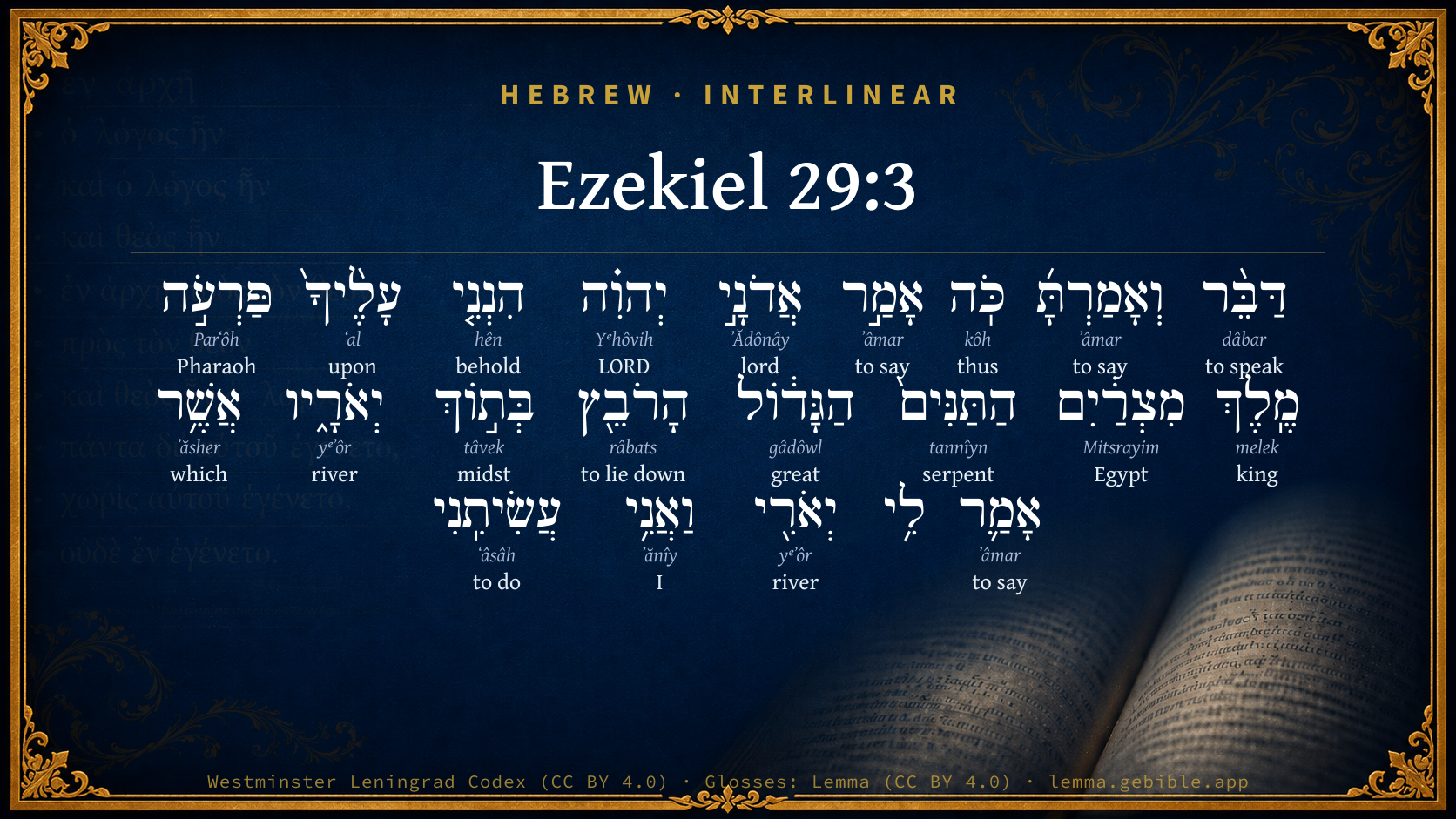
הַתַּנִּים֙
tannîyn
H8577
“the · serpent”
Particle, Definite Article + Noun, Common, Masculine, Singular, Absolute
Part of Speech
Particle + Noun
Type
Common
Gender
Masculine
Number
Singular
State
Absolute
Full BDB Definition

Origin: intensive from the same as H8565

TWOT: 2528b

dragon, serpent, sea monster - dragon or dinosaur - sea or river monster - serpent, venomous snake
  1. דַּבֵּ֨ר dâbar H1696 “speak” Verb, Piel, Imperative, 2nd Person, Masculine, Singular
  2. וְאָמַרְתָּ֜ ʼâmar H559 “and · to say” Conjunction + Verb, Qal, Sequential Perfect, 2nd Person, Masculine, Singular
  3. כֹּֽה kôh H3541 “thus” Adverb
  4. אָמַ֣ר ʼâmar H559 “to say” Verb, Qal, Perfect, 3rd Person, Masculine, Singular
  5. אֲדֹנָ֣י ʼĂdônây H136 “Lord · my” Noun, Common, Masculine, Plural, Construct + Suffix, Personal, 1st Person, Common, Singular
  6. יְהוִ֗ה Yᵉhôvih H3069 “LORD” Noun, Proper
  7. הִנְנִ֤י hên H2005 “behold · me” Particle, Demonstrative + Suffix, Personal, 1st Person, Common, Singular
  8. עָלֶ֨יךָ֙ ʻal H5921 “upon · you” Preposition + Suffix, Personal, 2nd Person, Masculine, Singular
  9. פַּרְעֹ֣ה Parʻôh H6547 “Pharaoh” Noun, Proper
  10. מֶֽלֶךְ melek H4428 “king of” Noun, Common, Masculine, Singular, Construct
  11. מִצְרַ֔יִם Mitsrayim H4714 “Egypt” Noun, Proper
  12. הַגָּד֔וֹל gâdôwl H1419 “the · great” Particle, Definite Article + Adjective, Adjective, Masculine, Singular, Absolute
  13. הָרֹבֵ֖ץ râbats H7257 “the · lying down” Particle, Definite Article + Verb, Qal, Participle Active, Masculine, Singular, Absolute
  14. בְּת֣וֹךְ tâvek H8432 “in/at · midst of” Preposition + Noun, Common, Masculine, Singular, Construct
  15. יְאֹרָ֑יו yᵉʼôr H2975 “rivers · his” Noun, Common, Masculine, Plural, Construct + Suffix, Personal, 3rd Person, Masculine, Singular
  16. אֲשֶׁ֥ר ʼăsher H834 “which” Particle, Relative
  17. אָמַ֛ר ʼâmar H559 “to say” Verb, Qal, Perfect, 3rd Person, Masculine, Singular
  18. יְאֹרִ֖י yᵉʼôr H2975 “river · my” Noun, Proper + Suffix, Personal, 1st Person, Common, Singular
  19. וַאֲנִ֥י ʼănîy H589 “and · I” Conjunction + Pronoun, Personal, 1st Person, Common, Singular
  20. עֲשִׂיתִֽנִי ʻâsâh H6213 “to do · me” Verb, Qal, Perfect, 1st Person, Common, Singular + Suffix, Personal, 1st Person, Common, Singular

About this verse

These counts appear in no published source. They are computed here, from the morphology-tagged text and Lemma’s own curated glosses. What Lemma adds →

22
words
18
distinct lemmas
Prophets
section

Shared distinctive vocabulary

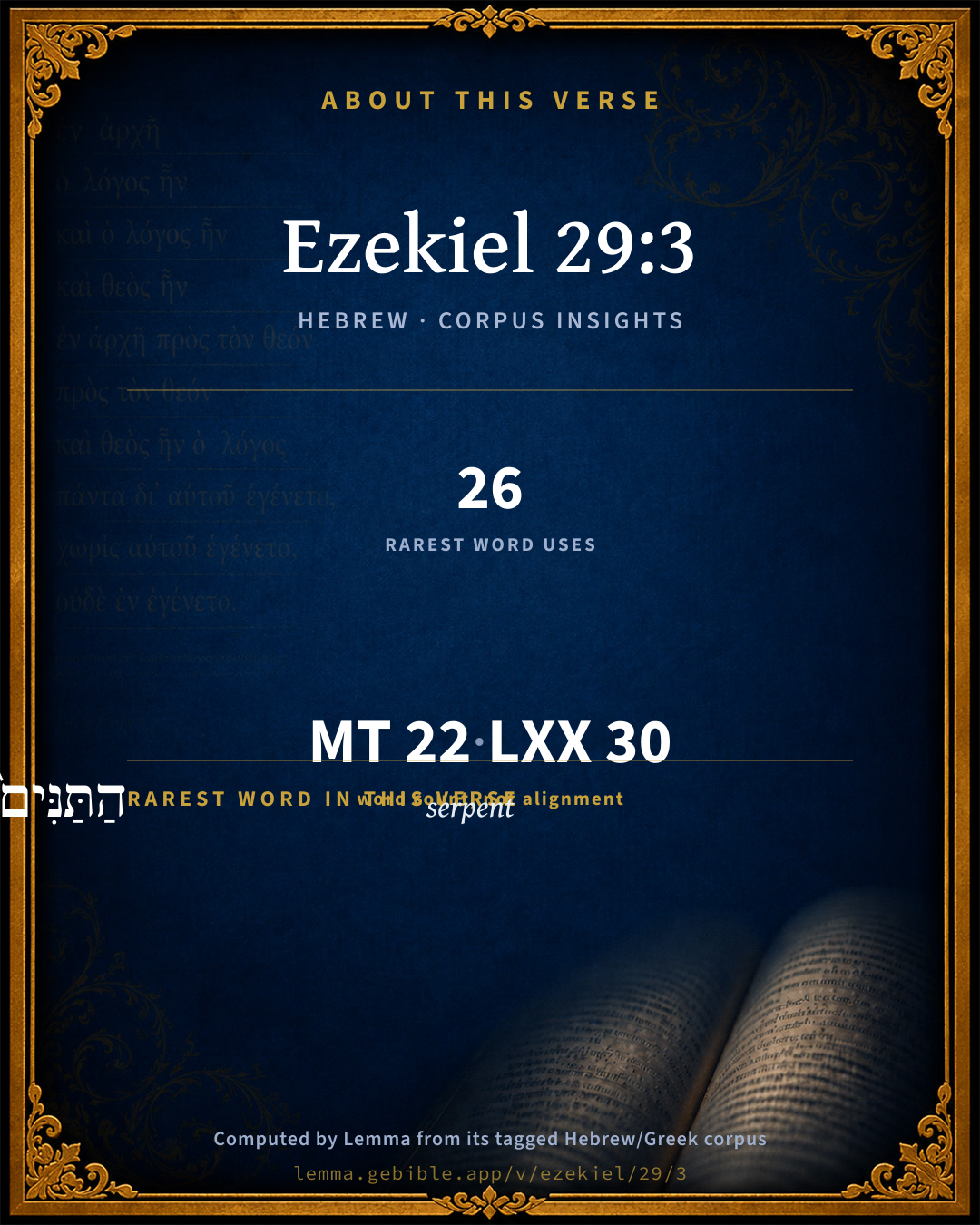
הַתַּנִּים֙ serpent H8577 occurs in 26 verses of the Hebrew Bible. Also found in:

Grammatical profile

  • 6 verbs
  • 9 nouns
  • 1 adjective
  • 1 pronoun
  • 2 prepositions
  • 1 adverb
  • 2 particles

Verb forms

  • דַּבֵּ֨ר Piel · Imperative
  • וְאָמַרְתָּ֜ Qal · Sequential Perfect
  • אָמַ֣ר Qal · Perfect
  • הָרֹבֵ֖ץ Qal · Participle Active
  • אָמַ֛ר Qal · Perfect
  • עֲשִׂיתִֽנִי Qal · Perfect

Repetition

Words recur within this verse — often emphatic in Hebrew:

  • וְאָמַרְתָּ֜ to say H559 ×3
  • יְאֹרָ֑יו river H2975 ×2

Hebrew & Septuagint length

In English translation the verse runs 43 words from the Hebrew and 32 from the Septuagint (LXX English) — closely comparable.

A rough comparison of the two English renderings, which tokenize alike — not a word-level alignment.

Word counts can differ between the Hebrew and the Greek without any difference in meaning — e.g. the Hebrew direct-object marker אֵת has no separate Greek word, and Greek often adds the article ὁ.

In the original languages it is 22 Hebrew tokens and 30 Greek tokens — but the two are counted differently (Hebrew bundles its prefixes and suffixes into one token; the Greek is in lemma form), so that isn’t a like-for-like length.

Cross-references

20

Topical passages linked to Ezekiel 29:3 in the Treasury of Scripture Knowledge — connected by theme and wording, ordered by reader-vote popularity; previews shown in the World English Bible.

  • Isaiah 27:1 In that day Yahweh with his hard and great and strong sword will punish leviathan the swift serpent, and leviathan the crooked serpent; and he will kill the monster that is in the sea.
  • Ezekiel 32:2 Son of man, take up a lamentation over Pharaoh king of Egypt, and tell him, You were likened to a young lion of the nations: yet are you as a monster in the seas; and you did break forth with your rivers, and troubled the waters with your feet, and fouled their rivers.
  • Jeremiah 44:30 Thus says Yahweh, Behold, I will give Pharaoh Hophra king of Egypt into the hand of his enemies, and into the hand of those who seek his life; as I gave Zedekiah king of Judah into the hand of Nebuchadrezzar king of Babylon, who was his enemy, and sought his life.
  • Deuteronomy 8:17 and [lest] you say in your heart, My power and the might of my hand has gotten me this wealth.
  • Ezekiel 29:9–10 The land of Egypt shall be a desolation and a waste; and they shall know that I am Yahweh. Because he has said, The river is mine, and I have made it;
  • Psalms 74:13–14 You divided the sea by your strength. You broke the heads of the sea monsters in the waters.
  • Psalms 76:7 You, even you, are to be feared. Who can stand in your sight when you are angry?
  • Isaiah 10:13–14 For he has said, By the strength of my hand I have done it, and by my wisdom; for I have understanding: and I have removed the bounds of the peoples, and have robbed their treasures, and like a valiant man I have brought down those who sit [on thrones]:
  • Ezekiel 28:2 Son of man, tell the prince of Tyre, Thus says the Lord Yahweh: Because your heart is lifted up, and you have said, I am a god, I sit in the seat of God, in the midst of the seas; yet you are man, and not God, though you did set your heart as the heart of God;-
  • Ezekiel 28:22 and say, Thus says the Lord Yahweh: Behold, I am against you, Sidon; and I will be glorified in the midst of you; and they shall know that I am Yahweh, when I shall have executed judgments in her, and shall be sanctified in her.
  • Daniel 4:30–31 The king spoke and said, Is not this great Babylon, which I have built for the royal dwelling-place, by the might of my power and for the glory of my majesty?
  • Nahum 1:6 Who can stand before his indignation? Who can endure the fierceness of his anger? His wrath is poured out like fire, and the rocks are broken apart by him.
  • Revelation 12:3–4 Another sign was seen in heaven. Behold, a great red dragon, having seven heads and ten horns, and on his heads seven crowns.
  • Isaiah 51:9 Awake, awake, put on strength, arm of Yahweh; awake, as in the days of old, the generations of ancient times. Isn't it you who did cut Rahab in pieces, who pierced the monster?
  • Revelation 12:16–17 The earth helped the woman, and the earth opened its mouth and swallowed up the river which the dragon spewed out of his mouth.
  • Revelation 13:2 The beast which I saw was like a leopard, and his feet were like those of a bear, and his mouth like the mouth of a lion. The dragon gave him his power, his throne, and great authority.
  • Revelation 13:4 They worshiped the dragon, because he gave his authority to the beast, and they worshiped the beast, saying, "Who is like the beast? Who is able to make war with him?"
  • Revelation 13:11 I saw another beast coming up out of the earth. He had two horns like a lamb, and he spoke like a dragon.
  • Revelation 16:13 I saw coming out of the mouth of the dragon, and out of the mouth of the beast, and out of the mouth of the false prophet, three unclean spirits, something like frogs;
  • Revelation 20:2 He seized the dragon, the old serpent, which is the devil and Satan, who deceives the whole inhabited earth, and bound him for a thousand years,

Cross-references courtesy of OpenBible.info (CC BY 4.0).

Hebrew and Greek witnesses Masoretic Hebrew ↔ Greek Septuagint

The same verse in the two great witnesses to the Old Testament, shown verse-for-verse.

These are two independent witnesses, not word-aligned to each other, and the Septuagint is shown in lemma (dictionary) form.

Hebrew Ezekiel 29:3 Masoretic · Westminster Leningrad Codex

דַּבֵּ֨ר וְאָמַרְתָּ֜ כֹּֽה אָמַ֣ר אֲדֹנָ֣י יְהוִ֗ה הִנְנִ֤י עָלֶ֨יךָ֙ פַּרְעֹ֣ה מֶֽלֶךְ מִצְרַ֔יִם הַתַּנִּים֙ הַגָּד֔וֹל הָרֹבֵ֖ץ בְּת֣וֹךְ יְאֹרָ֑יו אֲשֶׁ֥ר אָמַ֛ר לִ֥י יְאֹרִ֖י וַאֲנִ֥י עֲשִׂיתִֽנִי

speak, and say, Thus says the Lord Yahweh: Behold, I am against you, Pharaoh king of Egypt, the great monster that lies in the midst of his rivers, that has said, My river is my own, and I have made it for myself.

World English Bible · Public Domain

Greek LXX Ezekiel 29:3 Septuagint · lemma form

καί εἶπον ὅδε λέγω κύριος ἰδού ἐγώ ἐπί φαραώ ὁ δράκων ὁ μέγας ὁ ἐν καταἧμαι ἐν μέσος ποταμός αὐτός ὁ λέγω ἐγώ εἰμί ὁ ποταμός καί ἐγώ ποιέω αὐτός

and say, Thus says the Lord; Behold, I am against Pharao, the great dragon that lies in the midst of his rivers, that says, The rivers are mine, and I made them.

LXX2012 (modern English Septuagint) · Public Domain

On this verse, John Gill's Exposition discusses the Septuagint’s reading. Read the note in Commentary ↓

Hebrew: Westminster Leningrad Codex (CC BY 4.0). Greek: Septuagint (public domain); English from LXX2012 (modern English Septuagint) (Public Domain). How the Septuagint differs from the Hebrew →

Targum (Aramaic paraphrase)

1

The Targum is the ancient Jewish Aramaic paraphrase of the Hebrew Scriptures — an interpretive translation, not the Hebrew text itself. Onkelos (literal) and Pseudo-Jonathan (expansive) render the Torah, and Jonathan the Prophets. Coverage is partial: where no permissively-licensed English translation exists for a verse, only the Aramaic is shown. This is verse-level text, not a word-by-word alignment to the Hebrew.

  1. Targum Jonathan Prophets (Joshua–Malachi)
    אִתְנַבֵּי וְתֵימַר כִּדְנַן אֲמַר יְיָ אֱלֹהִים הָא אֲנָא שְׁלַח רוּגְזִי עֲלָךְ פַּרְעֹה מַלְכָּא דְמִצְרָיִם דְאַתְּ דָמֵי לְתַנִינָא רַבָּא דִי שָׁרֵי בְּגוֹ נַהַרְוָתֵיהּ דִי אֲמַר דִילִי מַלְכוּתָא וַאֲנָא כְבִישִׁית:

    (no public-domain English translation for this verse)

    Targum Jonathan — Aramaic: “Mikraot Gedolot” (public domain). English: “Sefaria Community Translation” (CC0 1.0 (public-domain dedication)); “London "Chaldee Paraphrase," 1871” (public domain). Text via Sefaria.

Commentary

Notes on Ezekiel 29:3 from classic Christian and Jewish commentators (each source and its license shown beneath its notes). The classic Christian expositions comment on the surrounding passage and are grouped to its opening verse, so a note may address several verses; the Jewish commentaries on the Tanakh (Rashi and others) are per-verse, so they appear only where the commentator wrote on this verse.

Lemma curates 59 commentaries, every one of them public domain or Creative Commons licensed, each selected and text-cleaned for this edition rather than reprinted as found. About our sources →

Trapp's Complete Commentary

John Trapp

Eze 29:3 Speak, and say, Thus saith the Lord GOD; Behold, I [am] against thee, Pharaoh king of Egypt, the great dragon that lieth in the midst of his rivers, which hath said, My river [is] mine own, and I have made [it] for myself.

Ver. 3. The great dragon.] Or, Whale, or crocodile, the figure of Pharaoh; whose princes also and people are fitly compared to lesser fishes, and Egypt to waters, wherewith it aboundeth. These shall all suffer together, saith the prophet: Principis enim calamitas, populi clades est. {a} Compare Psa 74:13-14.

That lieth in the midst of his rivers.] That lieth at ease in the swollen waters of his Nile, and battleth.

Which hath said, My river is mine own.] The river Nile watereth Egypt, and maketh it fruitful beyond credulity. They do but cast in the seed, and have four rich harvests in less than four months, say travellers. Hence the Egyptians were generally proud, riotous, and superstitious above measure:

“ Nequitias tellus scit dare nulla magis. ”

- Plin., Paneg.

The most poisonous flies are bred in the sweetest fruit trees. See on 1Ti 6:17.

And I have made it for myself,] i.e., Useful and serviceable to my country with much pains and expense, by ditches, channels, water courses, &c. These were cleansed and repaired by the command of Augustus Caesar, when he had subdued Egypt, and reduced it into a province. {b} Some render it, Ego feci me ipsum, I have made myself; a most arrogant speech!

“ Sum felix; quis enim neget hoc? felixque manebo;

Hoc quoque quis dubitet? tutum me copia fecit.

Maior sum quam cui possit fortuna nocere. ” - Ovid.

{a} Oecolamp.

{b} Sueton.

John Trapp, A Commentary or Exposition upon All the Books of the Old and New Testament (1647–1656) — public domain. Text from a community e-Sword module.

Tyndale Open Study Notes

Tyndale Open Resources

29:3-16 The opening section of the oracle is a word of judgment against Pharaoh, who is addressed as a great sea monster. These creatures were a familiar part of ancient Near Eastern mythology as a manifestation of chaos that had to be tamed by the gods. Strikingly, these same sea monsters appear in demythologized form as part of God’s good creation (Gen 1:21). In this chapter, however, the mythical image blends with the image of Pharaoh as a great crocodile, resting comfortably in the streams that laced the delta of the Nile.

Tyndale Open Study Notes — © Tyndale Open Resources, licensed CC BY-SA 4.0. Text via the HelloAO Bible API.

Geneva Bible (1599)

Geneva Bible translators

He compareth Pharaoh to a dragon which hideth himself in the river Nile, as Isa. 51:9.

Geneva Bible (1599) marginal notes — public domain. Text via Bolls.life.

Jamieson, Fausset & Brown

Robert Jamieson, A. R. Fausset & David Brown

dragon--Hebrew, tanim, any large aquatic animal, here the crocodile, which on Roman coins is the emblem of Egypt.

lieth--restest proudly secure.

his rivers--the mouths, branches, and canals of the Nile, to which Egypt owed its fertility.

Jamieson, Fausset & Brown — Commentary Critical and Explanatory on the Whole Bible (1871) — public domain (CC PDM 1.0). Text via the HelloAO Bible API.

Adam Clarke's Commentary

Verse 3. The great dragon] התנים hattannim should here be translated crocodile, as that is a real animal, and numerous in the Nile; whereas the dragon is wholly fabulous. The original signifies any large animal.

The midst of his rivers] This refers to the several branches of the Nile, by which this river empties itself into the Mediterranean. The ancients termed them septem ostia Nili, "the seven mouths of the Nile." The crocodile was the emblem of Egypt.

Adam Clarke's Commentary on the Bible (1810–1826) — public domain. Text from a community e-Sword/MySword module.

Ellicott's Commentary for English Readers

(3) The great dragon.—This word is usually translated dragon in the English version, but sometimes whale (Eze_32:2), and (in a slightly modified form) serpent (Exo_7:9-10; Exo_7:12). It unquestionably means crocodile, the characteristic animal of Egypt, in some parts hated and destroyed, in some worshipped as a deity, but in all alike feared, and regarded as the most powerful and destructive creature of their country.

Lieth in the midst of his rivers.—Egypt, a creation of the Nile, and dependent entirely upon it for its productiveness, is personified by the crocodile, its characteristic animal, basking upon the sand-banks of its waters. The expression “his rivers,” used of the branches of the Nile near its mouth, is peculiarly appropriate to the Twenty-sixth Dynasty, to which Pharaoh-Hophra belonged, whose capital was Sais, in the midst of the Delta.

My river is mine own.—This is characteristic of the pride of Hophra, who, according to Herodotus, was accustomed to say that “not even a god could dispossess him of power.” The whole dynasty to which he belonged, beginning with Psammeticus, improved the river and encouraged commerce with foreign nations, thereby acquiring great wealth.

A Bible Commentary for English Readers, edited by Charles John Ellicott (1878–1897) — public domain. Text from a community e-Sword module.

The Cambridge Bible for Schools and Colleges

gen. ed. J. J. S. Perowne

3. the great dragon] i.e. the crocodile. Conversely the present Arabs with some humour name the crocodile “Pharaoh.”

midst of his rivers] The Nile arms and canals.

My river is mine] The Nile. The prophet is well aware what the Nile is to Egypt, and he represents Pharaoh, who, just like the prince of Tyre, is the impersonation of the spirit and disposition of the people of Egypt, as equally well aware. The Nile is the life and the wealth of the land. And Pharaoh in his pride claims to be the creator, the author of it. To the prophet’s profoundly religious mind this is blasphemous arrogance.

made it for myself] A peculiar construction, but not impossible, cf. Zec_7:5.

The Cambridge Bible for Schools and Colleges (gen. ed. J. J. S. Perowne; Cambridge University Press, 1878–1918) — public domain. Text from a community e-Sword module.

John Gill's Exposition

Speak, and say, thus saith the Lord God,.... The one only, living, and true God, the almighty, eternal, and unchangeable Jehovah, which the gods of Egypt were not:

behold, I am against thee, Pharaoh king of Egypt; who, though so great a king, was not a match for God, yea, nothing in his hands; nor could he stand before him, or contend with him; or,

I am above thee (y); though the king of Egypt was so high above others, and thought so highly of himself, as if he was a god; yet the Lord was higher than he:

the great dragon that lieth in the midst of his rivers; the chief river of Egypt was the Nile, which opened in seven mouths or gates into the sea, and out of which canals were made to water the whole land; and which abounding with rivers and watery places, hence the king of it is compared to a great fish, a dragon or whale, or rather a crocodile, which was a fish very common, and almost peculiar to Egypt; and with which the description here agrees, as Bochart observes; and who also remarks that Pharaoh in the Arabic language signifies a crocodile; and to which he may be compared for his cruel, voracious, and mischievous nature; and is here represented as lying at ease, and rolling himself in the enjoyment of his power, riches, and pleasures:

which hath said, my river is mine own, and I have made it for myself; alluding to the river Nile, which his predecessors had by their wisdom cut out into canals, for the better watering of the land; and which he might have improved, so that it stood in no need of rain, nor of the supplies of other countries, having a sufficiency from its own product; though he chiefly designs his kingdom, which was his own, and he had established it, and made himself great in it; for the last clause may be rendered, either, "I have made it", as the Syriac version, the river Nile, ascribing that to himself which belonged to God; or, "I have made them", the rivers among whom he lay, as the Septuagint and Arabic versions; or, "I have made myself", as the Vulgate Latin version; that is, a great king. So the Targum,

"the kingdom is mine, and I have subdued it.''

Herodotus says of this king, that he was so lifted up with pride, and so secure of his happy state, that he said there was no God could deprive him of his kingdom (z). This proud tyrannical monarch was an emblem of that beast that received his power from the dragon, and who himself spake like one; of the whore of Babylon that sits upon many waters, and boasts of her sovereignty and power, of her wealth and riches, of her ease, peace, pleasure, prosperity, and settled estate, Rev 13:2.

(y) "super te", Montanus. (z) Herodot. Euterpe, sive l. 2. c. 169. & l. 11. c. 163.

John Gill's Exposition of the Whole Bible (1746–1763) — public domain (CC PDM 1.0). Text via the HelloAO Bible API.

Albert Barnes' Notes on the Bible

The king is addressed as the embodiment of the state.

Dragon - Here the crocodile, the great monster of the Nile, which was regarded very differently in different parts of Egypt. By some it was worshipped and embalmed after death, and cities were named after it (e. g., in the Arsinoite nome). Others viewed it with the utmost abhorrence. An animal so terrible, so venerated, or so abhorred, was an apt image of the proud Egyptian monarch - the more so, perhaps, because it was in truth less formidable than it appeared, and often became an easy prey to such as assailed it with skill and courage.

Lieth in the midst of his rivers - Sais, the royal city, during the twenty-sixth dynasty was in the Delta, in the very midst of the various branches and canals of the Nile.

My river is mine own ... - It was the common boast of Hophra (Apries), that “not even a god could dispossess him of power.” The river was at all times the source of fertility and wealth to Egypt, but especially so to the Saite kings, who had their royal residence on the river, and encouraged contact with foreigners, by whose commerce the kingdom was greatly enriched.

Albert Barnes' Notes on the Bible (1834–1885) — public domain. Text from a community e-Sword/MySword module.

Haydock's Catholic Bible Commentary

Dragon. Hebrew tannin, (Haydock) whence thunnus may be derived, means any water monster, and seems here put for the crocodile, (Calmet) which Pharao signifies. (Grotius) --- It was the symbol of Egypt, (Calmet) and adored by the people, Jeremias xv. 2. --- Rivers; the different branches of the Nile, and the canals. --- Myself. I owe my power to no other. (Calmet) --- "Apries is said to think that no god could deprive him of the kingdom, so well he seemed to have established it." (Herodotus ii. 169.) --- So the ancient Pharao said; I know not the Lord, Exodus v. 2. He boasts of having conducted the waters of the Nile through the land, ver. 9. (Menochius) --- This river was honoured as the greatest of the gods. (Heliod. 9.) --- Terra suis contenta bonis non indiga mercis

Aut Jovis; in solo tanta est fiducia Nilo. (Lucan viii.)

George Leo Haydock (1774–1849), Haydock's Catholic Family Bible and Commentary, 1859 edition — public domain. Excludes Psalms (Douay-Rheims chapter numbering differs from Protestant) and Deuterocanonical books (Catholic canon only).

Matthew Poole's English Annotations

Thus saith the Lord God; that God that drowned one of thy predecessors with his army, horsemen, and horses in the Red Sea, at whose name thou shouldst tremble, who ever fulfilled his word, and is the same, it is he foretells thee by my mouth what is to be. I am against thee: see Eze 28:22. Pharaoh: see Eze 29:2.

Great; it may refer either to the grandeur of this king, as if he had been Pharaoh the Great, or to the largeness of this creature, to which he is by this hieroglyphic compared.

Dragon: some would have it the whale, but that lies not in rivers, as in his own place: it is surely the crocodile, of which Nilus hath many; and Eze 32:2, our prophet doth, and so Isa 51:9, compare the Egyptian king to that devouring serpent, or dragon.

That lieth; not only at rest, but waiting for a prey, which never escapes, if this devourer lay any considerable hold of it.

In the midst of his rivers: Nilus was the chief river of Egypt; but either there were some less rivers that run into Nilus, or some divisions of it, where it made some islands, or the seven mouths of it, where it falls into the sea, which may give the name of rivers to it, or those channels that were cut large and deep, to convey water into the country; in all which these crocodiles bred, and rested, and waited for their prey.

Which hath said; which hath thought, accounted, and boasted; by which it appears the prophet speaks of a dragon in a figurative sense.

My river; kingdom, power, riches, and forces, signified here by a river. All the strength and glory of Egypt are mine, saith this proud king.

Is mine own; at my dispose and will. It is probable that this king of Egypt was an aspiring king, who aimed at absolute power, and thought he had secured it to himself; for the river, the emblem of the kingdom, is mine, saith he. I have made it: this seems to give some credit to the conjecture, that this king had raised the prerogative royal, and done what others before him would, but could not, and therefore assumes it to himself, as his own work, forgetting God, who gives kingdoms, and whose they are.

I have made it for myself; somewhat like the proud boast,

I have built for the glory of my name, Dan 4:30, and like to meet as sad an end.

Matthew Poole's English Annotations on the Holy Bible (1683–1685) — public domain. Text from a community e-Sword/MySword module.

Whedon's Commentary on the Bible

Daniel D. Whedon

3. Great dragon — In the Chinese Book of Changes the dragon is the symbol of the sage and the king (Edkins, Ancient Symbolism, p. 9). The dragon of the rivers (or, Nile canals, Exo_7:17-24) must be the crocodile, which, even to this day is called Pharaoh by the fellaheen. (Compare Job_41:13; Isa_27:1.)

My river is mine own, and I have made it — The canals of Egypt are still called “rivers” by the Egyptians. A great canal between the Mediterranean and the Red Sea had been projected from ancient times and had been almost completed a generation earlier than this. (See author’s Ancient Egypt, p. 86.) This verse may refer to some such great enterprise of Hophra’s, or it may refer to the whole network of irrigating streams considered as a unit. Herodotus, writing of this same king, says (ii, 169) that he “believed there was not a god who could cast him down from his eminence,” so firmly was he established in his kingdom.

Daniel D. Whedon (gen. ed.), Commentary on the Old and New Testaments (1874–1909) — public domain. Text from a community e-Sword module.

The Pulpit Commentary

The great dragon. The word is cognate with that used in Gen_1:21 for the great "whales," monsters of the deep. The "dragon," probably the crocodile of the Nile (compare the description of "leviathan" in Job 41) had come to be the received prophetic symbol of. (Psa_74:13; Isa_27:1 Isa_51:9) The rivers are the Nile-branches of the Delta. My river is mine own. The words probably imply that Hophra, like his grandfather Necho, in his plan of a canal from the Nile to the Red Sea, had given much time and labor to irrigation works in Lower Egypt. The boast which rose to his lips reminds us of that of Nebuchadnezzar as he looked on Babylon. (Dan_4:30) He, like the kings of Tyre and Babylon, was tempted to a self-apotheosis, and thought of himself as the Creator of his own power. The words of Herodotus (2. 169), in which he says that Apries believed himself so firmly established in his kingdom that there was no god that could cast him out of it, present a suggestive parallel.

HOMILIES BY J.R. THOMSON

Boastful self-confidence.

The prophet, interdicted from prophesying concerning his own nation, directs his regard to one and another of the neighboring states, with all of which the Jews were in some way connected. With Egypt, Israel had from the earliest period of its history been related and associated. During the epoch of the Captivity, the attention of those Jews who were left in Jerusalem and in Judah was turned towards Egypt, from which source they thought they might obtain assistance against the power of Babylon. The prophets who lived and prophesied about this period had occasion again and again to warn their countrymen against alliance with Egypt, against looking to Egypt for help and deliverance. They regarded Babylon as fulfilling with respect to the Jewish people the decrees of Jehovah himself, and counseled submission and a willingness to learn the Divine lessons of calamity and of exile. It was this just view of the position of their countrymen which led Ezekiel and others to warn the Jews against seeking the aid of Egypt. But the offence of Egypt, on account of which the prophet in the passage denounces the indignation of the Divine Ruler, was the sin of pride and haughty self-confidence.

I EGYPT"S GROUNDS FOR SELF-CONFIDENCE. There was very much in the position, the strength, and the history of Egypt which seemed to men to justify the nation"s pride and assumption of superiority.

1. The river Nile is alluded to by Ezekiel in this passage a river in some respects the most marvelous in the world. The mystery of its source, the remarkable rise and fall of the stream, occasioning the extraordinary fertility of the soil, the stately temples and the lordly cities upon its banks, the harbor and port at its entrance into the Mediterranean, all invested the Nile with a peculiar interest. In fact, as has often been said, it is the Nile which made Egypt what it was the birthplace of civilization and the granary of nations.

2. Hence the wonderful fruitfulness of the laud, and the wealth of every kind which in its ages of prosperity Egypt enjoyed by reason of its teeming products, by which not only were its own inhabitants supplied, but distant peoples were fed. The territory was narrow, hemmed in by the desert on either side, yet abounding in most of the necessaries and luxuries of life.

3. The antiquity and fame of Egypt were unparalleled. A great nation before the other famous monarchies and empires of the ancient world came into being, a nation renowned wherever civilization existed, Egypt was prone to count herself the mother of nations, and to look upon all others as parvenus. A genealogy lost in remote antiquity not unnaturally inspired much pride and self-confidence, much haughty contempt for those who had their position still to make among the nations.

4. Add to all this the consciousness of great military power. The armies, and especially the cavalry and the war-chariots of Egypt, were such as to render her both formidable as a foe and desirable as an ally. These several circumstances account for the conviction cherished by the Egyptians that they were of all nations the greatest, and the least exposed to calamity and disaster.

II THE WICKEDNESS OF EGYPT"S SELF-CONFIDENCE.

1. This appears from the fact that Egypt assumed the prerogative of the Creator himself. "The river is mine!" was the proud boast of Pharaoh, who herein proved himself to have lost sight of the dependence and feebleness which are attributes of humanity. God"s river, given for their use, was by the arrogant Egyptians claimed as their own.

2. Egypt failed to recognize its dependence for material and social advantages upon the superhuman Source and Giver of all good. God was not in all their ways.

3. On the contrary, the people of Egypt took credit to themselves for national greatness and prosperity. It is, indeed, a sin common among the mighty, the wealthy, the flattered; who are too much given to assume first that they deserve credit for the powers of body and of mind with which they are endowed; and then, secondly, that all the results of the exercise of those powers are due to themselves. But nothing is clearer than that our humanity is bound both to gratitude and to humility. The appeal may well be addressed to every individual and to every nation, "Who made thee to differ? What hast thou that thou didst not receive?

III THE PUNISHMENT OF EGYPT"S SELF-CONFIDENCE. Such a temper of mind, such language, and such confidence as the prophet here describes, could not be allowed to pass unchecked, unrebuked. The Egyptians were preparing humiliation for themselves; for if there is one scriptural principle more than another enforced by the lessons of history, it is this: "He hath scattered the proud in the imagination of their heart; he hath put down princes from their thrones." The facts recorded agree with the predictions of the inspired prophet. Egypt was speedily

(1) subdued by her Babylonian the;

(2) humiliated by defeat; and

(3) enfeebled in her military power, crippled, and rendered impotent. T.

Vers. 3-5. Mightier than the mighty.

It is ever the vocation of the prophet, and indeed of every religious teacher, to counteract the superficial views and to expose the worldly standards which too often obtain among men. In the time of Ezekiel there were certain States of great wealth, power, and renown, which men were wont to regard with feelings of reverence amounting to superstition. One office which he was called upon to discharge was to shake the confidence of men in the great secular world-powers which seemed capable of enduring for ever, and of defying the assaults of human arms and even the decaying power of time itself. In this passage the prophet concedes the greatness of Egypt, and yet affirms the superiority and supremacy of Jehovah, the God of nations.

I THE POWER OF A MIGHTY STATE REPRESENTED UNDER AS IMPRESSIVE SIMILITUDE. By the dragon we are to understand the crocodile, the powerful and monstrous creature which haunts the river Nile, and which is the terror of the population. An appropriate emblem of Egypt in its ancient, settled, and formidable strength.

II THE REPUTATION OF THAT STATE AS INVULNERABLE AND IRRESISTIBLE. As the giant crocodile seems to make the river its own, lording it over all beside, devouring the fish, terrifying the dwellers upon the river"s banks, so Pharaoh King of Egypt, in his haughty self-confidence and defiant fearlessness, regarded himself as the great potentate of the world, secure from all molestation, able to carry out all his schemes of aggrandizement, ready to meet in battle, and certain to overcome, the forces of any nation that might be foolhardy enough to challenge his supremacy. As "the great dragon that lieth in the midst of his rivers," so the power of Egypt dwelt secure and proud, claiming dominion, and dreading no disturbance from any foreign rival or foe.

III THE ALMIGHTY GOD CONTROLS AND VANQUISHES THE POWER OF THE MIGHTIEST or NATIONS AND OF KINGS. The language attributed to Jehovah, who is represented as addressing Pharaoh, is very graphic: "I will put hooks in thy jaws and I will bring thee up out of the midst of thy rivers." God uses his own agents, but he always accomplishes his own purposes. He saw the need of humbling Egypt"s pride, and he employed Babylon to do this work. It was done, and done effectively. The arms of Nebuchadnezzar were turned against Egypt, and God gave the land of Egypt to the King of Babylon, as a spoil and prey, and as his hire and wages for the service he had rendered in the siege and destruction of Tyre.

IV THE MIGHTY OF THIS WORLD, WHEN DEALT WITH BY THE MIGHTIEST, IS LEFT DEFENSELESS, HUMILIATED, AND ASHAMED. The picture here, in the fourth and fifth verses, painted by the prophet, is painful, but it is effective. The mighty, monster of the Nile is dragged by hook and line from the depths of the river it has been wont to call its own, is flung into the wilderness, and is "given for meat to the beasts of the field and to the fowls of the heaven." Egypt, and all her dependents who trusted in her and boasted of her patronage, are brought low, their helplessness is made apparent; and those who but lately were an object of envy and of fear are now regarded with pity or with derision. T.

The Pulpit Commentary (1880–1919), ed. H.D.M. Spence-Jones & Joseph S. Exell — public domain. Text from a community e-Sword module.

John Wesley's Explanatory Notes

The great dragon - The crocodile; our prophet, as well as Isaiah, compares the Egyptian king to that devouring serpent, or dragon. That lieth - Not only at rest, but waiting for prey. My river - My kingdom, power, riches, and forces, all the strength and glory of Egypt.

John Wesley, Explanatory Notes Upon the Whole Bible (1754–1765) — public domain. Text via the GEBible commentary corpus.

Rashi

Rabbi Shlomo Yitzchaki (Rashi)

the great crocodile Since all the greatness of Egypt and all its plenty comes though the Nile River, the prophet compares its king to a crocodile and its people to the fish of the river.

My river is my own I do not need the heavenly powers, for my river provides all my necessities

and I made myself With my might and with my wisdom, I enhanced my greatness and my dominion.

Rashi on the Tanakh — English translations: “The Judaica Press complete Tanach with Rashi, translated by A. J. Rosenberg” (CC BY 4.0); “Pentateuch with Rashi's commentary by M. Rosenbaum and A.M. Silbermann, 1929-1934” (public domain); “The Metsudah Tanach series, Lakewood, N.J” (CC BY 4.0); and “The Book of Joshua, Metsudah Publications, 1997” (CC BY 4.0). Text via Sefaria.

Lesson kit

Teaching starters — assembled from the data on this page, not authored interpretation. Every prompt links to the verse data it draws on. Edit before teaching.

Ezekiel, in the Prophets, opens this verse with 22 words (18 distinct Hebrew lemmas). Its most distinctive word is tannîyn (“serpent”). A historical commentator’s framing appears above. Read the whole chapter for the surrounding context.

Discussion questions

  1. The word tannîyn carries the sense “serpent.” How does it shape the verse?
  2. How does Genesis 1:21, which shares the word «serpent», read alongside this verse?
  3. What does the repetition of “to say” (3× in this one verse) do in this verse?
  4. These translations render this verse differently. What is at stake in choosing one wording over another?
  5. «דַּבֵּ֨ר» is a Piel Imperative verb. How does that grammatical form shape the action described?
  6. Compare how Trapp's Complete Commentary and Tyndale Open Study Notes read this verse. Where do they agree or differ?

Things to notice

Reading settings

Reading text

Shown beneath each verse's original-language words.

Old Testament
Old Testament edition

Read the OT as the Masoretic Hebrew (MT) or the Greek Septuagint (LXX).

English shown for the Greek Septuagint (in the Hebrew ↔ Greek comparison).

Comparing translations? Open the Compare panel on any verse page to stack up to four side by side.