
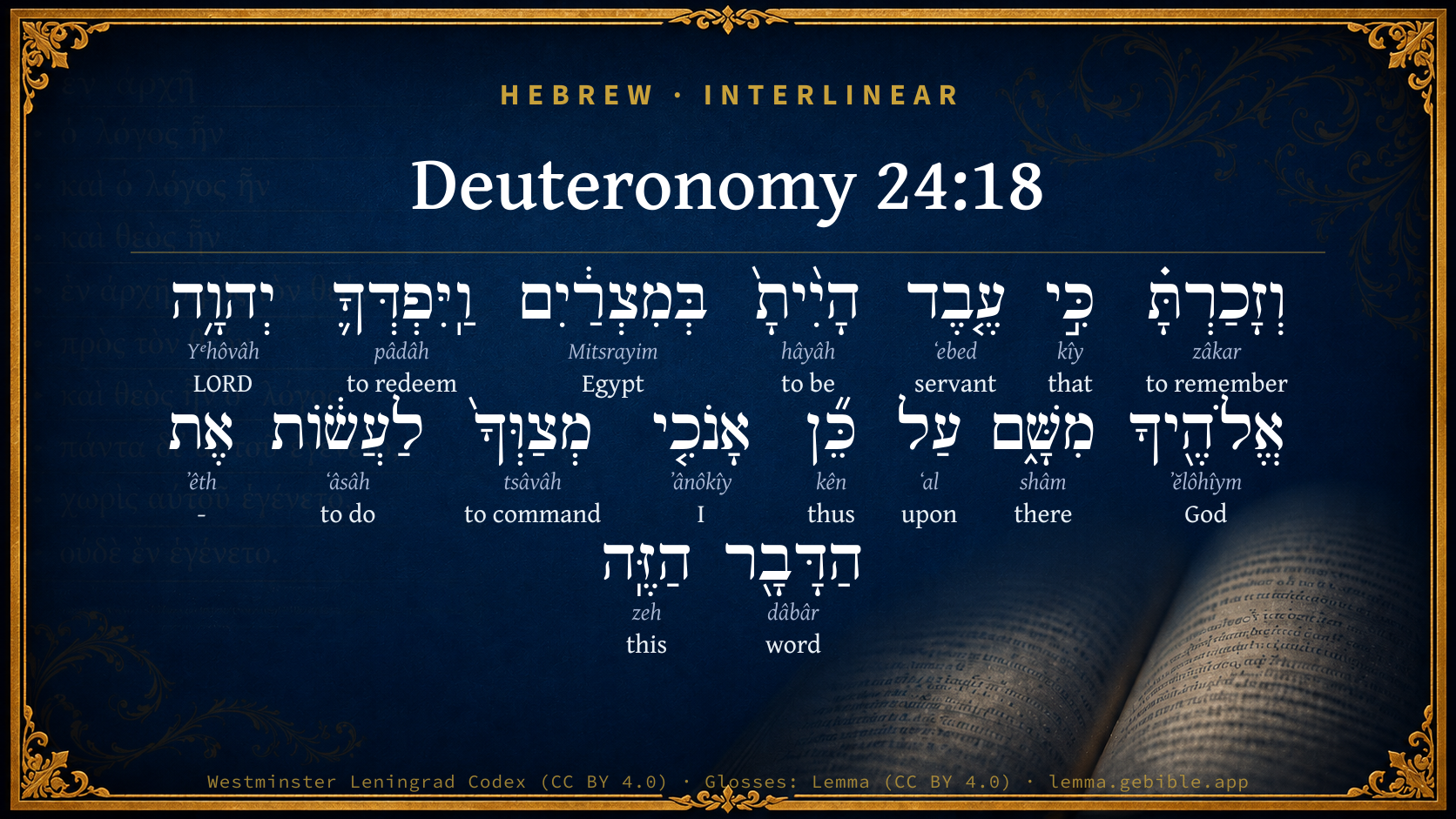
Deuteronomy 24:18

Hebrew (Westminster Leningrad Codex) Deuteronomy 24:18 appears in the Hebrew Old Testament. The text above is from the Westminster Leningrad Codex. Each word links to its Strong’s number, a concise gloss, and parsing drawn from the Open Scriptures Hebrew Bible morphology. Click any word for its full Brown-Driver-Briggs (BDB) entry.
Download image
Cite this verse

Deuteronomy 24:18 (World English Bible). Public Domain. Lemma interlinear Bible study tool, https://lemma.gebible.app/v/deuteronomy/24/18.

Show BibTeX & RIS
BibTeX
RIS
English Translation
but you shall remember that you were a bondservant in Egypt, and Yahweh your God redeemed you there: therefore I command you to do this thing.
World English Bible · Public Domain
Download a study sheet

One document with this verse’s original text, its word-by-word gloss line, the meaning frame, cross-references with their text, attributed commentary, and full source and license credits — printable, and it pastes into notes with its structure intact.

This verse Autodidact and up

Study sheet (.html) Plain text (.txt)

A passage Seminary Student

Up to 50 verses in one chapter. A passage sheet keeps up to 6 commentary sources and 12 cross-references per verse, in the order this page ranks them, and says so on the sheet whenever that leaves anything out. Ask for a single verse and you get the Autodidact verse sheet above.

Everything on this page stays free to read, with no account — the sheet is a download of what is already on screen, not access to it.

Want to remove ads? Support Godless Engineer
Compare translations 3

The same verse in 3 English versions, stacked beneath the original-language interlinear above. Click any original word for its lexicon entry.

Each is an independent rendering of the whole verse — the interlinear is not word-aligned to these translations.

Highlighted words mark where these versions differ — a whole-verse word diff, not a word-by-word alignment.

  • World English Bible Public Domain
    but you shall remember that you were a bondservant in Egypt, and Yahweh your God redeemed you there: therefore I command you to do this thing.
  • King James Version Public Domain
    But thou shalt remember that thou wast a bondman in Egypt, and the LORD thy God redeemed thee thence: therefore I command thee to do this thing.
  • unfoldingWord Literal Text CC BY-SA 4.0
    And you shall remember that you were a slave in Egypt, and Yahweh your God redeemed you from there. Therefore, I command you to do this word.

unfoldingWord Literal Text — © unfoldingWord, licensed CC BY-SA 4.0. Word-aligned USFM3 via Door43 (git.door43.org/unfoldingWord/en_ult).

Versions to compare (up to 4)

3 of 4 selected

Show all 18 translations

Every available English version of this verse, each an independent rendering of the whole verse.

  • World English Bible Public Domain
    but you shall remember that you were a bondservant in Egypt, and Yahweh your God redeemed you there: therefore I command you to do this thing.
  • Berean Standard Bible Public Domain
    Remember that you were slaves in Egypt, and the LORD your God redeemed you from that place. Therefore I am commanding you to do this.
  • Majority Standard Bible Public Domain
    Remember that you were slaves in Egypt, and the LORD your God redeemed you from that place. Therefore I am commanding you to do this.
  • King James Version Public Domain
    But thou shalt remember that thou wast a bondman in Egypt, and the LORD thy God redeemed thee thence: therefore I command thee to do this thing.
  • American Standard Version (1901) Public Domain
    but thou shalt remember that thou wast a bondman in Egypt, and Jehovah thy God redeemed thee thence: therefore I command thee to do this thing.
  • Revised Version (1885) Public Domain
    but thou shalt remember that thou wast a bondman in Egypt, and the LORD thy God redeemed thee thence: therefore I command thee to do this thing.
  • Geneva Bible (1599) Public Domain
    But remember that thou wast a seruant in Egypt, and howe the Lord thy God deliuered thee thence. Therefore I commaund thee to doe this thing.
  • Douay-Rheims (1899) Public Domain
    Remember that thou wast a slave in Egypt, and the Lord thy God delivered thee from thence. Therefore I command thee to do this thing.
  • Young's Literal Translation Public Domain
    and thou hast remembered that a servant thou hast been in Egypt, and Jehovah thy God doth ransom thee from thence; therefore I am commanding thee to do this thing.
  • Literal Standard Version CC BY-SA 4.0
    and you have remembered that you have been a servant in Egypt, and your God YHWH ransoms you from there; therefore I am commanding you to do this thing.
  • Unlocked Literal Bible CC BY-SA 4.0
    Instead, you must call to mind that you were a slave in Egypt, and that Yahweh your God rescued you from there. Therefore I instruct you to obey this command.
  • unfoldingWord Literal Text CC BY-SA 4.0
    And you shall remember that you were a slave in Egypt, and Yahweh your God redeemed you from there. Therefore, I command you to do this word.
  • Darby Bible Public Domain
    And thou shalt remember that thou wast a bondman in Egypt, and that Jehovah thy God redeemed thee from thence; therefore I command thee to do this thing.
  • World Messianic Bible Public Domain
    but you shall remember that you were a slave in Egypt, and the LORD your God redeemed you there. Therefore I command you to do this thing.
  • Webster's Bible Public Domain
    But thou shalt remember that thou wast a bond-man in Egypt, and the LORD thy God redeemed thee thence: therefore I command thee to do this thing.
  • Free Bible Version CC BY-SA 4.0
    Remember that you were once slaves in Egypt, and the Lord your God rescued you from that place. That's why I'm ordering you to do this.
  • Bible in Basic English Public Domain
    But keep in mind that you were a servant in the land of Egypt, and the Lord your God made you free: for this is why I give you orders to do this.
  • JPS Tanakh (1917) Public Domain
    But thou shalt remember that thou wast a bondman in Egypt, and the LORD thy God redeemed thee thence; therefore I command thee to do this thing.

Literal Standard Version (2020), Covenant Press — licensed CC BY-SA 4.0. Text via the HelloAO Bible API (eBible.org). Unlocked Literal Bible (unfoldingWord) — licensed CC BY-SA 4.0. Text via the HelloAO Bible API (eBible.org). unfoldingWord Literal Text — © unfoldingWord, licensed CC BY-SA 4.0. Word-aligned USFM3 via Door43 (git.door43.org/unfoldingWord/en_ult). Free Bible Version, Dr. Jonathan Gallagher — licensed CC BY-SA 4.0. Text via the HelloAO Bible API (eBible.org).

Word by word

More ways to search: Search by grammar → Find every occurrence → Compare this word →

Practice this passage: Drill this verse → Learn its vocabulary →

וַֽיִּפְדְּךָ֛
pâdâh
H6299
“and · to redeem · you”
Conjunction + Verb, Qal, Sequential Imperfect, 3rd Person, Masculine, Singular + Suffix, Personal, 2nd Person, Masculine, Singular
Part of Speech
Conjunction + Verb
Stem
Qal
Form
Sequential Imperfect
Person
3rd Person
Gender
Masculine
Number
Singular
Full BDB Definition

Origin: a primitive root

TWOT: 1734

to ransom, redeem, rescue, deliver - (Qal) to ransom - (Niphal) to be ransomed - (Hiphil) to allow one to be ransomed - (Hophal) redeemed
  1. וְזָכַרְתָּ֗ zâkar H2142 “and · to remember” Conjunction + Verb, Qal, Sequential Perfect, 2nd Person, Masculine, Singular
  2. כִּ֣י kîy H3588 “that” Conjunction
  3. עֶ֤בֶד ʻebed H5650 “servant” Noun, Common, Masculine, Singular, Absolute
  4. הָיִ֨יתָ֙ hâyâh H1961 “to be” Verb, Qal, Perfect, 2nd Person, Masculine, Singular
  5. בְּמִצְרַ֔יִם Mitsrayim H4714 “in/at · Egypt” Preposition + Noun, Proper
  6. יְהוָ֥ה Yᵉhôvâh H3068 “LORD” Noun, Proper
  7. אֱלֹהֶ֖יךָ ʼĕlôhîym H430 “God(s) · your” Noun, Common, Masculine, Plural, Construct + Suffix, Personal, 2nd Person, Masculine, Singular
  8. מִשָּׁ֑ם shâm H8033 “from · there” Preposition + Adverb
  9. עַל ʻal H5921 “upon” Preposition
  10. כֵּ֞ן kên H3651 “thus” Particle, Demonstrative
  11. אָנֹכִ֤י ʼânôkîy H595 “I” Pronoun, Personal, 1st Person, Common, Singular
  12. מְצַוְּךָ֙ tsâvâh H6680 “commanding · you” Verb, Piel, Participle Active, Masculine, Singular, Construct + Suffix, Personal, 2nd Person, Masculine, Singular
  13. לַעֲשׂ֔וֹת ʻâsâh H6213 “to do” Preposition + Verb, Qal, Infinitive Construct
  14. אֶת ʼêth H853 “-” Particle, Direct Object
  15. הַדָּבָ֖ר dâbâr H1697 “the · word” Particle, Definite Article + Noun, Common, Masculine, Singular, Absolute
  16. הַזֶּֽה zeh H2088 “the · this” Particle, Definite Article + Pronoun, Demonstrative, Masculine, Singular

About this verse

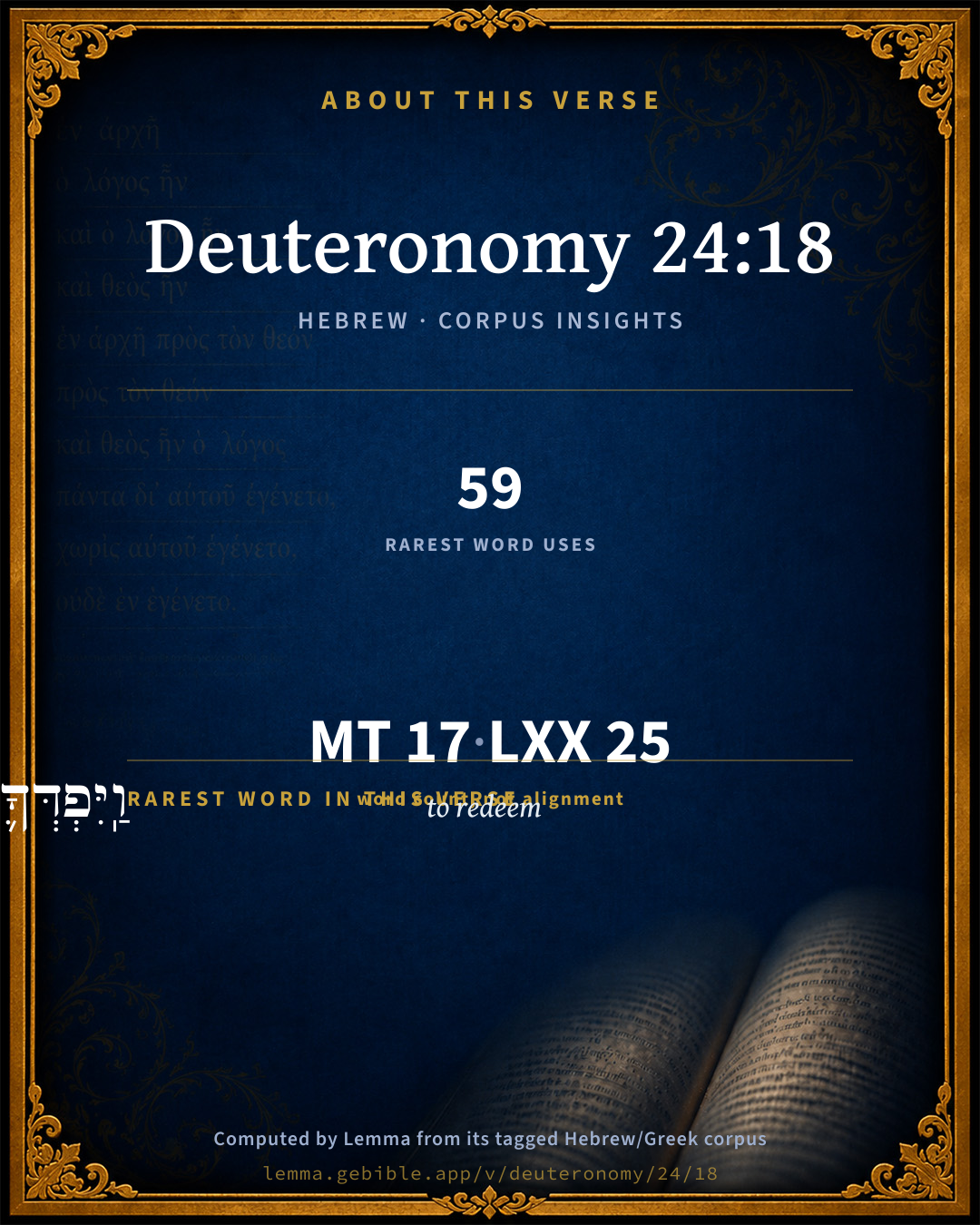
These counts appear in no published source. They are computed here, from the morphology-tagged text and Lemma’s own curated glosses. What Lemma adds →

17
words
17
distinct lemmas
Pentateuch
section

Shared distinctive vocabulary

וַֽיִּפְדְּךָ֛ to redeem H6299 occurs in 48 verses of the Hebrew Bible. Also found in:

Grammatical profile

  • 5 verbs
  • 5 nouns
  • 2 pronouns
  • 1 preposition
  • 1 conjunction
  • 1 adverb
  • 2 particles

Verb forms

  • וְזָכַרְתָּ֗ Qal · Sequential Perfect
  • הָיִ֨יתָ֙ Qal · Perfect
  • וַֽיִּפְדְּךָ֛ Qal · Sequential Imperfect
  • מְצַוְּךָ֙ Piel · Participle Active
  • לַעֲשׂ֔וֹת Qal · Infinitive Construct

Hebrew & Septuagint length

In English translation the verse runs 26 words from the Hebrew and 34 from the Septuagint (LXX English) — closely comparable.

A rough comparison of the two English renderings, which tokenize alike — not a word-level alignment.

Word counts can differ between the Hebrew and the Greek without any difference in meaning — e.g. the Hebrew direct-object marker אֵת has no separate Greek word, and Greek often adds the article ὁ.

In the original languages it is 17 Hebrew tokens and 25 Greek tokens — but the two are counted differently (Hebrew bundles its prefixes and suffixes into one token; the Greek is in lemma form), so that isn’t a like-for-like length.

Cross-references

4

Topical passages linked to Deuteronomy 24:18 in the Treasury of Scripture Knowledge — connected by theme and wording, ordered by reader-vote popularity; previews shown in the World English Bible.

  • Deuteronomy 5:15 You shall remember that you were a servant in the land of Egypt, and Yahweh your God brought you out of there by a mighty hand and by an outstretched arm: therefore Yahweh your God commanded you to keep the Sabbath day.
  • Deuteronomy 15:15 You shall remember that you were a bondservant in the land of Egypt, and Yahweh your God redeemed you: therefore I command you this thing today.
  • Deuteronomy 16:12 You shall remember that you were a bondservant in Egypt: and you shall observe and do these statutes.
  • Deuteronomy 24:22 You shall remember that you were a bondservant in the land of Egypt: therefore I command you to do this thing.

Cross-references courtesy of OpenBible.info (CC BY 4.0).

Hebrew and Greek witnesses Masoretic Hebrew ↔ Greek Septuagint

The same verse in the two great witnesses to the Old Testament, shown verse-for-verse.

These are two independent witnesses, not word-aligned to each other, and the Septuagint is shown in lemma (dictionary) form.

Hebrew Deuteronomy 24:18 Masoretic · Westminster Leningrad Codex

וְזָכַרְתָּ֗ כִּ֣י עֶ֤בֶד הָיִ֨יתָ֙ בְּמִצְרַ֔יִם וַֽיִּפְדְּךָ֛ יְהוָ֥ה אֱלֹהֶ֖יךָ מִשָּׁ֑ם עַל כֵּ֞ן אָנֹכִ֤י מְצַוְּךָ֙ לַעֲשׂ֔וֹת אֶת הַדָּבָ֖ר הַזֶּֽה

but you shall remember that you were a bondservant in Egypt, and Yahweh your God redeemed you there: therefore I command you to do this thing.

World English Bible · Public Domain

Greek LXX Deuteronomy 24:18 Septuagint · lemma form

καί μιμνήσκω ὅτι οἰκέτης εἰμί ἐν γῆ αἴγυπτος καί λυτρόω σύ κύριος ὁ θεός σύ ἐκεῖθεν διά οὗτος ἐγώ σύ ἐντέλλομαι ποιέω ὁ ῥῆμα οὗτος

The fathers shall not be put to death for the children, and the sons shall not be put to death for the fathers; every one shall be put to death for his own sin.

LXX2012 (modern English Septuagint) · Public Domain

Hebrew: Westminster Leningrad Codex (CC BY 4.0). Greek: Septuagint (public domain); English from LXX2012 (modern English Septuagint) (Public Domain). How the Septuagint differs from the Hebrew →

Targum (Aramaic paraphrase)

2

The Targum is the ancient Jewish Aramaic paraphrase of the Hebrew Scriptures — an interpretive translation, not the Hebrew text itself. Onkelos (literal) and Pseudo-Jonathan (expansive) render the Torah, and Jonathan the Prophets. Coverage is partial: where no permissively-licensed English translation exists for a verse, only the Aramaic is shown. This is verse-level text, not a word-by-word alignment to the Hebrew.

  1. Targum Onkelos Torah (Genesis–Deuteronomy)
    וְתִדְכַּר אֲרֵי עַבְדָא הֲוֵיתָא בְּמִצְרַיִם וּפָרְקָךְ יְיָ אֱלָהָךְ מִתַּמָן עַל כֵּן אֲנָא מְפַקְדָךְ לְמֶעְבַּד יָת פִּתְגָמָא הָדֵין

    (no public-domain English translation for this verse)

    Targum Onkelos — Aramaic: “Onkelos Genesis” (public domain); “Onkelos Exodus” (public domain); “Onkelos Leviticus” (public domain); “Onkelos Numbers” (public domain); “Onkelos Deuteronomy” (public domain). English: “Sefaria Community Translation” (CC0 1.0 (public-domain dedication)); “J.W. Etheridge. The Targums of Onkelos and Jonathan Ben Uzziel on the Pentateuch. London: Longmans, Green, 1862” (public domain). Text via Sefaria.

  2. Targum Pseudo-Jonathan Torah (Genesis–Deuteronomy)
    וְתֶהֱווּן דְּכִירִין אֲרוּם מְשַׁעַבְּדִין הֲוֵיתוּן בְּאַרְעָא דְמִצְרַיִם וּפְרַק יַתְכוֹן מֵימְרָא דַיְיָ אֱלָהָכוֹן מִתַּמָּן בְּגִין כֵּן אֲנָא מְפַקֵּיד לְכוֹן לְמֶעֱבַד יַת פִּתְגָמָא הָדֵין

    And remember that you were bondservants in the land of Mizraim, and that the Word of the Lord your God delivered you from thence; therefore have I commanded you to observe this thing.

    Targum Pseudo-Jonathan — Aramaic: “Targum Jonathan on Genesis” (public domain); “Targum Jonathan on Exodus” (public domain); “Targum Jonathan on Leviticus” (public domain); “Targum Jonathan on Numbers” (public domain); “Targum Jonathan on Deuteronomy” (public domain). English: “The Targum of Jonathan ben Uzziel, trans. J. W. Etheridge, London, 1862” (public domain). Text via Sefaria.

Commentary

Notes on Deuteronomy 24:18 from classic Christian and Jewish commentators (each source and its license shown beneath its notes). The classic Christian expositions comment on the surrounding passage and are grouped to its opening verse, so a note may address several verses; the Jewish commentaries on the Tanakh (Rashi and others) are per-verse, so they appear only where the commentator wrote on this verse.

Lemma curates 59 commentaries, every one of them public domain or Creative Commons licensed, each selected and text-cleaned for this edition rather than reprinted as found. About our sources →

The Biblical Illustrator

Joseph S. Exell

Deu_24:18

Remember that thou wast a bondman in Egypt.

Important recollection

The admonition may seem needless, but we are prone to forget Gods works and wonders. We have need to be stirred up to remembrance for four purposes.

1. For the purpose of humility. We think more highly of ourselves than we ought to think. With the lowly is wisdom. If wise, we were once foolish; if justified, we were once condemned; if sons of God, we were once servants of sin. Look to the rock from whence hewn.

2. For the purpose of gratitude. If affected by kindness flora our fellow creatures, should we overlook our infinite Benefactor? We have no claims upon Him and should be thankful for all His benefits. But herein is love. Blessed be the God of Israel, for He hath visited and redeemed His people.

3. For the purpose of confidence. David argued from the past to the future. Because Thou hast been my help, therefore under the shadow of Thy wings will I rejoice. Here we have peculiar reason for encouragement. What were we when He first took knowledge of us? Was the want of worthiness a bar to His goodness then? Will it be so now? Is there variableness or shadow of turning with Him? Is there not the same power in His arm and the same love in His heart? Did He pardon me when a rebel, and will He cast me off now that He has made me a friend? He that spared not His own Son but delivered Him up for us all, etc.

4. For the purpose of piety and zeal. How many round about you in the gall of bitterness and in the bond of iniquity ready to perish? You know the state they are in, and the blessedness of deliverance from it. You are witnesses of what God is able and willing to do. Invite the prisoners of hope to turn to Him--you can speak from experience. (W. Jay.)

Remembrance of the past

I. The exercise of mental activity.

II. The particular object of consideration.

1. Our original state.

2. Our redeemed condition.

III. The especial gain to be derived from this consideration.

1. It will make us humble.

2. It will render us grateful.

3. It should give us confidence and faith.

4. It should kindle our piety and zeal. (Homilist.)

The necessary remembrance

I. The Christians original state.

1. Degraded.

2. Oppressed.

3. Helpless.

II. The Christians happy deliverance. Redeemed. God redeemed Israel by His mighty arm. Our redemption, like theirs--

1. Originated in Gods free compassion. Without claim or merit. He saw our self-procured ruin, and exercised His infinite mercy towards us.

2. Was effected by the mission and work of His Son.

3. Is connected with faith and obedience to our great Deliverer.

III. The Christians obligation to remember his redemption. But can we forget? Why, the Israelites did. Our own hearts are prone to forget; the cares of the world choke the soul, and cause us to forget God. Satan, by his temptations, would seduce us from this remembrance.

1. We should remember it with intentness of soul and gratitude of heart. Such love and goodness should never be obliterated. A lively remembrance will keep the flame of gratitude burning on the altar of our hearts.

2. We should remember it with feelings of humility and contrition. If self-righteousness would spring up, if we would glory at all in ourselves, this remembrance will lead us back to our original state, and then all boasting will be slain.

3. We should remember that we may feel for those around who are still in the gall of bitterness and the bonds of iniquity. The love of Christ to us should fill us with love to our fellowmen.

4. We should especially remember, when in the means of grace, and at the table of the Lord. (J. Burns, D. D.)

The memorable deliverance

I. The deliverance obtained.

1. From the curse of the law.

2. From the bondage of sin.

3. From the tyranny of Satan.

4. From the evils of the world.

II. The deliverer described.

1. Redemption originally proceeds from the mercy and love of God.

2. Redemption is meritoriously procured by the Lord Jesus Christ.

3. Redemption is personally realised by the power of the Holy Ghost.

III. The remembrance enjoined. This command is applicable to the people of God in every age, and extends to all the blessings we receive. As it regards our redemption, we must cherish--

1. A grateful remembrance. We should frequently call to mind the deplorable state from which we are redeemed, the inestimable privileges with which we are honoured, and the ineffable felicities to which we are entitled. Such pious reflections will always be profitable, and associated with deep humility, devoted admiration, unfeigned gratitude, and fervent praise (Psa_103:1-4; Isa_12:1).

2. An affectionate remembrance. A consciousness of the unspeakable love of God to us should deeply interest and inspire our souls with a reciprocation of love to Him. Our love to God must be supreme, vigorous, manifest, and progressive. It must be the ruling principle of the heart, and the actuating motive of the life (Mat_22:37-38; Rom_5:5; 1Jn_5:3; 1Jn_5:5).

3. An obedient remembrance. This is the specific argument of the text: Thou shalt remember, therefore I command thee to do this thing. Their obedience was demanded on the ground of Divine goodness.

4. A perpetual remembrance. Redeeming grace deeply involves our immortal interests, and therefore should never be forgotten. (Sketches of Four Hundred Sermons.)

The Biblical Illustrator, edited by Joseph S. Exell (c. 1880s–1900s) — public domain. Text from a community e-Sword module.

Adam Clarke's Commentary

Verse 18. Thou shalt remember that thou wast a bondman] Most people who have affluence rose from comparative penury, for those who are born to estates frequently squander them away; such therefore should remember what their feelings, their fears, and anxieties were, when they were poor and abject. A want of attention to this most wholesome precept is the reason why pride and arrogance are the general characteristics of those who have risen in the world from poverty to affluence; and it is the conduct of those men which gave rise to the rugged proverb, "Set a beggar on horseback, and he will ride to the devil."

Adam Clarke's Commentary on the Bible (1810–1826) — public domain. Text from a community e-Sword/MySword module.

The Cambridge Bible for Schools and Colleges

gen. ed. J. J. S. Perowne

18. thou shalt remember, etc.] Almost exactly as in Deu_24:22, and Deu_15:5; cp. Deu_5:15.

The Cambridge Bible for Schools and Colleges (gen. ed. J. J. S. Perowne; Cambridge University Press, 1878–1918) — public domain. Text from a community e-Sword module.

John Gill's Exposition

But thou shalt remember that thou wast a bondman in Egypt,.... The remembrance of which may cause sympathy with persons in distress; particularly the stranger, the fatherless, and the widow:

and the Lord thy God redeemed thee thence; the Targum of Jonathan,"the Word of the Lord thy God;''which, as it was an act of great kindness and mercy in God to them, taught them, and laid them under obligation to show favour to their fellow creatures in distress:

therefore I command thee to do this thing: not to pervert the judgment of the stranger and fatherless, nor take a widow's raiment for a pledge; and it may be carried further into the context, and respect the laws about the pledge of the poor man, and giving the hired servant his wages in due time.

John Gill's Exposition of the Whole Bible (1746–1763) — public domain (CC PDM 1.0). Text via the HelloAO Bible API.

Haydock's Catholic Bible Commentary

This thing. It is uncertain whether this refer to the preceding or to the following law. It may be applied to both, as the remembrance of the Egyptian slavery might teach God’s people not to oppress, but rather to shew mercy to those in distress. As the same thing is however repeated, ver. 22, it seems more probable that the present verse forbids any oppression. (Haydock)

George Leo Haydock (1774–1849), Haydock's Catholic Family Bible and Commentary, 1859 edition — public domain. Excludes Psalms (Douay-Rheims chapter numbering differs from Protestant) and Deuterocanonical books (Catholic canon only).

Matthew Poole's English Annotations

Thou shalt remember, to wit, affectionately and practically; and by the compassionate sense of others’ miseries, thou shalt make it evident that thou hast not forgotten thy own distresses and deliverances.

I command thee to do this thing; I having thereby authority to command thee, and thou having obligations on that account, both to obey me, and to pity others in the same calamities which thou hast felt.

Matthew Poole's English Annotations on the Holy Bible (1683–1685) — public domain. Text from a community e-Sword/MySword module.

Scofield Reference Notes

C. I. Scofield

redeemed

(See Scofield "Exo 14:30").

The Scofield Reference Bible (1917 edition), notes by C. I. Scofield — public domain. Text from a community e-Sword module.

Rashi

Rabbi Shlomo Yitzchaki (Rashi)

וזכרת BUT THOU SHALT REMEMBER [THAT THOU WAST A SERVANT IN EGYPT AND THE LORD THY GOD RELEASED THEE THENCE] — I released you only with this condition — that you should observe my statutes even though there be monetary loss in the matter.

Rashi on the Tanakh — English translations: “The Judaica Press complete Tanach with Rashi, translated by A. J. Rosenberg” (CC BY 4.0); “Pentateuch with Rashi's commentary by M. Rosenbaum and A.M. Silbermann, 1929-1934” (public domain); “The Metsudah Tanach series, Lakewood, N.J” (CC BY 4.0); and “The Book of Joshua, Metsudah Publications, 1997” (CC BY 4.0). Text via Sefaria.

Ramban (Nachmanides)

Rabbi Moshe ben Nachman (Ramban / Nachmanides)

AND THOU SHALT REMEMBER THAT THOU WAST A BONDMAN IN EGYPT. “I have redeemed you on the condition that you observe My statutes even though it may involve monetary loss.” This is Rashi’s language. But the correct interpretation is that it refers back to the admonitions concerning the stranger. I have already explained the meaning thereof..

Ramban (Nachmanides) on the Tanakh — English translation: “Commentary on the Torah by Ramban (Nachmanides). Translated and annotated by Charles B. Chavel. New York, Shilo Pub. House, 1971-1976” (CC BY 4.0). Text via Sefaria.

Lesson kit

Teaching starters — assembled from the data on this page, not authored interpretation. Every prompt links to the verse data it draws on. Edit before teaching.

Deuteronomy, in the Pentateuch, opens this verse with 17 words (17 distinct Hebrew lemmas). Its most distinctive word is pâdâh (“to redeem”). A historical commentator’s framing appears above. Read the whole chapter for the surrounding context.

Discussion questions

  1. What does “to redeem” (pâdâh) contribute to the verse as a whole?
  2. Exodus 13:13 shares the word «to redeem» with this verse. How do the two illuminate each other?
  3. These translations render this verse differently; the difference is in the English rendering, not the original. What questions does that raise?
  4. The verb «וְזָכַרְתָּ֗» is Qal Sequential Perfect. How does its form color the action?
  5. Reading how The Biblical Illustrator and Adam Clarke's Commentary read this verse, where do the two commentators agree and where do they part?

Things to notice

Reading settings

Reading text

Shown beneath each verse's original-language words.

Old Testament
Old Testament edition

Read the OT as the Masoretic Hebrew (MT) or the Greek Septuagint (LXX).

English shown for the Greek Septuagint (in the Hebrew ↔ Greek comparison).

Comparing translations? Open the Compare panel on any verse page to stack up to four side by side.