
Ezekiel 30:11

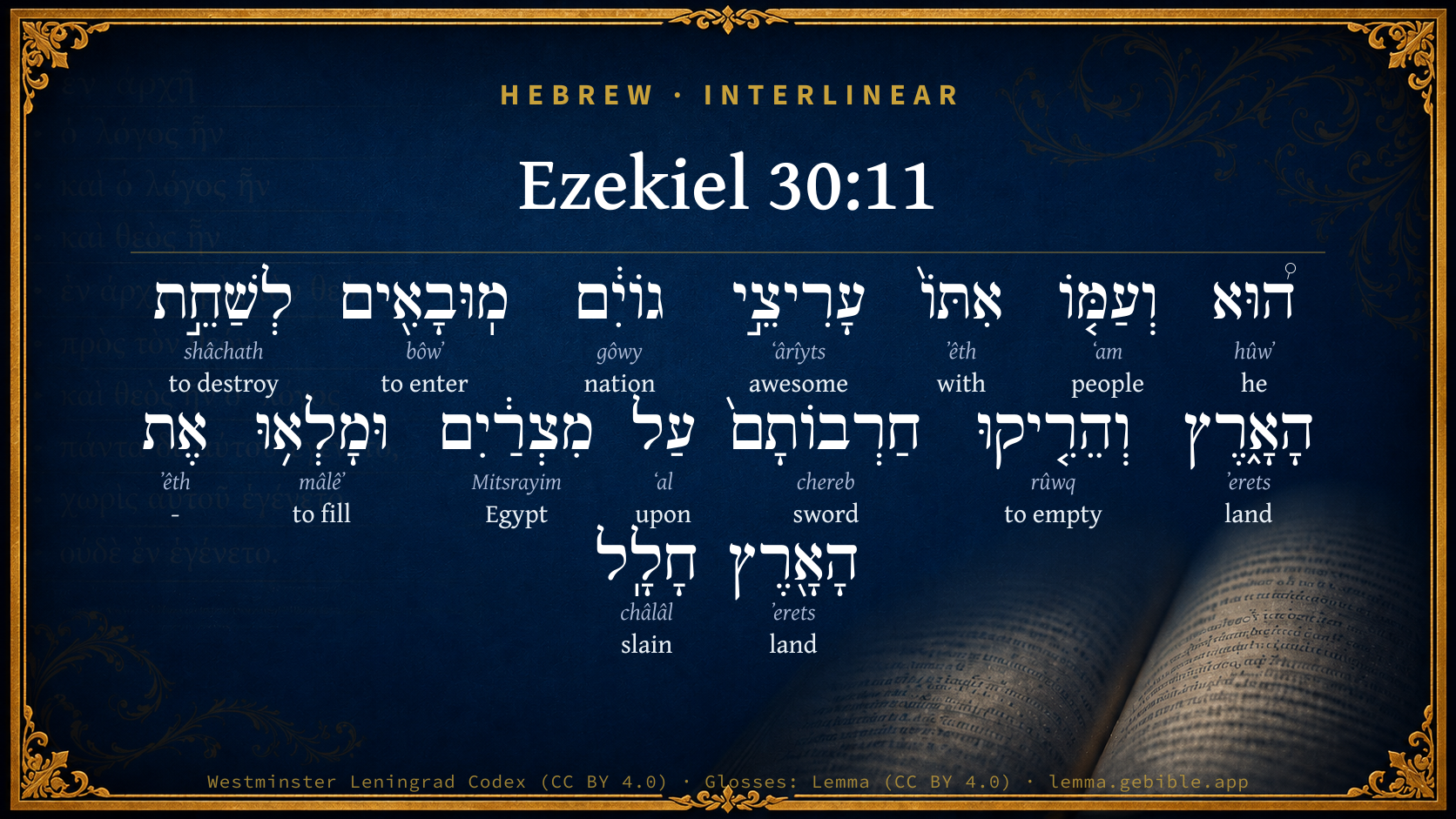
Hebrew (Westminster Leningrad Codex) Ezekiel 30:11 appears in the Hebrew Old Testament. The text above is from the Westminster Leningrad Codex. Each word links to its Strong’s number, a concise gloss, and parsing drawn from the Open Scriptures Hebrew Bible morphology. Click any word for its full Brown-Driver-Briggs (BDB) entry.
Download image
Cite this verse

Ezekiel 30:11 (World English Bible). Public Domain. Lemma interlinear Bible study tool, https://lemma.gebible.app/v/ezekiel/30/11.

Show BibTeX & RIS
BibTeX
RIS
English Translation
He and his people with him, the terrible of the nations, shall be brought in to destroy the land; and they shall draw their swords against Egypt, and fill the land with the slain.
World English Bible · Public Domain
Download a study sheet

One document with this verse’s original text, its word-by-word gloss line, the meaning frame, cross-references with their text, attributed commentary, and full source and license credits — printable, and it pastes into notes with its structure intact.

This verse Autodidact and up

Study sheet (.html) Plain text (.txt)

A passage Seminary Student

Up to 50 verses in one chapter. A passage sheet keeps up to 6 commentary sources and 12 cross-references per verse, in the order this page ranks them, and says so on the sheet whenever that leaves anything out. Ask for a single verse and you get the Autodidact verse sheet above.

Everything on this page stays free to read, with no account — the sheet is a download of what is already on screen, not access to it.

Want to remove ads? Support Godless Engineer
Compare translations 3

The same verse in 3 English versions, stacked beneath the original-language interlinear above. Click any original word for its lexicon entry.

Each is an independent rendering of the whole verse — the interlinear is not word-aligned to these translations.

Highlighted words mark where these versions differ — a whole-verse word diff, not a word-by-word alignment.

  • World English Bible Public Domain
    He and his people with him, the terrible of the nations, shall be brought in to destroy the land; and they shall draw their swords against Egypt, and fill the land with the slain.
  • King James Version Public Domain
    He and his people with him, the terrible of the nations, shall be brought to destroy the land: and they shall draw their swords against Egypt, and fill the land with the slain.
  • unfoldingWord Literal Text CC BY-SA 4.0
    He and his army with him, the terror of nations, will be brought to destroy the land; they will draw out their swords against Egypt and fill the land with those who have been killed.

unfoldingWord Literal Text — © unfoldingWord, licensed CC BY-SA 4.0. Word-aligned USFM3 via Door43 (git.door43.org/unfoldingWord/en_ult).

Versions to compare (up to 4)

3 of 4 selected

Show all 18 translations

Every available English version of this verse, each an independent rendering of the whole verse.

  • World English Bible Public Domain
    He and his people with him, the terrible of the nations, shall be brought in to destroy the land; and they shall draw their swords against Egypt, and fill the land with the slain.
  • Berean Standard Bible Public Domain
    He and his people with him, the most ruthless of the nations, will be brought in to destroy the land. They will draw their swords against Egypt and fill the land with the slain.
  • Majority Standard Bible Public Domain
    He and his people with him, the most ruthless of the nations, will be brought in to destroy the land. They will draw their swords against Egypt and fill the land with the slain.
  • King James Version Public Domain
    He and his people with him, the terrible of the nations, shall be brought to destroy the land: and they shall draw their swords against Egypt, and fill the land with the slain.
  • American Standard Version (1901) Public Domain
    He and his people with him, the terrible of the nations, shall be brought in to destroy the land; and they shall draw their swords against Egypt, and fill the land with the slain.
  • Revised Version (1885) Public Domain
    He and his people with him, the terrible of the nations, shall be brought in to destroy the land; and they shall draw their swords against Egypt, and fill the land with the slain.
  • Geneva Bible (1599) Public Domain
    For he and his people with him, euen the terrible nations shall be brought to destroy the land: and they shall drawe their swordes against Egypt, and fill the land with the slaine.
  • Douay-Rheims (1899) Public Domain
    He and his people with him, the strongest of nations, shall be brought to destroy the land: and they shall draw their swords upon Egypt: and shall fill the land with the slain.
  • Young's Literal Translation Public Domain
    He and his people with him -- the terrible of nations, Are brought in to destroy the land, And they have drawn their swords against Egypt, And have filled the land `with' the wounded.
  • Literal Standard Version CC BY-SA 4.0
    He and his people with him—the terrible of nations, || Are brought in to destroy the land, || And they have drawn their swords against Egypt, || And have filled the land [with] the wounded.
  • Unlocked Literal Bible CC BY-SA 4.0
    He and his army with him, the terror of nations, will be brought to destroy the land; they will draw out their swords against Egypt and fill the land with those who have been killed.
  • unfoldingWord Literal Text CC BY-SA 4.0
    He and his army with him, the terror of nations, will be brought to destroy the land; they will draw out their swords against Egypt and fill the land with those who have been killed.
  • Darby Bible Public Domain
    He and his people with him, the terrible of the nations, shall be brought to destroy the land; and they shall draw their swords against Egypt, and fill the land with slain.
  • World Messianic Bible Public Domain
    He and his people with him, the terrible of the nations, will be brought in to destroy the land. They will draw their swords against Egypt, and fill the land with the slain.
  • Webster's Bible Public Domain
    He and his people with him, the terrible of the nations, shall be brought to destroy the land: and they shall draw their swords against Egypt, and fill the land with the slain.
  • Free Bible Version CC BY-SA 4.0
    He and his army from the cruelest nation in the world will be brought to destroy the country. They will use their swords to attack Egypt, and they will fill the land with dead bodies.
  • Bible in Basic English Public Domain
    He and the people with him, causing fear among the nations, will be sent for the destruction of the land; their swords will be let loose against Egypt and the land will be full of dead.
  • JPS Tanakh (1917) Public Domain
    He and his people with him, the terrible of the nations, shall be brought in to destroy the land; and they shall draw their swords against Egypt, and fill the land with the slain.

Literal Standard Version (2020), Covenant Press — licensed CC BY-SA 4.0. Text via the HelloAO Bible API (eBible.org). Unlocked Literal Bible (unfoldingWord) — licensed CC BY-SA 4.0. Text via the HelloAO Bible API (eBible.org). unfoldingWord Literal Text — © unfoldingWord, licensed CC BY-SA 4.0. Word-aligned USFM3 via Door43 (git.door43.org/unfoldingWord/en_ult). Free Bible Version, Dr. Jonathan Gallagher — licensed CC BY-SA 4.0. Text via the HelloAO Bible API (eBible.org).

Word by word

More ways to search: Search by grammar → Find every occurrence → Compare this word →

Practice this passage: Drill this verse → Learn its vocabulary →

וְהֵרִ֤יקוּ
rûwq
H7324
“and · to empty”
Conjunction + Verb, Hiphil, Sequential Perfect, 3rd Person, Common, Plural
Part of Speech
Conjunction + Verb
Stem
Hiphil
Form
Sequential Perfect
Person
3rd Person
Gender
Common
Number
Plural
Full BDB Definition

Origin: a primitive root

TWOT: 2161

to make empty, empty out - (Hiphil) - to empty, keep empty or hungry - to pour out or down - to empty out - (Hophal) to be emptied out
  1. ה֠וּא hûwʼ H1931 “he” Pronoun, Personal, 3rd Person, Masculine, Singular
  2. וְעַמּ֤וֹ ʻam H5971 “and · people · his” Conjunction + Noun, Common, Masculine, Singular, Construct + Suffix, Personal, 3rd Person, Masculine, Singular
  3. אִתּוֹ֙ ʼêth H854 “with · him” Preposition + Suffix, Personal, 3rd Person, Masculine, Singular
  4. עָרִיצֵ֣י ʻârîyts H6184 “awesome of” Adjective, Adjective, Masculine, Plural, Construct
  5. גוֹיִ֔ם gôwy H1471 “nations” Noun, Common, Masculine, Plural, Absolute
  6. מֽוּבָאִ֖ים bôwʼ H935 “entered” Verb, Hophal, Participle Passive, Masculine, Plural, Absolute
  7. לְשַׁחֵ֣ת shâchath H7843 “to destroy” Preposition + Verb, Piel, Infinitive Construct
  8. הָאָ֑רֶץ ʼerets H776 “the · land” Particle, Definite Article + Noun, Common, Both, Singular, Absolute
  9. חַרְבוֹתָם֙ chereb H2719 “swords · their” Noun, Common, Feminine, Plural, Construct + Suffix, Personal, 3rd Person, Masculine, Plural
  10. עַל ʻal H5921 “upon” Preposition
  11. מִצְרַ֔יִם Mitsrayim H4714 “Egypt” Noun, Proper
  12. וּמָלְא֥וּ mâlêʼ H4390 “and · to fill” Conjunction + Verb, Qal, Sequential Perfect, 3rd Person, Common, Plural
  13. אֶת ʼêth H853 “-” Particle, Direct Object
  14. הָאָ֖רֶץ ʼerets H776 “the · land” Particle, Definite Article + Noun, Common, Both, Singular, Absolute
  15. חָלָֽל châlâl H2491 “slain” Adjective, Adjective, Masculine, Singular, Absolute

About this verse

These counts appear in no published source. They are computed here, from the morphology-tagged text and Lemma’s own curated glosses. What Lemma adds →

16
words
15
distinct lemmas
Prophets
section

Notable vocabulary

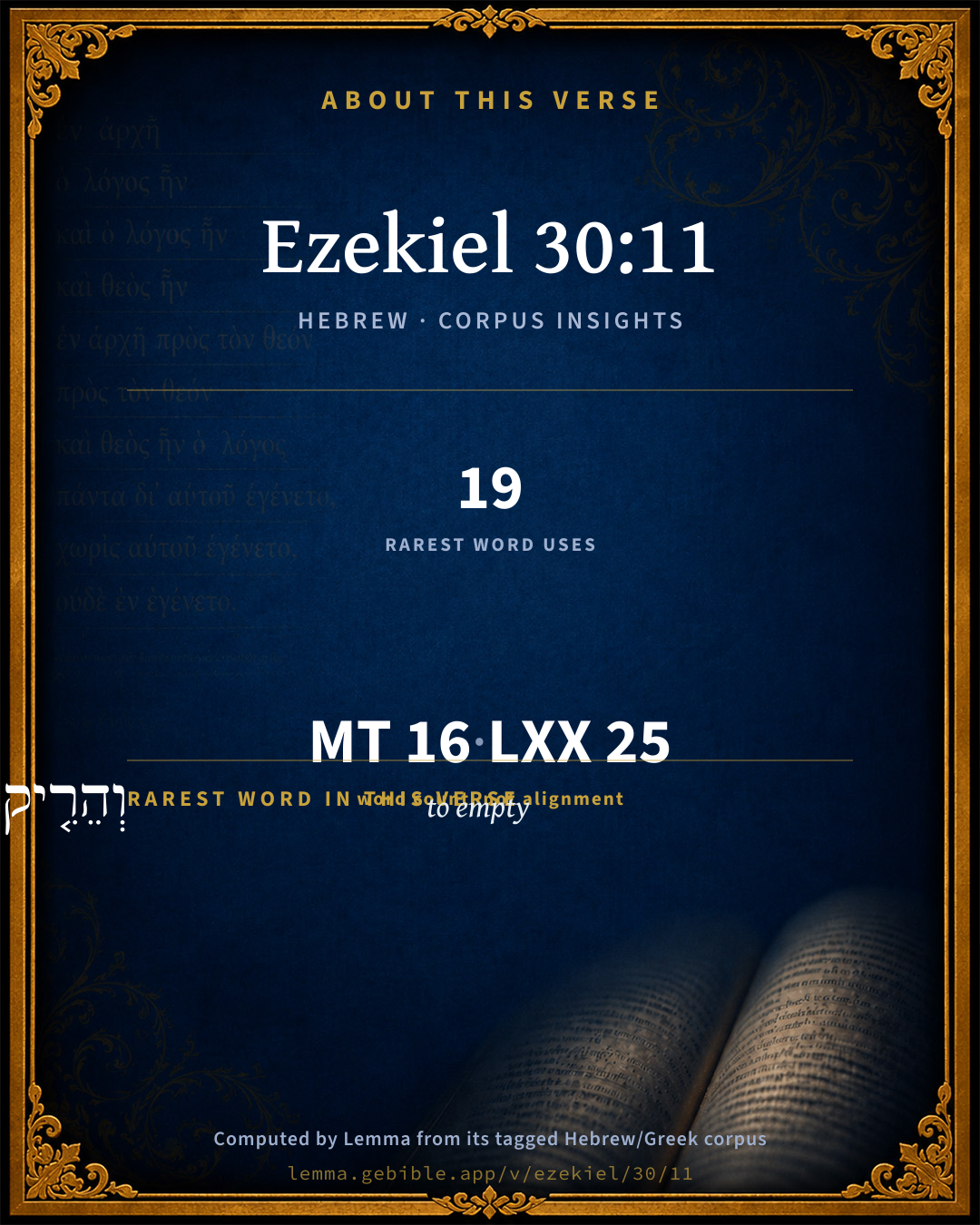
The rarest word here is וְהֵרִ֤יקוּ to empty H7324 — appearing just 19 times in the whole Hebrew Bible.

Shared distinctive vocabulary

וְהֵרִ֤יקוּ to empty H7324 occurs in 19 verses of the Hebrew Bible. Also found in:

Grammatical profile

  • 4 verbs
  • 6 nouns
  • 2 adjectives
  • 1 pronoun
  • 2 prepositions
  • 1 particle

Verb forms

  • מֽוּבָאִ֖ים Hophal · Participle Passive
  • לְשַׁחֵ֣ת Piel · Infinitive Construct
  • וְהֵרִ֤יקוּ Hiphil · Sequential Perfect
  • וּמָלְא֥וּ Qal · Sequential Perfect

Repetition

A word recurs within this verse — often emphatic in Hebrew:

  • הָאָ֑רֶץ land H776 ×2

Hebrew & Septuagint length

In English translation the verse runs 34 words from the Hebrew and 34 from the Septuagint (LXX English) — the same length.

A rough comparison of the two English renderings, which tokenize alike — not a word-level alignment.

Word counts can differ between the Hebrew and the Greek without any difference in meaning — e.g. the Hebrew direct-object marker אֵת has no separate Greek word, and Greek often adds the article ὁ.

In the original languages it is 16 Hebrew tokens and 25 Greek tokens — but the two are counted differently (Hebrew bundles its prefixes and suffixes into one token; the Greek is in lemma form), so that isn’t a like-for-like length.

Cross-references

12

Topical passages linked to Ezekiel 30:11 in the Treasury of Scripture Knowledge — connected by theme and wording, ordered by reader-vote popularity; previews shown in the World English Bible.

  • Ezekiel 28:7 therefore, behold, I will bring strangers on you, the terrible of the nations; and they shall draw their swords against the beauty of your wisdom, and they shall defile your brightness.
  • Deuteronomy 28:50 a nation of fierce facial expressions, that shall not regard the person of the old, nor show favor to the young,
  • Isaiah 14:4–6 that you shall take up this parable against the king of Babylon, and say, How has the oppressor ceased! the golden city ceased!
  • Isaiah 34:3–7 Their slain also shall be cast out, and the stench of their dead bodies shall come up; and the mountains shall be melted with their blood.
  • Jeremiah 51:20–23 You are my battle-axe and weapons of war: and with you will I break in pieces the nations; and with you will I destroy kingdoms;
  • Ezekiel 31:12 Strangers, the terrible of the nations, have cut him off, and have left him: on the mountains and in all the valleys his branches are fallen, and his boughs are broken by all the watercourses of the land; and all the peoples of the earth are gone down from his shadow, and have left him.
  • Ezekiel 32:12 By the swords of the mighty will I cause your multitude to fall; the terrible of the nations are they all: and they shall bring to nothing the pride of Egypt, and all the multitude of it shall be destroyed.
  • Ezekiel 35:8 I will fill its mountains with its slain: in your hills and in your valleys and in all your watercourses shall they fall who are slain with the sword.
  • Ezekiel 39:4 You shall fall on the mountains of Israel, you, and all your hordes, and the peoples who are with you: I will give you to the ravenous birds of every sort, and to the animals of the field to be devoured.
  • Ezekiel 39:11–20 It shall happen in that day, that I will give to Gog a place for burial in Israel, the valley of those who pass through on the east of the sea; and it shall stop those who pass through: and there shall they bury Gog and all his multitude; and they shall call it The valley of Hamon Gog.
  • Habakkuk 1:6–9 For, behold, I raise up the Chaldeans, that bitter and hasty nation, that march through the breadth of the earth, to possess dwelling places that are not theirs.
  • Zephaniah 1:17–18 I will bring distress on men, that they will walk like blind men, because they have sinned against Yahweh, and their blood will be poured out like dust, and their flesh like dung.

Cross-references courtesy of OpenBible.info (CC BY 4.0).

Hebrew and Greek witnesses Masoretic Hebrew ↔ Greek Septuagint

The same verse in the two great witnesses to the Old Testament, shown verse-for-verse.

These are two independent witnesses, not word-aligned to each other, and the Septuagint is shown in lemma (dictionary) form.

Hebrew Ezekiel 30:11 Masoretic · Westminster Leningrad Codex

ה֠וּא וְעַמּ֤וֹ אִתּוֹ֙ עָרִיצֵ֣י גוֹיִ֔ם מֽוּבָאִ֖ים לְשַׁחֵ֣ת הָאָ֑רֶץ וְהֵרִ֤יקוּ חַרְבוֹתָם֙ עַל מִצְרַ֔יִם וּמָלְא֥וּ אֶת הָאָ֖רֶץ חָלָֽל

He and his people with him, the terrible of the nations, shall be brought in to destroy the land; and they shall draw their swords against Egypt, and fill the land with the slain.

World English Bible · Public Domain

Greek LXX Ezekiel 30:11 Septuagint · lemma form

αὐτός καί ὁ λαός αὐτός λοιμός ἀπό ἔθνος ἀποστέλλω ἀποὀλλύω ὁ γῆ καί ἐκκενόω πᾶς ὁ μάχαιρα αὐτός ἐπί αἴγυπτος καί πίμπλημι ὁ γῆ τραυματίας

his hand and his people's; they are plagues sent forth from the nations to destroy the land: and they all shall unsheath their swords against Egypt, and the land shall be filled with slain.

LXX2012 (modern English Septuagint) · Public Domain

Hebrew: Westminster Leningrad Codex (CC BY 4.0). Greek: Septuagint (public domain); English from LXX2012 (modern English Septuagint) (Public Domain). How the Septuagint differs from the Hebrew →

Targum (Aramaic paraphrase)

1

The Targum is the ancient Jewish Aramaic paraphrase of the Hebrew Scriptures — an interpretive translation, not the Hebrew text itself. Onkelos (literal) and Pseudo-Jonathan (expansive) render the Torah, and Jonathan the Prophets. Coverage is partial: where no permissively-licensed English translation exists for a verse, only the Aramaic is shown. This is verse-level text, not a word-by-word alignment to the Hebrew.

  1. Targum Jonathan Prophets (Joshua–Malachi)
    הוּא וְעַמֵיהּ עִמֵיהּ תְּקִיפֵי עַמְמַיָא אֶתֵּן לְחַבָּלָא אַרְעָא וְיִשְׁלְפוּן סַיְפֵיהוֹן עַל מִצְרַיִם וְיִמְלוֹן יַת אַרְעָא קְטִילִין:

    (no public-domain English translation for this verse)

    Targum Jonathan — Aramaic: “Mikraot Gedolot” (public domain). English: “Sefaria Community Translation” (CC0 1.0 (public-domain dedication)); “London "Chaldee Paraphrase," 1871” (public domain). Text via Sefaria.

Commentary

Notes on Ezekiel 30:11 from classic Christian and Jewish commentators (each source and its license shown beneath its notes). The classic Christian expositions comment on the surrounding passage and are grouped to its opening verse, so a note may address several verses; the Jewish commentaries on the Tanakh (Rashi and others) are per-verse, so they appear only where the commentator wrote on this verse.

Lemma curates 59 commentaries, every one of them public domain or Creative Commons licensed, each selected and text-cleaned for this edition rather than reprinted as found. About our sources →

Trapp's Complete Commentary

John Trapp

Eze 30:11 He and his people with him, the terrible of the nations, shall be brought to destroy the land: and they shall draw their swords against Egypt, and fill the land with the slain.

Ver. 11. The terrible of the nations.] Tyranni gentium. Homo homini lupus.

John Trapp, A Commentary or Exposition upon All the Books of the Old and New Testament (1647–1656) — public domain. Text from a community e-Sword module.

The Cambridge Bible for Schools and Colleges

gen. ed. J. J. S. Perowne

11. terrible of the nations] Cf. ch. Eze_28:7, Eze_31:12, Eze_32:12.

The Cambridge Bible for Schools and Colleges (gen. ed. J. J. S. Perowne; Cambridge University Press, 1878–1918) — public domain. Text from a community e-Sword module.

John Gill's Exposition

He and his people with him,.... He and his army, consisting chiefly of Chaldeans; though there were of other nations among them, as were in his army when he besieged Jerusalem, as seems to be suggested in the next clause:

the terrible of the nations shall be brought to destroy the land; the Chaldeans, the most fierce, cruel, and terrible of all people, and others the most terrible that could be collected out of all nations under the yoke of the king of Babylon; and all of them terrible to the nations against whom they came, as now against Egypt to destroy it; see Hab 1:6,

and they shall draw their swords against Egypt, and fill the land with the slain; go through the land with their drawn swords, and kill all they meet; and not put them up till they have quite depopulated the land, and filled it with dead carcasses.

John Gill's Exposition of the Whole Bible (1746–1763) — public domain (CC PDM 1.0). Text via the HelloAO Bible API.

Matthew Poole's English Annotations

He; Nebuchadrezzar.

His people; his own subjects, not hired soldiers.

The terrible: this is the description of them, Hab 1:7, a fierce and cruel people, as Psa 137:8,9.

Shall be brought, by the hand of God, using means for that end, as before noted, Eze 29:4.

Draw their swords against Egypt; readily, and with resolution not to sheath them till Egypt be filled with slain.

Matthew Poole's English Annotations on the Holy Bible (1683–1685) — public domain. Text from a community e-Sword/MySword module.

John Wesley's Explanatory Notes

His people - His own subjects, not hired soldiers.

John Wesley, Explanatory Notes Upon the Whole Bible (1754–1765) — public domain. Text via the GEBible commentary corpus.

Lesson kit

Teaching starters — assembled from the data on this page, not authored interpretation. Every prompt links to the verse data it draws on. Edit before teaching.

Ezekiel, in the Prophets, opens this verse with 16 words (15 distinct Hebrew lemmas). Its most distinctive word is rûwq (“to empty”). A historical commentator’s framing appears above. Read the whole chapter for the surrounding context.

Discussion questions

  1. The word rûwq carries the sense “to empty.” How does it shape the verse?
  2. Genesis 14:14 shares the word «to empty» with this verse. How do the two illuminate each other?
  3. “land” occurs 2× in this one verse. What is the effect of the repetition?
  4. These translations render this verse differently. What is at stake in choosing one wording over another?
  5. The verb «מֽוּבָאִ֖ים» is Hophal Participle Passive. How does its form color the action?
  6. Reading how Trapp's Complete Commentary and The Cambridge Bible for Schools and Colleges read this verse, where do the two commentators agree and where do they part?

Things to notice

Reading settings

Reading text

Shown beneath each verse's original-language words.

Old Testament
Old Testament edition

Read the OT as the Masoretic Hebrew (MT) or the Greek Septuagint (LXX).

English shown for the Greek Septuagint (in the Hebrew ↔ Greek comparison).

Comparing translations? Open the Compare panel on any verse page to stack up to four side by side.