
Jeremiah 44:27

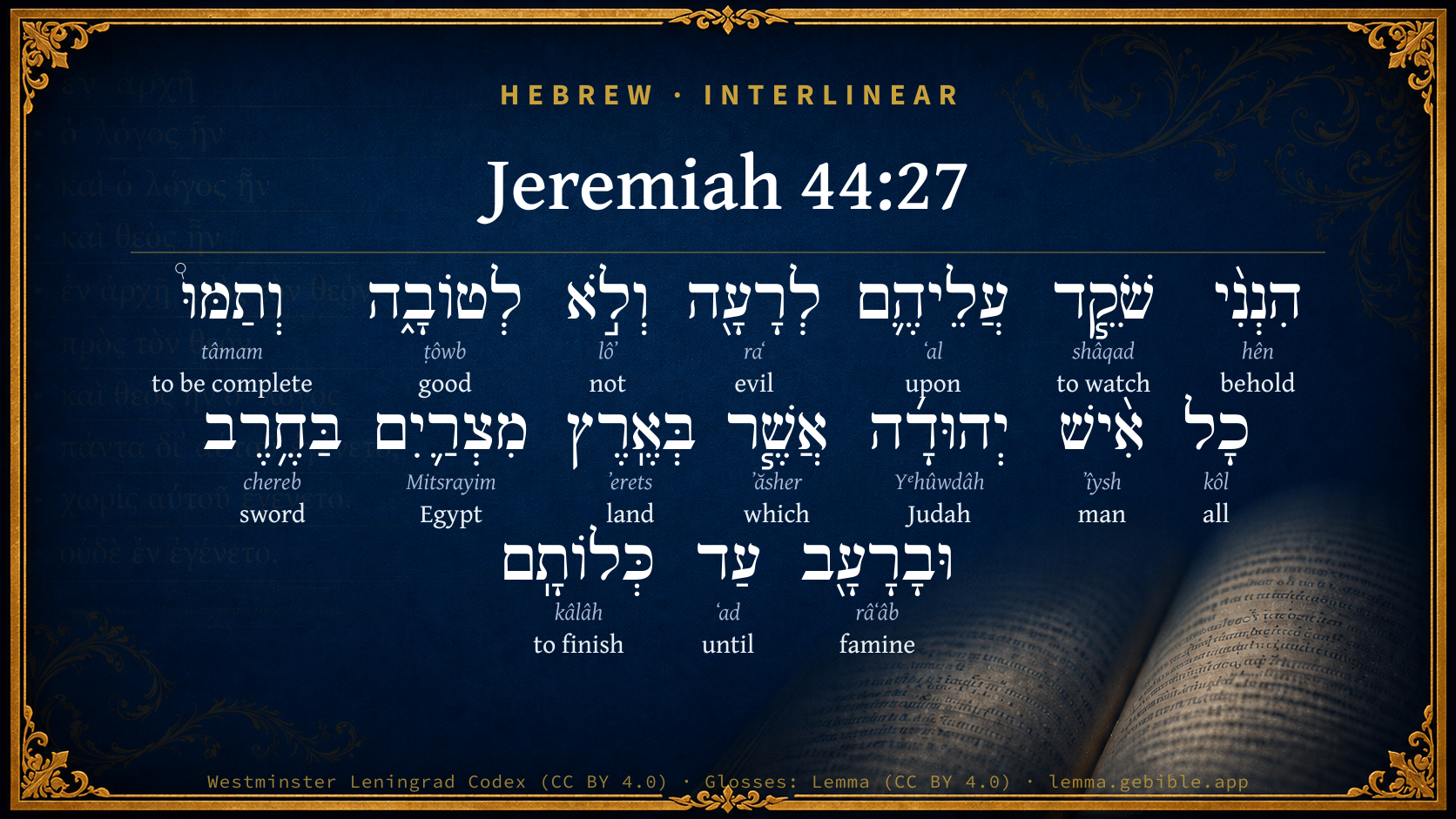
Hebrew (Westminster Leningrad Codex) Jeremiah 44:27 appears in the Hebrew Old Testament. The text above is from the Westminster Leningrad Codex. Each word links to its Strong’s number, a concise gloss, and parsing drawn from the Open Scriptures Hebrew Bible morphology. Click any word for its full Brown-Driver-Briggs (BDB) entry.
Download image
Cite this verse

Jeremiah 44:27 (World English Bible). Public Domain. Lemma interlinear Bible study tool, https://lemma.gebible.app/v/jeremiah/44/27.

Show BibTeX & RIS
BibTeX
RIS
English Translation
Behold, I watch over them for evil, and not for good; and all the men of Judah who are in the land of Egypt shall be consumed by the sword and by the famine, until there be an end of them.
World English Bible · Public Domain
Download a study sheet

One document with this verse’s original text, its word-by-word gloss line, the meaning frame, cross-references with their text, attributed commentary, and full source and license credits — printable, and it pastes into notes with its structure intact.

This verse Autodidact and up

Study sheet (.html) Plain text (.txt)

A passage Seminary Student

Up to 50 verses in one chapter. A passage sheet keeps up to 6 commentary sources and 12 cross-references per verse, in the order this page ranks them, and says so on the sheet whenever that leaves anything out. Ask for a single verse and you get the Autodidact verse sheet above.

Everything on this page stays free to read, with no account — the sheet is a download of what is already on screen, not access to it.

Want to remove ads? Support Godless Engineer
Compare translations 3

The same verse in 3 English versions, stacked beneath the original-language interlinear above. Click any original word for its lexicon entry.

Each is an independent rendering of the whole verse — the interlinear is not word-aligned to these translations.

Highlighted words mark where these versions differ — a whole-verse word diff, not a word-by-word alignment.

  • World English Bible Public Domain
    Behold, I watch over them for evil, and not for good; and all the men of Judah who are in the land of Egypt shall be consumed by the sword and by the famine, until there be an end of them.
  • King James Version Public Domain
    Behold, I will watch over them for evil, and not for good: and all the men of Judah that are in the land of Egypt shall be consumed by the sword and by the famine, until there be an end of them.
  • unfoldingWord Literal Text CC BY-SA 4.0
    See, I am watching over them for disaster and not for good. Every person of Judah in the land of Egypt will perish by sword and famine until they are all finished.

unfoldingWord Literal Text — © unfoldingWord, licensed CC BY-SA 4.0. Word-aligned USFM3 via Door43 (git.door43.org/unfoldingWord/en_ult).

Versions to compare (up to 4)

3 of 4 selected

Show all 18 translations

Every available English version of this verse, each an independent rendering of the whole verse.

  • World English Bible Public Domain
    Behold, I watch over them for evil, and not for good; and all the men of Judah who are in the land of Egypt shall be consumed by the sword and by the famine, until there be an end of them.
  • Berean Standard Bible Public Domain
    I am watching over them for harm and not for good, and every man of Judah who is in the land of Egypt will meet his end by sword or famine, until they are finished off.
  • Majority Standard Bible Public Domain
    I am watching over them for harm and not for good, and every man of Judah who is in the land of Egypt will meet his end by sword or famine, until they are finished off.
  • King James Version Public Domain
    Behold, I will watch over them for evil, and not for good: and all the men of Judah that are in the land of Egypt shall be consumed by the sword and by the famine, until there be an end of them.
  • American Standard Version (1901) Public Domain
    Behold, I watch over them for evil, and not for good; and all the men of Judah that are in the land of Egypt shall be consumed by the sword and by the famine, until there be an end of them.
  • Revised Version (1885) Public Domain
    Behold, I watch over them for evil, and not for good: and all the men of Judah that are in the land of Egypt shall be consumed by the sword and by the famine, until there be an end of them.
  • Geneva Bible (1599) Public Domain
    Behold, I wil watch ouer them for euil and not for good, and all men of Iudah that are in the land of Egypt, shalbe consumed by the sword, and by the famine, vntill they be vtterly destroied.
  • Douay-Rheims (1899) Public Domain
    Behold I will watch over them for evil, and not for good: and all the men of Juda that are in the land of Egypt, shall be consumed, by the sword, and by famine, till there be an end of them.
  • Young's Literal Translation Public Domain
    Lo, I am watching over them for evil, and not for good, and consumed have been all the men of Judah who `are' in the land of Egypt, by sword and by famine, till their consumption.
  • Literal Standard Version CC BY-SA 4.0
    Behold, I am watching over them for calamity, and not for good, and all the men of Judah who [are] in the land of Egypt have been consumed by sword and by famine, until their consumption.
  • Unlocked Literal Bible CC BY-SA 4.0
    See, I am watching over them for disaster and not for good. Every person of Judah in the land of Egypt will perish by sword and famine until they are all finished.
  • unfoldingWord Literal Text CC BY-SA 4.0
    See, I am watching over them for disaster and not for good. Every person of Judah in the land of Egypt will perish by sword and famine until they are all finished.
  • Darby Bible Public Domain
    Behold, I will watch over them for evil, and not for good; and all the men of Judah that are in the land of Egypt shall be consumed by the sword and by the famine, until there be an end of them.
  • World Messianic Bible Public Domain
    Behold, I watch over them for evil, and not for good; and all the men of Judah who are in the land of Egypt will be consumed by the sword and by the famine, until they are all gone.
  • Webster's Bible Public Domain
    Behold, I will watch over them for evil, and not for good: and all the men of Judah that are in the land of Egypt shall be consumed by the sword and by the famine, until there shall be an end of them.
  • Free Bible Version CC BY-SA 4.0
    I will take care of them in the bad sense, and not in the good sense. All the people from Judah who are in Egypt will die by sword or famine, until they are wiped out.
  • Bible in Basic English Public Domain
    See, I am watching over them for evil and not for good: all the men of Judah who are in the land of Egypt will be wasted by the sword and by need of food till there is an end of them.
  • JPS Tanakh (1917) Public Domain
    Behold, I watch over them for evil, and not for good; and all the men of Judah that are in the land of Egypt shall be consumed by the sword and by the famine, until there be an end of them.

Literal Standard Version (2020), Covenant Press — licensed CC BY-SA 4.0. Text via the HelloAO Bible API (eBible.org). Unlocked Literal Bible (unfoldingWord) — licensed CC BY-SA 4.0. Text via the HelloAO Bible API (eBible.org). unfoldingWord Literal Text — © unfoldingWord, licensed CC BY-SA 4.0. Word-aligned USFM3 via Door43 (git.door43.org/unfoldingWord/en_ult). Free Bible Version, Dr. Jonathan Gallagher — licensed CC BY-SA 4.0. Text via the HelloAO Bible API (eBible.org).

Word by word

More ways to search: Search by grammar → Find every occurrence → Compare this word →

Practice this passage: Drill this verse → Learn its vocabulary →

שֹׁקֵ֧ד
shâqad
H8245
“watching”
Verb, Qal, Participle Active, Masculine, Singular, Absolute
Part of Speech
Verb
Stem
Qal
Form
Participle Active
Gender
Masculine
Number
Singular
State
Absolute
Full BDB Definition

Origin: a primitive root

TWOT: 2451

to wake, watch, awake, be alert - (Qal) - to keep watch of, be wakeful over - to be wakeful, wake (as mourner or sufferer)
  1. הִנְנִ֨י hên H2005 “behold · me” Particle, Demonstrative + Suffix, Personal, 1st Person, Common, Singular
  2. עֲלֵיהֶ֛ם ʻal H5921 “upon · them” Preposition + Suffix, Personal, 3rd Person, Masculine, Plural
  3. לְרָעָ֖ה raʻ H7451 “to/for · evil” Preposition + Noun, Common, Feminine, Singular, Absolute
  4. וְלֹ֣א lôʼ H3808 “and · not” Conjunction + Particle, Negative
  5. לְטוֹבָ֑ה ṭôwb H2896 “to/for · good” Preposition + Adjective, Adjective, Feminine, Singular, Absolute
  6. וְתַמּוּ֩ tâmam H8552 “and · to be complete” Conjunction + Verb, Qal, Sequential Perfect, 3rd Person, Common, Plural
  7. כָל kôl H3605 “all of” Noun, Common, Masculine, Singular, Construct
  8. אִ֨ישׁ ʼîysh H376 “man of” Noun, Common, Masculine, Singular, Construct
  9. יְהוּדָ֜ה Yᵉhûwdâh H3063 “Judah” Noun, Proper
  10. אֲשֶׁ֧ר ʼăsher H834 “which” Particle, Relative
  11. בְּאֶֽרֶץ ʼerets H776 “in/at · land of” Preposition + Noun, Common, Both, Singular, Construct
  12. מִצְרַ֛יִם Mitsrayim H4714 “Egypt” Noun, Proper
  13. בַּחֶ֥רֶב chereb H2719 “in/at the · sword” Preposition, Determined + Noun, Common, Feminine, Singular, Absolute
  14. וּבָרָעָ֖ב râʻâb H7458 “and · in/at the · famine” Conjunction + Preposition, Determined + Noun, Common, Masculine, Singular, Absolute
  15. עַד ʻad H5704 “until” Preposition
  16. כְּלוֹתָֽם kâlâh H3615 “to finish · them” Verb, Qal, Infinitive Construct + Suffix, Personal, 3rd Person, Masculine, Plural

About this verse

These counts appear in no published source. They are computed here, from the morphology-tagged text and Lemma’s own curated glosses. What Lemma adds →

17
words
17
distinct lemmas
Prophets
section

Notable vocabulary

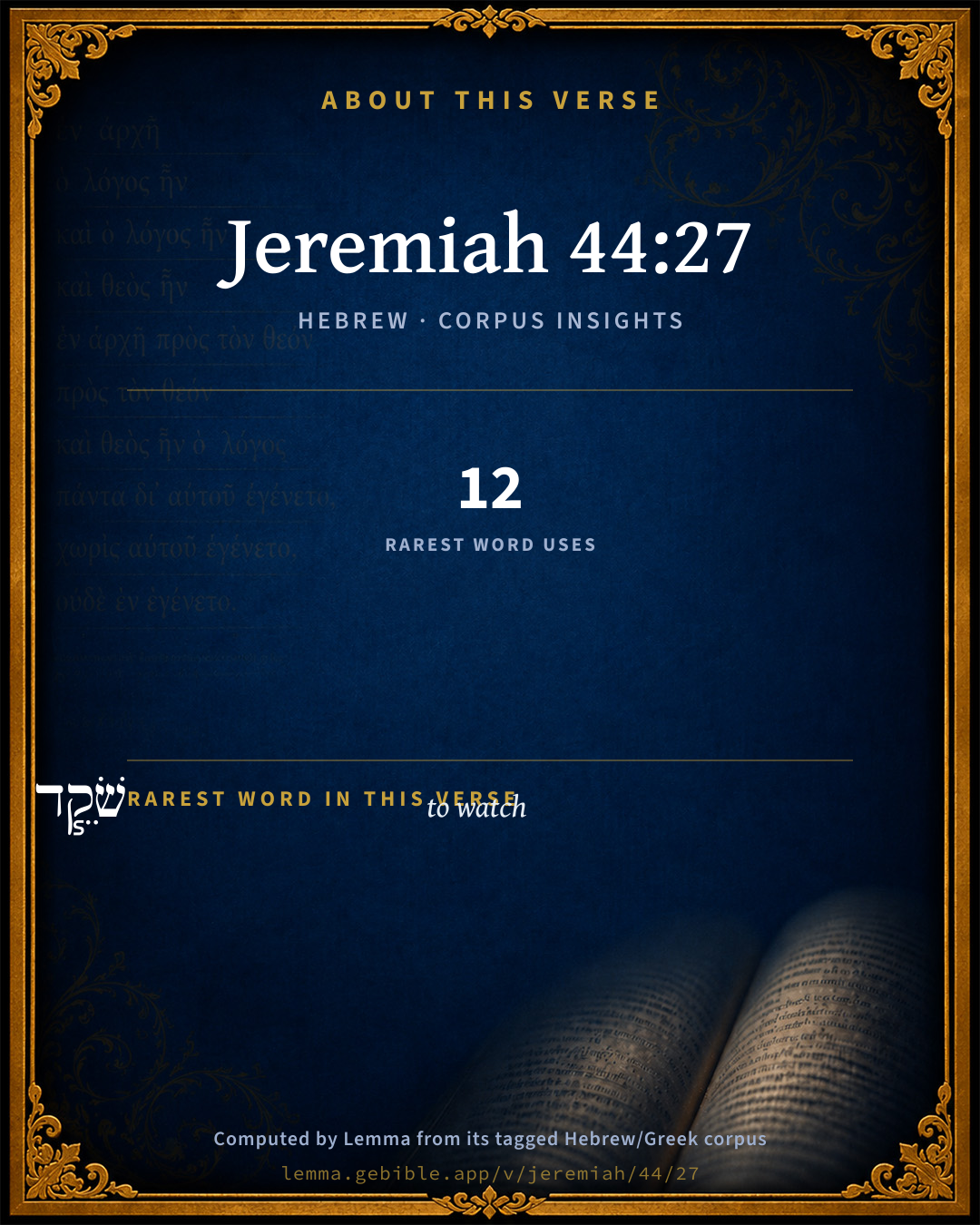
The rarest word here is שֹׁקֵ֧ד to watch H8245 — appearing just 12 times in the whole Hebrew Bible.

Shared distinctive vocabulary

שֹׁקֵ֧ד to watch H8245 occurs in 11 verses of the Hebrew Bible. Also found in:

Grammatical profile

  • 3 verbs
  • 8 nouns
  • 1 adjective
  • 2 prepositions
  • 3 particles

Verb forms

  • שֹׁקֵ֧ד Qal · Participle Active
  • וְתַמּוּ֩ Qal · Sequential Perfect
  • כְּלוֹתָֽם Qal · Infinitive Construct

Cross-references

7

Topical passages linked to Jeremiah 44:27 in the Treasury of Scripture Knowledge — connected by theme and wording, ordered by reader-vote popularity; previews shown in the World English Bible.

  • Jeremiah 31:28 It shall happen that, like as I have watched over them to pluck up and to break down and to overthrow and to destroy and to afflict, so will I watch over them to build and to plant, says Yahweh.
  • 2 Kings 21:14 I will cast off the remnant of my inheritance, and deliver them into the hand of their enemies; and they shall become a prey and a spoil to all their enemies;
  • Jeremiah 1:10 behold, I have this day set you over the nations and over the kingdoms, to pluck up and to break down and to destroy and to overthrow, to build and to plant.
  • Jeremiah 21:10 For I have set my face on this city for evil, and not for good, says Yahweh: it shall be given into the hand of the king of Babylon, and he shall burn it with fire.
  • Jeremiah 44:12 I will take the remnant of Judah, that have set their faces to go into the land of Egypt to sojourn there, and they shall all be consumed; in the land of Egypt shall they fall; they shall be consumed by the sword and by the famine; they shall die, from the least even to the greatest, by the sword and by the famine; and they shall be an object of horror, [and] an astonishment, and a curse, and a reproach.
  • Jeremiah 44:18 But since we left off burning incense to the queen of the sky, and pouring out drink-offerings to her, we have wanted all things, and have been consumed by the sword and by the famine.
  • Ezekiel 7:6 An end is come, the end is come; it awakes against you; behold, it comes.

Cross-references courtesy of OpenBible.info (CC BY 4.0).

Hebrew and Greek witnesses Masoretic Hebrew ↔ Greek Septuagint

The same verse in the two great witnesses to the Old Testament, shown verse-for-verse.

These are two independent witnesses, not word-aligned to each other, and the Septuagint is shown in lemma (dictionary) form.

Hebrew Jeremiah 44:27 Masoretic · Westminster Leningrad Codex

הִנְנִ֨י שֹׁקֵ֧ד עֲלֵיהֶ֛ם לְרָעָ֖ה וְלֹ֣א לְטוֹבָ֑ה וְתַמּוּ֩ כָל אִ֨ישׁ יְהוּדָ֜ה אֲשֶׁ֧ר בְּאֶֽרֶץ מִצְרַ֛יִם בַּחֶ֥רֶב וּבָרָעָ֖ב עַד כְּלוֹתָֽם

Behold, I watch over them for evil, and not for good; and all the men of Judah who are in the land of Egypt shall be consumed by the sword and by the famine, until there be an end of them.

World English Bible · Public Domain

Greek LXX Structure differs

In the Septuagint, Jeremiah is about an eighth shorter than the Hebrew and arranges its material differently — the Oracles Against the Nations (Hebrew chapters 46–51) appear in the middle of the Greek book, after 25:13. Because the chapter and verse boundaries do not line up, a verse-for-verse comparison with the Hebrew is not shown.

A verse-for-verse comparison isn’t shown here because the chapters and verses don’t line up. Switch to the LXX edition with the MT / LXX toggle above to read the Greek directly.

Hebrew: Westminster Leningrad Codex (CC BY 4.0). Greek: Septuagint (public domain); English from a public-domain English Septuagint. How the Septuagint differs from the Hebrew →

Targum (Aramaic paraphrase)

1

The Targum is the ancient Jewish Aramaic paraphrase of the Hebrew Scriptures — an interpretive translation, not the Hebrew text itself. Onkelos (literal) and Pseudo-Jonathan (expansive) render the Torah, and Jonathan the Prophets. Coverage is partial: where no permissively-licensed English translation exists for a verse, only the Aramaic is shown. This is verse-level text, not a word-by-word alignment to the Hebrew.

  1. Targum Jonathan Prophets (Joshua–Malachi)
    הָא אֲנָא מַסְעַר עֲלֵיהוֹן לְבִישָׁא וְלָא לְטָבָא וִיסוּפוּן כָּל אֱנַשׁ יְהוּדָה דִי בְאַרְעָא דְמִצְרַיִם בְּחַרְבָּא וּבְכַפְנָא עַד דְיִשְׁתֵּיצוּן:

    (no public-domain English translation for this verse)

    Targum Jonathan — Aramaic: “Mikraot Gedolot” (public domain). English: “Sefaria Community Translation” (CC0 1.0 (public-domain dedication)); “London "Chaldee Paraphrase," 1871” (public domain). Text via Sefaria.

Commentary

Notes on Jeremiah 44:27 from classic Christian and Jewish commentators (each source and its license shown beneath its notes). The classic Christian expositions comment on the surrounding passage and are grouped to its opening verse, so a note may address several verses; the Jewish commentaries on the Tanakh (Rashi and others) are per-verse, so they appear only where the commentator wrote on this verse.

Lemma curates 59 commentaries, every one of them public domain or Creative Commons licensed, each selected and text-cleaned for this edition rather than reprinted as found. About our sources →

Trapp's Complete Commentary

John Trapp

Jer 44:27 Behold, I will watch over them for evil, and not for good: and all the men of Judah that [are] in the land of Egypt shall be consumed by the sword and by the famine, until there be an end of them.

Ver. 27. Behold, I will watch over them for evil.] I will watch them a shrewd turn, as we say. I will take my time to hit them when I may most hurt them.

John Trapp, A Commentary or Exposition upon All the Books of the Old and New Testament (1647–1656) — public domain. Text from a community e-Sword module.

Jamieson, Fausset & Brown

Robert Jamieson, A. R. Fausset & David Brown

watch over . . . for evil-- (Jer 1:10; Eze 7:6). The God, whose providence is ever solicitously watching over His people for good, shall solicitously, as it were, watch for their hurt. Contrast Jer 31:28; Jer 32:41.

Jamieson, Fausset & Brown — Commentary Critical and Explanatory on the Whole Bible (1871) — public domain (CC PDM 1.0). Text via the HelloAO Bible API.

John Calvin's Commentaries

Here he more dearly expresses what he had said in the last verse, that none of the Jews would remain alive in Egypt. He now then points out the manner, even because he would not cease to consume them until they wholly perished and were brought to final ruin. He had said, No more shall my name be called, nor shall the Jews in Egypt swear, Live doth Jehovah; and why? because I will destroy them all, so that there will be none remaining in Egypt to pollute under a false pretense my name.

I will watch over them, he says, for evil and not for good This mode of speaking we have observed elsewhere, and explained why the Prophets spoke thus, even because hypocrites, though they think God cares not for human affairs, and imagine that he sleeps in heaven, and hence audaciously provoke him, as though they were fugitives and their purpose hid from God, yet boast of God’s providence, and pretend that they acquiesce confidently in him. For this reason the Prophet answered, that God watched indeed, but not for good We then perceive the object of the Prophet; he derided the presumption of the people, who thought that God had a care for their safety. He then says, that God indeed does not sleep, but that this would bring no benefit to hypocrites; for though God watches as a father to preserve his own people, he yet watches as a judge to destroy all the ungodly. It follows, —

John Calvin's Commentaries (1540-1563) — public domain. Text from the Calvin Translation Society English edition (1840s-50s) via the Christian Classics Ethereal Library (ccel.org). Calvin's coverage is partial (roughly two-thirds of the Bible); uncommented books and verses are honest gaps, never fabricated. The 19th-century editor's footnotes and remarks are omitted so the notes are faithfully Calvin's own voice.

The Cambridge Bible for Schools and Colleges

gen. ed. J. J. S. Perowne

27. for evil, and not for good] Cp. Jer_1:12, Jer_31:28.

The Cambridge Bible for Schools and Colleges (gen. ed. J. J. S. Perowne; Cambridge University Press, 1878–1918) — public domain. Text from a community e-Sword module.

John Gill's Exposition

Behold, I will watch over them for evil, and not for good,.... To bring the evil of punishment upon them, the particulars of which are after mentioned, and not the blessings of goodness, as formerly; and this he would be as careful and diligent to bring about, as one that watches all opportunities to do hurt to another; and it must be dreadful to be under the vigilant avenging eye of God:

and all the men of Judah that are in the land of Egypt shall be consumed by the sword, and by the famine, until there be an end of them; that is, the greatest part of them, excepting a few that shall escape, hereafter mentioned, particularly Jeremiah and Baruch; but as for the main body of such, who went of their own accord to Egypt, and settled, and fell: into the idolatry of the country; these should all perish one after another, till there were none of them left; either by the sword of the king of Babylon; or by famine, which his army and sieges would produce; or by pestilence, though not here mentioned, yet is in Jer 44:13.

John Gill's Exposition of the Whole Bible (1746–1763) — public domain (CC PDM 1.0). Text via the HelloAO Bible API.

Matthew Poole's English Annotations

God here either sets out himself as one who would be industrious and solicitous to bring evil upon them, as men who are so in any business watch opportunities to do it; or else he derides their vain confidence as to his protection of them, and care for them: saith God, I will watch over them, but not to build and to plant, as Jer 31:28, but, as it is in the former part of that verse, to pluck up, and to throw down, and to destroy, and to afflict. For so it follows,

they shall be consumed by the sword and by the famine.

Matthew Poole's English Annotations on the Holy Bible (1683–1685) — public domain. Text from a community e-Sword/MySword module.

Whedon's Commentary on the Bible

Daniel D. Whedon

27. Watch… for evil — As the wild beast watches for his prey. See Jer_1:12, and Jer_5:6.

Daniel D. Whedon (gen. ed.), Commentary on the Old and New Testaments (1874–1909) — public domain. Text from a community e-Sword module.

The Pulpit Commentary

Watching over men for evil.

I THIS WATCHING IS NEVER IRRESPECTIVE OF CONDUCT. If God ever watches over any man for evil it is because the man"s conduct deserves it. It is not so necessarily with our watching. We may watch over a man for evil either from intensity of malice or intensity of selfishness. We may wish to do him ill from revenge or because his prosperity seems to mean our adversity. A word announcing watch over men for evil is a very serious word to fall even from Divine lips; and While,god may speak it, perhaps we ought never to speak it. But at the same time, we cannot help watching over men for evil, and what we need especially to guard ourselves against is the doing of this from wrong motives. We must follow in the footsteps of God himself. When we censure others, or oppose them, or make them suffer in any way, let it be clear to ourselves and as far as possible clear to the world that their conduct has demanded it.

II EVIL CONDUCT IS NEVER SEPARATED FROM SUCH WATCHING. God says that he is watching in this particular instance, but we know that he watches for evil against all evil doers. We speak of evil doing as being invariably followed by suffering, but this is only one way of putting the matter. We may also say that when suffering follows our wickedness it is the proof that God is watching for evil over the evil doer. And in this matter we need zealously and boldly to do as God does, though, of course, we must do it according to the measure of human limits and infirmity. When any one is engaged with determination in any evil pursuit, it must be ours to show that we are by no means indifferent. God"s watching over wicked men for evil is often done through the eyes of his own people; for if we have the Spirit of God in us there will be something of Divine discernment.

III A CONNECTED TRUTH THAT NEEDS TO BE CONSIDERED AT THE SAME TIME. If God watches over the wicked for evil and not for good, it is equally true that he watches over the righteous for good and not for evil. Not one life, going on patiently and bravely in uprightness, is unobserved by him. Whatever the appearances may be, the abiding realities of life are against the wicked and for the righteous. Y.

The Pulpit Commentary (1880–1919), ed. H.D.M. Spence-Jones & Joseph S. Exell — public domain. Text from a community e-Sword module.

Lesson kit

Teaching starters — assembled from the data on this page, not authored interpretation. Every prompt links to the verse data it draws on. Edit before teaching.

Jeremiah, in the Prophets, opens this verse with 17 words (17 distinct Hebrew lemmas). Its most distinctive word is shâqad (“to watch”). A historical commentator’s framing appears above. Read the whole chapter for the surrounding context.

Discussion questions

  1. How does “to watch” (shâqad) shape what this verse is saying?
  2. Ezra 8:29 shares the word «to watch» with this verse. How do the two illuminate each other?
  3. These translations render this verse differently; the difference is in the English rendering, not the original. What questions does that raise?
  4. The verb «שֹׁקֵ֧ד» is Qal Participle Active. How does its form color the action?
  5. Reading how Trapp's Complete Commentary and Jamieson, Fausset & Brown read this verse, where do the two commentators agree and where do they part?

Things to notice

Reading settings

Reading text

Shown beneath each verse's original-language words.

Old Testament
Old Testament edition

Read the OT as the Masoretic Hebrew (MT) or the Greek Septuagint (LXX).

English shown for the Greek Septuagint (in the Hebrew ↔ Greek comparison).

Comparing translations? Open the Compare panel on any verse page to stack up to four side by side.