
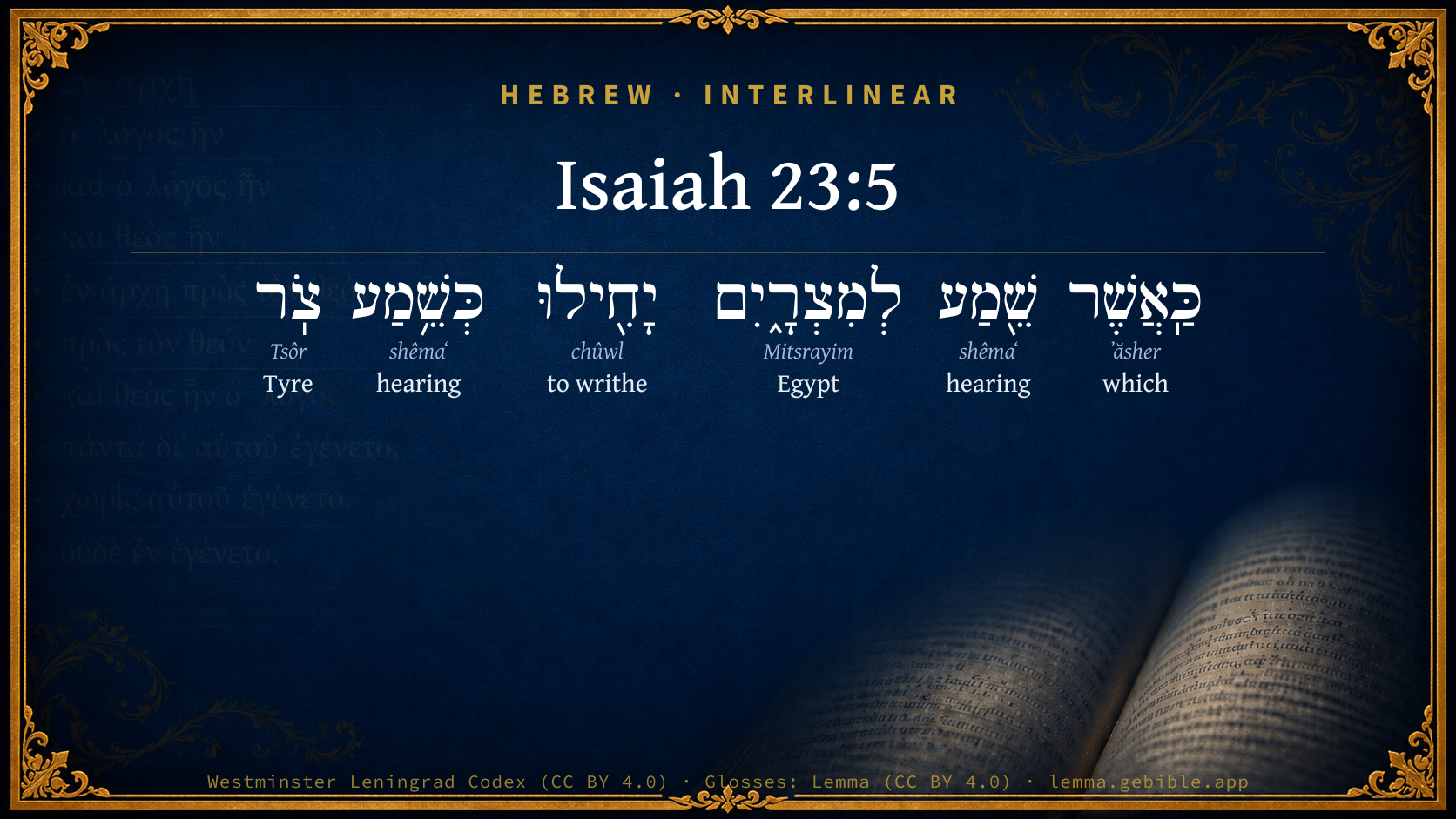
Isaiah 23:5

Hebrew (Westminster Leningrad Codex) Isaiah 23:5 appears in the Hebrew Old Testament. The text above is from the Westminster Leningrad Codex. Each word links to its Strong’s number, a concise gloss, and parsing drawn from the Open Scriptures Hebrew Bible morphology. Click any word for its full Brown-Driver-Briggs (BDB) entry.
Download image
Cite this verse

Isaiah 23:5 (World English Bible). Public Domain. Lemma interlinear Bible study tool, https://lemma.gebible.app/v/isaiah/23/5.

Show BibTeX & RIS
BibTeX
RIS
English Translation
When the report comes to Egypt, they shall be sorely pained at the report of Tyre.
World English Bible · Public Domain
Download a study sheet

One document with this verse’s original text, its word-by-word gloss line, the meaning frame, cross-references with their text, attributed commentary, and full source and license credits — printable, and it pastes into notes with its structure intact.

This verse Autodidact and up

Study sheet (.html) Plain text (.txt)

A passage Seminary Student

Up to 50 verses in one chapter. A passage sheet keeps up to 6 commentary sources and 12 cross-references per verse, in the order this page ranks them, and says so on the sheet whenever that leaves anything out. Ask for a single verse and you get the Autodidact verse sheet above.

Everything on this page stays free to read, with no account — the sheet is a download of what is already on screen, not access to it.

Want to remove ads? Support Godless Engineer
Compare translations 3

The same verse in 3 English versions, stacked beneath the original-language interlinear above. Click any original word for its lexicon entry.

Each is an independent rendering of the whole verse — the interlinear is not word-aligned to these translations.

Highlighted words mark where these versions differ — a whole-verse word diff, not a word-by-word alignment.

  • World English Bible Public Domain
    When the report comes to Egypt, they shall be sorely pained at the report of Tyre.
  • King James Version Public Domain
    As at the report concerning Egypt, so shall they be sorely pained at the report of Tyre.
  • unfoldingWord Literal Text CC BY-SA 4.0
    When the report to Egypt, they will writhe at the report of Tyre.

unfoldingWord Literal Text — © unfoldingWord, licensed CC BY-SA 4.0. Word-aligned USFM3 via Door43 (git.door43.org/unfoldingWord/en_ult).

Versions to compare (up to 4)

3 of 4 selected

Show all 18 translations

Every available English version of this verse, each an independent rendering of the whole verse.

  • World English Bible Public Domain
    When the report comes to Egypt, they shall be sorely pained at the report of Tyre.
  • Berean Standard Bible Public Domain
    When the report reaches Egypt, they will writhe in agony over the news of Tyre.
  • Majority Standard Bible Public Domain
    When the report reaches Egypt, they will writhe in agony over the news of Tyre.
  • King James Version Public Domain
    As at the report concerning Egypt, so shall they be sorely pained at the report of Tyre.
  • American Standard Version (1901) Public Domain
    When the report cometh to Egypt, they shall be sorely pained at the report of Tyre.
  • Revised Version (1885) Public Domain
    When the report cometh to Egypt, they shall be sorely pained at the report of Tyre.
  • Geneva Bible (1599) Public Domain
    When the fame commeth to the Egyptians, they shall be sorie, concerning the rumour of Tyrus.
  • Douay-Rheims (1899) Public Domain
    When it shall be heard in Egypt, they will be sorry when they shall hear of Tyre:
  • Young's Literal Translation Public Domain
    As `at' the report of Egypt they are pained, So `at' the report of Tyre.
  • Literal Standard Version CC BY-SA 4.0
    As they are pained [at] the report of Egypt, || So [at] the report of Tyre.
  • Unlocked Literal Bible CC BY-SA 4.0
    When the report comes to Egypt, they will be grieved concerning Tyre.
  • unfoldingWord Literal Text CC BY-SA 4.0
    When the report to Egypt, they will writhe at the report of Tyre.
  • Darby Bible Public Domain
    -- When the report came into Egypt, they were sorely pained at the news of Tyre.
  • World Messianic Bible Public Domain
    When the report comes to Egypt, they will be in anguish at the report of Tyre.
  • Webster's Bible Public Domain
    As at the report concerning Egypt, so shall they be sorely pained at the report of Tyre.
  • Free Bible Version CC BY-SA 4.0
    When the news about Tyre reaches Egypt they will be in agony.
  • Bible in Basic English Public Domain
    When the news comes to Egypt they will be bitterly pained at the fate of Tyre.
  • JPS Tanakh (1917) Public Domain
    When the report cometh to Egypt, they shall be sorely pained at the report of Tyre.

Literal Standard Version (2020), Covenant Press — licensed CC BY-SA 4.0. Text via the HelloAO Bible API (eBible.org). Unlocked Literal Bible (unfoldingWord) — licensed CC BY-SA 4.0. Text via the HelloAO Bible API (eBible.org). unfoldingWord Literal Text — © unfoldingWord, licensed CC BY-SA 4.0. Word-aligned USFM3 via Door43 (git.door43.org/unfoldingWord/en_ult). Free Bible Version, Dr. Jonathan Gallagher — licensed CC BY-SA 4.0. Text via the HelloAO Bible API (eBible.org).

Word by word

More ways to search: Search by grammar → Find every occurrence → Compare this word →

Practice this passage: Drill this verse → Learn its vocabulary →

About this verse

These counts appear in no published source. They are computed here, from the morphology-tagged text and Lemma’s own curated glosses. What Lemma adds →

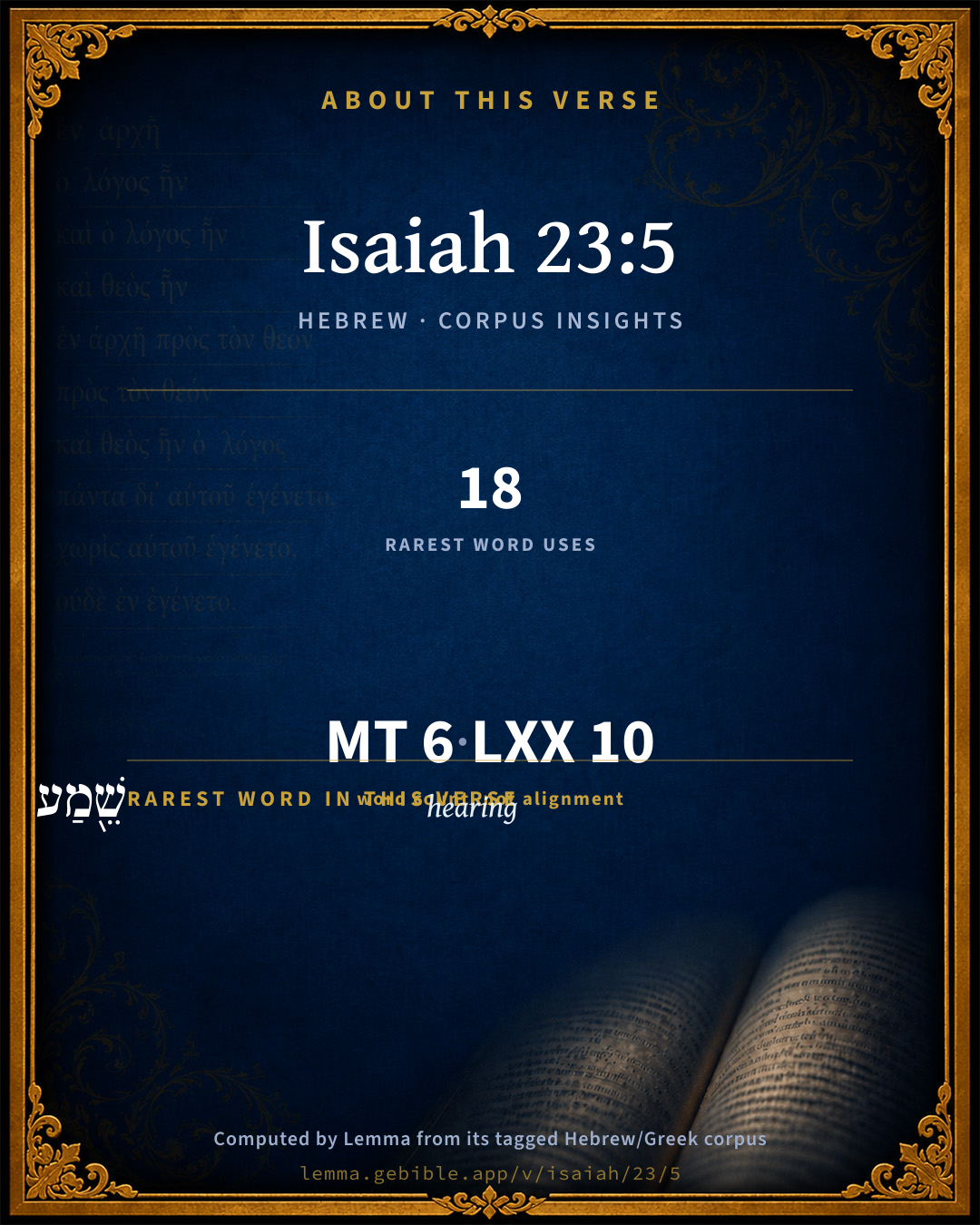
6
words
5
distinct lemmas
Prophets
section

Notable vocabulary

The rarest word here is שֵׁ֖מַע hearing H8088 — appearing just 18 times in the whole Hebrew Bible.

Shared distinctive vocabulary

שֵׁ֖מַע hearing H8088 occurs in 17 verses of the Hebrew Bible. Also found in:

Grammatical profile

  • 1 verb
  • 4 nouns
  • 1 particle

Verb forms

  • יָחִ֖ילוּ Qal · Imperfect

Repetition

A word recurs within this verse — often emphatic in Hebrew:

  • שֵׁ֖מַע hearing H8088 ×2

Hebrew & Septuagint length

In English translation the verse runs 16 words from the Hebrew and 14 from the Septuagint (LXX English) — closely comparable.

A rough comparison of the two English renderings, which tokenize alike — not a word-level alignment.

Word counts can differ between the Hebrew and the Greek without any difference in meaning — e.g. the Hebrew direct-object marker אֵת has no separate Greek word, and Greek often adds the article ὁ.

In the original languages it is 6 Hebrew tokens and 10 Greek tokens — but the two are counted differently (Hebrew bundles its prefixes and suffixes into one token; the Greek is in lemma form), so that isn’t a like-for-like length.

Cross-references

7

Topical passages linked to Isaiah 23:5 in the Treasury of Scripture Knowledge — connected by theme and wording, ordered by reader-vote popularity; previews shown in the World English Bible.

  • Exodus 15:14–16 The peoples have heard. They tremble. Pangs have taken hold on the inhabitants of Philistia.
  • Joshua 2:9–11 and she said to the men, I know that Yahweh has given you the land, and that the fear of you is fallen on us, and that all the inhabitants of the land melt away before you.
  • Ezekiel 26:15–21 Thus says the Lord Yahweh to Tyre: shall not the isles shake at the sound of your fall, when the wounded groan, when the slaughter is made in the midst of you?
  • Ezekiel 27:29–36 All who handled the oar, the mariners, [and] all the pilots of the sea, shall come down from their ships; they shall stand on the land,
  • Ezekiel 28:19 All those who know you among the peoples shall be astonished at you: you are become a terror, and you shall nevermore have any being.
  • Revelation 18:17–19 For in an hour such great riches are made desolate.' Every shipmaster, and everyone who sails anywhere, and mariners, and as many as gain their living by sea, stood far away,
  • Isaiah 19:16 In that day shall the Egyptians be like women; and they shall tremble and fear because of the shaking of the hand of Yahweh of Hosts, which he shakes over them.

Cross-references courtesy of OpenBible.info (CC BY 4.0).

Hebrew and Greek witnesses Masoretic Hebrew ↔ Greek Septuagint

The same verse in the two great witnesses to the Old Testament, shown verse-for-verse.

These are two independent witnesses, not word-aligned to each other, and the Septuagint is shown in lemma (dictionary) form.

Hebrew Isaiah 23:5 Masoretic · Westminster Leningrad Codex

כַּֽאֲשֶׁר שֵׁ֖מַע לְמִצְרָ֑יִם יָחִ֖ילוּ כְּשֵׁ֥מַע צֹֽר

When the report comes to Egypt, they shall be sorely pained at the report of Tyre.

World English Bible · Public Domain

Greek LXX Isaiah 23:5 Septuagint · lemma form

ὅταν δέ ἀκουστός γίγνομαι αἴγυπτος λαμβάνω αὐτός ὀδύνη περί τύρος

Moreover when it shall be heard in Egypt, sorrow shall seize them for Tyre.

LXX2012 (modern English Septuagint) · Public Domain

On this verse, John Gill's Exposition discusses the Septuagint’s reading. Read the note in Commentary ↓

Hebrew: Westminster Leningrad Codex (CC BY 4.0). Greek: Septuagint (public domain); English from LXX2012 (modern English Septuagint) (Public Domain). How the Septuagint differs from the Hebrew →

Targum (Aramaic paraphrase)

1

The Targum is the ancient Jewish Aramaic paraphrase of the Hebrew Scriptures — an interpretive translation, not the Hebrew text itself. Onkelos (literal) and Pseudo-Jonathan (expansive) render the Torah, and Jonathan the Prophets. Coverage is partial: where no permissively-licensed English translation exists for a verse, only the Aramaic is shown. This is verse-level text, not a word-by-word alignment to the Hebrew.

  1. Targum Jonathan Prophets (Joshua–Malachi)
    כְּמָא דִי שְׁמָעוּ לְמַחֲתָא דִלְקוֹ מִצְרָאֵי זָעוּ כַּד שְׁמַעוּ צוֹרָאֵי:

    When they heard of the stroke wherewith the Egyptians were smitten, the Tyrians quaked when they heard it.

    Targum Jonathan — Aramaic: “Mikraot Gedolot” (public domain). English: “Sefaria Community Translation” (CC0 1.0 (public-domain dedication)); “London "Chaldee Paraphrase," 1871” (public domain). Text via Sefaria.

Commentary

Notes on Isaiah 23:5 from classic Christian and Jewish commentators (each source and its license shown beneath its notes). The classic Christian expositions comment on the surrounding passage and are grouped to its opening verse, so a note may address several verses; the Jewish commentaries on the Tanakh (Rashi and others) are per-verse, so they appear only where the commentator wrote on this verse.

Lemma curates 59 commentaries, every one of them public domain or Creative Commons licensed, each selected and text-cleaned for this edition rather than reprinted as found. About our sources →

Trapp's Complete Commentary

John Trapp

Isa 23:5 As at the report concerning Egypt, [so] shall they be sorely pained at the report of Tyre.

Ver. 5. As at the report concerning Egypt,] i.e, Concerning their overthrow once at the Red Sea. {Exo 15:14} They are also shortly to be overrun by Nebuchadnezzar, to whom God hath promised Egypt, as his pay for his pains taken in taking Tyre.

John Trapp, A Commentary or Exposition upon All the Books of the Old and New Testament (1647–1656) — public domain. Text from a community e-Sword module.

Joseph Benson's Commentary

Isa 23:5. As at the report concerning Egypt, &c. — “The words, as they stand in our translation, imply, that the Zidonians, spoken of Isa 23:4, or in general other neighbouring places, should be as much concerned at the news of the destruction of Tyre as they were at the calamity of Egypt, mentioned chap. 19. But there is a difficulty in admitting this sense, because the destruction of Tyre here spoken of was before that of Egypt, if we mean that calamity of Egypt which is usually joined with the destruction of Tyre in the prophets: see Jer 25:19; Jer 25:22; Eze 29:18-20. Therefore others read this verse thus: As soon as the report of Tyre shall come to, or be heard in, Egypt, they shall be in great pain for it; namely, because they exported their corn to Tyre, and made a gainful trade by it.” — Lowth.

Joseph Benson's Commentary on the Old and New Testaments (1811–1818) — public domain. Text from a community e-Sword module.

Tyndale Open Study Notes

Tyndale Open Resources

23:5 Egypt depended on the ships from Tyre for the export of its products (see 23:3).

Tyndale Open Study Notes — © Tyndale Open Resources, licensed CC BY-SA 4.0. Text via the HelloAO Bible API.

Geneva Bible (1599)

Geneva Bible translators

Because these two countries were joined in league together.

Geneva Bible (1599) marginal notes — public domain. Text via Bolls.life.

Jamieson, Fausset & Brown

Robert Jamieson, A. R. Fausset & David Brown

As, &c.--rather, "When the report (shall reach) the people of Egypt, they shall be sorely pained at the report concerning Tyre" (namely, its overthrow). So JEROME, "When the Egyptians shall hear that so powerful a neighboring nation has been destroyed, they must know their own end is near" [LOWTH, &c.].

Jamieson, Fausset & Brown — Commentary Critical and Explanatory on the Whole Bible (1871) — public domain (CC PDM 1.0). Text via the HelloAO Bible API.

Ellicott's Commentary for English Readers

(5) As at the report concerning Egypt . . .—Better, When the report cometh to Egypt . . . The news of the capture of Tyre would cause dismay in Egypt, partly because the export trade of their corn depended upon it, partly because it had served as a kind of outpost against the Assyrians, who, under Sargon (Records of the Past, vii. 34) and Sennacherib (2Ki_18:21; 2Ki_19:8), were pressing on against the Ethiopian dynasty then dominant in Egypt.

A Bible Commentary for English Readers, edited by Charles John Ellicott (1878–1897) — public domain. Text from a community e-Sword module.

The Cambridge Bible for Schools and Colleges

gen. ed. J. J. S. Perowne

5. The verse should be read as in R.V. When the report cometh to Egypt, they shall be sorely pained at the report of Tyre. Assyria being the common enemy of Egypt and Tyre, the report of the latter’s fall is received with the utmost anxiety in Egypt.

The Cambridge Bible for Schools and Colleges (gen. ed. J. J. S. Perowne; Cambridge University Press, 1878–1918) — public domain. Text from a community e-Sword module.

John Gill's Exposition

As at the report concerning Egypt,.... Its future destruction prophesied of, Isa 19:1 or what had in times past befallen it when the ten plagues were inflicted on it, and Pharaoh and his host were drowned in the Red Sea; the report of which filled the neighbouring nations with fear and trembling, and put them into a panic; so the Targum,

"as they heard the plague with which the Egyptians were smitten:''

so shall they be sorely pained at the report of Tyre; of the destruction of that; this should have the like effect upon the nations round about them, especially such as traded with them, as the judgments on Egypt had upon their neighbours; for, as for what was to come, the destruction of Tyre was before the destruction of Egypt by Nebuchadnezzar: though some read the words, and they will bear to be read thus, "when the report" was made, or came "to the Egyptians, they will be in pain at", or "according to the report of Tyre" (t);

"when it was heard in Egypt, pain shall take them for Tyre;''

as soon as the Egyptians heard of the taking and ruin of Tyre, they were in pain, as a woman in travail, partly fearing their own turn would be next, Tyre lying in the way of the Chaldeans unto them; and partly because of the loss of trade they sustained through the destruction of that city. In like pain will be the kings or merchants of the earth, at the destruction of Rome, Rev 18:9 and, according to an exposition mentioned by Jarchi, Tyre here is Edom; that is, Rome, for that with the Jews is commonly meant by Edom.

(t) So the Septuagint, Vatbalus, and others.

John Gill's Exposition of the Whole Bible (1746–1763) — public domain (CC PDM 1.0). Text via the HelloAO Bible API.

Albert Barnes' Notes on the Bible

As at the report concerning Egypt - According to our translation, this verse would seem to mean that the Sidonians and other nations had been pained or grieved at the report of the calamities that had come upon Egypt, and that they would be similarly affected at the report concerning Tyre. In accordance with this, some (as Jarchi) have understood it of the plagues of Egypt, and suppose that the prophet means to say, that as the nations were astonished at that, so they would be at the report of the calamities that would come upon Tyre. Others refer it to the calamities that. would come upon Egypt referred to in Isa. 19, and suppose that the prophet means to say, that as the nations would be amazed at the report of these calamities, so they would be at the report of the overthrow of Tyre. So Vitringa. But the sense of the Hebrew may be expressed thus: ‘As the report, or tidings of the destruction of Tyre shall reach Egypt, they shall be pained at the tidings respecting Tyre.’ So Lowth, Noyes, Rosenmuller, Grotius, Calvin. They would be grieved, either

(1) because the destruction of Tyre would injure the commerce of Egypt; or

(2) because the Egyptians might fear that the army of Nebuchadnezzar would come upon them, and that they would share the fate of Tyre.

Sorely pained - The word used here (יחילוּ yâchı̂ylû) is commonly applied to the severe pain of parturition.

Albert Barnes' Notes on the Bible (1834–1885) — public domain. Text from a community e-Sword/MySword module.

Matthew Poole's English Annotations

According to this translation the sense is, All the neighbouring nations shall be no less terrified at the tidings of lite destruction of Tyrus, than they were of old upon the report of God’s former and dreadful judgments upon the Egyptians, of which see Exo 15:14-16; Jos 2:9,11, because they shall despair of resisting that enemy against whom that vast and potent city, which was deemed impregnable, could not defend itself. But the words are by the LXX., and other both ancient and later interpreters, rendered otherwise, and that very agreeably to the Hebrew text, When the report (to wit, of the destruction of Tyre) came, or shall come, (which word is easily understood, as it is above, Isa 23:3, and in other texts of Scripture before mentioned,) to the Egyptians, they shall be sorely pained according to the report of Tyre; their grief shall be answerable to the report; as the report is very dreadful, so their grief and anguish shall be very great: or, they shall fear lest they should be destroyed in like manner as Tyrus was destroyed.

Matthew Poole's English Annotations on the Holy Bible (1683–1685) — public domain. Text from a community e-Sword/MySword module.

Whedon's Commentary on the Bible

Daniel D. Whedon

5. Concerning Egypt — The translation seems better thus: “At what time the report cometh to Egypt they shall bewail at the report of Tyre.” For the loss of Tyre is the loss of Egypt’s market for her products.

Daniel D. Whedon (gen. ed.), Commentary on the Old and New Testaments (1874–1909) — public domain. Text from a community e-Sword module.

The Pulpit Commentary

As at the report concerning Egypt; rather, when the rumor shall reach Egypt (see the Septuagint, the Vulgate, Gesenius, Knobel, Cheyne, etc.). They shall be sorely pained. The Egyptians bore no great affection towards any foreign nation. They were a people whose charity began and ended at home. But the fall of Tyre was always a shock to them, and was felt to portend evil to themselves. The Asiatic power which was strong enough to capture the island-fortress would be a formidable enemy to Egypt itself, and might be expected at no distant date to attempt the conquest of the Nile valley.

The Pulpit Commentary (1880–1919), ed. H.D.M. Spence-Jones & Joseph S. Exell — public domain. Text from a community e-Sword module.

John Wesley's Explanatory Notes

Waters - By the sea, which is very fitly called the great waters, understand, cometh, or is brought to her. The seed - The corn of Egypt, wherewith Egypt abounded. Sihor is the same as the Nile. The harvest - The plentiful harvest of corn which comes from the inundation of the Nile; emphatically called the river. The revenue - Is as plentifully enjoyed by her, as if it grew in her own territories. A mart - A place to which all nations resort for traffick.

John Wesley, Explanatory Notes Upon the Whole Bible (1754–1765) — public domain. Text via the GEBible commentary corpus.

J. A. Alexander on Isaiah

Joseph Addison Alexander

“When the report (comes) to Egypt, they are pained at the report of Tyre.” There are three distinct interpretations of this verse. The first refers the pronoun to the Sidonians or Phoenicians generally, and understands the verse to mean that they would be as much grieved to hear of the fall of Tyre as if they should hear of that of Egypt. The second makes the verb indefinite, or understands it of the nations generally, who are then said to be as much astounded at the fall of Tyre as they once were at the judgments of Jehovah upon Egypt. The third, which is the one now commonly adopted, makes Egypt itself or the Egyptians the subject of the verb. This last supposes the Egyptians to lament for the loss of their great mart and commercial ally. The idea expressed by the second construction is a much more elevated one. Either of these interpretations appears preferable to the first, which yields an unnatural and inappropriate sense.

Joseph Addison Alexander, The Prophecies of Isaiah (1846–1847; New York: Scribner, 1870–1878) — public domain. Text from a community e-Sword module.

Rashi

Rabbi Shlomo Yitzchaki (Rashi)

Like the report concerning Egypt which they heard about the Egyptians, that I had brought ten plagues upon them, and that they finally drowned in the sea.

shall they quake They shall be frightened.

at the report When the listeners hear that the report concerning Tyre has been announced, for also the plagues of Tyre shall be in the same pattern as those plagues: “Blood and fire” (Joel 3:3); (Isaiah 66:6) “A voice of tumult from the city,” like the croaking of the frogs, (Infra 34:9) “And its brooks shall be turned to pitch and its dust into sulphur,” on the pattern of the plague of lice. (Ibid. 11) “But the pelican and hedgehog shall take possession of it,” after the pattern of the plague of a mixture of noxious beasts. (Ezekiel 38:22) “And I will hold judgment over him with pestilence and with blood,” a pattern of the plague of murrain. (Zechariah 14:12) “His flesh shall consume away,” after the pattern of the plague of boils. (Supra 18:5) “And he shall cut off the tendrils,” after the pattern of the hail and locusts; (infra 34:6) “And a great massacre in the land of Edom,” corresponding to the plague of the first born. This system is true if his צוֹר is another city (Edom, Rome[Parshandatha]). If it is actually Tyre, because the sea inundated it, the prophet says about it, “Like the report concerning Egypt,” and I say that the entire section, indeed, is talking about Tyre, because Zidon is near it. ([Other editions read:] And I say that the entire section is, indeed, talking about Tyre. Because Zidon is near it, he juxtaposes Zidon to it [Parshandatha].)

Rashi on the Tanakh — English translations: “The Judaica Press complete Tanach with Rashi, translated by A. J. Rosenberg” (CC BY 4.0); “Pentateuch with Rashi's commentary by M. Rosenbaum and A.M. Silbermann, 1929-1934” (public domain); “The Metsudah Tanach series, Lakewood, N.J” (CC BY 4.0); and “The Book of Joshua, Metsudah Publications, 1997” (CC BY 4.0). Text via Sefaria.

Ibn Ezra

Rabbi Abraham ibn Ezra

And at the report, etc. As at the report of the defeat of Egypt every one was startled, so they will be startled at the report of the fall of Tyre.

Ibn Ezra on the Tanakh — English translations: “Sefaria Community Translation” (CC0 1.0 (public-domain dedication)); “Yalkut, Sifsei Chachomim Chumash, Metsudah Publications, 2009” (CC BY 4.0); and “Commentary of Ibn Ezra on Isaiah - trans. by M. Friedlander, 1873” (public domain). Text via Sefaria.

Lesson kit

Teaching starters — assembled from the data on this page, not authored interpretation. Every prompt links to the verse data it draws on. Edit before teaching.

Isaiah, in the Prophets, opens this verse with 6 words (5 distinct Hebrew lemmas). Its most distinctive word is shêmaʻ (“hearing”). A historical commentator’s framing appears above. Read the whole chapter for the surrounding context.

Discussion questions

  1. What does “hearing” (shêmaʻ) contribute to the verse as a whole?
  2. How does Genesis 29:13, which shares the word «hearing», read alongside this verse?
  3. What does the repetition of “hearing” (2× in this one verse) do in this verse?
  4. The translations on this page render this verse differently — a whole-verse word diff, not a word-by-word alignment. What might account for the different wordings?
  5. «יָחִ֖ילוּ» is a Qal Imperfect verb. How does that grammatical form shape the action described?
  6. Compare how Trapp's Complete Commentary and Joseph Benson's Commentary read this verse. Where do they agree or differ?

Things to notice

Reading settings

Reading text

Shown beneath each verse's original-language words.

Old Testament
Old Testament edition

Read the OT as the Masoretic Hebrew (MT) or the Greek Septuagint (LXX).

English shown for the Greek Septuagint (in the Hebrew ↔ Greek comparison).

Comparing translations? Open the Compare panel on any verse page to stack up to four side by side.