
Deuteronomy 17:16

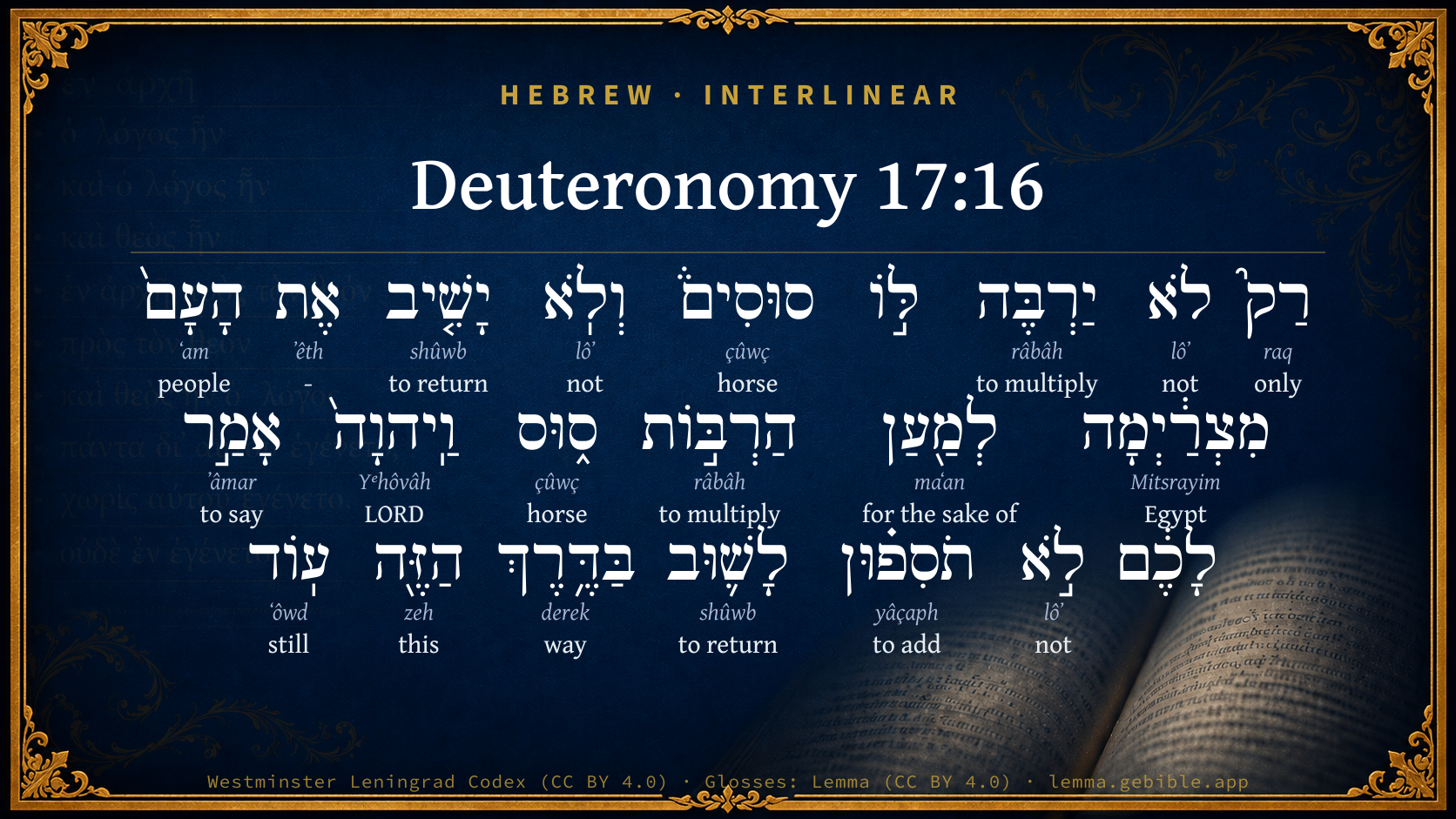
Hebrew (Westminster Leningrad Codex) Deuteronomy 17:16 appears in the Hebrew Old Testament. The text above is from the Westminster Leningrad Codex. Each word links to its Strong’s number, a concise gloss, and parsing drawn from the Open Scriptures Hebrew Bible morphology. Click any word for its full Brown-Driver-Briggs (BDB) entry.
Download image
Cite this verse

Deuteronomy 17:16 (World English Bible). Public Domain. Lemma interlinear Bible study tool, https://lemma.gebible.app/v/deuteronomy/17/16.

Show BibTeX & RIS
BibTeX
RIS
English Translation
Only he shall not multiply horses to himself, nor cause the people to return to Egypt, to the end that he may multiply horses; because Yahweh has said to you, You shall henceforth return no more that way.
World English Bible · Public Domain
Download a study sheet

One document with this verse’s original text, its word-by-word gloss line, the meaning frame, cross-references with their text, attributed commentary, and full source and license credits — printable, and it pastes into notes with its structure intact.

This verse Autodidact and up

Study sheet (.html) Plain text (.txt)

A passage Seminary Student

Up to 50 verses in one chapter. A passage sheet keeps up to 6 commentary sources and 12 cross-references per verse, in the order this page ranks them, and says so on the sheet whenever that leaves anything out. Ask for a single verse and you get the Autodidact verse sheet above.

Everything on this page stays free to read, with no account — the sheet is a download of what is already on screen, not access to it.

Want to remove ads? Support Godless Engineer
Compare translations 3

The same verse in 3 English versions, stacked beneath the original-language interlinear above. Click any original word for its lexicon entry.

Each is an independent rendering of the whole verse — the interlinear is not word-aligned to these translations.

Highlighted words mark where these versions differ — a whole-verse word diff, not a word-by-word alignment.

  • World English Bible Public Domain
    Only he shall not multiply horses to himself, nor cause the people to return to Egypt, to the end that he may multiply horses; because Yahweh has said to you, You shall henceforth return no more that way.
  • King James Version Public Domain
    But he shall not multiply horses to himself, nor cause the people to return to Egypt, to the end that he should multiply horses: forasmuch as the LORD hath said unto you, Ye shall henceforth return no more that way.
  • unfoldingWord Literal Text CC BY-SA 4.0
    Only he shall not multiply horses for himself, so that he shall not cause the people to return to Egypt so that he may multiply horses, for Yahweh said to you, ‘You will no longer return that way again.’

unfoldingWord Literal Text — © unfoldingWord, licensed CC BY-SA 4.0. Word-aligned USFM3 via Door43 (git.door43.org/unfoldingWord/en_ult).

Versions to compare (up to 4)

3 of 4 selected

Show all 18 translations

Every available English version of this verse, each an independent rendering of the whole verse.

  • World English Bible Public Domain
    Only he shall not multiply horses to himself, nor cause the people to return to Egypt, to the end that he may multiply horses; because Yahweh has said to you, You shall henceforth return no more that way.
  • Berean Standard Bible Public Domain
    But the king must not acquire many horses for himself or send the people back to Egypt to acquire more horses, for the LORD has said, ‘You are never to go back that way again.’
  • Majority Standard Bible Public Domain
    But the king must not acquire many horses for himself or send the people back to Egypt to acquire more horses, for the LORD has said, ‘You are never to go back that way again.’
  • King James Version Public Domain
    But he shall not multiply horses to himself, nor cause the people to return to Egypt, to the end that he should multiply horses: forasmuch as the LORD hath said unto you, Ye shall henceforth return no more that way.
  • American Standard Version (1901) Public Domain
    Only he shall not multiply horses to himself, nor cause the people to return to Egypt, to the end that he may multiply horses; forasmuch as Jehovah hath said unto you, Ye shall henceforth return no more that way.
  • Revised Version (1885) Public Domain
    Only he shall not multiply horses to himself, nor cause the people to return to Egypt, to the end that he should multiply horses: forasmuch as the LORD hath said unto you, Ye shall henceforth return no more that way.
  • Geneva Bible (1599) Public Domain
    In any wise he shall not prepare him many horses, nor bring the people againe to Egypt, for to encrease the number of horses, seeing the Lord hath sayd vnto you, Ye shall henceforth goe no more againe that way.
  • Douay-Rheims (1899) Public Domain
    And when he is made king, he shall not multiply horses to himself, nor lead back the people into Egypt, being lifted up with the number of his horsemen, especially since the Lord hath commanded you to return no more the same way.
  • Young's Literal Translation Public Domain
    `Only, he doth not multiply to himself horses, nor cause the people to turn back to Egypt, so as to multiply horses, seeing Jehovah hath said to you, Ye do not add to turn back in this way any more.
  • Literal Standard Version CC BY-SA 4.0
    Only, he does not multiply horses for himself, nor cause the people to return to Egypt, so as to multiply horses, seeing YHWH has said to you, You do not add to return in this way anymore.
  • Unlocked Literal Bible CC BY-SA 4.0
    But he must not multiply horses for himself, nor cause the people to return to Egypt so that he may multiply horses, for Yahweh had said to you, 'You will never return that way again.'
  • unfoldingWord Literal Text CC BY-SA 4.0
    Only he shall not multiply horses for himself, so that he shall not cause the people to return to Egypt so that he may multiply horses, for Yahweh said to you, ‘You will no longer return that way again.’
  • Darby Bible Public Domain
    Only he shall not multiply horses to himself, nor lead back the people to Egypt, to multiply horses; for Jehovah hath said unto you, Ye shall not return again any more that way.
  • World Messianic Bible Public Domain
    Only he shall not multiply horses to himself, nor cause the people to return to Egypt, to the end that he may multiply horses; because the LORD has said to you, “You shall not go back that way again.”
  • Webster's Bible Public Domain
    But he shall not multiply horses to himself, nor cause the people to return to Egypt, to the end that he should multiply horses: forasmuch as the LORD hath said to you, ye shall henceforth return no more that way.
  • Free Bible Version CC BY-SA 4.0
    Your king must not have large numbers of horses, or send his men to Egypt to buy more horses, because the Lord has declared, “You must never return there again.”
  • Bible in Basic English Public Domain
    And he is not to get together a great army of horses for himself, or make the people go back to Egypt to get horses for him: because the Lord has said, You will never again go back that way.
  • JPS Tanakh (1917) Public Domain
    Only he shall not multiply horses to himself, nor cause the people to return to Egypt, to the end that he should multiply horses; forasmuch as the LORD hath said unto you: 'Ye shall henceforth return no more that way.'

Literal Standard Version (2020), Covenant Press — licensed CC BY-SA 4.0. Text via the HelloAO Bible API (eBible.org). Unlocked Literal Bible (unfoldingWord) — licensed CC BY-SA 4.0. Text via the HelloAO Bible API (eBible.org). unfoldingWord Literal Text — © unfoldingWord, licensed CC BY-SA 4.0. Word-aligned USFM3 via Door43 (git.door43.org/unfoldingWord/en_ult). Free Bible Version, Dr. Jonathan Gallagher — licensed CC BY-SA 4.0. Text via the HelloAO Bible API (eBible.org).

Word by word

More ways to search: Search by grammar → Find every occurrence → Compare this word →

Practice this passage: Drill this verse → Learn its vocabulary →

רַק֮
raq
H7535
“only”
Particle, Accusative
Part of Speech
Particle
Type
Accusative
Full BDB Definition

Origin: the same as H7534 as a noun

TWOT: 2218a

only, altogether, surely - only - only, nought but, altogether (in limitation) - save, except (after a negative) - only, altogether, surely (with an affirmative) - if only, provided only (prefixed for emphasis) - only, exclusively (for emphasis)
  1. לֹא lôʼ H3808 “not” Particle, Negative
  2. יַרְבֶּה râbâh H7235 “to multiply” Verb, Hiphil, Imperfect, 3rd Person, Masculine, Singular
  3. סוּסִים֒ çûwç H5483 “horses” Noun, Common, Masculine, Plural, Absolute
  4. וְלֹֽא lôʼ H3808 “and · not” Conjunction + Particle, Negative
  5. יָשִׁ֤יב shûwb H7725 “to return” Verb, Hiphil, Imperfect, 3rd Person, Masculine, Singular
  6. אֶת ʼêth H853 “-” Particle, Direct Object
  7. הָעָם֙ ʻam H5971 “the · people” Particle, Definite Article + Noun, Common, Masculine, Singular, Absolute
  8. מִצְרַ֔יְמָה Mitsrayim H4714 “Egypt · toward” Noun, Proper + Suffix, Demonstrative
  9. לְמַ֖עַן maʻan H4616 “for the sake of” Preposition
  10. הַרְבּ֣וֹת râbâh H7235 “to multiply” Verb, Hiphil, Infinitive Construct
  11. ס֑וּס çûwç H5483 “horse” Noun, Common, Masculine, Singular, Absolute
  12. וַֽיהוָה֙ Yᵉhôvâh H3068 “and · LORD” Conjunction + Noun, Proper
  13. אָמַ֣ר ʼâmar H559 “to say” Verb, Qal, Perfect, 3rd Person, Masculine, Singular
  14. לֹ֣א lôʼ H3808 “not” Particle, Negative
  15. תֹסִפ֗וּן yâçaph H3254 “to add” Verb, Hiphil, Imperfect, 2nd Person, Masculine, Plural + Suffix, n
  16. לָשׁ֛וּב shûwb H7725 “to return” Preposition + Verb, Qal, Infinitive Construct
  17. בַּדֶּ֥רֶךְ derek H1870 “in/at the · way” Preposition, Determined + Noun, Common, Both, Singular, Absolute
  18. הַזֶּ֖ה zeh H2088 “the · this” Particle, Definite Article + Pronoun, Demonstrative, Masculine, Singular
  19. עֽוֹד ʻôwd H5750 “still” Adverb

About this verse

These counts appear in no published source. They are computed here, from the morphology-tagged text and Lemma’s own curated glosses. What Lemma adds →

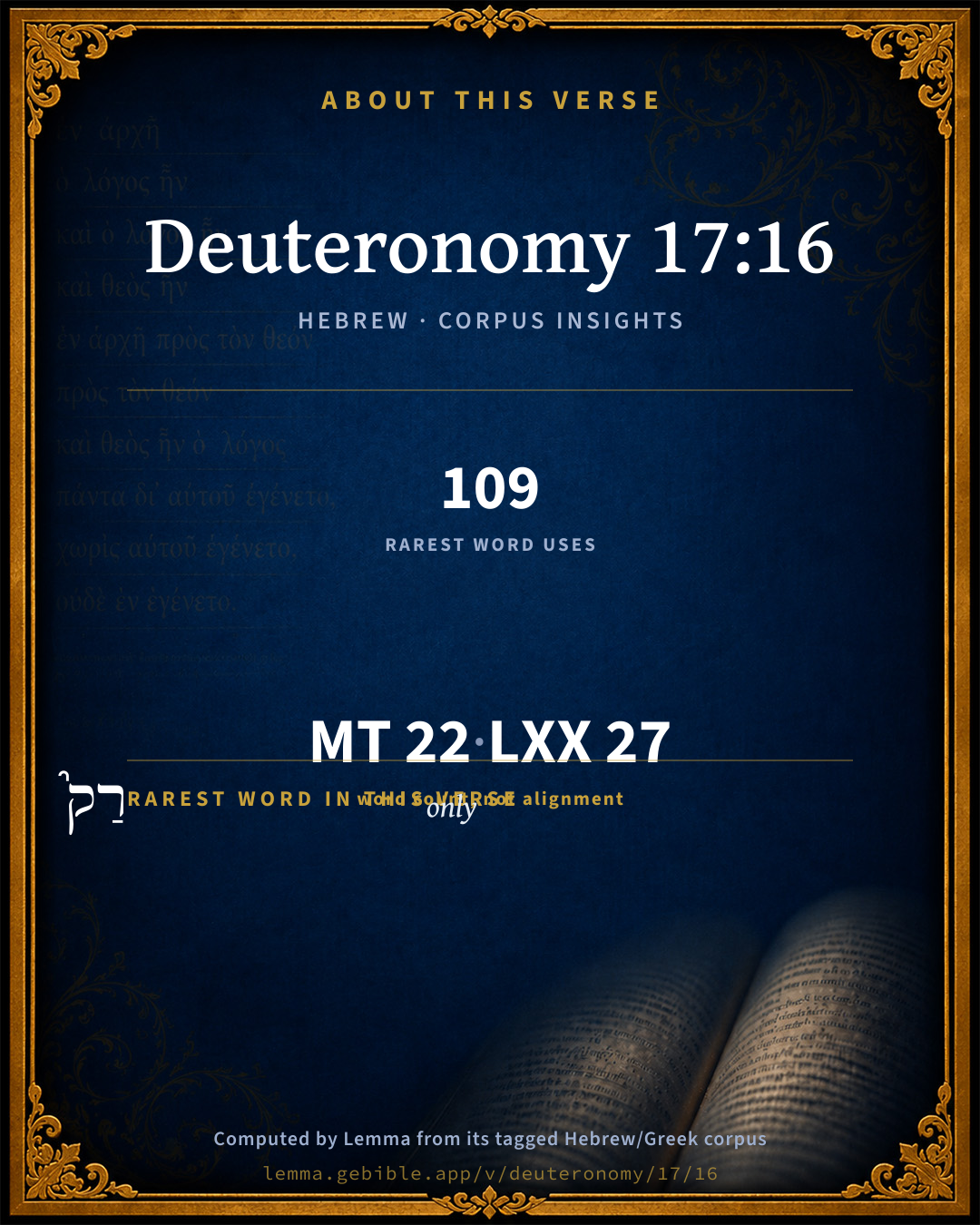
22
words
15
distinct lemmas
Pentateuch
section

Grammatical profile

  • 6 verbs
  • 6 nouns
  • 1 pronoun
  • 3 prepositions
  • 1 adverb
  • 5 particles

Verb forms

  • יַרְבֶּה Hiphil · Imperfect
  • יָשִׁ֤יב Hiphil · Imperfect
  • הַרְבּ֣וֹת Hiphil · Infinitive Construct
  • אָמַ֣ר Qal · Perfect
  • תֹסִפ֗וּן Hiphil · Imperfect
  • לָשׁ֛וּב Qal · Infinitive Construct

Repetition

Words recur within this verse — often emphatic in Hebrew:

  • יַרְבֶּה to multiply H7235 ×2
  • סוּסִים֒ horse H5483 ×2
  • יָשִׁ֤יב to return H7725 ×2
  • לֹא not H3808 ×3

Hebrew & Septuagint length

In English translation the verse runs 38 words from the Hebrew and 41 from the Septuagint (LXX English) — closely comparable.

A rough comparison of the two English renderings, which tokenize alike — not a word-level alignment.

Word counts can differ between the Hebrew and the Greek without any difference in meaning — e.g. the Hebrew direct-object marker אֵת has no separate Greek word, and Greek often adds the article ὁ.

In the original languages it is 22 Hebrew tokens and 27 Greek tokens — but the two are counted differently (Hebrew bundles its prefixes and suffixes into one token; the Greek is in lemma form), so that isn’t a like-for-like length.

Cross-references

17

Topical passages linked to Deuteronomy 17:16 in the Treasury of Scripture Knowledge — connected by theme and wording, ordered by reader-vote popularity; previews shown in the World English Bible.

  • Isaiah 31:1–3 Woe to those who go down to Egypt for help, and rely on horses, and trust in chariots because they are many, and in horsemen because they are very strong, but they don't look to the Holy One of Israel, neither seek Yahweh!
  • Deuteronomy 28:68 Yahweh will bring you into Egypt again with ships, by the way of which I said to you, You shall see it no more again: and there you shall sell yourselves to your enemies for bondservants and for bondmaids, and no man shall buy you.
  • Ezekiel 17:15 But he rebelled against him in sending his ambassadors into Egypt, that they might give him horses and much people. Shall he prosper? shall he escape who does such things? shall he break the covenant, and yet escape?
  • Psalms 20:7 Some trust in chariots, and some in horses, But we trust the name of Yahweh our God.
  • Hosea 11:5 "They won't return into the land of Egypt; But the Assyrian will be their king, Because they refused to repent.
  • Exodus 13:17 It happened, when Pharaoh had let the people go, that God didn't lead them by the way of the land of the Philistines, although that was near; for God said, "Lest perhaps the people change their minds when they see war, and they return to Egypt;"
  • Numbers 14:3–4 Why does Yahweh bring us to this land, to fall by the sword? Our wives and our little ones will be a prey: wouldn't it be better for us to return into Egypt?
  • 1 Kings 4:26 Solomon had forty thousand stalls of horses for his chariots, and twelve thousand horsemen.
  • 1 Kings 10:26–28 Solomon gathered together chariots and horsemen: and he had a thousand and four hundred chariots, and twelve thousand horsemen, that he bestowed in the chariot cities, and with the king at Jerusalem.
  • Exodus 14:13 Moses said to the people, "Don't be afraid. Stand still, and see the salvation of Yahweh, which he will work for you today: for the Egyptians whom you have seen today, you shall never see them again.
  • 1 Kings 1:5 Then Adonijah the son of Haggith exalted himself, saying, I will be king: and he prepared him chariots and horsemen, and fifty men to run before him.
  • Jeremiah 42:14–16 saying, No; but we will go into the land of Egypt, where we shall see no war, nor hear the sound of the trumpet, nor have hunger of bread; and there will we dwell:
  • 1 Samuel 8:11 He said, This will be the manner of the king who shall reign over you: he will take your sons, and appoint them to him, for his chariots, and to be his horsemen; and they shall run before his chariots;
  • 2 Samuel 8:4 David took from him one thousand seven hundred horsemen, and twenty thousand footmen: and David hamstrung all the chariot horses, but reserved of them for one hundred chariots.
  • Isaiah 36:8–9 Now therefore, please give pledges to my master the king of Assyria, and I will give you two thousand horses, if you are able on your part to set riders on them.
  • Hosea 14:3 Assyria can't save us. We won't ride on horses; Neither will we say any more to the work of our hands, 'Our gods!' For in you the fatherless finds mercy."
  • 2 Chronicles 9:25 Solomon had four thousand stalls for horses and chariots, and twelve thousand horsemen, that he bestowed in the chariot cities, and with the king at Jerusalem.

Cross-references courtesy of OpenBible.info (CC BY 4.0).

Hebrew and Greek witnesses Masoretic Hebrew ↔ Greek Septuagint

The same verse in the two great witnesses to the Old Testament, shown verse-for-verse.

These are two independent witnesses, not word-aligned to each other, and the Septuagint is shown in lemma (dictionary) form.

Hebrew Deuteronomy 17:16 Masoretic · Westminster Leningrad Codex

רַק֮ לֹא יַרְבֶּה לּ֣וֹ סוּסִים֒ וְלֹֽא יָשִׁ֤יב אֶת הָעָם֙ מִצְרַ֔יְמָה לְמַ֖עַן הַרְבּ֣וֹת ס֑וּס וַֽיהוָה֙ אָמַ֣ר לָכֶ֔ם לֹ֣א תֹסִפ֗וּן לָשׁ֛וּב בַּדֶּ֥רֶךְ הַזֶּ֖ה עֽוֹד

Only he shall not multiply horses to himself, nor cause the people to return to Egypt, to the end that he may multiply horses; because Yahweh has said to you, You shall henceforth return no more that way.

World English Bible · Public Domain

Greek LXX Deuteronomy 17:16 Septuagint · lemma form

διότι οὐ πληθύνω ἑαυτοῦ ἵππος οὐδέ μή ἀποστρέφω ὁ λαός εἰς αἴγυπτος ὅπως πληθύνω ἑαυτοῦ ἵππος ὁ δέ κύριος εἶπον οὐ προςτίθημι ἀποστρέφω ὁ ὁδός οὗτος ἔτι

For he shall not multiply to himself horses, and he shall by no means turn the people back to Egypt, lest he should multiply to himself horses; for the Lord said, You⌃ shall not any more turn back by that way.

LXX2012 (modern English Septuagint) · Public Domain

Hebrew: Westminster Leningrad Codex (CC BY 4.0). Greek: Septuagint (public domain); English from LXX2012 (modern English Septuagint) (Public Domain). How the Septuagint differs from the Hebrew →

Targum (Aramaic paraphrase)

2

The Targum is the ancient Jewish Aramaic paraphrase of the Hebrew Scriptures — an interpretive translation, not the Hebrew text itself. Onkelos (literal) and Pseudo-Jonathan (expansive) render the Torah, and Jonathan the Prophets. Coverage is partial: where no permissively-licensed English translation exists for a verse, only the Aramaic is shown. This is verse-level text, not a word-by-word alignment to the Hebrew.

  1. Targum Onkelos Torah (Genesis–Deuteronomy)
    לְחוֹד לָא יַסְגֵי לֵהּ סוּסָוָן וְלָא יָתֵב יָת עַמָא לְמִצְרָיִם בְּדִיל לְאַסְגָּאָה לֵהּ סוּסָוָן וַיְיָ אֲמַר לְכוֹן לָא תוֹסְפוּן לְמִתוּב בְּאֹרַח הָדֵין עוֹד

    (no public-domain English translation for this verse)

    Targum Onkelos — Aramaic: “Onkelos Genesis” (public domain); “Onkelos Exodus” (public domain); “Onkelos Leviticus” (public domain); “Onkelos Numbers” (public domain); “Onkelos Deuteronomy” (public domain). English: “Sefaria Community Translation” (CC0 1.0 (public-domain dedication)); “J.W. Etheridge. The Targums of Onkelos and Jonathan Ben Uzziel on the Pentateuch. London: Longmans, Green, 1862” (public domain). Text via Sefaria.

  2. Targum Pseudo-Jonathan Torah (Genesis–Deuteronomy)
    לְחוֹד לָא יִסְגוּן לֵיהּ עַל תְּרֵין סוּסְוָון דִּלְמָא יִרְכְּבוּן רַבְרְבָנוֹי עֲלֵיהוֹן וְיִתְגָאוּן וְיִתְבַּטְלוּן מִפִּתְגָמֵי אוֹרַיְיתָא וִיחוֹבוּן חוֹבַת גָּלוּתָא לְמִצְרַיִם וַיְיָ אָמַר לְכוֹן לָא תוֹסְפוּן לְמֵתוּב בְּאָרְחָא הָדֵין תּוּב

    Only let him not increase to him more than two horses, lest his princes ride upon them, and become proud, neglect the words of the law, and commit the sin of the captivity of Mizraim; for the Lord hath told you, By that way ye shall return no more.

    Targum Pseudo-Jonathan — Aramaic: “Targum Jonathan on Genesis” (public domain); “Targum Jonathan on Exodus” (public domain); “Targum Jonathan on Leviticus” (public domain); “Targum Jonathan on Numbers” (public domain); “Targum Jonathan on Deuteronomy” (public domain). English: “The Targum of Jonathan ben Uzziel, trans. J. W. Etheridge, London, 1862” (public domain). Text via Sefaria.

Commentary

Notes on Deuteronomy 17:16 from classic Christian and Jewish commentators (each source and its license shown beneath its notes). The classic Christian expositions comment on the surrounding passage and are grouped to its opening verse, so a note may address several verses; the Jewish commentaries on the Tanakh (Rashi and others) are per-verse, so they appear only where the commentator wrote on this verse.

Lemma curates 59 commentaries, every one of them public domain or Creative Commons licensed, each selected and text-cleaned for this edition rather than reprinted as found. About our sources →

Trapp's Complete Commentary

John Trapp

Deu 17:16 But he shall not multiply horses to himself, nor cause the people to return to Egypt, to the end that he should multiply horses: forasmuch as the LORD hath said unto you, Ye shall henceforth return no more that way.

Ver. 16. He shall not multiply horses.] Lest he be held as our Henry III was, Regni dilapidator, the royal spendthrift.

The Lord hath said.] Not in so many words, but by consequence, when he showed his displeasure against such as would have made them a captain to go back to Egypt. {Num 14:4; Num 14:11}

John Trapp, A Commentary or Exposition upon All the Books of the Old and New Testament (1647–1656) — public domain. Text from a community e-Sword module.

The Biblical Illustrator

Joseph S. Exell

Deu_17:16

Ye shall henceforth return no more that way.

Never again

Touching and sad is the last look of the emigrant leaving his old home and the white cliffs of his native land. Some partings have in them more than sorrow. Never again! is a mournful utterance. It has in it warning, admonition, and counsel.

1. The ways of youth are not to be trodden by us again. We are ever entering into new paths. Personality is ever changing, while individual identity remains the same.

2. The ways of possible improvement in the past cannot be trodden again. The capabilities of the organ are limited by its compass and the number of its stops. But within the necessary limits what marvellous varieties of music can be brought out of it! Our life, with measured capacities, is the instrument, and we the players. In the exercise of responsible will we can bring out heavenly harmonies, or unearthly discords. How the great player wishes the audience could come back and hear what he feels he can do now. But the chance is gone. Nothing can be done with the past.

3. If the past cannot be lived over again, it is our duty to make the best of our present. There is much to be done for ourselves and others. (Preachers Monthly.)

Once for all

If I can pass this way no more, then--

I. I cannot do what I then missed doing.

1. What thought I of myself?

2. Did I seek Gods way or my own?

II. I cannot undo what I have done. What manner of tracks did I leave in the way?

1. Oaths.

2. Drunkenness.

3. Temptations to others to do wrong.

III. In view of this, how should i walk?

1. Confessing my past sins.

2. Repenting of, and forsaking them.

3. Exercising a cheerful faith.

4. Doing good to all men as opportunity offers.

Lessons:

1. Sad and solemn things are in the past.

2. Eternal things are before us. (B. Knepper.)

Never this way again

We are told that at one of those splendid pageants in Berlin, not long ago, the wife of the English ambassador unfortunately unfastened the necklace she was wearing, and lost a costly pearl somewhere in the roadway. Perhaps it might have been regained if a serious search had been in order at such a time. But the grand procession must hurry along, and a lost place in the rank was of more account than a lost pearl. They did not return by the same way. We may be in equal peril if an accident should occur in this ceaseless rush of our years. An admonition in it for the close of the year.

I. It is now a most significant time for the taking of spiritual stock. Most religious people would be glad to know just where they are, and how the balance stands. It is well to have a clearing out, even if one is afraid he may be suffocated with the lifted dust.

II. Then, again, this is a good time for us to give over lackadaisical complainings about short chances in the past. You will not have to take the same chances again. Ye shall henceforth return no more by that way of youth. But does anybody really want to do that? Victor Hugo confessed to his close friends that the most disagreeable advance in age to him had been that from thirty-nine to forty. But, said his companion, I should think it a great deal brighter to be forty than fifty. Not at all, replied Hugo, gaily; forty years is the old age of youth, while fifty is the youth of old age. Ah, just think how many fine chances yet wait for a brave heart in the beautiful future which we hope to enter on after next New Years day!

III. It is best for us now, also, to keep a clear look out for what is still ahead. Almost all of us have some past worth looking over. But the glory of every true life is in the time to come. God has not yet exhausted Himself in apocalypses of splendid radiance to His waiting people. There certainly is, in the distance, that which eye hath not seen nor ear heard. And wise men, while the years chime on, might well think of readiness to make the great journey and meet the revelations.

IV. Once more; by this time we ought to learn to estimate results and forget processes. We do really respect hills that we have climbed painfully over; but it awakes no emotion in others when we keep rehearsing the steps which we took, and the snows we met, and the winds that we resisted. Wiser is it always to let the dead past bury its dead out of sight. Ye shall henceforth return no more that way; and to some the past year has been a year of conflict; and who wants to go over all that again? Please remember, moments of success are not always moments of happiness; much depends on what the success has cost. Ye shall henceforth return no more that way; to some the past year has been one of self-discipline. How much it costs just to make a slender progress in Divine things!

V. Finally, this is the time in which to inquire after work yet left unfinished. We should bring our unfulfilled resolutions to God, and ask Him to grant us time to complete them. (C. S. Robinson, D. D.)

The irrevocable past; or, no going back

I. Ye shall henceforth return no more that way, to undo evil. It matters not how black may have been your deed, nor how terrible soever its burden, it must stand. It cannot be undone. It is mans dread prerogative to do; but he cannot undo. In the drift of a far-off period in the geological ages, long before Adam was created, we find the feet marks of gigantic fowls. The mud, once soft, hardened into rock, and became the permanent record of life and activity now extinct from the globe. The effects of human action are as unchangeable. This it is that makes sin so terrible: when it has gone forth we cannot recall it. Sin is a monument of everlasting shame. A single careless miner, by a momentary act of folly, can do what can never be undone, and in an instant fill a land with sorrow, and hundreds of homes with the tears of widows and orphans. The shocking gap in human life and relationship nothing can repair. Reparation may be effected only within narrow limits; and then the wrong done cannot in the most trivial instance be wholly undone.

II. Ye shall henceforth return no more that way, to make imperfect good better. The merchant who has been slothful, inattentive, cannot live over again the months that are gone. The transactions and figures in his books are unalterable. He cannot transport industry into past idleness, nor introduce a single item of gain into past losses. Not a stroke of work is possible in time that is over, not a sixpence of profit can be added to the accounts which are closed. It is the same thing with the student. When his examinations are over, if his session has been indolent, unsuccessful, he cannot improve the work which has been unsatisfactorily performed. He may be grieved and ashamed that his time has been so little devoted to his vocation. But the insufficiency of the past is beyond his reach. The culture of the field and the vineyard exhibits the same law. If there has been neglect or inadequate tillage, when harvest time arrives there is no going back to re-sow or re-tend. There must be scanty crops, dwindled grain and fruit, and only half-filled ears and half-laden boughs. These laws have their fulfilment in the domain of spiritual life. In the day of reckoning you cannot number profits where there have been no gains, nor number victories, if no achievements have been won. The popular proverb says, It is never too late to mend. True, it is never too late to mend in the present, but always too late to mend in the past. The path of time gone by is closed.

III. Ye shall henceforth return no more that way, to use neglected opportunity. Christian, thou hast had thine opportunities. Perhaps, when thou wert blind--blinded by thy tears--thy opportunities were the nearest to thee. The Lord, it may be, laid Himself out with parental tenderness to purify thee by disappointment, crosses, and suffering. Yet thou sawest no bright avenues crossing the path of thy shade, and conducting to beauty and peace. Has seed been put into thy hand, and hast thou not sown it? Has fruit hung within thy reach, and hast thou not plucked it? Has blessing been committed to thy solemn trust, and hast thou not scattered it? To all neglecters, opportunity is a narrowing path, which at length vanishes in trackless wilds; to the obedient, it is an ever-expanding, ascending, and illumined career, and into it all courses run which lead to glory, honour, and immortality. Every precious opportunity of each departed year is now dead to thee, dead to thine effort and industry.

IV. Ye shall henceforth return no more that way, to encounter past trial, guilt, and suffering. Do manifold imperfection and unworthiness bow thee down? Have they cost thee tears? Are they the burden of thy prayers? Dost thou daily struggle for the mastery of self, and sin, and Satan; and yet do thy besetments discourage thee? In the years now behind thee, has the firmament of thy soul often been dull and sunless, and even louring and tempestuous? Thou wilt never tread that path any more. New ground is before thee, and every step is towards the light. Conclusion:

1. The peculiar character of the Gospel is due to the fact that we cannot undo the past. Sin remains. Moral laws are immutable in their foundations, and their penalties are irrepealable. But the Lord Jesus has effected a saving work. He stands between the sinner and the woe that pursues him. He fulfils, honours, and satisfies broken laws, and covers the defenceless head of the contrite, and turns aside the merited destruction which was sweeping towards him.

2. Since what is done cannot by you be undone, are you to sit down and weep the tears of despair? My message is salvation, but not salvation which you can effect in time that is gone. The great lesson is, Act in the present.

3. Let the sincere Christian be comforted. The Lord has borne your sins. Your holy life is watched and guarded by His sheltering love. Ponder what you have done. Throw away no lessons which it offers. Be true to your past experience and conviction. But brood not over bygone evil.

4. Let us be up and doing; for all things pure and beautiful sweep along the upward groove of progress to perfection. The movement of every world and sun and system is onward.

5. In a few more breaths thy life may close. The Lord may be saying with the most literal emphasis, Ye shall henceforth return no more that way--no more the way to business, no more the way to the house of thy friend, no more the way to the church, no more the way to thy family and home, no more the way from the grave whither thou thyself shalt have been carried. (H. Batchelor.)

The past irrevocable

I. I can conceive that to some of us there may be relief and even comfort in this assurance. The experiences through which we have come may have been such that we cannot wish for their renewal. The path over which we have passed may have been so rough and steep and dangerous that we cannot contemplate traversing it again without a shudder. When I was in Chamounix, last summer, a friend who had crossed the glacier and come down by the Mauvais Pas, on which the iron railing put for the safety of travellers had parted from its fastenings in his grasp, assured me that be would not go through that experience again for all that earth could give. And there may be not a few among us who feel just in the same way concerning some chapters in our last years life. We are, perhaps, thankful to be through them, but we do not wish to repeat them. We feel regarding them as one does who has come safely out of a terrible railway accident, or who sets his foot on land after a dangerous and tempestuous voyage. We are glad that we have escaped, but, even although we should escape another time, we do not desire to be again in the same peril. Some, too, may have had such a time of labour and anxiety that they are glad to think that it is now behind them and not to be renewed. And some there are who have had such a fierce fight with temptation, and have come out of it, victorious indeed, yet with such exhaustion that they cannot but rejoice in the thought that now it is all behind them in the irrevocable past. They are glad for the result, but they would not willingly go back into the agony of the conflict. So this text, taken as an assurance, that we cannot re-live our lives, or go again through the experiences of the past, has in it an element of comfort. It is a relief to know that some things are over and done with.

II. But there is another side to the subject, and that is full of solemnity, not unattended with sorrow, For in the past there are many things which now we wish had been otherwise. Our afterthought has shown us much to which our forethought was blind; but we cannot alter anything now. The past is always seen more correctly after it has become the past than it was when it was present. Lost opportunities cannot be recalled, and no cement of human device can mend a broken vow. Ah! what a sad reflection have we here! You cannot recall the profane word; you cannot wipe out the impure act; you cannot undo the sins you have committed. What then? What is to be done with it? I answer, that if we cannot cancel it, we can confess the evil that is in it, and seek through Jesus Christ forgiveness for that. If we please, we can obtain, through the great atonement, acceptance with God notwithstanding our sins. The sting of our guilt may be extracted, and the past may cease to be a clog upon our spiritual progress.

III. And then, turning the thought which the words of my text express, we may make it full of admonition to ourselves for the future. We are about to enter upon a path in which there will be no possibility of retracing our steps; let us be very careful, therefore, where we plant our feet. We have only once to live; therefore let us live to purpose. The day that dawned this morning will never dawn again. So let us seize every moment as it comes, and use it as we shall wish we had done when we look back upon it from eternity. Remember, the year does not come to you all at once, in twelve months at a time, nor even in twelve distinct installments of a month each; no, nor yet in three hundred and sixty-five separate portions of a day apiece: but in individual moments. Do not, therefore, lose the moments in thinking that you will secure the year; but consider that the year is to be redeemed by the consecration of each moment to the Lord Jesus. Fill every day with His service. (W. M. Taylor, D. D.)

The Biblical Illustrator, edited by Joseph S. Exell (c. 1880s–1900s) — public domain. Text from a community e-Sword module.

Joseph Benson's Commentary

Deu 17:16. He shall not multiply horses — Though he might have horses for his own use, yet he was not to have many horses for his officers and guard, much less for war, lest he should trust in them. The multiplying horses is also forbidden, lest it should raise too great a correspondence with Egypt, which furnished Canaan with them. The Lord hath said — The Lord hath now said to me, and I, by his command, declare it to you. Ye shall no more return that way — Into Egypt, lest ye be again infected with her idolatries.

Joseph Benson's Commentary on the Old and New Testaments (1811–1818) — public domain. Text from a community e-Sword module.

Tyndale Open Study Notes

Tyndale Open Resources

17:16 never return to Egypt: Going there would show a king’s lack of dependence on God, who had redeemed Israel from bondage to Egypt. The best horses were found in Egypt (see 1 Kgs 10:28-29).

Tyndale Open Study Notes — © Tyndale Open Resources, licensed CC BY-SA 4.0. Text via the HelloAO Bible API.

Geneva Bible (1599)

Geneva Bible translators

To revenge their injuries, and to take them of their best horses, 1 Kings 10:28.

Geneva Bible (1599) marginal notes — public domain. Text via Bolls.life.

Jamieson, Fausset & Brown

Robert Jamieson, A. R. Fausset & David Brown

he shall not multiply horses to himself--The use of these animals was not absolutely prohibited, nor is there any reason to conclude that they might not be employed as part of the state equipage. But the multiplication of horses would inevitably lead to many evils, to increased intercourse with foreign nations, especially with Egypt, to the importation of an animal to which the character of the country was not suited, to the establishment of an Oriental military despotism, to proud and pompous parade in peace, to a dependence upon Egypt in time of war, and a consequent withdrawal of trust and confidence in God. (Sa2 8:4; Kg1 10:26; Ch2 1:16; Ch2 9:28; Isa 31:3).

Jamieson, Fausset & Brown — Commentary Critical and Explanatory on the Whole Bible (1871) — public domain (CC PDM 1.0). Text via the HelloAO Bible API.

Adam Clarke's Commentary

Verse 16. He shall not multiply horses] As horses appear to have been generally furnished by Egypt, God prohibits these,

1. Lest there should be such commerce with Egypt as might lead to idolatry.

2. Lest the people might depend on a well-appointed cavalry as a means of security, and so cease from trusting in the strength and protection of God. And,

3. That they might not be tempted to extend their dominion by means of cavalry, and so get scattered among the surrounding idolatrous nations, and thus cease, in process of time, to be that distinct and separate people which God intended they should be, and without which the prophecies relative to the Messiah could not be known to have their due and full accomplishment.

Adam Clarke's Commentary on the Bible (1810–1826) — public domain. Text from a community e-Sword/MySword module.

The Cambridge Bible for Schools and Colleges

gen. ed. J. J. S. Perowne

16. Only] Heb. raḳ, see on Deu_10:15.

he shall not multiply horses, etc.] On the horse in Israel, see Jerusalem i. 324 f. Horses came from N. to S. in W. Asia, probably from Asia Minor. Brought into Egypt by the Hyksos after 1800 b.c. they were never very common there, but the breed was excellent. (W. M. Müller, E.B. ‘Egypt,’ § 9.) By 1600 b.c. they were used in Palestine. Solomon seems to have introduced them into Israel; and they and the chariots for which they were first employed became symbolic of the strength of the N. Kingdom (2Ki_2:12; 2Ki_13:14). The prophets mention horses nearly always with war and foreign subsidies, in which the people were tempted to trust instead of in God. See Amo_4:10, Hos_1:7; Hos_14:3, Isa_2:7; Isa_31:1; Isa_31:3, Eze_17:15, of which the last three passages and probably also (because of the parallel) Hos_14:3, identify them with Israel’s irreligious confidence in an Egyptian alliance. Hence the clause nor cause the people to return to Egypt. This does not mean that individual Hebrews were bartered for Egyptian horses (Steuern.). Like the prophets D is hostile to an Egyptian alliance, of which the clearest token would be subsidies of horses.

the Lord hath said, etc.] Not found in Exod.—Numb. ‘It is probable that as in other cases (cf. on Deu_1:22, Deu_10:1-3; Deu_10:9, Deu_17:2) the actual words were still read in some part of the narrative of JE, extant at the time when Deut. was composed’ (Driver).

The Cambridge Bible for Schools and Colleges (gen. ed. J. J. S. Perowne; Cambridge University Press, 1878–1918) — public domain. Text from a community e-Sword module.

John Gill's Exposition

But he shall not multiply horses to himself,.... That he might not put his trust and confidence in outward things, as some are apt to trust in horses and chariots; and that he might not tyrannise over and distress his subjects by keeping a number of horses and chariots as a standing army, and chiefly for a reason that follows; he was to have no more than for his own chariot, so Jarchi, and so the Misnah (g) and Maimonides (h); the Targum of Jonathan restrains it to two:

nor cause the people to return to Egypt, to the end that he should multiply horses; which was a country that abounded with them, and therefore he was not to encourage, and much less oblige his subjects to travel thither or trade with that people for the sake of increasing his stock of horses, Isa 31:1.

forasmuch as the Lord hath said unto you, ye shall henceforth return no more that way; not that going into Egypt on any account whatsoever was forbidden, as for trade and merchandise in other things, or for shelter and safety, for which some good men fled thither; but for outward help and assistance against enemies, and for horses on that account, and particularly in order to dwell there, from which the Jews in the times of Jeremiah were dissuaded by him, and threatened by the Lord with destruction, in case they should, Jer 42:15. When the Lord said this is not certain; it may be when they proposed to make a captain, and return unto Egypt; or he said this in his providence, this was the language of it ever since they came out of it, or however this he now said; see Deu 28:68.

(g) Sanhedrin, c. 2. sect. 4. (h) Hilchot Melachim, c. 3. sect. 3.

John Gill's Exposition of the Whole Bible (1746–1763) — public domain (CC PDM 1.0). Text via the HelloAO Bible API.

Albert Barnes' Notes on the Bible

The horse was not anciently used in the East for purposes of agriculture or traveling, but ordinarily for war only. He appears constantly in Scripture as the symbol and embodiment of fleshly strength and the might of the creature (compare Psa 20:7; Psa 33:16-17; Psa 147:10; Job 39:19 ff), and is sometimes significantly spoken of simply as “the strong one” (compare Jer 8:16). The spirit of the prohibition therefore is that the king of Israel must not, like other earthly potentates, put his trust in costly and formidable preparations for war (compare Hos 1:7).

Egypt was the principal source from where the nations of western Asia drew their supplies of this animal (compare Exo 14:5 ff; 1Ki 10:28-29; 2Ki 7:6); but contact, traffic, or alliance which would “cause the people to return to Egypt” would be to reverse that great and beneficent wonderwork of God which inaugurated the Mosaic covenant, the deliverance from the bondage of Egypt; and to bring about of set purpose that which God threatened Deu 28:68 as the most severe punishment for Israel’s sin.

Albert Barnes' Notes on the Bible (1834–1885) — public domain. Text from a community e-Sword/MySword module.

Haydock's Catholic Bible Commentary

Horses. Josue and David rendered the captured horses useless, (Josue xi. 6., and 2 Kings viii. 4,) and the judges rode on asses, Judges x. 4., and xii. 14. Solomon began to keep some, and in his days in Egypt was noted for the traffic of horses; though, after Sesostris had intersected the country with canals, they were more neglected. (Marsham, Canon. sæc. xiii., and xiv.) God did not wish his people to engage in the tumults of war, nor would he permit their king to be puffed up with his own strength, Psalm xix. 8., and xxxii. 17. Philo says he would not have them to listen to any one who might promise to conduct them to a better country and thus teach them to lead a wandering life. (Calmet) --- He precludes also the attempt to conquer Egypt. Hebrew, "he shall not make the people return to Egypt, in order that he may multiply horses," by their buying them for him in that country, 3 Kings x. 29. --- Way. When the people proposed returning, God severely punished them, Numbers xiv. 5.

George Leo Haydock (1774–1849), Haydock's Catholic Family Bible and Commentary, 1859 edition — public domain. Excludes Psalms (Douay-Rheims chapter numbering differs from Protestant) and Deuterocanonical books (Catholic canon only).

Matthew Poole's English Annotations

He shall not multiply horses to himself, to wit, excessively, beyond what the state and majesty of his place required. Hereby God would prevent many sins and mischiefs, as,

1. Pride of heart, and contempt of his people.

2. Oppression and tyranny, and the imposition of unnecessary burdens upon his people.

3. Carnal confidence, which by this means would be promoted. See Psa 33:17; Pro 21:31.

4. Much commerce with Egypt, as it here follows, which was famous for horses, as appears from Exo 14:23; 1Ki 10:26,28; 2Ch 1:16; 9:28; Isa 31:1,3; Eze 17:15.

Nor cause the people to return to Egypt; either for habitation, or for trade. This God forbade to prevent,

1. Their unthankfulness for their deliverance out of Egypt.

2. Their confederacies with the Egyptians, their trusting to them for aid, which they were very prone to, and their infection by the idolatry and other manifold wickednesses for which Egypt was infamous.

3. Their multiplication of horses, as it here follows. The Lord hath said: when or where? Answ. Either implicitly, when he showed his dislike of their return to Egypt, as Exo 13:17; Num 14:3,4; or expressly at this time, The Lord hath now said it to me, and I in his name, and by his command, declare it to you. That way; in the way that leads to that place.

Matthew Poole's English Annotations on the Holy Bible (1683–1685) — public domain. Text from a community e-Sword/MySword module.

Whedon's Commentary on the Bible

Daniel D. Whedon

16. He shall not multiply horses to himself — Horses were chiefly used in the East in ancient times for military purposes. In many passages the horse is mentioned in connexion with warlike operations. The reasons for the prohibition are apparent. Their king should not make those preparations for war and conquest which were so generally made by Eastern despots.

Nor cause the people to return to Egypt — Egypt was the principal source of supply for horses to the nations of western Asia. The gathering of large supplies of horses would necessitate great commercial intercourse with Egypt. Moses saw in the corruptions of Egyptian life the danger there was to the people in a close connexion with that country.

Daniel D. Whedon (gen. ed.), Commentary on the Old and New Testaments (1874–1909) — public domain. Text from a community e-Sword module.

The Pulpit Commentary

Vers. 16, 17. Certain rules are prescribed for the king. It is forbidden to him to multiply horses, to multiply wives, and to amass large treasures of silver and gold, and he must have a copy of the Law written out for him from that kept by the priests, that he might have it by him, and read it all the days of his life. The multiplying of horses is prohibited, because this would bring Israel into intercourse and friendly relations with Egypt, and might tend to their going back to that country from which they had been so marvelously delivered; a prohibition which could only have been given at an early stage in the history of the people, for at a later period, after they had been well established in Canaan, such a prohibition for such a reason would have been simply ridiculous. The prohibition to multiply wives and to amass large treasures has respect to the usage common from the earliest period with Oriental monarchs to have vast harems and huge accumulations of the precious metals, as much for ostentation as for either luxury or use; and as there was no small danger of the King of Israel being seduced to follow this usage, and so to have his heart turned away from the Lord, it was fitting that such a prohibition should be prospectively enacted for his guidance. Both these prohibitions were neglected by Solomon, and probably by others of the Jewish kings; but this only indicates that the law was so ancient that it had come in their time to be regarded as obsolete. The rule that the king was to write him a copy of the Law for his own constant use does not necessarily imply that he was to write this with his own hand; he might cause it to be written by some qualified scribe for him.

No retreat!" or "The gate behind us closed.

shall henceforth return no more that way." In these words, Moses reminds the people that Egypt once quitted was quitted forever. If they should come in the course of time to desire and to choose a king, he must by no means take them back to Egypt; their dark experience of Egyptian bondage was never to be repeated. They should return that way no more. The only course open to them was to go onward to the realization of their destiny as a free people, for the gate behind them was closed, never to be opened again. The text may naturally be regarded as God"s voice to his emancipated host, saying, No retreat!" We shall apply this to the life of believers. It is true in two spheres.

I IT IS TRUE IN THE SPHERE OF BEING. With regard to the old state of sin, out or" which the children of God have been brought by the redemption which is in Christ Jesus and by the power of the Holy Ghost, it is true, "ye shall henceforth return no more that way.

1. They way not if they would. They have quitted the broad road which leadeth to destruction, and, through the gateway of repentance, have entered on the King"s highway of holiness." Having once come over from Satan to Christ, it is altogether forbidden them to dream of a return. Whosoever he be who has avowedly quitted the service of sin for that of the living God, never must he think of returning to the world he has left. Back to his old life of sin? Never! He is to reckon himself henceforth as "dead indeed unto sin, but alive unto God," and, whether living or dying, he is to be the Lord"s.

2. They would not if they might. Not only is it the Law of God that they must not retreat, but the law of the Spirit of life in Christ Jesus leads them to say, "We will not, by the help of God." And herein is the blessed freedom of the new creature in Christ Jesus. What God wills, he wills. He has voluntarily left the world, and voluntarily he remains out of its comp. The very thought of "returning any more that way" is anguish to him. He has said to earth, once for all, farewell; to sinful pleasures, farewell; to the pride of life, farewell. He has cast in his lot with Christ, and he esteems reproach for him greater riches than the treasures in Egypt. He would not move a step that is not towards God and heaven. He has done with the vanities of earth, and can return no more that way!

II IT IS TRUE IN THE SPHERE OF TIME. We can neither retrace the steps we have already trodden, nor recall nor reproduce the circumstances of bygone days or years.

1. We cannot recall, or change, or obliterate the past, even if we would. The trials and cares of bygone years are gone, never to be repeated. The actions of past years are done, and however we may desire it, they cannot be undone. There is no such thing as recalling a single moment, to correct what has been amiss, nor erasing a single word or deed so as to prevent its issues traveling on to eternity! We may do something now to shape future years, but to alter past years nothing. For good or ill they have left their mark. We can alter nothing. We can "return no more that way.

2. The pilgrim, Zionward, would not retreat if he could. The child of God who has been, however imperfectly, endeavoring in Divine strength to serve and please his Father in heaven, reviewing his years with their trials, afflictions, and cares, feels it to be a great joy to him that he can return no more that way. He would not linger here. He wants to speed him onward. He oftentimes sings at eventide, with thankful heart, "a day"s march nearer home." The goal of his being is ahead. To serve God here is blissful. But he longs, not to repeat past imperfections, but to go on unto perfection," to press forward towards the higher service of the heavenly world. He feels and knows that all the Divine arrangements for him are mercy and truth. He would not change them. Mercy shuts off the past beyond recall. Mercy opens the future.

Then, welcome, each declining day, Welcome each closing year!

The Pulpit Commentary (1880–1919), ed. H.D.M. Spence-Jones & Joseph S. Exell — public domain. Text from a community e-Sword module.

John Wesley's Explanatory Notes

He shall not multiply horses - Tho' he might have horses for his own use, yet he was not to have many horses for his officers and guard, much less for war, lest he should trust in them. The multiplying horses is also forbidden, lest it should raise too great a correspondence with Egypt which furnished Canaan with them. The Lord hath said - The Lord hath now said to me, and I by his command declare it to you. Ye shall no more return that way - Into Egypt, lest ye be again infected with her idolatries.

John Wesley, Explanatory Notes Upon the Whole Bible (1754–1765) — public domain. Text via the GEBible commentary corpus.

unfoldingWord translationNotes

Door43 World Missions Community

for Yahweh had said to you, 'You will never return that way again.'

This has a quotation within a quotation. A direct quotation can be stated as an indirect quotation. AT: "for Yahweh had said that you must never return to Egypt again." (See: Quotes Within Quotes and Direct and Indirect Quotations)

so that his heart does not turn away

Here "heart" refers to the whole person. An Israelite king who marries foreign wives and starts to worship their false gods is spoken of as if his heart were to turn away from Yahweh. AT: "so that they do not cause him to stop honoring Yahweh and start worshiping false gods" (See: Synecdoche and Metaphor)

translationWords

multiply

horse

Egypt

heart

turn

silver

gold

unfoldingWord translationNotes — © Distant Shores Media and the Door43 World Missions Community, licensed CC BY-SA 4.0. Source: git.door43.org/Door43/en_tn.

Rashi

Rabbi Shlomo Yitzchaki (Rashi)

לא ירבה לו סוסים HE SHALL NOT MULTIPLY HORSES TO HIMSELF — but he shall have only what is sufficient for his carriages, in order that he shall not cause the people to return to Egypt, because horses come from there, as it is said in the history of Solomon (1 Kings 10:29) “And a chariot came up and went out of Egypt for six hundred shekels of silver and a horse for a hundred and fifty” (Sanhedrin 21b).

Rashi on the Tanakh — English translations: “The Judaica Press complete Tanach with Rashi, translated by A. J. Rosenberg” (CC BY 4.0); “Pentateuch with Rashi's commentary by M. Rosenbaum and A.M. Silbermann, 1929-1934” (public domain); “The Metsudah Tanach series, Lakewood, N.J” (CC BY 4.0); and “The Book of Joshua, Metsudah Publications, 1997” (CC BY 4.0). Text via Sefaria.

Ramban (Nachmanides)

Rabbi Moshe ben Nachman (Ramban / Nachmanides)

HE SHALL NOT MULTIPLY HORSES TO HIMSELF — “except what he needs for his carriage, in order that he cause not the people to return to Egypt, because horses were obtained from Egypt, as it is said, And a chariot came up and went out of Egypt for six hundred shekels of silver, and a horse for a hundred and fifty.” This is Rashi’s language. But I have this difficulty regarding it, for the Rabbis have said in Yerushalmi at the end of Tractate Sanhedrin: “You may not return there for settlement, but you may return for business, for goods, and for conquest of the land.” And so, if the king should send men and buy horses and chariots there, it would be considered “trading” and would be permissible! It is then possible that Scripture admonishes [the king] not to increase his numbers of horses even from his own Land, or from the land of Shinar, or by way of permissible trading, in order that he should not put his trust in his chariots, because they are many, and in his horsemen, because they are exceedingly mighty, but his trust shall be in the Name of the Eternal. Then he admonishes the king not to cause the people to return to Egypt, to have his servants and people there as overseers of cattle dwelling in the cities for the chariots to the end that he should multiply horses, similar to what is said of Solomon, and all the store-cities that Solomon had, and the cities for his chariots etc. And thus he had in Egypt, as it is said, And the horses which Solomon had, were brought out of Egypt; also out of Keveh, the king’s merchants buying them etc. for no one was allowed to export horses from Egypt without permission from the Egyptian king and they paid him a tax for them. To Solomon, however, Pharaoh gave the right to export horses, meaning that he could take them out at will, and he could transfer that right to whomever he wished and keep the tax. He also had merchants stationed in Egypt buying all horses and sending to their lord [Solomon] those that he wanted and selling the others to kings of other countries. Thus it is said and so for all the kings of the Hittites, and for the kings of Aram, did they bring them out by their means, that is to say, they took them out through Solomon’s merchants, and it was to him that they gave the tax.

RAK’ (ONLY) — [‘Only’ he shall not multiply horses to himself]. The purport of the word only is to state, “although you will set a king over you like all the nations that are around you — only he shall not be like their kings. He should not multiply horses as they do,” for the main desire of kings is to increase horses and horsemen for themselves.

SINCE THE ETERNAL HATH SAID UNTO YOU. The meaning thereof is that “since G-d is telling you (He said) is in past tense. Nevertheless Ramban is compelled to define it in the present tense because we find no preceding text wherein G-d prohibited the return to Egypt. Hence we must interpret the word amar in the present tense, “since G-d is saying to you …” Further, Ramban will explain amar in the ordinary past tense. that you are henceforth not to return by the way of Egypt.” Similarly, as the Eternal thy G-d ‘commanded’ thee which means “as He is thus commanding you.” Or it may be that the expression He hath said unto you means “He had said to me to command you,” similar to the verse, And Moses said, ‘Thus saith the Eternal: About midnight etc.’ And by way of our Rabbis, the verse, for whereas ye have seen the Egyptians today, ye shall see them again no more constitutes a [negative] commandment [for all times], and Moses is thus here reminding them that the Eternal ‘hath said’ unto you [at the Red Sea] that ye shall henceforth return no more that way. I have already explained it. And the reason for this commandment is because the Egyptians and Canaanites were wicked and sinners against the Eternal exceedingly, just as He said, After the doings of the land of Egypt, wherein ye dwelt, shall ye not do; and after the doings of the land of Canaan etc. Now the Eternal desired that the Israelites not learn from their deeds and so He ordered that all living things, from among the Canaanites be destroyed, saying, They shall not dwell in thy Land, and he warned with respect to the Egyptians that we are not to settle there in their land.

Ramban (Nachmanides) on the Tanakh — English translation: “Commentary on the Torah by Ramban (Nachmanides). Translated and annotated by Charles B. Chavel. New York, Shilo Pub. House, 1971-1976” (CC BY 4.0). Text via Sefaria.

Lesson kit

Teaching starters — assembled from the data on this page, not authored interpretation. Every prompt links to the verse data it draws on. Edit before teaching.

Deuteronomy, in the Pentateuch, opens this verse with 22 words (15 distinct Hebrew lemmas). Its most distinctive word is raq (“only”). A historical commentator’s framing appears above. Read the whole chapter for the surrounding context.

Discussion questions

  1. How does “only” (raq) shape what this verse is saying?
  2. Isaiah 31:1–3 shares this passage’s theme. How do the two illuminate each other?
  3. “to multiply” occurs 2× in this one verse. What is the effect of the repetition?
  4. The translations on this page render this verse differently — a whole-verse word diff, not a word-by-word alignment. What might account for the different wordings?
  5. The verb «יַרְבֶּה» is Hiphil Imperfect. How does its form color the action?
  6. Reading how Trapp's Complete Commentary and The Biblical Illustrator read this verse, where do the two commentators agree and where do they part?

Things to notice

Reading settings

Reading text

Shown beneath each verse's original-language words.

Old Testament
Old Testament edition

Read the OT as the Masoretic Hebrew (MT) or the Greek Septuagint (LXX).

English shown for the Greek Septuagint (in the Hebrew ↔ Greek comparison).

Comparing translations? Open the Compare panel on any verse page to stack up to four side by side.