
Joshua 5:4

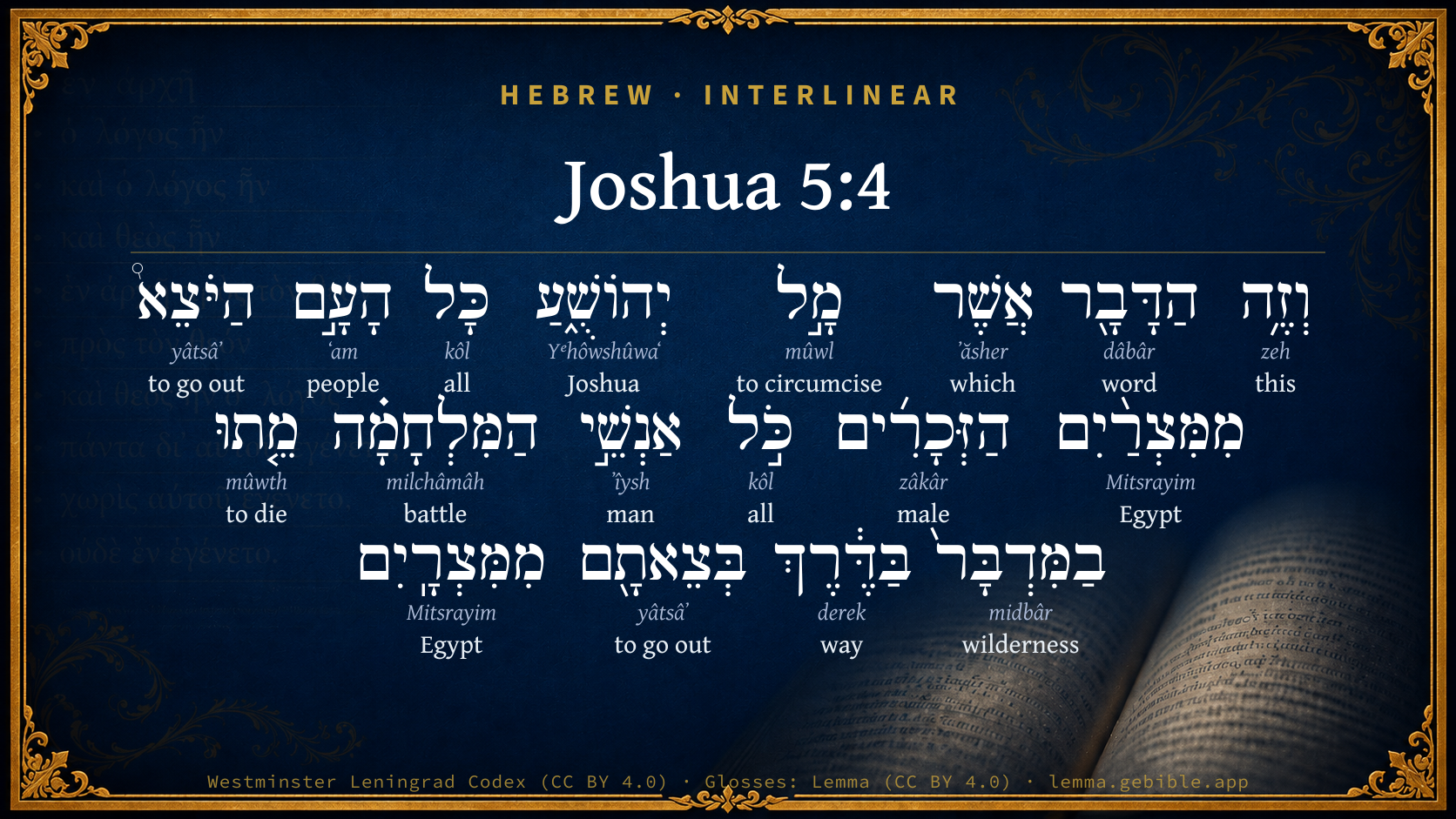
Hebrew (Westminster Leningrad Codex) Joshua 5:4 appears in the Hebrew Old Testament. The text above is from the Westminster Leningrad Codex. Each word links to its Strong’s number, a concise gloss, and parsing drawn from the Open Scriptures Hebrew Bible morphology. Click any word for its full Brown-Driver-Briggs (BDB) entry.
Download image
Cite this verse

Joshua 5:4 (World English Bible). Public Domain. Lemma interlinear Bible study tool, https://lemma.gebible.app/v/joshua/5/4.

Show BibTeX & RIS
BibTeX
RIS
English Translation
This is the cause why Joshua did circumcise: all the people who came forth out of Egypt, who were males, even all the men of war, died in the wilderness by the way, after they came forth out of Egypt.
World English Bible · Public Domain
Download a study sheet

One document with this verse’s original text, its word-by-word gloss line, the meaning frame, cross-references with their text, attributed commentary, and full source and license credits — printable, and it pastes into notes with its structure intact.

This verse Autodidact and up

Study sheet (.html) Plain text (.txt)

A passage Seminary Student

Up to 50 verses in one chapter. A passage sheet keeps up to 6 commentary sources and 12 cross-references per verse, in the order this page ranks them, and says so on the sheet whenever that leaves anything out. Ask for a single verse and you get the Autodidact verse sheet above.

Everything on this page stays free to read, with no account — the sheet is a download of what is already on screen, not access to it.

Want to remove ads? Support Godless Engineer
Compare translations 3

The same verse in 3 English versions, stacked beneath the original-language interlinear above. Click any original word for its lexicon entry.

Each is an independent rendering of the whole verse — the interlinear is not word-aligned to these translations.

Highlighted words mark where these versions differ — a whole-verse word diff, not a word-by-word alignment.

  • World English Bible Public Domain
    This is the cause why Joshua did circumcise: all the people who came forth out of Egypt, who were males, even all the men of war, died in the wilderness by the way, after they came forth out of Egypt.
  • King James Version Public Domain
    And this is the cause why Joshua did circumcise: All the people that came out of Egypt, that were males, even all the men of war, died in the wilderness by the way, after they came out of Egypt.
  • unfoldingWord Literal Text CC BY-SA 4.0
    And this the reason that Joshua circumcised: All of the people having come out from Egypt, the males, all of the men of war, had died in the wilderness on the way, in their coming out from Egypt.

unfoldingWord Literal Text — © unfoldingWord, licensed CC BY-SA 4.0. Word-aligned USFM3 via Door43 (git.door43.org/unfoldingWord/en_ult).

Versions to compare (up to 4)

3 of 4 selected

Show all 18 translations

Every available English version of this verse, each an independent rendering of the whole verse.

  • World English Bible Public Domain
    This is the cause why Joshua did circumcise: all the people who came forth out of Egypt, who were males, even all the men of war, died in the wilderness by the way, after they came forth out of Egypt.
  • Berean Standard Bible Public Domain
    Now this is why Joshua circumcised them: All those who came out of Egypt—all the men of war—had died on the journey in the wilderness after they had left Egypt.
  • Majority Standard Bible Public Domain
    Now this is why Joshua circumcised them: All those who came out of Egypt—all the men of war—had died on the journey in the wilderness after they had left Egypt.
  • King James Version Public Domain
    And this is the cause why Joshua did circumcise: All the people that came out of Egypt, that were males, even all the men of war, died in the wilderness by the way, after they came out of Egypt.
  • American Standard Version (1901) Public Domain
    And this is the cause why Joshua did circumcise: all the people that came forth out of Egypt, that were males, even all the men of war, died in the wilderness by the way, after they came forth out of Egypt.
  • Revised Version (1885) Public Domain
    And this is the cause why Joshua did circumcise: all the people that came forth out of Egypt, that were males, even all the men of war, died in the wilderness by the way, after they came forth out of Egypt.
  • Geneva Bible (1599) Public Domain
    And this is the cause why Ioshua circumcised all the people, euen the males that came out of Egypt, because all the men of warre were dead in the wildernesse by the way after they came out of Egypt.
  • Douay-Rheims (1899) Public Domain
    Now this is the cause of the second circumcision: All the people that came out of Egypt that were males, all the men fit for war, died in the desert, during the time of the long going about in the way.
  • Young's Literal Translation Public Domain
    And this `is' the thing `for' which Joshua circumciseth `them': all the people who are coming out of Egypt, who are males, all the men of war have died in the wilderness, in the way, in their coming out of Egypt,
  • Literal Standard Version CC BY-SA 4.0
    And this [is] the thing [for] which Joshua circumcises [them]: all the people who are coming out of Egypt, who are males, all the men of war have died in the wilderness, in the way, in their coming out of Egypt,
  • Unlocked Literal Bible CC BY-SA 4.0
    This is the reason Joshua circumcised them: All the males who had come out of Egypt, including all the men of war, had died in the wilderness along the way, after they came out from Egypt.
  • unfoldingWord Literal Text CC BY-SA 4.0
    And this the reason that Joshua circumcised: All of the people having come out from Egypt, the males, all of the men of war, had died in the wilderness on the way, in their coming out from Egypt.
  • Darby Bible Public Domain
    And this is the cause why Joshua circumcised [them]: all the people that had come out of Egypt, the males, all the men of war, had died in the wilderness on the way, after they came out of Egypt.
  • World Messianic Bible Public Domain
    This is the reason Joshua circumcised them: all the people who came out of Egypt, who were males, even all the men of war, died in the wilderness along the way, after they came out of Egypt.
  • Webster's Bible Public Domain
    And this is the cause why Joshua did circumcise: All the people that came out of Egypt, that were males, even all the men of war died in the wilderness by the way, after they came out of Egypt.
  • Free Bible Version CC BY-SA 4.0
    This is the reason why Joshua had them all circumcised: all those who left Egypt—the men of fighting age—had died on the journey through the wilderness after the Exodus.
  • Bible in Basic English Public Domain
    And this is the reason why Joshua did so: all the males of the people who came out of Egypt, all the fighting-men, had been overtaken by death in the waste land on the way, after they came out of Egypt.
  • JPS Tanakh (1917) Public Domain
    And this is the cause why Joshua did circumcise: all the people that came forth out of Egypt, that were males, even all the men of war, died in the wilderness by the way, after they came forth out of Egypt.

Literal Standard Version (2020), Covenant Press — licensed CC BY-SA 4.0. Text via the HelloAO Bible API (eBible.org). Unlocked Literal Bible (unfoldingWord) — licensed CC BY-SA 4.0. Text via the HelloAO Bible API (eBible.org). unfoldingWord Literal Text — © unfoldingWord, licensed CC BY-SA 4.0. Word-aligned USFM3 via Door43 (git.door43.org/unfoldingWord/en_ult). Free Bible Version, Dr. Jonathan Gallagher — licensed CC BY-SA 4.0. Text via the HelloAO Bible API (eBible.org).

Word by word

More ways to search: Search by grammar → Find every occurrence → Compare this word →

Practice this passage: Drill this verse → Learn its vocabulary →

מָ֣ל
mûwl
H4135
“to circumcise”
Verb, Qal, Perfect, 3rd Person, Masculine, Singular
Part of Speech
Verb
Stem
Qal
Form
Perfect
Person
3rd Person
Gender
Masculine
Number
Singular
Full BDB Definition

Origin: a primitive root

TWOT: 1161

to circumcise, let oneself be circumcised, cut, be cut off - (Qal) to circumcise - (Niphal) to be circumcised, circumcise oneself - (Hiphil) to cause to be circumcised - of destruction (figuratively) - (Hithpolel) to be cut off - (Polel) cut down
  1. וְזֶ֥ה zeh H2088 “and · this” Conjunction + Pronoun, Demonstrative, Masculine, Singular
  2. הַדָּבָ֖ר dâbâr H1697 “the · word” Particle, Definite Article + Noun, Common, Masculine, Singular, Absolute
  3. אֲשֶׁר ʼăsher H834 “which” Particle, Relative
  4. יְהוֹשֻׁ֑עַ Yᵉhôwshûwaʻ H3091 “Joshua” Noun, Proper
  5. כָּל kôl H3605 “all of” Noun, Common, Masculine, Singular, Construct
  6. הָעָ֣ם ʻam H5971 “the · people” Particle, Definite Article + Noun, Common, Masculine, Singular, Absolute
  7. הַיֹּצֵא֩ yâtsâʼ H3318 “the · going out” Particle, Definite Article + Verb, Qal, Participle Active, Masculine, Singular, Absolute
  8. מִמִּצְרַ֨יִם Mitsrayim H4714 “from · Egypt” Preposition + Noun, Proper
  9. הַזְּכָרִ֜ים zâkâr H2145 “the · males” Particle, Definite Article + Noun, Common, Masculine, Plural, Absolute
  10. כֹּ֣ל kôl H3605 “all of” Noun, Common, Masculine, Singular, Construct
  11. אַנְשֵׁ֣י ʼîysh H376 “men of” Noun, Common, Masculine, Plural, Construct
  12. הַמִּלְחָמָ֗ה milchâmâh H4421 “the · battle” Particle, Definite Article + Noun, Common, Feminine, Singular, Absolute
  13. מֵ֤תוּ mûwth H4191 “to die” Verb, Qal, Perfect, 3rd Person, Common, Plural
  14. בַמִּדְבָּר֙ midbâr H4057 “in/at the · wilderness” Preposition, Determined + Noun, Common, Masculine, Singular, Absolute
  15. בַּדֶּ֔רֶךְ derek H1870 “in/at the · way” Preposition, Determined + Noun, Common, Both, Singular, Absolute
  16. בְּצֵאתָ֖ם yâtsâʼ H3318 “in/at · to go out · them” Preposition + Verb, Qal, Infinitive Construct + Suffix, Personal, 3rd Person, Masculine, Plural
  17. מִמִּצְרָֽיִם Mitsrayim H4714 “from · Egypt” Preposition + Noun, Proper

About this verse

These counts appear in no published source. They are computed here, from the morphology-tagged text and Lemma’s own curated glosses. What Lemma adds →

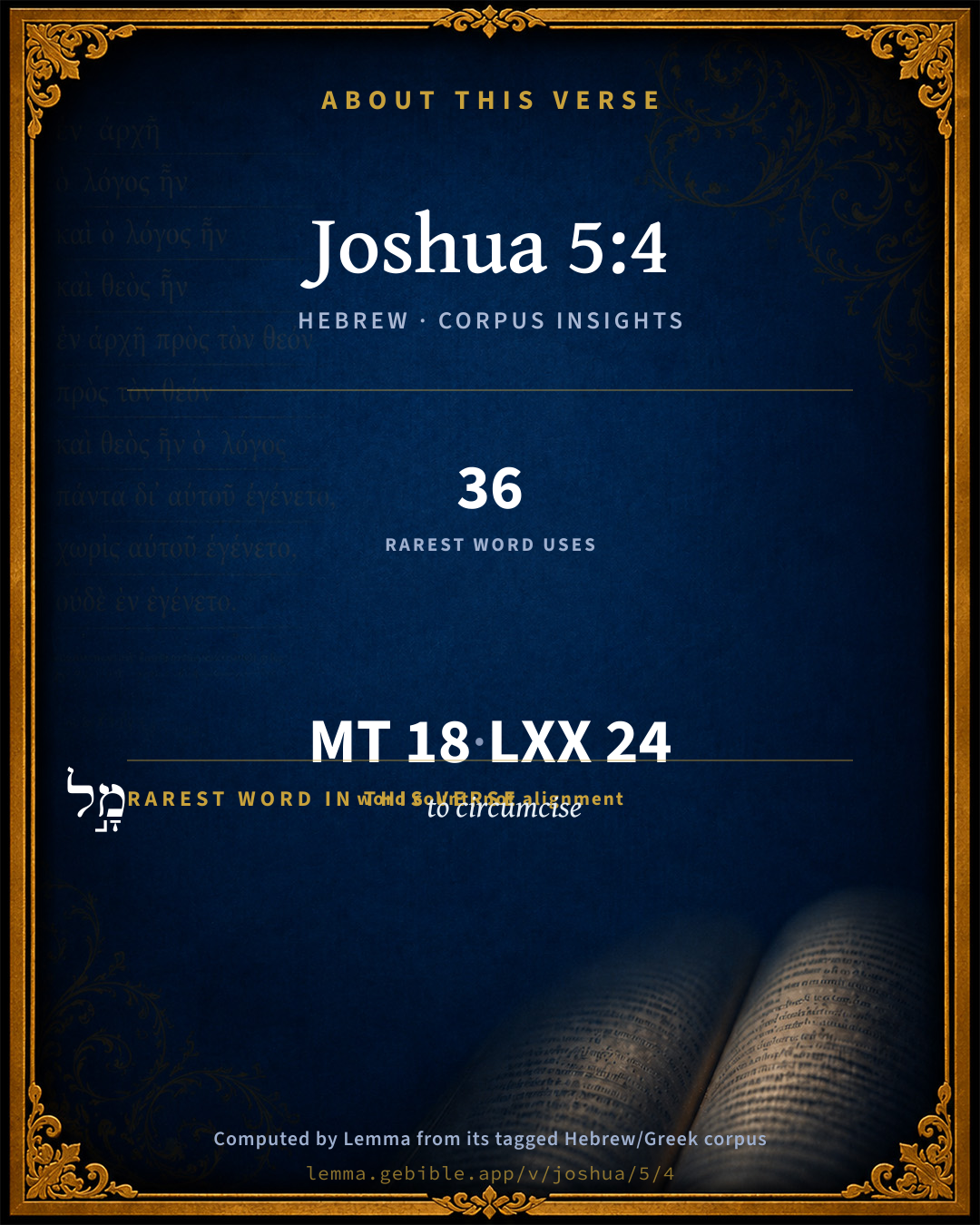
18
words
15
distinct lemmas
Historical
section

Shared distinctive vocabulary

מָ֣ל to circumcise H4135 occurs in 32 verses of the Hebrew Bible. Also found in:

Grammatical profile

  • 4 verbs
  • 12 nouns
  • 1 pronoun
  • 1 particle

Verb forms

  • מָ֣ל Qal · Perfect
  • הַיֹּצֵא֩ Qal · Participle Active
  • מֵ֤תוּ Qal · Perfect
  • בְּצֵאתָ֖ם Qal · Infinitive Construct

Repetition

Words recur within this verse — often emphatic in Hebrew:

  • כָּל all H3605 ×2
  • הַיֹּצֵא֩ to go out H3318 ×2
  • מִמִּצְרַ֨יִם Egypt H4714 ×2

Hebrew & Septuagint length

In English translation the verse runs 40 words from the Hebrew and 34 from the Septuagint (LXX English) — closely comparable.

A rough comparison of the two English renderings, which tokenize alike — not a word-level alignment.

Word counts can differ between the Hebrew and the Greek without any difference in meaning — e.g. the Hebrew direct-object marker אֵת has no separate Greek word, and Greek often adds the article ὁ.

In the original languages it is 18 Hebrew tokens and 24 Greek tokens — but the two are counted differently (Hebrew bundles its prefixes and suffixes into one token; the Greek is in lemma form), so that isn’t a like-for-like length.

Cross-references

6

Topical passages linked to Joshua 5:4 in the Treasury of Scripture Knowledge — connected by theme and wording, ordered by reader-vote popularity; previews shown in the World English Bible.

  • Numbers 26:64–65 But among these there was not a man of them who were numbered by Moses and Aaron the priest, who numbered the children of Israel in the wilderness of Sinai.
  • Deuteronomy 2:16 So it happened, when all the men of war were consumed and dead from among the people,
  • 1 Corinthians 10:5 However with most of them, God was not well pleased, for they were overthrown in the wilderness.
  • Numbers 14:22 because all those men who have seen my glory, and my signs, which I worked in Egypt and in the wilderness, yet have tempted me these ten times, and have not listened to my voice;
  • Deuteronomy 2:14 The days in which we came from Kadesh-barnea, until we were come over the brook Zered, were thirty-eight years; until all the generation of the men of war were consumed from the midst of the camp, as Yahweh swore to them.
  • Hebrews 3:17–19 With whom was he displeased forty years? Wasn't it with those who sinned, whose bodies fell in the wilderness?

Cross-references courtesy of OpenBible.info (CC BY 4.0).

Hebrew and Greek witnesses Masoretic Hebrew ↔ Greek Septuagint

The same verse in the two great witnesses to the Old Testament, shown verse-for-verse.

These are two independent witnesses, not word-aligned to each other, and the Septuagint is shown in lemma (dictionary) form.

Hebrew Joshua 5:4 Masoretic · Westminster Leningrad Codex

וְזֶ֥ה הַדָּבָ֖ר אֲשֶׁר מָ֣ל יְהוֹשֻׁ֑עַ כָּל הָעָ֣ם הַיֹּצֵא֩ מִמִּצְרַ֨יִם הַזְּכָרִ֜ים כֹּ֣ל אַנְשֵׁ֣י הַמִּלְחָמָ֗ה מֵ֤תוּ בַמִּדְבָּר֙ בַּדֶּ֔רֶךְ בְּצֵאתָ֖ם מִמִּצְרָֽיִם

This is the cause why Joshua did circumcise: all the people who came forth out of Egypt, who were males, even all the men of war, died in the wilderness by the way, after they came forth out of Egypt.

World English Bible · Public Domain

Greek LXX Joshua 5:4 Septuagint · lemma form

ὅς δέ τρόπος περι κατααἴρω ἰησοῦς ὁ υἱός ἰσραήλ ὅσος ποτέ γίγνομαι ἐν ὁ ὁδός καί ὅσος ποτέ ἀπερίτμητος εἰμί ὁ ἐκἔρχομαι ἐκ αἴγυπτος

And this is the way in which Joshua purified the children of Israel; as many as were born in the way, and as many as were uncircumcised of them that came out of Egypt,

LXX2012 (modern English Septuagint) · Public Domain

Hebrew: Westminster Leningrad Codex (CC BY 4.0). Greek: Septuagint (public domain); English from LXX2012 (modern English Septuagint) (Public Domain). How the Septuagint differs from the Hebrew →

Targum (Aramaic paraphrase)

1

The Targum is the ancient Jewish Aramaic paraphrase of the Hebrew Scriptures — an interpretive translation, not the Hebrew text itself. Onkelos (literal) and Pseudo-Jonathan (expansive) render the Torah, and Jonathan the Prophets. Coverage is partial: where no permissively-licensed English translation exists for a verse, only the Aramaic is shown. This is verse-level text, not a word-by-word alignment to the Hebrew.

  1. Targum Jonathan Prophets (Joshua–Malachi)
    וְדֵין פִּתְגָמָא דִי גְזַר יְהוֹשֻׁעַ כָּל עַמָא דִנְפַק מִמִצְרַיִם דָכְרַיָא כָּל גַבְרֵי מְגִיחֵי קְרָבָא מִיתוּ בְמַדְבְּרָא בְּאוֹרְחָא בְּמִפַּקְהוֹן מִמִצְרָיִם:

    (no public-domain English translation for this verse)

    Targum Jonathan — Aramaic: “Mikraot Gedolot” (public domain). English: “Sefaria Community Translation” (CC0 1.0 (public-domain dedication)); “London "Chaldee Paraphrase," 1871” (public domain). Text via Sefaria.

Commentary

Notes on Joshua 5:4 from classic Christian and Jewish commentators (each source and its license shown beneath its notes). The classic Christian expositions comment on the surrounding passage and are grouped to its opening verse, so a note may address several verses; the Jewish commentaries on the Tanakh (Rashi and others) are per-verse, so they appear only where the commentator wrote on this verse.

Lemma curates 59 commentaries, every one of them public domain or Creative Commons licensed, each selected and text-cleaned for this edition rather than reprinted as found. About our sources →

Trapp's Complete Commentary

John Trapp

Jos 5:4 And this [is] the cause why Joshua did circumcise: All the people that came out of Egypt, [that were] males, [even] all the men of war, died in the wilderness by the way, after they came out of Egypt.

Ver. 4. Died in the wilderness by the way.] There their carcasses fell for their rebellion; and a new generation rose up which were now to be circumcised, that they might be in case to keep the passover.

John Trapp, A Commentary or Exposition upon All the Books of the Old and New Testament (1647–1656) — public domain. Text from a community e-Sword module.

Joseph Benson's Commentary

Jos 5:4. All that came out of Egypt that were males died — This is to be restrained to such as were then above twenty years old, and such as were guilty of the rebellion mentioned Numbers 14., as it is expressed Jos 5:6.

Joseph Benson's Commentary on the Old and New Testaments (1811–1818) — public domain. Text from a community e-Sword module.

Tyndale Open Study Notes

Tyndale Open Resources

5:4-7 This unexpected detour in the narrative provides an important reminder of Israel’s earlier refusal to believe that God would bring them safely into the land of Canaan (Num 14). This summary of God’s judgment upon their fathers reminded the present generation that trusting in God was still necessary if they were to occupy the land their ancestors had forfeited. Further, it signaled the completion of God’s judgment upon the earlier generation.

Tyndale Open Study Notes — © Tyndale Open Resources, licensed CC BY-SA 4.0. Text via the HelloAO Bible API.

Jamieson, Fausset & Brown

Robert Jamieson, A. R. Fausset & David Brown

this is the cause why Joshua did circumcise--The omission to circumcise the children born in the wilderness might have been owing to the incessant movements of the people; but it is most generally thought that the true cause was a temporary suspension of the covenant with the unbelieving race who, being rejected of the Lord, were doomed to perish in the wilderness, and whose children had to bear the iniquity of their fathers (Num 14:33), though, as the latter were to be brought into the promised land, the covenant would be renewed with them.

Jamieson, Fausset & Brown — Commentary Critical and Explanatory on the Whole Bible (1871) — public domain (CC PDM 1.0). Text via the HelloAO Bible API.

Adam Clarke's Commentary

Verse 4. This is the cause why Joshua did circumcise] The text here explains itself. Before the Israelites left Egypt all the males were circumcised; and some learned men think that all those who were born during their encampment at Sinai were circumcised also, because there they celebrated the passover; but after that time, during the whole of their stay in the wilderness, there were none circumcised till they entered into the promised land. Owing to their unsettled state, God appears to have dispensed, for the time being, with this rite; but as they were about to celebrate another passover, it was necessary that all the males should be circumcised; for without this they could not be considered within the covenant, and could not keep the passover, which was the seal of that covenant. As baptism is generally understood to have succeeded to circumcision, and the holy eucharist to the passover, hence, in the Church of England, and probably in most others, no person is permitted to receive the sacrament of the Lord's Supper till he has been baptized.

Adam Clarke's Commentary on the Bible (1810–1826) — public domain. Text from a community e-Sword/MySword module.

Ellicott's Commentary for English Readers

(4) The cause why Joshua did circumcise.—As the narrative stands it is not quite obvious why uncircumcision is called “the reproach of Egypt,” whereas all the people born in Egypt were circumcised. The uncircumcision attached to those who were born in the wilderness, during the years of wandering. But that period of wandering, between the departure from Kadesh-barnea and the return to Kadesh (thirty-seven and a half years, Numbers 15-19, inclusive), is a kind of blank in the story of the Exodus. The five chapters which belong to it in the Book of Numbers contain no note of progress as to time or place. The people had “turned back in their hearts to Egypt” (Act_7:39; Num_14:4), and were bearing the reproach of their apostasy all those years, “the reproach of Egypt.” Suffering under the “breach of promise” of Jehovah (Num_14:34), they appear to have omitted the sign of the covenant, as though they were no longer the people of God. The passage of Jordan was the practical proof of Israel’s restoration to Divine favour, and they were brought into covenant with Him once more.

A Bible Commentary for English Readers, edited by Charles John Ellicott (1878–1897) — public domain. Text from a community e-Sword module.

John Gill's Exposition

And this is the cause why Joshua did circumcise,.... Or the reason of the command given him to circumcise the children of Israel at this time, namely, what follows:

all the people that came out of Egypt that were males, even all the men of war; meaning such that were twenty years old, and upwards:

died in the wilderness, by the way, after they came out of Egypt; not directly, but in a course of forty years, as they journeyed through the wilderness; this is to be understood with an exception of Joshua, Caleb, Eleazar, &c. but then there was a large number who were under twenty years of age, that came out of Egypt, and were now living.

John Gill's Exposition of the Whole Bible (1746–1763) — public domain (CC PDM 1.0). Text via the HelloAO Bible API.

Albert Barnes' Notes on the Bible

Of the whole nation those only were already circumcised at the time of the passage of the Jordan who had been under twenty years of age at the time of the complaining and consequent rejection at Kadesh (compare the marginal reference). These would have been circumcised before they left Egypt, and there would still survive of them more than a quarter of a million of thirty-eight years old and upward.

The statements of these verses are of a general kind. The “forty years” of Jos 5:6 is a round number, and the statement in the latter part of Jos 5:5 cannot be strictly accurate. For there must have been male children born in the wilderness during the first year after the Exodus, and these must have been circumcised before the celebration of the Passover at Sinai in the first month of the second year (compare Num 9:1-5, and Exo 12:48). The statements of the verses are, however, sufficiently close to the facts for the purpose in hand; namely, to render a reason for the general circumcising which is here recorded.

The reason why circumcision was omitted in the wilderness, was that the sentence of Num 14:28 ff placed the whole nation for the time under a ban; and that the discontinuance of circumcision, and the consequent omission of the Passover, was a consequence and a token of that ban. The rejection was not, indeed, total, for the children of the complainers were to enter into the rest; nor final, for when the children had borne the punishment of the fathers’ sins for the appointed years, and the complainers were dead, then it was to be removed, as now by Joshua. But for the time the covenant was abrogated, though God’s purpose to restore it was from the first made known, and confirmed by the visible marks of His favor which He still vouchsafed to bestow during the wandering. The years of rejection were indeed exhausted before the death of Moses (compare Deu 2:14): but God would not call upon the people to renew their engagement to Him until He had first given them glorious proof of His will and power to fulfill His engagements to them. So He gave them the first fruits of the promised inheritance - the kingdoms of Sihon and Og; and through a miracle planted their feet on the very soil that still remained to be conquered; and then recalled them to His covenant. It is to be noted, too, that they were just about to go to war against foes mightier than themselves. Their only hope of success lay in the help of God. At such a crisis the need of full communion with God would be felt indeed; and the blessing and strength of it are accordingly granted.

The revival of the two great ordinances - circumcision and the Passover - after so long an intermission could not but awaken the zeal and invigorate the faith and fortitude of the people. Both as seals and as means of grace and God’s good purpose toward them then, the general circumcision of the people, followed up by the solemn celebration of the Passover - the one formally restoring the covenant and reconciling them nationally to God, the other ratifying and confirming all that circumcision intended - were at this juncture most opportune.

Albert Barnes' Notes on the Bible (1834–1885) — public domain. Text from a community e-Sword/MySword module.

Haydock's Catholic Bible Commentary

Second. Hebrew, "this is the thing, (the cause why) Josue gave circumcision."

George Leo Haydock (1774–1849), Haydock's Catholic Family Bible and Commentary, 1859 edition — public domain. Excludes Psalms (Douay-Rheims chapter numbering differs from Protestant) and Deuterocanonical books (Catholic canon only).

Matthew Poole's English Annotations

This is to be restrained to such as were then above twenty years old, and such as were guilty of that rebellion, Num 14, as it is expressed below, Jos 5:6.

Matthew Poole's English Annotations on the Holy Bible (1683–1685) — public domain. Text from a community e-Sword/MySword module.

Whedon's Commentary on the Bible

Daniel D. Whedon

4. And this is the cause — As this book contains not only a record of events, but also ascribes a rational cause to each, it may be classed among philosophical histories.

All the people — This expression is limited first to the males, and then to those of military age, from twenty years old and upwards. Num_14:29-32.

Died in the wilderness — Because of their rebellion against Jehovah, and the cowardice displayed when the panic-stricken spies made their exaggerated report. Num_14:21-35. Caleb and Joshua were the only exceptions to this sweeping sentence. Num_26:64-65.

Daniel D. Whedon (gen. ed.), Commentary on the Old and New Testaments (1874–1909) — public domain. Text from a community e-Sword module.

The Pulpit Commentary

After they came out from Egypt. Rather on their journey from Egypt." See next verse, where the same words are translated "as they came out."

The Pulpit Commentary (1880–1919), ed. H.D.M. Spence-Jones & Joseph S. Exell — public domain. Text from a community e-Sword module.

John Wesley's Explanatory Notes

Out of Egypt - This is to be restrained to such as were then above twenty years old, and such as were guilty of that rebellion, Num. xiv, 1-25, as it is expressed below, ver. 6.

John Wesley, Explanatory Notes Upon the Whole Bible (1754–1765) — public domain. Text via the GEBible commentary corpus.

unfoldingWord translationNotes

Door43 World Missions Community

General Information:

The reason all the males of Israel had to be circumcised is explained.

the men of war

the men who were old enough to be soldiers

translationWords

Joshua

circumcise

Egypt

desert

unfoldingWord translationNotes — © Distant Shores Media and the Door43 World Missions Community, licensed CC BY-SA 4.0. Source: git.door43.org/Door43/en_tn.

Rashi

Rabbi Shlomo Yitzchaki (Rashi)

And this is the reason. [Lit. and this is the thing] After this speech he circumcised them. He said to them. “Do you think you will inherit this land while you are yet uncircumcised? Was it not said to Avrohom, ‘And you will preserve My covenant etc.’ ‘and I will give you and your descendants after you, the land of your sojournings.’”

All the people that went out. Not one of them was here for they had all died, and they had all been circumcised, as it is said, ‘for they were circumcised.’

Rashi on the Tanakh — English translations: “The Judaica Press complete Tanach with Rashi, translated by A. J. Rosenberg” (CC BY 4.0); “Pentateuch with Rashi's commentary by M. Rosenbaum and A.M. Silbermann, 1929-1934” (public domain); “The Metsudah Tanach series, Lakewood, N.J” (CC BY 4.0); and “The Book of Joshua, Metsudah Publications, 1997” (CC BY 4.0). Text via Sefaria.

Lesson kit

Teaching starters — assembled from the data on this page, not authored interpretation. Every prompt links to the verse data it draws on. Edit before teaching.

Joshua, in the Historical, opens this verse with 18 words (15 distinct Hebrew lemmas). Its most distinctive word is mûwl (“to circumcise”). A historical commentator’s framing appears above. Read the whole chapter for the surrounding context.

Discussion questions

  1. What does “to circumcise” (mûwl) contribute to the verse as a whole?
  2. How does Genesis 17:10, which shares the word «to circumcise», read alongside this verse?
  3. What does the repetition of “all” (2× in this one verse) do in this verse?
  4. The translations on this page render this verse differently — a whole-verse word diff, not a word-by-word alignment. What might account for the different wordings?
  5. «מָ֣ל» is a Qal Perfect verb. How does that grammatical form shape the action described?
  6. Compare how Trapp's Complete Commentary and Joseph Benson's Commentary read this verse. Where do they agree or differ?

Things to notice

Reading settings

Reading text

Shown beneath each verse's original-language words.

Old Testament
Old Testament edition

Read the OT as the Masoretic Hebrew (MT) or the Greek Septuagint (LXX).

English shown for the Greek Septuagint (in the Hebrew ↔ Greek comparison).

Comparing translations? Open the Compare panel on any verse page to stack up to four side by side.