Jeremiah 44:13

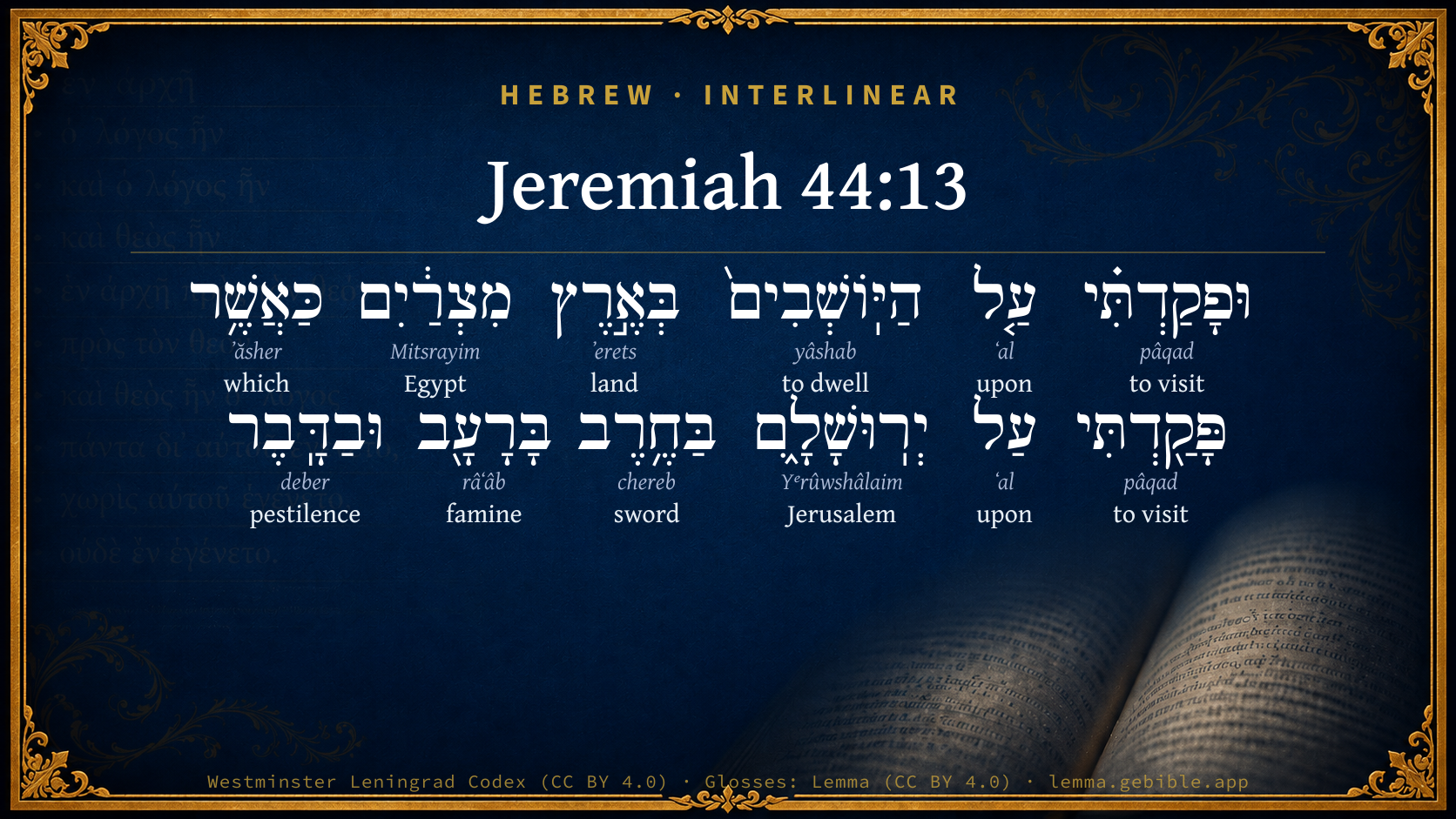
Hebrew (Westminster Leningrad Codex) Jeremiah 44:13 appears in the Hebrew Old Testament. The text above is from the Westminster Leningrad Codex. Each word links to its Strong’s number, a concise gloss, and parsing drawn from the Open Scriptures Hebrew Bible morphology. Click any word for its full Brown-Driver-Briggs (BDB) entry.
Download image
Cite this verse

Jeremiah 44:13 (World English Bible). Public Domain. Lemma interlinear Bible study tool, https://lemma.gebible.app/v/jeremiah/44/13.

Show BibTeX & RIS
BibTeX
RIS
English Translation
For I will punish those who dwell in the land of Egypt, as I have punished Jerusalem, by the sword, by the famine, and by the pestilence;
World English Bible · Public Domain
Download a study sheet

One document with this verse’s original text, its word-by-word gloss line, the meaning frame, cross-references with their text, attributed commentary, and full source and license credits — printable, and it pastes into notes with its structure intact.

This verse Autodidact and up

Study sheet (.html) Plain text (.txt)

A passage Seminary Student

Up to 50 verses in one chapter. A passage sheet keeps up to 6 commentary sources and 12 cross-references per verse, in the order this page ranks them, and says so on the sheet whenever that leaves anything out. Ask for a single verse and you get the Autodidact verse sheet above.

Everything on this page stays free to read, with no account — the sheet is a download of what is already on screen, not access to it.

Want to remove ads? Support Godless Engineer
Compare translations 3

The same verse in 3 English versions, stacked beneath the original-language interlinear above. Click any original word for its lexicon entry.

Each is an independent rendering of the whole verse — the interlinear is not word-aligned to these translations.

Highlighted words mark where these versions differ — a whole-verse word diff, not a word-by-word alignment.

  • World English Bible Public Domain
    For I will punish those who dwell in the land of Egypt, as I have punished Jerusalem, by the sword, by the famine, and by the pestilence;
  • King James Version Public Domain
    For I will punish them that dwell in the land of Egypt, as I have punished Jerusalem, by the sword, by the famine, and by the pestilence:
  • unfoldingWord Literal Text CC BY-SA 4.0
    For I will punish the people inhabiting the land of Egypt just as I punished Jerusalem with the sword, with famine, and with the plague,

unfoldingWord Literal Text — © unfoldingWord, licensed CC BY-SA 4.0. Word-aligned USFM3 via Door43 (git.door43.org/unfoldingWord/en_ult).

Versions to compare (up to 4)

3 of 4 selected

Show all 18 translations

Every available English version of this verse, each an independent rendering of the whole verse.

  • World English Bible Public Domain
    For I will punish those who dwell in the land of Egypt, as I have punished Jerusalem, by the sword, by the famine, and by the pestilence;
  • Berean Standard Bible Public Domain
    I will punish those who live in the land of Egypt, just as I punished Jerusalem, by sword and famine and plague,
  • Majority Standard Bible Public Domain
    I will punish those who live in the land of Egypt, just as I punished Jerusalem, by sword and famine and plague,
  • King James Version Public Domain
    For I will punish them that dwell in the land of Egypt, as I have punished Jerusalem, by the sword, by the famine, and by the pestilence:
  • American Standard Version (1901) Public Domain
    For I will punish them that dwell in the land of Egypt, as I have punished Jerusalem, by the sword, by the famine, and by the pestilence;
  • Revised Version (1885) Public Domain
    For I will punish them that dwell in the land of Egypt, as I have punished Jerusalem, by the sword, by the famine, and by the pestilence:
  • Geneva Bible (1599) Public Domain
    For I will visite them that dwel in the land of Egypt, as I haue visited Ierusalem, by ye sworde, by the famine, and by the pestilence,
  • Douay-Rheims (1899) Public Domain
    And I will visit them that dwell in the land of Egypt, as I have visited Jerusalem by the sword, and by famine, and by pestilence.
  • Young's Literal Translation Public Domain
    `And I have seen after those dwelling in the land of Egypt, as I saw after Jerusalem, with sword, with famine, and with pestilence,
  • Literal Standard Version CC BY-SA 4.0
    And I have seen after those dwelling in the land of Egypt, as I saw after Jerusalem, with sword, with famine, and with pestilence,
  • Unlocked Literal Bible CC BY-SA 4.0
    For I will punish the people inhabiting the land of Egypt just as I punished Jerusalem with the sword, with famine, and with the plague,
  • unfoldingWord Literal Text CC BY-SA 4.0
    For I will punish the people inhabiting the land of Egypt just as I punished Jerusalem with the sword, with famine, and with the plague,
  • Darby Bible Public Domain
    And I will punish them that dwell in the land of Egypt as I have punished Jerusalem, by the sword, by the famine, and by the pestilence;
  • World Messianic Bible Public Domain
    For I will punish those who dwell in the land of Egypt, as I have punished Jerusalem, by the sword, by the famine, and by the pestilence;
  • Webster's Bible Public Domain
    For I will punish them that dwell in the land of Egypt, as I have punished Jerusalem, by the sword, by the famine, and by the pestilence:
  • Free Bible Version CC BY-SA 4.0
    I'm going to punish you who live in Egypt like I punished Jerusalem, by war and famine and disease.
  • Bible in Basic English Public Domain
    For I will send punishment on those who are living in the land of Egypt, as I have sent punishment on Jerusalem, by the sword and by need of food and by disease:
  • JPS Tanakh (1917) Public Domain
    For I will punish them that dwell in the land of Egypt, as I have punished Jerusalem, by the sword, by the famine, and by the pestilence;

Literal Standard Version (2020), Covenant Press — licensed CC BY-SA 4.0. Text via the HelloAO Bible API (eBible.org). Unlocked Literal Bible (unfoldingWord) — licensed CC BY-SA 4.0. Text via the HelloAO Bible API (eBible.org). unfoldingWord Literal Text — © unfoldingWord, licensed CC BY-SA 4.0. Word-aligned USFM3 via Door43 (git.door43.org/unfoldingWord/en_ult). Free Bible Version, Dr. Jonathan Gallagher — licensed CC BY-SA 4.0. Text via the HelloAO Bible API (eBible.org).

Word by word

More ways to search: Search by grammar → Find every occurrence → Compare this word →

Practice this passage: Drill this verse → Learn its vocabulary →

וּבַדָּֽבֶר
deber
H1698
“and · in/at the · pestilence”
Conjunction + Preposition, Determined + Noun, Common, Masculine, Singular, Absolute
Part of Speech
Conjunction + Preposition + Noun
Type
Common
Gender
Masculine
Number
Singular
State
Absolute
Full BDB Definition

Origin: from H1696 (in the sense of destroying)

TWOT: 399b

pestilence, plague - murrain, cattle disease, cattle-plague
  1. וּפָקַדְתִּ֗י pâqad H6485 “and · to visit” Conjunction + Verb, Qal, Sequential Perfect, 1st Person, Common, Singular
  2. עַ֤ל ʻal H5921 “upon” Preposition
  3. הַיּֽוֹשְׁבִים֙ yâshab H3427 “the · dwelling” Particle, Definite Article + Verb, Qal, Participle Active, Masculine, Plural, Absolute
  4. בְּאֶ֣רֶץ ʼerets H776 “in/at · land of” Preposition + Noun, Common, Both, Singular, Construct
  5. מִצְרַ֔יִם Mitsrayim H4714 “Egypt” Noun, Proper
  6. כַּאֲשֶׁ֥ר ʼăsher H834 “like/as · which” Preposition + Particle, Relative
  7. פָּקַ֖דְתִּי pâqad H6485 “to visit” Verb, Qal, Perfect, 1st Person, Common, Singular
  8. עַל ʻal H5921 “upon” Preposition
  9. יְרֽוּשָׁלִָ֑ם Yᵉrûwshâlaim H3389 “Jerusalem” Noun, Proper
  10. בַּחֶ֥רֶב chereb H2719 “in/at the · sword” Preposition, Determined + Noun, Common, Feminine, Singular, Absolute
  11. בָּרָעָ֖ב râʻâb H7458 “in/at the · famine” Preposition, Determined + Noun, Common, Masculine, Singular, Absolute

About this verse

These counts appear in no published source. They are computed here, from the morphology-tagged text and Lemma’s own curated glosses. What Lemma adds →

12
words
10
distinct lemmas
Prophets
section

Shared distinctive vocabulary

וּבַדָּֽבֶר pestilence H1698 occurs in 48 verses of the Hebrew Bible. Also found in:

Grammatical profile

  • 3 verbs
  • 6 nouns
  • 2 prepositions
  • 1 particle

Verb forms

  • וּפָקַדְתִּ֗י Qal · Sequential Perfect
  • הַיּֽוֹשְׁבִים֙ Qal · Participle Active
  • פָּקַ֖דְתִּי Qal · Perfect

Repetition

Words recur within this verse — often emphatic in Hebrew:

  • וּפָקַדְתִּ֗י to visit H6485 ×2
  • עַ֤ל upon H5921 ×2

Cross-references

6

Topical passages linked to Jeremiah 44:13 in the Treasury of Scripture Knowledge — connected by theme and wording, ordered by reader-vote popularity; previews shown in the World English Bible.

  • Jeremiah 11:22 therefore thus says Yahweh of hosts, Behold, I will punish them: the young men shall die by the sword; their sons and their daughters shall die by famine;
  • Jeremiah 43:11 He shall come, and shall strike the land of Egypt; such as are for death [shall be given] to death, and such as are for captivity to captivity, and such as are for the sword to the sword.
  • Jeremiah 44:27–28 Behold, I watch over them for evil, and not for good; and all the men of Judah who are in the land of Egypt shall be consumed by the sword and by the famine, until there be an end of them.
  • Jeremiah 21:9 He who remains in this city shall die by the sword, and by the famine, and by the pestilence; but he who goes out, and passes over to the Chaldeans who besiege you, he shall live, and his life shall be to him for a prey.
  • Jeremiah 24:10 I will send the sword, the famine, and the pestilence, among them, until they be consumed from off the land that I gave to them and to their fathers.
  • Jeremiah 42:18 For thus says Yahweh of Hosts, the God of Israel: As my anger and my wrath has been poured forth on the inhabitants of Jerusalem, so shall my wrath be poured forth on you, when you shall enter into Egypt; and you shall be an object of horror, and an astonishment, and a curse, and a reproach; and you shall see this place no more.

Cross-references courtesy of OpenBible.info (CC BY 4.0).

Hebrew and Greek witnesses Masoretic Hebrew ↔ Greek Septuagint

The same verse in the two great witnesses to the Old Testament, shown verse-for-verse.

These are two independent witnesses, not word-aligned to each other, and the Septuagint is shown in lemma (dictionary) form.

Hebrew Jeremiah 44:13 Masoretic · Westminster Leningrad Codex

וּפָקַדְתִּ֗י עַ֤ל הַיּֽוֹשְׁבִים֙ בְּאֶ֣רֶץ מִצְרַ֔יִם כַּאֲשֶׁ֥ר פָּקַ֖דְתִּי עַל יְרֽוּשָׁלִָ֑ם בַּחֶ֥רֶב בָּרָעָ֖ב וּבַדָּֽבֶר

For I will punish those who dwell in the land of Egypt, as I have punished Jerusalem, by the sword, by the famine, and by the pestilence;

World English Bible · Public Domain

Greek LXX Structure differs

In the Septuagint, Jeremiah is about an eighth shorter than the Hebrew and arranges its material differently — the Oracles Against the Nations (Hebrew chapters 46–51) appear in the middle of the Greek book, after 25:13. Because the chapter and verse boundaries do not line up, a verse-for-verse comparison with the Hebrew is not shown.

A verse-for-verse comparison isn’t shown here because the chapters and verses don’t line up. Switch to the LXX edition with the MT / LXX toggle above to read the Greek directly.

Hebrew: Westminster Leningrad Codex (CC BY 4.0). Greek: Septuagint (public domain); English from a public-domain English Septuagint. How the Septuagint differs from the Hebrew →

Targum (Aramaic paraphrase)

1

The Targum is the ancient Jewish Aramaic paraphrase of the Hebrew Scriptures — an interpretive translation, not the Hebrew text itself. Onkelos (literal) and Pseudo-Jonathan (expansive) render the Torah, and Jonathan the Prophets. Coverage is partial: where no permissively-licensed English translation exists for a verse, only the Aramaic is shown. This is verse-level text, not a word-by-word alignment to the Hebrew.

  1. Targum Jonathan Prophets (Joshua–Malachi)
    וְאַסְעַר עַל דְיָתְבִין בְּאַרְעָא דְמִצְרַיִם כְּמָא דְאַסְעֵרִית עַל יְרוּשְׁלֵם בְּחַרְבָּא בְּכַפְנָא וּבְמוֹתָא:

    (no public-domain English translation for this verse)

    Targum Jonathan — Aramaic: “Mikraot Gedolot” (public domain). English: “Sefaria Community Translation” (CC0 1.0 (public-domain dedication)); “London "Chaldee Paraphrase," 1871” (public domain). Text via Sefaria.

Commentary

Notes on Jeremiah 44:13 from classic Christian and Jewish commentators (each source and its license shown beneath its notes). The classic Christian expositions comment on the surrounding passage and are grouped to its opening verse, so a note may address several verses; the Jewish commentaries on the Tanakh (Rashi and others) are per-verse, so they appear only where the commentator wrote on this verse.

Lemma curates 59 commentaries, every one of them public domain or Creative Commons licensed, each selected and text-cleaned for this edition rather than reprinted as found. About our sources →

Trapp's Complete Commentary

John Trapp

Jer 44:13 For I will punish them that dwell in the land of Egypt, as I have punished Jerusalem, by the sword, by the famine, and by the pestilence:

Ver. 13. For I will punish them.] Let them never think that they shall one day be settled again in their own country; they could easily come down into Egypt.

“ Sed revocare gradum,” &c. “Hic labor,” &c.

I will watch them for ever going back again; let them set their hearts at rest for that matter, it will never be.

John Trapp, A Commentary or Exposition upon All the Books of the Old and New Testament (1647–1656) — public domain. Text from a community e-Sword module.

John Calvin's Commentaries

He confirms in this verse what he had said in the last, that he would again take vengeance on impiety, as he had done previously. The Jews were before visited with a very grievous calamity, when inebriated with prosperity; but now, when God would have shaken from off them their torpor, the Prophet justly reminds them of the calamities which they had suffered: As, then, I visited Jerusalem, so will I visit those who dwell in Egypt But the argument is also from the greater to the less; for if God had not spared the holy city, in which he had chosen a habitation, how should he spare Egypt? for Egypt was not worthy that God should regard it. We know that it was a profane and an accursed land. It was, then, the greatest madness for the Jews to hope to be safe in Egypt, when they could not have been so in the holy land, which was God’s sanctuary, which was their heritage, which was even God’s rest.

We now see the object of the Prophet; for he set before · them the ruin of the city and of the land of Judah, that they might know that they could not escape the hand of God while they dwelt in Egypt contrary to his command, for God would be a severer judge to them there than he had been before in the land of Judah. It follows, —

John Calvin's Commentaries (1540-1563) — public domain. Text from the Calvin Translation Society English edition (1840s-50s) via the Christian Classics Ethereal Library (ccel.org). Calvin's coverage is partial (roughly two-thirds of the Bible); uncommented books and verses are honest gaps, never fabricated. The 19th-century editor's footnotes and remarks are omitted so the notes are faithfully Calvin's own voice.

Ellicott's Commentary for English Readers

(13) I will punish them that dwell in the land of Egypt.—The words point, like those of Jer_43:11, to a punishment which should fall on the whole of Egypt, and from which the Jews who dwelt in it should find no exemption.

A Bible Commentary for English Readers, edited by Charles John Ellicott (1878–1897) — public domain. Text from a community e-Sword module.

John Gill's Exposition

For I will punish them that dwell in the land of Egypt,.... Or "visit"; in a way of wrath and vengeance; meaning not the native inhabitants of Egypt; though these should be punished, and in whose punishment the Jews would be involved; but here it means the Jews that dwelt in Egypt, who went thither contrary to the will of God, and there settled:

as I have punished Jerusalem, by the sword, by the famine, and by the pestilence; signifying that the same punishment that came upon the inhabitants of Jerusalem, and other cities of Judea, should come upon these Jews in Egypt, and as sure as they came upon them; even those which they thought to have escaped, by leaving Judea, and going to Egypt.

John Gill's Exposition of the Whole Bible (1746–1763) — public domain (CC PDM 1.0). Text via the HelloAO Bible API.

Haydock's Catholic Bible Commentary

CHAPTER XLIV.

George Leo Haydock (1774–1849), Haydock's Catholic Family Bible and Commentary, 1859 edition — public domain. Excludes Psalms (Douay-Rheims chapter numbering differs from Protestant) and Deuterocanonical books (Catholic canon only).

unfoldingWord translationNotes

Door43 World Missions Community

I punished Jerusalem

Here "Jerusalem" represents the people. AT: "I punished the people of Jerusalem" (See: Metonymy)

with the sword, with famine, and with the plague

Here "sword" represents enemies carrying weapons. AT: "by causing enemies to kill some of them, others to starve to death, and others to die because of disease" (See: Metonymy)

translationWords

punish

Jerusalem

plague

unfoldingWord translationNotes — © Distant Shores Media and the Door43 World Missions Community, licensed CC BY-SA 4.0. Source: git.door43.org/Door43/en_tn.

Lesson kit

Teaching starters — assembled from the data on this page, not authored interpretation. Every prompt links to the verse data it draws on. Edit before teaching.

Jeremiah, in the Prophets, opens this verse with 12 words (10 distinct Hebrew lemmas). Its most distinctive word is deber (“pestilence”). A historical commentator’s framing appears above. Read the whole chapter for the surrounding context.

Discussion questions

  1. What does “pestilence” (deber) contribute to the verse as a whole?
  2. How does Exodus 5:3, which shares the word «pestilence», read alongside this verse?
  3. What does the repetition of “to visit” (2× in this one verse) do in this verse?
  4. These translations render this verse differently; the difference is in the English rendering, not the original. What questions does that raise?
  5. «וּפָקַדְתִּ֗י» is a Qal Sequential Perfect verb. How does that grammatical form shape the action described?
  6. Compare how Trapp's Complete Commentary and John Calvin's Commentaries read this verse. Where do they agree or differ?

Things to notice

  • These translations choose different wording for 8 words in this verse.
  • “to visit” occurs 2× in this single verse.
  • 10 distinct Hebrew lemmas span 12 words in this verse.

Reading settings

Reading text

Shown beneath each verse's original-language words.

Old Testament
Old Testament edition

Read the OT as the Masoretic Hebrew (MT) or the Greek Septuagint (LXX).

English shown for the Greek Septuagint (in the Hebrew ↔ Greek comparison).

Comparing translations? Open the Compare panel on any verse page to stack up to four side by side.