
Ezekiel 20:5

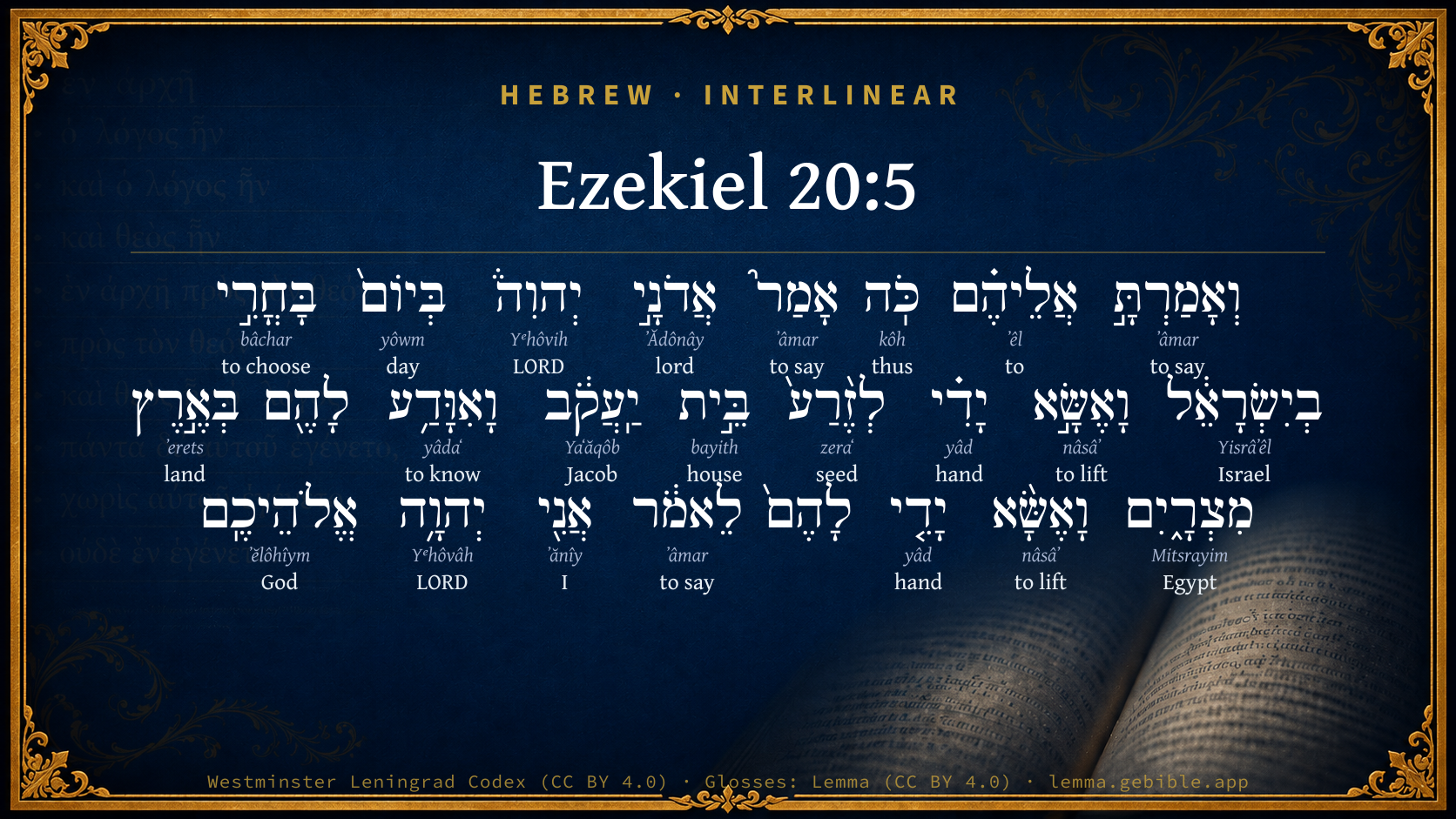
Hebrew (Westminster Leningrad Codex) Ezekiel 20:5 appears in the Hebrew Old Testament. The text above is from the Westminster Leningrad Codex. Each word links to its Strong’s number, a concise gloss, and parsing drawn from the Open Scriptures Hebrew Bible morphology. Click any word for its full Brown-Driver-Briggs (BDB) entry.
Download image
Cite this verse

Ezekiel 20:5 (World English Bible). Public Domain. Lemma interlinear Bible study tool, https://lemma.gebible.app/v/ezekiel/20/5.

Show BibTeX & RIS
BibTeX
RIS
English Translation
and tell them, Thus says the Lord Yahweh: In the day when I chose Israel, and swore to the seed of the house of Jacob, and made myself known to them in the land of Egypt, when I swore to them, saying, I am Yahweh your God;
World English Bible · Public Domain
Download a study sheet

One document with this verse’s original text, its word-by-word gloss line, the meaning frame, cross-references with their text, attributed commentary, and full source and license credits — printable, and it pastes into notes with its structure intact.

This verse Autodidact and up

Study sheet (.html) Plain text (.txt)

A passage Seminary Student

Up to 50 verses in one chapter. A passage sheet keeps up to 6 commentary sources and 12 cross-references per verse, in the order this page ranks them, and says so on the sheet whenever that leaves anything out. Ask for a single verse and you get the Autodidact verse sheet above.

Everything on this page stays free to read, with no account — the sheet is a download of what is already on screen, not access to it.

Want to remove ads? Support Godless Engineer
Compare translations 3

The same verse in 3 English versions, stacked beneath the original-language interlinear above. Click any original word for its lexicon entry.

Each is an independent rendering of the whole verse — the interlinear is not word-aligned to these translations.

Highlighted words mark where these versions differ — a whole-verse word diff, not a word-by-word alignment.

  • World English Bible Public Domain
    and tell them, Thus says the Lord Yahweh: In the day when I chose Israel, and swore to the seed of the house of Jacob, and made myself known to them in the land of Egypt, when I swore to them, saying, I am Yahweh your God;
  • King James Version Public Domain
    And say unto them, Thus saith the Lord GOD; In the day when I chose Israel, and lifted up mine hand unto the seed of the house of Jacob, and made myself known unto them in the land of Egypt, when I lifted up mine hand unto them, saying, I am the LORD your God;
  • unfoldingWord Literal Text CC BY-SA 4.0
    Say to them, ‘The Lord Yahweh says this: On the day that I chose Israel and raised my hand to swear an oath to the descendants of the house of Jacob, and made myself known to them in the land of Egypt, when I raised my hand to swear an oath to them. I said, “I am Yahweh your God”—

unfoldingWord Literal Text — © unfoldingWord, licensed CC BY-SA 4.0. Word-aligned USFM3 via Door43 (git.door43.org/unfoldingWord/en_ult).

Versions to compare (up to 4)

3 of 4 selected

Show all 18 translations

Every available English version of this verse, each an independent rendering of the whole verse.

  • World English Bible Public Domain
    and tell them, Thus says the Lord Yahweh: In the day when I chose Israel, and swore to the seed of the house of Jacob, and made myself known to them in the land of Egypt, when I swore to them, saying, I am Yahweh your God;
  • Berean Standard Bible Public Domain
    and tell them that this is what the Lord GOD says: On the day I chose Israel, I swore an oath to the descendants of the house of Jacob and made Myself known to them in the land of Egypt. With an uplifted hand I said to them, ‘I am the LORD your God.’
  • Majority Standard Bible Public Domain
    and tell them that this is what the Lord GOD says: On the day I chose Israel, I swore an oath to the descendants of the house of Jacob and made Myself known to them in the land of Egypt. With an uplifted hand I said to them, ‘I am the LORD your God.’
  • King James Version Public Domain
    And say unto them, Thus saith the Lord GOD; In the day when I chose Israel, and lifted up mine hand unto the seed of the house of Jacob, and made myself known unto them in the land of Egypt, when I lifted up mine hand unto them, saying, I am the LORD your God;
  • American Standard Version (1901) Public Domain
    and say unto them, Thus saith the Lord Jehovah: In the day when I chose Israel, and sware unto the seed of the house of Jacob, and made myself known unto them in the land of Egypt, when I sware unto them, saying, I am Jehovah your God;
  • Revised Version (1885) Public Domain
    and say unto them, Thus saith the Lord GOD: In the day when I chose Israel, and lifted up mine hand unto the seed of the house of Jacob, and made myself known unto them in the land of Egypt, when I lifted up mine hand unto them, Saying, I am the LORD your God;
  • Geneva Bible (1599) Public Domain
    And say vnto them, Thus saith the Lord God, In the day when I chose Israel, and lift vp mine hand vnto the seede of the house of Iaakob, and made my selfe knowen vnto them in the land of Egypt, when I lift vp mine hand vnto them, and sayd, I am the Lord your God,
  • Douay-Rheims (1899) Public Domain
    And say to them: Thus saith the Lord God: In the day when I chose Israel, and lifted up my hand for the race of the house of Jacob: and appeared to them in the land of Egypt, and lifted up my hand for them, saying: I am the Lord your God:
  • Young's Literal Translation Public Domain
    and thou hast said unto them: Thus said the Lord Jehovah: In the day of My fixing on Israel, I lift up My hand, To the seed of the house of Jacob, And am known to them in the land of Egypt, And I lift up My hand to them, Saying, I `am' Jehovah your God.
  • Literal Standard Version CC BY-SA 4.0
    and you have said to them, Thus said Lord YHWH: In the day of My fixing on Israel, || I lift up My hand, || To the seed of the house of Jacob, || And am known to them in the land of Egypt, || And I lift up My hand to them, || Saying, I [am] your God YHWH.
  • Unlocked Literal Bible CC BY-SA 4.0
    Say to them, 'The Lord Yahweh says this: On the day that I chose Israel and raised my hand to swear an oath to the descendants of the house of Jacob, and made myself known to them in the land of Egypt, when I raised my hand to swear an oath to them. I said, “I am Yahweh your God”—
  • unfoldingWord Literal Text CC BY-SA 4.0
    Say to them, ‘The Lord Yahweh says this: On the day that I chose Israel and raised my hand to swear an oath to the descendants of the house of Jacob, and made myself known to them in the land of Egypt, when I raised my hand to swear an oath to them. I said, “I am Yahweh your God”—
  • Darby Bible Public Domain
    and say unto them, Thus saith the Lord Jehovah: In the day when I chose Israel, and lifted up my hand unto the seed of the house of Jacob, and made myself known unto them in the land of Egypt, when I lifted up my hand unto them, saying, I [am] Jehovah your God,
  • World Messianic Bible Public Domain
    Tell them, ‘The Lord GOD says: “In the day when I chose Israel, and swore to the offspring of the house of Jacob, and made myself known to them in the land of Egypt, when I swore to them, saying, ‘I am the LORD your God;’
  • Webster's Bible Public Domain
    And say to them, Thus saith the Lord GOD; In the day when I chose Israel, and lifted up my hand to the seed of the house of Jacob, and made myself known to them in the land of Egypt, when I lifted up my hand to them, saying, I am the LORD your God;
  • Free Bible Version CC BY-SA 4.0
    and then tell them that this is what the Lord God says: At the time I chose Israel, I held up my hand and made a solemn promise to Jacob's descendants and revealed myself to them when they were in Egypt. I held up my hand and told them, ‘I am the Lord your God.’
  • Bible in Basic English Public Domain
    And say to them, This is what the Lord has said: In the day when I took Israel for myself, when I made an oath to the seed of the family of Jacob, and I gave them knowledge of myself in the land of Egypt, saying to them with an oath, I am the Lord your God;
  • JPS Tanakh (1917) Public Domain
    and say unto them: Thus saith the Lord GOD: In the day when I chose Israel, and lifted up My hand unto the seed of the house of Jacob, and made Myself known unto them in the land of Egypt, when I lifted up My hand unto them, saying: I am the LORD your God;

Literal Standard Version (2020), Covenant Press — licensed CC BY-SA 4.0. Text via the HelloAO Bible API (eBible.org). Unlocked Literal Bible (unfoldingWord) — licensed CC BY-SA 4.0. Text via the HelloAO Bible API (eBible.org). unfoldingWord Literal Text — © unfoldingWord, licensed CC BY-SA 4.0. Word-aligned USFM3 via Door43 (git.door43.org/unfoldingWord/en_ult). Free Bible Version, Dr. Jonathan Gallagher — licensed CC BY-SA 4.0. Text via the HelloAO Bible API (eBible.org).

Word by word

More ways to search: Search by grammar → Find every occurrence → Compare this word →

Practice this passage: Drill this verse → Learn its vocabulary →

בָּחֳרִ֣י
bâchar
H977
“to choose · me”
Verb, Qal, Infinitive Construct + Suffix, Personal, 1st Person, Common, Singular
Part of Speech
Verb
Stem
Qal
Form
Infinitive Construct
Full BDB Definition

Origin: a primitive root

TWOT: 231

to choose, elect, decide for - (Qal) to choose - (Niphal) to be chosen - (Pual) to be chosen, selected
  1. וְאָמַרְתָּ֣ ʼâmar H559 “and · to say” Conjunction + Verb, Qal, Sequential Perfect, 2nd Person, Masculine, Singular
  2. אֲלֵיהֶ֗ם ʼêl H413 “to · them” Preposition + Suffix, Personal, 3rd Person, Masculine, Plural
  3. כֹּֽה kôh H3541 “thus” Adverb
  4. אָמַר֮ ʼâmar H559 “to say” Verb, Qal, Perfect, 3rd Person, Masculine, Singular
  5. אֲדֹנָ֣י ʼĂdônây H136 “Lord · my” Noun, Common, Masculine, Plural, Construct + Suffix, Personal, 1st Person, Common, Singular
  6. יְהוִה֒ Yᵉhôvih H3069 “LORD” Noun, Proper
  7. בְּיוֹם֙ yôwm H3117 “in/at · day of” Preposition + Noun, Common, Masculine, Singular, Construct
  8. בְיִשְׂרָאֵ֔ל Yisrâʼêl H3478 “in/at · Israel” Preposition + Noun, Proper
  9. וָאֶשָּׂ֣א nâsâʼ H5375 “and · to lift” Conjunction + Verb, Qal, Sequential Imperfect, 1st Person, Common, Singular
  10. יָדִ֗י yâd H3027 “hand · my” Noun, Common, Both, Singular, Construct + Suffix, Personal, 1st Person, Common, Singular
  11. לְזֶ֨רַע֙ zeraʻ H2233 “to/for · seed of” Preposition + Noun, Common, Masculine, Singular, Construct
  12. בֵּ֣ית bayith H1004 “house of” Noun, Common, Masculine, Singular, Construct
  13. יַֽעֲקֹ֔ב Yaʻăqôb H3290 “Jacob” Noun, Proper
  14. וָאִוָּדַ֥ע yâdaʻ H3045 “and · to know” Conjunction + Verb, Niphal, Sequential Imperfect, 1st Person, Common, Singular
  15. בְּאֶ֣רֶץ ʼerets H776 “in/at · land of” Preposition + Noun, Common, Both, Singular, Construct
  16. מִצְרָ֑יִם Mitsrayim H4714 “Egypt” Noun, Proper
  17. וָאֶשָּׂ֨א nâsâʼ H5375 “and · to lift” Conjunction + Verb, Qal, Sequential Imperfect, 1st Person, Common, Singular
  18. יָדִ֤י yâd H3027 “hand · my” Noun, Common, Both, Singular, Construct + Suffix, Personal, 1st Person, Common, Singular
  19. לֵאמֹ֔ר ʼâmar H559 “to say” Preposition + Verb, Qal, Infinitive Construct
  20. אֲנִ֖י ʼănîy H589 “I” Pronoun, Personal, 1st Person, Common, Singular
  21. יְהוָ֥ה Yᵉhôvâh H3068 “LORD” Noun, Proper
  22. אֱלֹהֵיכֶֽם ʼĕlôhîym H430 “God(s) · your” Noun, Common, Masculine, Plural, Construct + Suffix, Personal, 2nd Person, Masculine, Plural

About this verse

These counts appear in no published source. They are computed here, from the morphology-tagged text and Lemma’s own curated glosses. What Lemma adds →

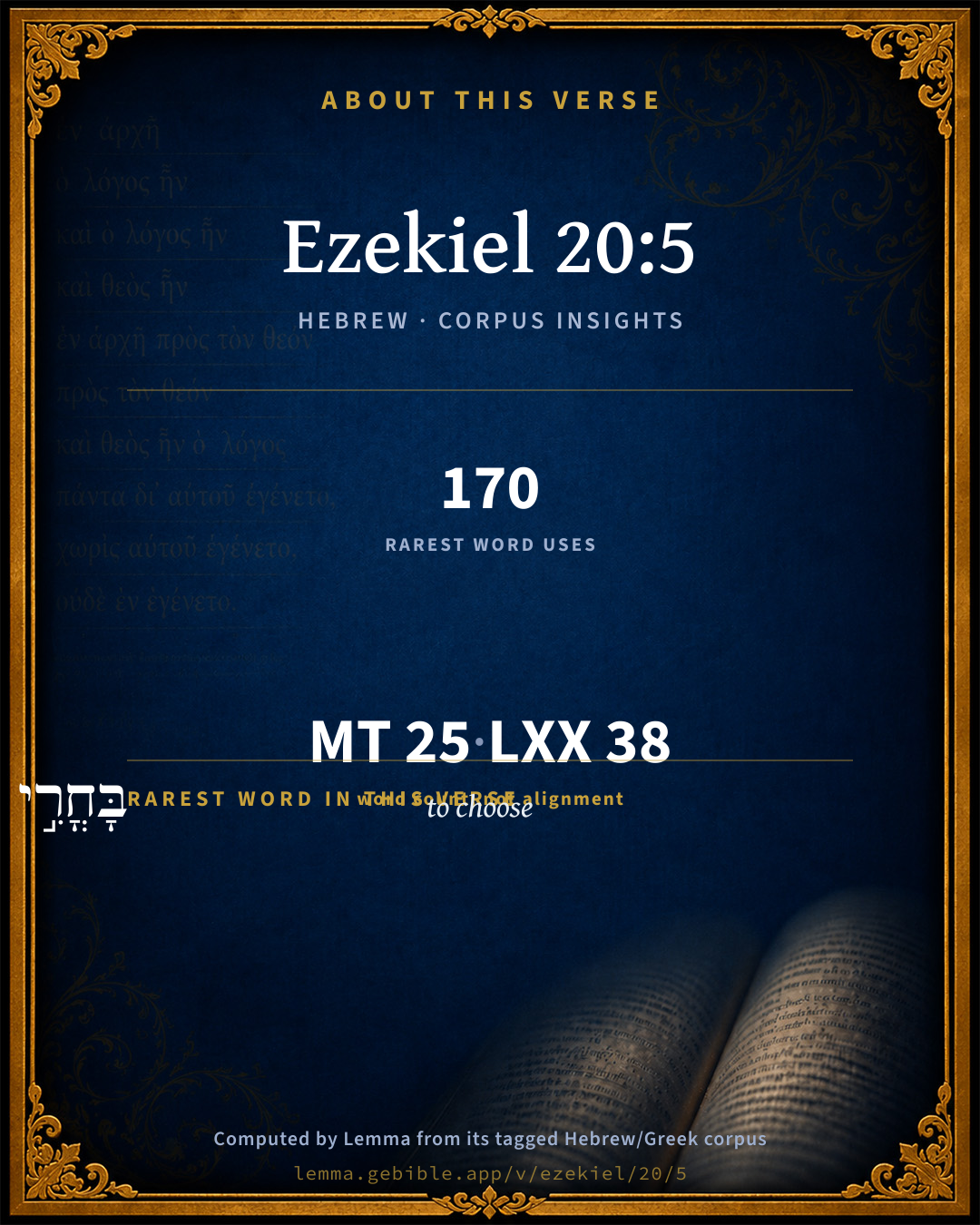
25
words
19
distinct lemmas
Prophets
section

Grammatical profile

  • 7 verbs
  • 13 nouns
  • 1 pronoun
  • 3 prepositions
  • 1 adverb

Verb forms

  • וְאָמַרְתָּ֣ Qal · Sequential Perfect
  • אָמַר֮ Qal · Perfect
  • בָּחֳרִ֣י Qal · Infinitive Construct
  • וָאֶשָּׂ֣א Qal · Sequential Imperfect
  • וָאִוָּדַ֥ע Niphal · Sequential Imperfect
  • וָאֶשָּׂ֨א Qal · Sequential Imperfect
  • לֵאמֹ֔ר Qal · Infinitive Construct

Repetition

Words recur within this verse — often emphatic in Hebrew:

  • וְאָמַרְתָּ֣ to say H559 ×3
  • וָאֶשָּׂ֣א to lift H5375 ×2
  • יָדִ֗י hand H3027 ×2

Hebrew & Septuagint length

In English translation the verse runs 47 words from the Hebrew and 54 from the Septuagint (LXX English) — closely comparable.

A rough comparison of the two English renderings, which tokenize alike — not a word-level alignment.

Word counts can differ between the Hebrew and the Greek without any difference in meaning — e.g. the Hebrew direct-object marker אֵת has no separate Greek word, and Greek often adds the article ὁ.

In the original languages it is 25 Hebrew tokens and 38 Greek tokens — but the two are counted differently (Hebrew bundles its prefixes and suffixes into one token; the Greek is in lemma form), so that isn’t a like-for-like length.

Cross-references

27

Topical passages linked to Ezekiel 20:5 in the Treasury of Scripture Knowledge — connected by theme and wording, ordered by reader-vote popularity; previews shown in the World English Bible.

  • Genesis 14:22 Abram said to the king of Sodom, "I have lifted up my hand to Yahweh, God Most High, possessor of heaven and earth,
  • Exodus 3:8 I have come down to deliver them out of the hand of the Egyptians, and to bring them up out of that land to a good and large land, to a land flowing with milk and honey; to the place of the Canaanite, the Hittite, the Amorite, the Perizzite, the Hivite, and the Jebusite.
  • Exodus 4:31 The people believed, and when they heard that Yahweh had visited the children of Israel, and that he had seen their affliction, then they bowed their heads and worshiped.
  • Exodus 6:6–7 Therefore tell the children of Israel, 'I am Yahweh, and I will bring you out from under the burdens of the Egyptians, and I will rid you out of their bondage, and I will redeem you with an outstretched arm, and with great judgments:
  • Deuteronomy 7:6 For you are a holy people to Yahweh your God: Yahweh your God has chosen you to be a people for his own possession, above all peoples who are on the face of the earth.
  • Ezekiel 20:15 Moreover also I swore to them in the wilderness, that I would not bring them into the land which I had given them, flowing with milk and honey, which is the glory of all lands;
  • Ezekiel 20:23 Moreover I swore to them in the wilderness, that I would scatter them among the nations, and disperse them through the countries;
  • Ezekiel 47:14 You shall inherit it, one as well as another; for I swore to give it to your fathers: and this land shall fall to you for inheritance.
  • Exodus 3:6 Moreover he said, "I am the God of your father, the God of Abraham, the God of Isaac, and the God of Jacob." Moses hid his face; for he was afraid to look at God.
  • Exodus 3:16 Go, and gather the elders of Israel together, and tell them, 'Yahweh, the God of your fathers, the God of Abraham, of Isaac, and of Jacob, has appeared to me, saying, "I have surely visited you, and seen that which is done to you in Egypt;
  • Exodus 6:2 God spoke to Moses, and said to him, "I am Yahweh;
  • Exodus 19:4–6 'You have seen what I did to the Egyptians, and how I bore you on eagles' wings, and brought you to myself.
  • Exodus 20:2–3 "I am Yahweh your God, who brought you out of the land of Egypt, out of the house of bondage.
  • Deuteronomy 4:34 Or has God tried to go and take him a nation from the midst of [another] nation, by trials, by signs, and by wonders, and by war, and by a mighty hand, and by an outstretched arm, and by great terrors, according to all that Yahweh your God did for you in Egypt before your eyes?
  • Deuteronomy 4:37 Because he loved your fathers, therefore he chose their seed after them, and brought you out with his presence, with his great power, out of Egypt;
  • Deuteronomy 11:2–7 Know you this day: for I don't speak with your children who have not known, and who have not seen the chastisement of Yahweh your God, his greatness, his mighty hand, and his outstretched arm,
  • Deuteronomy 14:2 For you are a holy people to Yahweh your God, and Yahweh has chosen you to be a people for his own possession, above all peoples who are on the face of the earth.
  • Deuteronomy 32:40 For I lift up my hand to heaven, And say, As I live forever,
  • Psalms 33:12 Blessed is the nation whose God is Yahweh, The people whom he has chosen for his own inheritance.
  • Psalms 103:7 He made known his ways to Moses, His deeds to the children of Israel.
  • Isaiah 43:10 You are my witnesses, says Yahweh, and my servant whom I have chosen; that you may know and believe me, and understand that I am he: before me there was no God formed, neither shall there be after me.
  • Isaiah 44:1–2 Yet now hear, Jacob my servant, and Israel, who I have chosen:
  • Jeremiah 33:24 Don't you consider what this people has spoken, saying, The two families which Yahweh did choose, he has cast them off? thus do they despise my people, that they should be no more a nation before them.
  • Ezekiel 35:11 therefore, as I live, says the Lord Yahweh, I will do according to your anger, and according to your envy which you have shown out of your hatred against them; and I will make myself known among them, when I shall judge you.
  • Mark 13:20 Unless the Lord had shortened the days, no flesh would have been saved; but for the sake of the chosen ones, whom he picked out, he shortened the days.
  • Revelation 10:5 The angel who I saw standing on the sea and on the land lifted up his right hand to the sky,
  • Isaiah 41:8–9 But you, Israel, my servant, Jacob whom I have chosen, the seed of Abraham my friend,

Cross-references courtesy of OpenBible.info (CC BY 4.0).

Hebrew and Greek witnesses Masoretic Hebrew ↔ Greek Septuagint

The same verse in the two great witnesses to the Old Testament, shown verse-for-verse.

These are two independent witnesses, not word-aligned to each other, and the Septuagint is shown in lemma (dictionary) form.

Hebrew Ezekiel 20:5 Masoretic · Westminster Leningrad Codex

וְאָמַרְתָּ֣ אֲלֵיהֶ֗ם כֹּֽה אָמַר֮ אֲדֹנָ֣י יְהוִה֒ בְּיוֹם֙ בָּחֳרִ֣י בְיִשְׂרָאֵ֔ל וָאֶשָּׂ֣א יָדִ֗י לְזֶ֨רַע֙ בֵּ֣ית יַֽעֲקֹ֔ב וָאִוָּדַ֥ע לָהֶ֖ם בְּאֶ֣רֶץ מִצְרָ֑יִם וָאֶשָּׂ֨א יָדִ֤י לָהֶם֙ לֵאמֹ֔ר אֲנִ֖י יְהוָ֥ה אֱלֹהֵיכֶֽם

and tell them, Thus says the Lord Yahweh: In the day when I chose Israel, and swore to the seed of the house of Jacob, and made myself known to them in the land of Egypt, when I swore to them, saying, I am Yahweh your God;

World English Bible · Public Domain

Greek LXX Ezekiel 20:5 Septuagint · lemma form

καί εἶπον πρός αὐτός ὅδε λέγω κύριος ἀπό ὅς ἡμέρα αἱρετίζω ὁ οἶκος ἰσραήλ καί γνωρίζω ὁ σπέρμα οἶκος ἰακώβ καί γιγνώσκω αὐτός ἐν γῆ αἴγυπτος καί ἀντιλαμβάνω ὁ χείρ ἐγώ αὐτός λέγω ἐγώ κύριος ὁ θεός σύ

and you shall say to them, Thus says the Lord; From the day that I chose the house of Israel, and became known to the seed of the house of Jacob, and was known to them in the land of Egypt, and helped them with my hand, saying, I am the Lord your God;

LXX2012 (modern English Septuagint) · Public Domain

Hebrew: Westminster Leningrad Codex (CC BY 4.0). Greek: Septuagint (public domain); English from LXX2012 (modern English Septuagint) (Public Domain). How the Septuagint differs from the Hebrew →

Targum (Aramaic paraphrase)

1

The Targum is the ancient Jewish Aramaic paraphrase of the Hebrew Scriptures — an interpretive translation, not the Hebrew text itself. Onkelos (literal) and Pseudo-Jonathan (expansive) render the Torah, and Jonathan the Prophets. Coverage is partial: where no permissively-licensed English translation exists for a verse, only the Aramaic is shown. This is verse-level text, not a word-by-word alignment to the Hebrew.

  1. Targum Jonathan Prophets (Joshua–Malachi)
    וְתֵימַר לְהוֹן כִּדְנַן אֲמַר יְיָ אֱלֹהִים בְּיוֹמָא דְאִתְרְעֵיתִי בְיִשְׂרָאֵל וְקַיְמֵית לְהוֹן בְּמֵימְרִי לְזַרְעָא דְבֵית יַעֲקֹב וְאִתְגְלֵיתִי לְמִפְרַקְהוֹן בְּאַרְעָא דְמִצְרַיִם וְקַיְמֵית בְּמֵימְרִי לְהוֹן לְמֵימָר אֲנָא יְיָ אֱלָֹהָכוֹן:

    (no public-domain English translation for this verse)

    Targum Jonathan — Aramaic: “Mikraot Gedolot” (public domain). English: “Sefaria Community Translation” (CC0 1.0 (public-domain dedication)); “London "Chaldee Paraphrase," 1871” (public domain). Text via Sefaria.

Commentary

Notes on Ezekiel 20:5 from classic Christian and Jewish commentators (each source and its license shown beneath its notes). The classic Christian expositions comment on the surrounding passage and are grouped to its opening verse, so a note may address several verses; the Jewish commentaries on the Tanakh (Rashi and others) are per-verse, so they appear only where the commentator wrote on this verse.

Lemma curates 59 commentaries, every one of them public domain or Creative Commons licensed, each selected and text-cleaned for this edition rather than reprinted as found. About our sources →

John Calvin's Commentaries

God confirms what I said before, that the Jews were not to be reproved for beginning lately to sin: it was not sufficient to bring recent offenses before them; but God orders the Prophet to begin with their fathers, as if he had said that the nation was abandoned from the very beginning, as Stephen reproaches them: Uncircumcised in heart, you still resist the Holy Spirit, as your fathers always did. (Acts 7:51.) And Christ had said the same thing before: You fill up the measure of your fathers. (Matthew 23:32.) We know also how frequently rebukes of this kind occur in the Prophets. God therefore says, that from the time when he chose the seed of Israel, he had experienced both the wickedness and obstinacy of the people; for he says that they were not drawn aside by either error or ignorance, but because they were unwilling to hear, when they were over and over again admonished as to their duty. Hence three things are to be marked, namely, that the people were bound to God, since he had gratuitously adopted them; for God here commends his gratuitous election, together with the singular benefits which he had conferred on that people: this is one point. The second is, that he not only took them once to himself, but showed them what was right, so that they could not mistake, except knowingly and willfully: this is the second point. Then the third is, that they rebelled purposely, because they would not listen: for if they had been left at the meeting of two roads, their error had been excusable if they had turned to the left instead of the right. But if God by his law so shone before them, that he was prepared to direct them straight to the mark, and they turned aside; thus their obstinacy and rebellion is plainly detected. This is the sense.

Now as far as words are concerned, he says, that he had chosen Israel. But election, as I have already briefly touched upon, is opposed to all merits: for if anything had been found in the people which should cause them to be preferred to others, it would be improperly said that God had elected them. But since all were in the same condition, as Moses says in his song (Deuteronomy 32:8, 9,) there was scope for God’s grace, since he separated them from others of his own accord: for they were just like the rest, and God did not find any difference between them; we see, then, that they were bound to God more sacredly, since he had joined them to himself gratuitously. He now adds, that he lifted up his hand to the seed of Jacob. The lifting up the hand seems to be taken here in different senses. Since it was a customary method of swearing, God is said sometimes to lift up his hand when he swears. That is indeed harsh, since the lifting up the hand does not suit God: for we lift up the hand when we call God to witness; but God swears by himself, and cannot raise his hand above himself. But we know that he uses forms of speech according to the common customs of men: hence there is nothing absurd in this phrase, he lifted up his hand, that is, he swore. Hence, if we may so explain it, this was a confirmation of the covenant, when God by interposing a oath promised himself to be Israel’s God. But since he shortly afterwards adds, that he was known, the other sense suits pretty well, since it refers to the benefits which he had conferred upon the people. And truly experimental knowledge is intended, since God really proved himself to be worthy of credit, and thus illustrated his own power in preserving the people. Hence I said that to lift up the hand is to be received variously in this chapter, since, if we read the two clauses conjointly, I lifted up my hand unto the seed of the house of Jacob, and was made known to them, truly the lifting up the hand will imply a display of power. That also has been said by means of a simile; but shortly afterwards the lifting up of the hand must be taken for to swear, by the figure of rhetoric called catachresis, which is the use of a word in a different signification, and yet there is no absurdity.

I have raised my hand, therefore, to the seed of the house of Jacob, saying, I Jehovah am your God. (Ezekiel 20:5.)

We see, then, that God raised his hand to sanction the covenant which he had made; for when he pronounces himself their God, he binds them to himself, and claims them for his peculiar people, and thus confirms his covenant. But at the same time he had raised his hand or arm by so many miracles performed in freeing the people. He says, in that day I raised my hand to, or towards them, to bring them out. Again, the raising the hand refers to God’s power, since he brought them forth by an extended arm from that miserable slavery. Since, therefore, he so raised his hand, he acquired them as his own, that they should no longer be free, but belong altogether to him. He afterwards adds other benefits, since he not only snatched them from the tyranny of Pharaoh, but brought them into a land flowing with milk and honey, which he had espied for them. We see how briefly God enlarges upon that remarkable benefit which he had bestowed upon his people. Not only was he their Redeemer, but he looked out for a place of residence for them, not only commodious, but abounding with plenty; for this phrase is common enough with Moses. In that same day in which I led them out of Egypt, I brought them into a land, the desire of all lands; that is, which is desirable and superior to all other lands. It is true, indeed, that other nations were not less fruitful; but God, in thus praising the land of Canaan. considers it, clothed and adorned by his bounty. But there was no region under heaven to be compared with the land of Canaan in one point, namely, God’s choosing it as his earthly dwelling place. Since the land of Canaan excelled all others in this respect, it is deservedly called the desire of all lands, or desirable beyond all lands.

Another clause now follows, that God instructed the Jews in piety, and withdrew them from all the idolatries to which they had been devoted. Instruction then went before, which showed them the right way of salvation, and recalled them from their superstitions. The meaning is, that when God adopted the people, he gave them the rule of living piously, that they should not be tossed about hither and thither, but. have an aim, to which they might direct the whole course of their life. I said, therefore, to each of them: this seems more emphatic than if he had spoken to all promiscuously and generally: but this familiar invitation ought to penetrate more into their minds, when he speaks to each individually, just as if he said, let each of you cast away your abominations, and not pollute himself anymore with the idols of Egypt. When therefore God thus attached them to himself, he shows that he could not be rightly worshipped by them unless they bid their idolatries farewell, and formed their whole life according to the rule of his law. He calls their enticements defilements or idols of the eyes: but we know that the Prophet often speaks thus, that unbelievers should consider their idols. Hence it is just as if God recalled them from all the wiles of Satan in which they were enticed, and were so devoted to them as to have their eyes exclusively fixed on them. He speaks by name of the idols of Egypt: whence it easily appears that they were corrupted by depraved desires, so as for the most part to worship the fictitious gods of Egypt. Yet they knew themselves elected by the true God, and boasted in circumcision as a symbol of divorce from all nations. Yet though they wished to be thought illustrious on the one hand, they afterwards prostituted themselves so as to differ in nothing from the Egyptians. We see then that the desire of piety was almost extinct in their hearts, since they had so contaminated themselves with the superstitions of Egypt. That he might retain them the better, he says at the same time that he was their God: for without this principle men are tossed hither and thither, for we know that we are lighter than vanity. Hence the devil will always find us subject to his fallacies unless God restrains us in our duty, until he appears to us and shows himself the only God: we see then the necessity for this remedy, lest men should be carried away by idolatries, namely, the knowledge of the true God. The third clause will follow afterwards, but we shall explain it in its turn.

John Calvin's Commentaries (1540-1563) — public domain. Text from the Calvin Translation Society English edition (1840s-50s) via the Christian Classics Ethereal Library (ccel.org). Calvin's coverage is partial (roughly two-thirds of the Bible); uncommented books and verses are honest gaps, never fabricated. The 19th-century editor's footnotes and remarks are omitted so the notes are faithfully Calvin's own voice.

Ellicott's Commentary for English Readers

(5) When I chose Israel.—In Eze_20:5-9 the Lord takes up the first, or Egyptian period of the history* of Israel. The record of that period, as it has come to us in the Pentateuch, does not contain either any commands against idolatry, or any notice of the rebellion of the people against such command; but both are clearly implied. The very mission of Moses to deliver them rested upon a covenant by which they were to be the peculiar people of Jehovah (Exo_6:2-4); the command to go into the wilderness to sacrifice to the Lord implies that this was a duty neglected in Egypt; and their previous habitual idolatries may be certainly inferred from Lev_17:7, while the disposition of their hearts is seen in their prompt relapse into the idolatry of the golden calf in Exodus 32. Their whole murmurings and rebellions were but the manifestation of their resistance to having the Lord for their God, and His will for their guide.

Lifted up mine hand—As the form of taking an oath (see Eze_20:23 and Eze_47:14). The reference is to such passages as Gen_15:17-21; Exo_6:8; Deu_32:40, &c. The phrase is repeated in Eze_20:6. which is a continuation of Eze_20:5.

A Bible Commentary for English Readers, edited by Charles John Ellicott (1878–1897) — public domain. Text from a community e-Sword module.

The Cambridge Bible for Schools and Colleges

gen. ed. J. J. S. Perowne

5. when I chose Israel] The choice or election of Israel is referred to only here in Ez., and also once in Jer_33:24. The idea is much insisted on in Isaiah 40-66. Already, however, Deu_7:6.

lifted up mine hand] i.e. sware, Exo_6:8; Num_14:30. The thing sworn is stated Eze_20:6.

made myself known] Cf. Exo_3:6 seq., Eze_6:3. He made himself known as Jehovah their God, whose nature his acts revealed, Psa_103:7.

5–29. Review of the history of the fathers

The principle that has ruled this history is that all through it Jehovah has acted for his name’s sake. It is this principle that has given Israel a history, otherwise their sins would have cut them off. For his name’s sake he spared the people in Egypt (Eze_20:9), again in the wilderness (Eze_20:14), and again the second generation there (Eze_20:22). The history is reviewed in these divisions: Eze_20:5-10 Israel in Egypt; Eze_20:11-17 the people led out into the wilderness: Eze_20:18-26 the children of those who fell in the wilderness; and Eze_20:27-29 the people that entered Canaan.

The Cambridge Bible for Schools and Colleges (gen. ed. J. J. S. Perowne; Cambridge University Press, 1878–1918) — public domain. Text from a community e-Sword module.

Trapp's Complete Commentary

John Trapp

Eze 20:5 And say unto them, Thus saith the Lord GOD; In the day when I chose Israel, and lifted up mine hand unto the seed of the house of Jacob, and made myself known unto them in the land of Egypt, when I lifted up mine hand unto them, saying, I [am] the LORD your God;

Ver. 5. In the day when I chose Israel.] Declared them to be my firstborn, and so higher than the kings of the earth. {Psa 89:27}

When I lifted up mine hand unto them, saying, I am the Lord your God.] This sweet promise is not so easily, and, indeed, is never enough, believed, and is therefore here confirmed by God’s solemn oath thrice repeated, "that by two immutable things, wherein it was impossible for God to lie, his people might have strong consolation." {Heb 6:18}

John Trapp, A Commentary or Exposition upon All the Books of the Old and New Testament (1647–1656) — public domain. Text from a community e-Sword module.

Albert Barnes' Notes on the Bible

The children of Israel in Egypt were warned to abstain from the idolatry of the pagan. This purpose they lost sight of, yet God spared them and brought them into another state of probation.

Eze 20:5

Lifted up mine hand - i. e., sware, because the hand was lifted up in adjuration.

Eze 20:8

Idols of Egypt - These incidental notices show the children of Israel in Egypt to have been addicted to idolatry. Compare Jos 24:14.

Eze 20:9

I wrought for my name’s sake - Lest it should appear to the Egyptians that Yahweh was a God who would, but could not, save.

Albert Barnes' Notes on the Bible (1834–1885) — public domain. Text from a community e-Sword/MySword module.

Joseph Benson's Commentary

Eze 20:5. In the day when I chose Israel — When I entered into a solemn covenant. And lifted up my hand, &c. — That is, sware unto them, this being a gesture used in swearing: see the margin, and notes on Gen 14:22, and Psa 144:8. “Among the Jews the juror held up his right hand toward heaven; which explains Psa 144:8, Whose mouth speaketh vanity, and their right hand is a right hand of falsehood. The same form is retained in Scotland still.” — Paley’s Moral and Political Philosophy, p. 159. This manner of taking an oath is mentioned by Homer, Ευχετο χειρας ανασχων, which shows it to have been of great antiquity, even among the heathen. It was a solemn appeal to God, as the author of truth, and the defender thereof, and also the judge of the heart; implying a wish in the person swearing, that God would take vengeance if the truth was either violated or concealed. Some think, however, that lifting up the hand in this place means giving them help and deliverance: but the 15th and 23d verses evidently confirm the former explication. And made myself known unto them — By appearing unto Moses, and showing myself present among them, by the wonders I wrought for their deliverance. Saying, I am the Lord your God — I am the God whom you ought to serve, and none else.

Joseph Benson's Commentary on the Old and New Testaments (1811–1818) — public domain. Text from a community e-Sword module.

Whedon's Commentary on the Bible

Daniel D. Whedon

THE PROPHET RECITES BEFORE THE ELDERS THE IDOLATROUS HISTORY OF THEIR FATHERS, Eze_20:5-29.

5. In the day when I chose Israel — That is, at the Exodus — drawing the attention of the whole world to Israel “as a holy people unto the Lord” (Deu_7:6; see also Jer_33:24; Isaiah 40, 66).

Lifted up mine hand — The solemn attitude assumed in taking an official oath (Exo_6:8; Num_14:30; note Dan_12:7).

Made myself known — That is, as Jehovah (Exo_3:6; Exo_6:3; <19A307>Psa_103:7).

Daniel D. Whedon (gen. ed.), Commentary on the Old and New Testaments (1874–1909) — public domain. Text from a community e-Sword module.

The Preacher's Complete Homiletical Commentary

Joseph S. Exell (gen. ed.)

(Eze_20:5-9.)

EXEGETICAL NOTES.—The election of Israel in Egypt, where God made Himself known to them by wonders and signs, and promised to become their God. Israel’s ingratitude, though the Lord brought them out of Egypt into a land flowing with milk and honey.

Eze_20:5. “When I chose Israel.” God chose them for high purposes, of His own free grace, and not for any deserving on their part (Deu_7:6-7; Deu_10:15; Deu_14:2). “Lifted up mine hand unto the seed of the house of Jacob.” The reference is plainly to the lifting up of the hands, as in the act of swearing (Gen_14:22). “I am the Lord your God.” This was God’s ancient promise renewed to Moses (Exo_6:6-8).

Eze_20:6. “Had espied.” “God, as it were, spied out this land for them, sought it out with the greatest care as the best.”—(Hengstenberg). “The glory of all lands.” It was a “goodly land” (Deu_8:7-9), even in its physical characteristics: but eminently “glorious” (Dan_11:16; Dan_11:41; Dan_11:45), because it was the scene where the glories of the Son of God were displayed. It was the land from which the streams of salvation should flow all over the earth.

Eze_20:7. “The abominations of His eyes.” The worship of visible objects which Israel had substituted for the invisible God. “Defile not yourselves with the idols of Egypt.” “The election of the Israelites to be the people of Jehovah, contained eo ipso the command to give up the idols of Egpyt, although it was at Sinai that the worship of other gods was for the first time expressly prohibited (Eze_20:3), and Egyptian idolatry is only mentioned in Lev_17:7.”—(Keil).

Eze_20:8. “Neither did they forsake the idols of Egypt.” “History does not expressly mention such a revolt of the people in Egypt; yet we are led indirectly to this by the statements of the books of Moses concerning the perpetual tendency of the people in the wilderness to the customs of Egypt. To this belongs, e.g., the making of the golden calf, in which there is an imitation of the Egyptian worship of the brute; further (Lev_17:16), according to which Israel in the wilderness served he-goats. The worship of a deity under the form of a he goat was peculiar to Egypt (Lev_18:3), when the people are admonished; “After the doings of the land of Egypt, wherein ye dwelt, shall ye not do.” That the Israelites generally served idols in Egypt is attested by Jos_24:14; and this being so, it is to be expected beforehand that this inclination would not immediately cease after the true God had made Himself known to them. The murmuring also of the people in Egypt again Moses and Aaron (Exo_5:21), implies an under-current of Egyptian tendencies.”—(Hengstenberg). The evidence furnished by Jos_24:14). established the fact that the Israelites practised idolatry in Egypt. Israel had to be redeemed, not so much from the bondage of Pharaoh as from “the gods of Egypt” (Exo_12:12), whom Pharaoh and his magicians served. The whole controversy with Pharaoh turned on the question, would he allow Israel to serve the Lord?

Eze_20:9. “But I wrought for thy name’s sake, that it should not be polluted before the heathen among whom they were.” “The missing object explaining what He did, namely, abstain from pouring out His wrath, is to be gathered from what follows: ‘for my name’s sake, that it should not be polluted before the heathen.’ This would have taken place if God had destroyed Israel by pouring out His wrath; in other words, have allowed them to be destroyed by the Egyptians. The heathen might then have said that Jehovah had been unable to liberate His people from their hand and power (Num_14:16; Exo_32:12.”)—(Keil). “Not only the miserable circumstances of their external condition, but still more the state of spiritual degradation into which the Hebrews had sunk, infinitely magnified the Divine mercy which interposed for their deliverance. ‘Where sin abounded, grace did much more abound.’ The glory of this, as well as of the other attributes of Jehovah, was the ultimate end which He had in view in bringing them forth from the house of bondage. This is described as His name, i.e., the sum-total of His known perfections (Rom_9:17; 2Sa_7:23; Isa_63:12). The preservation of that name from desecration is repeatedly spoken of this chapter (Eze_20:14; Eze_20:22; Eze_20:39).—(Henderson)

HOMILETICS

ISRAEL’S ELECTION

I. It was of God’s free choice. “In the day when I chose Israel” (Eze_20:5). This choice had no reference to their merit or special fitness. They were selected to carry out the special purposes of redemption, because such was the will of God, who is not obliged to give any account to men of His matters. We must, however, avoid the error of attributing any caprice to God. He works not according to mere will, but “after the counsel of His own will” (Eph_1:11).

II. It implied His willingness to be their God. “I am the Lord your God” (Eze_20:5). This includes all that the Creator can give to the creature—every blessing for time and eternity. Several stages were necessary for the realisation of this gift.

1. God revealed Himself to them. “And made myself known unto them in the land of Egypt.” It is absolutely necessary that the soul should know Him whom it is to serve, and from whom it is to expect every blessing. “He that cometh to God must believe that He is, and that He is a rewarder of them that diligently seek Him” (Heb_11:6). But how can we come to God and have faith in Him unless He makes Himself known to us as an object worthy of our trust and reverence? We cannot know a person except he speaks and we cannot know God unless He reveals Himself in an intelligible voice. Therefore it is that “faith cometh by hearing, and hearing by the word of God” (Rom_10:17).

2. God entered into covenant with them. “And lifted up thine hand unto the seed of the house of Jacob” (Eze_20:5). God’s communication to His people was a covenant wherein He bound Himself to bless them, binding them at the same time to certain conditions.

3. God engaged to lead them. “To bring them forth of the land of Egypt” (Eze_20:6). He sought out and prepared for them a place of habitation, had espied for them a land flowing with milk and honey, which is the glory of all lands. Thus when God promises His people to be their God, this promise implies all that is meant by godliness and its reward—revelation, covenant blessings, discipline and guidance, the peace and rest of the lot of the conquered inheritance.

III. It demanded corresponding duties. By every revelation of Himself, by every gift of God, man comes under obligation. It was the duty of Israel

1. To forsake all false objects of worship (Eze_20:7). But instead of this they defiled themselves with the idols of Egypt.

2. To yield obedience to God’s commands. But instead of this, they rebelled against Him. God chooses men not for evil, but that He might redeem and save them. But they cannot be saved unless they are obedient to God’s way of salvation. The children of Israel were disobedient. They did the very things which were contrary to the purpose for which they were elected. They were infected by the idolatry of Egypt. Though they were called out of the world to be a peculiar people, yet the influence of the world overcame them. They wished to stand well with Egypt, which was then the world-power.

IV. It heightened Israel’s ingratitude. When they sinned against their high calling their sin was all the greater.

1. The anger of God was provoked. “I will pour out my fury upon them to accomplish my anger against them.” The Egyptians were the instruments of this vengeance. It was, “in the midst of the land of Egypt” that God would accomplish His anger. They were punished by the very people whom they sought to propitiate. Thus God chastises men by those things in which they most delight.

2. Even in the punishment of His people, God has regard to the honour of His name. “But I wrought for my name’s sake that it should not be polluted before the heathen among whom they were, in whose sight I made Myself known to them, in bringing them forth out of the land of Egypt” (Eze_20:9). “But the revelation which I had given of Myself before the eyes of the heathen among whom they were was not to be desecrated before these same eyes, especially before the Egyptians, as if to wish well to My name were present with Me, but not the power of performance (regard being had at the same time to the heathen, as Israel was placed in a peculiar position in regard to humanity as a whole) Comp. Num_14:13, etc.; Exo_32:12; Num_23:19.”—(Lange).

(Eze_20:6)

1. Old mercies should be remembered. Not only by those they were first bestowed upon, but also by their posterity. In this, and in the former verse, God reminds them of old mercies, His choice of them, His professing to be their God, His bringing them out of Egypt, which were some eight or nine hundred years before, and His espying out a land for them, which was four hundred years before that; for it was in Abraham’s days that God took notice of that land (Gen_12:1; Gen_12:7). These old mercies God would have them to mind, though they were in Babylon, and deprived of the good land God had given them. Let men be in what condition they will, old mercies should not be forgotten (Psa_44:1-2; Jdg_6:13). And because men are apt to forget former mercies, when they grow old they grow out of mind, the Lord laid a charge upon the Jews that they should not forget them (Deu_6:10-12).

2. Countries and habitations of people are appointed by the Lord. He distributes lands and habitations to whom He thinks meet. “The earth is the Lord’s and the fulness thereof” (Psa_24:1). He is the sole owner, the true Lord of the soil, and all it brings forth, and He hath “given it to the children of men” (Psa_115:16). He hath assigned them their several portions (Deu_32:8). The most high God, being Lord paramount, would not have the sons of Adam to live all in one country, but appointed them several lands to dwell in, and set their bounds and limits. Alter the flood, at the building of Babel, God confounded the languages, and dispersed the posterity of Noah into divers lands, and set them their bounds (Gen_11:9). And so, when He brought the Israelites into the land of Canaan, He gave them their bounds (Psa_78:55).

3. The Lord provides and bestows the choicest mercies upon His own people. If there be a land in the world that flows with milk and honey, that exceeds all other lands for plenty and pleasantness, His people shall have it. When God carried Jacob and his family into Egypt, He provided the good and fat of that land for them (Gen_45:18); yea, they were placed in “the best of the land” (Gen_47:11). God fed and filled His people with “the finest of the wheat” (Psa_147:14). Moses mentions seven things together in Deu_32:13-15, as “honey out of the rock, oil out of the flinty rock, butter of kine, milk of sheep, fat of lambs, and rams of the breed of Bashan, and goats, fat of kidneys of wheat, the pure blood of the grape;” these the Lord provided for His people, and they had all an excellency in them. God bestowed choice mercies upon this people (Eze_16:10-13). David acknowledges that he had a “goodly heritage,” even a “wealthy place.” Daniel and the three children were set in eminent places (Daniel 2; Daniel 3).

4. Spiritual mercies make a land glorious. Canaan was the glory of all lands, not so much for its great plenty as for the spiritual mercies it enjoyed. There was the Lord’s presence, His prophets, His worship, His oracles, and His ordinances, and these made it glorious, yea, more than all the nations far or near. “In Judah is God known: His name is great in Israel. In Salem also is His tabernacle, and His dwelling-place in Zion” (Psa_76:1-2). God was not known in Babylon, in Egypt, in other nations; His tabernacle and dwelling-place was not amongst them, therefore they were not glorious. “Thou art more glorious than the mountains of prey”; thou Judah, thou Israel, thou Salem, thou Zion, that hast spiritual mercies and blessings, art more glorious than they, whatever their glory be. Have the nations abroad goodly towers? thou hast the temple. Have they stately cities? thou hast Jerusalem, the city of God. Have they wise men? thou hast the prophets. Have they gods of gold, silver, and stones? thou hast the true living God, Jehovah, to be thy God. Have they human laws that are good? thou hast divine laws that excel. Have they temporal excellencies? thou hast spiritual. Have they the glory of the world? thou hast the glory of heaven. “Out of Zion, the perfection of beauty, God hath shined” (Psa_50:1-2). What made Zion so glorious and beautiful? It was the presence of God; if He had not been there, Zion had been like other mountains, and Canaan like other nations; but His presence was like the sun, darting out His beams, and making all glorious and beautiful. Spiritual mercies are beams and rays of that God who is brighter than the sun; by these He shined in Zion and made it the perfection of beauty. By these He shined out of Zion, and darkened all the glory of the nations. Where God and His ordinances are, there is glory; and where these are not, there is no glory, but Egyptian darkness—a land without the sun. In Canaan was spiritual light and glory. There were glorious appearances of God, glorious praisings of God, glorious conversions of sinners unto God, glorious sabbaths and assemblies, and glorious beauties of holiness, glorious types of Christ, and people who were the glory of God (Isa_4:5). There were glorious truths, ordinances, and dispensations of God. Plenty of outward things do not make a land glorious as spiritual mercies do. If God, Christ, Gospel, and the ordinances of it be in a land they make it glorious above all other nations. Let us learn to know our true glory, even spiritual mercies, and prize them highly, though loathed by some, like the manna of old, and pray that such glory may ever dwell in our land.—(Greenhill.)

(Eze_20:9)

God’s name is polluted.

(1). When it is not hallowed. Not acknowledged, or esteemed to be holy and honourable.

(2). When it is slighted, and not used reverently. God’s name is great, glorious, excellent, holy, and ought to be reverenced (Psa_111:9).

(3). When occasion is given to the wicked to speak evil of God and His ways. David by his sins gave great occasion to the enemies of God to blaspheme (2Sa_12:14). The Jews by their sinful carriage caused the name of God to be profaned among the heathen. Had the Lord, then, destroyed this people in Egypt, according as He purposed, the Egyptians and other nations would have slighted Him, spoken evil of His doings, blasphemed His name, and wounded His honour. Therefore, though this people deserved to die in the way of justice, yet God spared them in the way of mercy for the honour of his name. “Before the heathen.” The Hebrew is, “in the eyes of the heathen.” God would not have them to see or behold anything which might occasion them to dishonour Him. He would not slay His people in their sight, but made Himself known by His word and mighty works unto the Jews, in the sight of the heathen, so that hereby He was known unto both.

1. The Lord spares and saves sinners deserving death, even for His name’s sake. God’s honour and glory are strong arguments to move Him to show mercy to His people. This the servants of God have known, and made use of, in their straits. When Jerusalem was in a manner laid desolate, and the jealousy of God burned like fire, what argument did the Church use then to move God to show mercy but His “name,” and the glory of it? (Psa_79:9). What hurt would it be to God’s name if He did it not? It would not be glorious, but dishonoured; for in the next verse it is said, “Wherefore should the heathen say, Where is their God?” They trusted in their God, and He is a non-helping God, a non-delivering God. This was the argument Joshua used when Israel fell before their enemies, “Lord, what wilt Thou do unto Thy great name?” When the people forgot the multitude of great mercies they had in Egypt, and provoked Him at the sea, even at the Red Sea, and deserved to be drowned in it, what saith the text? “Nevertheless, He saved them for His name’s sake.” (Psa_106:8).

2. God’s sparing of His people is an honouring and sanctifying of His name. God deals with His people sometimes, not after the ordinary rule and course of His proceedings, but in a prerogative way; He spares them, though their sins be great, because their enemies would be proud, arrogant, and blasphemous. (Deu_32:26-27.)

3. That notwithstanding the sins of God’s people, He shows them kindness openly, and in the face of their enemies. Though the Jews had rebelled against God, and the Egyptians would have rejoiced in their ruin, yet, in their sight, God made Himself known unto them, in bringing them forth out of the land of Egypt. God would have the Egyptians see that He could be kind to His people, though they were disobedient unto Him.—(Greenhill.)

The Preacher's Complete Homiletical Commentary (gen. ed. Joseph S. Exell; Funk & Wagnalls, c. 1892) — public domain (pre-1929). A full-Bible homiletical/sermon-outline anthology covering 65 of 66 books (2 John is absent from the source module). Text from a community e-Sword module.

Keil & Delitzsch

C. F. Keil & F. Delitzsch

Election of Israel in Egypt. Its resistance to the commandments of God. - Eze 20:5. And say to them, Thus saith the Lord Jehovah, In the day that I chose Israel, and lifted my hand to the seed of Jacob, and made myself known to them in the land of Egypt, and lifted my hand to them, saying, I am Jehovah, your God: Eze 20:6. In that day I lifted my hand to them, to bring them out of the land of Egypt into the land which I sought out for them, which floweth with milk and honey - it is an ornament of all lands: Eze 20:7. And said to them, Cast away every man the abominations of his eyes, and do not defile yourselves with the idols of Egypt. I am Jehovah, your God. Eze 20:8. But they were rebellious against me, and would not hearken to me. Not one of them threw away the abominations of his eyes, and they did not forsake the idols of Egypt. Then I thought to pour out my wrath upon them, to accomplish my anger upon them in the midst of the land of Egypt. Eze 20:9. But I did it for my name's sake, that it might not be profaned before the eyes of the nations, in the midst of which they were, before whose eyes I had made myself known to them, to bring them out of the land of Egypt. - Eze 20:5 and Eze 20:6 form one period. בּיּום בּחרי (Eze 20:5) is resumed in בּיּום ההוּא (Eze 20:6), and the sentence continued. With ואשּׂא the construction with the infinitive passes over into the finite verb. Lifting the hand, sc. to heaven, is a gesture employed in taking an oath (see the comm. on Exo 6:8). The substance of the oath is introduced by the word לאמר at the close of Eze 20:5; but the clause 'ואוּדע וגו (and made myself known) is previously inserted, and then the lifting of the hand mentioned again to indicate the importance of this act of divine grace. The contents of Eze 20:5 and Eze 20:6 rest upon Exo 6:2., where the Lord makes Himself known to Moses, and through him to the children of Israel, according to the nature involved in the name Jehovah, in which He had not yet revealed Himself to the patriarchs (Exo 6:3). Both נשׂאתי ידי (I lifted my hand) and אני יהוה are taken from Exo 6:8. The word תּרתּי, from תּוּר, to seek out, explore, also belongs to the Pentateuch (compare Deu 1:33); and the same may be said of the description given of Canaan as "a land flowing with milk and honey" (vid., Exo 3:8, etc.). But צבי, ornament, as an epithet applied to the land of Israel, is first employed by the prophets of the time of the captivity - namely, in Eze 20:6 and Eze 20:15 of this chapter, in Jer 3:19, and in Dan 8:9; Dan 11:16, Dan 11:41. The election of the Israelites to be the people of Jehovah, contained eo ipso the command to give up the idols of Egypt, although it was at Sinai that the worship of other gods was for the first time expressly prohibited (Exo 20:3), and Egyptian idolatry is only mentioned in Lev 17:7 (cf. Jos 24:14). Ezekiel calls the idols "abominations of their eyes," because, "although they were abominable and execrable things, they were looked upon with delight by them" (Rosenmller). It is true that there is nothing expressly stated in the Pentateuch as to the refusal of the Israelites to obey the command of God, or their unwillingness to give up idolatry in Egypt; but it may be inferred from the statements contained in Exo 6:9 and Exo 6:12, to the effect that the Israelites did not hearken to Moses when he communicated to them the determination of God to lead them out of Egypt, and still more plainly from their relapse into Egyptian idolatry, from the worship of the golden calf at Sinai (Ex 32), and from their repeated desire to return to Egypt while wandering in the desert.

(Note: The remarks of Calvin upon this point are very good. "We do not learn directly from Moses," he says, "that they had been rebels against God, because they would not throw away their idols and superstitions; but the conjecture is a very probable one, that they had always been so firmly fixed in their abominations as to prevent in a certain way the hand of God from bringing them relief. And assuredly, if they had embraced what Moses promised them in the name of God with promptness of mind, the execution of the promise would have been more prompt and swift. But we may learn that it was their own obtuseness which hindered God from stretching out His hand forthwith and actually fulfilling all that He had promised. It was necessary, indeed, that God should contend with Pharaoh, that His power might be more conspicuously displayed; but the people would not have been so tyrannically afflicted if they had not closed the door of divine mercy.")

Nor is there anything said in the Pentateuch concerning the determination of God to pour out His wrath upon the idolatrous people in Egypt. We need not indeed assume on this account that Ezekiel derived his information from some special traditional source, as Vitringa has done ObservV. ss. I. 263), or regard the statement as a revelation made by God to Ezekiel, and through him to us. The words do not disclose to us either a particular fact or a definite decree of God; they simply contain a description of the attitude which God, from His inmost nature, assumes towards sinners who rebel against His holy commandments, and which He displayed both in the declaration made concerning Himself as a zealous, or jealous God, who visits iniquities (Exo 20:5), and also in the words addressed to Moses when the people fell into idolatry at Sinai, "Let me alone, that my wrath may wax not against them, and that I may consume them" (Exo 32:10). All that God expresses here, His heart must have felt in Egypt towards the people who would not desist from idolatry. For the words themselves, compare Eze 7:8; Eze 6:12; Eze 5:13. ואעשׂ (Eze 20:9), "but I did it for my name's sake." The missing object explaining what He did, namely, abstain from pouring out His wrath, is to be gathered from what follows: "that I might not profane my name." This would have taken place if God had destroyed Israel by pouring out His wrath; in other words, have allowed them to be destroyed by the Egyptians. The heathen might then have said that Jehovah had been unable to liberate His people from their hand and power (cf. Num 14:16 and Exo 32:12). החל is an infin. Niphal of חלל for החל (cf. Lev 21:4).

Keil & Delitzsch — Biblical Commentary on the Old Testament (1861–1891) — public domain (CC PDM 1.0). Text via the HelloAO Bible API. (Old Testament only.)

Geneva Bible (1599)

Geneva Bible translators

I sware that I would be their God, which manner of oath was observed from all antiquity, where they used to lift up their hands toward the heaven, acknowledging God to be the author of truth, and the defender thereof, and also the Judge of the heart, wishing that he should take vengeance, if they concealed anything which they knew to be truth.

Geneva Bible (1599) marginal notes — public domain. Text via Bolls.life.

Matthew Henry's Commentary

The history of the ingratitude and rebellion of the people of Israel here begins as early as their beginning; so does the history of man's apostasy from his Maker. No sooner have we read the story of our first parents' creation than we immediately meet with that of their rebellion; so we see here it was with Israel, a people designed to represent the body of mankind both in their dealings with God and in his with them. Here is,

I. The gracious purposes of God's law concerning Israel in Egypt, where they were bond-slaves to Pharaoh. Be it spoken, be it written, to the immortal honour of free grace, that then and there, 1. He chose Israel to be a peculiar people to himself, though their condition was bad and their character worse, that he might have the honour of mending both. He therefore chose them, because they were the seed of the house of Jacob, the posterity of that prince with God, that he might keep the oath which he had sworn unto their fathers, Deu 7:7, Deu 7:8. 2. He made himself known to them by his name Jehovah (a new name, Exo 6:3), when by reason of their servitude they had almost lost the knowledge of that name by which he was known to their fathers, God Almighty. Note, As the foundation of our blessedness is laid in God's choosing us, so the first step towards it is God's making himself known to us. And whatever distance we are at, whatever distress we are in, he that made himself known to Israel even in the land of Egypt can find us out, and follow us with the gracious discoveries and manifestations of his favour. 3. He made over himself to them as their God in covenant: I lifted up my hand unto them, saying it, and confirming it with an oath. "I am the Lord your God, to whom you are to pay your homage, and from whom and in whom you are to expect your bliss." 4. He promised to bring them out of Egypt; and made good what he promised. He lifted up his hand, that is, he swore unto them, that he would deliver them; and, they being very unworthy, and their deliverance very unlikely, it was requisite that the promise of it should be confirmed by an oath. Or, He lifted up his hand, that is, he put forth his almighty power to do it; he did it with an outstretched arm, Psa 136:12. 5. He assured them that he would put them in possession of the land of Canaan. He therefore brought them out of Egypt, that he might bring them into a land that he had spied out for them, a second garden of Eden, which was the glory of all lands. So he found it, the climate being temperate, the soil fruitful, the situation pleasant, and every thing agreeable (Deu 8:7; Deu 11:12); or, however this might be, so he made it, by setting up his sanctuary in it.

II. The reasonable commands he gave them, and the easy conditions of his covenant with them at that time. Having told them what they might expect from him, he next tells them what was all he expected from them; it was no more than this (Eze 20:7): "Cast you away every man his images that he uses for worship, that are the adorations, but should be the abominations, of his eyes. Let him abominate them, and put them out of his sight, and defile not yourselves with the idols of Egypt." Of these, it seems, many of them were fond; the golden calf was one of them. It was just, and what might reasonably be expected, that, being delivered from the Egyptian slavery, they should quit the Egyptian idolatry, especially when God, at bringing them out, executed judgment upon the gods of Egypt (Num 33:4) and thereby showed himself above them. And, whatever other idols they might have an inclination to, one would think they should have had a rooted aversion to the gods of Egypt for Egypt's sake, which had been to them a house of bondage. Yet, it seems, they needed this caution, and it is backed with a good reason: I am the Lord your God, who neither need an assistant nor will admit a rival.

III. Their unreasonable disobedience to these commands, for which God might justly have cut them off as soon as ever they were formed into a people (Eze 20:8): They rebelled against God, not only refused to comply with his particular precepts, but shook off their allegiance, and in effect told him that they should be at liberty to worship what God they pleased. And even then when God came down to deliver them, and sent Moses for that purpose, yet they would not forsake the idols of Egypt, which perhaps made them speak so affectionately of the onions of Egypt (Num 11:5), for among other things the Egyptians worshipped an onion. It was strange that all the plagues of Egypt would not prevail to cure them of their affection to the idols of Egypt. For this God said he would pour out his fury upon them, even while they were yet in the midst of the land of Egypt. Justly might he have said, "Let them die with the Egyptians." This magnifies the riches of God's goodness, that he was pleased to work so great a salvation for them even when he saw them ripe for ruin. Well might Moses tell them, It is not for your righteousness, Duet. Eze 9:4, Eze 9:5.

IV. The wonderful deliverance which God wrought for them, notwithstanding. Though they forfeited the favour while it was in the bestowing, and when God would have healed them then their iniquity was discovered (Hos 7:1), yet mercy rejoiced against judgment, and God did what he designed purely for his own name's sake, Eze 20:9. When nothing in us will furnish him with a reason for his favours he furnishes himself with one. God made himself known to them in the sight of the heathen when he ordered Moses publicly to say to Pharaoh, Israel is my son, my first-born, let them go, that they may serve me. Now, if he had left them to perish for their wickedness as they deserved, the Egyptians would have reflected upon him for it, and his name would have been polluted, which ought to be sanctified and shall be so. Note, The church is secured, even when it is corrupt, because God will secure his own honour.

Matthew Henry's Commentary on the Whole Bible (1708–1710) — public domain (CC PDM 1.0). Text via the HelloAO Bible API.

Jamieson, Fausset & Brown

Robert Jamieson, A. R. Fausset & David Brown

The thrice lifting up of God's hand (the sign of His oath, Rev 10:5-6; Exo 6:8, Margin; Num 14:30; to which passages the form of words here alludes) implies the solemn earnestness of God's purpose of grace to them.

made myself known unto them--proving Myself faithful and true by the actual fulfilment of My promises (Exo 4:31; Exo 6:3); revealing Myself as "Jehovah," that is, not that the name was unknown before, but that then first the force of that name was manifested in the promises of God then being realized in performances.

Jamieson, Fausset & Brown — Commentary Critical and Explanatory on the Whole Bible (1871) — public domain (CC PDM 1.0). Text via the HelloAO Bible API.

Adam Clarke's Commentary

Verse 5. I chose Israel] They did not choose me for their God, till I had chosen them to be my people.

I lifted up mine hand] I bound myself In a covenant to them to continue to be their God, if they should be faithful, and continue to be my people. Among the Jews the juror lifted up his right hand to heaven; which explains Ps 144:8: "Their right hand is a right hand of falsehood." This is a form used in England, Scotland, and Ireland.

Adam Clarke's Commentary on the Bible (1810–1826) — public domain. Text from a community e-Sword/MySword module.

John Gill's Exposition

And say unto them, thus saith the Lord God,.... Here begins the account of their fathers; of God's unmerited goodness to them, and of their sins and transgressions against him, and how it fared with them:

in the day when I chose Israel; to be his peculiar people, above all people on the face of the earth; when he declared his choice of them, and made it appear that he had chosen them, and distinguished them, by special blessings and favours bestowed on them:

and lifted up mine hand to the seed of the house of Jacob; the posterity of Jacob or Israel, to whom the Lord swore that he would do such and such things for them; of which the lifting up the hand was a token; it is a gesture used in swearing, Dan 12:7; and so the Targum,

"and I swore unto them by my word:''

and made myself known unto them in the land of Egypt: by his name Jehovah; by the prophets he sent unto them, Moses, Aaron, and Miriam; and by the miracles he wrought among them:

when I lifted up mine hand unto them, saying, I am the Lord your God: making promise of it, declaring it unto them, confirming it with an oath; see Heb 6:17.

John Gill's Exposition of the Whole Bible (1746–1763) — public domain (CC PDM 1.0). Text via the HelloAO Bible API.

Matthew Poole's English Annotations

In the day; at the time, the season; it speaks not of that precise portion of hours which make up the natural day, but of the time wherein God began to show them his great mercy. When I chose; it includes mercy without merit in them, and it refers to God’s declaring by his kindness to them that he had chosen them; it supposeth the free eternal election, but it expressly refers to a temporal and seasonable selecting them from others; chosen, as Isa 14:1; again Deu 7:6,7; or possibly thus, when I went to make them a choice people by refining them from their dross and idolatries contracted in Egypt, so the word Isa 48:10, and selecting them.

Israel; not personally considered, but nationally.

Lifted up mine hand; either assuring them by oath that he would now make good his promise, and bring them out of bondage; it is the gesture of one that solemnly sweareth, and scriptures frequently mention it, as Eze 20:15; Deu 32:40; or else, stretched out and made bare my arm, i.e. magnified my power for your deliverance.

The seed of the house of Jacob: this explaineth and tells us who Israel was.

Made myself known unto them, by the miracles which he wrought; for it is not to be understood of making known or discovering his essence and incomprehensible being. It is not unlikely that many of them either were ignorant or forgot God; now by his wonders wrought for their deliverance he brings them to remember him, and look to him. Moses’s question in Exo 3:13 seems to intimate this ignorance of this people.

In the land of Egypt; as this expressly directs us to the place, so it points out the time too when Israel was chosen, selected.

When I lifted up mine hand unto them; showed my power in performing my oath and promise in what was now to be done, and assuring them of doing what was further promised by him, and expected by them; and to assure them the more, it is doubled.

I am the Lord your God: so Exo 3:13,16,17. Yours from your progenitors, yours by promise, by covenant, and now am come to be your God by actual and punctual performing my word to you, bringing you out of the land of Egypt by a lifted-up hand and arm.

Matthew Poole's English Annotations on the Holy Bible (1683–1685) — public domain. Text from a community e-Sword/MySword module.

The Pulpit Commentary

Vers. 5, 6. In the day that I lifted up mine hand. The attitude was that of one who takes an oath, (Exo_6:8) and implies the confirmation of the covenant made with Abraham. The land flowing with milk and honey appears first in Exo_3:8, and became proverbial. The glory of all lands is peculiar to Ezekiel. Isaiah applies (Isa_13:19) the word to Babylon.

Vers. 5-7. The elect Israel.

The elect Israel is a type of the people of God, the spiritual Israel. Consider the peculiarities of the one as indications of the special marks of the other.

I THE WAY IN WHICH ISRAEL WAS MADE AN ELECT NATION.

1. Chosen by God. This is the root idea of election. God chooses his people before they choose him chooses them out of the multitude, and so constitutes them a separate nation. The grounds of the choice rest with him and need not be divulged. But we may be sure there are grounds, and that these are not capricious. History has revealed one great end of the election of Israel. The nation was chosen in order that it might become the channel of blessing to all nations. So the Church is chosen to be God"s means of bringing the gospel to the whole world.

2. Chosen in a state of degradation. The Jews were chosen in Egypt. Though promises had been made to the patriarchs centuries earlier, the fulfilment of those promises commenced with God"s deliverance from the bondage of Pharaoh. When the people seemed to be most lost they were found by God. When they appeared to be of least value he chose them for himself. The Lord married the castaway child. (Eze_16:8) Thus God now takes his people in their low estate.

3. Chosen by deeds of might. God proved his choice by bringing his people out of bondage. He "lifted up" his "hand unto the seed of the house of Jacob." With God to will is to do. The mighty deeds of God in the plagues and the passage of the Red Sea are outdone by his great work in Christ. In Christ God does not only choose us, he lifts up his hand to save.

4. Chosen through the revelation of God. God made known his Name to Israel through Moses. (Exo_3:15) We must know God to hear his voice. The revelation of Christ goes with the election of God. The chosen are called by means of the gospel.

II THE PURPOSES FOR WHICH ISRAEL WAS ELECTED.

1. High privileges.

(1) Deliverance. The Jews were chosen to be delivered from Egypt. God chooses his people, in the first place, in order to save them from their evil condition. Salvation is the first result of election.

(2) The possession of Canaan. This "land flowing with milk and honey, which is the glory of all lands," was given to Israel by God, not inherited by right, nor won by the sword apart from God"s interference. God gives his people the kingdom of heaven here, and the heavenly Canaan hereafter. It is a glorious privilege to be counted among the true people of God; for the fruits of the gospel are sweeter and more satisfying to the soul than the best crops of Palestine to the body.

2. Holy living. There was a condition of the Divine election, or rather, a condition on which the continuation of its privileges depended. The Jews were to cast away their idols, as God could endure no rivals. The people had been chosen in their idolatry; but they were required to renounce it.

God chooses his people now while they are yet runners. But his choice means that they must give up their sins, and if they still cleave to them the election will be rendered null and void. The great mercy of God in choosing souls before the souls have turned to. him should be sufficient ground to induce all who accept the privileges of the gospel to live up to the standard it sets forth. After God has chosen us to be his people the least we can do is to choose him to be our Portion. (Psa_73:26)

Vers. 5-9. The memory of the great deliverance.

The continuity of the national life seems to have been as constantly present to the mind of Ezekiel as was the fact of individual responsibility. He distinguished between national and personal character; but both were in his apprehension real. It is certainly remarkable that, in answering as he was directed to do, the application of the elders, he should proceed to epitomize the history of the nation. His aim seems to have been to show that the irreligion and rebellion of which he complained in the epoch of the Captivity had existed throughout the several periods of Israelitish history. In a few brief paragraphs the prophet, in a most graphic way, exhibits the conduct of the chosen people in several successive eras. As was customary and natural, the first period dealt with was that of the momentous deliverance from the bondage of Egypt.

I REVELATION. God made himself known unto Israel in the land of Egypt. In this revelation were included:

1. Choice.

2. Covenant, confirmed by oath.

3. Promise of deliverance from bondage; further promise of a land flowing with milk and honey, the glory of all lands.

II COMMAND. One great duty Jehovah laid upon his chosen and covenant people the duty of abandoning the idolatry, whose evil effects they had witnessed among the Egyptians. They could not consistently receive the Divine revelation, and at the same time be guilty of idolatry, which in all its forms was a contradiction of the worship and service of the one living and true God. Idolatry was not only dishonouring to Jehovah; it was a defilement of all who took part in its practices.

III REBELLION. Notwithstanding the grace displayed in the revelation, notwithstanding the authority accompanying the command, the chosen and favoured nation rebelled. The circumstances of the case, when considered, render this all the more marvellous. Although the superior power of the God of their fathers had been so conspicuously displayed, "they did not forsake the idols of Egypt." Such conduct was both treason and rebellion in one.

IV THREATENING. The truly human manner in which the prophet, in this and similar places, speaks of the Eternal leads some readers to charge him with anthropomorphism. The language used of a man might imply vindictiveness; and, taken in connection with what follows, might even imply mutability and fickleness. The Divine "fury "and "anger" may not be free from emotion, but such language is mainly intended to convey the impression that the law of righteousness exists, and that it cannot be violated and defied with impunity, either by nations or by individuals.

V RELENTING AND SALVATION. The ground upon which Jehovah bore with his sinful people is remarkable; it was "for his own Name"s sake, that it should not be polluted before the heathen." For this reason he brought them forth out of the land of Egypt. Their emancipation was owing, not to any daring of their own, not to any heroism of their leaders, not to any fortunate conjunction of circumstances, but to the interposition of Almighty power. T.

Vers. 5-9. God, and Israel in Egypt.

say unto them, Thus saith the Lord God; In the day when I chose Israel," etc. This paragraph sets forth the dealings of God with his people in the land of Egypt.

I THE CHOICE OF THE PEOPLE BY GOD. "Thus saith the Lord; In the day when chose Israel, and lifted up mine hand unto the seed of the house of Jacob, and made myself known unto them in the land of Egypt, when I lifted up mine hand unto them, saying, I am the Lord your God." The day when God chose Israel and made himself known unto them as their God was the time when he interposed on their behalf by his servant Moses. He chose them; they did not choose him. They did not seek to serve or worship him; but he sent Moses to demand their emancipation in order that they might worship and serve him. And he thus chose them neither for their greatness nor their goodness, but because of his own love for them and his fidelity to his promises made unto their fathers (cf. Deu_7:7, Deu_7:8) He chose them to receive special revelations of religious and redemptive truth, to be "a people for his own possession," his visible Church in the world, and his witnesses amongst men, testifying to his unity and supremacy, and observing and maintaining his worship (cf. Deu_10:15 Deu_14:2) And still God of his grace calls men to himself. He begins with us, and not we with him. "God commendeth his own love toward us," etc.; (Rom_5:8) "Herein is love, not that we loved God," etc.. (1Jn_4:10) If we have sought God, it was because he first sought us. "By the grace of God I am what I am." And the Lord made himself known to them as their God, both by declarations and by mighty deeds wrought on their behalf. (Exo_3:14 Exo_6:1-8) He chose them to be his people; he gave himself to them to be their God. "I am the Lord your God." God." This is a great word, and hath great mercy in it; an engaging word, tying God and all his attributes to them: your God to counsel you, your God to protect you, your God to deliver you, your God to comfort you, your God to plead for you, your God to teach you, your God to set up my Name and worship among you, your God to bless you with the dews of heaven and fulness of the earth, your God to hear your prayers and make you happy" (Greenhill). And he asserts this relationship in the most solemn manner. "I lifted up mine hand unto them," i.e. I sware unto them.

II THE GRACIOUS PURPOSE OF GOD IN RELATION TO HIS PEOPLE. (Ver. 6.) This purpose has two branches.

1. To deliver them from a miserable condition. "In that day I lifted up mine hand unto them, to bring them forth out of the land of Egypt." He broke the power of their cruel oppressors, and by a mighty hand he set them free from their burdens, and led them out of the land of their captivity. And when men believe on the Lord Jesus Christ, and respond to his call, he delivers them from the bondage of sin. He came into our world to "proclaim liberty to the captives," to save men from the power and pollution and punishment of sin.

2. To establish them in a desirable condition. "Into a land that I had espied for them, flowing with milk and honey, which is the glory of all lands.

(1) This land was selected for them by God. He summoned Abram to go forth unto the land that he would show him. (Gen_12:1; and cf. Exo_3:8, Exo_3:17) "He shall choose our inheritance for us, the excellency of Jacob whom he loved.

(2) This land was excellently situated and richly fertile. (We have noticed these points in treating of. (Eze_19:10) In its natural fortifications, its remarkable fertility, and its religious privileges, it was glorious as compared with other lands. And this land God gave unto them. And our Saviour Jesus Christ not only delivers from sin those who believe on him, but he introduces them into a condition of spiritual privilege and progress. "Ye received not the spirit of bondage again unto fear," etc.; (Rom_8:15-17) "Beloved, now are we children of God," etc.. (1Jn_3:2)

III THE OBLIGATIONS OF THE PEOPLE TO GOD. "And I said unto them, Cast ye away every man the abominations of his eyes, and defile not yourselves with the idols of Egypt: I am the Lord your God." This obligation arises out of the relationship stated in ver. 5. Because they are his people and he is their God, they must be true tohim as their God, having no connection with idols. The great basis of their obligation to him is contained in the words, "I am Jehovah your God". (cf. Exo_20:1, Exo_20:2) In this prohibition of idolatry there are two points which call for brief notice.

1. Sin entering by the eyes. "The abominations of his eyes anexpression which denotes idols. The eyes look upon the idols, become familiar with them, and come to behold them with respect and reverence. The eyes are both inlets and outlets to the heart. They convey to the heart the impression of the idol, and if the heart come to reverence the idol, they express that reverence in their gaze. The eyes are often an avenue through which temptation to sin enters the soul.

2. Sin defiling the heart. "Defile not yourselves with the idols of Egypt."Sin pollutes our moral life at its very springs. It proceeds from an impure heart, and it makes the heart still more impure. David was conscious of its defilement when he prayed, "Wash me throughly from mine iniquity," etc.. (Psa_51:2, Psa_51:7, Psa_51:10) The people of God are under the most binding obligations to shun everything that would lead to their moral contamination, and to be true to him both in heart and in life.

IV THE REBELLION OF THE PEOPLE AGAINST GOD. (Ver. 8.)

1. The nature of this rebellion. "But they rebelled against me, and would not hearken unto me; they did not every man cast away the abominations of their eyes, neither did they forsake the idols of Egypt." They rebelled against Jehovah by persisting in their idolatrous practices. The Mosaic history does not explicitly mention the idolatry of the Israelites in Egypt; but it points to it by implication. The making and worship of the golden calf was probably an imitation of the Egyptian worship of the various sacred cows or of the sacred bulls. It appears from Lev_17:7 (Revised Version) that in the desert the Israelites offered sacrifices to he-goats, and "the worship of a deity under the form of a he-goat was peculiar to Egypt" (Hengstenberg). That they worshipped idols in Egypt is evident also from Jos_24:14, "Put away The gods which your fathers served beyond the river, and in Egypt; and serve ye the Lord." And from Eze_23:3 of our prophet, "They committed whoredoms in Egypt." This idolatry they did not abandon when summoned so to do.

2. The punishment of this rebellion. "Then I said I would pour out my fury upon them, to accomplish my anger against them in the midst of the land of Egypt." Greenhill explains this clause, "He thought in his heart to destroy them in the midst of Egypt." Scott, "He justly might, and certainly would, have destroyed them with the Egyptians, if he had dealt with them according to their deserts." Schroder suggests that the increased oppression, and the persecution of the Israelites by the Egyptians, (Exo_5:5-23) were signs of the anger of the Lord against them. The Egyptians acted wickedly and cruelly in thus ill treating them; for they had not wronged them. Yet they might have been the unconscious agents of punishing the Israelites for their unfaithfulness to the Lord their God. This is certain, that persistent sin invariably meets with deserved punishment.

V THE FULFILMENT OF THE PURPOSE OF GOD NOTWITHSTANDING THE REBELLION OF THE PEOPLE. "But I wrought for my Name"s sake, that it should not be profaned in the sight of the nations, among whom they were, in whose sight I made myself known unto them, in bringing them forth out of the land of Egypt". (cf. Num_14:13-16) Had he not accomplished his purpose in delivering them out of Egypt, his Name or honour might have been contemned by the Egyptians and others. They might have questioned or even denied:

1. His ability to execute his purposes and fulfil his promises, asserting thathe did not do so because he could not. (cf. Num_14:15, Num_14:16)

2. His fidelity to his purposes and promises, asserting that he does notabide by his determinations, but is changeable and therefore unreliable.

3. His kindness towards his people, asserting that he is not so deeplyinterested in them as to always fulfil his engagements with them. Therefore, for his Name"s sake, he brought Israel in triumph out of Egypt. The sins of man cannot frustrate the purposes of God. By his sins man may exclude himself from any participation in their fulfilment, or any enjoyment thereof; but he cannot defeat their fulfilment. (cf. Exo_32:9, Exo_32:10; Num_14:11, 12 23:19; 2Ti_2:13)

CONCLUSION. Our subject presents:

1. Warnings against rebellion against God.

2. Encouragements to trust and obey him. W.J.

The Pulpit Commentary (1880–1919), ed. H.D.M. Spence-Jones & Joseph S. Exell — public domain. Text from a community e-Sword module.

John Wesley's Explanatory Notes

When I chose - When I shewed that I had chosen them. The history of the rebellions of the children of Israel, begins as early, as their beginning. So does the history of man's apostasy from his Maker. No sooner have we read the story of his creation, but we meet with that of his rebellion. So we see here, it was with Israel; a people designed to represent the body of mankind, both in their dealings with God, and in God's dealing with them. Lifted up my hand - Or stretched out and made bare my arm; that is, magnified my power for their deliverance. When I lifted up mine hand - Shewed my power in performing my oath, and assuring them of doing what was farther promised.

John Wesley, Explanatory Notes Upon the Whole Bible (1754–1765) — public domain. Text via the GEBible commentary corpus.

Rashi

Rabbi Shlomo Yitzchaki (Rashi)

On the day I chose Israel This hatred was pent up before the Omnipresent close to nine hundred years from [the days] that they were in Egypt until [those of] Ezekiel but His love had shielded them. Now that they had increased their transgressions, though, it was awakened, and concerning this it is stated (Prov. 10:12): “Hatred arouses quarrels [but love covers up all transgressions].”

Rashi on the Tanakh — English translations: “The Judaica Press complete Tanach with Rashi, translated by A. J. Rosenberg” (CC BY 4.0); “Pentateuch with Rashi's commentary by M. Rosenbaum and A.M. Silbermann, 1929-1934” (public domain); “The Metsudah Tanach series, Lakewood, N.J” (CC BY 4.0); and “The Book of Joshua, Metsudah Publications, 1997” (CC BY 4.0). Text via Sefaria.

Lesson kit

Teaching starters — assembled from the data on this page, not authored interpretation. Every prompt links to the verse data it draws on. Edit before teaching.

Ezekiel, in the Prophets, opens this verse with 25 words (19 distinct Hebrew lemmas). Its most distinctive word is bâchar (“to choose”). A historical commentator’s framing appears above. Read the whole chapter for the surrounding context.

Discussion questions

  1. How does “to choose” (bâchar) shape what this verse is saying?
  2. Genesis 14:22 shares this passage’s theme. How do the two illuminate each other?
  3. “to say” occurs 3× in this one verse. What is the effect of the repetition?
  4. The translations on this page render this verse differently — a whole-verse word diff, not a word-by-word alignment. What might account for the different wordings?
  5. The verb «וְאָמַרְתָּ֣» is Qal Sequential Perfect. How does its form color the action?
  6. Reading how John Calvin's Commentaries and Ellicott's Commentary for English Readers read this verse, where do the two commentators agree and where do they part?

Things to notice

Reading settings

Reading text

Shown beneath each verse's original-language words.

Old Testament
Old Testament edition

Read the OT as the Masoretic Hebrew (MT) or the Greek Septuagint (LXX).

English shown for the Greek Septuagint (in the Hebrew ↔ Greek comparison).

Comparing translations? Open the Compare panel on any verse page to stack up to four side by side.