
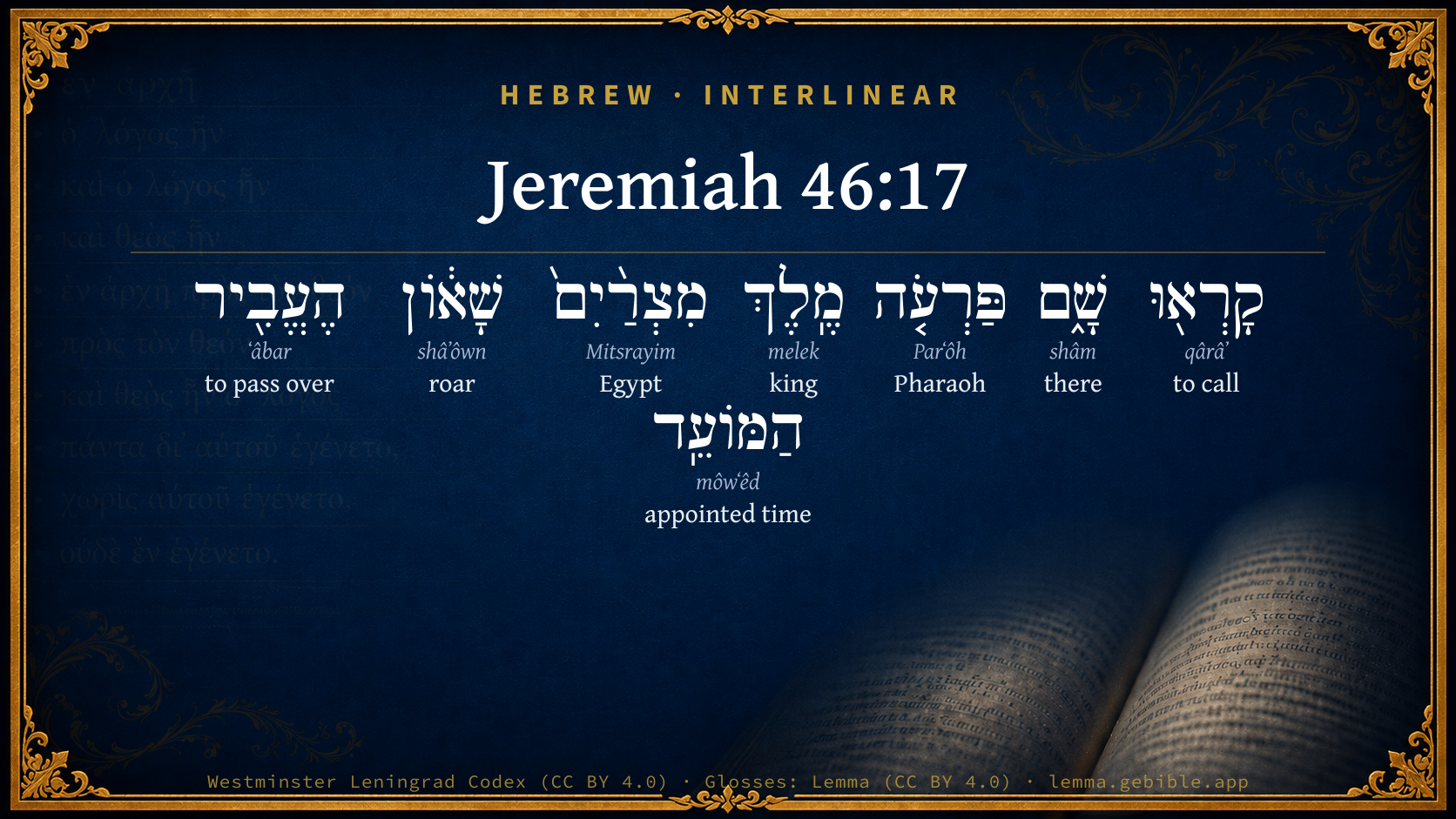
Jeremiah 46:17

Hebrew (Westminster Leningrad Codex) Jeremiah 46:17 appears in the Hebrew Old Testament. The text above is from the Westminster Leningrad Codex. Each word links to its Strong’s number, a concise gloss, and parsing drawn from the Open Scriptures Hebrew Bible morphology. Click any word for its full Brown-Driver-Briggs (BDB) entry.
Download image
Cite this verse

Jeremiah 46:17 (World English Bible). Public Domain. Lemma interlinear Bible study tool, https://lemma.gebible.app/v/jeremiah/46/17.

Show BibTeX & RIS
BibTeX
RIS
English Translation
They cried there, Pharaoh king of Egypt is but a noise; he has let the appointed time pass by.
World English Bible · Public Domain
Download a study sheet

One document with this verse’s original text, its word-by-word gloss line, the meaning frame, cross-references with their text, attributed commentary, and full source and license credits — printable, and it pastes into notes with its structure intact.

This verse Autodidact and up

Study sheet (.html) Plain text (.txt)

A passage Seminary Student

Up to 50 verses in one chapter. A passage sheet keeps up to 6 commentary sources and 12 cross-references per verse, in the order this page ranks them, and says so on the sheet whenever that leaves anything out. Ask for a single verse and you get the Autodidact verse sheet above.

Everything on this page stays free to read, with no account — the sheet is a download of what is already on screen, not access to it.

Want to remove ads? Support Godless Engineer
Compare translations 3

The same verse in 3 English versions, stacked beneath the original-language interlinear above. Click any original word for its lexicon entry.

Each is an independent rendering of the whole verse — the interlinear is not word-aligned to these translations.

Highlighted words mark where these versions differ — a whole-verse word diff, not a word-by-word alignment.

  • World English Bible Public Domain
    They cried there, Pharaoh king of Egypt is but a noise; he has let the appointed time pass by.
  • King James Version Public Domain
    They did cry there, Pharaoh king of Egypt is but a noise; he hath passed the time appointed.
  • unfoldingWord Literal Text CC BY-SA 4.0
    They proclaimed there, ‘Pharaoh the king of Egypt is only a noise, one who has let his opportunity slip away.’

unfoldingWord Literal Text — © unfoldingWord, licensed CC BY-SA 4.0. Word-aligned USFM3 via Door43 (git.door43.org/unfoldingWord/en_ult).

Versions to compare (up to 4)

3 of 4 selected

Show all 18 translations

Every available English version of this verse, each an independent rendering of the whole verse.

  • World English Bible Public Domain
    They cried there, Pharaoh king of Egypt is but a noise; he has let the appointed time pass by.
  • Berean Standard Bible Public Domain
    There they will cry out: ‘Pharaoh king of Egypt was all noise; he has let the appointed time pass him by.’
  • Majority Standard Bible Public Domain
    There they will cry out: ‘Pharaoh king of Egypt was all noise; he has let the appointed time pass him by.’
  • King James Version Public Domain
    They did cry there, Pharaoh king of Egypt is but a noise; he hath passed the time appointed.
  • American Standard Version (1901) Public Domain
    They cried there, Pharaoh king of Egypt is but a noise; he hath let the appointed time pass by.
  • Revised Version (1885) Public Domain
    They cried there, Pharaoh king of Egypt is but a noise; he hath let the appointed time pass by.
  • Geneva Bible (1599) Public Domain
    They did cry there, Pharaoh King of Egypt, and of a great multitude hath passed the time appointed.
  • Douay-Rheims (1899) Public Domain
    Call ye the name of Pharao king Egypt, a tumult time hath brought.
  • Young's Literal Translation Public Domain
    They have cried there: Pharaoh king of Egypt `is' a desolation, Passed by hath the appointed time.
  • Literal Standard Version CC BY-SA 4.0
    They have cried there: Pharaoh king of Egypt [is] a desolation, || The appointed time has passed by.
  • Unlocked Literal Bible CC BY-SA 4.0
    They proclaimed there, 'Pharaoh the king of Egypt is only a noise, one who has let his opportunity slip away.'
  • unfoldingWord Literal Text CC BY-SA 4.0
    They proclaimed there, ‘Pharaoh the king of Egypt is only a noise, one who has let his opportunity slip away.’
  • Darby Bible Public Domain
    There did they cry, Pharaoh king of Egypt is but a noise; he hath let the time appointed go by.
  • World Messianic Bible Public Domain
    They cried there, ‘Pharaoh king of Egypt is but a noise; he has let the appointed time pass by.’
  • Webster's Bible Public Domain
    They cried there, Pharaoh king of Egypt is but a noise; he hath passed the time appointed.
  • Free Bible Version CC BY-SA 4.0
    When they get there they'll say about Pharaoh king of Egypt, “He just makes a lot of noise. He wasted his opportunity.”
  • Bible in Basic English Public Domain
    Give a name to Pharaoh, king of Egypt: A noise who has let the time go by.
  • JPS Tanakh (1917) Public Domain
    They cried there: 'Pharaoh king of Egypt is but a noise; he hath let the appointed time pass by.'

Literal Standard Version (2020), Covenant Press — licensed CC BY-SA 4.0. Text via the HelloAO Bible API (eBible.org). Unlocked Literal Bible (unfoldingWord) — licensed CC BY-SA 4.0. Text via the HelloAO Bible API (eBible.org). unfoldingWord Literal Text — © unfoldingWord, licensed CC BY-SA 4.0. Word-aligned USFM3 via Door43 (git.door43.org/unfoldingWord/en_ult). Free Bible Version, Dr. Jonathan Gallagher — licensed CC BY-SA 4.0. Text via the HelloAO Bible API (eBible.org).

Word by word

More ways to search: Search by grammar → Find every occurrence → Compare this word →

Practice this passage: Drill this verse → Learn its vocabulary →

About this verse

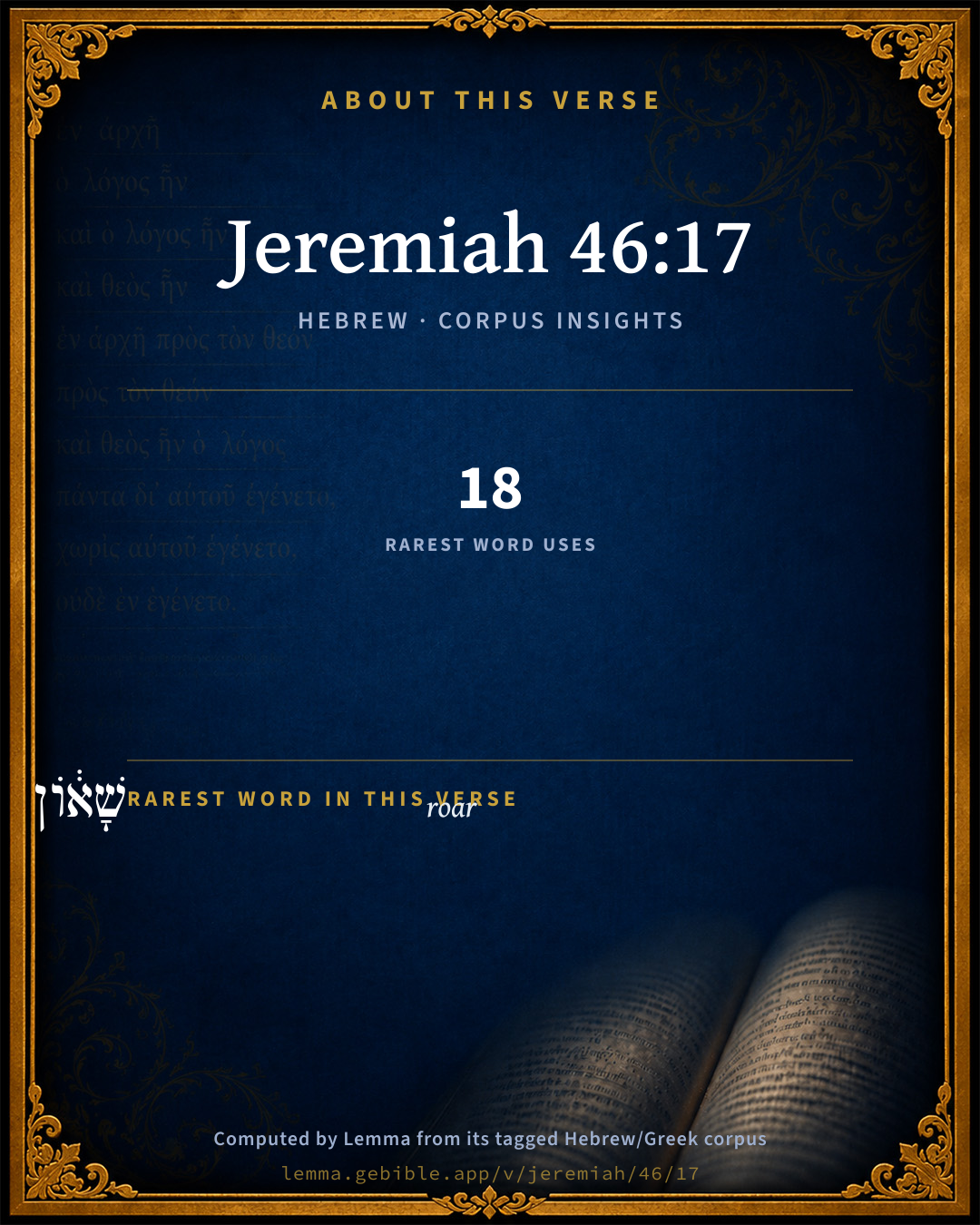
These counts appear in no published source. They are computed here, from the morphology-tagged text and Lemma’s own curated glosses. What Lemma adds →

8
words
8
distinct lemmas
Prophets
section

Notable vocabulary

The rarest word here is שָׁא֔וֹן roar H7588 — appearing just 18 times in the whole Hebrew Bible.

Shared distinctive vocabulary

שָׁא֔וֹן roar H7588 occurs in 16 verses of the Hebrew Bible. Also found in:

Grammatical profile

  • 2 verbs
  • 5 nouns
  • 1 adverb

Verb forms

  • קָרְא֖וּ Qal · Perfect
  • הֶעֱבִ֖יר Hiphil · Perfect

Cross-references

8

Topical passages linked to Jeremiah 46:17 in the Treasury of Scripture Knowledge — connected by theme and wording, ordered by reader-vote popularity; previews shown in the World English Bible.

  • Isaiah 19:11–16 The princes of Zoan are utterly foolish; the counsel of the wisest counselors of Pharaoh is become brutish: how do you say to Pharaoh, I am the son of the wise, the son of ancient kings?
  • Exodus 15:9 The enemy said, 'I will pursue, I will overtake, I will divide the spoil. My desire shall be satisfied on them. I will draw my sword, my hand shall destroy them.'
  • 1 Kings 20:10 Ben Hadad sent to him, and said, The gods do so to me, and more also, if the dust of Samaria shall suffice for handfuls for all the people who follow me.
  • 1 Kings 20:18 He said, Whether they are come out for peace, take them alive, or whether they are come out for war, taken them alive.
  • Isaiah 31:3 Now the Egyptians are men, and not God; and their horses flesh, and not spirit: and when Yahweh shall stretch out his hand, both he who helps shall stumble, and he who is helped shall fall, and they all shall be consumed together.
  • Isaiah 37:27–29 Therefore their inhabitants were of small power, they were dismayed and confounded; they were as the grass of the field, and as the green herb, as the grass on the housetops, and as a field [of grain] before it is grown up.
  • Ezekiel 29:3 speak, and say, Thus says the Lord Yahweh: Behold, I am against you, Pharaoh king of Egypt, the great monster that lies in the midst of his rivers, that has said, My river is my own, and I have made it for myself.
  • Ezekiel 31:18 To whom are you thus like in glory and in greatness among the trees of Eden? yet shall you be brought down with the trees of Eden to the lower parts of the earth: you shall lie in the midst of the uncircumcised, with those who are slain by the sword. This is Pharaoh and all his multitude, says the Lord Yahweh.

Cross-references courtesy of OpenBible.info (CC BY 4.0).

Hebrew and Greek witnesses Masoretic Hebrew ↔ Greek Septuagint

The same verse in the two great witnesses to the Old Testament, shown verse-for-verse.

These are two independent witnesses, not word-aligned to each other, and the Septuagint is shown in lemma (dictionary) form.

Hebrew Jeremiah 46:17 Masoretic · Westminster Leningrad Codex

קָרְא֖וּ שָׁ֑ם פַּרְעֹ֤ה מֶֽלֶךְ מִצְרַ֨יִם֙ שָׁא֔וֹן הֶעֱבִ֖יר הַמּוֹעֵֽד

They cried there, Pharaoh king of Egypt is but a noise; he has let the appointed time pass by.

World English Bible · Public Domain

Greek LXX Structure differs

In the Septuagint, Jeremiah is about an eighth shorter than the Hebrew and arranges its material differently — the Oracles Against the Nations (Hebrew chapters 46–51) appear in the middle of the Greek book, after 25:13. Because the chapter and verse boundaries do not line up, a verse-for-verse comparison with the Hebrew is not shown.

A verse-for-verse comparison isn’t shown here because the chapters and verses don’t line up. Switch to the LXX edition with the MT / LXX toggle above to read the Greek directly.

On this verse, Ellicott's Commentary for English Readers discusses the Septuagint’s reading. Read the note in Commentary ↓

Hebrew: Westminster Leningrad Codex (CC BY 4.0). Greek: Septuagint (public domain); English from a public-domain English Septuagint. How the Septuagint differs from the Hebrew →

Targum (Aramaic paraphrase)

1

The Targum is the ancient Jewish Aramaic paraphrase of the Hebrew Scriptures — an interpretive translation, not the Hebrew text itself. Onkelos (literal) and Pseudo-Jonathan (expansive) render the Torah, and Jonathan the Prophets. Coverage is partial: where no permissively-licensed English translation exists for a verse, only the Aramaic is shown. This is verse-level text, not a word-by-word alignment to the Hebrew.

  1. Targum Jonathan Prophets (Joshua–Malachi)
    זַמִינוּ לְתַמָן פַּרְעֹה מַלְכָּא דְמִצְרַיִם דְסַגִיאִין אִתְרְגוּשְׁתֵיהּ מַעְדֵי זִמְנַיָא:

    (no public-domain English translation for this verse)

    Targum Jonathan — Aramaic: “Mikraot Gedolot” (public domain). English: “Sefaria Community Translation” (CC0 1.0 (public-domain dedication)); “London "Chaldee Paraphrase," 1871” (public domain). Text via Sefaria.

Commentary

Notes on Jeremiah 46:17 from classic Christian and Jewish commentators (each source and its license shown beneath its notes). The classic Christian expositions comment on the surrounding passage and are grouped to its opening verse, so a note may address several verses; the Jewish commentaries on the Tanakh (Rashi and others) are per-verse, so they appear only where the commentator wrote on this verse.

Lemma curates 59 commentaries, every one of them public domain or Creative Commons licensed, each selected and text-cleaned for this edition rather than reprinted as found. About our sources →

Trapp's Complete Commentary

John Trapp

Jer 46:17 They did cry there, Pharaoh king of Egypt [is but] a noise; he hath passed the time appointed.

Ver. 17. Pharaoh king of Egypt is but a noise,] {a} A mere flash, one that vaunteth and vapoureth, and that is all. So of Charles VIII, King of France, Guicciardini saith, that in his expedition to Naples he came into the field like thunder and lightning, but went out like a snuff; more than a man at first, and less than a woman at last.

He hath passed the time appointed.] He let slip his best opportunity, which, in giving battle, is sometimes the loss of all. Charles, King of Sicily and Jerusalem, was for this fault called Carolus Cunctator, i.e., The Delayer.

{a} Strepitus est.

John Trapp, A Commentary or Exposition upon All the Books of the Old and New Testament (1647–1656) — public domain. Text from a community e-Sword module.

The Biblical Illustrator

Joseph S. Exell

Jer_46:17

Pharaoh king of Egypt is but a noise.

Religious judgments

How the Bible can torment its adversaries!--mock them, contemn them, dash them in pieces like a potters vessel. Yet it is never mere contempt. The contempt of the Bible is the penal side of a profound philosophy. Its contempt is as necessary as its Gospel--nay, more, its Gospel renders its contempt necessary. Our God is a consuming fire, God is love, the wrath of the Lamb. So when Pharaoh-Necho--mighty man--is called by the contemptuous term of noise no mere sneer is employed. This is a righteous judgment, a moral estimate, a correct representation of things as they are in reality, not of things as they appear to be. In all judgments we must have regard to distance, proportion, perspective. Pharaoh king of Egypt, with horses, chariots, swords, spears, hosts of men, is a terrific power; but to a man standing in the quiet of the Divine sanctuary, Pharaoh king of Egypt is but a noise--a waft of wind, a curl of smoke dying whilst it rises. If men would but consider this law of proportion the whole estimate of life would undergo an instantaneous and complete reversion. The text brings before us the great subject of religious judgments--by religious judgments I mean estimates. We must call religion into the house if we would take a true appraisement of what we possess. Only religion, as interpreted in Holy Scripture, can tell you what you are and what you are worth.

1. With regard to those religious estimates or judgments, note how fearless they are. They are not judgments about personal manners, social etiquette, little and variable customs; they challenge the whole world. We are moved by their heroism. Religious judgments do not fritter away our time and patience in discussing little questions and petty problems: they summon kings to their bar and call nations to stand back and be judged. There is a national entity as well as a personal individuality. Blessed is the voice that, fills a nation; grand is the Gospel that spreads itself over the whole world. We cannot do without the heroic element, the heroic judgment, the broad estimate, the complete arbitrament, that takes within its purview and decision everything concerning individual life and general civilisation. You must have the great call, the sublime challenge, the heroic appeal, the white throne that stretches itself from horizon to horizon, and before which kings are as little men and little men as kings--the grand astronomical pomp and majesty before which all else settles into its right relation. That you have in the Bible, and nowhere else.

2. The judgments of the Bible are rational as well as fearless. Under all contempt there is a rock of logic. Why does the Bible contemn things? Because of their proportion. It knows the exact proportion which everything bears to the sum-total of things and to the sovereign purpose of the Divine government. Then the judgments of the Bible are rational because the matter or element of duration is continually present to the minds of the inspired writers. The inspired writer has been locked up with God, and turning away from that glory all other things become as the baseless fabric of a vision. If we could see God we should be filled with contempt regarding all things, in so far as they affected to hinder us by their greatness or overpower us by their solidity.

3. Then the judgments of the Bible are also critical. They are very dainty in their expression: they take the right word with an inspired ingenuity. Pharaoh king of Egypt is but a noise. You cannot amend that comment. Try to amend anything Jesus Christ ever said. As well amend a dewdrop; as well paint the lily. And the nations, according to the biblical estimate, are but a wind that cometh for a little time and then passeth away; and our life is but a vapour, dying in its very living. These are the condensations of Omniscience; these arc the sharpened points whetted in eternity; these stand incapable of amendment.

4. But fearless, rational, critical--is there no word that comes nearer to my own necessity? Yes, there is a word that touches us all to-day: these religious judgments are inspiring. Man wants inspiration every day. The Bible was not inspired once for all, in the sense of having its whole meaning shown in one disclosure. Inspiration comes with every dawn, distils in every dew-shower, breathes in every breeze; it is the daily gift of God. How are these judgments inspiring? Because they enable a man who is right in his spirit and purpose to say, If God be for us, who can be against us? (J. Parker, D. D.)

The Biblical Illustrator, edited by Joseph S. Exell (c. 1880s–1900s) — public domain. Text from a community e-Sword module.

Geneva Bible (1599)

Geneva Bible translators

He derideth them which shall impute their overthrow to lack of counsel and policy, or to fortune, and not observing of time: not considering that it is God’s just judgment.

Geneva Bible (1599) marginal notes — public domain. Text via Bolls.life.

Jamieson, Fausset & Brown

Robert Jamieson, A. R. Fausset & David Brown

there--in their own country severally, the foreign soldiers (Jer 46:16) cry, "Pharaoh is," &c.

but a noise--He threatens great things, but when the need arises, he does nothing. His threats are mere "noise" (compare Co1 13:1). MAURER translates, "is ruined," literally (in appropriate abruptness of language), "Pharaoh, king . . . ruin." The context favors English Version. His vauntings of what he would do when the time of battle should come have proved to be empty sounds; he hath passed the time appointed (namely, for battle with the Chaldeans).

Jamieson, Fausset & Brown — Commentary Critical and Explanatory on the Whole Bible (1871) — public domain (CC PDM 1.0). Text via the HelloAO Bible API.

Adam Clarke's Commentary

Verse 17. They did cry there] Dr. Blayney translates this cry thus: -

_______ "O Pharaoh, king of Egypt,

A tumult hath frustrated the appointed meeting."

These allies sent their excuse to Pharaoh, that the disasters they had met with had prevented them from joining him as they had intended.

Adam Clarke's Commentary on the Bible (1810–1826) — public domain. Text from a community e-Sword/MySword module.

John Calvin's Commentaries

This verse ought to be joined with the preceding, for he refers to the cries of the soldiers who had been deceived by their own hopes: they at length cried, Pharaoh is to us a king of confusion. The Prophet predicts what was to be; but he speaks, according to what was usually done, in the past time; for the Prophets announce unknown things as before their eyes, in order to gain credit to their prophecies. He then says, that there would be a cry among the soldiers, Pharaoh the king of Egypt is a king of confusion; for the word שאון, shaun, is to be read in the genitive case; as though the Prophet had said that the soldiers would really find that Pharaoh would not turn out according to his boasting. The name of Egypt first filled him and the whole nation with arrogance; and further, it was dreaded by the neighbouring nations. When, therefore, they came to Pharaoh, they thought that they were coming to some sort of a god. The Prophet derided that foolish confidence unreasonably entertained, and says, “They shall cry there, O Pharaoh, magnificent king, thou art now a king of tumult,” or confusion.

What follows is not well explained, as I think, by interpreters; for they all, with one consent, think that Pharaoh is derided, because he delayed time, after having before said that he would go against Nebuchadnezzar; as earthly kings, when they think themselves sufficiently prepared, do not wait until the enemy is at hand, or finds them at home, but go to meet him at a distance. Others think that the time for war had been proclaimed, as it was usual formerly for both sides to proclaim a certain day on which they were to come to a conflict. But from the last verse we may gather that the Prophet meant another thing, he then derides, if I am not mistaken, the folly of Pharaoh for another reason, even because he thought that those threatenings were vain and empty, which had been dispersed by the Jews; for the Egyptians were not ignorant of what had been predicted by the Prophets. Isaiah had long before cried out against the Jews, because they made treaties with the Egyptians, and fled there for aid. There is no doubt but the courtiers, in order to gain favor, said to them, “Behold, our Prophets hinder us as much as they can, and we must take care lest they turn aside the people: while then there is time, let us make the treaty, which will be useful to you as well as to us.” As, then, the destruction of Egypt had been predicted many years before, and as the Egyptians remained in safety after Judea was overthrown and laid waste, it is probable that they became more hardened, thinking that the time had elapsed. And this view, as I have said, is confirmed by the context. For it follows, —

John Calvin's Commentaries (1540-1563) — public domain. Text from the Calvin Translation Society English edition (1840s-50s) via the Christian Classics Ethereal Library (ccel.org). Calvin's coverage is partial (roughly two-thirds of the Bible); uncommented books and verses are honest gaps, never fabricated. The 19th-century editor's footnotes and remarks are omitted so the notes are faithfully Calvin's own voice.

Ellicott's Commentary for English Readers

(17) They did cry there . . .—Better, There they cry . . . The difficulty of the verse has led to very various renderings. The meaning of the English version is that the exiles returning to their own land would say that Pharaoh with all his haughty boasts was but an empty noise, that he had passed the limit of God’s long-suffering, and that the day of retribution had come. A slight change in the Hebrew words, however, gives, They have called the name of Pharaoh king of Egypt, A Noise; he hath passed (or lost) the appointed season—i.e., the time allowed by the long-suffering of God. This is supported by some of the ancient versions, and may be accepted as the best rendering. The LXX. and Vulg. agree in taking the opening words as an imperative, “Call ye the name of Pharaoh . . . ;” but the former, as if despairing of the meaning, simply reproduces the Hebrew words that follow in Greek letters, while the latter translates, Tumultum adduxit tempus (“Time, the appointed time, has brought the noise”—i.e., of war and destruction), as if it were, like Magor-missabib, a new nomen et omen given to the Egyptian king. Luther, giving another meaning to the words translated “appointed time,” renders “Pharaoh king of Egypt lies prostrate, he has left his tent.” Ewald, following the line of the Vulgate, renders the name by which Pharaoh is spoken of as “tumult, which a sign or ‘moment’ disperses,” the “tumult” being his boastful clamour, the “sign” the token of Jehovah’s will. Hitzig agrees more closely with the English version in the latter clause, and it may be accepted as having on the whole most in its favour.

A Bible Commentary for English Readers, edited by Charles John Ellicott (1878–1897) — public domain. Text from a community e-Sword module.

The Cambridge Bible for Schools and Colleges

gen. ed. J. J. S. Perowne

17. They cried there … a noise] Read, Call ye the name of Pharaoh (so far accord Syr. and Vulg., and so the LXX, who add Neco) a Crash. Thus Dr., who compares for a name symbolical of a great disaster Jer_20:3, and for the Hebrew word used here Jer_25:31 (“a noise”); Hos_10:14; Amo_2:2 (“tumult”). Cp. Psa_40:2 R.V. mg., “tumult or destruction.”

he hath let the appointed time pass by] the time for effectual preparation to resist. The period of grace is over. The Hebrew verb in this clause (he‘ĕbir) is thought to be a play on the name Hophra (cp. Isa_30:7 with note in C.B. for a contemptuous play on a name for Egypt). If this be so, the v. can hardly be a gloss (Du.) or otherwise non-Jeremianic (Gi.), and it will help to authenticate the whole passage (Jer_46:14 ff.). A later writer would probably have known that it was as a matter of fact not Hophra but his successor Amasis who was ruler of Egypt at the time of Nebuchadnezzar’s invasion (See on Jer_43:13).

The Cambridge Bible for Schools and Colleges (gen. ed. J. J. S. Perowne; Cambridge University Press, 1878–1918) — public domain. Text from a community e-Sword module.

John Gill's Exposition

They did cry there,.... Not the Chaldeans, deriding Pharaoh and his army, and mocking them, saying the following words, as some; nor the Egyptians in Egypt, as Kimchi, complaining of their king; much less in Carchemish, as others; since this prophecy refers to another event, time, and place; but the auxiliaries of Egypt in the field of battle; these did cry out aloud, as follows:

Pharaoh king of Egypt is but a noise; he boasted and bragged of great things he would do, and does nothing; he promised to bring a large army into the field, and talked big of attacking the enemy with great ardour and fury, and hectored and blustered as if he feared him not, and was sure of victory; but when it came to the push, his courage failed him; and it may be said of him what the man said of his nightingale, "vox et praeterea nihil", a voice, and nothing else. This was not Pharaohnecho, as the Septuagint have wrongly inserted, but Pharaohhophra, Jer 44:30; or it may be supplied thus, "Pharaoh king of Egypt is a king of noise" (l); a noisy, big, and blusterous king in words, but in deeds nothing:

he hath passed the time appointed; to join his auxiliaries, in order to give the enemy battle; and so left them in the lurch, of which they complain; or through his dilatoriness lost the proper opportunity of attacking him. Some indeed understand it, not of the king of Egypt, but of the king of Babylon; as if the sense was this, the Egyptians cried aloud, and encouraged themselves and their allies against the king of Babylon; saying, what Jeremiah the prophet said concerning Pharaoh king of Egypt and his destruction is all mere noise; there is nothing in it; for the time set by him for that event is passed and over: others, because the word has sometimes the signification of a solemn meeting or festival, take the meaning to be, that Pharaoh king of Egypt being brought to utter destruction, as the word for noise may signify, or being a noisy tumultuous prince, who brought ruin on himself and others, has thereby caused the solemn feasts to pass away (m), or the festivals to cease; whether in a civil or a religious way; but the first sense seems best.

(l) "rex Aegypti, rex tumultus", Munster, Vatablus; "rex perturbationis", Calvin; so Ben Melech; "rex Aegypti, vir strepertus est", Piscator, Junius & Tremellius. (m) "transire fecit solennitatem", De Dieu.

John Gill's Exposition of the Whole Bible (1746–1763) — public domain (CC PDM 1.0). Text via the HelloAO Bible API.

Albert Barnes' Notes on the Bible

Translate it with the versions: “They have called (or, Call ye) the name of Pharaoh king of Egypt - A noise: he hath overstepped the appointed time.” For this custom of giving prophetic names see Jer 20:3; Isa 8:3, ... The words mean that Pharaoh is a mere empty sound, and that he has allowed the years of prosperity, which he enjoyed at the beginning of his reign, to pass by; having misused them, nothing now remains but his ruin.

Albert Barnes' Notes on the Bible (1834–1885) — public domain. Text from a community e-Sword/MySword module.

Haydock's Catholic Bible Commentary

Pharao. Septuagint add, "Nechao." But Apries seems rather to be meant. (Calmet) --- A. Hebrew shaon hehebir hamohed. Protestants, "is but a noise, he hath passed the time appointed;" (Haydock) or, "the height which the crowd (or God, who raised) hath displaced." (Calmet) --- Septuagint retain the original: but the middle word varies in their copies. (Haydock) --- All the boasts of Pharao ended in smoke. He lost the proper opportunity, and caused his own kingdom to be laid waste. Syriac, "the disturber, who deranges the times." (Calmet)

George Leo Haydock (1774–1849), Haydock's Catholic Family Bible and Commentary, 1859 edition — public domain. Excludes Psalms (Douay-Rheims chapter numbering differs from Protestant) and Deuterocanonical books (Catholic canon only).

Matthew Poole's English Annotations

That is, the Ethiopians and Lubims that should come to help the king of Egypt should cry, or the Chaldeans or the Egyptians themselves should cry, Pharaoh is but a noise, that is, hath made a great noise, but it cometh to nothing: others make the sense, Pharaoh is a man of noise, or tumult. that hath made a great deal of disturbance to himself and us.

He hath passed the time appointed; that is, say the most, he hath passed the time himself fixed whereat he would come and fight the Chaldeans. But these words compared with the next verse incline others to think, that either Pharaoh’s soldiers or his allies are here brought in mocking at Pharaoh, promising himself that the king of Babylon would not come, and laughing at Jeremiah’s prophecy, saying the time appointed was past, that is, the time of his coming mentioned by Jeremiah was past. Jeremiah foretells that Pharaoh’s army and confederates would see reason to cry out, Pharaoh, in saying so, was but a noise.

Matthew Poole's English Annotations on the Holy Bible (1683–1685) — public domain. Text from a community e-Sword/MySword module.

Whedon's Commentary on the Bible

Daniel D. Whedon

17. Noise — Rather, destruction. There they cry, Pharaoh… is destruction.

Daniel D. Whedon (gen. ed.), Commentary on the Old and New Testaments (1874–1909) — public domain. Text from a community e-Sword module.

The Pulpit Commentary

They did cry there, etc.; rather, they cry there, viz. the following words. But why should attention be called to the place where the cry is made? and why should the mercenaries (the subject of the preceding verb, and therefore presumably of this verb) have their exclamation recorded? Alter the vowel points (which merely represent an early but not infallible exegetical tradition), and all becomes clear. We then get a renewal of the summons in ver. 14 to make a proclamation respecting the war. The persons addressed are, not foreigners, but the children of the soil, and the summons runs thus: "Call ye the name of Pharaoh, King of Egypt, Desolation." No longer "Pharaoh," honoured by titles indicating that he, like Apis, is a Divine incarnation (neb, i.e. lord, and nuter, i.e. god), but Shaon, the Hebrew for Desolation, is the fittest name for the fallen monarch. The custom of changing names with a symbolic meaning is no strange one to readers of the prophecies. We have met with it in this very book; (see Jer_20:3) and Isaiah contains a parallel as exact as could be desired, in the famous passage in which the prophetic name (itself symbolic) of Egypt (Rahab, i.e. boisterousness, arrogance) is changed into "Rahabhem-shebheth" (i.e. "Rahab! they are utter indolence"). In behalf of this view we may claim the authority of a tradition still older than that preserved in the vowel points, for the Septuagint (followed substantially by the Peshito and the Vulgate) has, Kalesate to onoma Faraw Necaw basilewv Aiguptou Sawn . He hath passed the time appointed. A difficult clause, and variously interpreted. One thing is clear, that "passed" cannot be correct, as the verb is in the Hifil or causative conjugation. We must, at any rate, render, "He hath let the time appointed pass by." This is, in fact, the simplest and most natural explanation. There was a time within which repentance might have averted the judgment of God; but this "accepted time" has been foolishly let slip.

The Pulpit Commentary (1880–1919), ed. H.D.M. Spence-Jones & Joseph S. Exell — public domain. Text from a community e-Sword module.

John Wesley's Explanatory Notes

Pharaoh - Hath made a great noise, but it cometh to nothing. Passed - That is, he hath passed the time himself fixed when he would cone, and fight the Chaldeans.

John Wesley, Explanatory Notes Upon the Whole Bible (1754–1765) — public domain. Text via the GEBible commentary corpus.

Rashi

Rabbi Shlomo Yitzchaki (Rashi)

There they called out In the battle, they proclaimed publicly a reproachful byword.

“Pharaoh, king of Egypt, who made a lot of noise” Who would raise the sound of his noise, the noises to boast with his armies.

has allowed the appointed time to pass by For he had appointed a set time to go forth and wage war, and he did not go forth, and the day of the appointed time passed by.

Rashi on the Tanakh — English translations: “The Judaica Press complete Tanach with Rashi, translated by A. J. Rosenberg” (CC BY 4.0); “Pentateuch with Rashi's commentary by M. Rosenbaum and A.M. Silbermann, 1929-1934” (public domain); “The Metsudah Tanach series, Lakewood, N.J” (CC BY 4.0); and “The Book of Joshua, Metsudah Publications, 1997” (CC BY 4.0). Text via Sefaria.

Lesson kit

Teaching starters — assembled from the data on this page, not authored interpretation. Every prompt links to the verse data it draws on. Edit before teaching.

Jeremiah, in the Prophets, opens this verse with 8 words (8 distinct Hebrew lemmas). Its most distinctive word is shâʼôwn (“roar”). A historical commentator’s framing appears above. Read the whole chapter for the surrounding context.

Discussion questions

  1. The word shâʼôwn carries the sense “roar.” How does it shape the verse?
  2. How does Psalms 40:2, which shares the word «roar», read alongside this verse?
  3. These translations render this verse differently; the difference is in the English rendering, not the original. What questions does that raise?
  4. «קָרְא֖וּ» is a Qal Perfect verb. How does that grammatical form shape the action described?
  5. Compare how Trapp's Complete Commentary and The Biblical Illustrator read this verse. Where do they agree or differ?

Things to notice

Reading settings

Reading text

Shown beneath each verse's original-language words.

Old Testament
Old Testament edition

Read the OT as the Masoretic Hebrew (MT) or the Greek Septuagint (LXX).

English shown for the Greek Septuagint (in the Hebrew ↔ Greek comparison).

Comparing translations? Open the Compare panel on any verse page to stack up to four side by side.