
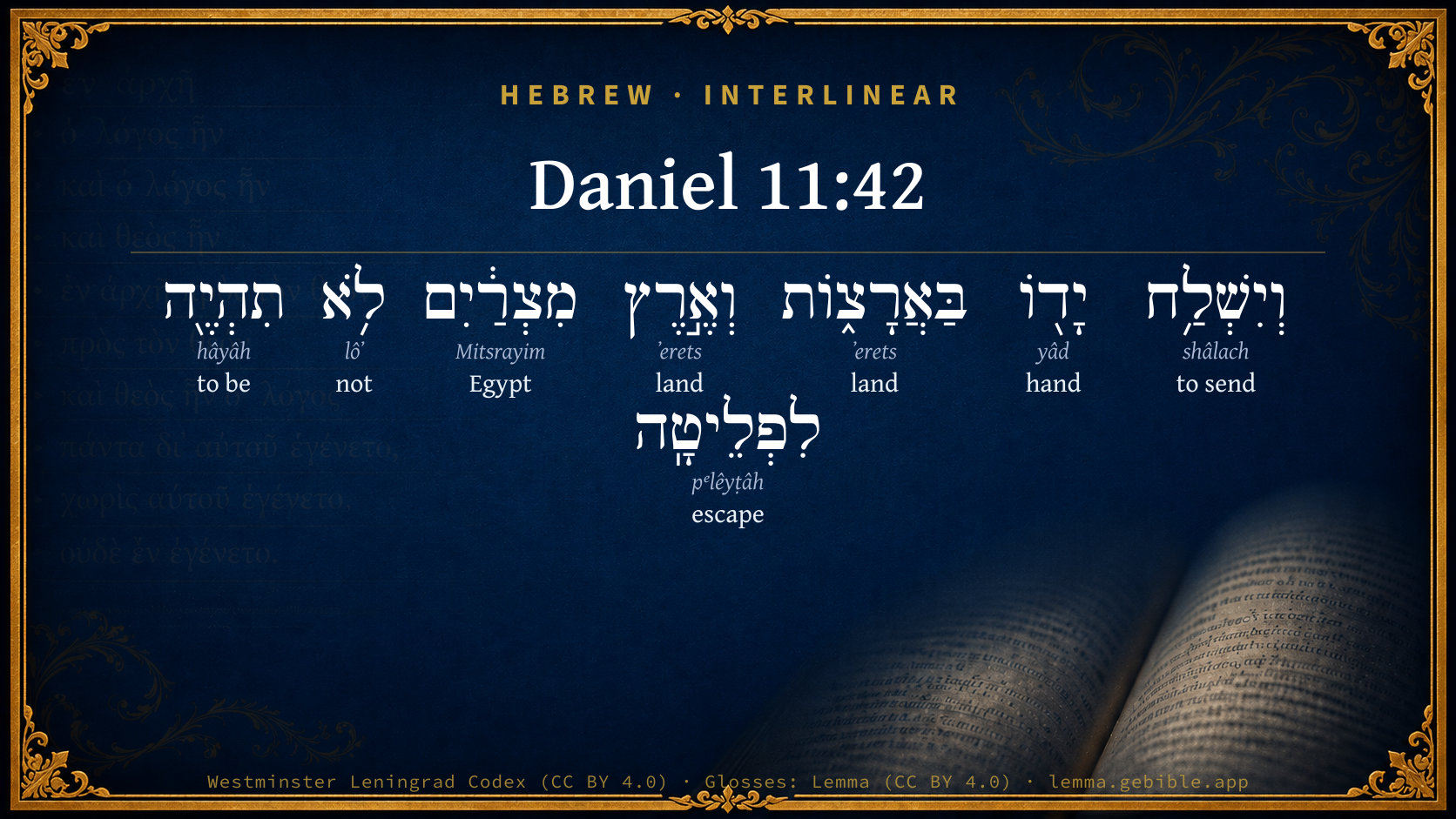
Daniel 11:42

Hebrew (Westminster Leningrad Codex) Daniel 11:42 appears in the Hebrew Old Testament. The text above is from the Westminster Leningrad Codex. Each word links to its Strong’s number, a concise gloss, and parsing drawn from the Open Scriptures Hebrew Bible morphology. Click any word for its full Brown-Driver-Briggs (BDB) entry.
Download image
Cite this verse

Daniel 11:42 (World English Bible). Public Domain. Lemma interlinear Bible study tool, https://lemma.gebible.app/v/daniel/11/42.

Show BibTeX & RIS
BibTeX
RIS
English Translation
He shall stretch forth his hand also on the countries; and the land of Egypt shall not escape.
World English Bible · Public Domain
Download a study sheet

One document with this verse’s original text, its word-by-word gloss line, the meaning frame, cross-references with their text, attributed commentary, and full source and license credits — printable, and it pastes into notes with its structure intact.

This verse Autodidact and up

Study sheet (.html) Plain text (.txt)

A passage Seminary Student

Up to 50 verses in one chapter. A passage sheet keeps up to 6 commentary sources and 12 cross-references per verse, in the order this page ranks them, and says so on the sheet whenever that leaves anything out. Ask for a single verse and you get the Autodidact verse sheet above.

Everything on this page stays free to read, with no account — the sheet is a download of what is already on screen, not access to it.

Want to remove ads? Support Godless Engineer
Compare translations 3

The same verse in 3 English versions, stacked beneath the original-language interlinear above. Click any original word for its lexicon entry.

Each is an independent rendering of the whole verse — the interlinear is not word-aligned to these translations.

Highlighted words mark where these versions differ — a whole-verse word diff, not a word-by-word alignment.

  • World English Bible Public Domain
    He shall stretch forth his hand also on the countries; and the land of Egypt shall not escape.
  • King James Version Public Domain
    He shall stretch forth his hand also upon the countries: and the land of Egypt shall not escape.
  • unfoldingWord Literal Text CC BY-SA 4.0
    He will stretch out his hand against the countries, and the land of Egypt will not escape.

unfoldingWord Literal Text — © unfoldingWord, licensed CC BY-SA 4.0. Word-aligned USFM3 via Door43 (git.door43.org/unfoldingWord/en_ult).

Versions to compare (up to 4)

3 of 4 selected

Show all 18 translations

Every available English version of this verse, each an independent rendering of the whole verse.

  • World English Bible Public Domain
    He shall stretch forth his hand also on the countries; and the land of Egypt shall not escape.
  • Berean Standard Bible Public Domain
    He will extend his power over many countries, and not even the land of Egypt will escape.
  • Majority Standard Bible Public Domain
    He will extend his power over many countries, and not even the land of Egypt will escape.
  • King James Version Public Domain
    He shall stretch forth his hand also upon the countries: and the land of Egypt shall not escape.
  • American Standard Version (1901) Public Domain
    He shall stretch forth his hand also upon the countries; and the land of Egypt shall not escape.
  • Revised Version (1885) Public Domain
    He shall stretch forth his hand also upon the countries: and the land of Egypt shall not escape.
  • Geneva Bible (1599) Public Domain
    He shall stretch foorth his hands also vpon the countreis, and ye land of Egypt shall not escape.
  • Douay-Rheims (1899) Public Domain
    And he shall lay his hand upon the lands: and the land of Egypt shall not escape.
  • Young's Literal Translation Public Domain
    `And he sendeth forth his hand upon the lands, and the land of Egypt is not for an escape;
  • Literal Standard Version CC BY-SA 4.0
    And he sends forth his hand on the lands, and the land of Egypt is not for an escape;
  • Unlocked Literal Bible CC BY-SA 4.0
    He will extend his hand into lands; the land of Egypt will not be rescued.
  • unfoldingWord Literal Text CC BY-SA 4.0
    He will stretch out his hand against the countries, and the land of Egypt will not escape.
  • Darby Bible Public Domain
    And he shall stretch forth his hand upon the countries; and the land of Egypt shall not escape.
  • World Messianic Bible Public Domain
    He will also stretch out his hand on the countries. The land of Egypt won’t escape.
  • Webster's Bible Public Domain
    He shall stretch forth his hand also upon the countries: and the land of Egypt shall not escape.
  • Free Bible Version CC BY-SA 4.0
    He will extend his attacks against different countries—even the land of Egypt will not be able to escape.
  • Bible in Basic English Public Domain
    And his hand will be stretched out on the countries: and the land of the south will not be safe from him.
  • JPS Tanakh (1917) Public Domain
    He shall stretch forth his hand also upon the countries; and the land of Egypt shall not escape.

Literal Standard Version (2020), Covenant Press — licensed CC BY-SA 4.0. Text via the HelloAO Bible API (eBible.org). Unlocked Literal Bible (unfoldingWord) — licensed CC BY-SA 4.0. Text via the HelloAO Bible API (eBible.org). unfoldingWord Literal Text — © unfoldingWord, licensed CC BY-SA 4.0. Word-aligned USFM3 via Door43 (git.door43.org/unfoldingWord/en_ult). Free Bible Version, Dr. Jonathan Gallagher — licensed CC BY-SA 4.0. Text via the HelloAO Bible API (eBible.org).

Word by word

More ways to search: Search by grammar → Find every occurrence → Compare this word →

Practice this passage: Drill this verse → Learn its vocabulary →

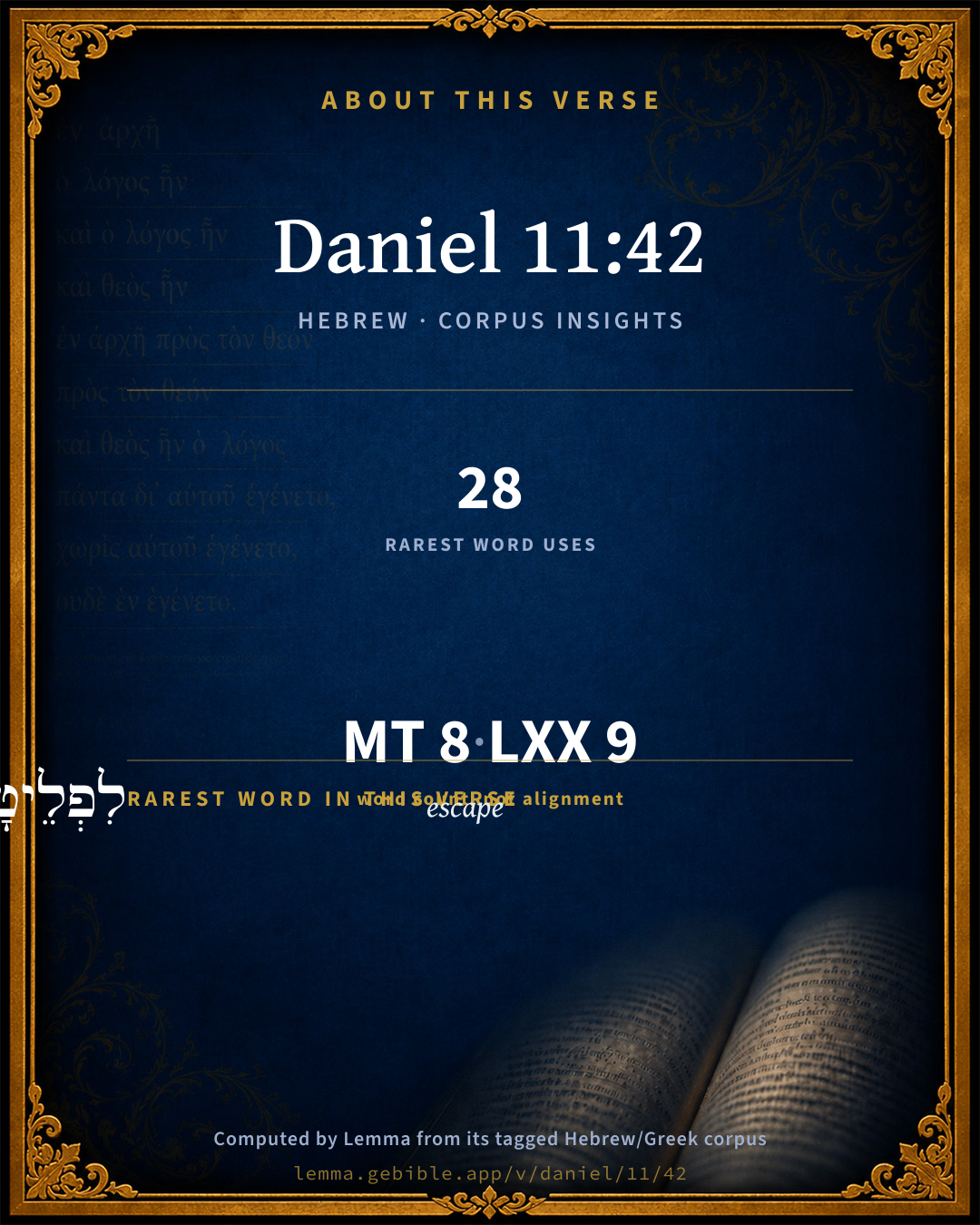
About this verse

These counts appear in no published source. They are computed here, from the morphology-tagged text and Lemma’s own curated glosses. What Lemma adds →

8
words
7
distinct lemmas
Prophets
section

Shared distinctive vocabulary

לִפְלֵיטָֽה escape H6413 occurs in 28 verses of the Hebrew Bible. Also found in:

Grammatical profile

  • 2 verbs
  • 5 nouns
  • 1 particle

Verb forms

  • וְיִשְׁלַ֥ח Qal · Imperfect
  • תִהְיֶ֖ה Qal · Imperfect

Repetition

A word recurs within this verse — often emphatic in Hebrew:

  • בַּאֲרָצ֑וֹת land H776 ×2

Hebrew & Septuagint length

In English translation the verse runs 18 words from the Hebrew and 18 from the Septuagint (LXX English) — the same length.

A rough comparison of the two English renderings, which tokenize alike — not a word-level alignment.

Word counts can differ between the Hebrew and the Greek without any difference in meaning — e.g. the Hebrew direct-object marker אֵת has no separate Greek word, and Greek often adds the article ὁ.

In the original languages it is 8 Hebrew tokens and 9 Greek tokens — but the two are counted differently (Hebrew bundles its prefixes and suffixes into one token; the Greek is in lemma form), so that isn’t a like-for-like length.

Cross-references

4

Topical passages linked to Daniel 11:42 in the Treasury of Scripture Knowledge — connected by theme and wording, ordered by reader-vote popularity; previews shown in the World English Bible.

  • Ezekiel 29:14 and I will bring back the captivity of Egypt, and will cause them to return into the land of Pathros, into the land of their birth; and they shall be there a base kingdom.
  • Zechariah 10:10–11 I will bring them again also out of the land of Egypt, And gather them out of Assyria; And I will bring them into the land of Gilead and Lebanon; And there won't be room enough for them.
  • Zechariah 14:17 It will be, that whoever of all the families of the earth doesn't go up to Jerusalem to worship the King, Yahweh of Hosts, on them there will be no rain.
  • Revelation 11:8 Their dead bodies will be in the street of the great city, which spiritually is called Sodom and Egypt, where also their Lord was crucified.

Cross-references courtesy of OpenBible.info (CC BY 4.0).

Hebrew and Greek witnesses Masoretic Hebrew ↔ Greek Septuagint

The same verse in the two great witnesses to the Old Testament, shown verse-for-verse.

These are two independent witnesses, not word-aligned to each other, and the Septuagint is shown in lemma (dictionary) form.

Hebrew Daniel 11:42 Masoretic · Westminster Leningrad Codex

וְיִשְׁלַ֥ח יָד֖וֹ בַּאֲרָצ֑וֹת וְאֶ֣רֶץ מִצְרַ֔יִם לֹ֥א תִהְיֶ֖ה לִפְלֵיטָֽה

He shall stretch forth his hand also on the countries; and the land of Egypt shall not escape.

World English Bible · Public Domain

Greek LXX Daniel 11:42 Septuagint · lemma form

καί ἐν χώρα αἴγυπτος οὐ εἰμί ἐν αὐτός διασώζω

And he shall stretch forth his hand over the land; and the land of Egypt shall not escape.

LXX2012 (modern English Septuagint) · Public Domain

On this verse, The Pulpit Commentary discusses the Septuagint’s reading. Read the note in Commentary ↓

Hebrew: Westminster Leningrad Codex (CC BY 4.0). Greek: Septuagint (public domain); English from LXX2012 (modern English Septuagint) (Public Domain). How the Septuagint differs from the Hebrew →

Commentary

Notes on Daniel 11:42 from classic Christian and Jewish commentators (each source and its license shown beneath its notes). The classic Christian expositions comment on the surrounding passage and are grouped to its opening verse, so a note may address several verses; the Jewish commentaries on the Tanakh (Rashi and others) are per-verse, so they appear only where the commentator wrote on this verse.

Lemma curates 59 commentaries, every one of them public domain or Creative Commons licensed, each selected and text-cleaned for this edition rather than reprinted as found. About our sources →

Trapp's Complete Commentary

John Trapp

Dan 11:42 He shall stretch forth his hand also upon the countries: and the land of Egypt shall not escape.

Ver. 42. He shall stretch forth his hand also.] He shall be very victorious toward his latter end, that he may be the riper for ruin; fatted ware are but fitted for destruction.

John Trapp, A Commentary or Exposition upon All the Books of the Old and New Testament (1647–1656) — public domain. Text from a community e-Sword module.

Joseph Benson's Commentary

Dan 11:42-43. He shall stretch forth his hand also upon the countries — Namely, upon the countries near to Egypt, as well as upon Egypt itself. Some think that the occasion of Antiochus’s coming into Egypt this third time was a quarrel between Ptolemy Philometor and his brother Physcon, who set up against him; and that Antiochus sided with Physcon, and assisted him to expel Ptolemy. He shall have power over the treasures, &c., of Egypt — In intestine broils, those who are called in to the assistance of either party, generally make their market of it, and pay themselves with the riches of the country. This, from the character of Antiochus, we may well suppose he would do; and if Physcon stood in need of his assistance, he could not gainsay him. Polybius giving an account of the wealth of Antiochus in gold, silver, and precious stones, adds, “Part of this he took from Egypt, breaking the covenant which he had made with Ptolemy Philometor.” This testimony seems strongly to confirm, that what is said here is spoken of Antiochus: for the historian relates exactly the same thing that Daniel here foretels. And the Lybians and the Ethiopians shall be at his steps — Or, follow him; that is, as captives, being overcome in war; for that seems to be the meaning of the expression, be at his steps. It is very probable that Antiochus, from Egypt, made an incursion against those people, and gained some victories over them.

Joseph Benson's Commentary on the Old and New Testaments (1811–1818) — public domain. Text from a community e-Sword module.

Jamieson, Fausset & Brown

Robert Jamieson, A. R. Fausset & David Brown

Egypt . . . Libyans . . . Ethiopians--The latter two, being the allies of the first, served under Antiochus when he conquered Egypt. Antitypically, Egypt, though it held out long under the Mamelukes, in A.D. 1517 fell under the Turks. Algiers, Tunis, and other parts of Africa, are still under them.

at his steps--following him (Exo 11:8, Margin; Jdg 4:10).

Jamieson, Fausset & Brown — Commentary Critical and Explanatory on the Whole Bible (1871) — public domain (CC PDM 1.0). Text via the HelloAO Bible API.

Adam Clarke's Commentary

Verse 42. He shall stretch forth his hand] He - the Ottoman emperors, have stretched forth the hand, not only on European, but also upon Asiatic and African countries. Egypt - has not escaped; it is a province of the Turkish government, as are also Fez, Morocco, Algiers, and many other African countries. And as the prophecy says they "got power over the silver and gold, and the precious things of Egypt," so it was; for when Selim conquered Egypt, A.D. 1517, he took all its spoils; and the immense sums drawn from it to the present day, and the wretchedness of the land in consequence, are almost incredible.

The Libyans and the Ethiopians] The Cushim - unconquered Arabs, all sought their friendship; and many of them are tributary to the present time.

Adam Clarke's Commentary on the Bible (1810–1826) — public domain. Text from a community e-Sword/MySword module.

Ellicott's Commentary for English Readers

(42) He shall stretch forth.—He seizes various countries through which he passes, and among them Egypt is especially selected for mention, representing, as it does, the most powerful of them. The king has at last attained his object. He has frequently been partially successful in his attempts (see Dan_11:12-13; Dan_11:15; Dan_11:29), but now Egypt is completely overthrown.

A Bible Commentary for English Readers, edited by Charles John Ellicott (1878–1897) — public domain. Text from a community e-Sword module.

The Cambridge Bible for Schools and Colleges

gen. ed. J. J. S. Perowne

42. stretch forth his hand] viz. to seize them: see Exo_22:8 (‘put orth his hand upon’), where the verb in the Heb. is the same.

shall not escape] i.e. shall have none to escape; lit. shall not become an escaping body (Gen_32:8 [9 Heb.]).

The Cambridge Bible for Schools and Colleges (gen. ed. J. J. S. Perowne; Cambridge University Press, 1878–1918) — public domain. Text from a community e-Sword module.

John Gill's Exposition

He shall stretch forth his hand also upon the countries,.... Before mentioned, and take possession of them and rule over them, as the Turk does to this day:

and the land of Egypt shall not escape; the hands of the Turk by whom it was taken from the Mamalucs; and is now a province of the Turkish empire, and governed by a Turkish basha, with twenty four princes under him (a). This was not true of Antiochus, who, after he had been checked by the Romans, never entered into Egypt, and much less became master of it, as the Turk now is.

(a) Ibid. (See Dr. Newton's Dissertations on the Prophecies) p. 394.

John Gill's Exposition of the Whole Bible (1746–1763) — public domain (CC PDM 1.0). Text via the HelloAO Bible API.

Albert Barnes' Notes on the Bible

He shall stretch forth his hand also upon the countries - Margin, send forth. Significant of war and conquest. The idea is, that he would be an invader of foreign lands - a characteristic which it is not necessary to show pertained to Antiochus.

And the land of Egypt shall not escape - Moab and Edom, and the land of Ammon would escape, but Egypt would not. We have seen in the exposition of this chapter (see the notes at Dan 11:25-28) that he, in fact, subdued Memphis and the best portions of Egypt, and even obtained possession of the person of the king.

Albert Barnes' Notes on the Bible (1834–1885) — public domain. Text from a community e-Sword/MySword module.

Matthew Poole's English Annotations

Though Egypt (and the adjacent countries) long stood out under the Mamelukes, yet was forced to submit to the Ottoman, anno 1517.

Matthew Poole's English Annotations on the Holy Bible (1683–1685) — public domain. Text from a community e-Sword/MySword module.

Whedon's Commentary on the Bible

Daniel D. Whedon

42. Here we have another glance backward at Dan_11:25-28. Egypt, who has proved a helper to Palestine so often, shall herself be overrun by this beast with the iron teeth, who “shall wear out the saints of the Most High” (Dan_7:25), who casts the holy ones to the ground and stamps upon them (Dan_8:10; Dan_8:23; Dan_8:27).

Daniel D. Whedon (gen. ed.), Commentary on the Old and New Testaments (1874–1909) — public domain. Text from a community e-Sword module.

The Pulpit Commentary

He shall stretch forth his hand also upon the countries: and the land of Egypt shall not escape. The Septuagint rendering is, "And he shall send forth his hand upon the countries, and in the land of Egypt there shall not be a saviour in it." The first part of this verse is marked with an asterisk. Evidently the text before the translators had hflep hl (lah pelaytah), "to her deliverance," and "deliverance" in the abstract became "deliverer" in the concrete. Theodotion renders in a different sense, "And he shall stretch his hand upon the land, and the land of Egypt shall not be for salvation." The idea here is that for the land of Palestine, Egypt shall not be a deliverer. This, probably, is the true reading. The Peshitta agrees with the Massoretic pretty closely, "He shall stretch his hand over the countries, and the land of Egypt shall escape from his hands." The Vulgate has nothing to justify remark. Probably this verse, in the way it is rendered by Theodotion, is a portion of the lost vision of Daniel. The vagueness of "countries" stands in contrast to the definiteness of Edom, Moab, and Ammon, and is thus suspicious. Help was always expected from Egypt in the time when Assyria and Babylonia successively claimed the subjection of the Holy Land.

The Pulpit Commentary (1880–1919), ed. H.D.M. Spence-Jones & Joseph S. Exell — public domain. Text from a community e-Sword module.

unfoldingWord translationNotes

Door43 World Missions Community

General Information:

This is still about the king of the North.

He will extend his hand into lands

Here "hand" represents power and control. AT: "He will extend his control over various lands" (See: Metaphor)

into lands

Here the idea is many lands or various lands. (See: Assumed Knowledge and Implicit Information)

the land of Egypt will not be rescued

This can be put into active form. AT: "the land of Egypt will not escape" (See: Active or Passive)

the Libyans and the Cushites will be in his footsteps

Here "footsteps" represent submission. AT: "the Libyans and the Cushites will have to serve him" (See: Idiom)

the Libyans and the Cushites

"the people of Libya and Cush." Libya is a country west of Egypt, and Cush is a country south of Egypt. (See: How to Translate Names)

translationWords

power

Egypt

gold

silver

Ethiopia

unfoldingWord translationNotes — © Distant Shores Media and the Door43 World Missions Community, licensed CC BY-SA 4.0. Source: git.door43.org/Door43/en_tn.

Lesson kit

Teaching starters — assembled from the data on this page, not authored interpretation. Every prompt links to the verse data it draws on. Edit before teaching.

Daniel, in the Prophets, opens this verse with 8 words (7 distinct Hebrew lemmas). Its most distinctive word is pᵉlêyṭâh (“escape”). A historical commentator’s framing appears above. Read the whole chapter for the surrounding context.

Discussion questions

  1. The word pᵉlêyṭâh carries the sense “escape.” How does it shape the verse?
  2. How does Genesis 32:8, which shares the word «escape», read alongside this verse?
  3. What does the repetition of “land” (2× in this one verse) do in this verse?
  4. These translations render this verse differently. What is at stake in choosing one wording over another?
  5. «וְיִשְׁלַ֥ח» is a Qal Imperfect verb. How does that grammatical form shape the action described?
  6. Compare how Trapp's Complete Commentary and Joseph Benson's Commentary read this verse. Where do they agree or differ?

Things to notice

Reading settings

Reading text

Shown beneath each verse's original-language words.

Old Testament
Old Testament edition

Read the OT as the Masoretic Hebrew (MT) or the Greek Septuagint (LXX).

English shown for the Greek Septuagint (in the Hebrew ↔ Greek comparison).

Comparing translations? Open the Compare panel on any verse page to stack up to four side by side.