
Jeremiah 32:20

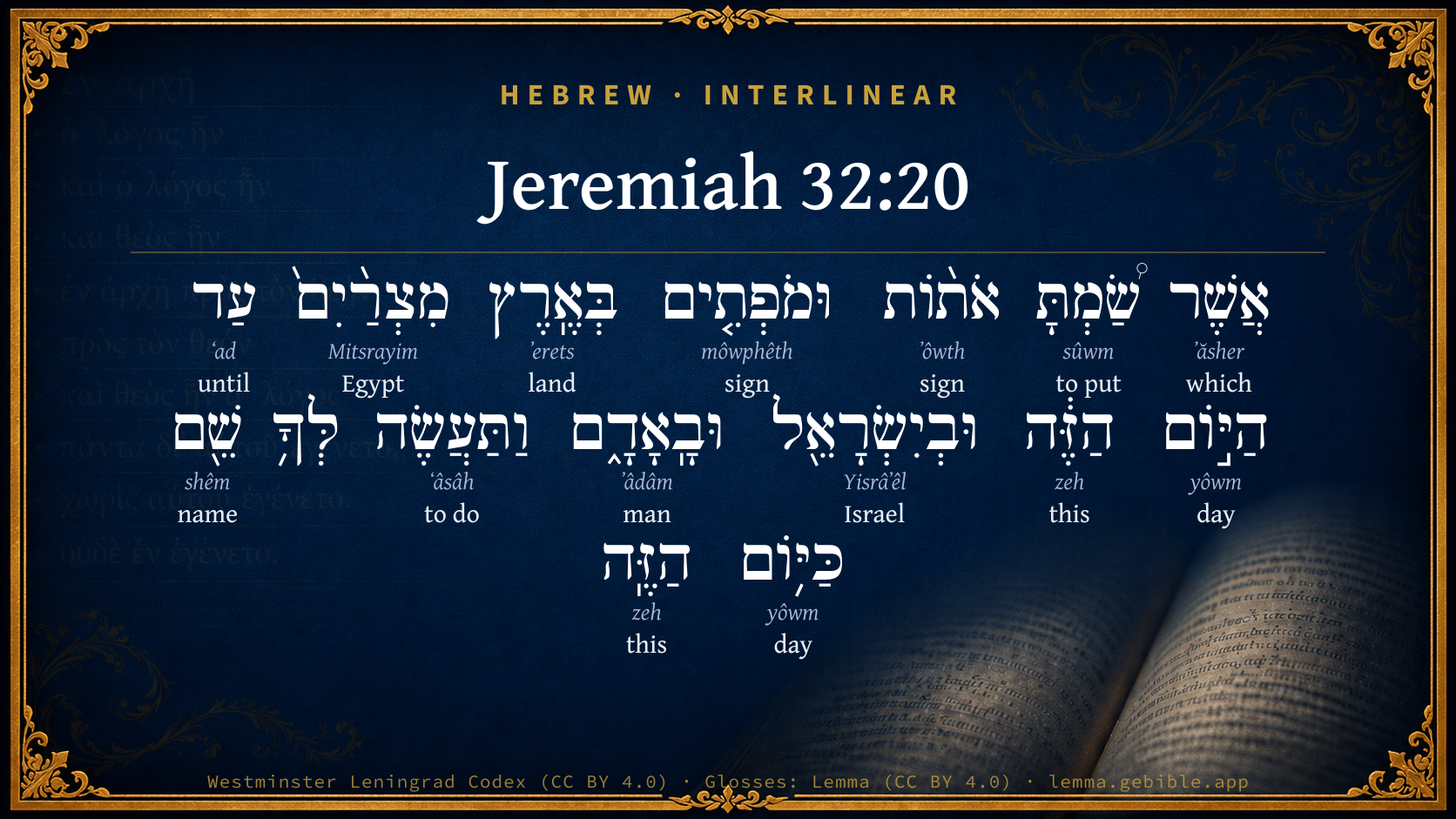
Hebrew (Westminster Leningrad Codex) Jeremiah 32:20 appears in the Hebrew Old Testament. The text above is from the Westminster Leningrad Codex. Each word links to its Strong’s number, a concise gloss, and parsing drawn from the Open Scriptures Hebrew Bible morphology. Click any word for its full Brown-Driver-Briggs (BDB) entry.
Download image
Cite this verse

Jeremiah 32:20 (World English Bible). Public Domain. Lemma interlinear Bible study tool, https://lemma.gebible.app/v/jeremiah/32/20.

Show BibTeX & RIS
BibTeX
RIS
English Translation
who performed signs and wonders in the land of Egypt, even to this day, both in Israel and among [other] men; and made you a name, as in this day;
World English Bible · Public Domain
Download a study sheet

One document with this verse’s original text, its word-by-word gloss line, the meaning frame, cross-references with their text, attributed commentary, and full source and license credits — printable, and it pastes into notes with its structure intact.

This verse Autodidact and up

Study sheet (.html) Plain text (.txt)

A passage Seminary Student

Up to 50 verses in one chapter. A passage sheet keeps up to 6 commentary sources and 12 cross-references per verse, in the order this page ranks them, and says so on the sheet whenever that leaves anything out. Ask for a single verse and you get the Autodidact verse sheet above.

Everything on this page stays free to read, with no account — the sheet is a download of what is already on screen, not access to it.

Want to remove ads? Support Godless Engineer
Compare translations 3

The same verse in 3 English versions, stacked beneath the original-language interlinear above. Click any original word for its lexicon entry.

Each is an independent rendering of the whole verse — the interlinear is not word-aligned to these translations.

Highlighted words mark where these versions differ — a whole-verse word diff, not a word-by-word alignment.

  • World English Bible Public Domain
    who performed signs and wonders in the land of Egypt, even to this day, both in Israel and among [other] men; and made you a name, as in this day;
  • King James Version Public Domain
    Which hast set signs and wonders in the land of Egypt, even unto this day, and in Israel, and among other men; and hast made thee a name, as at this day;
  • unfoldingWord Literal Text CC BY-SA 4.0
    You did signs and wonders in the land of Egypt. To this present day here in Israel and among all mankind, you have made your name famous.

unfoldingWord Literal Text — © unfoldingWord, licensed CC BY-SA 4.0. Word-aligned USFM3 via Door43 (git.door43.org/unfoldingWord/en_ult).

Versions to compare (up to 4)

3 of 4 selected

Show all 18 translations

Every available English version of this verse, each an independent rendering of the whole verse.

  • World English Bible Public Domain
    who performed signs and wonders in the land of Egypt, even to this day, both in Israel and among [other] men; and made you a name, as in this day;
  • Berean Standard Bible Public Domain
    You performed signs and wonders in the land of Egypt, and You do so to this very day, both in Israel and among all mankind. And You have made a name for Yourself, as is the case to this day.
  • Majority Standard Bible Public Domain
    You performed signs and wonders in the land of Egypt, and You do so to this very day, both in Israel and among all mankind. And You have made a name for Yourself, as is the case to this day.
  • King James Version Public Domain
    Which hast set signs and wonders in the land of Egypt, even unto this day, and in Israel, and among other men; and hast made thee a name, as at this day;
  • American Standard Version (1901) Public Domain
    who didst set signs and wonders in the land of Egypt, even unto this day, both in Israel and among `other' men; and madest thee a name, as at this day;
  • Revised Version (1885) Public Domain
    which didst set signs and wonders in the land of Egypt, even unto this day, both in Israel and among other men; and madest thee a name, as at this day;
  • Geneva Bible (1599) Public Domain
    Which hast set signes and wonders in the land of Egypt vnto this day, and in Israel, and among all men, and hast made thee a Name, as appeareth this day,
  • Douay-Rheims (1899) Public Domain
    Who hast set signs and wonders in the land of Egypt even until this day, and in Israel, and amongst men, and hast made thee a name as at this day.
  • Young's Literal Translation Public Domain
    In that thou hast done signs and wonders in the land of Egypt unto this day, and in Israel, and among men, and Thou dost make for Thee a name as `at' this day.
  • Literal Standard Version CC BY-SA 4.0
    in that you have done signs and wonders in the land of Egypt to this day, and in Israel, and among men, and You make for Yourself a name as [at] this day.
  • Unlocked Literal Bible CC BY-SA 4.0
    You did signs and wonders in the land of Egypt. To this present day here in Israel and among all mankind, you have made your name famous.
  • unfoldingWord Literal Text CC BY-SA 4.0
    You did signs and wonders in the land of Egypt. To this present day here in Israel and among all mankind, you have made your name famous.
  • Darby Bible Public Domain
    who hast displayed signs and wonders unto this day, in the land of Egypt and in Israel and among [other] men; and hast made thee a name, as at this day.
  • World Messianic Bible Public Domain
    who performed signs and wonders in the land of Egypt, even to this day, both in Israel and among other men; and made yourself a name, as it is today;
  • Webster's Bible Public Domain
    Who hast set signs and wonders in the land of Egypt, even to this day, and in Israel, and among other men; and hast made thee a name, as at this day;
  • Free Bible Version CC BY-SA 4.0
    You carried out signs and miracles in Egypt, and you still do so today, both here in Israel and among all people everywhere. As a result you gained a great reputation, and this is still true today.
  • Bible in Basic English Public Domain
    You have done signs and wonders in the land of Egypt, and even to this day, in Israel and among other men; and have made a name for yourself as at this day;
  • JPS Tanakh (1917) Public Domain
    who didst set signs and wonders in the land of Egypt, even unto this day, and in Israel and among other men; and madest Thee a name, as at this day;

Literal Standard Version (2020), Covenant Press — licensed CC BY-SA 4.0. Text via the HelloAO Bible API (eBible.org). Unlocked Literal Bible (unfoldingWord) — licensed CC BY-SA 4.0. Text via the HelloAO Bible API (eBible.org). unfoldingWord Literal Text — © unfoldingWord, licensed CC BY-SA 4.0. Word-aligned USFM3 via Door43 (git.door43.org/unfoldingWord/en_ult). Free Bible Version, Dr. Jonathan Gallagher — licensed CC BY-SA 4.0. Text via the HelloAO Bible API (eBible.org).

Word by word

More ways to search: Search by grammar → Find every occurrence → Compare this word →

Practice this passage: Drill this verse → Learn its vocabulary →

וּמֹפְתִ֤ים
môwphêth
H4159
“and · signs”
Conjunction + Noun, Common, Masculine, Plural, Absolute
Part of Speech
Conjunction + Noun
Type
Common
Gender
Masculine
Number
Plural
State
Absolute
Full BDB Definition

Origin: from H3302 in the sense of conspicuousness

TWOT: 152a

wonder, sign, miracle, portent - wonder (as a special display of God's power) - sign, token (of future event)
  1. אֲשֶׁר ʼăsher H834 “which” Particle, Relative
  2. שַׂ֠מְתָּ sûwm H7760 “to put” Verb, Qal, Perfect, 2nd Person, Masculine, Singular
  3. אֹת֨וֹת ʼôwth H226 “signs” Noun, Common, Both, Plural, Absolute
  4. בְּאֶֽרֶץ ʼerets H776 “in/at · land of” Preposition + Noun, Common, Both, Singular, Construct
  5. מִצְרַ֨יִם֙ Mitsrayim H4714 “Egypt” Noun, Proper
  6. עַד ʻad H5704 “until” Preposition
  7. הַיּ֣וֹם yôwm H3117 “the · day” Particle, Definite Article + Noun, Common, Masculine, Singular, Absolute
  8. הַזֶּ֔ה zeh H2088 “the · this” Particle, Definite Article + Pronoun, Demonstrative, Masculine, Singular
  9. וּבְיִשְׂרָאֵ֖ל Yisrâʼêl H3478 “and · in/at · Israel” Conjunction + Preposition + Noun, Proper
  10. וּבָֽאָדָ֑ם ʼâdâm H120 “and · in/at the · man” Conjunction + Preposition, Determined + Noun, Common, Masculine, Singular, Absolute
  11. וַתַּעֲשֶׂה ʻâsâh H6213 “and · to do” Conjunction + Verb, Qal, Sequential Imperfect, 2nd Person, Masculine, Singular
  12. שֵׁ֖ם shêm H8034 “name” Noun, Common, Masculine, Singular, Absolute
  13. כַּיּ֥וֹם yôwm H3117 “like/as the · day” Preposition, Determined + Noun, Common, Masculine, Singular, Absolute
  14. הַזֶּֽה zeh H2088 “the · this” Particle, Definite Article + Pronoun, Demonstrative, Masculine, Singular

About this verse

These counts appear in no published source. They are computed here, from the morphology-tagged text and Lemma’s own curated glosses. What Lemma adds →

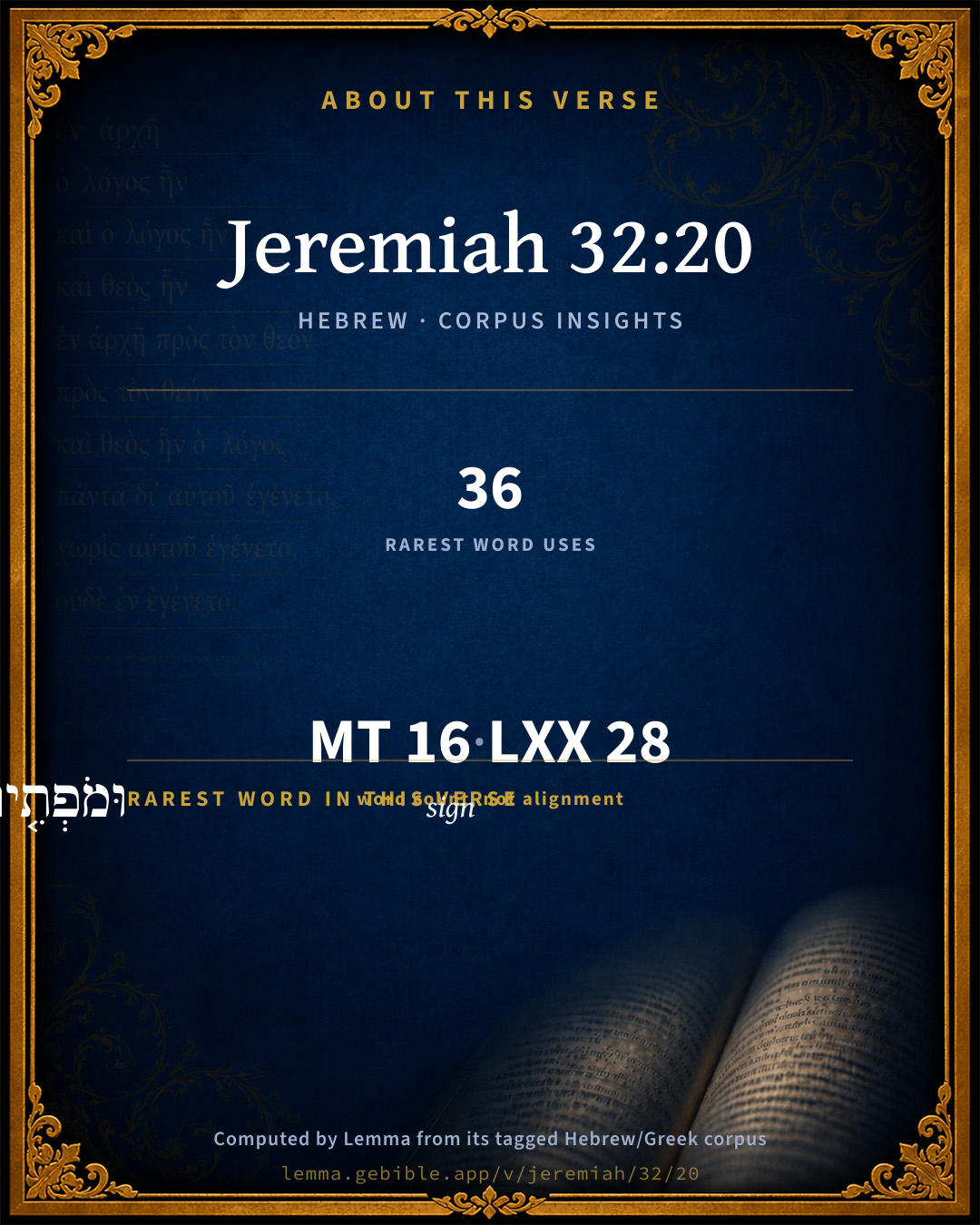
16
words
13
distinct lemmas
Prophets
section

Shared distinctive vocabulary

וּמֹפְתִ֤ים sign H4159 occurs in 35 verses of the Hebrew Bible. Also found in:

Grammatical profile

  • 2 verbs
  • 9 nouns
  • 2 pronouns
  • 2 prepositions
  • 1 particle

Verb forms

  • שַׂ֠מְתָּ Qal · Perfect
  • וַתַּעֲשֶׂה Qal · Sequential Imperfect

Repetition

Words recur within this verse — often emphatic in Hebrew:

  • הַיּ֣וֹם day H3117 ×2
  • הַזֶּ֔ה this H2088 ×2

Hebrew & Septuagint length

In the original languages it is 16 Hebrew tokens and 28 Greek tokens — but the two are counted differently (Hebrew bundles its prefixes and suffixes into one token; the Greek is in lemma form), so that isn’t a like-for-like length.

Cross-references

15

Topical passages linked to Jeremiah 32:20 in the Treasury of Scripture Knowledge — connected by theme and wording, ordered by reader-vote popularity; previews shown in the World English Bible.

  • Nehemiah 9:10 and shown signs and wonders on Pharaoh, and on all his servants, and on all the people of his land; for you knew that they dealt proudly against them, and did get you a name, as it is this day.
  • Exodus 9:16 but indeed for this cause I have made you stand: to show you my power, and that my name may be declared throughout all the earth;
  • Exodus 10:2 and that you may tell in the hearing of your son, and of your son's son, what things I have done to Egypt, and my signs which I have done among them; that you may know that I am Yahweh."
  • 2 Samuel 7:23 What one nation in the earth is like your people, even like Israel, whom God went to redeem to himself for a people, and to make him a name, and to do great things for you, and awesome things for your land, before your people, whom you redeem to you out of Egypt, [from] the nations and their gods?
  • Psalms 135:9 Who sent signs and wonders into the midst of you, Egypt, On Pharaoh, and on all his servants;
  • Daniel 9:15 Now, Lord our God, who has brought your people forth out of the land of Egypt with a mighty hand, and have gotten you renown, as at this day; we have sinned, we have done wickedly.
  • Acts 7:36 This man led them out, having worked wonders and signs in Egypt, in the Red Sea, and in the wilderness for forty years.
  • Exodus 7:3 I will harden Pharaoh's heart, and multiply my signs and my wonders in the land of Egypt.
  • Deuteronomy 4:34 Or has God tried to go and take him a nation from the midst of [another] nation, by trials, by signs, and by wonders, and by war, and by a mighty hand, and by an outstretched arm, and by great terrors, according to all that Yahweh your God did for you in Egypt before your eyes?
  • Deuteronomy 6:22 and Yahweh shown signs and wonders, great and sore, on Egypt, on Pharaoh, and on all his house, before our eyes;
  • Deuteronomy 7:19 the great trials which your eyes saw, and the signs, and the wonders, and the mighty hand, and the outstretched arm, by which Yahweh your God brought you out: so shall Yahweh your God do to all the peoples of whom you are afraid.
  • 1 Chronicles 17:21 What one nation in the earth is like your people Israel, whom God went to redeem to himself for a people, to make you a name by great and awesome things, in driving out nations from before your people, whom you redeem out of Egypt?
  • Psalms 78:43–51 How he set his signs in Egypt, His wonders in the field of Zoan,
  • Psalms 105:27–36 They performed miracles among them, And wonders in the land of Ham.
  • Isaiah 63:12 who caused his glorious arm to go at the right hand of Moses? who divided the waters before them, to make himself an everlasting name?

Cross-references courtesy of OpenBible.info (CC BY 4.0).

Hebrew and Greek witnesses Masoretic Hebrew ↔ Greek Septuagint

The same verse in the two great witnesses to the Old Testament, shown verse-for-verse.

These are two independent witnesses, not word-aligned to each other, and the Septuagint is shown in lemma (dictionary) form.

Hebrew Jeremiah 32:20 Masoretic · Westminster Leningrad Codex

אֲשֶׁר שַׂ֠מְתָּ אֹת֨וֹת וּמֹפְתִ֤ים בְּאֶֽרֶץ מִצְרַ֨יִם֙ עַד הַיּ֣וֹם הַזֶּ֔ה וּבְיִשְׂרָאֵ֖ל וּבָֽאָדָ֑ם וַתַּעֲשֶׂה לְּךָ֥ שֵׁ֖ם כַּיּ֥וֹם הַזֶּֽה

who performed signs and wonders in the land of Egypt, even to this day, both in Israel and among [other] men; and made you a name, as in this day;

World English Bible · Public Domain

Greek LXX Structure differs

In the Septuagint, Jeremiah is about an eighth shorter than the Hebrew and arranges its material differently — the Oracles Against the Nations (Hebrew chapters 46–51) appear in the middle of the Greek book, after 25:13. Because the chapter and verse boundaries do not line up, a verse-for-verse comparison with the Hebrew is not shown.

A verse-for-verse comparison isn’t shown here because the chapters and verses don’t line up. Switch to the LXX edition with the MT / LXX toggle above to read the Greek directly.

Hebrew: Westminster Leningrad Codex (CC BY 4.0). Greek: Septuagint (public domain); English from a public-domain English Septuagint. How the Septuagint differs from the Hebrew →

Targum (Aramaic paraphrase)

1

The Targum is the ancient Jewish Aramaic paraphrase of the Hebrew Scriptures — an interpretive translation, not the Hebrew text itself. Onkelos (literal) and Pseudo-Jonathan (expansive) render the Torah, and Jonathan the Prophets. Coverage is partial: where no permissively-licensed English translation exists for a verse, only the Aramaic is shown. This is verse-level text, not a word-by-word alignment to the Hebrew.

  1. Targum Jonathan Prophets (Joshua–Malachi)
    דְשַׁוֵיתָא אָתִין וּמוֹפְתִין בְּאַרְעָא דְמִצְרַיִם עַד יוֹמָא הָדֵין וּלְיִשְׂרָאֵל עֲבַדְתָּא פְּרִישָׁן בְּגוֹ בְּנֵי אֱנָשָׁא וַעֲבַדְתָּא לָךְ שׁוּם בְּיוֹמָא הָדֵין:

    (no public-domain English translation for this verse)

    Targum Jonathan — Aramaic: “Mikraot Gedolot” (public domain). English: “Sefaria Community Translation” (CC0 1.0 (public-domain dedication)); “London "Chaldee Paraphrase," 1871” (public domain). Text via Sefaria.

Commentary

Notes on Jeremiah 32:20 from classic Christian and Jewish commentators (each source and its license shown beneath its notes). The classic Christian expositions comment on the surrounding passage and are grouped to its opening verse, so a note may address several verses; the Jewish commentaries on the Tanakh (Rashi and others) are per-verse, so they appear only where the commentator wrote on this verse.

Lemma curates 59 commentaries, every one of them public domain or Creative Commons licensed, each selected and text-cleaned for this edition rather than reprinted as found. About our sources →

Trapp's Complete Commentary

John Trapp

Jer 32:20 Which hast set signs and wonders in the land of Egypt, [even] unto this day, and in Israel, and among [other] men; and hast made thee a name, as at this day;

Ver. 20. Who hast set signs and wonders.] Psa 78:43; Psa 106:22; Psa 135:9.

Even unto this day.] Oresius writeth {a} that the tracks of Pharaoh’s chariot wheels are yet to be seen at the Red Sea. Fides sit penes authorem.

{a} Oros., lib. i. cap. 10.

John Trapp, A Commentary or Exposition upon All the Books of the Old and New Testament (1647–1656) — public domain. Text from a community e-Sword module.

Tyndale Open Study Notes

Tyndale Open Resources

32:20 The Lord had done great miracles throughout the history of Israel, but he had also been active all around the world. As a result, everyone knew about Israel’s God.

Tyndale Open Study Notes — © Tyndale Open Resources, licensed CC BY-SA 4.0. Text via the HelloAO Bible API.

Geneva Bible (1599)

Geneva Bible translators

Meaning, that his miracles in delivering his people, should never be forgotten.

Geneva Bible (1599) marginal notes — public domain. Text via Bolls.life.

Jamieson, Fausset & Brown

Robert Jamieson, A. R. Fausset & David Brown

even unto this day--Thou hast given "signs" of Thy power from the day when Thou didst deliver Israel out of Egypt by mighty miracles, down to the present time [MAURER]. CALVIN explains it, "memorable even unto this day."

among other men--not in Israel only, but among foreign peoples also. Compare for "other" understood, Psa 73:5.

made thee a name-- (Exo 9:16; Ch1 17:21; Isa 63:12).

as at this day--a name of power, such as Thou hast at this day.

Jamieson, Fausset & Brown — Commentary Critical and Explanatory on the Whole Bible (1871) — public domain (CC PDM 1.0). Text via the HelloAO Bible API.

John Calvin's Commentaries

The Prophet here especially commemorates the singular kindness of God, by which he had testified his paternal favor towards his Church. He then says, that signs and wonders had been done by him in the land of Egypt, that: is, for the sake of his people. For why were so many miracles done, except to prove the care he had for his chosen people, and thus to confirm his covenant? We hence see that God’s favor towards the children of Abraham is here set forth, that is, when he refers to the signs and wonders

which had been done in the land of Egypt. And he adds, and in Israel He extols not only God’s power in miracles, but especially the mercy with which he favored his chosen people. He says also, to this day Not that God performed miracles in every age, but he means that they were worthy of being perpetually remembered, and throughout all ages. Then this refers to the remembrance and celebration of God’s power, when the Prophet says, to this day God, indeed, performed miracles at a certain time, but he performed them that they might be remembered in all ages, and that posterity might acknowledge how wonderfully God had dwelt with their fathers.

As then the power which he manifested in Egypt was worthy of being remembered, miracles are said to have been done to this day; and they are said to have been done in Israel, because it was God’s purpose to prove the certainty of his faithfulness when he redeemed his people as he had promised.

He afterwards adds, and among men The Prophet goes on still further. After he had spoken of the redemption of the people, he intimates that wherever he turned himself, he observed and admired the evidences of God’s power, as though he had said, “O Lord, thou hast indeed given peculiar testimonies as to thy wonderful power and goodness; the redemption of thy people was a singular work, and ought to be commemorated through all ages; but wherever we turn ourselves, there is no corner in the whole world where some miracles do not appear, which ought to lead us to celebrate thy praises.” We hence see that the Prophet proceeds from what is particular to what is general: after having considered God’s power and goodness in the redemption of his people, he extended his thoughts to all parts of the world, and contemplated God’s miracles everywhere. And this is what often occurs in Scripture; after having been reminded of some particular instance of divine power or grace, we are carried away so that we make a transition to what is general. And he adds, and thou hast made thee, or acquired to thyself, a name according to this day; that is, thou hast made thy name to be perpetual, as its glory still at this day shines forth before our eyes. Then the Prophet means that God had so wonderfully manifested his power, that the knowledge of it would be perpetual, and could never be buried by the ingratitude of men.

John Calvin's Commentaries (1540-1563) — public domain. Text from the Calvin Translation Society English edition (1840s-50s) via the Christian Classics Ethereal Library (ccel.org). Calvin's coverage is partial (roughly two-thirds of the Bible); uncommented books and verses are honest gaps, never fabricated. The 19th-century editor's footnotes and remarks are omitted so the notes are faithfully Calvin's own voice.

Ellicott's Commentary for English Readers

(20) Even unto this day . . .—The reference to the signs and wonders in Egypt seems natural enough, but in what sense, we ask, could those wonders have been said to have been wrought “unto this day”? It is conceivable that what he had heard of the frogs, and the lice, and the boils of Egypt might seem to Jeremiah the perpetuation, in part, of the old plagues; but we get, perhaps, an adequate meaning by seeing in the words the assertion that the old signs and wonders continued in their effect and in their memory. The “name” continued, though the signs themselves had passed away.

Among other men.—Better, among men. There is no word for “other” in the Hebrew, and the words have their full force of declaring God’s universal government over mankind at large.

A Bible Commentary for English Readers, edited by Charles John Ellicott (1878–1897) — public domain. Text from a community e-Sword module.

The Cambridge Bible for Schools and Colleges

gen. ed. J. J. S. Perowne

20. which didst set] Cp. Deu_6:22; Neh_9:10.

even unto this day] a difficult expression. Perhaps we should understand before these words, and hast continued them (signs and wonders).

The Cambridge Bible for Schools and Colleges (gen. ed. J. J. S. Perowne; Cambridge University Press, 1878–1918) — public domain. Text from a community e-Sword module.

John Gill's Exposition

And hast brought forth thy people Israel of the land of Egypt,.... As he promised Abraham, some hundreds of years before, that they should come out from thence; and where they had been as bondsmen, though they were the Lord's peculiar people, whom he had chose for himself above all people, and therefore he brought them out of their state of bondage; and this was his own doing, they could not deliver themselves; the enemy would not let them go till he was obliged to it by the superior power of God:

with signs and with wonders; which he wrought for them at the time of their deliverance, slaying the firstborn; and at the Red sea, and in the wilderness, after he brought them out of Egypt, and before their settlement in the laud of Canaan; and so these may be considered as distinct from the signs and wonders in the land of Egypt before mentioned:

and with a strong hand, and with a stretched out arm; with great power, and so delivered the Israelites from them that were stronger than they; with a mighty hand, that protected his people; and with a long arm, that reached their enemies, and destroyed them:

and with great terror; with great reverence in the Israelites, who saw the power and majesty of God; and with great terror to Pharaoh and his host, when they saw the waters return and overwhelm them; and to all the nations round about, when they heard of it; see Deu 4:34. The Targum is,

"with great vision;''

so a spectacle, as the Syriac version; openly, before the eyes of all.

John Gill's Exposition of the Whole Bible (1746–1763) — public domain (CC PDM 1.0). Text via the HelloAO Bible API.

Albert Barnes' Notes on the Bible

The sense is, who hast set, i. e., performed Exo 10:2 signs etc., and hast continued working them unto this day, both in lsrael and among men (i. e., the pagan).

Albert Barnes' Notes on the Bible (1834–1885) — public domain. Text from a community e-Sword/MySword module.

Haydock's Catholic Bible Commentary

Day. We remember thy ancient miracles, and witness others.

George Leo Haydock (1774–1849), Haydock's Catholic Family Bible and Commentary, 1859 edition — public domain. Excludes Psalms (Douay-Rheims chapter numbering differs from Protestant) and Deuterocanonical books (Catholic canon only).

Matthew Poole's English Annotations

Who didst wonders of justice in the land of Egypt, such as are remembered and made matters of astonishing discourse even to this day; and wroughtest wonders of mercy in Israel, bringing them out of Egypt through the Red Sea, raining them down manna and quails from heaven, and fetching water out of the rock for them, &c.; and hast done also many wondrous works in other places, by which thou hast made thyself a glorious name.

Matthew Poole's English Annotations on the Holy Bible (1683–1685) — public domain. Text from a community e-Sword/MySword module.

Whedon's Commentary on the Bible

Daniel D. Whedon

20. Unto this day — The construction is a pregnant one, and implies hast continued working signs and wonders among men “unto this day.”

Daniel D. Whedon (gen. ed.), Commentary on the Old and New Testaments (1874–1909) — public domain. Text from a community e-Sword module.

The Pulpit Commentary

Even unto this day. A loose expression. Jeremiah simply means that signs and wonders equal to those wrought in Egypt have continued to the present time. And in Israel; rather, both in Israel.

The Pulpit Commentary (1880–1919), ed. H.D.M. Spence-Jones & Joseph S. Exell — public domain. Text from a community e-Sword module.

John Wesley's Explanatory Notes

Who hast set signs - Who didst wonders of justice in the land of Egypt, such as are remembered even to this day.

John Wesley, Explanatory Notes Upon the Whole Bible (1754–1765) — public domain. Text via the GEBible commentary corpus.

Keil & Delitzsch

C. F. Keil & F. Delitzsch

The Lord has further shown this omnipotence and righteousness in His guidance of Israel, in His leading them out of Egypt with wonders and signs; cf. Deu 6:22; Deu 34:11. "Until this day" cannot mean that the wonders continue in Egypt until this day - still less, that their glorious remembrance continues till this day (Calvin, Rosenmller, etc.). Just as little can we connect the words with what follows, "until this day, in Egypt and among men," as Jerome supposed; although the idea et in Israel et in cunctis mortalibus quotidie tua signa complentur is in itself quite right. Logically considered, "until this day" belongs to the verb. 'ושׂמתּ וגו, and the construction is pregnant, as in Jer 11:7 : "Thou hast done wonders in Egypt, and hast still been doing them until this day in Israel and among other men." "Men," in contrast to "Israel," are mankind outside of Israel - other men, the heathen; on the expression, cf. Jdg 18:7; Isa 43:4; Psa 73:5. "As at this day:" cf. Jer 11:5; Jer 25:18. Through signs and wonders the Lord wrought, leading Israel out of Egypt, and into the land of Canaan, which had been promised to their fathers. Jer 32:21 is almost exactly the same as Deu 26:8, cf. Deu 4:34. מורא refers to the terror spread among the neighbouring nations, Exo 15:14., by the wonders, especially the slaying of the first-born among the Egyptians, Exo 12:30., and the miracle at the Red Sea. On "a land flowing with milk and honey," cf. Exo 3:8.

Keil & Delitzsch — Biblical Commentary on the Old Testament (1861–1891) — public domain (CC PDM 1.0). Text via the HelloAO Bible API. (Old Testament only.)

Rashi

Rabbi Shlomo Yitzchaki (Rashi)

and in mankind And in other people. Another explanation: Signs that were equal for Israel and for the Egyptians. How so? “And there was the cloud and the darkness, and it illuminated the night” (Exodus 14:20). That guardian angel that served darkness for the Egyptians, served light for the Israelites Midrash Aggadah (source unknown). And Jonathan renders: And for Israel You performed wonders among people.

Rashi on the Tanakh — English translations: “The Judaica Press complete Tanach with Rashi, translated by A. J. Rosenberg” (CC BY 4.0); “Pentateuch with Rashi's commentary by M. Rosenbaum and A.M. Silbermann, 1929-1934” (public domain); “The Metsudah Tanach series, Lakewood, N.J” (CC BY 4.0); and “The Book of Joshua, Metsudah Publications, 1997” (CC BY 4.0). Text via Sefaria.

Lesson kit

Teaching starters — assembled from the data on this page, not authored interpretation. Every prompt links to the verse data it draws on. Edit before teaching.

Jeremiah, in the Prophets, opens this verse with 16 words (13 distinct Hebrew lemmas). Its most distinctive word is môwphêth (“sign”). A historical commentator’s framing appears above. Read the whole chapter for the surrounding context.

Discussion questions

  1. How does “sign” (môwphêth) shape what this verse is saying?
  2. Exodus 4:21 shares the word «sign» with this verse. How do the two illuminate each other?
  3. “day” occurs 2× in this one verse. What is the effect of the repetition?
  4. These translations render this verse differently; the difference is in the English rendering, not the original. What questions does that raise?
  5. The verb «שַׂ֠מְתָּ» is Qal Perfect. How does its form color the action?
  6. Reading how Trapp's Complete Commentary and Tyndale Open Study Notes read this verse, where do the two commentators agree and where do they part?

Things to notice

Reading settings

Reading text

Shown beneath each verse's original-language words.

Old Testament
Old Testament edition

Read the OT as the Masoretic Hebrew (MT) or the Greek Septuagint (LXX).

English shown for the Greek Septuagint (in the Hebrew ↔ Greek comparison).

Comparing translations? Open the Compare panel on any verse page to stack up to four side by side.