
Jeremiah 7:22

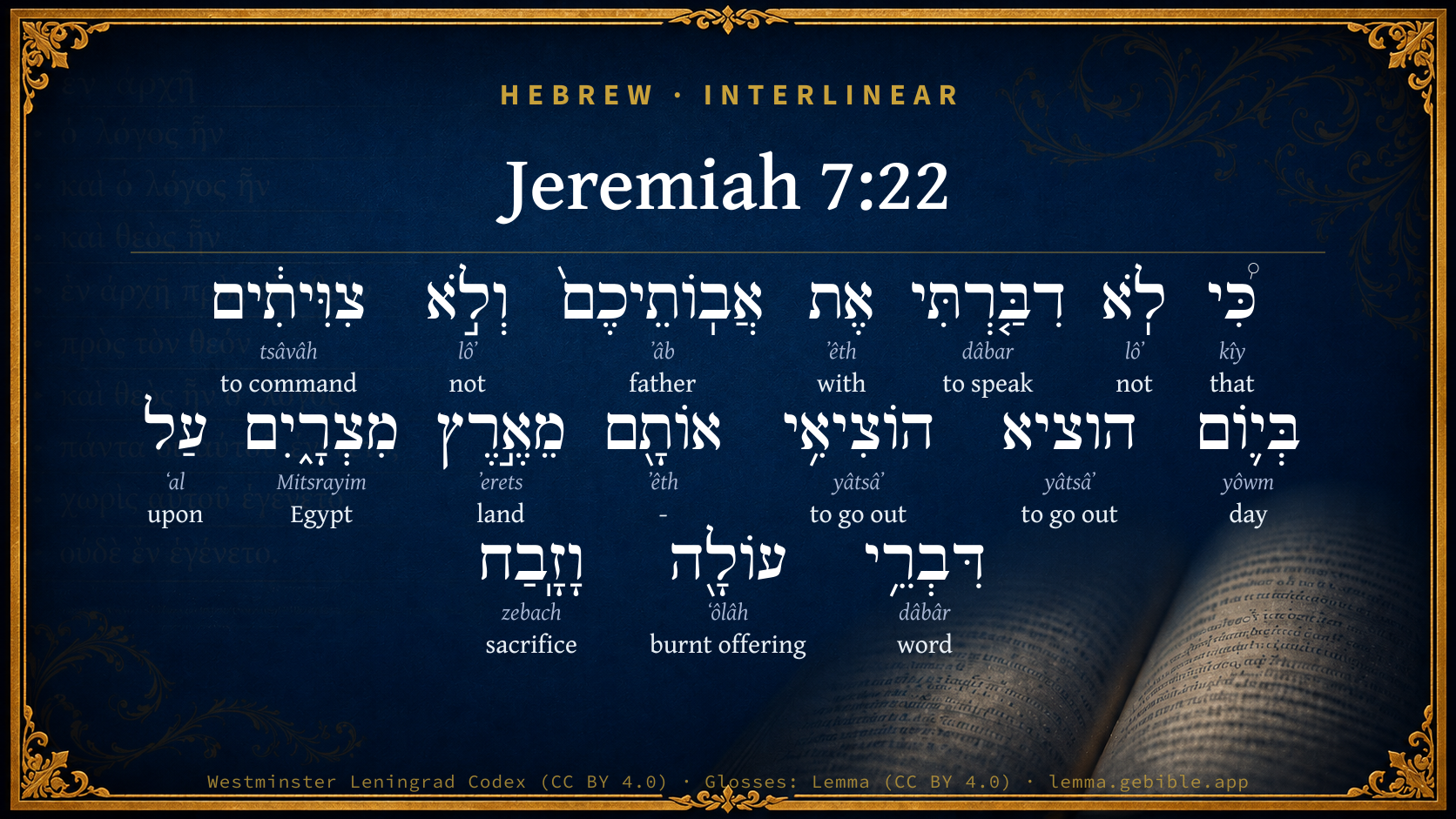
Hebrew (Westminster Leningrad Codex) Jeremiah 7:22 appears in the Hebrew Old Testament. The text above is from the Westminster Leningrad Codex. Each word links to its Strong’s number, a concise gloss, and parsing drawn from the Open Scriptures Hebrew Bible morphology. Click any word for its full Brown-Driver-Briggs (BDB) entry.
Download image
Cite this verse

Jeremiah 7:22 (World English Bible). Public Domain. Lemma interlinear Bible study tool, https://lemma.gebible.app/v/jeremiah/7/22.

Show BibTeX & RIS
BibTeX
RIS
English Translation
For I didn't speak to your fathers, nor command them in the day that I brought them out of the land of Egypt, concerning burnt offerings or sacrifices:
World English Bible · Public Domain
Download a study sheet

One document with this verse’s original text, its word-by-word gloss line, the meaning frame, cross-references with their text, attributed commentary, and full source and license credits — printable, and it pastes into notes with its structure intact.

This verse Autodidact and up

Study sheet (.html) Plain text (.txt)

A passage Seminary Student

Up to 50 verses in one chapter. A passage sheet keeps up to 6 commentary sources and 12 cross-references per verse, in the order this page ranks them, and says so on the sheet whenever that leaves anything out. Ask for a single verse and you get the Autodidact verse sheet above.

Everything on this page stays free to read, with no account — the sheet is a download of what is already on screen, not access to it.

Want to remove ads? Support Godless Engineer
Compare translations 3

The same verse in 3 English versions, stacked beneath the original-language interlinear above. Click any original word for its lexicon entry.

Each is an independent rendering of the whole verse — the interlinear is not word-aligned to these translations.

Highlighted words mark where these versions differ — a whole-verse word diff, not a word-by-word alignment.

  • World English Bible Public Domain
    For I didn't speak to your fathers, nor command them in the day that I brought them out of the land of Egypt, concerning burnt offerings or sacrifices:
  • King James Version Public Domain
    For I spake not unto your fathers, nor commanded them in the day that I brought them out of the land of Egypt, concerning burnt offerings or sacrifices:
  • unfoldingWord Literal Text CC BY-SA 4.0
    For I did not speak to your fathers nor did I command them on the day I brought them out from the land of Egypt concerning matters of burnt offering and sacrifice.

unfoldingWord Literal Text — © unfoldingWord, licensed CC BY-SA 4.0. Word-aligned USFM3 via Door43 (git.door43.org/unfoldingWord/en_ult).

Versions to compare (up to 4)

3 of 4 selected

Show all 18 translations

Every available English version of this verse, each an independent rendering of the whole verse.

  • World English Bible Public Domain
    For I didn't speak to your fathers, nor command them in the day that I brought them out of the land of Egypt, concerning burnt offerings or sacrifices:
  • Berean Standard Bible Public Domain
    For when I brought your fathers out of the land of Egypt, I did not merely command them about burnt offerings and sacrifices,
  • Majority Standard Bible Public Domain
    For when I brought your fathers out of the land of Egypt, I did not merely command them about burnt offerings and sacrifices,
  • King James Version Public Domain
    For I spake not unto your fathers, nor commanded them in the day that I brought them out of the land of Egypt, concerning burnt offerings or sacrifices:
  • American Standard Version (1901) Public Domain
    For I spake not unto your fathers, nor commanded them in the day that I brought them out of the land of Egypt, concerning burnt-offerings or sacrifices:
  • Revised Version (1885) Public Domain
    For I spake not unto your fathers, nor commanded them in the day that I brought them out of the land of Egypt, concerning burnt offerings or sacrifices:
  • Geneva Bible (1599) Public Domain
    For I spake not vnto your fathers, nor commanded them, when I brought them out of the land of Egypt, concerning burnt offrings and sacrifices.
  • Douay-Rheims (1899) Public Domain
    For I spoke not to your fathers, and I commanded them not, in the day that I brought them out of the land of Egypt, concerning the matter of burnt offerings and sacrifices.
  • Young's Literal Translation Public Domain
    For I did not speak with your fathers, Nor did I command them in the day of My bringing them out of the land of Egypt, Concerning the matters of burnt-offering and sacrifice,
  • Literal Standard Version CC BY-SA 4.0
    For I did not speak with your fathers, || Nor did I command them in the day of My bringing them out of the land of Egypt, || Concerning the matters of burnt-offering and sacrifice,
  • Unlocked Literal Bible CC BY-SA 4.0
    For when I brought your ancestors out from the land of Egypt, I did not require anything from them. I gave them no command about matters of burnt offerings and sacrifices.
  • unfoldingWord Literal Text CC BY-SA 4.0
    For I did not speak to your fathers nor did I command them on the day I brought them out from the land of Egypt concerning matters of burnt offering and sacrifice.
  • Darby Bible Public Domain
    For I spoke not unto your fathers, nor commanded them concerning burnt-offerings and sacrifices, in the day that I brought them out of the land of Egypt;
  • World Messianic Bible Public Domain
    For I didn’t speak to your fathers or command them in the day that I brought them out of the land of Egypt concerning burnt offerings or sacrifices;
  • Webster's Bible Public Domain
    For I spoke not to your fathers, nor commanded them in the day that I brought them out of the land of Egypt, concerning burnt-offerings or sacrifices:
  • Free Bible Version CC BY-SA 4.0
    When I led your forefathers out of Egypt I didn't just give them instructions about burnt offerings and sacrifices,
  • Bible in Basic English Public Domain
    For I said nothing to your fathers, and gave them no orders, on the day when I took them out of Egypt, about burned offerings or offerings of beasts:
  • JPS Tanakh (1917) Public Domain
    For I spoke not unto your fathers, nor commanded them in the day that I brought them out of the land of Egypt, concerning burnt-offerings or sacrifices;

Literal Standard Version (2020), Covenant Press — licensed CC BY-SA 4.0. Text via the HelloAO Bible API (eBible.org). Unlocked Literal Bible (unfoldingWord) — licensed CC BY-SA 4.0. Text via the HelloAO Bible API (eBible.org). unfoldingWord Literal Text — © unfoldingWord, licensed CC BY-SA 4.0. Word-aligned USFM3 via Door43 (git.door43.org/unfoldingWord/en_ult). Free Bible Version, Dr. Jonathan Gallagher — licensed CC BY-SA 4.0. Text via the HelloAO Bible API (eBible.org).

Word by word

More ways to search: Search by grammar → Find every occurrence → Compare this word →

Practice this passage: Drill this verse → Learn its vocabulary →

וָזָֽבַח
zebach
H2077
“and · sacrifice”
Conjunction + Noun, Common, Masculine, Singular, Absolute
Part of Speech
Conjunction + Noun
Type
Common
Gender
Masculine
Number
Singular
State
Absolute
Full BDB Definition

Origin: from H2076

TWOT: 525a

sacrifice - sacrifices of righteousness - sacrifices of strife - sacrifices to dead things - the covenant sacrifice - the passover - annual sacrifice - thank offering
  1. כִּ֠י kîy H3588 “that” Conjunction
  2. לֹֽא lôʼ H3808 “not” Particle, Negative
  3. דִבַּ֤רְתִּי dâbar H1696 “to speak” Verb, Piel, Perfect, 1st Person, Common, Singular
  4. אֶת ʼêth H854 “with” Preposition
  5. אֲבֽוֹתֵיכֶם֙ ʼâb H1 “fathers · your” Noun, Common, Masculine, Plural, Construct + Suffix, Personal, 2nd Person, Masculine, Plural
  6. וְלֹ֣א lôʼ H3808 “and · not” Conjunction + Particle, Negative
  7. צִוִּיתִ֔ים tsâvâh H6680 “to command · them” Verb, Piel, Perfect, 1st Person, Common, Singular + Suffix, Personal, 3rd Person, Masculine, Plural
  8. בְּי֛וֹם yôwm H3117 “in/at · day of” Preposition + Noun, Common, Masculine, Singular, Construct
  9. הוציא yâtsâʼ H3318 “to go out” Verb, Hiphil, Infinitive Construct
  10. הוֹצִיאִ֥י yâtsâʼ H3318 “to go out · me” Verb, Hiphil, Infinitive Construct + Suffix, Personal, 1st Person, Common, Singular
  11. אוֹתָ֖ם ʼêth H853 “- · them” Particle, Direct Object + Suffix, Personal, 3rd Person, Masculine, Plural
  12. מֵאֶ֣רֶץ ʼerets H776 “from · land of” Preposition + Noun, Common, Both, Singular, Construct
  13. מִצְרָ֑יִם Mitsrayim H4714 “Egypt” Noun, Proper
  14. עַל ʻal H5921 “upon” Preposition
  15. דִּבְרֵ֥י dâbâr H1697 “words of” Noun, Common, Masculine, Plural, Construct
  16. עוֹלָ֖ה ʻôlâh H5930 “burnt offering” Noun, Common, Feminine, Singular, Absolute

About this verse

These counts appear in no published source. They are computed here, from the morphology-tagged text and Lemma’s own curated glosses. What Lemma adds →

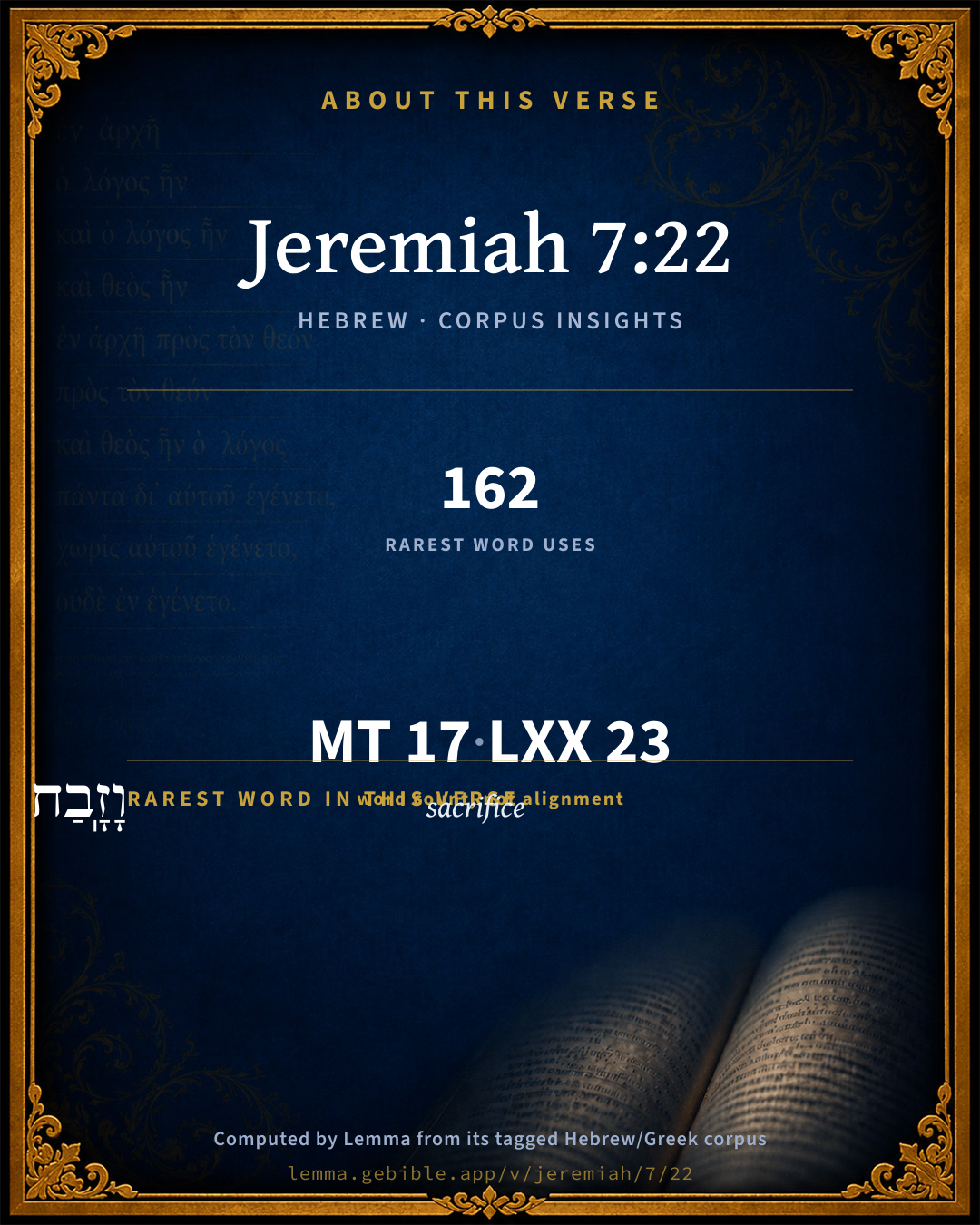
17
words
15
distinct lemmas
Prophets
section

Grammatical profile

  • 4 verbs
  • 7 nouns
  • 2 prepositions
  • 1 conjunction
  • 3 particles

Verb forms

  • דִבַּ֤רְתִּי Piel · Perfect
  • צִוִּיתִ֔ים Piel · Perfect
  • הוציא Hiphil · Infinitive Construct
  • הוֹצִיאִ֥י Hiphil · Infinitive Construct

Repetition

Words recur within this verse — often emphatic in Hebrew:

  • הוציא to go out H3318 ×2
  • לֹֽא not H3808 ×2

Hebrew & Septuagint length

In the original languages it is 17 Hebrew tokens and 23 Greek tokens — but the two are counted differently (Hebrew bundles its prefixes and suffixes into one token; the Greek is in lemma form), so that isn’t a like-for-like length.

Cross-references

7

Topical passages linked to Jeremiah 7:22 in the Treasury of Scripture Knowledge — connected by theme and wording, ordered by reader-vote popularity; previews shown in the World English Bible.

  • Hosea 6:6 For I desire mercy, and not sacrifice; And the knowledge of God more than burnt offerings.
  • 1 Samuel 15:22 Samuel said, Has Yahweh as great delight in burnt offerings and sacrifices, as in obeying the voice of Yahweh? Behold, to obey is better than sacrifice, and to listen than the fat of rams.
  • Psalms 51:16–17 For you don't delight in sacrifice, or else I would give it. You have no pleasure in burnt offering.
  • Matthew 9:13 But you go and learn what this means: 'I desire mercy, and not sacrifice,' for I came not to call the righteous, but sinners to repentance."
  • Psalms 40:6 Sacrifice and offering you didn't desire. You have opened my ears: Burnt offering and sin offering you have not required.
  • Psalms 50:8–17 I don't rebuke you for your sacrifices. Your burnt offerings are continually before me.
  • Mark 12:33 and to love him with all the heart, and with all the understanding, with all the soul, and with all the strength, and to love his neighbor as himself, is more important than all whole burnt offerings and sacrifices."

Cross-references courtesy of OpenBible.info (CC BY 4.0).

Hebrew and Greek witnesses Masoretic Hebrew ↔ Greek Septuagint

The same verse in the two great witnesses to the Old Testament, shown verse-for-verse.

These are two independent witnesses, not word-aligned to each other, and the Septuagint is shown in lemma (dictionary) form.

Hebrew Jeremiah 7:22 Masoretic · Westminster Leningrad Codex

כִּ֠י לֹֽא דִבַּ֤רְתִּי אֶת אֲבֽוֹתֵיכֶם֙ וְלֹ֣א צִוִּיתִ֔ים בְּי֛וֹם הוציא הוֹצִיאִ֥י אוֹתָ֖ם מֵאֶ֣רֶץ מִצְרָ֑יִם עַל דִּבְרֵ֥י עוֹלָ֖ה וָזָֽבַח

For I didn't speak to your fathers, nor command them in the day that I brought them out of the land of Egypt, concerning burnt offerings or sacrifices:

World English Bible · Public Domain

Greek LXX Structure differs

In the Septuagint, Jeremiah is about an eighth shorter than the Hebrew and arranges its material differently — the Oracles Against the Nations (Hebrew chapters 46–51) appear in the middle of the Greek book, after 25:13. Because the chapter and verse boundaries do not line up, a verse-for-verse comparison with the Hebrew is not shown.

A verse-for-verse comparison isn’t shown here because the chapters and verses don’t line up. Switch to the LXX edition with the MT / LXX toggle above to read the Greek directly.

On this verse, Haydock's Catholic Bible Commentary discusses the Septuagint’s reading. Read the note in Commentary ↓

Hebrew: Westminster Leningrad Codex (CC BY 4.0). Greek: Septuagint (public domain); English from a public-domain English Septuagint. How the Septuagint differs from the Hebrew →

Targum (Aramaic paraphrase)

1

The Targum is the ancient Jewish Aramaic paraphrase of the Hebrew Scriptures — an interpretive translation, not the Hebrew text itself. Onkelos (literal) and Pseudo-Jonathan (expansive) render the Torah, and Jonathan the Prophets. Coverage is partial: where no permissively-licensed English translation exists for a verse, only the Aramaic is shown. This is verse-level text, not a word-by-word alignment to the Hebrew.

  1. Targum Jonathan Prophets (Joshua–Malachi)
    אֲרֵי לָא מַלְלִית עִם אֲבָהַתְכוֹן וְלָא פַּקֵדְתִּינוּן בְּיוֹמָא דְאַפְקֵית יַתְהוֹן מֵאַרְעָא דְמִצְרַיִם עַל עִסְקֵי עַלְוָן וְנִכְסַת קוּדְשִׁין:

    (no public-domain English translation for this verse)

    Targum Jonathan — Aramaic: “Mikraot Gedolot” (public domain). English: “Sefaria Community Translation” (CC0 1.0 (public-domain dedication)); “London "Chaldee Paraphrase," 1871” (public domain). Text via Sefaria.

Commentary

Notes on Jeremiah 7:22 from classic Christian and Jewish commentators (each source and its license shown beneath its notes). The classic Christian expositions comment on the surrounding passage and are grouped to its opening verse, so a note may address several verses; the Jewish commentaries on the Tanakh (Rashi and others) are per-verse, so they appear only where the commentator wrote on this verse.

Lemma curates 59 commentaries, every one of them public domain or Creative Commons licensed, each selected and text-cleaned for this edition rather than reprinted as found. About our sources →

Trapp's Complete Commentary

John Trapp

Jer 7:22 For I spake not unto your fathers, nor commanded them in the day that I brought them out of the land of Egypt, concerning burnt offerings or sacrifices:

Ver. 22. For I spake not unto your fathers.] Videlicet solum aut simpliciter. Only clearly and candidly I gave them not those holy rites as the substance of my service, or that ye should thus hold them up against my threats for your rebellions, as a buckler of defence. Sacrifices without obedience nec placent nec placant Deum. neither may they please nor placate God.

John Trapp, A Commentary or Exposition upon All the Books of the Old and New Testament (1647–1656) — public domain. Text from a community e-Sword module.

Geneva Bible (1599)

Geneva Bible translators

Showing that it was not his chief purpose and intent, that they should offer sacrifices: but that they should regard, wherefore they were ordained: to wit, to be joined to the word as seals and confirmations of remissions of sins in Christ: for without the word they were vain and unprofitable.

Geneva Bible (1599) marginal notes — public domain. Text via Bolls.life.

Jamieson, Fausset & Brown

Robert Jamieson, A. R. Fausset & David Brown

Not contradicting the divine obligation of the legal sacrifices. But, "I did not require sacrifices, unless combined with moral obedience" (Psa 50:8; Psa 51:16-17). The superior claim of the moral above the positive precepts of the law was marked by the ten commandments having been delivered first, and by the two tables of stone being deposited alone in the ark (Deu 5:6). The negative in Hebrew often supplies the want of the comparative: not excluding the thing denied, but only implying the prior claim of the thing set in opposition to it (Hos 6:6). "I will have mercy, and not sacrifice" (Sa1 15:22). Love to God is the supreme end, external observances only means towards that end. "The mere sacrifice was not so much what I commanded, as the sincere submission to My will gives to the sacrifice all its virtue" [MAGEE, Atonement, Note 57].

Jamieson, Fausset & Brown — Commentary Critical and Explanatory on the Whole Bible (1871) — public domain (CC PDM 1.0). Text via the HelloAO Bible API.

John Calvin's Commentaries

The Prophet therefore adds, I spoke not to your fathers, nor commanded them, in the day I brought them forth from the land of Egypt, concerning sacrifices or burnt — offerings: but this only I commanded them, to hear my voice, and to walk in all the way which I commanded them. Jeremiah seems to have condemned sacrifices too much; for we know they were designed for certain purposes: they were intended to promote penitence; for when an animal was killed at the altar, all were reminded that they were guilty of death, which the animals underwent instead of men. Hence God did thereby represent to the Jews, as in a mirror, the dreadful judgment they deserved; and the sacrifices were also living images of Christ; they were sure pledges of that expiation through which men are reconciled to God. Jeremiah then seems here to speak too contemptibly of sacrifices; for they were seals of God’s grace, and had been instituted to lead men to repentance. But he speaks according to the ideas of those who had strangely vitiated the worship of God; for the Jews were sedulously attentive to sacrifices, and yet neglected the main things — faith and repentance. Hence the Prophet here repudiates sacrifices, because these false worshippers of God had adulterated them; for they were only intent on external rites, and overlooked their design, and even despised it.

We know that it was God’s will from the beginning to be worshipped in a spiritual manner; and he has not changed his nature in our day. As then at this day he approves of no other than a spiritual worship, as He is a Spirit, (John 4:24) so also under the Law he was to be worshipped with a sincere heart. Absurdly then did the Jews offer their sacrifices, as though they could thereby appease God: and this is the reason why the prophets inveighed so pointedly against sacrifices. God says that he nauseated them, that he was wearied with them, that his name was thereby polluted, (Isaiah 1:14) he says also, that to sacrifice was the same as though one killed a dog, an unclean animal, and as though one killed a man. (Isaiah 66:3.)

“What are your offerings and sacrifices to me.”

he says by Amos. Such declarations occur everywhere in the Prophets; we are told that sacrifices were not only of no account before God, but that they were filthy things which he abominated; that is, when the things signified were separated from the signs. This then is the reason why Jeremiah here wholly rejects sacrifices: he complains that God’s worship was violated and profaned; and it was so, because the Jews presented to God mere shadows instead of realities.

But still he seems to have exceeded due limits; as he says of God, that he gave no command respecting sacrifices: for before the law was published, God had ordered sacrifices to be offered to him; as, for instance, the passover; for the pascal lamb, as it is well known, was a sacrifice; and he had also spoken of sacrifices before the people were liberated. Moreover, after the law was given, a priesthood was established among the people, as Moses clearly shews. Further still, we see with what care regulations have been given as to sacrifices. Why then is it here said, that he spoke nothing respecting sacrifices? Even because God regards not sacrifices in themselves. He therefore makes a distinction between external signs and spiritual worship; for the Jews, as it has been already said, had by their corruptions so subverted what God had instituted, that he would not acknowledge what they did as having been commanded by him. And if we take the words as they are, they are wholly true, — that God had commanded nothing respecting mere sacrifices, or sacrifices for their own sake. This distinction solves every difficulty; that is, that God never delighted in sacrifices themselves, that it was never his will to be served with mere external rites, that burnt — offerings, victims, incense, and things of this kind, were of themselves regarded by him of no value. Since, then, sacrifices did not please God, except on account of the end designed, it remains a clear truth, that God commanded nothing respecting sacrifices: for his design only was to remind the Jews of their sin, and also to shew to them the way of reconciliation. We hence see that God had not from the beginning required mere sacrifices, for he required them for a certain end. It is the same as though we should say at this day, that God regards not fasting. We yet know that fasting is commended to us, but not on account of itself. We now understand the meaning of the Prophet.

Now, this passage contains a very useful doctrine, and which ought the more to be observed by us, as the neglect of it introduces dreadful darkness. They under the Papacy think that God is duly and in the best manner worshipped, when they accumulate many pompous exhibitions of ceremonies; nor can they be persuaded that all this is altogether frivolous. How so? Because they think of God according to their own fancies and disposition. And yet all the Papal ceremonies are the inventions of men: for they derive no authority either from the Law or from the Gospel. And since God has so severely reprobated ceremonies, which yet he had appointed for a purpose which was overlooked, what can be thought at this day of the foolish inventions of men, when there is the some impiety in the people as was formerly in the Jews? For when the Papists perform their trumperies, when the monks and the sacrificing priests fill the churches with their noises, when they practice their childish mummeries, and when they delight themselves with music and incense, they think that God is satisfied, however full of obscenities and filthiness their whole life may be: they are hardened in that false confidence, by which the Jews were inebriated. We ought, therefore, with special care, to notice this doctrine, — that God so approves of spiritual worship, that he esteems all other things as nothing; that is, when unconnected with sincerity of heart.

John Calvin's Commentaries (1540-1563) — public domain. Text from the Calvin Translation Society English edition (1840s-50s) via the Christian Classics Ethereal Library (ccel.org). Calvin's coverage is partial (roughly two-thirds of the Bible); uncommented books and verses are honest gaps, never fabricated. The 19th-century editor's footnotes and remarks are omitted so the notes are faithfully Calvin's own voice.

Ellicott's Commentary for English Readers

(22) I spake not . . . concerning burnt offerings or sacrifices.—“Concerning” is, literally, for, or with a view to, the matter of sacrifices. The words seem at first hard to reconcile with the multiplied rules as to sacrifices both in Exodus and Leviticus. They are, however, rightly understood, strictly in harmony with the facts. They were not the end contemplated. The first promulgation of the Law, the basis of the covenant with Israel, contemplated a spiritual, ethical religion, of which the basis was found in the ten great Words, or commandments, of Exodus 20. The ritual in connection with sacrifice was prescribed partly as a concession to the feeling which showed itself, in its evil form, in the worship of the golden calf, partly as an education. The book of Deuteronomy, representing the higher truth from which Moses started (Exo_19:5), and upon which he at last fell back, bore its witness to the original purport of the Law (Deu_6:3; Deu_10:12). Its re-discovery under Josiah left, here as elsewhere, its impress on the mind of Jeremiah; but prophets, as in 1Sa_15:22; Hos_6:6; Hos_8:11-13; Amo_5:21-27; Mic_6:6-8; Psalms 50, 51, had all along borne a like witness, even while recognising to the full the fact and the importance of a sacrificial ritual.

A Bible Commentary for English Readers, edited by Charles John Ellicott (1878–1897) — public domain. Text from a community e-Sword module.

The Cambridge Bible for Schools and Colleges

gen. ed. J. J. S. Perowne

22. The passage is of the highest importance in its bearing on the epochs at which the different parts of the Pentateuch were severally composed. It is now held to be made up from elements of very diverse dates. Careful examination has shewn that in Jeremiah’s day the “Priestly Code” (P) which emphasizes and elaborates the sacrificial ritual had not been added to the earlier constituents (J and E). It is true indeed that those earlier constituents are not devoid of reference to sacrifice (see Exo_23:14-19), nor is Deut. either (e.g. Jer_12:5 ff., Jer_16:1 ff.), but (in Peake’s words) “there is a very marked difference between the attitude of the earlier Codes and the Priestly Legislation. In the latter the ritual system is of very high importance, and sacrifice fills a prominent place, in the former sacrifice holds a relatively insignificant position.” See further on Jer_8:8 as to Jeremiah’s view.

In general it may be said that obedience to the moral law always ranked first (cp. Jer_11:4), and sacrifices were, as is here taught, wholly worthless when offered by the immoral. Moreover, the “outward ceremonial of sacrifice is discounted, in view of the danger of dependence on it” (Buchanan Blake, How to read the Prophets, Part I. p. 222). For the relation between prophecy and the ritual law, see further in C. B. Introd. to the Pentateuch, pp. 174–181. The Jews (it may be added) read in their services this portion of the prophets as the Haph tarah (2nd Lesson) in connexion with Leviticus 6-8. (as 1st Lesson), thus supporting the view that sacrifices are but secondary. Cp. for the sentiment of the Jeremiah 7 :1Sa_15:22; Isa_1:11 ff.; Hos_6:6; Amo_5:22 ff.; Mic_6:6 ff.

in the day] i.e. at the period of their history.

The Cambridge Bible for Schools and Colleges (gen. ed. J. J. S. Perowne; Cambridge University Press, 1878–1918) — public domain. Text from a community e-Sword module.

John Gill's Exposition

For I spake not unto your fathers,.... Meaning not Abraham, Isaac, and Jacob, but Moses, Aaron, and others, who were living at the time of the bringing of the children of Israel out of Egypt, as appears by what follows:

nor commanded them in the day that I brought them out of the land of Egypt, concerning burnt offerings, or sacrifices; these are not in the decalogue or ten commands; these are no part of that law or covenant, but are an appendage or addition to it; and though they are of early institution and use, yet they never were appointed for the sake of themselves, but for another end; they were types of Christ, and were designed to lead the faith of the people of God to him; they never were intended as proper expiations of sin, and much less to cover and encourage immorality; whenever therefore they were offered up in a hypocritical manner, and without faith in Christ, and in order to atone for sinful actions, without any regard to the sacrifice of Christ, they were an abomination to the Lord. These were not the only things the Lord commanded the children of Israel; nor the chief and principal ones; and in comparison of others, of more consequence and moment, were as none at all; and which are next mentioned.

John Gill's Exposition of the Whole Bible (1746–1763) — public domain (CC PDM 1.0). Text via the HelloAO Bible API.

Haydock's Catholic Bible Commentary

I commanded them not: viz., such sacrifices as the Jews at this time offered without obedience; which was the thing principally commanded: so that in comparison with it, the offering of the holocausts and sacrifices was of small account. (Challoner) --- The observance of the decalogue would suffice. Victims were to teach internal piety, Leviticus i. (Worthington) --- God "brought them out of Egypt, not for the sake of their sacrifices, but that they might....hear his word." (St. Irenæus, [Against Heresies] iv. 17.) --- This was the principal design. See Matthew ix. 13., and Osee vi. 6., and 1 Corinthians i. 17. (Maldonat) (Menochius) (Calmet) --- The rules for sacrifices were given after the adoration of the calf, as necessary preservatives against idolatry. (St. Thomas Aquinas, [Summa Theologiae] i. 2. q. 102. a. 3.) --- Yet the paschal lamb, &c., had been already commanded. (Calmet) --- Many such absolute expressions imply a condition or comparison. (Gloss.) (Proverbs viii. 10.) --- I brought. Several manuscripts read thus more accurately than the Hebrew, "He brought," (Kennicott) which Protestants abandon, (Haydock) though the present reading may stand. (Chappel.) (Crat.) --- Every variation should be noticed, as this and the former verse "seem greatly corrupted; perhaps the Syriac version will be the best guide to their true meaning." (Kennicott) --- Yet the passage is sufficiently intelligible in the Vulgate and Septuagint.

George Leo Haydock (1774–1849), Haydock's Catholic Family Bible and Commentary, 1859 edition — public domain. Excludes Psalms (Douay-Rheims chapter numbering differs from Protestant) and Deuterocanonical books (Catholic canon only).

Matthew Poole's English Annotations

Some would argue from hence that sacrifices were at first an invention of men, as papists and Socinians; and because they should not be used to idols, God gave way for the introducing them into his worship; but it is evident in Scripture that they have been of Divine institution ever since Adam, Gen 4:3,4. As to the meaning of the words, God doth not condemn them, or deny them, save only comparatively in respect of obedience, not so much these as obeying his commands, 1Sa 15:22; Hos 6:6, i.e. mercy rather than sacrifice. Negatives are often put for comparatives, Gen 45:8; Exo 16:8; Joh 5:45. Hence the Hebrew is, the matter of burnt-offerings; for sacrifices were not instituted for themselves, but for other uses, and to be signs of faith in his promises, and obedience to his commands, as in the next verse, where the condition, promise, and end are all set down.

Matthew Poole's English Annotations on the Holy Bible (1683–1685) — public domain. Text from a community e-Sword/MySword module.

Whedon's Commentary on the Bible

Daniel D. Whedon

22. For I spake not — The evidence which some have found in this passage of the late origin of the ceremonial portions of the Pentateuch, is of no value whatever: the many allusions in this book and the earlier prophetical books to the ceremonial law refute that idea. The prophet speaks not absolutely, but relatively; relatively, as to time and importance. God spake not so early, nor so emphatically, as to sacrifices, as he did respecting obedience to his spiritual law.

Daniel D. Whedon (gen. ed.), Commentary on the Old and New Testaments (1874–1909) — public domain. Text from a community e-Sword module.

The Pulpit Commentary

I spake not unto your fathers, etc. An important and much-disputed passage, from which Graf, Colenso, and Kuenen derive one of their chief subsidiary arguments for the post-Exile date of the Levitical legislation. The prophet here appears to deny in tote that Jehovah at Mount Sinai had given any injunctions on the subject of sacrifice. But the prophet must at any rate be consistent with himself; he cannot utter anything by Divine command which is fundamentally at variance with other equally authoritative declarations. Do the statements of Jeremiah elsewhere justify us in accepting the words in their literal, superficial meaning? There are three other passages which have a claim to be considered. In Jer_17:26 the prophet draws a picture of the happy condition in which the Jews might be, were they only obedient. One of the features of this picture is that the Jews would still bring all the various kinds of sacrifices to the house of Jehovah. In Jer_31:14 a similar description is closed with the promise to "satiate the soul of the priests with fatness," implying that there would be a great abundance of thank offerings in regenerate Israel. In Jer_33:11, among other blessings of the future, the prophet mentions the praiseful exclamations of those who would bring the sacrifice of thanksgiving. These passages do not contain any statement respecting the origin of the sacrificial system; but they do expressly assert that Jehovah contemplates that system with pleasure, and apparently that he designs it to be permanent among his people Israel. Let us now turn to Jer_33:17-24. Here the prophet, in the Name of Jehovah, declares that there is a Divine covenant "with the Levites, the priests," who shall never "want a man before me... to do sacrifice continually." A covenant with the priests implies a covenant with the people, the priests being the representatives of the people. This passage, therefore, is more distinct than those previously quoted; it does appear to maintain that the range of the Sinaitic covenant included the duties of the priesthood, i.e. sacrifices. On the other hand, it should be observed that the genuineness of this latter passage is not beyond dispute, the whole section in which it occurs (Jer_33:14-26) being omitted in the Septuagint. We have now to inquire, Is there a real discrepancy between the words of Jeremiah (strictly speaking, of Jehovah) in the verse now before us, interpreted literally, and the passages adduced above? Are they more inconsistent than such an utterance as Jer_6:20 (first half of verse), which appears to deny the utility of sacrifices altogether? If the latter may be explained as a forcible oratorical exaggeration, why not also the present passage? Jeremiah sees the people attaching a pernicious importance to the opus operatum of sacrifice. On one occasion he tells them that Jehovah cares not for sacrifices; he means, as the context shows, the sacrifices of men without spiritual sensibilities. On another, that Jehovah never commanded their fathers to sacrifice; he means (may we not presume?) the mere outward forms of the ritual, divorced from the sentiment and practice of piety, which, as Hosea tells us, (Hos_6:6) Jehovah "delights in and not equivalent to "more than sacrifice." There is, therefore, no fundamental inconsistency between the passage before us and the three passages first quoted, and if so there can be no real discrepancy with the last-mentioned passage, for the priests (as was remarked) perform their functions on behalf of the people, and the permanence of Jehovah"s covenant with the priests depended on the spiritual life of the people they represented (read Jeremiah 33, as a whole). This view seems less arbitrary than that of Ewald, who thinks that the sacrifices spoken of in our passage are merely the free-will offerings of the rich; and than that of Dahler, who interprets, "My chief care was not to prescribe rules for holocausts and sacrifices, but this is what I commanded thee above all," viz. moral obedience. According to it, the prophet"s denial is not absolute, but relative relative, that is, to the notion of sacrifices entertained by the Jews whom he addresses. Of course, Graf"s view, that the denial is absolute, will equally well suit the context. The people were surprised at Jeremiah"s objurgations, because they thought they had fulfilled the claims of the covenant. Jeremiah"s purpose is equally well fulfilled whether his denial is qualified or unqualified, absolute or relative. Our object has been to separate the exegesis of our passage from a still doubtful controversy, and to offer a tenable view of it, based upon grounds purely internal to Jeremiah. It may be suggested, however, to the student of Leviticus, that even if the Levitical legislation in its present form were proved to be of a pest-Exile date, it would still be doubtful whether any believing temple-worshipper could help assuming that Jehovah had, from the first existence of the nation, given his direct sanction to the offering of sacrifices. If so, it is comparatively unimportant (except with regard to the progressive revelation of the strictness of the law of truth) whether the Levitical code was given to Moses at Mount Sinai in its present form or not.

The Pulpit Commentary (1880–1919), ed. H.D.M. Spence-Jones & Joseph S. Exell — public domain. Text from a community e-Sword module.

John Wesley's Explanatory Notes

For - God doth not condemn these offerings, save only comparatively in respect of obedience, not so much these, as obeying his commands.

John Wesley, Explanatory Notes Upon the Whole Bible (1754–1765) — public domain. Text via the GEBible commentary corpus.

Scofield Reference Notes

C. I. Scofield

nor commanded

Cf. (See Scofield "Exo 20:4"), note 2, the threefold giving of the law. The command concerning burnt-offerings and sacrifices was not given to the people till they had broken the decalogue, the law of obedience.

The Scofield Reference Bible (1917 edition), notes by C. I. Scofield — public domain. Text from a community e-Sword module.

Rashi

Rabbi Shlomo Yitzchaki (Rashi)

on the day I brought them forth The beginning of the condition was only (Exodus 19:5): “If you hearken to My voice and keep My covenant, you shall be a peculiar treasure to Me.”

Rashi on the Tanakh — English translations: “The Judaica Press complete Tanach with Rashi, translated by A. J. Rosenberg” (CC BY 4.0); “Pentateuch with Rashi's commentary by M. Rosenbaum and A.M. Silbermann, 1929-1934” (public domain); “The Metsudah Tanach series, Lakewood, N.J” (CC BY 4.0); and “The Book of Joshua, Metsudah Publications, 1997” (CC BY 4.0). Text via Sefaria.

Lesson kit

Teaching starters — assembled from the data on this page, not authored interpretation. Every prompt links to the verse data it draws on. Edit before teaching.

Jeremiah, in the Prophets, opens this verse with 17 words (15 distinct Hebrew lemmas). Its most distinctive word is zebach (“sacrifice”). A historical commentator’s framing appears above. Read the whole chapter for the surrounding context.

Discussion questions

  1. How does “sacrifice” (zebach) shape what this verse is saying?
  2. Hosea 6:6 shares this passage’s theme. How do the two illuminate each other?
  3. “to go out” occurs 2× in this one verse. What is the effect of the repetition?
  4. These translations render this verse differently. What is at stake in choosing one wording over another?
  5. The verb «דִבַּ֤רְתִּי» is Piel Perfect. How does its form color the action?
  6. Reading how Trapp's Complete Commentary and Geneva Bible (1599) read this verse, where do the two commentators agree and where do they part?

Things to notice

Reading settings

Reading text

Shown beneath each verse's original-language words.

Old Testament
Old Testament edition

Read the OT as the Masoretic Hebrew (MT) or the Greek Septuagint (LXX).

English shown for the Greek Septuagint (in the Hebrew ↔ Greek comparison).

Comparing translations? Open the Compare panel on any verse page to stack up to four side by side.