
Isaiah 19:23

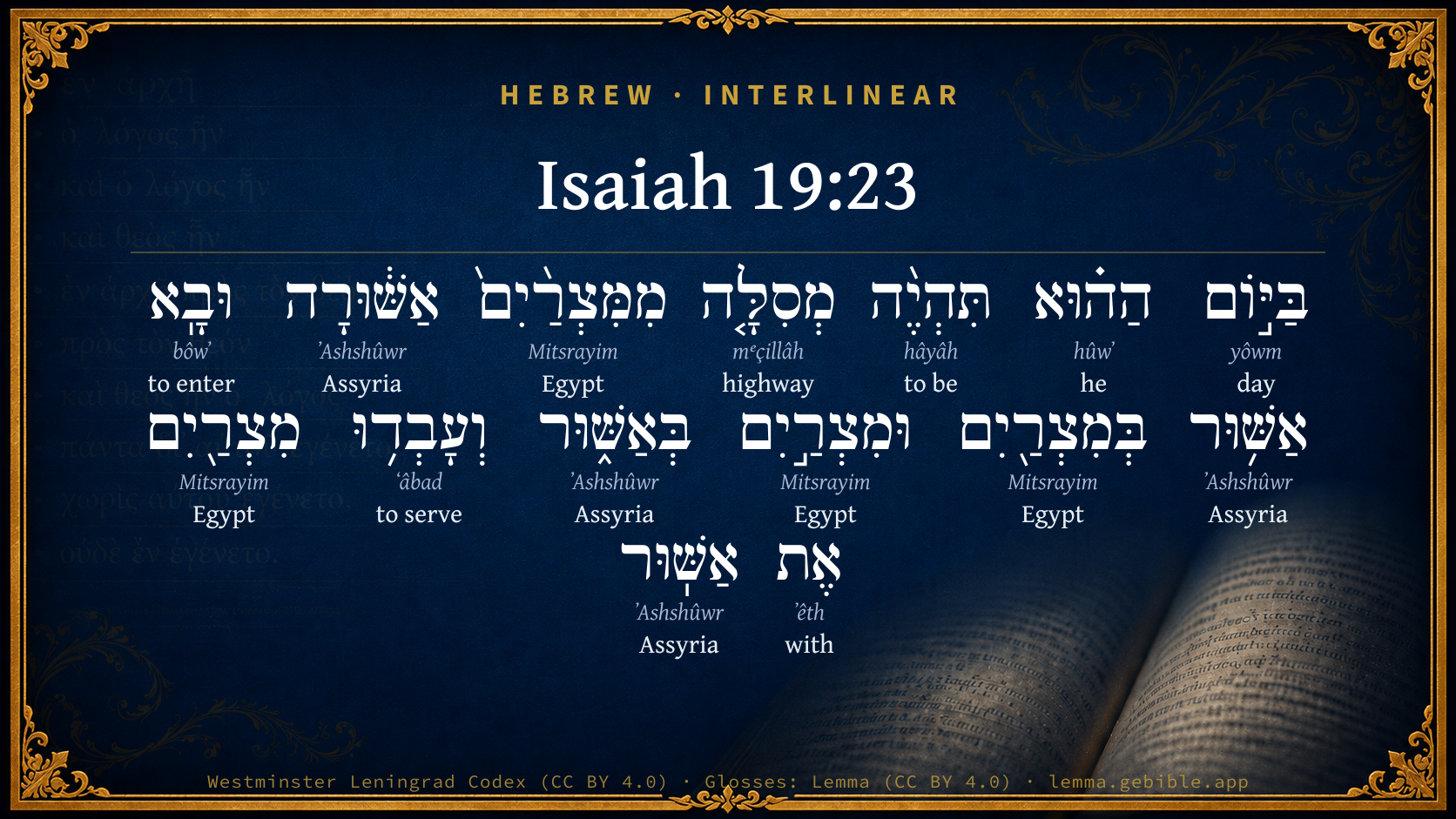
Hebrew (Westminster Leningrad Codex) Isaiah 19:23 appears in the Hebrew Old Testament. The text above is from the Westminster Leningrad Codex. Each word links to its Strong’s number, a concise gloss, and parsing drawn from the Open Scriptures Hebrew Bible morphology. Click any word for its full Brown-Driver-Briggs (BDB) entry.
Download image
Cite this verse

Isaiah 19:23 (World English Bible). Public Domain. Lemma interlinear Bible study tool, https://lemma.gebible.app/v/isaiah/19/23.

Show BibTeX & RIS
BibTeX
RIS
English Translation
In that day shall there be a highway out of Egypt to Assyria, and the Assyrian shall come into Egypt, and the Egyptian into Assyria; and the Egyptians shall worship with the Assyrians.
World English Bible · Public Domain
Download a study sheet

One document with this verse’s original text, its word-by-word gloss line, the meaning frame, cross-references with their text, attributed commentary, and full source and license credits — printable, and it pastes into notes with its structure intact.

This verse Autodidact and up

Study sheet (.html) Plain text (.txt)

A passage Seminary Student

Up to 50 verses in one chapter. A passage sheet keeps up to 6 commentary sources and 12 cross-references per verse, in the order this page ranks them, and says so on the sheet whenever that leaves anything out. Ask for a single verse and you get the Autodidact verse sheet above.

Everything on this page stays free to read, with no account — the sheet is a download of what is already on screen, not access to it.

Want to remove ads? Support Godless Engineer
Compare translations 3

The same verse in 3 English versions, stacked beneath the original-language interlinear above. Click any original word for its lexicon entry.

Each is an independent rendering of the whole verse — the interlinear is not word-aligned to these translations.

Highlighted words mark where these versions differ — a whole-verse word diff, not a word-by-word alignment.

  • World English Bible Public Domain
    In that day shall there be a highway out of Egypt to Assyria, and the Assyrian shall come into Egypt, and the Egyptian into Assyria; and the Egyptians shall worship with the Assyrians.
  • King James Version Public Domain
    In that day shall there be a highway out of Egypt to Assyria, and the Assyrian shall come into Egypt, and the Egyptian into Assyria, and the Egyptians shall serve with the Assyrians.
  • unfoldingWord Literal Text CC BY-SA 4.0
    In that day a highway will be from Egypt to Assyria, and Assyria will come into Egypt and Egypt into Assyria, and Egypt will serve with Assyria.

unfoldingWord Literal Text — © unfoldingWord, licensed CC BY-SA 4.0. Word-aligned USFM3 via Door43 (git.door43.org/unfoldingWord/en_ult).

Versions to compare (up to 4)

3 of 4 selected

Show all 18 translations

Every available English version of this verse, each an independent rendering of the whole verse.

  • World English Bible Public Domain
    In that day shall there be a highway out of Egypt to Assyria, and the Assyrian shall come into Egypt, and the Egyptian into Assyria; and the Egyptians shall worship with the Assyrians.
  • Berean Standard Bible Public Domain
    In that day there will be a highway from Egypt to Assyria. The Assyrians will go to Egypt, and the Egyptians to Assyria. The Egyptians and Assyrians will worship together.
  • Majority Standard Bible Public Domain
    In that day there will be a highway from Egypt to Assyria. The Assyrians will go to Egypt, and the Egyptians to Assyria. The Egyptians and Assyrians will worship together.
  • King James Version Public Domain
    In that day shall there be a highway out of Egypt to Assyria, and the Assyrian shall come into Egypt, and the Egyptian into Assyria, and the Egyptians shall serve with the Assyrians.
  • American Standard Version (1901) Public Domain
    In that day shall there be a highway out of Egypt to Assyria, and the Assyrian shall come into Egypt, and the Egyptian into Assyria; and the Egyptians shall worship with the Assyrians.
  • Revised Version (1885) Public Domain
    In that day shall there be a highway out of Egypt to Assyria, and the Assyrian shall come into Egypt, and the Egyptian into Assyria; and the Egyptians shall worship with the Assyrians.
  • Geneva Bible (1599) Public Domain
    In that day shall there be a path from Egypt to Asshur, and Asshur shall come into Egypt, and Egypt into Asshur: so the Egyptians shall worship with Asshur.
  • Douay-Rheims (1899) Public Domain
    In that day there shall be a way from Egypt to the Assyrians, and the Assyrian shall enter into Egypt, and the Egyptian to the Assyrians, and the Egyptians shall serve the Assyrian.
  • Young's Literal Translation Public Domain
    In that day is a highway out of Egypt to Asshur, And come in have the Assyrians to Egypt, And the Egyptians into Asshur, And the Egyptians have served with the Assyrians.
  • Literal Standard Version CC BY-SA 4.0
    In that day a highway is out of Egypt to Asshur, || And the Assyrians have come into Egypt, || And the Egyptians into Asshur, || And the Egyptians have served with the Assyrians.
  • Unlocked Literal Bible CC BY-SA 4.0
    In that day there will be a highway from Egypt to Assyria, and the Assyrian will come to Egypt, and the Egyptian to Assyria; and the Egyptians will worship with the Assyrians.
  • unfoldingWord Literal Text CC BY-SA 4.0
    In that day a highway will be from Egypt to Assyria, and Assyria will come into Egypt and Egypt into Assyria, and Egypt will serve with Assyria.
  • Darby Bible Public Domain
    In that day shall there be a highway out of Egypt to Assyria; and the Assyrian shall come into Egypt, and the Egyptian into Assyria; and Egypt shall serve with Assyria.
  • World Messianic Bible Public Domain
    In that day there will be a highway out of Egypt to Assyria, and the Assyrian shall come into Egypt, and the Egyptian into Assyria; and the Egyptians will worship with the Assyrians.
  • Webster's Bible Public Domain
    In that day shall there be a highway from Egypt to Assyria, and the Assyrian shall come into Egypt, and the Egyptian into Assyria, and the Egyptians shall serve with the Assyrians.
  • Free Bible Version CC BY-SA 4.0
    At that time there will be a highway from Egypt to Assyria. The Assyrians will go to Egypt, and the Egyptians will go to Assyria. The Egyptians and Assyrians will worship together.
  • Bible in Basic English Public Domain
    In that day there will be a highway out of Egypt to Assyria, and Assyria will come into Egypt, and Egypt will come into Assyria; and the Egyptians will give worship to the Lord together with the Assyrians.
  • JPS Tanakh (1917) Public Domain
    In that day shall there be a highway out of Egypt to Assyria, and the Assyrian shall come into Egypt, and the Egyptian into Assyria; and the Egyptians shall worship with the Assyrians.

Literal Standard Version (2020), Covenant Press — licensed CC BY-SA 4.0. Text via the HelloAO Bible API (eBible.org). Unlocked Literal Bible (unfoldingWord) — licensed CC BY-SA 4.0. Text via the HelloAO Bible API (eBible.org). unfoldingWord Literal Text — © unfoldingWord, licensed CC BY-SA 4.0. Word-aligned USFM3 via Door43 (git.door43.org/unfoldingWord/en_ult). Free Bible Version, Dr. Jonathan Gallagher — licensed CC BY-SA 4.0. Text via the HelloAO Bible API (eBible.org).

Word by word

More ways to search: Search by grammar → Find every occurrence → Compare this word →

Practice this passage: Drill this verse → Learn its vocabulary →

מְסִלָּ֤ה
mᵉçillâh
H4546
“highway”
Noun, Common, Feminine, Singular, Absolute
Part of Speech
Noun
Type
Common
Gender
Feminine
Number
Singular
State
Absolute
Full BDB Definition

Origin: from H5549

TWOT: 1506d

highway, raised way, public road
  1. בַּיּ֣וֹם yôwm H3117 “in/at the · day” Preposition, Determined + Noun, Common, Masculine, Singular, Absolute
  2. הַה֗וּא hûwʼ H1931 “the · he” Particle, Definite Article + Pronoun, Personal, 3rd Person, Masculine, Singular
  3. תִּהְיֶ֨ה hâyâh H1961 “to be” Verb, Qal, Imperfect, 3rd Person, Feminine, Singular
  4. מִמִּצְרַ֨יִם֙ Mitsrayim H4714 “from · Egypt” Preposition + Noun, Proper
  5. אַשּׁ֔וּרָה ʼAshshûwr H804 “Assyria · toward” Noun, Proper + Suffix, Demonstrative
  6. וּבָֽא bôwʼ H935 “and · to enter” Conjunction + Verb, Qal, Sequential Perfect, 3rd Person, Masculine, Singular
  7. אַשּׁ֥וּר ʼAshshûwr H804 “Assyria” Noun, Proper
  8. בְּמִצְרַ֖יִם Mitsrayim H4714 “in/at · Egypt” Preposition + Noun, Proper
  9. וּמִצְרַ֣יִם Mitsrayim H4714 “and · Egypt” Conjunction + Noun, Proper
  10. בְּאַשּׁ֑וּר ʼAshshûwr H804 “in/at · Assyria” Preposition + Noun, Proper
  11. וְעָבְד֥וּ ʻâbad H5647 “and · to serve” Conjunction + Verb, Qal, Sequential Perfect, 3rd Person, Common, Plural
  12. מִצְרַ֖יִם Mitsrayim H4714 “Egypt” Noun, Proper
  13. אֶת ʼêth H854 “with” Preposition
  14. אַשּֽׁוּר ʼAshshûwr H804 “Assyria” Noun, Proper

About this verse

These counts appear in no published source. They are computed here, from the morphology-tagged text and Lemma’s own curated glosses. What Lemma adds →

15
words
9
distinct lemmas
Prophets
section

Shared distinctive vocabulary

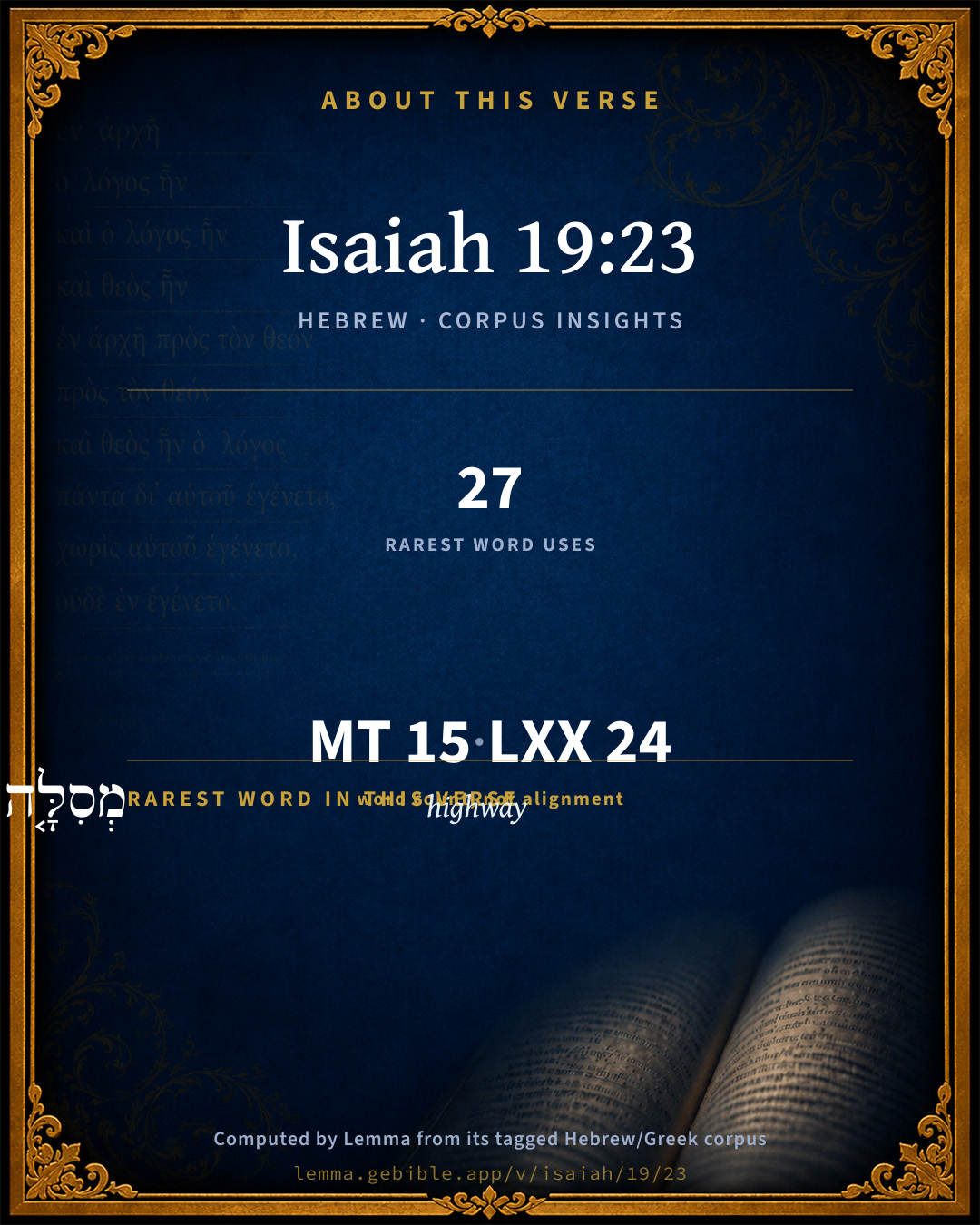
מְסִלָּ֤ה highway H4546 occurs in 26 verses of the Hebrew Bible. Also found in:

Grammatical profile

  • 3 verbs
  • 10 nouns
  • 1 pronoun
  • 1 preposition

Verb forms

  • תִּהְיֶ֨ה Qal · Imperfect
  • וּבָֽא Qal · Sequential Perfect
  • וְעָבְד֥וּ Qal · Sequential Perfect

Repetition

Words recur within this verse — often emphatic in Hebrew:

  • מִמִּצְרַ֨יִם֙ Egypt H4714 ×4
  • אַשּׁ֔וּרָה Assyria H804 ×4

Hebrew & Septuagint length

In English translation the verse runs 33 words from the Hebrew and 35 from the Septuagint (LXX English) — closely comparable.

A rough comparison of the two English renderings, which tokenize alike — not a word-level alignment.

Word counts can differ between the Hebrew and the Greek without any difference in meaning — e.g. the Hebrew direct-object marker אֵת has no separate Greek word, and Greek often adds the article ὁ.

In the original languages it is 15 Hebrew tokens and 24 Greek tokens — but the two are counted differently (Hebrew bundles its prefixes and suffixes into one token; the Greek is in lemma form), so that isn’t a like-for-like length.

Cross-references

6

Topical passages linked to Isaiah 19:23 in the Treasury of Scripture Knowledge — connected by theme and wording, ordered by reader-vote popularity; previews shown in the World English Bible.

  • Isaiah 11:16 There shall be a highway for the remnant of his people, who shall remain, from Assyria; like as there was for Israel in the day that he came up out of the land of Egypt.
  • Isaiah 27:13 It shall happen in that day, that a great trumpet shall be blown; and they shall come who were ready to perish in the land of Assyria, and those who were outcasts in the land of Egypt; and they shall worship Yahweh in the holy mountain at Jerusalem.
  • Isaiah 35:8–10 A highway shall be there, and a way, and it shall be called The way of holiness. The unclean shall not pass over it, but is shall be for for him who walks in the Way. Wicked fools will not go there.
  • Isaiah 40:3–5 The voice of one who cries, Prepare you in the wilderness the way of Yahweh; make level in the desert a highway for our God.
  • Ephesians 2:18–22 For through him we both have our access in one Spirit to the Father.
  • Ephesians 3:6–8 that the Gentiles are fellow heirs, and fellow members of the body, and fellow partakers of his promise in Christ Jesus through the Gospel,

Cross-references courtesy of OpenBible.info (CC BY 4.0).

Hebrew and Greek witnesses Masoretic Hebrew ↔ Greek Septuagint

The same verse in the two great witnesses to the Old Testament, shown verse-for-verse.

These are two independent witnesses, not word-aligned to each other, and the Septuagint is shown in lemma (dictionary) form.

Hebrew Isaiah 19:23 Masoretic · Westminster Leningrad Codex

בַּיּ֣וֹם הַה֗וּא תִּהְיֶ֨ה מְסִלָּ֤ה מִמִּצְרַ֨יִם֙ אַשּׁ֔וּרָה וּבָֽא אַשּׁ֥וּר בְּמִצְרַ֖יִם וּמִצְרַ֣יִם בְּאַשּׁ֑וּר וְעָבְד֥וּ מִצְרַ֖יִם אֶת אַשּֽׁוּר

In that day shall there be a highway out of Egypt to Assyria, and the Assyrian shall come into Egypt, and the Egyptian into Assyria; and the Egyptians shall worship with the Assyrians.

World English Bible · Public Domain

Greek LXX Isaiah 19:23 Septuagint · lemma form

ὁ ἡμέρα ἐκεῖνος εἰμί ὁδός αἴγυπτος πρός ἀσσύριος καί εἰςἔρχομαι ἀσσύριος εἰς αἴγυπτος καί αἰγύπτιος πορεύομαι πρός ἀσσύριος καί δουλεύω ὁ αἰγύπτιος ὁ ἀσσύριος

In that day there shall be a way from Egypt to the Assyrians, and the Assyrians shall enter into Egypt, and the Egyptians shall go to the Assyrians, and the Egyptians shall serve the Assyrians.

LXX2012 (modern English Septuagint) · Public Domain

Hebrew: Westminster Leningrad Codex (CC BY 4.0). Greek: Septuagint (public domain); English from LXX2012 (modern English Septuagint) (Public Domain). How the Septuagint differs from the Hebrew →

Targum (Aramaic paraphrase)

1

The Targum is the ancient Jewish Aramaic paraphrase of the Hebrew Scriptures — an interpretive translation, not the Hebrew text itself. Onkelos (literal) and Pseudo-Jonathan (expansive) render the Torah, and Jonathan the Prophets. Coverage is partial: where no permissively-licensed English translation exists for a verse, only the Aramaic is shown. This is verse-level text, not a word-by-word alignment to the Hebrew.

  1. Targum Jonathan Prophets (Joshua–Malachi)
    בְּעִדָנָא הַהִיא תְּהֵי אוֹרַח כְבִישָׁא מִמִצְרַיִם לְאַתּוּר וִינוּחוּן אֲתּוּרָאֵי לְמִצְרָאֵי וּמִצְרָאֵי בְּאַתּוּרָאֵי וְיִפְלְחוּן מִצְרָאֵי יַת אַתּוּרָאֵי:

    And at that time there shall be a highway from Egypt to Assyria; and the Assyrians shall fight against the Egyptians, and the Egyptians against the Assyrians, and the Egyptians shall serve the Assyrians.

    Targum Jonathan — Aramaic: “Mikraot Gedolot” (public domain). English: “Sefaria Community Translation” (CC0 1.0 (public-domain dedication)); “London "Chaldee Paraphrase," 1871” (public domain). Text via Sefaria.

Commentary

Notes on Isaiah 19:23 from classic Christian and Jewish commentators (each source and its license shown beneath its notes). The classic Christian expositions comment on the surrounding passage and are grouped to its opening verse, so a note may address several verses; the Jewish commentaries on the Tanakh (Rashi and others) are per-verse, so they appear only where the commentator wrote on this verse.

Lemma curates 59 commentaries, every one of them public domain or Creative Commons licensed, each selected and text-cleaned for this edition rather than reprinted as found. About our sources →

Trapp's Complete Commentary

John Trapp

Isa 19:23 In that day shall there be a highway out of Egypt to Assyria, and the Assyrian shall come into Egypt, and the Egyptian into Assyria, and the Egyptians shall serve with the Assyrians.

Ver. 23. In that day there shall be an highway, &c.] All hostility shall cease, and a blessed unanimity be settled among Christ’s subjects of several nations; hereunto way was made by the Roman empire, reducing both these great countries into provinces.

And the Egyptians shall serve.] Serve the Lord "with one shoulder." {as Zep 3:9}

John Trapp, A Commentary or Exposition upon All the Books of the Old and New Testament (1647–1656) — public domain. Text from a community e-Sword module.

The Biblical Illustrator

Joseph S. Exell

Isa_19:23-25

In that day shall Israel be the third with Egypt and with Assyria

Israel, Egypt, and Assyria

Israel is no longer alone Gods people, Gods creation, Gods inheritance, but Egypt and Assyria are each a third sharer with Israel.

In order to express this, Israels three names of honour are mixed together, and each of three peoples receives one of the precious names, of which inheritance is assigned to Israel as pointing back to the beginning of its history. This essential equalisation of the heathen peoples with Israel is no degradation to the latter; for although henceforth there exists no essential distinction of the peoples in their relation to God, it is nevertheless always Israels God who attains recognition, and Israel is the people which, according to the promise, has become the medium of blessing to the earth. (F. Delitzsch.)

The significance of the prophecy

These nations represent to the prophet the heathen world which was eventually to be incorporated in the kingdom of God. The prediction can never be realised for those nations, because they have ceased to exist; but it will yet be realised in that great peace of the world, which is the hope of all the nations of mankind. (C. A. Briggs, D. D.)

A forecast of the triumph of Christianity

Never had the faith of the prophet soared so high or approached so near to the conception of a universal religion. (Prof. Robertson Smith.)

The holy triple alliance

The two great powers which have hitherto met only as foes are to meet in the worship of Jehovah. And in consequence of this there is to be fellowship between them. And this is brought about by the little central state. Israel has reached the grand end of its calling; it becomes a blessing to the whole circuit of the earth. It is a grand prophecy destined to find its full accomplishment in the latter days.

I. IT IS GODS PURPOSE TO PERFECT THE RACE THROUGH INTERNATIONAL INTERCOURSE AND FRIENDSHIP. Chronic national antagonism is not Heavens design. Neither is the design of God respecting the various peoples that they should dwell in a state of isolation. The Divine purpose is manifestly that the several nations shall complete each other through sympathy and reciprocity.

1. Geography indicates this. The good things of nature are not all found in any one land; reciprocity is designed and necessitated by the very dispositions of soil and climate.

2. Ethnology also gives a reason for national sympathy and intercourse. No one national type includes all perfections. The nations need one another. History shows us the solidarity of the race and how wonderfully any one people is enriched by the contributions of the rest. Take our own nation. In our gardens are the flowers and fruits of all climates. In a thousand ways our neighbours have contributed to make us what we are. The Italians and French taught us silk weaving. The Flemings taught us our fine woollen trade. The Venetians showed us how to make glass. A German erected our first paper mill. A Dutchman began our potteries. The Genoese taught us to build ships. And so history reveals that through successive generations the several nations have enriched each other in art, industry, literature, jurisprudence, language, philosophy, government, and religion. The thought of God is the brotherhood of man, and all things prove it.

II. THE GOSPEL OF CHRIST IS THE SUPREME UNIFYING POWER OF THE RACE. In the fulness of its meaning this is what our text signifies. The lesson here for us is that the marriage of nations will take place where other marriages are celebrated--at the altar of God. In other words, the unifying power of the race is the highest religious faith--the faith of our Lord Jesus Christ.

1. Some suppose that the ameliorative reconciling influence will be found in commerce. But there are malign influences which defeat the benign influences of trade.

2. Others think that the principle of unity will be found in the cultivation of cosmopolitan literature. The influence of great literature is pacifying, but it must also be remembered that such literature feeds patriotism, which is a peril.

3. Many build great hopes on science. Science reveals the unity of nature, but it teaches also that all nature is full of strife, and civilisation itself is built on antagonism. It is only as a great faith changes the spirit of man that discords will resolve themselves into harmonies.

III. GOD HAS IN A VERY SPECIAL MEASURE COMMITTED UNTO US THE VERY EDIFYING GOSPEL OF OUR LORD JESUS CHRIST. To a large extent England in this age occupies the position that Israel occupied of old--it is our special calling to bring all nations to the obedience of the faith. As Palestine came between Egypt and Assyria so this island comes in a wonderful manner between the Old World and the New. God gave spiritual gifts in a remarkable degree to Israel, and God has given us richly the treasure of His Gospel. God has also given to us special powers for the diffusion of the Gospel. (W. L. Watkinson.)

The missionary religion

This was the glorious vision of the statesman prophet, a new world arising out of the confusions and struggles of the old, a redeemed humanity, of which these now extinct peoples are the symbol, united by the benediction of God.

I. WE MUST NOT READ INTO THESE WORDS ANY COMPROMISE WITH THE RELIGION OF EGYPT AND ASSYRIA. He did not mean that the faith of Israel was the third with the faiths of the Nile and the Euphrates. Perhaps the most insidious foe of the missionary spirit is the suggestion that Christianity is only one among many religions and rival creeds. It is contradicted by all the facts of Scripture and of human experience. The study of comparative religion so far from blinding us to the gleams of truth and the broken lights of heathenism, enables us to feel more deeply how faint and broken they are. The stars are invisible to us in the glory of the noon. Yet if we descend into some deep pit we lose the daylight and we see the stars. So in all ages some elect souls, sunk in the deep and horrible pit of heathenism, have seen shining far above them the pure, peaceful stars of God. Their faint light has not been enough to live by, not enough for guidance or hope, only enough to reach the remoteness of heaven and God, enough for aspiration and to keep alive the great questions of human existence and destiny. Some of our modern teachers have gone down into the deep pit, and they have forgotten that they themselves are the children of the day. We solemnly deny that any religion is suited to any people, either East or West, which cannot give cleansing to the conscience, or power to the will, or peace to the heart, which is silent where it should speak most clearly, which can cast no light beyond the grave, which does not honour womanhood and protect childhood. Heathenism is man seeking God. The Gospel is God coming down to seek man. In its essence the Gospel is unchangeable, yet there is much in our religion which is capable of adaptation to the conditions, tastes, and temperaments of different races.

II. We see in our text THE WIPING OUT OF NATIONAL PREJUDICES AND RACIAL ANIMOSITIES IN A COMMON SALVATION. Egypt was the ancient foe and oppressor of Israel. The pages of Isaiah are full of warnings against the broken reed of Egypt. The prophet saw the gathering storm and knew that Assyria should scatter the nation and destroy the city and the temple. Yet he spoke of both as resting with Israel under the blessing of God. But, more than that, the known world of Isaiahs day was bounded on the west by Egypt and on the east by Assyria. They stand for the world, because they were then the confines of the world. Six centuries later the world of St. Paul was larger still Our world is the whole world, but it has not outgrown the love or the promise or the duty. This larger outlook rests upon three chief grounds.

1. The brotherhood of man.

2. All the great redemptive facts are toy humanity.

3. The purposes of God are for mankind.

III. It only remains to ask whether this promise of a redeemed humanity is only a dream, and a glowing but unsubstantial vision, or IS IT A DIVINE REALITY? If it rested upon an obscure word in an ancient prophecy we might fear to press it. But it is the burden of Scripture. It was the vision of Christ as He rejoiced in spirit and cried, And if I be lifted up I will draw all men unto Me. But it is the method of God to use human instruments. He accepts the tribute of His peoples love, and He makes the wrath of man to praise Him. (J. H. Shakespeare, M. A.)

Gods purposes worked out

1. God intends that each single nation of the earth shall make the most of itself for the good of all other nations.

2. God is ruling over all the nations, and is working out His great and glorious purposes through them. (D. Gregg, LL. D.)

Gods converting grace

These are mysterious words, which certainly have not been fulfilled. There was a partial fulfilment of them on the day of Pentecost, when we learn that Medea, Parthians, Elamites, together with dwellers in Mesopotamia, joined with those of Egypt, Libya, Cyrene, and Judea, in acknowledging the power of the exalted Saviour, and the mighty baptism of the Holy Spirit. But just beyond the veil which hides the immediate future, we are doubtless destined to see greater things than these. In any case, we may take the prophets words as illustrating the truth, that none are beyond the pale of Divine mercy; that God can change persecutors into apostles, and that the elements that make men bad will, beneath converting grace, be the constituents of strong and holy lives. God rejoices to take those who have been strong in the service of Satan, and make them lowly and devoted servants of the Cross. (F. B. Meyer, B. A.)

Isaiahs wide outlook and cosmopolitan sympathies

We shall never do the Jewish religion justice till we pay attention to what its greatest prophets thought of the outside world, how they sympathised with this, and in what way they proposed to make it subject to their own faith.

1. There is something in the very manner of Isaiahs treatment of foreign nations which causes the old charges of exclusiveness to sink in our throats. Isaiah treats these foreigners at least as men. Take his prophecies on Egypt or on Tyre or on Babylon--nations which were the hereditary enemies of his nation--and you find him speaking of their natural misfortunes, their social decays, their national follies and disasters, with the same pity and with the same purely moral considerations, with which he has treated his own land. When news of those far away sorrows comes to Jerusalem, it moves this large-hearted prophet to mourning and tears. He breathes out to distant lands elegies as beautiful as he has poured upon Jerusalem. He shows as intelligent an interest in their social evolutions as he does in those of the Jewish State. He gives a picture of the industry and politics of Egypt as careful as his pictures of the fashions and statecraft of Judah. In short, as you read his prophecies upon foreign nations, you perceive that before the eyes of this man humanity, broken and scattered in his days as it was, rose up one great whole, every part of which was subject to the same laws of righteousness, and deserved from the prophet of God the same love and pity. To some few tribes he says decisively that they shall certainly be wiped out, but even them he does not address in contempt or in hatred. The large empire of Egypt, the great commercial power of Tyre, he speaks of in language of respect and admiration; but that does not prevent him from putting the plain issue to them which he put to his own countrymen: If you are unrighteous, intemperate, impure--lying diplomats and dishonest rulers, you shall certainly perish before Assyria. If you are righteous, temperate, pure, if you do trust in truth and God, nothing can move you.

2. But he who thus treated all nations with the same strict measures of justice and the same fulness of pity with which he treated his own, was surely not far from extending to the world the religious privileges which he so frequently identified with Jerusalem. In his old age, at least, Isaiah looked forward to the time when the particular religious opportunities of the Jew should be the inheritance of humanity. (Prof. G. A. Smith, D. D.)

The dominating influence of national righteousness

The moral is this: When the leading nation of the world is true to God and His principles, knowing no compromise and no hesitation; when it lives these principles, incorporates them into its laws and institutions, builds them into the code by which it governs its international relations, makes them part of its foreign policy, and, so far as it has it in its power, insists upon other nations honouring them and administering their affairs by them kit is always sure to win the day, and to rule as a mighty influence among all the nations of the world, and to lift them up toward the level of its own high civilisation. (D. Gregg, LL. D.)

A transformed world

No one who has seen the lovely Bay of Naples can ever forget it. The magnificent stretch of waters, the twenty or thirty miles of memorable coast that girdle it, the vast city with its painted palaces, its domes and spires, Vesuvius with nodding plume of fire and vapour, and over all the sky blue as Aarons mantle. Now, geologists tell us that that lovely bay is really the crater of an extinct volcano. In primitive ages it was a vast and awful abyss of flame and fury, but the fires died down, the lava ceased to flow, the smoke rolled away, the glorious sea overflowed the crater, and now the lovely waters sleep and dream, reflecting the lights and colours of the sky. This world, for ages, has been a veritable mouth of hell. But its fires are slackening, its wrath abates, its darkness is less dense, its desolations and miseries come to a perpetual end, and truth and justice, mercy and kindness, are covering it as the great deep profound. (W. L. Watkinson.)

One Gospel for all

Gods Gospel is made not for Englishmen, but for all men. Many think the Gospel is a very beautiful thing--if you would only keep it at home; but the moment you try to apply it to anybody else, it will not suit them. Try it upon the negro; he is too low. Try it upon the Hindoo; he is too high. Each of these must have a religion of his own; one would not suit them all. The rice that forms a suitable food for the natives of hot climates is not suitable for the bleak north. The food that is suitable for the north, the clothing and house suitable for the north, are not suitable for the tropics, and so with religion. A man looked into the eye of an Anglo-Saxon, says William Arthur, and found it blue, and into the eye of a negro and found it black, and he said, These are different organisations; you are not so bewildered as to think you can enlighten both these eyes with the same sun. You must have a sun for each of them; you must have different suns, you see, because the eyes are differently organised. Very well, that is exceedingly fine in theory, but try it--try whether the sun which God put in the heaven will not illuminate the pale eye of the northerner and the dark eye of the southerner. (Sunday School Chronicle.)

The universal language

When Haydn was prevailed upon to visit England for the first time, Mozart said to him, You have no training for the great world, and you speak too few languages. Haydn replied, My language is understood by all the world. The power of the name of Jesus is, however, more universal in its appeal than the power of great music. (Sunday School Chronicle.)

.

The Biblical Illustrator, edited by Joseph S. Exell (c. 1880s–1900s) — public domain. Text from a community e-Sword module.

Joseph Benson's Commentary

Isa 19:23-25. In that day, &c. — Here the prophet proceeds to show the effect of this benefit of divine grace toward the Egyptians, namely, their spiritual alliance with the Assyrians and Israelites, with a great abundance of the divine blessings. There shall be a highway out of Egypt to Assyria — A happy correspondence and intercourse settled. And the Assyrian shall come into Egypt, &c. — They who were implacable enemies one to another, and both to the church of God, shall now be reconciled and united together in the service of God, and love to his church. In that day shall Israel be the third — The third party in that sacred league, whereby all of them oblige themselves to serve God. With Egypt and with Assyria — These are named, because they were the most obstinate enemies to God’s church, but they are here put for all the Gentiles. Even a blessing — That is, Israel shall be a blessing. This is peculiar to Israel, who is not only a third party, but is the most eminent of the three, as being the fountain by which the blessing is conveyed to the other two; because Christ was to be born of them, and the gospel-church and ordinances were first established among them, and from them derived to the Gentiles. In the midst of the land — Or, of those lands, namely, Egypt and Assyria, between which Israel lay: or, in the midst of the earth, as כקרב הארצ, more properly means: which may be added, to imply that God’s blessing should be conveyed from and by Israel, not only to the Egyptians and Assyrians, but to all the nations of the earth, in the midst of which the land of Israel might well be said to be. Whom the Lord of hosts shall bless — That is, which people, Israel, Egypt, and Assyria; of whom he speaks as of one people, because they were all to be united into one church. Blessed be Egypt my people — This title, and those which follow, that were peculiar to the people of Israel, should now be given to these and all other nations.

Joseph Benson's Commentary on the Old and New Testaments (1811–1818) — public domain. Text from a community e-Sword module.

Tyndale Open Study Notes

Tyndale Open Resources

19:23 Traditionally, Egypt and Assyria were enemies of one another and of Israel. They were idolatrous to the core, but they would leave behind their enmity and their idols to worship the true God. • In the rugged terrain of the ancient Near East, a highway provided a means for safe, easy travel and trade (see 11:16; 35:8; 40:3; 62:10).

Tyndale Open Study Notes — © Tyndale Open Resources, licensed CC BY-SA 4.0. Text via the HelloAO Bible API.

Geneva Bible (1599)

Geneva Bible translators

By these two nations, which were then chief enemies of the Church, he showeth that the Gentiles and the Jews should be joined together in one faith and religion, and should be all one fold under Christ their shepherd.

Geneva Bible (1599) marginal notes — public domain. Text via Bolls.life.

Jamieson, Fausset & Brown

Robert Jamieson, A. R. Fausset & David Brown

highway--free communication, resting on the highest basis, the common faith of both (Isa 19:18; Isa 11:16). Assyria and Egypt were joined under Alexander as parts of his empire: Jews and proselytes from both met at the feasts of Jerusalem. A type of gospel times to come.

serve with--serve Jehovah with the Assyrians. So "serve" is used absolutely (Job 36:11).

Jamieson, Fausset & Brown — Commentary Critical and Explanatory on the Whole Bible (1871) — public domain (CC PDM 1.0). Text via the HelloAO Bible API.

Adam Clarke's Commentary

Verse 23. Shall there be a highway] Under the latter kings of Persia, and under Alexander, Egypt, Judea, and Assyria lived peaceably under the same government, and were on such friendly terms that there was a regular, uninterrupted intercourse between them, so that the Assyrian came into Egypt and the Egyptian into Assyria, and Israel became the third, i.e., was in strict union with the other two; and was a blessing to both, as affording them some knowledge of the true God, Isa 19:24.

Adam Clarke's Commentary on the Bible (1810–1826) — public domain. Text from a community e-Sword/MySword module.

Ellicott's Commentary for English Readers

(23) In that day shall there be a highway out of Egypt to Assyria.—The prophet’s horizon at once brightens and expands. Palestine was in his time the battle-field of the two great empires. The armies of one of the great powers crossed it both before and after, as in the case of Shishak, Zerah, Tirhakah, Necho, Sargon, Sennacherib, Nebuchadnezzar, on their march against the other. The prophet looks forward to a time when the long-standing discord should cease (Assyria, or the power which succeeded her, gaining for a time the suzerainty), and both should be joined with Israel, as in “a three-fold cord, not easily broken.” Like other bright ideals of the future, it yet waits for its complete fulfilment. The nearest historical approximation to it is, perhaps, found in the Persian monarchy, including, as it did, the territory of Assyria, of Israel, and of Egypt, and acknowledging, through the proclamations of Cyrus, Jehovah as the God of heaven (Ezr_1:2). May we connect this prediction with Isaiah’s distinctly defined anticipation of the part which Persia was to play in the drama of the world’s history as an iconoclastic and monotheistic power, and so with the dominant idea of Isaiah 40-66?

A Bible Commentary for English Readers, edited by Charles John Ellicott (1878–1897) — public domain. Text from a community e-Sword module.

The Cambridge Bible for Schools and Colleges

gen. ed. J. J. S. Perowne

23. a highway] leading of course through Palestine. The ancient enmity between the two empires is laid aside in consequence of their common acceptance of the religion of Jehovah. Egypt shall serve (Jehovah) with Assyria.

23–25. The incorporation of Egypt and Assyria in the kingdom of God. On the hypothesis that the prophecy is post-exilic “Assyria” will here denote the power to whom the reversion of the ancient Assyrian Empire had fallen. See on ch. Isa_11:11.

The Cambridge Bible for Schools and Colleges (gen. ed. J. J. S. Perowne; Cambridge University Press, 1878–1918) — public domain. Text from a community e-Sword module.

John Gill's Exposition

In that day shall there be a highway out of Egypt to Assyria,.... It signifies that there should be peace between them, all hostilities should cease, free trade and commerce with each other should be opened, and nothing should hinder communion with one another; which some think had some show of accomplishment in the times of Psammiticus; but it chiefly refers to Gospel times, and to the Christian communion between one nation and another, that receive the Gospel, though before implacable enemies, as the Egyptians and Assyrians were:

and the Assyrian shall come into Egypt, and the Egyptian into Assyria: which is expressive of entire concord and harmony between them, such as was among the first Christians:

and the Egyptians shall serve with the Assyrians; that is, the Lord, as Kimchi and Ben Melech interpret it; they shall both serve the Lord with one shoulder and consent, unite in prayer to the Lord, in hearing the word, and attending on other ordinances. Some render it, "the Egyptians shall serve the Assyrians" (g); not as being their lords and masters in a servile way, but by love, as saints do or should serve one another, doing all kind offices of love to each other; see Gal 5:13.

(g) "et serviet Aegyptius Assyrio", Cocceius; "et servient Aegyptii ipsi Assur", Montanus.

John Gill's Exposition of the Whole Bible (1746–1763) — public domain (CC PDM 1.0). Text via the HelloAO Bible API.

Albert Barnes' Notes on the Bible

There shall be a highway - A communication; that is, there shall be an alliance between Egypt and Assyria, as constituting parts of one empire, and as united in the service of the true God. The same figure of a “highway” is found in Isa 11:16 (see the note on that place). The truth was, that Alexander, by his conquests, subjected Assyria and Egypt, and they constituted parts of his empire, and were united under him. It was true, also, that there were large numbers of Jews in both these countries, and that they were united in the service of the true God. They worshipped him in those countries; and they met at Jerusalem at the great feasts, and thus Judah, Assyria, and Egypt, were united in his worship.

And the Assyrian shall come into Egypt - There shall be free and uninterrupted contact between the two nations, as parts of the same empire.

And the Egyptians shall serve with the Assyrians - In the same armies; under the same leader. This was the case under Alexander the Great. Or the word ‘serve’ may mean that they would serve God unitedly. So Lowth and Noyes render it.

Albert Barnes' Notes on the Bible (1834–1885) — public domain. Text from a community e-Sword/MySword module.

Matthew Poole's English Annotations

The Assyrian shall come into Egypt, and the Egyptian into Assyria; they who were implacable enemies one to another, and both to the church and people of God, shall now be reconciled and united together in the service of God, and love to his church.

Shall serve, to wit, the Lord, who is easily understood from Isa 19:21,25.

Matthew Poole's English Annotations on the Holy Bible (1683–1685) — public domain. Text from a community e-Sword/MySword module.

Whedon's Commentary on the Bible

Daniel D. Whedon

23. A highway out of Egypt — In like manner with “Egypt,” Assyria is to be humbled. Both these great powers are to go down, and the trampling upon Judah by their great armies is to cease. Peace between them is simply the work of divine chastisement causing both, in some degree, to acknowledge Jehovah as the mightiest ruler of the earth.

Daniel D. Whedon (gen. ed.), Commentary on the Old and New Testaments (1874–1909) — public domain. Text from a community e-Sword module.

The Pulpit Commentary

Vers. 23-25. UNION BETWEEN EGYPT, ASSYRIA, AND ISRAEL. Assyria"s conversion to God will follow or accompany that of Egypt. The two will be joined with Israel in an intimate connection, Israel acting as the intermediary. There will be uninterrupted communication, common worship, and the common blessing of God extending over the three.

Shall there be a highway. The phraseology resembles that of Isa_11:16; but the purpose is different. Then the "highway" was to facilitate the return of the Israelites to their own land. Now the object is perfectly free communication between the three peoples. The Egyptians shall serve with the Assyrians. "Shall serve" means "shall worship" (see ver. 21). The "Assyrians" represent the inhabitants of the Mesopotamian regions generally. As, from the time of Alexander, Hebrew influence extended itself largely over Egypt, so, even from an earlier date, it began to be felt in the Mesopotamian countries. The transplantation of the ten tribes, or a considerable portion of them, into Upper Mesopotamia and Media, was the commencement of a diffusion of Hebrew ideas through those regions. The captivity of Judah still further impressed these ideas on the native races. Great numbers of Jews did not return from the Captivity, but remained in the countries and cities to which they had been trans ported, particularly in Babylon (Josephus, "Ant. Jud:," 11:1). The policy of the Seleucid princes was to establish Jewish colonies in all their great cities. In the time between Alexander and the birth of our Lord, the Hebrew community was re cognized as composed of three great sections the Palestinian, the Egyptian, and the Syro-Babylonian. Constant communication was maintained between the three branches. Ecclesiastical regulations, framed at Jerusalem, were transmitted to Alexandria and Babylon, while collections made in all parts of Egypt and Mesopotamia for the temple service were annually carried to the Palestinian capital by trusty persons. It is thus quite reasonable to regard as an "initial stage in the fulfillment of this prophecy" the state of things existing at this period (Kay). The more complete fulfillment was doubtless after Pentecost, when Christianity was preached and established in Egypt and Libya on the one hand, in Parthia, and Media, and Elam, and Mesopotamia on the other. (Act_2:9, Act_2:10)

Vers. 23, 24. Unity in religion joins together the bitterest foes.

As, ultimately, the establishment of the kingdom of Christ among all the nations of the earth (Isa_2:2) will produce a reign of universal peace, so that men will everywhere "beat their swords into ploughshares, and their spears into pruning-hooks", (Isa_2:4) so, on a lesser scale, wherever true religion prevails, asperities are softened, old enmities die out and disappear, a friendly spirit springs up, and former adversaries are reconciled and become friends. Assyria, Egypt, Israel, long the bitterest foes, were drawn together by a common faith in the later days of Judaism and the earlier ones of Christianity felt sympathy one with another, and lived in harmony. The Papacy was an attempt to bring all the Roman communion into a species of political unity, to abolish wars between its various members, and unite it against heathendom. This attempt had, however, only a partial success, owing to the admixture of bad with good motives in those who were at the head of the movement and had the direction of it. That war has not yet ceased among all Christian nations is a slur upon Christianity, and an indication that nations are still Christian in name rather than in spirit. The league of Assyria, Egypt, Israel, may well be held up to the modern Christian world as an example that should shame it into the adoption of "peace principles." If such foes, so fiercely hostile, so long estranged, could become close friends through the influence of a community of religion, why cannot the Christian nations of modern times attain to a similar unity?

Vers. 23, 24. The crown of privilege.

The promise of the text may not have seemed to Israel so gracious and so inspiring as many others; but it was one that might well have been considered surpassingly good. For it predicted that the time would come when Israel should be closely associated as "a third" with two great world-powers- Egypt and Assyria; not, indeed, to triumph over them, but to be "a blessing in the midst" of them. This is the very crown of privilege. Concerning privilege itself we may consider

I ITS UNDOUBTED EXISTENCE. There are "elect" nations and individuals; it is not only a truth written in the pages of Scripture, but a fact confirmed by all testimony and observation, that God has conferred on some much more than he has allotted to others. To one nation (man) he gives one talent, to another two, and to another five. Physical strength, intellectual capacity, force of character, material wealth and natural advantages, knowledge, revealed truth, these are some of the privileges by which "men and nations are favored.

II ITS PERIL. The great danger attending the possession of privilege is that of entirely mistaking the object of the Creator in conferring it; of assuming that he bestowed it simply for the gratification or the exaltation of its recipients. This was the disastrous mistake which the Jews made: hence their spiritual arrogance, their selfishness, their pitiable exclusiveness, their misreading of Scripture, their maltreatment of their Messiah. It is a mistake we are all tempted to make; it is one against which we do welt to guard with the utmost vigilance; for it is a sinful one, and one that carries ruin in its train.

III ITS CROWN. This is to be "a blessing in the midst of the land;" to be a bond of union between other powers a "third" to the Egypt and Assyria by which we may be surrounded. Privileged lands, like England, find their crown, not in military successes, nor in annexations, nor even in well-filled banks or well-fitted vessels; but in giving free institutions to neighboring or even distant nations, in conveying the message of Divine mercy to heathen lands, "in being a blessing in the midst of the earth." Privileged men find the crown of their life, not in possession, nor in enjoyment, nor in conscious superiority to others "that are without;" but in distributing, in imparting, in making others partakers of the peace and joy and hope that fill their own hearts, in broadening the belt of light on which they stand, in sowing the seed of the kingdom in land which now bears only briers and thorns, in being "a blessing in the midst of the land. C.

The Pulpit Commentary (1880–1919), ed. H.D.M. Spence-Jones & Joseph S. Exell — public domain. Text from a community e-Sword module.

John Wesley's Explanatory Notes

Assyria - They who were implacable enemies one to another, and both to the church of God, shall now be reconciled and united together in the service of God, and love to his church. Serve - The Lord.

John Wesley, Explanatory Notes Upon the Whole Bible (1754–1765) — public domain. Text via the GEBible commentary corpus.

Keil & Delitzsch

C. F. Keil & F. Delitzsch

Asshur, as we already know from Isa 18:1-7, is equally humbled; so that now the two great powers, which have hitherto only met as enemies, meet in the worship of Jehovah, which unites them together. "In that day a road will run from Egypt to Asshur, and Asshur comes into Egypt, and Egypt to Asshur; and Egypt worships (Jehovah) with Asshur." את is not a sign of the accusative, for there can be no longer any idea of the subjection of Egypt to Asshur: on the contrary, it is a preposition indicating fellowship; and עבדוּ is used in the sense of worship, as in Isa 19:21. Friendly intercourse is established between Egypt and Assyria by the fact that both nations are now converted to Jehovah. The road of communication runs through Canaan.

Keil & Delitzsch — Biblical Commentary on the Old Testament (1861–1891) — public domain (CC PDM 1.0). Text via the HelloAO Bible API. (Old Testament only.)

J. A. Alexander on Isaiah

Joseph Addison Alexander

“In that day there shall be a highway from Egypt to Assyria, and Assyria shall come into Egypt and Egypt into Assyria, and Egypt (or the Egyptians) shall serve with Assyria.” No translation will convey the precise form of the original, in which the ancestral names are put not only for their descendants but for the countries which they occupied. No one, it is probable, has ever yet maintained that a road was literally opened between Egypt and Assyria, or that Isaiah expected it. All classes of interpreters agree that the opening of the highway is a figure for easy, free, and intimate communication. This unanimous admission of a metaphor in this place not only shows that the same mode of interpretation is admissible in the other parts of the same prophecy, but makes it highly probable that what is said of altar and sacrifices is to be likewise so understood.

Joseph Addison Alexander, The Prophecies of Isaiah (1846–1847; New York: Scribner, 1870–1878) — public domain. Text from a community e-Sword module.

unfoldingWord translationNotes

Door43 World Missions Community

there will be a highway

A highway is a large road on which many people can travel.

the Assyrian will come

"the Assyrian" refers to a person from Assyria, but represents anyone from Assyria who comes to Egypt. AT: "Assyrians will come" (See: Generic Noun Phrases)

the Egyptian to Assyria

The words "will come" are understood. AT: "the Egyptian will come to Assyria" (See: Ellipsis)

the Egyptian

This refers to a person from Egypt, but represents anyone from Egypt who comes to Assyria. AT: "Egyptians" (See: Generic Noun Phrases)

the Egyptians will worship with the Assyrians

The object of their worship can be made explicit. AT: "the Egyptians and Assyrians will worship Yahweh" (See: Assumed Knowledge and Implicit Information)

translationWords

Egypt

Assyria

worship

unfoldingWord translationNotes — © Distant Shores Media and the Door43 World Missions Community, licensed CC BY-SA 4.0. Source: git.door43.org/Door43/en_tn.

Rashi

Rabbi Shlomo Yitzchaki (Rashi)

there shall be a highway And there shall be a paved road by which they will always go from Egypt to Assyria.

and Assyria shall come upon Egypt Jonathan renders: And the Assyrians shall wage war with the Egyptians.

Rashi on the Tanakh — English translations: “The Judaica Press complete Tanach with Rashi, translated by A. J. Rosenberg” (CC BY 4.0); “Pentateuch with Rashi's commentary by M. Rosenbaum and A.M. Silbermann, 1929-1934” (public domain); “The Metsudah Tanach series, Lakewood, N.J” (CC BY 4.0); and “The Book of Joshua, Metsudah Publications, 1997” (CC BY 4.0). Text via Sefaria.

Ibn Ezra

Rabbi Abraham ibn Ezra

אשורה To Assyria.—Egypt and Assyria will be in peace together, after a part of the Egyptians have been taken captive and made subjects of the king of Assyria.

Ibn Ezra on the Tanakh — English translations: “Sefaria Community Translation” (CC0 1.0 (public-domain dedication)); “Yalkut, Sifsei Chachomim Chumash, Metsudah Publications, 2009” (CC BY 4.0); and “Commentary of Ibn Ezra on Isaiah - trans. by M. Friedlander, 1873” (public domain). Text via Sefaria.

Lesson kit

Teaching starters — assembled from the data on this page, not authored interpretation. Every prompt links to the verse data it draws on. Edit before teaching.

Isaiah, in the Prophets, opens this verse with 15 words (9 distinct Hebrew lemmas). Its most distinctive word is mᵉçillâh (“highway”). A historical commentator’s framing appears above. Read the whole chapter for the surrounding context.

Discussion questions

  1. What does “highway” (mᵉçillâh) contribute to the verse as a whole?
  2. Numbers 20:19 shares the word «highway» with this verse. How do the two illuminate each other?
  3. “Egypt” occurs 4× in this one verse. What is the effect of the repetition?
  4. These translations render this verse differently; the difference is in the English rendering, not the original. What questions does that raise?
  5. The verb «תִּהְיֶ֨ה» is Qal Imperfect. How does its form color the action?
  6. Reading how Trapp's Complete Commentary and The Biblical Illustrator read this verse, where do the two commentators agree and where do they part?

Things to notice

Reading settings

Reading text

Shown beneath each verse's original-language words.

Old Testament
Old Testament edition

Read the OT as the Masoretic Hebrew (MT) or the Greek Septuagint (LXX).

English shown for the Greek Septuagint (in the Hebrew ↔ Greek comparison).

Comparing translations? Open the Compare panel on any verse page to stack up to four side by side.