
Jeremiah 37:7

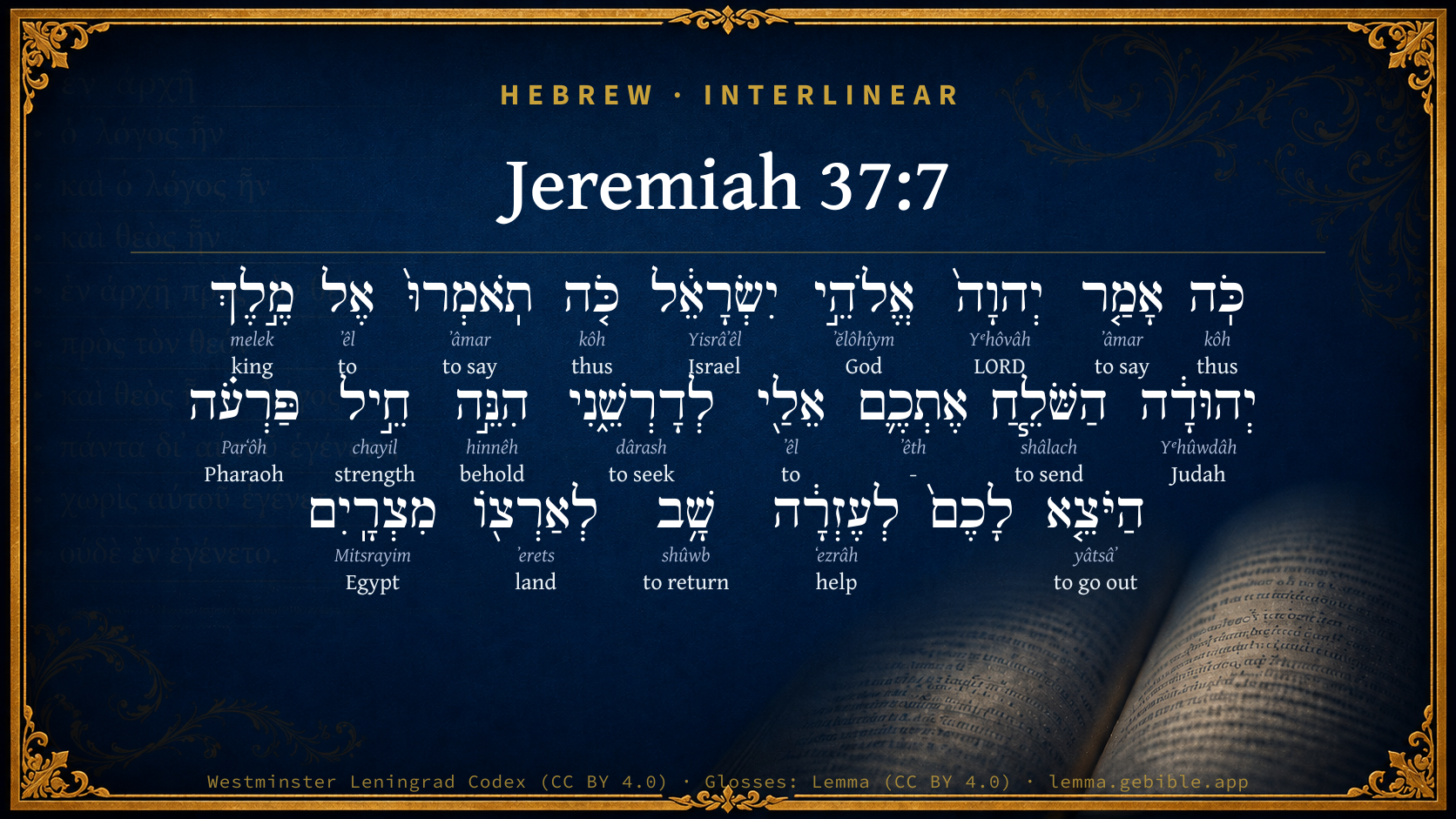
Hebrew (Westminster Leningrad Codex) Jeremiah 37:7 appears in the Hebrew Old Testament. The text above is from the Westminster Leningrad Codex. Each word links to its Strong’s number, a concise gloss, and parsing drawn from the Open Scriptures Hebrew Bible morphology. Click any word for its full Brown-Driver-Briggs (BDB) entry.
Download image
Cite this verse

Jeremiah 37:7 (World English Bible). Public Domain. Lemma interlinear Bible study tool, https://lemma.gebible.app/v/jeremiah/37/7.

Show BibTeX & RIS
BibTeX
RIS
English Translation
Thus says Yahweh, the God of Israel, Thus shall you tell the king of Judah, who sent you to me to inquire of me: Behold, Pharaoh's army, which is come forth to help you, shall return to Egypt into their own land.
World English Bible · Public Domain
Download a study sheet

One document with this verse’s original text, its word-by-word gloss line, the meaning frame, cross-references with their text, attributed commentary, and full source and license credits — printable, and it pastes into notes with its structure intact.

This verse Autodidact and up

Study sheet (.html) Plain text (.txt)

A passage Seminary Student

Up to 50 verses in one chapter. A passage sheet keeps up to 6 commentary sources and 12 cross-references per verse, in the order this page ranks them, and says so on the sheet whenever that leaves anything out. Ask for a single verse and you get the Autodidact verse sheet above.

Everything on this page stays free to read, with no account — the sheet is a download of what is already on screen, not access to it.

Want to remove ads? Support Godless Engineer
Compare translations 3

The same verse in 3 English versions, stacked beneath the original-language interlinear above. Click any original word for its lexicon entry.

Each is an independent rendering of the whole verse — the interlinear is not word-aligned to these translations.

Highlighted words mark where these versions differ — a whole-verse word diff, not a word-by-word alignment.

  • World English Bible Public Domain
    Thus says Yahweh, the God of Israel, Thus shall you tell the king of Judah, who sent you to me to inquire of me: Behold, Pharaoh's army, which is come forth to help you, shall return to Egypt into their own land.
  • King James Version Public Domain
    Thus saith the LORD, the God of Israel; Thus shall ye say to the king of Judah, that sent you unto me to enquire of me; Behold, Pharaoh's army, which is come forth to help you, shall return to Egypt into their own land.
  • unfoldingWord Literal Text CC BY-SA 4.0
    “Yahweh, God of Israel, says this: This is what you will say to the king of Judah, because he has sent you to seek advice from me, ‘See, Pharaoh’s army, which came to help you, is about to go back to Egypt, its own land.

unfoldingWord Literal Text — © unfoldingWord, licensed CC BY-SA 4.0. Word-aligned USFM3 via Door43 (git.door43.org/unfoldingWord/en_ult).

Versions to compare (up to 4)

3 of 4 selected

Show all 18 translations

Every available English version of this verse, each an independent rendering of the whole verse.

  • World English Bible Public Domain
    Thus says Yahweh, the God of Israel, Thus shall you tell the king of Judah, who sent you to me to inquire of me: Behold, Pharaoh's army, which is come forth to help you, shall return to Egypt into their own land.
  • Berean Standard Bible Public Domain
    “This is what the LORD, the God of Israel, says that you are to tell the king of Judah, who sent you to Me: Behold, Pharaoh’s army, which has marched out to help you, will go back to its own land of Egypt.
  • Majority Standard Bible Public Domain
    “This is what the LORD, the God of Israel, says that you are to tell the king of Judah, who sent you to Me: Behold, Pharaoh’s army, which has marched out to help you, will go back to its own land of Egypt.
  • King James Version Public Domain
    Thus saith the LORD, the God of Israel; Thus shall ye say to the king of Judah, that sent you unto me to enquire of me; Behold, Pharaoh's army, which is come forth to help you, shall return to Egypt into their own land.
  • American Standard Version (1901) Public Domain
    Thus saith Jehovah, the God of Israel, Thus shall ye say to the king of Judah, that sent you unto me to inquire of me: Behold, Pharaoh's army, which is come forth to help you, shall return to Egypt into their own land.
  • Revised Version (1885) Public Domain
    Thus saith the LORD, the God of Israel: Thus shall ye say to the king of Judah, that sent you unto me to inquire of me; Behold, Pharaoh’s army, which is come forth to help you, shall return to Egypt into their own land.
  • Geneva Bible (1599) Public Domain
    Thus sayth the Lord God of Israel, Thus shall ye say to the King of Iudah, that sent you vnto me to inquire of me, Behold, Pharaohs hoste, which is come forth to helpe you, shall returne to Egypt into their owne land.
  • Douay-Rheims (1899) Public Domain
    And the Chaldeans shall come again, and fight against this city, and take it, and burn it with fire.
  • Young's Literal Translation Public Domain
    `Thus said Jehovah, God of Israel, Thus do ye say unto the king of Judah, who is sending you unto Me, to seek Me: Lo, the force of Pharaoh that is coming out to you for help hath turned back to its land, to Egypt,
  • Literal Standard Version CC BY-SA 4.0
    “Thus said YHWH, God of Israel: Thus you say to the king of Judah who is sending you to Me, to seek Me: Behold, the force of Pharaoh that is coming out to you for help has turned back to its land, to Egypt,
  • Unlocked Literal Bible CC BY-SA 4.0
    “Yahweh, God of Israel, says this: This is what you will say to the king of Judah, because he has sent you to seek advice from me, 'See, Pharaoh's army, which came to help you, is about to go back to Egypt, its own land.
  • unfoldingWord Literal Text CC BY-SA 4.0
    “Yahweh, God of Israel, says this: This is what you will say to the king of Judah, because he has sent you to seek advice from me, ‘See, Pharaoh’s army, which came to help you, is about to go back to Egypt, its own land.
  • Darby Bible Public Domain
    Thus saith Jehovah the God of Israel: Thus shall ye say to the king of Judah, that sent you unto me to inquire of me: Behold, Pharaoh's army, which is come forth to help you, shall return to Egypt into their own land.
  • World Messianic Bible Public Domain
    “The LORD, the God of Israel, says, ‘You shall tell the king of Judah, who sent you to me to inquire of me: “Behold, Pharaoh’s army, which has come out to help you, will return to Egypt into their own land.
  • Webster's Bible Public Domain
    Thus saith the LORD, the God of Israel; Thus shall ye say to the king of Judah, that sent you to me to inquire of me; Behold, Pharaoh's army, which hath come forth to help you, shall return to Egypt into their own land.
  • Free Bible Version CC BY-SA 4.0
    This is what the Lord, the God of Israel, instructs you to tell the king of Judah, who sent you to ask me for help: Look! Pharaoh's army, which set out to help you, is going to return home to Egypt.
  • Bible in Basic English Public Domain
    The Lord, the God of Israel, has said: This is what you are to say to the king of Judah who sent you to get directions from me: See, Pharaoh's army, which has come out to your help, will go back to Egypt, to their land.
  • JPS Tanakh (1917) Public Domain
    'Thus saith the LORD, the God of Israel: Thus shall ye say to the king of Judah, that sent you unto Me to inquire of Me: Behold, Pharaoh's army, which is come forth to help you, shall return to Egypt into their own land.

Literal Standard Version (2020), Covenant Press — licensed CC BY-SA 4.0. Text via the HelloAO Bible API (eBible.org). Unlocked Literal Bible (unfoldingWord) — licensed CC BY-SA 4.0. Text via the HelloAO Bible API (eBible.org). unfoldingWord Literal Text — © unfoldingWord, licensed CC BY-SA 4.0. Word-aligned USFM3 via Door43 (git.door43.org/unfoldingWord/en_ult). Free Bible Version, Dr. Jonathan Gallagher — licensed CC BY-SA 4.0. Text via the HelloAO Bible API (eBible.org).

Word by word

More ways to search: Search by grammar → Find every occurrence → Compare this word →

Practice this passage: Drill this verse → Learn its vocabulary →

לְעֶזְרָ֔ה
ʻezrâh
H5833
“to/for · help”
Preposition + Noun, Common, Feminine, Singular, Absolute
Part of Speech
Preposition + Noun
Type
Common
Gender
Feminine
Number
Singular
State
Absolute
Full BDB Definition

Origin: from H5828

TWOT: 1598b

help, succour, assistance - help, succour - one who helps
  1. כֹּֽה kôh H3541 “thus” Adverb
  2. אָמַ֤ר ʼâmar H559 “to say” Verb, Qal, Perfect, 3rd Person, Masculine, Singular
  3. יְהוָה֙ Yᵉhôvâh H3068 “LORD” Noun, Proper
  4. אֱלֹהֵ֣י ʼĕlôhîym H430 “God(s) of” Noun, Common, Masculine, Plural, Construct
  5. יִשְׂרָאֵ֔ל Yisrâʼêl H3478 “Israel” Noun, Proper
  6. כֹּ֤ה kôh H3541 “thus” Adverb
  7. תֹֽאמְרוּ֙ ʼâmar H559 “to say” Verb, Qal, Imperfect, 2nd Person, Masculine, Plural
  8. אֶל ʼêl H413 “to” Preposition
  9. מֶ֣לֶךְ melek H4428 “king of” Noun, Common, Masculine, Singular, Construct
  10. יְהוּדָ֔ה Yᵉhûwdâh H3063 “Judah” Noun, Proper
  11. הַשֹּׁלֵ֧חַ shâlach H7971 “the · sending” Particle, Definite Article + Verb, Qal, Participle Active, Masculine, Singular, Absolute
  12. אֶתְכֶ֛ם ʼêth H853 “- · you” Particle, Direct Object + Suffix, Personal, 2nd Person, Masculine, Plural
  13. אֵלַ֖י ʼêl H413 “to · me” Preposition + Suffix, Personal, 1st Person, Common, Singular
  14. לְדָרְשֵׁ֑נִי dârash H1875 “to seek · me” Preposition + Verb, Qal, Infinitive Construct + Suffix, Personal, 1st Person, Common, Singular
  15. הִנֵּ֣ה hinnêh H2009 “behold” Particle, Demonstrative
  16. חֵ֣יל chayil H2428 “strength of” Noun, Common, Masculine, Singular, Construct
  17. פַּרְעֹ֗ה Parʻôh H6547 “Pharaoh” Noun, Proper
  18. הַיֹּצֵ֤א yâtsâʼ H3318 “the · going out” Particle, Definite Article + Verb, Qal, Participle Active, Masculine, Singular, Absolute
  19. שָׁ֥ב shûwb H7725 “to return” Verb, Qal, Perfect, 3rd Person, Masculine, Singular
  20. לְאַרְצ֖וֹ ʼerets H776 “to/for · land · his” Preposition + Noun, Common, Both, Singular, Construct + Suffix, Personal, 3rd Person, Masculine, Singular
  21. מִצְרָֽיִם Mitsrayim H4714 “Egypt” Noun, Proper

About this verse

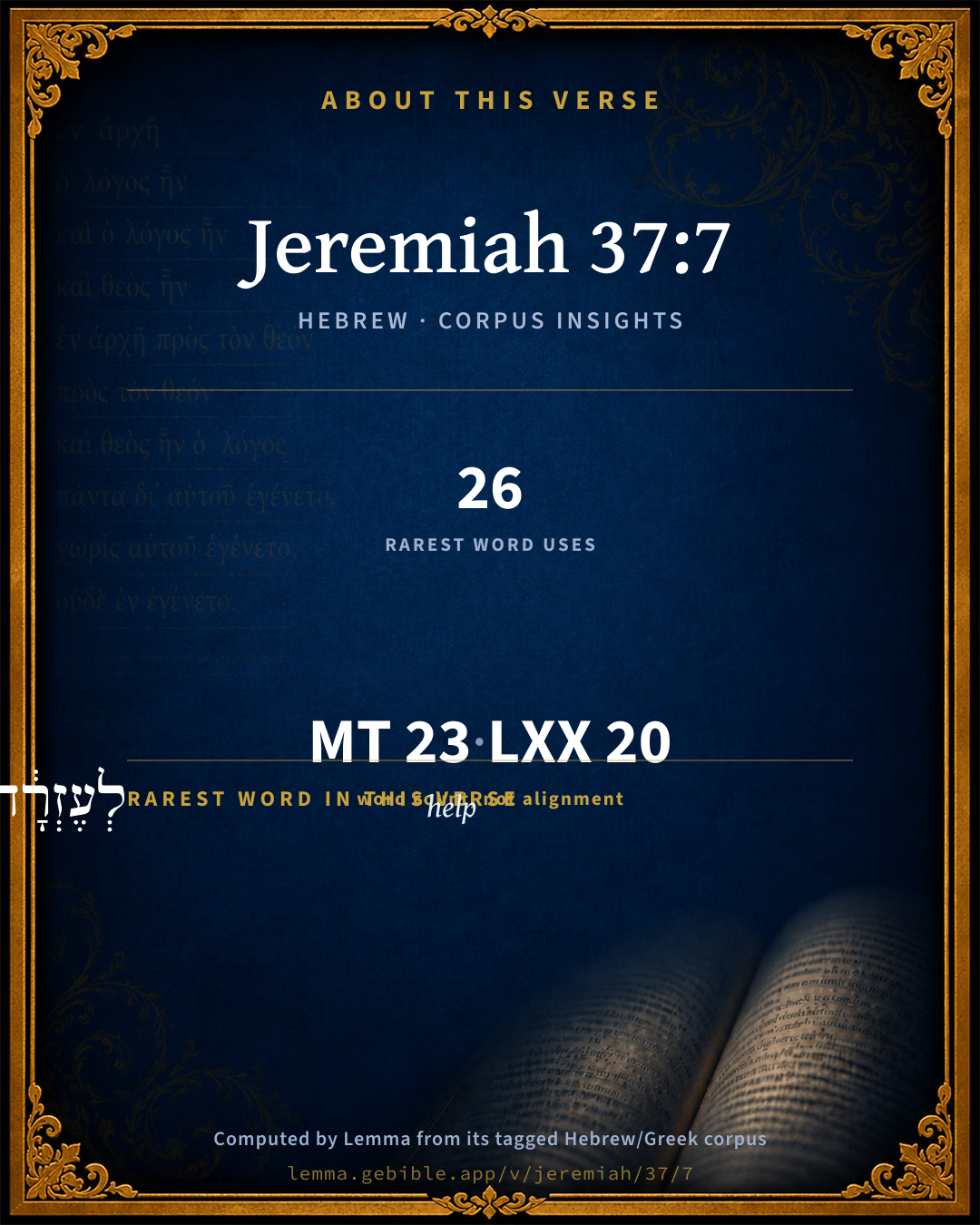
These counts appear in no published source. They are computed here, from the morphology-tagged text and Lemma’s own curated glosses. What Lemma adds →

23
words
19
distinct lemmas
Prophets
section

Shared distinctive vocabulary

לְעֶזְרָ֔ה help H5833 occurs in 25 verses of the Hebrew Bible. Also found in:

Grammatical profile

  • 6 verbs
  • 10 nouns
  • 3 prepositions
  • 2 adverbs
  • 2 particles

Verb forms

  • אָמַ֤ר Qal · Perfect
  • תֹֽאמְרוּ֙ Qal · Imperfect
  • הַשֹּׁלֵ֧חַ Qal · Participle Active
  • לְדָרְשֵׁ֑נִי Qal · Infinitive Construct
  • הַיֹּצֵ֤א Qal · Participle Active
  • שָׁ֥ב Qal · Perfect

Repetition

Words recur within this verse — often emphatic in Hebrew:

  • כֹּֽה thus H3541 ×2
  • אָמַ֤ר to say H559 ×2
  • אֶל to H413 ×2

Hebrew & Septuagint length

In the original languages it is 23 Hebrew tokens and 20 Greek tokens — but the two are counted differently (Hebrew bundles its prefixes and suffixes into one token; the Greek is in lemma form), so that isn’t a like-for-like length.

Cross-references

12

Topical passages linked to Jeremiah 37:7 in the Treasury of Scripture Knowledge — connected by theme and wording, ordered by reader-vote popularity; previews shown in the World English Bible.

  • Lamentations 4:17 Our eyes do yet fail [in looking] for our vain help: In our watching we have watched for a nation that could not save.
  • 2 Kings 22:18 But to the king of Judah, who sent you to inquire of Yahweh, thus shall you tell him, Thus says Yahweh, the God of Israel: As touching the words which you have heard,
  • Isaiah 31:1–3 Woe to those who go down to Egypt for help, and rely on horses, and trust in chariots because they are many, and in horsemen because they are very strong, but they don't look to the Holy One of Israel, neither seek Yahweh!
  • Jeremiah 21:2 Please inquire of Yahweh for us; for Nebuchadrezzar king of Babylon makes war against us: peradventure Yahweh will deal with us according to all his wondrous works, that he may go up from us.
  • Jeremiah 37:3 Zedekiah the king sent Jehucal the son of Shelemiah, and Zephaniah the son of Maaseiah, the priest, to the prophet Jeremiah, saying, Pray now to Yahweh our God for us.
  • Ezekiel 17:17 Neither shall Pharaoh with his mighty army and great company help him in the war, when they cast up mounds and build forts, to cut off many persons.
  • Proverbs 21:30 There is no wisdom nor understanding Nor counsel against Yahweh.
  • Isaiah 30:1–6 Woe to the rebellious children, says Yahweh, who take counsel, but not of me; and who make a league, but not of my Spirit, that they may add sin to sin,
  • Jeremiah 2:36 Why go you about so much to change your way? you shall be ashamed of Egypt also, as you were ashamed of Assyria.
  • Jeremiah 17:5–6 Thus says Yahweh: Cursed is the man who trusts in man, and makes flesh his arm, and whose heart departs from Yahweh.
  • Ezekiel 29:6–7 All the inhabitants of Egypt shall know that I am Yahweh, because they have been a staff of reed to the house of Israel.
  • Ezekiel 29:16 It shall be no more the confidence of the house of Israel, bringing iniquity to memory, when they turn to look after them: and they shall know that I am the Lord Yahweh.

Cross-references courtesy of OpenBible.info (CC BY 4.0).

Hebrew and Greek witnesses Masoretic Hebrew ↔ Greek Septuagint

The same verse in the two great witnesses to the Old Testament, shown verse-for-verse.

These are two independent witnesses, not word-aligned to each other, and the Septuagint is shown in lemma (dictionary) form.

Hebrew Jeremiah 37:7 Masoretic · Westminster Leningrad Codex

כֹּֽה אָמַ֤ר יְהוָה֙ אֱלֹהֵ֣י יִשְׂרָאֵ֔ל כֹּ֤ה תֹֽאמְרוּ֙ אֶל מֶ֣לֶךְ יְהוּדָ֔ה הַשֹּׁלֵ֧חַ אֶתְכֶ֛ם אֵלַ֖י לְדָרְשֵׁ֑נִי הִנֵּ֣ה חֵ֣יל פַּרְעֹ֗ה הַיֹּצֵ֤א לָכֶם֙ לְעֶזְרָ֔ה שָׁ֥ב לְאַרְצ֖וֹ מִצְרָֽיִם

Thus says Yahweh, the God of Israel, Thus shall you tell the king of Judah, who sent you to me to inquire of me: Behold, Pharaoh's army, which is come forth to help you, shall return to Egypt into their own land.

World English Bible · Public Domain

Greek LXX Structure differs

In the Septuagint, Jeremiah is about an eighth shorter than the Hebrew and arranges its material differently — the Oracles Against the Nations (Hebrew chapters 46–51) appear in the middle of the Greek book, after 25:13. Because the chapter and verse boundaries do not line up, a verse-for-verse comparison with the Hebrew is not shown.

A verse-for-verse comparison isn’t shown here because the chapters and verses don’t line up. Switch to the LXX edition with the MT / LXX toggle above to read the Greek directly.

Hebrew: Westminster Leningrad Codex (CC BY 4.0). Greek: Septuagint (public domain); English from a public-domain English Septuagint. How the Septuagint differs from the Hebrew →

Targum (Aramaic paraphrase)

1

The Targum is the ancient Jewish Aramaic paraphrase of the Hebrew Scriptures — an interpretive translation, not the Hebrew text itself. Onkelos (literal) and Pseudo-Jonathan (expansive) render the Torah, and Jonathan the Prophets. Coverage is partial: where no permissively-licensed English translation exists for a verse, only the Aramaic is shown. This is verse-level text, not a word-by-word alignment to the Hebrew.

  1. Targum Jonathan Prophets (Joshua–Malachi)
    כִּדְנַן אֲמַר יְיָ אֱלָהָא דְיִשְׂרָאֵל כְּדֵין תֵּימְרוּן לִמְלַךְ שִׁבְטָא דְבֵית יְהוּדָה דִשְׁלַח יַתְכוֹן לִקֳדָמַי לְמִתְבַּע אוּלְפַן מִן קֳדָמַי הָא מַשִׁרְיַת פַּרְעֹה דְנַפְקָא לְכוֹן לְסָעִיד תָּבָא לְאַרְעֲהוֹן לְמִצְרָיִם:

    (no public-domain English translation for this verse)

    Targum Jonathan — Aramaic: “Mikraot Gedolot” (public domain). English: “Sefaria Community Translation” (CC0 1.0 (public-domain dedication)); “London "Chaldee Paraphrase," 1871” (public domain). Text via Sefaria.

Commentary

Notes on Jeremiah 37:7 from classic Christian and Jewish commentators (each source and its license shown beneath its notes). The classic Christian expositions comment on the surrounding passage and are grouped to its opening verse, so a note may address several verses; the Jewish commentaries on the Tanakh (Rashi and others) are per-verse, so they appear only where the commentator wrote on this verse.

Lemma curates 59 commentaries, every one of them public domain or Creative Commons licensed, each selected and text-cleaned for this edition rather than reprinted as found. About our sources →

Trapp's Complete Commentary

John Trapp

Jer 37:7 Thus saith the LORD, the God of Israel; Thus shall ye say to the king of Judah, that sent you unto me to enquire of me; Behold, Pharaoh’s army, which is come forth to help you, shall return to Egypt into their own land.

Ver. 7. To inquire of me.] Or, To seek to me, to set me to work for you at the throne of grace.

Behold Pharaoh’s army, &c.] The Talmudists tale here of what frightened back the Egyptians is not worth the telling. It may be read in Corn. A Lapide upon Jer 37:5.

John Trapp, A Commentary or Exposition upon All the Books of the Old and New Testament (1647–1656) — public domain. Text from a community e-Sword module.

Joseph Benson's Commentary

Jer 37:7-10. Pharaoh’s army, which is come forth to help you, shall return — They shall be discomfited by the Chaldeans, and forced to retreat without affording you any assistance: see 2Ki 24:7. And the Chaldeans shall come again — They shall return, renew the siege, and prosecute it with more vigour than ever. And take it and burn it with fire — The sentence passed upon Jerusalem shall be executed, and they shall be the executioners: see Jer 34:22. Deceive not yourselves, &c. —

In vain did the Jews rejoice in Pharaoh’s coming to help them: in vain did they flatter themselves that the army of the Chaldeans would be routed; for, (as God was against them,) had this even been the case, had they smitten, as God here tells them, the whole army of the Chaldeans, so that there remained but wounded men among them, yet would they have been sufficient to have taken and laid low the proud city of Jerusalem. For, when God will take away, who shall rescue? — In vain, therefore, if God be our enemy, is all our power and policy; in vain do we endeavour to strengthen ourselves by riches and great friends, and to build our nest on high; for we can never be safe, but in the favour, and under the protection of the Almighty. And we may observe further, that whatever instruments God has determined to make use of, in any service for him, whether of mercy or judgment, they shall accomplish that for which they are designed, whatever incapacity they may lie under, or be reduced to.

Joseph Benson's Commentary on the Old and New Testaments (1811–1818) — public domain. Text from a community e-Sword module.

Jamieson, Fausset & Brown

Robert Jamieson, A. R. Fausset & David Brown

shall return--without accomplishing any deliverance for you.

Jamieson, Fausset & Brown — Commentary Critical and Explanatory on the Whole Bible (1871) — public domain (CC PDM 1.0). Text via the HelloAO Bible API.

Adam Clarke's Commentary

Verse 7. Pharaoh's army - shall return to Egypt] They were defeated by the Chaldeans; and, not being hearty in the cause, returned immediately to Egypt, leaving Nebuchadnezzar unmolested to recommence the siege.

Adam Clarke's Commentary on the Bible (1810–1826) — public domain. Text from a community e-Sword/MySword module.

John Calvin's Commentaries

Now follows the answer: Jeremiah says that the word of Jehovah came to him, and that he was to tell the messengers of Zedekiah, that the Chaldeans would shortly return. He then says, Behold the army of Pharaoh, which has come forth to deliver you, shall return to their own land; that is, being compelled to do so, the Egyptians being either conquered in battle or smitten with fear, and returning of their own accord to secure themselves in their own cities. The Prophet says, that no advantage could be expected from the Egyptians, for the soldiers of Pharaoh would return to their own land; and then he adds, and the Chaldeans shall return and fight against this city, until they take and burn it This was a hard answer, and Zedekiah was, no doubt, greatly exasperated at hearing the message, and also very angry with the Prophet, who thus dared plainly to threaten the city and the people with final ruin. But here the Prophet disregarded the pride of the king, for it was necessary for him to obey God’s command, he therefore boldly performed his office; and, at the same time, he touched the king Zedekiah to the quick, say to the king who sent you to inquire of me, etc

The word דרש daresh, means indeed to ask in general, but the Prophet means here that he was to inquire; and yet this was not said before; for he only told us that messengers had been sent to ask him to pray for the safety of the king and the people. But Scripture, we know, often omits one of the two things that are included; and we may easily conclude, that the king had not only sent to Jeremiah to pray, but also to bring some favorable prophecy from the Lord. For why did he apply to him rather than to the chief priest or some others, except that he knew him to be the true Prophet of God? Then Zedekiah requested Jeremiah to pray, but he tried also to draw from him some favorable prophecy, by which he might be relieved. Hence Jeremiah indirectly reproved him, because he feignedly sent to him as though he was ready to hear whatever God might declare by the mouth of his servant, — “He sent you to inquire of me; he is mistaken, for he will not get what he seeks; for thus saith God, ‘The Egyptians shall avail you nothing, and the Chaldeans shall return and take and burn the city.’”

We now perceive that when hypocrites pretend in a circuitous way to seek God, they do not obtain what they wish; for God justly disappoints them, inasmuch as they do not come to him with sincere hearts and desires; for they wish to transform God into their own nature and character, and they bend not themselves to his service nor submit to his word. Thus it comes that God will not answer their prayers; but the faithful, who seek God sincerely and from the heart, always find him propitious; and though he may not hear them immediately, yet he really shews that he cares for their safety. But hypocrites, whose confidence God regards with disdain, deserve that it should be empty and vain. This, then, is the reason why the Prophet gave such a severe answer to Zedekiah and his messengers. It now follows, —

John Calvin's Commentaries (1540-1563) — public domain. Text from the Calvin Translation Society English edition (1840s-50s) via the Christian Classics Ethereal Library (ccel.org). Calvin's coverage is partial (roughly two-thirds of the Bible); uncommented books and verses are honest gaps, never fabricated. The 19th-century editor's footnotes and remarks are omitted so the notes are faithfully Calvin's own voice.

Ellicott's Commentary for English Readers

(7) Behold, Pharaoh’s army, which is come forth to help you, shall return to Egypt.—A like prediction as to the fate of the Egyptian army is found in Eze_17:17, and is there connected with the fact that Zedekiah’s application to Egypt was a distinct breach of the compact which he had made with the Chaldæans. Their arrival, like that of Tirhakah in the Assyrian invasion (2Ki_19:9; Isa_37:9), caused only a temporary suspension of hostilities, and led finally to the conquest and subjugation of Egypt by Nebuchadnezzar.

A Bible Commentary for English Readers, edited by Charles John Ellicott (1878–1897) — public domain. Text from a community e-Sword module.

John Gill's Exposition

Thus saith the Lord, the God of Israel,.... Which are the usual titles and characters the Lord takes to himself, when he spake by the prophet; see Jer 34:2;

thus shall ye say to the king of Judah, that sent you unto me, to inquire of me; in an oracular way; for by this it seems that they were not only sent to desire the prophet to pray for them, but to obtain an oracle from the Lord, confirming it to them, that the Chaldean army which was gone would not return any more; this they were willing to believe, but wanted to have a confirmation of it from the Lord; and so the Targum,

"to seek an oracle from me;''

or to ask instruction or doctrine from me: now these messengers are bid to go back and tell the king, his nobles, and all the people of the land, what follows:

behold, Pharaoh's army, which is come forth to help you, shall return to Egypt, into their own land; being afraid to face the Chaldean army; or being defeated and driven back by it. Josephus (a) says there was a battle fought between the Egyptians and Chaldeans, in which the latter were conquerors, and put the former to flight, and drove them out of all Syria. Jarchi relates a fable, how that the Egyptian army came by ships, and that at sea they saw strange appearances, upon which they said one to another, what means this? they replied, these are our fathers, whom the fathers of those we are going to help drowned in the sea; and immediately returned to their own land.

(a) Anitqu. l. 10. c. 7. sect. 3.

John Gill's Exposition of the Whole Bible (1746–1763) — public domain (CC PDM 1.0). Text via the HelloAO Bible API.

Albert Barnes' Notes on the Bible

Jeremiah’s answer here is even more unfavorable than that which is given in Jer 21:4-7. So hopeless is resistance that the disabled men among the Chaldaeans would alone suffice to capture the city and burn it to the ground.

Albert Barnes' Notes on the Bible (1834–1885) — public domain. Text from a community e-Sword/MySword module.

Matthew Poole's English Annotations

The word

inquire lets us know that Zedekiah did not send to the prophet only to pray for him, but to inquire of God what the issue would be of this future contingency; it may be more desirous to know that, than that Jeremiah should intercede with God for them. The prophet tells them from God that the king of Egypt’s army should do them no service; it is expounded, Eze 17:17, He should not make for him in the war, by casting up mounts, and building forts, to cut off many persons. Probably the Egyptian army, upon the sight of the strength of the Chaldeans, and the weak and impotent state of the Jews, were discouraged, and would not adventure to fight them, but by and by returned to their own land.

Matthew Poole's English Annotations on the Holy Bible (1683–1685) — public domain. Text from a community e-Sword/MySword module.

Rashi

Rabbi Shlomo Yitzchaki (Rashi)

is returning to his land Egypt They were coming in ships, and the Holy One, blessed be He, signaled to the sea and caused a type of bottles and flasks (i.e., inflated) resembling human skins to float on it. They said to each other, What is this? They replied, These are our forefathers, whom the forefathers of these whom we are going to aid, drowned. They immediately returned to their land.

Rashi on the Tanakh — English translations: “The Judaica Press complete Tanach with Rashi, translated by A. J. Rosenberg” (CC BY 4.0); “Pentateuch with Rashi's commentary by M. Rosenbaum and A.M. Silbermann, 1929-1934” (public domain); “The Metsudah Tanach series, Lakewood, N.J” (CC BY 4.0); and “The Book of Joshua, Metsudah Publications, 1997” (CC BY 4.0). Text via Sefaria.

Lesson kit

Teaching starters — assembled from the data on this page, not authored interpretation. Every prompt links to the verse data it draws on. Edit before teaching.

Jeremiah, in the Prophets, opens this verse with 23 words (19 distinct Hebrew lemmas). Its most distinctive word is ʻezrâh (“help”). A historical commentator’s framing appears above. Read the whole chapter for the surrounding context.

Discussion questions

  1. How does “help” (ʻezrâh) shape what this verse is saying?
  2. Judges 5:23 shares the word «help» with this verse. How do the two illuminate each other?
  3. “thus” occurs 2× in this one verse. What is the effect of the repetition?
  4. These translations render this verse differently. What is at stake in choosing one wording over another?
  5. The verb «אָמַ֤ר» is Qal Perfect. How does its form color the action?
  6. Reading how Trapp's Complete Commentary and Joseph Benson's Commentary read this verse, where do the two commentators agree and where do they part?

Things to notice

Reading settings

Reading text

Shown beneath each verse's original-language words.

Old Testament
Old Testament edition

Read the OT as the Masoretic Hebrew (MT) or the Greek Septuagint (LXX).

English shown for the Greek Septuagint (in the Hebrew ↔ Greek comparison).

Comparing translations? Open the Compare panel on any verse page to stack up to four side by side.