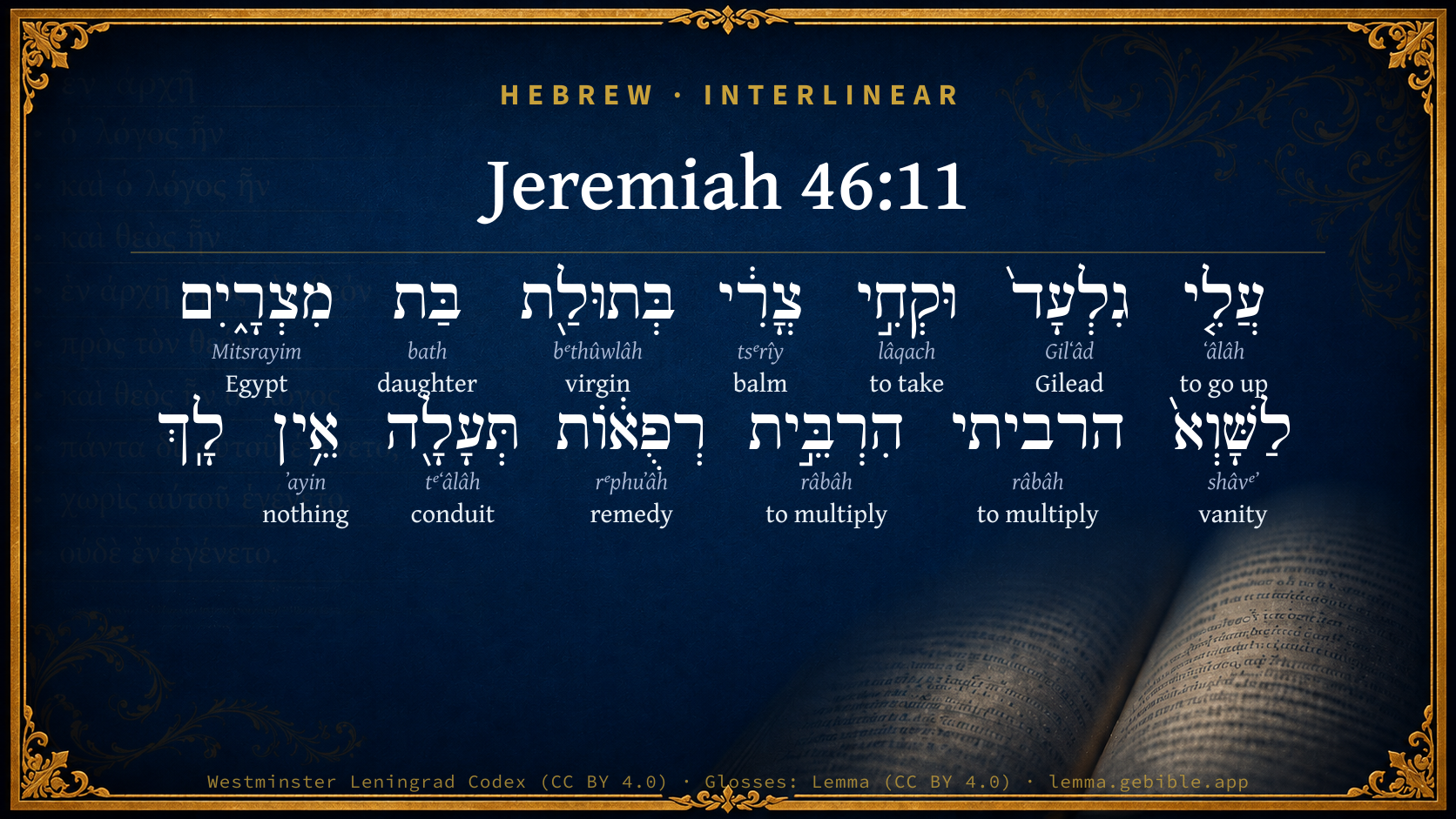
Jeremiah 46:11

Hebrew (Westminster Leningrad Codex) Jeremiah 46:11 appears in the Hebrew Old Testament. The text above is from the Westminster Leningrad Codex. Each word links to its Strong’s number, a concise gloss, and parsing drawn from the Open Scriptures Hebrew Bible morphology. Click any word for its full Brown-Driver-Briggs (BDB) entry.
Download image
Cite this verse

Jeremiah 46:11 (World English Bible). Public Domain. Lemma interlinear Bible study tool, https://lemma.gebible.app/v/jeremiah/46/11.

Show BibTeX & RIS
BibTeX
RIS
English Translation
Go up into Gilead, and take balm, virgin daughter of Egypt: in vain do you use many medicines; there is no healing for you.
World English Bible · Public Domain
Download a study sheet

One document with this verse’s original text, its word-by-word gloss line, the meaning frame, cross-references with their text, attributed commentary, and full source and license credits — printable, and it pastes into notes with its structure intact.

This verse Autodidact and up

Study sheet (.html) Plain text (.txt)

A passage Seminary Student

Up to 50 verses in one chapter. A passage sheet keeps up to 6 commentary sources and 12 cross-references per verse, in the order this page ranks them, and says so on the sheet whenever that leaves anything out. Ask for a single verse and you get the Autodidact verse sheet above.

Everything on this page stays free to read, with no account — the sheet is a download of what is already on screen, not access to it.

Want to remove ads? Support Godless Engineer
Compare translations 3

The same verse in 3 English versions, stacked beneath the original-language interlinear above. Click any original word for its lexicon entry.

Each is an independent rendering of the whole verse — the interlinear is not word-aligned to these translations.

Highlighted words mark where these versions differ — a whole-verse word diff, not a word-by-word alignment.

  • World English Bible Public Domain
    Go up into Gilead, and take balm, virgin daughter of Egypt: in vain do you use many medicines; there is no healing for you.
  • King James Version Public Domain
    Go up into Gilead, and take balm, O virgin, the daughter of Egypt: in vain shalt thou use many medicines; for thou shalt not be cured.
  • unfoldingWord Literal Text CC BY-SA 4.0
    Go up to Gilead and obtain medicine, virgin daughter of Egypt. It is useless that you put much medicine on yourself. There is no cure for you.

unfoldingWord Literal Text — © unfoldingWord, licensed CC BY-SA 4.0. Word-aligned USFM3 via Door43 (git.door43.org/unfoldingWord/en_ult).

Versions to compare (up to 4)

3 of 4 selected

Show all 18 translations

Every available English version of this verse, each an independent rendering of the whole verse.

  • World English Bible Public Domain
    Go up into Gilead, and take balm, virgin daughter of Egypt: in vain do you use many medicines; there is no healing for you.
  • Berean Standard Bible Public Domain
    Go up to Gilead for balm, O Virgin Daughter of Egypt! In vain you try many remedies, but for you there is no healing.
  • Majority Standard Bible Public Domain
    Go up to Gilead for balm, O Virgin Daughter of Egypt! In vain you try many remedies, but for you there is no healing.
  • King James Version Public Domain
    Go up into Gilead, and take balm, O virgin, the daughter of Egypt: in vain shalt thou use many medicines; for thou shalt not be cured.
  • American Standard Version (1901) Public Domain
    Go up into Gilead, and take balm, O virgin daughter of Egypt: in vain dost thou use many medicines; there is no healing for thee.
  • Revised Version (1885) Public Domain
    Go up into Gilead, and take balm, O virgin daughter of Egypt: in vain dost thou use many medicines; there is no healing for thee.
  • Geneva Bible (1599) Public Domain
    Goe vp vnto Gilead, and take balme, O virgine, the daughter of Egypt: in vaine shalt thou vse many medicines: for thou shalt haue no health.
  • Douay-Rheims (1899) Public Domain
    Go up into Galaad, and take balm, O virgin daughter of Egypt: in vain dost thou multiply medicines, there shall be no cure for thee.
  • Young's Literal Translation Public Domain
    Go up to Gilead, and take balm, O virgin daughter of Egypt, In vain thou hast multiplied medicines, Healing there is none for thee.
  • Literal Standard Version CC BY-SA 4.0
    Go up to Gilead, and take balm, || O virgin daughter of Egypt, || You have multiplied medicines in vain, || There is no healing for you.
  • Unlocked Literal Bible CC BY-SA 4.0
    Go up to Gilead and obtain medicine, virgin daughter of Egypt. It is useless that you put much medicine on yourself. There is no cure for you.
  • unfoldingWord Literal Text CC BY-SA 4.0
    Go up to Gilead and obtain medicine, virgin daughter of Egypt. It is useless that you put much medicine on yourself. There is no cure for you.
  • Darby Bible Public Domain
    Go up to Gilead, and fetch balm, O virgin-daughter of Egypt! In vain shalt thou multiply remedies: there is no healing for thee.
  • World Messianic Bible Public Domain
    Go up into Gilead, and take balm, virgin daughter of Egypt. You use many medicines in vain. There is no healing for you.
  • Webster's Bible Public Domain
    Go up into Gilead, and take balm, O virgin, the daughter of Egypt: in vain shalt thou use many medicines; for thou shalt not be cured.
  • Free Bible Version CC BY-SA 4.0
    Go and find some healing ointment in Gilead, Virgin Daughter of Egypt! But whatever you use to help you will fail, because there's nothing that will heal you.
  • Bible in Basic English Public Domain
    Go up to Gilead and take sweet oil, O virgin daughter of Egypt: there is no help in all your medical arts; nothing will make you well.
  • JPS Tanakh (1917) Public Domain
    Go up into Gilead, and take balm, O virgin daughter of Egypt; in vain dost thou use many medicines; there is no cure for thee.

Literal Standard Version (2020), Covenant Press — licensed CC BY-SA 4.0. Text via the HelloAO Bible API (eBible.org). Unlocked Literal Bible (unfoldingWord) — licensed CC BY-SA 4.0. Text via the HelloAO Bible API (eBible.org). unfoldingWord Literal Text — © unfoldingWord, licensed CC BY-SA 4.0. Word-aligned USFM3 via Door43 (git.door43.org/unfoldingWord/en_ult). Free Bible Version, Dr. Jonathan Gallagher — licensed CC BY-SA 4.0. Text via the HelloAO Bible API (eBible.org).

Word by word

More ways to search: Search by grammar → Find every occurrence → Compare this word →

Practice this passage: Drill this verse → Learn its vocabulary →

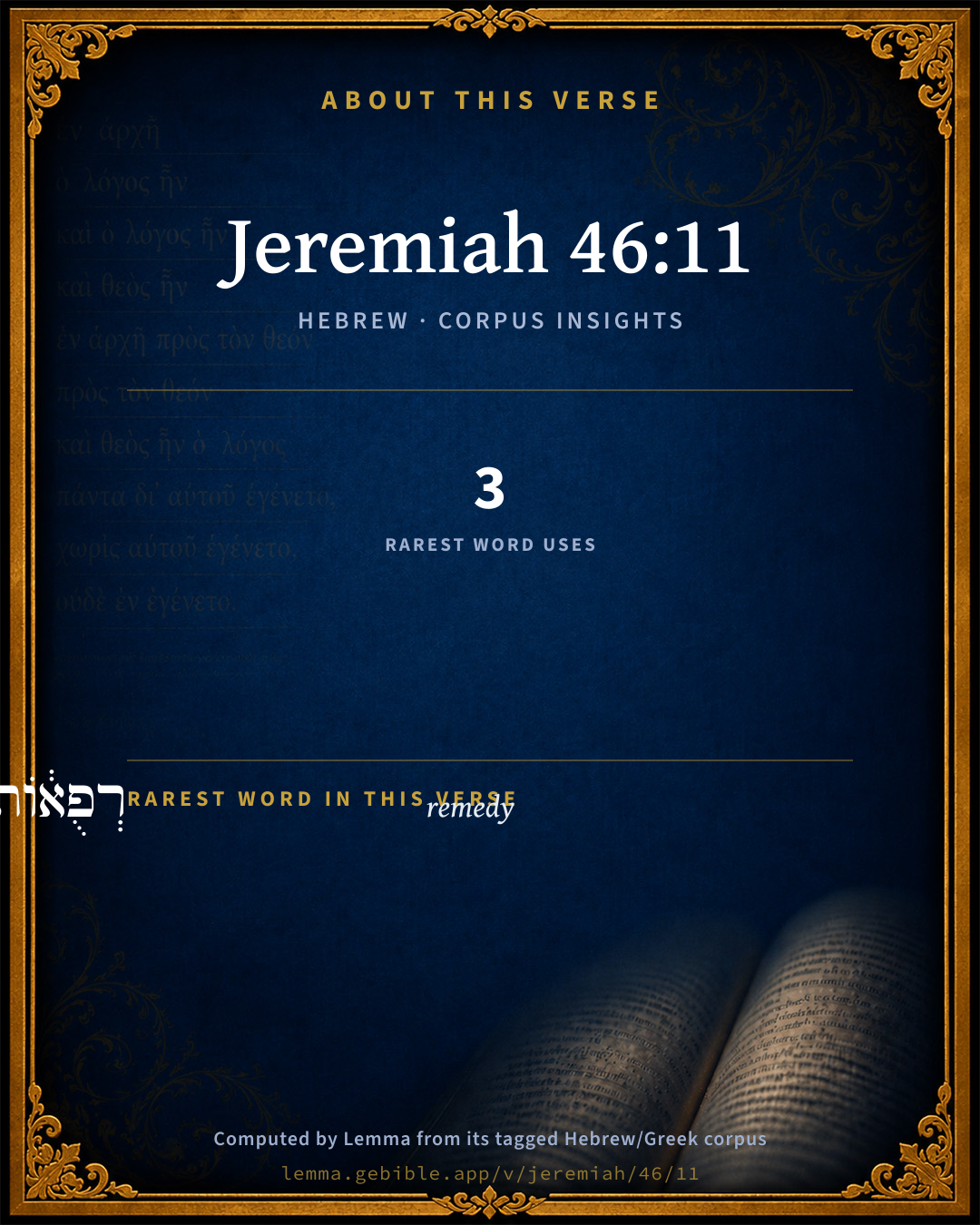
רְפֻא֔וֹת
rᵉphuʼâh
H7499
“remedies”
Noun, Common, Feminine, Plural, Absolute
Part of Speech
Noun
Type
Common
Gender
Feminine
Number
Plural
State
Absolute
Full BDB Definition

Origin: pass part of H7495

TWOT: 2196a

remedy, medicine
  1. עֲלִ֤י ʻâlâh H5927 “go up” Verb, Qal, Imperative, 2nd Person, Feminine, Singular
  2. גִלְעָד֙ Gilʻâd H1568 “Gilead” Noun, Proper
  3. וּקְחִ֣י lâqach H3947 “and · take” Conjunction + Verb, Qal, Imperative, 2nd Person, Feminine, Singular
  4. צֳרִ֔י tsᵉrîy H6875 “balm” Noun, Common, Masculine, Singular, Absolute
  5. בְּתוּלַ֖ת bᵉthûwlâh H1330 “virgin of” Noun, Common, Feminine, Singular, Construct
  6. בַּת bath H1323 “daughter of” Noun, Common, Feminine, Singular, Construct
  7. מִצְרָ֑יִם Mitsrayim H4714 “Egypt” Noun, Proper
  8. לַשָּׁוְא֙ shâvᵉʼ H7723 “to/for the · vanity” Preposition, Determined + Noun, Common, Masculine, Singular, Absolute
  9. הרביתי râbâh H7235 “to multiply” Verb, Hiphil, Perfect, 1st Person, Common, Singular
  10. הִרְבֵּ֣ית râbâh H7235 “to multiply” Verb, Hiphil, Perfect, 2nd Person, Feminine, Singular
  11. תְּעָלָ֖ה tᵉʻâlâh H8585 “conduit” Noun, Common, Feminine, Singular, Absolute
  12. אֵ֥ין ʼayin H369 “nothing” Particle, Negative

About this verse

These counts appear in no published source. They are computed here, from the morphology-tagged text and Lemma’s own curated glosses. What Lemma adds →

14
words
12
distinct lemmas
Prophets
section

Notable vocabulary

The rarest word here is רְפֻא֔וֹת remedy H7499 — appearing just 3 times in the whole Hebrew Bible.

Shared distinctive vocabulary

רְפֻא֔וֹת remedy H7499 occurs in 3 verses of the Hebrew Bible. Also found in:

Grammatical profile

  • 4 verbs
  • 8 nouns
  • 1 preposition
  • 1 particle

Verb forms

  • עֲלִ֤י Qal · Imperative
  • וּקְחִ֣י Qal · Imperative
  • הרביתי Hiphil · Perfect
  • הִרְבֵּ֣ית Hiphil · Perfect

Repetition

A word recurs within this verse — often emphatic in Hebrew:

  • הרביתי to multiply H7235 ×2

Cross-references

13

Topical passages linked to Jeremiah 46:11 in the Treasury of Scripture Knowledge — connected by theme and wording, ordered by reader-vote popularity; previews shown in the World English Bible.

  • Jeremiah 8:22 Is there no balm in Gilead? is there no physician there? why then isn't the health of the daughter of my people recovered?
  • Micah 1:9 For her wounds are incurable; For it has come even to Judah. It reaches to the gate of my people, Even to Jerusalem.
  • Isaiah 47:1 Come down, and sit in the dust, virgin daughter of Babylon; sit on the ground without a throne, daughter of the Chaldeans: for you shall no more be called tender and delicate.
  • Jeremiah 14:17 You shall say this word to them, Let my eyes run down with tears night and day, and let them not cease; for the virgin daughter of my people is broken with a great breach, with a very grievous wound.
  • Nahum 3:19 There is no healing your wound, for your injury is fatal. All who hear the report of you clap their hands over you; for who hasn't felt your endless cruelty?
  • Luke 8:43–44 A woman who had a flow of blood for twelve years, who had spent all her living on physicians, and could not be healed by any,
  • Genesis 37:25 They sat down to eat bread, and they lifted up their eyes and looked, and saw a caravan of Ishmaelites was coming from Gilead, with their camels bearing spices and balm and myrrh, going to carry it down to Egypt.
  • Genesis 43:11 Their father, Israel, said to them, "If it be so now, do this. Take from the choice fruits of the land in your bags, and carry down a present for the man, a little balm, a little honey, spices and myrrh, nuts, and almonds;
  • Jeremiah 30:12–15 For thus says Yahweh, Your hurt is incurable, and your wound grievous.
  • Jeremiah 51:8 Babylon is suddenly fallen and destroyed: wail for her; take balm for her pain, if so be she may be healed.
  • Ezekiel 27:17 Judah, and the land of Israel, they were your traffickers: they traded for your merchandise wheat of Minnith, and confections, and honey, and oil, and balm.
  • Ezekiel 30:21–25 Son of man, I have broken the arm of Pharaoh king of Egypt; and, behold, it has not been bound up, to apply [healing] medicines, to put a bandage to bind it, that it be strong to hold the sword.
  • Matthew 5:26 Most assuredly I tell you, you shall by no means get out of there, until you have paid the last penny.

Cross-references courtesy of OpenBible.info (CC BY 4.0).

Hebrew and Greek witnesses Masoretic Hebrew ↔ Greek Septuagint

The same verse in the two great witnesses to the Old Testament, shown verse-for-verse.

These are two independent witnesses, not word-aligned to each other, and the Septuagint is shown in lemma (dictionary) form.

Hebrew Jeremiah 46:11 Masoretic · Westminster Leningrad Codex

עֲלִ֤י גִלְעָד֙ וּקְחִ֣י צֳרִ֔י בְּתוּלַ֖ת בַּת מִצְרָ֑יִם לַשָּׁוְא֙ הרביתי הִרְבֵּ֣ית רְפֻא֔וֹת תְּעָלָ֖ה אֵ֥ין לָֽךְ

Go up into Gilead, and take balm, virgin daughter of Egypt: in vain do you use many medicines; there is no healing for you.

World English Bible · Public Domain

Greek LXX Structure differs

In the Septuagint, Jeremiah is about an eighth shorter than the Hebrew and arranges its material differently — the Oracles Against the Nations (Hebrew chapters 46–51) appear in the middle of the Greek book, after 25:13. Because the chapter and verse boundaries do not line up, a verse-for-verse comparison with the Hebrew is not shown.

A verse-for-verse comparison isn’t shown here because the chapters and verses don’t line up. Switch to the LXX edition with the MT / LXX toggle above to read the Greek directly.

Hebrew: Westminster Leningrad Codex (CC BY 4.0). Greek: Septuagint (public domain); English from a public-domain English Septuagint. How the Septuagint differs from the Hebrew →

Targum (Aramaic paraphrase)

1

The Targum is the ancient Jewish Aramaic paraphrase of the Hebrew Scriptures — an interpretive translation, not the Hebrew text itself. Onkelos (literal) and Pseudo-Jonathan (expansive) render the Torah, and Jonathan the Prophets. Coverage is partial: where no permissively-licensed English translation exists for a verse, only the Aramaic is shown. This is verse-level text, not a word-by-word alignment to the Hebrew.

  1. Targum Jonathan Prophets (Joshua–Malachi)
    סַקִי לְגִלְעָד וּסְבִי שְׁעִיף מַלְכוּת כְּנִשְׁתָּא דְמִצְרַיִם לָא לַהֲנָאָה אַסְגֵית סַמְמָנִין אַסוּ לָא סַלְקַת לִיךְ:

    (no public-domain English translation for this verse)

    Targum Jonathan — Aramaic: “Mikraot Gedolot” (public domain). English: “Sefaria Community Translation” (CC0 1.0 (public-domain dedication)); “London "Chaldee Paraphrase," 1871” (public domain). Text via Sefaria.

Commentary

Notes on Jeremiah 46:11 from classic Christian and Jewish commentators (each source and its license shown beneath its notes). The classic Christian expositions comment on the surrounding passage and are grouped to its opening verse, so a note may address several verses; the Jewish commentaries on the Tanakh (Rashi and others) are per-verse, so they appear only where the commentator wrote on this verse.

Lemma curates 59 commentaries, every one of them public domain or Creative Commons licensed, each selected and text-cleaned for this edition rather than reprinted as found. About our sources →

Trapp's Complete Commentary

John Trapp

Jer 46:11 Go up into Gilead, and take balm, O virgin, the daughter of Egypt: in vain shalt thou use many medicines; [for] thou shalt not be cured.

Ver. 11. Go up unto Gilead, and take balm.] See Jer 8:22 cf. Gen 37:25; q.d., Thy calamity is no less incurable than ignominious.

John Trapp, A Commentary or Exposition upon All the Books of the Old and New Testament (1647–1656) — public domain. Text from a community e-Sword module.

Joseph Benson's Commentary

Jer 46:11-12. Go up into Gilead, and take balm — Gilead was famous for producing balm and such like healing gums: see note on Jer 8:22. The prophet, alluding to the custom of men’s going thither for relief in dangerous infirmities, ironically advises the Egyptians to try all the methods they can think of to prevent that destruction that threatened them, but he signifies that all their endeavours would be in vain. Compare Jer 51:8. O virgin, the daughter of Egypt — Those cities or countries are called virgins which were never conquered. Egypt was grown great by her conquests, particularly by the former battle at Carchemish,

(see Jer 46:2,) and did not apprehend itself to be in any danger of being conquered. The nations have heard of thy shame — Of thy armies being shamefully beaten and running away; for the mighty man hath stumbled against the mighty — When an army is once broken and disordered, multitudes are a hinderance one to another, and one part helps to destroy another. Thus the prophet concludes the first prophecy against Egypt, or, as he expresses it, the daughter of Egypt, by an apostrophe to her, addressing her as a conquered nation, whose wound is pronounced incurable, and disgrace universally known; forasmuch as the number of her warriors served only to augment the general disorder, and more effectually to destroy each other.

Joseph Benson's Commentary on the Old and New Testaments (1811–1818) — public domain. Text from a community e-Sword module.

Tyndale Open Study Notes

Tyndale Open Resources

46:11 Gilead was known as a source of healing plants (cp. 8:22).

Tyndale Open Study Notes — © Tyndale Open Resources, licensed CC BY-SA 4.0. Text via the HelloAO Bible API.

Geneva Bible (1599)

Geneva Bible translators

So called, because Egypt had not yet been overcome by the enemy.

He showeth that no salve or medicine can prevail whereas God giveth the wound.

For at Gilead did grow most sovereign balm for wounds.

Geneva Bible (1599) marginal notes — public domain. Text via Bolls.life.

Jamieson, Fausset & Brown

Robert Jamieson, A. R. Fausset & David Brown

Gilead . . . balm--(See on Jer 8:22); namely, for curing the wounds; but no medicine will avail, so desperate shall be the slaughter.

virgin--Egypt is so called on account of her effeminate luxury, and as having never yet been brought under foreign yoke.

thou shalt not be cured--literally, "there shall be no cure for thee" (Jer 30:13; Eze 30:21). Not that the kingdom of Egypt should cease to exist, but it should not recover its former strength; the blow should be irretrievable.

Jamieson, Fausset & Brown — Commentary Critical and Explanatory on the Whole Bible (1871) — public domain (CC PDM 1.0). Text via the HelloAO Bible API.

Adam Clarke's Commentary

Verse 11. Go up into Gilead, and take balm] An irony. Egypt is so completely enfeebled by this overthrow, that her political wound is utterly incurable. This figure is used with the more propriety here, as the Egyptians have been celebrated from the remotest antiquity for their knowledge of medicine.

Adam Clarke's Commentary on the Bible (1810–1826) — public domain. Text from a community e-Sword/MySword module.

John Calvin's Commentaries

The Prophet adds here nothing new, but confirms by another metaphor what he had said before. He then says, that the slaughter would be like a fatal plague, as though God would take away from the Egyptians every hope. We indeed know that the kingdom of Egypt did not then perish; for the nation itself remained. But the kingdom was so depressed, that, as it was stated yesterday, they kept themselves as shut up within their own borders, and did not afterwards bring out their forces. And yet it is well known how great was the pride and audacity of that nation; but they saw that they were wholly broken down and weakened. Hence the Prophet says, not without reason, that that would be an incurable wound, by which God would so smite Egypt, that it would no more recover its ancient strength; for after that time the kingdom of Egypt never flourished; and after a few years, as we shall see in another prophecy, it was brought under the power of Babylon.

he now turns his discourse to Egypt: he says, O virgin, the daughter of Egypt, a mode of speaking common in the Prophets. They call Babylon, The daughter of Babylon; they call Judea, The daughter of Judah. But this may be applied to the people or to the kingdom. And he calls Egypt virgin on account of its delicacies, as though he had said, that the Egyptians were tender and delicate, because they had during a long peace gathered strength and all kinds of wealth. As then they were so inebriated with their pleasures, Egypt by way of mockery is called a virgin.

Ascend, he says, into Gilead, and take rosin, or, as some render it, “balm.” Jerome, in another place, rendered it “honey,” but without reason; and it is probable that the word means rosin rather than balm. It may be also concluded from other places that the best rosin was found on Mount Gilead, as we have also stated in the eighth chapter of this book (Jeremiah 8). The rosin was a juice flowing from trees, especially from the terebinth; and hence the best rosin is the terebinthine, which we call terebenthine. There is at the same time a rosin from firs and other trees. But as I have already said, Mount Gilead was fruitful in rosin, and is celebrated not only for the abundance of its rosin but also for its excellency; and its medicinal qualities are found better and more efficacious in some places than in others.

According, then, to the common mode of speaking, he says, O daughter of Egypt, ascend into Gilead, and take to thee rosin; but it will be, he says, in vain; that is, “Wert thou earnestly to seek a remedy for thy evils, thou couldst never find it; for thy stroke is incurable.” Not that the kingdom of Egypt perished or was wholly overthrown, but that its strength would be lost, so that the Chaldean king would take possession of all that part of Asia which the Egyptians had occupied, even as far as Pelusium, to the very borders of the Nile. He at length adds, —

John Calvin's Commentaries (1540-1563) — public domain. Text from the Calvin Translation Society English edition (1840s-50s) via the Christian Classics Ethereal Library (ccel.org). Calvin's coverage is partial (roughly two-thirds of the Bible); uncommented books and verses are honest gaps, never fabricated. The 19th-century editor's footnotes and remarks are omitted so the notes are faithfully Calvin's own voice.

Ellicott's Commentary for English Readers

(11) Go up into Gilead, and take balm . . .—The words have the tone of a triumphant irony. The “balm of Gilead” was looked on as a cure for all wounds (Jer_8:22; Jer_51:8), but the wounds which Egypt received at Carchemish would be found incurable. It proved, in fact, to be a blow from which the old Egyptian monarchy never recovered. In the “virgin, the daughter of Egypt”—virgin, as being till then, as it boasted, unconquered (Isa_23:12)—we have a like touch of sarcasm. The report of the defeat and the utter rout and confused flight that followed (Jer_46:12) would spread far and wide among the nations.

A Bible Commentary for English Readers, edited by Charles John Ellicott (1878–1897) — public domain. Text from a community e-Sword module.

The Cambridge Bible for Schools and Colleges

gen. ed. J. J. S. Perowne

11. balm] See on Jer_8:22, Jer_30:13.

Egyptian knowledge of medicine is celebrated by Homer (Od. 4:229). Cyrus and Darius both sent to Egypt for medical men (Herod. III. 1, 132); cp. Pliny XIX. 5.

The Cambridge Bible for Schools and Colleges (gen. ed. J. J. S. Perowne; Cambridge University Press, 1878–1918) — public domain. Text from a community e-Sword module.

John Gill's Exposition

Go up into Gilead,.... Still the irony or sarcasm is continued Gilead was a place in the land of Israel famous for balm or balsam, used in curing wounds; see Jer 8:22; hence it follows:

and take balm, O virgin, daughter of Egypt; the kingdom of Egypt, as the Targum; so called because of its glory and excellency; and because as yet it had not been conquered and brought under the power of another: now the inhabitants of it are bid to take balm or balsam, as Kimchi and Ben Melech; but this grew not in Gilead beyond Jordan, but near Jericho on this side Jordan, as Bochart (z) has proved from various authors; particularly Strabo (a) says of Jericho, that there is the paradise of balsam, an aromatic plant, and of great esteem; for there only it is produced: and so Diodorus Siculus (b), speaking of places near Jericho, says, about these places, in a certain valley, grows what is called balsam, from which much profit arises; nor is the plant to be found in any other part of the world: and Justin (c) observes the same; that much riches accrue to the nation from the tax on balsam, which is only produced in this country, in Jericho, and the valley near it; yea, Kimchi himself elsewhere (d) says, that the balsam is not any where in the whole world but in Jericho. The word therefore should be rendered rosin, as also in Jer 8:22; as it is by some (e); and which is used in cleansing, healing, and contracting wounds, and dispersing humours, as Pliny (f) relates; and this here is ordered to be taken, either literally, to cure the vast number of their wounded by the Chaldeans; or rather, figuratively, they are called upon to make use of all means to recover their loss sustained; by recruiting their army, fortifying their cities, and getting fresh allies and auxiliaries; all which would yet be to no purpose:

in vain shalt thou use many medicines; for thou shall not be cured; notwithstanding all means made use of to repair its losses; though it should not utterly be destroyed yet should never recover its former glory.

(z) Hierozoic. par. 1. l. 2. c. 51. col. 628, 629. (a) Geograph. l. 16. p. 525. (b) Bibliothec. l. 19. p. 734. (c) E Trogo, l. 36. c. 3. (d) Comment in 2 Kings xx. 13. So R. Levi Ben Gersom in ib. (e) "tolle resinam", Montanus, Munster, Calvin, Grotius. (f) Nat. Hist. l. 24. c. 6.

John Gill's Exposition of the Whole Bible (1746–1763) — public domain (CC PDM 1.0). Text via the HelloAO Bible API.

Albert Barnes' Notes on the Bible

Balm - i. e., balsam, the usual remedy for wounds Jer 8:22.

In vain shalt ... - Or, in vain hast thou multiplied medicines: healing-plaster hast thou none. Nothing shall avail to heal the blow.

Albert Barnes' Notes on the Bible (1834–1885) — public domain. Text from a community e-Sword/MySword module.

Haydock's Catholic Bible Commentary

Of Egypt; or ye Egyptians, who have been wounded. The balm (Haydock) or resina of Galaad was then very famous, Genesis xxxvii. 25. (Calmet) --- Egypt thought itself invulnerable, and is derided. Its cures was hopeless, ver. 16. (Worthington)

George Leo Haydock (1774–1849), Haydock's Catholic Family Bible and Commentary, 1859 edition — public domain. Excludes Psalms (Douay-Rheims chapter numbering differs from Protestant) and Deuterocanonical books (Catholic canon only).

Matthew Poole's English Annotations

Great states are ordinarily in Scripture called

virgins, for their beauty and pleasant state;

Gilead was a most famous place for balm. The prophet ironically calls to the Egyptians to go to Gilead for balm, but tells them it would be to no purpose, God was about to wound them beyond all help of medicines.

Matthew Poole's English Annotations on the Holy Bible (1683–1685) — public domain. Text from a community e-Sword/MySword module.

Whedon's Commentary on the Bible

Daniel D. Whedon

11. Balm — Balsam.

Daniel D. Whedon (gen. ed.), Commentary on the Old and New Testaments (1874–1909) — public domain. Text from a community e-Sword module.

The Pulpit Commentary

Go up into Gilead. (see on Jer_8:22) In vain shalt thou use, etc.; rather, in vain hast thou used, etc.; a much more vigorous, pictorial expression. Thou shalt not be cured. The literal rendering is more forcible, there is no plaster for thee; i.e. no bandage will avail to heal the wound. (comp. Jer_30:13)

Incurable diseases.

I WHAT DISEASES ARE NATURALLY INCURABLE?

1. Sin. No man can root out his own evil nature. The wicked man, left to himself, will never grow into righteousness. Sin does not burn out; it continually finds fresh fuel and kindles a greater fire.

2. The judgment of sin. This cannot be resisted, for it comes from the hand of the Almighty. It cannot be bought off by compensating merits, for the most we can do is not to deserve more punishment in the future by new sin. When we have done our best we are "unprofitable servants; we have done that which was our duty to do.

II HOW GOD CURES THE NATURALLY INCURABLE DISEASE. Christ is the good Physician, the great Healer. Where medicine fails miracle triumphs. She who "had suffered many things of many physicians, and had spent all that she had, and was nothing bettered, but rather grew worse" was made whole by a touch of the hem of the Saviour"s garment. The cure may be impossible with man, but with God all things are possible.

1. The cure for sin. This is in the new birth which makes the Christian a "new creation" in Christ Jeans, and the constant aid of the Spirit of God to cleanse and purify the soul.

2. The cure for the judgment of sin. This is in the free pardon offered to the penitent who trust to Christ, and it is secured through his mediation, his one sacrifice for sin, and his perpetual intercession for sinners.

The Pulpit Commentary (1880–1919), ed. H.D.M. Spence-Jones & Joseph S. Exell — public domain. Text from a community e-Sword module.

Keil & Delitzsch

C. F. Keil & F. Delitzsch

The blow which shall there come on the Egyptians is one from which they shall never recover, and the wound shall be one not to be healed by any balm. As to the balm of Gilead, see on Jer 8:22; on רפאות and תּעלה, see Jer 30:13. "Virgin daughter of Egypt" is equivalent to virgin-like people of Egypt, i.e., not hitherto forced, but now ravished, violated, so that all nations shall hear of the dishonour done them, and their cry shall fill the whole earth, for (as at the conclusion, the threat is added by way of confirmation) all the heroes of Egypt stumble and fall. גּבּור בּגבּור, "hero against hero," i.e., one against another, or over the others, as usually happens in a flight where confusion reigns; cf. Jer. 26:37.

Keil & Delitzsch — Biblical Commentary on the Old Testament (1861–1891) — public domain (CC PDM 1.0). Text via the HelloAO Bible API. (Old Testament only.)

unfoldingWord translationNotes

Door43 World Missions Community

General Information:

Yahweh finishes his declaration to Egypt.

Go up to Gilead and obtain medicine

Gilead was a region famous for having people skillful with medicine. Yahweh is mocking the Egyptians by telling them to go get medicine, but he knows it will not help them. (See: Irony)

virgin daughter of Egypt

The people of Egypt are spoken of as if they were the virgin daughter of Egypt. AT: "people of Egypt" (See: Metaphor)

disgrace

This word means a condition of feeling ashamed or the loss of respect.

The earth is filled with your laments

Here "earth" is a metonym for the people of the earth and a generalization for the people who know what has happened to Egypt. All the people of the earth hearing the Egyptians crying is spoken of as if their laments filled the earth. AT: "All the people of the earth hear you crying" (See: Metonymy and Hyperbole and Generalization and Metaphor)

for soldier stumbles against soldier; both of them fall together

Soldiers dying in battle is spoken of as if they were stumbling and falling down. AT: "for your soldiers die in battle" (See: Metaphor)

translationWords

Gilead

virgin

Egypt

cure

nation

earth

lament

unfoldingWord translationNotes — © Distant Shores Media and the Door43 World Missions Community, licensed CC BY-SA 4.0. Source: git.door43.org/Door43/en_tn.

Lesson kit

Teaching starters — assembled from the data on this page, not authored interpretation. Every prompt links to the verse data it draws on. Edit before teaching.

Jeremiah, in the Prophets, opens this verse with 14 words (12 distinct Hebrew lemmas). Its most distinctive word is rᵉphuʼâh (“remedy”). A historical commentator’s framing appears above. Read the whole chapter for the surrounding context.

Discussion questions

  1. What does “remedy” (rᵉphuʼâh) contribute to the verse as a whole?
  2. How does Jeremiah 30:13, which shares the word «remedy», read alongside this verse?
  3. What does the repetition of “to multiply” (2× in this one verse) do in this verse?
  4. These translations render this verse differently. What is at stake in choosing one wording over another?
  5. «עֲלִ֤י» is a Qal Imperative verb. How does that grammatical form shape the action described?
  6. Compare how Trapp's Complete Commentary and Joseph Benson's Commentary read this verse. Where do they agree or differ?

Things to notice

Reading settings

Reading text

Shown beneath each verse's original-language words.

Old Testament
Old Testament edition

Read the OT as the Masoretic Hebrew (MT) or the Greek Septuagint (LXX).

English shown for the Greek Septuagint (in the Hebrew ↔ Greek comparison).

Comparing translations? Open the Compare panel on any verse page to stack up to four side by side.