Ezekiel 29:13

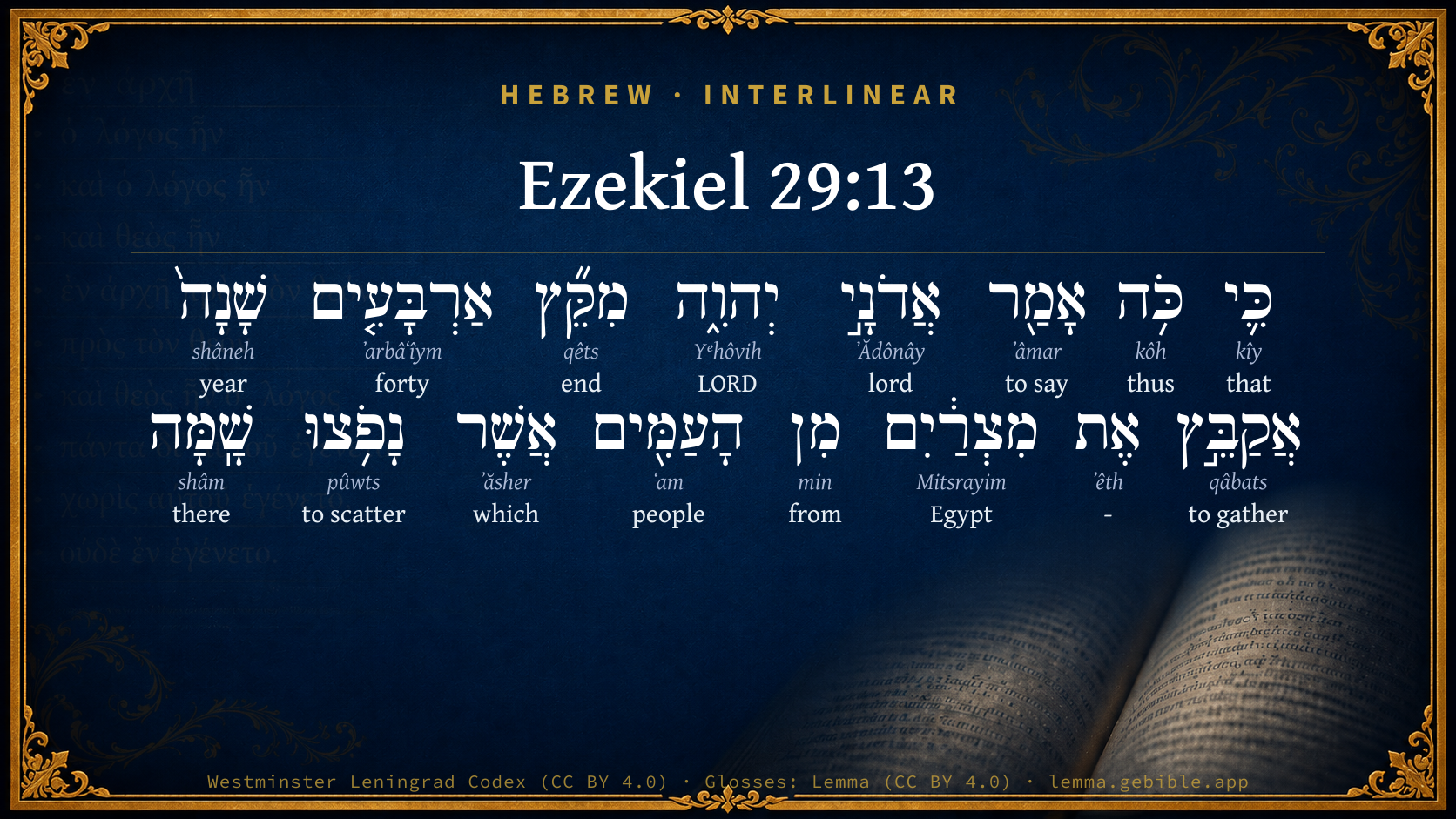
Hebrew (Westminster Leningrad Codex) Ezekiel 29:13 appears in the Hebrew Old Testament. The text above is from the Westminster Leningrad Codex. Each word links to its Strong’s number, a concise gloss, and parsing drawn from the Open Scriptures Hebrew Bible morphology. Click any word for its full Brown-Driver-Briggs (BDB) entry.
Download image
Cite this verse

Ezekiel 29:13 (World English Bible). Public Domain. Lemma interlinear Bible study tool, https://lemma.gebible.app/v/ezekiel/29/13.

Show BibTeX & RIS
BibTeX
RIS
English Translation
For thus says the Lord Yahweh: At the end of forty years will I gather the Egyptians from the peoples where they were scattered;
World English Bible · Public Domain
Download a study sheet

One document with this verse’s original text, its word-by-word gloss line, the meaning frame, cross-references with their text, attributed commentary, and full source and license credits — printable, and it pastes into notes with its structure intact.

This verse Autodidact and up

Study sheet (.html) Plain text (.txt)

A passage Seminary Student

Up to 50 verses in one chapter. A passage sheet keeps up to 6 commentary sources and 12 cross-references per verse, in the order this page ranks them, and says so on the sheet whenever that leaves anything out. Ask for a single verse and you get the Autodidact verse sheet above.

Everything on this page stays free to read, with no account — the sheet is a download of what is already on screen, not access to it.

Want to remove ads? Support Godless Engineer
Compare translations 3

The same verse in 3 English versions, stacked beneath the original-language interlinear above. Click any original word for its lexicon entry.

Each is an independent rendering of the whole verse — the interlinear is not word-aligned to these translations.

Highlighted words mark where these versions differ — a whole-verse word diff, not a word-by-word alignment.

  • World English Bible Public Domain
    For thus says the Lord Yahweh: At the end of forty years will I gather the Egyptians from the peoples where they were scattered;
  • King James Version Public Domain
    Yet thus saith the Lord GOD; At the end of forty years will I gather the Egyptians from the people whither they were scattered:
  • unfoldingWord Literal Text CC BY-SA 4.0
    For the Lord Yahweh says this: At the end of forty years I will gather Egypt from the peoples among whom they were scattered.

unfoldingWord Literal Text — © unfoldingWord, licensed CC BY-SA 4.0. Word-aligned USFM3 via Door43 (git.door43.org/unfoldingWord/en_ult).

Versions to compare (up to 4)

3 of 4 selected

Show all 18 translations

Every available English version of this verse, each an independent rendering of the whole verse.

  • World English Bible Public Domain
    For thus says the Lord Yahweh: At the end of forty years will I gather the Egyptians from the peoples where they were scattered;
  • Berean Standard Bible Public Domain
    For this is what the Lord GOD says: At the end of forty years I will gather the Egyptians from the nations to which they were scattered.
  • Majority Standard Bible Public Domain
    For this is what the Lord GOD says: At the end of forty years I will gather the Egyptians from the nations to which they were scattered.
  • King James Version Public Domain
    Yet thus saith the Lord GOD; At the end of forty years will I gather the Egyptians from the people whither they were scattered:
  • American Standard Version (1901) Public Domain
    For thus saith the Lord Jehovah: At the end of forty years will I gather the Egyptians from the peoples whither they were scattered;
  • Revised Version (1885) Public Domain
    For thus saith the Lord GOD: At the end of forty years will I gather the Egyptians from the peoples whither they were scattered:
  • Geneva Bible (1599) Public Domain
    Yet thus saieth the Lord God, At the end of fourtie yeeres will I gather the Egyptians from the people, where they were scattered,
  • Douay-Rheims (1899) Public Domain
    For thus saith the Lord God: At the end of forty years I will gather the Egyptians from the people among whom they had been scattered.
  • Young's Literal Translation Public Domain
    But thus said the Lord Jehovah: At the end of forty years I gather the Egyptians Out of the peoples whither they have been scattered,
  • Literal Standard Version CC BY-SA 4.0
    But thus said Lord YHWH: At the end of forty years I gather the Egyptians || Out of the peoples to where they have been scattered,
  • Unlocked Literal Bible CC BY-SA 4.0
    For the Lord Yahweh says this: At the end of forty years I will gather Egypt from the peoples among whom they were scattered.
  • unfoldingWord Literal Text CC BY-SA 4.0
    For the Lord Yahweh says this: At the end of forty years I will gather Egypt from the peoples among whom they were scattered.
  • Darby Bible Public Domain
    Yet thus saith the Lord Jehovah: At the end of forty years will I gather the Egyptians from the peoples whither they were scattered;
  • World Messianic Bible Public Domain
    “‘For the Lord GOD says: “At the end of forty years I will gather the Egyptians from the peoples where they were scattered.
  • Webster's Bible Public Domain
    Yet thus saith the Lord GOD; At the end of forty years will I gather the Egyptians from the people whither they were scattered:
  • Free Bible Version CC BY-SA 4.0
    However, this is what the Lord God says: After forty years I will gather the Egyptians from the different countries where they were scattered.
  • Bible in Basic English Public Domain
    For this is what the Lord has said: At the end of forty years I will get the Egyptians together from the peoples where they have gone in flight:
  • JPS Tanakh (1917) Public Domain
    For thus saith the Lord GOD: At the end of forty years will I gather the Egyptians from the peoples whither they were scattered;

Literal Standard Version (2020), Covenant Press — licensed CC BY-SA 4.0. Text via the HelloAO Bible API (eBible.org). Unlocked Literal Bible (unfoldingWord) — licensed CC BY-SA 4.0. Text via the HelloAO Bible API (eBible.org). unfoldingWord Literal Text — © unfoldingWord, licensed CC BY-SA 4.0. Word-aligned USFM3 via Door43 (git.door43.org/unfoldingWord/en_ult). Free Bible Version, Dr. Jonathan Gallagher — licensed CC BY-SA 4.0. Text via the HelloAO Bible API (eBible.org).

Word by word

More ways to search: Search by grammar → Find every occurrence → Compare this word →

Practice this passage: Drill this verse → Learn its vocabulary →

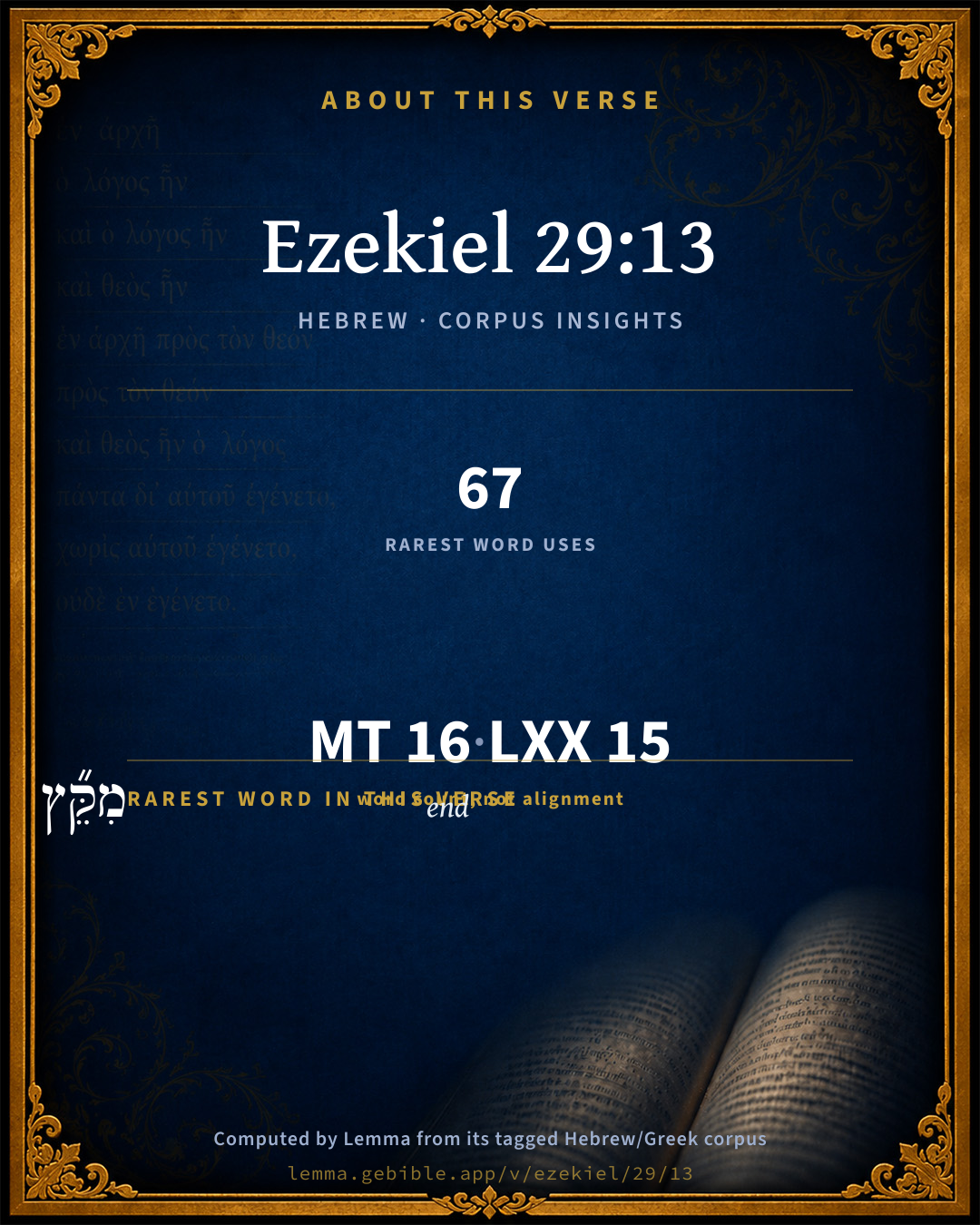
מִקֵּ֞ץ
qêts
H7093
“from · end of”
Preposition + Noun, Common, Masculine, Singular, Construct
Part of Speech
Preposition + Noun
Type
Common
Gender
Masculine
Number
Singular
State
Construct
Full BDB Definition

Origin: contracted from H7112 , an extremity

TWOT: 2060a

end - end, at the end of (of time) - end (of space)
  1. כִּ֛י kîy H3588 “that” Conjunction
  2. כֹּ֥ה kôh H3541 “thus” Adverb
  3. אָמַ֖ר ʼâmar H559 “to say” Verb, Qal, Perfect, 3rd Person, Masculine, Singular
  4. אֲדֹנָ֣י ʼĂdônây H136 “Lord · my” Noun, Common, Masculine, Plural, Construct + Suffix, Personal, 1st Person, Common, Singular
  5. יְהוִ֑ה Yᵉhôvih H3069 “LORD” Noun, Proper
  6. אַרְבָּעִ֤ים ʼarbâʻîym H705 “forty” Adjective, Cardinal number, Both, Plural, Absolute
  7. שָׁנָה֙ shâneh H8141 “year” Noun, Common, Feminine, Singular, Absolute
  8. אֲקַבֵּ֣ץ qâbats H6908 “to gather” Verb, Piel, Imperfect, 1st Person, Common, Singular
  9. אֶת ʼêth H853 “-” Particle, Direct Object
  10. מִצְרַ֔יִם Mitsrayim H4714 “Egypt” Noun, Proper
  11. מִן min H4480 “from” Preposition
  12. הָעַמִּ֖ים ʻam H5971 “the · peoples” Particle, Definite Article + Noun, Common, Masculine, Plural, Absolute
  13. אֲשֶׁר ʼăsher H834 “which” Particle, Relative
  14. נָפֹ֥צוּ pûwts H6327 “to scatter” Verb, Niphal, Perfect, 3rd Person, Common, Plural
  15. שָֽׁמָּה shâm H8033 “there · toward” Adverb + Suffix, Demonstrative

About this verse

These counts appear in no published source. They are computed here, from the morphology-tagged text and Lemma’s own curated glosses. What Lemma adds →

16
words
16
distinct lemmas
Prophets
section

Grammatical profile

  • 3 verbs
  • 6 nouns
  • 1 adjective
  • 1 preposition
  • 1 conjunction
  • 2 adverbs
  • 2 particles

Verb forms

  • אָמַ֖ר Qal · Perfect
  • אֲקַבֵּ֣ץ Piel · Imperfect
  • נָפֹ֥צוּ Niphal · Perfect

Hebrew & Septuagint length

In English translation the verse runs 24 words from the Hebrew and 21 from the Septuagint (LXX English) — closely comparable.

A rough comparison of the two English renderings, which tokenize alike — not a word-level alignment.

Word counts can differ between the Hebrew and the Greek without any difference in meaning — e.g. the Hebrew direct-object marker אֵת has no separate Greek word, and Greek often adds the article ὁ.

In the original languages it is 16 Hebrew tokens and 15 Greek tokens — but the two are counted differently (Hebrew bundles its prefixes and suffixes into one token; the Greek is in lemma form), so that isn’t a like-for-like length.

Cross-references

2

Topical passages linked to Ezekiel 29:13 in the Treasury of Scripture Knowledge — connected by theme and wording, ordered by reader-vote popularity; previews shown in the World English Bible.

  • Isaiah 19:22 Yahweh will strike Egypt, smiting and healing; and they shall return to Yahweh, and he will be entreated of them, and will heal them.
  • Jeremiah 46:26 and I will deliver them into the hand of those who seek their lives, and into the hand of Nebuchadrezzar king of Babylon, and into the hand of his servants; and afterwards it shall be inhabited, as in the days of old, says Yahweh.

Cross-references courtesy of OpenBible.info (CC BY 4.0).

Hebrew and Greek witnesses Masoretic Hebrew ↔ Greek Septuagint

The same verse in the two great witnesses to the Old Testament, shown verse-for-verse.

These are two independent witnesses, not word-aligned to each other, and the Septuagint is shown in lemma (dictionary) form.

Hebrew Ezekiel 29:13 Masoretic · Westminster Leningrad Codex

כִּ֛י כֹּ֥ה אָמַ֖ר אֲדֹנָ֣י יְהוִ֑ה מִקֵּ֞ץ אַרְבָּעִ֤ים שָׁנָה֙ אֲקַבֵּ֣ץ אֶת מִצְרַ֔יִם מִן הָעַמִּ֖ים אֲשֶׁר נָפֹ֥צוּ שָֽׁמָּה

For thus says the Lord Yahweh: At the end of forty years will I gather the Egyptians from the peoples where they were scattered;

World English Bible · Public Domain

Greek LXX Ezekiel 29:13 Septuagint · lemma form

ὅδε λέγω κύριος μετά τεσσαράκοντα ἔτος συνἄγω ὁ αἰγύπτιος ἀπό ὁ ἔθνος ὅς διασκορπίζω ἐκεῖ

Thus says the Lord; After forty years I will gather the Egyptians from the nations among whom they have been scattered;

LXX2012 (modern English Septuagint) · Public Domain

Hebrew: Westminster Leningrad Codex (CC BY 4.0). Greek: Septuagint (public domain); English from LXX2012 (modern English Septuagint) (Public Domain). How the Septuagint differs from the Hebrew →

Targum (Aramaic paraphrase)

1

The Targum is the ancient Jewish Aramaic paraphrase of the Hebrew Scriptures — an interpretive translation, not the Hebrew text itself. Onkelos (literal) and Pseudo-Jonathan (expansive) render the Torah, and Jonathan the Prophets. Coverage is partial: where no permissively-licensed English translation exists for a verse, only the Aramaic is shown. This is verse-level text, not a word-by-word alignment to the Hebrew.

  1. Targum Jonathan Prophets (Joshua–Malachi)
    אֲרֵי כִדְנַן אֲמַר יְיָ אֱלֹהִים מִסוֹף אַרְבְּעִין שְׁנִין אַכְנֵישׁ יַת מִצְרָאֵי מִבֵּינֵי עַמְמַיָא דְאִתְבַּדָרוּ לְתַמָן:

    (no public-domain English translation for this verse)

    Targum Jonathan — Aramaic: “Mikraot Gedolot” (public domain). English: “Sefaria Community Translation” (CC0 1.0 (public-domain dedication)); “London "Chaldee Paraphrase," 1871” (public domain). Text via Sefaria.

Commentary

Notes on Ezekiel 29:13 from classic Christian and Jewish commentators (each source and its license shown beneath its notes). The classic Christian expositions comment on the surrounding passage and are grouped to its opening verse, so a note may address several verses; the Jewish commentaries on the Tanakh (Rashi and others) are per-verse, so they appear only where the commentator wrote on this verse.

Lemma curates 59 commentaries, every one of them public domain or Creative Commons licensed, each selected and text-cleaned for this edition rather than reprinted as found. About our sources →

Trapp's Complete Commentary

John Trapp

Eze 29:13 Yet thus saith the Lord GOD; At the end of forty years will I gather the Egyptians from the people whither they were scattered:

Ver. 13. Will I gather the Egyptians.] God loveth to help men that are forsaken of their hopes. Cyrus sent them home likely about that time that he took Babylon; and his son Cambyses had somewhat to do to subdue them, so high they were soon grown and headstrong. Humbled they were, but not humble; low, but not lowly.

John Trapp, A Commentary or Exposition upon All the Books of the Old and New Testament (1647–1656) — public domain. Text from a community e-Sword module.

Jamieson, Fausset & Brown

Robert Jamieson, A. R. Fausset & David Brown

(Jer 46:26).

Jamieson, Fausset & Brown — Commentary Critical and Explanatory on the Whole Bible (1871) — public domain (CC PDM 1.0). Text via the HelloAO Bible API.

Adam Clarke's Commentary

Verse 13. Will I gather the Egyptians] It is probable that Cyrus gave permission to the Egyptians brought to Babylon by Nebuchadnezzar, to return to their own country. And if we reckon from the commencement of the war against Pharaoh-hophra by Nebuchadnezzar, to the third or fourth year of Cyrus, the term will be about forty years.

Adam Clarke's Commentary on the Bible (1810–1826) — public domain. Text from a community e-Sword/MySword module.

Ellicott's Commentary for English Readers

(13) At the end of forty years.—See Note on Eze_29:11.

A Bible Commentary for English Readers, edited by Charles John Ellicott (1878–1897) — public domain. Text from a community e-Sword module.

The Cambridge Bible for Schools and Colleges

gen. ed. J. J. S. Perowne

13. After forty years of desolation Egypt shall be restored, though only to the rank of a humble kingdom. It shall no more rule over the nations (Eze_29:15); and no more be a confidence to the house of Israel, seducing them away from trust in Jehovah alone.

Yet thus saith] For thus. Ezekiel considers forty years—a general expression like Jeremiah’s seventy years—to be the period of Babylonian supremacy in the world. At the end of this period a change in the aspect of the world shall supervene under Jehovah’s guidance; Israel will be restored (ch. Eze_4:6), and the other nations subject to Babylon shall be reinstated. Egypt shall be restored though only to be a humble state in comparison of her former greatness. For people peoples.

The Cambridge Bible for Schools and Colleges (gen. ed. J. J. S. Perowne; Cambridge University Press, 1878–1918) — public domain. Text from a community e-Sword module.

John Gill's Exposition

Yet thus saith the Lord God, at the end of forty years,.... Reckoning from its devastation by Nebuchadnezzar to the taking of Babylon by Cyrus:

will I gather the Egyptians from the people whither they were scattered; from Babylon, and other places; Cyrus very probably being stirred up by the Lord to proclaim liberty to the Egyptians, as he did to the Jews, to return to their own land; and at the same time restored Amasis to the quiet possession of his kingdom, who must be still alive; since, according to Diodorus Siculus (w), he reigned fifty five years; though, according to Herodotus (x), he reigned but forty four years.

(w) Bibliothec. l. 1. p. 62. Ed. Rhodoman. (x) Thalia, sive l. 3. c. 10.

John Gill's Exposition of the Whole Bible (1746–1763) — public domain (CC PDM 1.0). Text via the HelloAO Bible API.

Albert Barnes' Notes on the Bible

A similar respite was promised to Moab Jer 48:47, to Ammon Jer 49:6, and to Tyre Isa 23:15.

Albert Barnes' Notes on the Bible (1834–1885) — public domain. Text from a community e-Sword/MySword module.

Matthew Poole's English Annotations

Forty years: see Eze 29:11.

Gather, by some eminent acts of Providence toward them, perhaps inclining the generous mind of Cyrus to favour them, and proclaim liberty to them, and under the government of old Areasis, that reigned fifty-five years, saith Diodorus, some ten or twelve of which might be under Cyrus, who had a kindness for the old man; and he, to repair the wastes, obtained and published great privileges for the new replanters.

The people; Babylon, Ethiopia, Libya, and other countries, that can be but conjectured to have been receptacles for them.

Matthew Poole's English Annotations on the Holy Bible (1683–1685) — public domain. Text from a community e-Sword/MySword module.

The Pulpit Commentary

At the end of forty years. The restoration described may probably be connected with the policy of the Persian kings. There may have been a parallel, as regards Egypt, to the return of the Jewish exiles under Cyrus and his successors, though it has not left its mark on history.

Vers. 13-16. Light out of darkness,

The case of Egypt was very different from that of Tyre. For inscrutable reasons, Tyre was destined to destruction, and Egypt to recovery and revival. The destruction of one city occupying a rock upon the seashore was the extinction of Tyre. Egypt was a vast territory, peopled by a widespread and prolific race; it might be humiliated, but could not easily be politically annihilated. The fortunes of the land of the Pharaohs were gloomy in the immediate future; but the remoter prospect was not without relief and even brightness.

I THE PROMISED RECOVERY AND RESTORATION. The prophet was instructed to foretell, first Egypt"s defeat, dispersion, and captivity, and then Egypt"s restoration to the land of Pathros, the land of their origin. We are not told, and we do not know how large was the section of the army or of the inhabitants of the country affected by these predictions. The fact only concerns us, and we recognize that in the midst of judgment the Lord remembered mercy, that banishment was not perpetual, and that the national, life was appointed for revival.

II THE QUALIFICATION AND TEMPERING OF THE BOON THUS GRACIOUSLY VOUCHSAFED. Lest Egypt should be again puffed up, the prophet was directed to utter an assurance that the nation, though spared utter humiliation and extinction, should nevertheless never resume its former greatness. Two points are expressly mentioned.

1. The restored Egypt should be "a base kingdom." It should not take the rank among the nations which it had been entitled to hold aforetime. Its power should be crippled, and its splendor should be dimmed.

2. It should no more bear rule over other nations. Such had in former times been subject to its authority, as dependents, subjects, and tributaries. Egypt"s might should no longer avail to reduce surrounding peoples to subjection.

III THE MORAL AND POLITICAL LESSONS OF THE PROVIDENTIAL ACTION OF GOD TOWARDS EGYPT. These also are very explicitly stated by Ezekiel.

1. Israel should no more look to Egypt for aid, as, in defiance of express warnings from Jehovah, she had been wont to do in times past.

2. Both Israel and Egypt should know that the Lord is God. This was a truth with which Israel was speculatively well acquainted, but which Israel was too ready to forget. Egypt had not enjoyed the same opportunity of learning the wisdom, the authority, the compassion, of Jehovah. Yet lessons may be learnt in adversity which prosperity cannot teach. Egypt was taught by stern discipline; but some impression was doubtless made. It was not for Israel"s sake alone that Egypt"s calamities were permitted; but that the smitten nation might bow beneath the rod, and acknowledge the justice of the King of men. T.

The Pulpit Commentary (1880–1919), ed. H.D.M. Spence-Jones & Joseph S. Exell — public domain. Text from a community e-Sword module.

unfoldingWord translationNotes

Door43 World Missions Community

General Information:

Yahweh continues giving Ezekiel his message to Pharaoh.

I will gather Egypt

Here "Egypt" is a metonym for the people of Egypt, and "gather" is a metaphor for causing them to return to Egypt. AT: "I will cause the people of Egypt to return to Egypt" (See: Metonymy and Metaphor)

among whom they were scattered

This can be translated in active form. AT: "among whom I scattered them" (See: Active or Passive)

I will restore the fortunes of Egypt

The phrase "fortunes of Egypt" is a metaphor for the people of Egypt who had been taken away to other countries. AT: "I will bring back the people of Egypt" (See: Metaphor)

the region of Pathros

the southern part of Egypt between the Delta and the land of Cush. This is also called Upper Egypt. (See: How to Translate Names)

a lowly kingdom

Here "lowly" represents unimportant. AT: "an unimportant kingdom" (See: Metaphor)

translationWords

Lord Yahweh

people group

restore

lowly

kingdom

unfoldingWord translationNotes — © Distant Shores Media and the Door43 World Missions Community, licensed CC BY-SA 4.0. Source: git.door43.org/Door43/en_tn.

Lesson kit

Teaching starters — assembled from the data on this page, not authored interpretation. Every prompt links to the verse data it draws on. Edit before teaching.

Ezekiel, in the Prophets, opens this verse with 16 words (16 distinct Hebrew lemmas). Its most distinctive word is qêts (“end”). A historical commentator’s framing appears above. Read the whole chapter for the surrounding context.

Discussion questions

  1. The word qêts carries the sense “end.” How does it shape the verse?
  2. Isaiah 19:22 shares this passage’s theme. How do the two illuminate each other?
  3. These translations render this verse differently. What is at stake in choosing one wording over another?
  4. The verb «אָמַ֖ר» is Qal Perfect. How does its form color the action?
  5. Reading how Trapp's Complete Commentary and Jamieson, Fausset & Brown read this verse, where do the two commentators agree and where do they part?

Things to notice

Reading settings

Reading text

Shown beneath each verse's original-language words.

Old Testament
Old Testament edition

Read the OT as the Masoretic Hebrew (MT) or the Greek Septuagint (LXX).

English shown for the Greek Septuagint (in the Hebrew ↔ Greek comparison).

Comparing translations? Open the Compare panel on any verse page to stack up to four side by side.