
Ezekiel 32:16

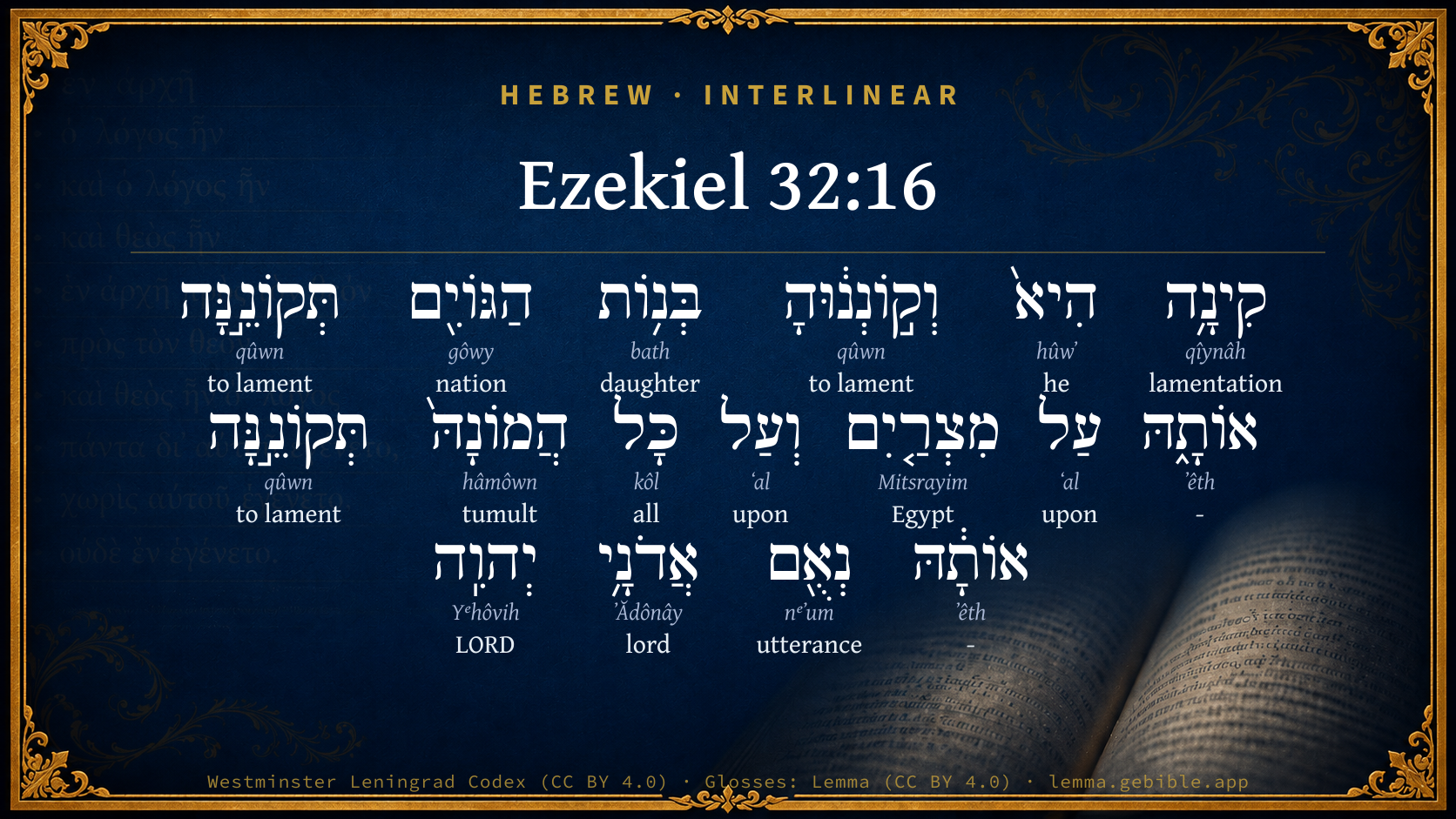
Hebrew (Westminster Leningrad Codex) Ezekiel 32:16 appears in the Hebrew Old Testament. The text above is from the Westminster Leningrad Codex. Each word links to its Strong’s number, a concise gloss, and parsing drawn from the Open Scriptures Hebrew Bible morphology. Click any word for its full Brown-Driver-Briggs (BDB) entry.
Download image
Cite this verse

Ezekiel 32:16 (World English Bible). Public Domain. Lemma interlinear Bible study tool, https://lemma.gebible.app/v/ezekiel/32/16.

Show BibTeX & RIS
BibTeX
RIS
English Translation
This is the lamentation with which they shall lament; the daughters of the nations shall lament therewith; over Egypt, and over all her multitude, shall they lament therewith, says the Lord Yahweh.
World English Bible · Public Domain
Download a study sheet

One document with this verse’s original text, its word-by-word gloss line, the meaning frame, cross-references with their text, attributed commentary, and full source and license credits — printable, and it pastes into notes with its structure intact.

This verse Autodidact and up

Study sheet (.html) Plain text (.txt)

A passage Seminary Student

Up to 50 verses in one chapter. A passage sheet keeps up to 6 commentary sources and 12 cross-references per verse, in the order this page ranks them, and says so on the sheet whenever that leaves anything out. Ask for a single verse and you get the Autodidact verse sheet above.

Everything on this page stays free to read, with no account — the sheet is a download of what is already on screen, not access to it.

Want to remove ads? Support Godless Engineer
Compare translations 3

The same verse in 3 English versions, stacked beneath the original-language interlinear above. Click any original word for its lexicon entry.

Each is an independent rendering of the whole verse — the interlinear is not word-aligned to these translations.

Highlighted words mark where these versions differ — a whole-verse word diff, not a word-by-word alignment.

  • World English Bible Public Domain
    This is the lamentation with which they shall lament; the daughters of the nations shall lament therewith; over Egypt, and over all her multitude, shall they lament therewith, says the Lord Yahweh.
  • King James Version Public Domain
    This is the lamentation wherewith they shall lament her: the daughters of the nations shall lament her: they shall lament for her, even for Egypt, and for all her multitude, saith the Lord GOD.
  • unfoldingWord Literal Text CC BY-SA 4.0
    There will be a lament; the daughters of the nations will lament over her; they will lament over Egypt, over all her multitudes they will lament—this is the Lord Yahweh’s declaration.’”

unfoldingWord Literal Text — © unfoldingWord, licensed CC BY-SA 4.0. Word-aligned USFM3 via Door43 (git.door43.org/unfoldingWord/en_ult).

Versions to compare (up to 4)

3 of 4 selected

Show all 18 translations

Every available English version of this verse, each an independent rendering of the whole verse.

  • World English Bible Public Domain
    This is the lamentation with which they shall lament; the daughters of the nations shall lament therewith; over Egypt, and over all her multitude, shall they lament therewith, says the Lord Yahweh.
  • Berean Standard Bible Public Domain
    This is the lament they will chant for her; the daughters of the nations will chant it. Over Egypt and all her multitudes they will chant it, declares the Lord GOD.”
  • Majority Standard Bible Public Domain
    This is the lament they will chant for her; the daughters of the nations will chant it. Over Egypt and all her multitudes they will chant it, declares the Lord GOD.”
  • King James Version Public Domain
    This is the lamentation wherewith they shall lament her: the daughters of the nations shall lament her: they shall lament for her, even for Egypt, and for all her multitude, saith the Lord GOD.
  • American Standard Version (1901) Public Domain
    This is the lamentation wherewith they shall lament; the daughters of the nations shall lament therewith; over Egypt, and over all her multitude, shall they lament therewith, saith the Lord Jehovah.
  • Revised Version (1885) Public Domain
    This is the lamentation wherewith they shall lament; the daughters of the nations shall lament therewith: for Egypt, and for all her multitude, shall they lament therewith, saith the Lord GOD.
  • Geneva Bible (1599) Public Domain
    This is the mourning wherewith they shall lament her: the daughters of the nations shall lament her: they shall lament for Egypt, and for all her multitude, sayeth the Lord God.
  • Douay-Rheims (1899) Public Domain
    This is the lamentation, and they shall lament therewith: the daughters of the nations shall lament therewith: for Egypt, and for the multitude thereof they shall lament therewith, saith the Lord God.
  • Young's Literal Translation Public Domain
    A lamentation it `is', and they have lamented her, Daughters of the nations do lament her, For Egypt, and for all her multitude, they lament her, An affirmation of the Lord Jehovah.'
  • Literal Standard Version CC BY-SA 4.0
    It [is] a lamentation, and they have lamented her, || Daughters of the nations lament her, || For Egypt, and for all her multitude, they lament her, || A declaration of Lord YHWH.”
  • Unlocked Literal Bible CC BY-SA 4.0
    There will be a lament; the daughters of the nations will lament over her; they will lament over Egypt, over all her multitudes they will lament—this is the Lord Yahweh's declaration.'”
  • unfoldingWord Literal Text CC BY-SA 4.0
    There will be a lament; the daughters of the nations will lament over her; they will lament over Egypt, over all her multitudes they will lament—this is the Lord Yahweh’s declaration.’”
  • Darby Bible Public Domain
    It is a lamentation, and [thus] they shall lament her: the daughters of the nations shall say it in lamenting; they shall say it in lamenting over Egypt and over all her multitude, saith the Lord Jehovah.
  • World Messianic Bible Public Domain
    “‘“This is the lamentation with which they will lament. The daughters of the nations will lament with this. They will lament with it over Egypt, and over all her multitude,” says the Lord GOD.’”
  • Webster's Bible Public Domain
    This is the lamentation with which they shall lament her: the daughters of the nations shall lament her: they shall lament for her, even for Egypt, and for all her multitude, saith the Lord GOD.
  • Free Bible Version CC BY-SA 4.0
    This is the funeral song that foreign women will sing. They will sing it in mourning over Egypt and all its many people, declares the Lord God.”
  • Bible in Basic English Public Domain
    It is a song of grief, and people will give voice to it, the daughters of the nations will give voice to it, even for Egypt and all her people, says the Lord.
  • JPS Tanakh (1917) Public Domain
    This is the lamentation wherewith they shall lament; the daughters of the nations shall lament therewith; for Egypt, and for all her multitude, shall they lament therewith, saith the Lord GOD.'

Literal Standard Version (2020), Covenant Press — licensed CC BY-SA 4.0. Text via the HelloAO Bible API (eBible.org). Unlocked Literal Bible (unfoldingWord) — licensed CC BY-SA 4.0. Text via the HelloAO Bible API (eBible.org). unfoldingWord Literal Text — © unfoldingWord, licensed CC BY-SA 4.0. Word-aligned USFM3 via Door43 (git.door43.org/unfoldingWord/en_ult). Free Bible Version, Dr. Jonathan Gallagher — licensed CC BY-SA 4.0. Text via the HelloAO Bible API (eBible.org).

Word by word

More ways to search: Search by grammar → Find every occurrence → Compare this word →

Practice this passage: Drill this verse → Learn its vocabulary →

וְק֣וֹנְנ֔וּהָ
qûwn
H6969
“and · to lament · her”
Conjunction + Verb, Polel, Sequential Perfect, 3rd Person, Common, Plural + Suffix, Personal, 3rd Person, Feminine, Singular
Part of Speech
Conjunction + Verb
Stem
Polel
Form
Sequential Perfect
Person
3rd Person
Gender
Common
Number
Plural
Full BDB Definition

Origin: a primitive root

TWOT: 2018

to chant a dirge, chant, wail, lament - (Polel) to lament
  1. קִינָ֥ה qîynâh H7015 “lamentation” Noun, Common, Feminine, Singular, Absolute
  2. הִיא֙ hûwʼ H1931 “he” Pronoun, Personal, 3rd Person, Feminine, Singular
  3. בְּנ֥וֹת bath H1323 “daughters of” Noun, Common, Feminine, Plural, Construct
  4. הַגּוֹיִ֖ם gôwy H1471 “the · nations” Particle, Definite Article + Noun, Common, Masculine, Plural, Absolute
  5. תְּקוֹנֵ֣נָּה qûwn H6969 “to lament” Verb, Polel, Imperfect, 3rd Person, Feminine, Plural
  6. אוֹתָ֑הּ ʼêth H853 “- · her” Particle, Direct Object + Suffix, Personal, 3rd Person, Feminine, Singular
  7. עַל ʻal H5921 “upon” Preposition
  8. מִצְרַ֤יִם Mitsrayim H4714 “Egypt” Noun, Proper
  9. וְעַל ʻal H5921 “and · upon” Conjunction + Preposition
  10. כָּל kôl H3605 “all of” Noun, Common, Masculine, Singular, Construct
  11. הֲמוֹנָהּ֙ hâmôwn H1995 “tumult · her” Noun, Common, Masculine, Singular, Construct + Suffix, Personal, 3rd Person, Feminine, Singular
  12. תְּקוֹנֵ֣נָּה qûwn H6969 “to lament” Verb, Polel, Imperfect, 3rd Person, Feminine, Plural
  13. אוֹתָ֔הּ ʼêth H853 “- · her” Particle, Direct Object + Suffix, Personal, 3rd Person, Feminine, Singular
  14. נְאֻ֖ם nᵉʼum H5002 “utterance of” Noun, Common, Masculine, Singular, Construct
  15. אֲדֹנָ֥י ʼĂdônây H136 “Lord · my” Noun, Common, Masculine, Plural, Construct + Suffix, Personal, 1st Person, Common, Singular
  16. יְהוִֽה Yᵉhôvih H3069 “LORD” Noun, Proper

About this verse

These counts appear in no published source. They are computed here, from the morphology-tagged text and Lemma’s own curated glosses. What Lemma adds →

17
words
13
distinct lemmas
Prophets
section

Notable vocabulary

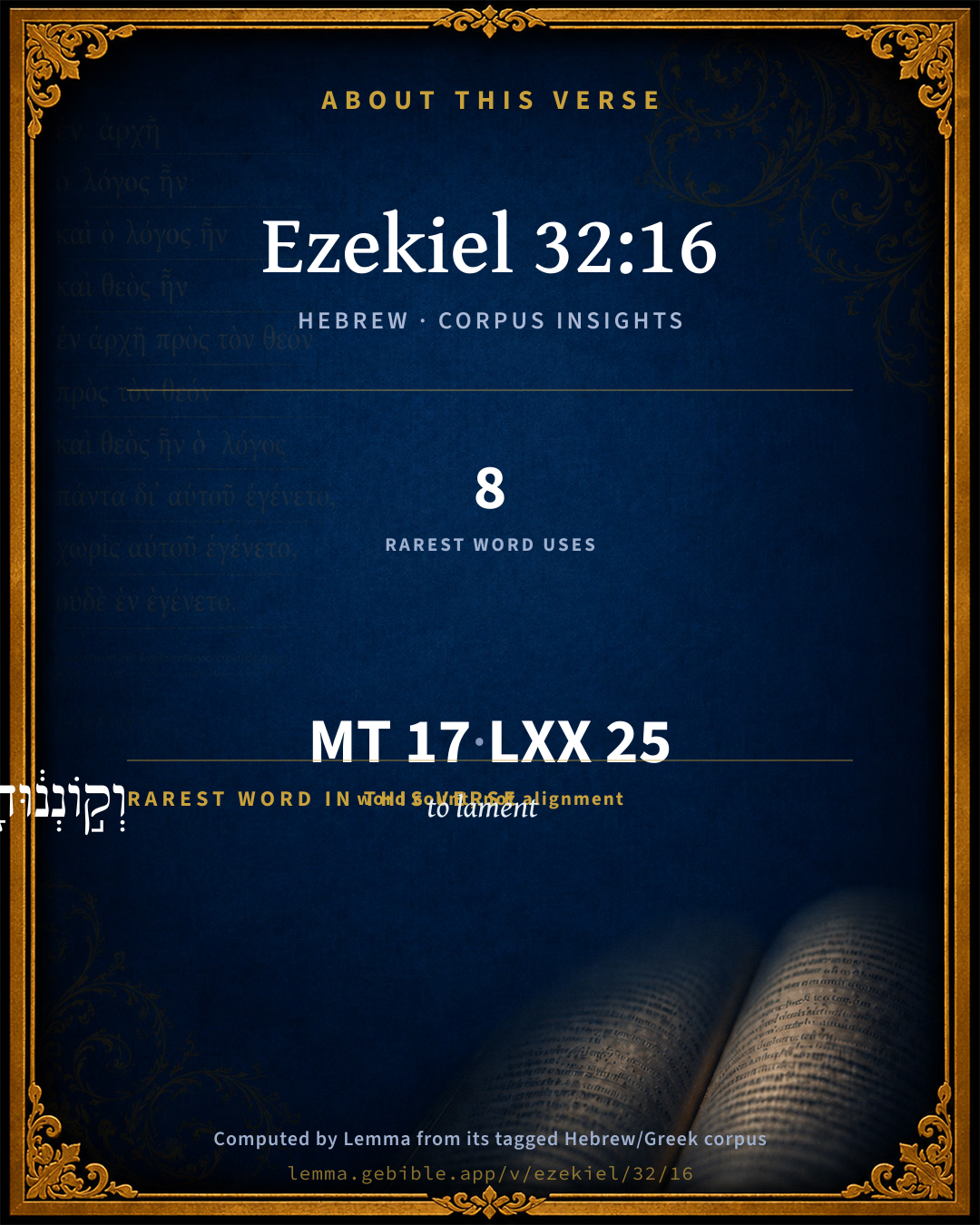
The rarest word here is וְק֣וֹנְנ֔וּהָ to lament H6969 — appearing just 8 times in the whole Hebrew Bible.

Shared distinctive vocabulary

וְק֣וֹנְנ֔וּהָ to lament H6969 occurs in 6 verses of the Hebrew Bible. Also found in:

Grammatical profile

  • 3 verbs
  • 9 nouns
  • 1 pronoun
  • 2 prepositions
  • 2 particles

Verb forms

  • וְק֣וֹנְנ֔וּהָ Polel · Sequential Perfect
  • תְּקוֹנֵ֣נָּה Polel · Imperfect
  • תְּקוֹנֵ֣נָּה Polel · Imperfect

Repetition

Words recur within this verse — often emphatic in Hebrew:

  • וְק֣וֹנְנ֔וּהָ to lament H6969 ×3
  • עַל upon H5921 ×2

Hebrew & Septuagint length

In English translation the verse runs 32 words from the Hebrew and 36 from the Septuagint (LXX English) — closely comparable.

A rough comparison of the two English renderings, which tokenize alike — not a word-level alignment.

Word counts can differ between the Hebrew and the Greek without any difference in meaning — e.g. the Hebrew direct-object marker אֵת has no separate Greek word, and Greek often adds the article ὁ.

In the original languages it is 17 Hebrew tokens and 25 Greek tokens — but the two are counted differently (Hebrew bundles its prefixes and suffixes into one token; the Greek is in lemma form), so that isn’t a like-for-like length.

Cross-references

6

Topical passages linked to Ezekiel 32:16 in the Treasury of Scripture Knowledge — connected by theme and wording, ordered by reader-vote popularity; previews shown in the World English Bible.

  • 2 Samuel 1:17 David lamented with this lamentation over Saul and over Jonathan his son
  • 2 Chronicles 35:25 Jeremiah lamented for Josiah: and all the singing men and singing women spoke of Josiah in their lamentations to this day; and they made them an ordinance in Israel: and, behold, they are written in the lamentations.
  • Ezekiel 26:17 They shall take up a lamentation over you, and tell you, How are you destroyed, who were inhabited by seafaring men, the renowned city, who was strong in the sea, she and her inhabitants, who caused their terror to be on all who lived there!
  • Ezekiel 32:2 Son of man, take up a lamentation over Pharaoh king of Egypt, and tell him, You were likened to a young lion of the nations: yet are you as a monster in the seas; and you did break forth with your rivers, and troubled the waters with your feet, and fouled their rivers.
  • 2 Samuel 3:33–34 The king lamented for Abner, and said, Should Abner die as a fool dies?
  • Jeremiah 9:17 Thus says Yahweh of Hosts, Consider you, and call for the mourning women, that they may come; and send for the skillful women, that they may come:

Cross-references courtesy of OpenBible.info (CC BY 4.0).

Hebrew and Greek witnesses Masoretic Hebrew ↔ Greek Septuagint

The same verse in the two great witnesses to the Old Testament, shown verse-for-verse.

These are two independent witnesses, not word-aligned to each other, and the Septuagint is shown in lemma (dictionary) form.

Hebrew Ezekiel 32:16 Masoretic · Westminster Leningrad Codex

קִינָ֥ה הִיא֙ וְק֣וֹנְנ֔וּהָ בְּנ֥וֹת הַגּוֹיִ֖ם תְּקוֹנֵ֣נָּה אוֹתָ֑הּ עַל מִצְרַ֤יִם וְעַל כָּל הֲמוֹנָהּ֙ תְּקוֹנֵ֣נָּה אוֹתָ֔הּ נְאֻ֖ם אֲדֹנָ֥י יְהוִֽה

This is the lamentation with which they shall lament; the daughters of the nations shall lament therewith; over Egypt, and over all her multitude, shall they lament therewith, says the Lord Yahweh.

World English Bible · Public Domain

Greek LXX Ezekiel 32:16 Septuagint · lemma form

θρῆνος εἰμί καί θρηνέω αὐτός καί ὁ θυγάτηρ ὁ ἔθνος θρηνέω αὐτός ἐπί αἴγυπτος καί ἐπί πᾶς ὁ ἰσχύς αὐτός θρηνέω αὐτός λέγω κύριος κύριος

There is a lamentation, and you shall utter it; and the daughters of the nations shall utter it, even for Egypt, and they shall mourn for it over all the strength thereof, says the Lord God.

LXX2012 (modern English Septuagint) · Public Domain

On this verse, The Cambridge Bible for Schools and Colleges discusses the Septuagint’s reading. Read the note in Commentary ↓

Hebrew: Westminster Leningrad Codex (CC BY 4.0). Greek: Septuagint (public domain); English from LXX2012 (modern English Septuagint) (Public Domain). How the Septuagint differs from the Hebrew →

Targum (Aramaic paraphrase)

1

The Targum is the ancient Jewish Aramaic paraphrase of the Hebrew Scriptures — an interpretive translation, not the Hebrew text itself. Onkelos (literal) and Pseudo-Jonathan (expansive) render the Torah, and Jonathan the Prophets. Coverage is partial: where no permissively-licensed English translation exists for a verse, only the Aramaic is shown. This is verse-level text, not a word-by-word alignment to the Hebrew.

  1. Targum Jonathan Prophets (Joshua–Malachi)
    אֲמַר נְבִיָא אִלְיָא הִיא נְבוּאֲתָה וּתְהֵי לְאִלְיָא כַּפְרָנֵי עַמְמַיָא יֵלְלוּן יָתָהּ עַל מִצְרַיִם וְעַל כָּל אִתְרְגוּשְׁתָּהּ יֵלִילוּן יָתָהּ אֲמַר יְיָ אֱלֹהִים:

    (no public-domain English translation for this verse)

    Targum Jonathan — Aramaic: “Mikraot Gedolot” (public domain). English: “Sefaria Community Translation” (CC0 1.0 (public-domain dedication)); “London "Chaldee Paraphrase," 1871” (public domain). Text via Sefaria.

Commentary

Notes on Ezekiel 32:16 from classic Christian and Jewish commentators (each source and its license shown beneath its notes). The classic Christian expositions comment on the surrounding passage and are grouped to its opening verse, so a note may address several verses; the Jewish commentaries on the Tanakh (Rashi and others) are per-verse, so they appear only where the commentator wrote on this verse.

Lemma curates 59 commentaries, every one of them public domain or Creative Commons licensed, each selected and text-cleaned for this edition rather than reprinted as found. About our sources →

Trapp's Complete Commentary

John Trapp

Eze 32:16 This [is] the lamentation wherewith they shall lament her: the daughters of the nations shall lament her: they shall lament for her, [even] for Egypt, and for all her multitude, saith the Lord GOD.

Ver. 16. This is the lamentation.] And this is the epilogue of this former prophecy; the latter followeth, being of the self-same argument - viz., a funeral dirge and exequies over Egypt.

John Trapp, A Commentary or Exposition upon All the Books of the Old and New Testament (1647–1656) — public domain. Text from a community e-Sword module.

Joseph Benson's Commentary

Eze 32:16. This is the lamentation wherewith they shall lament her — This is the substance of the lamentation, which may be properly used to bewail the calamities which Egypt shall suffer: see note on Eze 32:2. The daughters of the nations shall lament her — That is, the people of the neighbouring countries shall use such like words as these when they hear of Egypt’s calamities: thus the daughter of Zion and of Babylon signifies the inhabitants of those cities. This verse alludes to the mourning women, whose office it was to lament at funerals.

Joseph Benson's Commentary on the Old and New Testaments (1811–1818) — public domain. Text from a community e-Sword module.

Jamieson, Fausset & Brown

Robert Jamieson, A. R. Fausset & David Brown

As in Eze 19:14. This is a prophetical lamentation; yet so it shall come to pass [GROTIUS].

Jamieson, Fausset & Brown — Commentary Critical and Explanatory on the Whole Bible (1871) — public domain (CC PDM 1.0). Text via the HelloAO Bible API.

Ellicott's Commentary for English Readers

(16) Daughters of the nations is a common enough expression for the nations themselves, but is peculiarly appropriate in connection with a lamentation, since the formal mourning of the East was always performed by women.

A Bible Commentary for English Readers, edited by Charles John Ellicott (1878–1897) — public domain. Text from a community e-Sword module.

The Cambridge Bible for Schools and Colleges

gen. ed. J. J. S. Perowne

16. Lit. It is a lamentation and they shall chant it (LXX. thou shalt chant it); the daughters of the nations shall chant it; over Egypt and over all her multitude shall they chant it. The daughters of the nations, in Eze_32:18 the daughters of the famous nations, chant the dirge because professional wailers were chiefly women; cf. Jer_9:17, “call for the mourning women … and let them take up a wailing for us.”

The Cambridge Bible for Schools and Colleges (gen. ed. J. J. S. Perowne; Cambridge University Press, 1878–1918) — public domain. Text from a community e-Sword module.

John Gill's Exposition

This is the lamentation with which they shall lament her,.... The Egyptians themselves, or rather they that are after mentioned. The Targum is,

"the prophet said, a lamentation is this prophecy, and it shall be for a lamentation;''

he was bid at the beginning of it to take up a lamentation, and now at the end of it he pronounces it to be one, and that it should be sung as such:

the daughters of the nations shall lament for her; either literally understood, it being the business and custom of women to say or sing the funeral dirge, or the lamentation at the interment of the deceased; or figuratively, the inhabitants of other nations. So Ben Melech and the Targum,

"the villages of the people shall lament her'';

that is, the inhabitants of them, who were in alliance with Egypt, and under its protection:

they shall lament for her, even for Egypt, and for all her multitude; for the desolation of the land, and for the vast numbers of people that should be slain with the sword, or carried captive:

saith the Lord God; which is added for the confirmation of it; for what he has spoken shall be done.

John Gill's Exposition of the Whole Bible (1746–1763) — public domain (CC PDM 1.0). Text via the HelloAO Bible API.

Albert Barnes' Notes on the Bible

Daughters of the nations - Pagan kingdoms.

Albert Barnes' Notes on the Bible (1834–1885) — public domain. Text from a community e-Sword/MySword module.

Matthew Poole's English Annotations

This heavy, mournful, and sad account, which the prophet hath given of the state of Egypt,

is the lamentation, the funeral speech of this kingdom; for this, as a funeral oration, tells us what was their ancient glory, and what is now their miserable reproach and loss.

They shall lament; her friends, or the Egyptians themselves rather.

The daughters of the nations: this may be expository of the former, and tell us who they are that shall lament Egypt, the provinces and cities of their neighbouring nations; or literally, the daughters, the tender-hearted virgins and women abroad.

Even for Egypt; ruined Egypt.

All her multitude; the common people, many of whom suffered for what they could not prevent; a sort of people that were fitter to be pitied and spared, than to be robbed and slain, a sort of people none but unrelenting hearts could be harsh to or hasty with.

Matthew Poole's English Annotations on the Holy Bible (1683–1685) — public domain. Text from a community e-Sword/MySword module.

Whedon's Commentary on the Bible

Daniel D. Whedon

16. Davidson translates literally: It is a lamentation, and they shall chant it; the daughters of the nation shall chant it; over Egypt and over all her multitude shall they chant it. (Compare Jer_9:17.)

Daniel D. Whedon (gen. ed.), Commentary on the Old and New Testaments (1874–1909) — public domain. Text from a community e-Sword module.

The Pulpit Commentary

This is the lamentation, etc. The work of mourning for the dead was for the most part assigned to women (2Sa_1:24; Jer_9:17; 2Ch_35:25) and is therefore appropriately assigned to the daughters of the nations. He hears, as it were, their wailing over the fallen greatness of Egypt, even in the solitude of Tel-Abib.

The Pulpit Commentary (1880–1919), ed. H.D.M. Spence-Jones & Joseph S. Exell — public domain. Text from a community e-Sword module.

John Wesley's Explanatory Notes

This is the lamentation - This mournful account, which the prophet has given of Egypt.

John Wesley, Explanatory Notes Upon the Whole Bible (1754–1765) — public domain. Text via the GEBible commentary corpus.

Lesson kit

Teaching starters — assembled from the data on this page, not authored interpretation. Every prompt links to the verse data it draws on. Edit before teaching.

Ezekiel, in the Prophets, opens this verse with 17 words (13 distinct Hebrew lemmas). Its most distinctive word is qûwn (“to lament”). A historical commentator’s framing appears above. Read the whole chapter for the surrounding context.

Discussion questions

  1. The word qûwn carries the sense “to lament.” How does it shape the verse?
  2. How does 2 Samuel 1:17, which shares the word «to lament», read alongside this verse?
  3. What does the repetition of “to lament” (3× in this one verse) do in this verse?
  4. The translations on this page render this verse differently — a whole-verse word diff, not a word-by-word alignment. What might account for the different wordings?
  5. «וְק֣וֹנְנ֔וּהָ» is a Polel Sequential Perfect verb. How does that grammatical form shape the action described?
  6. Compare how Trapp's Complete Commentary and Joseph Benson's Commentary read this verse. Where do they agree or differ?

Things to notice

Reading settings

Reading text

Shown beneath each verse's original-language words.

Old Testament
Old Testament edition

Read the OT as the Masoretic Hebrew (MT) or the Greek Septuagint (LXX).

English shown for the Greek Septuagint (in the Hebrew ↔ Greek comparison).

Comparing translations? Open the Compare panel on any verse page to stack up to four side by side.