
Genesis 41:56

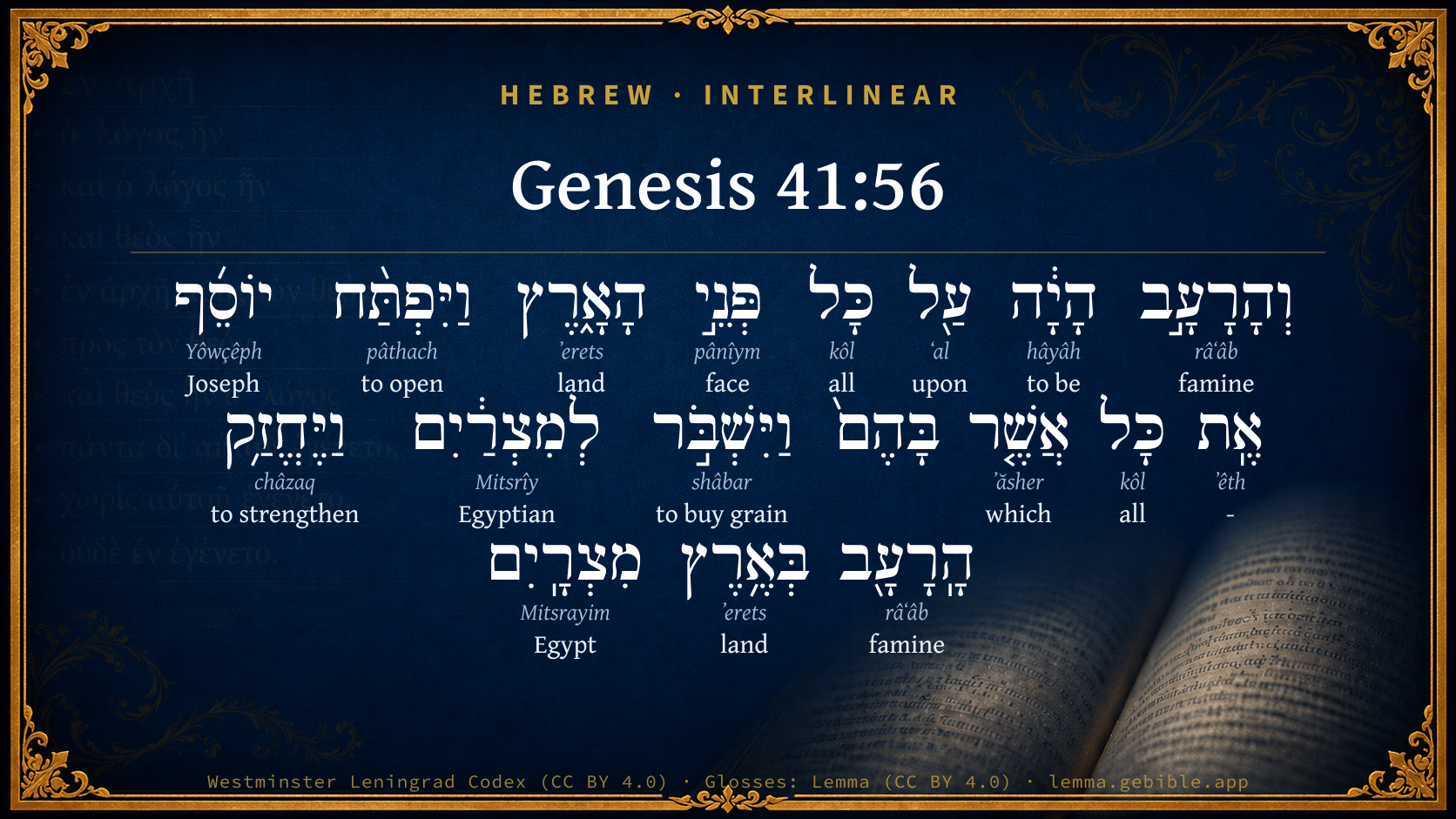
Hebrew (Westminster Leningrad Codex) Genesis 41:56 appears in the Hebrew Old Testament. The text above is from the Westminster Leningrad Codex. Each word links to its Strong’s number, a concise gloss, and parsing drawn from the Open Scriptures Hebrew Bible morphology. Click any word for its full Brown-Driver-Briggs (BDB) entry.
Download image
Cite this verse

Genesis 41:56 (World English Bible). Public Domain. Lemma interlinear Bible study tool, https://lemma.gebible.app/v/genesis/41/56.

Show BibTeX & RIS
BibTeX
RIS
English Translation
The famine was over all the surface of the earth. Joseph opened all the store-houses, and sold to the Egyptians. The famine was severe in the land of Egypt.
World English Bible · Public Domain
Highlights
  • 1 first appearance in the Hebrew Bible
Full analysis ↓
Download a study sheet

One document with this verse’s original text, its word-by-word gloss line, the meaning frame, cross-references with their text, attributed commentary, and full source and license credits — printable, and it pastes into notes with its structure intact.

This verse Autodidact and up

Study sheet (.html) Plain text (.txt)

A passage Seminary Student

Up to 50 verses in one chapter. A passage sheet keeps up to 6 commentary sources and 12 cross-references per verse, in the order this page ranks them, and says so on the sheet whenever that leaves anything out. Ask for a single verse and you get the Autodidact verse sheet above.

Everything on this page stays free to read, with no account — the sheet is a download of what is already on screen, not access to it.

Want to remove ads? Support Godless Engineer
Compare translations 3

The same verse in 3 English versions, stacked beneath the original-language interlinear above. Click any original word for its lexicon entry.

Each is an independent rendering of the whole verse — the interlinear is not word-aligned to these translations.

Highlighted words mark where these versions differ — a whole-verse word diff, not a word-by-word alignment.

  • World English Bible Public Domain
    The famine was over all the surface of the earth. Joseph opened all the store-houses, and sold to the Egyptians. The famine was severe in the land of Egypt.
  • King James Version Public Domain
    And the famine was over all the face of the earth: and Joseph opened all the storehouses, and sold unto the Egyptians; and the famine waxed sore in the land of Egypt.
  • unfoldingWord Literal Text CC BY-SA 4.0
    And the famine was over all the face of the land, so Joseph opened all that in them and sold to the Egyptians. And the famine was severe in the land of Egypt.

unfoldingWord Literal Text — © unfoldingWord, licensed CC BY-SA 4.0. Word-aligned USFM3 via Door43 (git.door43.org/unfoldingWord/en_ult).

Versions to compare (up to 4)

3 of 4 selected

Show all 18 translations

Every available English version of this verse, each an independent rendering of the whole verse.

  • World English Bible Public Domain
    The famine was over all the surface of the earth. Joseph opened all the store-houses, and sold to the Egyptians. The famine was severe in the land of Egypt.
  • Berean Standard Bible Public Domain
    When the famine had spread over all the land, Joseph opened up all the storehouses and sold grain to the Egyptians; for the famine was severe in the land of Egypt.
  • Majority Standard Bible Public Domain
    When the famine had spread over all the land, Joseph opened up all the storehouses and sold grain to the Egyptians; for the famine was severe in the land of Egypt.
  • King James Version Public Domain
    And the famine was over all the face of the earth: and Joseph opened all the storehouses, and sold unto the Egyptians; and the famine waxed sore in the land of Egypt.
  • American Standard Version (1901) Public Domain
    And the famine was over all the face of the earth: and Joseph opened all the store-houses, and sold unto the Egyptians; and the famine was sore in the land of Egypt.
  • Revised Version (1885) Public Domain
    And the famine was over all the face of the earth: and Joseph opened all the storehouses, and sold unto the Egyptians; and the famine was sore in the land of Egypt.
  • Geneva Bible (1599) Public Domain
    When the famine was vpon all the land, Ioseph opened all places, wherein the store was, and solde vnto the Egyptians: for the famine waxed sore in the land of Egypt.
  • Douay-Rheims (1899) Public Domain
    The seven years of scarcity, which Joseph had foretold, began to come: and the famine prevailed in the whole world, but there was bread in all the land of Egypt.
  • Young's Literal Translation Public Domain
    And the famine has been over all the face of the land, and Joseph openeth all `places' which have `corn' in them, and selleth to the Egyptians; and the famine is severe in the land of Egypt,
  • Literal Standard Version CC BY-SA 4.0
    And the famine has been over all the face of the land, and Joseph opens all [places] which have [grain] in them, and sells to the Egyptians; and the famine is severe in the land of Egypt,
  • Unlocked Literal Bible CC BY-SA 4.0
    The famine was over all the face of the whole land. Joseph opened all the storehouses and sold to the Egyptians. The famine was severe in the land of Egypt.
  • unfoldingWord Literal Text CC BY-SA 4.0
    And the famine was over all the face of the land, so Joseph opened all that in them and sold to the Egyptians. And the famine was severe in the land of Egypt.
  • Darby Bible Public Domain
    And the famine was on all the earth. And Joseph opened every place in which there was [provision], and sold grain to the Egyptians; and the famine was grievous in the land of Egypt.
  • World Messianic Bible Public Domain
    The famine was over all the surface of the earth. Joseph opened all the store houses, and sold to the Egyptians. The famine was severe in the land of Egypt.
  • Webster's Bible Public Domain
    And the famine was over all the face of the earth; and Joseph opened all the store-houses, and sold to the Egyptians; and the famine became severe in the land of Egypt.
  • Free Bible Version CC BY-SA 4.0
    The famine had spread all over the country so Joseph opened all the storehouses and sold grain to the people of Egypt. The famine was very bad in Egypt,
  • Bible in Basic English Public Domain
    And everywhere on the earth they were short of food; then Joseph, opening all his store-houses, gave the people of Egypt grain for money; so great was the need of food in the land of Egypt.
  • JPS Tanakh (1917) Public Domain
    And the famine was over all the face of the earth; and Joseph opened all the storehouses, and sold unto the Egyptians; and the famine was sore in the land of Egypt.

Literal Standard Version (2020), Covenant Press — licensed CC BY-SA 4.0. Text via the HelloAO Bible API (eBible.org). Unlocked Literal Bible (unfoldingWord) — licensed CC BY-SA 4.0. Text via the HelloAO Bible API (eBible.org). unfoldingWord Literal Text — © unfoldingWord, licensed CC BY-SA 4.0. Word-aligned USFM3 via Door43 (git.door43.org/unfoldingWord/en_ult). Free Bible Version, Dr. Jonathan Gallagher — licensed CC BY-SA 4.0. Text via the HelloAO Bible API (eBible.org).

Word by word

More ways to search: Search by grammar → Find every occurrence → Compare this word →

Practice this passage: Drill this verse → Learn its vocabulary →

וַיִּשְׁבֹּ֣ר
shâbar
H7666
“and · to buy grain”
Conjunction + Verb, Qal, Sequential Imperfect, 3rd Person, Masculine, Singular
Part of Speech
Conjunction + Verb
Stem
Qal
Form
Sequential Imperfect
Person
3rd Person
Gender
Masculine
Number
Singular
Full BDB Definition

Origin: denominative from H7668

TWOT: 2322

to buy or purchase grain - (Qal) to buy grain - (Hiphil) to sell grain
  1. וְהָרָעָ֣ב râʻâb H7458 “and · the · famine” Conjunction + Particle, Definite Article + Noun, Common, Masculine, Singular, Absolute
  2. הָיָ֔ה hâyâh H1961 “to be” Verb, Qal, Perfect, 3rd Person, Masculine, Singular
  3. עַ֖ל ʻal H5921 “upon” Preposition
  4. כָּל kôl H3605 “all of” Noun, Common, Masculine, Singular, Construct
  5. פְּנֵ֣י pânîym H6440 “face(s) of” Noun, Common, Both, Plural, Construct
  6. הָאָ֑רֶץ ʼerets H776 “the · land” Particle, Definite Article + Noun, Common, Both, Singular, Absolute
  7. וַיִּפְתַּ֨ח pâthach H6605 “and · to open” Conjunction + Verb, Qal, Sequential Imperfect, 3rd Person, Masculine, Singular
  8. יוֹסֵ֜ף Yôwçêph H3130 “Joseph” Noun, Proper
  9. אֶֽת ʼêth H853 “-” Particle, Direct Object
  10. כָּל kôl H3605 “all of” Noun, Common, Masculine, Singular, Construct
  11. אֲשֶׁ֤ר ʼăsher H834 “which” Particle, Relative
  12. לְמִצְרַ֔יִם Mitsrîy H4713 “to/for · Egyptian” Preposition + Noun, Proper
  13. וַיֶּחֱזַ֥ק châzaq H2388 “and · to strengthen” Conjunction + Verb, Qal, Sequential Imperfect, 3rd Person, Masculine, Singular
  14. הָֽרָעָ֖ב râʻâb H7458 “the · famine” Particle, Definite Article + Noun, Common, Masculine, Singular, Absolute
  15. בְּאֶ֥רֶץ ʼerets H776 “in/at · land of” Preposition + Noun, Common, Both, Singular, Construct
  16. מִצְרָֽיִם Mitsrayim H4714 “Egypt” Noun, Proper

About this verse

These counts appear in no published source. They are computed here, from the morphology-tagged text and Lemma’s own curated glosses. What Lemma adds →

18
words
14
distinct lemmas
Pentateuch
section

Notable vocabulary

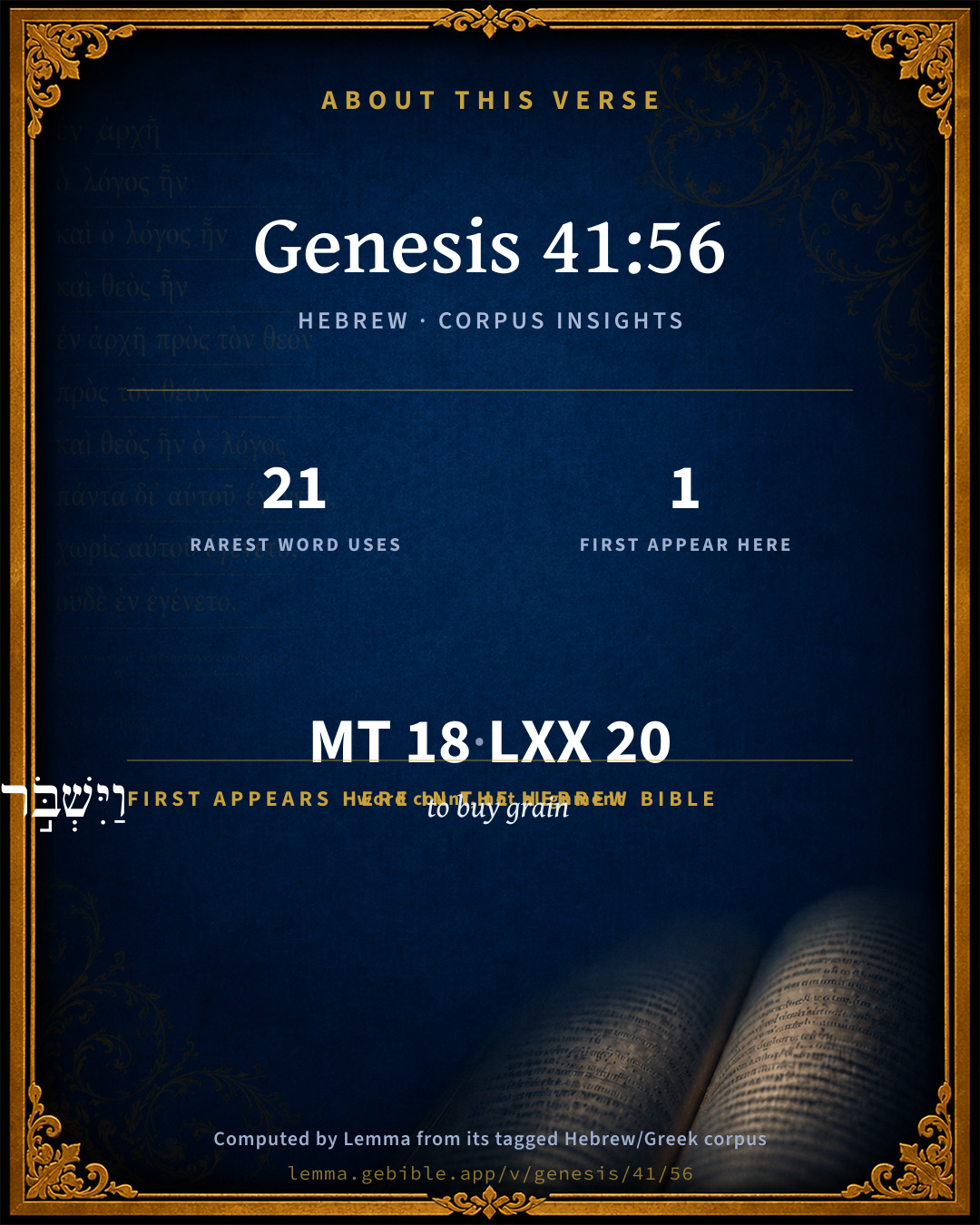
The rarest word here is וַיִּשְׁבֹּ֣ר to buy grain H7666 — appearing just 21 times in the whole Hebrew Bible.

First appearance in Scripture

This word makes its first canonical appearance in the Hebrew Bible here:

  • וַיִּשְׁבֹּ֣ר to buy grain H7666

Shared distinctive vocabulary

וַיִּשְׁבֹּ֣ר to buy grain H7666 occurs in 20 verses of the Hebrew Bible. Also found in:

Grammatical profile

  • 4 verbs
  • 10 nouns
  • 2 prepositions
  • 2 particles

Verb forms

  • הָיָ֔ה Qal · Perfect
  • וַיִּפְתַּ֨ח Qal · Sequential Imperfect
  • וַיִּשְׁבֹּ֣ר Qal · Sequential Imperfect
  • וַיֶּחֱזַ֥ק Qal · Sequential Imperfect

Repetition

Words recur within this verse — often emphatic in Hebrew:

  • וְהָרָעָ֣ב famine H7458 ×2
  • כָּל all H3605 ×2
  • הָאָ֑רֶץ land H776 ×2

Hebrew & Septuagint length

In English translation the verse runs 29 words from the Hebrew and 23 from the Septuagint (LXX English) — closely comparable.

A rough comparison of the two English renderings, which tokenize alike — not a word-level alignment.

Word counts can differ between the Hebrew and the Greek without any difference in meaning — e.g. the Hebrew direct-object marker אֵת has no separate Greek word, and Greek often adds the article ὁ.

In the original languages it is 18 Hebrew tokens and 20 Greek tokens — but the two are counted differently (Hebrew bundles its prefixes and suffixes into one token; the Greek is in lemma form), so that isn’t a like-for-like length.

Cross-references

6

Topical passages linked to Genesis 41:56 in the Treasury of Scripture Knowledge — connected by theme and wording, ordered by reader-vote popularity; previews shown in the World English Bible.

  • Genesis 42:6 Joseph was the governor over the land. It was he who sold to all the people of the land. Joseph's brothers came, and bowed themselves down to him with their faces to the earth.
  • Genesis 47:14–24 Joseph gathered up all the money that was found in the land of Egypt, and in the land of Canaan, for the grain which they bought: and Joseph brought the money into Pharaoh's house.
  • Isaiah 23:17 It shall happen after the end of seventy years, that Yahweh will visit Tyre, and she shall return to her hire, and shall play the prostitute with all the kingdoms of the world on the surface of the earth.
  • Zechariah 5:3 Then he said to me, "This is the curse that goes out over the surface of the whole land; for everyone who steals shall be cut off according to it on the one side; and everyone who swears falsely shall be cut off according to it on the other side.
  • Luke 21:35 For it will come like a snare on all those who dwell on the surface of all the earth.
  • Acts 17:26 He made from one blood every nation of men to dwell on all the surface of the earth, having determined appointed seasons, and the boundaries of their dwellings,

Cross-references courtesy of OpenBible.info (CC BY 4.0).

Hebrew and Greek witnesses Masoretic Hebrew ↔ Greek Septuagint

The same verse in the two great witnesses to the Old Testament, shown verse-for-verse.

These are two independent witnesses, not word-aligned to each other, and the Septuagint is shown in lemma (dictionary) form.

Hebrew Genesis 41:56 Masoretic · Westminster Leningrad Codex

וְהָרָעָ֣ב הָיָ֔ה עַ֖ל כָּל פְּנֵ֣י הָאָ֑רֶץ וַיִּפְתַּ֨ח יוֹסֵ֜ף אֶֽת כָּל אֲשֶׁ֤ר בָּהֶם֙ וַיִּשְׁבֹּ֣ר לְמִצְרַ֔יִם וַיֶּחֱזַ֥ק הָֽרָעָ֖ב בְּאֶ֥רֶץ מִצְרָֽיִם

The famine was over all the surface of the earth. Joseph opened all the store-houses, and sold to the Egyptians. The famine was severe in the land of Egypt.

World English Bible · Public Domain

Greek LXX Genesis 41:56 Septuagint · lemma form

καί ὁ λιμός εἰμί ἐπί πρόσωπον πᾶς ὁ γῆ ἀναοἴγω δέ ιωσηφ πᾶς ὁ σιτοβολών καί πωλέω πᾶς ὁ αἰγύπτιος

And the famine was on the face of all the earth; and Joseph opened all the granaries, and sold to all the Egyptians.

LXX2012 (modern English Septuagint) · Public Domain

On this verse, The Cambridge Bible for Schools and Colleges discusses the Septuagint’s reading. Read the note in Commentary ↓

Hebrew: Westminster Leningrad Codex (CC BY 4.0). Greek: Septuagint (public domain); English from LXX2012 (modern English Septuagint) (Public Domain). How the Septuagint differs from the Hebrew →

Targum (Aramaic paraphrase)

2

The Targum is the ancient Jewish Aramaic paraphrase of the Hebrew Scriptures — an interpretive translation, not the Hebrew text itself. Onkelos (literal) and Pseudo-Jonathan (expansive) render the Torah, and Jonathan the Prophets. Coverage is partial: where no permissively-licensed English translation exists for a verse, only the Aramaic is shown. This is verse-level text, not a word-by-word alignment to the Hebrew.

  1. Targum Onkelos Torah (Genesis–Deuteronomy)
    וְכַפְנָא הֲוָה עַל כָּל אַפֵּי אַרְעָא וּפְתַח יוֹסֵף יָת כָּל דִּי בְהוֹן עִיבוּרָא וְזַבִּין לְמִצְרַיִם וּתְקֵיף כַּפְנָא בְּאַרְעָא דְמִצְרָיִם

    (no public-domain English translation for this verse)

    Targum Onkelos — Aramaic: “Onkelos Genesis” (public domain); “Onkelos Exodus” (public domain); “Onkelos Leviticus” (public domain); “Onkelos Numbers” (public domain); “Onkelos Deuteronomy” (public domain). English: “Sefaria Community Translation” (CC0 1.0 (public-domain dedication)); “J.W. Etheridge. The Targums of Onkelos and Jonathan Ben Uzziel on the Pentateuch. London: Longmans, Green, 1862” (public domain). Text via Sefaria.

  2. Targum Pseudo-Jonathan Torah (Genesis–Deuteronomy)
    וְכַפְנָא הֲוַת עַל כָּל אַנְפֵּי אַרְעָא וּפְתַח יוֹסֵף יַת כָּל אוֹצְרִין דִבְהוֹן עִיבּוּרָא וְזַבִּין לְמִצְרָאֵי וּתְקֵף כַּפְנָא בְּאַרְעָא דְמִצְרָיִם

    And the famine was upon all the face of the land; and Joseph opened all the treasures and sold to the Mizraee. And the famine waxed mighty in the land of Mizraim;

    Targum Pseudo-Jonathan — Aramaic: “Targum Jonathan on Genesis” (public domain); “Targum Jonathan on Exodus” (public domain); “Targum Jonathan on Leviticus” (public domain); “Targum Jonathan on Numbers” (public domain); “Targum Jonathan on Deuteronomy” (public domain). English: “The Targum of Jonathan ben Uzziel, trans. J. W. Etheridge, London, 1862” (public domain). Text via Sefaria.

Commentary

Notes on Genesis 41:56 from classic Christian and Jewish commentators (each source and its license shown beneath its notes). The classic Christian expositions comment on the surrounding passage and are grouped to its opening verse, so a note may address several verses; the Jewish commentaries on the Tanakh (Rashi and others) are per-verse, so they appear only where the commentator wrote on this verse.

Lemma curates 59 commentaries, every one of them public domain or Creative Commons licensed, each selected and text-cleaned for this edition rather than reprinted as found. About our sources →

Trapp's Complete Commentary

John Trapp

Gen 41:56 And the famine was over all the face of the earth: And Joseph opened all the storehouses, and sold unto the Egyptians; and the famine waxed sore in the land of Egypt.

Ver. 56. Sold.] Heb., Brake, shivered, parcelled it out.

John Trapp, A Commentary or Exposition upon All the Books of the Old and New Testament (1647–1656) — public domain. Text from a community e-Sword module.

Adam Clarke's Commentary

Verse 56. Over all the face of the earth] The original, כל פני הארץ col peney haarets, should be translated, all the face of that land, viz., Egypt, as it is explained at the end of the verse.

Adam Clarke's Commentary on the Bible (1810–1826) — public domain. Text from a community e-Sword/MySword module.

The Cambridge Bible for Schools and Colleges

gen. ed. J. J. S. Perowne

56. all the storehouses] The Hebrew text is in error: lit. “all that was in them.” The versions have supplied the right meaning. LXX πάντας τοὺς σιτοβολῶνας, Lat. universa horrea, i.e. “all the granaries.”

The Cambridge Bible for Schools and Colleges (gen. ed. J. J. S. Perowne; Cambridge University Press, 1878–1918) — public domain. Text from a community e-Sword module.

The Pulpit Commentary

Vers. 56, 57. And the famine was over all the face of the earth (vide supra, ver. 54): And Joseph opened all the storehouses, literally, all wherein was, i.e. all the magazines that had grain in them. The granaries of Egypt are represented on the monuments. "In the tomb of Amenemha at Beni-hassan there is the painting of a great storehouse, before whose door lies a great heap of grain already winnowed. Near by stands the bushel with which it is measured, and the registrar who takes the account" (Hengstenberg"s "Egypt and the Books of Moses," p. 36)and sold unto the Egyptians; (cf. Pro_2:2-6) and the famine waxed sore (literally, became strong) in the land of Egypt. A remarkable inscription from the tomb at Eileythia of Barn, which Brugsch ("Histoire d"Egypte," second ed., p. 174, seqq.) assigns to the latter part of the seventeenth dynasty, mentions a dearth of several years in Egypt ("A famine having broken out during many years, I gave corn to the town during each famine"), which that distinguished Egyptologer identifies with the famine of Joseph under Apophis, the shepherd king (vide " Encyclopedia Britannica," ninth edition, art. Egypt); but, this, according to Bunsen ("Egypt"s Place, 3:334), is rather to be detected in a dearth of several years which occurred in the time of Osirtasen I, and which is mentioned in an inscription at Beni-hassan, recording the fact that during its prevalence food was supplied by Amenee, the governor of a district of Upper Egypt (Smith"s" Dict.," art. Joseph). The character of Chnumhotep (a near relative and favorite of Osirtasen I, and his immediate successor), and the recorded events of his government, as described in the Beni-hassan monuments, also remind one of Joseph: (i.e. Chnumhotep) injured no little child; he oppressed no widow; he detained for his own purpose no fisherman; took from his work no shepherd; no overseer"s men were taken. There was no beggar in his days; no one starved in his time. When years of famine occurred he ploughed all the lands of the district, producing abundant food; no one starved in it; he treated the widow as a woman with a husband to protect her" (vide "Speaker"s Commentary," vol. 1. p. 450). And all countries (i.e. people from all the adjoining lands) came into Egypt to Joseph for to buy corn; because the famine was so sore in all lands.

The Pulpit Commentary (1880–1919), ed. H.D.M. Spence-Jones & Joseph S. Exell — public domain. Text from a community e-Sword module.

Rashi

Rabbi Shlomo Yitzchaki (Rashi)

על כל פני הארץ OVER ALL THE FACE OF THE EARTH — Who are the face of the earth? the well-to-do people (Genesis Rabbah 91:5).

את כל אשר בהם — understand it as the Targum renders it: [JOSEPH OPENED ALL THE STOREHOUSES] IN WHICH THERE WAS CORN.

וישבור למצרים AND HE SOLD UNTO THE EGYPTIANS — The root שבר has the meaning both of selling and buying. Here it is used in the sense of selling, whereas in (43:2) “שברו for us a little food”, it means buying. You cannot say that it (the word) can be used only of selling and buying grain for we find it used also of wine and milk: (Isaiah 55:1) “And come, buy (שברו) wine and milk without money and without price”.

Rashi on the Tanakh — English translations: “The Judaica Press complete Tanach with Rashi, translated by A. J. Rosenberg” (CC BY 4.0); “Pentateuch with Rashi's commentary by M. Rosenbaum and A.M. Silbermann, 1929-1934” (public domain); “The Metsudah Tanach series, Lakewood, N.J” (CC BY 4.0); and “The Book of Joshua, Metsudah Publications, 1997” (CC BY 4.0). Text via Sefaria.

Ramban (Nachmanides)

Rabbi Moshe ben Nachman (Ramban / Nachmanides)

AND HE SOLD GRAIN UNTO THE EGYPTIANS, AND THE FAMINE WAS SEVERE IN THE LAND OF EGYPT. The verse states that Joseph did not throw open the contents of the storehouses until the famine had become severe in the land, but not as soon as they cried to Pharaoh, as people would cry even when they have a small amount of sustenance, and it was his desire that nothing remain to them before he opened the granaries. This is the meaning of the verse, And the famine was over all the face of the earth, meaning that before he had opened his storehouses the famine was over the entire face of the earth, and then the verse proceeds to explain that he did not sell them food until the famine had become severe upon them. Perhaps it is possible that the verse is magnifying the famine by stating that it was a “famine accompanied by panic.”

Ramban (Nachmanides) on the Tanakh — English translation: “Commentary on the Torah by Ramban (Nachmanides). Translated and annotated by Charles B. Chavel. New York, Shilo Pub. House, 1971-1976” (CC BY 4.0). Text via Sefaria.

Sforno

Rabbi Ovadia Sforno

Yoseif opened. He opened all his storehouses to show that he had sufficient grain to feed them all.

The famine became severe. Foods other than bread also disappeared.

Sforno on the Tanakh — English translation: “Yalkut, Sifsei Chachomim Chumash, Metsudah Publications, 2009” (CC BY 4.0). Text via Sefaria.

Radak

Rabbi David Kimhi (Radak)

והרעב...ויפתח יוסף את כל אשר בהם, he now opened all the silos in which grain had been stored.

וישבר למצרים, first he sold grain only to the Egyptians until word had spread that there was food for sale in Egypt. Then he also sold to foreigners. The expression וישבר, vayishbor, is from the conjugation kal, and is used both as applicable to the seller and the buyer. Actually, the word shever means “breaking,” i.e. the grain, the harvest, is what “breaks” one’s hunger. Compare Psalms 104,11 ישברו פראים צמאם, “the wild asses slake their thirst, the word for “slaking,” being the word שבר. When it comes to the transaction, i.e. trading in victuals, especially grain, the seller gives something which will still the buyer’s hunger, i.e. break it, whereas the buyer at the same time is receiving something which breaks his hunger. Hence it is understandable why the same root is used to describe either buying or selling food, seeing both parties are concerned in dealing with someone’s hunger, putting an end to it, as it were. One party hands over the price, the other party receives payment, thus both seller and buyer are active in the transaction. The conjugation הפעיל however, is applicable only to the seller of food, not to the buyer, as in most instances this conjugation is used transitively. The word mashbir, or hamashbir, therefore refers to the seller, not to the buyer.

ויחזק הרעב, as foreign buyers appeared and the quantities sold to each had to be rationed in order to ensure that the supply would last, the famine was felt more strongly also by the local population, seeing the famine had been predicted to last for many years.

Radak on the Tanakh — English translations: “Sefaria Community Translation” (CC0 1.0 (public-domain dedication)); “Eliyahu Munk, HaChut Hameshulash” (CC BY 4.0); “Rabbi Mike Feuer, Jerusalem Anthology” (CC BY 4.0); and “R. David Kimhi on the first book of Psalms, Translated by R.G. Finch, London, 1919” (public domain). Text via Sefaria.

Lesson kit

Teaching starters — assembled from the data on this page, not authored interpretation. Every prompt links to the verse data it draws on. Edit before teaching.

Genesis, in the Pentateuch, opens this verse with 18 words (14 distinct Hebrew lemmas). Its most distinctive word is shâbar (“to buy grain”). A historical commentator’s framing appears above. Read the whole chapter for the surrounding context.

Discussion questions

  1. The word shâbar carries the sense “to buy grain.” How does it shape the verse?
  2. The word “to buy grain” first appears here in Scripture. What is being introduced at this debut?
  3. Genesis 41:57 shares the word «to buy grain» with this verse. How do the two illuminate each other?
  4. “famine” occurs 2× in this one verse. What is the effect of the repetition?
  5. The translations on this page render this verse differently — a whole-verse word diff, not a word-by-word alignment. What might account for the different wordings?
  6. The verb «הָיָ֔ה» is Qal Perfect. How does its form color the action?
  7. Reading how Trapp's Complete Commentary and Adam Clarke's Commentary read this verse, where do the two commentators agree and where do they part?

Things to notice

Reading settings

Reading text

Shown beneath each verse's original-language words.

Old Testament
Old Testament edition

Read the OT as the Masoretic Hebrew (MT) or the Greek Septuagint (LXX).

English shown for the Greek Septuagint (in the Hebrew ↔ Greek comparison).

Comparing translations? Open the Compare panel on any verse page to stack up to four side by side.