
Hosea 9:6

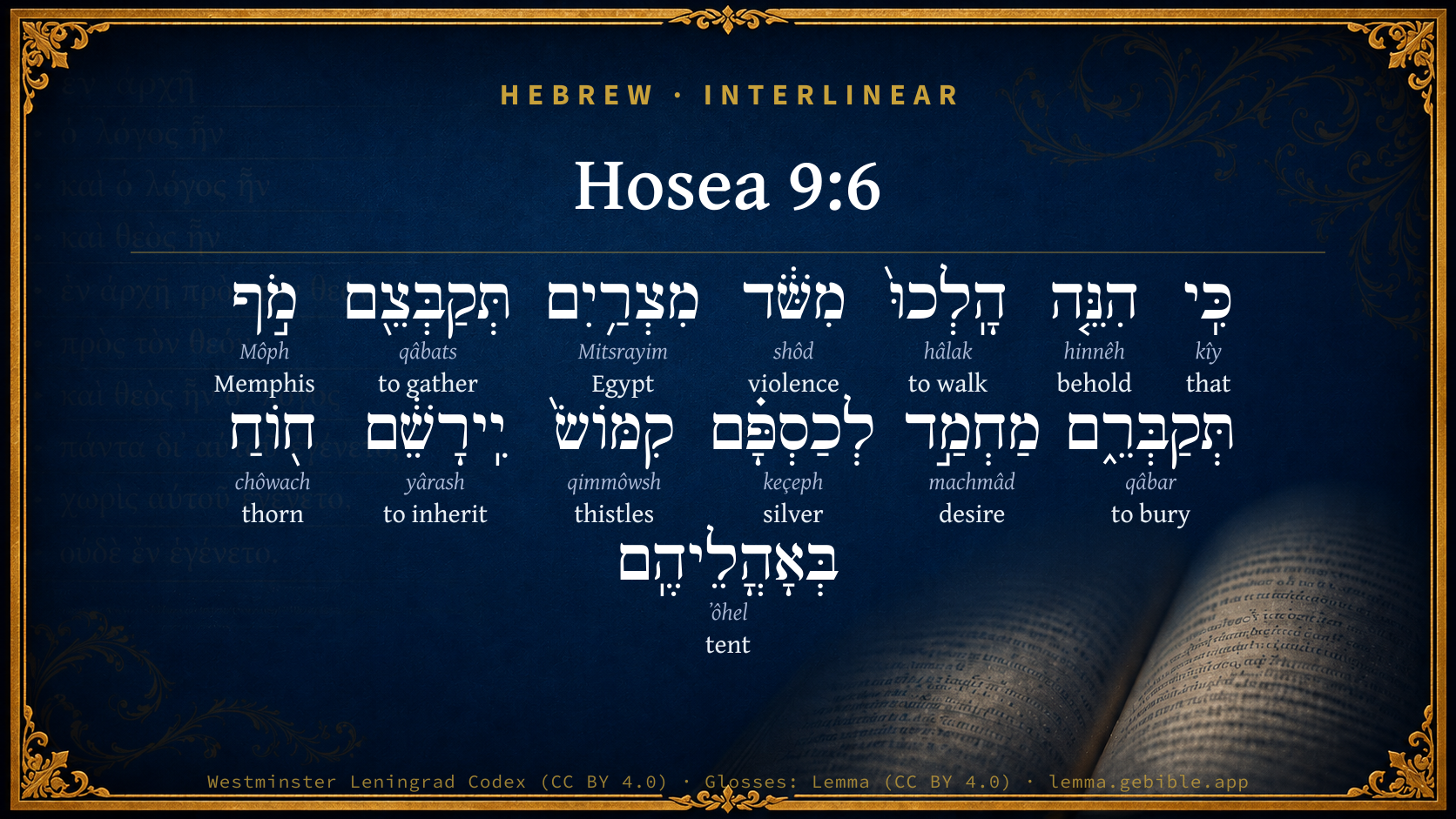
Hebrew (Westminster Leningrad Codex) Hosea 9:6 appears in the Hebrew Old Testament. The text above is from the Westminster Leningrad Codex. Each word links to its Strong’s number, a concise gloss, and parsing drawn from the Open Scriptures Hebrew Bible morphology. Click any word for its full Brown-Driver-Briggs (BDB) entry.
Download image
Cite this verse

Hosea 9:6 (World English Bible). Public Domain. Lemma interlinear Bible study tool, https://lemma.gebible.app/v/hosea/9/6.

Show BibTeX & RIS
BibTeX
RIS
English Translation
For, behold, they have gone away from destruction. Egypt will gather them up. Memphis will bury them. Nettles will possess their pleasant things of silver. Thorns will be in their tents.
World English Bible · Public Domain
Highlights
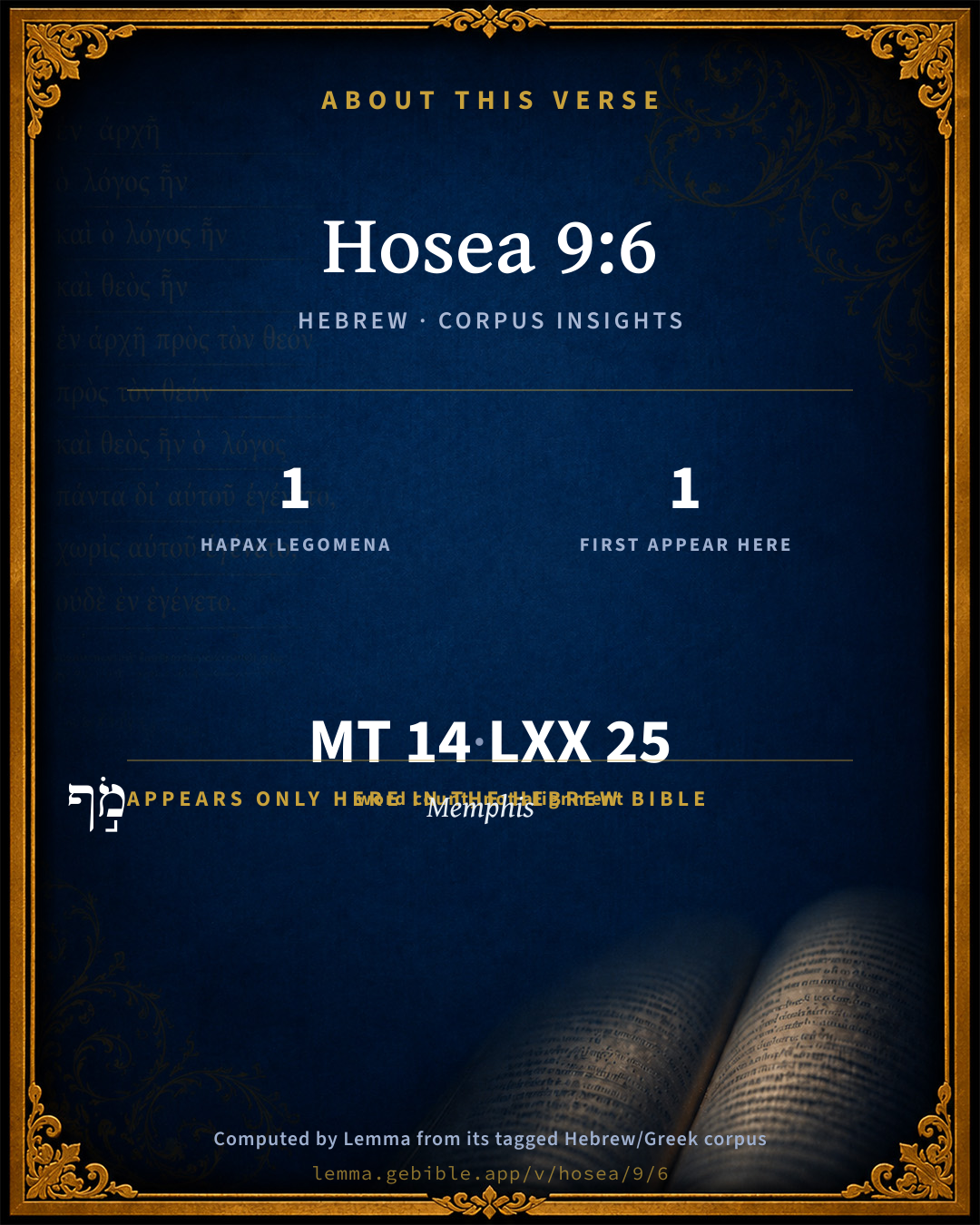
  • 1 hapax legomenon — only here in the Hebrew Bible
  • 1 first appearance in the Hebrew Bible
Full analysis ↓
Download a study sheet

One document with this verse’s original text, its word-by-word gloss line, the meaning frame, cross-references with their text, attributed commentary, and full source and license credits — printable, and it pastes into notes with its structure intact.

This verse Autodidact and up

Study sheet (.html) Plain text (.txt)

A passage Seminary Student

Up to 50 verses in one chapter. A passage sheet keeps up to 6 commentary sources and 12 cross-references per verse, in the order this page ranks them, and says so on the sheet whenever that leaves anything out. Ask for a single verse and you get the Autodidact verse sheet above.

Everything on this page stays free to read, with no account — the sheet is a download of what is already on screen, not access to it.

Want to remove ads? Support Godless Engineer
Compare translations 3

The same verse in 3 English versions, stacked beneath the original-language interlinear above. Click any original word for its lexicon entry.

Each is an independent rendering of the whole verse — the interlinear is not word-aligned to these translations.

Highlighted words mark where these versions differ — a whole-verse word diff, not a word-by-word alignment.

  • World English Bible Public Domain
    For, behold, they have gone away from destruction. Egypt will gather them up. Memphis will bury them. Nettles will possess their pleasant things of silver. Thorns will be in their tents.
  • King James Version Public Domain
    For, lo, they are gone because of destruction: Egypt shall gather them up, Memphis shall bury them: the pleasant places for their silver, nettles shall possess them: thorns shall be in their tabernacles.
  • unfoldingWord Literal Text CC BY-SA 4.0
    For behold, they go away from destruction, Egypt will gather them; Memphis will bury them. Nettles will possess the precious things of their silver; thorns in their tents.

unfoldingWord Literal Text — © unfoldingWord, licensed CC BY-SA 4.0. Word-aligned USFM3 via Door43 (git.door43.org/unfoldingWord/en_ult).

Versions to compare (up to 4)

3 of 4 selected

Show all 18 translations

Every available English version of this verse, each an independent rendering of the whole verse.

  • World English Bible Public Domain
    For, behold, they have gone away from destruction. Egypt will gather them up. Memphis will bury them. Nettles will possess their pleasant things of silver. Thorns will be in their tents.
  • Berean Standard Bible Public Domain
    For even if they flee destruction, Egypt will gather them and Memphis will bury them. Their precious silver will be taken over by thistles, and thorns will overrun their tents.
  • Majority Standard Bible Public Domain
    For even if they flee destruction, Egypt will gather them and Memphis will bury them. Their precious silver will be taken over by thistles, and thorns will overrun their tents.
  • King James Version Public Domain
    For, lo, they are gone because of destruction: Egypt shall gather them up, Memphis shall bury them: the pleasant places for their silver, nettles shall possess them: thorns shall be in their tabernacles.
  • American Standard Version (1901) Public Domain
    For, lo, they are gone away from destruction; `yet' Egypt shall gather them up, Memphis shall bury them; their pleasant things of silver, nettles shall possess them; thorns shall be in their tents.
  • Revised Version (1885) Public Domain
    For, lo, they are gone away from destruction, yet Egypt shall gather them up, Memphis shall bury them: their pleasant things of silver, nettles shall possess them: thorns shall be in their tents.
  • Geneva Bible (1599) Public Domain
    For loe, they are gone from destruction: but Egypt shall gather them vp, and Memphis shall burie them: the nettle shall possesse the pleasant places of their siluer, and the thorne shall be in their tabernacles.
  • Douay-Rheims (1899) Public Domain
    For behold they are gone because of destruction: Egypt shall gather them together, Memphis shall bury them: nettles shall inherit their beloved silver, the bur shall be in their tabernacles.
  • Young's Literal Translation Public Domain
    For, lo, they have gone because of destruction, Egypt gathereth them, Moph burieth them, The desirable things of their silver, Nettles possess them -- a thorn `is' in their tents.
  • Literal Standard Version CC BY-SA 4.0
    For behold, they have gone because of destruction, || Egypt gathers them, Moph buries them, || The desirable things of their silver, || Nettles possess them—a thorn [is] in their tents.
  • Unlocked Literal Bible CC BY-SA 4.0
    For, look, if they escape from destruction, Egypt will gather them, and Memphis will bury them. As for their treasures of silver— sharp briers will possess them, and thorns will fill their tents.
  • unfoldingWord Literal Text CC BY-SA 4.0
    For behold, they go away from destruction, Egypt will gather them; Memphis will bury them. Nettles will possess the precious things of their silver; thorns in their tents.
  • Darby Bible Public Domain
    For behold, they are gone away because of destruction: Egypt shall gather them up, Moph shall bury them: their pleasant things of silver, nettles shall possess them; thorns shall be in their tents.
  • World Messianic Bible Public Domain
    For, behold, when they flee destruction, Egypt will gather them up. Memphis will bury them. Nettles will possess their pleasant things of silver. Thorns will be in their tents.
  • Webster's Bible Public Domain
    For lo, they are gone because of destruction: Egypt shall gather them up, Memphis shall bury them: the pleasant places for their silver, nettles shall possess them: thorns shall be in their tabernacles.
  • Free Bible Version CC BY-SA 4.0
    Look, they have left because of the destruction: Egypt will with gather them, and Memphis will bury them. They gain a “valued possession” for their silver. Weeds will possess them, and thorns will grow over their tents.
  • Bible in Basic English Public Domain
    For see, they are going away into Assyria; Egypt will get them together, Memphis will be their last resting-place; their fair silver vessels will be covered over with field plants, and thorns will come up in their tents.
  • JPS Tanakh (1917) Public Domain
    For, lo, they are gone away from destruction, yet Egypt shall gather them up, Memphis shall bury them; their precious treasures of silver, nettles shall possess them, thorns shall be in their tents.

Literal Standard Version (2020), Covenant Press — licensed CC BY-SA 4.0. Text via the HelloAO Bible API (eBible.org). Unlocked Literal Bible (unfoldingWord) — licensed CC BY-SA 4.0. Text via the HelloAO Bible API (eBible.org). unfoldingWord Literal Text — © unfoldingWord, licensed CC BY-SA 4.0. Word-aligned USFM3 via Door43 (git.door43.org/unfoldingWord/en_ult). Free Bible Version, Dr. Jonathan Gallagher — licensed CC BY-SA 4.0. Text via the HelloAO Bible API (eBible.org).

Word by word

More ways to search: Search by grammar → Find every occurrence → Compare this word →

Practice this passage: Drill this verse → Learn its vocabulary →

מֹ֣ף
Môph
H4644
“Memphis”
Noun, Proper
Part of Speech
Noun
Type
Proper
Full BDB Definition

Origin: of Egyptian origin

TWOT: None

Memphis = "haven of the good" - a capital of Lower Egypt located on the western bank of the Nile about 9 miles (15 kilometers) south of Cairo
  1. כִּֽי kîy H3588 “that” Conjunction
  2. הִנֵּ֤ה hinnêh H2009 “behold” Particle, Demonstrative
  3. הָֽלְכוּ֙ hâlak H1980 “to walk” Verb, Qal, Perfect, 3rd Person, Common, Plural
  4. מִשֹּׁ֔ד shôd H7701 “from · violence” Preposition + Noun, Common, Masculine, Singular, Absolute
  5. מִצְרַ֥יִם Mitsrayim H4714 “Egypt” Noun, Proper
  6. תְּקַבְּצֵ֖ם qâbats H6908 “to gather · them” Verb, Piel, Imperfect, 3rd Person, Feminine, Singular + Suffix, Personal, 3rd Person, Masculine, Plural
  7. תְּקַבְּרֵ֑ם qâbar H6912 “to bury · them” Verb, Piel, Imperfect, 3rd Person, Feminine, Singular + Suffix, Personal, 3rd Person, Masculine, Plural
  8. מַחְמַ֣ד machmâd H4261 “desire of” Noun, Common, Masculine, Singular, Construct
  9. לְכַסְפָּ֗ם keçeph H3701 “to/for · silver · their” Preposition + Noun, Common, Masculine, Singular, Construct + Suffix, Personal, 3rd Person, Masculine, Plural
  10. קִמּוֹשׂ֙ qimmôwsh H7057 “thistles” Noun, Common, Masculine, Singular, Absolute
  11. יִֽירָשֵׁ֔ם yârash H3423 “to inherit · them” Verb, Qal, Imperfect, 3rd Person, Masculine, Singular + Suffix, Personal, 3rd Person, Masculine, Plural
  12. ח֖וֹחַ chôwach H2336 “thorn” Noun, Common, Masculine, Singular, Absolute
  13. בְּאָהֳלֵיהֶֽם ʼôhel H168 “in/at · tents · their” Preposition + Noun, Common, Masculine, Plural, Construct + Suffix, Personal, 3rd Person, Masculine, Plural

About this verse

These counts appear in no published source. They are computed here, from the morphology-tagged text and Lemma’s own curated glosses. What Lemma adds →

14
words
14
distinct lemmas
Prophets
section

Notable vocabulary

1 hapax legomenon — a word that appears only here in the entire Hebrew Bible:

First appearance in Scripture

This word makes its first canonical appearance in the Hebrew Bible here:

Shared distinctive vocabulary

קִמּוֹשׂ֙ thistles H7057 occurs in 2 verses of the Hebrew Bible. Also found in:

Grammatical profile

  • 4 verbs
  • 8 nouns
  • 1 conjunction
  • 1 particle

Verb forms

  • הָֽלְכוּ֙ Qal · Perfect
  • תְּקַבְּצֵ֖ם Piel · Imperfect
  • תְּקַבְּרֵ֑ם Piel · Imperfect
  • יִֽירָשֵׁ֔ם Qal · Imperfect

Hebrew & Septuagint length

In English translation the verse runs 31 words from the Hebrew and 34 from the Septuagint (LXX English) — closely comparable.

A rough comparison of the two English renderings, which tokenize alike — not a word-level alignment.

Word counts can differ between the Hebrew and the Greek without any difference in meaning — e.g. the Hebrew direct-object marker אֵת has no separate Greek word, and Greek often adds the article ὁ.

In the original languages it is 14 Hebrew tokens and 25 Greek tokens — but the two are counted differently (Hebrew bundles its prefixes and suffixes into one token; the Greek is in lemma form), so that isn’t a like-for-like length.

Cross-references

19

Topical passages linked to Hosea 9:6 in the Treasury of Scripture Knowledge — connected by theme and wording, ordered by reader-vote popularity; previews shown in the World English Bible.

  • Hosea 10:8 The high places also of Aven, the sin of Israel, will be destroyed. The thorn and the thistle will come up on their altars. They will tell the mountains, "Cover us!" and the hills, "Fall on us!"
  • Isaiah 5:6 I will lay it a wasteland. It won't be pruned nor hoed, But it will grow briers and thorns. I will also command the clouds that they rain no rain on it."
  • Isaiah 7:23 It will happen in that day that every place where there were a thousand vines at a thousand silver shekels, shall be for briers and thorns.
  • Hosea 7:16 They return, but not to the Most High. They are like a faulty bow. Their princes will fall by the sword for the rage of their tongue. This will be their derision in the land of Egypt.
  • Hosea 8:13 As for the sacrifices of my offerings, they sacrifice flesh and eat it; But Yahweh doesn't accept them. Now he will remember their iniquity, And punish their sins. They will return to Egypt.
  • Hosea 9:3 They won't dwell in Yahweh's land; But Ephraim will return to Egypt, And they will eat unclean food in Assyria.
  • Deuteronomy 28:63–64 It shall happen that as Yahweh rejoiced over you to do you good, and to multiply you, so Yahweh will rejoice over you to cause you to perish, and to destroy you; and you shall be plucked from off the land where you go in to possess it.
  • 1 Samuel 13:6 When the men of Israel saw that they were in a strait (for the people were distressed), then the people did hide themselves in caves, and in thickets, and in rocks, and in coverts, and in pits.
  • 2 Kings 13:7 For he didn't leave to Jehoahaz of the people save fifty horsemen, and ten chariots, and ten thousand footmen; for the king of Syria destroyed them, and made them like the dust in threshing.
  • Psalms 107:34 And a fruitful land into a salt waste, For the wickedness of those who dwell in it.
  • Proverbs 24:31 Behold, it was all grown over with thorns. Its surface was covered with nettles, And its stone wall was broken down.
  • Isaiah 11:11 It shall happen in that day, that the Lord will set his hand again the second time to recover the remnant of his people, who shall remain, from Assyria, and from Egypt, and from Pathros, and from Cush, and from Elam, and from Shinar, and from Hamath, and from the islands of the sea.
  • Isaiah 19:13 The princes of Zoan are become fools, the princes of Memphis are deceived; they have caused Egypt to go astray, who are the corner-stone of her tribes.
  • Isaiah 27:12 It shall happen in that day, that Yahweh will beat off [his fruit] from the flood of the River to the brook of Egypt; and you shall be gathered one by one, you children of Israel.
  • Isaiah 32:13 On the land of my people shall come up thorns and briers; yes, on all the houses of joy in the joyous city.
  • Isaiah 34:13 Thorns shall come up in its palaces, nettles and thistles in the fortresses of it; and it shall be a habitation of jackals, a court for ostriches.
  • Hosea 7:13 Woe to them! For they have wandered from me. Destruction to them! For they have trespassed against me. Though I would redeem them, Yet they have spoken lies against me.
  • Hosea 11:11 They will come trembling like a bird out of Egypt, And like a dove out of the land of Assyria; And I will settle them in their houses," says Yahweh.
  • Zechariah 10:10–11 I will bring them again also out of the land of Egypt, And gather them out of Assyria; And I will bring them into the land of Gilead and Lebanon; And there won't be room enough for them.

Cross-references courtesy of OpenBible.info (CC BY 4.0).

Hebrew and Greek witnesses Masoretic Hebrew ↔ Greek Septuagint

The same verse in the two great witnesses to the Old Testament, shown verse-for-verse.

These are two independent witnesses, not word-aligned to each other, and the Septuagint is shown in lemma (dictionary) form.

Hebrew Hosea 9:6 Masoretic · Westminster Leningrad Codex

כִּֽי הִנֵּ֤ה הָֽלְכוּ֙ מִשֹּׁ֔ד מִצְרַ֥יִם תְּקַבְּצֵ֖ם מֹ֣ף תְּקַבְּרֵ֑ם מַחְמַ֣ד לְכַסְפָּ֗ם קִמּוֹשׂ֙ יִֽירָשֵׁ֔ם ח֖וֹחַ בְּאָהֳלֵיהֶֽם

For, behold, they have gone away from destruction. Egypt will gather them up. Memphis will bury them. Nettles will possess their pleasant things of silver. Thorns will be in their tents.

World English Bible · Public Domain

Greek LXX Hosea 9:6 Septuagint · lemma form

διά οὗτος ἰδού πορεύομαι ἐκ ταλαιπωρία αἴγυπτος καί ἐκδέχομαι αὐτός μέμφις καί θάπτω αὐτός μαχμας ὁ ἀργύριον αὐτός ὄλεθρος κληρονομέω ἄκανθα ἐν ὁ σκήνωμα αὐτός

Therefore, behold, they go forth from the trouble of Egypt, and Memphis shall receive them, and Machmas shall bury them: as for their silver, destruction shall inherit it; thorns shall be in their tents.

LXX2012 (modern English Septuagint) · Public Domain

On this verse, John Gill's Exposition discusses the Septuagint’s reading. Read the note in Commentary ↓

Hebrew: Westminster Leningrad Codex (CC BY 4.0). Greek: Septuagint (public domain); English from LXX2012 (modern English Septuagint) (Public Domain). How the Septuagint differs from the Hebrew →

Targum (Aramaic paraphrase)

1

The Targum is the ancient Jewish Aramaic paraphrase of the Hebrew Scriptures — an interpretive translation, not the Hebrew text itself. Onkelos (literal) and Pseudo-Jonathan (expansive) render the Torah, and Jonathan the Prophets. Coverage is partial: where no permissively-licensed English translation exists for a verse, only the Aramaic is shown. This is verse-level text, not a word-by-word alignment to the Hebrew.

  1. Targum Jonathan Prophets (Joshua–Malachi)
    אֲרֵי הָא יִגְלוּן מִן קֳדָם בָּזוֹזִין לְמִצְרַיִם יִתְכַּנְשׁוּן לְמָפֵיס יִתְקַבְּרוּן בֵּית חֶמְדַת כַּסְפְּהוֹן קַרְסוּלִין יִשְׁרוּן בְּהוֹן חֲתוּלִין בְבִרְנְיָתְהוֹן:

    (no public-domain English translation for this verse)

    Targum Jonathan — Aramaic: “Mikraot Gedolot” (public domain). English: “Sefaria Community Translation” (CC0 1.0 (public-domain dedication)); “London "Chaldee Paraphrase," 1871” (public domain). Text via Sefaria.

Commentary

Notes on Hosea 9:6 from classic Christian and Jewish commentators (each source and its license shown beneath its notes). The classic Christian expositions comment on the surrounding passage and are grouped to its opening verse, so a note may address several verses; the Jewish commentaries on the Tanakh (Rashi and others) are per-verse, so they appear only where the commentator wrote on this verse.

Lemma curates 59 commentaries, every one of them public domain or Creative Commons licensed, each selected and text-cleaned for this edition rather than reprinted as found. About our sources →

Trapp's Complete Commentary

John Trapp

Hos 9:6 For, lo, they are gone because of destruction: Egypt shall gather them up, Memphis shall bury them: the pleasant [places] for their silver, nettles shall possess them: thorns [shall be] in their tabernacles.

Ver. 6. For, lo, they are gone because of destruction] They are gone either into Egypt for refuge, or into the state of the dead, they are gone out of the world ( abierunt, i.e. obierunt). They shall perish by destruction, so some render it. When God had said in the former verse, "What will ye do," they should have fallen down before him and said, "What wilt thou have us to do, Lord?" we know not what at all to do, but our eyes are toward thee. This had been right, and thus they might have disarmed God’s indignation; but they had other carnal shifts, and thought they could tell well enough what to do, and whither to go; whereupon they were so fully bent, that the prophet here reports them gone already. "For, lo, they are gone," and got to Egypt; as various of them did doubtless during the siege, and after the sack of Samaria, when they were forced to shift for themselves as they could: but did they so "escape by iniquity. In thine anger cast down the people, O God," saith David; and it is not more a prayer than a prophecy, Psa 56:7, and this people had the proof of it.

Egypt shall gather them] Either for punishment or for burial, as Eze 29:5 Jer 8:2, so that they fled but out of the smoke into the fire; and in running from death they ran to it; as the historian saith of those poor Scots at Musselborough Field, who, running for their lives, so strained themselves in their race, that they fell down breathless and dead.

Memphis shall bury them] Lest they should please themselves with vain hopes of return to their country, he shows that that shall never be; but they shall lay their bones in a strange land. Memphis (anciently called Noph, Isa 19:13, or (as some will), No, Nah 3:8, at this day Grand Cairo, famous for the pyramids and the kings’ sepulchres), Memphis, I say, a principal city of Egypt, shall be a Kibrothhattaavah to you, a place of sepulchres; especially then when Nebuchadnezzar, sent by God (who giveth him Egypt as his pay for his pains at Tyre), shall come and smite that land, and deliver such as are for death to death, and such as are for the sword to the sword, Jer 43:11.

The pleasant places for themselves, nettles shall possess them] Heb. shall possess them as their inheritance; so that the Israelites nor their heirs shall ever repossess these pleasant places for their silver, i.e. where they either laid up their silver (their repositories or countinghouses), or where they laid out their silver, either in costly buildings and sumptuous furniture, or else in idols and statues placed therein, to their no small charge and delight. These shall be ruined and overrun with nettles, thorns, and thistles, a token of horrible desolation, Isa 32:13; Isa 34:13. Note hence, that as God spareth a place for a few good men found therein (as he would have done Sodom, which is now a place of nettles and salt pits, Zep 2:9), so a fruitful land bringeth he into barrenness (or saltness), for the wickedness of them that dwell therein, Psa 106:34-35; witness Judaea, that land of desire, Jer 22:27, that garden of Eden, Joe 2:3, that glorious land, Dan 11:16, yea, glory of all lands, Eze 20:15, now woefully waste and desolate; so is Grecia, formerly so famous for arms and arts; so are some parts of Germany, and so may England soon be (without the greater mercy of God, by a miracle of whose mercy, and by a prop of whose extraordinary patience, we have hitherto subsisted), I say, England, whose valleys now are like Eden, whose hills are as Lebanon, whose springs are as Pisgah, whose rivers are as Jordan, whose walls is the ocean, and whose defence is the Lord Jehovah.

John Trapp, A Commentary or Exposition upon All the Books of the Old and New Testament (1647–1656) — public domain. Text from a community e-Sword module.

Whedon's Commentary on the Bible

Daniel D. Whedon

6. Already the prophet sees the people leaving the land of Jehovah to experience the deprivations of the exile pictured in Hos_9:4-5.

They are gone — The prophetic perfect in Hebrew.

Because of destruction — If the text is correct, better, with the R.V., ‘“away from destruction” — away from the destruction of their native land. Some alter the text so as to read “to Assyria,” chiefly because Hosea frequently joins Egypt and Assyria.

Shall gather them up — In exile (Hos_8:10); in connection with “bury” the thought seems to be of gathering for burial (Jer_8:2; Jer_25:33).

Memphis shall bury — Memphis was the old capital of Lower Egypt, and throughout the entire history of Egypt it remained a city of great prominence. It is located on the Nile a short distance south of Cairo.

Here, as a representative city of the kingdom, it is synonymous with Egypt. The figure is taken from the numerous and extensive burial grounds in Egypt, many of which recent excavations have brought to light. One of the largest of these was uncovered at Memphis, stretching twenty miles from north to south. As the dead are gathered in these burial fields never to rise again, so Israel will be swallowed up in Egypt. Meanwhile their own land will become a wilderness, covered with nettles and thorns.

Pleasant places for their silver — The treasure houses; but R.V., “pleasant things of silver” — their valuable possessions made of silver. The expression cannot be limited to idols. From the parallel clause it seems that the reference is to houses decorated and filled with silver.

Nettles shall possess — They will grow over them; and thorns shall cover their tabernacles — Dwellings.

In Hos_9:7-9 the text is in such confusion that the exact meaning of some parts cannot be determined. The first part of Hos_9:7 evidently connects with Hos_9:6.

Are come — To express his assurance that the days of visitation, that is, of judgment and recompense for wrongdoing (described in 2-6), will certainly come the prophet uses the prophetic perfect, equivalent to shall surely come.

Israel shall know it — Find out by experience (compare Isa_9:9). Shall know what? Some answer, that “the prophet is a fool,… is mad.” In other words, the people will discover that they have been deceived by the prophets who have promised continued peace and prosperity (Mic_2:11; Mic_3:5). This interpretation makes the prophet and the spiritual man, or man that hath the spirit, the false prophet. If this is the correct interpretation the words “Israel shall… mad” must be regarded as a parenthetical sentence, since the latter part of the verse, “for the abundance of thine iniquity,” must be connected with the announcement of judgment in the first part. But would a true prophet call a false prophet a spiritual man? This is at least doubtful (Eze_13:3); the expression is certainly more applicable to a true prophet. If so here, the above interpretation cannot be correct. A second interpretation connects “Israel shall know it” with the preceding; Israel shall know the terrors of the judgment. With “the prophet” begins a new sentence, which continues to the end of the verse. According to this view, Hosea says that the true prophet has become a fool and madman; that is, he has become beside himself at the sight of the awful condition and the thought of the impending doom of the people. The awfulness of the expected calamity was indeed sufficient to drive mad a man with the sensitive nature of an Hosea. A third interpretation sees in the words “the prophet… mad” a defiant reply of the people. They meet the exhortations of the prophet with a contemptuous sneer that he is a fool and a madman (2Ki_9:11; compare Act_2:13). These words the prophet takes up and says, The prophet has indeed gone mad, but it is your sin and his yearning sympathy for you which has made him so. It may be difficult to say which of these is the right interpretation; on the whole, the last seems preferable.

The great hatred — R.V., “the enmity is great”; that is, the enmity manifested against the prophet (explained further in Hos_9:8) helps to drive him mad. Some change the text and read “greatness of thy sin,” so as to bring it in accord with the parallel clause.

Hos_9:8 also presents serious difficulties.

The watchman of Ephraim was with my God — R.V., “Ephraim was a watchman with my God.” Most commentators seem to prefer the construction adopted by the Revisers, but all recognize the difficulties of the clause. As a result there have been many translations and interpretations, and not a few emendations. Delitzsch, understanding watchman in a bad sense, interprets, “The God who speaks by the prophet has in Ephraim a malignant spy instead of a humble observer”; for this reason the prophet is persecuted. More commonly, however, the word is used in a good sense, a watchman appointed by Jehovah (Jer_6:17; Eze_3:17; Hab_2:1, etc.). Therefore Keil and others interpret, “Ephraim (Israel) looks out for the prophecies or divine revelations with the God of the prophets, that is, at the side of Jehovah; in other words, it does not trust or follow its own prophets, who are not inspired by Jehovah.” These interpreters regard the prophets mentioned in the latter part of the verse as false prophets, who are to the people a snare of the fowler in all its ways; that is, everywhere they attempt to ensnare the people; even in the house of Jehovah they manifest their evil intentions (compare Amo_7:10-17). These are two representative interpretations of the text as it stands; of these that of Delitzsch is preferable, for after condemning so persistently the attitude of Ephraim toward Jehovah it is not probable that Hosea would describe Ephraim as a watchman waiting longingly for divine revelations. But, even admitting that the Hebrew may possibly yield the thought suggested by Delitzsch, the expression is peculiar and un-Hebraic; and it is this feeling that accounts for the many emendations proposed. Of these the most simple is that of Cheyne, which requires only the addition of one letter (מ), which, he assumes, has fallen out accidentally at the beginning of one word because the preceding word ends with the same consonant. In addition, he connects the first clause with the second and reads the entire verse, “The watchman of Ephraim (so A.V.), appointed by my God (literally, from my God), even the prophet — a fowler’s snare is in all his ways, and enmity in the house of his God.” This gives a very satisfactory sense.

Watchman of Ephraim — The prophet (compare Jer_6:17).

Snare of a fowler — Spread by the Israelites who seek to destroy the prophet.

The house of his God — Either the sanctuary of Jehovah (Amo_7:10-17), or house may be used, as in Hos_8:1; Hos_9:15, in the sense of land. Nowhere in the land is the prophet safe. All other emendations require more radical changes in the text. Nowack, by means of omissions, transpositions, and other changes, gets, “Hostility to the watchman is found in the house of his God; the prophet finds fowler’s snares in all his ways.” Harper, taking “enmity” over from Hos_9:7, connecting the latter part of Hos_9:8 with 9a, and changing the latter, reads, “Enmity exists toward Ephraim’s watchman; the prophet (finds) the snares of the fowler in all his ways; in the (very) house of God they dig for him a deep pit.”

Hos_9:9, as it now stands, forms a suitable conclusion. They have gone to the lowest depths of corruption.

As in the days of Gibeah — Hosea refers again to this crime in Hos_10:9 (compare Jdg_19:22-30; Jdg_20:46-48).

That deed of shame was severely punished. Would Israel escape? Surely not. He will remember… visit — See on Hos_7:2; Hos_8:13.

Daniel D. Whedon (gen. ed.), Commentary on the Old and New Testaments (1874–1909) — public domain. Text from a community e-Sword module.

Tyndale Open Study Notes

Tyndale Open Resources

9:6 Even if some Israelites were to escape Assyrian exile by fleeing to Egypt, God’s relentless judgment would reach them there.

Tyndale Open Study Notes — © Tyndale Open Resources, licensed CC BY-SA 4.0. Text via the HelloAO Bible API.

Geneva Bible (1599)

Geneva Bible translators

Though they think to escape by fleeing the destruction that is at hand, yet shall they be destroyed in the place whither they flee for succor.

Geneva Bible (1599) marginal notes — public domain. Text via Bolls.life.

Jamieson, Fausset & Brown

Robert Jamieson, A. R. Fausset & David Brown

because of destruction--to escape from the devastation of their country.

Egypt shall gather them up--that is, into its sepulchres (Jer 8:2; Eze 29:5). Instead of returning to Palestine, they should die in Egypt.

Memphis--famed as a necropolis.

the pleasant places for their silver--that is, their desired treasuries for their money. Or, "whatever precious thing they have of silver" [MAURER].

nettles--the sign of desolation (Isa 34:13).

Jamieson, Fausset & Brown — Commentary Critical and Explanatory on the Whole Bible (1871) — public domain (CC PDM 1.0). Text via the HelloAO Bible API.

Adam Clarke's Commentary

Verse 6. For, lo, they are gone] Many of them fled to Egypt to avoid the destruction; but they went there only to die.

Memphis] Now Cairo, or Kahira, found them graves.

The pleasant places for their silver] The fine estates or villas which they had purchased by their money, being now neglected and uninhabited, are covered with nettles; and even in their tabernacles, thorns and brambles of different kinds grow. These are the fullest marks of utter desolation.

Adam Clarke's Commentary on the Bible (1810–1826) — public domain. Text from a community e-Sword/MySword module.

John Calvin's Commentaries

The Prophet confirms here what is contained in the last verse, that is, that the Israelites would at length find that the Prophets had not in vain threatened them, though they at the time heedlessly despised the judgement of God. Lo, he says, they have departed: he speaks of the exile as if it had already taken place, when it was only nigh at hand. The Israelites were then dwelling in their own country, he yet speaks of them as having already gone away. But he sets forth the certainty of the prediction by this manner of speaking, that profane men might cease to promise themselves impunity when God summons them to his tribunal: yea, he shows that he was already armed to take vengeance: “They have gone away,” he says, “on account of desolation.” Then he adds, Egypt shall gather them To gather here is to be taken in a bad sense; for it means the same as trousser (to pack up, to bundle) in our language; and it is often taken in this sense by the Prophets, when mention is made of destruction: and this appears still clearer from the word, burying, which the Prophet immediately subjoins. Egypt shall gather them: He certainly speaks not of a kind retreat, but declares that Egypt would be a sepulchre to them, in which they should remain shut up: and thus he takes away from them any hope of deliverance. The Israelites expected that they should find shelter for a season in Egypt, when they bent their course there for fear of their enemies. The Prophet now shows that they would be disappointed in dreaming of a return, for they would remain there gathered up; that is, a free return, as they imagined, would not be allowed them, but a perpetual habitation, yea, a grave.

‘Egypt will gather them, Memphis will bury them.’ There is a striking correspondence between the words here used, קבר, kober, and קבף, kobets,. By the first the Prophet signifies that they should be shut up, so as to be, as it were, bound and fixed to a place; and then he adds that they should be buried.

He then says, The desirable place of their silver the nettle shall possess, as by hereditary right, and the thorn, etc.; some render it paliurus; but I follow what is more received, the thorn then shall be in their tabernacles The meaning is, that the Israelites would be exiles and sojourners, not for a short time, but that their exile would be so long that their land would become waste and uncultivated; for neither nettles nor thorns grow in an inhabited place. Hosea then declares that their land would be deserted and without inhabitants, for nettles and thorns would occupy it instead of men. Now it tended greatly to increase the sorrow of exile, that the hope of return was cut off from them; and God had also declared that Egypt, where they had promised a refuge for themselves, would be to them like a grave. And thus it happens for the most part to the ungodly, who retake themselves to vain solaces, that they may escape the vengeance of God; for they throw themselves into deep labyrinths; where they think to find a harbour of rest for a time, and a commodious habitation; but there they find either a gulf or a grave. This is the meaning. Let us proceed —

John Calvin's Commentaries (1540-1563) — public domain. Text from the Calvin Translation Society English edition (1840s-50s) via the Christian Classics Ethereal Library (ccel.org). Calvin's coverage is partial (roughly two-thirds of the Bible); uncommented books and verses are honest gaps, never fabricated. The 19th-century editor's footnotes and remarks are omitted so the notes are faithfully Calvin's own voice.

Ellicott's Commentary for English Readers

(6) Translate, Behold if they have gone from the desolation (i.e., Palestine laid waste by the invader), Egypt shall gather them, Memphis bury them—Memphis, the vast city and necropolis of Ptah, where Apis and Ibis, kings and men, lay by thousands mummied, the religious shrine of Egyptian faith in the under-world, from which Israel had been emancipated at the Exodus.—There is a longing for their silver (i.e., they shall long for the silver left behind concealed in their desolate land.—The thistle shall possess them, the thorn shall be in their tents. Hosea prophesies an exile to Egypt after the anticipated invasion. That many exiles took refuge in Egypt in 721 B.C., after the great overthrow of the northern kingdom (as in the case of Judah in the days of Jeremiah), cannot admit of doubt. (Comp. Hos_8:13 and Hos_9:3 above; see Hos_11:5, Note.)

A Bible Commentary for English Readers, edited by Charles John Ellicott (1878–1897) — public domain. Text from a community e-Sword module.

The Cambridge Bible for Schools and Colleges

gen. ed. J. J. S. Perowne

6. Hosea ‘in the Spirit’ sees the Israelites already being carried into captivity.

because of destruction] Rather, from the devastation. They have left their desolated country.

shall gather them up] viz. in burial; comp. Eze_29:5; Jer_8:2; Jer_25:33.

Memphis] The most ancient of the capitals of Egypt, on the west bank of the Nile, south of old Cairo, elsewhere called in the Hebrew Noph (Isa_19:13; Jer_2:16), but here Moph. The Egyptian name, given to it by Menes, accounts for both forms—Men-nufre ‘the good’ or ‘perfect mansion’; the Assyrians called it Mimpi. All that is left of Memphis is its necropolis ‘stretching north and south nearly twenty miles’, where Hosea threateningly declares that the Israelites shall find a grave, remote, dishonoured, and ‘unclean.’ Contrast Exo_14:11, where the Israelites reproach Moses with having deprived them of their right to sepulture in the vast cemeteries of Egypt.

the pleasant places for their silver] Rather, their precious things of silver, i.e. costly silver ornaments.

their tabernacles] i.e., either the idol-tents of the high places (comp. Eze_16:16), or simply their dwellings (comp. 2Sa_20:1).

The Cambridge Bible for Schools and Colleges (gen. ed. J. J. S. Perowne; Cambridge University Press, 1878–1918) — public domain. Text from a community e-Sword module.

John Gill's Exposition

The days of visitation are come, the days of recompense are come,.... In which the Lord would punish the people of Israel for their sins, and reward them in a righteous manner, according as their evil works deserved; which time, being fixed and appointed by him, are called "days"; and these, because near at hand, are said to be "come"; and this is repeated for the certainty of it:

Israel shall know it; by sad experience, that these days are come; and shall acknowledge the truth of the divine predictions, and the righteousness of God in his judgments. Schultens (z), from the use of the phrase in the Arabic language, interprets it of Israel's suffering punishment; with which agrees the Septuagint version, "Israel shall be afflicted", or it shall go ill with him; and to the same purpose the Arabic version:

the prophet is a fool; so Israel said, before those days came, of a true prophet of the Lord, that he was a fool for prophesying of evil things, but now they shall find it otherwise. So the Targum,

"they of the house of Israel shall know that they who had prophesied to them were true prophets;''

but rather this is to be understood of false prophets, who, when the day of God's visitation shall come on Israel in a way of wrath and vengeance, will appear both to themselves and others to be fools, for prophesying good things to them, when evil was at hand:

the spiritual man is mad; he that was truly so, and prophesied under the inspiration of the Spirit of God, was accounted a madman for speaking against the idolatry of the times, and foretelling the judgments of God that would come upon the nation for it; but now it would be manifest, that not he, but such who pretended to be spiritual men, and to be directed and dictated by the Spirit of God, when they promised the people peace, though they walked after the imagination of their hearts, were the real madmen; who pursued the frenzies and fancies of their own minds, to the deception of themselves and the people, and called these the revelations of God, and pretended they came from the Spirit of God:

for the multitude of thine iniquities, and the great hatred; that is, either those evil days came upon them for their manifold sins and transgressions, which were hateful to God, and the cause of his hatred of them; or they were suffered to give heed to those foolish and mad prophets, because of their many sins, especially idolatry; and because of their great hatred of God, and of his true prophets, and of his laws and ordinances, of his word, will, and worship, and of one another, God gave them up to a reprobate mind, to a judicial blindness and hardness of heart, to believe a lie, and whatsoever those false prophets declared unto them, because they did not like to retain him in their knowledge, to walk according to his law, and to believe his prophets. The Targum is,

"but the false prophets besotted them, so as to increase thy transgression, and strengthen thine iniquities.''

(z) Animadv. Philol. in Job, p. 78.

John Gill's Exposition of the Whole Bible (1746–1763) — public domain (CC PDM 1.0). Text via the HelloAO Bible API.

Albert Barnes' Notes on the Bible

For lo, they are gone because of destruction - They had fled, for fear of destruction, to destruction. For fear of the destruction from Assyria, they were fled away and gone to Egypt, hoping, doubtless, to find there some temporary refuge, until the Assyrian invasion should have swept by. But, as befalls those who flee from God, they fell into more certain destruction.

Egypt shall gather them up, Memphis shall bury them - They had fled singly, in making their escape from the Assyrian. Egypt shall receive them, and shall gather them together, but only to one common burial, so that none should escape. So Jeremiah says, “They shall not be gathered nor buried” Jer 8:2; and Ezekiel, “Thou shalt not be brought together, nor gathered” Eze 29:5. “Memphis” is the Greek name for the Egyptian “Mamphta,” whence the Hebrew “Moph” ; or “Manuph,” whence the Hebrew “Noph” (Isa 19:13; Jer 2:16; Jer 44:1; Jer 46:14; Eze 30:13 ff). It was at this time the capital of Egypt, whose idols God threatens . Its name, “the dwelling of Phta,” the Greek Vulcan, marked it, as a seat of idolatry; and in it was the celebrated court of Apis , the original of Jeroboam’s calf. There in the home of the idol for whom they forsook their God, they should be gathered to burial. It was reputed to be the burial-place of Osiris, and hence, was a favorite burial-place of the Egyptians. It once embraced a circuit of almost 19 miles , with magnificent buildings; it declined after the building of Alexandria; its very ruins gradually perished, after Cairo rose in its neighborhood.

The pleasant places for their silver, nettles shall possess them - The English margin gives the same sense in different words; “their silver shall be desired; (as Obadiah saith, “his hidden treasures were searched out) nettles shall inherit them” Oba 1:6. In either way, it is a picture of utter desolation. The long rank grass or the nettle, waving amid man’s habitations, looks all the sadder, as betokening that man once was there, and is gone. The desolate house looks like the grave of the departed. According to either rendering, the silver which they once had treasured, was gone. As they had “inherited” and “driven” out (the word is one) the nations, whose land God had given them, so now nettles and thorns should “inherit them.” These should be the only tenants of their treasure-houses and their dwellings.

Albert Barnes' Notes on the Bible (1834–1885) — public domain. Text from a community e-Sword/MySword module.

Haydock's Catholic Bible Commentary

Gather into the grave. Yet some shall escape, chap. xi. 11. --- Silver, which they buried at the approach of the enemy, hoping to recover it when they should depart. The Arabs do so still, (Calmet) and the Indians likewise, that they may have something to support them in the next world! (Bernier) --- Bur. Hebrew, "thorns." (Calmet)

George Leo Haydock (1774–1849), Haydock's Catholic Family Bible and Commentary, 1859 edition — public domain. Excludes Psalms (Douay-Rheims chapter numbering differs from Protestant) and Deuterocanonical books (Catholic canon only).

Matthew Poole's English Annotations

For, lo; mark it well, and observe the event.

They are gone because of destruction; some of the wary and timorous are already withdrawn from the desolation that cometh on their country, and more will flee from the Assyrian invader; and it is very near, and very uncertain, expressed therefore in the perfect tense.

Egypt shall gather them up; in Egypt they hope to be quiet, and survive these desolations, and to return into their own land; but they shall die in Egypt, and Egyptians shall lay them out, and prepare them to their grave. So this phrase, Jer 8:2; Eze 29:5.

Memphis, which elsewhere is called Noph, Isa 19:13, a very greatly traded city in those days, and at this day also known by the name which speaks its greatness, Grand Cairo.

Shall bury them: many of the ten tribes, fleeing their own wasted country, did no doubt remove so far as Memphis, partly for safety, that they might be out of the Assyrian’s reach, but more principally for convenience of a trade, that they might at least get a livelihood, if not grow rich on their trade; there many of these fugitives died; and perhaps by the pestilence (which is a disease that frequently sweeps that city) multitudes of them might be swept away into their graves in and about that city.

The pleasant places for their silver; their beautiful and strong houses built for keeping their wealth in.

Nettles shall possess them; they shall be ruined, and lie long in rubbish, till nettles grow up in them.

Thorns, or briers, or whatever (one kind for all) worthless and hurtful shrubs used to grow in perpetuated desolations, shall be in their tabernacles, in their dwellingplaces, their houses, which here retain the name of their ancient habitations when they dwelt in tents.

Matthew Poole's English Annotations on the Holy Bible (1683–1685) — public domain. Text from a community e-Sword/MySword module.

The Pulpit Commentary

For, lo, they are gone because of destruction: Egypt shall gather them up, Memphis shall bury them. Their future exile was seen in prophetic vision; and in consequence and because of its certainty he speaks of it as having already taken place. The destruction is the desolation and wasting of their native land, because of which, or away from which and leaving it behind, they are gone. The land of their banishment was the land of their bondage. There, far from the land of their birth, they were doomed to die and to be gathered together for a common burial. Memphis was the ancient capital of Lower Egypt; its situation was on the western bank of the Nile, and south of Old Cairo. There its ruins are still seen, with extensive burial-grounds, while amid those ruins is the village of Mitrahenni. Kimchi identifies Moph with Noph. The pleasant places for their silver, nettles shall possess them: thorns shall be in their tabernacles. The literal rendering of the first clause is,

(1) their cherished delight of silver. By this some understand

(a) silver idols;

(b) others, valuables in silver;

(c) the Jewish commentators, the houses of the precious treasures of their silver so Rashi; "Their precious buildings where their silver treasures were so Kimchi;

(d) Jerome understands their mansions and all the ornaments of their mansions purchased by silver; Keil also has, "houses ornamented and filled with the precious metals." This explanation is pretty generally accepted, and appears to us to deserve the preference. Their former homes, so pleasant and so richly decorated, were so utterly desolate and deserted that thorns and thistles overspread them. But

(2) the sentence is differently translated and explained by Rosenm and some others; thus: "Moph (Memphis) will bury them out of desire for their silver." This violent divulsion destroys the parallelism of the second hemistich, besides ignoring the athnach. The LXX, again

(3) puzzled by the word maehmad, mistook it for a proper name: "Therefore, behold, they go forth from the trouble of Egypt, and Hemphis shall receive them, and Machmas (Macmav ) shall bury them." Giving a decided preference to (1) (d), we have a thrilling picture of distress. First comes the destruction of their native city; having looked their last look on the ruins where once stood their home, they have set forth a miserable band of pilgrims to the land of the stranger, and that stranger their conqueror and oppressor; they have reached the place of exile, there to find, not a home, but a grave, and not a single grave for each, according to the Jews" mode of sepulture to the present day, but a common place of burial into which they are huddled together, Egypt gathering them and Memphis burying them; while in the land that gave them birth, their once happy homesteads, richly decorated and expensively adorned, are left utterly desolate a heritage for thorns and thistles.

The Pulpit Commentary (1880–1919), ed. H.D.M. Spence-Jones & Joseph S. Exell — public domain. Text from a community e-Sword module.

John Wesley's Explanatory Notes

They are gone - Some are already withdrawn from the desolation that cometh. Egypt - In Egypt they hope to be quiet and survive these desolations, but they shall die in Egypt. The pleasant places - Their beautiful houses built for keeping their wealth in. Nettles - Shall be ruined, and lie in rubbish, 'till nettles grow in them.

John Wesley, Explanatory Notes Upon the Whole Bible (1754–1765) — public domain. Text via the GEBible commentary corpus.

Rashi

Rabbi Shlomo Yitzchaki (Rashi)

For behold, they have gone away from their place because of the many plunderers who will come upon them with Nebuchadnezzar.

Moph shall bury them It is of the land of Egypt.

the treasurehouses for their silver The houses of the precious treasures of their silver.

thistles etc. briers Heb. קִימוֹשׁ חוֹחַ. Jonathan renders these terms as species of beasts.

Rashi on the Tanakh — English translations: “The Judaica Press complete Tanach with Rashi, translated by A. J. Rosenberg” (CC BY 4.0); “Pentateuch with Rashi's commentary by M. Rosenbaum and A.M. Silbermann, 1929-1934” (public domain); “The Metsudah Tanach series, Lakewood, N.J” (CC BY 4.0); and “The Book of Joshua, Metsudah Publications, 1997” (CC BY 4.0). Text via Sefaria.

Lesson kit

Teaching starters — assembled from the data on this page, not authored interpretation. Every prompt links to the verse data it draws on. Edit before teaching.

Hosea, in the Prophets, opens this verse with 14 words (14 distinct Hebrew lemmas). Its most distinctive word is Môph (“Memphis”). A historical commentator’s framing appears above. Read the whole chapter for the surrounding context.

Discussion questions

  1. How does “Memphis” (Môph) shape what this verse is saying?
  2. 1 word here appears nowhere else in the Hebrew Bible. Why might the author reach for such rare wording?
  3. This is the first place “Memphis” appears in Scripture (first appears here). What does its debut here establish?
  4. How does Isaiah 34:13, which shares the word «thistles», read alongside this verse?
  5. These translations render this verse differently; the difference is in the English rendering, not the original. What questions does that raise?
  6. «הָֽלְכוּ֙» is a Qal Perfect verb. How does that grammatical form shape the action described?
  7. Compare how Trapp's Complete Commentary and Whedon's Commentary on the Bible read this verse. Where do they agree or differ?

Things to notice

Reading settings

Reading text

Shown beneath each verse's original-language words.

Old Testament
Old Testament edition

Read the OT as the Masoretic Hebrew (MT) or the Greek Septuagint (LXX).

English shown for the Greek Septuagint (in the Hebrew ↔ Greek comparison).

Comparing translations? Open the Compare panel on any verse page to stack up to four side by side.