
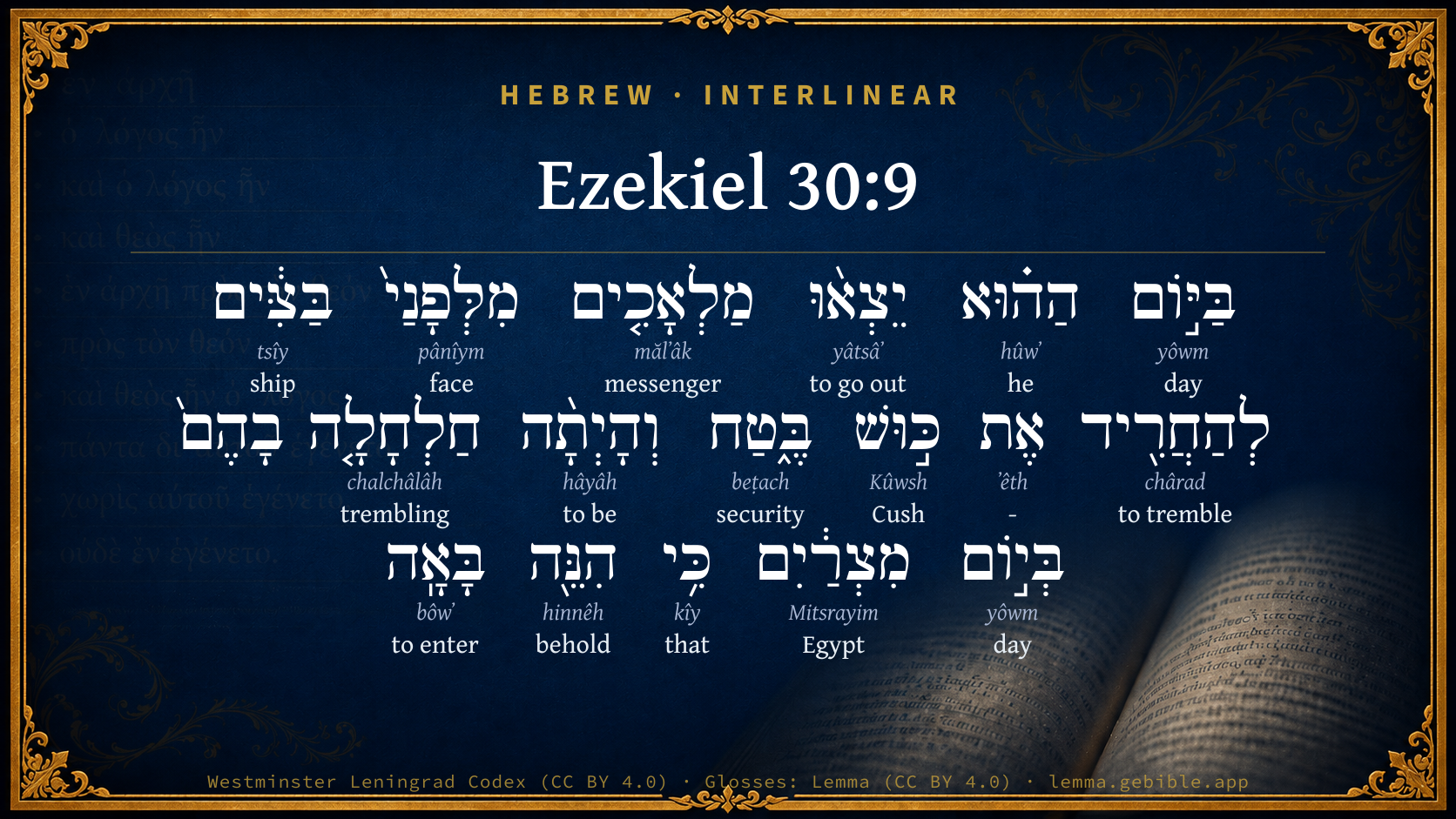
Ezekiel 30:9

Hebrew (Westminster Leningrad Codex) Ezekiel 30:9 appears in the Hebrew Old Testament. The text above is from the Westminster Leningrad Codex. Each word links to its Strong’s number, a concise gloss, and parsing drawn from the Open Scriptures Hebrew Bible morphology. Click any word for its full Brown-Driver-Briggs (BDB) entry.
Download image
Cite this verse

Ezekiel 30:9 (World English Bible). Public Domain. Lemma interlinear Bible study tool, https://lemma.gebible.app/v/ezekiel/30/9.

Show BibTeX & RIS
BibTeX
RIS
English Translation
In that day shall messengers go forth from before me in ships to make the careless Ethiopians afraid; and there shall be anguish on them, as in the day of Egypt; for, behold, it comes.
World English Bible · Public Domain
Download a study sheet

One document with this verse’s original text, its word-by-word gloss line, the meaning frame, cross-references with their text, attributed commentary, and full source and license credits — printable, and it pastes into notes with its structure intact.

This verse Autodidact and up

Study sheet (.html) Plain text (.txt)

A passage Seminary Student

Up to 50 verses in one chapter. A passage sheet keeps up to 6 commentary sources and 12 cross-references per verse, in the order this page ranks them, and says so on the sheet whenever that leaves anything out. Ask for a single verse and you get the Autodidact verse sheet above.

Everything on this page stays free to read, with no account — the sheet is a download of what is already on screen, not access to it.

Want to remove ads? Support Godless Engineer
Compare translations 3

The same verse in 3 English versions, stacked beneath the original-language interlinear above. Click any original word for its lexicon entry.

Each is an independent rendering of the whole verse — the interlinear is not word-aligned to these translations.

Highlighted words mark where these versions differ — a whole-verse word diff, not a word-by-word alignment.

  • World English Bible Public Domain
    In that day shall messengers go forth from before me in ships to make the careless Ethiopians afraid; and there shall be anguish on them, as in the day of Egypt; for, behold, it comes.
  • King James Version Public Domain
    In that day shall messengers go forth from me in ships to make the careless Ethiopians afraid, and great pain shall come upon them, as in the day of Egypt: for, lo, it cometh.
  • unfoldingWord Literal Text CC BY-SA 4.0
    In that day messengers will go out from before me in ships to terrorize a secure Cush, and there will be anguish among them on the day of Egypt’s doom. For behold! It is coming.

unfoldingWord Literal Text — © unfoldingWord, licensed CC BY-SA 4.0. Word-aligned USFM3 via Door43 (git.door43.org/unfoldingWord/en_ult).

Versions to compare (up to 4)

3 of 4 selected

Show all 18 translations

Every available English version of this verse, each an independent rendering of the whole verse.

  • World English Bible Public Domain
    In that day shall messengers go forth from before me in ships to make the careless Ethiopians afraid; and there shall be anguish on them, as in the day of Egypt; for, behold, it comes.
  • Berean Standard Bible Public Domain
    On that day messengers will go out from Me in ships to frighten Cush out of complacency. Anguish will come upon them on the day of Egypt’s doom. For it is indeed coming.
  • Majority Standard Bible Public Domain
    On that day messengers will go out from Me in ships to frighten Cush out of complacency. Anguish will come upon them on the day of Egypt’s doom. For it is indeed coming.
  • King James Version Public Domain
    In that day shall messengers go forth from me in ships to make the careless Ethiopians afraid, and great pain shall come upon them, as in the day of Egypt: for, lo, it cometh.
  • American Standard Version (1901) Public Domain
    In that day shall messengers go forth from before me in ships to make the careless Ethiopians afraid; and there shall be anguish upon them, as in the day of Egypt; for, lo, it cometh.
  • Revised Version (1885) Public Domain
    In that day shall messengers go forth from before me in ships to make the careless Ethiopians afraid; and there shall be anguish upon them, as in the day of Egypt; for, lo, it cometh.
  • Geneva Bible (1599) Public Domain
    In that day shall there messengers go forth from me in shippes, to make the carelesse Mores aftaide, and feare shall come vpon them, as in the day of Egypt: for loe, it commeth.
  • Douay-Rheims (1899) Public Domain
    In that day shall messengers go forth from my face in ships to destroy the confidence of Ethiopia, and there shall be dread among them in the day of Egypt: because it shall certainly come.
  • Young's Literal Translation Public Domain
    In that day go forth do messengers from before Me in ships, To trouble confident Cush, And there hath been great pain among them, As the day of Egypt, for lo, it hath come.
  • Literal Standard Version CC BY-SA 4.0
    In that day messengers go forth from before Me in ships, || To trouble confident Cush, || And there has been great pain among them, || As the day of Egypt, for behold, it has come.
  • Unlocked Literal Bible CC BY-SA 4.0
    In that day messengers will go out from before me in ships to terrorize a secure Cush, and there will be anguish among them on the day of Egypt's doom. For behold! It is coming.
  • unfoldingWord Literal Text CC BY-SA 4.0
    In that day messengers will go out from before me in ships to terrorize a secure Cush, and there will be anguish among them on the day of Egypt’s doom. For behold! It is coming.
  • Darby Bible Public Domain
    In that day shall messengers go forth from me in ships, to make careless Ethiopia afraid; and anguish shall come upon them, as in the day of Egypt: for behold, it cometh!
  • World Messianic Bible Public Domain
    “‘“In that day messengers will go out from before me in ships to make the careless Ethiopians afraid. There will be anguish on them, as in the day of Egypt; for, behold, it comes.”
  • Webster's Bible Public Domain
    In that day shall messengers go forth from me in ships to make the careless Cushites afraid, and great pain shall come upon them, as in the day of Egypt: for lo, it cometh.
  • Free Bible Version CC BY-SA 4.0
    At that time I will send messengers in ships to shock Cush out of its sense of security. They will tremble in fear when disasters hit Egypt. Watch out! It's definitely coming!
  • Bible in Basic English Public Domain
    In that day men will go out quickly to take the news, causing fear in untroubled Ethiopia; and bitter pain will come on them as in the day of Egypt; for see, it is coming.
  • JPS Tanakh (1917) Public Domain
    In that day shall messengers go forth from before Me in ships to make the confident Ethiopians afraid; and there shall come convulsion upon them in the day of Egypt; for, lo, it cometh.

Literal Standard Version (2020), Covenant Press — licensed CC BY-SA 4.0. Text via the HelloAO Bible API (eBible.org). Unlocked Literal Bible (unfoldingWord) — licensed CC BY-SA 4.0. Text via the HelloAO Bible API (eBible.org). unfoldingWord Literal Text — © unfoldingWord, licensed CC BY-SA 4.0. Word-aligned USFM3 via Door43 (git.door43.org/unfoldingWord/en_ult). Free Bible Version, Dr. Jonathan Gallagher — licensed CC BY-SA 4.0. Text via the HelloAO Bible API (eBible.org).

Word by word

More ways to search: Search by grammar → Find every occurrence → Compare this word →

Practice this passage: Drill this verse → Learn its vocabulary →

בַּצִּ֔ים
tsîy
H6716
“in/at the · ships”
Preposition, Determined + Noun, Common, Masculine, Plural, Absolute
Part of Speech
Preposition + Noun
Type
Common
Gender
Masculine
Number
Plural
State
Absolute
Full BDB Definition

Origin: from H6680

TWOT: 1907

ship
  1. בַּיּ֣וֹם yôwm H3117 “in/at the · day” Preposition, Determined + Noun, Common, Masculine, Singular, Absolute
  2. הַה֗וּא hûwʼ H1931 “the · he” Particle, Definite Article + Pronoun, Personal, 3rd Person, Masculine, Singular
  3. יֵצְא֨וּ yâtsâʼ H3318 “to go out” Verb, Qal, Imperfect, 3rd Person, Masculine, Plural
  4. מַלְאָכִ֤ים mălʼâk H4397 “messengers” Noun, Common, Masculine, Plural, Absolute
  5. מִלְּפָנַי֙ pânîym H6440 “from · to/for · face(s) · my” Preposition + Preposition + Noun, Common, Both, Plural, Construct + Suffix, Personal, 1st Person, Common, Singular
  6. לְהַחֲרִ֖יד chârad H2729 “to tremble” Preposition + Verb, Hiphil, Infinitive Construct
  7. אֶת ʼêth H853 “-” Particle, Direct Object
  8. כּ֣וּשׁ Kûwsh H3568 “Cush” Noun, Proper
  9. בֶּ֑טַח beṭach H983 “security” Noun, Common, Masculine, Singular, Absolute
  10. וְהָיְתָ֨ה hâyâh H1961 “and · to be” Conjunction + Verb, Qal, Sequential Perfect, 3rd Person, Feminine, Singular
  11. חַלְחָלָ֤ה chalchâlâh H2479 “trembling” Noun, Common, Feminine, Singular, Absolute
  12. בְּי֣וֹם yôwm H3117 “in/at · day of” Preposition + Noun, Common, Masculine, Singular, Construct
  13. מִצְרַ֔יִם Mitsrayim H4714 “Egypt” Noun, Proper
  14. כִּ֥י kîy H3588 “that” Conjunction
  15. הִנֵּ֖ה hinnêh H2009 “behold” Particle, Demonstrative
  16. בָּאָֽה bôwʼ H935 “entering” Verb, Qal, Participle Active, Feminine, Singular, Absolute

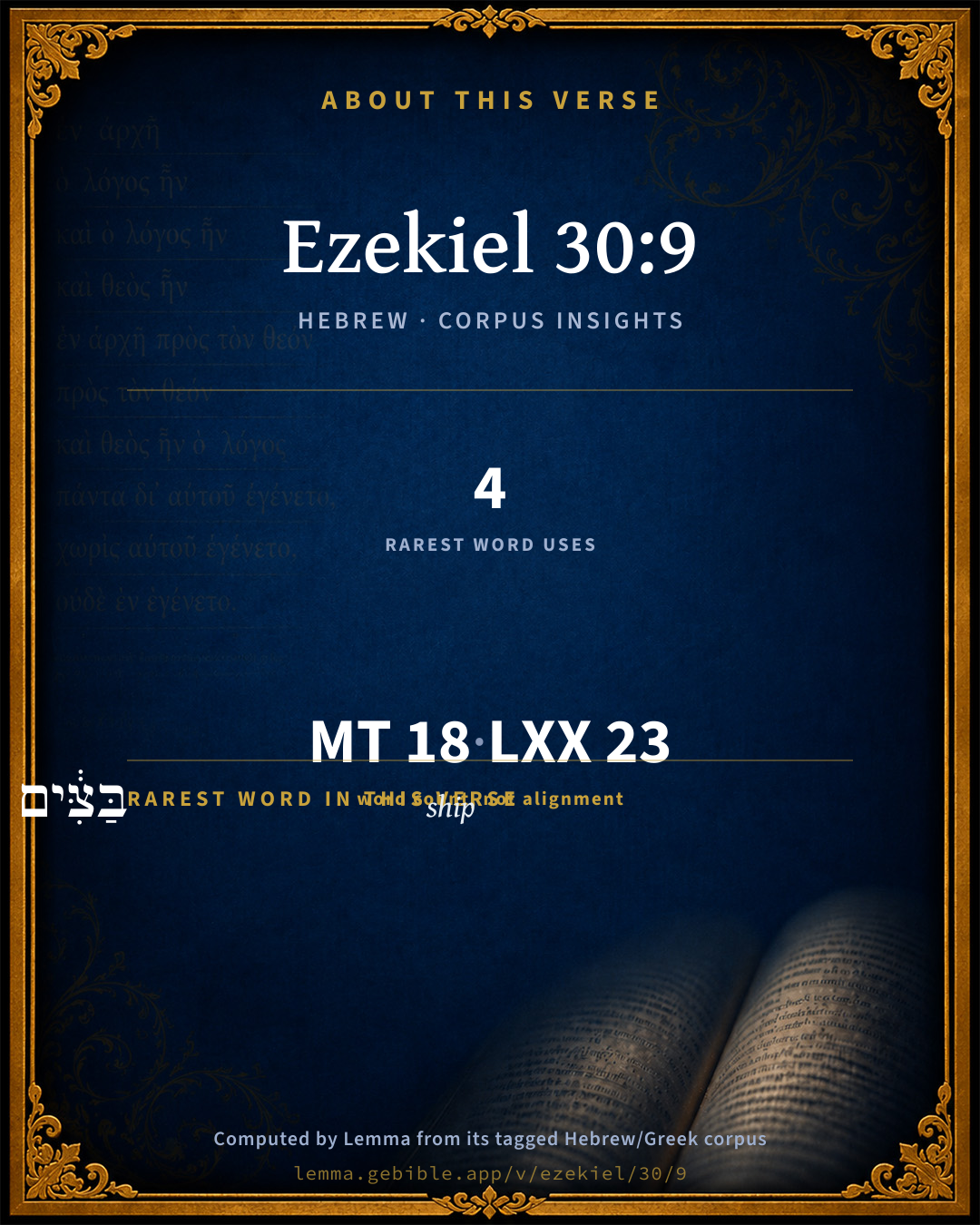
About this verse

These counts appear in no published source. They are computed here, from the morphology-tagged text and Lemma’s own curated glosses. What Lemma adds →

18
words
16
distinct lemmas
Prophets
section

Notable vocabulary

The rarest word here is בַּצִּ֔ים ship H6716 — appearing just 4 times in the whole Hebrew Bible.

Shared distinctive vocabulary

בַּצִּ֔ים ship H6716 occurs in 4 verses of the Hebrew Bible. Also found in:

Grammatical profile

  • 4 verbs
  • 9 nouns
  • 1 pronoun
  • 1 preposition
  • 1 conjunction
  • 2 particles

Verb forms

  • יֵצְא֨וּ Qal · Imperfect
  • לְהַחֲרִ֖יד Hiphil · Infinitive Construct
  • וְהָיְתָ֨ה Qal · Sequential Perfect
  • בָּאָֽה Qal · Participle Active

Repetition

A word recurs within this verse — often emphatic in Hebrew:

  • בַּיּ֣וֹם day H3117 ×2

Hebrew & Septuagint length

In English translation the verse runs 35 words from the Hebrew and 28 from the Septuagint (LXX English) — closely comparable.

A rough comparison of the two English renderings, which tokenize alike — not a word-level alignment.

Word counts can differ between the Hebrew and the Greek without any difference in meaning — e.g. the Hebrew direct-object marker אֵת has no separate Greek word, and Greek often adds the article ὁ.

In the original languages it is 18 Hebrew tokens and 23 Greek tokens — but the two are counted differently (Hebrew bundles its prefixes and suffixes into one token; the Greek is in lemma form), so that isn’t a like-for-like length.

Cross-references

22

Topical passages linked to Ezekiel 30:9 in the Treasury of Scripture Knowledge — connected by theme and wording, ordered by reader-vote popularity; previews shown in the World English Bible.

  • Isaiah 18:1–2 Ah, the land of the rustling of wings, which is beyond the rivers of Ethiopia;
  • Isaiah 23:5 When the report comes to Egypt, they shall be sorely pained at the report of Tyre.
  • Ezekiel 32:9–10 I will also vex the hearts of many peoples, when I shall bring your destruction among the nations, into the countries which you have not known.
  • Judges 18:7 Then the five men departed, and came to Laish, and saw the people who were therein, how they lived in security, after the manner of the Sidonians, quiet and secure; for there was none in the land, possessing authority, that might put [them] to shame in anything, and they were far from the Sidonians, and had no dealings with any man.
  • Isaiah 19:17 The land of Judah shall become a terror to Egypt; everyone to whom mention is made of it shall be afraid, because of the purpose of Yahweh of Hosts, which he purposes against it.
  • Isaiah 20:3 Yahweh said, Like as my servant Isaiah has walked naked and barefoot three years for a sign and a wonder concerning Egypt and concerning Ethiopia;
  • Isaiah 20:5 They shall be dismayed and confounded, because of Ethiopia their expectation, and of Egypt their glory.
  • Isaiah 32:9–11 Rise up, you women who are at ease, [and] hear my voice; you careless daughters, give ear to my speech.
  • Isaiah 47:8 Now therefore hear this, you who are given to pleasures, who sit securely, who say in your heart, I am, and there is none else besides me; I shall not sit as a widow, neither shall I know the loss of children:
  • Jeremiah 49:21 The earth trembles at the noise of their fall; there is a cry, the noise which is heard in the Red Sea.
  • Jeremiah 49:31 Arise, go up to a nation that is at ease, that dwells without care, says Yahweh; that have neither gates nor bars, that dwell alone.
  • Ezekiel 26:16 Then all the princes of the sea shall come down from their thrones, and lay aside their robes, and strip off their embroidered garments: they shall clothe themselves with trembling; they shall sit on the ground, and shall tremble every moment, and be astonished at you.
  • Ezekiel 27:35 All the inhabitants of the isles are astonished at you, and their kings are horribly afraid; they are troubled in their face.
  • Ezekiel 30:4–6 A sword shall come on Egypt, and anguish shall be in Ethiopia, when the slain shall fall in Egypt; and they shall take away her multitude, and her foundations shall be broken down.
  • Ezekiel 33:33 When this comes to pass, (behold, it comes), then shall they know that a prophet has been among them.
  • Ezekiel 38:11 and you shall say, I will go up to the land of unwalled villages; I will go to those who are at rest, who dwell securely, all of them dwelling without walls, and having neither bars nor gates;
  • Ezekiel 39:6 I will send a fire on Magog, and on those who dwell securely in the isles; and they shall know that I am Yahweh.
  • Amos 4:2 The Lord Yahweh has sworn by his holiness that behold, "The days shall come on you that they will take you away with hooks, And the last of you with fish hooks.
  • Zephaniah 2:12 You Cushites also, you will be killed by my sword.
  • Zephaniah 2:15 This is the joyous city that lived carelessly, that said in her heart, "I am, and there is none besides me." How she has become a desolation, a place for animals to lie down in! Everyone who passes by her will hiss, and shake their fists.
  • Zechariah 11:2–3 Wail, fir tree, for the cedar has fallen, Because the stately ones are destroyed. Wail, you oaks of Bashan, For the strong forest has come down.
  • 1 Thessalonians 5:2 For you yourselves know well that the day of the Lord comes like a thief in the night.

Cross-references courtesy of OpenBible.info (CC BY 4.0).

Hebrew and Greek witnesses Masoretic Hebrew ↔ Greek Septuagint

The same verse in the two great witnesses to the Old Testament, shown verse-for-verse.

These are two independent witnesses, not word-aligned to each other, and the Septuagint is shown in lemma (dictionary) form.

Hebrew Ezekiel 30:9 Masoretic · Westminster Leningrad Codex

בַּיּ֣וֹם הַה֗וּא יֵצְא֨וּ מַלְאָכִ֤ים מִלְּפָנַי֙ בַּצִּ֔ים לְהַחֲרִ֖יד אֶת כּ֣וּשׁ בֶּ֑טַח וְהָיְתָ֨ה חַלְחָלָ֤ה בָהֶם֙ בְּי֣וֹם מִצְרַ֔יִם כִּ֥י הִנֵּ֖ה בָּאָֽה

In that day shall messengers go forth from before me in ships to make the careless Ethiopians afraid; and there shall be anguish on them, as in the day of Egypt; for, behold, it comes.

World English Bible · Public Domain

Greek LXX Ezekiel 30:9 Septuagint · lemma form

ἐν ὁ ἡμέρα ἐκεῖνος ἐκἔρχομαι ἄγγελος σπεύδω ἀπο ἀναἵζω ὁ αἰθιοπία καί εἰμί ταραχή ἐν αὐτός ἐν ὁ ἡμέρα αἴγυπτος ὅτι ἰδού ἥκω

In that day shall messengers go forth hasting to destroy Ethiopia utterly, and there shall be tumult among them in the day of Egypt: for, behold it comes.

LXX2012 (modern English Septuagint) · Public Domain

On this verse, Whedon's Commentary on the Bible discusses the Septuagint’s reading. Read the note in Commentary ↓

Hebrew: Westminster Leningrad Codex (CC BY 4.0). Greek: Septuagint (public domain); English from LXX2012 (modern English Septuagint) (Public Domain). How the Septuagint differs from the Hebrew →

Targum (Aramaic paraphrase)

1

The Targum is the ancient Jewish Aramaic paraphrase of the Hebrew Scriptures — an interpretive translation, not the Hebrew text itself. Onkelos (literal) and Pseudo-Jonathan (expansive) render the Torah, and Jonathan the Prophets. Coverage is partial: where no permissively-licensed English translation exists for a verse, only the Aramaic is shown. This is verse-level text, not a word-by-word alignment to the Hebrew.

  1. Targum Jonathan Prophets (Joshua–Malachi)
    בְּעִדָנָא הַהִיא יִפְקוּן אִזְגַדִין מִן קֳדָמַי בְּלִגְיוֹנִין לַאֲזָעָא כּוּשׁ דְשַׁרְיָא לְרוֹחֲצָן וִיהֵי זִיעָא בְּהוֹן כְּיוֹם מִצְרַיִם אֲרֵי הָא אַתְיָא:

    (no public-domain English translation for this verse)

    Targum Jonathan — Aramaic: “Mikraot Gedolot” (public domain). English: “Sefaria Community Translation” (CC0 1.0 (public-domain dedication)); “London "Chaldee Paraphrase," 1871” (public domain). Text via Sefaria.

Commentary

Notes on Ezekiel 30:9 from classic Christian and Jewish commentators (each source and its license shown beneath its notes). The classic Christian expositions comment on the surrounding passage and are grouped to its opening verse, so a note may address several verses; the Jewish commentaries on the Tanakh (Rashi and others) are per-verse, so they appear only where the commentator wrote on this verse.

Lemma curates 59 commentaries, every one of them public domain or Creative Commons licensed, each selected and text-cleaned for this edition rather than reprinted as found. About our sources →

Trapp's Complete Commentary

John Trapp

Eze 30:9 In that day shall messengers go forth from me in ships to make the careless Ethiopians afraid, and great pain shall come upon them, as in the day of Egypt: for, lo, it cometh.

Ver. 9. In that day shall messengers go forth from me,] i.e., The Chaldeans, by an instinct from me to subdue Ethiopia also.

In ships.] For Nile was navigable:

“ Lene fluit Nile. ” - Claudian.

To make the careless Ethiopians.] Heb., Confident Cush. Security ushereth in calamity.

As in the day of Egypt.] That cloudy day, {Eze 30:3} when clouds of blood were dissolved upon them. Or that dismal day of old, when they perished in the Red Sea. {Exo 15:10}

John Trapp, A Commentary or Exposition upon All the Books of the Old and New Testament (1647–1656) — public domain. Text from a community e-Sword module.

Jamieson, Fausset & Brown

Robert Jamieson, A. R. Fausset & David Brown

messengers . . . in ships to . . . Ethiopians-- (Isa 18:1-2). The cataracts interposing between them and Egypt should not save them. Egyptians "fleeing from before Me" in My execution of judgment, as "messengers" in "skiffs" ("vessels of bulrushes," Isa 18:2) shall go up the Nile as far as navigable, to announce the advance of the Chaldeans.

as in the day of Egypt--The day of Ethiopia's "pain" shall come shortly, as Egypt's day came.

Jamieson, Fausset & Brown — Commentary Critical and Explanatory on the Whole Bible (1871) — public domain (CC PDM 1.0). Text via the HelloAO Bible API.

Adam Clarke's Commentary

Verse 9. Messengers go forth from me in ships] Ships can ascend the Nile up to Syene or Essuan, by the cataracts; and when Nebuchadnezzar's vessels went up, they struck terror into the Ethiopians. They are represented here as the "messengers of God."

Adam Clarke's Commentary on the Bible (1810–1826) — public domain. Text from a community e-Sword/MySword module.

Ellicott's Commentary for English Readers

(9) Messengers go forth from me in ships.—Comp. Isa_18:1-2. This does not mean the army of Nebuchadnezzar, which did not penetrate into Ethiopia, but the flying Egyptians, who ascend the Nile to seek safety in Ethiopia, and alarm it with the tidings of Egypt’s fall. The “careless” are the secure Ethiopians. “As in the day of Egypt” is a reference to a past event, and can only mean, as in the day of judgment upon Egypt at the Exodus.

A Bible Commentary for English Readers, edited by Charles John Ellicott (1878–1897) — public domain. Text from a community e-Sword module.

The Cambridge Bible for Schools and Colleges

gen. ed. J. J. S. Perowne

9. messengers … in ships] Cf. Isa_18:2. The word “ships” again Num_24:24; Isa_33:21.

go forth from me] This means more than that messengers go in ships from Egypt, where Jehovah is present. He sends them; his intervention in Egypt is designed to alarm the world, and bring himself to its knowledge.

as in the day] in the day (om. as) Isa_23:5.

The Cambridge Bible for Schools and Colleges (gen. ed. J. J. S. Perowne; Cambridge University Press, 1878–1918) — public domain. Text from a community e-Sword module.

John Gill's Exposition

In that day shall messengers go forth from me in ships,.... Either by the river Nile, or by the Red sea, to Arabia Felix, which some think is meant by Ethiopia. Cush or Ethiopia was encompassed about with water, so that there was no coming to it but by ships; see Gen 2:13, compare with this Isa 18:1, the messengers here were either such who under a divine impulse, or however by the providence of God, were directed to go to Ethiopia, and tell them the news of the destruction of Egypt; or these were messengers sent by the king of Babylon, to demand a surrender of their country to him; or it may design him himself, and his army, who marched thither to subdue that country also, after the conquest of Egypt. So the Targum,

"at that time messengers shall go forth from before me with legions;''

and because all this was by the appointment and providence of God, they are represented as messengers sent by him:

to make the careless Ethiopians afraid; with the news of the fall of Egypt their confederate, and of a mighty army coming against them; who had dwelt securely and confidently, at ease and unconcerned, without any sense of danger, or fear of any enemy:

and great pain shall come upon them, as in the day of Egypt; either as of old, when the plagues were on Egypt, and especially when they were drowning in the Red sea; or as of late, when the sword was in Egypt, and ravaging there:

for, lo, it cometh; the same day was coming on them as came on Egypt, the day of the Lord, a cloudy one, and the time of the Heathen; it was certain, just at hand, and there was no escaping it; see Eze 30:3.

John Gill's Exposition of the Whole Bible (1746–1763) — public domain (CC PDM 1.0). Text via the HelloAO Bible API.

Albert Barnes' Notes on the Bible

Careless Ethiopians - The Ethiopians, who were dwelling in fancied security Zep 2:15, shall tremble at Egypt’s ruin.

Albert Barnes' Notes on the Bible (1834–1885) — public domain. Text from a community e-Sword/MySword module.

Haydock's Catholic Bible Commentary

Messengers; the Chaldeans. (Calmet) --- The Nile was navigable as far as Syene. (St. Jerome)

George Leo Haydock (1774–1849), Haydock's Catholic Family Bible and Commentary, 1859 edition — public domain. Excludes Psalms (Douay-Rheims chapter numbering differs from Protestant) and Deuterocanonical books (Catholic canon only).

Matthew Poole's English Annotations

In that day; the day of God’s severe but just judgments, and Egypt’s fatal desolation.

Messengers; such as having seen and escaped the sword, shall tell the dismal news.

From me; by my permission and providence they shall go, as if sent by me.

In ships; ships that either carried them over into Pentapolis, crossing the river Nilus, or rather going down the river into the Mediterranean, and so to any part of those north parts of Africa, and others by ship through the Red Sea to Arabia Felix, which is that Ethiopia which is here meant; though it is possible in those days the African Ethiopia might, as once it did, extend quite to the mouth of the Red Sea. on whose shore their ancestors must needs first land out of Arabia, whence the Abyssinians, who are our present Ethiopians, do own their descent. So messengers by ships might carry the news to both the Ethiopian, Asian, and African, by the Red Sea.

The careless Ethiopians; in much security they had hitherto lived, the most potent and formidable neighbour having been their ancient ally, till the news of so mighty an enemy at their very doors.

Great pain; apprehensions of danger, that puzzles their wisdom, weakens their courage, makes them in perplexity, both sick and astonished.

As in the day of Egypt; either like that which, when their host was drowned in the Red Sea, seized all Egypt, or rather like this latter fear, which arose from the mighty havoc made by the Chaldean.

It cometh; a storm like that certainly cometh against you.

Matthew Poole's English Annotations on the Holy Bible (1683–1685) — public domain. Text from a community e-Sword/MySword module.

Whedon's Commentary on the Bible

Daniel D. Whedon

9. From me in ships — LXX, and Peshito, in haste; R.V., “from before me in ships.” (Compare Isa_18:2.)

As in the day — Omit “as.” The Ethiopians fear that Nebuchadnezzar will not stop at Syene, but will press on into their country (notes Eze_29:10-11).

Daniel D. Whedon (gen. ed.), Commentary on the Old and New Testaments (1874–1909) — public domain. Text from a community e-Sword module.

The Pulpit Commentary

In that day shall messengers, etc. The whole passage seems an echo of Isa_18:2. The ships are those that bear the tidings of the conquest of Lower Egypt to the upper valley of the Nile. The careless Ethiopians are so named as confiding in their remoteness from the scene of action. They thought themselves safe, and were lulled into a false security. (comp. Isa_32:9-11 and Zep_2:15, for a like rendering of the verb) As in the day of Egypt. As Isaiah (Isa_9:4) refers to the day of Midian," so Ezekiel points to the memorable time when like tidings of the judgments that fell on Egypt carried dismay into the hearts of the surrounding nations. (Exo_15:14, Exo_15:15)

The careless Ethiopians.

These people who were heedless of the coming danger that threatened them in common with great Egypt may serve as a type of the careless generally.

I THE PREVALENCE OF CARELESSNESS. These "careless Ethiopians" are not rare specimens of an obscure class. We have not to go to Africa, nor to antiquity, for the like of them. The genus to which they belong is far from extinct even in this age of anxiety and energy. Note the various forms which carelessness takes.

1. In regard to danger. This was the condition of the easy-going Ethiopians. They would not consider the approaching danger of the Chaldean invasion. Men will not see risks to health till they suddenly break down; then they discover them, perhaps, too late. Soul-danger is ignored by thoughtless sinners.

2. In respect to guilt. The pilgrim felt the weight of his burden, but most of the inhabitants of the City of Destruction seem to have had no thought of their sins. Many men sin recklessly. They add up the score of guilt without a thought.

3. In reference to duty. Multitudes live as though they were only to be expected to please themselves. The sacred word "duty" has no meaning for them. They may be very anxious about their business and what will be profitable, but they are quite careless as to what they ought to do.

4. In connection with other men. Dives is careless as to the condition of Lazarus. The Church is too negligent of the state of the heathen world. In great cities people think little of their next-door neighbors. It is possible to starve in a land of plenty, and for no one to give heed till too late.

5. In relation to God. He is our Father and Master, and it is our first duty and our highest interest to regard his will. Yet many act as if he did not exist. They care neither for his love nor for his wrath.

II THE EVIL OF CARELESSNESS. The "careless Ethiopians" are to share in the great deluge of general calamities that is about to sweep over the nations. Their carelessness does not protect them. Carelessness is evil on many accounts.

1. Because of its folly. This is more than childish. It is the stultification of mind. Man is made in the image of God, a thinking being. To renounce thought is to abdicate the throne of supremacy over the lower creation.

2. Because of its negligence. This carelessness is willful. It springs from an idle refusal to take the trouble of thinking, or from an insane infatuation with superficial interests. It is our duty to consider our ways, to consider the poor, and to remember our Creator. Negligence is sin.

3. Because of its danger. The danger is not in any degree lessened because we decline to consider it. The recklessness of an engine-driver about red lights does not annihilate obstructions on the line. The wages of sin will be paid punctually and to the full, whether we expect the day of recompense or never anticipate it.

Observe, in conclusion, that there is a way of being saved from care. This is not to be found in carelessness, however. We can quench worldly care with trust. Other anxieties may be softened and ultimately abolished when we seriously set ourselves to seeking God"s favor and doing his will.

The Pulpit Commentary (1880–1919), ed. H.D.M. Spence-Jones & Joseph S. Exell — public domain. Text from a community e-Sword module.

John Wesley's Explanatory Notes

Messengers - Such as having escaped the sword, shall tell the news. From me - By my permission and providence. In ship's - Messengers by ships might carry the news to both the Ethiopian, Asian, and African, by the Red-sea. As in the day - During the mighty havock made by the Chaldeans. It - A like storm.

John Wesley, Explanatory Notes Upon the Whole Bible (1754–1765) — public domain. Text via the GEBible commentary corpus.

Rashi

Rabbi Shlomo Yitzchaki (Rashi)

emissaries...from before Me Troops of armies going on My mission in many caravans to frighten Cush, which is dwelling securely.

With legions [Heb. בַּצִים,] like (Num. 24:24): “And legions (וְצִים) from the place of the Kittites,” and so too did Jonathan render it: with legions.

Rashi on the Tanakh — English translations: “The Judaica Press complete Tanach with Rashi, translated by A. J. Rosenberg” (CC BY 4.0); “Pentateuch with Rashi's commentary by M. Rosenbaum and A.M. Silbermann, 1929-1934” (public domain); “The Metsudah Tanach series, Lakewood, N.J” (CC BY 4.0); and “The Book of Joshua, Metsudah Publications, 1997” (CC BY 4.0). Text via Sefaria.

Lesson kit

Teaching starters — assembled from the data on this page, not authored interpretation. Every prompt links to the verse data it draws on. Edit before teaching.

Ezekiel, in the Prophets, opens this verse with 18 words (16 distinct Hebrew lemmas). Its most distinctive word is tsîy (“ship”). A historical commentator’s framing appears above. Read the whole chapter for the surrounding context.

Discussion questions

  1. How does “ship” (tsîy) shape what this verse is saying?
  2. How does Numbers 24:24, which shares the word «ship», read alongside this verse?
  3. What does the repetition of “day” (2× in this one verse) do in this verse?
  4. The translations on this page render this verse differently — a whole-verse word diff, not a word-by-word alignment. What might account for the different wordings?
  5. «יֵצְא֨וּ» is a Qal Imperfect verb. How does that grammatical form shape the action described?
  6. Compare how Trapp's Complete Commentary and Jamieson, Fausset & Brown read this verse. Where do they agree or differ?

Things to notice

Reading settings

Reading text

Shown beneath each verse's original-language words.

Old Testament
Old Testament edition

Read the OT as the Masoretic Hebrew (MT) or the Greek Septuagint (LXX).

English shown for the Greek Septuagint (in the Hebrew ↔ Greek comparison).

Comparing translations? Open the Compare panel on any verse page to stack up to four side by side.