Hosea 12:9

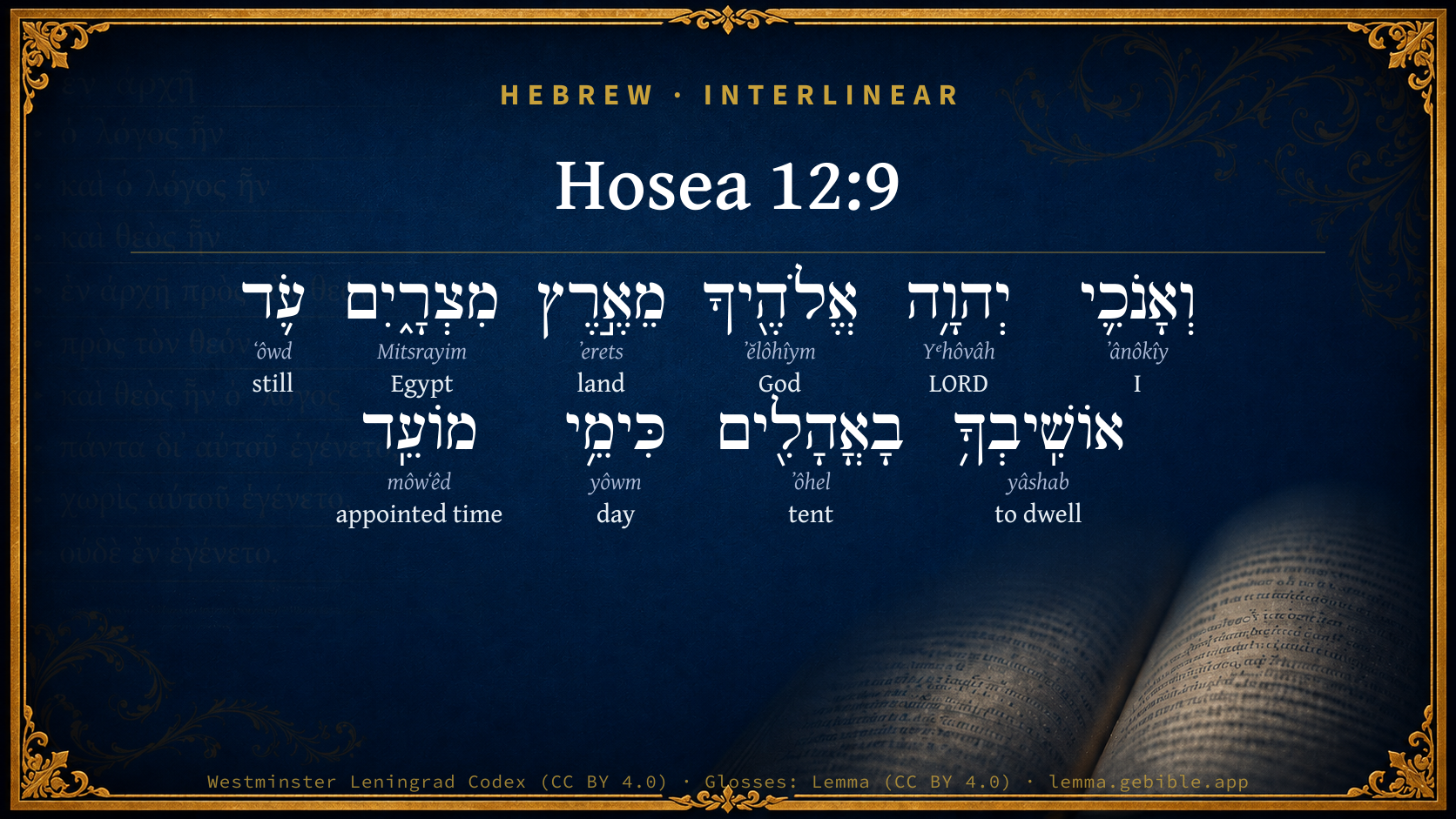
Hebrew (Westminster Leningrad Codex) Hosea 12:9 appears in the Hebrew Old Testament. The text above is from the Westminster Leningrad Codex. Each word links to its Strong’s number, a concise gloss, and parsing drawn from the Open Scriptures Hebrew Bible morphology. Click any word for its full Brown-Driver-Briggs (BDB) entry.
Download image
Cite this verse

Hosea 12:9 (World English Bible). Public Domain. Lemma interlinear Bible study tool, https://lemma.gebible.app/v/hosea/12/9.

Show BibTeX & RIS
BibTeX
RIS
English Translation
"But I am Yahweh your God from the land of Egypt. I will yet again make you to dwell in tents, As in the days of the solemn feast.
World English Bible · Public Domain
Download a study sheet

One document with this verse’s original text, its word-by-word gloss line, the meaning frame, cross-references with their text, attributed commentary, and full source and license credits — printable, and it pastes into notes with its structure intact.

This verse Autodidact and up

Study sheet (.html) Plain text (.txt)

A passage Seminary Student

Up to 50 verses in one chapter. A passage sheet keeps up to 6 commentary sources and 12 cross-references per verse, in the order this page ranks them, and says so on the sheet whenever that leaves anything out. Ask for a single verse and you get the Autodidact verse sheet above.

Everything on this page stays free to read, with no account — the sheet is a download of what is already on screen, not access to it.

Want to remove ads? Support Godless Engineer
Compare translations 3

The same verse in 3 English versions, stacked beneath the original-language interlinear above. Click any original word for its lexicon entry.

Each is an independent rendering of the whole verse — the interlinear is not word-aligned to these translations.

Highlighted words mark where these versions differ — a whole-verse word diff, not a word-by-word alignment.

  • World English Bible Public Domain
    "But I am Yahweh your God from the land of Egypt. I will yet again make you to dwell in tents, As in the days of the solemn feast.
  • King James Version Public Domain
    And I that am the LORD thy God from the land of Egypt will yet make thee to dwell in tabernacles, as in the days of the solemn feast.
  • unfoldingWord Literal Text CC BY-SA 4.0
    “And I Yahweh your God from the land of Egypt. I will make you dwell in tents again, as in the days of the appointed festival.

unfoldingWord Literal Text — © unfoldingWord, licensed CC BY-SA 4.0. Word-aligned USFM3 via Door43 (git.door43.org/unfoldingWord/en_ult).

Versions to compare (up to 4)

3 of 4 selected

Show all 18 translations

Every available English version of this verse, each an independent rendering of the whole verse.

  • World English Bible Public Domain
    "But I am Yahweh your God from the land of Egypt. I will yet again make you to dwell in tents, As in the days of the solemn feast.
  • Berean Standard Bible Public Domain
    But I am the LORD your God ever since the land of Egypt. I will again make you dwell in tents, as in the days of the appointed feast.
  • Majority Standard Bible Public Domain
    But I am the LORD your God ever since the land of Egypt. I will again make you dwell in tents, as in the days of the appointed feast.
  • King James Version Public Domain
    And I that am the LORD thy God from the land of Egypt will yet make thee to dwell in tabernacles, as in the days of the solemn feast.
  • American Standard Version (1901) Public Domain
    But I am Jehovah thy God from the land of Egypt; I will yet again make thee to dwell in tents, as in the days of the solemn feast.
  • Revised Version (1885) Public Domain
    But I am the LORD thy God from the land of Egypt; I will yet again make thee to dwell in tents, as in the days of the solemn feast.
  • Geneva Bible (1599) Public Domain
    Though I am the Lord thy God, from the land of Egypt, yet will I make thee to dwel in the tabernacles, as in the daies of the solemne feast.
  • Douay-Rheims (1899) Public Domain
    And I that am the Lord thy God from the land of Egypt, will yet cause thee to dwell in tabernacles, as in the days of the feast.
  • Young's Literal Translation Public Domain
    And I -- Jehovah thy God from the land of Egypt, Again do I turn thee back into tents, As in the days of the appointed time.
  • Literal Standard Version CC BY-SA 4.0
    And I—your God YHWH from the land of Egypt, || Again I turn you back into tents, || As in the days of the appointed time.
  • Unlocked Literal Bible CC BY-SA 4.0
    “I am Yahweh your God from the land of Egypt. I will again make you live in tents, as in the days of the appointed festival.
  • unfoldingWord Literal Text CC BY-SA 4.0
    “And I Yahweh your God from the land of Egypt. I will make you dwell in tents again, as in the days of the appointed festival.
  • Darby Bible Public Domain
    But I [that am] Jehovah thy God from the land of Egypt will again make thee to dwell in tents, as in the days of the solemn feast.
  • World Messianic Bible Public Domain
    “But I am the LORD your God from the land of Egypt. I will yet again make you dwell in tents, as in the days of the solemn feast.
  • Webster's Bible Public Domain
    \\12:8\\And Ephraim said, Yet I have become rich, I have found for myself substance: in all my labors they shall find no iniquity in me that were sin.
  • Free Bible Version CC BY-SA 4.0
    But I am the Lord your God who brought you out of the land of Egypt. I will make you live again in tents like you do at the time of that particular festival.
  • Bible in Basic English Public Domain
    And Ephraim said, Now I have got wealth and much property; in all my works no sin may be seen in me.
  • JPS Tanakh (1917) Public Domain
    (12-10) But I am the LORD thy God from the land of Egypt; I will yet again make thee to dwell in tents, as in the days of the appointed season.

Literal Standard Version (2020), Covenant Press — licensed CC BY-SA 4.0. Text via the HelloAO Bible API (eBible.org). Unlocked Literal Bible (unfoldingWord) — licensed CC BY-SA 4.0. Text via the HelloAO Bible API (eBible.org). unfoldingWord Literal Text — © unfoldingWord, licensed CC BY-SA 4.0. Word-aligned USFM3 via Door43 (git.door43.org/unfoldingWord/en_ult). Free Bible Version, Dr. Jonathan Gallagher — licensed CC BY-SA 4.0. Text via the HelloAO Bible API (eBible.org).

Word by word

More ways to search: Search by grammar → Find every occurrence → Compare this word →

Practice this passage: Drill this verse → Learn its vocabulary →

מוֹעֵֽד
môwʻêd
H4150
“appointed time”
Noun, Common, Masculine, Singular, Absolute
Part of Speech
Noun
Type
Common
Gender
Masculine
Number
Singular
State
Absolute
Full BDB Definition

Origin: from H3259

TWOT: 878b

appointed place, appointed time, meeting - appointed time - appointed time (general) - sacred season, set feast, appointed season - appointed meeting - appointed place - appointed sign or signal - tent of meeting
  1. וְאָנֹכִ֛י ʼânôkîy H595 “and · I” Conjunction + Pronoun, Personal, 1st Person, Common, Singular
  2. יְהוָ֥ה Yᵉhôvâh H3068 “LORD” Noun, Proper
  3. אֱלֹהֶ֖יךָ ʼĕlôhîym H430 “God(s) · your” Noun, Common, Masculine, Plural, Construct + Suffix, Personal, 2nd Person, Masculine, Singular
  4. מֵאֶ֣רֶץ ʼerets H776 “from · land of” Preposition + Noun, Common, Both, Singular, Construct
  5. מִצְרָ֑יִם Mitsrayim H4714 “Egypt” Noun, Proper
  6. עֹ֛ד ʻôwd H5750 “still” Adverb
  7. אוֹשִֽׁיבְךָ֥ yâshab H3427 “to dwell · you” Verb, Hiphil, Imperfect, 1st Person, Common, Singular + Suffix, Personal, 2nd Person, Masculine, Singular
  8. בָאֳהָלִ֖ים ʼôhel H168 “in/at · tents” Preposition + Noun, Common, Masculine, Plural, Absolute
  9. כִּימֵ֥י yôwm H3117 “like/as · days of” Preposition + Noun, Common, Masculine, Plural, Construct

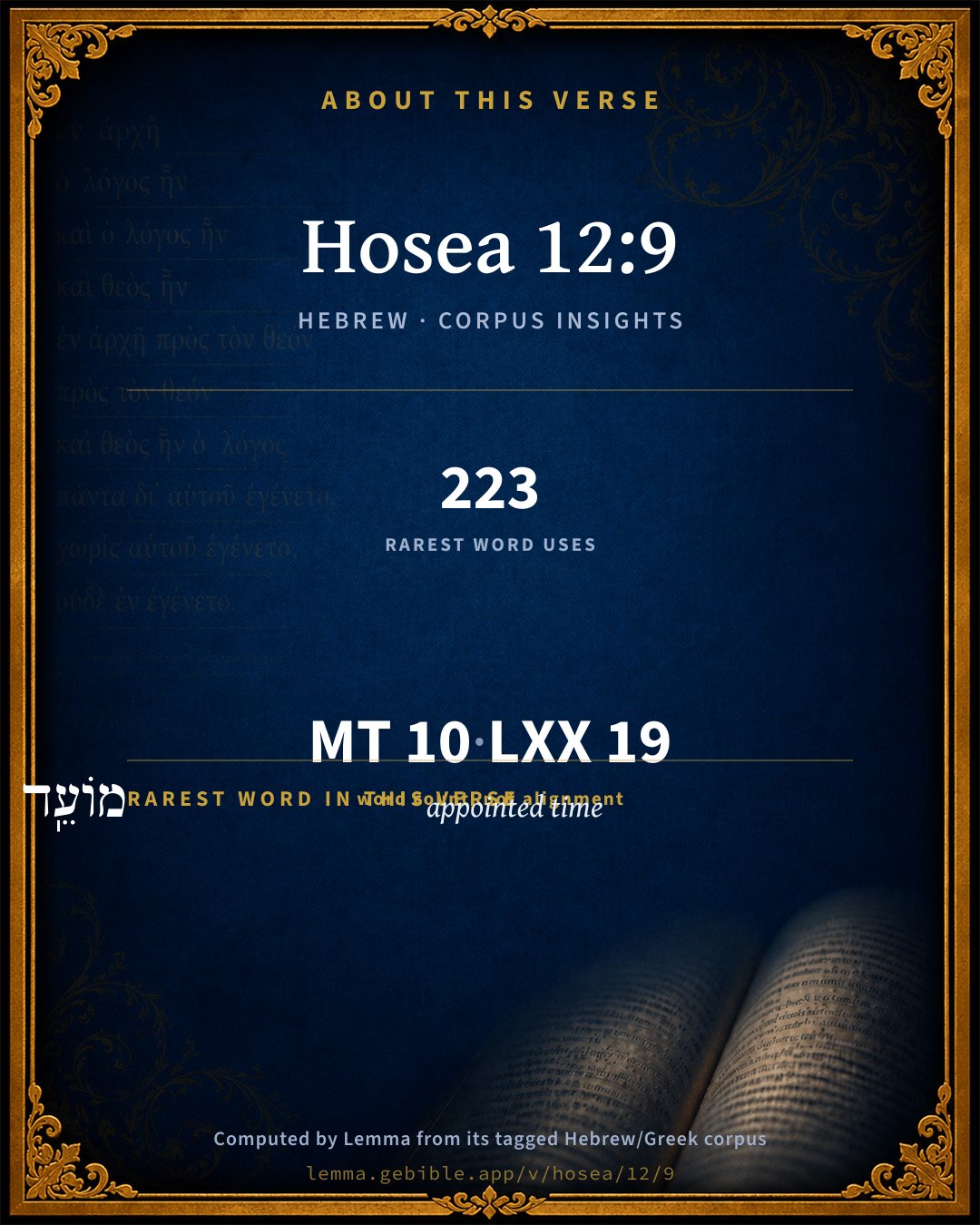
About this verse

These counts appear in no published source. They are computed here, from the morphology-tagged text and Lemma’s own curated glosses. What Lemma adds →

10
words
10
distinct lemmas
Prophets
section

Grammatical profile

  • 1 verb
  • 7 nouns
  • 1 pronoun
  • 1 adverb

Verb forms

  • אוֹשִֽׁיבְךָ֥ Hiphil · Imperfect

Hebrew & Septuagint length

In English translation the verse runs 29 words from the Hebrew and 31 from the Septuagint (LXX English) — closely comparable.

A rough comparison of the two English renderings, which tokenize alike — not a word-level alignment.

Word counts can differ between the Hebrew and the Greek without any difference in meaning — e.g. the Hebrew direct-object marker אֵת has no separate Greek word, and Greek often adds the article ὁ.

In the original languages it is 10 Hebrew tokens and 19 Greek tokens — but the two are counted differently (Hebrew bundles its prefixes and suffixes into one token; the Greek is in lemma form), so that isn’t a like-for-like length.

Cross-references

16

Topical passages linked to Hosea 12:9 in the Treasury of Scripture Knowledge — connected by theme and wording, ordered by reader-vote popularity; previews shown in the World English Bible.

  • Leviticus 23:40–43 You shall take on the first day the fruit of goodly trees, branches of palm trees, and boughs of thick trees, and willows of the brook; and you shall rejoice before Yahweh your God seven days.
  • 2 Samuel 7:2 that the king said to Nathan the prophet, See now, I dwell in a house of cedar, but the ark of God dwells within curtains.
  • Nehemiah 8:15–17 and that they should publish and proclaim in all their cities, and in Jerusalem, saying, Go forth to the mountain, and get olive branches, and branches of wild olive, and myrtle branches, and palm branches, and branches of thick trees, to make booths, as it is written.
  • Psalms 81:10 I am Yahweh, your God, Who brought you up out of the land of Egypt. Open your mouth wide, and I will fill it.
  • Hosea 13:4 "Yet I am Yahweh your God from the land of Egypt; And you will know no god but me, And besides me there is no savior.
  • Genesis 25:27 The boys grew. Esau was a skillful hunter, a man of the field. Jacob was a quiet man, living in tents.
  • Exodus 20:2 "I am Yahweh your God, who brought you out of the land of Egypt, out of the house of bondage.
  • Leviticus 19:36 Just balances, just weights, a just ephah, and a just hin, shall you have. I am Yahweh your God, who brought you out of the land of Egypt.
  • Leviticus 26:13 I am Yahweh your God, who brought you forth out of the land of Egypt, that you should not be their slaves; and I have broken the bars of your yoke, and made you go upright.
  • Numbers 15:41 I am Yahweh your God, who brought you out of the land of Egypt, to be your God: I am Yahweh your God.
  • Ezra 3:4 They kept the feast of tents, as it is written, and [offered] the daily burnt offerings by number, according to the ordinance, as the duty of every day required;
  • Jeremiah 35:7 neither shall you build house, nor sow seed, nor plant vineyard, nor have any; but all your days you shall dwell in tents; that you may live many days in the land in which you sojourn.
  • Zechariah 14:16–19 It will happen that everyone who is left of all the nations that came against Jerusalem will go up from year to year to worship the King, Yahweh of Hosts, and to keep the feast of tents.
  • John 7:2 Now the feast of the Jews, the Feast of Booths, was at hand.
  • Hebrews 11:9–13 By faith, he lived as an alien in the land of promise, as in a land not his own, dwelling in tents, with Isaac and Jacob, the heirs with him of the same promise.
  • Micah 6:4 For I brought you up out of the land of Egypt, And redeemed you out of the house of bondage. I sent before you Moses, Aaron, and Miriam.

Cross-references courtesy of OpenBible.info (CC BY 4.0).

Hebrew and Greek witnesses Masoretic Hebrew ↔ Greek Septuagint

The same verse in the two great witnesses to the Old Testament, shown verse-for-verse.

These are two independent witnesses, not word-aligned to each other, and the Septuagint is shown in lemma (dictionary) form.

Hebrew Hosea 12:9 Masoretic · Westminster Leningrad Codex

וְאָנֹכִ֛י יְהוָ֥ה אֱלֹהֶ֖יךָ מֵאֶ֣רֶץ מִצְרָ֑יִם עֹ֛ד אוֹשִֽׁיבְךָ֥ בָאֳהָלִ֖ים כִּימֵ֥י מוֹעֵֽד

"But I am Yahweh your God from the land of Egypt. I will yet again make you to dwell in tents, As in the days of the solemn feast.

World English Bible · Public Domain

Greek LXX Hosea 12:9 Septuagint · lemma form

καί εἶπον ἐφράιμ πλήν πλουτέω εὑρίσκω ἀναψυχή ἐμαυτοῦ πᾶς ὁ πόνος αὐτός οὐ εὑρίσκω αὐτός διά ἀδικία ὅς ἁμαρτάνω

But I the Lord your God brought you up out of the land of Egypt: I will yet cause you to dwell in tabernacles, according to the days of the feast.

LXX2012 (modern English Septuagint) · Public Domain

Hebrew: Westminster Leningrad Codex (CC BY 4.0). Greek: Septuagint (public domain); English from LXX2012 (modern English Septuagint) (Public Domain). How the Septuagint differs from the Hebrew →

Targum (Aramaic paraphrase)

1

The Targum is the ancient Jewish Aramaic paraphrase of the Hebrew Scriptures — an interpretive translation, not the Hebrew text itself. Onkelos (literal) and Pseudo-Jonathan (expansive) render the Torah, and Jonathan the Prophets. Coverage is partial: where no permissively-licensed English translation exists for a verse, only the Aramaic is shown. This is verse-level text, not a word-by-word alignment to the Hebrew.

  1. Targum Jonathan Prophets (Joshua–Malachi)
    וַאֲמַרוּ דְבֵית אֶפְרַיִם בְּרַם עַתַרְנָא אַשְׁכַּחְנָא אוֹנָס לָנָא נְבִיָא אֱמַר לְהוֹן כָּל עוֹתַרְכוֹן לָא יִתְקַיֵם לְכוֹן כְּיוֹם תּוּשְׁלְמַת חוֹבֵיכוֹן:

    (no public-domain English translation for this verse)

    Targum Jonathan — Aramaic: “Mikraot Gedolot” (public domain). English: “Sefaria Community Translation” (CC0 1.0 (public-domain dedication)); “London "Chaldee Paraphrase," 1871” (public domain). Text via Sefaria.

Commentary

Notes on Hosea 12:9 from classic Christian and Jewish commentators (each source and its license shown beneath its notes). The classic Christian expositions comment on the surrounding passage and are grouped to its opening verse, so a note may address several verses; the Jewish commentaries on the Tanakh (Rashi and others) are per-verse, so they appear only where the commentator wrote on this verse.

Lemma curates 59 commentaries, every one of them public domain or Creative Commons licensed, each selected and text-cleaned for this edition rather than reprinted as found. About our sources →

The Cambridge Bible for Schools and Colleges

gen. ed. J. J. S. Perowne

9. And I] Rather, For I. It is explanatory of the vague hint of an inexorable doom.

thy God from the land of Egypt] Who is therefore ever ready to help you (Isa_46:3), but who will also, if necessary, punish you as He did of old (comp. Num_14:26-30).

will yet make thee to dwell in tabernacles] Rather, will again make thee to dwell in tents. The analogy of a parallel passage (Hos_2:14) at once suggests the idea that this prediction is a threat and not (as St Jerome, Kimchi, and Calvin would have it) a promise. Not indeed a threat without a tinge of promise (see on Hos_2:14), but the unrelieved worldliness of the speech in Hos_12:9 calls forth a declaration of God’s purpose as uncompromising in its earnestness. ‘Again’ alludes to the journey through the wilderness. On the rendering yet, see further note in Introduction, part v.

as in the days of the solemn feast] Better, of the festal season. The word used is mô‘çd (lit. appointed time), which is used rather more widely than khag ‘festival.’ Here however the prophet does mean one of the three ancient festivals, viz. the so-called Feast of Tabernacles (or rather, Booths). This was the most popular of all the feasts (see on Hos_9:1): it was originally a time of rejoicing for the ‘ingathering’ (whence its name in Exo_23:16) of the latest crops of the year, and the ‘booths’ or ‘tents’ (as they are here, for once, called) were simply designed (as at the analogous festivals of other nations) to promote the enjoyment of the simple-minded rural merrymakers. Another object is indeed ascribed to the festival in the Book of Leviticus, viz. to remind the Israelites of the tent-life of their fathers in the wilderness, but this, as Mr Clark and others have well shown (see Speaker’s Commentary on Lev_23:43), can only have been an after-thought, as the nomad Israelites are never said to have dwelt in ‘booths’ or ‘huts’, but always in ‘tents’ (of skin or cloth). Hosea’s reference to the Feast of Booths points a striking contrast. The predominant tone of the Israelites is now one of exuberant joyousness (Hos_9:1), culminating in the merry, out-of-door life of the local autumn-festivals, but soon they shall dwell in tents again, not for amusement, but by bitter compulsion.

The Cambridge Bible for Schools and Colleges (gen. ed. J. J. S. Perowne; Cambridge University Press, 1878–1918) — public domain. Text from a community e-Sword module.

Trapp's Complete Commentary

John Trapp

Hos 12:9 And I [that am] the LORD thy God from the land of Egypt will yet make thee to dwell in tabernacles, as in the days of the solemn feast.

Ver. 9. And I that am thy Lord God from the land of Egypt] This seemeth to be interlaced for the comfort of the better sort, that trembled at the former threatenings; for as in a family if the dogs be beaten the children will be apt to cry, so is it in God’s house. Hence he is capable to take out the precious from the vile, and telleth them that he hath not cast off his people whom he foreknew; but would surely observe his ancient covenant, made even in the land of Egypt towards his spiritual Israel.

I will yet make them to dwell in tabernacles, &c.] i.e. I will deliver my Church from the spiritual Egypt, and make her to pass through the wilderness of the world, in particular Churches, aspiring toward the heavenly Canaan; even as my people dwelt in tents in the wilderness, the remembrance whereof is celebrated in the feast of tabernacles, Lev 23:43. See Zec 14:16. {See Trapp on "Zec 14:16"}

John Trapp, A Commentary or Exposition upon All the Books of the Old and New Testament (1647–1656) — public domain. Text from a community e-Sword module.

The Biblical Illustrator

Joseph S. Exell

Hos_12:9

Make thee to dwell in tabernacles, as in the days of the solemn feast.

The feast of tabernacles as a type

This feast was the yearly remembrance Of Gods miraculous guidance and support of Israel through the wilderness. It was the link which bound on their deliverance from Egypt to the close of their pilgrim life, and their entrance into their rest. The passage of the Red Sea, like baptism, was the beginning of Gods promises. By it Israel was saved from Egypt and from bondage, and was born to be a people of God. Yet, being the beginning, it was plainly not the completion, nor could they themselves complete it. The wilderness dangers had to be surmounted. It was a time of the visible presence of God. It was a long trial time, and they were taught entire dependence on God; a time of sifting, in which God proved His faithfulness to those who persevered. Standing there, between the beginning and the end of the accomplishment of Gods promise to Abraham and to them, it was a type of His whole guidance of His people at all times. It was a pledge that God would lead His own, if often, by a way which they knew not, yet to rest with Him. The yearly commemoration of it was not only a thanksgiving for Gods past mercies; it was a confession also of their present relation to God, that here we have no continuing city; that they still needed the guidance and support of God; and that their trust was not in themselves, nor in man, but in Him. This they themselves saw. When they said, Leave a fixed habitation, and dwell in a chance abode, they meant that the command to dwell in tabernacles was given to teach us that no man must rely on the height or strength of his house, or on its good arrangements, though it abound in all good; nor may he rely on the help of any man, not though he were lord and king of the whole earth, but must trust Him by whose Word the worlds were made. For with Him alone is power and faithfulness, so that whereinsoever any man may place his trust he shall receive no consolation, from it, since in God alone is refuge and trust. The feast of tabernacles was also a yearly thanksgiving for the mercies with which God had crowned the year. The joy must have been even the greater since it followed, by five days only, after the mournful day of atonement, its rigid fast from evening to evening, and its confession of sin. Joy is greater when ushered in by sorrow; sorrow for sin is the condition of joy in God. The Feast of Tabernacles was, as far as it could be, a sort of Easter after Lent. At the time when Israel rejoiced in the good gifts of the year, God made them express, in act, their fleeting condition in this life. It must have been a striking confession of the slight tenure of all earthly things, when their kings and great men, their rich men and those who lived at ease, had all, at the command of God, to leave their sailed houses, and dwell for seven days in rude booths, constructed for the season, pervious in some measure to the sun and wind, with no fixed foundation, to be removed when the festival was passed. Because, says a Jewish writer, at the time of the ingathering of the increase from the field, man wishes to go from the field to his house to make a fixed abode there, the law was anxious lest, on account of this fixed abode, his heart should be lifted up at having found a sort of palace, and he should wax fat and kick. Therefore it is written, All that are Israelites born shall dwell in booths. Whoso begins to think himself a citizen in this world, and not a foreigner, him God biddeth leave his ordinary dwelling, to remove into a temporary lodging, in order that, leaving these thoughts, he may learn to acknowledge that he is only a stranger in this world, and not a citizen, in that he dwells as in a strangers hut, and so should not attribute too much to the shadow of his beams, but dwell under the shadow of the Almighty. Every year the law was publicy read in the feast. Ephraim was living clean contrary to all this. He boasted in his wealth, justified himself on the ground of it, ascribed it and his deliverance from Egypt to his idols. He would not keep the feast, as alone God willed it to be kept. While he existed in his separate kingdom, it could not be. Their political existence had to be broken that they might be restored. God then conveys the notice of the impending punishment in words which promised the future mercy. He did not then make them to dwell in tabernacles. For all their service of Him was out of their own mind, contrary to His will, displeasing to Him. This, then, I will yet make thee to dwell in tabernacles, implies a distnt mercy, beyond and distinct from their present condition. Looking on beyond the time of the Captivity, He says that they shall yet have a time of joy, as in the days of the solemn feast. God would give them a new deliverance, but out of a new captivity, The Feast of the Tabernacles typifies this our pilgrim-state, the life of simple faith in God, for which God provides; poor in this worlds goods, but rich in God. The church militant dwells, as it were, in tabernacles; hereafter, we hope to be received into everlasting habitations in the Church triumphant. (E. B. Pusey, D. D.)

The days of Moed

1. Explanation. Of ancient agreement, or according to appointed days; for God had promised to give the land of Canaan to the posterity of Abraham for their perpetual rest. Explanation--

2. Israelites are here reproved, because they neglected the command of God, who had instituted a festal day, on which they were to commemorate yearly their redemption. Explanation--

3. The prophet threatens the Israelites, as though he said, God will again drive you out, that you may dwell in tents, as you formerly did in the desert. Explanation--

4. Inasmuch as your former redemption has lost its influence through your wicked forgetfulness, I will become again your redeemer; I will therefore make thee to abide in tents as formerly; as your first redemption avails nothing, I will add a second, that you may at length repent, and know how much you are indebted to Me. (John Calvin.)

The Biblical Illustrator, edited by Joseph S. Exell (c. 1880s–1900s) — public domain. Text from a community e-Sword module.

Joseph Benson's Commentary

Hos 12:9-10. I that am the Lord thy God from the land of Egypt — From the time I brought thee out of it: will yet make thee to dwell in tabernacles — That is, in thy habitations, quietly and joyfully, as in festival times. The word tabernacles is here put for houses, or habitations; because at first the Israelites dwelt in tabernacles, or tents. This must be taken as a promise of the restoration of the Israelites to their own land, after their being carried into captivity, provided they turned to God, and to his worship and service, in true repentance, and new obedience. I have also spoken by the prophets, &c. — “Here are three species of prophecy distinctly mentioned: 1st, Immediate suggestion, or inspiration, when God dictates the very words which the prophet is to deliver: 2d, Vision, or a representation made of external objects to the imagination, in as lively a manner as if they were conveyed to the senses: and, 3d, Parables, and apt resemblances, such as that of God’s church to a vineyard, Isa 5:1, of the destruction of Jerusalem to a forest set on fire, Eze 20:46; Eze 20:49, and to a seething- pot, chapter Eze 24:3. Hosea himself was a parable, or type, to the Jews, in taking a wife of whoredoms. to represent the idolatries of the house of Israel” — Lowth.

Joseph Benson's Commentary on the Old and New Testaments (1811–1818) — public domain. Text from a community e-Sword module.

Keil & Delitzsch

C. F. Keil & F. Delitzsch

"Yet am I Jehovah thy God, from the land of Egypt hither: I will still cause thee to dwell in tents, as in the days of the feast. Hos 12:10. I have spoken to the prophets; and I, I have multiplied visions, and spoken similitudes through the prophets. Hos 12:11. If Gilead (is) worthlessness, they have only come to nothing: in Gilgal they offered bullocks: even their altars are like stone-heaps in the furrows of the field." The Lord meets the delusion of the people, that they had become great and powerful through their own exertion, by reminding them that He (ואנכי is adversative, yet I) has been Israel's God from Egypt hither, and that to Him they owe all prosperity and good in both past and present (cf. Hos 13:4). Because they do not recognise this, and because they put their trust in unrighteousness rather than in Him, He will now cause them to dwell in tents again, as in the days of the feast of Tabernacles, i.e., will repeat the leading through the wilderness. It is evident from the context that mō‛ēd (the feast) is here the feast of Tabernacles. מועד (the days of the feast) are the seven days of this festival, during which Israel was to dwell in booths, in remembrance of the fact that when God led them out of Egypt He had caused them to dwell in booths (tabernacles, Lev 23:42-43). אד אושׁיבך stands in antithesis to הושׁבתּי ot si in Lev 23:43. "The preterite is changed into a future through the ingratitude of the nation" (Hengstenberg). The simile, "as in the days of the feast," shows that the repetition of the leading through the desert is not thought of here merely as a time of punishment, such as the prolongation of the sojourn of the Israelites in the wilderness for forty years really was (Num 14:33). For their dwelling in tents, or rather in booths (sukkōth), on the feast of Tabernacles, was intended not so much to remind the people of the privations of their unsettled wandering life in the desert, as to call to their remembrance the shielding and sheltering care and protection of God in their wandering through the great and terrible wilderness (see at Lev 23:42-43). We must combine the two allusions, therefore: so that whilst the people are threatened indeed with being driven out of the good and glorious land, with its large and beautiful cities and houses full of all that is good (Deu 6:10.), into a dry and barren desert, they have also set before them the repetition of the divine guidance through the desert; so that they are not threatened with utter rejection on the part of God, but only with temporary banishment into the desert. In Hos 12:10 and Hos 12:11 the two thoughts of Hos 12:9 are still further expanded. In Hos 12:10 they are reminded how the Lord had proved Himself to be the God of Israel from Egypt onwards, by sending prophets and multiplying prophecy, to make known His will and gracious counsel to the people, and to promote their salvation. דּבּר with על, to speak to, not because the word is something imposed upon a person, but because the inspiration of God came down to the prophets from above. אדמּה, not "I destroy," for it is only the kal that occurs in this sense, and not the piel, but "to compare," i.e., speak in similes; as, for example, in Hos 1:1-11 and Hos 3:1-5, Isa 5:1., Ezekiel 16 etc.: "I have left no means of admonishing them untried" (Rosenmller). Israel, however, has not allowed itself to be admonished and warned, but has given itself up to sin and idolatry, the punishment of which cannot be delayed. Gilead and Gilgal represent the two halves of the kingdom of the ten tribes; Gilead the land to the east of the Jordan, and Gilgal the territory to the west. As Gilead is called "a city (i.e., a rendezvous) of evil-doers" (פּעלי און) in Hos 6:8, so is it here called distinctly און, worthlessness, wickedness; and therefore it is to be utterly brought to nought. און and שׁוא are synonymous, denoting moral and physical nonentity (compare Job 15:31). Here the two notions are so distributed, that the former denotes the moral decay, the latter the physical. Worthlessness brings nothingness after it as a punishment. אך, only = nothing, but equivalent to utterly. The perfect היוּ is used for the certain future. Gilgal, which is mentioned in Hos 4:15; Hos 9:15, as the seat of one form of idolatrous worship, is spoken of here as a place of sacrifice, to indicate with a play upon the name the turning of the altars into heaps of stones (Gallim). The desolation or destruction of the altars involves not only the cessation of the idolatrous worship, but the dissolution of the kingdom and the banishment of the people out of the land. שׁורים, which only occurs in the plural here, cannot of course be the dative (to sacrifice to oxen), but only the accusative. The sacrifice of oxen was reckoned as a sin on the part of the people, not on account of the animals offers, but on account of the unlawful place of sacrifice. The suffix to mizbechōthâm (their sacrifices) refers to Israel, the subject implied in zibbēchū.

Keil & Delitzsch — Biblical Commentary on the Old Testament (1861–1891) — public domain (CC PDM 1.0). Text via the HelloAO Bible API. (Old Testament only.)

Tyndale Open Study Notes

Tyndale Open Resources

12:9 I will make you live in tents again: God’s judgment on the wealthy Israelite merchants was for them to return to the humble dwellings of the Exodus. There is also a word of hope here: God’s plan of salvation for Israel would begin anew in the wilderness (see 2:14-15).

Tyndale Open Study Notes — © Tyndale Open Resources, licensed CC BY-SA 4.0. Text via the HelloAO Bible API.

Geneva Bible (1599)

Geneva Bible translators

Seeing thou wilt not acknowledge my benefits, I will bring thee again to dwell in tents, as in the feast of the Tabernacles, which thou dost now contemn.

Geneva Bible (1599) marginal notes — public domain. Text via Bolls.life.

Jamieson, Fausset & Brown

Robert Jamieson, A. R. Fausset & David Brown

And--rather, "And yet." Though Israel deserves to be cast off for ever, yet I am still what I have been from the time of My delivering them out of Egypt, their covenant God; therefore, "I will yet make thee to dwell in tabernacles," that is, to keep the feast of tabernacles again in remembrance of a new deliverance out of bondage. Fulfilled primarily at the return from Babylon (Neh 8:17). Fully and antitypically to be fulfilled at the final restoration from the present dispersion (Zac 14:16; compare Lev 23:42-43).

Jamieson, Fausset & Brown — Commentary Critical and Explanatory on the Whole Bible (1871) — public domain (CC PDM 1.0). Text via the HelloAO Bible API.

Adam Clarke's Commentary

Verse 9. And I - the Lord thy God] I who brought thee out of the land of Egypt, will again make thee to dwell in tabernacles. This appears to be a threatening. I will reduce you to as miserable a state in the land of your captivity, as you often were through your transgressions in the wilderness. This was the opinion of some of the ancients on this verse; and the context requires it to be understood in this way. I do not think that the feast of tabernacles is referred to.

Adam Clarke's Commentary on the Bible (1810–1826) — public domain. Text from a community e-Sword/MySword module.

John Calvin's Commentaries

In the first clause God reproaches the Israelites for having forgotten the benefit of his redemption, the memory of which ought ever to have prevailed and flourished among them. I yet, he says, am thy God from the land of Egypt; that is, “It is strange that you are so forgetful that your redemption does not come to your mind, which yet ought to be well known, and be ever, as it were, before your eyes.” That was, as we know, a memorable instance of God’s kindness. But when he says that he is the God of that people from the land of Egypt, he points out the end of redemption, as though he said, “I redeemed thee for this end, that thou mightest be forever bound to me.” For we know that when he delivered that people from their cruel tyranny, he at the same time acquired for himself an eternal kingdom; he was then sanctified in his elect people. The end of redemption is then to be observed in the words of the Prophet, “I am,” he says, “thy God from the land of Egypt; how otherwise couldest thou have come forth from thy grave?” For they were like the dead, when God stretched out his hand to them. From the land of Egypt then I am thy God, which means this: “Since thou hast been so wonderfully restored from death to life by my favour, am not I thy God from that day? Thou owest then thyself and all thine to me; for I purchased thee for myself as a peculiar possession. When now thou detest petulantly to reject my Prophets, who speak in my name, it is surely an ingratitude not to be endured, that thou forgettest thy redemptions and the end for which I made known to thee my power and grace.”

But as to the second clause, interpreters vary; some explain it in this way, that God would not cease to show mercy to the Israelites, however unworthy they were, I will make thee to dwell in thy tabernacles; and they take tabernacles, not strictly proper, for houses. Then they say, according to the days of Moed, that is, of ancient agreement, or, according to appointed days; for God had promised to give the land of Canaan to the posterity of Abraham for their perpetual rest. But this exposition seems not suitable. Others say, that the Israelites are here reproved, because they neglected the command of God, who had instituted a festal-day, on which they were to commemorate yearly their redemption. We indeed know that there was the annual feast of tabernacles: so they think the meaning of the Prophet to be this “I not only once redeemed thee, but I also wished that there should be a memorial of this favour; and for what purpose have I commanded you to keep a yearly festival, except that ye might retain in your memory what otherwise might have been forgotten? But I have effected nothing by this rite, for I am now rejected, and my prophets possess no authority among you.” But this sense also is frigid. Some think that the Prophet here threatens the Israelites, as though he said, “God will again drive you out, that you may dwell in tents as you did formerly in the desert.” Though I do not reject this opinion, yet I think there is something more emphatical in the Prophet’s words, that is, that God here says in an indirect way, that there was need of a new redemption, that he might bind the people more to himself; as though he said, “I see that you are unmindful of my former redemption; for I see that you esteem it as nothing, as if it were obsolete; I must then lose all my labour, except the memory of my ancient favour be renewed: I will therefore make thee to dwell again in tents. It is necessary to eject thee again from thy heritage, and to restore thee again, and that in a manner unusual and least expected, that thou mayest understand that I am thy Redeemer.

We now then apprehend what the Prophet meant. After God had said that he was the God of Israel from the land of Egypt, he then adds, “Inasmuch as your former redemption has lost all its influence through your wicked forgetfulness, I will become again your Redeemer; I will therefore make thee to abide or dwell in tents as formerly; as your first redemption avails nothing, I will add a second, that you may at length repent, and know how much you are indebted to me.” The days of Moed he takes for their manner of proceeding in the desert as described by Moses; for they assembled together for sacrifices from their camps. Hence God does not speak here of the convention he had made with his people, as if he pointed out some perpetual compact; but he calls those the days of Moed on which the Israelites were assembled, when they were located in their camps according to the account given by Moses. It now follows —

John Calvin's Commentaries (1540-1563) — public domain. Text from the Calvin Translation Society English edition (1840s-50s) via the Christian Classics Ethereal Library (ccel.org). Calvin's coverage is partial (roughly two-thirds of the Bible); uncommented books and verses are honest gaps, never fabricated. The 19th-century editor's footnotes and remarks are omitted so the notes are faithfully Calvin's own voice.

Ellicott's Commentary for English Readers

(9) Tabernacles.—The prophet here speaks of Israel’s moral restoration under the form of a return to “the old ideal of simple agricultural life, in which every good gift is received directly from Jehovah’s hand.” To the true theocratic spirit the condition here spoken of is one of real blessedness, but to the worldly, grasping Canaan or Ephraim it would come as a threat of expulsion, desolation, and despair. (Comp. Hos_2:14; Hos_3:3.)

A Bible Commentary for English Readers, edited by Charles John Ellicott (1878–1897) — public domain. Text from a community e-Sword module.

John Gill's Exposition

And I that am the Lord thy God from the land of Egypt,.... Ephraim being so very corrupt in things, both religious and civil, and so very impenitent and impudent, is let alone to suffer the just punishment of his sins; but Judah being called to repentance, and brought unto it, gracious promises are here made unto him, to be fulfilled in the times of the Messiah, either at the first or latter part of them; especially the last is to be understood, when indeed all Israel shall return to the Lord, and be saved; and then it will appear, that the Lord, who was their God, as was evident from his bringing them out of Egyptian bondage, and continued to be so from that time to the Babylonish captivity, and even to the times of the Messiah, will now be their God most clearly and manifestly, having redeemed them from worse than Egyptian bondage; from the bondage of sin, Satan, the law, the world, and death; even the Lord Jesus Christ, the true Messiah, they will now seek and embrace, who is God over all, and equal to such a work of redemption and salvation; Immanuel, God with us, God in our nature, our Lord and our God, the God of the Jews now converted, as will be acknowledged, as well as of the Gentiles: and he

will yet make thee to dwell in tabernacles, as in the days of the solemn feast; alluding to the feast of tabernacles, kept in commemoration of the Israelites dwelling in tents in the wilderness, Lev 23:42; typical of Christ's incarnation, expressed by his tabernacling among men in human nature, Joh 1:14; and which feast, though abolished by Christ with the rest, yet it is said will be kept by converted Jews and Gentiles in the latter day; which can be understood no otherwise than of their embracing and professing the incarnate Saviour, partaking of the blessings of grace that come by him, and attending on those ordinances of public worship instituted by him; see Zac 14:16; and which booths, tents, or tabernacles, the Israelites dwelt in at that feast, were also typical of the churches of Christ under the Gospel dispensation, and which are here meant; and in which it is here promised the converted Jews shall dwell, as they had been used to do in their booths at the solemn feast of tabernacles. These Christian churches resembling them in the matter of them; believers in Christ, the materials of such churches, being compared to goodly trees, to willows of the brook, to palm trees, olive trees, and myrtle trees, with others, the branches of which were used at the above feast, to make their tabernacles with; see Lev 23:40; and in the use of them, which was to dwell in during the time of the said feast; as the churches of Christ are the tabernacles of the most High, the dwelling places of Father, Son, and Spirit; and the habitation of the saints, where they dwell and enjoy great plenty and prosperity, tranquillity and security; and here it particularly denotes that joy, peace, and the converted Jews shall partake of in the churches of Christ in the latter day; of which the feast of tabernacles was but a shadow, and which was attended with much rejoicing, plenty of provisions, and great safety.

John Gill's Exposition of the Whole Bible (1746–1763) — public domain (CC PDM 1.0). Text via the HelloAO Bible API.

Albert Barnes' Notes on the Bible

And I, the Lord thy God from the land of Egypt - God, in few words, comprises whole centuries of blessings, all, from the going out of Egypt to that very day, all the miracles in Egypt, in the wilderness, under Joshua, the Judges; one stream of benefits it had been, which God had poured out upon them from first to last. The penitent sees in one glance, how God had been “his” God, from his birth until that hour, and how he had all along offended God.

Will yet make thee to dwell in tabernacles - The feast of tabernacles was the yearly remembrance of God’s miraculous guidance and support of Israel through the wilderness. It was the link, which bound on their deliverance from Egypt to the close of their pilgrim-life and their entrance into their rest. The passage of the Red Sea, like Baptism, was the beginning of God’s promises. By it israel was saved from Egypt and from bondage, and was born to be a people of God. Yet, being the beginning, it was plainly not the completion; nor could they themselves complete it. Enemies, more powerful than they, had to be dispossessed; “the great and terrible wilderness, the fiery serpents and scorpions, and the land of exceeding drought, where was no water” Deu 8:15, had to be surmounted; no food was there, no water, for so vast a multitude. It was a time of the visible presence of God. He promised; “I send an Angel before thee to keep thee in the way and to bring thee into the place which I have prepared” Exo 23:20. “He brought them forth water out of the rock of flint, and fed them with manna which,” He says, “thy fathers knew not” Deu 8:15-16. “Thy raiment,” He appeals to them, “waxed not old, nor did thy foot swell these forty years” Deu 8:4; “thy shoe is not waxen old upon thy foot; ye have not eaten bread, neither have ye drunk wine or strong drink, that ye may know that I am the Lord your God” Deu 29:5-6.

It was a long trial-time, in which they were taught entire dependence upon God; a time of sifting, in which God proved His faithfulness to those who persevered. Standing there between the beginning and the end of the accomplishment of God’s promise to Abraham and to them, it was a type of His whole guidance of His people at all times. It was a pledge that God would lead His own, if often “by a way which they knew not” Isa 42:16, yet to rest, with Him. The yearly commemoration of it was not only a thanksgiving for God’s past mercies; it was a confession also of their present relation to God, that “here we have no continuing city” (Heb 13:14; compare Hos 11:9-10); that they still needed the guidance and support of God; and that their trust was not in themselves, nor in man, but in Him. This they themselves saw. : “When they said, ‘Leave a fixed habitation, and dwell in a chance abode,’ they meant, that the command to dwell in tabernacles was given, to teach us, that no man must rely on the height or strength of his house, or on its good arrangements though it abound in all good; nor may he rely on the help of any man, not though he were lord and king of the whole earth, but must trust in Him by whose word the worlds were made. For with Him alone is power and faithfulness, so that, whereinsoever any man may place his trust, he shall receive no consolation from it, since in God alone is refuge and trust, as it is said, ‘Whoso putteth his trust in the Lord, mercy embraceth him on every side, and I will say unto the Lord, my Refuge and my Fortress, my God, in Him will I trust. ‘“

The feast of tabernacles was also a yearly thanksgiving for the mercies with which God had “crowned the year.” The joy must have been even the greater, since it followed, by five days only, after the mournful day of atonement, its rigid fast from evening to evening, and its confession of sin. Joy is greater when ushered in by sorrow; sorrow for sin is the condition of joy in God. The Feast of tabernacles was, as far it could be, a sort of Easter after Lent. At the time when Israel rejoiced in the good gifts of the year, God bade them express, in act, their fleeting condition in this life. It must have been a striking confession of the slight tenure of all earthly things, when their kings and great men, their rich men and those who lived at ease, had all, at the command of God, to leave their ceiled houses, and dwell for seven days in rude booths, constructed for the season, pervious in some measure to the sun and wind, with no fixed foundation, to be removed when the festival was passed. “Because,” says a Jewish writer , “at the time of the gathering of the increase from the field, man wishes to go from the field to his house to make a fixed abode there, the law was anxious, lest on account of this fixed abode, his heart should be lifted up at having found a sort of palace, and he should ‘wax fat and kick.’ Therefore it is written, ‘all that are Israelites born shall dwell in booths.’ Whoso begins to think himself a citizen in this world, and not a foreigner, him God biddeth, leaving his ordinary dwelling, to remove into a temporary lodging, in order that, leaving these thoughts, he may learn to acknowledge that he is only a stranger in this world and not a citizen, in that he dwells as in a stranger’s hut, and so should not attribute too much to the shadow of his beams, but ‘dwell under the shadow of the Almighty. ‘“

Every year, the law was publicly read in the feast. Ephraim was living clean contrary to all this. He boasted in his wealth, justified himself on the ground of it, ascribed it and his deliverance from Egypt to his idols. He would not keep the feast, as alone God willed it to be kept. While he existed in his separate kingdom, it could not be. Their political existence had to be broken, that they might be restored.

God then conveys the notice of the impending punishment in words which promised the future mercy. He did not, “then, make” them “to dwell in tabernacles.” For all their service of Him was out of their own mind, contrary to His will, displeasing to Him. This, then, “I will “yet” make thee dwell in tabernacles,” implies a distant mercy, beyond and distinct from their present condition. Looking on beyond the time of the captivity, He says that they shall yet have a time of joy, “as in the days of the solemn feast.” God would give them a new deliverance, but out of a new captivity.

The feast of tabernacles typifies this our pilgrim-state, the life of simple faith in God, for which God provides; poor in this world’s goods, but rich in God. The Church militant dwells, as it were, in tabernacles; hereafter, we hope to be “received into everlasting habitations,” in the Church triumphant.

Albert Barnes' Notes on the Bible (1834–1885) — public domain. Text from a community e-Sword/MySword module.

Haydock's Catholic Bible Commentary

Egypt. At Sinai the covenant between God and Israel was chiefly ratified. The former ceased not to perform the conditions, but the latter repaid him with ingratitude. --- Feast. The people shall be brought back, (Calmet) or they shall again be forced to dwell under tents. (Theodoret) --- "Shall I still cause?" &c. (Tournemine)

George Leo Haydock (1774–1849), Haydock's Catholic Family Bible and Commentary, 1859 edition — public domain. Excludes Psalms (Douay-Rheims chapter numbering differs from Protestant) and Deuterocanonical books (Catholic canon only).

Matthew Poole's English Annotations

And, or but, I the Lord thy God, who forbade thy frauds and gave thee wealth, and am forgotten in both, thou fearest not mine anger and sinnest; thou forgettest that I give thee power to get wealth, and takest glory to thyself; but wouldst thou, as thou shouldst, remember, thou wouldst know

that I am the Lord thy God from the land of Egypt, that all thy blessings from thy coming out of Egypt to this day are from me; I give more than thou gettest; thou boastest of what is not thine, and if thou wilt glory, remember it should be in my goodness and bounty.

Will yet make, & c.; hitherto have made, &c.; thy peace, safety, plenty, and joy, (here expressed proverbially, in allusion to the joy and security which they enjoyed in the days of the feast of tabernacles,) were all through my goodness, presence, and faithfulness. And darest thou, O Ephraim, thus sacrilegiously rob me of the praise and glory? darest thou be thus unthankful? Or else thus, I would still make thee to dwell, &c., I take what course is fittest to prevent thy dangers, sorrows, and ruin, but all will not do, thou wilt undo thyself. I am Jehovah, I change not, I am thy God still, and have been so ever since thou camest out of Egypt, I gave thee plenty, peace, safety, joy, and would willingly continue it all, as will appear by what I have done to prevent thy sin, and continue thy obedience. Some tell us it is a threat that God will bring them into the condition of wanderers again, others make it a promise of future mercy; and in various conjectures we have ventured on what will suit the contexture of the words, at least tolerably well; if it be not the best, it best pleaseth at present.

Matthew Poole's English Annotations on the Holy Bible (1683–1685) — public domain. Text from a community e-Sword/MySword module.

The Pulpit Commentary

And I that am the Lord thy God from the land of Egypt will yet make thee to dwell in tabernacles, as in the days of the solemn feast. This verse consists of two parts which in the original are coordinated; but in the Authorized Version the one is subordinated to the other by supplying an awkward and unnecessary ellipsis. It is better, therefore, to translate thus: And I am the Lord thy God, from the land of Egypt: I will yet make thee to dwell in tabernacles, as in the days of the solemn feast. Some understand this verse as a threatening; not a few as a promise; while others combine both.

(1) Theodoret, who may be taken as representing the first class of interpreters, comments thus: "That thou mayest understand this and learn wisdom by thy calamity, I will bring thee back again to that point that thou must again dwell in tents and wander as an exile in a foreign land.

(2) Kimchi may represent those who understand it as a promise, or rather a promise with an implied threatening, and thus combine both. His exposition is as follows: "Even so am I ready to bring you forth out of the captivity where ye shall Be, as I did when I brought you forth out of the land of Egypt, and sustained you in the wilderness and made you dwell in tents; so am I ready yet again, when I shall have brought you forth out of the lands of the Gentiles, to cause you to dwell in tents in the wilderness by the way, and to show you wonders until ye shall return to your land in peace.

(3) Wunsche rejects both the preceding, and refers the statement to the other, present time, taking dwO, not in the sense of "yet again," but in the equally allowable meaning of "further," or "still further;" thus his rendering of the verse is, "And yet I am thy God from Egypt, still I let thee dwell in tents, as in the days of the solemn feast." Thus we have a remembrance of God"s goodness to Israel all along from the Exodus to the time then present, including the celebration of their feasts, especially that of Tabernacles, the most joyful of them all. This is favored by the interpretation of Aben Ezra, which is the following: "The sense is, "Shouldst thou not remember that I brought thee up out of the land of Egypt in great riches for which thou didst not labor, and nourished thee in the wilderness when thou wast in tents?" In like manner he shall be able to do unto thee as in the days of the solemn feast of thy coming out of Egypt." We prefer, notwithstanding, the exposition number (2), which includes, or rather implies, a threatening of being driven out of their good laud into a wilderness state, because of their forgetfulness of, and ingratitude to, God, as also because of their proud self-confidence; while, with this implied threat of punishment, God holds out to them the promise and prospect of like guiding care and sheltering guardianship, as in that early period of their history, the remembrance of which was still kept up by the moed, or Feast of Tabernacles, during the seven days of which the people dwelt in booths, in commemoration of their having dwelt in booths in the wilderness after they had been delivered out of the land of Egypt. Thus, as Hengstenberg has well observed, "the preterit is changed into a future through the ingratitude of the nation.

"Turn thou to thy God.

If there is one message more frequently repeated than another in the Scriptures, both of the Old and New Testaments, it is this message requiring repentance. There has been no generation of men, nay, there has been no individual man, to whom it might not justly be said, Repent!

I HUMAN CHARACTER AND LIFE ARE SUCH AS TO RENDER NECESSARY THIS TURNING TO GOD. One who is on the right road already has no need to turn; but he who is traveling in the wrong direction must first of all reverse his steps, his course. As sin and error have been universal, no limit can be placed to the appropriateness of the summons of the text.

II MAN MAY FIND IN HIMSELF MANY AND SUFFICIENT REASONS FOR REPENTANCE. His interests demand, his conscience enjoins, his best feelings urge, that he should turn unto God. His present happiness and his future prospects are imperiled by his remaining estranged from his God.

III IN GOD HIMSELF, AND IN HIS REVELATION, ARE MANY GROUNDS FOR REPENTANCE.

1. First of all there is the fact that he is our God. "Turn thou to thy God." How just and proper, then, that, instead of looking away from him, men should look towards him!

2. It must be considered that all our happiness is bound up with his favor and fellowship. To turn to him is to turn to the light of the sun, to the source of life.

3. The Divine directions and promises furnish the most persuasive motive add the most authoritative justification for turning unto God. T.

"Wait on thy God.

It is very instructive that the prophet in this passage admonished, not only to repentance, reformation, and righteousness, but also to "waiting on God." Many of the effects of repentance, and especially the moral, subjective effects, might be felt immediately, but there were other consequences which might probably be delayed. Hence the admonition of the text.

I IT IS HONORING TO GOD THAT HIS PEOPLE SHOULD WAIT UPON HIM. It is not for man to dictate to his Maker, to seek to prescribe when, how, and where God should intervene upon behalf of a suppliant. His wisdom is not to be questioned; his goodness is not to be impugned.

II IT IS PROFITABLE TO GOD"S PEOPLE TO WAIT UPON HIM. Thus faith and patience are cultivated virtues which are most serviceable to Christians, and which are a true ornament to the godly character.

III IT IS WELL TO WAIT UPON GOD CONTINUALLY. Remissness in so doing is to be condemned; weariness in waiting is dangerous. Just at the moment when the Helper draws nigh the needy soul may be in slumber or may be otherwise engaged. Waiting means watching.

IV GOD"S PEOPLE CANNOT WAIT FOR HIM IN VAIN. They may wait long, but their waiting shall be rewarded. Then shall they sing aloud for joy, "This is our God; we have waited for him." Wait for the harvest, and you shall reap. Wait for the morning, and the sun shall rise upon your expectant soul. T.

Happiness in reserve.

The mixture of promise with threat is one of the remarkable and instructive characteristics of these prophecies. In the midst of wrath God remembers mercy. The bright lining of the cloud cheers the beholder when he is downcast and troubled. Hoses is commissioned to assure Israel that upon their repentance they shall rejoice before God in the glad Feast of Tabernacles, which they shall celebrate to his glory.

I TRUE HAPPINESS CONSISTS IN THE REMEMBRANCE AND CELEBRATION OF GOD"S MERCIES. The feast of Tabernacles observed by the Jews was a festival in which the nation commemorated the goodness of Jehovah, both in supplying their wants by means of the harvest, and in delivering them as a nation from the power of Egypt. Now we as Christians have even greater mercies to acknowledge; God has given us the Bread of life, and he has rescued us from the power of sin and Satan. It behooves us, therefore, to cherish gratitude to God the Savior for all the great works he has wrought for us, and for all the loving-kindness with which he has treated us.

II THE PROSPECT OF SUCH HAPPINESS IS FITTED TO CHEER THE HEART IN TIMES OF SORROW AND TROUBLE. If this be the wilderness through which we pass, we are journeying to the land of possession and repose. If this be the darksome night whose shadows gather round us, we hope soon to see the streaks of the coming day. Let the discouraged and harassed Christian learn to say with the psalmist, Why art thou cast down, O my soul? and why art thou disquieted within me? hope thou in God: for I shall yet praise him.

III THE FAITHFUL PROMISES OF THE ETERNAL ASSURE A HAPPY FUTURE TO THOSE WHO TRUST AND LOVE HIM. The religion of Christ places the golden age in the future. The Christian has always something blessed and glorious to which to look forward. His dwelling-place is above. And he has ever before him the happy and inspiring prospect of sharing in "the marriage supper of the Lamb. T.

The Pulpit Commentary (1880–1919), ed. H.D.M. Spence-Jones & Joseph S. Exell — public domain. Text from a community e-Sword module.

John Wesley's Explanatory Notes

From Egypt - From the time I brought thee out of it. In tabernacles - I have given thee all these blessings and comforts, expressed proverbially in allusion to the joy which they had at the feast of tabernacles.

John Wesley, Explanatory Notes Upon the Whole Bible (1754–1765) — public domain. Text via the GEBible commentary corpus.

unfoldingWord translationNotes

Door43 World Missions Community

General Information:

Yahweh is speaking to the people of Israel.

I am Yahweh your God from the land of Egypt

Possible meanings are 1) "I am Yahweh your God, who brought your ancestors from the land of Egypt" or 2) "I have been your God ever since you were in the land of Egypt" or 3) "I became your God when you were in the land of Egypt"

I will again make you live in tents

Possible meanings are 1) Yahweh is threatening to force the people of Israel from their homes and make them live in tents. So, here to "live in tents" would represent being sent into exile, or 2) it is a promise that after their exile the people will live in tents again, and Yahweh will take care of them as he did when the Israelites left Egypt. So, here "to live in tents" would represent a return to an ideal situation when Yahweh took care of his people. (See: Metonymy)

By the hand of the prophets

Here "hand" represents the one who carries out an action. AT: "Through the prophets" (See: Synecdoche)

translationWords

Yahweh

God

Egypt

life

tent

appoint

festival

prophet

vision

hand

parable

unfoldingWord translationNotes — © Distant Shores Media and the Door43 World Missions Community, licensed CC BY-SA 4.0. Source: git.door43.org/Door43/en_tn.

Rashi

Rabbi Shlomo Yitzchaki (Rashi)

Surely I have become rich Now why should I worship the Holy One, blessed be He? I have found power for myself Heb. אוֹן, meaning strength. Rabbi Simon, however, explained it homiletically as follows: I found אוֹן for myself: I found a deed of indebtedness for myself, that I possess kingship over Israel. (Gen. 50:18) “And his brothers too wept and fell etc. ‘Behold we are slaves to you etc.’” אוֹן means the laws of a deed. Comp. (Gittin 43b) “They may write his deed (אוֹנוֹ) for it.” Comp. (Gittin 43b) “They may write his deed אוֹנוֹ for it.” Comp. also (Gen. Rabbah 2:2) With one deed (אוֹנוֹ) and with one price. And this is its explanation: “And Ephraim said: Surely I have become rich; I have found a deed for myself.” Jeroboam son of Nebat, who was of the tribe of Ephraim, boasts and declares: Surely I have become rich, I have found a deed for myself, one deed, that all Israel are my slaves, for my father acquired them, as it is written: And his brothers too went and fell before him, and said: Behold we are your slaves. And whatever a slave acquires belongs to his master. Hence, all their property is mine. Therefore, I have no sin if I take all that is theirs, for they are my slaves. What is written after this? And I am the Lord your God from the land of Egypt. The greatness that came to your father in Egypt was from Me. Said the Holy One, blessed be He. ‘Behold we are your slaves,’ you have not forgotten, but ‘I am the Lord your God,’ which was stated in the Decalogue, you have forgotten, for you have erected two calves, one in Bethel and one in Dan. And according to the simple meaning of the verse, you say, “I have found power for myself through oppression and deceitful scales.” And I am the Lord your God from the land of Egypt. There I distinguished between a droplet [of seed] of a firstborn and a droplet which was not of a firstborn. I also know and exact retribution from deceitful scales made without understanding and from one who hides his weights in salt in order to deceive.

all my toils shall not suffice for my etc. It would have been better for you had you said to yourself: All my money shall not suffice to atone for my iniquity which I have sinned. In this manner Jonathan renders it: The prophet said to them: All your wealth will not remain with you on the day of the retribution of your sins.

shall not suffice Heb. לֹא יִמְצְאוּ, usually translated ‘shall not find.’ They shall not suffice. Comp. (Num. 11:22) “and suffice (וּמָצָא) for them.” But it cannot be explained: כָֹּל-יְגִיעַי, all those who toil to seek my iniquity shall not find any iniquity with me, for, were that the case, it should be spelled יְגֵעַי without a “yud,” and it should be vowelized with a “tseireh,” but now it is not an expression of one who toils but an expression of toil.

Rashi on the Tanakh — English translations: “The Judaica Press complete Tanach with Rashi, translated by A. J. Rosenberg” (CC BY 4.0); “Pentateuch with Rashi's commentary by M. Rosenbaum and A.M. Silbermann, 1929-1934” (public domain); “The Metsudah Tanach series, Lakewood, N.J” (CC BY 4.0); and “The Book of Joshua, Metsudah Publications, 1997” (CC BY 4.0). Text via Sefaria.

Lesson kit

Teaching starters — assembled from the data on this page, not authored interpretation. Every prompt links to the verse data it draws on. Edit before teaching.

Hosea, in the Prophets, opens this verse with 10 words (10 distinct Hebrew lemmas). Its most distinctive word is môwʻêd (“appointed time”). A historical commentator’s framing appears above. Read the whole chapter for the surrounding context.

Discussion questions

  1. How does “appointed time” (môwʻêd) shape what this verse is saying?
  2. Leviticus 23:40–43 shares this passage’s theme. How do the two illuminate each other?
  3. These translations render this verse differently. What is at stake in choosing one wording over another?
  4. The verb «אוֹשִֽׁיבְךָ֥» is Hiphil Imperfect. How does its form color the action?
  5. Reading how The Cambridge Bible for Schools and Colleges and Trapp's Complete Commentary read this verse, where do the two commentators agree and where do they part?

Things to notice

Reading settings

Reading text

Shown beneath each verse's original-language words.

Old Testament
Old Testament edition

Read the OT as the Masoretic Hebrew (MT) or the Greek Septuagint (LXX).

English shown for the Greek Septuagint (in the Hebrew ↔ Greek comparison).

Comparing translations? Open the Compare panel on any verse page to stack up to four side by side.