Micah 6:4

Hebrew (Westminster Leningrad Codex) Micah 6:4 appears in the Hebrew Old Testament. The text above is from the Westminster Leningrad Codex. Each word links to its Strong’s number, a concise gloss, and parsing drawn from the Open Scriptures Hebrew Bible morphology. Click any word for its full Brown-Driver-Briggs (BDB) entry.
Download image
Cite this verse

Micah 6:4 (World English Bible). Public Domain. Lemma interlinear Bible study tool, https://lemma.gebible.app/v/micah/6/4.

Show BibTeX & RIS
BibTeX
RIS
English Translation
For I brought you up out of the land of Egypt, And redeemed you out of the house of bondage. I sent before you Moses, Aaron, and Miriam.
World English Bible · Public Domain
Download a study sheet

One document with this verse’s original text, its word-by-word gloss line, the meaning frame, cross-references with their text, attributed commentary, and full source and license credits — printable, and it pastes into notes with its structure intact.

This verse Autodidact and up

Study sheet (.html) Plain text (.txt)

A passage Seminary Student

Up to 50 verses in one chapter. A passage sheet keeps up to 6 commentary sources and 12 cross-references per verse, in the order this page ranks them, and says so on the sheet whenever that leaves anything out. Ask for a single verse and you get the Autodidact verse sheet above.

Everything on this page stays free to read, with no account — the sheet is a download of what is already on screen, not access to it.

Want to remove ads? Support Godless Engineer
Compare translations 3

The same verse in 3 English versions, stacked beneath the original-language interlinear above. Click any original word for its lexicon entry.

Each is an independent rendering of the whole verse — the interlinear is not word-aligned to these translations.

Highlighted words mark where these versions differ — a whole-verse word diff, not a word-by-word alignment.

  • World English Bible Public Domain
    For I brought you up out of the land of Egypt, And redeemed you out of the house of bondage. I sent before you Moses, Aaron, and Miriam.
  • King James Version Public Domain
    For I brought thee up out of the land of Egypt, and redeemed thee out of the house of servants; and I sent before thee Moses, Aaron, and Miriam.
  • unfoldingWord Literal Text CC BY-SA 4.0
    For I brought you up from the land of Egypt, and from the house of slaves I redeemed you, and I sent before your face Moses, Aaron, and Miriam.

unfoldingWord Literal Text — © unfoldingWord, licensed CC BY-SA 4.0. Word-aligned USFM3 via Door43 (git.door43.org/unfoldingWord/en_ult).

Versions to compare (up to 4)

3 of 4 selected

Show all 18 translations

Every available English version of this verse, each an independent rendering of the whole verse.

  • World English Bible Public Domain
    For I brought you up out of the land of Egypt, And redeemed you out of the house of bondage. I sent before you Moses, Aaron, and Miriam.
  • Berean Standard Bible Public Domain
    For I brought you up from the land of Egypt and redeemed you from the house of slavery. I sent Moses before you, as well as Aaron and Miriam.
  • Majority Standard Bible Public Domain
    For I brought you up from the land of Egypt and redeemed you from the house of slavery. I sent Moses before you, as well as Aaron and Miriam.
  • King James Version Public Domain
    For I brought thee up out of the land of Egypt, and redeemed thee out of the house of servants; and I sent before thee Moses, Aaron, and Miriam.
  • American Standard Version (1901) Public Domain
    For I brought thee up out of the land of Egypt, and redeemed thee out of the house of bondage; and I sent before thee Moses, Aaron, and Miriam.
  • Revised Version (1885) Public Domain
    For I brought thee up out of the land of Egypt, and redeemed thee out of the house of bondage; and I sent before thee Moses, Aaron, and Miriam.
  • Geneva Bible (1599) Public Domain
    Surely I brought thee vp out of the land of Egypt, and redeemed thee out of the house of seruants, and I haue sent before thee, Moses, Aaron, and Miriam.
  • Douay-Rheims (1899) Public Domain
    For I brought thee up out of the land of Egypt, and delivered thee out of the house of slaves: and I sent before thy face Moses, and Aaron, and Mary.
  • Young's Literal Translation Public Domain
    For I brought thee up from the land of Egypt, And from the house of servants I have ransomed thee, And I send before thee Moses, Aaron, and Miriam.
  • Literal Standard Version CC BY-SA 4.0
    For I brought you up from the land of Egypt, || And I have ransomed you from the house of servants, || And I send Moses, Aaron, and Miriam before you.
  • Unlocked Literal Bible CC BY-SA 4.0
    For I brought you up out of the land of Egypt and rescued you out of the house of bondage. I sent Moses, Aaron, and Miriam to you.
  • unfoldingWord Literal Text CC BY-SA 4.0
    For I brought you up from the land of Egypt, and from the house of slaves I redeemed you, and I sent before your face Moses, Aaron, and Miriam.
  • Darby Bible Public Domain
    For I brought thee up out of the land of Egypt, and redeemed thee out of the house of bondage; and I sent before thee Moses, Aaron, and Miriam.
  • World Messianic Bible Public Domain
    For I brought you up out of the land of Egypt, and redeemed you out of the house of bondage. I sent before you Moses, Aaron, and Miriam.
  • Webster's Bible Public Domain
    For I brought thee out of the land of Egypt, and redeemed thee from the house of servants; and I sent before thee Moses, Aaron, and Miriam.
  • Free Bible Version CC BY-SA 4.0
    For I brought you out of the land of Egypt and rescued you from slavery. I sent Moses, Aaron, and Miriam to lead you.
  • Bible in Basic English Public Domain
    For I took you up out of the land of Egypt and made you free from the prison-house; I sent before you Moses, Aaron, and Miriam.
  • JPS Tanakh (1917) Public Domain
    For I brought thee up out of the land of Egypt, and redeemed thee out of the house of bondage, and I sent before thee Moses, Aaron, and Miriam.

Literal Standard Version (2020), Covenant Press — licensed CC BY-SA 4.0. Text via the HelloAO Bible API (eBible.org). Unlocked Literal Bible (unfoldingWord) — licensed CC BY-SA 4.0. Text via the HelloAO Bible API (eBible.org). unfoldingWord Literal Text — © unfoldingWord, licensed CC BY-SA 4.0. Word-aligned USFM3 via Door43 (git.door43.org/unfoldingWord/en_ult). Free Bible Version, Dr. Jonathan Gallagher — licensed CC BY-SA 4.0. Text via the HelloAO Bible API (eBible.org).

Word by word

More ways to search: Search by grammar → Find every occurrence → Compare this word →

Practice this passage: Drill this verse → Learn its vocabulary →

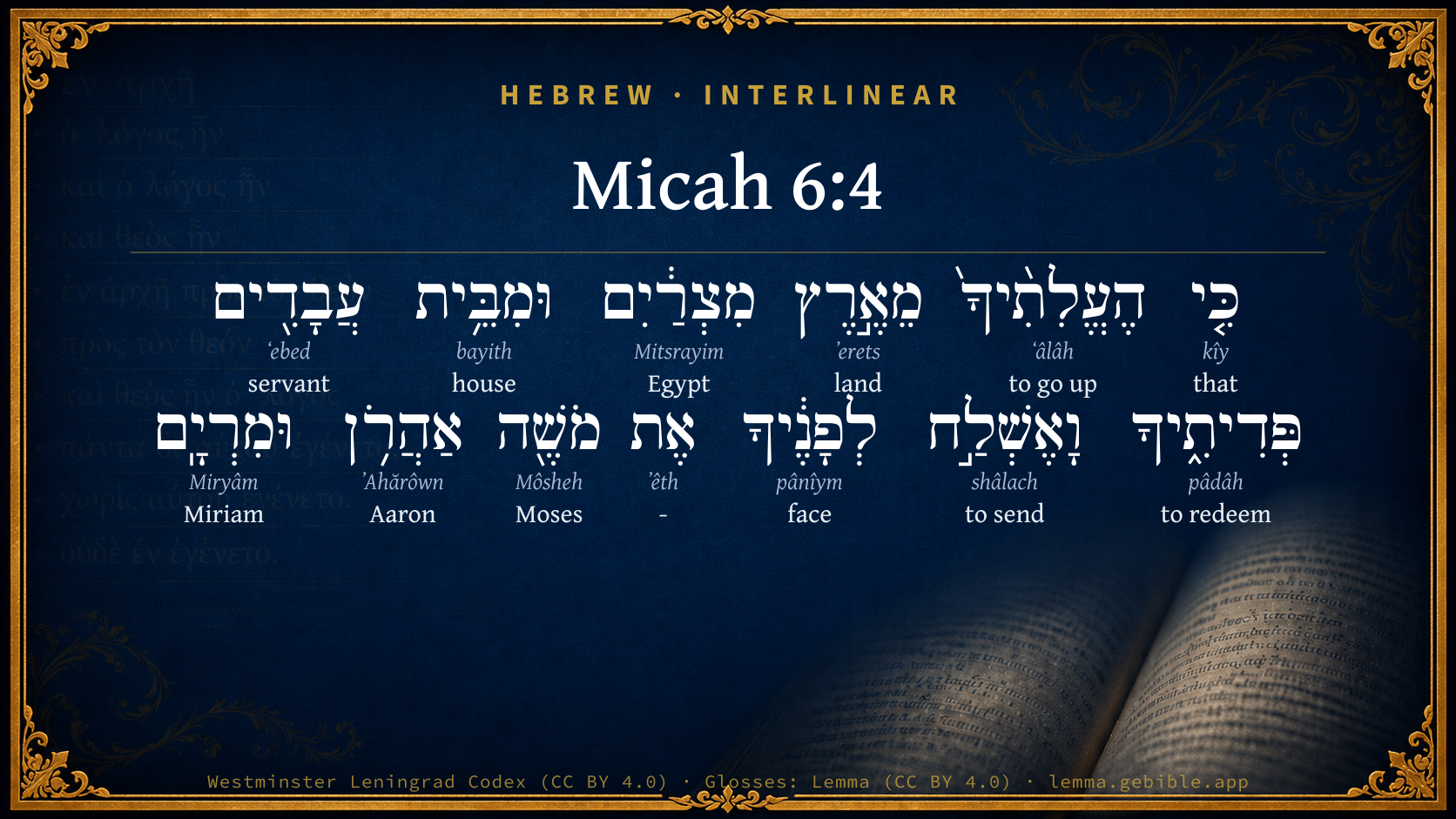
וּמִרְיָֽם
Miryâm
H4813
“and · Miriam”
Conjunction + Noun, Proper
Part of Speech
Conjunction + Noun
Type
Proper
Full BDB Definition

Origin: from H4805

TWOT: None

Miriam = "rebellion" - elder sister of Moses and Aaron - a woman of Judah
  1. כִּ֤י kîy H3588 “that” Conjunction
  2. הֶעֱלִתִ֨יךָ֙ ʻâlâh H5927 “to go up · you” Verb, Hiphil, Perfect, 1st Person, Common, Singular + Suffix, Personal, 2nd Person, Masculine, Singular
  3. מֵאֶ֣רֶץ ʼerets H776 “from · land of” Preposition + Noun, Common, Both, Singular, Construct
  4. מִצְרַ֔יִם Mitsrayim H4714 “Egypt” Noun, Proper
  5. וּמִבֵּ֥ית bayith H1004 “and · from · house of” Conjunction + Preposition + Noun, Common, Masculine, Singular, Construct
  6. עֲבָדִ֖ים ʻebed H5650 “servants” Noun, Common, Masculine, Plural, Absolute
  7. פְּדִיתִ֑יךָ pâdâh H6299 “to redeem · you” Verb, Qal, Perfect, 1st Person, Common, Singular + Suffix, Personal, 2nd Person, Masculine, Singular
  8. וָאֶשְׁלַ֣ח shâlach H7971 “and · to send” Conjunction + Verb, Qal, Sequential Imperfect, 1st Person, Common, Singular
  9. לְפָנֶ֔יךָ pânîym H6440 “to/for · face(s) · your” Preposition + Noun, Common, Both, Plural, Construct + Suffix, Personal, 2nd Person, Masculine, Singular
  10. אֶת ʼêth H853 “-” Particle, Direct Object
  11. מֹשֶׁ֖ה Môsheh H4872 “Moses” Noun, Proper
  12. אַהֲרֹ֥ן ʼAhărôwn H175 “Aaron” Noun, Proper

About this verse

These counts appear in no published source. They are computed here, from the morphology-tagged text and Lemma’s own curated glosses. What Lemma adds →

13
words
13
distinct lemmas
Prophets
section

Notable vocabulary

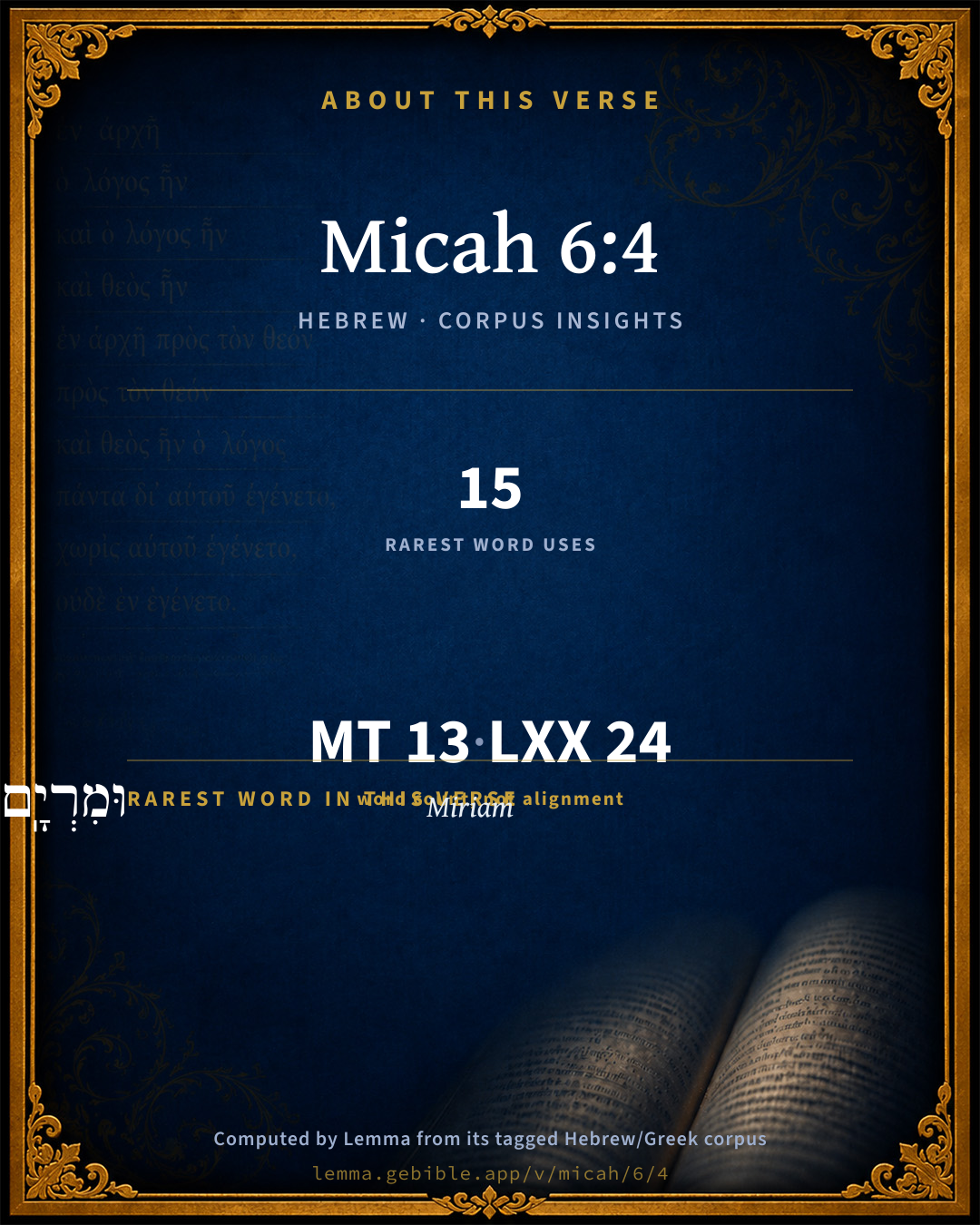
The rarest word here is וּמִרְיָֽם Miriam H4813 — appearing just 15 times in the whole Hebrew Bible.

Shared distinctive vocabulary

וּמִרְיָֽם Miriam H4813 occurs in 13 verses of the Hebrew Bible. Also found in:

Grammatical profile

  • 3 verbs
  • 8 nouns
  • 1 conjunction
  • 1 particle

Verb forms

  • הֶעֱלִתִ֨יךָ֙ Hiphil · Perfect
  • פְּדִיתִ֑יךָ Qal · Perfect
  • וָאֶשְׁלַ֣ח Qal · Sequential Imperfect

Hebrew & Septuagint length

In English translation the verse runs 28 words from the Hebrew and 29 from the Septuagint (LXX English) — closely comparable.

A rough comparison of the two English renderings, which tokenize alike — not a word-level alignment.

Word counts can differ between the Hebrew and the Greek without any difference in meaning — e.g. the Hebrew direct-object marker אֵת has no separate Greek word, and Greek often adds the article ὁ.

In the original languages it is 13 Hebrew tokens and 24 Greek tokens — but the two are counted differently (Hebrew bundles its prefixes and suffixes into one token; the Greek is in lemma form), so that isn’t a like-for-like length.

Cross-references

24

Topical passages linked to Micah 6:4 in the Treasury of Scripture Knowledge — connected by theme and wording, ordered by reader-vote popularity; previews shown in the World English Bible.

  • Exodus 12:51 It happened the same day, that Yahweh brought the children of Israel out of the land of Egypt by their hosts.
  • Deuteronomy 7:8 but because Yahweh loves you, and because he would keep the oath which he swore to your fathers, has Yahweh brought you out with a mighty hand, and redeemed you out of the house of bondage, from the hand of Pharaoh king of Egypt.
  • Psalms 136:10–11 To him who struck down the Egyptian firstborn; For his loving kindness endures forever;
  • Exodus 15:20–21 Miriam the prophetess, the sister of Aaron, took a tambourine in her hand; and all the women went out after her with tambourines and with dances.
  • Exodus 20:2 "I am Yahweh your God, who brought you out of the land of Egypt, out of the house of bondage.
  • Numbers 12:1 Miriam and Aaron spoke against Moses because of the Cushite woman whom he had married; for he had married a Cushite woman.
  • 2 Samuel 7:23 What one nation in the earth is like your people, even like Israel, whom God went to redeem to himself for a people, and to make him a name, and to do great things for you, and awesome things for your land, before your people, whom you redeem to you out of Egypt, [from] the nations and their gods?
  • Isaiah 63:9–12 In all their affliction he was afflicted, and the angel of his presence saved them: in his love and in his pity he redeemed them; and he bore them, and carried them all the days of old.
  • Jeremiah 32:21 and brought forth your people Israel out of the land of Egypt with signs, and with wonders, and with a strong hand, and with an outstretched arm, and with great terror;
  • Amos 2:10 Also I brought you up out of the land of Egypt, And led you forty years in the wilderness, To possess the land of the Amorite.
  • Exodus 4:16 He will be your spokesman to the people; and it will happen, that he will be to you a mouth, and you will be to him as God.
  • Exodus 14:30–31 Thus Yahweh saved Israel that day out of the hand of the Egyptians; and Israel saw the Egyptians dead on the seashore.
  • Deuteronomy 4:34 Or has God tried to go and take him a nation from the midst of [another] nation, by trials, by signs, and by wonders, and by war, and by a mighty hand, and by an outstretched arm, and by great terrors, according to all that Yahweh your God did for you in Egypt before your eyes?
  • Deuteronomy 5:6 "I am Yahweh your God, who brought you out of the land of Egypt, out of the house of bondage.
  • Deuteronomy 9:26 I prayed to Yahweh, and said, Lord Yahweh, don't destroy your people and your inheritance, that you have redeemed through your greatness, that you have brought forth out of Egypt with a mighty hand.
  • Deuteronomy 15:15 You shall remember that you were a bondservant in the land of Egypt, and Yahweh your God redeemed you: therefore I command you this thing today.
  • Deuteronomy 24:18 but you shall remember that you were a bondservant in Egypt, and Yahweh your God redeemed you there: therefore I command you to do this thing.
  • Nehemiah 9:9–11 You saw the affliction of our fathers in Egypt, and heard their cry by the Red Sea,
  • Psalms 77:20 You led your people like a flock, By the hand of Moses and Aaron.
  • Psalms 106:7–10 Our fathers didn't understand your wonders in Egypt. They didn't remember the multitude of your loving kindnesses, But were rebellious at the sea, even at the Red Sea.
  • Ezekiel 20:5–9 and tell them, Thus says the Lord Yahweh: In the day when I chose Israel, and swore to the seed of the house of Jacob, and made myself known to them in the land of Egypt, when I swore to them, saying, I am Yahweh your God;
  • Acts 7:36 This man led them out, having worked wonders and signs in Egypt, in the Red Sea, and in the wilderness for forty years.
  • Deuteronomy 4:20 But Yahweh has taken you, and brought you forth out of the iron furnace, out of Egypt, to be to him a people of inheritance, as at this day.
  • Psalms 78:51–53 And struck all the firstborn in Egypt, The chief of their strength in the tents of Ham.

Cross-references courtesy of OpenBible.info (CC BY 4.0).

Hebrew and Greek witnesses Masoretic Hebrew ↔ Greek Septuagint

The same verse in the two great witnesses to the Old Testament, shown verse-for-verse.

These are two independent witnesses, not word-aligned to each other, and the Septuagint is shown in lemma (dictionary) form.

Hebrew Micah 6:4 Masoretic · Westminster Leningrad Codex

כִּ֤י הֶעֱלִתִ֨יךָ֙ מֵאֶ֣רֶץ מִצְרַ֔יִם וּמִבֵּ֥ית עֲבָדִ֖ים פְּדִיתִ֑יךָ וָאֶשְׁלַ֣ח לְפָנֶ֔יךָ אֶת מֹשֶׁ֖ה אַהֲרֹ֥ן וּמִרְיָֽם

For I brought you up out of the land of Egypt, And redeemed you out of the house of bondage. I sent before you Moses, Aaron, and Miriam.

World English Bible · Public Domain

Greek LXX Micah 6:4 Septuagint · lemma form

διότι ἀναἄγω σύ ἐκ γῆ αἴγυπτος καί ἐκ οἶκος δουλεία λυτρόω σύ καί ἐκ ἀποστέλλω πρό πρόσωπον σύ ὁ μωυσῆς καί ἀαρών καί μαριαμ

For I brought tee up out of the land of Egypt, and redeemed you out of the house of bondage, and sent before you Moses, and Aaron, and Mariam.

LXX2012 (modern English Septuagint) · Public Domain

Hebrew: Westminster Leningrad Codex (CC BY 4.0). Greek: Septuagint (public domain); English from LXX2012 (modern English Septuagint) (Public Domain). How the Septuagint differs from the Hebrew →

Targum (Aramaic paraphrase)

1

The Targum is the ancient Jewish Aramaic paraphrase of the Hebrew Scriptures — an interpretive translation, not the Hebrew text itself. Onkelos (literal) and Pseudo-Jonathan (expansive) render the Torah, and Jonathan the Prophets. Coverage is partial: where no permissively-licensed English translation exists for a verse, only the Aramaic is shown. This is verse-level text, not a word-by-word alignment to the Hebrew.

  1. Targum Jonathan Prophets (Joshua–Malachi)
    אֲרֵי אֲסִיקְתָּךְ מֵאַרְעָא דְמִצְרַיִם וּמִבֵּית עַבְדוּתָא פָּרִקְתָּךְ וּשְׁלָחֵית קֳדָמָךְ תְּלָתָא נְבִיִין מֹשֶׁה לְאַלָפָא מְסִירַת דִינִין אַהֲרֹן לְכַפָּרָא עַל עַמָא וּמִרְיָם לְאוֹרָאָה לִנְשַׁיָא:

    (no public-domain English translation for this verse)

    Targum Jonathan — Aramaic: “Mikraot Gedolot” (public domain). English: “Sefaria Community Translation” (CC0 1.0 (public-domain dedication)); “London "Chaldee Paraphrase," 1871” (public domain). Text via Sefaria.

Commentary

Notes on Micah 6:4 from classic Christian and Jewish commentators (each source and its license shown beneath its notes). The classic Christian expositions comment on the surrounding passage and are grouped to its opening verse, so a note may address several verses; the Jewish commentaries on the Tanakh (Rashi and others) are per-verse, so they appear only where the commentator wrote on this verse.

Lemma curates 59 commentaries, every one of them public domain or Creative Commons licensed, each selected and text-cleaned for this edition rather than reprinted as found. About our sources →

Trapp's Complete Commentary

John Trapp

Mic 6:4 For I brought thee up out of the land of Egypt, and redeemed thee out of the house of servants; and I sent before thee Moses, Aaron, and Miriam.

Ver. 4. For I brought thee up out of the land of Egypt] Here God twits them with his former favours; which he never doth but in case of brutish unthankfulness. Now there was brutish, and worse. To render good for evil is divine; good for good is human; evil for evil is brutish; but evil for good devilish. This makes God, contrary to his custom, upbraid people with what he hath done for them; and angrily call for his love tokens back again, as Hos 2:9. For their deliverance out of the Egyptian servitude how great a mercy it was, {See Trapp on "Hos 11:1"} such as they were again and again charged never to forget, Deu 6:12; Deu 5:15; Deu 26:5-12. How much more bound are we to God for our redemption by Christ! for what is Pharaoh to Satan? Egypt to this present evil world? Egyptian bondage to sin’s slavery? Seeing then that our God hath given us such deliverance as this, should we again break his commandments? Well might the hills and mountains testify against such a monstrous unthankfulness and disingenuity.

And redeemed thee out of the house of servants] Gradatim progreditur, saith Calvin. It was something to be brought out of the land of Egypt, a most superstitious place, where they turned the glory of the incorruptible God to the similitude of the image of a corruptible man, Rom 1:23 (for they deified their king, Osiris), and of birds (for they worshipped the hawk and ibis), and of four-footed beasts (for they worshipped an ox, a dog, a cat, a swine), and of creeping things, for they worshipped the crocodile, ichneumon, &c., yea, they worshipped plants and pot herbs. Hence Juvenal,

“ Felices genres, quibus haec nascuntur in hortis Numina ” -

To be brought out, therefore, from among such hateful idolaters was no small favour, lest they should smell of their superstitions, as Micah’s mother did after all that erring sin in the desert, Jdg 17:3; and Jeroboam, by being there a while, had learned calf worship; hence that strict charge never to make league with them. But to be redeemed out of the house of servants was more; out of the iron furnace, Deu 4:20 Jer 11:4, where they wrought night and day in latere et luto, Exo 1:11, in setting up those famous pyramids and treasure cities for Pharaoh, where they served with rigour, Exo 1:13; their lives were made bitter with hard bondage, Exo 1:14, till God withdrew their shoulders from the burden, and their hands did leave the pots, Psa 81:6, "till they saw the God of Israel: and there was under his feet as it were a paved work of a sapphire stone," Exo 24:10, to show that God had now changed their condition, their bricks made in their bondage to sapphires. Confer Isa 54:11, and consider what God hath done for us, by bringing us into the glorious liberty of his own children, who were once the devil’s drudges and dromedaries, "serving divers lusts and pleasures," Tit 3:3, which gave laws to our members, Rom 7:23, and held us under in a brutish bondage, much worse than the heathen’s mill house, the Turks’ galleys, Bajazet’s iron cage, the Indian mines, or Egyptian furnace. For there, if they did their task they escaped stripes; but here, let men do the devil never such doughty service, they are sure of scourges and scorpions after all, armies and changes of sorrows and sufferings, terrors and torments, without any the least hope of ever either mending or ending. This should make us lift up many a humble, joyful, and thankful heart to our most powerful Redeemer; saying with St Paul, "Now to the King eternal, immortal, invisible, the only wise God, be honour and glory for ever and ever, Amen," 1Ti 1:17.

And I sent before thee Moses, Aaron, and Miriam] As three principal guides, and Miriam for one who did her part among the women, Exo 15:20, and having a prophetic spirit, became a singular instrument in the hand of God, who spake by her, Num 12:2. But her weak head was not able to bear such a cup of honour without being intoxicated; which caused her father to spit in her face, Num 12:2; Num 12:14. Her death is recorded in Scripture, Num 20:1, but not her age, as is Sarah’s, Gen 23:1. Some have observed that God thought not fit to tell us of the length of the life of any woman in Scripture but Sarah, to humble that sex. But as souls have no sexes, so of some women (such as were Miriam, Deborah, the Virgin Mary, Priscilla, Blandina, the Lady Jane Grey, Queen Elizabeth) it may be said, that in them, besides their sex, there was nothing woman-like or weak: as if (what philosophy saith) the souls of these noble creatures had followed the temperament of their bodies, which consist of a frame of rarer rooms of a more exact composition than man’s doth. It is possible that Miriam might (till that matter of emulation between her and Moses’s wife occured) be as helpful to Moses and Aaron as Nazianzen’s mother was to his father; not a help fellow only, but a doctress and governess, Non solum adiutricem in pietate, sed etiam doctricem et gubernatricem (Nazian.).

John Trapp, A Commentary or Exposition upon All the Books of the Old and New Testament (1647–1656) — public domain. Text from a community e-Sword module.

The Biblical Illustrator

Joseph S. Exell

Mic_6:4

For I brought thee up out of the land of Egypt, and redeemed thee out of the house of servants; and I sent before thee Moses, Aaron, and Miriam

Reasons for gratitude

Ingratitude often meets with, what it always deserves, the most grievous punishment.

The highest aggravation of this ingratitude is, when the goodness of God is despised, when His loving kindness is disregarded, and the mercies the Supreme Being bestows on poor depending creatures are neglected, if not altogether forgotten, by those to whom they were graciously afforded. Then a grateful remembrance of any remarkable mercy, or signal deliverance, is a duty the most reasonable in itself, and well pleasing to God. This important duty is not confined to private persons; but if God bestows on a nation public mercies, all the members of the community should join together to express their gratitude and thankfulness.

1. Consider the great reason the children of Israel had thankfully to remember the mercy in the text mentioned.

(1) The miserable condition they were delivered from with regard to their bodies and souls.

(2) Their wonderful deliverance from this unhappy state.

(3) The state they were brought into.

2. Show how applicable this is to our present circumstances. (Reference is to the reformation of the Church of England from popery, in the time of Queen Elizabeth.) (Richard Mayo, M. A.)

The Biblical Illustrator, edited by Joseph S. Exell (c. 1880s–1900s) — public domain. Text from a community e-Sword module.

Tyndale Open Study Notes

Tyndale Open Resources

6:4-5 The Lord had brought Israel out of Egypt and had preserved them and blessed them throughout their journey to the Promised Land. God encouraged and warned Israel always to remember what he had done for them from Sinai onward (Exod 3:15; Deut 5:15; Pss 77:11; 111:4; see also Pss 78, 136). • Balak . . . Balaam: (see Num 22–24). • Acacia Grove, located on the east of the Jordan River, was Israel’s base camp before entering the Promised Land (see Num 25:1; Josh 2:1; 3:1). The trip from there to Gilgal (west of the Jordan River) bears witness to God’s covenant faithfulness. God’s saving acts brought the Israelites into the Promised Land.

Tyndale Open Study Notes — © Tyndale Open Resources, licensed CC BY-SA 4.0. Text via the HelloAO Bible API.

Geneva Bible (1599)

Geneva Bible translators

I have not hurt thee, but bestowed infinite benefits upon thee.

Geneva Bible (1599) marginal notes — public domain. Text via Bolls.life.

Jamieson, Fausset & Brown

Robert Jamieson, A. R. Fausset & David Brown

For--On the contrary, so far from doing anything harsh, I did thee every kindness from the earliest years of thy nationality.

Miriam--mentioned, as being the prophetess who led the female chorus who sang the song of Moses (Exo 15:20). God sent Moses to give the best laws; Aaron to pray for the people; Miriam as an example to the women of Israel.

Jamieson, Fausset & Brown — Commentary Critical and Explanatory on the Whole Bible (1871) — public domain (CC PDM 1.0). Text via the HelloAO Bible API.

Adam Clarke's Commentary

Verse 4. I brought thee up out of the land of Egypt] Where you were slaves, and grievously oppressed; from all this I redeemed you. Was this a small benefit? I sent before thee MOSES, my chosen servant, and instructed him that he might be your leader and lawgiver. I sent with him AARON, that he might be your priest and transact all spiritual matters between myself and you, in offerings, sacrifices, and atonements. I sent MIRIAM, to whom I gave the spirit of prophecy, that she might tell you things to come, and be the director of your females. To this sense the Chaldee, "I have sent three prophets before you; Moses, that he might teach you the tradition of judgments, Aaron, that he might make atonement for the people; and Miriam, that she might instruct the females."

Adam Clarke's Commentary on the Bible (1810–1826) — public domain. Text from a community e-Sword/MySword module.

John Calvin's Commentaries

God, having testified that he had in nothing been troublesome to the people, now states with how great and with how many benefits he had bound them to himself. But we may prefer taking the words as explanatory and somewhat ironical that he records his benefits in the place of trouble or vexation; though, in my judgment, it is better to read the two clauses apart. I have brought thee, he says, from the land of Egypt, from that miserable bondage; and then he says, I have redeemed thee By the word, redeem, he expresses more clearly and more fully illustrates his kindness. Then he adds, I have set over thee as leaders Moses, and Aaron, and Miriam, the sister of them both. Benefits, we know, are often accompanied with injuries; and he who obliges another destroys all his favor, when he turns kindness as it often happens, into reproach. It is hence frequently the case, that he who has been kind to another brings so serious an injury, that the memory of his kindness ought not to continue. God mentions here these two things, — that he had conferred vast benefits on the people, — and yet that he had in nothing been burdensome to them; as though he said “Many are those things which I can, if necessary, on my part bring forward, by which I have more than a hundred times made thee indebted to me; now thou canst not in thy turn bring anything against me; thou canst not say that I have accompanied my benefits with wrongs, or that thou hast been despised, because thou were under obligations to me, as it is often the case with men who proudly domineer, when they think that they have made others bound to them. I have not then thought proper to accompany my great favors with anything troublesome or grievous to thee.” We now understand why the Prophet expressly mentions these two things, — that God had in nothing been vexatious to his people, — and that he had brought them up from the land of Egypt.

That redemption was so great, that the people ought not to have complained, had it been the will of God to lay on their shoulders some very heavy burdens: for this answer might have been ever readily given, — “Ye have been delivered by me; ye owe to me your life and your safety. There is therefore no reason why any thing should be now burdensome to you; for the bondage of Egypt must have been bitterer to you than hundred deaths; and I redeemed you from that bondage.” But, as the Lord had treated his redeemed people so kindly and so humanely, yea, with so much indulgence, how great and how intolerable was their ingratitude in not responding to his great kindness? We now more fully understand the Prophet’s meaning in these words.

I have made thee to ascend, he says, from Egypt; and then, I have redeemed thee. He goes on, as we have said, by degrees. He afterwards adds, I have sent before thy face Moses, Aaron, and Miriam. God means here that it had not been a momentary kindness; for he continued his favor towards the Jews when he set over them Moses and Aaron, and Miriam, which was an evidence of his constant care, until he had completed his work of delivering them. For Moses was a minister of their deliverance in upholding civil order, and Aaron as to the priesthood and spiritual discipline. With regard to Miriam, she also performed her part towards the women; and as we find in Exodus 15, she composed a song of thanksgiving after passing through the Red Sea: and hence arose her base envy with regard to Moses; for being highly praised, she thought herself equal to him in dignity. It is at the same time right to mention, that it was an extraordinary thing, when God gave authority to a woman, as was the case with Deborah that no one may consider this singular precedent as a common rule. It now follows —

John Calvin's Commentaries (1540-1563) — public domain. Text from the Calvin Translation Society English edition (1840s-50s) via the Christian Classics Ethereal Library (ccel.org). Calvin's coverage is partial (roughly two-thirds of the Bible); uncommented books and verses are honest gaps, never fabricated. The 19th-century editor's footnotes and remarks are omitted so the notes are faithfully Calvin's own voice.

Ellicott's Commentary for English Readers

(4) For I brought thee up.—There seems a pause intended; but Israel, abashed, remains silent. So the Lord continues to plead: “Thou dost not testify against me? No; for I showed thee the greatest mercies: I redeemed thee out of Egypt, the house of bondage.” Moses, Aaron, and Miriam are mentioned as the three great members of the family to whom it was committed to carry out the Divine decree.

A Bible Commentary for English Readers, edited by Charles John Ellicott (1878–1897) — public domain. Text from a community e-Sword module.

The Cambridge Bible for Schools and Colleges

gen. ed. J. J. S. Perowne

4. For I brought thee up] ‘Nothing,’ is the only truthful answer to the divine question. Jehovah has indeed wonderfully assisted His people in their troubles. Nothing could extinguish the sense of the overwhelming grandeur of Israel’s first deliverance. A prophet, writing in the name of the Jewish Church of the Captivity, points back to the happy days of old, when he ‘brought them up out of the sea with the shepherds of his flock’ (Isa_63:11).

I sent before thee Moses, Aaron, and Miriam] These were the shepherds, by whom ‘God led His people like sheep’ (Psa_77:20)—Eastern shepherds going before their sheep (Joh_10:4).

The Cambridge Bible for Schools and Colleges (gen. ed. J. J. S. Perowne; Cambridge University Press, 1878–1918) — public domain. Text from a community e-Sword module.

John Gill's Exposition

For I brought thee up out of the land of Egypt,.... Instead of doing them any wrong, he had done them much good; of which this is one instance, and he was able to produce more: this a notorious, plain, and full proof of his goodness to them, which could not be denied. It may be rendered, as it is by some, "surely I brought thee up" (s), &c. this is a certain thing, well known, and cannot be disproved; it must be allowed to be a great favour and kindness to be brought up out of a superstitious, idolatrous, Heathenish people, enemies to God and true religion, and who had used them in a barbarous and cruel manner:

and redeemed thee out of the house of servants; or, "out of the house of bondage"; as the same words are rendered, Exo 20:2; that is, out of hard service, in which their lives were made bitter; out of cruel bondage and slavery; which made them cry to the Lord for help and deliverance, and he heard them, and sent them a deliverer; by whose hand he redeemed them from this base and low estate in which they were, and for which they ought ever to have been thankful, and to have shown their gratitude by their cheerful and constant obedience. Some take "the house of servants" to be descriptive, not of the state of the children of Israel in Egypt, but of the character of the Egyptians themselves; who, being the posterity of Ham, were inheritors of his curse, that he should be a servant of servants; and so it is an aggravation of the blessing, that Israel were redeemed from being servants to the servants of servants. This sense is mentioned by Kimchi and Abarbinel:

and I sent before thee Moses, Aaron, and Miriam; not to bring them the news of their deliverance out of Egypt, before they came out of it, as Kimchi; but to be their guides to conduct and direct them in all matters, civil and religious. Moses was their lawgiver, leader, and commander; Aaron was their priest to offer sacrifice for them, and to intercede on their behalf; and Miriam was a prophetess; and they were all very useful and beneficial to them; and a very great blessing it is to a people to have a good constitution, civil and ecclesiastic, and to have good magistrates, and good ministers of the word. The Targum is,

"I sent before thee three prophets, Moses to teach the tradition of the judgments, Aaron to make atonement for the people, and Miriam to instruct the women.''

(s) "certe", Calvin, Piscator, Tarnovius; so some in Vatablus.

John Gill's Exposition of the Whole Bible (1746–1763) — public domain (CC PDM 1.0). Text via the HelloAO Bible API.

Albert Barnes' Notes on the Bible

For I brought thee up out of the land of Egypt, and redeemed thee out of the hoarse of servants - What wert thou? What art thou? Who made thee what thou art? God reminds them. They were slaves; they are His people in the heritage of the pagan, and that by His outstretched arm. God mentions some heads of the mercies which tie had shown them, when He had made them His people, His redemption of them from Egypt, His guidance through the wilderness, His leading them over the last difficulty to the proraised land. The use of the familiar language of the Pentateuch is like the touching of so many key-notes, recalling the whole harmony of His love. Moses, Aaron, and Miriam together, are Lawgiver, to deliver and instruct; Priest, to atone; and prophetess Exo 15:20 to praise God; and the name of Miriam at once recalled the mighty works at the Red Sea and how they then thanked God.

Albert Barnes' Notes on the Bible (1834–1885) — public domain. Text from a community e-Sword/MySword module.

Haydock's Catholic Bible Commentary

Slaves. Their prison, in Algiers, &c., is dreadful. (Calmet) --- Mary. She taught the women. (Chaldean; Theodotion) --- She was a figure of Christ’s mother, as Moses and Aaron were of himself. (Worthington)

George Leo Haydock (1774–1849), Haydock's Catholic Family Bible and Commentary, 1859 edition — public domain. Excludes Psalms (Douay-Rheims chapter numbering differs from Protestant) and Deuterocanonical books (Catholic canon only).

Matthew Poole's English Annotations

Look as far back as thy coming out of Egypt, near seven hundred and forty years agone;

for I brought thee up, with an out-stretched arm, out of the land of Egypt, where by servants thou wert oppressed, where thy oppressors did plot thy utter extirpation, where thou servedst in the iron furnace.

Redeemed thee; delivered thee by mighty power, and gave Egypt for thy ransom; I made them pay dear for their detaining thee, and ill using of thee.

Out of the house of servants; being offspring of Canaan, they were in their father’s curse doomed to be servants, and were (as servile minds are) most barbarously cruel to Israel, as appears by the bloody edict against the male children, and by requiring brick without straw; their bondage was a cruel bondage under which they groaned.

I sent before thee Moses; a man excellently qualified to be a conductor to them, a very learned, martial, and experienced man; he improved his forty years by the advantages of a royal education first, and next by the great employments which such persons are called to: for his wisdom and learning, his might and valour, you have witness, Act 7:22; the Hebrew tradition is, that he fought and got many battles, in which he commanded as generalissimo for Pharaoh. Moses was beside this admitted to extraordinary consults with God: by this means their model of polity was made very exact.

Aaron; a person called to the exercise of the highest office in the priesthood, to offer sacrifice, and make atonement for the sins of the people, and to be a type of the great Intercessor.

Miriam; a prophetess, to be assistant to her brothers last mentioned, to be example and counsellor to the women: God furnished them with magistrate, priest, and prophet.

Matthew Poole's English Annotations on the Holy Bible (1683–1685) — public domain. Text from a community e-Sword/MySword module.

The Pulpit Commentary

God answers his own question by recounting some of his chief mercies to Israel. He has not burdened the people, but loaded them with benefits. I brought thee up, etc. The Exodus was the most wonderful instance of God"s intervention and to it the prophets often refer. (comp. Isa_63:11, etc.; Jer_2:6 Amo_2:10) Out of the house of servants; of bondage, quoting the language of the Pentateuch, to show the greatness of the benefit. (Exo_13:3, 14 Deu_8:14, etc.) I sent before thee. As leaders of the Lord"s flock. (Psa_77:20) Moses, the inspired leader, teacher, and lawgiver. Aaron, the priest, the director of Divine worship. Miriam, the prophetess, who led the praises of the people at their great deliverance, (Exo_15:20) and who probably was charged with some special mission to the women of Israel. (see Num_12:1, Num_12:2)

The Pulpit Commentary (1880–1919), ed. H.D.M. Spence-Jones & Joseph S. Exell — public domain. Text from a community e-Sword module.

John Wesley's Explanatory Notes

And Miriam - A prophetess to be assistant to her brothers, and to be an example and a counsellor to the women.

John Wesley, Explanatory Notes Upon the Whole Bible (1754–1765) — public domain. Text via the GEBible commentary corpus.

Scofield Reference Notes

C. I. Scofield

redeemed

(See Scofield "Isa 59:20"). See Scofield "Exo 14:30".

The Scofield Reference Bible (1917 edition), notes by C. I. Scofield — public domain. Text from a community e-Sword module.

Rashi

Rabbi Shlomo Yitzchaki (Rashi)

For I brought you up—Although I bestowed all this benefit upon you, I did not weary you with much worship or with large sacrifices.

Moses, Aaron, and Miriam—Jonathan paraphrases: Moses to teach the transmission of the laws, Aaron to atone for the people, and Miriam to instruct the women.

Rashi on the Tanakh — English translations: “The Judaica Press complete Tanach with Rashi, translated by A. J. Rosenberg” (CC BY 4.0); “Pentateuch with Rashi's commentary by M. Rosenbaum and A.M. Silbermann, 1929-1934” (public domain); “The Metsudah Tanach series, Lakewood, N.J” (CC BY 4.0); and “The Book of Joshua, Metsudah Publications, 1997” (CC BY 4.0). Text via Sefaria.

Lesson kit

Teaching starters — assembled from the data on this page, not authored interpretation. Every prompt links to the verse data it draws on. Edit before teaching.

Micah, in the Prophets, opens this verse with 13 words (13 distinct Hebrew lemmas). Its most distinctive word is Miryâm (“Miriam”). A historical commentator’s framing appears above. Read the whole chapter for the surrounding context.

Discussion questions

  1. The word Miryâm carries the sense “Miriam.” How does it shape the verse?
  2. Exodus 15:20 shares the word «Miriam» with this verse. How do the two illuminate each other?
  3. These translations render this verse differently. What is at stake in choosing one wording over another?
  4. The verb «הֶעֱלִתִ֨יךָ֙» is Hiphil Perfect. How does its form color the action?
  5. Reading how Trapp's Complete Commentary and The Biblical Illustrator read this verse, where do the two commentators agree and where do they part?

Things to notice

Reading settings

Reading text

Shown beneath each verse's original-language words.

Old Testament
Old Testament edition

Read the OT as the Masoretic Hebrew (MT) or the Greek Septuagint (LXX).

English shown for the Greek Septuagint (in the Hebrew ↔ Greek comparison).

Comparing translations? Open the Compare panel on any verse page to stack up to four side by side.