
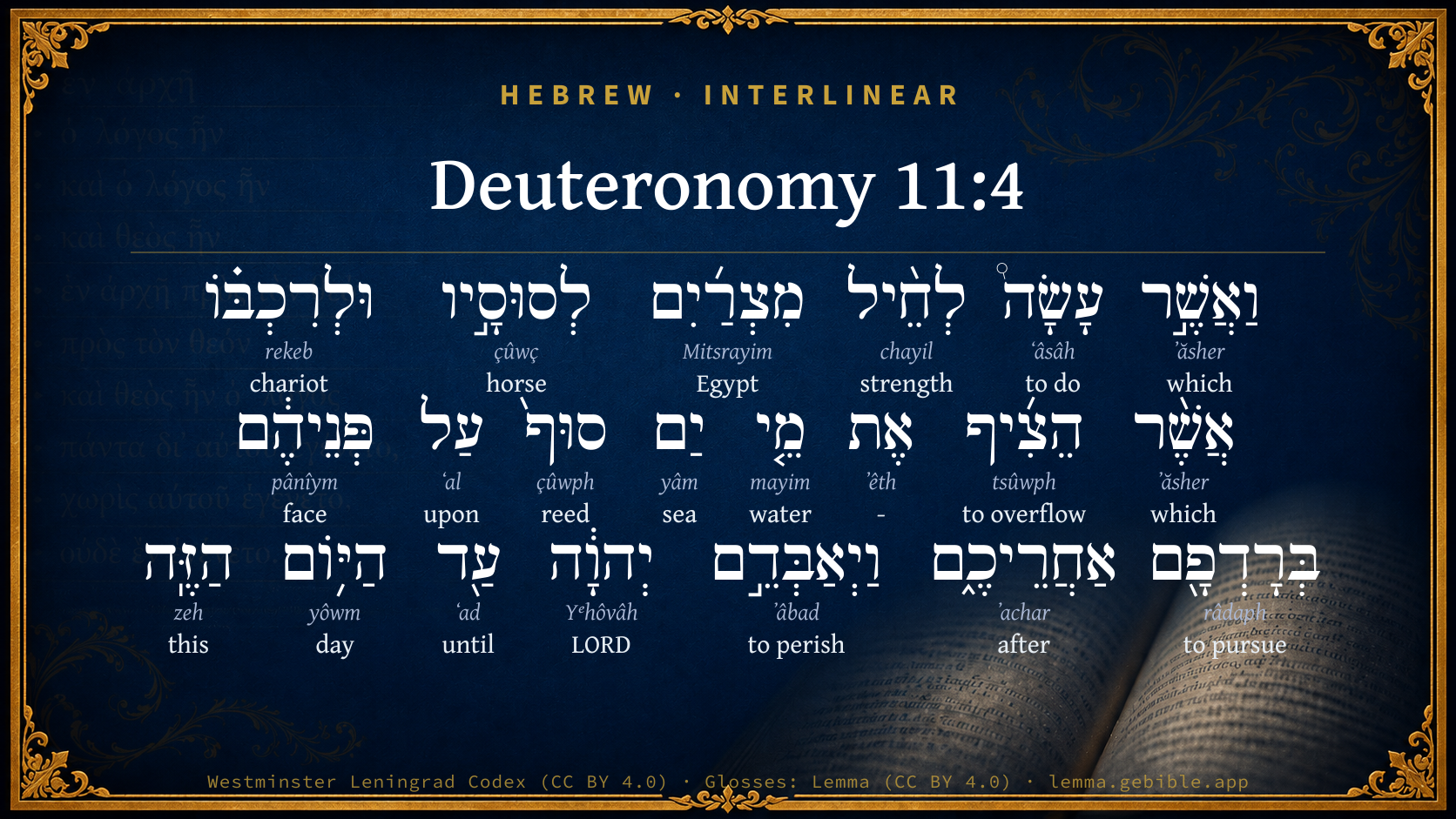
Deuteronomy 11:4

Hebrew (Westminster Leningrad Codex) Deuteronomy 11:4 appears in the Hebrew Old Testament. The text above is from the Westminster Leningrad Codex. Each word links to its Strong’s number, a concise gloss, and parsing drawn from the Open Scriptures Hebrew Bible morphology. Click any word for its full Brown-Driver-Briggs (BDB) entry.
Download image
Cite this verse

Deuteronomy 11:4 (World English Bible). Public Domain. Lemma interlinear Bible study tool, https://lemma.gebible.app/v/deuteronomy/11/4.

Show BibTeX & RIS
BibTeX
RIS
English Translation
and what he did to the army of Egypt, to their horses, and to their chariots; how he made the water of the Red Sea to overflow them as they pursued after you, and how Yahweh has destroyed them to this day;
World English Bible · Public Domain
Highlights
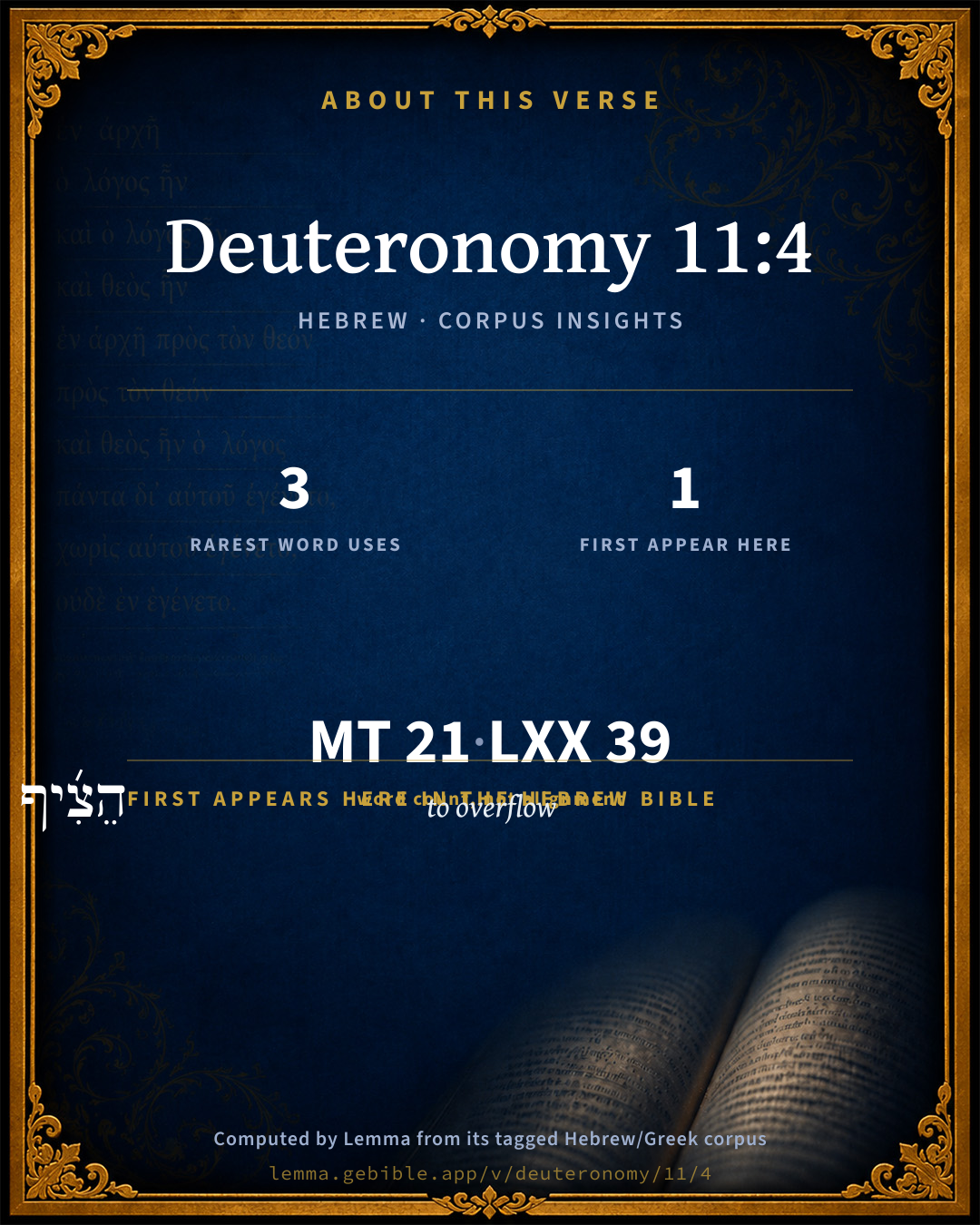
  • 1 first appearance in the Hebrew Bible
Full analysis ↓
Download a study sheet

One document with this verse’s original text, its word-by-word gloss line, the meaning frame, cross-references with their text, attributed commentary, and full source and license credits — printable, and it pastes into notes with its structure intact.

This verse Autodidact and up

Study sheet (.html) Plain text (.txt)

A passage Seminary Student

Up to 50 verses in one chapter. A passage sheet keeps up to 6 commentary sources and 12 cross-references per verse, in the order this page ranks them, and says so on the sheet whenever that leaves anything out. Ask for a single verse and you get the Autodidact verse sheet above.

Everything on this page stays free to read, with no account — the sheet is a download of what is already on screen, not access to it.

Want to remove ads? Support Godless Engineer
Compare translations 3

The same verse in 3 English versions, stacked beneath the original-language interlinear above. Click any original word for its lexicon entry.

Each is an independent rendering of the whole verse — the interlinear is not word-aligned to these translations.

Highlighted words mark where these versions differ — a whole-verse word diff, not a word-by-word alignment.

  • World English Bible Public Domain
    and what he did to the army of Egypt, to their horses, and to their chariots; how he made the water of the Red Sea to overflow them as they pursued after you, and how Yahweh has destroyed them to this day;
  • King James Version Public Domain
    And what he did unto the army of Egypt, unto their horses, and to their chariots; how he made the water of the Red sea to overflow them as they pursued after you, and how the LORD hath destroyed them unto this day;
  • unfoldingWord Literal Text CC BY-SA 4.0
    and what he did to the army of Egypt, to its horses and to its chariots, how he caused the water of the Sea of Reeds to flow over their faces in their pursuit after you, and Yahweh has destroyed them to this day,

unfoldingWord Literal Text — © unfoldingWord, licensed CC BY-SA 4.0. Word-aligned USFM3 via Door43 (git.door43.org/unfoldingWord/en_ult).

Versions to compare (up to 4)

3 of 4 selected

Show all 18 translations

Every available English version of this verse, each an independent rendering of the whole verse.

  • World English Bible Public Domain
    and what he did to the army of Egypt, to their horses, and to their chariots; how he made the water of the Red Sea to overflow them as they pursued after you, and how Yahweh has destroyed them to this day;
  • Berean Standard Bible Public Domain
    what He did to the Egyptian army and horses and chariots when He made the waters of the Red Sea engulf them as they pursued you, and how He destroyed them completely, even to this day;
  • Majority Standard Bible Public Domain
    what He did to the Egyptian army and horses and chariots when He made the waters of the Red Sea engulf them as they pursued you, and how He destroyed them completely, even to this day;
  • King James Version Public Domain
    And what he did unto the army of Egypt, unto their horses, and to their chariots; how he made the water of the Red sea to overflow them as they pursued after you, and how the LORD hath destroyed them unto this day;
  • American Standard Version (1901) Public Domain
    and what he did unto the army of Egypt, unto their horses, and to their chariots; how he made the water of the Red Sea to overflow them as they pursued after you, and how Jehovah hath destroyed them unto this day;
  • Revised Version (1885) Public Domain
    and what he did unto the army of Egypt, unto their horses, and to their chariots; how he made the water of the Red Sea to overflow them as they pursued after you, and how the LORD hath destroyed them unto this day;
  • Geneva Bible (1599) Public Domain
    And what he did vnto the hoste of the Egyptians, vnto their horses, and to their charets, when he caused the waters of the red Sea to ouerflowe them, as they pursued after you, and the Lord destroied them vnto this day:
  • Douay-Rheims (1899) Public Domain
    And to all the host of the Egyptians, and to their horses and chariots: how the waters of the Red Sea covered them, when they pursued you, and how the Lord destroyed them until this present day:
  • Young's Literal Translation Public Domain
    and that which He hath done to the force of Egypt, to its horses, and to its chariot, when He hath caused the waters of the Red Sea to flow against their faces in their pursuing after them, and Jehovah destroyeth them, unto this day;
  • Literal Standard Version CC BY-SA 4.0
    and that which He has done to the force of Egypt, to its horses, and to its chariot, when He has caused the waters of the Red Sea to flow against their faces in their pursuing after them, and YHWH destroys them, to this day;
  • Unlocked Literal Bible CC BY-SA 4.0
    Neither did they see what he did to the army of Egypt, to their horses, or to their chariots, how he made the water of the Sea of Reeds overwhelm them as they pursued after you, and how Yahweh has destroyed them until today,
  • unfoldingWord Literal Text CC BY-SA 4.0
    and what he did to the army of Egypt, to its horses and to its chariots, how he caused the water of the Sea of Reeds to flow over their faces in their pursuit after you, and Yahweh has destroyed them to this day,
  • Darby Bible Public Domain
    and what he did unto the army of Egypt, unto their horses, and unto their chariots, over which he made the water of the Red sea flow as they pursued after you, and Jehovah destroyed them unto this day;
  • World Messianic Bible Public Domain
    and what he did to the army of Egypt, to their horses, and to their chariots; how he made the water of the Sea of Suf to overflow them as they pursued you, and how the LORD has destroyed them to this day;
  • Webster's Bible Public Domain
    And what he did to the army of Egypt, to their horses, and to their chariots; how he made the water of the Red sea to overflow them as they pursued after you, and how the LORD hath destroyed them to this day;
  • Free Bible Version CC BY-SA 4.0
    You saw what he did to the Egyptian army and its horses and chariots when he swept them away in the Red Sea, drowning them as they chased after you. The story hasn't changed!
  • Bible in Basic English Public Domain
    And what he did to the army of Egypt, to their horses and their war-carriages; how he made the waters of the Red Sea come up over them when they went after you, and how the Lord put an end to them even to this day;
  • JPS Tanakh (1917) Public Domain
    and what He did unto the army of Egypt, unto their horses, and to their chariots; how He made the water of the Red Sea to overflow them as they pursued after you, and how the LORD hath destroyed them unto this day;

Literal Standard Version (2020), Covenant Press — licensed CC BY-SA 4.0. Text via the HelloAO Bible API (eBible.org). Unlocked Literal Bible (unfoldingWord) — licensed CC BY-SA 4.0. Text via the HelloAO Bible API (eBible.org). unfoldingWord Literal Text — © unfoldingWord, licensed CC BY-SA 4.0. Word-aligned USFM3 via Door43 (git.door43.org/unfoldingWord/en_ult). Free Bible Version, Dr. Jonathan Gallagher — licensed CC BY-SA 4.0. Text via the HelloAO Bible API (eBible.org).

Word by word

More ways to search: Search by grammar → Find every occurrence → Compare this word →

Practice this passage: Drill this verse → Learn its vocabulary →

הֵצִ֜יף
tsûwph
H6687
“to overflow”
Verb, Hiphil, Perfect, 3rd Person, Masculine, Singular
Part of Speech
Verb
Stem
Hiphil
Form
Perfect
Person
3rd Person
Gender
Masculine
Number
Singular
Full BDB Definition

Origin: a primitive root

TWOT: 1892

to flow, overflow, flood, float - (Qal) to flood - (Hiphil) - to cause to flow over - to cause to float
  1. וַאֲשֶׁ֣ר ʼăsher H834 “and · which” Conjunction + Particle, Relative
  2. עָשָׂה֩ ʻâsâh H6213 “to do” Verb, Qal, Perfect, 3rd Person, Masculine, Singular
  3. לְחֵ֨יל chayil H2428 “to/for · strength of” Preposition + Noun, Common, Masculine, Singular, Construct
  4. מִצְרַ֜יִם Mitsrayim H4714 “Egypt” Noun, Proper
  5. לְסוּסָ֣יו çûwç H5483 “to/for · horses · his” Preposition + Noun, Common, Masculine, Plural, Construct + Suffix, Personal, 3rd Person, Masculine, Singular
  6. וּלְרִכְבּ֗וֹ rekeb H7393 “and · to/for · chariot · his” Conjunction + Preposition + Noun, Common, Masculine, Singular, Construct + Suffix, Personal, 3rd Person, Masculine, Singular
  7. אֲשֶׁ֨ר ʼăsher H834 “which” Particle, Relative
  8. אֶת ʼêth H853 “-” Particle, Direct Object
  9. מֵ֤י mayim H4325 “water(s) of” Noun, Common, Masculine, Plural, Construct
  10. יַם yâm H3220 “sea of” Noun, Common, Masculine, Singular, Construct
  11. סוּף֙ çûwph H5488 “reed” Noun, Common, Masculine, Singular, Absolute
  12. עַל ʻal H5921 “upon” Preposition
  13. פְּנֵיהֶ֔ם pânîym H6440 “face(s) · their” Noun, Common, Both, Plural, Construct + Suffix, Personal, 3rd Person, Masculine, Plural
  14. בְּרָדְפָ֖ם râdaph H7291 “in/at · to pursue · them” Preposition + Verb, Qal, Infinitive Construct + Suffix, Personal, 3rd Person, Masculine, Plural
  15. אַחֲרֵיכֶ֑ם ʼachar H310 “after · you” Preposition + Suffix, Personal, 2nd Person, Masculine, Plural
  16. וַיְאַבְּדֵ֣ם ʼâbad H6 “and · to perish · them” Conjunction + Verb, Piel, Sequential Imperfect, 3rd Person, Masculine, Singular + Suffix, Personal, 3rd Person, Masculine, Plural
  17. יְהוָ֔ה Yᵉhôvâh H3068 “LORD” Noun, Proper
  18. עַ֖ד ʻad H5704 “until” Preposition
  19. הַיּ֥וֹם yôwm H3117 “the · day” Particle, Definite Article + Noun, Common, Masculine, Singular, Absolute
  20. הַזֶּֽה zeh H2088 “the · this” Particle, Definite Article + Pronoun, Demonstrative, Masculine, Singular

About this verse

These counts appear in no published source. They are computed here, from the morphology-tagged text and Lemma’s own curated glosses. What Lemma adds →

21
words
20
distinct lemmas
Pentateuch
section

Notable vocabulary

The rarest word here is הֵצִ֜יף to overflow H6687 — appearing just 3 times in the whole Hebrew Bible.

First appearance in Scripture

This word makes its first canonical appearance in the Hebrew Bible here:

  • הֵצִ֜יף to overflow H6687

Shared distinctive vocabulary

הֵצִ֜יף to overflow H6687 occurs in 3 verses of the Hebrew Bible. Also found in:

Grammatical profile

  • 4 verbs
  • 10 nouns
  • 1 pronoun
  • 3 prepositions
  • 3 particles

Verb forms

  • עָשָׂה֩ Qal · Perfect
  • הֵצִ֜יף Hiphil · Perfect
  • בְּרָדְפָ֖ם Qal · Infinitive Construct
  • וַיְאַבְּדֵ֣ם Piel · Sequential Imperfect

Repetition

A word recurs within this verse — often emphatic in Hebrew:

  • וַאֲשֶׁ֣ר which H834 ×2

Hebrew & Septuagint length

In English translation the verse runs 42 words from the Hebrew and 48 from the Septuagint (LXX English) — closely comparable.

A rough comparison of the two English renderings, which tokenize alike — not a word-level alignment.

Word counts can differ between the Hebrew and the Greek without any difference in meaning — e.g. the Hebrew direct-object marker אֵת has no separate Greek word, and Greek often adds the article ὁ.

In the original languages it is 21 Hebrew tokens and 39 Greek tokens — but the two are counted differently (Hebrew bundles its prefixes and suffixes into one token; the Greek is in lemma form), so that isn’t a like-for-like length.

Cross-references

6

Topical passages linked to Deuteronomy 11:4 in the Treasury of Scripture Knowledge — connected by theme and wording, ordered by reader-vote popularity; previews shown in the World English Bible.

  • Exodus 14:23–31 The Egyptians pursued, and went in after them into the midst of the sea: all of Pharaoh's horses, his chariots, and his horsemen.
  • Exodus 15:9–10 The enemy said, 'I will pursue, I will overtake, I will divide the spoil. My desire shall be satisfied on them. I will draw my sword, my hand shall destroy them.'
  • Exodus 15:19 For the horses of Pharaoh went in with his chariots and with his horsemen into the sea, and Yahweh brought back the waters of the sea on them; but the children of Israel walked on dry land in the midst of the sea.
  • Psalms 106:11 The waters covered their adversaries. There was not one of them left.
  • Exodus 15:4 Pharaoh's chariots and his host has he cast into the sea; His chosen captains are sunk in the Red Sea.
  • Hebrews 11:29 By faith, they passed through the Red sea as on dry land. When the Egyptians tried to do so, they were swallowed up.

Cross-references courtesy of OpenBible.info (CC BY 4.0).

Hebrew and Greek witnesses Masoretic Hebrew ↔ Greek Septuagint

The same verse in the two great witnesses to the Old Testament, shown verse-for-verse.

These are two independent witnesses, not word-aligned to each other, and the Septuagint is shown in lemma (dictionary) form.

Hebrew Deuteronomy 11:4 Masoretic · Westminster Leningrad Codex

וַאֲשֶׁ֣ר עָשָׂה֩ לְחֵ֨יל מִצְרַ֜יִם לְסוּסָ֣יו וּלְרִכְבּ֗וֹ אֲשֶׁ֨ר הֵצִ֜יף אֶת מֵ֤י יַם סוּף֙ עַל פְּנֵיהֶ֔ם בְּרָדְפָ֖ם אַחֲרֵיכֶ֑ם וַיְאַבְּדֵ֣ם יְהוָ֔ה עַ֖ד הַיּ֥וֹם הַזֶּֽה

and what he did to the army of Egypt, to their horses, and to their chariots; how he made the water of the Red Sea to overflow them as they pursued after you, and how Yahweh has destroyed them to this day;

World English Bible · Public Domain

Greek LXX Deuteronomy 11:4 Septuagint · lemma form

καί ὅσος ποιέω ὁ δύναμις ὁ αἰγύπτιος ὁ ἅρμα αὐτός καί ὁ ἵππος αὐτός ὡς ἐπικλύζω ὁ ὕδωρ ὁ θάλασσα ὁ ἐρυθρός ἐπί πρόσωπον αὐτός καταδιώκω αὐτός ἐκ ὁ ὀπίσω σύ καί ἀποὀλλύω αὐτός κύριος ἕως ὁ σήμερον ἡμέρα

and what he did to the host of the Egyptians, and to their chariots, and their cavalry, and their host; how he made the water of the Red Sea to overwhelm the face of them as they pursued after you, and the Lord destroyed them until this day;

LXX2012 (modern English Septuagint) · Public Domain

Hebrew: Westminster Leningrad Codex (CC BY 4.0). Greek: Septuagint (public domain); English from LXX2012 (modern English Septuagint) (Public Domain). How the Septuagint differs from the Hebrew →

Targum (Aramaic paraphrase)

2

The Targum is the ancient Jewish Aramaic paraphrase of the Hebrew Scriptures — an interpretive translation, not the Hebrew text itself. Onkelos (literal) and Pseudo-Jonathan (expansive) render the Torah, and Jonathan the Prophets. Coverage is partial: where no permissively-licensed English translation exists for a verse, only the Aramaic is shown. This is verse-level text, not a word-by-word alignment to the Hebrew.

  1. Targum Onkelos Torah (Genesis–Deuteronomy)
    וְדִי עֲבַד לְמַשִׁרְיַת מִצְרַיִם לְסוּסְוָתֵהּ וְלִרְתִיכוֹהִי דִי אַטִיף יָת מֵי יַמָא דְסוּף עַל אַפֵּיהוֹן בְּמִרְדָפְהוֹן בַּתְרֵיכוֹן וְאוֹבָדִנוּן יְיָ עַד יוֹמָא הָדֵין

    (no public-domain English translation for this verse)

    Targum Onkelos — Aramaic: “Onkelos Genesis” (public domain); “Onkelos Exodus” (public domain); “Onkelos Leviticus” (public domain); “Onkelos Numbers” (public domain); “Onkelos Deuteronomy” (public domain). English: “Sefaria Community Translation” (CC0 1.0 (public-domain dedication)); “J.W. Etheridge. The Targums of Onkelos and Jonathan Ben Uzziel on the Pentateuch. London: Longmans, Green, 1862” (public domain). Text via Sefaria.

  2. Targum Pseudo-Jonathan Torah (Genesis–Deuteronomy)
    וּדְעָבַד לְמַשִׁרְיַית מִצְרַיִם לְסוּסְוַותְהוֹן וּלְאַרְתִיכֵיהוֹן דִּי אַטִּיף יַת מוֹי דְיַמָא דְסוּף עַל אַפֵּיהוֹן כַּד רְדָפוּ בַּתְרֵיכוֹן וְאַבֵּידִינוּן יְיָ עַד זְמַן יוֹמָא הָדֵין

    what He did also to the hosts of Mizraim, to their horses and chariots, when He made the waters of the Red Sea to overwhelm their faces when they followed after you, when the Lord destroyed them unto this day’s time;

    Targum Pseudo-Jonathan — Aramaic: “Targum Jonathan on Genesis” (public domain); “Targum Jonathan on Exodus” (public domain); “Targum Jonathan on Leviticus” (public domain); “Targum Jonathan on Numbers” (public domain); “Targum Jonathan on Deuteronomy” (public domain). English: “The Targum of Jonathan ben Uzziel, trans. J. W. Etheridge, London, 1862” (public domain). Text via Sefaria.

Commentary

Notes on Deuteronomy 11:4 from classic Christian and Jewish commentators (each source and its license shown beneath its notes). The classic Christian expositions comment on the surrounding passage and are grouped to its opening verse, so a note may address several verses; the Jewish commentaries on the Tanakh (Rashi and others) are per-verse, so they appear only where the commentator wrote on this verse.

Lemma curates 59 commentaries, every one of them public domain or Creative Commons licensed, each selected and text-cleaned for this edition rather than reprinted as found. About our sources →

Trapp's Complete Commentary

John Trapp

Deu 11:4 And what he did unto the army of Egypt, unto their horses, and to their chariots; how he made the water of the Red sea to overflow them as they pursued after you, and [how] the LORD hath destroyed them unto this day;

Ver. 4. Hath destroyed them unto this day,] i.e., Hath so destroyed and dismayed them, that to this day we hear no more of them: as the Romans so quailed and quelled King Attalus, that he made a law that none of his successors should make war with that state for ever.

John Trapp, A Commentary or Exposition upon All the Books of the Old and New Testament (1647–1656) — public domain. Text from a community e-Sword module.

Joseph Benson's Commentary

Deu 11:4-5. Hath destroyed them unto this day — Brought them so low that they have not yet recovered their strength. Or, the effect of which destruction continueth to this day, in their weakness and fear, and our safety from their further attempts against us. What he did in the wilderness — Both in a way of judgment and mercy.

Joseph Benson's Commentary on the Old and New Testaments (1811–1818) — public domain. Text from a community e-Sword module.

Tyndale Open Study Notes

Tyndale Open Resources

11:4 The common translation Red Sea (literally sea of reeds) comes from the Greek Old Testament. It was called the “Sea of Reeds” because of the marshy plants that grew along its shores.

Tyndale Open Study Notes — © Tyndale Open Resources, licensed CC BY-SA 4.0. Text via the HelloAO Bible API.

The Cambridge Bible for Schools and Colleges

gen. ed. J. J. S. Perowne

4. the Red Sea] On the Heb. name, probably Sea of Reeds or Sedge, see note to Exo_13:18. On the passage of the sea, see Exodus 14. D does not mention it elsewhere than here; but see Deu_1:1; Deu_1:40.

destroyed them] This form of the verb, ’ibbed, found in D only here and in Deu_12:2-3, another Pl. passage. But both Sg. and Pl. use another form of the same verb.

The Cambridge Bible for Schools and Colleges (gen. ed. J. J. S. Perowne; Cambridge University Press, 1878–1918) — public domain. Text from a community e-Sword module.

John Gill's Exposition

And what he did unto the army of Egypt, unto their horses, and to their chariots,.... At the Red sea, when they pursued Israel in order to bring them back or destroy them, after they had let them go, which army was very numerous; see Exo 14:7.

how he made the water of the Red sea to overflow them; "or to flow over their faces" (b):

as they pursued after you; so that they could not see their way, nor steer their course after them; and not only so, but were covered with the waters of the sea, drowned in them, and sunk to the bottom of them: and how the Lord hath destroyed them unto this day; either continued to destroy them yet more and more by one means or another; or else the destruction made by the several plagues upon them, and particularly that of their army at the Red sea, which was the strength and glory of the nation, was so general and extensive, that they never recovered it to that day; and so were in no capacity of coming out against them, and attacking them, and doing them any hurt, all the forty years they had been in the wilderness; of which no doubt they had knowledge, and of their condition and circumstances there.

(b) "fecit inundare super facics eorum", Pagninus, Junius & Tremellius, Piscator.

John Gill's Exposition of the Whole Bible (1746–1763) — public domain (CC PDM 1.0). Text via the HelloAO Bible API.

Haydock's Catholic Bible Commentary

Day. So that none of the Egyptians have since been able to molest you.

George Leo Haydock (1774–1849), Haydock's Catholic Family Bible and Commentary, 1859 edition — public domain. Excludes Psalms (Douay-Rheims chapter numbering differs from Protestant) and Deuterocanonical books (Catholic canon only).

Matthew Poole's English Annotations

The effect of which destruction continueth to this day, in their weakness and fear, and our safety from all their further attempts against us.

Matthew Poole's English Annotations on the Holy Bible (1683–1685) — public domain. Text from a community e-Sword/MySword module.

John Wesley's Explanatory Notes

Unto this day - The effect of which destruction continueth to this day, in their weakness and fear, and our safety from their farther attempts against us.

John Wesley, Explanatory Notes Upon the Whole Bible (1754–1765) — public domain. Text via the GEBible commentary corpus.

unfoldingWord translationNotes

Door43 World Missions Community

General Information:

Moses continues speaking to the adult Israelites who were old enough to see what God did in Egypt.

Neither did they see what he did

"Neither did your children see what Yahweh did"

the army of Egypt

"the Egyptian soldiers"

they pursued after you

Here "you" means the Israelites who were alive about 40 years earlier.

to this place

This means the plain of the Jordan River Valley where Moses is speaking to them before they cross over into Canaan.

translationWords

Egypt

horse

chariot

Sea of Reeds

Yahweh

desert

unfoldingWord translationNotes — © Distant Shores Media and the Door43 World Missions Community, licensed CC BY-SA 4.0. Source: git.door43.org/Door43/en_tn.

Ramban (Nachmanides)

Rabbi Moshe ben Nachman (Ramban / Nachmanides)

HOW HE MADE THE WATER OF THE RED SEA TO OVERFLOW THEM THAT PURSUED AFTER YOU, AND HOW THE ETERNAL HATH DESTROYED THEM UNTO THIS DAY. I have not understood the meaning of the phrase, unto this day, for all who die in the sea are destroyed forever [thus the expression unto this day would appear redundant]! Possibly it refers back to the expression unto their horses, and to their chariots, that for the entire generation [following the exodus] horses and chariots remained [irretrievably] lost, since Pharaoh had taken along with him all the horses, chariots, and horsemen that were in Egypt and they were all destroyed, and henceforth it was a lowly kingdom without the chariot and horse, the army and the power. And Rabbi Abraham ibn Ezra commented that [the expression unto this day] denotes that their children afterwards never rose in their stead to resemble them. Rabbi Abraham’s intent is to state that G-d [not only] destroyed the pursuers in the sea, [but] in Egypt [proper] He destroyed the seed [of the pursuers], not leaving them a name and remnant, 14:22. since they were the most wicked of all the Egyptians to pursue after the redeemed of the Eternal., 62:12. But this is not mentioned in the Torah!

Ramban (Nachmanides) on the Tanakh — English translation: “Commentary on the Torah by Ramban (Nachmanides). Translated and annotated by Charles B. Chavel. New York, Shilo Pub. House, 1971-1976” (CC BY 4.0). Text via Sefaria.

Ibn Ezra

Rabbi Abraham ibn Ezra

Hashem destroyed them until this day. The reason is so that their children will not grow up to be just like them.

Ibn Ezra on the Tanakh — English translations: “Sefaria Community Translation” (CC0 1.0 (public-domain dedication)); “Yalkut, Sifsei Chachomim Chumash, Metsudah Publications, 2009” (CC BY 4.0); and “Commentary of Ibn Ezra on Isaiah - trans. by M. Friedlander, 1873” (public domain). Text via Sefaria.

Lesson kit

Teaching starters — assembled from the data on this page, not authored interpretation. Every prompt links to the verse data it draws on. Edit before teaching.

Deuteronomy, in the Pentateuch, opens this verse with 21 words (20 distinct Hebrew lemmas). Its most distinctive word is tsûwph (“to overflow”). A historical commentator’s framing appears above. Read the whole chapter for the surrounding context.

Discussion questions

  1. What does “to overflow” (tsûwph) contribute to the verse as a whole?
  2. This is the first place “to overflow” appears in Scripture (first appears here). What does its debut here establish?
  3. How does 2 Kings 6:6, which shares the word «to overflow», read alongside this verse?
  4. What does the repetition of “which” (2× in this one verse) do in this verse?
  5. The translations on this page render this verse differently — a whole-verse word diff, not a word-by-word alignment. What might account for the different wordings?
  6. «עָשָׂה֩» is a Qal Perfect verb. How does that grammatical form shape the action described?
  7. Compare how Trapp's Complete Commentary and Joseph Benson's Commentary read this verse. Where do they agree or differ?

Things to notice

Reading settings

Reading text

Shown beneath each verse's original-language words.

Old Testament
Old Testament edition

Read the OT as the Masoretic Hebrew (MT) or the Greek Septuagint (LXX).

English shown for the Greek Septuagint (in the Hebrew ↔ Greek comparison).

Comparing translations? Open the Compare panel on any verse page to stack up to four side by side.