
Isaiah 27:12

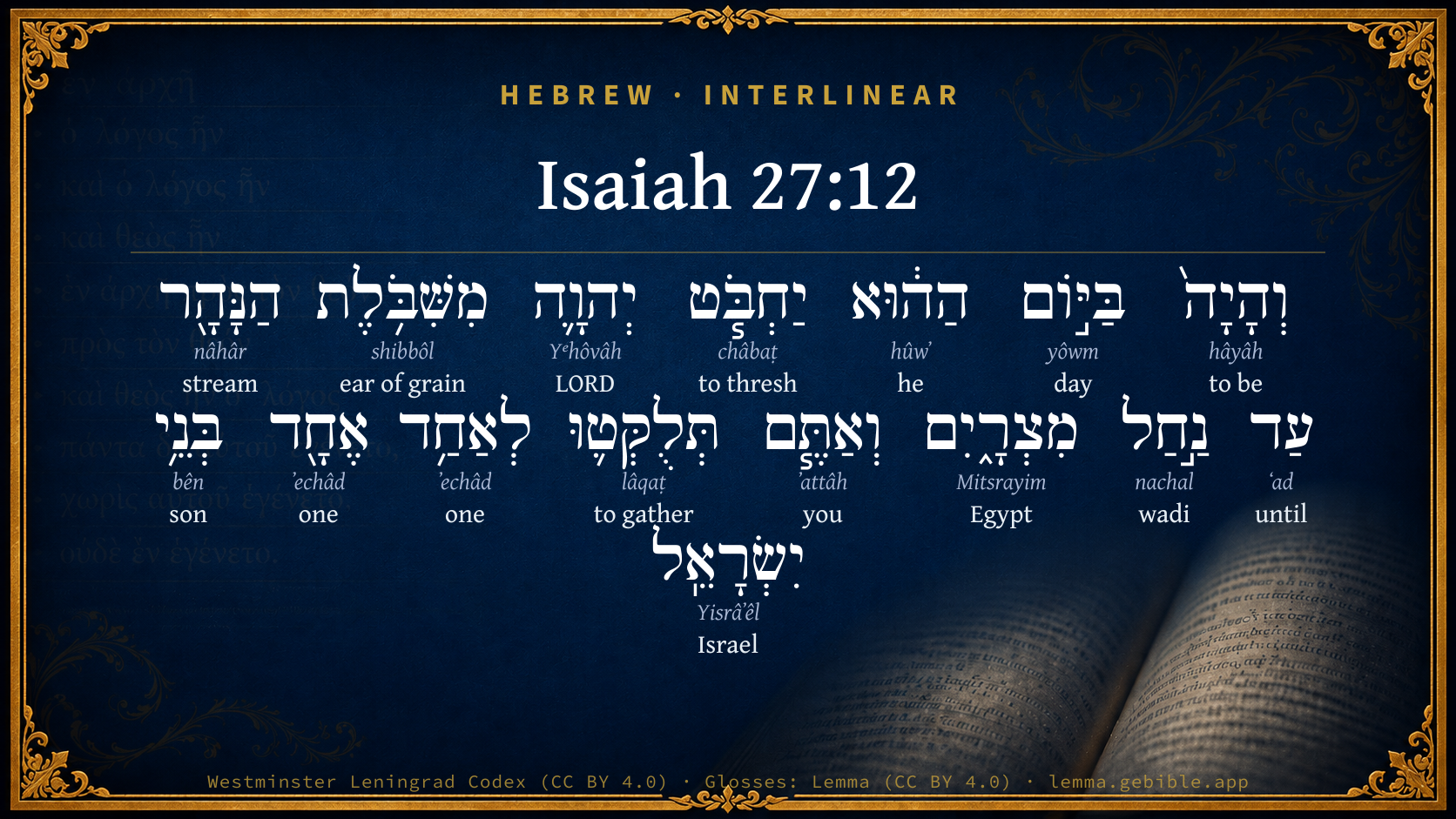
Hebrew (Westminster Leningrad Codex) Isaiah 27:12 appears in the Hebrew Old Testament. The text above is from the Westminster Leningrad Codex. Each word links to its Strong’s number, a concise gloss, and parsing drawn from the Open Scriptures Hebrew Bible morphology. Click any word for its full Brown-Driver-Briggs (BDB) entry.
Download image
Cite this verse

Isaiah 27:12 (World English Bible). Public Domain. Lemma interlinear Bible study tool, https://lemma.gebible.app/v/isaiah/27/12.

Show BibTeX & RIS
BibTeX
RIS
English Translation
It shall happen in that day, that Yahweh will beat off [his fruit] from the flood of the River to the brook of Egypt; and you shall be gathered one by one, you children of Israel.
World English Bible · Public Domain
Download a study sheet

One document with this verse’s original text, its word-by-word gloss line, the meaning frame, cross-references with their text, attributed commentary, and full source and license credits — printable, and it pastes into notes with its structure intact.

This verse Autodidact and up

Study sheet (.html) Plain text (.txt)

A passage Seminary Student

Up to 50 verses in one chapter. A passage sheet keeps up to 6 commentary sources and 12 cross-references per verse, in the order this page ranks them, and says so on the sheet whenever that leaves anything out. Ask for a single verse and you get the Autodidact verse sheet above.

Everything on this page stays free to read, with no account — the sheet is a download of what is already on screen, not access to it.

Want to remove ads? Support Godless Engineer
Compare translations 3

The same verse in 3 English versions, stacked beneath the original-language interlinear above. Click any original word for its lexicon entry.

Each is an independent rendering of the whole verse — the interlinear is not word-aligned to these translations.

Highlighted words mark where these versions differ — a whole-verse word diff, not a word-by-word alignment.

  • World English Bible Public Domain
    It shall happen in that day, that Yahweh will beat off [his fruit] from the flood of the River to the brook of Egypt; and you shall be gathered one by one, you children of Israel.
  • King James Version Public Domain
    And it shall come to pass in that day, that the LORD shall beat off from the channel of the river unto the stream of Egypt, and ye shall be gathered one by one, O ye children of Israel.
  • unfoldingWord Literal Text CC BY-SA 4.0
    And it will happen in that day, Yahweh will thresh from the flood of the River to the stream of Egypt, and you, you will be gathered to one, one, sons of Israel.

unfoldingWord Literal Text — © unfoldingWord, licensed CC BY-SA 4.0. Word-aligned USFM3 via Door43 (git.door43.org/unfoldingWord/en_ult).

Versions to compare (up to 4)

3 of 4 selected

Show all 18 translations

Every available English version of this verse, each an independent rendering of the whole verse.

  • World English Bible Public Domain
    It shall happen in that day, that Yahweh will beat off [his fruit] from the flood of the River to the brook of Egypt; and you shall be gathered one by one, you children of Israel.
  • Berean Standard Bible Public Domain
    In that day the LORD will thresh from the flowing Euphrates to the Wadi of Egypt, and you, O Israelites, will be gathered one by one.
  • Majority Standard Bible Public Domain
    In that day the LORD will thresh from the flowing Euphrates to the Wadi of Egypt, and you, O Israelites, will be gathered one by one.
  • King James Version Public Domain
    And it shall come to pass in that day, that the LORD shall beat off from the channel of the river unto the stream of Egypt, and ye shall be gathered one by one, O ye children of Israel.
  • American Standard Version (1901) Public Domain
    And it shall come to pass in that day, that Jehovah will beat off `his fruit' from the flood of the River unto the brook of Egypt; and ye shall be gathered one by one, O ye children of Israel.
  • Revised Version (1885) Public Domain
    And it shall come to pass in that day, that the LORD shall beat off his fruit, from the flood of the River unto the brook of Egypt, and ye shall be gathered one by one, O ye children of Israel.
  • Geneva Bible (1599) Public Domain
    And in that day shall the Lord thresh from the chanell of the Riuer vnto the riuer of Egypt, and ye shalbe gathered, one by one, O children of Israel.
  • Douay-Rheims (1899) Public Domain
    And it shall come to pass, that in that day the Lord will strike from the channel of the river even to the torrent of Egypt, and you shall be gathered together one by one, O ye children of Israel.
  • Young's Literal Translation Public Domain
    And it hath come to pass, in that day, Beat out doth Jehovah from the branch of the river, Unto the stream of Egypt, And ye are gathered one by one, O sons of Israel.
  • Literal Standard Version CC BY-SA 4.0
    And it has come to pass in that day, || YHWH beats out from the branch of the river, || To the stream of Egypt, || And you are gathered one by one, O sons of Israel.
  • Unlocked Literal Bible CC BY-SA 4.0
    It will come about on that day that Yahweh will thresh from the Euphrates River to the Wadi of Egypt and you, the people of Israel, will be gathered together one by one.
  • unfoldingWord Literal Text CC BY-SA 4.0
    And it will happen in that day, Yahweh will thresh from the flood of the River to the stream of Egypt, and you, you will be gathered to one, one, sons of Israel.
  • Darby Bible Public Domain
    And it shall come to pass in that day, that Jehovah shall beat out from the flood of the river unto the torrent of Egypt, and ye shall be gathered one by one, [ye] children of Israel.
  • World Messianic Bible Public Domain
    It will happen in that day that the LORD will thresh from the flowing stream of the Euphrates to the brook of Egypt; and you will be gathered one by one, children of Israel.
  • Webster's Bible Public Domain
    And it shall come to pass in that day, that the LORD shall gather from the channel of the river to the stream of Egypt, and ye shall be gathered one by one, O ye children of Israel.
  • Free Bible Version CC BY-SA 4.0
    At that time the Lord will thresh the grain harvested from the Euphrates River to the Wadi of Egypt, and you Israelites will be gathered up one by one.
  • Bible in Basic English Public Domain
    And it will be in that day that the Lord will get together his grain, from the River to the stream of Egypt, and you will be got together with care, O children of Israel.
  • JPS Tanakh (1917) Public Domain
    And it shall come to pass in that day, that the LORD will beat off His fruit from the flood of the River unto the Brook of Egypt, and ye shall be gathered one by one, O ye children of Israel.

Literal Standard Version (2020), Covenant Press — licensed CC BY-SA 4.0. Text via the HelloAO Bible API (eBible.org). Unlocked Literal Bible (unfoldingWord) — licensed CC BY-SA 4.0. Text via the HelloAO Bible API (eBible.org). unfoldingWord Literal Text — © unfoldingWord, licensed CC BY-SA 4.0. Word-aligned USFM3 via Door43 (git.door43.org/unfoldingWord/en_ult). Free Bible Version, Dr. Jonathan Gallagher — licensed CC BY-SA 4.0. Text via the HelloAO Bible API (eBible.org).

Word by word

More ways to search: Search by grammar → Find every occurrence → Compare this word →

Practice this passage: Drill this verse → Learn its vocabulary →

יַחְבֹּ֧ט
châbaṭ
H2251
“to thresh”
Verb, Qal, Imperfect, 3rd Person, Masculine, Singular
Part of Speech
Verb
Stem
Qal
Form
Imperfect
Person
3rd Person
Gender
Masculine
Number
Singular
Full BDB Definition

Origin: a primitive root

TWOT: 591

to beat, beat out, beat off, thresh - (Qal) - to beat out - to beat off - (Niphal) to be beaten out
  1. וְהָיָה֙ hâyâh H1961 “and · to be” Conjunction + Verb, Qal, Sequential Perfect, 3rd Person, Masculine, Singular
  2. בַּיּ֣וֹם yôwm H3117 “in/at the · day” Preposition, Determined + Noun, Common, Masculine, Singular, Absolute
  3. הַה֔וּא hûwʼ H1931 “the · he” Particle, Definite Article + Pronoun, Personal, 3rd Person, Masculine, Singular
  4. יְהוָ֛ה Yᵉhôvâh H3068 “LORD” Noun, Proper
  5. מִשִּׁבֹּ֥לֶת shibbôl H7641 “from · ear of grain of” Preposition + Noun, Common, Feminine, Singular, Construct
  6. הַנָּהָ֖ר nâhâr H5104 “the · stream” Particle, Definite Article + Noun, Common, Masculine, Singular, Absolute
  7. עַד ʻad H5704 “until” Preposition
  8. נַ֣חַל nachal H5158 “wadi of” Noun, Common, Masculine, Singular, Construct
  9. מִצְרָ֑יִם Mitsrayim H4714 “Egypt” Noun, Proper
  10. וְאַתֶּ֧ם ʼattâh H859 “and · you” Conjunction + Pronoun, Personal, 2nd Person, Masculine, Plural
  11. תְּלֻקְּט֛וּ lâqaṭ H3950 “to gather” Verb, Pual, Imperfect, 2nd Person, Masculine, Plural
  12. לְאַחַ֥ד ʼechâd H259 “to/for · one” Preposition + Adjective, Cardinal number, Masculine, Singular, Absolute
  13. אֶחָ֖ד ʼechâd H259 “one” Adjective, Cardinal number, Masculine, Singular, Absolute
  14. בְּנֵ֥י bên H1121 “sons of” Noun, Common, Masculine, Plural, Construct
  15. יִשְׂרָאֵֽל Yisrâʼêl H3478 “Israel” Noun, Proper

About this verse

These counts appear in no published source. They are computed here, from the morphology-tagged text and Lemma’s own curated glosses. What Lemma adds →

16
words
15
distinct lemmas
Prophets
section

Notable vocabulary

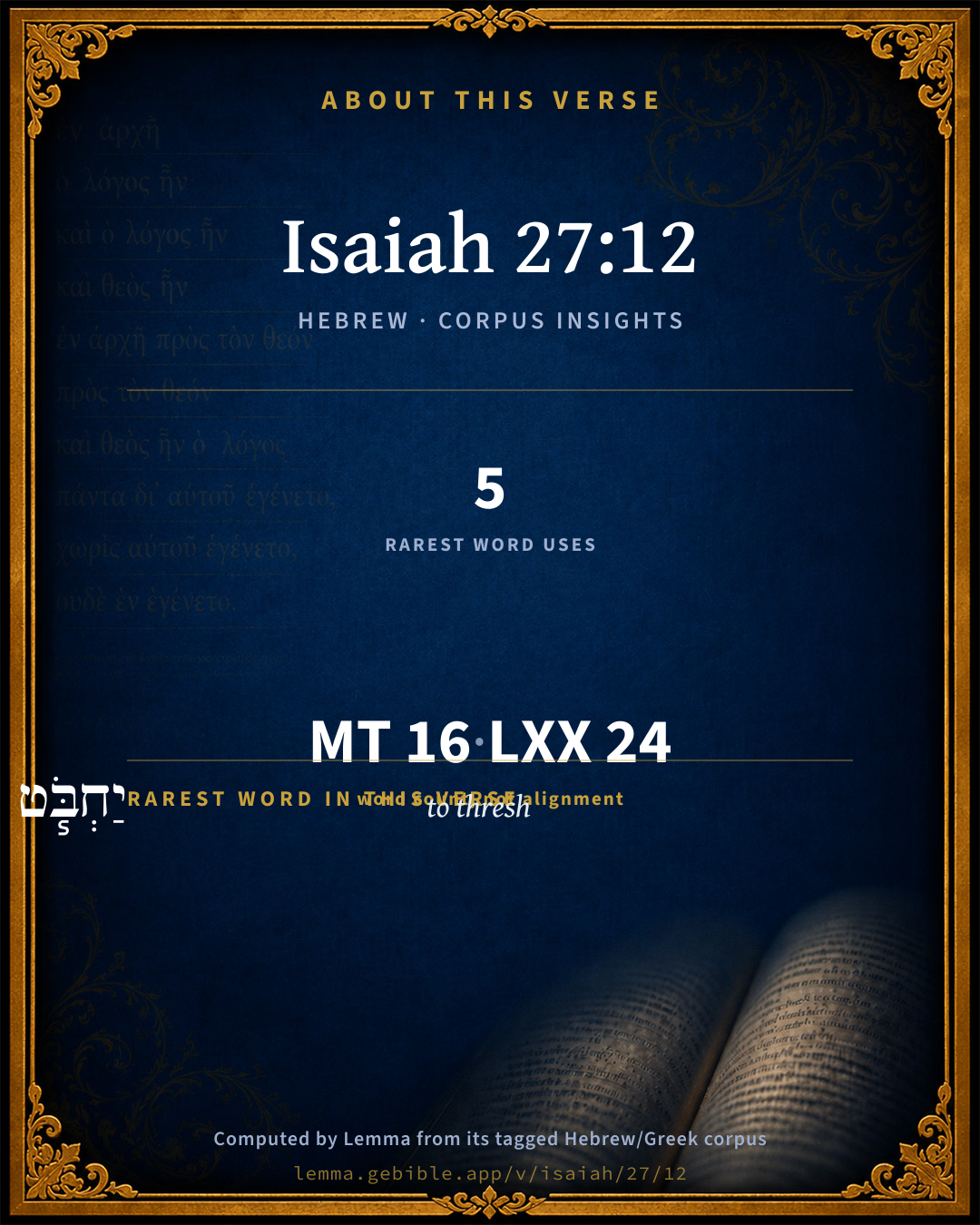
The rarest word here is יַחְבֹּ֧ט to thresh H2251 — appearing just 5 times in the whole Hebrew Bible.

Shared distinctive vocabulary

יַחְבֹּ֧ט to thresh H2251 occurs in 5 verses of the Hebrew Bible. Also found in:

Grammatical profile

  • 3 verbs
  • 8 nouns
  • 2 adjectives
  • 2 pronouns
  • 1 preposition

Verb forms

  • וְהָיָה֙ Qal · Sequential Perfect
  • יַחְבֹּ֧ט Qal · Imperfect
  • תְּלֻקְּט֛וּ Pual · Imperfect

Repetition

A word recurs within this verse — often emphatic in Hebrew:

  • לְאַחַ֥ד one H259 ×2

Hebrew & Septuagint length

In English translation the verse runs 36 words from the Hebrew and 36 from the Septuagint (LXX English) — the same length.

A rough comparison of the two English renderings, which tokenize alike — not a word-level alignment.

Word counts can differ between the Hebrew and the Greek without any difference in meaning — e.g. the Hebrew direct-object marker אֵת has no separate Greek word, and Greek often adds the article ὁ.

In the original languages it is 16 Hebrew tokens and 24 Greek tokens — but the two are counted differently (Hebrew bundles its prefixes and suffixes into one token; the Greek is in lemma form), so that isn’t a like-for-like length.

Cross-references

15

Topical passages linked to Isaiah 27:12 in the Treasury of Scripture Knowledge — connected by theme and wording, ordered by reader-vote popularity; previews shown in the World English Bible.

  • Genesis 15:18 In that day Yahweh made a covenant with Abram, saying, "To your seed have I given this land, from the river of Egypt to the great river, the river Euphrates:
  • Deuteronomy 30:3–4 that then Yahweh your God will turn your captivity, and have compassion on you, and will return and gather you from all the peoples, where Yahweh your God has scattered you.
  • Nehemiah 1:9 but if you return to me, and keep my commandments and do them, though your outcasts were in the uttermost part of the heavens, yet will I gather them from there, and will bring them to the place that I have chosen, to cause my name to dwell there.
  • Isaiah 56:8 The Lord Yahweh, who gathers the outcasts of Israel, says, Yet will I gather [others] to him, besides his own who are gathered.
  • Psalms 68:22 The Lord said, "I will bring you again from Bashan, I will bring you again from the depths of the sea;
  • Psalms 72:8 He shall have dominion also from sea to sea, From the River to the ends of the earth.
  • Isaiah 11:11–16 It shall happen in that day, that the Lord will set his hand again the second time to recover the remnant of his people, who shall remain, from Assyria, and from Egypt, and from Pathros, and from Cush, and from Elam, and from Shinar, and from Hamath, and from the islands of the sea.
  • Isaiah 17:6 Yet there shall be left therein gleanings, as the shaking of an olive tree, two or three berries in the top of the uppermost bough, four or five in the outmost branches of a fruitful tree, says Yahweh, the God of Israel.
  • Isaiah 24:13–16 For thus shall it be in the midst of the earth among the peoples, as the shaking of an olive tree, as the gleanings when the vintage is done.
  • Jeremiah 3:14 Return, backsliding children, says Yahweh; for I am a husband to you: and I will take you one of a city, and two of a family, and I will bring you to Zion:
  • Amos 9:9 "For, behold, I will command, and I will sift the house of Israel among all the nations, as grain is sifted in a sieve, yet not the least kernel will fall on the earth.
  • Matthew 18:12–14 "What do you think? If a man has one hundred sheep, and one of them goes astray, doesn't he leave the ninety-nine, go to the mountains, and seek that which has gone astray?
  • Luke 15:4 "Which of you men, if you had one hundred sheep, and lost one of them, wouldn't leave the ninety-nine in the wilderness, and go after the one that was lost, until he found it?
  • John 10:16 I have other sheep, which are not of this fold. I must bring them also, and they will hear my voice. They will become one flock with one shepherd.
  • John 6:37 All those who the Father gives me will come to me. Him who comes to me I will in no way throw out.

Cross-references courtesy of OpenBible.info (CC BY 4.0).

Hebrew and Greek witnesses Masoretic Hebrew ↔ Greek Septuagint

The same verse in the two great witnesses to the Old Testament, shown verse-for-verse.

These are two independent witnesses, not word-aligned to each other, and the Septuagint is shown in lemma (dictionary) form.

Hebrew Isaiah 27:12 Masoretic · Westminster Leningrad Codex

וְהָיָה֙ בַּיּ֣וֹם הַה֔וּא יַחְבֹּ֧ט יְהוָ֛ה מִשִּׁבֹּ֥לֶת הַנָּהָ֖ר עַד נַ֣חַל מִצְרָ֑יִם וְאַתֶּ֧ם תְּלֻקְּט֛וּ לְאַחַ֥ד אֶחָ֖ד בְּנֵ֥י יִשְׂרָאֵֽל

It shall happen in that day, that Yahweh will beat off [his fruit] from the flood of the River to the brook of Egypt; and you shall be gathered one by one, you children of Israel.

World English Bible · Public Domain

Greek LXX Isaiah 27:12 Septuagint · lemma form

καί εἰμί ἐν ὁ ἡμέρα ἐκεῖνος συνφράσσω κύριος ἀπό ὁ διῶρυξ ὁ ποταμός ἕως ῥινοκοροῦρα σύ δέ συνἄγω ὁ υἱός ἰσραήλ κατά εἷς εἷς

And it shall come to pass in that day that God shall fence men off from the channel of the river as far as Rhinocorura; but do you⌃ gather one by one the children of Israel.

LXX2012 (modern English Septuagint) · Public Domain

On this verse, John Gill's Exposition discusses the Septuagint’s reading. Read the note in Commentary ↓

Hebrew: Westminster Leningrad Codex (CC BY 4.0). Greek: Septuagint (public domain); English from LXX2012 (modern English Septuagint) (Public Domain). How the Septuagint differs from the Hebrew →

Targum (Aramaic paraphrase)

1

The Targum is the ancient Jewish Aramaic paraphrase of the Hebrew Scriptures — an interpretive translation, not the Hebrew text itself. Onkelos (literal) and Pseudo-Jonathan (expansive) render the Torah, and Jonathan the Prophets. Coverage is partial: where no permissively-licensed English translation exists for a verse, only the Aramaic is shown. This is verse-level text, not a word-by-word alignment to the Hebrew.

  1. Targum Jonathan Prophets (Joshua–Malachi)
    וִיהֵי בְּעִדָנָא הַהִיא יִתְרְמוּן קְטִילִין קֳדָם יְיָ מִכֵּיף נַהֲרָא פְּרָת עַד נַחֲלָא דְמִצְרָיִם וְאַתּוּן תִּתְקָרְבוּן חַד לִסְטַר חַד בְּנֵי יִשְׂרָאֵל:

    And it shall come to pass at that time, that the slain of the Lord shall be cast from the bank of the river Euphrates into the river of Egypt; and ye shall be brought near one to the other, o ye sons of Israel.

    Targum Jonathan — Aramaic: “Mikraot Gedolot” (public domain). English: “Sefaria Community Translation” (CC0 1.0 (public-domain dedication)); “London "Chaldee Paraphrase," 1871” (public domain). Text via Sefaria.

Commentary

Notes on Isaiah 27:12 from classic Christian and Jewish commentators (each source and its license shown beneath its notes). The classic Christian expositions comment on the surrounding passage and are grouped to its opening verse, so a note may address several verses; the Jewish commentaries on the Tanakh (Rashi and others) are per-verse, so they appear only where the commentator wrote on this verse.

Lemma curates 59 commentaries, every one of them public domain or Creative Commons licensed, each selected and text-cleaned for this edition rather than reprinted as found. About our sources →

Trapp's Complete Commentary

John Trapp

Isa 27:12 And it shall come to pass in that day, [that] the LORD shall beat off from the channel of the river unto the stream of Egypt, and ye shall be gathered one by one, O ye children of Israel.

Ver. 12. In that day,] sc., When God shall have purged his people by his Word and by his rod.

The Lord shall beat off.] Or, Shall thresh. The ministry of the Word is God’s flail to sever the chaff from grain - to single his out of the midst of wicked and profane worldlings. See the like of afflictions sanctified, Isa 27:9.

And ye shall be gathered.] As ears of grain are for threshing.

One by one.] There is no thresher in the world, saith one here, that thresheth half so clean, for he loseth not one grain, See Joh 17:12; Joh 10:3. Christ hath a care of every one particularly, and by the poll; some gather from hence that the calling of the Jews shall be general and universal.

John Trapp, A Commentary or Exposition upon All the Books of the Old and New Testament (1647–1656) — public domain. Text from a community e-Sword module.

The Biblical Illustrator

Joseph S. Exell

Isa_27:12

Ye shall be gathered one by one

The one-by-one principle

This principle is developed--

I.

IN THE DEALINGS OF PROVIDENCE.

II. IN THE PROVISIONS OF THE GOSPEL.

III. IN THE REQUIREMENTS OF THE LAW OF GOD. (F. Greeves.)

Gathered one by one

1. There is a country whose mysterious shores are visited each year by thousands from every continent of earth, and not one of them ever returns to detail its marvels. It is called in Scripture a land of darkness, and the shadow of death. It is a great republic, though it has a despot for its ruler; and it is the only one in which the dream of human equality can be fully realised. There the rich and the poor meet together, and are on a perfect level; there the cheek of beauty, the form of grace, and the withered limbs of age, are alike the banquet of the heedless worm; there the prisoners rest together; they hear not the voice, of the oppressor; the small and the great are there, and the slave is free from his master. There, side by side, in peaceful slumber, lie kings of the earth, and all people; princes, and the judges of the earth: both young men and maidens; old men, and children. Mysterious land! And oh! how densely peopled! But does it not throw a fearful solemnity over this thought, when we consider that to it we shall be gathered one by one? We live together; we act together; but we must die alone. Shall not this consideration lead you to remember your individuality now, and one by one to prepare for that hour by working out your salvation with fear and trembling?

2. Solemn, however, as is this gathering of the grave, it derives, fresh importance from the fact, that we need not fear, and we must not hope that it will be the last gathering. Behold, I show you a mystery; we shall not all sleep, but we shall all be changed, in a moment, in the twinkling of an eye, at the last trump: for the trumpet shall sound, and we shall be raised incorruptible. What a gathering that shall be! They shall come, the dead of all generations--from Adam to Noah, from Noah to Abraham, from Abraham to David, from David to the Saviour, from the Saviour to us, from ourselves to the judgment; all shall come; the sea shall give up the dead that are in it, and the earth the dead that are in it, and death and hell the dead that are in them; and the whole posterity of Adam, young and old, rich and poor, countless as the sands on the seashore, or the stars of

Heaven--all, without exception, shall be gathered there. But let us not forget the principle before us. Each individual of that mighty gathering will retain his own personal identity.

3. This, however, is but the opening scene of a yet more tremendous tragedy. It is but the lurid dawning of the great and terrible day of the Lord. There shall be yet another gathering, the most momentous gathering of our race, and the last. Each one of us shall give account of himself to God.

4. Learn thus that you have an individuality. Each one of you has powers, duties, talents, responsibilities, which you cannot share with any other being in the universe of God. You may commit sin in a crowd; but when you are judged for it you must stand alone.

5. Will ye be gathered now, gathered to the Saviours arms, gathered one by one? (F. Greeves.)

Gathered in death one by one

We often ask why should we die alone? It is not for us to give an answer for God. The Judge of all the earth will do right. Our entrance into the world is one by one; it is not unnatural that our departure should be the same. Each ones conversion, marriage, all the great events of life, are passed through, not in the mass, but each by himself, one by one.

I. The individuality of Gods dealings with men in their highest and most solemn experiences is AN HONOUR AND A FAVOUR. Each is thus made His special care. The most precious fruit is gathered by hand.

II. THE SHOCK OF BEREAVEMENT IS THUS LESSENED; a sparing mercy to those who are left to mourn.

III. WARNINGS OF THE INEVITABLE HOUR ARE THUS MULTIPLIED, that survivors may prepare. (Homiletic Review.)

Gathered one by one,

Gathered one by one, i.e., ye shall carefully gathered together, and brought safe into your own land. The words are taken from olives or apples or the like fruits, which are gathered one by one, and so laid up in some place appointed; which olives or apples or other fruit so gathered last better than they which are beaten off or shaken down from the tree. He seems to oppose this gathering one by one, to that beating off mentioned in this verse. (W. Day, M. A.)

The Biblical Illustrator, edited by Joseph S. Exell (c. 1880s–1900s) — public domain. Text from a community e-Sword module.

Joseph Benson's Commentary

Isa 27:12-13. It shall come to pass, &c., that the Lord shall beat off — Or, beat out: which is not meant in the way of punishment, but as an act of mercy, as is evident from the following clause of this, and of the next verse: the sense is, He shall sever, and take from among the nations, and gather together, like thrashed corn into the garner; from the channel of the river unto the stream of Egypt — All the Israelites that are scattered in those parts. It is a metaphor taken from thrashing, or beating out and separating the pure grain from the chaff. And ye shall be gathered one by one — Which signifies God’s exact and singular care of them. And in that day the great trumpet shall be blown — God shall summon them, as it were, by the sound of trumpet, namely, by an eminent call, or act of his providence on their behalf. He alludes to the custom of calling the Israelites together with trumpets: of which see Num 10:2-3. And they shall come which were in the land of Assyria — Into which the ten tribes had been carried captive; and the outcasts in the land of Egypt — Where many of the Jews were, as is manifest, both from the Scriptures and from other authors. This prediction had its first accomplishment in the restoration of the Jews from Babylon, to whom many of the Israelites from Assyria were joined, and returned with them; and to whom many from Egypt, and other parts, came and united themselves, and having rebuilt the city and temple, worshipped the Lord, as is here said, in his holy mountain at Jerusalem. But this prophecy has manifestly a further aspect, and foretels the restoration of the Jews in the latter times; when, the gospel trumpet having been blown, and the fulness of the Gentiles brought in, the Jews shall be gathered from their several dispersions, united to God’s church, numbered among his true worshippers, and probably reinstated in their own land.

Joseph Benson's Commentary on the Old and New Testaments (1811–1818) — public domain. Text from a community e-Sword module.

Keil & Delitzsch

C. F. Keil & F. Delitzsch

But when Israel repents, the mercy of Jehovah will change all this. "And it will come to pass on that day, Jehovah will appoint a beating of corn from the water-flood of the Euphrates to the brook of Egypt, and ye will be gathered together one by one, O sons of Israel. And it will come to pass in that day, a great trumpet will be blown, and the lost ones in the land of Asshur come, and the outcasts in the land of Egypt, and cast themselves down before Jehovah on the holy mountain in Jerusalem." I regard every exposition of Isa 27:12 which supposes it to refer to the return of the captives as altogether false. The Euphrates and the brook of Egypt, i.e., the Wady el-Arish, were the north-eastern and south-western boundaries of the land of Israel, according to the original promise (Gen 15:18; Kg1 8:65), and it is not stated that Jehovah will beat on the outside of these boundaries, but within them. Hence Gesenius is upon a more correct track, when he explains it as meaning that "the kingdom will be peopled again in its greatest promised extent, and that as rapidly and numerously as if men had fallen like olives from the trees." No doubt the word châbat is applied to the beating down of olives in Deu 24:20; but this figure is inapplicable here, as olives must already exist before they can be knocked down, whereas the land of Israel is to be thought of as desolate. What one expects is, that Jehovah will cause the dead to live within the whole of the broad expanse of the promised land (according to the promise in Isa 26:19, Isa 26:21). And the figure answers this expectation most clearly and most gloriously. Châbat as the word commonly applied to the knocking out of fruits with husks, which were too tender and valuable to be threshed. Such fruits, as the prophet himself affirms in Isa 28:27, were knocked out carefully with a stick, and would have been injured by the violence of ordinary threshing. And the great field of dead that stretched from the Euphrates to the Rhinokoloura,

(Note: Rhinokoloura (or Rhinokoroura): for the origin of this name of the Wady el-Arish, see Strabo, xvi. 2, 31.)

resembled a floor covered over with such tender, costly fruit. There true Israelites and apostate Israelites lay mixed together. But Jehovah would separate them. He would institute a beating, so that the true members of the church would come to the light of day, being separated from the false like grains sifted from their husks. "Thy dead will live;" it is to this that the prophet returns. And this view is supported by the choice of the word shibboleth, which combines in itself the meanings of "flood" (Psa 69:3, Psa 69:16) and "ear" (sc., of corn). This word gives a fine dilogy (compare the dilogy in Isa 19:18 and Hab 2:7). From the "ear" of the Euphrates down to the Peninsula of Sinai, Jehovah would knock - a great heap of ears, the grains of which were to be gathered together "one by one," i.e., singly (in the most careful manner possible; Greek, καθεῖς κατη ̓ ἓνα). To this risen church there would be added the still living diaspora, gathered together by the signal of God (compare Isa 18:3; Isa 11:12). Asshur and Egypt are named as lands of banishment. They represent all the lands of exile, as in Isa 19:23-25 (compare Isa 11:11). The two names are emblematical, and therefore not to be used as proofs that the prophecy is within the range of Isaiah's horizon. Nor is there any necessity for this. It is just as certain that the cycle of prophecy in chapters 24-27 belongs to Isaiah, and not to any other prophet, as it is that there are not two men to be found in the world with faces exactly alike.

Keil & Delitzsch — Biblical Commentary on the Old Testament (1861–1891) — public domain (CC PDM 1.0). Text via the HelloAO Bible API. (Old Testament only.)

Tyndale Open Study Notes

Tyndale Open Resources

27:12 Yet: God’s withholding of mercy from Israel (27:11) will be temporary. • from the Euphrates River . . . to the Brook of Egypt: God’s remnant will return from Assyria and Egypt to the territory that God promised to Abraham (Gen 15:18; see 1 Kgs 4:21).

Tyndale Open Study Notes — © Tyndale Open Resources, licensed CC BY-SA 4.0. Text via the HelloAO Bible API.

Geneva Bible (1599)

Geneva Bible translators

He shall destroy all from Euphrates to the Nile: for some fled toward Egypt, thinking to have escaped.

Geneva Bible (1599) marginal notes — public domain. Text via Bolls.life.

Jamieson, Fausset & Brown

Robert Jamieson, A. R. Fausset & David Brown

Restoration of the Jews from their dispersion, described under the image of fruits shaken from trees and collected.

beat off--as fruit beaten off a tree with a stick (Deu 24:20), and then gathered.

river--Euphrates.

stream of Egypt--on the confines of Palestine and Egypt (Num 34:5; Jos 15:4, Jos 15:47), now Wady-el-Arish, Jehovah's vineyard, Israel, extended according to His purpose from the Nile to the Euphrates (Kg1 4:21, Kg1 4:24; Psa 72:8).

one by one--gathered most carefully, not merely as a nation, but as individuals.

Jamieson, Fausset & Brown — Commentary Critical and Explanatory on the Whole Bible (1871) — public domain (CC PDM 1.0). Text via the HelloAO Bible API.

Adam Clarke's Commentary

Verse 12. The channel of the river] The river Sabbation, beyond which the Israelites were carried captive. - Kimchi.

Adam Clarke's Commentary on the Bible (1810–1826) — public domain. Text from a community e-Sword/MySword module.

Ellicott's Commentary for English Readers

(12) The Lord shall beat off . . .—The English Version conveys scarcely any meaning. The verb used is that which we find in Isa_28:27 for the “beating out” of seeds from their husks, as a form of threshing. In Deu_24:20 it is used of the beating down of the olive crop. So understood, the words imply a promise, like that of Isa_17:6, but on a far wider scale. Instead of the gleaning of a few olives from the topmost boughs, there should be a full and abundant gathering, and yet each single olive, “one by one” should receive an undivided care. Judah and Israel should once more be peopled as in the days of old, and the ideal boundaries or their territory should be restored.

The channel, or flood of the river, is the Euphrates.

The stream of Egypt.—As in Gen_15:18, 1Ki_8:65, not the Nile, but the river which divides Palestine from Egypt, known by the Greeks as Rhinocolura, and now the Wady-el-’Arish.

A Bible Commentary for English Readers, edited by Charles John Ellicott (1878–1897) — public domain. Text from a community e-Sword module.

The Cambridge Bible for Schools and Colleges

gen. ed. J. J. S. Perowne

12. the Lord shall beat off … Egypt] Rather: Jehovah shall thresh out from the corn-ears of the River (the Euphrates) unto (those of) the brook of Egypt, i.e. all that grows between those limits. The term “beat out” is applied both to the beating of olives from the tree (Deu_24:20) and to the beating out of grain with a staff—a more careful process than the ordinary methods (Isa_28:27; Jdg_6:11). The latter analogy gives the best sense here. The “brook of Egypt” is the Wadi el Arish, the south-western frontier of Palestine, this and the Euphrates being the extreme boundaries of the ideal territory of Israel (Gen_15:18, &c.). The meaning is that within this territory Jehovah will carefully separate the corn from the chaff and straw,—the true Israelites from heathens and apostates, Isa_27:13 then describes, under another figure, the ingathering of those who were exiled beyond these limits.

12, 13. The return from Exile,—a prophecy of the same character as ch. Isa_11:11-16.

The Cambridge Bible for Schools and Colleges (gen. ed. J. J. S. Perowne; Cambridge University Press, 1878–1918) — public domain. Text from a community e-Sword module.

John Gill's Exposition

And it shall come to pass in that day,.... When the song will be sung, Isa 27:2 when God will appear to have taken particular care of his church, and is about to bring it into a flourishing condition; when its troubles and afflictions will come to an end, with a sanctified use of them; and when the city of Rome will be destroyed, and all the antichristian powers, then will be the conversion of the Jews; for antichrist stands in the way of that work:

that the Lord shall beat off; or "beat out" (g); alluding either to the beating off of fruit from a tree, or to the beating out of grain from the ear; and signifies the separating of the Lord's people in the effectual calling from the rest of the world; as the fruit beaten off is separated from the tree, and corn beaten out is separated from the ear and chaff; for this beating off does not intend judgment, but mercy; and is done not by the rod of affliction, but by the rod of the Lord's strength sent out of Zion, even the Gospel, the power of God to salvation; which, in the ministration of it, should reach

from the channel of the river unto the stream of Egypt; from the river Euphrates, on the banks of which was the city of Babylon, to the river Nile in Egypt, which were the limits and boundaries of the land of Israel, Deu 11:24 and in which places many Jews (h) were, or would be, as in the following verse Isa 27:13. The Septuagint version is,

"from the ditch of the river to Rhinocorura;''

which, Jerom says, is a town on the borders of Egypt and Palestine. The meaning is, that the Lord would find out his people, wherever they were, in those parts, and separate and call them by his grace, and gather them to himself, and to his church and people, as follows:

and ye shall be gathered one by one, O ye children of Israel; as fruit is gathered up, when beaten off of the tree; and the phrase "one by one" denotes either the fewness of them, and the gradual manner in which they will be gathered; or rather, since this does not so well suit with the conversion of the Jews, which will be of a nation at once, it may signify the completeness of this work, that they shall be everyone gathered, not one shall be left or lost, but all Israel shall be saved; or it may be also expressive of the conjunction of them, and union of them one to another, in the Gospel church state, into which they shall be gathered, as fruit beaten off, and gathered up, is laid together in a storehouse. To this sense agrees the Targum,

"ye shall be brought near one to another, O ye children of Israel (i).''

(g) "excutiat", Pagninus, Montanus, Junius & Tremellius, Cocceius. (h) Ben Melech interprets the river of the river Sabation or the Sabbatical river, beyond which the Jews generally suppose the ten tribes are, and from whence they will come at the time of their restoration; and, as this writer says, will come to Egypt, and there be gathered together with their brethren, the children of this captivity, Judah and Benjamin, which are scattered in every corner, and join one another. (i) "ad unum unum", Montanus; "unus ad unum"; so some in Vatablus, Forerius.

John Gill's Exposition of the Whole Bible (1746–1763) — public domain (CC PDM 1.0). Text via the HelloAO Bible API.

Albert Barnes' Notes on the Bible

And it shall come to pass in that day, that the Lord shall beat off - The word which is used here (חבט châbaṭ) means properly “to beat off with a stick,” as fruit from a tree Deu 20:20. It also means to beat out grain with a stick Jdg 6:11; Rth 2:17 The word which is rendered in the other member of the sentence, ‘shall be gathered’ (לקט lâqaṭ), is applied to the act of “collecting” fruit after it has been beaten from a tree, or grain after it has been threshed. The use of these words here shows that the image is taken from the act of collecting fruit or grain after harvest; and the expression means, that as the farmer gathers in his fruit, so God would gather in his people. In the figure, it is supposed that the garden or vineyard of Yahweh extends from the Euphrates to the Nile; that his people are scattered in all that country; that there shall be agitation or a shaking in all that region as when a farmer beats off his fruit from the tree, or beats out his grain; and that the result would be that all those scattered people would be gathered into their own land. The time referred to is, doubtless, after Babylon should be taken; and in explanation of the declaration it is to be remembered that the Jews were not only carried to Babylon, but were scattered in large numbers in all the adjacent regions. The promise here is, that from all those regions where they had been scattered they should be re-collected and restored to their own land.

From the channel of the river - The river here undoubtedly refers to the river Euphrates (see the note at Isa 11:15).

Unto the stream of Egypt - The Nile. “And ye shall be gathered one by one.” As the farmer collects his fruits one by one - collecting them carefully, and not leaving any. This means that God will not merely collect them as a nation, but as “individuals.” He will see that none is overlooked, and that all shall be brought in safety to their land.

Albert Barnes' Notes on the Bible (1834–1885) — public domain. Text from a community e-Sword/MySword module.

Haydock's Catholic Bible Commentary

River Euphrates, even to the Nile. (Haydock) --- Nabuchodonosor laid waste all the intermediate countries. Afterwards Cyrus gave the people liberty. On the death of Cambyses, the nations were in consternation; and it was only during the peaceable reign of Darius that Israel returned, though not in a body, as the Jews had done twenty years before, chap. xxvi. (Calmet) --- By one, into the Church of Christ, John xi. (Menochius)

George Leo Haydock (1774–1849), Haydock's Catholic Family Bible and Commentary, 1859 edition — public domain. Excludes Psalms (Douay-Rheims chapter numbering differs from Protestant) and Deuterocanonical books (Catholic canon only).

Matthew Poole's English Annotations

Shall beat off; or, shall beat out; which is not meant in a way of punishment, which is rather designed by threshing, as Isa 21:10; 25:10, than by beating; but as an act of mercy, as is evident from the following clause of this, and from the next verse. It is a metaphor from some grains which were beaten out with a rod or staff, of which see Isa 28:27,28, and then were carefully gathered and laid up, for the use of man.

From the channel of the river unto the stream of Egypt; from Euphrates to Nilus, which were the two borders of the Land of Promise, Jos 1:4; 13:3. All the Israelites which are left in the land; which are here opposed to those of them that are dispersed into foreign parts, such as Assyria and Egypt.

Ye shall be gathered one by one; which signifies either the smallness of the remnant of that numerous people; or rather God’s exact and singular care of them, that not one of them should be lost.

Matthew Poole's English Annotations on the Holy Bible (1683–1685) — public domain. Text from a community e-Sword/MySword module.

Whedon's Commentary on the Bible

Daniel D. Whedon

12. But on Israel’s repentance all this is to cease, as to Jerusalem.

Shall beat off from the channel — Of the Euphrates to the river of Egypt (Wady el Arish) the Rhinocolura of the Septuagint, ancient boundary line between Egypt and Palestine. Over the whole extent of the original land of Promise, Jehovah shall order the growth and beating, or threshing, of grain for the sustenance of the returned ones of Israel. This is one view of the imagery employed here. Another is, that the beating implies an extensive growth of olives or other fruit to be carefully beaten off and discriminated as to the good and the bad; the good then to be gathered together; the whole signifying that the true Israel shall be discriminately gathered.

One by one — Rather, one to another, or, one after another, in colonies, to their home in Judea, from the different directions where their exile has been. Perhaps this meaning better suits the idea of the text.

Daniel D. Whedon (gen. ed.), Commentary on the Old and New Testaments (1874–1909) — public domain. Text from a community e-Sword module.

The Pulpit Commentary

Vers. 12, 13. JUDAH PROMISED RESTORATION. The general practice of Isaiah is to append to gloomy prophecies words of encouragement He does this even when heathen nations are denounced; (Isa_18:7 Isa_19:18-25 Isa_23:17, Isa_23:18) and still more when he is predicting judgments upon Israel. (Isa_2:2-4 Isa_6:13 Isa_10:20-34 Isa_24:23 Isa_29:18-24, etc.) The encouragement in this place is a promise of return after dispersion, and of re-establishment on the "holy mount at Jerusalem" (ver. 19).

The Lord shall beat off; i.e. "gather in his harvest." The metaphor is taken either from the beating of olive trees to obtain the berries, (see Isa_17:6) or from the beating out of the grain by a threshing-flail. (Jud_1:6:11 Rth_2:17; and below Isa_28:27) Perhaps the best translation would be, The Lord shall thresh. From the channel of the river; rather, from the strong stream of the river. As usual, "the river" (hannahar) is the Euphrates. (comp. Exo_23:31 Deu_11:24 Jos_24:2, Jos_24:3, Jos_24:14, Jos_24:15, etc.) Its "strong stream," or "flood," is contrasted with the scant thread of water which was alone to be found in the "Torrens Aegypti." The stream of Egypt (nachal Mizraim) is generally allowed to be the modern Wady el Arish, which was appointed to be the southern boundary of the Holy Land. (Num_34:5 1Ki_8:65) The Lord would collect within these limits all that were of Israel. He would also, as appears from the next verse, subsequently overstep the limits.

The Israel of God gathered in and garnered one by one.

While Scripture often speaks broadly of the call and conversion of nations, it yet, to an attentive reader, is continually proclaiming the fact that salvation is an individual matter. No privileges of birth or covenant, of Church-membership or Church-position, assure any one who has come to years of discretion that he is among the saved, or can make up for the want of personal fitness, personal faith, personal sincerity. God is very careful, and very choice, when he "makes up his jewels". (Mal_3:17) His eye is not only over all, but each. He tests them "one by one." He says to each, "My son, give me thy heart". (Pro_23:26) He requires of each conversion to him, trust in him, the earnest wish to please him. "One by one," as they become fit for it, he gathers them in, adds them to his crown, causes them to join the "innumerable company" of his elect spirits of just men made defect". (Heb_12:22, Heb_12:23) This consideration should make men careful to assure themselves;

(1) of their hold on the faith;

(2) of their interest in Christ;

(3) of their possession of that "holiness" without which "no one shall see the Lord". (Heb_12:14)

Vers. 12, 13. The return of God"s absent ones.

In the relation of God to his people in exile, as depicted in these two verses, we may find a picture of the relation in which he stands to all his absent children.

I THE BREADTH OF HIS KINGDOM: the broad fields of the husbandman, in which he might "beat off" fruit, from the far river in the East to the far river in the West from end to end of the known earth. God"s rights and claims extend to all peoples, to all classes, to men of every character and every temperament and every tongue, to both sexes; his empire, like his commandment, is "exceeding broad." He looks everywhere for fruit to be beaten off, to be gathered in, at the time of harvest.

II THE NEED OF HIS INTERPOSITION. This fruit which God is seeking is spiritual; it is the reverence, the love, the worship, the obedience, of his own children. But these his sons and daughters are:

1. Afar off. They are outcasts, a long way from home. It is not geographical, but moral and spiritual distance which has to be deplored. They are in the "strange land" of doubt, of denial, of disobedience, of indifference and forgetfulness, of utter unlikeness to the heavenly Father.

2. Or they are at the point of extinction. "Ready to perish." Those who have not "bowed the knee to Baal, "who have not been fascinated and won by ruinous seductions, are a mere remnant, and even their life, like Elijah"s, is at stake. Everything cries for God"s merciful interposition.

III HIS SUMMONS TO RETURN. The "great trumpet" is being blown; its notes are sounding far and wide. "The voice of Jesus sounds o"er land and sea," saying, "Return unto thy Rest;" "Come unto me, all ye that labor." From the "far country" of sin, of folly, of selfishness, of unrest, the summons calls all human hearts to leave behind them their sin, their misery, their bondage, and to cast themselves at the feet of the Divine Father, and beg to be taken back into that holy service which is perfect freedom.

IV HIS DISTINGUISHING KINDNESS. "Ye shall be gathered one by one." God does not content himself with issuing a general proclamation which each man may interpret and apply. He comes to every human soul himself. In the Person, and by the direct influence, of his Holy Spirit, he makes his appeal to the individual heart and conscience. He says, "Come thou, my child." "Return thou, my daughter." "My son, give me thy heart.

V THE GATHERING-PLACE OF HIS RETURNED ONES. "Ye shall worship the Lord in the holy mount at Jerusalem." All they who return unto God

(1) gather at his house on earth for worship there; and

(2) meet in the heavenly city, the new Jerusalem, for "nobler worship there. C.

The Pulpit Commentary (1880–1919), ed. H.D.M. Spence-Jones & Joseph S. Exell — public domain. Text from a community e-Sword module.

John Wesley's Explanatory Notes

Beat out - It is a metaphor from grain which was beaten out with a rod or staff, and then carefully gathered and laid up. From - From Euphrates to the Nile, which were the two borders of the land of promise. All the Israelites who are left in the land. One by one - Which signifies, God's exact care of them.

John Wesley, Explanatory Notes Upon the Whole Bible (1754–1765) — public domain. Text via the GEBible commentary corpus.

J. A. Alexander on Isaiah

Joseph Addison Alexander

“And it shall be in that day that Jehovah shall beat of (or gather in his fruit), from the channel of the river to the stream of Egypt, and ye shall be gathered one by one (or one to another), oh ye children of Israel.” To the downfall of Babylon he now adds, as in Isa 11:1, its most important consequence, the restoration of the Jews. The idea meant to be conveyed is that of a careful and complete ingathering. Stream of Egypt is now commonly agreed to signify the Wady Elarish, anciently called Rhinocorura, which name is given to it here by the Septuagint. The river is as usual the Euphrates. The simple meaning of the whole expression is, from Assyria to Egypt, both which are expressly mentioned in the next verse. The precise sense of the Hebrew phrase in the latter part of the verse is not well expressed by the English one by one, which seems to represent the process as a gradual one. It rather denotes one to one, (i.e., in our idiom, one to another, all together, or without exception). From what has been already said it will be seen, that the boundaries named are not intended to define the territory which should be occupied by those returning, but the regions whence they should return, which explanation is confirmed moreover by the explicit terms of the next verse.

Joseph Addison Alexander, The Prophecies of Isaiah (1846–1847; New York: Scribner, 1870–1878) — public domain. Text from a community e-Sword module.

unfoldingWord translationNotes

Door43 World Missions Community

It will come about

This phrase marks an important event that will happen.

on that day

"at that time"

Yahweh will thresh

Yahweh gathering his people to bring them back from the foreign nations to the land of Israel is spoken of as if he were threshing wheat to separate the grain from the chaff. (See: Metaphor)

from the Euphrates River to the Wadi of Egypt

Isaiah mentions the Euphrates River and the Wadi of Egypt to mean that Yahweh will bring back the people of Israel who were exiled in lands near those waters, that is, Assyria and Egypt. The Euphrates River is northeast of Israel, and the Wadi of Egypt is southwest of Israel.

the Wadi of Egypt

"the brook of Egypt"

you ... will be gathered together one by one

This can be stated in active form. AT: "Yahweh will gather you together one by one" (See: Active or Passive)

a great trumpet will be blown

This can be stated in active form. AT: "someone will blow a trumpet loudly" (See: Active or Passive)

the perishing ones in the land of Assyria will come, and the outcasts in the land of Egypt

The understood information can be stated clearly. AT: "those who are in exile and dying in the land of Assyria and the land of Egypt will return to the land of Israel" (See: Ellipsis)

holy mountain

The "holy mountain" is Mount Zion, in Jerusalem. See how you translated this in Isaiah 11:9.

translationWords

Yahweh

thresh

Euphrates River

Egypt

people group

Israel

trumpet

perish

Assyria

worship

holy

Jerusalem

unfoldingWord translationNotes — © Distant Shores Media and the Door43 World Missions Community, licensed CC BY-SA 4.0. Source: git.door43.org/Door43/en_tn.

Rashi

Rabbi Shlomo Yitzchaki (Rashi)

that the Lord shall gather יַחְבֹּט, lit., shall beat. Jonathan renders: shall fall dead. I.e., the nations from the banks of the Euphrates to the stream of Egypt. I say, however, that these two expressions, (viz.) beating and gathering, coincide with one another, like one who bears his olive trees and goes back and gathers them and (ms. or) others gather them from the ground, so will the Holy One, blessed be He, commence the gathering, as it is said: A great shofar shall be sounded.

from the flood of the river These are those lost in the land of Assyria.

to the stream of Egypt Those are the ones exiled in the land of Egypt.

the river Euphrates. They are those in Assyria who live by the Euphrates.

to the stream of Egypt These are those who live in Egypt, He shall gather them like one who gathers olives.

and you shall be gathered from the exiles.

one and one Whoever finds one of you will bring him as an offering.

Rashi on the Tanakh — English translations: “The Judaica Press complete Tanach with Rashi, translated by A. J. Rosenberg” (CC BY 4.0); “Pentateuch with Rashi's commentary by M. Rosenbaum and A.M. Silbermann, 1929-1934” (public domain); “The Metsudah Tanach series, Lakewood, N.J” (CC BY 4.0); and “The Book of Joshua, Metsudah Publications, 1997” (CC BY 4.0). Text via Sefaria.

Ibn Ezra

Rabbi Abraham ibn Ezra

ביום ההוא In those days.

יחבט Shall beat off. Comp. תחבט thou wilt beat (Deut. 24:10); חובט beating (Judg. 6:11); therefore the expression תלקטו you will be gathered together is also used.

One by one. Only a few will be left out of many.

Ibn Ezra on the Tanakh — English translations: “Sefaria Community Translation” (CC0 1.0 (public-domain dedication)); “Yalkut, Sifsei Chachomim Chumash, Metsudah Publications, 2009” (CC BY 4.0); and “Commentary of Ibn Ezra on Isaiah - trans. by M. Friedlander, 1873” (public domain). Text via Sefaria.

Lesson kit

Teaching starters — assembled from the data on this page, not authored interpretation. Every prompt links to the verse data it draws on. Edit before teaching.

Isaiah, in the Prophets, opens this verse with 16 words (15 distinct Hebrew lemmas). Its most distinctive word is châbaṭ (“to thresh”). A historical commentator’s framing appears above. Read the whole chapter for the surrounding context.

Discussion questions

  1. The word châbaṭ carries the sense “to thresh.” How does it shape the verse?
  2. How does Deuteronomy 24:20, which shares the word «to thresh», read alongside this verse?
  3. What does the repetition of “one” (2× in this one verse) do in this verse?
  4. These translations render this verse differently. What is at stake in choosing one wording over another?
  5. «וְהָיָה֙» is a Qal Sequential Perfect verb. How does that grammatical form shape the action described?
  6. Compare how Trapp's Complete Commentary and The Biblical Illustrator read this verse. Where do they agree or differ?

Things to notice

Reading settings

Reading text

Shown beneath each verse's original-language words.

Old Testament
Old Testament edition

Read the OT as the Masoretic Hebrew (MT) or the Greek Septuagint (LXX).

English shown for the Greek Septuagint (in the Hebrew ↔ Greek comparison).

Comparing translations? Open the Compare panel on any verse page to stack up to four side by side.