
Exodus 13:3

Hebrew (Westminster Leningrad Codex) Exodus 13:3 appears in the Hebrew Old Testament. The text above is from the Westminster Leningrad Codex. Each word links to its Strong’s number, a concise gloss, and parsing drawn from the Open Scriptures Hebrew Bible morphology. Click any word for its full Brown-Driver-Briggs (BDB) entry.
Download image
Cite this verse

Exodus 13:3 (World English Bible). Public Domain. Lemma interlinear Bible study tool, https://lemma.gebible.app/v/exodus/13/3.

Show BibTeX & RIS
BibTeX
RIS
English Translation
Moses said to the people, "Remember this day, in which you came out from Egypt, out of the house of bondage; for by strength of hand Yahweh brought you out from this place. No leavened bread shall be eaten.
World English Bible · Public Domain
Highlights
  • 1 first appearance in the Hebrew Bible
Full analysis ↓
Download a study sheet

One document with this verse’s original text, its word-by-word gloss line, the meaning frame, cross-references with their text, attributed commentary, and full source and license credits — printable, and it pastes into notes with its structure intact.

This verse Autodidact and up

Study sheet (.html) Plain text (.txt)

A passage Seminary Student

Up to 50 verses in one chapter. A passage sheet keeps up to 6 commentary sources and 12 cross-references per verse, in the order this page ranks them, and says so on the sheet whenever that leaves anything out. Ask for a single verse and you get the Autodidact verse sheet above.

Everything on this page stays free to read, with no account — the sheet is a download of what is already on screen, not access to it.

Want to remove ads? Support Godless Engineer
Compare translations 3

The same verse in 3 English versions, stacked beneath the original-language interlinear above. Click any original word for its lexicon entry.

Each is an independent rendering of the whole verse — the interlinear is not word-aligned to these translations.

Highlighted words mark where these versions differ — a whole-verse word diff, not a word-by-word alignment.

  • World English Bible Public Domain
    Moses said to the people, "Remember this day, in which you came out from Egypt, out of the house of bondage; for by strength of hand Yahweh brought you out from this place. No leavened bread shall be eaten.
  • King James Version Public Domain
    And Moses said unto the people, Remember this day, in which ye came out from Egypt, out of the house of bondage; for by strength of hand the LORD brought you out from this place: there shall no leavened bread be eaten.
  • unfoldingWord Literal Text CC BY-SA 4.0
    And Moses said to the people, “Remember this day, that you went out from Egypt, from the house of slavery, because by a strong hand Yahweh brought you out from here. And no yeast may be eaten.

unfoldingWord Literal Text — © unfoldingWord, licensed CC BY-SA 4.0. Word-aligned USFM3 via Door43 (git.door43.org/unfoldingWord/en_ult).

Versions to compare (up to 4)

3 of 4 selected

Show all 18 translations

Every available English version of this verse, each an independent rendering of the whole verse.

  • World English Bible Public Domain
    Moses said to the people, "Remember this day, in which you came out from Egypt, out of the house of bondage; for by strength of hand Yahweh brought you out from this place. No leavened bread shall be eaten.
  • Berean Standard Bible Public Domain
    So Moses told the people, “Remember this day, the day you came out of Egypt, out of the house of slavery; for the LORD brought you out of it by the strength of His hand. And nothing leavened shall be eaten.
  • Majority Standard Bible Public Domain
    So Moses told the people, “Remember this day, the day you came out of Egypt, out of the house of slavery; for the LORD brought you out of it by the strength of His hand. And nothing leavened shall be eaten.
  • King James Version Public Domain
    And Moses said unto the people, Remember this day, in which ye came out from Egypt, out of the house of bondage; for by strength of hand the LORD brought you out from this place: there shall no leavened bread be eaten.
  • American Standard Version (1901) Public Domain
    And Moses said unto the people, Remember this day, in which ye came out from Egypt, out of the house of bondage; for by strength of hand Jehovah brought you out from this place: there shall no leavened bread be eaten.
  • Revised Version (1885) Public Domain
    And Moses said unto the people, Remember this day, in which ye came out from Egypt, out of the house of bondage; for by strength of hand the LORD brought you out from this place: there shall no leavened bread be eaten.
  • Geneva Bible (1599) Public Domain
    Then Moses sayd vnto the people, Remember this day in the which ye came out of Egypt, out of the house of bondage: for by a mightie hande the Lord brought you out from thence: therefore no leauened bread shall bee eaten.
  • Douay-Rheims (1899) Public Domain
    And Moses said to the people: Remember this day in which you came forth out of Egypt, and out of the house of bondage, for with a strong hand hath the Lord brought you forth out of this place: that you eat no leavened bread.
  • Young's Literal Translation Public Domain
    And Moses saith unto the people, `Remember this day `in' which ye have gone out from Egypt, from the house of servants, for by strength of hand hath Jehovah brought you out from this, and any thing fermented is not eaten;
  • Literal Standard Version CC BY-SA 4.0
    And Moses says to the people, “Remember this day [in] which you have gone out from Egypt, from the house of servants, for by strength of hand YHWH has brought you out from this, and anything fermented is not eaten;
  • Unlocked Literal Bible CC BY-SA 4.0
    Moses said to the people, “Call this day to mind, the day on which you came out from Egypt, out of the house of slavery, for by Yahweh's strong hand he brought you out from this place. No bread with yeast may be eaten.
  • unfoldingWord Literal Text CC BY-SA 4.0
    And Moses said to the people, “Remember this day, that you went out from Egypt, from the house of slavery, because by a strong hand Yahweh brought you out from here. And no yeast may be eaten.
  • Darby Bible Public Domain
    And Moses said to the people, Remember this day, in which ye came out from Egypt, out of the house of bondage; for with a powerful hand hath Jehovah brought you out from this; and nothing leavened shall be eaten.
  • World Messianic Bible Public Domain
    Moses said to the people, “Remember this day, in which you came out of Egypt, out of the house of bondage; for by strength of hand the LORD brought you out from this place. No leavened bread shall be eaten.
  • Webster's Bible Public Domain
    And Moses said to the people, Remember this day, in which ye came out from Egypt, out of the house of bondage; for by strength of hand the LORD brought you out from this place: there shall no leavened bread be eaten.
  • Free Bible Version CC BY-SA 4.0
    So Moses told the people, “Remember this is the day you left Egypt, the land of your slavery, for the Lord led you out of it by his amazing power. (Nothing with yeast in it shall be eaten.)
  • Bible in Basic English Public Domain
    And Moses said to the people, Let this day, on which you came out of Egypt, out of your prison-house, be kept for ever in memory; for by the strength of his hand the Lord has taken you out from this place; let no leavened bread be used.
  • JPS Tanakh (1917) Public Domain
    And Moses said unto the people: 'Remember this day, in which ye came out from Egypt, out of the house of bondage; for by strength of hand the LORD brought you out from this place; there shall no leavened bread be eaten.

Literal Standard Version (2020), Covenant Press — licensed CC BY-SA 4.0. Text via the HelloAO Bible API (eBible.org). Unlocked Literal Bible (unfoldingWord) — licensed CC BY-SA 4.0. Text via the HelloAO Bible API (eBible.org). unfoldingWord Literal Text — © unfoldingWord, licensed CC BY-SA 4.0. Word-aligned USFM3 via Door43 (git.door43.org/unfoldingWord/en_ult). Free Bible Version, Dr. Jonathan Gallagher — licensed CC BY-SA 4.0. Text via the HelloAO Bible API (eBible.org).

Word by word

More ways to search: Search by grammar → Find every occurrence → Compare this word →

Practice this passage: Drill this verse → Learn its vocabulary →

בְּחֹ֣זֶק
chôzeq
H2392
“in/at · strength of”
Preposition + Noun, Common, Masculine, Singular, Construct
Part of Speech
Preposition + Noun
Type
Common
Gender
Masculine
Number
Singular
State
Construct
Full BDB Definition

Origin: from H2388

TWOT: 636c

strength
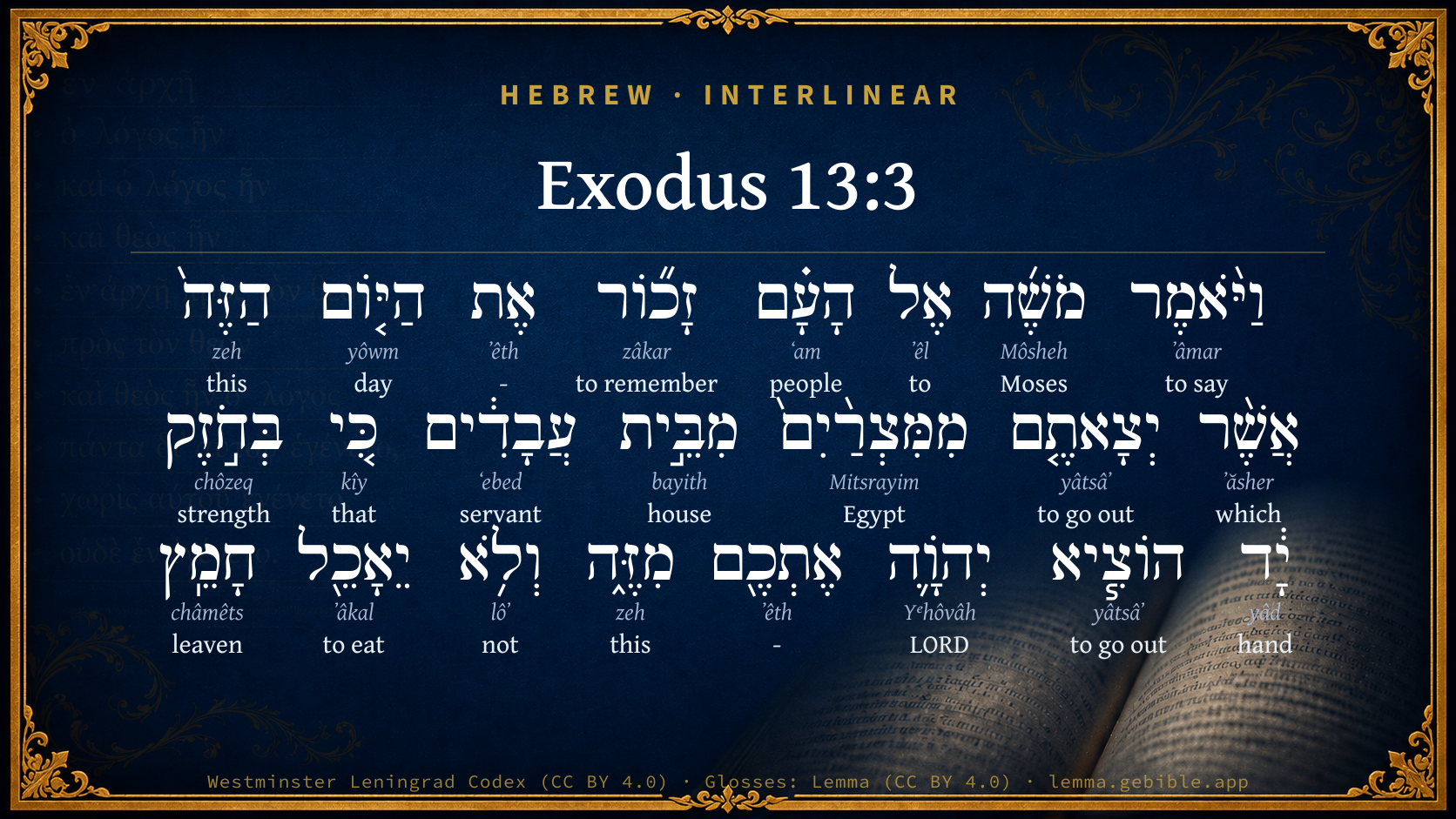
  1. וַיֹּ֨אמֶר ʼâmar H559 “and · to say” Conjunction + Verb, Qal, Sequential Imperfect, 3rd Person, Masculine, Singular
  2. מֹשֶׁ֜ה Môsheh H4872 “Moses” Noun, Proper
  3. אֶל ʼêl H413 “to” Preposition
  4. הָעָ֗ם ʻam H5971 “the · people” Particle, Definite Article + Noun, Common, Masculine, Singular, Absolute
  5. זָכ֞וֹר zâkar H2142 “to remember” Verb, Qal, Infinitive Absolute
  6. אֶת ʼêth H853 “-” Particle, Direct Object
  7. הַיּ֤וֹם yôwm H3117 “the · day” Particle, Definite Article + Noun, Common, Masculine, Singular, Absolute
  8. הַזֶּה֙ zeh H2088 “the · this” Particle, Definite Article + Pronoun, Demonstrative, Masculine, Singular
  9. אֲשֶׁ֨ר ʼăsher H834 “which” Particle, Relative
  10. יְצָאתֶ֤ם yâtsâʼ H3318 “to go out” Verb, Qal, Perfect, 2nd Person, Masculine, Plural
  11. מִמִּצְרַ֨יִם֙ Mitsrayim H4714 “from · Egypt” Preposition + Noun, Proper
  12. מִבֵּ֣ית bayith H1004 “from · house of” Preposition + Noun, Common, Masculine, Singular, Construct
  13. עֲבָדִ֔ים ʻebed H5650 “servants” Noun, Common, Masculine, Plural, Absolute
  14. כִּ֚י kîy H3588 “that” Conjunction
  15. יָ֔ד yâd H3027 “hand” Noun, Common, Both, Singular, Absolute
  16. הוֹצִ֧יא yâtsâʼ H3318 “to go out” Verb, Hiphil, Perfect, 3rd Person, Masculine, Singular
  17. יְהֹוָ֛ה Yᵉhôvâh H3068 “LORD” Noun, Proper
  18. אֶתְכֶ֖ם ʼêth H853 “- · you” Particle, Direct Object + Suffix, Personal, 2nd Person, Masculine, Plural
  19. מִזֶּ֑ה zeh H2088 “from · this” Preposition + Pronoun, Demonstrative, Masculine, Singular
  20. וְלֹ֥א lôʼ H3808 “and · not” Conjunction + Particle, Negative
  21. יֵאָכֵ֖ל ʼâkal H398 “to eat” Verb, Niphal, Imperfect, 3rd Person, Masculine, Singular
  22. חָמֵֽץ châmêts H2557 “leaven” Noun, Common, Masculine, Singular, Absolute

About this verse

These counts appear in no published source. They are computed here, from the morphology-tagged text and Lemma’s own curated glosses. What Lemma adds →

23
words
20
distinct lemmas
Pentateuch
section

Notable vocabulary

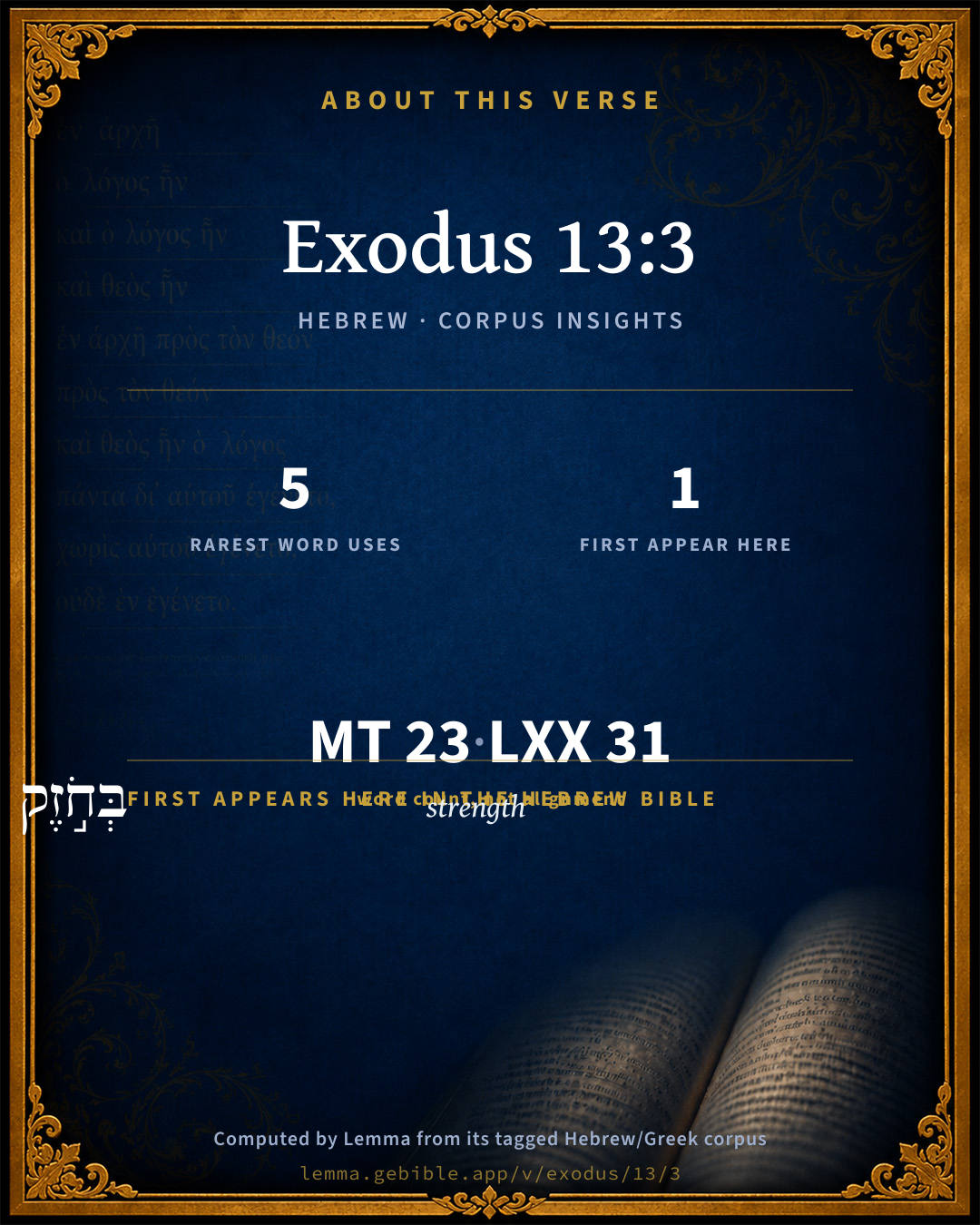
The rarest word here is בְּחֹ֣זֶק strength H2392 — appearing just 5 times in the whole Hebrew Bible.

First appearance in Scripture

This word makes its first canonical appearance in the Hebrew Bible here:

  • בְּחֹ֣זֶק strength H2392

Shared distinctive vocabulary

בְּחֹ֣זֶק strength H2392 occurs in 5 verses of the Hebrew Bible. Also found in:

Grammatical profile

  • 5 verbs
  • 10 nouns
  • 2 pronouns
  • 1 preposition
  • 1 conjunction
  • 4 particles

Verb forms

  • וַיֹּ֨אמֶר Qal · Sequential Imperfect
  • זָכ֞וֹר Qal · Infinitive Absolute
  • יְצָאתֶ֤ם Qal · Perfect
  • הוֹצִ֧יא Hiphil · Perfect
  • יֵאָכֵ֖ל Niphal · Imperfect

Repetition

Words recur within this verse — often emphatic in Hebrew:

  • יְצָאתֶ֤ם to go out H3318 ×2
  • הַזֶּה֙ this H2088 ×2

Hebrew & Septuagint length

In English translation the verse runs 39 words from the Hebrew and 43 from the Septuagint (LXX English) — closely comparable.

A rough comparison of the two English renderings, which tokenize alike — not a word-level alignment.

Word counts can differ between the Hebrew and the Greek without any difference in meaning — e.g. the Hebrew direct-object marker אֵת has no separate Greek word, and Greek often adds the article ὁ.

In the original languages it is 23 Hebrew tokens and 31 Greek tokens — but the two are counted differently (Hebrew bundles its prefixes and suffixes into one token; the Greek is in lemma form), so that isn’t a like-for-like length.

Cross-references

26

Topical passages linked to Exodus 13:3 in the Treasury of Scripture Knowledge — connected by theme and wording, ordered by reader-vote popularity; previews shown in the World English Bible.

  • Deuteronomy 24:18 but you shall remember that you were a bondservant in Egypt, and Yahweh your God redeemed you there: therefore I command you to do this thing.
  • Deuteronomy 5:15 You shall remember that you were a servant in the land of Egypt, and Yahweh your God brought you out of there by a mighty hand and by an outstretched arm: therefore Yahweh your God commanded you to keep the Sabbath day.
  • Exodus 20:2 "I am Yahweh your God, who brought you out of the land of Egypt, out of the house of bondage.
  • Deuteronomy 5:6 "I am Yahweh your God, who brought you out of the land of Egypt, out of the house of bondage.
  • Deuteronomy 16:12 You shall remember that you were a bondservant in Egypt: and you shall observe and do these statutes.
  • Deuteronomy 15:15 You shall remember that you were a bondservant in the land of Egypt, and Yahweh your God redeemed you: therefore I command you this thing today.
  • Deuteronomy 6:12 then beware lest you forget Yahweh, who brought you forth out of the land of Egypt, out of the house of bondage.
  • Exodus 13:14 It shall be, when your son asks you in time to come, saying, 'What is this?' that you shall tell him, 'By strength of hand Yahweh brought us out from Egypt, from the house of bondage;
  • Deuteronomy 8:14 then your heart be lifted up, and you forget Yahweh your God, who brought you forth out of the land of Egypt, out of the house of bondage;
  • Deuteronomy 16:3 You shall eat no leavened bread with it; seven days shall you eat unleavened bread therewith, even the bread of affliction; for you came forth out of the land of Egypt in haste: that you may remember the day when you came forth out of the land of Egypt all the days of your life.
  • Deuteronomy 13:10 You shall stone him to death with stones, because he has sought to draw you away from Yahweh your God, who brought you out of the land of Egypt, out of the house of bondage.
  • Joshua 24:17 for Yahweh our God, he it is who brought us and our fathers up out of the land of Egypt, from the house of bondage, and who did those great signs in our sight, and preserved us in all the way in which we went, and among all the peoples through the midst of whom we passed;
  • Exodus 12:42 It is a night to be much observed to Yahweh for bringing them out from the land of Egypt. This is that night of Yahweh, to be much observed of all the children of Israel throughout their generations.
  • Deuteronomy 24:22 You shall remember that you were a bondservant in the land of Egypt: therefore I command you to do this thing.
  • Deuteronomy 13:5 That prophet, or that dreamer of dreams, shall be put to death, because he has spoken rebellion against Yahweh your God, who brought you out of the land of Egypt, and redeemed you out of the house of bondage, to draw you aside out of the way which Yahweh your God commanded you to walk in. So shall you put away the evil from the midst of you.
  • Deuteronomy 4:34 Or has God tried to go and take him a nation from the midst of [another] nation, by trials, by signs, and by wonders, and by war, and by a mighty hand, and by an outstretched arm, and by great terrors, according to all that Yahweh your God did for you in Egypt before your eyes?
  • Exodus 23:15 You shall observe the feast of unleavened bread. Seven days you shall eat unleavened bread, as I commanded you, at the time appointed in the month Abib (for in it you came out from Egypt), and no one shall appear before me empty.
  • Exodus 3:20 I will put forth my hand and strike Egypt with all my wonders which I will do in the midst of it, and after that he will let you go.
  • Exodus 6:1 Yahweh said to Moses, "Now you shall see what I will do to Pharaoh, for by a strong hand he shall let them go, and by a strong hand he shall drive them out of his land."
  • Exodus 12:8 They shall eat the flesh in that night, roasted with fire, and unleavened bread. They shall eat it with bitter herbs.
  • Exodus 12:19 Seven days shall there be no yeast found in your houses, for whoever eats that which is leavened, that soul shall be cut off from the congregation of Israel, whether he be a foreigner, or one who is born in the land.
  • Exodus 20:8 "Remember the Sabbath day, to keep it holy.
  • Exodus 12:15 Seven days shall you eat unleavened bread; even the first day you shall put away yeast out of your houses, for whoever eats leavened bread from the first day until the seventh day, that soul shall be cut off from Israel.
  • Deuteronomy 11:2–3 Know you this day: for I don't speak with your children who have not known, and who have not seen the chastisement of Yahweh your God, his greatness, his mighty hand, and his outstretched arm,
  • Psalms 105:5 Remember his marvelous works that he has done; His wonders, and the judgments of his mouth,
  • Ephesians 1:19 and what is the exceeding greatness of his power toward us who believe, according to that working of the strength of his might

Cross-references courtesy of OpenBible.info (CC BY 4.0).

Hebrew and Greek witnesses Masoretic Hebrew ↔ Greek Septuagint

The same verse in the two great witnesses to the Old Testament, shown verse-for-verse.

These are two independent witnesses, not word-aligned to each other, and the Septuagint is shown in lemma (dictionary) form.

Hebrew Exodus 13:3 Masoretic · Westminster Leningrad Codex

וַיֹּ֨אמֶר מֹשֶׁ֜ה אֶל הָעָ֗ם זָכ֞וֹר אֶת הַיּ֤וֹם הַזֶּה֙ אֲשֶׁ֨ר יְצָאתֶ֤ם מִמִּצְרַ֨יִם֙ מִבֵּ֣ית עֲבָדִ֔ים כִּ֚י בְּחֹ֣זֶק יָ֔ד הוֹצִ֧יא יְהֹוָ֛ה אֶתְכֶ֖ם מִזֶּ֑ה וְלֹ֥א יֵאָכֵ֖ל חָמֵֽץ

Moses said to the people, "Remember this day, in which you came out from Egypt, out of the house of bondage; for by strength of hand Yahweh brought you out from this place. No leavened bread shall be eaten.

World English Bible · Public Domain

Greek LXX Exodus 13:3 Septuagint · lemma form

εἶπον δέ μωυσῆς πρός ὁ λαός μνημονεύω ὁ ἡμέρα οὗτος ἐν ὅς ἐκἔρχομαι ἐκ γῆ αἴγυπτος ἐκ οἶκος δουλεία ἐν γάρ χείρ κραταιός ἐκἄγω σύ κύριος ἐντεῦθεν καί οὐ βιβρώσκω ζύμη

And Moses said to the people, Remember this day, in which you⌃ came forth out of the land of Egypt, out of the house of bondage, for with a strong hand the Lord brought you forth thence; and leaven shall not be eaten.

LXX2012 (modern English Septuagint) · Public Domain

Hebrew: Westminster Leningrad Codex (CC BY 4.0). Greek: Septuagint (public domain); English from LXX2012 (modern English Septuagint) (Public Domain). How the Septuagint differs from the Hebrew →

Targum (Aramaic paraphrase)

2

The Targum is the ancient Jewish Aramaic paraphrase of the Hebrew Scriptures — an interpretive translation, not the Hebrew text itself. Onkelos (literal) and Pseudo-Jonathan (expansive) render the Torah, and Jonathan the Prophets. Coverage is partial: where no permissively-licensed English translation exists for a verse, only the Aramaic is shown. This is verse-level text, not a word-by-word alignment to the Hebrew.

  1. Targum Onkelos Torah (Genesis–Deuteronomy)
    וַאֲמַר משֶׁה לְעַמָא הֲווֹ דְכִירִין יָת יוֹמָא הָדֵין דִי נְפַקְתּוּן מִמִצְרַיִם מִבֵּית עַבְדוּתָא אֲרֵי בִּתְקוֹף יְדָא אַפֵּיק יְיָ יָתְכוֹן מִכָּא וְלָא יִתְאֲכֵל חֲמִיעַ:

    (no public-domain English translation for this verse)

    Targum Onkelos — Aramaic: “Onkelos Genesis” (public domain); “Onkelos Exodus” (public domain); “Onkelos Leviticus” (public domain); “Onkelos Numbers” (public domain); “Onkelos Deuteronomy” (public domain). English: “Sefaria Community Translation” (CC0 1.0 (public-domain dedication)); “J.W. Etheridge. The Targums of Onkelos and Jonathan Ben Uzziel on the Pentateuch. London: Longmans, Green, 1862” (public domain). Text via Sefaria.

  2. Targum Pseudo-Jonathan Torah (Genesis–Deuteronomy)
    וַאֲמַר משֶׁה לְעַמָּא הֲווֹן דְּכִירִין יַת יוֹמָא הָדֵין דִּי נְפַקְתּוּן פְּרִיקִין מִמִצְרַיִם מִבֵּית שִׁעְבּוּד עֲבָדַיָיא אֲרוּם בִּתְקוֹף גְּבוּרַת יְדָא אַפֵּיק יְיָ יַתְכוֹן מִיכָּא וְלָא יִתְאָכֵל חָמִיעַ

    And Mosheh said to the people, Remember this the day in which you went out free from Mizraim from the house of the bondage of slaves; for by great strength of hand did the Lord bring you forth from thence; and you shall not eat leaven.

    Targum Pseudo-Jonathan — Aramaic: “Targum Jonathan on Genesis” (public domain); “Targum Jonathan on Exodus” (public domain); “Targum Jonathan on Leviticus” (public domain); “Targum Jonathan on Numbers” (public domain); “Targum Jonathan on Deuteronomy” (public domain). English: “The Targum of Jonathan ben Uzziel, trans. J. W. Etheridge, London, 1862” (public domain). Text via Sefaria.

Commentary

Notes on Exodus 13:3 from classic Christian and Jewish commentators (each source and its license shown beneath its notes). The classic Christian expositions comment on the surrounding passage and are grouped to its opening verse, so a note may address several verses; the Jewish commentaries on the Tanakh (Rashi and others) are per-verse, so they appear only where the commentator wrote on this verse.

Lemma curates 59 commentaries, every one of them public domain or Creative Commons licensed, each selected and text-cleaned for this edition rather than reprinted as found. About our sources →

Jamieson, Fausset & Brown

Robert Jamieson, A. R. Fausset & David Brown

MEMORIAL OF THE PASSOVER. (Exo 13:3-10)

Moses said unto the people, Remember this day--The day that gave them a national existence and introduced them into the privileges of independence and freedom, deserved to live in the memories of the Hebrews and their posterity; and, considering the signal interposition of God displayed in it, to be held not only in perpetual, but devout remembrance.

house of bondage--literally, "house of slaves"--that is, a servile and degrading condition.

for by strength of hand the Lord brought you out from this place--The emancipation of Israel would never have been obtained except it had been wrung from the Egyptian tyrant by the appalling judgments of God, as had been at the outset of his mission announced to Moses (Exo 3:19).

There shall no leavened bread, &c.--The words are elliptical, and the meaning of the clause may be paraphrased thus:--"For by strength of hand the Lord brought you out from this place, in such haste that there could or should be no leavened bread eaten."

Jamieson, Fausset & Brown — Commentary Critical and Explanatory on the Whole Bible (1871) — public domain (CC PDM 1.0). Text via the HelloAO Bible API.

Trapp's Complete Commentary

John Trapp

Exo 13:3 And Moses said unto the people, Remember this day, in which ye came out from Egypt, out of the house of bondage; for by strength of hand the LORD brought you out from this [place]: there shall no leavened bread be eaten.

Ver. 3. Remember.] Heb., To remember, indefinitely; q.d., Remember perpetually, and commemorate.

John Trapp, A Commentary or Exposition upon All the Books of the Old and New Testament (1647–1656) — public domain. Text from a community e-Sword module.

The Biblical Illustrator

Joseph S. Exell

Exo_13:3-4

Remember this day.

A day to be remembered

1. Gods commands and His servants obedience are sweetly united together.

2. Deliverance of the Church from Egyptian bondage is justly chargeable on their memory.

3. Jehovah the Author of deliverance is to be minded with His work, and power of doing it.

4. Remembrance of Jehovah carrieth with it mindfulness of duty and service to Him (Exo_13:3).

5. Days and months of mercy are ordered by God to be remembered (Exo_13:4). (G. Hughes, B. D.)

Days to be remembered

I. There are days in the history of individuals which ought to be celebrated.

II. There are days in the history of churches which ought to be celebrated.

III. There are days in the history of nations which ought to be celebrated. (J. S. Exell, M. A.)

The Biblical Illustrator, edited by Joseph S. Exell (c. 1880s–1900s) — public domain. Text from a community e-Sword module.

Geneva Bible (1599)

Geneva Bible translators

To signify that they had not leisure to leaven their bread.

Hebrew, house of servants.

Where they were in most cruel slavery.

Geneva Bible (1599) marginal notes — public domain. Text via Bolls.life.

Ellicott's Commentary for English Readers

(3) Remember this day.—Remembrance was secured in four ways:—(1) By the month being made to commence the ecclesiastical year; (2) by the institution of the Passover; (3) by the seven days of unleavened bread; and (4) by the redemption, and the inquiries it would necessitate (Exo_13:14-15).

A Bible Commentary for English Readers, edited by Charles John Ellicott (1878–1897) — public domain. Text from a community e-Sword module.

The Cambridge Bible for Schools and Colleges

gen. ed. J. J. S. Perowne

3. this day] i.e. the 15th of Abib.

house of bondage (lit. of bondmen or slaves)] so v. 14, Exo_20:2; and hence often in Dt. (Deu_5:6 [= Deu_20:2], Deu_6:12, Deu_7:8, Deu_8:14, Deu_13:5; Deu_13:10), and Jos_24:17 (D2[135]); also Mic_6:4†. The expression means a place in which slaves are confined (Lat. ergastulum), such as Egypt was to the Hebrews in bondage.

[135] Deuteronomic passages in Josh., Jud., Kings.

strength of hand] so vv. 14, 16†. The usual expression is a strong hand (v. 9): see on Exo_6:1.

3–4. No leavened bread to be eaten on the day of the Exodus.

3–16. Moses’ promulgation to the people of directions respecting (a) Maẓẓoth, vv. 3–10, and (b) the sanctity of the firstborn, vv. 11–16. Both passages approximate in style and tone to Deuteronomy (cf. on Exo_12:25-27 a); and it is probable that they are both parenetic expansions, by the compiler of JE, of a simpler original in J, contained perhaps in vv. 3a (to people), 4, 6–7, 10, 12–13.

(a) 3–10. Maẓẓoth. Regulations respecting Maẓẓoth have already been given to Moses by Jehovah in Exo_12:14-20 (P); but the differences, both material (no mention of a ‘holy convocation,’ with restrictions from work, on the 1st and 7th days; different name, ‘Abib,’ for the month; the 7th, not the 1st day, the ‘pilgrimage’) and linguistic, shew that the regulations found here cannot be by the same writer, but that they have been taken by the compiler from the source J. Cf. the note on Exo_12:21-27.

The Cambridge Bible for Schools and Colleges (gen. ed. J. J. S. Perowne; Cambridge University Press, 1878–1918) — public domain. Text from a community e-Sword module.

John Gill's Exposition

And Moses said unto the people,.... After the Lord had spoken to him, and said the above things:

remember this day in which ye came out of Egypt, out of the house of bondage; or "of servants" (x) where they had been servants to the Egyptians, by whom they had been made to serve with rigour, and their lives made bitter with hard bondage; that country had been like a prison house unto them, where they had been detained captives, and treated in a very cruel manner; but now they were come out of this place and state of servitude, even that very day, the fifteenth of Nisan; and which therefore it became them to remember, they and theirs, in all succeeding generations, as the Lord had directed, and which is afterwards repeated to impress it the more upon their, minds and memories:

for by strength of hand the Lord brought you out of this place; it was not by their own might and strength that they were redeemed from their state of bondage, but by the mighty hand of the Lord who wrought such signs and wonders before Pharaoh and his servants, and inflicted such plagues upon them, which none but an omnipotent hand could do, which obliged them at last to let them go: and if the Israelites were under obligation, on account of this redemption, to remember the day when it was in this wonderful manner wrought out, much, more reason have we to remember the redemption by Christ the mighty Redeemer, whose own arm wrought salvation for us, and delivered us out of the hands of our spiritual enemies, that were stronger than we, by frequently attending the ordinance of the Lord's supper, which is instituted to bring this amazing affair to our remembrance, and which is to be continued for that purpose unto the second coming of Christ:

there shall no leavened bread be eaten; as they then on this very day had no other but unleavened bread to eat, so they should eat no other on this day and the six days following, in successive ages unto the coming of the Messiah.

(x) "e domo servorum", Pagninus, Montanus, Tigurine version, Junius & Tremellius, Piscator, Vatablus, & Drusius.

John Gill's Exposition of the Whole Bible (1746–1763) — public domain (CC PDM 1.0). Text via the HelloAO Bible API.

The Pulpit Commentary

And Moses said. Without relating the directions given to Moses any further, the author passes to the directions given by him. He thus, here and elsewhere, avoids unnecessary repetition. Remember this day. The injunction came with great force at the close of the first day"s journey, when the good-will of the Egyptians had been shown, and the people had been helped and speeded on their way, and felt that they were actually quitting the house of their bondage, and setting out for Canaan. By strength of hand the Lord brought you outi.e. ., "by His powerful protection has God brought you on your way thus far." Therefore, "Remember this day, and remember that nothing leavened is to be eaten on it". (see Exo_12:15-20)

Vers. 3-16. The rightful use of Church ordinances.

Church ordinances are

(1) Commemorative;

(2) Disciplinary;

(3) Channels of supernatural grace.

The benefits derivable from them depend mainly upon their rightful use. We learn from the instructions hero given to the Israelites by Moses, that their rightful use consists especially

I IN THE REGULAR KEEPING OF THEM. "Thou shalt keep this ordinance in his season from year to year." Spasmodic observance, enthusiastic and frequent at one time, perfunctory and infrequent at another, ten times this year, once the next, will bring no blessing, conduct to no good result. Each ordinance has its own time or times baptism and confirmation once in a lifetime the Holy Communion weekly, if opportunity offers; if not, monthly; or, at the least, thrice a year attendance at public worship, each Sunday, twice fasting, on Fridays and in Lent commemoration of chief festivals, once a year and so on. Fitness has in every ease been considered, and set times appointed at proper intervals. Let the rule of the Church be regularly followed, let there be no needless variation, no will-worship, no caprice, and the greatest benefit may be confidently anticipated. But following one"s own fancy in the matter, now observing rules, now breaking them, making ourselves in fact a law to ourselves, is a course that will assuredly obtain no blessing upon it. "Thou shalt keep each ordinance in his season.

II IN THE STRICT KEEPING OF THEM. "There shall no leavened bread be seen with thee, neither shall there be leaven seen with thee, in all thy quarters." Lukewarmness, double-mindedness, half-and-half measures, are everywhere condemned in Scripture. "If the Lord be God, follow Him; if Baal, then follow him." "Because thou art lukewarm, and neither cold nor hot, I will spue thee out of my mouth." If the ordinances of the Church are worth following at all, they are worth following strictly. If the Church says away gaiety and amusement during this or that season," then all gaiety and amusement should be put away none should be seen "in all our quarters." If she appoints two services, or (as some understand it) three for Sundays, then men should not limit their attendance to one. If she urges frequent communions, they should attend frequently, and not be content with the minimum of three times in the year.

III IN THE KEEPING OF SUCH OF THEM AS ARE COMMEMORATIVE WITH REMEMBRANCE. "Remember this day, in the which ye came out from Egypt Lord slew all the first-born therefore I sacrifice to the Lord all that openeth the matrix." A large part of the ritual of every church is commemorative. Sunday is a commemoration. The Friday fast, enjoined by the Church of England and others, is a commemoration. Christmas, Easter, Whitsuntide, Ascension Day, are commemorations. And the Holy Communion is in part commemorative. To observe, in a certain sense, these days and seasons and ordinances, without giving serious thought to the historical events with which they are connected, and out of which they have arisen, is to lose half the benefit which their observance was intended to secure to us. It is scarcely, perhaps, to be supposed that any one could receive the Holy Communion without some thought of the death of Christ upon the Cross; but it must greatly conduce to the rite having its due and full operation on our minds and hearts, that we should vividly present to ourselves on the occasion a mental picture of the agonies suffered for us, that we should dwell in thought upon the whole scene of the trial and the crucifixion, and seek to realise its particulars. We cannot have too deeply impressed upon us the recollection of the day on which, and the means by which, God brought the Church of the first-born out of the spiritual bondage of Egypt, saved them from the destroyer, sanctified them, and made them his "peculiar people.

IV IN THE CONTINUED KEEPING OF THEM THROUGH TIMES OF PROSPERITY. "When the Lord shall bring thee into the land of the Canaanites, thou shalt keep this service." The discipline of adversity is apt to draw men nearer to God than that of prosperity. Many are very careful and regular attendants on Church ordinances when they are afflicted, or in poor circumstances, or suffering from a bereavement; but, if the world smiles upon them, if they grow rich and respected, if men court and flatter them, they grow careless and irregular in such matters. They think that they cease to have the time for them; but in reality they cease to relish them. "The cares of the world and the deceitfulness of riches," choke the good seed that was in them, and "they become unfruitful." They forget God, and the marvellous things that he hath done for them. Hence a warning is required. We must not let the "milk and honey" of Canon wean our hearts from God, or make us less zealous in his service, or less constant attendants upon his ordinances. The higher we are lifted up the more we need his grace; the greater attraction that the world offers to us, the more helpful to us are those holy rites and usages, which draw our thoughts away from earthly things, and fix them upon things Divine and heavenly.

Vers. 3-11. Remember this day.

The exhortation in these verses may very well be applied to Christians. They are to remember the fact add the might of their redemption. They are to commemorate it by observance of appointed ordinances. They are to beware of forgetting it in days of prosperity. They are to show their remembrance of it by a holy walk, and by due instruction of their children.

I REMEMBER THE FACT AND THE MIGHT OF YOUR REDEMPTION.

1. The fact of it (vers. 3-8). How Jesus has brought you up "out of a horrible pit, out of the miry clay"; (Psa_40:1) has redeemed you from the law"s curse, from Satan"s tyranny, from a condition of wrath, and from spiritual death; has introduced you into the liberty of God"s children, and started you on your journey to an everlasting and glorious inheritance. Redemption from the thraldom of Pharaoh sinks into insignificance as compared with this "so great salvation." If Israel was summoned to remember the day on which they came out of Egypt, out of the house of bondage, much more is it the duty of Christians to remember what great things God has done for them.

2. The might of it. "By strength of hand the Lord brought you out of this place" (vers. 3, 9, 14). They were to remember this as enhancing their sense of the greatness of their redemption, and as affording a pledge that God was able to accomplish all else that he had promised (ver. 5). The might expended in the Christian redemption is not less, but greater, than in the exodus from Egypt. It does not detract from its greatness that it is chiefly moral strength power exerted in overcoming evil, in producing moral effects in the minds and consciences of men, and in making them new creatures in Christ Jesus. Redemption has both its objective and its subjective sides, and in both is displayed the power of God. God"s might is seen in the upholding of Christ; in the victories which, while on earth, he was enabled to gain over the powers of evil; in the gigantic triumph of the Cross; and in the spiritual effects produced since, through eighteen centuries, by the preaching of his Gospel; in the regeneration of souls, in the strength given to his servants to do spiritual work, in the victory whereby they overcome the world.

II BEWARE OF FORGETTING YOUR REDEMPTION IN THE DAYS OF YOUR PROSPERITY, ver. 15. Prosperity has a subtle influence in leading away the heart from God. When men have eaten, and are full, (Deu_8:12-18) they are very apt to grow haughty and self-sufficient. This danger is one to be jealously watched against.

III SHOW THAT YOU REMEMBER YOUR REDEMPTION BY DOING THE THINGS THAT GOD COMMANDS.

1. By observing his ordinances. The special ordinance here alluded to is the feast of unleavened bread a sequel to the passover (vers. 3-10). Christians are to observe the Lord"s Supper.

2. By a holy life. The observance of the outward ordinance would be valueless if that which it spiritually represented was lost sight of, viz., the need of a walk in "newness of life." We are to "keep the feast, not with old leaven, neither with the leaven of malice and wickedness, but with the unleavened bread of sincerity and truth". (1Co_5:7) To this end has Christ redeemed us, that we may walk in holiness. (Eph_5:25-28; Tit_2:14 1Pe_1:18)

3. By instruction of children. God lays stress on this. (vers. 8-14; cf. Deu_6:6-9 Deu_11:18-22) It is his chief way of perpetuating a holy seed. The responsibility of instruction rests primarily on the parent. No task should be more delightful to him, or should be discharged more faithfully. If the parent is willing, many opportunities will present themselves. A child"s curiosity is ever active. The ordinances of the Church will furnish starting-points for conversation. We have in these verses, and elsewhere in the book, specimens of the instruction that is to be given. J.O.

The Pulpit Commentary (1880–1919), ed. H.D.M. Spence-Jones & Joseph S. Exell — public domain. Text from a community e-Sword module.

unfoldingWord translationNotes

Door43 World Missions Community

Call this day to mind

The words "Call ... to mind" were a customary way of telling someone to remember something. AT: "Remember and celebrate this day" (See: Idiom and Assumed Knowledge and Implicit Information)

the house of slavery

Moses speaks of Egypt as if it were a house where people keep slaves. AT: "the place where you were slaves" (See: Metaphor)

Yahweh's strong hand

Here the word "hand" refers to power. See how you translated "strong hand" in Exodus 6:1. (See: Metonymy)

No bread with yeast may be eaten

This can be stated in active form. AT: "You must not eat bread with yeast" (See: Active or Passive)

the month of Aviv

This is the name of the first month of the Hebrew calendar. Aviv is during the last part of March and the first part of April on Western calendars. (See: Hebrew Months and How to Translate Names)

a land flowing with milk and honey

Since milk comes from cows and goats, "milk" represents food produced by livestock. Because honey is produced from flowers, "honey" represents food from crops. See how you translated this in Exodus 3:8. AT: "food from livestock and from crops" (See: Metonymy)

you must observe this act of worship

When the Israelites live in Canaan, they must celebrate the Passover on this day each year. See how you translated this phrase in Exodus 12:25.

translationWords

people of God

day

mind

Egypt

servant

hand

bread

yeast

Canaan

Hittite

Amorite

Hivite

Jebus

oath

honey

worship

unfoldingWord translationNotes — © Distant Shores Media and the Door43 World Missions Community, licensed CC BY-SA 4.0. Source: git.door43.org/Door43/en_tn.

Rashi

Rabbi Shlomo Yitzchaki (Rashi)

זכור את היום הזה REMEMBER THIS DAY — This teaches that one must make mention of the Exodus from Egypt every day (Mekhilta; cf. Rashi on Deuteronomy 27:9).

Rashi on the Tanakh — English translations: “The Judaica Press complete Tanach with Rashi, translated by A. J. Rosenberg” (CC BY 4.0); “Pentateuch with Rashi's commentary by M. Rosenbaum and A.M. Silbermann, 1929-1934” (public domain); “The Metsudah Tanach series, Lakewood, N.J” (CC BY 4.0); and “The Book of Joshua, Metsudah Publications, 1997” (CC BY 4.0). Text via Sefaria.

Lesson kit

Teaching starters — assembled from the data on this page, not authored interpretation. Every prompt links to the verse data it draws on. Edit before teaching.

Exodus, in the Pentateuch, opens this verse with 23 words (20 distinct Hebrew lemmas). Its most distinctive word is chôzeq (“strength”). A historical commentator’s framing appears above. Read the whole chapter for the surrounding context.

Discussion questions

  1. How does “strength” (chôzeq) shape what this verse is saying?
  2. This is the first place “strength” appears in Scripture (first appears here). What does its debut here establish?
  3. How does Exodus 13:14, which shares the word «strength», read alongside this verse?
  4. What does the repetition of “to go out” (2× in this one verse) do in this verse?
  5. These translations render this verse differently. What is at stake in choosing one wording over another?
  6. «וַיֹּ֨אמֶר» is a Qal Sequential Imperfect verb. How does that grammatical form shape the action described?
  7. Compare how Jamieson, Fausset & Brown and Trapp's Complete Commentary read this verse. Where do they agree or differ?

Things to notice

Reading settings

Reading text

Shown beneath each verse's original-language words.

Old Testament
Old Testament edition

Read the OT as the Masoretic Hebrew (MT) or the Greek Septuagint (LXX).

English shown for the Greek Septuagint (in the Hebrew ↔ Greek comparison).

Comparing translations? Open the Compare panel on any verse page to stack up to four side by side.