Jeremiah 46:19

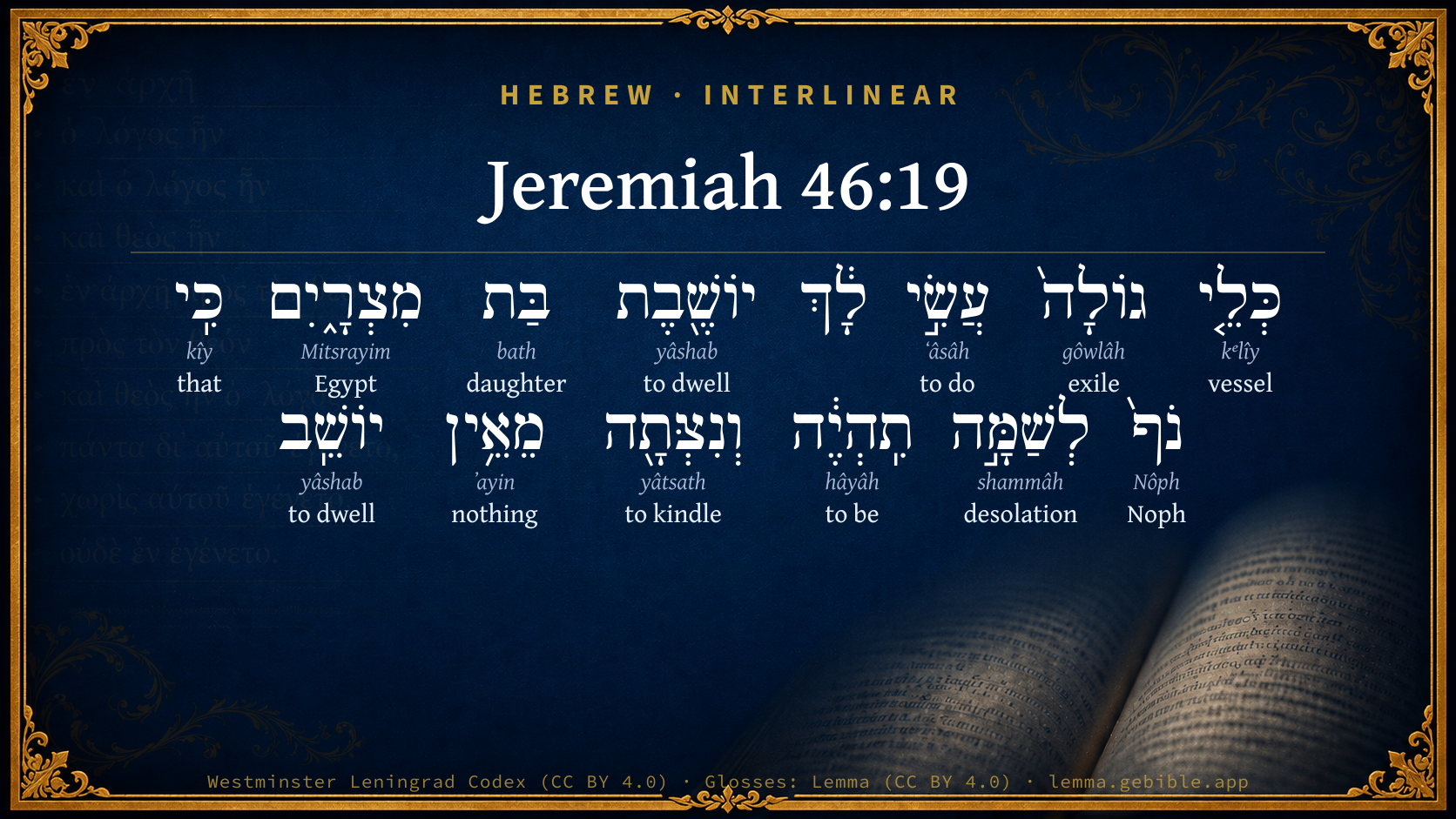
Hebrew (Westminster Leningrad Codex) Jeremiah 46:19 appears in the Hebrew Old Testament. The text above is from the Westminster Leningrad Codex. Each word links to its Strong’s number, a concise gloss, and parsing drawn from the Open Scriptures Hebrew Bible morphology. Click any word for its full Brown-Driver-Briggs (BDB) entry.
Download image
Cite this verse

Jeremiah 46:19 (World English Bible). Public Domain. Lemma interlinear Bible study tool, https://lemma.gebible.app/v/jeremiah/46/19.

Show BibTeX & RIS
BibTeX
RIS
English Translation
You daughter who dwell in Egypt, furnish yourself to go into captivity; for Memphis shall become a desolation, and shall be burnt up, without inhabitant.
World English Bible · Public Domain
Download a study sheet

One document with this verse’s original text, its word-by-word gloss line, the meaning frame, cross-references with their text, attributed commentary, and full source and license credits — printable, and it pastes into notes with its structure intact.

This verse Autodidact and up

Study sheet (.html) Plain text (.txt)

A passage Seminary Student

Up to 50 verses in one chapter. A passage sheet keeps up to 6 commentary sources and 12 cross-references per verse, in the order this page ranks them, and says so on the sheet whenever that leaves anything out. Ask for a single verse and you get the Autodidact verse sheet above.

Everything on this page stays free to read, with no account — the sheet is a download of what is already on screen, not access to it.

Want to remove ads? Support Godless Engineer
Compare translations 3

The same verse in 3 English versions, stacked beneath the original-language interlinear above. Click any original word for its lexicon entry.

Each is an independent rendering of the whole verse — the interlinear is not word-aligned to these translations.

Highlighted words mark where these versions differ — a whole-verse word diff, not a word-by-word alignment.

  • World English Bible Public Domain
    You daughter who dwell in Egypt, furnish yourself to go into captivity; for Memphis shall become a desolation, and shall be burnt up, without inhabitant.
  • King James Version Public Domain
    O thou daughter dwelling in Egypt, furnish thyself to go into captivity: for Noph shall be waste and desolate without an inhabitant.
  • unfoldingWord Literal Text CC BY-SA 4.0
    Pack for yourselves baggage to carry into exile, you who live in Egypt. For Memphis will become a waste, it will lie in ruins and no one will live there.

unfoldingWord Literal Text — © unfoldingWord, licensed CC BY-SA 4.0. Word-aligned USFM3 via Door43 (git.door43.org/unfoldingWord/en_ult).

Versions to compare (up to 4)

3 of 4 selected

Show all 18 translations

Every available English version of this verse, each an independent rendering of the whole verse.

  • World English Bible Public Domain
    You daughter who dwell in Egypt, furnish yourself to go into captivity; for Memphis shall become a desolation, and shall be burnt up, without inhabitant.
  • Berean Standard Bible Public Domain
    Pack your bags for exile, O daughter dwelling in Egypt! For Memphis will be laid waste, destroyed and uninhabited.
  • Majority Standard Bible Public Domain
    Pack your bags for exile, O daughter dwelling in Egypt! For Memphis will be laid waste, destroyed and uninhabited.
  • King James Version Public Domain
    O thou daughter dwelling in Egypt, furnish thyself to go into captivity: for Noph shall be waste and desolate without an inhabitant.
  • American Standard Version (1901) Public Domain
    O thou daughter that dwellest in Egypt, furnish thyself to go into captivity; for Memphis shall become a desolation, and shall be burnt up, without inhabitant.
  • Revised Version (1885) Public Domain
    O thou daughter that dwellest in Egypt, furnish thyself to go into captivity: for Noph shall become a desolation, and shall be burnt up, without inhabitant.
  • Geneva Bible (1599) Public Domain
    O thou daughter dwelling in Egypt, make thee geare to goe into captiuitie: for Noph shall be waste and desolate, without an inhabitant.
  • Douay-Rheims (1899) Public Domain
    Furnish thyself to go into captivity, thou daughter inhabitant of Egypt: for Memphis shall be made desolate, and shall be forsaken and uninhabited.
  • Young's Literal Translation Public Domain
    Goods for removal make for thee, O inhabitant, daughter of Egypt, For Noph becometh a desolation, And hath been burnt up, without inhabitant.
  • Literal Standard Version CC BY-SA 4.0
    Make goods for yourself for removal, || O inhabitant, daughter of Egypt, || For Noph becomes a desolation, || And has been burned up, without inhabitant.
  • Unlocked Literal Bible CC BY-SA 4.0
    Pack for yourselves baggage to carry into exile, you who live in Egypt. For Memphis will become a waste, it will lie in ruins and no one will live there.
  • unfoldingWord Literal Text CC BY-SA 4.0
    Pack for yourselves baggage to carry into exile, you who live in Egypt. For Memphis will become a waste, it will lie in ruins and no one will live there.
  • Darby Bible Public Domain
    Thou, inhabitress, daughter of Egypt, furnish for thyself a captive's baggage, for Noph shall be a desolation and shall be ruined, so that none shall dwell therein.
  • World Messianic Bible Public Domain
    You daughter who dwells in Egypt, furnish yourself to go into captivity; for Memphis will become a desolation, and will be burned up, without inhabitant.
  • Webster's Bible Public Domain
    O thou daughter dwelling in Egypt, furnish thyself to go into captivity: for Noph shall be waste and desolate without an inhabitant.
  • Free Bible Version CC BY-SA 4.0
    Pack your bags ready for exile, daughter living in Egypt! Memphis is going to be destroyed, an empty place where no one lives.
  • Bible in Basic English Public Domain
    O daughter living in Egypt, make ready the vessels of a prisoner: for Noph will become a waste, it will be burned up and become unpeopled.
  • JPS Tanakh (1917) Public Domain
    O thou daughter that dwellest in Egypt, furnish thyself to go into captivity; for Noph shall become a desolation, and shall be laid waste, without inhabitant.

Literal Standard Version (2020), Covenant Press — licensed CC BY-SA 4.0. Text via the HelloAO Bible API (eBible.org). Unlocked Literal Bible (unfoldingWord) — licensed CC BY-SA 4.0. Text via the HelloAO Bible API (eBible.org). unfoldingWord Literal Text — © unfoldingWord, licensed CC BY-SA 4.0. Word-aligned USFM3 via Door43 (git.door43.org/unfoldingWord/en_ult). Free Bible Version, Dr. Jonathan Gallagher — licensed CC BY-SA 4.0. Text via the HelloAO Bible API (eBible.org).

Word by word

More ways to search: Search by grammar → Find every occurrence → Compare this word →

Practice this passage: Drill this verse → Learn its vocabulary →

נֹף֙
Nôph
H5297
“Noph”
Noun, Proper
Part of Speech
Noun
Type
Proper
Full BDB Definition

Origin: a variation of H4644

TWOT: None

Noph = "presentability" - another name for 'Memphis' the capital city of Egypt
  1. כְּלֵ֤י kᵉlîy H3627 “vessels of” Noun, Common, Masculine, Plural, Construct
  2. גוֹלָה֙ gôwlâh H1473 “exile” Noun, Common, Feminine, Singular, Absolute
  3. עֲשִׂ֣י ʻâsâh H6213 “do” Verb, Qal, Imperative, 2nd Person, Feminine, Singular
  4. יוֹשֶׁ֖בֶת yâshab H3427 “dwelling” Verb, Qal, Participle Active, Feminine, Singular, Construct
  5. בַּת bath H1323 “daughter of” Noun, Common, Feminine, Singular, Construct
  6. מִצְרָ֑יִם Mitsrayim H4714 “Egypt” Noun, Proper
  7. כִּֽי kîy H3588 “that” Conjunction
  8. לְשַׁמָּ֣ה shammâh H8047 “to/for · desolation” Preposition + Noun, Common, Feminine, Singular, Absolute
  9. תִֽהְיֶ֔ה hâyâh H1961 “to be” Verb, Qal, Imperfect, 3rd Person, Feminine, Singular
  10. וְנִצְּתָ֖ה yâtsath H3341 “and · to kindle” Conjunction + Verb, Niphal, Sequential Perfect, 3rd Person, Feminine, Singular
  11. מֵאֵ֥ין ʼayin H369 “from · nothing” Preposition + Particle, Negative
  12. יוֹשֵֽׁב yâshab H3427 “dwelling” Verb, Qal, Participle Active, Masculine, Singular, Absolute

About this verse

These counts appear in no published source. They are computed here, from the morphology-tagged text and Lemma’s own curated glosses. What Lemma adds →

14
words
12
distinct lemmas
Prophets
section

Notable vocabulary

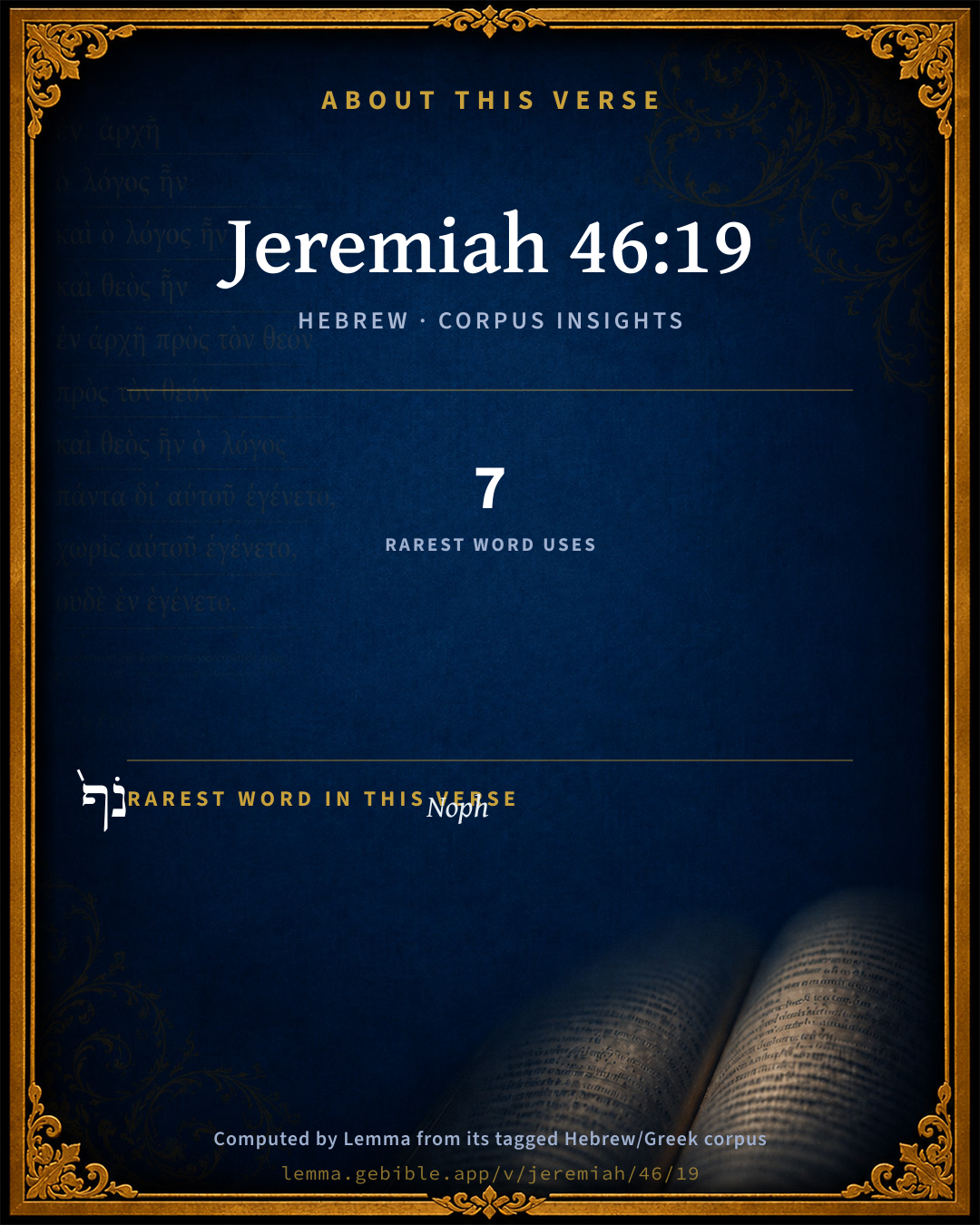
The rarest word here is נֹף֙ Noph H5297 — appearing just 7 times in the whole Hebrew Bible.

Shared distinctive vocabulary

נֹף֙ Noph H5297 occurs in 7 verses of the Hebrew Bible. Also found in:

Grammatical profile

  • 5 verbs
  • 6 nouns
  • 1 preposition
  • 1 conjunction
  • 1 particle

Verb forms

  • עֲשִׂ֣י Qal · Imperative
  • יוֹשֶׁ֖בֶת Qal · Participle Active
  • תִֽהְיֶ֔ה Qal · Imperfect
  • וְנִצְּתָ֖ה Niphal · Sequential Perfect
  • יוֹשֵֽׁב Qal · Participle Active

Repetition

A word recurs within this verse — often emphatic in Hebrew:

  • יוֹשֶׁ֖בֶת to dwell H3427 ×2

Cross-references

9

Topical passages linked to Jeremiah 46:19 in the Treasury of Scripture Knowledge — connected by theme and wording, ordered by reader-vote popularity; previews shown in the World English Bible.

  • Isaiah 20:4 so shall the king of Assyria lead away the captives of Egypt, and the exiles of Ethiopia, young and old, naked and barefoot, and with buttocks uncovered, to the shame of Egypt.
  • Jeremiah 48:18 You daughter who dwells in Dibon, come down from your glory, and sit in thirst; for the destroyer of Moab is come up against you, he has destroyed your strongholds.
  • Jeremiah 44:1 The word that came to Jeremiah concerning all the Jews who lived in the land of Egypt, who lived at Migdol, and at Tahpanhes, and at Memphis, and in the country of Pathros, saying,
  • Ezekiel 30:13 Thus says the Lord Yahweh: I will also destroy the idols, and I will cause the images to cease from Memphis; and there shall be no more a prince from the land of Egypt: and I will put a fear in the land of Egypt.
  • Jeremiah 26:9 Why have you prophesied in the name of Yahweh, saying, This house shall be like Shiloh, and this city shall be desolate, without inhabitant? All the people were gathered to Jeremiah in the house of Yahweh.
  • Jeremiah 34:22 Behold, I will command, says Yahweh, and cause them to return to this city; and they shall fight against it, and take it, and burn it with fire: and I will make the cities of Judah a desolation, without inhabitant.
  • Jeremiah 51:29–30 The land trembles and is in pain; for the purposes of Yahweh against Babylon do stand, to make the land of Babylon a desolation, without inhabitant.
  • Ezekiel 12:3–12 Therefore, you son of man, prepare you stuff for removing, and remove by day in their sight; and you shall remove from your place to another place in their sight: it may be they will consider, though they are a rebellious house.
  • Zephaniah 2:5 Woe to the inhabitants of the sea coast, the nation of the Cherethites! The word of Yahweh is against you, Canaan, the land of the Philistines. I will destroy you, that there will be no inhabitant.

Cross-references courtesy of OpenBible.info (CC BY 4.0).

Hebrew and Greek witnesses Masoretic Hebrew ↔ Greek Septuagint

The same verse in the two great witnesses to the Old Testament, shown verse-for-verse.

These are two independent witnesses, not word-aligned to each other, and the Septuagint is shown in lemma (dictionary) form.

Hebrew Jeremiah 46:19 Masoretic · Westminster Leningrad Codex

כְּלֵ֤י גוֹלָה֙ עֲשִׂ֣י לָ֔ךְ יוֹשֶׁ֖בֶת בַּת מִצְרָ֑יִם כִּֽי נֹף֙ לְשַׁמָּ֣ה תִֽהְיֶ֔ה וְנִצְּתָ֖ה מֵאֵ֥ין יוֹשֵֽׁב

You daughter who dwell in Egypt, furnish yourself to go into captivity; for Memphis shall become a desolation, and shall be burnt up, without inhabitant.

World English Bible · Public Domain

Greek LXX Structure differs

In the Septuagint, Jeremiah is about an eighth shorter than the Hebrew and arranges its material differently — the Oracles Against the Nations (Hebrew chapters 46–51) appear in the middle of the Greek book, after 25:13. Because the chapter and verse boundaries do not line up, a verse-for-verse comparison with the Hebrew is not shown.

A verse-for-verse comparison isn’t shown here because the chapters and verses don’t line up. Switch to the LXX edition with the MT / LXX toggle above to read the Greek directly.

Hebrew: Westminster Leningrad Codex (CC BY 4.0). Greek: Septuagint (public domain); English from a public-domain English Septuagint. How the Septuagint differs from the Hebrew →

Targum (Aramaic paraphrase)

1

The Targum is the ancient Jewish Aramaic paraphrase of the Hebrew Scriptures — an interpretive translation, not the Hebrew text itself. Onkelos (literal) and Pseudo-Jonathan (expansive) render the Torah, and Jonathan the Prophets. Coverage is partial: where no permissively-licensed English translation exists for a verse, only the Aramaic is shown. This is verse-level text, not a word-by-word alignment to the Hebrew.

  1. Targum Jonathan Prophets (Joshua–Malachi)
    מָנֵי גָלוּתָא אַתְקִינִי לִיךְ מַלְכוּת כְּנִשְׁתָּא דְמִצְרַיִם אֲרֵי מַפַּס לְצָדוּ תְהֵי וְתִצְדֵי מִבְּלִי יָתֵיב:

    (no public-domain English translation for this verse)

    Targum Jonathan — Aramaic: “Mikraot Gedolot” (public domain). English: “Sefaria Community Translation” (CC0 1.0 (public-domain dedication)); “London "Chaldee Paraphrase," 1871” (public domain). Text via Sefaria.

Commentary

Notes on Jeremiah 46:19 from classic Christian and Jewish commentators (each source and its license shown beneath its notes). The classic Christian expositions comment on the surrounding passage and are grouped to its opening verse, so a note may address several verses; the Jewish commentaries on the Tanakh (Rashi and others) are per-verse, so they appear only where the commentator wrote on this verse.

Lemma curates 59 commentaries, every one of them public domain or Creative Commons licensed, each selected and text-cleaned for this edition rather than reprinted as found. About our sources →

Trapp's Complete Commentary

John Trapp

Jer 46:19 O thou daughter dwelling in Egypt, furnish thyself to go into captivity: for Noph shall be waste and desolate without an inhabitant.

Ver. 19. O thou daughter dwelling in Egypt.] But not likely to dwell long there.

Furnish thyself to go into captivity.] Heb., Make thee instruments or implements of captivity. Sarcinis reculisque collectis, prepare to be packing.

John Trapp, A Commentary or Exposition upon All the Books of the Old and New Testament (1647–1656) — public domain. Text from a community e-Sword module.

Joseph Benson's Commentary

Jer 46:19. O thou daughter dwelling in Egypt — Blaney translates it, O inhabiting daughter of Egypt, observing, that an antithesis seems to be designed between יושׁבת, inhabiting, and the act of migration, which was to follow. Countries and cities are often represented under the emblem of women, especially in medals and pictures. Furnish thyself to go into captivity — “The expression is ironical, implying that, instead of the rich and goodly furniture wherein she did pride herself, she should be carried away captive, naked and bare, and wanting all manner of conveniences.” The Hebrew of this clause seems to be more literally translated in the margin than in the text; the word כלי, there rendered instruments, meaning either the carriages, or the trunks and boxes that were to hold the things to be removed. Blaney reads it, Get ready thy equipage for removing. For Noph shall be waste, &c. — Noph in particular shall be wholly depopulated and laid waste. This place, called also Memphis, was accordingly laid waste some time after this, and remained some years in a state of desolation. It was, indeed, afterward rebuilt, but never recovered its ancient splendour.

Joseph Benson's Commentary on the Old and New Testaments (1811–1818) — public domain. Text from a community e-Sword module.

Tyndale Open Study Notes

Tyndale Open Resources

46:19 Memphis will be destroyed: This happened in 568–567 BC, when Nebuchadnezzar invaded Egypt.

Tyndale Open Study Notes — © Tyndale Open Resources, licensed CC BY-SA 4.0. Text via the HelloAO Bible API.

Jamieson, Fausset & Brown

Robert Jamieson, A. R. Fausset & David Brown

furnish thyself--literally, "make for thyself vessels" (namely, to contain food and other necessaries for the journey) for captivity.

daughter--so in Jer 46:11.

dwelling in Egypt--that is, the inhabitants of Egypt, the Egyptians, represented as the daughter of Egypt (Jer 48:18; Kg2 19:21). "Dwelling" implies that they thought themselves to be securely fixed in their habitations beyond the reach of invasion.

Jamieson, Fausset & Brown — Commentary Critical and Explanatory on the Whole Bible (1871) — public domain (CC PDM 1.0). Text via the HelloAO Bible API.

Adam Clarke's Commentary

Verse 19. Furnish thyself to go into captivity] The thing is unavoidable; prepare for this calamity.

Adam Clarke's Commentary on the Bible (1810–1826) — public domain. Text from a community e-Sword/MySword module.

John Calvin's Commentaries

The Prophet exults over the Egyptians, in order that he might more and more confirm his doctrine; for we have said, and experience teaches the same, that the unbelieving are but little moved when God summons them to his tribunal, and gives evidence of his vengeance; for they remain stupid, except their torpor is by force shaken from them. This is the reason why the Prophet sharply assails the wicked, even that they might awake from their drowsiness.

Hence he says, Take to thee the furniture of transmigration, that is, prepare for thyself garments and other things for the purpose of removing. The Egyptians, having a fruitful land, remained quietly in their own country, and led, as it were, a sedentary life. Now the Prophet intimates that they were to move elsewhere; and he bids them to prepare for a long journey, or a long peregrination: Make to thee, then, furniture for transmigration; for Memphis shall be reduced to solitude, and laid waste without an inhabitant

He mentions Memphis again, which, as we have said, was a very celebrated city and a royal residence. He says that it would be laid waste, and yet we know that the Pyramids there were reckoned among the wonders of the world. The city was populous, and had many advantages. The Prophet dooms it to desolation. If, then, such solitude awaited the most celebrated city, what was to become of the smaller towns? what was to become of the villages? We now, then, see what was the purpose of the Prophet, even to shew, that when Nebuchadnezzar made an irruption into Egypt, all things would be under his power, so that he would, at his pleasure, seize on, plunder, and lay waste the whole land. It now follows, —

John Calvin's Commentaries (1540-1563) — public domain. Text from the Calvin Translation Society English edition (1840s-50s) via the Christian Classics Ethereal Library (ccel.org). Calvin's coverage is partial (roughly two-thirds of the Bible); uncommented books and verses are honest gaps, never fabricated. The 19th-century editor's footnotes and remarks are omitted so the notes are faithfully Calvin's own voice.

Ellicott's Commentary for English Readers

(19) O thou daughter dwelling in Egypt.—As in Jer_46:11, the daughter is Egypt itself personified. She is to prepare herself (literally, with the instruments of captivity), as with “bag and baggage” for a long journey. (Comp. Eze_12:3.) Noph (= Memphis) is to be left as a depopulated city.

A Bible Commentary for English Readers, edited by Charles John Ellicott (1878–1897) — public domain. Text from a community e-Sword module.

The Cambridge Bible for Schools and Colleges

gen. ed. J. J. S. Perowne

19. O thou daughter that dwellest in Egypt] the population of Egypt personified, preferable to mg. O thou that dwellest with the daughter of Egypt.

furnish thyself to go into captivity] more literally as mg. make thee vessels of captivity, supply thyself with all that thou wilt need as thy outfit for exile. Cp. Eze_12:3 mg.

Noph] See on Jer_2:16.

The Cambridge Bible for Schools and Colleges (gen. ed. J. J. S. Perowne; Cambridge University Press, 1878–1918) — public domain. Text from a community e-Sword module.

John Gill's Exposition

O thou daughter dwelling in Egypt,.... That is, O ye inhabitants of Egypt, that have long dwelt there, in great security, enjoying great plenty, and who promised themselves a long continuance:

furnish thyself to go into captivity; or, "make", or "prepare for thyself vessels of captivity" (y); or such things as are proper for captives, as suitable clothes to travel in, shoes to walk in, scrip and staff, and the like; expect captivity, and prepare for it:

for Noph shall be waste and desolate without an inhabitant; the city Memphis, as the Targum, and all the versions: this is particularly mentioned, because it was a royal city, as Kimchi observes; and, though a very populous one, its destruction should be so general, that not an inhabitant should be left in it: the devastation of this city is put for that of all the rest, and as a sure token of it and the whole nation going into captivity.

(y) "vase vel instrumenta migrationis fac tibi", Piscator, Schmidt; "praepara", Vatablus; "pare", Junius & Tremellius.

John Gill's Exposition of the Whole Bible (1746–1763) — public domain (CC PDM 1.0). Text via the HelloAO Bible API.

Albert Barnes' Notes on the Bible

Literally, “O thou inhabitant daughter of Egypt,” an equivalent here for Egypt and its whole population.

Furnish thyself ... - literally, make for thee vessels of banishment, not merely the packages necessary, but their outfit generally.

Albert Barnes' Notes on the Bible (1834–1885) — public domain. Text from a community e-Sword/MySword module.

Haydock's Catholic Bible Commentary

Furnish. Literally, "make thyself vessels of captivity," or pack up what thou mayst want there. (Haydock) (Ezechiel xii. 3., and xxix. 11.) --- Many returned under Cyrus, ver. 26.

George Leo Haydock (1774–1849), Haydock's Catholic Family Bible and Commentary, 1859 edition — public domain. Excludes Psalms (Douay-Rheims chapter numbering differs from Protestant) and Deuterocanonical books (Catholic canon only).

Matthew Poole's English Annotations

That is, O you inhabitants in the land of Egypt, make ready to go into another country as prisoners of war; for your cities shall be destroyed; Noph particularly shall be wholly depopulated and laid waste, and have none to dwell in it.

Matthew Poole's English Annotations on the Holy Bible (1683–1685) — public domain. Text from a community e-Sword/MySword module.

Whedon's Commentary on the Bible

Daniel D. Whedon

19. Daughter dwelling in Egypt — That is, the inhabitants of Egypt — Egypt as to her people. Furnish thyself, etc. — Literally, make for the vessels of wandering.

Noph — Memphis, the capital.

Daniel D. Whedon (gen. ed.), Commentary on the Old and New Testaments (1874–1909) — public domain. Text from a community e-Sword module.

The Pulpit Commentary

O thou daughter dwelling in Egypt; literally, O inhabitress-daughter of Egypt. The phrase is exactly parallel to "virgin daughter of Zion." The "daughter of Egypt" means the population of Egypt, the land being regarded as the mother of its people. Furnish thyself to go into captivity. The rendering of the margin is, however, more exact. The "vessels of captivity or, "exile" are a pilgrim"s staff and wallet, with the provisions and utensils necessary for a journey. (so in Eze_12:4)

The Pulpit Commentary (1880–1919), ed. H.D.M. Spence-Jones & Joseph S. Exell — public domain. Text from a community e-Sword module.

Rashi

Rabbi Shlomo Yitzchaki (Rashi)

equipment for exile When a person embarks on a journey, he prepares for himself a flask and an earthenware cup with which to drink.

desolate Heb. ונצחה, an expression of desolation (ציה).

Rashi on the Tanakh — English translations: “The Judaica Press complete Tanach with Rashi, translated by A. J. Rosenberg” (CC BY 4.0); “Pentateuch with Rashi's commentary by M. Rosenbaum and A.M. Silbermann, 1929-1934” (public domain); “The Metsudah Tanach series, Lakewood, N.J” (CC BY 4.0); and “The Book of Joshua, Metsudah Publications, 1997” (CC BY 4.0). Text via Sefaria.

Lesson kit

Teaching starters — assembled from the data on this page, not authored interpretation. Every prompt links to the verse data it draws on. Edit before teaching.

Jeremiah, in the Prophets, opens this verse with 14 words (12 distinct Hebrew lemmas). Its most distinctive word is Nôph (“Noph”). A historical commentator’s framing appears above. Read the whole chapter for the surrounding context.

Discussion questions

  1. How does “Noph” (Nôph) shape what this verse is saying?
  2. How does Isaiah 19:13, which shares the word «Noph», read alongside this verse?
  3. What does the repetition of “to dwell” (2× in this one verse) do in this verse?
  4. These translations render this verse differently. What is at stake in choosing one wording over another?
  5. «עֲשִׂ֣י» is a Qal Imperative verb. How does that grammatical form shape the action described?
  6. Compare how Trapp's Complete Commentary and Joseph Benson's Commentary read this verse. Where do they agree or differ?

Things to notice

Reading settings

Reading text

Shown beneath each verse's original-language words.

Old Testament
Old Testament edition

Read the OT as the Masoretic Hebrew (MT) or the Greek Septuagint (LXX).

English shown for the Greek Septuagint (in the Hebrew ↔ Greek comparison).

Comparing translations? Open the Compare panel on any verse page to stack up to four side by side.