
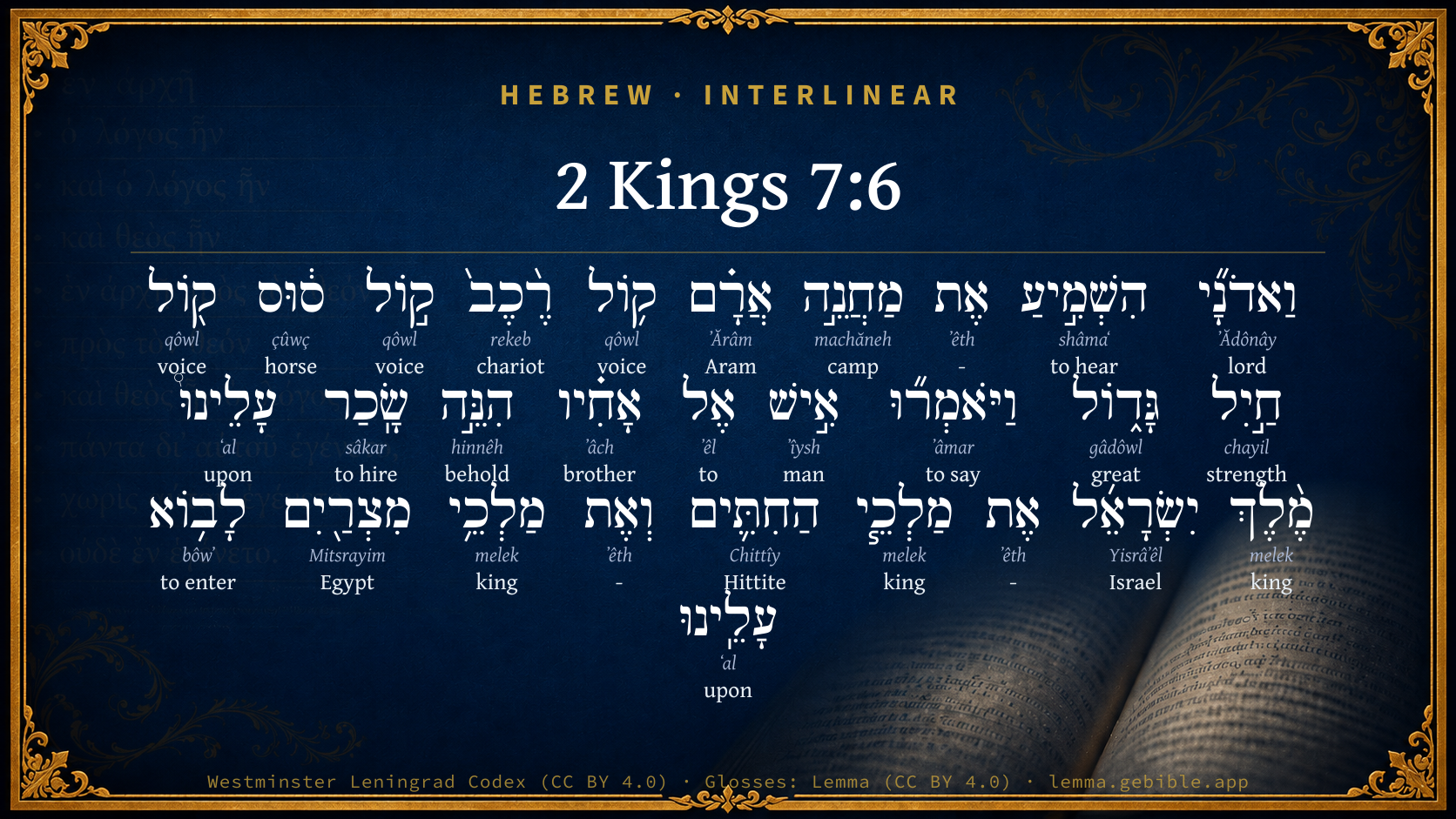
2 Kings 7:6

Hebrew (Westminster Leningrad Codex) 2 Kings 7:6 appears in the Hebrew Old Testament. The text above is from the Westminster Leningrad Codex. Each word links to its Strong’s number, a concise gloss, and parsing drawn from the Open Scriptures Hebrew Bible morphology. Click any word for its full Brown-Driver-Briggs (BDB) entry.
Download image
Cite this verse

2 Kings 7:6 (World English Bible). Public Domain. Lemma interlinear Bible study tool, https://lemma.gebible.app/v/2-kings/7/6.

Show BibTeX & RIS
BibTeX
RIS
English Translation
For the Lord had made the host of the Syrians to hear a noise of chariots, and a noise of horses, even the noise of a great host: and they said one to another, Behold, the king of Israel has hired against us the kings of the Hittites, and the kings of the Egyptians, to come on us.
World English Bible · Public Domain
Download a study sheet

One document with this verse’s original text, its word-by-word gloss line, the meaning frame, cross-references with their text, attributed commentary, and full source and license credits — printable, and it pastes into notes with its structure intact.

This verse Autodidact and up

Study sheet (.html) Plain text (.txt)

A passage Seminary Student

Up to 50 verses in one chapter. A passage sheet keeps up to 6 commentary sources and 12 cross-references per verse, in the order this page ranks them, and says so on the sheet whenever that leaves anything out. Ask for a single verse and you get the Autodidact verse sheet above.

Everything on this page stays free to read, with no account — the sheet is a download of what is already on screen, not access to it.

Want to remove ads? Support Godless Engineer
Compare translations 3

The same verse in 3 English versions, stacked beneath the original-language interlinear above. Click any original word for its lexicon entry.

Each is an independent rendering of the whole verse — the interlinear is not word-aligned to these translations.

Highlighted words mark where these versions differ — a whole-verse word diff, not a word-by-word alignment.

  • World English Bible Public Domain
    For the Lord had made the host of the Syrians to hear a noise of chariots, and a noise of horses, even the noise of a great host: and they said one to another, Behold, the king of Israel has hired against us the kings of the Hittites, and the kings of the Egyptians, to come on us.
  • King James Version Public Domain
    For the LORD had made the host of the Syrians to hear a noise of chariots, and a noise of horses, even the noise of a great host: and they said one to another, Lo, the king of Israel hath hired against us the kings of the Hittites, and the kings of the Egyptians, to come upon us.
  • unfoldingWord Literal Text CC BY-SA 4.0
    For the Lord had made the camp of Aram hear the sound of chariotry, the sound of a horse, the sound of a great army. And they said, a man to his brother, “Behold, the king of Israel has hired against us the kings of the Hittites and the kings of the Egyptians to come against us.”

unfoldingWord Literal Text — © unfoldingWord, licensed CC BY-SA 4.0. Word-aligned USFM3 via Door43 (git.door43.org/unfoldingWord/en_ult).

Versions to compare (up to 4)

3 of 4 selected

Show all 18 translations

Every available English version of this verse, each an independent rendering of the whole verse.

  • World English Bible Public Domain
    For the Lord had made the host of the Syrians to hear a noise of chariots, and a noise of horses, even the noise of a great host: and they said one to another, Behold, the king of Israel has hired against us the kings of the Hittites, and the kings of the Egyptians, to come on us.
  • Berean Standard Bible Public Domain
    For the Lord had caused the Arameans to hear the sound of chariots, horses, and a great army, so that they said to one another, “Look, the king of Israel must have hired the kings of the Hittites and Egyptians to attack us.”
  • Majority Standard Bible Public Domain
    For the Lord had caused the Arameans to hear the sound of chariots, horses, and a great army, so that they said to one another, “Look, the king of Israel must have hired the kings of the Hittites and Egyptians to attack us.”
  • King James Version Public Domain
    For the LORD had made the host of the Syrians to hear a noise of chariots, and a noise of horses, even the noise of a great host: and they said one to another, Lo, the king of Israel hath hired against us the kings of the Hittites, and the kings of the Egyptians, to come upon us.
  • American Standard Version (1901) Public Domain
    For the Lord had made the host of the Syrians to hear a noise of chariots, and a noise of horses, even the noise of a great host: and they said one to another, Lo, the king of Israel hath hired against us the kings of the Hittites, and the kings of the Egyptians, to come upon us.
  • Revised Version (1885) Public Domain
    For the Lord had made the host of the Syrians to hear a noise of chariots, and a noise of horses, even the noise of a great host: and they said one to another, Lo, the king of Israel hath hired against us the kings of the Hittites, and the kings of the Egyptians, to come upon us.
  • Geneva Bible (1599) Public Domain
    For the Lord had caused the campe of the Aramites to heare a noyse of charets and a noise of horses, and a noise of a great armie, so that they sayde one to another, Beholde, the King of Israel hath hired against vs the Kings of the Hittites, and the Kings of the Egyptians to come vpon vs.
  • Douay-Rheims (1899) Public Domain
    For the Lord had made them hear, in the camp of Syria, the noise of chariots, and of horses, and of a very great army, and they said one to another: Behold the king of Israel hath hired against us the kings of the Hethites, and of the Egyptians, and they are come upon us.
  • Young's Literal Translation Public Domain
    seeing Jehovah hath caused the camp of Aram to hear a noise of chariot and a noise of horse -- a noise of great force, and they say one unto another, `Lo, the king of Israel hath hired against us the kings of the Hittites, and the kings of Egypt, to come against us.'
  • Literal Standard Version CC BY-SA 4.0
    seeing YHWH has caused the camp of Aram to hear a noise of chariot and a noise of horse—a noise of great force, and they say to one another, “Behold, the king of Israel has hired against us the kings of the Hittites, and the kings of Egypt, to come against us.”
  • Unlocked Literal Bible CC BY-SA 4.0
    For the Lord had made the Aramean army hear a noise of chariots, and a noise of horses—the noise of another large army, and they said to each other, “The king of Israel has hired the kings of the Hittites and Egyptians to come against us.”
  • unfoldingWord Literal Text CC BY-SA 4.0
    For the Lord had made the camp of Aram hear the sound of chariotry, the sound of a horse, the sound of a great army. And they said, a man to his brother, “Behold, the king of Israel has hired against us the kings of the Hittites and the kings of the Egyptians to come against us.”
  • Darby Bible Public Domain
    For the Lord had made the army of the Syrians to hear a noise of chariots, and a noise of horses, a noise of a great host; and they said one to another, Behold, the king of Israel has hired against us the kings of the Hittites, and the kings of the Egyptians, to come upon us.
  • World Messianic Bible Public Domain
    For the Lord had made the army of the Syrians to hear the sound of chariots and the sound of horses, even the noise of a great army; and they said to one another, “Behold, the king of Israel has hired against us the kings of the Hittites and the kings of the Egyptians to attack us.”
  • Webster's Bible Public Domain
    For the Lord had made the army of the Syrians to hear a noise of chariots, and a noise of horses, even the noise of a great army: and they said one to another, Lo, the king of Israel hath hired against us the kings of the Hittites, and the kings of the Egyptians, to come upon us.
  • Free Bible Version CC BY-SA 4.0
    For the Lord had made the Arameans hear the sound of chariots, horses, and a large army approaching, so they said to each other, “The king of Israel has hired the kings of the Hittites and Egyptians to come and attack us.”
  • Bible in Basic English Public Domain
    For the Lord had made the sound of carriages and horses, and the noise of a great army, come to the ears of the Aramaeans, so that they said to one another, Truly, the king of Israel has got the kings of the Hittites and of the Egyptians for a price to make an attack on us.
  • JPS Tanakh (1917) Public Domain
    For the Lord had made the host of the Arameans to hear a noise of chariots, and a noise of horses, even the noise of a great host; and they said one to another: 'Lo, the king of Israel hath hired against us the kings of the Hittites, and the kings of the Egyptians, to come upon us.'

Literal Standard Version (2020), Covenant Press — licensed CC BY-SA 4.0. Text via the HelloAO Bible API (eBible.org). Unlocked Literal Bible (unfoldingWord) — licensed CC BY-SA 4.0. Text via the HelloAO Bible API (eBible.org). unfoldingWord Literal Text — © unfoldingWord, licensed CC BY-SA 4.0. Word-aligned USFM3 via Door43 (git.door43.org/unfoldingWord/en_ult). Free Bible Version, Dr. Jonathan Gallagher — licensed CC BY-SA 4.0. Text via the HelloAO Bible API (eBible.org).

Word by word

More ways to search: Search by grammar → Find every occurrence → Compare this word →

Practice this passage: Drill this verse → Learn its vocabulary →

שָֽׂכַר
sâkar
H7936
“to hire”
Verb, Qal, Perfect, 3rd Person, Masculine, Singular
Part of Speech
Verb
Stem
Qal
Form
Perfect
Person
3rd Person
Gender
Masculine
Number
Singular
Full BDB Definition

Origin: a primitive root [apparently akin (by prosthesis) to H3739 through the idea of temporary purchase]

TWOT: 2264 . 1

to hire - (Qal) to hire - (Niphal) to hire oneself out - (Hithpael) to earn wages
  1. וַאדֹנָ֞י ʼĂdônây H136 “and · Lord · my” Conjunction + Noun, Common, Masculine, Plural, Construct + Suffix, Personal, 1st Person, Common, Singular
  2. הִשְׁמִ֣יעַ shâmaʻ H8085 “to hear” Verb, Hiphil, Perfect, 3rd Person, Masculine, Singular
  3. אֶת ʼêth H853 “-” Particle, Direct Object
  4. מַחֲנֵ֣ה machăneh H4264 “camp of” Noun, Common, Both, Singular, Construct
  5. אֲרָ֗ם ʼĂrâm H758 “Aram” Noun, Proper
  6. ק֥וֹל qôwl H6963 “voice of” Noun, Common, Masculine, Singular, Construct
  7. רֶ֨כֶב֙ rekeb H7393 “chariot” Noun, Common, Masculine, Singular, Absolute
  8. ק֣וֹל qôwl H6963 “voice of” Noun, Common, Masculine, Singular, Construct
  9. ס֔וּס çûwç H5483 “horse” Noun, Common, Masculine, Singular, Absolute
  10. ק֖וֹל qôwl H6963 “voice of” Noun, Common, Masculine, Singular, Construct
  11. חַ֣יִל chayil H2428 “strength” Noun, Common, Masculine, Singular, Absolute
  12. גָּד֑וֹל gâdôwl H1419 “great” Adjective, Adjective, Masculine, Singular, Absolute
  13. וַיֹּאמְר֞וּ ʼâmar H559 “and · to say” Conjunction + Verb, Qal, Sequential Imperfect, 3rd Person, Masculine, Plural
  14. אִ֣ישׁ ʼîysh H376 “man” Noun, Common, Masculine, Singular, Absolute
  15. אֶל ʼêl H413 “to” Preposition
  16. אָחִ֗יו ʼâch H251 “brother · his” Noun, Common, Masculine, Singular, Construct + Suffix, Personal, 3rd Person, Masculine, Singular
  17. הִנֵּ֣ה hinnêh H2009 “behold” Particle, Demonstrative
  18. עָלֵינוּ֩ ʻal H5921 “upon · us” Preposition + Suffix, Personal, 1st Person, Common, Plural
  19. מֶ֨לֶךְ melek H4428 “king of” Noun, Common, Masculine, Singular, Construct
  20. יִשְׂרָאֵ֜ל Yisrâʼêl H3478 “Israel” Noun, Proper
  21. אֶת ʼêth H853 “-” Particle, Direct Object
  22. מַלְכֵ֧י melek H4428 “kings of” Noun, Common, Masculine, Plural, Construct
  23. הַחִתִּ֛ים Chittîy H2850 “the · Hittites” Particle, Definite Article + Noun, Gentilic, Masculine, Plural, Absolute
  24. וְאֶת ʼêth H853 “and · -” Conjunction + Particle, Direct Object
  25. מַלְכֵ֥י melek H4428 “kings of” Noun, Common, Masculine, Plural, Construct
  26. מִצְרַ֖יִם Mitsrayim H4714 “Egypt” Noun, Proper
  27. לָב֥וֹא bôwʼ H935 “to enter” Preposition + Verb, Qal, Infinitive Construct
  28. עָלֵֽינוּ ʻal H5921 “upon · us” Preposition + Suffix, Personal, 1st Person, Common, Plural

About this verse

These counts appear in no published source. They are computed here, from the morphology-tagged text and Lemma’s own curated glosses. What Lemma adds →

29
words
22
distinct lemmas
Historical
section

Notable vocabulary

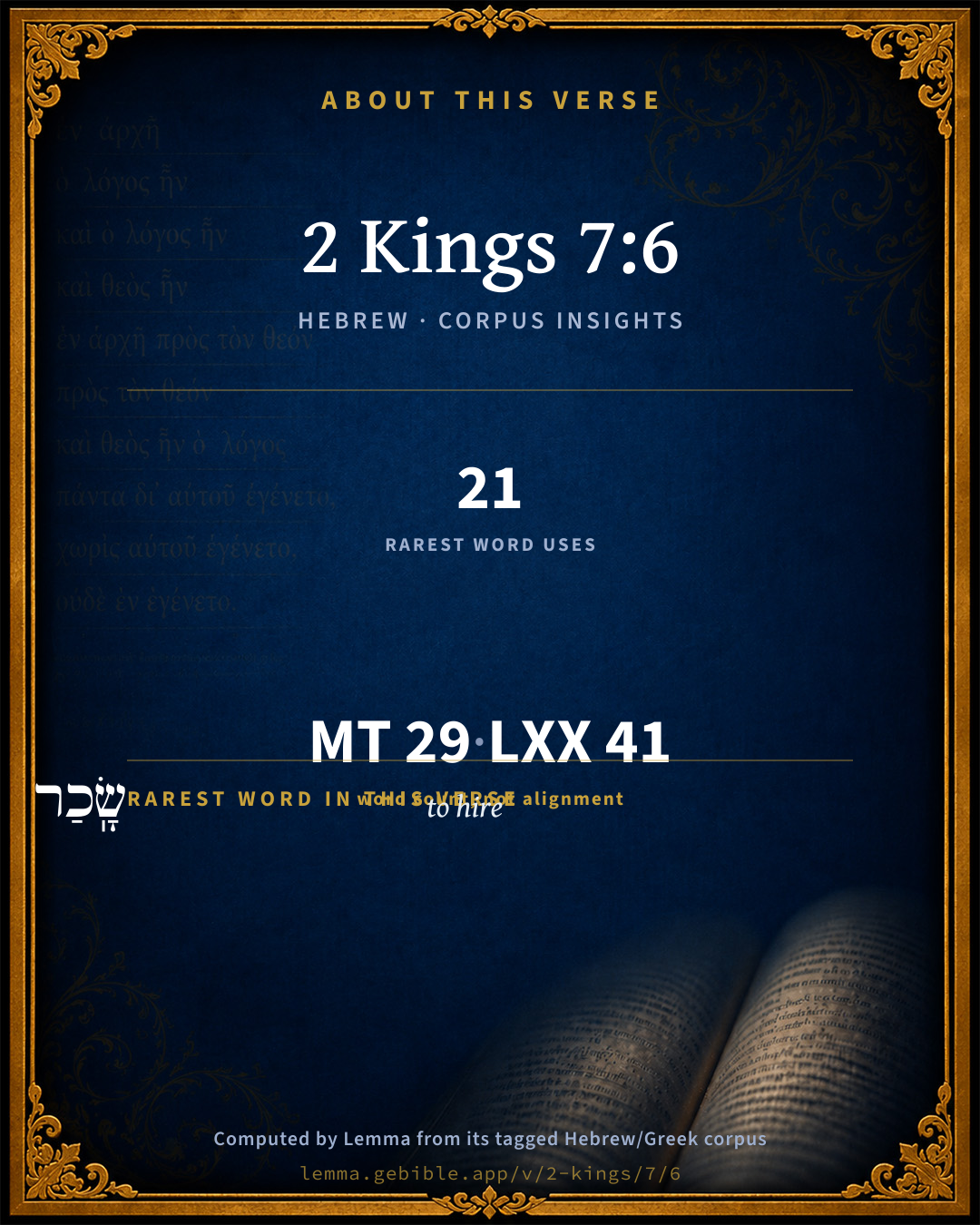
The rarest word here is שָֽׂכַר to hire H7936 — appearing just 21 times in the whole Hebrew Bible.

Shared distinctive vocabulary

שָֽׂכַר to hire H7936 occurs in 18 verses of the Hebrew Bible. Also found in:

Grammatical profile

  • 4 verbs
  • 17 nouns
  • 1 adjective
  • 3 prepositions
  • 4 particles

Verb forms

  • הִשְׁמִ֣יעַ Hiphil · Perfect
  • וַיֹּאמְר֞וּ Qal · Sequential Imperfect
  • שָֽׂכַר Qal · Perfect
  • לָב֥וֹא Qal · Infinitive Construct

Repetition

Words recur within this verse — often emphatic in Hebrew:

  • ק֥וֹל voice H6963 ×3
  • מֶ֨לֶךְ king H4428 ×3
  • עָלֵינוּ֩ upon H5921 ×2

Hebrew & Septuagint length

In English translation the verse runs 58 words from the Hebrew and 57 from the Septuagint (LXX English) — closely comparable.

A rough comparison of the two English renderings, which tokenize alike — not a word-level alignment.

Word counts can differ between the Hebrew and the Greek without any difference in meaning — e.g. the Hebrew direct-object marker אֵת has no separate Greek word, and Greek often adds the article ὁ.

In the original languages it is 29 Hebrew tokens and 41 Greek tokens — but the two are counted differently (Hebrew bundles its prefixes and suffixes into one token; the Greek is in lemma form), so that isn’t a like-for-like length.

Cross-references

13

Topical passages linked to 2 Kings 7:6 in the Treasury of Scripture Knowledge — connected by theme and wording, ordered by reader-vote popularity; previews shown in the World English Bible.

  • 2 Samuel 5:24 It shall be, when you hear the sound of marching in the tops of the mulberry trees, that then you shall bestir yourself; for then is Yahweh gone out before you to strike the host of the Philistines.
  • Isaiah 31:1 Woe to those who go down to Egypt for help, and rely on horses, and trust in chariots because they are many, and in horsemen because they are very strong, but they don't look to the Holy One of Israel, neither seek Yahweh!
  • 1 Kings 10:29 A chariot came up and went out of Egypt for six hundred [shekels] of silver, and a horse for one hundred fifty; and so for all the kings of the Hittites, and for the kings of Syria, did they bring them out by their means.
  • Revelation 9:9 They had breastplates, like breastplates of iron. The sound of their wings was like the sound of chariots, or of many horses rushing to war.
  • 2 Kings 3:22–27 They rose up early in the morning, and the sun shone on the water, and the Moabites saw the water over against them as red as blood:
  • 2 Chronicles 12:2–3 It happened in the fifth year of king Rehoboam, that Shishak king of Egypt came up against Jerusalem, because they had trespassed against Yahweh,
  • Job 15:21 A sound of terrors is in his ears; In prosperity the destroyer shall come on him.
  • Psalms 14:5 There they were in great fear, For God is in the generation of the righteous.
  • Isaiah 36:9 How then can you turn away the face of one captain of the least of my master's servants, and put your trust on Egypt for chariots and for horsemen?
  • Ezekiel 10:5 The sound of the wings of the cherubim was heard even to the outer court, as the voice of God Almighty when he speaks.
  • Revelation 6:15–16 The kings of the earth, the princes, the commanding officers, the rich, the strong, and every slave and free person, hid themselves in the caves and in the rocks of the mountains.
  • 2 Kings 19:7 Behold, I will put a spirit in him, and he shall hear news, and shall return to his own land; and I will cause him to fall by the sword in his own land.
  • Jeremiah 20:3–4 It happened on the next day, that Pashhur brought forth Jeremiah out of the stocks. Then said Jeremiah to him, Yahweh has not called your name Pashhur, but Magormissabib.

Cross-references courtesy of OpenBible.info (CC BY 4.0).

Hebrew and Greek witnesses Masoretic Hebrew ↔ Greek Septuagint

The same verse in the two great witnesses to the Old Testament, shown verse-for-verse.

These are two independent witnesses, not word-aligned to each other, and the Septuagint is shown in lemma (dictionary) form.

Hebrew 2 Kings 7:6 Masoretic · Westminster Leningrad Codex

וַאדֹנָ֞י הִשְׁמִ֣יעַ אֶת מַחֲנֵ֣ה אֲרָ֗ם ק֥וֹל רֶ֨כֶב֙ ק֣וֹל ס֔וּס ק֖וֹל חַ֣יִל גָּד֑וֹל וַיֹּאמְר֞וּ אִ֣ישׁ אֶל אָחִ֗יו הִנֵּ֣ה שָֽׂכַר עָלֵינוּ֩ מֶ֨לֶךְ יִשְׂרָאֵ֜ל אֶת מַלְכֵ֧י הַחִתִּ֛ים וְאֶת מַלְכֵ֥י מִצְרַ֖יִם לָב֥וֹא עָלֵֽינוּ

For the Lord had made the host of the Syrians to hear a noise of chariots, and a noise of horses, even the noise of a great host: and they said one to another, Behold, the king of Israel has hired against us the kings of the Hittites, and the kings of the Egyptians, to come on us.

World English Bible · Public Domain

Greek LXX 2 Kings 7:6 Septuagint · lemma form

καί κύριος ἀκουστός ποιέω ὁ παρεμβολή συρία φωνή ἅρμα καί φωνή ἵππος καί φωνή δύναμις μέγας καί εἶπον ἀνήρ πρός ὁ ἀδελφός αὐτός νῦν μισθόω ἐπί ἐγώ βασιλεύς ἰσραήλ ὁ βασιλεύς ὁ χετταῖος καί ὁ βασιλεύς αἴγυπτος ὁ ἔρχομαι ἐπί ἐγώ

For the Lord had made the army of Syria to hear a sound of chariots, and a sound of horses, even the sound of a great host: and each man said to his fellow, Now has the king of Israel hired against us the kings of the Chettites, and the kings of Egypt, to come against us.

LXX2012 (modern English Septuagint) · Public Domain

On this verse, Haydock's Catholic Bible Commentary discusses the Septuagint’s reading. Read the note in Commentary ↓

Hebrew: Westminster Leningrad Codex (CC BY 4.0). Greek: Septuagint (public domain); English from LXX2012 (modern English Septuagint) (Public Domain). How the Septuagint differs from the Hebrew →

Targum (Aramaic paraphrase)

1

The Targum is the ancient Jewish Aramaic paraphrase of the Hebrew Scriptures — an interpretive translation, not the Hebrew text itself. Onkelos (literal) and Pseudo-Jonathan (expansive) render the Torah, and Jonathan the Prophets. Coverage is partial: where no permissively-licensed English translation exists for a verse, only the Aramaic is shown. This is verse-level text, not a word-by-word alignment to the Hebrew.

  1. Targum Jonathan Prophets (Joshua–Malachi)
    וּמִן קֳדָם יְיָ אִשְׁתְּמַע לְמַשִׁרְיַת אֲרָם קַל רְתִיכִין קַל סוּסְוָן קַל מַשִׁרְיַן סַגִיאִן וַאֲמַרוּ גְבַר לְחַבְרֵיהּ הָא אֲגַר עֲלָנָא מַלְכָּא דְיִשְׂרָאֵל יַת מַלְכֵי חִתָּאֵי וְיַת מַלְכֵי מִצְרָאֵי לְמֵיתֵי עֲלָנָא:

    (no public-domain English translation for this verse)

    Targum Jonathan — Aramaic: “Mikraot Gedolot” (public domain). English: “Sefaria Community Translation” (CC0 1.0 (public-domain dedication)); “London "Chaldee Paraphrase," 1871” (public domain). Text via Sefaria.

Commentary

Notes on 2 Kings 7:6 from classic Christian and Jewish commentators (each source and its license shown beneath its notes). The classic Christian expositions comment on the surrounding passage and are grouped to its opening verse, so a note may address several verses; the Jewish commentaries on the Tanakh (Rashi and others) are per-verse, so they appear only where the commentator wrote on this verse.

Lemma curates 59 commentaries, every one of them public domain or Creative Commons licensed, each selected and text-cleaned for this edition rather than reprinted as found. About our sources →

Trapp's Complete Commentary

John Trapp

2Ki 7:6 For the Lord had made the host of the Syrians to hear a noise of chariots, and a noise of horses, [even] the noise of a great host: and they said one to another, Lo, the king of Israel hath hired against us the kings of the Hittites, and the kings of the Egyptians, to come upon us.

Ver. 6. To hear a noise of chariots.] Some think this noise was not in the air, but in their ears only, because none else heard it. But God can easily hold men’s senses, as hath been showed. {2Ki 6:18 Act 9:18} And it is likely that the angels made a hurrying noise in the air over their heads, which struck them into a great fear, and set them going in such posthaste, that they left their horses behind them. See a like miracle, 2Sa 5:24, and observe how

“ Ludit in humanis divina potentia rebus. ”

So the Roman historian reporteth, that by the noise of a great laughter, Hannibal’s great army lying at the gates of Rome was suddenly frightened and made to run away; whereupon a temple Deo Ridiculo, to the laughing god, was consecrated in via Appia, in the highway to the city.

Lo, the king of Israel hath hired against us.] A mere fancy of their own: whereby the Lord would, as it were, in a way of scorn and derision, put them into this disorder, running without any real cause, like so many madmen. God could have taken another course with them, as to have slain them by his angels, consumed them with fire from heaven, &c. About the year of grace 394, Theodosius had a great victory over the Persians and Saracens, whilst the Lord smote them with a panic terror, so that they ran headlong into the river Euphrates, and there perished in the waters above a hundred thousand of them, saith mine author. {a}

{a} Alsted., Chronol., p. 300.

John Trapp, A Commentary or Exposition upon All the Books of the Old and New Testament (1647–1656) — public domain. Text from a community e-Sword module.

Joseph Benson's Commentary

2Ki 7:6. The Lord had made the host of the Syrians hear a noise of chariots, &c. — The air, by the ministry of angels, doubtless, was put into such a motion about the camp of the Syrians, as to give sounds like to those it would have given if it had been agitated by the rattling of chariots, the prancing of horses, and all the other motions and actions of a numerous army and their attendants: so that the Syrians could not well draw any other conclusion than that an exceeding large army was marching against them and was just at hand, as they heard exactly the same noise as if it had been actually so. Some have supposed that it was not the air which was influenced, or acted upon, in this miracle, but the ears of the Syrians: if so, the work was the more wonderful, for in that case there must have been as many distinct miracles wrought as there were individuals that heard the noise. In either way their hearing was imposed upon, just as the sight of those that besieged Dothan had been imposed on: for God knows how to work upon any and every sense, pursuant to his own counsels. They said, Lo, the king of Israel hath hired against us the kings of the Hittites — Under which name, as elsewhere under the name of Amorites, seem to be comprehended all, or any of the people of Canaan. For though the greatest number of that people were destroyed, yet very many of them were spared, and many of them, upon Joshua’s coming, fled away, some to remote parts, others to the lands bordering upon Canaan, where they seated themselves, and grew numerous and powerful. Kings of the Egyptians — Either the king of Egypt, the plural number being put for the singular, or the princes and governors of the several provinces in Egypt.

Joseph Benson's Commentary on the Old and New Testaments (1811–1818) — public domain. Text from a community e-Sword module.

Geneva Bible (1599)

Geneva Bible translators

Thus God needeth no great preparation to destroy the wicked, though they be never so many: for he can scatter them with a small noise, or shaking of a leaf.

Geneva Bible (1599) marginal notes — public domain. Text via Bolls.life.

Jamieson, Fausset & Brown

Robert Jamieson, A. R. Fausset & David Brown

the Lord had made the host of the Syrians to hear a noise of chariots--This illusion of the sense of hearing, whereby the besiegers imagined the tramp of two armies from opposite quarters, was a great miracle which God wrought directly for the deliverance of His people.

Jamieson, Fausset & Brown — Commentary Critical and Explanatory on the Whole Bible (1871) — public domain (CC PDM 1.0). Text via the HelloAO Bible API.

Adam Clarke's Commentary

Verse 6. The Lord had made the - Syrians to hear a noise] This threw them into confusion; they imagined that they were about to be attacked by powerful auxiliaries, which the king of Israel had hired against them.

Adam Clarke's Commentary on the Bible (1810–1826) — public domain. Text from a community e-Sword/MySword module.

Ellicott's Commentary for English Readers

(6) For.—Now: introducing a new paragraph.

Even the noise.—Rather, a noise. The Syriac and the Arabic, as well as some Hebrew MSS., read “and a noise.” This is preferable. (Comp. 2Ki_6:14, where chariots and horses and a host [of infantry] are distinguished from each other.) The word qôl (literally, “voice”) is commonly used of thunder. (Comp. Psalms 29, passim.) The noise the Syrians heard was doubtless a sound in the air among the neighbouring hills.

The kings of the Hittites.—Comp. 1Ki_9:20; 1Ki_10:29. The tract of north Syria between the Euphrates and the Orontes was the cradle of the Hittite race, and it was over this that these kings of the several tribes bore sway. In the thirteenth century (B.C. ) their power extended over great part of Asia Minor, as rock inscriptions prove. Carchemish, Kadesh, Hamath, and Helbon (Aleppo) were their capitals. Rameses II. made a treaty of peace with Heta-sira, the prince of the Hittites. In the time of Tiglath Pileser I. (B.C. 1120), the Hittites were still paramount from the Euphrates to the Lebanon. Shalmaneser II. mentions a Hittite prince, Sapalulme, king of the Patinâa, a tribe on the Orontes. The Hittites from whom Solomon exacted forced labour were those who were left in the land of Israel (comp. Genesis 23, Gen_26:34; 1Sa_31:6), not the people of the great cities mentioned above, which remained independent, as we know from the Assyrian inscriptions. (Comp. Amo_6:2; 2Ch_8:4 for Hamath.) Tiglath Pileser II. conquered Hamath (B.C. 740). Twenty years later it revolted under Yahubihdi (“Jah is around me;” comp. Psa_3:3), but was again reduced, and made an Assyrian prefecture by Sargon, who afterwards stormed Carchemish (B.C. 717). (Comp. 2Ki_17:24; 2Ki_17:30.)

The kings of the Egyptians.—The plural may be rhetorical. (Comp. 2Ch_28:16 : “The kings of Assyria,” and Note.) Little is known of the state of Egypt at this time (towards the close of the twenty-second dynasty). The Syrians were seized with panic, under the idea that they were about to be attacked on all sides at once. Some such wild rumour as that expressed by the words of the text must have been spread through the camp; but we need not press the literal accuracy of the statement, for who was there to report the exact nature of the alarm to the historians of Israel? Moreover, it is evident from the style of the narrative in chapters 6 and 7 that it rests upon oral tradition, so that it would be a mistake to press subordinate details. Prof. Robertson Smith considers that the sudden retreat of the Syrians is explained by the fact that the Assyrians were already pressing upon them.

A Bible Commentary for English Readers, edited by Charles John Ellicott (1878–1897) — public domain. Text from a community e-Sword module.

The Cambridge Bible for Schools and Colleges

gen. ed. J. J. S. Perowne

6. For the Lord had made the host of the Syrians to hear a noise] As the eyes of the Syrians who came to seize Elisha were deluded, and deceived, so here the other sense is made to err. We need not enquire how it was brought about, for we are not told, nor intended to know. The report of what had alarmed the host would come to the knowledge of the Israelites in time, and they could only say, ‘It is the Lord’s doing, and is marvellous in our eyes’.

hath hired against us] Instances of such mercenary service are found elsewhere in the Bible narrative. Thus (2Sa_10:6) ‘the children of Ammon sent and hired the Syrians of Beth-rehob &c.’ And Amaziah, king of Judah, hired valiant men out of Israel (2Ch_25:6).

the kings of the Hittites] In the Bible we first meet with the Hittites as one among several nations whose land God promised to Abraham and his seed (Gen_15:20). Next they are mentioned as dwelling near Hebron (Gen_23:4), and from them Abraham buys a burial-place for Sarah, which is afterwards spoken of (Gen_25:9) as in the field of Ephron the son of Zohar the Hittite. Two of Esau’s wives were of this people (Gen_26:34), and their name occurs several times in the story of the captivity, among the people whose land Israel was to go up and possess (Exo_3:8; Exo_3:17; Exo_13:5 &c.). In Num_13:29 the spies when they came back mentioned the Hittites as some of the dwellers in the country, and in Jos_1:4, the whole country which the people were to go in and possess is described as ‘from the wilderness and this Lebanon even unto the great river, the river Euphrates, all the land of the Hittites’. The Hittites are among the enemy whom Israel overcame at the taking of Jericho (Jos_24:11), and they are part of the host conquered at the waters of Merom (Jos_11:4). Some of them continued to dwell in the land in the days of the Judges (Jdg_3:5) and intermingled with the children of Israel. Uriah the Hittite was among David’s captains (2Sa_23:39), and Hittite women were among the wives of Solomon (1Ki_11:1). For the kings of the Hittites, Solomon (1Ki_10:29) brought horses out of Egypt, and in the present chapter we have the same kings represented as a cause of great alarm to the Syrian host around Samaria. Yet in profane literature this people, evidently very wide-extended and powerful, are unmentioned, and it is only the modern deciphering of the records of Egypt and Babylon which has given us a conception of the Hittite power. Thence we learn that from very early times they were in conflict with Egypt, and that one of their chief towns, Kadesh on the river Orontes, was the scene of several contests between the Hittites and the Egyptians. Their other chief city is found to have been Carchemish on the Euphrates, so that the description of their territory in Jos_1:4 is seen to be utterly correct, and we can understand how the hiring of such a mighty enemy would be sure to alarm Benhadad. For particulars of the inscriptions which relate to the Hittites see Records of the Past 2:161; 2:61; 5:6, &c. and Dr Wright’s Empire of the Hittites.

and the kings of the Egyptians] Large districts of Egypt, called by Greeks, Nomes, were under distinct organization though owning allegiance to the Pharaoh. It is very probable that at various periods there were two if not three kingdoms in the land. Hence the Assyrians speak of the kings that had been hired out of Egypt. If this had been the case then Ben-hadad and his army would have been shut in both on the north and on the south. We need not wonder at the terror such a thought inspired. The plural ‘kings’ of the Egyptians may perhaps here be used vaguely, as ‘princes’ of Babylon is in 2Ch_32:31, when only Berodach-baladan is in question.

The Cambridge Bible for Schools and Colleges (gen. ed. J. J. S. Perowne; Cambridge University Press, 1878–1918) — public domain. Text from a community e-Sword module.

John Gill's Exposition

For the Lord had made the host of the Syrians to hear a noise of chariots, and a noise of horses, even the noise of a great host,.... Or of many armies, as the Targum; either in the air by the ministry of angels; or the Lord so wrought upon their imagination, that they fancied they heard such noises; or he caused such noises in their ears:

and they said one to another, lo, the king of Israel hath hired against us the kings of the Hittites; one of the nations of the Canaanites, and may be here put for the whole of those that remained, and who lived upon the borders of the land of Israel; though Josephus (y) has it, the kings of the isles; that is, of Chittim, see Jer 2:10.

and the kings of the Egyptians, to come upon us; Egypt being now divided into petty kingdoms; or else the governors of the several nomes or districts of it are here meant: for the king of Israel to hire these kings was very unlikely in his present circumstances; but those unreasonable things, in their panic, their imaginations suggested to them.

(y) Ut supra, (Antiqu. l. 9. c. 4.) sect. 5.

John Gill's Exposition of the Whole Bible (1746–1763) — public domain (CC PDM 1.0). Text via the HelloAO Bible API.

Albert Barnes' Notes on the Bible

It is a matter of no importance whether we say that the miracle by which God now performed deliverance for Samaria consisted in a mere illusion of the sense of hearing (compare 2Ki 6:19-20); or whether there was any objective reality in the sound (compare the marginal references).

The king of Israel hath hired - The swords of mercenaries had been employed by the nations bordering on Palestine as early as the time of David 2Sa 10:6; 1Ch 19:6-7. Hence, the supposition of the Syrians was far from improbable.

The kings of the Hittites - The Hittites, who are found first in the south Gen 23:7, then in the center of Judea Jos 11:3, seem to have retired northward after the occupation of Palestine by the Israelites. They are found among the Syrian enemies of the Egyptians in the monuments of the 19th dynasty (about 1300 B.C.), and appear at that time to have inhabited the valley of the Upper Orontes. In the early Assyrian monuments they form a great confederacy, as the most powerful people of northern Syria, dwelling on both banks of the Euphrates, while at the same time there is a second confederacy of their race further to the south, which seems to inhabit the anti-Lebanon between Hamath and Damascus. These southern Hittites are in the time of Benhadad and Hazael a powerful people, especially strong in chariots; and generally assist the Syrians against the Assyrians. The Syrians seem now to have imagined that these southern Hittites had been hired by Jehoram.

The kings of the Egyptians - This is a remarkable expression, since Egypt elsewhere throughout Scripture appears always as a centralised monarchy under a single ruler. The probability is that the principal Pharaoh had a prince or princes associated with him on the throne, a practice not uncommon in Egypt. The period, which is that of the 22nd dynasty, is an obscure one, on which the monuments throw but little light.

Albert Barnes' Notes on the Bible (1834–1885) — public domain. Text from a community e-Sword/MySword module.

Haydock's Catholic Bible Commentary

Hethites. Septuagint, "Chetteans." Josephus, "the islands" of Cyprus, &c. He seems to have read Cethim in the text, as they peopled Cyprus. (Calmet) --- See Jeremias ii. 10. (Menochius) --- These Hethites seem to have dwelt in the stony Arabia, (Judges i. 26.) or in Syria. (Haydock) --- Solomon had connexions with them, 3 Kings x. 29. (Calmet) --- Angels made the noise of a mighty army, and probably appeared, as they had done to Giezi, chap. vi. 17. (Tirinus)

George Leo Haydock (1774–1849), Haydock's Catholic Family Bible and Commentary, 1859 edition — public domain. Excludes Psalms (Douay-Rheims chapter numbering differs from Protestant) and Deuterocanonical books (Catholic canon only).

Matthew Poole's English Annotations

To hear a noise; either in the air; or rather, in their ears; otherwise the Samaritans had heard it.

The Hittites under which name (as elsewhere under the name of the Amorites) he seems to understand all or any of the people of Canaan. For though the greatest number of that people were destroyed, yet very many of them were spared, and many of them upon Joshua’s coming fled away, some to more remote parts, (which that famous and ancient inscription upon a pillar in Africa testifies,) and others to the lands bordering upon Canaan, where by reason of the scarcity of inhabitants there was in that age room enough for them; and there they seated themselves, and grew numerous and powerful and had (after their ancient and constant manner) kings over them. The kings also of Tyrus or Sidon may be here included.

The kings of the Egyptians; by which they may understand either the king of Egypt, the plural number being put for the singular, as it is elsewhere; of the princes and governors of the several nomi or provinces in Egypt, such being oft called kings in Scripture.

Matthew Poole's English Annotations on the Holy Bible (1683–1685) — public domain. Text from a community e-Sword/MySword module.

Whedon's Commentary on the Bible

Daniel D. Whedon

6. To hear a noise of chariots — This may have been the noise of the same host whose movements David was once permitted to hear in the tops of the trees, and which led him on to the conquest of the Philistines. 2Sa_5:24. Or the noise may have had no objective reality, but may have been a mere delusion produced in the minds of the Syrians. In either case it was caused by the Lord, and the Syrians were led to imagine that Jehoram had hired against them the armies of other nations.

Kings of the Hittites — After the Israelitish conquest of Palestine, the Hittites seem to have retired into Syria. “They are found,” says Rawlinson, “among the Syrian enemies of the Egyptians, in the monuments of the nineteenth dynasty, and appear at that time to have inhabited the valley of the upper Orontes. In the early Assyrian monuments they appear as the most powerful people of northern Syria, and were especially strong in chariots.”

Kings of the Egyptians — But, so far as we know, Egypt was always governed by a single ruler, and not, as the Canaanite races, by a number of petty kings. We need not assume, however, that these terrified Syrians used accurate language on this occasion.

Daniel D. Whedon (gen. ed.), Commentary on the Old and New Testaments (1874–1909) — public domain. Text from a community e-Sword module.

The Pulpit Commentary

For the Lord had made the host of the Syrians to hear a noise of chariots, and a noise of horses, even the noise of a great host. lwOq, voice, is used for noises of any kind (see Exo_20:18; Psa_42:7 Psa_93:4; Jer_47:3; Eze_1:24 Eze_3:13; Joe_2:5; Nah_3:2) though generally for those in which the human voice preponderated. A noise like that of chariots and of horses and of a great host (lwOdg liyaj) was borne in upon the ears of the Syrians about nightfall of the day on which Jehoram had determined to put Elisha to death; and, as they expected no reinforcements, they naturally concluded that succor had arrived to help their enemy. How the noise was produced it is impossible to say. Na-rural causes are insufficient; and the writer evidently regards the event as miraculous: "The Lord had made the host of the Syrians to hear a noise," etc. Nothing can be more weak and irrelevant than to remark, with Bahr," There are instances, even nowadays, that people in certain mountainous regions regard a rushing and roaring sound, such as is sometimes heard there, as a sign of coming war." The Syrians thought they heard the actual arrival of a vast army. And they said one to another, Lo, the King of Israel hath hired against us the kings of the Hittites. This supposition has been thought "strange," almost inexplicable. "No such nation as the Hittites any longer existed," says Mr. Sumner ("The Books of the Kings," vol. 2. p. 72, Eng. trans.). But the Assyrian records of the ninth and eighth centuries B.C. make it evident, not only that the Hittites still existed at that date, but that they were among the most powerful enemies of the Ninevite kings, being located in Northern Syria, about Carchemish (Jerabus) and the adjacent country. It is also apparent that they did not form a centralized monarchy, but were governed by a number of chiefs, or "kings," twelve of whom are mentioned in one place (G. Smith, "Eponym Canon," p. 112). It was no very improbablesupposition on the part of the Syrians that Jehoram had called in the aid of the Hittite confederacy, and that they had marched an army to his assistance. And the kings of the Egyptians. "The plural, kings of the Egyptians," says Keil, "is not to be pressed. It is probably occasioned only by the parallel expression," kings of the Hittites. But Egyptian history shows us that about this date Egypt was becoming disintegrated, and that two or three distinct dynasties were sometimes ruling at the same time, in different parts of the country one at Bubastis another at Thebes, a third at Tanis, occasionally a fourth at Memphis (see "Ancient Egypt," in "The Story of the Nations," p. 311). The writer thus shows a knowledge of the internal condition of Egypt which we should not have expected. To come upon us; i.e. to fall upon us from the north and from the south at the same time. In their panic, the Syrians did not stop to weigh probabilities, or to think how unlikely it was that such a simultaneous attack could have been arranged between powers so remote one from the other.

The Pulpit Commentary (1880–1919), ed. H.D.M. Spence-Jones & Joseph S. Exell — public domain. Text from a community e-Sword module.

John Wesley's Explanatory Notes

Hittites - Under which name (as elsewhere under the name of the Amorites) he seems to understand all the people of Canaan. For though the greatest number of that people were destroyed, yet very many of them were spared, and many of them upon Joshua's coming, fled away, some to remote parts, others to the lands bordering upon Canaan, where they seated themselves, and grew numerous and powerful. Kings - Either the king of Egypt, the plural number being put for the singular, or, the princes and governors of the several provinces in Egypt.

John Wesley, Explanatory Notes Upon the Whole Bible (1754–1765) — public domain. Text via the GEBible commentary corpus.

Rashi

Rabbi Shlomo Yitzchaki (Rashi)

Had caused the camp of Arom to hear. It seemed to them as though they were hearing.

Rashi on the Tanakh — English translations: “The Judaica Press complete Tanach with Rashi, translated by A. J. Rosenberg” (CC BY 4.0); “Pentateuch with Rashi's commentary by M. Rosenbaum and A.M. Silbermann, 1929-1934” (public domain); “The Metsudah Tanach series, Lakewood, N.J” (CC BY 4.0); and “The Book of Joshua, Metsudah Publications, 1997” (CC BY 4.0). Text via Sefaria.

Lesson kit

Teaching starters — assembled from the data on this page, not authored interpretation. Every prompt links to the verse data it draws on. Edit before teaching.

2 Kings, in the Historical, opens this verse with 29 words (22 distinct Hebrew lemmas). Its most distinctive word is sâkar (“to hire”). A historical commentator’s framing appears above. Read the whole chapter for the surrounding context.

Discussion questions

  1. How does “to hire” (sâkar) shape what this verse is saying?
  2. How does Genesis 30:16, which shares the word «to hire», read alongside this verse?
  3. What does the repetition of “voice” (3× in this one verse) do in this verse?
  4. These translations render this verse differently. What is at stake in choosing one wording over another?
  5. «הִשְׁמִ֣יעַ» is a Hiphil Perfect verb. How does that grammatical form shape the action described?
  6. Compare how Trapp's Complete Commentary and Joseph Benson's Commentary read this verse. Where do they agree or differ?

Things to notice

Reading settings

Reading text

Shown beneath each verse's original-language words.

Old Testament
Old Testament edition

Read the OT as the Masoretic Hebrew (MT) or the Greek Septuagint (LXX).

English shown for the Greek Septuagint (in the Hebrew ↔ Greek comparison).

Comparing translations? Open the Compare panel on any verse page to stack up to four side by side.