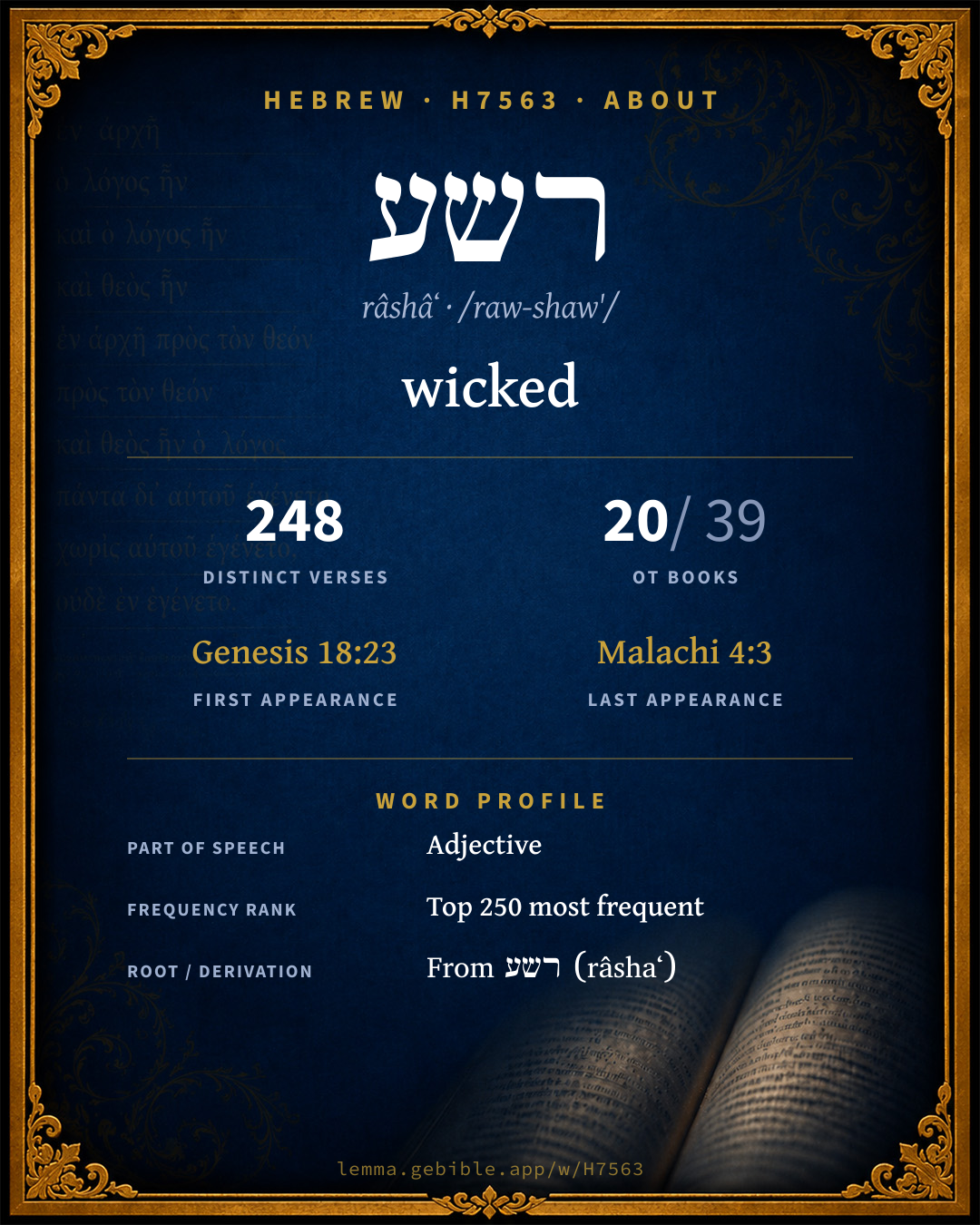
רָשָׁע
wicked
‘wicked’ is one of 4 main senses fuller range ↓
Full lexicon entry — Brown-Driver-Briggs (BDB)
From Brown-Driver-Briggs (BDB)
Where this word appears
See every Absolute-state word in the Hebrew Bible →
Grammar key — what these labels mean
Part of speech
- Adjective
- A word that describes or qualifies a noun.
State
- Absolute
- The independent form of a noun, not bound to a following word.
- Construct
- A noun bound to a following noun in a possessive / “of” relationship (the construct chain).
Gender
- Masculine
- Grammatically masculine.
- Feminine
- Grammatically feminine.
Number
- Plural
- More than one (in Hebrew, generally three or more).
- Singular
- One.
Grammatical forms
- Adjective, Adjective, Masculine, Plural, Absolute 130 times (49%)
- Adjective, Adjective, Masculine, Singular, Absolute 127 times (48%)
- Adjective, Adjective, Masculine, Plural, Construct 4 times (2%)
- Adjective, Adjective, Feminine, Singular, Absolute 2 times (1%)
Parsed forms decoded from the imported morphology (morphhb / Westminster Leningrad Codex — WLC text public domain, morphhb tagging CC BY 4.0), counted across 263 parsed occurrences — not distinct verses.
Page 1 of 2 — showing verses 1–200 of 248 distinct verses where H7563 appears, across 20 books. Click any verse to open its interlinear word-by-word view. Verse text shown in the World English Bible for context — . Each verse’s Hebrew form is shown with its reference; the English is not keyword-highlighted, since the data carries no word-level English alignment. Use “Compare translations” on any verse to read it across multiple English versions. This concordance covers the Hebrew Bible; Septuagint (Greek Old Testament) occurrences are not indexed here.
Genesis 2 verses
- Genesis 18:23 רָשָֽׁע adj Adjective ms Abraham drew near, and said, "Will you consume the righteous with the wicked?
- Genesis 18:25 רָשָׁ֔ע כָּ/רָשָׁ֑ע adj Adjective ms prep det + Adjective Adjective ms Be it far from you to do things like that, to kill the righteous with the wicked, that so the righteous should be as the wicked. May that be far from you. Shouldn't the Judge of all the earth do right?"
Exodus 4 verses
- Exodus 2:13 לָֽ/רָשָׁ֔ע prep det + Adjective Adjective ms He went out the second day, and, behold, two men of the Hebrews were fighting with each other. He said to him who did the wrong, "Why do you strike your fellow?"
- Exodus 9:27 הָ/רְשָׁעִֽים ptcl def.art + Adjective Adjective mp Pharaoh sent, and called for Moses and Aaron, and said to them, "I have sinned this time. Yahweh is righteous, and I and my people are wicked.
- Exodus 23:1 רָשָׁ֔ע adj Adjective ms "You shall not spread a false report. Don't join your hand with the wicked to be a malicious witness.
- Exodus 23:7 רָשָֽׁע adj Adjective ms "Keep far from a false charge, and don't kill the innocent and righteous: for I will not justify the wicked.
Numbers 2 verses
- Numbers 16:26 הָֽ/רְשָׁעִים֙ ptcl def.art + Adjective Adjective mp He spoke to the congregation, saying, Depart, I pray you, from the tents of these wicked men, and touch nothing of theirs, lest you be consumed in all their sins.
- Numbers 35:31 רָשָׁ֖ע adj Adjective ms Moreover you shall take no ransom for the life of a murderer who is guilty of death; but he shall surely be put to death.
Deuteronomy 2 verses
- Deuteronomy 25:1 הָ/רָשָֽׁע ptcl def.art + Adjective Adjective ms If there be a controversy between men, and they come to judgment, and [the judges] judge them; then they shall justify the righteous, and condemn the wicked;
- Deuteronomy 25:2 הָ/רָשָׁ֑ע ptcl def.art + Adjective Adjective ms and it shall be, if the wicked man be worthy to be beaten, that the judge shall cause him to lie down, and to be beaten before his face, according to his wickedness, by number.
1 Samuel 1 verse
2 Samuel 1 verse
1 Kings 1 verse
2 Chronicles 2 verses
- 2 Chronicles 6:23 לְ/רָשָׁ֔ע prep + Adjective Adjective ms then hear from heaven, and do, and judge your servants, requiting the wicked, to bring his way on his own head; and justifying the righteous, to give him according to his righteousness.
- 2 Chronicles 19:2 הֲ/לָ/רָשָׁ֣ע ptcl inter + prep det + Adjective Adjective ms Jehu the son of Hanani the seer went out to meet him, and said to king Jehoshaphat, Should you help the wicked, and love those who hate Yahweh? for this thing wrath is on you from before Yahweh.
Job 26 verses
- Job 3:17 רְ֭שָׁעִים adj Adjective mp There the wicked cease from troubling; There the weary are at rest.
- Job 8:22 רְשָׁעִ֣ים adj Adjective mp Those who hate you shall be clothed with shame. The tent of the wicked shall be no more."
- Job 9:22 וְ֝/רָשָׁ֗ע conj + Adjective Adjective ms "It is all the same. Therefore I say, He destroys the blameless and the wicked.
- Job 9:24 רָשָׁ֗ע adj Adjective ms The earth is given into the hand of the wicked. He covers the faces of the judges of it. If not he, then who is it?
- Job 10:3 רְשָׁעִ֣ים adj Adjective mp Is it good to you that you should oppress, That you should despise the work of your hands, And smile on the counsel of the wicked?
- Job 11:20 רְשָׁעִ֗ים adj Adjective mp But the eyes of the wicked shall fail, They shall have no way to flee; Their hope shall be the giving up of the spirit."
- Job 15:20 רָ֭שָׁע adj Adjective ms The wicked man travails with pain all his days, Even the number of years that are laid up for the oppressor.
- Job 16:11 רְשָׁעִ֣ים adj Adjective mp God delivers me to the ungodly, And casts me into the hands of the wicked.
- Job 18:5 רְשָׁעִ֣ים adj Adjective mp "Yes, the light of the wicked shall be put out, The spark of his fire shall not shine.
- Job 20:5 רְ֭שָׁעִים adj Adjective mp That the triumphing of the wicked is short, The joy of the godless but for a moment?
- Job 20:29 רָ֭שָׁע adj Adjective ms This is the portion of a wicked man from God, The heritage appointed to him by God."
- Job 21:7 רְשָׁעִ֣ים adj Adjective mp "Why do the wicked live, Become old, yes, and grow mighty in power?
- Job 21:16 רְ֝שָׁעִ֗ים adj Adjective mp Behold, their prosperity is not in their hand: The counsel of the wicked is far from me.
- Job 21:17 רְשָׁ֘עִ֤ים adj Adjective mp "How often is it that the lamp of the wicked is put out? That their calamity comes on them? That God distributes sorrows in his anger?
- Job 21:28 רְשָׁעִֽים adj Adjective mp For you say, 'Where is the house of the prince? Where is the tent in which the wicked lived?'
- Job 22:18 רְ֝שָׁעִ֗ים adj Adjective mp Yet he filled their houses with good things, But the counsel of the wicked is far from me.
- Job 24:6 רָשָׁ֣ע adj Adjective ms They cut their provender in the field. They glean the vineyard of the wicked.
- Job 27:7 כְ֭/רָשָׁע prep + Adjective Adjective ms "Let my enemy be as the wicked, Let him who rises up against me be as the unrighteous.
- Job 27:13 רָשָׁ֥ע adj Adjective ms "This is the portion of a wicked man with God, The heritage of oppressors, which they receive from the Almighty.
- Job 34:18 רָ֝שָׁ֗ע adj Adjective ms Who says to a king, 'Vile!' Or to nobles, 'Wicked!'
- Job 34:26 רְשָׁעִ֥ים adj Adjective mp He strikes them as wicked men In the open sight of others;
- Job 36:6 רָשָׁ֑ע adj Adjective ms He doesn't preserve the life of the wicked, But gives to the afflicted their right.
- Job 36:17 רָשָׁ֥ע adj Adjective ms "But you are full of the judgment of the wicked. Judgment and justice take hold of you.
- Job 38:13 רְשָׁעִ֣ים adj Adjective mp That it might take hold of the ends of the earth, And shake the wicked out of it?
- Job 38:15 מֵ/רְשָׁעִ֣ים prep + Adjective Adjective mp From the wicked, their light is withheld, The high arm is broken.
- Job 40:12 רְשָׁעִ֣ים adj Adjective mp Look on everyone who is proud, and humble him. Crush the wicked in their place.
Psalms 80 verses
- Psalms 1:1 רְשָׁ֫עִ֥ים adj Adjective mp Blessed is the man who doesn't walk in the counsel of the wicked, Nor stand in the way of sinners, Nor sit in the seat of scoffers;
- Psalms 1:4 הָ/רְשָׁעִ֑ים ptcl def.art + Adjective Adjective mp The wicked are not so, But are like the chaff which the wind drives away.
- Psalms 1:5 רְ֭שָׁעִים adj Adjective mp Therefore the wicked shall not stand in the judgment, Nor sinners in the congregation of the righteous.
- Psalms 1:6 רְשָׁעִ֣ים adj Adjective mp For Yahweh knows the way of the righteous, But the way of the wicked shall perish.
- Psalms 3:7 רְשָׁעִ֣ים adj Adjective mp Arise, Yahweh! Save me, my God! For you have struck all of my enemies on the cheek bone. You have broken the teeth of the wicked.
- Psalms 7:9 רְשָׁעִים֮ adj Adjective mp Oh let the wickedness of the wicked come to an end, But establish the righteous; Their minds and hearts are searched by the righteous God.
- Psalms 9:5 רָשָׁ֑ע adj Adjective ms You have rebuked the nations. You have destroyed the wicked. You have blotted out their name forever and ever.
- Psalms 9:16 רָשָׁ֑ע adj Adjective ms Yahweh has made himself known. He has executed judgment. The wicked is snared by the work of his own hands. Meditation. Selah.
- Psalms 9:17 רְשָׁעִ֣ים adj Adjective mp The wicked shall be turned back to Sheol, Even all the nations that forget God.
- Psalms 10:2 רָ֭שָׁע adj Adjective ms In arrogance, the wicked hunt down the weak; They are caught in the schemes that they devise.
- Psalms 10:3 רָ֭שָׁע adj Adjective ms For the wicked boasts of his heart's cravings, He blesses the greedy, and condemns Yahweh.
- Psalms 10:4 רָשָׁ֗ע adj Adjective ms The wicked, in the pride of his face, Has no room in his thoughts for God.
- Psalms 10:13 רָשָׁ֥ע adj Adjective ms Why does the wicked person condemn God, And say in his heart, "God won't call me into account?"
- Psalms 10:15 רָשָׁ֑ע adj Adjective ms Break the arm of the wicked. As for the evil man, seek out his wickedness until you find none.
- Psalms 11:2 הָ/רְשָׁעִ֡ים ptcl def.art + Adjective Adjective mp For, behold, the wicked bend their bows. They set their arrows on the strings, That they may shoot in darkness at the upright in heart.
- Psalms 11:5 וְ֭/רָשָׁע conj + Adjective Adjective ms Yahweh examines the righteous, But the wicked and him who loves violence his soul hates.
- Psalms 11:6 רְשָׁעִ֗ים adj Adjective mp On the wicked he will rain blazing coals; Fire, sulfur, and scorching wind shall be the portion of their cup.
- Psalms 12:8 רְשָׁעִ֥ים adj Adjective mp The wicked walk on every side, When what is vile is exalted among the sons of men.
- Psalms 17:9 רְ֭שָׁעִים adj Adjective mp From the wicked who oppress me, My deadly enemies, who surround me.
- Psalms 17:13 מֵ/רָשָׁ֥ע prep + Adjective Adjective ms Arise, Yahweh, Confront him, cast him down. Deliver my soul from the wicked by your sword;
- Psalms 26:5 רְ֝שָׁעִ֗ים adj Adjective mp I hate the assembly of evil-doers, And will not sit with the wicked.
- Psalms 28:3 רְשָׁעִים֮ adj Adjective mp Don't draw me away with the wicked, With the workers of iniquity who speak peace with their neighbors, But mischief is in their hearts.
- Psalms 31:17 רְ֝שָׁעִ֗ים adj Adjective mp Let me not be disappointed, Yahweh, for I have called on you. Let the wicked be disappointed. Let them be silent in Sheol.
- Psalms 32:10 לָ/רָ֫שָׁ֥ע prep det + Adjective Adjective ms Many sorrows shall be to the wicked, But he who trusts in Yahweh, loving kindness shall surround him.
- Psalms 34:21 רָשָׁ֣ע adj Adjective ms Evil shall kill the wicked. Those who hate the righteous shall be condemned.
- Psalms 36:1 לָ֭/רָשָׁע prep det + Adjective Adjective ms An oracle is within my heart about the disobedience of the wicked: "There is no fear of God before his eyes."
- Psalms 36:11 רְ֝שָׁעִ֗ים adj Adjective mp Don't let the foot of pride come against me. Don't let the hand of the wicked drive me away.
- Psalms 37:10 רָשָׁ֑ע adj Adjective ms For yet a little while, and the wicked will be no more. Yes, though you look for his place, he isn't there.
- Psalms 37:12 רָ֭שָׁע adj Adjective ms The wicked plots against the just, And gnashes at him with his teeth.
- Psalms 37:14 רְשָׁעִים֮ adj Adjective mp The wicked have drawn out the sword, and have bent their bow, To cast down the poor and needy, To kill those who are upright in the way.
- Psalms 37:16 רְשָׁעִ֥ים adj Adjective mp Better is a little that the righteous has, Than the abundance of many wicked.
- Psalms 37:17 רְ֭שָׁעִים adj Adjective mp For the arms of the wicked shall be broken, But Yahweh upholds the righteous.
- Psalms 37:20 רְשָׁעִ֨ים adj Adjective mp But the wicked shall perish. The enemies of Yahweh shall be like the beauty of the fields. They will vanish-- Vanish like smoke.
- Psalms 37:21 רָ֭שָׁע adj Adjective ms The wicked borrow, and don't pay back, But the righteous give generously.
- Psalms 37:28 רְשָׁעִ֣ים adj Adjective mp For Yahweh loves justice, And doesn't forsake his saints. They are preserved forever, But the children of the wicked shall be cut off.
- Psalms 37:32 רָ֭שָׁע adj Adjective ms The wicked watches the righteous, And seeks to kill him.
- Psalms 37:34 רְשָׁעִ֣ים adj Adjective mp Wait for Yahweh, and keep his way, And he will exalt you to inherit the land. When the wicked are cut off, you shall see it.
- Psalms 37:35 רָשָׁ֣ע adj Adjective ms I have seen the wicked in great power, Spreading himself like a green tree in its native soil.
- Psalms 37:38 רְשָׁעִ֣ים adj Adjective mp As for transgressors, they shall be destroyed together. The future of the wicked shall be cut off.
- Psalms 37:40 מֵ֭/רְשָׁעִים prep + Adjective Adjective mp Yahweh helps them, and rescues them. He rescues them from the wicked, and saves them, Because they have taken refuge in him.
- Psalms 39:1 רָשָׁ֣ע adj Adjective ms I said, "I will watch my ways, so that I don't sin with my tongue. I will keep my mouth with a bridle while the wicked is before me."
- Psalms 50:16 וְ/לָ֤/רָשָׁ֨ע conj + prep det + Adjective Adjective ms But to the wicked God says, "What right do you have to declare my statutes, That you have taken my covenant on your lips,
- Psalms 55:3 רָשָׁ֑ע adj Adjective ms Because of the voice of the enemy, Because of the oppression of the wicked. For they bring suffering on me. In anger they hold a grudge against me.
- Psalms 58:3 רְשָׁעִ֣ים adj Adjective mp The wicked go astray from the womb. They are wayward as soon as they are born, speaking lies.
- Psalms 58:10 הָ/רָשָֽׁע ptcl def.art + Adjective Adjective ms The righteous shall rejoice when he sees the vengeance. He shall wash his feet in the blood of the wicked;
- Psalms 68:2 רְ֝שָׁעִ֗ים adj Adjective mp As smoke is driven away, So drive them away. As wax melts before the fire, So let the wicked perish at the presence of God.
- Psalms 71:4 רָשָׁ֑ע adj Adjective ms Rescue me, my God, from the hand of the wicked, From the hand of the unrighteous and cruel man.
- Psalms 73:3 רְשָׁעִ֣ים adj Adjective mp For I was envious of the arrogant, When I saw the prosperity of the wicked.
- Psalms 73:12 רְשָׁעִ֑ים adj Adjective mp Behold, these are the wicked. Being always at ease, they increase in riches.
- Psalms 75:4 וְ֝/לָ/רְשָׁעִ֗ים conj + prep det + Adjective Adjective mp I said to the arrogant, "Don't boast;" To the wicked, "Don't lift up the horn.
- Psalms 75:8 רִשְׁעֵי adj Adjective mp cs For in the hand of Yahweh there is a cup, Full of foaming wine mixed with spices. He pours it out. Indeed the wicked of the earth drink and drink it to its very dregs.
- Psalms 75:10 רְשָׁעִ֣ים adj Adjective mp I will cut off all the horns of the wicked, But the horns of the righteous shall be lifted up.
- Psalms 82:2 רְ֝שָׁעִ֗ים adj Adjective mp "How long will you judge unjustly, And show partiality to the wicked?" Selah.
- Psalms 82:4 רְשָׁעִ֣ים adj Adjective mp Rescue the weak and needy. Deliver them out of the hand of the wicked."
- Psalms 91:8 רְשָׁעִ֣ים adj Adjective mp You will only look with your eyes, And see the recompense of the wicked.
- Psalms 92:7 רְשָׁעִ֨ים adj Adjective mp Though the wicked spring up as the grass, And all the evil-doers flourish, They will be destroyed forever.
- Psalms 94:3 רְשָׁעִ֥ים רְשָׁעִ֥ים adj Adjective mp adj Adjective mp Yahweh, how long will the wicked, How long will the wicked triumph?
- Psalms 94:13 לָ/רָשָׁ֣ע prep det + Adjective Adjective ms That you may give him rest from the days of adversity, Until the pit is dug for the wicked.
- Psalms 97:10 רְ֝שָׁעִ֗ים adj Adjective mp You who love Yahweh, hate evil. He preserves the souls of his saints. He delivers them out of the hand of the wicked.
- Psalms 101:8 רִשְׁעֵי adj Adjective mp cs Morning by morning, I will destroy all the wicked of the land; To cut off all the workers of iniquity from Yahweh's city.
- Psalms 104:35 וּ/רְשָׁעִ֤ים conj + Adjective Adjective mp Let sinners be consumed out of the earth. Let the wicked be no more. Bless Yahweh, my soul. Praise Yah!
- Psalms 106:18 רְשָׁעִֽים adj Adjective mp A fire was kindled in their company. The flame burned up the wicked.
- Psalms 109:2 רָשָׁ֡ע adj Adjective ms For they have opened the mouth of the wicked and the mouth of deceit against me. They have spoken to me with a lying tongue.
- Psalms 109:6 רָשָׁ֑ע adj Adjective ms Set a wicked man over him. Let an adversary stand at his right hand.
- Psalms 109:7 רָשָׁ֑ע adj Adjective ms When he is judged, let him come forth guilty. Let his prayer be turned into sin.
- Psalms 112:10 רָ֘שָׁ֤ע רְשָׁעִ֣ים adj Adjective ms adj Adjective mp The wicked will see it, and be grieved. He shall gnash with his teeth, and melt away. The desire of the wicked will perish.
- Psalms 119:53 מֵ/רְשָׁעִ֑ים prep + Adjective Adjective mp Indignation has taken hold on me, Because of the wicked who forsake your law.
- Psalms 119:61 רְשָׁעִ֣ים adj Adjective mp The ropes of the wicked bind me, But I won't forget your law.
- Psalms 119:95 רְשָׁעִ֣ים adj Adjective mp The wicked have waited for me, to destroy me. I will consider your statutes.
- Psalms 119:110 רְשָׁעִ֣ים adj Adjective mp The wicked have laid a snare for me, Yet I haven't gone astray from your precepts.
- Psalms 119:119 רִשְׁעֵי adj Adjective mp cs You put away all the wicked of the earth like dross. Therefore I love your testimonies.
- Psalms 119:155 מֵ/רְשָׁעִ֣ים prep + Adjective Adjective mp Salvation is far from the wicked, For they don't seek your statutes.
- Psalms 129:4 רְשָׁעִֽים adj Adjective mp Yahweh is righteous. He has cut apart the cords of the wicked.
- Psalms 139:19 רָשָׁ֑ע adj Adjective ms If only you, God, would kill the wicked. Get away from me, you bloodthirsty men!
- Psalms 140:4 רָשָׁ֗ע adj Adjective ms Yahweh, keep me from the hands of the wicked. Preserve me from the violent men who have determined to trip my feet.
- Psalms 140:8 רָשָׁ֑ע adj Adjective ms Yahweh, don't grant the desires of the wicked. Don't let their evil plans succeed, or they will become proud. Selah.
- Psalms 141:10 רְשָׁעִ֑ים adj Adjective mp Let the wicked fall together into their own nets, While I pass by.
- Psalms 145:20 הָ/רְשָׁעִ֣ים ptcl def.art + Adjective Adjective mp Yahweh preserves all those who love him, But all the wicked he will destroy.
- Psalms 146:9 רְשָׁעִ֣ים adj Adjective mp Yahweh preserves the foreigners. He upholds the fatherless and widow, But the way of the wicked he turns upside down.
- Psalms 147:6 רְשָׁעִ֣ים adj Adjective mp Yahweh upholds the humble. He brings the wicked down to the ground.
Proverbs 77 verses
- Proverbs 2:22 וּ֭/רְשָׁעִים conj + Adjective Adjective mp But the wicked will be cut off from the land. The treacherous will be rooted out of it.
- Proverbs 3:25 רְ֝שָׁעִ֗ים adj Adjective mp Don't be afraid of sudden fear, Neither of the desolation of the wicked, when it comes:
- Proverbs 3:33 רָשָׁ֑ע adj Adjective ms Yahweh's curse is in the house of the wicked, But he blesses the habitation of the righteous.
- Proverbs 4:14 רְ֭שָׁעִים adj Adjective mp Don't enter into the path of the wicked. Don't walk in the way of evil men.
- Proverbs 4:19 רְ֭שָׁעִים adj Adjective mp The way of the wicked is like darkness. They don't know what they stumble over.
- Proverbs 5:22 הָ/רָשָׁ֑ע ptcl def.art + Adjective Adjective ms The evil deeds of the wicked ensnare him. The cords of his sin hold him firmly.
- Proverbs 9:7 לְ/רָשָׁ֣ע prep + Adjective Adjective ms He who corrects a mocker invites insult. He who reproves a wicked man invites abuse.
- Proverbs 10:3 רְשָׁעִ֣ים adj Adjective mp Yahweh will not allow the soul of the righteous to go hungry, But he thrusts away the desire of the wicked.
- Proverbs 10:6 רְ֝שָׁעִ֗ים adj Adjective mp Blessings are on the head of the righteous, But violence covers the mouth of the wicked.
- Proverbs 10:7 רְשָׁעִ֣ים adj Adjective mp The memory of the righteous is blessed, But the name of the wicked will rot.
- Proverbs 10:11 רְ֝שָׁעִ֗ים adj Adjective mp The mouth of the righteous is a spring of life, But violence covers the mouth of the wicked.
- Proverbs 10:16 רָשָׁ֣ע adj Adjective ms The labor of the righteous leads to life. The increase of the wicked leads to sin.
- Proverbs 10:20 רְשָׁעִ֣ים adj Adjective mp The tongue of the righteous is like choice silver. The heart of the wicked is of little worth.
- Proverbs 10:24 רָ֭שָׁע adj Adjective ms What the wicked fear, will overtake them, But the desire of the righteous will be granted.
- Proverbs 10:25 רָשָׁ֑ע adj Adjective ms When the whirlwind passes, the wicked is no more; But the righteous stand firm forever.
- Proverbs 10:27 רְשָׁעִ֣ים adj Adjective mp The fear of Yahweh prolongs days, But the years of the wicked shall be shortened.
- Proverbs 10:28 רְשָׁעִ֣ים adj Adjective mp The prospect of the righteous is joy, But the hope of the wicked will perish.
- Proverbs 10:30 וּ֝/רְשָׁעִ֗ים conj + Adjective Adjective mp The righteous will never be removed, But the wicked will not dwell in the land.
- Proverbs 10:32 רְ֝שָׁעִ֗ים adj Adjective mp The lips of the righteous know what is acceptable, But the mouth of the wicked is perverse.
- Proverbs 11:5 רָשָֽׁע adj Adjective ms The righteousness of the blameless will direct his way, But the wicked shall fall by his own wickedness.
- Proverbs 11:7 רָ֭שָׁע adj Adjective ms When a wicked man dies, hope perishes, And expectation of power comes to nothing.
- Proverbs 11:8 רָשָׁ֣ע adj Adjective ms A righteous person is delivered out of trouble, And the wicked takes his place.
- Proverbs 11:10 רְשָׁעִ֣ים adj Adjective mp When it goes well with the righteous, the city rejoices. When the wicked perish, there is shouting.
- Proverbs 11:11 רְ֝שָׁעִ֗ים adj Adjective mp By the blessing of the upright, the city is exalted, But it is overthrown by the mouth of the wicked.
- Proverbs 11:18 רָשָׁ֗ע adj Adjective ms Wicked people earn deceitful wages, But one who sows righteousness reaps a sure reward.
- Proverbs 11:23 רְשָׁעִ֣ים adj Adjective mp The desire of the righteous is only good. The expectation of the wicked is wrath.
- Proverbs 11:31 רָשָׁ֥ע adj Adjective ms Behold, the righteous shall be repaid in the earth; How much more the wicked and the sinner!
- Proverbs 12:5 רְשָׁעִ֣ים adj Adjective mp The thoughts of the righteous are just, But the advice of the wicked is deceitful.
- Proverbs 12:6 רְשָׁעִ֣ים adj Adjective mp The words of the wicked are about lying in wait for blood, But the speech of the upright rescues them.
- Proverbs 12:7 רְשָׁעִ֣ים adj Adjective mp The wicked are overthrown, and are no more, But the house of the righteous shall stand.
- Proverbs 12:10 רְ֝שָׁעִ֗ים adj Adjective mp A righteous man regards the life of his animal, But the tender mercies of the wicked are cruel.
- Proverbs 12:12 רָ֭שָׁע adj Adjective ms The wicked desires the plunder of evil men, But the root of the righteous flourishes.
- Proverbs 12:21 וּ֝/רְשָׁעִ֗ים conj + Adjective Adjective mp No mischief shall happen to the righteous, But the wicked shall be filled with evil.
- Proverbs 12:26 רְשָׁעִ֣ים adj Adjective mp A righteous person is cautious in friendship, But the way of the wicked leads them astray.
- Proverbs 13:5 וְ֝/רָשָׁ֗ע conj + Adjective Adjective ms A righteous man hates lies, But a wicked man brings shame and disgrace.
- Proverbs 13:9 רְשָׁעִ֣ים adj Adjective mp The light of the righteous shines brightly, But the lamp of the wicked is snuffed out.
- Proverbs 13:17 רָ֭שָׁע adj Adjective ms A wicked messenger falls into trouble, But a trustworthy envoy gains healing.
- Proverbs 13:25 רְשָׁעִ֣ים adj Adjective mp The righteous one eats to the satisfying of his soul, But the belly of the wicked goes hungry.
- Proverbs 14:11 רְ֭שָׁעִים adj Adjective mp The house of the wicked will be overthrown, But the tent of the upright will flourish.
- Proverbs 14:19 וּ֝/רְשָׁעִ֗ים conj + Adjective Adjective mp The evil bow down before the good, And the wicked at the gates of the righteous.
- Proverbs 14:32 רָשָׁ֑ע adj Adjective ms The wicked is brought down in his calamity, But in death, the righteous has a refuge.
- Proverbs 15:6 רָשָׁ֣ע adj Adjective ms In the house of the righteous is much treasure, But the income of the wicked brings trouble.
- Proverbs 15:8 רְ֭שָׁעִים adj Adjective mp The sacrifice made by the wicked is an abomination to Yahweh, But the prayer of the upright is his delight.
- Proverbs 15:9 רָשָׁ֑ע adj Adjective ms The way of the wicked is an abomination to Yahweh, But he loves him who follows after righteousness.
- Proverbs 15:28 רְ֝שָׁעִ֗ים adj Adjective mp The heart of the righteous weighs answers, But the mouth of the wicked gushes out evil.
- Proverbs 15:29 מֵ/רְשָׁעִ֑ים prep + Adjective Adjective mp Yahweh is far from the wicked, But he hears the prayer of the righteous.
- Proverbs 16:4 רָ֝שָׁ֗ע adj Adjective ms Yahweh has made everything for its own end-- Yes, even the wicked for the day of evil.
- Proverbs 17:15 רָ֭שָׁע adj Adjective ms He who justifies the wicked, and he who condemns the righteous, Both of them alike are an abomination to Yahweh.
- Proverbs 17:23 רָשָׁ֣ע adj Adjective ms A wicked man receives a bribe in secret, To pervert the ways of justice.
- Proverbs 18:3 רָ֭שָׁע adj Adjective ms When wickedness comes, contempt also comes, And with shame comes disgrace.
- Proverbs 18:5 רָשָׁ֣ע adj Adjective ms To be partial to the faces of the wicked is not good, Nor to deprive the innocent of justice.
- Proverbs 19:28 רְ֝שָׁעִ֗ים adj Adjective mp A corrupt witness mocks justice, And the mouth of the wicked gulps down iniquity.
- Proverbs 20:26 רְ֭שָׁעִים adj Adjective mp A wise king winnows out the wicked, And drives the threshing wheel over them.
- Proverbs 21:4 רְשָׁעִ֣ים adj Adjective mp A high look, and a proud heart, The lamp of the wicked, is sin.
- Proverbs 21:7 רְשָׁעִ֥ים adj Adjective mp The violence of the wicked will drive them away, Because they refuse to do what is right.
- Proverbs 21:10 רָ֭שָׁע adj Adjective ms The soul of the wicked desires evil; His neighbor finds no mercy in his eyes.
- Proverbs 21:12 רָשָׁ֑ע רְשָׁעִ֣ים adj Adjective ms adj Adjective mp The Righteous One considers the house of the wicked, And brings the wicked to ruin.
- Proverbs 21:18 רָשָׁ֑ע adj Adjective ms The wicked is a ransom for the righteous; The treacherous for the upright.
- Proverbs 21:27 רְ֭שָׁעִים adj Adjective mp The sacrifice of the wicked is an abomination: How much more, when he brings it with a wicked mind!
- Proverbs 21:29 רָשָׁ֣ע adj Adjective ms A wicked man hardens his face; But as for the upright, he establishes his ways.
- Proverbs 24:15 רָ֭שָׁע adj Adjective ms Don't lay in wait, wicked man, against the habitation of the righteous. Don't destroy his resting-place:
- Proverbs 24:16 וּ֝/רְשָׁעִ֗ים conj + Adjective Adjective mp For a righteous man falls seven times, and rises up again; But the wicked are overthrown by calamity.
- Proverbs 24:19 בָּ/רְשָׁעִֽים prep det + Adjective Adjective mp Don't fret yourself because of evildoers; Neither be envious of the wicked:
- Proverbs 24:20 רְשָׁעִ֣ים adj Adjective mp For there will be no reward to the evil man; And the lamp of the wicked shall be snuffed out.
- Proverbs 24:24 לְ/רָשָׁע֮ prep + Adjective Adjective ms He who says to the wicked, "You are righteous;" Peoples shall curse him, and nations shall abhor him--
- Proverbs 25:5 רָ֭שָׁע adj Adjective ms Take away the wicked from the king's presence, And his throne will be established in righteousness.
- Proverbs 25:26 רָשָֽׁע adj Adjective ms Like a muddied spring, and a polluted well, So is a righteous man who gives way before the wicked.
- Proverbs 28:1 רָשָׁ֑ע adj Adjective ms The wicked flee when no one pursues; But the righteous are as bold as a lion.
- Proverbs 28:4 רָשָׁ֑ע adj Adjective ms Those who forsake the law praise the wicked; But those who keep the law contend with them.
- Proverbs 28:12 רְ֝שָׁעִ֗ים adj Adjective mp When the righteous triumph, there is great glory; But when the wicked rise, men hide themselves.
- Proverbs 28:15 רָ֝שָׁ֗ע adj Adjective ms As a roaring lion or a charging bear, So is a wicked ruler over helpless people.
- Proverbs 28:28 רְ֭שָׁעִים adj Adjective mp When the wicked rise, men hide themselves; But when they perish, the righteous thrive.
- Proverbs 29:2 רָ֝שָׁ֗ע adj Adjective ms When the righteous thrive, the people rejoice; But when the wicked rule, the people groan.
- Proverbs 29:7 רָ֝שָׁ֗ע adj Adjective ms The righteous care about justice for the poor. The wicked aren't concerned about knowledge.
- Proverbs 29:12 רְשָׁעִֽים adj Adjective mp If a ruler listens to lies, All of his officials are wicked.
- Proverbs 29:16 רְ֭שָׁעִים adj Adjective mp When the wicked increase, sin increases; But the righteous will see their downfall.
- Proverbs 29:27 רָשָׁ֣ע adj Adjective ms A dishonest man detests the righteous, And the upright in their ways detest the wicked.
Ecclesiastes 6 verses
- Ecclesiastes 3:17 הָ֣/רָשָׁ֔ע ptcl def.art + Adjective Adjective ms I said in my heart, "God will judge the righteous and the wicked; for there is a time there for every purpose and for every work."
- Ecclesiastes 7:15 רָשָׁ֔ע adj Adjective ms All this have I seen in my days of vanity: there is a righteous man who perishes in his righteousness, and there is a wicked man who lives long in his evil-doing.
About this entry
At a glance — auto-summarized from this page’s data, not written by a person. Every figure links to its source below. This summary describes the numbers; it doesn’t interpret them.
“wicked” is the headline sense of the Hebrew adjective רשע (râshâʻ). Carrying more than one sense, it rewards its full sense range. The Hebrew Bible uses it across 248 verses — common. More than a quarter of its appearances fall in Psalms. First canonically at Genesis 18:23, it enters the text early. See the sense tree, 248-verse concordance, and the renderings breakdown below.
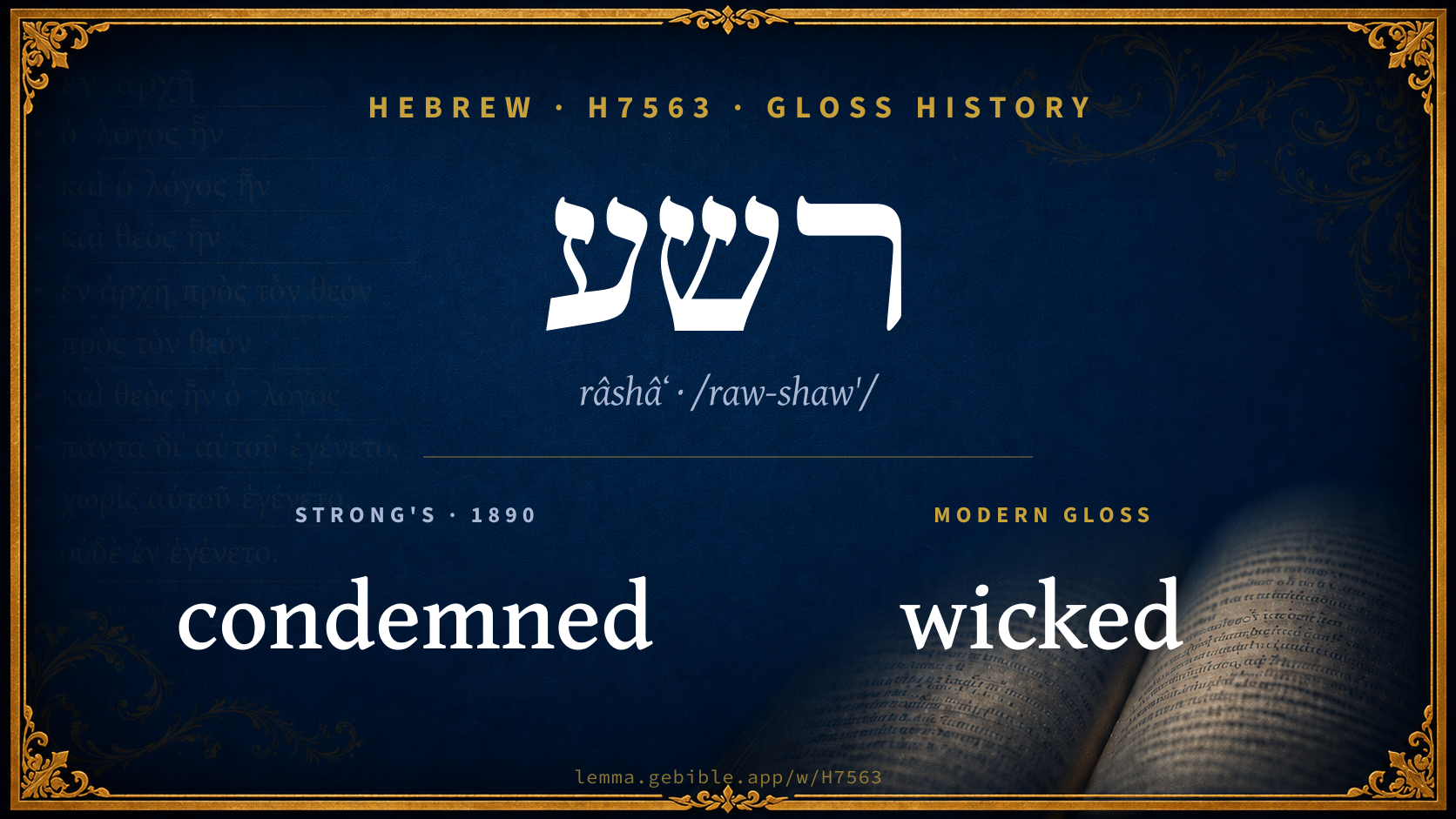
Gloss history
Strong's 1890 vs modern scholarship
About this word
Strong's H7563 catalogs a Hebrew word from the Hebrew Old Testament.
These counts are not copied from any lexicon or concordance. They are computed here, from the morphology-tagged Hebrew Old Testament. What Lemma adds →
- 248
- distinct verses
- The word appears in 248 distinct verses.
- 20 / 39
- OT books
- The word appears in 20 of 39 Old Testament books.
- #187
- by frequency
- Top 250 most frequent Hebrew words (rank 187 of 8,640 Hebrew words by occurrence).
View all 248 occurrences in the concordance →
By section of the Old Testament
By traditional corpus
Conventional, traditional groupings — biblical authorship is debated, so this is a traditional corpus grouping, not an authorship claim. Each share is this word’s portion of its verses in that division of the Hebrew canon. Each figure is a share of the word’s 248 distinct verses.
- Writings (Ketuvim) 192 verses · 77%
- Prophets (Nevi'im) 46 verses · 19%
- Torah (Pentateuch) 10 verses · 4%
How translations render this word
Counts come from each version’s own published word-to-Strong’s tagging or interlinear alignment — an approximate guide to how each version renders this word, not a word-level alignment the data otherwise carries. Because each total is that version’s own tagged count, the per-version totals vary from one another and need not match the appearance or distinct-verse counts above. These counts may also differ from a printed concordance because Lemma counts each distinctly tagged rendering and does not collapse phrase taggings into a single head-word total. This is a fixed set of word-tagged versions (KJV, ASV, BSB, ULT) and does not change with the reading translation you choose elsewhere. Each version’s license is shown beside its name below (and on Sources).
- King James Version: Wicked 219×, Ungodly 5×, Let the wicked 4×
- American Standard Version: Wicked 206×, Let the wicked 4×, Are wicked 3×
- Berean Standard Bible: Wicked 211×, Wicked man 20×, Guilty 5×
- unfoldingWord Literal Text: Wicked 213×, One 19×, Wicked ones 14×
King James Version Public Domain
Renders H7563 across 263 tagged occurrences — most commonly:
Plus 25 renderings that appear only once — usually multi-word phrases or single function words the recovered tagging swept in, not distinct renderings.
American Standard Version Public Domain
Renders H7563 across 261 tagged occurrences — most commonly:
Plus 42 renderings that appear only once — usually multi-word phrases or single function words the recovered tagging swept in, not distinct renderings.
Berean Standard Bible Public Domain
Renders H7563 across 263 tagged occurrences — most commonly:
Plus 21 renderings that appear only once — usually multi-word phrases or single function words the recovered tagging swept in, not distinct renderings.
unfoldingWord Literal Text CC BY-SA 4.0
Renders H7563 across 288 tagged occurrences — most commonly:
Plus 17 renderings that appear only once — usually multi-word phrases or single function words the recovered tagging swept in, not distinct renderings.
Senses in the full BDB
What do BDB’s symbols mean?
BDB uses these scholarly abbreviations:
| Symbol | Meaning |
|---|---|
| 𝔊 | the Septuagint (the ancient Greek translation, LXX) |
| 𝔙 | the Vulgate (the Latin translation) |
| 𝔖 | the Syriac version (the Peshitta) |
| 𝔗 | the Targum (the Aramaic translation) |
| ψ | the Psalms |
| √ | root (the underlying root or stem) |
| ‖ | parallel passage (a synonymous or contrasted parallel) |
| † | the dagger: every passage where the word occurs is cited |
The 3 senses and sub-senses the full Brown-Driver-Briggs lexicon distinguishes for this word, in lexicon order (not ranked by frequency), with BDB’s own verbatim wording and sub-sense lettering. Shown in Hebrew script with BDB’s own scholarly abbreviations. The condensed entry is in the Lexicon Entry tab. See also the Forms in the corpus table below.
- 1. usually as subst., one guilty of crime, deserving punishment; sometimes also wicked; opp. צַדִּיק; רָשָׁע Ex 2:13; 23:1 (E), Dt 25:2; Pr 17:23; 18:5; 25:5; Jb 9:22, 24; coll. Gn 18:23, 25(×2) (J) Mi 6:10; Pr 3:33; 28:4, רשׁעים 1 S 24:14; Je 5:26; Pr 19:28; 20:26; 29:12, אנשׁים רשׁעים 2 S 4:11 (murderers), רָשָׁע לָמוּת Nu 35:31 (P) guilty of death, מוֹשֵׁל ר׳ Pr 28:15, cf. 29:2, הִצְדִּיק ר׳ Ex 23:7 (E) Is 5:23; Pr 17:15; הִרְשִׁעַ ר׳ Dt 25:1 1 K 8:32 = השׁיב לְרָשָׁע 2 Ch 6:23; אמר לר׳ צַדִּיק Pr 24:24. e.g. Exodus 2:13
- 2. guilty of hostility to God or his people, wicked enemies: רשׁע sg. ψ 17:13 + 6 times ψψ, Is 26:10; coll. ψ 9:6, 17; 10:2 + 6 times ψψ, Is 11:4 Hb 3:13; רשׁעים ψ 3:8; 7:10; 9:18 + 5 times ψψ, Is 48:22; 57:20, 21 Je 25:31 Ez 21:34 Mal 3:21 (+ (poss.) other cases; often hard to decide); specif. of Pharaoh Ex 9:27 (J), Babylon Is 13:11; 14:5, Chaldeans Hb 1:4, 13; ‖ שׂנְאֵי יהוה 2 Ch 19:2. e.g. Psalms 17:13
- 3. guilty of sin, against either God or man, wicked: האנשׁים הרשׁעים Nu 16:26 (J, rebellious Korahites), Mal 3:18 (not serving י׳), opp. צַדִּיק; sg. indiv. Ez 3:18(×2); 21:30; 33:8(×2) ψ 11:5; 32:10 Pr 9:7 +; coll. Is 3:11 Jb 34:18; 36:6, 17; pl. רשׁעים Is 53:9 Je 23:19 = 30:23, Zp 1:3 ψ 26:5; Pr 10:3; Ec 8:10 +; ‖ חסידים 1 S 2:9 (poem), ψ 12:9; 50:16; 97:10; 145:20; ‖ עֹזְבֵי תוֹרָתֶ֑ךָ 119:53, cf. v 61, +; †אדם ר׳ Pr 11:7; Jb 20:29; 27:13; אִישׁ ר׳ Pr 21:29; מלאך ר׳ 13:17; זֶרַע רשׁעים ψ 37:28; †עֲצַת רשׁעים 1:1; Jb 10:3; 21:16; 22:18; †דֶּרֶךְ רשׁעים Je 12:1 ψ 1:6; 146:9; Pr 4:19; 12:26; דֶּרֶךְ רשׁע 15:9; מִדַּרְכּוֹ הָֽרְשָׁעָה Ez 3:18, 19 (but v. Co, supr.); †רִשְׁעֵי (ה)ארץ ψ 75:9; 101:8; 119:119 Ez 7:21 (𝔊 Co עריצי).—רָשָׁע is rare before exile; chiefly Ez ψψ WisdLit. e.g. Numbers 16:26
Senses from the full Brown-Driver-Briggs lexicon (Brown, Driver, Briggs; Oxford 1906 — public domain), digitized via Sefaria, supplemented by the OpenScriptures HebrewLexicon (CC BY 4.0). Full attribution on Sources.
Word origin
adj. wicked, criminal;—abs. ר׳ Gn 18:23 +; pl. רְשָׁעִים Is 13:11 +; cstr. רִשְׁעֵי ψ 75:9 + 3 times; fs. רְשָׁעָה Ez 3:18 (del. Co), v 19 (רָשָׁע Co);—
— Brown-Driver-Briggs (Oxford 1906, public domain), digitized via Sefaria, supplemented by the OpenScriptures HebrewLexicon (CC BY 4.0). See Sources.
Derived from רשע (râshaʻ) (H7561) — to be wicked.
Jastrow Dictionary
A second Hebrew/Aramaic lexicon for comparison, covering Aramaic and post-biblical (Talmudic, Targumic, Midrashic) usage that the biblical-Hebrew BDB does not. Matched by lemma rather than by Strong’s number, so a lemma may carry more than one Jastrow headword (shown separately below), and the entries cover usage well beyond the Bible.
רָשַׁע
- [to be powerful,] to do violence, be wicked. Yalk. Koh. 976 (ref. to Koh. VII, 17) אלא אם רָשַׁעְתָּ אל תִּרְשַׁע הרבה (omitted in Sabb. 31ᵇ) but it means, if thou hast once done wrong, do not therefore do more wrong. e.g. Ecclesiastes 7:17
- 1. to declare in the wrong, to condemn. Snh. 10ᵃ אלא מעתה והצדיקו שנים והִרְשִׁיעוּ שנים וכ׳ if this be so (that you can derive from ושפטום, Deut. XXV, 1, that there must be two judges and one in addition to make a majority vote possible) then ‘and they shall justify’ (ib.) indicates two, ‘and they shall condemn’ (ib.) means two, hence you would require seven judges for a court! e.g. Deuteronomy 25:1
- 2. to charge with wrong-doing, accuse. Ib. עדים שהרשיעו את הצדיק וכ׳ if (false) witnesses accused an innocent person, and other witnesses came and justified him. B. Kam. 64ᵇ (ref. to Ex. XXII, 8) ולא המַרְשִׁיעַ עצמו “he whom the judges shall condemn shall pay double”, but not he who accuses himself. Ib. (ref. to Ex. XXII, 3) פרט למרשיע וכ׳ to the exemption of him who &c.; a. fr.— to do wrong. Tanḥ. D’barim 3; Yalk. Deut. 805 (play on רשעתים, Jud. III, 8) הם הרשיעו עלינו שתי רשעיות they (the Aramæans) did us two wrongs. e.g. Exodus 22:8
רְשַׁע I
- Targ. Deut. XVIII, 23 (some ed. דיַרְ׳ Af.).—Sabb. 31ᵇ (ref. to Koh. VII, 17) הרבה הוא דלא לִירְשַׁע הא מעט לירשע man should not sin much, but little he may?; Yalk. Koh. 976. e.g. Ecclesiastes 7:17
- same. Targ. Deut. I, 43. Targ. Y. Ex. XVIII, 11. Targ. Ps. LXXVIII, 57; a. fr.
- to talk wickedly. Targ. Is. XXVIII, 22 (h. text תתלוצצו).
רְשַׁע II
- m., v. רִשְׁעָא
רָשָׁע
- preced. wds.) wicked man, wrongful claimant. Snh. 27ᵃ (ref. to Ex. XXIII, 1) אל תשת ר׳ עד allow not a wicked man to be witness. Ib. 9ᵇ ר׳ הוא והתורה אמרה וכ׳ he is a (self-confessed) wicked man, and the Law says, allow not &c. Ib. אין אדם משים עצמו ר׳ none can incriminate himself (his testimony against himself has no legal effect). Ib. 27ᵃ ר׳ דחמס בעינן (to be disqualified in court) he must be a wicked man connected with violence (but you cannot disqualify a sinner against ceremonial laws). Gen. R. s. 20 נחש זה ר׳ בעל תשובות that serpent is a wicked creature rich in arguments. Bekh. 8ᵃ ולאותו ר׳ לא וכ׳ and to that wicked creature (the serpent) I find no parallel in nature (as to duration of pregnancy). Ab. V, 19 בלעם הר׳ Balaam the wicked; a. v. fr.—Pl. רְשָׁעִים. Ib. 1 להפרע מן הר׳ וכ׳ in order to punish the wicked who ruin the world &c. Ib. I, 8 וכשיהיו … יהיו בעיניך כר׳ when disputants stand before thee (the judge), look upon both parties as wrongful claimants, opp. זכאין. Ib. IV, 15 אין … משלות הר׳ וכ׳ it is beyond our power to understand why the wicked are prosperous or why the righteous suffer. Snh. 110ᵇ קטני בני רִשְׁעֵי ישראל young children of wicked Israelites; Tosef. ib. XIII, 1 רשעי ארץ (corr. acc.). Ib. 2 (ref. to Ps. IX, 18) אלו ר׳ ישראל this refers to Israelitish sinners. Hor. 10ᵇ (ref. to Koh. VIII, 14) כמעשה חר׳ של עוה"ב like that which happens to the wicked in the world to come. Snh. 93ᵃ רִשְׁעֵיהֶם של ישראל the wicked (idolaters) of the Israelitish people; a. v. fr.—Fem. רְשָׁעָה. Ber. 61ᵇ מלכות הר׳ Ms. M. (v. Rabb. D. S. a. l. note) the wicked (Roman) government. Ex. R. s. 35 אדום הר׳ (sub. מלכות); a. fr. e.g. Exodus 23:1
רֶשַׁע
- preced.) wickedness, guilt. Snh. 47ᵃ נהרג מתוך רִשְׁעוֹ one who is put to death for his wickedness; מת מתוך רשעו who dies (a natural death) for his wickedness; a. e.
רִשְׁעָא
- Targ. O. Deut. XVIII, 22. Targ. Ps. XVIII, 22. Ib. XXXVI, 4. Ib. 5 (some ed. רשיעא, corr. acc.). Targ. Prov. VIII, 7 (some ed. רשיעא, corr. acc.); a. fr.
A Dictionary of the Targumim, the Talmud Babli and Yerushalmi, and the Midrashic Literature (Marcus Jastrow; London, Luzac, 1903) — Public Domain. Digitized via Sefaria. Digitized via Sefaria. Full attribution on Sources.
Forms in the corpus
The 80 distinct written forms H7563 takes in the Hebrew Bible, most frequent first — each parse links to that state’s occurrences in the concordance. Hebrew forms include their vowel points and cantillation, so a single lemma takes many written forms.
The 60 most common forms are shown; 20 rarer forms follow in the full concordance.
Same root — word family
Other BDB entries built from the same root as H7563, grouped by Strong’s listed origin. These share a root / origin per the lexicon — not necessarily a shared meaning. Each links to that word’s own entry.
Derives from
Shares the same root
Compare all same-root words → They share a root, not necessarily a meaning.
Septuagint verse parallels
This word appears in 222 verses that also exist in the Greek Old Testament (Septuagint), out of the 248 Hebrew verses it occurs in. You can read those verses in Greek by switching the Old Testament edition to the Septuagint.
Read these verses in the Septuagint
- Genesis 18:23
- Exodus 2:13
- Numbers 16:26
- Deuteronomy 25:1
- 1 Samuel 2:9
- 2 Samuel 4:11
- 1 Kings 8:32
- 2 Chronicles 6:23
- Job 3:17
- Psalms 1:1
- Proverbs 2:22
- Ecclesiastes 3:17
This is a verse-level parallel only — the same verses exist in both the Hebrew and Greek Old Testaments. No word-level Hebrew↔Greek correspondence is claimed: the data carries no such alignment, so no Greek word is shown as this Hebrew word’s translation. Coverage is not total — the Septuagint omits the deuterocanon and renumbers the Psalms, so some Hebrew verses have no direct Greek parallel.