
Psalms 32:10

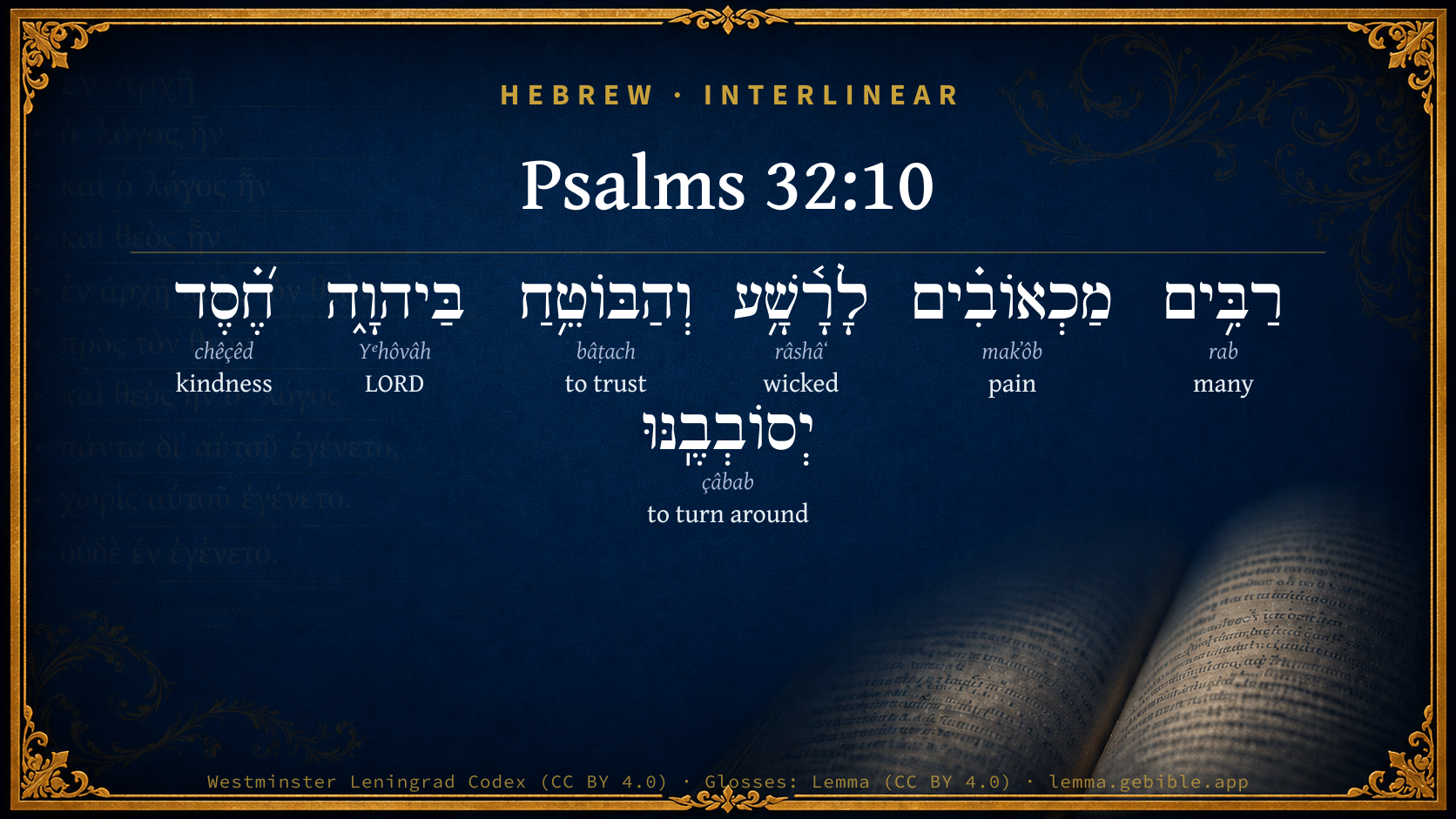
Hebrew (Westminster Leningrad Codex) Psalms 32:10 appears in the Hebrew Old Testament. The text above is from the Westminster Leningrad Codex. Each word links to its Strong’s number, a concise gloss, and parsing drawn from the Open Scriptures Hebrew Bible morphology. Click any word for its full Brown-Driver-Briggs (BDB) entry.
Download image
Cite this verse

Psalms 32:10 (World English Bible). Public Domain. Lemma interlinear Bible study tool, https://lemma.gebible.app/v/psalms/32/10.

Show BibTeX & RIS
BibTeX
RIS
English Translation
Many sorrows shall be to the wicked, But he who trusts in Yahweh, loving kindness shall surround him.
World English Bible · Public Domain
Download a study sheet

One document with this verse’s original text, its word-by-word gloss line, the meaning frame, cross-references with their text, attributed commentary, and full source and license credits — printable, and it pastes into notes with its structure intact.

This verse Autodidact and up

Study sheet (.html) Plain text (.txt)

A passage Seminary Student

Up to 50 verses in one chapter. A passage sheet keeps up to 6 commentary sources and 12 cross-references per verse, in the order this page ranks them, and says so on the sheet whenever that leaves anything out. Ask for a single verse and you get the Autodidact verse sheet above.

Everything on this page stays free to read, with no account — the sheet is a download of what is already on screen, not access to it.

Want to remove ads? Support Godless Engineer
Compare translations 3

The same verse in 3 English versions, stacked beneath the original-language interlinear above. Click any original word for its lexicon entry.

Each is an independent rendering of the whole verse — the interlinear is not word-aligned to these translations.

Highlighted words mark where these versions differ — a whole-verse word diff, not a word-by-word alignment.

  • World English Bible Public Domain
    Many sorrows shall be to the wicked, But he who trusts in Yahweh, loving kindness shall surround him.
  • King James Version Public Domain
    Many sorrows shall be to the wicked: but he that trusteth in the LORD, mercy shall compass him about.
  • unfoldingWord Literal Text CC BY-SA 4.0
    Many pains of the wicked, but the one trusting in Yahweh, covenant faithfulness surrounds him.

unfoldingWord Literal Text — © unfoldingWord, licensed CC BY-SA 4.0. Word-aligned USFM3 via Door43 (git.door43.org/unfoldingWord/en_ult).

Versions to compare (up to 4)

3 of 4 selected

Show all 18 translations

Every available English version of this verse, each an independent rendering of the whole verse.

  • World English Bible Public Domain
    Many sorrows shall be to the wicked, But he who trusts in Yahweh, loving kindness shall surround him.
  • Berean Standard Bible Public Domain
    Many are the sorrows of the wicked, but loving devotion surrounds him who trusts in the LORD.
  • Majority Standard Bible Public Domain
    Many are the sorrows of the wicked, but loving devotion surrounds him who trusts in the LORD.
  • King James Version Public Domain
    Many sorrows shall be to the wicked: but he that trusteth in the LORD, mercy shall compass him about.
  • American Standard Version (1901) Public Domain
    Many sorrows shall be to the wicked; But he that trusteth in Jehovah, lovingkindness shall compass him about.
  • Revised Version (1885) Public Domain
    Many sorrows shall be to the wicked: but he that trusteth in the LORD, mercy shall compass him about.
  • Geneva Bible (1599) Public Domain
    Many sorowes shall come to the wicked: but he, that trusteth in the Lord, mercie shall compasse him.
  • Douay-Rheims (1899) Public Domain
    Many are the scourges of the sinner, but mercy shall encompass him that hopeth in the Lord.
  • Young's Literal Translation Public Domain
    Many `are' the pains of the wicked; As to him who is trusting in Jehovah, Kindness doth compass him.
  • Literal Standard Version CC BY-SA 4.0
    Many [are] the pains of the wicked; As for him who is trusting in YHWH, || Kindness surrounds him.
  • Unlocked Literal Bible CC BY-SA 4.0
    The wicked have many sorrows, but Yahweh's covenant faithfulness will surround the one who trusts in him.
  • unfoldingWord Literal Text CC BY-SA 4.0
    Many pains of the wicked, but the one trusting in Yahweh, covenant faithfulness surrounds him.
  • Darby Bible Public Domain
    Many sorrows hath the wicked; but he that confideth in Jehovah, loving-kindness shall encompass him.
  • World Messianic Bible Public Domain
    Many sorrows come to the wicked, but loving kindness shall surround him who trusts in the LORD.
  • Webster's Bible Public Domain
    Many sorrows shall be to the wicked: but he that trusteth in the LORD, mercy shall encompass him.
  • Free Bible Version CC BY-SA 4.0
    The wicked have many problems, but those who trust in the Lord will be surrounded by his never-failing love.
  • Bible in Basic English Public Domain
    The sinner will be full of trouble; but mercy will be round the man who has faith in the Lord.
  • JPS Tanakh (1917) Public Domain
    Many are the sorrows of the wicked; but he that trusteth in the LORD, mercy compasseth him about.

Literal Standard Version (2020), Covenant Press — licensed CC BY-SA 4.0. Text via the HelloAO Bible API (eBible.org). Unlocked Literal Bible (unfoldingWord) — licensed CC BY-SA 4.0. Text via the HelloAO Bible API (eBible.org). unfoldingWord Literal Text — © unfoldingWord, licensed CC BY-SA 4.0. Word-aligned USFM3 via Door43 (git.door43.org/unfoldingWord/en_ult). Free Bible Version, Dr. Jonathan Gallagher — licensed CC BY-SA 4.0. Text via the HelloAO Bible API (eBible.org).

Word by word

More ways to search: Search by grammar → Find every occurrence → Compare this word →

Practice this passage: Drill this verse → Learn its vocabulary →

About this verse

These counts appear in no published source. They are computed here, from the morphology-tagged text and Lemma’s own curated glosses. What Lemma adds →

7
words
7
distinct lemmas
Wisdom
section

Notable vocabulary

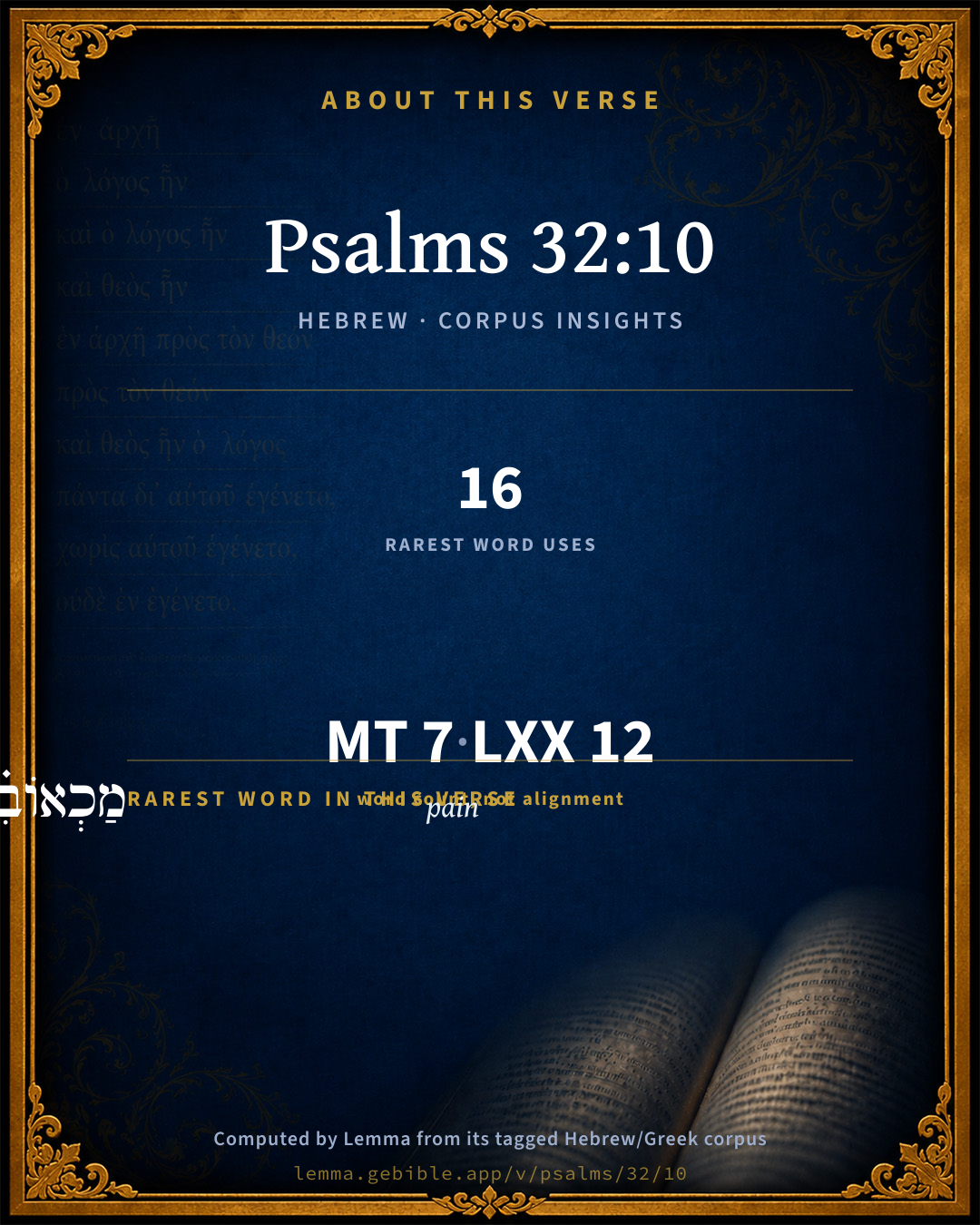
The rarest word here is מַכְאוֹבִ֗ים pain H4341 — appearing just 16 times in the whole Hebrew Bible.

Shared distinctive vocabulary

מַכְאוֹבִ֗ים pain H4341 occurs in 15 verses of the Hebrew Bible. Also found in:

Grammatical profile

  • 2 verbs
  • 3 nouns
  • 2 adjectives

Verb forms

  • וְהַבּוֹטֵ֥חַ Qal · Participle Active
  • יְסוֹבְבֶֽנּוּ Poel · Imperfect

Hebrew & Septuagint length

In English translation the verse runs 18 words from the Hebrew and 18 from the Septuagint (LXX English) — the same length.

A rough comparison of the two English renderings, which tokenize alike — not a word-level alignment.

Word counts can differ between the Hebrew and the Greek without any difference in meaning — e.g. the Hebrew direct-object marker אֵת has no separate Greek word, and Greek often adds the article ὁ.

In the original languages it is 7 Hebrew tokens and 12 Greek tokens — but the two are counted differently (Hebrew bundles its prefixes and suffixes into one token; the Greek is in lemma form), so that isn’t a like-for-like length.

Cross-references

19

Topical passages linked to Psalms 32:10 in the Treasury of Scripture Knowledge — connected by theme and wording, ordered by reader-vote popularity; previews shown in the World English Bible.

  • Proverbs 16:20 He who heeds the Word finds prosperity. Whoever trusts in Yahweh is blessed.
  • Isaiah 12:2–3 Behold, God is my salvation. I will trust, and will not be afraid; for Yah, Yahweh, is my strength and song; and he has become my salvation."
  • Proverbs 13:21 Misfortune pursues sinners, But prosperity rewards the righteous.
  • Psalms 147:11 Yahweh takes pleasure in those who fear him, In those who hope in his loving kindness.
  • Romans 2:8–9 but to those who are self-seeking, and don't obey the truth, but obey unrighteousness, will be wrath and indignation,
  • Psalms 146:5 Happy is he who has the God of Jacob for his help, Whose hope is in Yahweh, his God:
  • 1 Timothy 6:10 For the love of money is a root of all kinds of evil. Some have been led astray from the faith in their greed, and have pierced themselves through with many sorrows.
  • Psalms 5:12 For you will bless the righteous. Yahweh, you will surround him with favor as with a shield.
  • Psalms 34:8 Oh taste and see that Yahweh is good. Blessed is the man who takes refuge in him.
  • Psalms 34:19–21 Many are the afflictions of the righteous, But Yahweh delivers him out of them all.
  • Psalms 2:12 Kiss the son, lest he be angry, and you perish in the way, For his wrath will soon be kindled. Blessed are all those who take refuge in him.
  • Psalms 16:4 Their sorrows shall be multiplied who give gifts to another god. Their drink-offerings of blood I will not offer, Nor take their names on my lips.
  • Psalms 84:12 Yahweh of Hosts, Blessed is the man who trusts in you.
  • Isaiah 3:11 Woe to the wicked! Disaster is upon them; For the deeds of his hands will be paid back to him.
  • Psalms 40:4 Blessed is the man who makes Yahweh his trust, And doesn't respect the proud, nor such as turn aside to lies.
  • Psalms 140:11 An evil speaker won't be established in the earth. Evil will hunt the violent man to overthrow him.
  • Ecclesiastes 8:12 Though a sinner commits crimes a hundred times, and lives long, yet surely I know that it will be better with those who fear God, who are reverent before him.
  • Isaiah 57:21 There is no peace, says my God, to the wicked.
  • Jeremiah 17:7–8 Blessed is the man who trusts in Yahweh, and whose trust Yahweh is.

Cross-references courtesy of OpenBible.info (CC BY 4.0).

Hebrew and Greek witnesses Masoretic Hebrew ↔ Greek Septuagint

The same verse in the two great witnesses to the Old Testament, shown verse-for-verse.

You’re reading Greek Psalm 31 (Hebrew Psalm 32). The Septuagint counts the superscription, so verse numbers can differ from the Hebrew — chapter-level alignment, not verse-by-verse. Numbering follows Rahlfs.

These are two independent witnesses, not word-aligned to each other, and the Septuagint is shown in lemma (dictionary) form.

Hebrew Psalms 32:10 Masoretic · Westminster Leningrad Codex

רַבִּ֥ים מַכְאוֹבִ֗ים לָרָ֫שָׁ֥ע וְהַבּוֹטֵ֥חַ בַּיהוָ֑ה חֶ֝֗סֶד יְסוֹבְבֶֽנּוּ

Many sorrows shall be to the wicked, But he who trusts in Yahweh, loving kindness shall surround him.

World English Bible · Public Domain

Greek LXX Greek Psalm 31:10 Septuagint · lemma form

πολύς ὁ μάστιξ ὁ ἁμαρτωλός ὁ δέ ἐλπίζω ἐπί κύριος ἔλεος κυκλόω

Many are the scourges of the sinner: but him that hopes in the Lord mercy shall compass about.

LXX2012 (modern English Septuagint) · Public Domain

On this verse, The Pulpit Commentary discusses the Septuagint’s reading. Read the note in Commentary ↓

Hebrew: Westminster Leningrad Codex (CC BY 4.0). Greek: Septuagint (public domain); English from LXX2012 (modern English Septuagint) (Public Domain). How the Septuagint differs from the Hebrew →

Commentary

Notes on Psalms 32:10 from classic Christian and Jewish commentators (each source and its license shown beneath its notes). The classic Christian expositions comment on the surrounding passage and are grouped to its opening verse, so a note may address several verses; the Jewish commentaries on the Tanakh (Rashi and others) are per-verse, so they appear only where the commentator wrote on this verse.

Lemma curates 59 commentaries, every one of them public domain or Creative Commons licensed, each selected and text-cleaned for this edition rather than reprinted as found. About our sources →

Trapp's Complete Commentary

John Trapp

Psa 32:10 Many sorrows [shall be] to the wicked: but he that trusteth in the LORD, mercy shall compass him about.

Ver. 10. Many sorrows shall be to the wicked] This is David’s doctrine (his use followeth in the next verse), Many pains, or great smarts, are for the wicked, &c. And as Luther saith, Let him that can rightly distinguish between law and gospel give thanks to God, and know himself to be a good divine; so say I, let him that is firmly persuaded of this truth here delivered know himself to be a good proficient in Christ’s school: for it is the principle of all holy learning.

John Trapp, A Commentary or Exposition upon All the Books of the Old and New Testament (1647–1656) — public domain. Text from a community e-Sword module.

The Biblical Illustrator

Joseph S. Exell

Psa_32:10

Many sorrows shall be to the wicked: but he that trusteth in the Lord, mercy shall compass him about.

The portion of the righteous and the wicked contrasted

Note the contrast in these words. The wicked, and those who trust in the Lord. And the many sorrows of the one, with the encompassing mercy of the other. The psalmist, therefore, defines wickedness as a not trusting in the Lord. This certainly is not the description that would be generally given of a wicked person. You think it too mild to give of a wicked person, simply to affirm in respect of such an one, that he is a man who places no trust in God; and yet more attentive examination will serve to illustrate that scarcely could there be a more emphatic or a more melancholy description to give of a wicked man, than to declare of him that he is the exact opposite of one who puts trust in God. Why, only consider how want of trust in God leads necessarily to all that is depraved and vicious in practice. The man who is devoid of such trust has no defence left to keep him from any one species of wickedness. What is it but trust in God--trust in His character--trust in His promises--trust in His threatenings, which lies at the foundation of all that is morally excellent? Do away with this trust, and there seems to be no safeguard left to hinder from wickedness, or allure to piety. Let this trust be wanting, and where is the motive remaining, whether to animate for duty, or to warn from iniquity? And so if we were set to delineate the moral character of the righteous, we should be tempted to say far more than that he is simply one who puts his trust in God. But because this is the real essence of his character, the root from which springs all else that is good, therefore it is after all the best description that could be given. And whilst the text tells of many sorrows that shall be to the wicked, it does not put joys as the distinguishing lot of the righteous in opposition to those sorrows. But it tells of mercy: not of joy. Let us now seek to vindicate the assertions of the text.

I. As to the wicked. Is it true that many sorrows shall be to them? It often does not seem so, but the very reverse. But wherever a man reposes his main confidence, there he rests the foundation of his peace. But as the wicked does not trust in the Lord, he must be dependent on some created source, and all such are transient and perishable. No man can satisfy the desires of the soul with anything short of God. You cannot centre your affections on any created thing. Sorrow, then, must at length be inherited by the wicked. And they accompany him now; follow him into the recesses of his soul, where conscience will speak and will be heard, and what the soul has perpetually to hear is its condemning voice. There we see how it is that many sorrows shall be to the wicked.

II. As to the righteous. Mercy shall compass him about. Mercy, that is, pity and love. He needs both, for he is a transgressor, and prone to err. Therefore he needs not only love, but pity. And they are his. They are the mercy which environ him round. Who, then, would not rather choose his portion? (R. Bickersteth, B. A.)

The sorrows of the wicked

I. Was are the wicked? Describe the character of the ungodly--

1. By their dislike to God, and contempt of His authority.

2. By their practical violation of the Divine law.

3. By their hatred of the righteous.

4. By their unregenerate nature.

II. what are the sorrows of the wicked?

1. Disappointment (Ecc_2:4; Ecc_2:11; Ecc_2:26).

2. Remorse (Mat_27:4-5; Psa_7:16).

3. Anticipation.

4. The sorrows of hell. (R. Scott.)

Mercy for those who trust in the Lord

This is most encouraging and consolatory. It refers to--

1. The supplies with which God will favour us. What is it but mercy that feeds, clothes, and provides for us according to our several necessities? We have no claim to any of these blessings on the ground of human merit. God does not feed us because we deserve this grace: it is His mercy compassing us about.

2. The compassionate regard which God exercises toward us. When we consider our manifest defects, our imperfections, our infirmities, what reason have we to fear that God should enter into judgment with us!

3. The defence with which God will surround His people. Our enemies may beset us on every side, but mercy shall compass us about: Job; Daniel. (R. Scott.)

The righteous encompassed by mercy

Gods mercies are always more numerous than we see them. We choose to call one tiring or another a benefit and a blessing because it happens to fit our desires, or, at least, our ideas of what a blessing ought to be. But we are too insensible, too short-sighted, to see all the stars of Gods goodness in the sky. Only here and there do we perceive a point of light, a larger or a lesser sun or planet. But had we finer spiritual vision, we should perceive the innumerable points of light in what are now to us but the dark interstellar spaces. The highly-sensitized plate of the astronomical photographer reveals a countless multitude of stars where a field-glass, or even a telescope, fails to discover aught but blank space. We have not gone so far yet in our spiritual perceptions--we are not yet so spiritually sensitized--as to see our sky a blaze of light. But each new revelation, each new star or group of stars, as it appears above our horizon, ought to be an evidence that the dark is not darkness, but light unperceived. The sky of life is not merely studded with mercies. It is itself mercy. (P. Du Bois.)

The Biblical Illustrator, edited by Joseph S. Exell (c. 1880s–1900s) — public domain. Text from a community e-Sword module.

Joseph Benson's Commentary

Psa 32:10. Many sorrows shall be to the wicked — This is an argument to enforce the preceding admonition; as if he had said, If any will be refractory or unruly, God hath many ways to curb and chastise them, and bring them to be subject to his will. “They,” says Dr. Horne, “who are not to be reformed by gentler methods, must learn righteousness under the rod of affliction, in the school of the cross; and happy are they if their sorrows may so turn to their advantage. But happier are those who, led by the goodness of God to repentance and faith, enjoy the light and protection of mercy.” For, He that trusteth in the Lord, &c. — Who relies upon his providence and promise, for his preservation and deliverance, and commits himself to God’s care and conduct, waiting upon him in his way, and not turning aside to crooked or sinful paths for safety or comfort; mercy shall compass him about — Namely, on every side, and preserve him from departing from God on the one hand, and shall prevent any real evil from assaulting him on the other.

Joseph Benson's Commentary on the Old and New Testaments (1811–1818) — public domain. Text from a community e-Sword module.

The Pulpit Commentary

Many sorrows shall be to the wicked. A further warning to those addressed in the preceding verse. The LXX emphasize this by substituting for the generic "sorrows" the specific mastigev , "lashes," the usual punishment of the horse and mule. But he that trusteth in the Lord, mercy shall compass him about. (comp. Deu_32:10)

The Pulpit Commentary (1880–1919), ed. H.D.M. Spence-Jones & Joseph S. Exell — public domain. Text from a community e-Sword module.

J. A. Alexander on Psalms

Joseph Addison Alexander

10. (Psa 32:10) Many pains (are) to the wicked; and (as to) the (man) trusting in Jehovah, mercy shall encompass him, or, he will encompass him (with) mercy. In this and the remaining verse the psalmist loses sight, not only of the horse and mule, to which he had compared the stubborn sinner, but of the particular case which had occasioned the comparison, and closes with the statement of a general truth, founded in necessity and verified by all experience, that sin produces misery and trust in God salvation. It is implied though not expressed in the first clause, that the sufferings of the wicked, while he still continues such, are hopeless and incurable, while those to which the righteous is subjected, are salutary in effect and temporary in duration. See below, Psa 34:20 (19). Here again, as in Psa 31:15 (14) above, we may observe that the antithesis is not between the wicked and the absolutely righteous, but between the wicked and the man trusting in Jehovah, and that the effect ascribed to this trust is not the recognition of the man's inherent righteousness, but his experience of God's mercy, which implies that he is guilty and unworthy in himself, and can only be delivered from the necessary consequences of his sin, by simply trusting in the mercy of the very Being whom he has offended.—Of the two constructions given in the version of the closing words, the last is recommended by the analogy of Psa 32:7, where the same verb governs two accusatives.

Joseph Addison Alexander, The Psalms Translated and Explained (1850) — public domain. Text from a community e-Sword module.

Tyndale Open Study Notes

Tyndale Open Resources

32:10 Difficulties common to all of life will ensnare the wicked, whereas the Lord promises to protect the godly with his care.

Tyndale Open Study Notes — © Tyndale Open Resources, licensed CC BY-SA 4.0. Text via the HelloAO Bible API.

Jamieson, Fausset & Brown

Robert Jamieson, A. R. Fausset & David Brown

The sorrows of the impenitent contrasted with the peace and safety secured by God's mercy.

Jamieson, Fausset & Brown — Commentary Critical and Explanatory on the Whole Bible (1871) — public domain (CC PDM 1.0). Text via the HelloAO Bible API.

Adam Clarke's Commentary

Verse 10. Many sorrows shall be to the wicked] Every wicked man is a miserable man. God has wedded sin and misery as strongly as he has holiness and happiness. God hath joined them together; none can put them asunder.

But he that trusteth in the Lord] Such a person is both safe and happy.

Adam Clarke's Commentary on the Bible (1810–1826) — public domain. Text from a community e-Sword/MySword module.

John Calvin's Commentaries

10. Many sorrows shall be to the wicked. Without a figure he here declares what will be the condition of the rebellious and stiff-necked. Fry reads, “Many are the wounds of the refractory;” on which he has the following note:- “We perceive in this place the exact idea of ושץ, in its allusion to the restive, disobedient, unyielding, ungovernable mule or horse. It is opposed to בטח, to confide in, to yield to, or succumb, as the gentle beast fully confides and yields himself to the management of his guide.”

John Calvin's Commentaries (1540-1563) — public domain. Text from the Calvin Translation Society English edition (1840s-50s) via the Christian Classics Ethereal Library (ccel.org). Calvin's coverage is partial (roughly two-thirds of the Bible); uncommented books and verses are honest gaps, never fabricated. The 19th-century editor's footnotes and remarks are omitted so the notes are faithfully Calvin's own voice.

The Cambridge Bible for Schools and Colleges

gen. ed. J. J. S. Perowne

10. The warning given in the preceding verse is confirmed by the contrast between the lot of the ungodly and the faithful.

many sorrows] Calamities and chastisements. The LXX has μάστιγες, scourges. Cp. Job_33:19.

mercy] Lovingkindness (Psa_31:7; Psa_31:16; Psa_31:21; Psa_33:5; Psa_33:18; Psa_33:22). The clause may also be rendered, with lovingkindness will he compass him about. Cp. Psa_32:7.

The Cambridge Bible for Schools and Colleges (gen. ed. J. J. S. Perowne; Cambridge University Press, 1878–1918) — public domain. Text from a community e-Sword module.

John Gill's Exposition

Many sorrows shall be to the wicked,.... Who will not be instructed and reformed, but are like the horse and mule, without understanding; many outward sorrows or afflictions attend them; loathsome and consuming diseases come upon their bodies by intemperance and debauchery; and they and their families are brought to a piece of bread, through their vicious courses; and inward sorrows, horror and terror of mind, seize them when their consciences are at any time awakened, and are open to conviction; when a load of guilt lies on them, what remorse of conscience they feel! and what severe reflections do they make! and how are they pierced through with many sorrows! And though indeed, for the most part, wicked men have their good things in this life, and are in prosperous circumstances, and are not in trouble, as other men; yet what they have is with a curse; and they have no true peace, pleasure, and satisfaction in what they enjoy; and the curses of a righteous law; and everlasting destruction is prepared for them in the other world, when they will have many sorrows indeed; their worm will not die, and the fire of divine fury will not be quenched; there will be for ever indignation and wrath, tribulation and anguish, upon every soul of man that does evil;

but he that trusteth in the Lord; not in his wealth and riches, in his wisdom and strength, in himself, and his own righteousness; for such are wicked persons; but in the Lord; in his righteousness to justify him, in his blood to pardon him, in his strength to support him, and in his grace to supply him with everything necessary for him;

mercy shall compass him about; not only follow him and overtake him, but surround him; he shall be crowned with lovingkindness and tender mercies: the phrase denotes the abundance of mercies that shall be bestowed upon him here and hereafter, as both grace and glory.

John Gill's Exposition of the Whole Bible (1746–1763) — public domain (CC PDM 1.0). Text via the HelloAO Bible API.

Albert Barnes' Notes on the Bible

Many sorrows shall be to the wicked - The meaning here is, probably, that those who will not submit themselves to God in the manner which the psalmist recommends; who are like the horse and the mule, needing to be restrained, and who are to be restrained only by force, will experience bitter sorrows. The psalmist may refer here, in part, to sorrows such as he says he himself experienced when he attempted to suppress the convictions of guilt Psa 32:3-4; and partly to the punishment that will come upon the impenitent sinner for his sins. The sorrows referred to are probably both internal and external; those arising from remorse, and those which will be brought upon the guilty as a direct punishment.

But he that trusteth in the Lord - He that has faith in God; he that so confides in him that he goes to him with the language of sincere confession.

Mercy shall compass him about - Shall surround him; shall attend him; shall be on every side of him. It shall not be only in one respect, but in all respects. He shall be “surrounded” with mercy - as one is surrounded by the air, or by the sunlight. He shall find mercy and favor everywhere, at home, abroad; by day, by night; in society, in solitude; in sickness, in health; in life, in death; in time, in eternity. He shall walk amidst mercies; he shall die amidst mercies; he shall live in a better world in the midst of eternal mercies.

Albert Barnes' Notes on the Bible (1834–1885) — public domain. Text from a community e-Sword/MySword module.

Matthew Poole's English Annotations

Many sorrows shall be to the wicked: this is an argument to enforce the foregoing admonition; if any men will be refractory and unruly, God hath many ways to curb and chastise them, and bring them to his will.

He that trusteth in the Lord; who relies upon his providence and promise for his preservation and deliverance, and commits himself to God’s care and conduct, waiting upon him in his way, and not turning aside to crooked or sinful paths for safety or satisfaction.

Matthew Poole's English Annotations on the Holy Bible (1683–1685) — public domain. Text from a community e-Sword/MySword module.

The Treasury of David

Charles H. Spurgeon

Ver. 10. Many sorrows shall be to the wicked. Like refractory horses and mules, they have many cuts and bruises. Here and hereafter the portion of the wicked is undesirable. Their joys are evanescent, their sorrows are multiplying and ripening. He who sows sin will reap sorrow in heavy sheaves. Sorrows of conscience, of disappointment, of terror, are the sinner's sure heritage in time, and then for ever sorrows of remorse and despair. Let those who boast of present sinful joys, remember the shall be of the future and take warning. But he that trusteth in the Lord, mercy shall compass him about. Faith is here placed as the opposite of wickedness, since it is the source of virtue. Faith in God is the great charmer of life's cares, and he who possesses it, dwells in an atmosphere of grace, surrounded with the bodyguard of mercies. May it be given to us of the Lord at all times to believe in the mercy of God, even when we cannot see traces of its working, for to the believer, mercy is as all surrounding as omniscience, and every thought and act of God is perfumed with it. The wicked have a hive of wasps around them, many sorrows; but we have a swarm of bees storing honey for us.

Ver. 10. He that trusteth in the Lord, mercy shall compass him about. Even as in the midst of the sphere is the centre, from which all lines being drawn do tend towards their circumference: so a good Christian man hath God for his circumference; for whatever he thinketh, speaketh, or doth, it tendeth to Christ, of whom he is compassed round about. Robert Cawdray.

Ver. 10. Mercy shall compass him about. He shall be surrounded with mercyas one is surrounded by the air, or by the sunlight. He shall find mercy and favour everywhereat home, abroad; by day, by night; in society, in solitude; in sickness, in health; in life, in death; in time, in eternity. He shall walk amidst mercies; he shall die amidst mercies; he shall live in a better world in the midst of eternal mercies. Albert Barnes.

Ver. 10. "Mark that text, "said Richard Adkins to his grandson Abel, who was reading to him the thirty-second Psalm. "Mark that text, `He that trusteth in the Lord, mercy shall compass him about.' I read it in my youth and believed it; and now I read it in my old age, thank God, I know it to be true. Oh! it is a blessed thing in the midst of the joys and sorrows of the world, Abel, to trust in the Lord." The Christian Treasury, 1848.

Ver. 10. The many sorrows which result from sin. The encompassing mercy of the believer's life even in his most troublesome times.

The portion of the wicked, and the lot of the faithful.

Psalms 32:11*

Charles H. Spurgeon's The Treasury of David (1869–1885) — public domain. Psalms only. Text from a community e-Sword/MySword module.

Whedon's Commentary on the Bible

Daniel D. Whedon

10, 11. These verses are a summing up of the whole in the contrast of the conditions and treatment of the righteous and the wicked, and an exhortation to joy and praise by all the upright.

Daniel D. Whedon (gen. ed.), Commentary on the Old and New Testaments (1874–1909) — public domain. Text from a community e-Sword module.

John Wesley's Explanatory Notes

Sorrows - This is an argument to enforce the foregoing admonition.

John Wesley, Explanatory Notes Upon the Whole Bible (1754–1765) — public domain. Text via the GEBible commentary corpus.

Lesson kit

Teaching starters — assembled from the data on this page, not authored interpretation. Every prompt links to the verse data it draws on. Edit before teaching.

Psalms, in the Wisdom, opens this verse with 7 words (7 distinct Hebrew lemmas). Its most distinctive word is makʼôb (“pain”). A historical commentator’s framing appears above. Read the whole chapter for the surrounding context.

Discussion questions

  1. How does “pain” (makʼôb) shape what this verse is saying?
  2. Exodus 3:7 shares the word «pain» with this verse. How do the two illuminate each other?
  3. These translations render this verse differently; the difference is in the English rendering, not the original. What questions does that raise?
  4. The verb «וְהַבּוֹטֵ֥חַ» is Qal Participle Active. How does its form color the action?
  5. Reading how Trapp's Complete Commentary and The Biblical Illustrator read this verse, where do the two commentators agree and where do they part?

Things to notice

Reading settings

Reading text

Shown beneath each verse's original-language words.

Old Testament
Old Testament edition

Read the OT as the Masoretic Hebrew (MT) or the Greek Septuagint (LXX).

English shown for the Greek Septuagint (in the Hebrew ↔ Greek comparison).

Comparing translations? Open the Compare panel on any verse page to stack up to four side by side.