
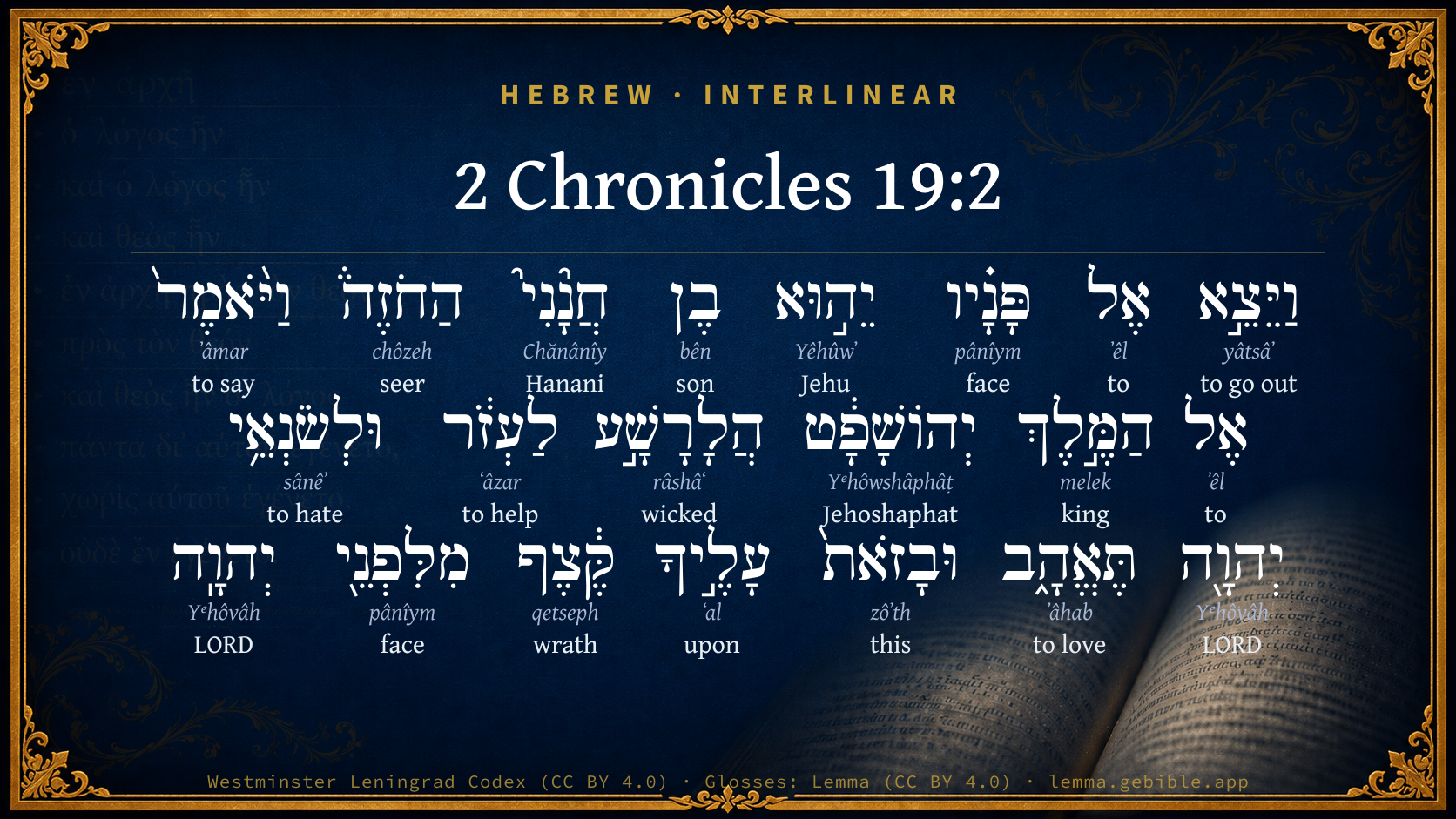
2 Chronicles 19:2

Hebrew (Westminster Leningrad Codex) 2 Chronicles 19:2 appears in the Hebrew Old Testament. The text above is from the Westminster Leningrad Codex. Each word links to its Strong’s number, a concise gloss, and parsing drawn from the Open Scriptures Hebrew Bible morphology. Click any word for its full Brown-Driver-Briggs (BDB) entry.
Download image
Cite this verse

2 Chronicles 19:2 (World English Bible). Public Domain. Lemma interlinear Bible study tool, https://lemma.gebible.app/v/2-chronicles/19/2.

Show BibTeX & RIS
BibTeX
RIS
English Translation
Jehu the son of Hanani the seer went out to meet him, and said to king Jehoshaphat, Should you help the wicked, and love those who hate Yahweh? for this thing wrath is on you from before Yahweh.
World English Bible · Public Domain
Download a study sheet

One document with this verse’s original text, its word-by-word gloss line, the meaning frame, cross-references with their text, attributed commentary, and full source and license credits — printable, and it pastes into notes with its structure intact.

This verse Autodidact and up

Study sheet (.html) Plain text (.txt)

A passage Seminary Student

Up to 50 verses in one chapter. A passage sheet keeps up to 6 commentary sources and 12 cross-references per verse, in the order this page ranks them, and says so on the sheet whenever that leaves anything out. Ask for a single verse and you get the Autodidact verse sheet above.

Everything on this page stays free to read, with no account — the sheet is a download of what is already on screen, not access to it.

Want to remove ads? Support Godless Engineer
Compare translations 3

The same verse in 3 English versions, stacked beneath the original-language interlinear above. Click any original word for its lexicon entry.

Each is an independent rendering of the whole verse — the interlinear is not word-aligned to these translations.

Highlighted words mark where these versions differ — a whole-verse word diff, not a word-by-word alignment.

  • World English Bible Public Domain
    Jehu the son of Hanani the seer went out to meet him, and said to king Jehoshaphat, Should you help the wicked, and love those who hate Yahweh? for this thing wrath is on you from before Yahweh.
  • King James Version Public Domain
    And Jehu the son of Hanani the seer went out to meet him, and said to king Jehoshaphat, Shouldest thou help the ungodly, and love them that hate the LORD? therefore is wrath upon thee from before the LORD.
  • unfoldingWord Literal Text CC BY-SA 4.0
    But Jehu, the son of Hanani the seer, went out to his face, and he said to King Jehoshaphat, “Should the wicked you help and the ones who hate Yahweh you love? And because of this, upon you is wrath from before Yahweh.

unfoldingWord Literal Text — © unfoldingWord, licensed CC BY-SA 4.0. Word-aligned USFM3 via Door43 (git.door43.org/unfoldingWord/en_ult).

Versions to compare (up to 4)

3 of 4 selected

Show all 18 translations

Every available English version of this verse, each an independent rendering of the whole verse.

  • World English Bible Public Domain
    Jehu the son of Hanani the seer went out to meet him, and said to king Jehoshaphat, Should you help the wicked, and love those who hate Yahweh? for this thing wrath is on you from before Yahweh.
  • Berean Standard Bible Public Domain
    Jehu son of Hanani the seer went out to confront him and said to King Jehoshaphat, “Should you help the wicked and love those who hate the LORD? Because of this, the wrath of the LORD is upon you.
  • Majority Standard Bible Public Domain
    Jehu son of Hanani the seer went out to confront him and said to King Jehoshaphat, “Should you help the wicked and love those who hate the LORD? Because of this, the wrath of the LORD is upon you.
  • King James Version Public Domain
    And Jehu the son of Hanani the seer went out to meet him, and said to king Jehoshaphat, Shouldest thou help the ungodly, and love them that hate the LORD? therefore is wrath upon thee from before the LORD.
  • American Standard Version (1901) Public Domain
    And Jehu the son of Hanani the seer went out to meet him, and said to king Jehoshaphat, Shouldest thou help the wicked, and love them that hate Jehovah? for this thing wrath is upon thee from before Jehovah.
  • Revised Version (1885) Public Domain
    And Jehu the son of Hanani the seer went out to meet him, and said to king Jehoshaphat, Shouldest thou help the wicked, and love them that hate the LORD? for this thing wrath is upon thee from before the LORD.
  • Geneva Bible (1599) Public Domain
    And Iehu the sonne of Hanani the Seer went out to meete him, and said to King Iehoshaphat, Wouldest thou helpe the wicked, and loue them that hate the Lord? therefore for this thing the wrath of the Lord is vpon thee.
  • Douay-Rheims (1899) Public Domain
    And Jehu the son of Hanani the seer met him, and said to him: Thou helpest the ungodly, and thou art joined in friendship with them that hate the Lord, and therefore thou didst deserve indeed the wrath of the Lord:
  • Young's Literal Translation Public Domain
    and go out unto his presence doth Jehu son of Hanani, the seer, and saith unto king Jehoshaphat, `To give help to the wicked, and to those hating Jehovah, dost thou love? and for this against thee `is' wrath from before Jehovah,
  • Literal Standard Version CC BY-SA 4.0
    and Jehu son of Hanani the seer goes out to his presence and says to King Jehoshaphat, “Do you love to give help to the wicked and to those hating YHWH? And for this, wrath [is] against you from before YHWH,
  • Unlocked Literal Bible CC BY-SA 4.0
    Then Jehu son of Hanani, the seer, went out to meet him and said to King Jehoshaphat, “Should you be helping the wicked? Should you be loving those who hate Yahweh? For this deed, anger from Yahweh is on you.
  • unfoldingWord Literal Text CC BY-SA 4.0
    But Jehu, the son of Hanani the seer, went out to his face, and he said to King Jehoshaphat, “Should the wicked you help and the ones who hate Yahweh you love? And because of this, upon you is wrath from before Yahweh.
  • Darby Bible Public Domain
    And Jehu the son of Hanani, the seer, went out to meet him, and said to king Jehoshaphat, Shouldest thou help the ungodly, and love them that hate Jehovah? Therefore is wrath upon thee from Jehovah.
  • World Messianic Bible Public Domain
    Jehu the son of Hanani the seer went out to meet him, and said to King Jehoshaphat, “Should you help the wicked, and love those who hate the LORD? Because of this, wrath is on you from before the LORD.
  • Webster's Bible Public Domain
    And Jehu the son of Hanani the seer went out to meet him, and said to king Jehoshaphat, Shouldst thou help the ungodly, and love them that hate the LORD? therefore is wrath upon thee from before the LORD.
  • Free Bible Version CC BY-SA 4.0
    Jehu, son of Hanani, the seer went out to face him. He said to King Jehoshaphat, “Why are you helping the wicked? Why do you love those who hate the Lord? The Lord is angry with you because of this.
  • Bible in Basic English Public Domain
    And Jehu, the son of Hanani the seer, went to King Jehoshaphat and said to him, Is it right for you to go to the help of evil-doers, loving the haters of the Lord? because of this, the wrath of the Lord has come on you.
  • JPS Tanakh (1917) Public Domain
    And Jehu the son of Hanani the seer went out to meet him, and said to king Jehoshaphat: 'Shouldest thou help the wicked, and love them that hate the LORD? for this thing wrath is upon thee from before the LORD.

Literal Standard Version (2020), Covenant Press — licensed CC BY-SA 4.0. Text via the HelloAO Bible API (eBible.org). Unlocked Literal Bible (unfoldingWord) — licensed CC BY-SA 4.0. Text via the HelloAO Bible API (eBible.org). unfoldingWord Literal Text — © unfoldingWord, licensed CC BY-SA 4.0. Word-aligned USFM3 via Door43 (git.door43.org/unfoldingWord/en_ult). Free Bible Version, Dr. Jonathan Gallagher — licensed CC BY-SA 4.0. Text via the HelloAO Bible API (eBible.org).

Word by word

More ways to search: Search by grammar → Find every occurrence → Compare this word →

Practice this passage: Drill this verse → Learn its vocabulary →

חֲנָ֘נִי֮
Chănânîy
H2607
“Hanani”
Noun, Proper
Part of Speech
Noun
Type
Proper
Full BDB Definition

Origin: from H2603

TWOT: None

Hanani = "gracious" - one of the sons of Heman, a chief musician of David, and head of the 18th course of the service - a seer who rebuked Asa, king of Judah, and was imprisoned - maybe, father of Jehu the seer who testified against Baasha - one of the priests who in the time of Ezra took a foreign wife - brother of Nehemiah whom Nehemiah appointed governor of Jerusalem - another priest who was the chief musician under Nehemiah
  1. וַיֵּצֵ֣א yâtsâʼ H3318 “and · to go out” Conjunction + Verb, Qal, Sequential Imperfect, 3rd Person, Masculine, Singular
  2. אֶל ʼêl H413 “to” Preposition
  3. פָּנָ֗יו pânîym H6440 “face(s) · his” Noun, Common, Both, Plural, Construct + Suffix, Personal, 3rd Person, Masculine, Singular
  4. יֵה֣וּא Yêhûwʼ H3058 “Jehu” Noun, Proper
  5. בֶן bên H1121 “son of” Noun, Common, Masculine, Singular, Construct
  6. הַחֹזֶה֒ chôzeh H2374 “the · seer” Particle, Definite Article + Verb, Qal, Participle Active, Masculine, Singular, Absolute
  7. וַיֹּ֨אמֶר֙ ʼâmar H559 “and · to say” Conjunction + Verb, Qal, Sequential Imperfect, 3rd Person, Masculine, Singular
  8. אֶל ʼêl H413 “to” Preposition
  9. הַמֶּ֣לֶךְ melek H4428 “the · king” Particle, Definite Article + Noun, Common, Masculine, Singular, Absolute
  10. יְהוֹשָׁפָ֔ט Yᵉhôwshâphâṭ H3092 “Jehoshaphat” Noun, Proper
  11. הֲלָרָשָׁ֣ע râshâʻ H7563 “to/for the · wicked” Particle, Interrogative + Preposition, Determined + Adjective, Adjective, Masculine, Singular, Absolute
  12. לַעְזֹ֔ר ʻâzar H5826 “to help” Preposition + Verb, Qal, Infinitive Construct
  13. וּלְשֹׂנְאֵ֥י sânêʼ H8130 “and · to/for · hating” Conjunction + Preposition + Verb, Qal, Participle Active, Masculine, Plural, Construct
  14. יְהוָ֖ה Yᵉhôvâh H3068 “LORD” Noun, Proper
  15. תֶּאֱהָ֑ב ʼâhab H157 “to love” Verb, Qal, Imperfect, 2nd Person, Masculine, Singular
  16. וּבָזֹאת֙ zôʼth H2063 “and · in/at · this” Conjunction + Preposition + Pronoun, Demonstrative, Feminine, Singular
  17. עָלֶ֣יךָ ʻal H5921 “upon · you” Preposition + Suffix, Personal, 2nd Person, Masculine, Singular
  18. קֶּ֔צֶף qetseph H7110 “wrath” Noun, Common, Masculine, Singular, Absolute
  19. מִלִּפְנֵ֖י pânîym H6440 “from · to/for · face(s) of” Preposition + Preposition + Noun, Common, Both, Plural, Construct
  20. יְהוָֽה Yᵉhôvâh H3068 “LORD” Noun, Proper

About this verse

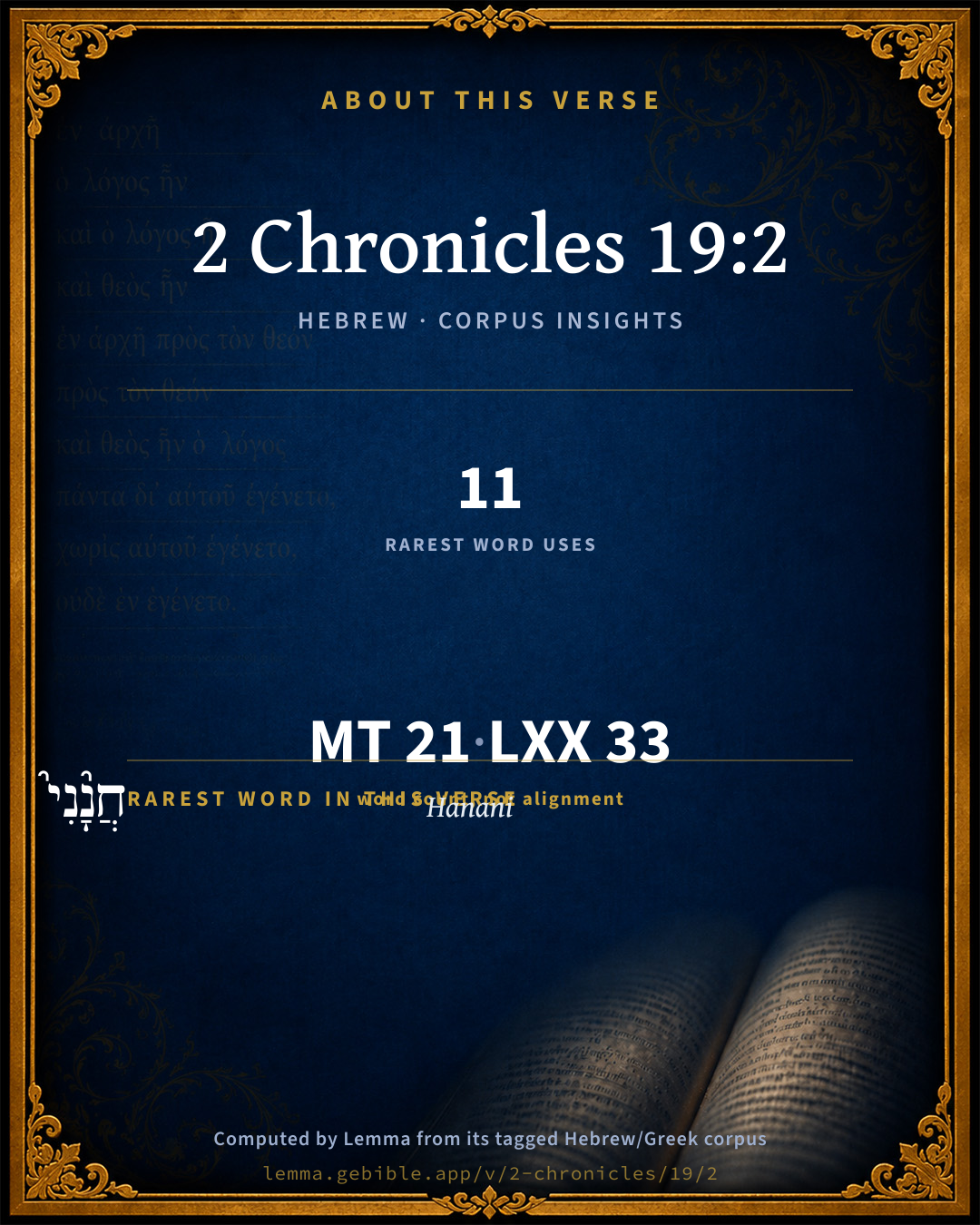
These counts appear in no published source. They are computed here, from the morphology-tagged text and Lemma’s own curated glosses. What Lemma adds →

21
words
18
distinct lemmas
Historical
section

Notable vocabulary

The rarest word here is חֲנָ֘נִי֮ Hanani H2607 — appearing just 11 times in the whole Hebrew Bible.

Shared distinctive vocabulary

חֲנָ֘נִי֮ Hanani H2607 occurs in 11 verses of the Hebrew Bible. Also found in:

Grammatical profile

  • 6 verbs
  • 10 nouns
  • 1 adjective
  • 1 pronoun
  • 3 prepositions

Verb forms

  • וַיֵּצֵ֣א Qal · Sequential Imperfect
  • הַחֹזֶה֒ Qal · Participle Active
  • וַיֹּ֨אמֶר֙ Qal · Sequential Imperfect
  • לַעְזֹ֔ר Qal · Infinitive Construct
  • וּלְשֹׂנְאֵ֥י Qal · Participle Active
  • תֶּאֱהָ֑ב Qal · Imperfect

Repetition

Words recur within this verse — often emphatic in Hebrew:

  • פָּנָ֗יו face H6440 ×2
  • יְהוָ֖ה LORD H3068 ×2
  • אֶל to H413 ×2

Hebrew & Septuagint length

In English translation the verse runs 38 words from the Hebrew and 43 from the Septuagint (LXX English) — closely comparable.

A rough comparison of the two English renderings, which tokenize alike — not a word-level alignment.

Word counts can differ between the Hebrew and the Greek without any difference in meaning — e.g. the Hebrew direct-object marker אֵת has no separate Greek word, and Greek often adds the article ὁ.

In the original languages it is 21 Hebrew tokens and 33 Greek tokens — but the two are counted differently (Hebrew bundles its prefixes and suffixes into one token; the Greek is in lemma form), so that isn’t a like-for-like length.

Cross-references

35

Topical passages linked to 2 Chronicles 19:2 in the Treasury of Scripture Knowledge — connected by theme and wording, ordered by reader-vote popularity; previews shown in the World English Bible.

  • Psalms 139:21–22 Yahweh, don't I hate those who hate you? Am I not grieved with those who rise up against you?
  • 2 John 1:10–11 If anyone comes to you, and doesn't bring this teaching, don't receive him into your house, and don't welcome him,
  • 2 Chronicles 18:3 Ahab king of Israel said to Jehoshaphat king of Judah, Will you go with me to Ramoth-gilead? He answered him, I am as you are, and my people as your people; and [we will be] with you in the war.
  • Ephesians 5:11 Have no fellowship with the unfruitful works of darkness, but rather even reprove them.
  • James 4:4 You adulterers and adulteresses, don't you know that friendship with the world is enmity with God? Whoever therefore wants to be a friend of the world makes himself an enemy of God.
  • 1 Kings 16:1 The word of Yahweh came to Jehu the son of Hanani against Baasha, saying,
  • 2 Chronicles 16:7 At that time Hanani the seer came to Asa king of Judah, and said to him, Because you have relied on the king of Syria, and have not relied on Yahweh your God, therefore is the host of the king of Syria escaped out of your hand.
  • 2 Chronicles 20:34 Now the rest of the acts of Jehoshaphat, first and last, behold, they are written in the history of Jehu the son of Hanani, which is inserted in the book of the kings of Israel.
  • 2 Chronicles 24:18 They forsook the house of Yahweh, the God of their fathers, and served the Asherim and the idols: and wrath came on Judah and Jerusalem for this their guiltiness.
  • 2 Chronicles 32:25 But Hezekiah didn't render again according to the benefit done to him; for his heart was lifted up: therefore there was wrath on him, and on Judah and Jerusalem.
  • 1 Samuel 9:9 (In earlier times in Israel, when a man went to inquire of God, thus he said, Come, and let us go to the seer; for he who is now called a Prophet was before called a Seer.)
  • Romans 8:7 because the mind of the flesh is hostile towards God; for it is not subject to God's law, neither indeed can it be.
  • Exodus 20:5 you shall not bow yourself down to them, nor serve them, for I, Yahweh your God, am a jealous God, visiting the iniquity of the fathers on the children, on the third and on the fourth generation of those who hate me,
  • Deuteronomy 5:9 you shall not bow down yourself to them, nor serve them; for I, Yahweh, your God, am a jealous God, visiting the iniquity of the fathers on the children, and on the third and on the fourth generation of those who hate me;
  • Deuteronomy 7:10 and repays those who hate him to their face, to destroy them: he will not be slack to him who hates him, he will repay him to his face.
  • Deuteronomy 32:41 If I whet my glittering sword, My hand take hold on judgment; I will render vengeance to my adversaries, Will recompense those who hate me.
  • Deuteronomy 33:11 Bless, Yahweh, his substance, Accept the work of his hands: Smite through the loins of those who rise up against him, Of those who hate him, that they not rise again.
  • 1 Kings 16:7 Moreover by the prophet Jehu the son of Hanani came the word of Yahweh against Baasha, and against his house, both because of all the evil that he did in the sight of Yahweh, to provoke him to anger with the work of his hands, in being like the house of Jeroboam, and because he struck him.
  • 1 Kings 16:12 Thus did Zimri destroy all the house of Baasha, according to the word of Yahweh, which he spoke against Baasha by Jehu the prophet,
  • 1 Kings 21:25 (But there was none like Ahab, who did sell himself to do that which was evil in the sight of Yahweh, whom Jezebel his wife stirred up.
  • 2 Chronicles 18:7 The king of Israel said to Jehoshaphat, There is yet one man by whom we may inquire of Yahweh: but I hate him; for he never prophesies good concerning me, but always evil: the same is Micaiah the son of Imla. Jehoshaphat said, Don't let the king say so.
  • 2 Chronicles 18:28 So the king of Israel and Jehoshaphat the king of Judah went up to Ramoth-gilead.
  • Psalms 15:4 In whose eyes a vile man is despised, But who honors those who fear Yahweh; He who keeps an oath even when it hurts, and doesn't change;
  • Psalms 21:8 Your hand will find out all of your enemies. Your right hand will find out those who hate you.
  • Psalms 68:1 Let God arise! Let his enemies be scattered! Let them who hate him also flee before him.
  • Psalms 90:7–8 For we are consumed in your anger. We are troubled in your wrath.
  • Proverbs 1:10–19 My son, if sinners entice you, don't consent.
  • John 15:18 If the world hates you, you know that it has hated me before it hated you.
  • John 15:23 He who hates me, hates my Father also.
  • Romans 1:18 For the wrath of God is revealed from heaven against all ungodliness and unrighteousness of men, who suppress the truth in unrighteousness,
  • Romans 1:30 backbiters, hateful to God, insolent, haughty, boastful, inventors of evil things, disobedient to parents,
  • Romans 1:32 who, knowing the ordinance of God, that those who practice such things are worthy of death, not only do the same, but also approve of those who practice them.
  • 1 Corinthians 11:31–32 For if we discerned ourselves, we wouldn't be judged.
  • 2 Chronicles 18:1 Now Jehoshaphat had riches and honor in abundance; and he joined affinity with Ahab.
  • Psalms 71:15 My mouth will tell about your righteousness, And of your salvation all day, Though I don't know its full measure.

Cross-references courtesy of OpenBible.info (CC BY 4.0).

Hebrew and Greek witnesses Masoretic Hebrew ↔ Greek Septuagint

The same verse in the two great witnesses to the Old Testament, shown verse-for-verse.

These are two independent witnesses, not word-aligned to each other, and the Septuagint is shown in lemma (dictionary) form.

Hebrew 2 Chronicles 19:2 Masoretic · Westminster Leningrad Codex

וַיֵּצֵ֣א אֶל פָּנָ֗יו יֵה֣וּא בֶן חֲנָ֘נִי֮ הַחֹזֶה֒ וַיֹּ֨אמֶר֙ אֶל הַמֶּ֣לֶךְ יְהוֹשָׁפָ֔ט הֲלָרָשָׁ֣ע לַעְזֹ֔ר וּלְשֹׂנְאֵ֥י יְהוָ֖ה תֶּאֱהָ֑ב וּבָזֹאת֙ עָלֶ֣יךָ קֶּ֔צֶף מִלִּפְנֵ֖י יְהוָֽה

Jehu the son of Hanani the seer went out to meet him, and said to king Jehoshaphat, Should you help the wicked, and love those who hate Yahweh? for this thing wrath is on you from before Yahweh.

World English Bible · Public Domain

Greek LXX 2 Chronicles 19:2 Septuagint · lemma form

καί ἐκἔρχομαι εἰς ἀπάντησις αὐτός ιου ὁ ὁ ανανι ὁ προφήτης καί εἶπον αὐτός βασιλεύς ιωσαφατ εἰ ἁμαρτωλός σύ βοηθέω ἤ μισέω ὑπό κύριος φιλιάζω διά οὗτος γίγνομαι ἐπί σύ ὀργή παρά κύριος

And there went out to meet him Jeu the prophet the son of Anani, and said to him, King Josaphat, do you help a sinner, or act friendly towards one hated of the Lord? Therefore has wrath come upon you from the Lord.

LXX2012 (modern English Septuagint) · Public Domain

Hebrew: Westminster Leningrad Codex (CC BY 4.0). Greek: Septuagint (public domain); English from LXX2012 (modern English Septuagint) (Public Domain). How the Septuagint differs from the Hebrew →

Commentary

Notes on 2 Chronicles 19:2 from classic Christian and Jewish commentators (each source and its license shown beneath its notes). The classic Christian expositions comment on the surrounding passage and are grouped to its opening verse, so a note may address several verses; the Jewish commentaries on the Tanakh (Rashi and others) are per-verse, so they appear only where the commentator wrote on this verse.

Lemma curates 59 commentaries, every one of them public domain or Creative Commons licensed, each selected and text-cleaned for this edition rather than reprinted as found. About our sources →

Trapp's Complete Commentary

John Trapp

2Ch 19:2 And Jehu the son of Hanani the seer went out to meet him, and said to king Jehoshaphat, Shouldest thou help the ungodly, and love them that hate the LORD? therefore [is] wrath upon thee from before the LORD.

Ver. 2. And Jehu the son of Hanani the seer.] Jehu delivered his message with better success than his father had done. {2Ch 16:7} Asa had gall in his ears, as some creatures are said to have; but good Jehoshaphat had aures purgatissimas, a "hearing ear," {Pro 20:12} an "obedient ear," {Pro 25:12} upon which "a wise reprover is as an earring of gold, and an ornament of fine gold." {See Trapp on "Pro 25:12"}

Shouldest thou help the ungodly,] i.e., That wicked wretch Ahab, of whom it might be said, as afterwards it was of the Jews in St Paul’s time, that "they pleased not God, and were contrary to all men," {1Th 2:15} or as the historian said of Commodus, the emperor, that he was called "the enemy of God and men."

And love them that hate the Lord?] I think not. Idolaters are God-haters - whatever they pretend - and are therefore to be heartily "hated," {Psa 139:22} provided that we hate non virum, sed vitium, not the man, but his manners.

Therefore is wrath upon thee.] Thy late great danger was a fair warning, and must be kept in recent remembrance. The Moabites and the Ammonites, &c., are preparing against thee. The prophet also might have respect - as one {a} hath well observed - to some dissension that began at present betwixt his sons; the seeds of that horrid slaughter Jehoram did afterwards make amongst them. {2Ch 21:4}

{a} Mr Jackson.

John Trapp, A Commentary or Exposition upon All the Books of the Old and New Testament (1647–1656) — public domain. Text from a community e-Sword module.

Whedon's Commentary on the Bible

Daniel D. Whedon

2. Jehu — This prophet had previously exercised his office in the kingdom of Israel, and had foretold the doom of Baasha. 1Ki_16:1, note.

Went out to meet him — As he was returning to his house from the war. So Azariah went out to meet Asa as the latter returned from the war with Zerah. 2Ch_15:2. But Jehu received a better treatment from Jehoshaphat than his father Hanani had received from Asa. 2Ch_16:10.

Shouldest thou help the ungodly — Such as the idolatrous Ahab, whose kingdom is so largely given over to the worship of Baal and Ashtoreth.

Love them that hate the Lord — Jehoshaphat’s affinity with Ahab’s family by marriage exposed him to this charge of loving those that hated Jehovah. Jezebel, and all whom she could influence, seem to have had a hatred towards Jehovah and his worshippers. Comp. 1Ki_18:4; 1Ki_19:2.

Wrath upon thee — Jehovah’s indignation, which will result in future woes to Judah.

Daniel D. Whedon (gen. ed.), Commentary on the Old and New Testaments (1874–1909) — public domain. Text from a community e-Sword module.

Geneva Bible (1599)

Geneva Bible translators

Hebrew, wrath from the Lord.

He declareth that the wrath and judgment of God is over all such that support the wicked, and rather show not in deed that they are enemies to all such as hate the Lord.

Geneva Bible (1599) marginal notes — public domain. Text via Bolls.life.

Adam Clarke's Commentary

Verse 2. Jehu the son of Hanani] We have met with this prophet before; 1Kg 16:7.

Therefore is wrath upon thee] That is, Thou deservest to be punished. And who can doubt this, who knows that he did help the ungodly, and did love them that hated Jehovah? And is not the wrath of God upon all those alliances which his people form with the ungodly, whether they be social, matrimonial, commercial, or political?

Adam Clarke's Commentary on the Bible (1810–1826) — public domain. Text from a community e-Sword/MySword module.

Ellicott's Commentary for English Readers

(2) And Jehu the son of Hanani the seer.—The seer whose father had suffered for his reproof of Asa (2Ch_16:7-10), and who had himself already witnessed against Baasha, king of Israel (1Ki_16:1-7).

To meet him.—Unto his presence (1Ch_12:17; 2Ch_15:2).

King.—The king. The prophets never shrank from facing the highest representatives of earthly power (comp. 1Ki_21:20).

Shouldest thou help.—Literally, to help the ungodly. The infinitive (as in 1Ch_5:1; 1Ch_9:25), i.e., oughtest thou to help.

The ungodly.—.The emphatic word. (See Psa_139:21-22; Psa_119:158 : “I beheld the transgressors with loathing.”)

Them that hate the Lord.—And haters of Jehovah lovest thou? (The particle le prefixed to the word for “haters” is characteristic of the chronicler’s style.)

Therefore is wrath upon thee.—See the same phrase, 1Ch_27:24. In the case of David, the Divine wrath was embodied in pestilence; what form did it take with Jehoshaphat? The following chapters seem to supply the answer. His land suffered invasion and his fleet shipwreck; his posterity was evil, and came to an evil end (2 Chronicles 20, 21, 22). There may be reference also to the failure of the campaign in which Jehoshaphat had engaged, and his inglorious return to his own land.

A Bible Commentary for English Readers, edited by Charles John Ellicott (1878–1897) — public domain. Text from a community e-Sword module.

The Cambridge Bible for Schools and Colleges

gen. ed. J. J. S. Perowne

2. Jehu the son of Hanani] He must have been an old man at this time for he had prophesied against Baasha (1Ki_16:1), since whose time two kings had reigned in Israel, viz., Omri (12 years) and Ahab (22 years).

the ungodly] R.V. the wicked.

and love them that hate the Lord] Cp. Psa_139:21-22.

therefore is wrath upon thee] R.V. for this thing wrath is upon thee, i.e. a visitation of wrath is impending. The visitation is described in chap. 20. For “wrath” (Heb. qeçeph) cp. 2Ki_3:27 R.V. mg.

The Cambridge Bible for Schools and Colleges (gen. ed. J. J. S. Perowne; Cambridge University Press, 1878–1918) — public domain. Text from a community e-Sword module.

John Gill's Exposition

And Jehu the son of Hanani the seer,.... The son of him that reproved Asa, for which he put him in prison, Ch2 17:7, but that did not deter this his son from reproving Jehoshaphat:

went out to meet him; as he was returning:

and said to King Jehoshaphat, shouldest thou help the ungodly; such an one as Ahab, an idolater, murderer, and persecutor:

and love them that hate the Lord? his laws, worship, and ordinances, as he had; intimating, that he had done wrong, by entering into alliance and affinity with him, by showing him friendship, and assisting him in his war against the Syrians:

therefore is wrath upon thee from before the Lord; which appeared in the war of the Ammonites and Moabites with him, related in the next chapter, and in the calamities that came upon his family, his sons being slain by Jehoram that succeeded him, and his grandsons by Jehu.

John Gill's Exposition of the Whole Bible (1746–1763) — public domain (CC PDM 1.0). Text via the HelloAO Bible API.

Albert Barnes' Notes on the Bible

Jehu ... went out to meet him - Compare 2Ch 15:2. The monarch was therefore rebuked at the earliest possible moment, and in the most effective way, as he was entering his capital at the head of his returning army. Jehu, 35 years previously, had worked in the northern kingdom, and prophesied against Baasha 1Ki 16:1-7, but had now come to Jerusalem, as prophet and historian (compare 2Ch 20:34).

Shouldest thou help ... - As a matter of mere human policy, the conduct of Jehoshaphat in joining Ahab against the Syrians was not only justifiable but wise and prudent. And the reasonings upon which such a policy was founded would have been unexceptionable but for one circumstance. Ahab was an idolater, and had introduced into his kingdom a false religion of a new and most degraded type. This should have led Jehoshaphat to reject his alliance. Military success could only come from the blessing and protection of Yahweh, which such an alliance, if persisted in, was sure to forfeit.

Albert Barnes' Notes on the Bible (1834–1885) — public domain. Text from a community e-Sword/MySword module.

Haydock's Catholic Bible Commentary

Thou. Sept. "O king Josaphat, if thou helpest the sinner; or, wilt thou befriend one hated by the Lord?" Prot. "shouldst thou....love them that hate the Lord?" H. --- The Donatists hence inferred, that it was not lawful to converse with sinners. But S. Augustine (contra ep. Par. ii. 18.) replied, that Josaphat was blamed for aiding Achab in the contempt of the true prophet, and for going to battle conformably to the predictions of impostors. Both kings offended, but in a different degree. W. --- We must also keep at as great a distance as possible from the notorious enemies of God, as their conversation is dangerous. T. --- Evil communications corrupt the best of manners. See Psalm cxxxviii., &c.

George Leo Haydock (1774–1849), Haydock's Catholic Family Bible and Commentary, 1859 edition — public domain. Excludes Psalms (Douay-Rheims chapter numbering differs from Protestant) and Deuterocanonical books (Catholic canon only).

Matthew Poole's English Annotations

Jehu the son of Hanani the seer; of whom see 1Ki 16:1.

Shouldest thou help the ungodly, and love them that hate the Lord? was this agreeable to thy duty and love which thou professest to God and godliness, that thou hast entered into so strict an alliance and friendship with wicked Ahab, my sworn enemy, and given such assistance to him?

Therefore is wrath upon thee from before the Lord; therefore God is angry with thee, and will chastise thee for this miscarriage: which he did, partly, by stirring up the Moabites and others to invade him, 2Ch 20; partly, by permitting his eldest son Jehoram to kill all his brethren, 2Ch 21:4; and principally, by bringing that sore and almost general destruction upon his grandchildren by Jehu, 2Ki 9:27; 10:13,14, which was the proper fruit of his alliance with Ahab.

Matthew Poole's English Annotations on the Holy Bible (1683–1685) — public domain. Text from a community e-Sword/MySword module.

The Pulpit Commentary

And Jehu the son of Hanani the seer went out to meet him. For Hanani, the faithful father of a faithful son, see 2Ch_16:7-10, where we read that he "came to Asa King of Judah," etc. Also for Jehu, see 1Ki_16:1-4, where we read of his commission at the word of the Lord to rebuke Baasha the King of Israel, at a date upwards of thirty years before the present; and see 2Ch_20:34, which would lead us to infer, though not with certainty, that he outlived Jehoshaphat. The book called by his name, however, was not necessarily finished by him. It is evident that neither the word of the Lord nor the messengers and prophets of the Lord were bound by the orthodox limits of the divided kingdom. The powerful character and the moral force of the true prophet is again seen. (comp. 2Ch_15:1-8) in the way in which he was wont to go out to meet the evil-doer, though he were a king. We are accustomed to set the whole of this down to the account of the special inspiration of the prophet of old; yet that was but typical of the intrinsic force that truth faithfully spoken should wield in its own right in later times. Religion is established in the nation and people that know and do this, by the accredited teachers of it, vie. the plain rebuke of the wrong. Shouldest thou love them that hate the Lord? Strong suspicion must attend upon Jehoshaphat, that he had been not a little misled by answering to some personal fascination in Ahab. The prophet"s rebuke is not that Jehoshaphat helped both Israel and therein Judah also against a common foe, but that he helped the ungodly, etc. Therefore wrath upon thee, etc. The significance of this sentence was probably not merely retrospective, glancing at the fact that Jehoshaphat returned to Jerusalem minus the victory for which he had bid, but was probably an intimation of troubles that should ripen, were already ripening for Jehoshaphat, in the coming invasion of his own kingdom. (2Ch_20:1-3)

HOMILIES BY W. CLARKSON Ver. 2.

Friendship with man and faithfulness to God.

The Apostle John fleeing from the baths because he saw the enemy of Christ entering, is a familiar picture. But how far are we to carry such unwillingness to be associated with the ungodly or the unbelieving? Jehoshaphat is here strongly rebuked for his intimacy with Ahab and the help he had been giving that wicked monarch. Let us consider

I HOW FAR OUR FREEDOM EXTENDS. It surely extends to:

1. The interchange of common courtesies. "Be courteous" is a maxim thatwill apply to every one. "Civility brings no conclusions," and may be shown to all people, without implying any sanction of their heresies or immoralities.

2. Fidelity in service and equity in negotiation. It was once thought right totake advantage of a man if he were a Jew or an infidel. But unrighteousness can never be anything but hateful to God and injurious to man, and justice and fair-dealing can never be otherwise than commendable. Moreover, the Christian servant or slave was urged by the apostle to show a right spirit "not only to the good and gentle, but also to the froward". (1Pe_2:18)

3. Succour to those who are in need. Pity for those who are in distress, and the helping hand stretched out to those that are "ready to perish," can never be contrary to the mind and the will of Jesus Christ.

4. Alliance for the promotion of a good common end. Here it may beobjected that this would justify Jehoshaphat in his "offensive alliance" with Ahab, as they were seeking the lawful common object of crippling Syria. But it must be remembered that by helping to sustain the kingdom of Israel Jehoshaphat was perpetuating the division between the twelve tribes, the dismemberment of the country; and he was sustaining a power which was recreant to its high mission, and was positively and seriously hostile to sacred truth, to the kingdom of God. We may lawfully associate with ungodly men as fellow-citizens who are united in such rightful objects as saving life, as promoting health, as providing food, as extending trade and commerce. In so doing we are not in any way compromising principle or sustaining wrong; we are not helping the ungodly" or loving them that hate the Lord.

II WHERE THE LINE OF PROHIBITION IS DRAWN. We have clearly no right to ally ourselves with sinful men when by so doing:

1. We advance the cause of unrighteousness or ungodliness. Better sacrifice anything we have at heart, better leave our personal preferences or our temporal interests entirely disregarded, than do that which will give an impetus to the cause of infidelity or immorality. In such a case we should certainly draw down God"s displeasure; we need no prophet to say to us, "Therefore is wrath upon thee from before the Lord.

1. When we show ourselves indifferent to the honour of our DivineSaviour. Jehoshaphat"s ostentatious companionship with such an enemy of

2. God as Ahab amounted to a tacit intimation that he could, when he wished to do so, be forgetful whose servant he was; he laid by that consideration to serve his momentary purpose. There may be some one who is a very pronounced enemy of Jesus Christ who seeks our friendship. To be very intimate with him is to put a slight upon our attachment to our Lord; it is to put him in the second place. Then fidelity to Christ will keep us at home; will lead us to seek other intimacies, to find our friendships with those who do not "hate the Lord.

3. When we expose our own character to serious risk. For one who is of aweaker mind and will to be associated intimately and for any length of time with an enemy of the Lord, can have but one result. It must issue in spiritual degeneracy; it may, indeed, end in spiritual ruin. Let those who contemplate the formation of a lifelong friendship beware how they trust their souls to any one who can be called "ungodly," how they "love them that hate the Lord." A sensitive, yielding spirit had better be "drowned in the midst of the sea" than be immersed in an atmosphere of worldliness or of unbelief, where all true piety and all living faith are daily being weakened and are constantly withering away. C.

The Pulpit Commentary (1880–1919), ed. H.D.M. Spence-Jones & Joseph S. Exell — public domain. Text from a community e-Sword module.

John Wesley's Explanatory Notes

Therefore - Therefore God will chastise thee for this miscarriage. Which he did partly by stirring up the Moabites, and others to invade him, chap. xx, 1, partly by permitting his eldest son Jehoram to kill all his brethren, chap. xxi, 4, and principally by bringing that almost general destruction upon his grand- children by Jehu, 2 Kings ix, 27; x, 13, 14, which was the fruit of his alliance with Ahab.

John Wesley, Explanatory Notes Upon the Whole Bible (1754–1765) — public domain. Text via the GEBible commentary corpus.

Lesson kit

Teaching starters — assembled from the data on this page, not authored interpretation. Every prompt links to the verse data it draws on. Edit before teaching.

2 Chronicles, in the Historical, opens this verse with 21 words (18 distinct Hebrew lemmas). Its most distinctive word is Chănânîy (“Hanani”). A historical commentator’s framing appears above. Read the whole chapter for the surrounding context.

Discussion questions

  1. The word Chănânîy carries the sense “Hanani.” How does it shape the verse?
  2. 1 Kings 16:1 shares the word «Hanani» with this verse. How do the two illuminate each other?
  3. “face” occurs 2× in this one verse. What is the effect of the repetition?
  4. The translations on this page render this verse differently — a whole-verse word diff, not a word-by-word alignment. What might account for the different wordings?
  5. The verb «וַיֵּצֵ֣א» is Qal Sequential Imperfect. How does its form color the action?
  6. Reading how Trapp's Complete Commentary and Whedon's Commentary on the Bible read this verse, where do the two commentators agree and where do they part?

Things to notice

Reading settings

Reading text

Shown beneath each verse's original-language words.

Old Testament
Old Testament edition

Read the OT as the Masoretic Hebrew (MT) or the Greek Septuagint (LXX).

English shown for the Greek Septuagint (in the Hebrew ↔ Greek comparison).

Comparing translations? Open the Compare panel on any verse page to stack up to four side by side.