
Ecclesiastes 8:10

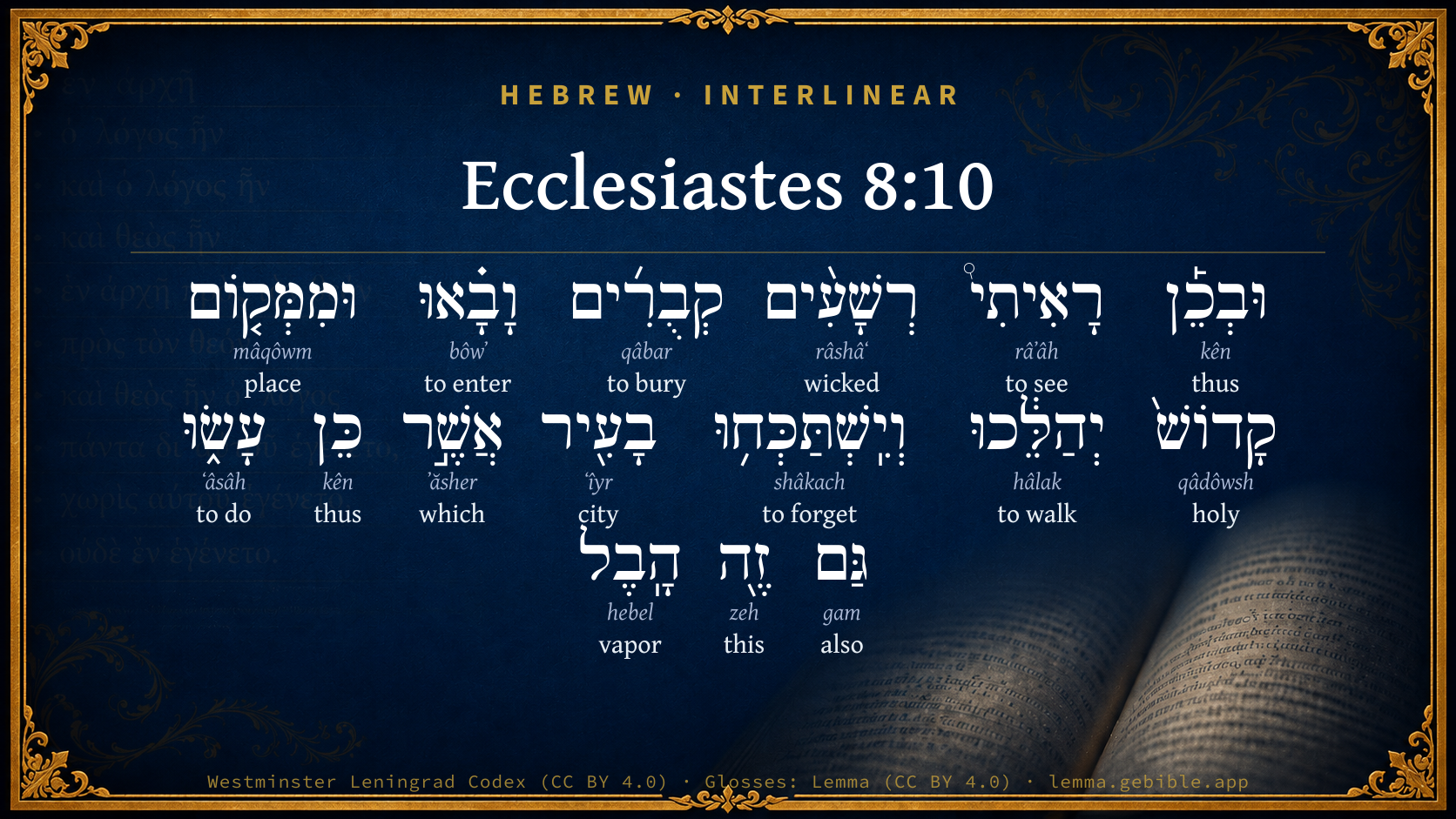
Hebrew (Westminster Leningrad Codex) Ecclesiastes 8:10 appears in the Hebrew Old Testament. The text above is from the Westminster Leningrad Codex. Each word links to its Strong’s number, a concise gloss, and parsing drawn from the Open Scriptures Hebrew Bible morphology. Click any word for its full Brown-Driver-Briggs (BDB) entry.
Download image
Cite this verse

Ecclesiastes 8:10 (World English Bible). Public Domain. Lemma interlinear Bible study tool, https://lemma.gebible.app/v/ecclesiastes/8/10.

Show BibTeX & RIS
BibTeX
RIS
English Translation
So I saw the wicked buried. Indeed they came also from holiness. They went and were forgotten in the city where they did this. This also is vanity.
World English Bible · Public Domain
Download a study sheet

One document with this verse’s original text, its word-by-word gloss line, the meaning frame, cross-references with their text, attributed commentary, and full source and license credits — printable, and it pastes into notes with its structure intact.

This verse Autodidact and up

Study sheet (.html) Plain text (.txt)

A passage Seminary Student

Up to 50 verses in one chapter. A passage sheet keeps up to 6 commentary sources and 12 cross-references per verse, in the order this page ranks them, and says so on the sheet whenever that leaves anything out. Ask for a single verse and you get the Autodidact verse sheet above.

Everything on this page stays free to read, with no account — the sheet is a download of what is already on screen, not access to it.

Want to remove ads? Support Godless Engineer
Compare translations 3

The same verse in 3 English versions, stacked beneath the original-language interlinear above. Click any original word for its lexicon entry.

Each is an independent rendering of the whole verse — the interlinear is not word-aligned to these translations.

Highlighted words mark where these versions differ — a whole-verse word diff, not a word-by-word alignment.

  • World English Bible Public Domain
    So I saw the wicked buried. Indeed they came also from holiness. They went and were forgotten in the city where they did this. This also is vanity.
  • King James Version Public Domain
    And so I saw the wicked buried, who had come and gone from the place of the holy, and they were forgotten in the city where they had so done: this is also vanity.
  • unfoldingWord Literal Text CC BY-SA 4.0
    And then, I saw wicked people buried, and they entered, and, from a place of holiness, they went. And they were praised in the city where thus they had done. This also vapor:

unfoldingWord Literal Text — © unfoldingWord, licensed CC BY-SA 4.0. Word-aligned USFM3 via Door43 (git.door43.org/unfoldingWord/en_ult).

Versions to compare (up to 4)

3 of 4 selected

Show all 18 translations

Every available English version of this verse, each an independent rendering of the whole verse.

  • World English Bible Public Domain
    So I saw the wicked buried. Indeed they came also from holiness. They went and were forgotten in the city where they did this. This also is vanity.
  • Berean Standard Bible Public Domain
    Then too, I saw the burial of the wicked who used to go in and out of the holy place, and they were praised in the city where they had done so. This too is futile.
  • Majority Standard Bible Public Domain
    Then too, I saw the burial of the wicked who used to go in and out of the holy place, and they were praised in the city where they had done so. This too is futile.
  • King James Version Public Domain
    And so I saw the wicked buried, who had come and gone from the place of the holy, and they were forgotten in the city where they had so done: this is also vanity.
  • American Standard Version (1901) Public Domain
    So I saw the wicked buried, and they came `to the grave'; and they that had done right went away from the holy place, and were forgotten in the city: this also is vanity.
  • Revised Version (1885) Public Domain
    And withal I saw the wicked buried, and they came to the grave; and they that had done right went away from the holy place, and were forgotten in the city: this also is vanity.
  • Geneva Bible (1599) Public Domain
    And likewise I sawe the wicked buried, and they returned, and they that came from the holy place, were yet forgotten in the citie where they had done right: this also is vanitie.
  • Douay-Rheims (1899) Public Domain
    I saw the wicked buried: who also when they were yet living were in the holy place, and were praised in the city as men of just works: but this also is vanity.
  • Young's Literal Translation Public Domain
    And so I have seen the wicked buried, and they went in, even from the Holy Place they go, and they are forgotten in the city whether they had so done. This also `is' vanity.
  • Literal Standard Version CC BY-SA 4.0
    And so I have seen the wicked buried, and they went in, even from the Holy Place they go, and they are forgotten in the city whether they had so done. This [is] also vanity.
  • Unlocked Literal Bible CC BY-SA 4.0
    So I saw the wicked buried publicly. They were taken from the holy area and buried and were praised by people in the city where they had done their wicked deeds. This also is uselessness.
  • unfoldingWord Literal Text CC BY-SA 4.0
    And then, I saw wicked people buried, and they entered, and, from a place of holiness, they went. And they were praised in the city where thus they had done. This also vapor:
  • Darby Bible Public Domain
    And I have also seen the wicked buried and going away; and such as had acted rightly went from [the] holy place, and were forgotten in the city. This also is vanity.
  • World Messianic Bible Public Domain
    So I saw the wicked buried. Indeed they came also from holiness. They went and were forgotten in the city where they did this. This also is vanity.
  • Webster's Bible Public Domain
    And so I saw the wicked buried, who had come and gone from the place of the holy, and they were forgotten in the city where they had so done: this is also vanity.
  • Free Bible Version CC BY-SA 4.0
    Yes, I have seen wicked people buried with great honor. They used to go to the holy place, and were praised in the very city where they did their evil. This is hard to understand!
  • Bible in Basic English Public Domain
    And then I saw evil men put to rest, taken even from the holy place; and they went about and were praised in the town because of what they had done. This again is to no purpose.
  • JPS Tanakh (1917) Public Domain
    And so I saw the wicked buried, and they entered into their rest; but they that had done right went away from the holy place, and were forgotten in the city; this also is vanity.

Literal Standard Version (2020), Covenant Press — licensed CC BY-SA 4.0. Text via the HelloAO Bible API (eBible.org). Unlocked Literal Bible (unfoldingWord) — licensed CC BY-SA 4.0. Text via the HelloAO Bible API (eBible.org). unfoldingWord Literal Text — © unfoldingWord, licensed CC BY-SA 4.0. Word-aligned USFM3 via Door43 (git.door43.org/unfoldingWord/en_ult). Free Bible Version, Dr. Jonathan Gallagher — licensed CC BY-SA 4.0. Text via the HelloAO Bible API (eBible.org).

Word by word

More ways to search: Search by grammar → Find every occurrence → Compare this word →

Practice this passage: Drill this verse → Learn its vocabulary →

הָֽבֶל
hebel
H1892
“vapor”
Noun, Common, Masculine, Singular, Absolute
Part of Speech
Noun
Type
Common
Gender
Masculine
Number
Singular
State
Absolute
Full BDB Definition

Origin: from H1891

TWOT: 463a

vapour, breath - breath, vapour - vanity (figuratively) - vainly
  1. וּבְכֵ֡ן kên H3651 “and · in/at · thus” Conjunction + Preposition + Adverb
  2. רָאִיתִי֩ râʼâh H7200 “to see” Verb, Qal, Perfect, 1st Person, Common, Singular
  3. רְשָׁעִ֨ים râshâʻ H7563 “wicked” Adjective, Adjective, Masculine, Plural, Absolute
  4. קְבֻרִ֜ים qâbar H6912 “buried” Verb, Qal, Participle Passive, Masculine, Plural, Absolute
  5. וָבָ֗אוּ bôwʼ H935 “and · to enter” Conjunction + Verb, Qal, Perfect, 3rd Person, Common, Plural
  6. וּמִמְּק֤וֹם mâqôwm H4725 “and · from · place of” Conjunction + Preposition + Noun, Common, Masculine, Singular, Construct
  7. קָדוֹשׁ֙ qâdôwsh H6918 “holy” Adjective, Adjective, Masculine, Singular, Absolute
  8. יְהַלֵּ֔כוּ hâlak H1980 “to walk” Verb, Piel, Imperfect, 3rd Person, Masculine, Plural
  9. וְיִֽשְׁתַּכְּח֥וּ shâkach H7911 “and · to forget” Conjunction + Verb, Hithpael, Imperfect, 3rd Person, Masculine, Plural
  10. בָעִ֖יר ʻîyr H5892 “in/at the · city” Preposition, Determined + Noun, Common, Feminine, Singular, Absolute
  11. אֲשֶׁ֣ר ʼăsher H834 “which” Particle, Relative
  12. כֵּן kên H3651 “thus” Particle, Demonstrative
  13. עָשׂ֑וּ ʻâsâh H6213 “to do” Verb, Qal, Perfect, 3rd Person, Common, Plural
  14. גַּם gam H1571 “also” Particle, Accusative
  15. זֶ֖ה zeh H2088 “this” Pronoun, Demonstrative, Masculine, Singular

About this verse

These counts appear in no published source. They are computed here, from the morphology-tagged text and Lemma’s own curated glosses. What Lemma adds →

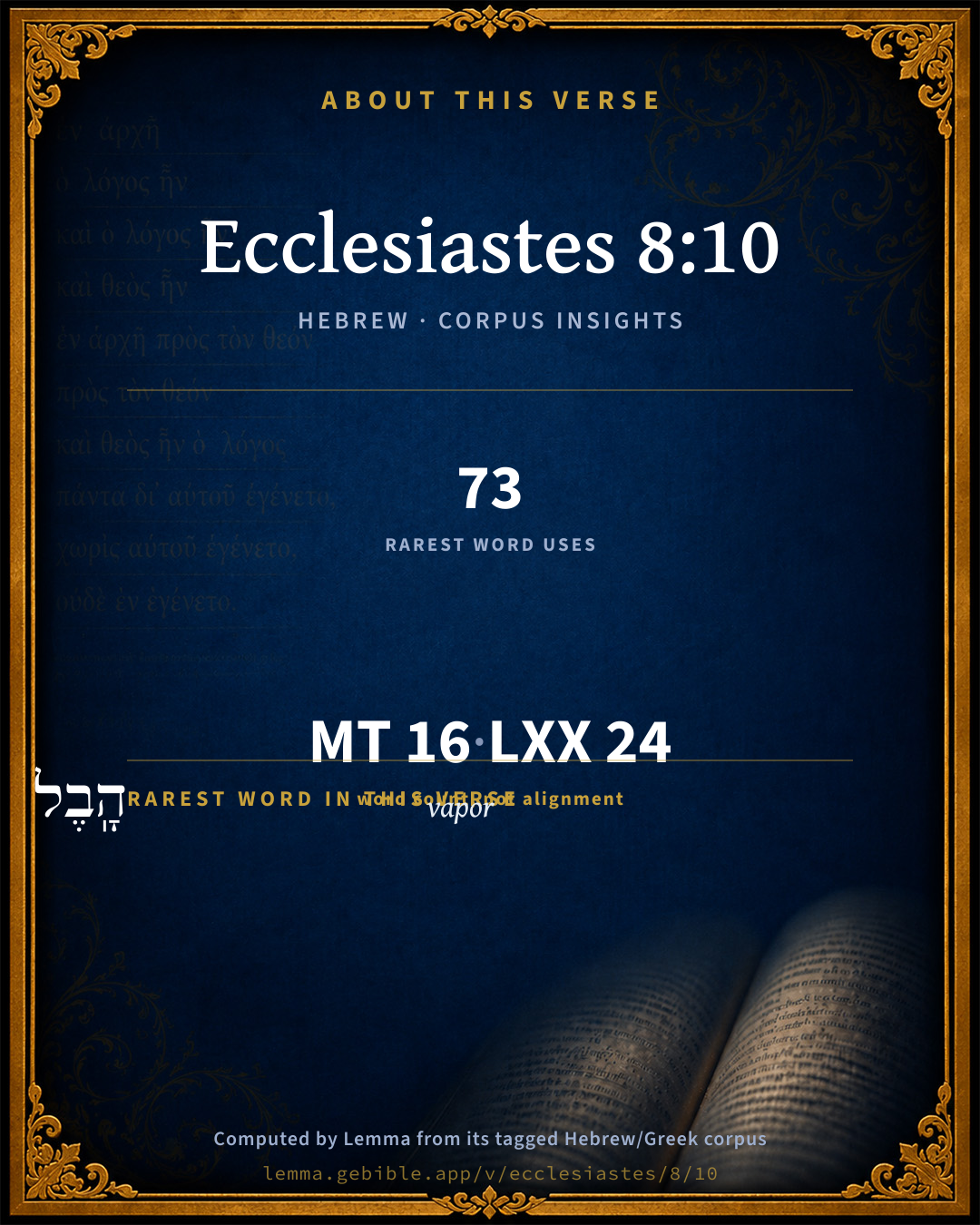
16
words
15
distinct lemmas
Wisdom
section

Grammatical profile

  • 6 verbs
  • 3 nouns
  • 2 adjectives
  • 1 pronoun
  • 1 adverb
  • 3 particles

Verb forms

  • רָאִיתִי֩ Qal · Perfect
  • קְבֻרִ֜ים Qal · Participle Passive
  • וָבָ֗אוּ Qal · Perfect
  • יְהַלֵּ֔כוּ Piel · Imperfect
  • וְיִֽשְׁתַּכְּח֥וּ Hithpael · Imperfect
  • עָשׂ֑וּ Qal · Perfect

Repetition

A word recurs within this verse — often emphatic in Hebrew:

  • וּבְכֵ֡ן thus H3651 ×2

Hebrew & Septuagint length

In English translation the verse runs 28 words from the Hebrew and 35 from the Septuagint (LXX English) — closely comparable.

A rough comparison of the two English renderings, which tokenize alike — not a word-level alignment.

Word counts can differ between the Hebrew and the Greek without any difference in meaning — e.g. the Hebrew direct-object marker אֵת has no separate Greek word, and Greek often adds the article ὁ.

In the original languages it is 16 Hebrew tokens and 24 Greek tokens — but the two are counted differently (Hebrew bundles its prefixes and suffixes into one token; the Greek is in lemma form), so that isn’t a like-for-like length.

Cross-references

13

Topical passages linked to Ecclesiastes 8:10 in the Treasury of Scripture Knowledge — connected by theme and wording, ordered by reader-vote popularity; previews shown in the World English Bible.

  • Proverbs 10:7 The memory of the righteous is blessed, But the name of the wicked will rot.
  • Ecclesiastes 2:16 For of the wise man, even as of the fool, there is no memory for ever, seeing that in the days to come all will have been long forgotten. Indeed, the wise man must die just like the fool!
  • Ecclesiastes 9:5 For the living know that they will die, but the dead don't know anything, neither do they have any more a reward; for the memory of them is forgotten.
  • 2 Kings 9:34–35 When he was come in, he ate and drink; and he said, See now to this cursed woman, and bury her; for she is a king's daughter.
  • Job 21:18 That they are as stubble before the wind, As chaff that the storm carries away?
  • Job 21:32–33 Yet shall he be borne to the grave, Men shall keep watch over the tomb.
  • Psalms 31:12 I am forgotten from their hearts like a dead man. I am like broken pottery.
  • Ecclesiastes 1:11 There is no memory of the former; neither shall there be any memory of the latter that are to come, among those that shall come after.
  • Jeremiah 17:13 Yahweh, the hope of Israel, all who forsake you shall be disappointed. Those who depart from me shall be written in the earth, because they have forsaken Yahweh, the spring of living waters.
  • Luke 16:22 It happened that the beggar died, and that he was carried away by the angels to Abraham's bosom. The rich man also died, and was buried.
  • Acts 6:13 and set up false witnesses who said, "This man never stops speaking blasphemous words against this holy place and the law.
  • Hebrews 10:38 But the righteous will live by faith. If he shrinks back, my soul has no pleasure in him."
  • Psalms 122:1–5 I was glad when they said to me, "Let's go to Yahweh's house!"

Cross-references courtesy of OpenBible.info (CC BY 4.0).

Hebrew and Greek witnesses Masoretic Hebrew ↔ Greek Septuagint

The same verse in the two great witnesses to the Old Testament, shown verse-for-verse.

These are two independent witnesses, not word-aligned to each other, and the Septuagint is shown in lemma (dictionary) form.

Hebrew Ecclesiastes 8:10 Masoretic · Westminster Leningrad Codex

וּבְכֵ֡ן רָאִיתִי֩ רְשָׁעִ֨ים קְבֻרִ֜ים וָבָ֗אוּ וּמִמְּק֤וֹם קָדוֹשׁ֙ יְהַלֵּ֔כוּ וְיִֽשְׁתַּכְּח֥וּ בָעִ֖יר אֲשֶׁ֣ר כֵּן עָשׂ֑וּ גַּם זֶ֖ה הָֽבֶל

So I saw the wicked buried. Indeed they came also from holiness. They went and were forgotten in the city where they did this. This also is vanity.

World English Bible · Public Domain

Greek LXX Ecclesiastes 8:10 Septuagint · lemma form

καί τότε ὁράω ἀσεβής εἰς τάφος εἰςἄγω καί ἐκ τόπος ἅγιος πορεύομαι καί ἐπιαἰνέω ἐν ὁ πόλις ὅτι οὕτως ποιέω καί γέ οὗτος ματαιότης

And then I saw the ungodly carried into the tombs, and that out of the holy place: and they departed, and were praised in the city, because they had done thus: this also is vanity.

LXX2012 (modern English Septuagint) · Public Domain

On this verse, John Gill's Exposition discusses the Septuagint’s reading. Read the note in Commentary ↓

Hebrew: Westminster Leningrad Codex (CC BY 4.0). Greek: Septuagint (public domain); English from LXX2012 (modern English Septuagint) (Public Domain). How the Septuagint differs from the Hebrew →

Commentary

Notes on Ecclesiastes 8:10 from classic Christian and Jewish commentators (each source and its license shown beneath its notes). The classic Christian expositions comment on the surrounding passage and are grouped to its opening verse, so a note may address several verses; the Jewish commentaries on the Tanakh (Rashi and others) are per-verse, so they appear only where the commentator wrote on this verse.

Lemma curates 59 commentaries, every one of them public domain or Creative Commons licensed, each selected and text-cleaned for this edition rather than reprinted as found. About our sources →

Trapp's Complete Commentary

John Trapp

Ecc 8:10 And so I saw the wicked buried, who had come and gone from the place of the holy, and they were forgotten in the city where they had so done: this [is] also vanity.

Ver. 10. And so I saw the wicked buried.] With pomp and great solemnity, funeral orations, statues, and epitaphs, &c., as if he had been another Josiah or Theodosius; so do men overwhelm this mouse with praises proper to the elephant, as the proverb hath it.

Who had come and gone from the place of the holy.] That is, From the place of magistracy, seat of judicature, where the holy God himself sits as Chief President and Lord Paramount. {Deu 1:17 2Ch 19:6 Psa 82:1}

And they were forgotten in the city where they had so done.] A great benefit to a wicked man to have his memory die with him, which if it be preserved stinks in keeping, and remains as a curse and perpetual disgrace, as one very well senseth it. {a}

{a} Pemble

John Trapp, A Commentary or Exposition upon All the Books of the Old and New Testament (1647–1656) — public domain. Text from a community e-Sword module.

The Biblical Illustrator

Joseph S. Exell

Ecc_8:10

And so I saw the wicked buried, who had come and gone from the place of the holy, and they were forgotten in the city where they had so done: this is also vanity.

The wicked mans life, funeral and epitaph

I. In the first place, here is some good company for you; some with whom you may walk to the house of God, for it is said of them that they did come and go from the place of the holy. By this, I think we may understand the place where the righteous meet to worship God. Gods house may be called the place of the holy. Still, if we confine ourselves strictly to the Hebrew, and to the connection, it appears that by the place of the holy is intended the judgment-seat--the place where the magistrate dispenses justice; and, alas I there be some wicked who come and go even to the place of judgment to judge their fellow-sinners. And we may with equal propriety consider it in a third sense to represent the pulpit, which should be the place of the holy: but we have seen the wicked come and go even from the pulpit, though God has never commanded them to declare his statutes. Happy the day when all such persons shall be purged from the pulpit; then shall it stand forth clear as the sun, fair as the moon, and terrible as an army with banners. I have seen the wicked come and go from the place of the holy.

II. And now we are going to his funeral. I shall want you to attend it. There is a man who has come and gone from the place of the holy. He has made a very blazing profession. He has been a county magistrate. Now, do you see what a stir is made about his poor bones? There is the hearse covered with plumes, and there follows a long string of carriages. The country people stare to see such a long train of carriages coming to follow one poor worm to its resting-place. What pomp! what grandeur! Will you just think of it, and who are they mourning for? A hypocrite! Who is all this pomp for? For one who was a wicked man; a man who made a pretension of religion; a man who judged others, and who ought to have been condemned himself. But possibly I may have seen the wicked man buried in a more quiet way. He is taken quietly to his tomb with as little pomp as possible, and he is with all decency and solemnity interred in the grave. And now listen to the minister. If he is a man of God, when he buries such a man as he ought to be buried, you do not hear a solitary word about the character of the deceased; you hear nothing at all about any hopes of everlasting life. He is put into his grave. As for the pompous funeral, that was ludicrous. A man might almost laugh to see the folly of honouring the man who deserved to be dishonoured, but as for the still and silent and truthful funeral, how sad it is! We ought to judge ourselves very much in the light of our funerals. That is the way we judge other things. Look at your fields to-morrow. There is the flaunting poppy, and there by the hedge-rows are many flowers that lift their heads to the sun. Judging them by their leaf, you might prefer them to the sober-coloured wheat. But wait until the funeral when the poppy shall be gathered and the weeds shall be bound up in a bundle to be burned--gathered into a heap in the field to be consumed, to be made into manure for the soil. But see the funeral of the wheat. What a magnificent funeral has the wheat-sheaf. Harvest home is shouted as it is carried to the garner, for it is a precious thing. Even so let each of us so live, as considering that we must die. But there is a sad thing yet to come. We must look a little deeper than the mere ceremonial of the burial, and we shall see that there is a great deal more in some peoples coffins besides their corpses. If we had eyes to see invisible things, and we could break the lid of the hypocrites coffin, we should see a great deal there. There lie all his hopes. The wicked man may come and go from the place of the holy, but he has no hope of being saved. He thought, because he had attended the place of the holy regularly, therefore he was safe for another world. There lie his hopes, and they are to be buried with him. Of all the frightful things that a man can look upon, the face of a dead hope is the most horrible. Wrapt in the same shroud, there lie all his dead pretensions. When he was here he made a pretension of being respectable; there lies his respect, he shall be a hissing and a reproach lev ever. But there is one thing that sleeps with him in his coffin that he had set his heart upon. He had set his heart upon being known after he was gone. He thought surely after he had departed this life he would be handed down to posterity and be remembered. Now read the text--And they were forgotten in the city where they had so done. There is his hope of fame. I have often noticed how soon wicked things die when the man dies who originated them. Look at Voltaires philosophy; with all the noise it made in his time--where is it now? There is just a little of it lingering, but it seems to have gone. And there was Tom Paine, who did his best to write his name in letters of damnation, and one would think he might have been remembered. Butt who cares for him now? Except amongst a few, here and there, his name has passed away. And all the names of error, and heresy, and schism, where do they go? You hear about St. Austin to this day, but you never hear about the heretics he attacked. Everybody knows about Athanasius, and how he stood up for the divinity of the Lord Jesus Christ; but we have almost forgotten the life of Arius, and scarcely ever think of those men who aided and abetted him in his folly. Bad men die out quickly, for the world feels it is a good thing to be rid of them; they are not worth remembering. But the death of a good man, the man who was sincerely a Christian--how different is that! And when you see the body of a saint, if he has served God with all his might, how sweet it is to look upon him--ah, and to look upon his coffin too, or upon his tomb in after years!

III. We are to write his epitaph; and his epitaph is contained in these short words: this also is vanity. And now in a few words I will endeavour to show that it is vanity for a man to come and go from the house of God, and yet have no true religion. Why, although you must deplore a wicked mans wickedness as a fearful crime, yet there is some kind of respect to be paid to the man who is downright honest in it; but not an atom of respect to the man who wants to be a cant and a hypocrite. (C.H. Spurgeon.)

The funeral of the wicked

I. Wicked men buried.

1. A truly sad scene. Wicked men going to their graves, their probation over, the means of improvement ended.

2. A common scene. Death does not wait for a mans repentance.

II. Who were once in connection with religious ordinances. Who had come and gone from the place of the holy. This suggests:--

1. The religious craving of human nature. The soul everywhere is restless for a God. All feel the want, whatever their character.

2. The power of man to resist Divine impressions.

3. The surest way to contract guilt. it will be more tolerable for Sodom and Gomorrha, etc.

4. There is no necessary power in religious means to improve men.

III. Passing from the memory of the living. There is a greater tendency in the living to forget the wicked than the good. It is true that some giants of depravity have stamped their impress on the heart of ages; such as Nero, Caligula, Napoleon, etc.; but the great mass of wicked men sink into oblivion, whilst the righteous shall be in everlasting remembrance. What are the powers of mind that prompt men to remember the departed?

1. Gratitude is a commemorative power. Men instinctively remember the good, but what benefits have the wicked wrought?

2. Love is a commemorative power. Those who have had power to draw out the esteem and admiration of the soul will not easily, if ever, fade from the memory. The mystic hand of love will hold them close to the heart. But who can love in a moral sense the wicked?

3. Hope is a commemorative power. Those from whom we anticipate good we do not easily forget. What good can be anticipated from the wicked? Future meetings, should they ever take place, will be very fearful things. (Homilist.)

The Biblical Illustrator, edited by Joseph S. Exell (c. 1880s–1900s) — public domain. Text from a community e-Sword module.

Geneva Bible (1599)

Geneva Bible translators

That is, others as wicked as they.

They that feared God and worshipped him according as he had appointed.

Geneva Bible (1599) marginal notes — public domain. Text via Bolls.life.

Jamieson, Fausset & Brown

Robert Jamieson, A. R. Fausset & David Brown

the wicked--namely, rulers (Ecc 8:9).

buried--with funeral pomp by man, though little meriting it (Jer 22:19); but this only formed the more awful contrast to their death, temporal and eternal, inflicted by God (Luk 16:22-23).

come and gone from the place of the holy--went to and came from the place of judicature, where they sat as God's representatives (Psa 82:1-6), with pomp [HOLDEN]. WEISS translates, "Buried and gone (utterly), even from the holy place they departed." As Joab, by Solomon's command, was sent to the grave from the "holy place" in the temple, which was not a sanctuary to murderers (Exo 21:14; Kg1 2:28, Kg1 2:31). The use of the very word "bury" there makes this view likely; still "who had come and gone" may be retained. Joab came to the altar, but had to go from it; so the "wicked rulers" (Ecc 8:9) (including high priests) came to, and went from, the temple, on occasions of solemn worship, but did not thereby escape their doom.

forgotten-- (Pro 10:7).

Jamieson, Fausset & Brown — Commentary Critical and Explanatory on the Whole Bible (1871) — public domain (CC PDM 1.0). Text via the HelloAO Bible API.

Adam Clarke's Commentary

Verse 10. Who had come and gone from the place of the holy] The place of the holy is the sacred office which they held, anointed either as kings or priests to God; and, not having fulfilled the holy office in a holy way, have been carried to their graves without lamentation, and lie among the dead without remembrance.

Adam Clarke's Commentary on the Bible (1810–1826) — public domain. Text from a community e-Sword/MySword module.

Ellicott's Commentary for English Readers

(10) They had so done.—An ambiguity in translation of this verse arises from the fact that the word translated “so” is rendered “well” (2Ki_7:9 and elsewhere). Consequently some understand the verse, “The wicked receive an honourable burial, while those who have acted well are driven away from the holy place (viz. Jerusalem, Isa_48:2; Neh. xi, 1, 18) and forgotten.” But we prefer to translate the word “so” the second time, as well as the first, where it occurs in the verse; and to take the meaning to be that the oppressor’s prosperity is but temporary, for soon comes death, burial, and forgetfulness of his honour.

A Bible Commentary for English Readers, edited by Charles John Ellicott (1878–1897) — public domain. Text from a community e-Sword module.

The Cambridge Bible for Schools and Colleges

gen. ed. J. J. S. Perowne

10. And so I saw the wicked buried] The English version is scarcely intelligible, and as far as it is so, goes altogether astray. We must therefore begin with a new translation, And so I have seen the wicked buried and they went their way (i. e. died a natural death and were carried to the grave); but from the holy place they departed (i. e. were treated with shame and contumely, in some way counted unholy and put under a ban), and were forgotten in the city, even such as acted rightly.

The verse will require, however, some explanation in details. In the burial of the wicked we have a parallel to the pregnant significance of the word in the parable of Dives and Lazarus, where “the rich man died and was buried” (Luk_16:22). This, from the Jewish standpoint, was the fit close of a prosperous and honoured life (comp. 2Ch_16:14; 2Ch_26:23; 2Ch_28:27; Jer_22:18-19). It implied a public and stately ceremonial. The words “they are gone” are not, as some have thought, equivalent to “they have entered into rest” (Isa_57:2), but, as in ch. Ecc_1:4, are given as the way in which men speak respectfully of the dead as “gone” or “gathered to their fathers.” So the Latins said Abiit ad plures. So we speak, half-pityingly, of the dead, “Ah, he’s gone!”

The “holy place” may possibly mean the consecrated ground (I do not use the word in its modern technical sense) of sepulture, but there is no evidence that the term was ever so used among the Jews, and it is more natural to take it, as explained by the use of the same term in Mat_24:15, as referring to the Temple. The writer has in his mind those whose names had been cast out as evil, who had been, as it were, excommunicated, “put out of the synagogue” (as in Joh_9:22; Joh_12:42), compelled to leave the Temple they had loved and worshipped in, departing with slow and sorrowing tread (comp. Psa_38:6; Job_30:28). And soon their place knows them no more. A generation rises up that knows them not, and they are forgotten in the very city where they had once been honoured. The reflection was, perhaps, the result of a personal experience. The Debater himself may have been so treated. The hypocrites whom he condemned (ch. Ecc_5:1-7) may have passed their sentence upon him as heretical, as some did afterwards upon his writings (see Introduction, ch. iii). If he was suspected of being in any way a follower of Epicurus, that would seem to them a sufficient ground for their anathemas. Epicureanism was, as it were, to the later Rabbis the deadliest of all heresies, and when they wanted to brand the believers in Christ with the last stigma of opprobrium, they called them not Christians, or even Nazarenes, but Epicureans. Something of this feeling may be traced, as has been shewn in the Introduction, ch. v., even in the Wisdom of Solomon. The main thought, so far as it refers only to the perishableness of human fame, has been common to the observers of the mutability of human things in all ages, and the Debater had himself dwelt on it (chaps. Ecc_1:11, Ecc_6:4). It finds, perhaps, its most striking echo in a book which has much in common with one aspect of Ecclesiastes, the De Imitatione Christi of à Kempis (B. i. 3). In substituting “such as acted rightly” for “where they had so done,” I follow the use of the word which the A. V. translates as “so” (ken); in 2Ki_7:9 (“we do not well”); Num_27:7 (“speak right”); Exo_10:29 (“thou hast spoken well”); Jos_2:4; Pro_15:7; Isa_16:6; Jer_8:6; Jer_23:10, and other passages.

I have given what seems to me (following wholly, or in part, on the lines of Ginsburg, Delitzsch, Knobel, and Bullock), the true meaning of this somewhat difficult verse, and it does not seem expedient, in a work of this nature, to enter at length into a discussion of the ten or twelve conflicting and complicated interpretations which seem to me, on various grounds, untenable. The chief points at issue are (1) whether the “departing from the place of the holy” belongs to “the wicked” of the first clause, or to those who are referred to in the second; (2) whether it describes that which was looked on as honourable or dishonourable, a stately funeral procession from temple or synagogue, or a penal and disgraceful expulsion; and (3) whether the latter are those who “act so,” i.e. as the wicked, or, as above, those who act rightly; and out of the varying combinations of the answers to these questions and of the various meanings attached to the phrases themselves, we get an almost indefinite number of theories as to the writer’s meaning.

this is also vanity] The recurrence of the refrain of the book at this point is interesting. It is precisely the survey of the moral anomalies of the world that originates and sustains the feeling so expressed.

The Cambridge Bible for Schools and Colleges (gen. ed. J. J. S. Perowne; Cambridge University Press, 1878–1918) — public domain. Text from a community e-Sword module.

John Gill's Exposition

And so I saw the wicked buried,.... Or "truly" (k), verily, as the Targum, this is matter of fact; or "then I saw", as Aben Ezra and others, upon applying his heart to every work; or when be observed particularly wicked magistrates, he took notice that some of them continued in their power until death, and died in their beds, and were carried to their graves in great pomp and state, and interred in a very magnificent manner, when they deserved no burial at all, but, as King Jeconiah, to be buried with the burial of an ass;

who had come and gone from the place of the holy; which most understand of the same persons, of wicked magistrates buried, who kept their posts of honour and places of power and authority as long as they lived; and went to and came from the courts of judicature and tribunals of justice, in great state and splendour; where they presided as God's vicegerents, and therefore called the place of the holy, Psa 82:1; or though they were sometimes deposed, yet they were restored again to their former dignity; or though they died and were buried, yet in a sense rose again in their children that succeeded them, so Aben Ezra: but it seems better to understated it of other persons, and render the, words thus, "and they came, and from the place of the holy", or "the holy place they walked" (l); that is, multitudes came to attend the funeral of such rich and mighty men, and walked after or followed the corpse; and ever, the priests and Levites from the temple made a part of the funeral procession, and walked in great solemnity from thence to the place of interment, which was usually without the city;

and they were forgotten in the city where they had done; all their evil deeds were forgotten, their acts of oppression and injustice, as if they had never been done by them. The Septuagint and Vulgate Latin versions are, "and they were praised in the city"; panegyrics upon them were written and rehearsed, monuments were erected to their honour, with large encomiums of them; and so it may be read by the change of a letter; and Jarchi says, do not read "forgotten", but "praised"; and so he says it is interpreted by their Rabbins. The whole may be considered in a very different view thus "but then I saw", &c. such arbitrary rulers die, and laid in the grave, one after another, and their names have been buried in oblivion, and never remembered more in the city where they have exercised so much power and authority. The latter part of the text is by many understood of good men, and rendered thus, "and" or "but on the contrary they were forgotten in the city where they had done right" (m); their persons and their good deeds were remembered no more; but this seems contrary to Psa 112:6. The Targum paraphrases the whole thus;

"and in truth I have seen sinners that are buried and destroyed out of the world, from the holy place where the righteous dwell, who go to be burned in hell; and they are forgotten among the inhabitants of the city; and as they have done, it is done to them;''

this is also vanity; the pompous funeral of such wicked magistrates.

(k) "et vere", Vatablus. (l) "et venerunt, immo ex ipso etiam loco sancti itabant", Rambaschius. (m) So Piscator, Mercerus, Cocceius, Gejerus, Rambachius.

John Gill's Exposition of the Whole Bible (1746–1763) — public domain (CC PDM 1.0). Text via the HelloAO Bible API.

Albert Barnes' Notes on the Bible

i. e., “I saw wicked (rulers) buried, who came into the world and went from the Holy place (the seat of authority and justice, Deu 19:17; 2Ch 19:6), and they were forgotten in the city where they had so ruled to the hurt of their subjects: this - their death and oblivion - shews their lot also to be vanity.” Others interpret the verse: “I have seen wicked men buried; and (others) came into the world, and from the Holy place they went out of the world, and were forgotten in the city where they had done rightly” (compare 2Ki 7:9).

Albert Barnes' Notes on the Bible (1834–1885) — public domain. Text from a community e-Sword/MySword module.

Haydock's Catholic Bible Commentary

Works. In life and death hypocrites are mixed with the unjust; and this excites indignation.

George Leo Haydock (1774–1849), Haydock's Catholic Family Bible and Commentary, 1859 edition — public domain. Excludes Psalms (Douay-Rheims chapter numbering differs from Protestant) and Deuterocanonical books (Catholic canon only).

Matthew Poole's English Annotations

And so, in like manner, or such another vanity or disorder, I saw the wicked; wicked princes or rulers, as the next clause limits this.

Buried; die quietly in their beds, and afterward be buried with state and pomp, whereas in truth they deserved an untimely end, and no other than the burial of an ass.

Who had come and gone; who had administered public justice and government, which is frequently signified by the phrase of coming in and going out before the people, as Num 27:17; Deu 31:2. The seventy Jewish interpreters, whom some others follow, render the word, they were praised, applauded and adored, by the variation of one letter in the Hebrew word, which also is very like that letter which is in the text.

The place of the holy; by which he understands either,

1. The holy city Jerusalem, or the Holy Land, where Israel dwelt; which may be added to aggravate the wickedness of such persons, from the obligations, and counsels, and examples which they had to do better things. Or,

2. The seat of majesty and judgment, which may well be called the place or seat of the Holy, i.e. of God, who is called the Holy One, Hab 3:3, and oft elsewhere, who is in a special manner present in and president over those places, whose work, and for whom, and in whose name and stead, magistrates act, who therefore are called gods; of all which see Exo 22:28; Deu 1:17; 1Ch 29:23; Psa 82:1, &c. And the throne or tribunal seems to be so called here, to aggravate their wickedness, who being sacred persons, and advanced by God into so high and sacred a place, betrayed so great a trust, and both practised and encouraged that wickedness which by their office they were obliged to suppress and punish. They were forgotten; whereas they designed to spread and perpetuate their names and memories to succeeding ages, Psa 49:11. Where they had so done, i.e. come to and go from the place of the holy; where they lived in great splendour, and were buried with great magnificence; which might have kept up their remembrance at least in that place. This is also vanity; that men should so earnestly thirst after and please themselves with worldly greatness and glory, which is so soon extinct, and the very memory of it quickly worn out of the minds of men.

Matthew Poole's English Annotations on the Holy Bible (1683–1685) — public domain. Text from a community e-Sword/MySword module.

Whedon's Commentary on the Bible

Daniel D. Whedon

10. I saw the wicked buried — The best translation of this difficult verse is the following: Indeed I have seen the buried wicked [ruler] reappear, [in his successor,] and those who did right depart even from the place of the holy, and be forgotten in the city. A more perplexing passage can hardly be found. The tyrant dies in quiet and leaves his power to his heir, while the righteous man, the devout attendant upon the sanctuary, passes away into oblivion. Admitting this lack of visible punishment for a sinful life, we are prepared for the impressive statement of the following verse.

Daniel D. Whedon (gen. ed.), Commentary on the Old and New Testaments (1874–1909) — public domain. Text from a community e-Sword module.

The Pulpit Commentary

Vers. 10-15. Section 6. Koheleth is troubled by apparent anomalies in God"s moral government. He notes the prosperity of the godless and the misery of the righteous, God"s abstention and the seeming impunity of sinners make men incredulous of Providence; but God is just in reward and punishment, as the end will prove. Meantime, returning to his old maxim, he advises men patiently to acquiesce in things as they are, and to make the best of life.

And so (kebW); then, in like manner, under the same circumstances. (Est_4:16) The writer notes some apparent exceptions to the law of retribution of which he has just been speaking, the double particle at the beginning of the verse implying the connection with the preceding statement. I saw the wicked buried. "The wicked" are especially the despots (ver. 9). These are carried to their graves with every outward honor and respect, like the rich man in the parable, who "died, and was buried". (Luk_16:22) Such men, if they had received their due reward, far from having a pompous and magnificent funeral (which would befit only a good and honored life), would have been buried with the burial of an ass. (comp. Isa_14:19; Jer_22:19) So far theAuthorized Version is undeniably correct. What follows is as certainly inaccurate as it is unintelligible. Who had come and gone from the place of the holy; literally, and they came, and from the place of the holy they went. The first verb seems to mean, "they came to their rest," they died a natural death. The words, in themselves ambiguous, are explained by the connection in which they stand. (comp. Isa_57:2) Wright renders, "they came into being," and explains it with the following clause, "they went away from the holy place," as one generation coming and another going, in constant succession. But if, as we suppose, the paragraph applies to the despot, such an interpretation is unsuitable. Cox"s idea, that oppressive despots "come again" in the persons of their wicked children, is wholly unsupported by the text. The verse admits and has received a dozen explanations differing more or less from one another. A good deal depends upon the manner in which the succeeding clause is translated, And they were forgotten in the city where they had so done. As the particle rendered "so" (ken) may also mean "well," "rightly," we get the rendering, "even such as acted justly," and thus introduce a contrast between the fate of the wicked man who is honored with a sumptuous funeral, and that of the righteous whose name is cast out as pollution and soon forgotten. So Cheyne ("Job and Solomon") gives, "And in accordance with this I have seen ungodly men honored, and that too in the holy place (the temple, (Isa_18:7) but those who had acted rightly had to depart, and were forgotten in the city." Against this interpretation, which has been adopted by many, it may reasonably be urged that in the same verse ken would hardly be used in two different senses, and that there is nothing in the text to indicate a change of subject. It seems to me that the whole verse applies to the wicked man. He dies in peace, he leaves the holy place; the evil that he has done is forgotten in the very city where he had so done, i.e. done wickedly. "The place of the holy" is Jerusalem (Isa_48:2; Mat_27:53) or the temple. (Mat_24:15) He is removed by death from that spot, the very name of which ought to have cried shame on his crimes and impiety. The expression seems to picture a great procession of priests and Levites accompanying the corpse of the deceased tyrant to the place of burial, while the final clause implies that no long lamentation was made over him, no monument erected to his memory. (see the opposite of this in the treatment of Josiah, 2Ch_35:24, 2Ch_35:25) They who consider "the righteous " to be the subject of the last clauses see in the words, "from the holy place they departed," an intimation that these were excommunicated from the synagogue or temple, or banished from the promised land, on account of their opinions. I would translate the passage thus: In like manner have I seen the wicked buried, and they came to their rest, and they went from the holy place, and were forgotten in the city where they had so (wickedly) acted. The versions have followed various readings. Thus the Septuagint: "And then I saw the impious brought unto graves, and from the holy place; and they departed and were praised in the city, because they had so done;" Vulgate, "I have seen the impious buried, who also, while they still lived, were in the holy place, and were praised in the city as if men of just doings." Commenting oh this version, St. Gregory writes, "The very tranquility of the peace of the Church conceals many under the Christian name who are beset with the plague of their own wickedness. But if a light breath of persecution strikes them, it sweeps them away at once as chaff from the threshing-floor. But some persons wish to bear the mark of Christian calling, because, since the name of Christ has been exalted on high, nearly all persons now look to appear faithful, and from seeing others called thus, they are ashamed not to seem faithful themselves; but they neglect to be that which they beast of being called. For they assume the reality of inward excellence, to adorn their outward appearance; and they who stand before the heavenly Judge, naked from the unbelief of their heart, are clothed, in the sight of men, with a holy profession, at least in words" ("Moral.," 25:26). This is also vanity. The old refrain recurs to the writer as he thinks on the prosperity of the wicked, and the conclusions which infidels draw therefrom. Here is another example of the vanity that prevails in all earthly circumstances.

The Pulpit Commentary (1880–1919), ed. H.D.M. Spence-Jones & Joseph S. Exell — public domain. Text from a community e-Sword module.

John Wesley's Explanatory Notes

And so - In like manner. The wicked - Wicked princes or rulers. Buried - With state and pomp. Who - Had administered publick justice, which is frequently signified by the phrase of coming in and going out before the people. The holy - The throne or tribunal seems to be so called here, to aggravate their wickedness, who being advanced by God into so high and sacred a place, betrayed so great a trust. Where - They lived in great splendour, and were buried with great magnificence. This - That men should so earnestly thirst after glory, which is so soon extinct.

John Wesley, Explanatory Notes Upon the Whole Bible (1754–1765) — public domain. Text via the GEBible commentary corpus.

Keil & Delitzsch

C. F. Keil & F. Delitzsch

"Who is like the wise? and who understandeth the interpretation of things? The wisdom of a man maketh his face bright, and the rudeness of his face is changed." Unlike this saying: "Who is like the wise?" are the formulas חכם מי, Hos 14:9, Jer 11:11, Psa 107:43, which are compared by Hitzig and others. "Who is like the wise?" means: Who is equal to him? and this question, after the scheme מי־כמכה, Exo 15:11, presents him as one who has not his like among men. Instead of כּה the word כּחכם might be used, after לחכם, Ecc 2:16, etc. The syncope is, as at Eze 40:25, omitted, which frequently occurs, particularly in the more modern books, Eze 47:22; Ch2 10:7; Ch2 25:10; Ch2 29:27; Neh 9:19; Neh 12:38. The regular giving of Dagesh to כ after מי, with Jethib, not Mahpach, is as at Ecc 8:7 after כּי; Jethib is a disjunctive. The second question is not כּיודע, but יודע וּמי, and thus does not mean: who is like the man of understanding, but: who understands, viz., as the wise man does; thus it characterizes the incomparably excellent as such. Many interpreters (Oetinger, Ewald, Hitz., Heiligst., Burg., Elst., Zckl.) persuade themselves that דּבר פּשׁר is meant of the understanding of the proverb, 8b. The absence of the art., says Hitzig, does not mislead us: of a proverb, viz., the following; but in this manner determinate ideas may be made from all indeterminate ones. Rightly, Gesenius: explicationem ullius rei; better, as at Ecc 7:8 : cujusvis rei. Ginsburg compares נבון דּבר, Sa1 16:18, which, however, does not mean him who has the knowledge of things, but who is well acquainted with words. It is true that here also the chief idea פּשׁר first leads to the meaning verbum (according to which the lxx, Jer., the Targ., and Syr. translate; the Venet.: ἑρμηνείαν λόγου); but since the unfolding or explaining (pēshěr) refers to the actual contents of the thing spoken, verbi and rei coincide. The wise man knows how to explain difficult things, to unfold mysterious things; in short, he understands how to go to the foundation of things.

Keil & Delitzsch — Biblical Commentary on the Old Testament (1861–1891) — public domain (CC PDM 1.0). Text via the HelloAO Bible API. (Old Testament only.)

unfoldingWord translationNotes

Door43 World Missions Community

the wicked buried publicly

This can be stated in active form. Evil people that died were given honorable burials. AT: "people bury the wicked publicly" (See: Active or Passive)

They were taken from the holy area and buried and were praised by people

This can be stated in active form. AT: "People took them from the holy area and buried them and praised them" (See: Active or Passive)

When a sentence against an evil crime is not executed quickly

This can be stated in active form. AT: "When people in authority do not quickly execute a sentence against an evil crime" (See: Active or Passive)

entices the hearts of human beings

Here people are represented by their "hearts" to emphasize their will and desires. AT: "entices human beings" (See: Synecdoche)

translationWords

bury

holy

praise

works

crime

unfoldingWord translationNotes — © Distant Shores Media and the Door43 World Missions Community, licensed CC BY-SA 4.0. Source: git.door43.org/Door43/en_tn.

Rashi

Rabbi Shlomo Yitzchaki (Rashi)

And so and then.

I saw the wicked buried In this prophecy, I saw wicked men buried, who were fit to he hidden in the dust, for they were despised among the nations, about whom it is said (Isa. 23: 13): “this people has never been,” and they ruled over the Temple of the Holy One, blessed be He, which is a holy place, and when they went from there to their land, they boasted that they did such and such a thing in the Temple of the Omnipresent. Do not read וְיִשְׁתַּכְּחוּ, and they will be forgotten, but וְיִשְׁתַּבְּחוּ, and they will boast. So did our Rabbis of blessed memory expound it (Gittin 56b). Concerning the forgetting, [i.e., the legitimate wording of the verse], it is expounded as follows in the Aggadah (unknown): and ultimately, their name and their remembrance will be forgotten from that very city, that they did so therein, as it is said (Joel 4:2): “I will gather all the nations and I will take them down to the Valley of Jehoshaphat.” In the place where they angered Him, He will mete out retribution upon them, and so Scripture states (Ps. 73:20): “O Lord, in the city You will despise their form.”

this too is one of the vanities that were given to the world to weary mankind, for the Holy One, blessed be He, does not hasten to mete out retribution upon evildoers, and mankind thinks that there is neither judgment nor Judge.

Rashi on the Tanakh — English translations: “The Judaica Press complete Tanach with Rashi, translated by A. J. Rosenberg” (CC BY 4.0); “Pentateuch with Rashi's commentary by M. Rosenbaum and A.M. Silbermann, 1929-1934” (public domain); “The Metsudah Tanach series, Lakewood, N.J” (CC BY 4.0); and “The Book of Joshua, Metsudah Publications, 1997” (CC BY 4.0). Text via Sefaria.

Lesson kit

Teaching starters — assembled from the data on this page, not authored interpretation. Every prompt links to the verse data it draws on. Edit before teaching.

Ecclesiastes, in the Wisdom, opens this verse with 16 words (15 distinct Hebrew lemmas). Its most distinctive word is hebel (“vapor”). A historical commentator’s framing appears above. Read the whole chapter for the surrounding context.

Discussion questions

  1. The word hebel carries the sense “vapor.” How does it shape the verse?
  2. How does Proverbs 10:7, which shares this passage’s theme, read alongside this verse?
  3. What does the repetition of “thus” (2× in this one verse) do in this verse?
  4. The translations on this page render this verse differently — a whole-verse word diff, not a word-by-word alignment. What might account for the different wordings?
  5. «רָאִיתִי֩» is a Qal Perfect verb. How does that grammatical form shape the action described?
  6. Compare how Trapp's Complete Commentary and The Biblical Illustrator read this verse. Where do they agree or differ?

Things to notice

Reading settings

Reading text

Shown beneath each verse's original-language words.

Old Testament
Old Testament edition

Read the OT as the Masoretic Hebrew (MT) or the Greek Septuagint (LXX).

English shown for the Greek Septuagint (in the Hebrew ↔ Greek comparison).

Comparing translations? Open the Compare panel on any verse page to stack up to four side by side.