Ecclesiastes 8:13

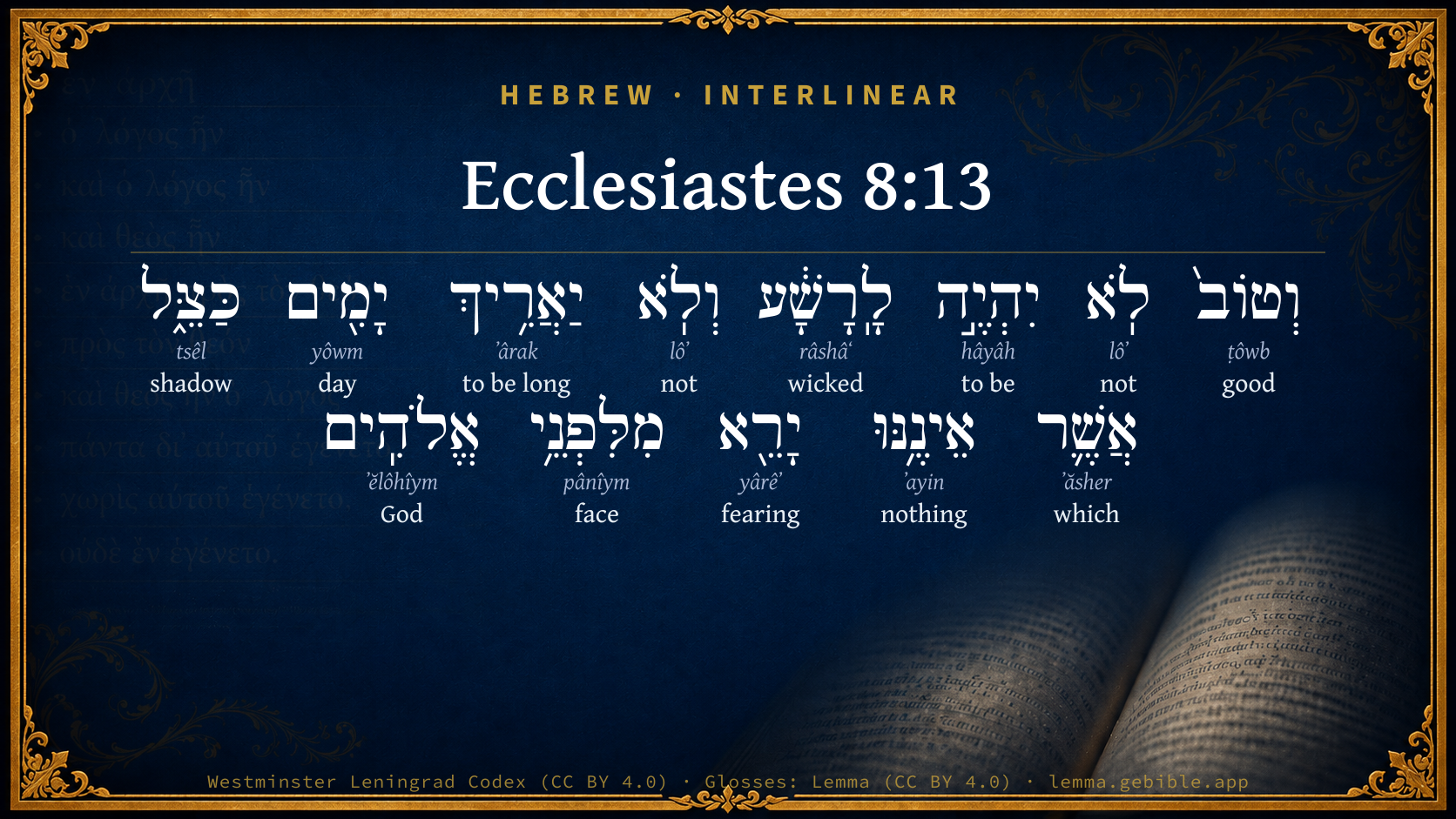
Hebrew (Westminster Leningrad Codex) Ecclesiastes 8:13 appears in the Hebrew Old Testament. The text above is from the Westminster Leningrad Codex. Each word links to its Strong’s number, a concise gloss, and parsing drawn from the Open Scriptures Hebrew Bible morphology. Click any word for its full Brown-Driver-Briggs (BDB) entry.
Download image
Cite this verse

Ecclesiastes 8:13 (World English Bible). Public Domain. Lemma interlinear Bible study tool, https://lemma.gebible.app/v/ecclesiastes/8/13.

Show BibTeX & RIS
BibTeX
RIS
English Translation
But it shall not be well with the wicked, neither shall he lengthen days like a shadow; because he doesn't fear God.
World English Bible · Public Domain
Download a study sheet

One document with this verse’s original text, its word-by-word gloss line, the meaning frame, cross-references with their text, attributed commentary, and full source and license credits — printable, and it pastes into notes with its structure intact.

This verse Autodidact and up

Study sheet (.html) Plain text (.txt)

A passage Seminary Student

Up to 50 verses in one chapter. A passage sheet keeps up to 6 commentary sources and 12 cross-references per verse, in the order this page ranks them, and says so on the sheet whenever that leaves anything out. Ask for a single verse and you get the Autodidact verse sheet above.

Everything on this page stays free to read, with no account — the sheet is a download of what is already on screen, not access to it.

Want to remove ads? Support Godless Engineer
Compare translations 3

The same verse in 3 English versions, stacked beneath the original-language interlinear above. Click any original word for its lexicon entry.

Each is an independent rendering of the whole verse — the interlinear is not word-aligned to these translations.

Highlighted words mark where these versions differ — a whole-verse word diff, not a word-by-word alignment.

  • World English Bible Public Domain
    But it shall not be well with the wicked, neither shall he lengthen days like a shadow; because he doesn't fear God.
  • King James Version Public Domain
    But it shall not be well with the wicked, neither shall he prolong his days, which are as a shadow; because he feareth not before God.
  • unfoldingWord Literal Text CC BY-SA 4.0
    But it will not be good for the wicked, nor will he lengthen days like the shadow, because he is not fearing before the face of God.

unfoldingWord Literal Text — © unfoldingWord, licensed CC BY-SA 4.0. Word-aligned USFM3 via Door43 (git.door43.org/unfoldingWord/en_ult).

Versions to compare (up to 4)

3 of 4 selected

Show all 18 translations

Every available English version of this verse, each an independent rendering of the whole verse.

  • World English Bible Public Domain
    But it shall not be well with the wicked, neither shall he lengthen days like a shadow; because he doesn't fear God.
  • Berean Standard Bible Public Domain
    Yet because the wicked do not fear God, it will not go well with them, and their days will not lengthen like a shadow.
  • Majority Standard Bible Public Domain
    Yet because the wicked do not fear God, it will not go well with them, and their days will not lengthen like a shadow.
  • King James Version Public Domain
    But it shall not be well with the wicked, neither shall he prolong his days, which are as a shadow; because he feareth not before God.
  • American Standard Version (1901) Public Domain
    but it shall not be well with the wicked, neither shall he prolong `his' days, `which are' as a shadow; because he feareth not before God.
  • Revised Version (1885) Public Domain
    but it shall not be well with the wicked, neither shall he prolong his days, which are as a shadow; because he feareth not before God.
  • Geneva Bible (1599) Public Domain
    But it shall not be well to the wicked, neither shall he prolong his dayes: he shall be like a shadowe, because he feareth not before God.
  • Douay-Rheims (1899) Public Domain
    But let it not be well with the wicked, neither let his days be prolonged, but as a shadow let them pass away that fear not the face of the Lord.
  • Young's Literal Translation Public Domain
    And good is not to the wicked, and he doth not prolong days as a shadow, because he is not fearing before God.
  • Literal Standard Version CC BY-SA 4.0
    And good is not to the wicked, and he does not prolong days as a shadow, because he is not fearing before God.
  • Unlocked Literal Bible CC BY-SA 4.0
    But it will not go well for a wicked man; his life will not be prolonged. His days are like a fleeting shadow because he does not honor God.
  • unfoldingWord Literal Text CC BY-SA 4.0
    But it will not be good for the wicked, nor will he lengthen days like the shadow, because he is not fearing before the face of God.
  • Darby Bible Public Domain
    but it shall not be well with the wicked, neither shall he prolong [his] days as a shadow, because he feareth not before God.
  • World Messianic Bible Public Domain
    But it shall not be well with the wicked, neither shall he lengthen days like a shadow, because he doesn’t fear God.
  • Webster's Bible Public Domain
    But it will not be well with the wicked, neither will he prolong his days, which are as a shadow; because he feareth not before God.
  • Free Bible Version CC BY-SA 4.0
    In fact, the wicked will not live long, passing like a shadow, because they refuse to follow God.
  • Bible in Basic English Public Domain
    But it will not be well for the evil-doer; he will not make his days long like a shade, because he has no fear before God.
  • JPS Tanakh (1917) Public Domain
    but it shall not be well with the wicked, neither shall he prolong his days, which are as a shadow, because he feareth not before God.

Literal Standard Version (2020), Covenant Press — licensed CC BY-SA 4.0. Text via the HelloAO Bible API (eBible.org). Unlocked Literal Bible (unfoldingWord) — licensed CC BY-SA 4.0. Text via the HelloAO Bible API (eBible.org). unfoldingWord Literal Text — © unfoldingWord, licensed CC BY-SA 4.0. Word-aligned USFM3 via Door43 (git.door43.org/unfoldingWord/en_ult). Free Bible Version, Dr. Jonathan Gallagher — licensed CC BY-SA 4.0. Text via the HelloAO Bible API (eBible.org).

Word by word

More ways to search: Search by grammar → Find every occurrence → Compare this word →

Practice this passage: Drill this verse → Learn its vocabulary →

יַאֲרִ֥יךְ
ʼârak
H748
“to be long”
Verb, Hiphil, Imperfect, 3rd Person, Masculine, Singular
Part of Speech
Verb
Stem
Hiphil
Form
Imperfect
Person
3rd Person
Gender
Masculine
Number
Singular
Full BDB Definition

Origin: a primitive root

TWOT: 162

to be long, prolong - (Qal) to be long - (Hiphil) - to prolong (days) - to make long (tent cords) - to grow long, continue long
  1. וְטוֹב֙ ṭôwb H2896 “and · good” Conjunction + Adjective, Adjective, Masculine, Singular, Absolute
  2. לֹֽא lôʼ H3808 “not” Particle, Negative
  3. יִהְיֶ֣ה hâyâh H1961 “to be” Verb, Qal, Imperfect, 3rd Person, Masculine, Singular
  4. לָֽרָשָׁ֔ע râshâʻ H7563 “to/for the · wicked” Preposition, Determined + Adjective, Adjective, Masculine, Singular, Absolute
  5. וְלֹֽא lôʼ H3808 “and · not” Conjunction + Particle, Negative
  6. יָמִ֖ים yôwm H3117 “days” Noun, Common, Masculine, Plural, Absolute
  7. כַּצֵּ֑ל tsêl H6738 “like/as the · shadow” Preposition, Determined + Noun, Common, Masculine, Singular, Absolute
  8. אֲשֶׁ֛ר ʼăsher H834 “which” Particle, Relative
  9. אֵינֶ֥נּוּ ʼayin H369 “nothing · him” Particle, Negative + Suffix, Personal, 3rd Person, Masculine, Singular
  10. יָרֵ֖א yârêʼ H3373 “fearing” Verb, Qal, Participle Active, Masculine, Singular, Absolute
  11. מִלִּפְנֵ֥י pânîym H6440 “from · to/for · face(s) of” Preposition + Preposition + Noun, Common, Both, Plural, Construct
  12. אֱלֹהִֽים ʼĕlôhîym H430 “God(s)” Noun, Common, Masculine, Plural, Absolute

About this verse

These counts appear in no published source. They are computed here, from the morphology-tagged text and Lemma’s own curated glosses. What Lemma adds →

13
words
12
distinct lemmas
Wisdom
section

Shared distinctive vocabulary

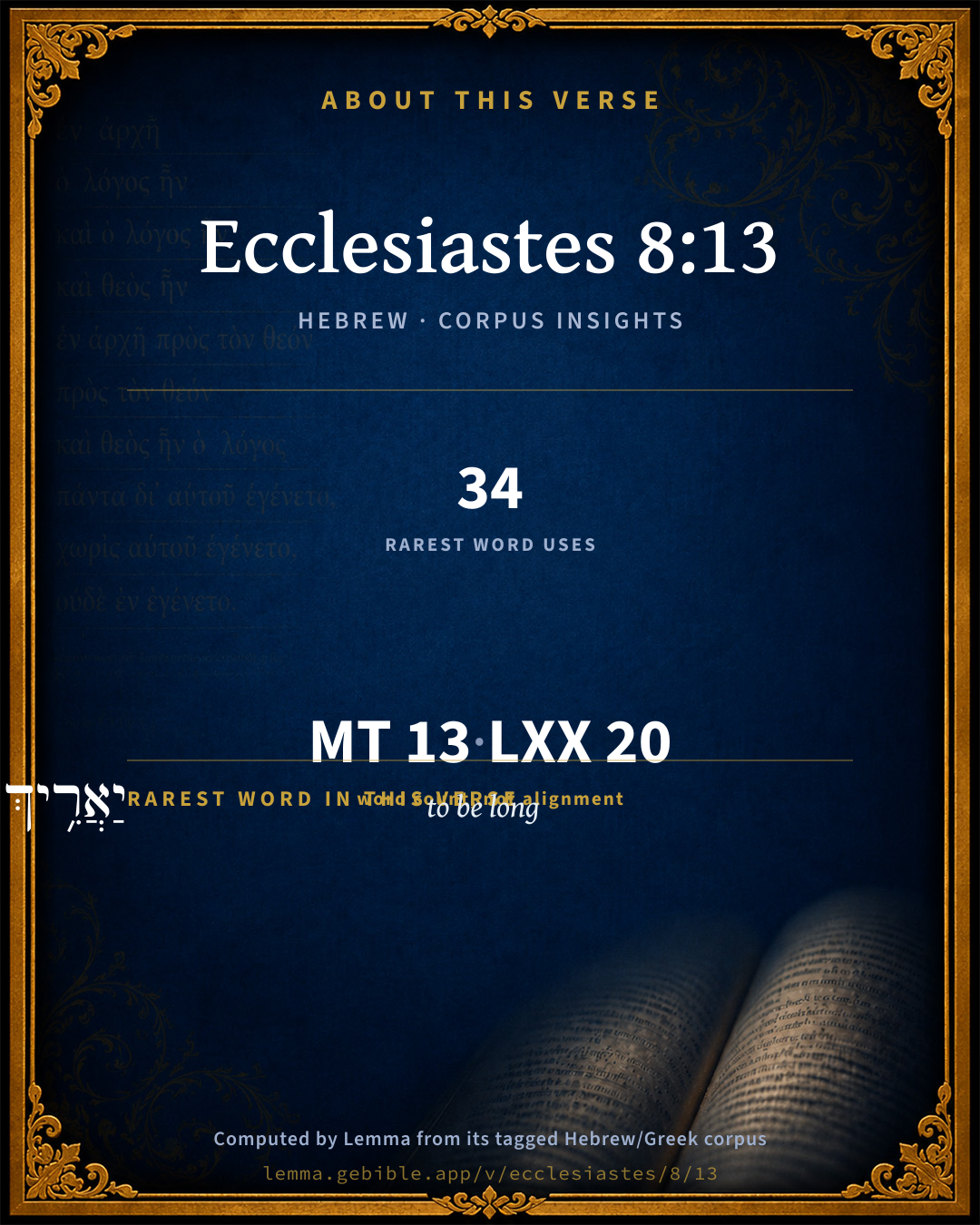
יַאֲרִ֥יךְ to be long H748 occurs in 34 verses of the Hebrew Bible. Also found in:

Grammatical profile

  • 3 verbs
  • 4 nouns
  • 2 adjectives
  • 4 particles

Verb forms

  • יִהְיֶ֣ה Qal · Imperfect
  • יַאֲרִ֥יךְ Hiphil · Imperfect
  • יָרֵ֖א Qal · Participle Active

Repetition

A word recurs within this verse — often emphatic in Hebrew:

Hebrew & Septuagint length

In English translation the verse runs 22 words from the Hebrew and 28 from the Septuagint (LXX English) — closely comparable.

A rough comparison of the two English renderings, which tokenize alike — not a word-level alignment.

Word counts can differ between the Hebrew and the Greek without any difference in meaning — e.g. the Hebrew direct-object marker אֵת has no separate Greek word, and Greek often adds the article ὁ.

In the original languages it is 13 Hebrew tokens and 20 Greek tokens — but the two are counted differently (Hebrew bundles its prefixes and suffixes into one token; the Greek is in lemma form), so that isn’t a like-for-like length.

Cross-references

18

Topical passages linked to Ecclesiastes 8:13 in the Treasury of Scripture Knowledge — connected by theme and wording, ordered by reader-vote popularity; previews shown in the World English Bible.

  • Ecclesiastes 6:12 For who knows what is good for man in life, all the days of his vain life which he spends like a shadow? For who can tell a man what will be after him under the sun?
  • Job 14:2 He comes forth like a flower, and is cut down. He also flees like a shadow, and doesn't continue.
  • Isaiah 3:11 Woe to the wicked! Disaster is upon them; For the deeds of his hands will be paid back to him.
  • Isaiah 57:21 There is no peace, says my God, to the wicked.
  • Malachi 3:18 Then you shall return and discern between the righteous and the wicked, between him who serves God and him who doesn't serve him.
  • Job 7:6–7 My days are swifter than a weaver's shuttle, And are spent without hope.
  • Job 18:5 "Yes, the light of the wicked shall be put out, The spark of his fire shall not shine.
  • Job 20:5 That the triumphing of the wicked is short, The joy of the godless but for a moment?
  • Job 21:30 That the evil man is reserved to the day of calamity? That they are led forth to the day of wrath?
  • Psalms 11:5 Yahweh examines the righteous, But the wicked and him who loves violence his soul hates.
  • Psalms 39:5 Behold, you have made my days handbreadths. My lifetime is as nothing before you. Surely every man stands as a breath." Selah.
  • Psalms 55:23 But you, God, will bring them down into the pit of destruction. Bloodthirsty and deceitful men shall not live out half their days, But I will trust in you.
  • Psalms 144:4 Man is like a breath. His days are like a shadow that passes away.
  • Isaiah 30:13 therefore this iniquity shall be to you as a breach ready to fall, swelling out in a high wall, whose breaking comes suddenly in an instant.
  • Matthew 13:49–50 So will it be in the end of the world. The angels will come forth, and separate the wicked from among the righteous,
  • John 5:29 and will come out; those who have done good, to the resurrection of life; and those who have done evil, to the resurrection of judgment.
  • James 4:14 Whereas you don't know what your life will be like tomorrow. For what is your life? For you are a vapor, that appears for a little time, and then vanishes away.
  • 2 Peter 2:3 In covetousness they will exploit you with deceptive words: whose sentence now from of old doesn't linger, and their destruction will not slumber.

Cross-references courtesy of OpenBible.info (CC BY 4.0).

Hebrew and Greek witnesses Masoretic Hebrew ↔ Greek Septuagint

The same verse in the two great witnesses to the Old Testament, shown verse-for-verse.

These are two independent witnesses, not word-aligned to each other, and the Septuagint is shown in lemma (dictionary) form.

Hebrew Ecclesiastes 8:13 Masoretic · Westminster Leningrad Codex

וְטוֹב֙ לֹֽא יִהְיֶ֣ה לָֽרָשָׁ֔ע וְלֹֽא יַאֲרִ֥יךְ יָמִ֖ים כַּצֵּ֑ל אֲשֶׁ֛ר אֵינֶ֥נּוּ יָרֵ֖א מִלִּפְנֵ֥י אֱלֹהִֽים

But it shall not be well with the wicked, neither shall he lengthen days like a shadow; because he doesn't fear God.

World English Bible · Public Domain

Greek LXX Ecclesiastes 8:13 Septuagint · lemma form

καί ἀγαθός οὐ εἰμί ὁ ἀσεβής καί οὐ μακρύνω ἡμέρα ἐν σκιά ὅς οὐ εἰμί φοβέω ἀπό πρόσωπον ὁ θεός

but it shall not be well with the ungodly, and he shall not prolong his days, which are as a shadow; forasmuch as he fears not before God.

LXX2012 (modern English Septuagint) · Public Domain

On this verse, Haydock's Catholic Bible Commentary discusses the Septuagint’s reading. Read the note in Commentary ↓

Hebrew: Westminster Leningrad Codex (CC BY 4.0). Greek: Septuagint (public domain); English from LXX2012 (modern English Septuagint) (Public Domain). How the Septuagint differs from the Hebrew →

Commentary

Notes on Ecclesiastes 8:13 from classic Christian and Jewish commentators (each source and its license shown beneath its notes). The classic Christian expositions comment on the surrounding passage and are grouped to its opening verse, so a note may address several verses; the Jewish commentaries on the Tanakh (Rashi and others) are per-verse, so they appear only where the commentator wrote on this verse.

Lemma curates 59 commentaries, every one of them public domain or Creative Commons licensed, each selected and text-cleaned for this edition rather than reprinted as found. About our sources →

Trapp's Complete Commentary

John Trapp

Ecc 8:13 But it shall not be well with the wicked, neither shall he prolong [his] days, [which are] as a shadow; because he feareth not before God.

Ver. 13. But it shall not be well with the wicked.] (1.) Not always well, {Isa 3:12} for "sin will be sure to find him out," {Num 32:23} and he that hath guilt in his bosom hath vengeance at his back. {a} Where iniquity breaks fast, calamity will be sure to dine, and to sup where it dines, and to lodge where it sups. When iniquity is once ripe in the field, God will not let it shed to grow again, but cuts it up by a just and seasonable vengeance. (2.) Not at all well; since prosperity slayeth these fools, and as sunshine ripens their sin, and so fits them for ruin. Hence Bernard calls it, Misericordiam omni indignatione crudeliorem. Poison in wine works more furiously. The fatter the ox, the sooner to the slaughter.

Neither shall he prolong his days.] See Psa 55:23 Jer 17:11. He dies tempore non suo {Ecc 7:17} though he lives long; he dies before he desires, and when it were better for him to do anything than to die; since he hath "walked in a vain show, disquieting himself in vain," {Psa 39:6} tumbling his tub to no purpose, lengthening out "his days as a shadow": the longer the shade, the nearer the sun is to setting. His sun also sets in the burning lake, and it hasteneth to the descent: "An end is come, is come, is come." {Eze 7:6-7}

Because he feareth not before God.] But in hypocrisy before men, whose laces he feareth, and would be much ashamed that they should see what he doth in secret. {Eph 5:12} But what saith the honest heathen? Si scirem homines ignoraturos et deos ignoscituros, tamen propter peccati turpitudinem, peccare non vellem. A good resolution surely, if as well put in execution. Sed libertas affuit scribent; non viventi, saith Augustine {b} of this author: He was a better speaker than liver. That of David was spoken from his heart, "I foresee the Lord always before my face; I set him at my right hand," &c. {Psa 16:8 Act 2:25} "Be thou in the fear of the Lord all day long." {Pro 23:17}

{a} Oυδεις ανθρωπων αδικων τισιν ουκ αποτισει. Nemo culpam gerit in pectore qui non idem Nemesin in tergo.

{b} Aug. De Civ. Dei, lib. vi. c. 10.

John Trapp, A Commentary or Exposition upon All the Books of the Old and New Testament (1647–1656) — public domain. Text from a community e-Sword module.

Jamieson, Fausset & Brown

Robert Jamieson, A. R. Fausset & David Brown

neither shall he prolong--not a contradiction to Ecc 8:12. The "prolonging" of his days there is only seeming, not real. Taking into account his eternal existence, his present days, however seemingly long, are really short. God's delay (Ecc 8:11) exists only in man's short-sighted view. It gives scope to the sinner to repent, or else to fill up his full measure of guilt; and so, in either case, tends to the final vindication of God's ways. It gives exercise to the faith, patience, and perseverance of saints.

shadow-- (Ecc 6:12; Job 8:9).

Jamieson, Fausset & Brown — Commentary Critical and Explanatory on the Whole Bible (1871) — public domain (CC PDM 1.0). Text via the HelloAO Bible API.

Adam Clarke's Commentary

Verse 13. But it shall not be well with the wicked] Let not the long-spared sinner presume that, because sentence is not speedily executed on his evil works, and he is suffered to go on to his hundredth transgression, God has forgotten to punish. No; he feareth not before God; and therefore he shall not ultimately escape.

Adam Clarke's Commentary on the Bible (1810–1826) — public domain. Text from a community e-Sword/MySword module.

Ellicott's Commentary for English Readers

(13) As a shadow.—Ecc_6:12; Wis_2:5; see also Wis_4:8.

A Bible Commentary for English Readers, edited by Charles John Ellicott (1878–1897) — public domain. Text from a community e-Sword module.

The Cambridge Bible for Schools and Colleges

gen. ed. J. J. S. Perowne

13. neither shall he prolong his days, which are as a shadow] The words seem at first in direct contradiction to the admission of the previous verse. But it is of the nature of the method of the book to teach by paradoxes, and to let the actual contradictions of the world reflect themselves in his teaching. What is meant is that the wicked does not gain by a prolonged life; that, as Isaiah had taught of old, “the sinner though he die a hundred years old, is as one accursed” (Isa_65:20). His life is still a shadow and “he disquieteth himself in vain” (Psa_39:6). So the writer of the Wisdom of Solomon (Ecc_4:8) writes, probably not without a reference to this very passage, that “honourable age is not that which standeth in length of time, nor that is measured by the number of the years.” In the “days which are as a shadow,” so far as they refer to the shortness of human life in general, we find, as before in ch. Ecc_6:12, echoes of Greek thought.

It is noticeable that in Wis_2:5, in accordance with what one may call the polemic tendency of the writer, the thought and the phrase are put into the mouth of the “ungodly, who reasoned not aright.” The universal fact, however, has become a universal thought and finds echoes everywhere (Psa_102:11; Psa_144:4).

The Cambridge Bible for Schools and Colleges (gen. ed. J. J. S. Perowne; Cambridge University Press, 1878–1918) — public domain. Text from a community e-Sword module.

John Gill's Exposition

But it shall not be well with the wicked,.... It shall be ill with him; more is designed than is expressed, Isa 3:11; in life they have no solid peace and comfort; at death they will be turned into at judgment they will hear the awful sentence, "Go, ye cursed", and will be in torment to all eternity, Mat 25:41;

neither shall he prolong his days, which are as a shadow: wicked men sometimes do not live out half their days, which, according to the course of nature, and common term of life, they might be thought to live; or if they prolong their days in wickedness, as sometimes they do, Ecc 7:15; yet their days at longest are but a shadow which declines, and is quickly gone; or, however, they do not attain to eternal life, which is sometimes meant by prolonging days, and is length of days for ever and ever, Isa 53:10; this they never enjoy; but when the righteous go into life lasting, they go into everlasting punishment. The reason of this is,

because he feareth not before God; the fear of God is not before his eyes, nor in his heart; he goes on in sin without fear of him, boldly and openly commits it, and instead of taking shame for it, or repenting of it, glories in it; stretches out his hand against God, and bids defiance to him, and desires not the knowledge of him, and refuses to obey him The Targum of the whole is,

"and it shall not be well with the wicked, and he shall have no space in the world to come; and in this world his days shall be cut off, and they shall flee and pass away as a shadow, because he fears not God.''

John Gill's Exposition of the Whole Bible (1746–1763) — public domain (CC PDM 1.0). Text via the HelloAO Bible API.

Haydock's Catholic Bible Commentary

Let. Or, Hebrew, "it shall not," &c. (Protestants) (Haydock) --- Faith evinces that the wicked will be punished. --- But. Hebrew, "like a shadow." Septuagint, "under the shade," in prosperity.

George Leo Haydock (1774–1849), Haydock's Catholic Family Bible and Commentary, 1859 edition — public domain. Excludes Psalms (Douay-Rheims chapter numbering differs from Protestant) and Deuterocanonical books (Catholic canon only).

Matthew Poole's English Annotations

It shall not be well, i.e. it shall go very ill with him; great miseries are prepared for him; which is a figure oft used in Scripture, as hath been formerly and frequently observed.

Neither shall he prolong his days, to wit, very long, or for ever, as he desireth.

As a shadow; his life, though it may be or seem to be long, yet in truth is but a mere shadow, which will quickly vanish and disappear, and be as if it never had been; and many times, like a shadow, when it is longest, it is nearest to abolition.

Because he feareth not before God; this is the punishment of his wickedness, and his casting off the fear and service of God. For although the lives of good men upon earth are short, as well as the lives of the wicked, yet their days are not like a shadow, because they are prolonged far beyond this mortal state, even to all eternity, and death itself doth but open the way for them to an endless life.

Matthew Poole's English Annotations on the Holy Bible (1683–1685) — public domain. Text from a community e-Sword/MySword module.

Whedon's Commentary on the Bible

Daniel D. Whedon

13. Prolong his days — The words, as a shadow, should precede “prolong his days.” “His days” shall flee like a “shadow.”

Daniel D. Whedon (gen. ed.), Commentary on the Old and New Testaments (1874–1909) — public domain. Text from a community e-Sword module.

The Pulpit Commentary

But it shall not be well with the wicked. If experience seemed often to militate against this assertion, Koheleth"s faith prevailed against apparent contradictions. Neither shall he prolong his days, which are as a shadow. Above we read of a wicked man enjoying a long, untroubled life; here the contrary is stated. Such contradictions are seen every day. There are inscrutable reasons for the delay of judgment; but on the whole moral government is vindicated, and even the long life of a sinner is no blessing. The author of the Book of Wisdom writes (4:8), "Honorable age is not that which standeth in length of time, nor that is measured by number of years;" and Isaiah, (Isa_65:20) "The sinner being a hundred years old shall be accursed." Man"s life is compared to a shadow because it passes away with the setting sun. (see on Ecc_6:12) The Vulgate, in order to obviate the apparent discrepancy between this and the preceding verses, renders the verb in a precatory form: Non sit bonum impio, etc., "Let it not be well with the wicked, and let his days not be prolonged; but let them pass away as a shadow who fear not the Lord." This is quite unnecessary; and the words, "as a shadow, according to the accents, belong to what precedes, as in the Authorized Version. Hitzig and others have adopted the Vulgate division, and render, "Like a shadow is he who fears not God." But there is no sufficient reason for disregarding the existing accentuation. Septuagint, "He shall not prolong his days in a shadow (ejn skia)." Because he feareth not before God. This is the reason, looking to temporal retribution, why the wicked shall not live out half their days (Ecc_7:17; Pro_10:27; Psa_55:23) Koheleth cleaves to the doctrine received from old time, although facts seem often to contradict it.

The Pulpit Commentary (1880–1919), ed. H.D.M. Spence-Jones & Joseph S. Exell — public domain. Text from a community e-Sword module.

John Wesley's Explanatory Notes

A shadow - His life, though it may seem long, yet in truth is but a shadow, which will quickly vanish and disappear.

John Wesley, Explanatory Notes Upon the Whole Bible (1754–1765) — public domain. Text via the GEBible commentary corpus.

Rashi

Rabbi Shlomo Yitzchaki (Rashi)

But it will not be well with the wicked because he does not fear God.

Rashi on the Tanakh — English translations: “The Judaica Press complete Tanach with Rashi, translated by A. J. Rosenberg” (CC BY 4.0); “Pentateuch with Rashi's commentary by M. Rosenbaum and A.M. Silbermann, 1929-1934” (public domain); “The Metsudah Tanach series, Lakewood, N.J” (CC BY 4.0); and “The Book of Joshua, Metsudah Publications, 1997” (CC BY 4.0). Text via Sefaria.

Lesson kit

Teaching starters — assembled from the data on this page, not authored interpretation. Every prompt links to the verse data it draws on. Edit before teaching.

Ecclesiastes, in the Wisdom, opens this verse with 13 words (12 distinct Hebrew lemmas). Its most distinctive word is ʼârak (“to be long”). A historical commentator’s framing appears above. Read the whole chapter for the surrounding context.

Discussion questions

  1. The word ʼârak carries the sense “to be long.” How does it shape the verse?
  2. Genesis 26:8 shares the word «to be long» with this verse. How do the two illuminate each other?
  3. “not” occurs 2× in this one verse. What is the effect of the repetition?
  4. These translations render this verse differently; the difference is in the English rendering, not the original. What questions does that raise?
  5. The verb «יִהְיֶ֣ה» is Qal Imperfect. How does its form color the action?
  6. Reading how Trapp's Complete Commentary and Jamieson, Fausset & Brown read this verse, where do the two commentators agree and where do they part?

Things to notice

Reading settings

Reading text

Shown beneath each verse's original-language words.

Old Testament
Old Testament edition

Read the OT as the Masoretic Hebrew (MT) or the Greek Septuagint (LXX).

English shown for the Greek Septuagint (in the Hebrew ↔ Greek comparison).

Comparing translations? Open the Compare panel on any verse page to stack up to four side by side.