
Proverbs 11:8

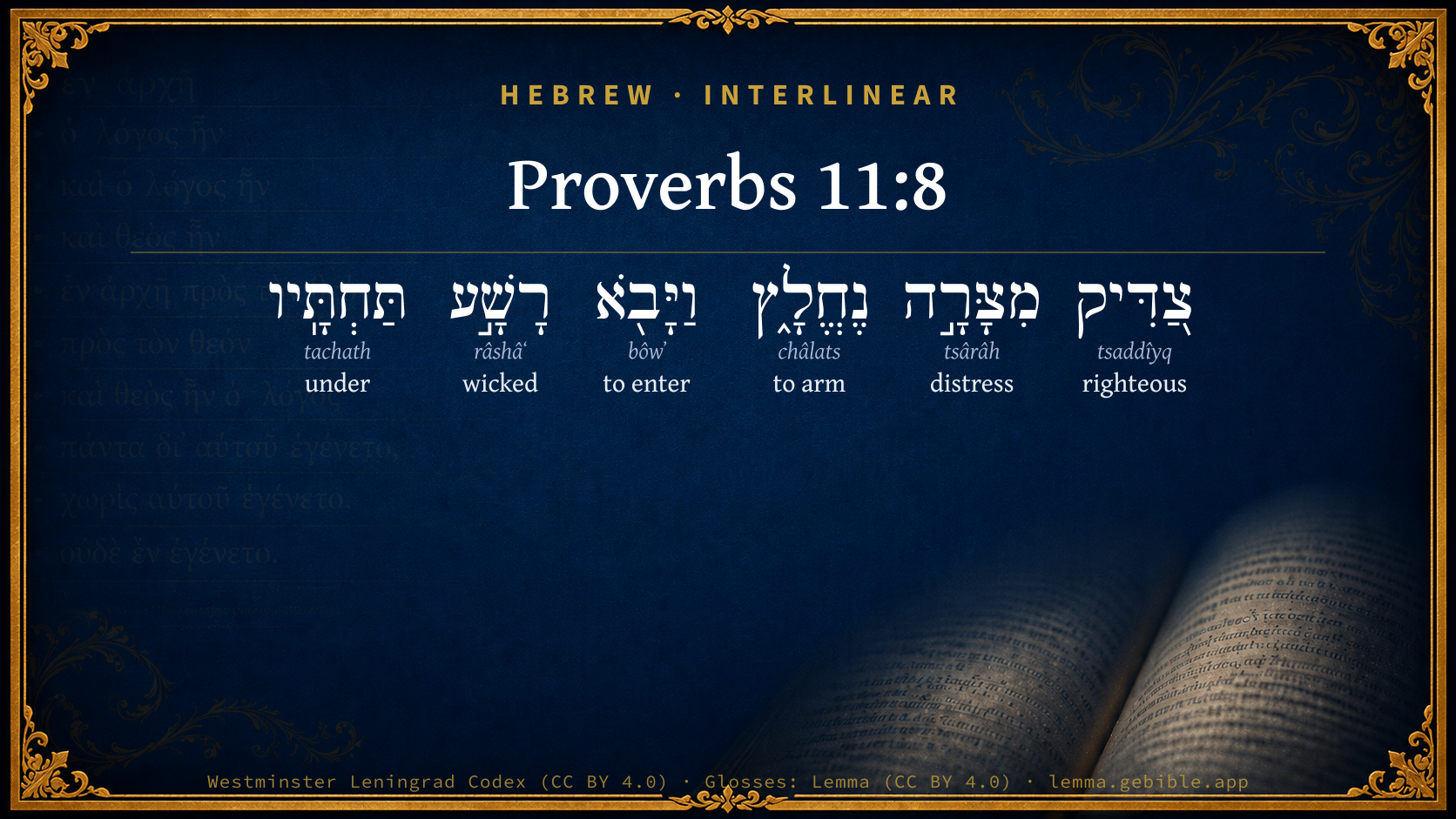
Hebrew (Westminster Leningrad Codex) Proverbs 11:8 appears in the Hebrew Old Testament. The text above is from the Westminster Leningrad Codex. Each word links to its Strong’s number, a concise gloss, and parsing drawn from the Open Scriptures Hebrew Bible morphology. Click any word for its full Brown-Driver-Briggs (BDB) entry.
Download image
Cite this verse

Proverbs 11:8 (World English Bible). Public Domain. Lemma interlinear Bible study tool, https://lemma.gebible.app/v/proverbs/11/8.

Show BibTeX & RIS
BibTeX
RIS
English Translation
A righteous person is delivered out of trouble, And the wicked takes his place.
World English Bible · Public Domain
Download a study sheet

One document with this verse’s original text, its word-by-word gloss line, the meaning frame, cross-references with their text, attributed commentary, and full source and license credits — printable, and it pastes into notes with its structure intact.

This verse Autodidact and up

Study sheet (.html) Plain text (.txt)

A passage Seminary Student

Up to 50 verses in one chapter. A passage sheet keeps up to 6 commentary sources and 12 cross-references per verse, in the order this page ranks them, and says so on the sheet whenever that leaves anything out. Ask for a single verse and you get the Autodidact verse sheet above.

Everything on this page stays free to read, with no account — the sheet is a download of what is already on screen, not access to it.

Want to remove ads? Support Godless Engineer
Compare translations 3

The same verse in 3 English versions, stacked beneath the original-language interlinear above. Click any original word for its lexicon entry.

Each is an independent rendering of the whole verse — the interlinear is not word-aligned to these translations.

Highlighted words mark where these versions differ — a whole-verse word diff, not a word-by-word alignment.

  • World English Bible Public Domain
    A righteous person is delivered out of trouble, And the wicked takes his place.
  • King James Version Public Domain
    The righteous is delivered out of trouble, and the wicked cometh in his stead.
  • unfoldingWord Literal Text CC BY-SA 4.0
    A righteous is drawn away from distress, and a wicked enters instead of him.

unfoldingWord Literal Text — © unfoldingWord, licensed CC BY-SA 4.0. Word-aligned USFM3 via Door43 (git.door43.org/unfoldingWord/en_ult).

Versions to compare (up to 4)

3 of 4 selected

Show all 18 translations

Every available English version of this verse, each an independent rendering of the whole verse.

  • World English Bible Public Domain
    A righteous person is delivered out of trouble, And the wicked takes his place.
  • Berean Standard Bible Public Domain
    The righteous man is delivered from trouble; in his place the wicked man goes in.
  • Majority Standard Bible Public Domain
    The righteous man is delivered from trouble; in his place the wicked man goes in.
  • King James Version Public Domain
    The righteous is delivered out of trouble, and the wicked cometh in his stead.
  • American Standard Version (1901) Public Domain
    The righteous is delivered out of trouble, And the wicked cometh in his stead.
  • Revised Version (1885) Public Domain
    The righteous is delivered out of trouble, and the wicked cometh in his stead.
  • Geneva Bible (1599) Public Domain
    The righteous escapeth out of trouble, and the wicked shall come in his steade.
  • Douay-Rheims (1899) Public Domain
    The just is delivered out of distress: and the wicked shall be given up for him.
  • Young's Literal Translation Public Domain
    The righteous from distress is drawn out, And the wicked goeth in instead of him.
  • Literal Standard Version CC BY-SA 4.0
    The righteous is drawn out from distress, || And the wicked goes in instead of him.
  • Unlocked Literal Bible CC BY-SA 4.0
    The righteous person is kept away from trouble and it comes upon the wicked instead.
  • unfoldingWord Literal Text CC BY-SA 4.0
    A righteous is drawn away from distress, and a wicked enters instead of him.
  • Darby Bible Public Domain
    The righteous is delivered out of trouble, and the wicked cometh in his stead.
  • World Messianic Bible Public Domain
    A righteous person is delivered out of trouble, and the wicked takes his place.
  • Webster's Bible Public Domain
    The righteous is delivered out of trouble, and the wicked cometh in his stead.
  • Free Bible Version CC BY-SA 4.0
    The good are saved from trouble, while the wicked get into trouble.
  • Bible in Basic English Public Domain
    The upright man is taken out of trouble, and in his place comes the sinner.
  • JPS Tanakh (1917) Public Domain
    The righteous is delivered out of trouble, and the wicked cometh in his stead.

Literal Standard Version (2020), Covenant Press — licensed CC BY-SA 4.0. Text via the HelloAO Bible API (eBible.org). Unlocked Literal Bible (unfoldingWord) — licensed CC BY-SA 4.0. Text via the HelloAO Bible API (eBible.org). unfoldingWord Literal Text — © unfoldingWord, licensed CC BY-SA 4.0. Word-aligned USFM3 via Door43 (git.door43.org/unfoldingWord/en_ult). Free Bible Version, Dr. Jonathan Gallagher — licensed CC BY-SA 4.0. Text via the HelloAO Bible API (eBible.org).

Word by word

More ways to search: Search by grammar → Find every occurrence → Compare this word →

Practice this passage: Drill this verse → Learn its vocabulary →

נֶחֱלָ֑ץ
châlats
H2502
“arming”
Verb, Niphal, Participle Active, Masculine, Singular, Absolute
Part of Speech
Verb
Stem
Niphal
Form
Participle Active
Gender
Masculine
Number
Singular
State
Absolute
Full BDB Definition

Origin: a primitive root

TWOT: 667 , 668

to remove, draw out, draw off, take off, withdraw, equip (for war), arm for war, rescue, be rescued - (Qal) equipped (participle) - (Niphal) - to be equipped - to go equipped - to be armed - (Hiphil) - to make strong, brace up - to invigorate - to draw off or out, withdraw - (Qal) - to draw, draw off - to withdraw - (Niphal) - to be delivered - to be saved - (Piel) - to pull out, tear out - to rescue, deliver, set free - to take away, plunder
  1. צַ֭דִּיק tsaddîyq H6662 “righteous” Adjective, Adjective, Masculine, Singular, Absolute
  2. מִצָּרָ֣ה tsârâh H6869 “from · distress” Preposition + Noun, Common, Feminine, Singular, Absolute
  3. וַיָּבֹ֖א bôwʼ H935 “and · to enter” Conjunction + Verb, Qal, Sequential Imperfect, 3rd Person, Masculine, Singular
  4. רָשָׁ֣ע râshâʻ H7563 “wicked” Adjective, Adjective, Masculine, Singular, Absolute
  5. תַּחְתָּֽיו tachath H8478 “under · him” Preposition + Suffix, Personal, 3rd Person, Masculine, Singular

About this verse

These counts appear in no published source. They are computed here, from the morphology-tagged text and Lemma’s own curated glosses. What Lemma adds →

6
words
6
distinct lemmas
Wisdom
section

Shared distinctive vocabulary

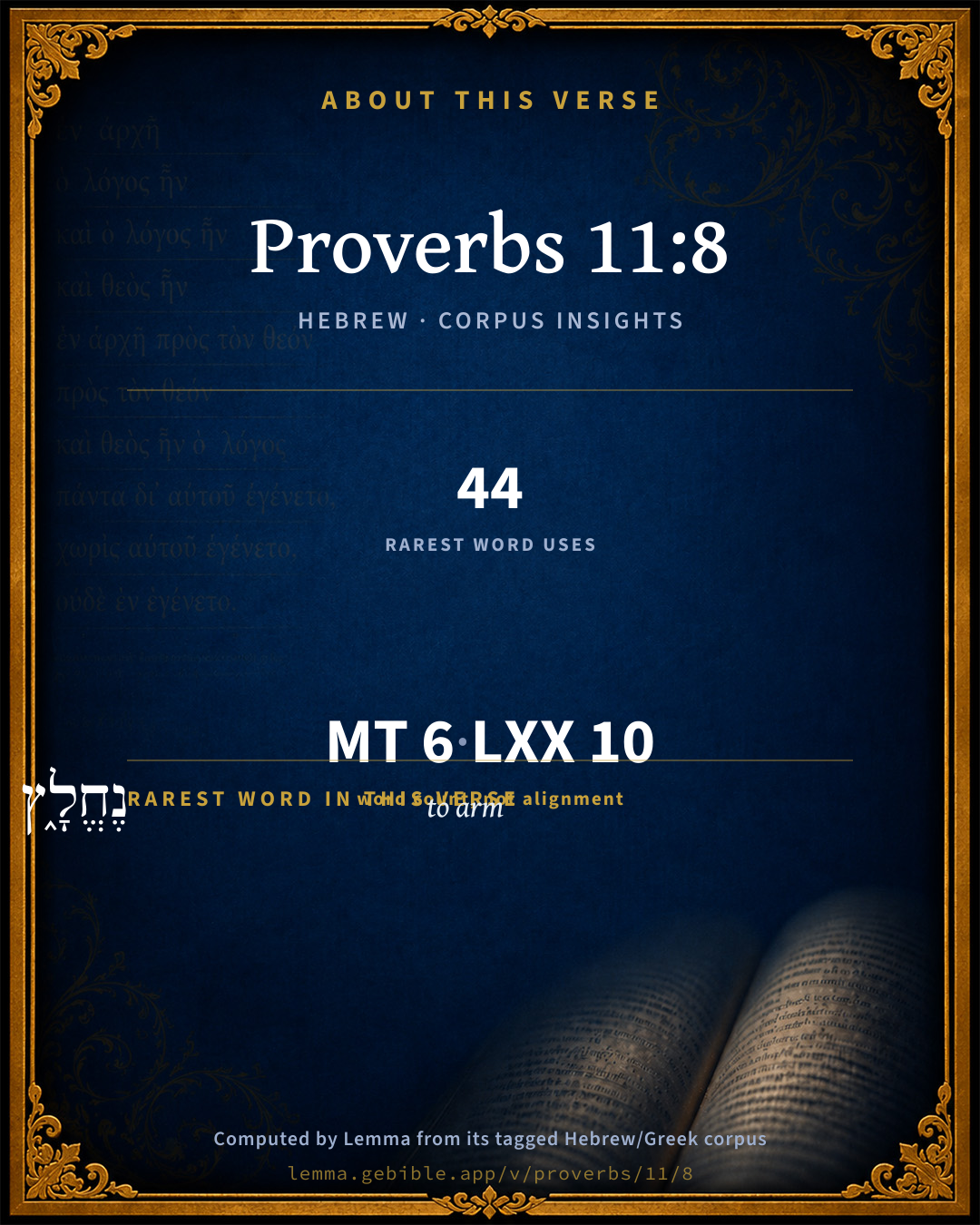
נֶחֱלָ֑ץ to arm H2502 occurs in 44 verses of the Hebrew Bible. Also found in:

Grammatical profile

  • 2 verbs
  • 1 noun
  • 2 adjectives
  • 1 preposition

Verb forms

  • נֶחֱלָ֑ץ Niphal · Participle Active
  • וַיָּבֹ֖א Qal · Sequential Imperfect

Hebrew & Septuagint length

In English translation the verse runs 14 words from the Hebrew and 17 from the Septuagint (LXX English) — closely comparable.

A rough comparison of the two English renderings, which tokenize alike — not a word-level alignment.

Word counts can differ between the Hebrew and the Greek without any difference in meaning — e.g. the Hebrew direct-object marker אֵת has no separate Greek word, and Greek often adds the article ὁ.

In the original languages it is 6 Hebrew tokens and 10 Greek tokens — but the two are counted differently (Hebrew bundles its prefixes and suffixes into one token; the Greek is in lemma form), so that isn’t a like-for-like length.

Cross-references

4

Topical passages linked to Proverbs 11:8 in the Treasury of Scripture Knowledge — connected by theme and wording, ordered by reader-vote popularity; previews shown in the World English Bible.

  • Daniel 6:23–24 Then was the king exceeding glad, and commanded that they should take Daniel up out of the den. So Daniel was taken up out of the den, and no manner of hurt was found on him, because he had trusted in his God.
  • Proverbs 21:18 The wicked is a ransom for the righteous; The treacherous for the upright.
  • Esther 7:9–10 Then said Harbonah, one of the chamberlains who were before the king, Behold also, the gallows fifty cubits high, which Haman has made for Mordecai, who spoke good for the king, stands in the house of Haman. The king said, Hang him thereon.
  • Isaiah 43:3–4 For I am Yahweh your God, the Holy One of Israel, your Savior; I have given Egypt as your ransom, Ethiopia and Seba in your place.

Cross-references courtesy of OpenBible.info (CC BY 4.0).

Hebrew and Greek witnesses Masoretic Hebrew ↔ Greek Septuagint

The same verse in the two great witnesses to the Old Testament, shown verse-for-verse.

These are two independent witnesses, not word-aligned to each other, and the Septuagint is shown in lemma (dictionary) form.

Hebrew Proverbs 11:8 Masoretic · Westminster Leningrad Codex

צַ֭דִּיק מִצָּרָ֣ה נֶחֱלָ֑ץ וַיָּבֹ֖א רָשָׁ֣ע תַּחְתָּֽיו

A righteous person is delivered out of trouble, And the wicked takes his place.

World English Bible · Public Domain

Greek LXX Proverbs 11:8 Septuagint · lemma form

δίκαιος ἐκ θήρα ἐκδύνω ἀντί αὐτός δέ παραδίδωμι ὁ ἀσεβής

A righteous man escapes from a snare, and the ungodly man is delivered up in his place.

LXX2012 (modern English Septuagint) · Public Domain

On this verse, The Pulpit Commentary discusses the Septuagint’s reading. Read the note in Commentary ↓

Hebrew: Westminster Leningrad Codex (CC BY 4.0). Greek: Septuagint (public domain); English from LXX2012 (modern English Septuagint) (Public Domain). How the Septuagint differs from the Hebrew →

Commentary

Notes on Proverbs 11:8 from classic Christian and Jewish commentators (each source and its license shown beneath its notes). The classic Christian expositions comment on the surrounding passage and are grouped to its opening verse, so a note may address several verses; the Jewish commentaries on the Tanakh (Rashi and others) are per-verse, so they appear only where the commentator wrote on this verse.

Lemma curates 59 commentaries, every one of them public domain or Creative Commons licensed, each selected and text-cleaned for this edition rather than reprinted as found. About our sources →

Trapp's Complete Commentary

John Trapp

Pro 11:8 The righteous is delivered out of trouble, and the wicked cometh in his stead.

Ver. 8. And the wicked cometh in his stead.] Thus it befell Haman, and Daniel’s enemies, and those inhuman Edomites, {Lam 4:21} and Herod with his hacksters. {Act 12:1-4; Act 12:21-23} It is "a righteous thing with God," {2Th 1:6-7} though to men it seem an incredible paradox, and a news by far more admirably [wonderfull] than acceptable, that there should be such a transmutation of conditions on both sides, to contraries. But thus it happens frequently. John Martin of Briqueras, a mile from Angrogne, in France, vaunted everywhere that he would slit the minister’s nose of Angrogne. But, behold! himself was shortly after assaulted by a wolf, which bit off his nose, so that he died mad from it. {a}

{a} Acts and Mon., fol. 871.

John Trapp, A Commentary or Exposition upon All the Books of the Old and New Testament (1647–1656) — public domain. Text from a community e-Sword module.

The Biblical Illustrator

Joseph S. Exell

Pro_11:8

The righteous is delivered out of trouble, and the wicked cometh in his stead.

Trouble in its relation to the righteous and the wicked

All men have their troubles. The relation of the good and the bed to trouble is strikingly different.

I. The righteous are going out of trouble. The troubles of the righteous arise from physical infirmities, mental difficulties, secular anxieties, moral imperfections, social dishonesties, falsehoods, end bereavements. But the fact is, that they are being delivered out of these troubles.

1. Partially, they are being delivered out of trouble now.

2. Completely, they will be delivered out of all trouble at death.

II. The wicked are going into trouble. They are going deeper into trouble every step they take. They are forging thunderbolts and nursing storms. The trouble they are going into is unmitigated. (D. Thomas, D.D.)

Retributive justice

Thus do these two classes change places in the dispensations of God. The same Providence often marks Divine faithfulness and retributive justice. The Israelites were delivered out of the trouble of the Red Sea; the Egyptians came in their stead. Mordecai was delivered from the gallows; Haman was hanged upon it. The noble confessors in Babylon were saved from the fire; their executioners were slain by it. Daniel was preserved from the lions; his accusers were devoured by them. Peter was snatched from death; his jailors and persecutors were condemned. Thus precious in the sight of the Lord is the life, no less than the death, of his saints. To what source but his own free and sovereign love can we trace this special estimation? (C. Bridges.)

The wicked cometh in his stead

Shadrach, Meshach, and Abednego came unhurt out of the burning fiery furnace; whilst the men who cast them in were slain by the fierceness of the heat (Dan_3:22-27.) Daniel was taken up alive and uninjured out of the lions den; whilst the men who had accused him were cast into the same den, and the lions, which had not touched Daniel, brake all their bones in pieces before they reached the bottom of the den (Dan_6:23-24).

The Biblical Illustrator, edited by Joseph S. Exell (c. 1880s–1900s) — public domain. Text from a community e-Sword module.

The Preacher's Complete Homiletical Commentary

Joseph S. Exell (gen. ed.)

MAIN HOMILETICS OF Pro_11:8

THE WICKED COMING IN THE STEAD OF THE RIGHTEOUS

I. This proverb must be fulfilled from the nature of the case. If a vessel is being steered straight for the rocks nothing can prevent her from being dashed upon them except a change of course. Nothing else can avert the catastrophe, unless a supernatural power removes the rock out of the way. This last cannot be; the first alternative rests with the will of the commander. If another vessel is going in an opposite direction she must as necessarily escape the doom to which the other is hastening. There is nothing of fate about their different destinies, they are the outcome of a choice of opposite courses. So with the opposite ends of the righteous and the wicked. Deliverance for the first, an inheritance of trouble for the latter, are the result of no arbitrary fate but the outcome of their pursuing opposite courses. Unless God will remove His everlasting laws out of the universe it must be so, and to expect Him to do that is to expect Him to change His nature, which would be a much more dire calamity than the trouble which comes upon the wicked from his course of wilful opposition to righteousness. For in this life it is always open to a man to turn round, to change his course, and so to escape the shipwreck of his existence upon the rocks of perdition. “Let the wicked forsake his way, and the unrighteous man his thoughts: and let him return unto the Lord, and He will have mercy upon him; and to our God, for He will abundantly pardon” (Isa_55:7). God will not remove His righteous laws out of the sinner’s way, but He holds out every inducement and encouragement to the transgressor to come into harmony with them.

II. The proverb has received abundant illustrations in the history of our race. Pharaoh designed to drive the Israelitish nation into the Red Sea and so to destroy them. God delivered them, and their oppressors “came in their stead.” Daniel’s persecutors planned to take his life, “the righteous man was delivered out of trouble,” and his wicked slanderers met with the death to which they had hoped to bring him. Instances might be multiplied in which this truth has been illustrated both in Scripture history and in more modern times.

OUTLINES AND SUGGESTIVE COMMENTS

It is a “righteous thing” with God (2Th_1:6-7), though to men it seems an incredible paradox, and a news far more wonderful than acceptable, that there should be such a transmutation of conditions on both sides, to contraries.—Trapp.

Though the afflictions of good men seem sharp and grievous, yet they are not perpetual. Before ever God bring His into troubles, He appointeth how they shall be preserved in them, and pass through them, and get out of them. He doth as well see their arrival, as their launching forth, and the end of the boisterous storms which they must endure as well as the beginning and entrance thereof.—Dod.

In this world trouble is a common place, as the world is, both to the righteous and the wicked, and it beseems them both. The one has his proper and due place, the other has his place of honour. For, as St. Basil saith, He that saith that tribulation doth not beseem a righteous man, saith nothing else but that an adversary doth not beseem a valiant champion. Sometimes God Himself doth put the righteous into trouble, and then as the place belongeth to them, so St. Chrysostom tells us, God doth it not to bring the trouble upon us, but rather by the trouble to bring us to Himself. Sometimes the injustice or malice of men doth thrust them into it, and then, God delivering them, puts the wicked in their place. For this world is full of misplacings, the wicked being seated where the godly should be, the godly seated where the wicked should be. God Almighty is pleased sometimes to put things in order, and, showing mercy to the righteous, doth give the wicked their due place.—Jermin.

The Preacher's Complete Homiletical Commentary (gen. ed. Joseph S. Exell; Funk & Wagnalls, c. 1892) — public domain (pre-1929). A full-Bible homiletical/sermon-outline anthology covering 65 of 66 books (2 John is absent from the source module). Text from a community e-Sword module.

Geneva Bible (1599)

Geneva Bible translators

That is, shall enter into trouble.

Geneva Bible (1599) marginal notes — public domain. Text via Bolls.life.

Matthew Henry's Commentary

As always in death, so sometimes in life, the righteous are remarkably favoured and the wicked crossed. 1. Good people are helped out of the distresses which they thought themselves lost in, and their feet are set in a large room, Psa 66:12; Psa 34:19. God has found out a way to deliver his people even when they have despaired and their enemies have triumphed, as if the wilderness had shut them in. 2. The wicked have fallen into the distresses which they thought themselves far from, nay, which they had been instrumental to bring the righteous into, so that they seem to come in their stead, as a ransom for the just. Mordecai is saved from the gallows, Daniel from the lion's den, and Peter from the prison; and their persecutors come in their stead. The Israelites are delivered out of the Red Sea and the Egyptians drowned in it. So precious are the saints in God's eye that he gives men for them, Isa 43:3, Isa 43:4.

Matthew Henry's Commentary on the Whole Bible (1708–1710) — public domain (CC PDM 1.0). Text via the HelloAO Bible API.

Jamieson, Fausset & Brown

Robert Jamieson, A. R. Fausset & David Brown

Perhaps the trouble prepared by the wicked, and which he inherits (compare Pro 11:6).

Jamieson, Fausset & Brown — Commentary Critical and Explanatory on the Whole Bible (1871) — public domain (CC PDM 1.0). Text via the HelloAO Bible API.

Adam Clarke's Commentary

Verse 8. The wicked cometh in his stead.] Often God makes this distinction; in public calamities and in sudden accidents he rescues the righteous, and leaves the wicked, who has filled up the measure of his iniquities, to be seized by the hand of death. Justice, then, does its own work; for mercy has been rejected.

Adam Clarke's Commentary on the Bible (1810–1826) — public domain. Text from a community e-Sword/MySword module.

Ellicott's Commentary for English Readers

(8) The righteous is delivered out of trouble. . . .—That is, misfortunes pass by the righteous and fall upon the wicked. (Comp. Pro_21:18.) Or, it may mean that the righteous “is taken away from the evil to come “by death (Isa_57:1), the wicked lives on to suffer in his place.

A Bible Commentary for English Readers, edited by Charles John Ellicott (1878–1897) — public domain. Text from a community e-Sword module.

John Gill's Exposition

The righteous is delivered out of trouble,.... One after another he comes into, if not in this life, yet at death; which is to him a perfect deliverance out of all tribulation; see Rev 7:14; or when the wicked die, as in Pro 11:7, then the righteous are delivered from the trouble they gave them, or designed to give them; though it seems rather to design deliverance from trouble in the first sense, since it follows,

and the wicked cometh in his stead; as Haman did in the room of Mordecai, and was hanged upon the gallows the other was delivered from, and he had prepared for him, Est 7:10; and as Daniel was delivered from the lion's den, and his enemies thrown into it, Dan 6:24; and as in the latter day the righteous will be delivered from all their persecutors, and antichrist will be destroyed with the breath of Christ's mouth, and the brightness of his coming; and then they that destroyed the earth shall be destroyed themselves, Rev 11:18.

John Gill's Exposition of the Whole Bible (1746–1763) — public domain (CC PDM 1.0). Text via the HelloAO Bible API.

Haydock's Catholic Bible Commentary

For him. As comparatively nothing worth to his master, chap. xxi. 18., and Isaias xliii. 3

George Leo Haydock (1774–1849), Haydock's Catholic Family Bible and Commentary, 1859 edition — public domain. Excludes Psalms (Douay-Rheims chapter numbering differs from Protestant) and Deuterocanonical books (Catholic canon only).

Matthew Poole's English Annotations

Is by God’s providence brought into the same miseries, which either he designed against the righteous, or had formerly inflicted upon the righteous, and now lately removed from them.

Matthew Poole's English Annotations on the Holy Bible (1683–1685) — public domain. Text from a community e-Sword/MySword module.

Whedon's Commentary on the Bible

Daniel D. Whedon

8. The righteous is delivered — A plain proverb, often illustrated in actual life. See Dan_6:14, seq.; Est_5:14; Est_7:8-10; Psa_7:15.

Daniel D. Whedon (gen. ed.), Commentary on the Old and New Testaments (1874–1909) — public domain. Text from a community e-Sword module.

The Pulpit Commentary

Out of trouble; i.e. God is at hand to help the righteous out of straits (de angustia, Vulgate); or takes him away from the evil to come. (Isa_57:1 RAPC Wis 4:10-14) Septuagint, "escapeth from the chase." In his stead. (Pro_21:18) The evil from which the righteous is saved fails upon the wicked. As Abraham says to Dives in the parable, "He is comforted, but thou art tormented". (comp. Luk_16:25) Of this substitution many instances occur in Scripture. Thus Haman was hanged on the gallows which he had erected for Mordecai; (Est_7:10) Daniel"s accusers were cast into the den of lions from which he was saved. (Dan_6:24 Isa_43:4)

The Pulpit Commentary (1880–1919), ed. H.D.M. Spence-Jones & Joseph S. Exell — public domain. Text from a community e-Sword module.

John Wesley's Explanatory Notes

Cometh - Into trouble.

John Wesley, Explanatory Notes Upon the Whole Bible (1754–1765) — public domain. Text via the GEBible commentary corpus.

Keil & Delitzsch

C. F. Keil & F. Delitzsch

8 The righteous is delivered from trouble,

And the godless comes in his stead.

The succession of the tenses gives the same meaning as when, periodizing, we say: while the one is delivered, the other, on the contrary, falls before the same danger. נחלץ (vid., under Isa 58:11) followed by the historical tense, the expression of the principal fact, is the perfect. The statement here made clothes itself after the manner of a parable in the form of history. It is true there are not wanting experiences of an opposite kind (from that here stated), because divine justice manifests itself in this world only as a prelude, but not perfectly and finally; but the poet considers this, that as a rule destruction falls upon the godless, which the righteous with the help of God escapes; and this he realizes as a moral motive. In itself תּחתּיו may also have only the meaning of the exchange of places, but the lxx translate αντ ̓ αὐτοῦ, and thus in the sense of representation the proverb appears to be understood in connection with Pro 21:18 (cf. the prophetico-historical application, Isa 43:4). The idea of atonement has, however, no application here, for the essence of atonement consists in the offering up of an innocent one in the room of the guilty, and its force lies in the offering up of self; the meaning is only, that if the divinely-ordained linking together of cause and effect in the realms of nature and of history brings with it evil, this brings to the godless destruction, while it opens the way of deliverance for the righteous, so that the godless becomes for the righteous the כּפר, or, as we might say in a figure of similar import, the lightning conductor.

Keil & Delitzsch — Biblical Commentary on the Old Testament (1861–1891) — public domain (CC PDM 1.0). Text via the HelloAO Bible API. (Old Testament only.)

Bridges on Proverbs

Charles Bridges

Thus do these two classes change places in the dispensations of God. The same providence often marks Divine faithfulness and retributive justice. The Israelites were delivered out of the trouble of the Red Sea; the Egyptians came in their stead. (Exo 14:21-28 .) Mordecai was delivered from the gallows; Haman was hanged upon it. (Est 5:14 ; Est 7:10 .) The noble confessors in Babylon were saved from the fire; their executioners were "slain" by it. (Dan 3:22-26 .) Daniel was preserved from the lions; his accusers were devoured by them. (Dan 6:22-24 .) Peter was snatched from death; his jailers and persecutors were condemned. (Act 12:6, Act 12:19, Act 12:23 .) Thus "precious in the sight of the LORD is" the life, no less than "the death, of his saints." (Psa 116:15 .) For the deliverance of one precious soul out of trouble he will bring a nation into distress. (1Sa 23:25-28 .) Yea — for the ransom of his own chosen people, he gave not only "Egypt" of old, but in later times "Ethiopia and Seba — men for them, and people for their life."†1 To what source but his own free and sovereign love can we trace this special estimation? "Since thou wast precious in my sight, thou hast been honourable, and I have loved thee." (Isa 43:4, ut supra.) We do not always mark the same outward manifestation. But the love is unchangeably the same. And how should it at once lay us in the dust, and build our confidence upon an unshaking foundation!

Footnotes:

†1 Isa 43:3-4, with 2Ch 14:9-11 . 2Ki 19:9 . Compare Pro 21:18 . How different their estimation in the eyes of man, when an Eastern autocrat was willing to cut them off at a single blow as a worthless thing! Est 3:8-15 . Compare 1Co 4:13 .

Charles Bridges, An Exposition of the Book of Proverbs (1846) — public domain. Text from a community e-Sword module.

Kretzmann's Popular Commentary

Paul E. Kretzmann

v. 8. The righteous is delivered out of trouble, the Lord Himself being his Deliverer, 2Ti 4:18, and the wicked cometh in his stead, taking the place of the righteous in the midst of trouble.

Paul E. Kretzmann, Popular Commentary of the Bible (1921–1924) — public domain. Text from a community e-Sword module.

Rashi

Rabbi Shlomo Yitzchaki (Rashi)

A righteous man is extricated from trouble when the wicked man dies, and this is connected to the preceding verse.

Rashi on the Tanakh — English translations: “The Judaica Press complete Tanach with Rashi, translated by A. J. Rosenberg” (CC BY 4.0); “Pentateuch with Rashi's commentary by M. Rosenbaum and A.M. Silbermann, 1929-1934” (public domain); “The Metsudah Tanach series, Lakewood, N.J” (CC BY 4.0); and “The Book of Joshua, Metsudah Publications, 1997” (CC BY 4.0). Text via Sefaria.

Lesson kit

Teaching starters — assembled from the data on this page, not authored interpretation. Every prompt links to the verse data it draws on. Edit before teaching.

Proverbs, in the Wisdom, opens this verse with 6 words (6 distinct Hebrew lemmas). Its most distinctive word is châlats (“to arm”). A historical commentator’s framing appears above. Read the whole chapter for the surrounding context.

Discussion questions

  1. How does “to arm” (châlats) shape what this verse is saying?
  2. How does Leviticus 14:40, which shares the word «to arm», read alongside this verse?
  3. These translations render this verse differently; the difference is in the English rendering, not the original. What questions does that raise?
  4. «נֶחֱלָ֑ץ» is a Niphal Participle Active verb. How does that grammatical form shape the action described?
  5. Compare how Trapp's Complete Commentary and The Biblical Illustrator read this verse. Where do they agree or differ?

Things to notice

Reading settings

Reading text

Shown beneath each verse's original-language words.

Old Testament
Old Testament edition

Read the OT as the Masoretic Hebrew (MT) or the Greek Septuagint (LXX).

English shown for the Greek Septuagint (in the Hebrew ↔ Greek comparison).

Comparing translations? Open the Compare panel on any verse page to stack up to four side by side.