
Proverbs 24:16

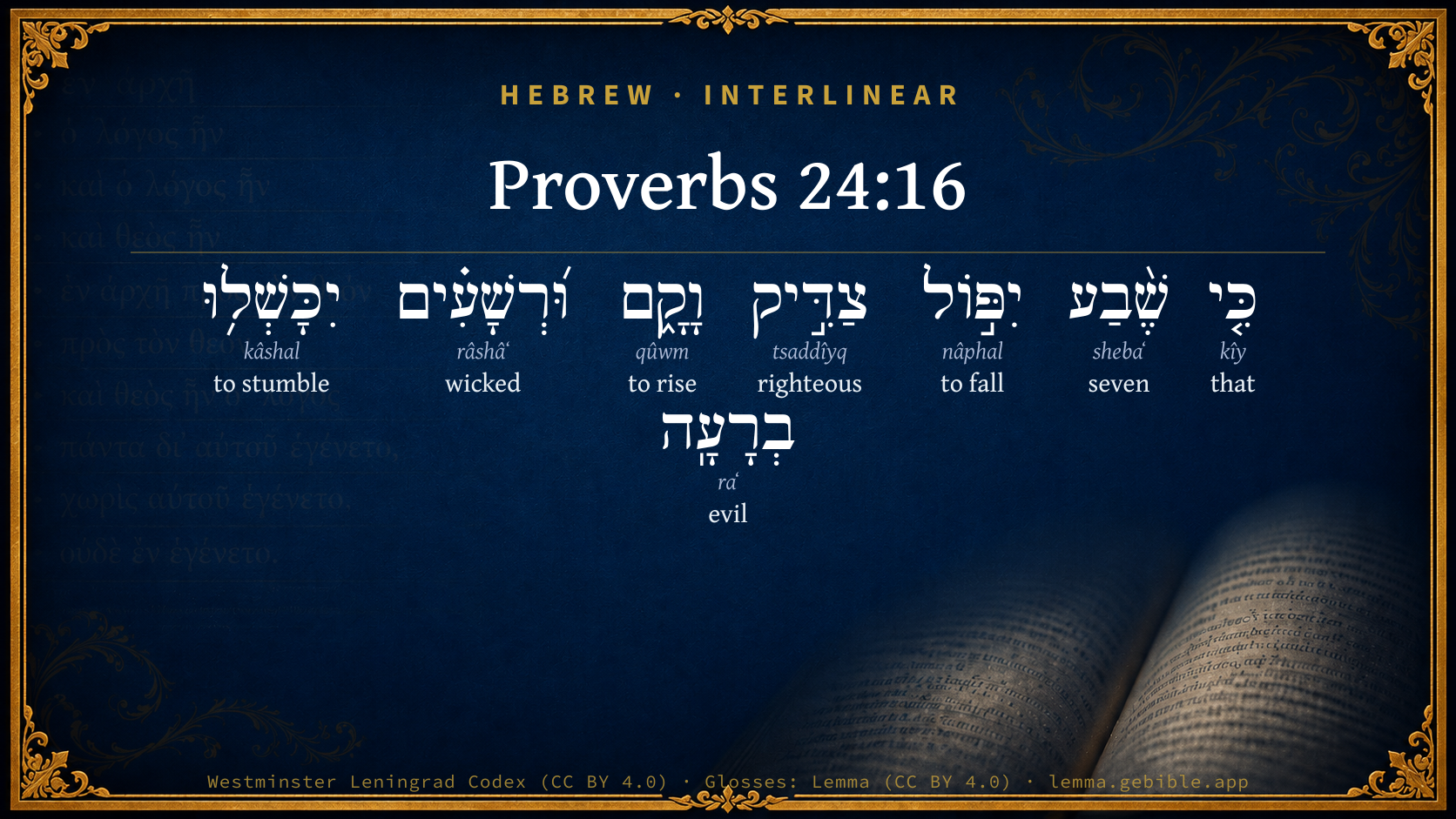
Hebrew (Westminster Leningrad Codex) Proverbs 24:16 appears in the Hebrew Old Testament. The text above is from the Westminster Leningrad Codex. Each word links to its Strong’s number, a concise gloss, and parsing drawn from the Open Scriptures Hebrew Bible morphology. Click any word for its full Brown-Driver-Briggs (BDB) entry.
Download image
Cite this verse

Proverbs 24:16 (World English Bible). Public Domain. Lemma interlinear Bible study tool, https://lemma.gebible.app/v/proverbs/24/16.

Show BibTeX & RIS
BibTeX
RIS
English Translation
For a righteous man falls seven times, and rises up again; But the wicked are overthrown by calamity.
World English Bible · Public Domain
Download a study sheet

One document with this verse’s original text, its word-by-word gloss line, the meaning frame, cross-references with their text, attributed commentary, and full source and license credits — printable, and it pastes into notes with its structure intact.

This verse Autodidact and up

Study sheet (.html) Plain text (.txt)

A passage Seminary Student

Up to 50 verses in one chapter. A passage sheet keeps up to 6 commentary sources and 12 cross-references per verse, in the order this page ranks them, and says so on the sheet whenever that leaves anything out. Ask for a single verse and you get the Autodidact verse sheet above.

Everything on this page stays free to read, with no account — the sheet is a download of what is already on screen, not access to it.

Want to remove ads? Support Godless Engineer
Compare translations 3

The same verse in 3 English versions, stacked beneath the original-language interlinear above. Click any original word for its lexicon entry.

Each is an independent rendering of the whole verse — the interlinear is not word-aligned to these translations.

Highlighted words mark where these versions differ — a whole-verse word diff, not a word-by-word alignment.

  • World English Bible Public Domain
    For a righteous man falls seven times, and rises up again; But the wicked are overthrown by calamity.
  • King James Version Public Domain
    For a just man falleth seven times, and riseth up again: but the wicked shall fall into mischief.
  • unfoldingWord Literal Text CC BY-SA 4.0
    For seven a righteous falls and rises up, but the wicked stumble into calamity.

unfoldingWord Literal Text — © unfoldingWord, licensed CC BY-SA 4.0. Word-aligned USFM3 via Door43 (git.door43.org/unfoldingWord/en_ult).

Versions to compare (up to 4)

3 of 4 selected

Show all 18 translations

Every available English version of this verse, each an independent rendering of the whole verse.

  • World English Bible Public Domain
    For a righteous man falls seven times, and rises up again; But the wicked are overthrown by calamity.
  • Berean Standard Bible Public Domain
    For though a righteous man may fall seven times, he still gets up; but the wicked stumble in bad times.
  • Majority Standard Bible Public Domain
    For though a righteous man may fall seven times, he still gets up; but the wicked stumble in bad times.
  • King James Version Public Domain
    For a just man falleth seven times, and riseth up again: but the wicked shall fall into mischief.
  • American Standard Version (1901) Public Domain
    For a righteous man falleth seven times, and riseth up again; But the wicked are overthrown by calamity.
  • Revised Version (1885) Public Domain
    For a righteous man falleth seven times, and riseth up again: but the wicked are overthrown by calamity.
  • Geneva Bible (1599) Public Domain
    For a iust man falleth seuen times, and riseth againe: but the wicked fall into mischiefe.
  • Douay-Rheims (1899) Public Domain
    For a just mall shall fall seven times and shall rise again: but the wicked shall fall down into evil.
  • Young's Literal Translation Public Domain
    For seven `times' doth the righteous fall and rise, And the wicked stumble in evil.
  • Literal Standard Version CC BY-SA 4.0
    For the righteous fall and rise seven [times], || And the wicked stumble in evil.
  • Unlocked Literal Bible CC BY-SA 4.0
    For the righteous person falls down seven times and rises again, but wicked people are brought down by calamity.
  • unfoldingWord Literal Text CC BY-SA 4.0
    For seven a righteous falls and rises up, but the wicked stumble into calamity.
  • Darby Bible Public Domain
    For the righteous falleth seven times, and riseth up again; but the wicked stumble into disaster.
  • World Messianic Bible Public Domain
    for a righteous man falls seven times and rises up again, but the wicked are overthrown by calamity.
  • Webster's Bible Public Domain
    For a just man falleth seven times, and riseth again: but the wicked shall fall into mischief.
  • Free Bible Version CC BY-SA 4.0
    Those who do right may fall down seven times, and still get up again; but the wicked are brought down by disaster.
  • Bible in Basic English Public Domain
    For an upright man, after falling seven times, will get up again: but trouble is the downfall of the evil.
  • JPS Tanakh (1917) Public Domain
    For a righteous man falleth seven times, and riseth up again, but the wicked stumble under adversity.

Literal Standard Version (2020), Covenant Press — licensed CC BY-SA 4.0. Text via the HelloAO Bible API (eBible.org). Unlocked Literal Bible (unfoldingWord) — licensed CC BY-SA 4.0. Text via the HelloAO Bible API (eBible.org). unfoldingWord Literal Text — © unfoldingWord, licensed CC BY-SA 4.0. Word-aligned USFM3 via Door43 (git.door43.org/unfoldingWord/en_ult). Free Bible Version, Dr. Jonathan Gallagher — licensed CC BY-SA 4.0. Text via the HelloAO Bible API (eBible.org).

Word by word

More ways to search: Search by grammar → Find every occurrence → Compare this word →

Practice this passage: Drill this verse → Learn its vocabulary →

יִכָּשְׁל֥וּ
kâshal
H3782
“to stumble”
Verb, Niphal, Imperfect, 3rd Person, Masculine, Plural
Part of Speech
Verb
Stem
Niphal
Form
Imperfect
Person
3rd Person
Gender
Masculine
Number
Plural
Full BDB Definition

Origin: a primitive root

TWOT: 1050

to stumble, stagger, totter - (Qal) - to stumble - to totter - (Niphal) - to stumble - to be tottering, be feeble - (Hiphil) - to cause to stumble, bring injury or ruin to, overthrow - to make feeble, make weak - (Hophal) to be made to stumble - (Piel) bereave
  1. כִּ֤י kîy H3588 “that” Conjunction
  2. שֶׁ֨בַע shebaʻ H7651 “seven” Adjective, Cardinal number, Feminine, Singular, Absolute
  3. יִפּ֣וֹל nâphal H5307 “to fall” Verb, Qal, Imperfect, 3rd Person, Masculine, Singular
  4. צַדִּ֣יק tsaddîyq H6662 “righteous” Adjective, Adjective, Masculine, Singular, Absolute
  5. וָקָ֑ם qûwm H6965 “and · to rise” Conjunction + Verb, Qal, Sequential Perfect, 3rd Person, Masculine, Singular
  6. וּ֝רְשָׁעִ֗ים râshâʻ H7563 “and · wicked” Conjunction + Adjective, Adjective, Masculine, Plural, Absolute
  7. בְרָעָֽה raʻ H7451 “in/at · evil” Preposition + Noun, Common, Feminine, Singular, Absolute

About this verse

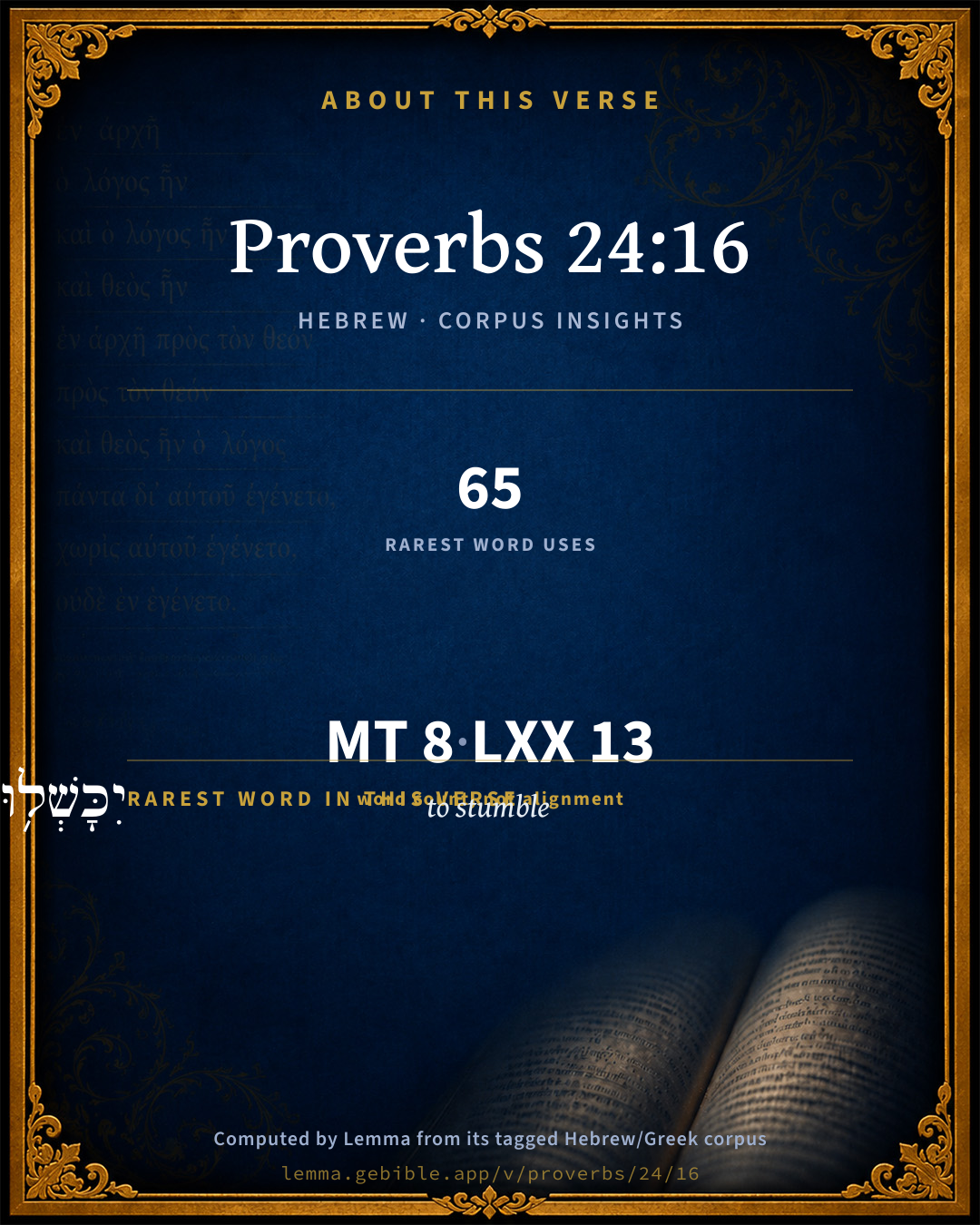
These counts appear in no published source. They are computed here, from the morphology-tagged text and Lemma’s own curated glosses. What Lemma adds →

8
words
8
distinct lemmas
Wisdom
section

Grammatical profile

  • 3 verbs
  • 1 noun
  • 3 adjectives
  • 1 conjunction

Verb forms

  • יִפּ֣וֹל Qal · Imperfect
  • וָקָ֑ם Qal · Sequential Perfect
  • יִכָּשְׁל֥וּ Niphal · Imperfect

Hebrew & Septuagint length

In English translation the verse runs 18 words from the Hebrew and 20 from the Septuagint (LXX English) — closely comparable.

A rough comparison of the two English renderings, which tokenize alike — not a word-level alignment.

Word counts can differ between the Hebrew and the Greek without any difference in meaning — e.g. the Hebrew direct-object marker אֵת has no separate Greek word, and Greek often adds the article ὁ.

In the original languages it is 8 Hebrew tokens and 13 Greek tokens — but the two are counted differently (Hebrew bundles its prefixes and suffixes into one token; the Greek is in lemma form), so that isn’t a like-for-like length.

Cross-references

20

Topical passages linked to Proverbs 24:16 in the Treasury of Scripture Knowledge — connected by theme and wording, ordered by reader-vote popularity; previews shown in the World English Bible.

  • Psalms 34:19 Many are the afflictions of the righteous, But Yahweh delivers him out of them all.
  • Psalms 37:24 Though he stumble, he shall not fall, For Yahweh holds him up with his hand.
  • Micah 7:8–10 Don't rejoice against me, my enemy. When I fall, I will arise. When I sit in darkness, Yahweh will be a light to me.
  • Job 5:19 He will deliver you in six troubles; Yes, in seven there shall no evil touch you.
  • 2 Corinthians 4:8–12 We are pressed on every side, yet not crushed; perplexed, yet not to despair;
  • 2 Corinthians 11:23–27 Are they servants of Christ? (I speak as one beside himself) I am more so; in labors more abundantly, in prisons more abundantly, in stripes above measure, in deaths often.
  • Proverbs 14:32 The wicked is brought down in his calamity, But in death, the righteous has a refuge.
  • 1 Thessalonians 5:3 For when they are saying, "Peace and safety," then sudden destruction will come on them, like birth pains on a pregnant woman; and they will in no way escape.
  • Revelation 18:20–21 Rejoice over her, O heaven, you saints, apostles, and prophets; for God has judged your judgment on her."
  • Proverbs 13:17 A wicked messenger falls into trouble, But a trustworthy envoy gains healing.
  • 2 Corinthians 1:8–10 For we don't desire to have you uninformed, brothers, concerning our affliction which happened to us in Asia, that we were weighed down exceedingly, beyond our power, so much that we despaired even of life.
  • Psalms 52:5 God will likewise destroy you forever. He will take you up, and pluck you out of your tent, And root you out of the land of the living. Selah.
  • Proverbs 28:14–18 Blessed is the man who always fears; But one who hardens his heart falls into trouble.
  • Amos 5:2 "The virgin of Israel has fallen; She shall rise no more. She is cast down on her land; There is no one to raise her up."
  • 1 Samuel 26:10 David said, As Yahweh lives, Yahweh will strike him; or his day shall come to die; or he shall go down into battle and perish.
  • Esther 7:10 So they hanged Haman on the gallows that he had prepared for Mordecai. Then was the king's wrath pacified.
  • Psalms 7:16 The trouble he causes shall return to his own head. His violence shall come down on the crown of his own head.
  • 1 Samuel 31:4 Then said Saul to his armor bearer, Draw your sword, and thrust me through therewith, lest these uncircumcised come and thrust me through, and abuse me. But his armor bearer would not; for he was sore afraid. Therefore Saul took his sword, and fell on it.
  • Acts 12:23 Immediately an angel of the Lord struck him, because he didn't give God the glory, and he was eaten by worms and died.
  • Amos 8:14 Those who swear by the sin of Samaria, And say, 'As your god, Dan, lives;' And, 'As the way of Beersheba lives;' They will fall, and never rise up again."

Cross-references courtesy of OpenBible.info (CC BY 4.0).

Hebrew and Greek witnesses Masoretic Hebrew ↔ Greek Septuagint

The same verse in the two great witnesses to the Old Testament, shown verse-for-verse.

These are two independent witnesses, not word-aligned to each other, and the Septuagint is shown in lemma (dictionary) form.

Hebrew Proverbs 24:16 Masoretic · Westminster Leningrad Codex

כִּ֤י שֶׁ֨בַע יִפּ֣וֹל צַדִּ֣יק וָקָ֑ם וּ֝רְשָׁעִ֗ים יִכָּשְׁל֥וּ בְרָעָֽה

For a righteous man falls seven times, and rises up again; But the wicked are overthrown by calamity.

World English Bible · Public Domain

Greek LXX Proverbs 24:16 Septuagint · lemma form

ἑπτάκι γάρ πίπτω ὁ δίκαιος καί ἀναἵστημι ὁ δέ ἀσεβής ἀσθενέω ἐν κακός

For a righteous man will fall seven times, and rise again: but the ungodly shall be without strength in troubles.

LXX2012 (modern English Septuagint) · Public Domain

On this verse, The Pulpit Commentary discusses the Septuagint’s reading. Read the note in Commentary ↓

Hebrew: Westminster Leningrad Codex (CC BY 4.0). Greek: Septuagint (public domain); English from LXX2012 (modern English Septuagint) (Public Domain). How the Septuagint differs from the Hebrew →

Commentary

Notes on Proverbs 24:16 from classic Christian and Jewish commentators (each source and its license shown beneath its notes). The classic Christian expositions comment on the surrounding passage and are grouped to its opening verse, so a note may address several verses; the Jewish commentaries on the Tanakh (Rashi and others) are per-verse, so they appear only where the commentator wrote on this verse.

Lemma curates 59 commentaries, every one of them public domain or Creative Commons licensed, each selected and text-cleaned for this edition rather than reprinted as found. About our sources →

Trapp's Complete Commentary

John Trapp

Pro 24:16 For a just [man] falleth seven times, and riseth up again: but the wicked shall fall into mischief.

Ver. 16. For a just man falleth seven times,] i.e., Often. Seven times a day, as the Vulgate and many of the Fathers read it, who also understand this text as falling into sin, and rising again by repentance. But the opposition carries it to the other sense, of falling into trouble. And the next verse speaks as much, "Rejoice not when thine enemy falleth." God’s saints are bound to "rejoice when they fall into divers temptations." {Jas 1:2} What though they fall into them? not go in step by step, but be precipitated, plunged over head and ears. Say they fall not into one but many crosses, - as they seldom come single, but like Job’s messengers, one at the heels of another, - yet be exceeding glad, saith the apostle; as a merchant is to see his ships come laden in. For, "though ye fall, ye shall arise; and though ye sit in darkness, the Lord shall give you light." {Mic 7:8}

But the wicked shall fall into mischief,] i.e., Into remediless misery. Non surget hic afflictio {Nah 1:9} As they shall have an evil, an only evil without mixture of mercy, {Eze 7:5} so they shall totally and finally be consumed at once. If Mordecai be of the seed of the Jews, before whom Haman hath begun to fall, he shall fall to some purpose. {Est 6:13} A Jew may fall before a Persian, and get up and prevail; but if a Persian or other persecutor begin to fall before a Jew, he can neither stay nor rise. There is an invisible hand of omnipotence that strikes in for his own, and confounds their opposites.

John Trapp, A Commentary or Exposition upon All the Books of the Old and New Testament (1647–1656) — public domain. Text from a community e-Sword module.

Geneva Bible (1599)

Geneva Bible translators

He is subject to many perils, but God delivereth him.

Geneva Bible (1599) marginal notes — public domain. Text via Bolls.life.

Jamieson, Fausset & Brown

Robert Jamieson, A. R. Fausset & David Brown

seven times--often, or many (Pro 6:16, Pro 6:31; Pro 9:1).

Jamieson, Fausset & Brown — Commentary Critical and Explanatory on the Whole Bible (1871) — public domain (CC PDM 1.0). Text via the HelloAO Bible API.

Adam Clarke's Commentary

Verse 16. For a just man] צדיק tsaddik, the righteous, the same person mentioned above.

Falleth seven times] Gets very often into distresses through his resting place being spoiled by the wicked man, the robber, the spoiler of the desert, lying in wait for this purpose, Pr 24:15.

And riseth up again] Though God permit the hand of violence sometimes to spoil his tent, temptations to assail his mind, and afflictions to press down his body, he constantly emerges; and every time he passes through the furnace, he comes out brighter and more refined.

But the wicked shall fall into mischief.] And there they shall lie; having no strong arm to uphold them. Yet,

Adam Clarke's Commentary on the Bible (1810–1826) — public domain. Text from a community e-Sword/MySword module.

Ellicott's Commentary for English Readers

(16) For a just man falleth seven times and riseth up again.—That is, falls into trouble (not sin, as is often supposed). Therefore thy malice will be of no avail, for God’s protection is about him. (Comp. Job_5:19; Psa_34:19; Psa_37:24.)

Seven times—i.e., frequently. (Comp. Mat_18:21.)

A Bible Commentary for English Readers, edited by Charles John Ellicott (1878–1897) — public domain. Text from a community e-Sword module.

The Cambridge Bible for Schools and Colleges

gen. ed. J. J. S. Perowne

16. falleth] not into sin, for the Heb. word is never used of moral lapse, but into trouble or calamity. You will “lay wait against” him and “spoil” him (Pro_24:15) to no purpose. You may cause him many “falls” by your machinations, but he will rise superior to them all. “Though he fall, he shall not be utterly cast down: for the Lord upholdeth him with his hand” (Psa_37:24. Comp. Psa_34:19). Whereas “the wicked,” among whom thou art thus numbering thyself (Pro_24:15), shall fall into mischief; or rather, shall not merely fall to rise again, but are overthrown by calamity (R.V.). By a single calamity, it may be (in contrast to the sevenfold recovery of the righteous) they are utterly crushed.

The Cambridge Bible for Schools and Colleges (gen. ed. J. J. S. Perowne; Cambridge University Press, 1878–1918) — public domain. Text from a community e-Sword module.

John Gill's Exposition

Rejoice not when thine enemy falleth,.... These words are spoken not to the wicked man, Pro 24:15; but to the just man, or Solomon's son, or the children of Wisdom; for by the "enemy" is meant such who are at enmity with the people of God, as the seed of the serpent, and those after the flesh, are: and when these "fall", saints should not "rejoice"; as when they fall into sin; for so to do would be to act as wicked "charity which rejoiceth not in iniquity", Co1 13:6, or rather when they fill into calamity and distress; for this is also the part which wicked men act towards the people of God, and should not be imitated in; see Oba 1:12. Joy may be expressed at the fall of the public enemies of God and his people, as was by the Israelites at the destruction of Pharaoh and his host, Exo 15:1; and as will be by the church at the destruction of antichrist, and which they are called upon to do, Rev 18:20; partly on account of their own deliverance and safety, and chiefly because of the glory of God, and of his justice displayed therein; see Psa 58:10; but as private revenge is not to be sought, nor acted, so joy at the calamity and ruin of a private enemy, or a man's own enemy, should not be expressed; but rather he is to be pitied and helped; see Pro 25:21; for to love an enemy, and show regard to him, is the doctrine both of the Old and of the New Testament;

and let not thine heart be glad when he stumbleth; even secret joy should not be indulged, gladness in the heart, though it does not appear in the countenance, and is not expressed in words; no, not at the least appearance of mischief, when he only stumbles and is ready to fall; and much less should there be exultation and rejoicings made in an open manner at the utter ruin of him.

John Gill's Exposition of the Whole Bible (1746–1763) — public domain (CC PDM 1.0). Text via the HelloAO Bible API.

Haydock's Catholic Bible Commentary

Fall into smaller sins, (St. Gregory vi. in 2 Reg. xv. &c.) or into disgrace, as yippol (Haydock) rather intimates. (Vatable) (St. Augustine, City of God xi. 31.) --- Both significations agree with the context. See Job v. 27., and Matthew xviii. 21. (Calmet) --- He who is not subject to mortal sin, may still be exposed to many failings, and venial sins, which do not deprive him of the title of just; whereas the wicked consents to mortal sin, from which he riseth not so easily. Hence the wise man admonishes us not to lie in wait, or calumniously seek impiety in the house or soul of the just. (Worthington)

George Leo Haydock (1774–1849), Haydock's Catholic Family Bible and Commentary, 1859 edition — public domain. Excludes Psalms (Douay-Rheims chapter numbering differs from Protestant) and Deuterocanonical books (Catholic canon only).

Matthew Poole's English Annotations

Falleth; either,

1. Into sin. Or, rather,

2. Into calamities, of which he evidently speaks, both in the foregoing verse, and in the opposite and following branch of this verse, and so this word is used in the next verse, and Psa 37:24; Isa 24:20; Jer 25:27; Amo 8:14; Mic 7:8, &c. And so this is fitly alleged as a just reason to dissuade wicked men from their unjust attempts against righteous men, because they should not succeed in them; and although they might by God’s permission bring them into some distress for a thee, yet God would deliver them out of their hands, and they should be disappointed of their hopes.

Seven times, i.e. frequently.

Into mischief; into unavoidable and irrecoverable destruction, ofttimes in this life, and infallibly in the next.

Matthew Poole's English Annotations on the Holy Bible (1683–1685) — public domain. Text from a community e-Sword/MySword module.

The Pulpit Commentary

A just man falleth seven times, and riseth up again. The fall may be taken of sin or of calamity. Preachers, ancient and modern, have made much use of this text in the first sense, expatiating how a good man may fall into venial or more serious sins, but he never loses his love of God, and rises from his fall by repentance on every occasion. We also often find the words in die, "a day," added, which indeed occur in some manuscripts, but are not in the original. But the verb naphal seems not to be used in the sense of "falling" morally; and the meaning here is that the just man frequently falls into trouble, he is not secure against worldly cares and losses, or the insidious attacks of the man mentioned in Ver. 15; but he never loses his trust in God or offends by fretfulness and impatience, and always God"s providence watches over him and delivers him out of all his afflictions. "Seven times" means merely often, that number being used to express plurality or completeness (see on Pro_6:31 Pro_26:16; and Gen_4:24 Job_5:19 which is like our passage; and comp. Mat_18:22) The expectation which the sinner conceived when he saw the good man distressed, that he might seize the opportunity and use it to his own benefit, is woefully disappointed. In contrast with the recovery and reestablishment of the righteous, when the wicked suffer calamity there is no recuperation for them. The wicked shall fall into mischief; Revised Version better, are overthrown by calamity. (comp. Pro_14:32, and note there) Septuagint," But the ungodly shall be weak in evils.

The fall of a good man.

I IT IS POSSIBLE FOR A GOOD MAN TO FALL.

1. Here is a warning against presumption. "Let him that thinketh he standeth take heed lest he fall". (1Co_10:12) No one is so perfect as to be impeccable. Peter, who little expected it, failed in the moment of trial.

2. He is a warning against wrong judgments. If a good man stumbles it is commonly thought that he proves himself to have been a hypocrite from the first. No notion could be more unwarrantable. It is possible that the former life was honest and true and up to its pretension, but that a sudden change for the worse has occurred through yielding to overpowering temptation. The citadel was honestly guarded; but in an unwary moment, when the custodian was sleeping, or careless, or weak, it fell before the assaults of the everwatchful foe. This may even be. repeated many times. We can scarcely think of a really good man lapsing utterly from the right way as many as seven times and as often returning to it. But some measure of sin is committed many times. There is not a Christian who does not fall into numerous sins.

II IF A GOOD MAN FALLS HE IS LIKELY TO RISE UP AGAIN. We need not now discuss the thorny doctrine of "final perseverance." Without retreating into the tangled thicket of a priori dogmatics, we may discover certain plain and practical. considerations which will encourage us to believe in the recovery of the lapsed.

1. The bent of a good mans life is towards goodness. He is a just man. Righteousness is characteristic of him. It is his habit. His fall is an event, his righteousness is his life. He is not the less guilty in his sin. He cannot shake it off and disown it, fortifying himself against the charge of it under the guise of his habitual righteousness. A long career of goodness is no excuse for a single wrong deed. Nevertheless, beneath and behind the sin into which the man has been surprised are the general tone and temper of his life. This will make his fall an agony. One look from Christ, and the shamefaced disciple goes out to weep bitterly. (Mat_26:75) The Christian who has been surprised in an hour of weakness will be in the greatest distress afterwards. He can have no rest till he is forgiven and restored. Hence there is a hope for him which we cannot cherish on behalf of the bad man who has had no experience of the better way and who has no inclination to follow it.

2. A good man may return. There is danger in despair. The miserable penitent fears that he may have committed the unpardonable sin, forgetting that his very grief is a proof that that dark eternity of guilt has not yet been reached. God is long-suffering and merciful. Seven times the poor man falls; seven times he is forgiven and restored by his compassionate Lord.

3. The grace of God assists recovery. Indeed, without this it were impossible. But with it who shall despair? On the other hand, alter a sicked man has indulged in sin he refuses to open his heart to Divine grace. "The one means by which he might climb up out of his deep ruin is rejected by him.

In conclusion, we may gather from a consideration of this subject that the first essential is the character of a man"s life, rather than that of isolated and perhaps exceptional deeds. God notes every deed, and not one can go unavenged. But the fundamental question is How does a man live in the main? is the set of his life towards goodness? does he habitually face the light or the darkness? Though with many stumbles and shameful bruises, is he, on the whole, going up, not down? If so, he is one of God"s sons.

The Pulpit Commentary (1880–1919), ed. H.D.M. Spence-Jones & Joseph S. Exell — public domain. Text from a community e-Sword module.

John Wesley's Explanatory Notes

Falleth - Into calamities, of which he evidently speaks both in the foregoing verse, and in the following branch of this verse. Fall - Frequently into irrecoverable destruction.

John Wesley, Explanatory Notes Upon the Whole Bible (1754–1765) — public domain. Text via the GEBible commentary corpus.

Kretzmann's Popular Commentary

Paul E. Kretzmann

v. 16. for a just man falleth seven times, for misfortunes often seem to single him out, he has his full share of them, and riseth up again, endowed with new strength by the Lord; but the wicked shall fall into mischief, stumble into destruction, their fate being everlasting misfortune.

Paul E. Kretzmann, Popular Commentary of the Bible (1921–1924) — public domain. Text from a community e-Sword module.

Lesson kit

Teaching starters — assembled from the data on this page, not authored interpretation. Every prompt links to the verse data it draws on. Edit before teaching.

Proverbs, in the Wisdom, opens this verse with 8 words (8 distinct Hebrew lemmas). Its most distinctive word is kâshal (“to stumble”). A historical commentator’s framing appears above. Read the whole chapter for the surrounding context.

Discussion questions

  1. How does “to stumble” (kâshal) shape what this verse is saying?
  2. Psalms 34:19 shares this passage’s theme. How do the two illuminate each other?
  3. These translations render this verse differently; the difference is in the English rendering, not the original. What questions does that raise?
  4. The verb «יִפּ֣וֹל» is Qal Imperfect. How does its form color the action?
  5. Reading how Trapp's Complete Commentary and Geneva Bible (1599) read this verse, where do the two commentators agree and where do they part?

Things to notice

Reading settings

Reading text

Shown beneath each verse's original-language words.

Old Testament
Old Testament edition

Read the OT as the Masoretic Hebrew (MT) or the Greek Septuagint (LXX).

English shown for the Greek Septuagint (in the Hebrew ↔ Greek comparison).

Comparing translations? Open the Compare panel on any verse page to stack up to four side by side.