
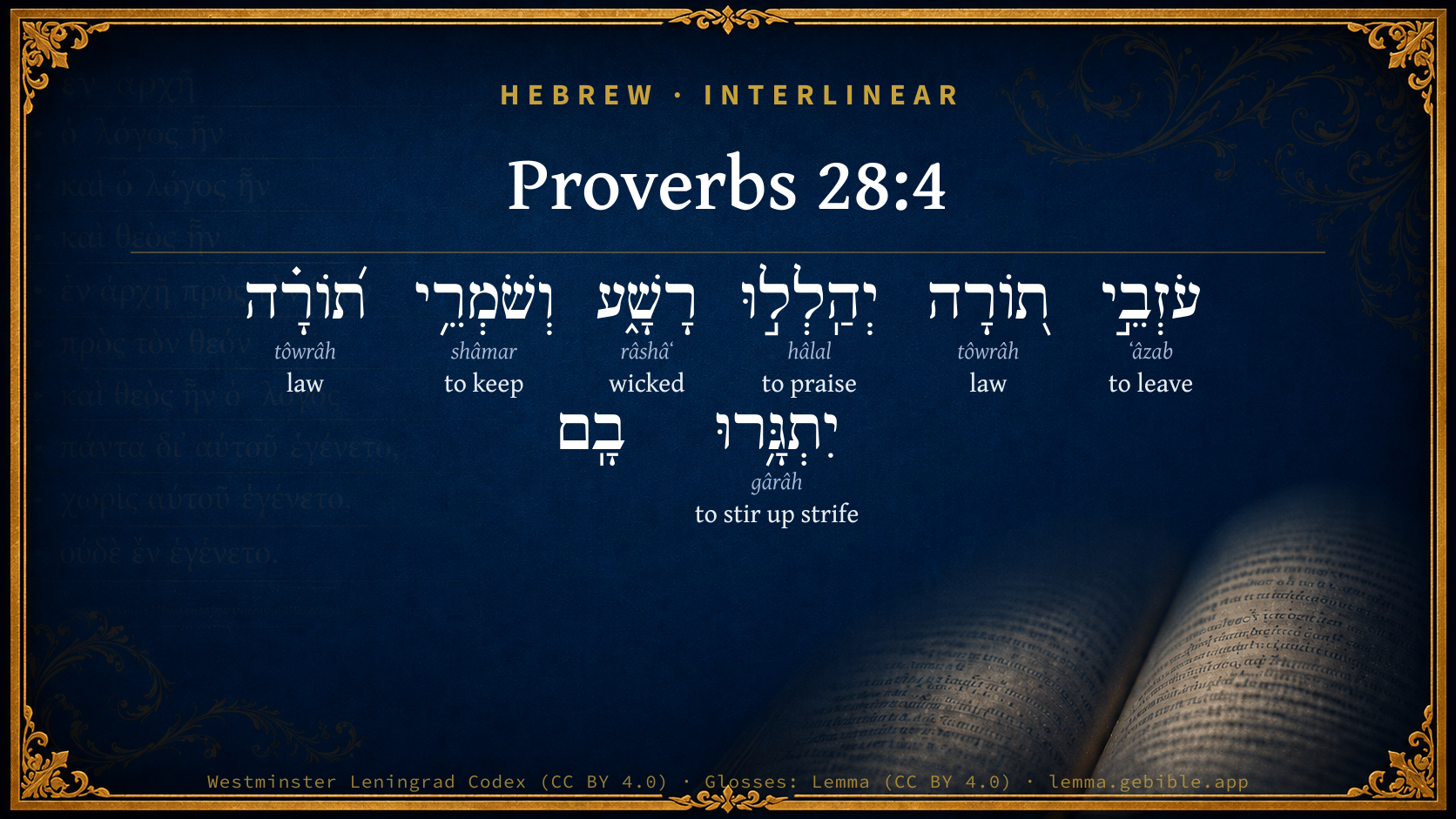
Proverbs 28:4

Hebrew (Westminster Leningrad Codex) Proverbs 28:4 appears in the Hebrew Old Testament. The text above is from the Westminster Leningrad Codex. Each word links to its Strong’s number, a concise gloss, and parsing drawn from the Open Scriptures Hebrew Bible morphology. Click any word for its full Brown-Driver-Briggs (BDB) entry.
Download image
Cite this verse

Proverbs 28:4 (World English Bible). Public Domain. Lemma interlinear Bible study tool, https://lemma.gebible.app/v/proverbs/28/4.

Show BibTeX & RIS
BibTeX
RIS
English Translation
Those who forsake the law praise the wicked; But those who keep the law contend with them.
World English Bible · Public Domain
Download a study sheet

One document with this verse’s original text, its word-by-word gloss line, the meaning frame, cross-references with their text, attributed commentary, and full source and license credits — printable, and it pastes into notes with its structure intact.

This verse Autodidact and up

Study sheet (.html) Plain text (.txt)

A passage Seminary Student

Up to 50 verses in one chapter. A passage sheet keeps up to 6 commentary sources and 12 cross-references per verse, in the order this page ranks them, and says so on the sheet whenever that leaves anything out. Ask for a single verse and you get the Autodidact verse sheet above.

Everything on this page stays free to read, with no account — the sheet is a download of what is already on screen, not access to it.

Want to remove ads? Support Godless Engineer
Compare translations 3

The same verse in 3 English versions, stacked beneath the original-language interlinear above. Click any original word for its lexicon entry.

Each is an independent rendering of the whole verse — the interlinear is not word-aligned to these translations.

Highlighted words mark where these versions differ — a whole-verse word diff, not a word-by-word alignment.

  • World English Bible Public Domain
    Those who forsake the law praise the wicked; But those who keep the law contend with them.
  • King James Version Public Domain
    They that forsake the law praise the wicked: but such as keep the law contend with them.
  • unfoldingWord Literal Text CC BY-SA 4.0
    Those forsaking the law praise the wicked, but those keeping the law strive against them.

unfoldingWord Literal Text — © unfoldingWord, licensed CC BY-SA 4.0. Word-aligned USFM3 via Door43 (git.door43.org/unfoldingWord/en_ult).

Versions to compare (up to 4)

3 of 4 selected

Show all 18 translations

Every available English version of this verse, each an independent rendering of the whole verse.

  • World English Bible Public Domain
    Those who forsake the law praise the wicked; But those who keep the law contend with them.
  • Berean Standard Bible Public Domain
    Those who forsake the law praise the wicked, but those who keep the law resist them.
  • Majority Standard Bible Public Domain
    Those who forsake the law praise the wicked, but those who keep the law resist them.
  • King James Version Public Domain
    They that forsake the law praise the wicked: but such as keep the law contend with them.
  • American Standard Version (1901) Public Domain
    They that forsake the law praise the wicked; But such as keep the law contend with them.
  • Revised Version (1885) Public Domain
    They that forsake the law praise the wicked: but such as keep the law contend with them.
  • Geneva Bible (1599) Public Domain
    They that forsake the Law, prayse the wicked: but they that keepe the Law, set themselues against them.
  • Douay-Rheims (1899) Public Domain
    They that forsake the law, praise the wicked man: they that keep it, are incensed against him.
  • Young's Literal Translation Public Domain
    Those forsaking the law praise the wicked, Those keeping the law plead against them.
  • Literal Standard Version CC BY-SA 4.0
    Those forsaking the Law praise the wicked, || Those keeping the Law plead against them.
  • Unlocked Literal Bible CC BY-SA 4.0
    Those who forsake the law praise wicked people, but those who keep the law fight against them.
  • unfoldingWord Literal Text CC BY-SA 4.0
    Those forsaking the law praise the wicked, but those keeping the law strive against them.
  • Darby Bible Public Domain
    They that forsake the law praise the wicked; but such as keep the law contend with them.
  • World Messianic Bible Public Domain
    Those who forsake the Torah praise the wicked; but those who keep the Torah contend with them.
  • Webster's Bible Public Domain
    They that forsake the law praise the wicked: but such as keep the law contend with them.
  • Free Bible Version CC BY-SA 4.0
    People who reject the law praise the wicked, but those who keep the law fight against them.
  • Bible in Basic English Public Domain
    Those who have no respect for the law give praise to the evil-doer; but such as keep the law are against him.
  • JPS Tanakh (1917) Public Domain
    They that forsake the law praise the wicked; but such as keep the law contend with them.

Literal Standard Version (2020), Covenant Press — licensed CC BY-SA 4.0. Text via the HelloAO Bible API (eBible.org). Unlocked Literal Bible (unfoldingWord) — licensed CC BY-SA 4.0. Text via the HelloAO Bible API (eBible.org). unfoldingWord Literal Text — © unfoldingWord, licensed CC BY-SA 4.0. Word-aligned USFM3 via Door43 (git.door43.org/unfoldingWord/en_ult). Free Bible Version, Dr. Jonathan Gallagher — licensed CC BY-SA 4.0. Text via the HelloAO Bible API (eBible.org).

Word by word

More ways to search: Search by grammar → Find every occurrence → Compare this word →

Practice this passage: Drill this verse → Learn its vocabulary →

יִתְגָּ֥רוּ
gârâh
H1624
“to stir up strife”
Verb, Hithpael, Imperfect, 3rd Person, Masculine, Plural
Part of Speech
Verb
Stem
Hithpael
Form
Imperfect
Person
3rd Person
Gender
Masculine
Number
Plural
Full BDB Definition

Origin: a primitive root

TWOT: 378

to cause strife, stir up, contend, meddle, strive, be stirred up - (Piel) to stir up strife, excite strife - (Hithpael) - to excite oneself against, engage in strife - to excite oneself (against foe), wage war
  1. עֹזְבֵ֣י ʻâzab H5800 “leaving” Verb, Qal, Participle Active, Masculine, Plural, Construct
  2. ת֭וֹרָה tôwrâh H8451 “law” Noun, Common, Feminine, Singular, Absolute
  3. יְהַֽלְל֣וּ hâlal H1984 “to praise” Verb, Piel, Imperfect, 3rd Person, Masculine, Plural
  4. רָשָׁ֑ע râshâʻ H7563 “wicked” Adjective, Adjective, Masculine, Singular, Absolute
  5. וְשֹׁמְרֵ֥י shâmar H8104 “and · keeping” Conjunction + Verb, Qal, Participle Active, Masculine, Plural, Construct
  6. ת֝וֹרָ֗ה tôwrâh H8451 “law” Noun, Common, Feminine, Singular, Absolute

About this verse

These counts appear in no published source. They are computed here, from the morphology-tagged text and Lemma’s own curated glosses. What Lemma adds →

8
words
6
distinct lemmas
Wisdom
section

Notable vocabulary

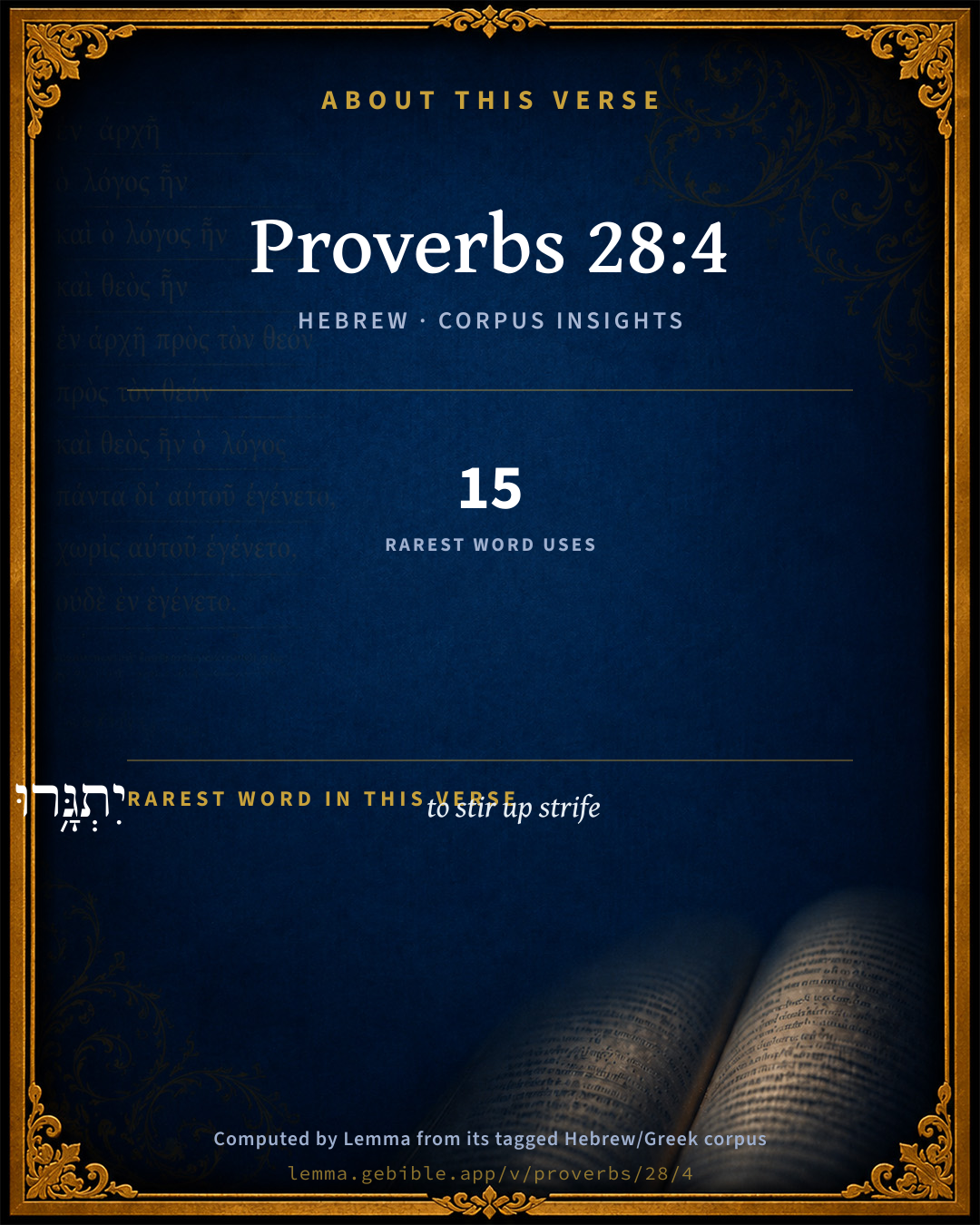
The rarest word here is יִתְגָּ֥רוּ to stir up strife H1624 — appearing just 15 times in the whole Hebrew Bible.

Shared distinctive vocabulary

יִתְגָּ֥רוּ to stir up strife H1624 occurs in 13 verses of the Hebrew Bible. Also found in:

Grammatical profile

  • 4 verbs
  • 2 nouns
  • 1 adjective
  • 1 preposition

Verb forms

  • עֹזְבֵ֣י Qal · Participle Active
  • יְהַֽלְל֣וּ Piel · Imperfect
  • וְשֹׁמְרֵ֥י Qal · Participle Active
  • יִתְגָּ֥רוּ Hithpael · Imperfect

Repetition

A word recurs within this verse — often emphatic in Hebrew:

  • ת֭וֹרָה law H8451 ×2

Hebrew & Septuagint length

In English translation the verse runs 17 words from the Hebrew and 19 from the Septuagint (LXX English) — closely comparable.

A rough comparison of the two English renderings, which tokenize alike — not a word-level alignment.

Word counts can differ between the Hebrew and the Greek without any difference in meaning — e.g. the Hebrew direct-object marker אֵת has no separate Greek word, and Greek often adds the article ὁ.

Cross-references

31

Topical passages linked to Proverbs 28:4 in the Treasury of Scripture Knowledge — connected by theme and wording, ordered by reader-vote popularity; previews shown in the World English Bible.

  • Romans 1:32 who, knowing the ordinance of God, that those who practice such things are worthy of death, not only do the same, but also approve of those who practice them.
  • Ephesians 5:11 Have no fellowship with the unfruitful works of darkness, but rather even reprove them.
  • Matthew 14:4 For John said to him, "It is not lawful for you to have her."
  • Matthew 3:7 But when he saw many of the Pharisees and Sadducees coming for his baptism, he said to them, "You offspring of vipers, who warned you to flee from the wrath to come?
  • 1 Kings 18:18 He answered, I have not troubled Israel; but you, and your father's house, in that you have forsaken the commandments of Yahweh, and you have followed the Baals.
  • Psalms 49:18 Though while he lived he blessed his soul-- And men praise you when you do well for yourself--
  • 1 John 4:5 They are of the world. Therefore they speak of the world, and the world hears them.
  • 1 Kings 18:21 Elijah came near to all the people, and said, "How long will you waver between the two sides? If Yahweh is God, follow him; but if Baal, then follow him." The people answered him not a word.
  • 2 Kings 3:13–14 Elisha said to the king of Israel, What have I to do with you? get you to the prophets of your father, and to the prophets of your mother. The king of Israel said to him, No; for Yahweh has called these three kings together to deliver them into the hand of Moab.
  • Nehemiah 5:7–13 Then I consulted with myself, and contended with the nobles and the rulers, and said to them, You exact usury, everyone of his brother. I held a great assembly against them.
  • Nehemiah 13:17–20 Then I contended with the nobles of Judah, and said to them, What evil thing is this that you do, and profane the Sabbath day?
  • Psalms 10:3 For the wicked boasts of his heart's cravings, He blesses the greedy, and condemns Yahweh.
  • Acts 15:2 Therefore when Paul and Barnabas had no small discord and discussion with them, they appointed Paul and Barnabas, and some others of them, to go up to Jerusalem to the apostles and elders about this question.
  • Jude 1:3 Beloved, while I was very eager to write to you about our common salvation, I was constrained to write to you exhorting you to contend earnestly for the faith which was once for all delivered to the saints.
  • 1 Samuel 15:14–24 Samuel said, What means then this bleating of the sheep in my ears, and the lowing of the oxen which I hear?
  • 1 Samuel 22:14–15 Then Ahimelech answered the king, and said, Who among all your servants is so faithful as David, who is the king's son-in-law, and is taken into your council, and is honorable in your house?
  • 1 Samuel 23:19–21 Then came up the Ziphites to Saul to Gibeah, saying, Doesn't David hide himself with us in the strongholds in the wood, in the hill of Hachilah, which is on the south of the desert?
  • 1 Kings 20:41–42 He hurried, and took the headband away from his eyes; and the king of Israel discerned him that he was of the prophets.
  • 1 Kings 21:19–20 You shall speak to him, saying, Thus says Yahweh, Have you killed and also taken possession? You shall speak to him, saying, Thus says Yahweh, In the place where dogs licked the blood of Naboth shall dogs lick your blood, even yours.
  • 1 Kings 22:19–28 [Micaiah] said, Therefore hear you the word of Yahweh: I saw Yahweh sitting on his throne, and all the host of heaven standing by him on his right hand and on his left.
  • Nehemiah 13:8–11 It grieved me sore: therefore I cast forth all the household stuff of Tobiah out of the chamber.
  • Nehemiah 13:15 In those days saw I in Judah some men treading wine-presses on the Sabbath, and bringing in sheaves, and lading donkeys [therewith]; as also wine, grapes, and figs, and all manner of burdens, which they brought into Jerusalem on the Sabbath day: and I testified [against them] in the day in which they sold food.
  • Nehemiah 13:23–26 In those days also saw I the Jews who had married women of Ashdod, of Ammon, [and] of Moab:
  • Nehemiah 13:28 One of the sons of Joiada, the son of Eliashib the high priest, was son-in-law to Sanballat the Horonite: therefore I chased him from me.
  • Jeremiah 5:30 A wonderful and horrible thing is happen in the land:
  • Matthew 3:15 But Jesus, answering, said to him, "Allow it now, for this is the fitting way for us to fulfill all righteousness." Then he allowed him.
  • Acts 12:22 The people shouted, "The voice of a god, and not of a man!"
  • Acts 19:9 But when some were hardened and disobedient, speaking evil of the Way before the multitude, he departed from them, and separated the disciples, reasoning daily in the school of Tyrannus.
  • Acts 24:2–4 When he was called, Tertullus began to accuse him, saying, "Seeing that by you we enjoy much peace, and that excellent measures are coming to this nation,
  • Galatians 2:3–6 But not even Titus, who was with me, being a Greek, was compelled to be circumcised.
  • 1 Thessalonians 2:2 but having suffered before and been shamefully treated, as you know, at Philippi, we grew bold in our God to tell you the Gospel of God in much conflict.

Cross-references courtesy of OpenBible.info (CC BY 4.0).

Hebrew and Greek witnesses Masoretic Hebrew ↔ Greek Septuagint

The same verse in the two great witnesses to the Old Testament, shown verse-for-verse.

These are two independent witnesses, not word-aligned to each other, and the Septuagint is shown in lemma (dictionary) form.

Hebrew Proverbs 28:4 Masoretic · Westminster Leningrad Codex

עֹזְבֵ֣י ת֭וֹרָה יְהַֽלְל֣וּ רָשָׁ֑ע וְשֹׁמְרֵ֥י ת֝וֹרָ֗ה יִתְגָּ֥רוּ בָֽם

Those who forsake the law praise the wicked; But those who keep the law contend with them.

World English Bible · Public Domain

Greek LXX Proverbs 28:4 Septuagint · lemma form

οὕτως ὁ ἐν καταλείπω ὁ νόμος ἐνκωμιάζω ἀσέβεια ὁ δέ ἀγαπάω ὁ νόμος περιβάλλω ἑαυτοῦ τεῖχος

so they that forsake the law praise ungodliness; but they that love the law fortify themselves with a wall.

LXX2012 (modern English Septuagint) · Public Domain

On this verse, The Pulpit Commentary discusses the Septuagint’s reading. Read the note in Commentary ↓

Hebrew: Westminster Leningrad Codex (CC BY 4.0). Greek: Septuagint (public domain); English from LXX2012 (modern English Septuagint) (Public Domain). How the Septuagint differs from the Hebrew →

Commentary

Notes on Proverbs 28:4 from classic Christian and Jewish commentators (each source and its license shown beneath its notes). The classic Christian expositions comment on the surrounding passage and are grouped to its opening verse, so a note may address several verses; the Jewish commentaries on the Tanakh (Rashi and others) are per-verse, so they appear only where the commentator wrote on this verse.

Lemma curates 59 commentaries, every one of them public domain or Creative Commons licensed, each selected and text-cleaned for this edition rather than reprinted as found. About our sources →

Trapp's Complete Commentary

John Trapp

Pro 28:4 They that forsake the law praise the wicked: but such as keep the law contend with them.

Ver. 4. They that forsake the law praise the wicked.] As Machiavel doth Caesar Borgia, that bipedum nequissimum, proposing him for a pattern to all Christian princes; as Onuphrius (the Pope’s biographer), doth Hildebrand or Gregory VII, in five books written of his noble acts and great virtues; whom Cardinal Benno truly describeth to have been a murderer, an adulterer, a conjurer, a schismatic, a heretic, and every way as bad as might be. Epiphanius {a} tells us that there were a sort of brain sick heretics that extolled Cain, and were therefore called Cainites. They also commended the Sodomites, Korah, Judas the traitor, &c. In the book of Judith, the act of Simeon and Levi upon the Shechemites is extolled; and there was one Bruno that wrote an oration in commendation of the devil.

But they that keep the law contend with them.] Moved with a zeal of God, they cannot be silent. As Croesus’s dumb son, they cry out, Wilt thou kill my father, dishonour nay God, &c.? Good blood will never belie itself; good metal will appear. How did young David bristle against blackmouthed Goliath, and enter the lists with him! "Do not I hate thmn that hate thee?" saith he, "yea, I hate them with a perfect hatred." {Psa 139:21-22} I cast down the gauntlet of defiance against them; I count them mine enemies. Asa cannot bear with idolatry, no, not in his own mother. Our Edward VI would by no means yield to a toleration for his sister Mary, though solicited thereunto by Cranmer and Ridley, for political respects. Mihi quidem Auxentius non alius erit quam diabolus, quamdiu Arianus, said Hilary; I shall look upon Auxentius as a devil, so long as he is an Arian. It was the speech of blessed Luther, who though he was very earnest to have the communion administered in both kinds, contrary to the doctrine and custom of Rome, yet if the Pope, saith he, as pope, commanded me to receive it in both kinds, I would but receive it in one kind; since to obey what he commands as pope, is a receiving of the mark of the beast.

{a} Epiphan., Haeret., 38.

John Trapp, A Commentary or Exposition upon All the Books of the Old and New Testament (1647–1656) — public domain. Text from a community e-Sword module.

Joseph Benson's Commentary

Pro 28:4. They that forsake the law — That live in contempt of, and disobedience to, God’s law; praise the wicked — Honour their persons, freely and familiarly associate themselves with them, and approve of their sinful practices: all which proceeds from their great likeness to them. But such as keep the law contend with them — Are so far from praising or applauding them, that they severely rebuke them, and to the utmost of their power oppose them in their wicked enterprises.

Joseph Benson's Commentary on the Old and New Testaments (1811–1818) — public domain. Text from a community e-Sword module.

The Preacher's Complete Homiletical Commentary

Joseph S. Exell (gen. ed.)

CRITICAL NOTES.—

Pro_28:5. Judgment, or, “what is right” (Delitzsch).

Pro_28:6. Perverse, etc., literally, “he who is crooked in two ways.” Delitzsch translates, “a double-going deceiver.”

Pro_28:8. Usury and unjust gain. Literally, “Interest and usury.” “These are so distinguished according to Lev_25:36, that the former denotes the annual revenue of a sum of money loaned out, the latter an exaction in other things, especially in natural product” (Zöckler).

MAIN HOMILETICS OF Pro_28:4-5

LAWKEEPERS AND LAWBREAKERS

I. A quick understanding in Divine things springs only from sympathy with Divine precepts. Spiritual truth can only be apprehended by a soul in love with what is good and true. A mere intellectual assent to certain moral propositions will not bring men to a real and intimate acquaintance with Divine realities, for the revelation of God is not a mathematical problem which appeals only to the intellect, but a message to the consciences and affections of men. “The secret of the Lord is with them that fear Him.” (Psa_25:14.) There must be spiritual sympathy before there can be spiritual perception, for sin puts out the eyes of the soul, and renders a man incapable of apprehending spiritual realities, as physical blindness makes him unable of seeing material objects. Hence our Lord made willingness to do His will the one essential condition to knowledge concerning His teaching. (Joh_7:17.)

II. Those who love and obey the Divine precepts contend with the wicked by their obedience. Love to God and obedience to Him are inseparable. The one is the necessary outcome of the other, so that the “seekers after God” described in Pro_28:5, and the “keepers of the law” mentioned in Pro_28:4, are the same persons. The lives of such people are a more powerful reproof to the godless and wicked than any words which they can utter. The feathers of the arrow have their place and value in helping the arrow to find its destination, but it is the steel point that penetrates the breast. So words of admonition fitly spoken have their worth, and are of some weight in contending with the wicked, but a constant life of obedience to God is more convincing and penetrating. So that every true servant of God is fighting against the servants of sin by simply seeking to bring his life into conformity with His Master’s will.

III. All neglect of God’s law is a commendation of sin. There are many men who would be ashamed openly to praise a wicked action who yet by their disregard of the Divine requirements encourage open transgressors. For there is no middle way here. Every man is on one side or the other, and all who are not contending with the wicked by obedience are countenancing their evil courses by their own forsaking of the law of God.

OUTLINES AND SUGGESTIVE COMMENTS

Pro_28:4. “Forsaking;” simply evading or avoiding it, no matter on what pretence. Solomon strikes for the result. He scoffs at all apology. Do you, or do you not, obey direction? If you do not, the fact that you do not is all that is needed to mislead the looker-on, for, seizing upon that most villainous of all things, praising the wicked—a thing that scarce ruffians do, a thing that obscene seducers scarcely venture—he says, All disobedience does it … But the lonely widow, going quietly to heaven, who has asked carefully the road, and has moved on as she was directed, the text suddenly arms with a sword and spear! She is a warrior! In her quiet walk she is smiting down the rivals of her King. And Solomon literally means it. The most effective army of the saints is the quiet group that dream of nothing but obedience.—Miller.

Pro_28:5. The natural man perceiveth not the things that belong to God, but the spiritual man discerneth all things. Albeit there is some light in the wicked man which is sufficient to make him inexcusable, yet he is always so blinded by natural ignorance and malice that both Christ and the Law to him is a mystery. Hence it cometh to pass that he neither fully seeth what is to be believed nor yet what is to be done, either generally in all sorts of actions, or particularly in the course of his calling or office.—Muffett.

Origen saith, “Of them who do not see, some are blind, and do not see because of their blindness; others are in darkness, and therefore do not see; but others do not see because they shut their eyes.” And this it is which many times makes the evil man not understand judgment—he will not do judgment, and therefore will not understand it. But true also it is that wickedness is a great blinding of the understanding. For it turns away the eyes from the Son of Righteousness, and casteth also a black shadow before it … But what do they not understand, that understand Him that understandeth all things? In all things that are required of them, they understand what is to be done by them; in all things that are taught them, they understand the truth of them.… They understand the judgment that shall be upon the wicked; they understand the reward that shall be to themselves; they understand in all things to do judgment to others; they are general scholars in their duties both to God and man.—Jermin.

He who makes wickedness his element, falls into the confusion of the moral conception; but he whose end is the one living God gains from that, in every situation of life, even amid the greatest difficulties, the sense of what is morally right. Similarly the apostle John (1Jn_2:20): “Ye have an unction from the Holy One, and ye know all things;” i.e., ye need to seek that knowledge which ye require, and which ye long after not without yourselves, but in the new Divine foundation of your personal life; from thence all that ye need for the growth of your spiritual life, and for the turning away from you of hostile influences, will come into your consciences.—Delitzsch.

For Homiletics on Pro_28:6, see on chap. Pro_19:1, page 561; on Pro_28:7, chap. Pro_10:1, page 137; on Pro_28:8, see the last remarks on chap. Pro_13:22, page. 332. On the subject of Pro_28:9, see on chap. Pro_15:8-9, pages 407 and 408, and on Pro_28:10, see on chap. Pro_26:27, page 722, etc.

The Preacher's Complete Homiletical Commentary (gen. ed. Joseph S. Exell; Funk & Wagnalls, c. 1892) — public domain (pre-1929). A full-Bible homiletical/sermon-outline anthology covering 65 of 66 books (2 John is absent from the source module). Text from a community e-Sword module.

Tyndale Open Study Notes

Tyndale Open Resources

28:4 Without law, chaos results and the wicked flourish.

Tyndale Open Study Notes — © Tyndale Open Resources, licensed CC BY-SA 4.0. Text via the HelloAO Bible API.

Matthew Henry's Commentary

Note, 1. Those that praise the wicked make it to appear that they do themselves forsake the law, and go contrary to it, for that curses and condemns the wicked. Wicked people will speak well of one another, and so strengthen one another's hands in their wicked ways, hoping thereby to silence the clamours of their own consciences and to serve the interests of the devil's kingdom, which is not done by any thing so effectually as by keeping vice in reputation. 2. Those that do indeed make conscience of the law of God themselves will, in their places, vigorously oppose sin, and bear their testimony against it, and do what they can to shame and suppress it. They will reprove the works of darkness, and silence the excuses which are made for those works, and do what they can to bring gross offenders to punishment, that others may hear and fear.

Matthew Henry's Commentary on the Whole Bible (1708–1710) — public domain (CC PDM 1.0). Text via the HelloAO Bible API.

Jamieson, Fausset & Brown

Robert Jamieson, A. R. Fausset & David Brown

They that forsake . . . wicked--Wrongdoers encourage one another.

Jamieson, Fausset & Brown — Commentary Critical and Explanatory on the Whole Bible (1871) — public domain (CC PDM 1.0). Text via the HelloAO Bible API.

Adam Clarke's Commentary

Verse 4. They that forsake the law] He that transgresses says, in fact, that it is right to transgress; and thus other wicked persons are encouraged.

Adam Clarke's Commentary on the Bible (1810–1826) — public domain. Text from a community e-Sword/MySword module.

Ellicott's Commentary for English Readers

(4) They that forsake the law praise the wicked.—The mark of extreme wickedness. (Comp. Rom_1:32.)

But such as keep the law contend with them.—Just as the sight of ill-doing was the one thing which roused our Lord to wrath, while insults and wrongs offered to Himself were passed by unnoticed.

A Bible Commentary for English Readers, edited by Charles John Ellicott (1878–1897) — public domain. Text from a community e-Sword module.

The Cambridge Bible for Schools and Colleges

gen. ed. J. J. S. Perowne

4. the law] not in its Jewish form, “The Law,” sc. of Moses, but in its wider sense; and so in Pro_28:7; Pro_28:9, below. See Introd. p. 13.

The Cambridge Bible for Schools and Colleges (gen. ed. J. J. S. Perowne; Cambridge University Press, 1878–1918) — public domain. Text from a community e-Sword module.

John Gill's Exposition

They that forsake the law praise the wicked,.... Who are like them; who forsake and transgress the law, as they do; every like loves its like; wicked men delight in sin, the transgression of the law, and in those that do it. One covetous man will bless and praise another, whom the Lord abhors, and commend his covetousness as frugality and good husbandry: one proud man will call another happy, and praise him as a man of spirit, that will not debase himself, but keep up his authority, rank, and dignity, and not condescend to men of low estates; the workers of wickedness are set up and extolled, and tempters of God, men of atheistical and deistical principles, are not only delivered from the punishment they deserve, but are commended for their bold spirits; see Psa 10:3. Or, "every wicked man praises those that forsake the law", so Schultens;

but such as keep the law contend with them; that is, with them that forsake it and praise the wicked; they are displeased with them, and show their resentment at them; they tend with them by arguments, and endeavour to convince them of their folly and wickedness; they prove them for it, even though they may be in high places, as John the Baptist reproved Herod. The Targum is,

"they contend with them, that they may return,''

or be converted; they strive and take pains with them, to convince them and bring them to repentance, and to a change of sentiments, life, and manners.

John Gill's Exposition of the Whole Bible (1746–1763) — public domain (CC PDM 1.0). Text via the HelloAO Bible API.

Matthew Poole's English Annotations

They that forsake the law, that live in the contempt of and disobedience to God’s law,

praise the wicked; honour their persons, contrary to Psa 15:4; freely and familiarly associate themselves with them, and approve of their sinful courses; all which proceeds from their great likeness to them.

Contend with them; are so far from praising or applauding them, that they severely rebuke them, and to the utmost of their power oppose them in their wicked enterprises.

Matthew Poole's English Annotations on the Holy Bible (1683–1685) — public domain. Text from a community e-Sword/MySword module.

Whedon's Commentary on the Bible

Daniel D. Whedon

4. Contend with them — “Are angry with.” — Gesenius. “Rouse up themselves against them.” — Stuart. “Make war upon them.” — Miller. Some think this proverb relates to the preceding. Lawless men will praise and flatter such an oppressor: but good men will firmly oppose him. Compare on first clause Psa_49:12; Psa_49:19; Psa_73:3; Psa_73:10; Psa_73:12. For the verb “contend” compare Jeremiah 1:24; Dan_11:10. See Thomson’s Land and Book, on both of the above, 498.

Daniel D. Whedon (gen. ed.), Commentary on the Old and New Testaments (1874–1909) — public domain. Text from a community e-Sword module.

The Pulpit Commentary

They that forsake the Law praise the wicked. This they do because they love iniquity, and like to see it extend its influence, and arm itself against the good, who are a standing reproach to them. St. Paul notes it as a mark of extreme wickedness that gross sinners "not only do the same iniquities, but have pleasure in them that do them". (Rom_1:32) Such as keep the Law contend with them; are angry with them. They are filled with righteous indignation; they cannot hold their peace when they see God"s Law outraged, and must have the offenders punished. (comp. 1Ki_19:14 Psa_74:11 etc.; Psa_119:136, 139 139:21) The LXX connects this verse with the latter part of the preceding, thus: "As an impetuous and profitless rain, thus those who forsake the Law praise ungodliness; but they who love the Law raise a wall around themselves.

Vers. 4, 5. The practice and effect of sin and righteousness.

We have a double contrast here between the practice of the sinner and of the righteous man, and between the consequence of sin and of goodness upon the mind of the guilty and of the good.

I THE PRACTICE OF SINFUL MEN. They "praise the wicked;" they "bless the covetous". (Psa_10:3)

1. It is a fact that they do so. We hear the voice of ungodliness lifted up in favour of what is utterly wrong in the sight of God; it is expressed in the language of the lips and in every form of literature. There is hardly an evil thing perpetrated by men which does not find its advocate in some quarter.

2. It is comprehensible that they would do so. And this for two reasons. The wicked, as such, have an interest in lowering the standard of public morals; the more they can reduce this. the less will be their own condemnation, and the higher they may hope to move in the society they affect. But perhaps the main account of it is found in

II THE BLINDING INFLUENCE OF SIN. Those who break God"s Law praise those who are wicked and that which is unworthy, because they "understand not judgment" (Ver. 5). It is the fearful and fatal effect of sin upon the soul to pervert the moral judgment, to deprave the conscience, to make men regard with a diminishing disapproval the wrongness of evil deeds, until they become absolutely indifferent to it, until they positively approve the actions which they once hated and denounced. Then the light that is in them is darkness, and how great and how sad that darkness is! (see Mat_5:23) Everything is seen in a false light; truth appears as falsehood, good as evil, wisdom as folly; and, on the other hand, all those miserable delusions which a sinful heart holds, and which are leading it down to death, appear as truth, and wrong and guilty actions appear as right, and lives which are dismal failures seem to be successes.

III THE FUNCTION OF THE RIGHTEOUS. Their duty, or one of their duties, is to "contend with the wicked." This was the office, the service, of righteous Noah, of Lot, of Elijah, of Daniel, of Nehemiah, of John the Baptist, of Paul; it has been the function of every true and loyal-hearted man placed in the midst of those who are opposing the will of God. Contention is not the highest, as it certainly is not the most inviting, duty we have to take in hand. But it is often very necessary, and is sometimes quite noble service.

1. We may have to contend with the flagrantly bad, to denounce violence, oppression, injustice, vice, profanity, etc.; or with the mere hypocrite, who is right in form but wrong in heart; or with those who are halfhearted, and who are practically opposing the truth and the kingdom of God.

2. We should be very sure of our ground before we take up the attitude and use the weapons of hostility.

3. We should oppose ourselves to those who are wrong in no spirit of animosity against men, but of hatred of all evil.

IV THE EFFECT AND REWARD OF RIGHTEOUSNESS. "They that seek the Lord understand all things." It is the most blessed effect of obedience that it elevates the doer; it purifies his heart, it clarifies his vision, it unlocks the door within which are rare treasures of immortal truth, it makes the soul to see and to rejoice in that to which it had been wholly blind. It unveils the living truth of God. It enables us:

1. To know ourselves as God knows us.

2. To understand our life as God intended us to regard it.

3. To appreciate the words and to recognize the will of the Divine Teacher.

4. To know him himself, "whom to know is life eternal. C.

The Pulpit Commentary (1880–1919), ed. H.D.M. Spence-Jones & Joseph S. Exell — public domain. Text from a community e-Sword module.

John Wesley's Explanatory Notes

Contend - Are so far from praising them, that they severely reprove them.

John Wesley, Explanatory Notes Upon the Whole Bible (1754–1765) — public domain. Text via the GEBible commentary corpus.

Keil & Delitzsch

C. F. Keil & F. Delitzsch

4 They who forsake the law praise the godless;

But they who keep the law become angry with them,

viz. the godless, for רשׁע is to be thought of collectively, as at Pro 28:1. They who praise the godless turn away from the revealed word of God (Psa 73:11-15); those, on the contrary, who are true to God's word (Pro 28:18) are aroused against them (vid., regarding גרה, Pro 15:18), they are deeply moved by their conduct, they cannot remain silent and let their wickedness go unpunished; התגּרה is zeal (excitement) always expressing itself, passing over into actions (syn. התעורר, Job 17:8).

Keil & Delitzsch — Biblical Commentary on the Old Testament (1861–1891) — public domain (CC PDM 1.0). Text via the HelloAO Bible API. (Old Testament only.)

Bridges on Proverbs

Charles Bridges

How responsible is the influence of our profession, acting upon all around for evil or for good! Congeniality of taste directs the choice of our companions. Those who love sin, naturally "have pleasure in them that do it." (Rom 1:32 .) They praise the wicked, because, like themselves, they forsake the law, and "cast it behind them."†1 "The world loveth its own."†2 Each countenances his brother in sin. (Isa 12:6 .) Each makes the other’s conduct, not the forsaken law, the standard of action. The wicked may possess some praiseworthy qualities. (Luk 16:8 .) But to praise them for their wickedness, identifies us with them. ’It is fearful to sin; more fearful to delight in sin; yet more to defend it.’†3

The servants of God maintain the same unity of spirit. They cannot call sin by smooth names, and gloss over an ungodly character. If they keep the law, they contend with them that forsake it. Noah thus contended with the ungodly in his day, condemning them not merely in word, but in life; and though "a preacher of righteousness," he preached more powerfully by his life, than by his doctrine.†4 But this contention must be aggressive. We must "reprove," as well as separate from, "the unfruitful works of darkness."†5 Our Divine Master’s open testimony was the grand offense.†6 So let us plainly shew, that his enemies are ours;†7 that we hold neutrality in his cause to be treason. For "he that is not with me is against me." (Mat 12:30 .)

Oh! the appalling recollection of our former influence for evil! the deadly, perhaps the eternal, injury, which all our subsequent labors have never undone! the encouragement, which our praise of the wicked gave to sin, hardening our companions in their wickedness! What would Manasseh have given to have undone his sin in all its evil consequences upon his son and his kingdom!†8 Intolerable would be the thought of the past, but for the blood which covers the guilt, while it deepens shame and self-abhorrence. (Eze 16:63 .) But let it ever be present before us, as our constraining obligation to redeem what has been lost, as far as may be, by a holy contention against sin, and by the convincing protest of consistent godliness.†9

Footnotes:

†1 1Sa 23:23 . Neh 4:17-19 . (E-compiler’s note: these references may be mistakes as they do not seem to correspond with the point being made at this place(?). In performing a search, the only Scripture found that mentions the law being cast behind the back is: Neh 9:26 .)

†2 Joh 15:19.

†3 Bp. Hall’s Works, 8:36.

†4 2Pe 2:5 . Heb 11:7 .

†5 Eph 5:11. Elijah — 1Ki 18:18 ; Elisha — 2Ki 3:13 . John — Mat 3:7 ; Mat 14:3-4 .

†6 Mat 15:10-12. Luk 20:19 . Joh 7:7 .

†7 Psa 139:21-22. See the rebuke given to a godly king, 2Ch 19:2 .

†8 2Ch 33:15-17, with 2Ch 33:22. 2Ki 23:26 . Mr. Cecil had deep cause to regret his ineffectual labor to reclaim from infidelity more than one, whom he had plunged into that gulf of ruin.

†9 Php 2:15-16. 1Pe 2:12 ; 1Pe 3:16 .

Charles Bridges, An Exposition of the Book of Proverbs (1846) — public domain. Text from a community e-Sword module.

Lesson kit

Teaching starters — assembled from the data on this page, not authored interpretation. Every prompt links to the verse data it draws on. Edit before teaching.

Proverbs, in the Wisdom, opens this verse with 8 words (6 distinct Hebrew lemmas). Its most distinctive word is gârâh (“to stir up strife”). A historical commentator’s framing appears above. Read the whole chapter for the surrounding context.

Discussion questions

  1. How does “to stir up strife” (gârâh) shape what this verse is saying?
  2. How does Deuteronomy 2:5, which shares the word «to stir up strife», read alongside this verse?
  3. What does the repetition of “law” (2× in this one verse) do in this verse?
  4. These translations render this verse differently; the difference is in the English rendering, not the original. What questions does that raise?
  5. «עֹזְבֵ֣י» is a Qal Participle Active verb. How does that grammatical form shape the action described?
  6. Compare how Trapp's Complete Commentary and Joseph Benson's Commentary read this verse. Where do they agree or differ?

Things to notice

Reading settings

Reading text

Shown beneath each verse's original-language words.

Old Testament
Old Testament edition

Read the OT as the Masoretic Hebrew (MT) or the Greek Septuagint (LXX).

English shown for the Greek Septuagint (in the Hebrew ↔ Greek comparison).

Comparing translations? Open the Compare panel on any verse page to stack up to four side by side.