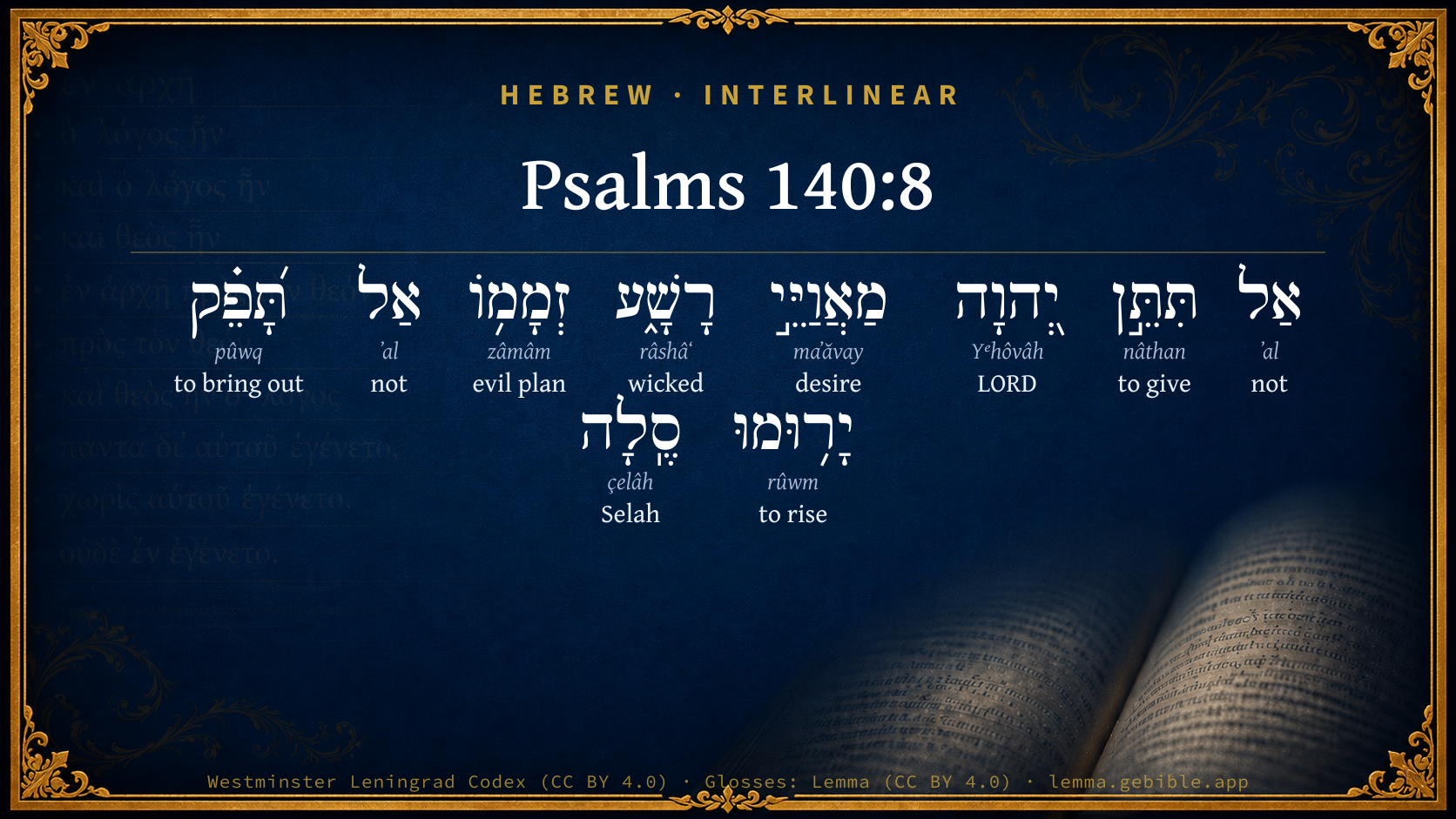
Psalms 140:8

Hebrew (Westminster Leningrad Codex) Psalms 140:8 appears in the Hebrew Old Testament. The text above is from the Westminster Leningrad Codex. Each word links to its Strong’s number, a concise gloss, and parsing drawn from the Open Scriptures Hebrew Bible morphology. Click any word for its full Brown-Driver-Briggs (BDB) entry.
Download image
Cite this verse

Psalms 140:8 (World English Bible). Public Domain. Lemma interlinear Bible study tool, https://lemma.gebible.app/v/psalms/140/8.

Show BibTeX & RIS
BibTeX
RIS
English Translation
Yahweh, don't grant the desires of the wicked. Don't let their evil plans succeed, or they will become proud. Selah.
World English Bible · Public Domain
Highlights
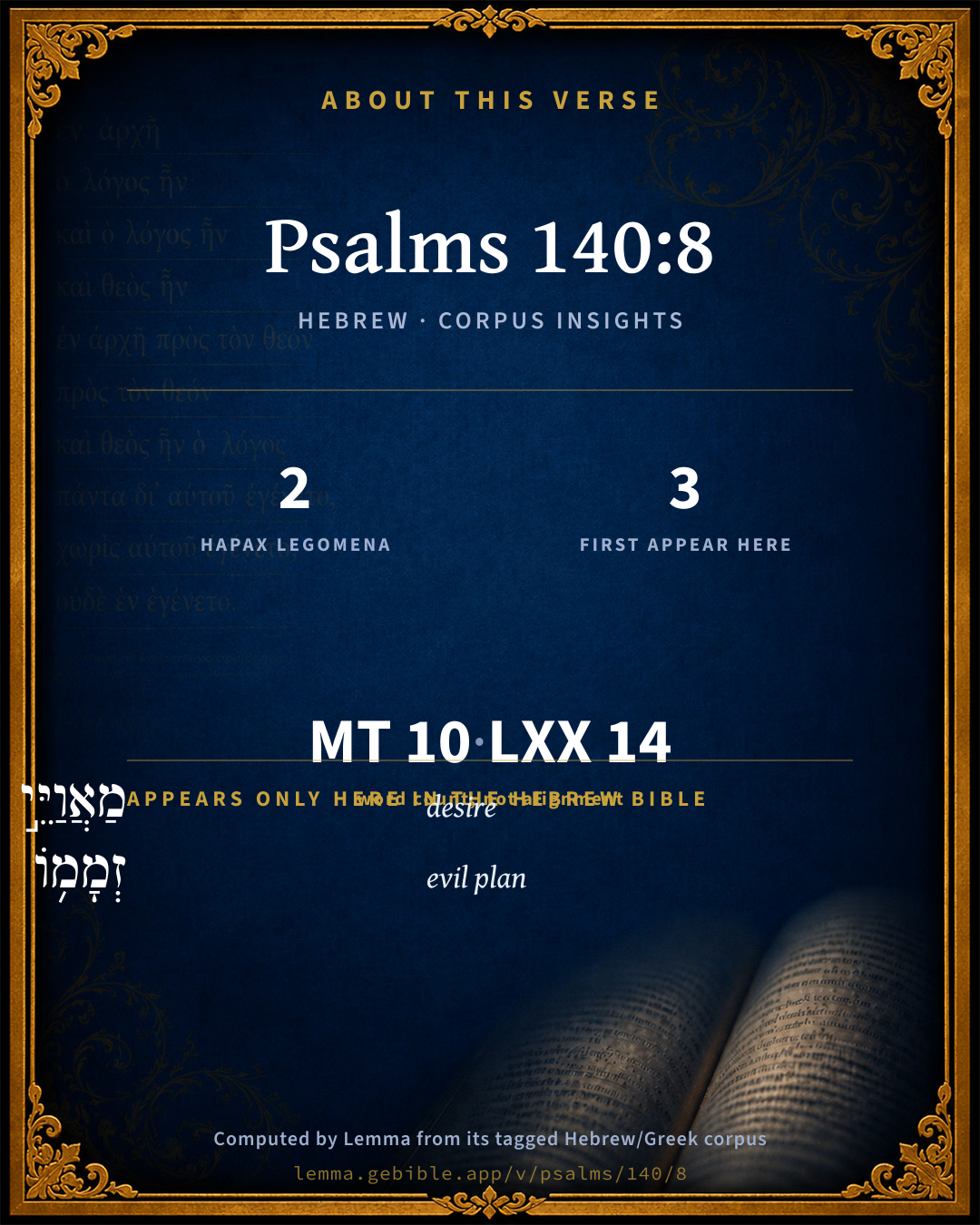
  • 2 hapax legomena — only here in the Hebrew Bible
  • 3 first appearances in the Hebrew Bible
Full analysis ↓
Download a study sheet

One document with this verse’s original text, its word-by-word gloss line, the meaning frame, cross-references with their text, attributed commentary, and full source and license credits — printable, and it pastes into notes with its structure intact.

This verse Autodidact and up

Study sheet (.html) Plain text (.txt)

A passage Seminary Student

Up to 50 verses in one chapter. A passage sheet keeps up to 6 commentary sources and 12 cross-references per verse, in the order this page ranks them, and says so on the sheet whenever that leaves anything out. Ask for a single verse and you get the Autodidact verse sheet above.

Everything on this page stays free to read, with no account — the sheet is a download of what is already on screen, not access to it.

Want to remove ads? Support Godless Engineer
Compare translations 3

The same verse in 3 English versions, stacked beneath the original-language interlinear above. Click any original word for its lexicon entry.

Each is an independent rendering of the whole verse — the interlinear is not word-aligned to these translations.

Highlighted words mark where these versions differ — a whole-verse word diff, not a word-by-word alignment.

  • World English Bible Public Domain
    Yahweh, don't grant the desires of the wicked. Don't let their evil plans succeed, or they will become proud. Selah.
  • King James Version Public Domain
    Grant not, O LORD, the desires of the wicked: further not his wicked device; lest they exalt themselves. Selah.
  • unfoldingWord Literal Text CC BY-SA 4.0
    Do not grant, Yahweh, the desires of the wicked; do not bring forth his plot, they rise up. Selah ts\*

unfoldingWord Literal Text — © unfoldingWord, licensed CC BY-SA 4.0. Word-aligned USFM3 via Door43 (git.door43.org/unfoldingWord/en_ult).

Versions to compare (up to 4)

3 of 4 selected

Show all 18 translations

Every available English version of this verse, each an independent rendering of the whole verse.

  • World English Bible Public Domain
    Yahweh, don't grant the desires of the wicked. Don't let their evil plans succeed, or they will become proud. Selah.
  • Berean Standard Bible Public Domain
    Grant not, O LORD, the desires of the wicked; do not promote their evil plans, lest they be exalted. Selah
  • Majority Standard Bible Public Domain
    Grant not, O LORD, the desires of the wicked; do not promote their evil plans, lest they be exalted. Selah
  • King James Version Public Domain
    Grant not, O LORD, the desires of the wicked: further not his wicked device; lest they exalt themselves. Selah.
  • American Standard Version (1901) Public Domain
    Grant not, O Jehovah, the desires of the wicked; Further not his evil device, `lest' they exalt themselves. Selah
  • Revised Version (1885) Public Domain
    Grant not, O LORD, the desires of the wicked; further not his evil device; lest they exalt themselves. Selah
  • Geneva Bible (1599) Public Domain
    Let not the wicked haue his desire, O Lord: performe not his wicked thought, least they be proude. Selah.
  • Douay-Rheims (1899) Public Domain
    If I ascend into heaven, thou art there: if I descend into hell, thou art present.
  • Young's Literal Translation Public Domain
    Grant not, O Jehovah, the desires of the wicked, His wicked device bring not forth, They are high. Selah.
  • Literal Standard Version CC BY-SA 4.0
    Do not grant, O YHWH, the desires of the wicked, || Do not bring forth his wicked scheme, || They are high. Selah.
  • Unlocked Literal Bible CC BY-SA 4.0
    Yahweh, do not grant the desires of the wicked; do not let their plots succeed. Selah
  • unfoldingWord Literal Text CC BY-SA 4.0
    Do not grant, Yahweh, the desires of the wicked; do not bring forth his plot, they rise up. Selah ts\*
  • Darby Bible Public Domain
    Grant not, O Jehovah, the desire of the wicked; further not his device: they would exalt themselves. Selah.
  • World Messianic Bible Public Domain
    LORD, don’t grant the desires of the wicked. Don’t let their evil plans succeed, or they will become proud. Selah.
  • Webster's Bible Public Domain
    \\140:7\\O GOD the Lord, the strength of my salvation, thou hast covered my head in the day of battle.
  • Free Bible Version CC BY-SA 4.0
    God, don't allow the wicked to get what they want—don't let them be successful in what they plan so they don't become proud. Selah.
  • Bible in Basic English Public Domain
    O Lord, give not the wrongdoer his desire; give him no help in his evil designs, or he may be uplifted in pride. (Selah.)
  • JPS Tanakh (1917) Public Domain
    (140-9) Grant not, O LORD, the desires of the wicked; further not his evil device, so that they exalt themselves. Selah

Literal Standard Version (2020), Covenant Press — licensed CC BY-SA 4.0. Text via the HelloAO Bible API (eBible.org). Unlocked Literal Bible (unfoldingWord) — licensed CC BY-SA 4.0. Text via the HelloAO Bible API (eBible.org). unfoldingWord Literal Text — © unfoldingWord, licensed CC BY-SA 4.0. Word-aligned USFM3 via Door43 (git.door43.org/unfoldingWord/en_ult). Free Bible Version, Dr. Jonathan Gallagher — licensed CC BY-SA 4.0. Text via the HelloAO Bible API (eBible.org).

Word by word

More ways to search: Search by grammar → Find every occurrence → Compare this word →

Practice this passage: Drill this verse → Learn its vocabulary →

About this verse

These counts appear in no published source. They are computed here, from the morphology-tagged text and Lemma’s own curated glosses. What Lemma adds →

10
words
9
distinct lemmas
Wisdom
section

Notable vocabulary

2 hapax legomena — words that appear only here in the entire Hebrew Bible:

  • מַאֲוַיֵּ֣י desire H3970
  • זְמָמ֥וֹ evil plan H2162

First appearance in Scripture

These words make their first canonical appearance in the Hebrew Bible here:

  • מַאֲוַיֵּ֣י desire H3970
  • זְמָמ֥וֹ evil plan H2162
  • תָּ֝פֵ֗ק to bring out H6329

Shared distinctive vocabulary

תָּ֝פֵ֗ק to bring out H6329 occurs in 7 verses of the Hebrew Bible. Also found in:

Grammatical profile

  • 3 verbs
  • 3 nouns
  • 1 adjective
  • 3 particles

Verb forms

  • תִּתֵּ֣ן Qal · Jussive
  • תָּ֝פֵ֗ק Hiphil · Jussive
  • יָר֥וּמוּ Qal · Imperfect

Repetition

A word recurs within this verse — often emphatic in Hebrew:

  • אַל not H408 ×2

Hebrew & Septuagint length

In English translation the verse runs 20 words from the Hebrew and 27 from the Septuagint (LXX English) — closely comparable.

A rough comparison of the two English renderings, which tokenize alike — not a word-level alignment.

Word counts can differ between the Hebrew and the Greek without any difference in meaning — e.g. the Hebrew direct-object marker אֵת has no separate Greek word, and Greek often adds the article ὁ.

In the original languages it is 10 Hebrew tokens and 14 Greek tokens — but the two are counted differently (Hebrew bundles its prefixes and suffixes into one token; the Greek is in lemma form), so that isn’t a like-for-like length.

Cross-references

6

Topical passages linked to Psalms 140:8 in the Treasury of Scripture Knowledge — connected by theme and wording, ordered by reader-vote popularity; previews shown in the World English Bible.

  • Psalms 10:2–3 In arrogance, the wicked hunt down the weak; They are caught in the schemes that they devise.
  • Deuteronomy 32:27 Were it not that I feared the provocation of the enemy, Lest their adversaries should judge wrongly, Lest they should say, Our hand is exalted, Yahweh has not done all this.
  • 2 Samuel 15:31 One told David, saying, Ahithophel is among the conspirators with Absalom. David said, Yahweh, please turn the counsel of Ahithophel into foolishness.
  • Job 5:12–13 He frustrates the devices of the crafty, So that their hands can't perform their enterprise.
  • Psalms 27:12 Don't deliver me over to the desire of my adversaries, For false witnesses have risen up against me, Such as breathe out cruelty.
  • Psalms 94:20–21 Shall the throne of wickedness have fellowship with you, Which brings about mischief by statute?

Cross-references courtesy of OpenBible.info (CC BY 4.0).

Hebrew and Greek witnesses Masoretic Hebrew ↔ Greek Septuagint

The same verse in the two great witnesses to the Old Testament, shown verse-for-verse.

You’re reading Greek Psalm 139 (Hebrew Psalm 140). The Septuagint counts the superscription, so verse numbers can differ from the Hebrew — chapter-level alignment, not verse-by-verse. Numbering follows Rahlfs.

These are two independent witnesses, not word-aligned to each other, and the Septuagint is shown in lemma (dictionary) form.

Hebrew Psalms 140:8 Masoretic · Westminster Leningrad Codex

אַל תִּתֵּ֣ן יְ֭הוָה מַאֲוַיֵּ֣י רָשָׁ֑ע זְמָמ֥וֹ אַל תָּ֝פֵ֗ק יָר֥וּמוּ סֶֽלָה

Yahweh, don't grant the desires of the wicked. Don't let their evil plans succeed, or they will become proud. Selah.

World English Bible · Public Domain

Greek LXX Greek Psalm 139:8 Septuagint · lemma form

κύριος κύριος δύναμις ὁ σωτηρία ἐγώ ἐπισκιάζω ἐπί ὁ κεφαλή ἐγώ ἐν ἡμέρα πόλεμος

Deliver me not, O Lord, to the sinner, according to my desire: they have devised mischief against me; forsake me not, lest they should be exalted. Pause.

LXX2012 (modern English Septuagint) · Public Domain

On this verse, Ellicott's Commentary for English Readers discusses the Septuagint’s reading. Read the note in Commentary ↓

Hebrew: Westminster Leningrad Codex (CC BY 4.0). Greek: Septuagint (public domain); English from LXX2012 (modern English Septuagint) (Public Domain). How the Septuagint differs from the Hebrew →

Commentary

Notes on Psalms 140:8 from classic Christian and Jewish commentators (each source and its license shown beneath its notes). The classic Christian expositions comment on the surrounding passage and are grouped to its opening verse, so a note may address several verses; the Jewish commentaries on the Tanakh (Rashi and others) are per-verse, so they appear only where the commentator wrote on this verse.

Lemma curates 59 commentaries, every one of them public domain or Creative Commons licensed, each selected and text-cleaned for this edition rather than reprinted as found. About our sources →

Matthew Henry's Commentary

Here is the believing foresight David had,

I. Of the shame and confusion of persecutors.

1. Their disappointment. This he prays for (Psa 140:8), that their lusts might not be gratified, their lust of ambition, envy, and revenge: "Grant not, O Lord! the desires of the wicked, but frustrate them; let them not see the ruin of my interest, which they so earnestly wish to see; but hear the voice of my supplications." He prays that their projects might not take effect, but be blasted: "O further not his wicked device; let not Providence favour any of his designs, but cross them; suffer not his wicked device to proceed, but chain his wheels, and stop him in the career of his pursuits." Thus we are to pray against the enemies of God's people, that they may not succeed in any of their enterprises. Such was David's prayer against Ahithophel, that God would turn his counsels into foolishness. The plea is, lest they exalt themselves, value themselves upon their success as if it were an evidence that God favoured them. Proud men, when they prosper, are made prouder, grow more impudent against God and insolent against his people, and therefore, "Lord, do not prosper them."

2. Their destruction. This he prays for (as we read it); but some choose to read it rather as a prophecy, and the original will bear it. If we take it as a prayer, that proceeds from a spirit of prophecy, which comes all to one. He foretels the ruin,

(1.) Of his own enemies: "As for those that compass me about, and seek my ruin," [1.] "The mischief of their own lips shall cover their heads (Psa 140:9); the evil they have wished to me shall come upon themselves, their curses shall be blown back into their own faces, and the very designs which they have laid against me shall turn to their own ruin," Psa 7:15, Psa 7:16. Let those that make mischief, by slandering, tale-bearing, misrepresenting their neighbours, and spreading ill-natured characters and stories, dread the consequence of it, and think how sad their condition will be when all the mischief they have been accessory to shall be made to return upon themselves. [2.] The judgments of God shall fall upon them, compared here to burning coals, in allusion to the destruction of Sodom; nay, as in the deluge the waters from above, and those from beneath, met for the drowning of the world, both the windows of heaven were opened and the fountains of the great deep were broken up, so here, to complete the ruin of the enemies of Christ and his kingdom, they shall not only have burning coals cast upon them from above (Job 20:23; Job 27:22), but they themselves shall be cast into the fire beneath; both heaven and hell, the wrath of God the Judge and the rage of Satan the tormentor, shall concur to make them miserable. And the fire they shall be cast into is not a furnace of fire, out of which perhaps they might escape, but a deep pit, out of which they cannot rise. Tophet is said to be deep and large, Isa 30:33.

(2.) Of all others that are like them, Psa 140:11. [1.] Evil speakers must expect to be shaken, for they shall never be established in the earth. What is got by fraud and falsehood, by calumny and unjust accusation, will not prosper, will not last. Wealth gotten by vanity will be diminished. Let not such men as Doeg think to reign long, for his doom will be theirs, Psa 2:5. A lying tongue is but for a moment, but the lip of truth shall be established for ever. [2.] Evil doers must expect to be destroyed: Evil shall hunt the violent man, as the blood-hound hunts the murderer to discover him, as the lion hunts his prey to tear it to pieces. Mischievous men will be brought to light, and brought to ruin; the destruction appointed shall run them down and overthrow them. Evil pursues sinners.

II. Here is his foresight of the deliverance and comfort of the persecuted, Psa 140:12, Psa 140:13. 1. God will do those justice, in delivering them, who, being wronged, commit themselves to him: "I know that the Lord will maintain the just and injured cause of his afflicted people, and will not suffer might always to prevail against right, though it be but the right of the poor, who have but little that they can pretend a right to." God is, and will be, the patron of oppressed innocence, much more of persecuted piety; those that know him cannot but know this. 2. They will do him justice (if I may so speak), in ascribing the glory of their deliverance to him: "Surely the righteous (who make conscience of rendering to God his due, as well as to men theirs) shall give thanks unto thy name when they find their cause pleaded with jealousy and prosecuted with effect." The closing words, The upright shall dwell in thy presence, denote both God's favour to them ("Thou shalt admit them to dwell in thy presence in grace here, in glory hereafter, and it shall be their safety and happiness") and their duty to God: "They shall attend upon thee as servants that keep in the presence of their masters, both to do them honour and to receive their commands." This is true thanksgiving, even thanksliving; and this use we should make of all our deliverance, we should serve God the more closely and cheerfully.

Matthew Henry's Commentary on the Whole Bible (1708–1710) — public domain (CC PDM 1.0). Text via the HelloAO Bible API.

Trapp's Complete Commentary

John Trapp

Psa 140:8 Grant not, O LORD, the desires of the wicked: further not his wicked device; [lest] they exalt themselves. Selah.

Ver. 8. Grant not, O Lord, &c.] For if they should be votorum compotes, masters of their desires, they would be intolerably insolent, so as to say, Our high hand, and not the Lord, hath done all this, Deu 32:27.

John Trapp, A Commentary or Exposition upon All the Books of the Old and New Testament (1647–1656) — public domain. Text from a community e-Sword module.

The Biblical Illustrator

Joseph S. Exell

Psa_140:8

Grant not, O Lord, the desires of the wicked.

The desires of the wicked inadmissible

I. Some of the desires of the wicked.

1. That there is no God. They dare not submit their conduct to Divine inspection, and would be glad if there were no Being to inspect. But against this desire the godly oppose their prayers. And there are good reasons why they thus feel. If there were no God, everything must immediately be thrown into a state of confusion. Chaos would return.

2. If a God do and must exist, sinners wish Him to be a mere spectator of the affairs of the world. The grand objection they have to His existence is, that if He exist He must have the reins of government. But the saints not only desire God to reign, they wish Him to manage all the affairs of creation. They consider their own safety and that of others to depend on this special care of God.

3. If God must exist, and must be an active agent in governing the world, the wicked are desirous that He should work without any plan. They are afraid of Divine decrees. They fear that these decrees do not favour them. The righteous, on the other hand, found all their hopes of salvation, both as it regards themselves and others, on the purposes of God.

4. Sinners desire happiness and heaven without holiness. Between these two God has established an indissoluble connection. He has decreed that holiness shall be the only path to happiness. But this connection sinners wish to destroy. They hate holiness wherever it appears, and yet they intend to be happy. The righteous, on the contrary, love nothing so much as holiness.

5. Sinners desire that Christians may walk disorderly, and so dishonour the religion of Jesus. Against these falls the saints pray, and are grieved when they take place. They love their fellow-saints. Every spot that appears in their garments grieves their hearts. They feel some of the same distress on such occasions as is felt when they go astray themselves.

6. The wicked desire to remain ignorant of their own characters. The righteous daily pray the favour of being acquainted with themselves.

7. Wicked men are very desirous that there may be no day of judgment. They do not wish the final inspection of Omniscience. In such desires the righteous cannot unite. It is their ardent wish that there may be a day that shall bring every deed to light, and pass an impartial judgment on all the actions of men.

8. The wicked are very desirous to be left to act without restraint. Nothing do they desire more. In this particular the children of God, and all holy beings, oppose their wishes. It would ruin the world to have them gratified. Free the wicked from restraint and there would be but little difference between earth and hell.

II. Inferences.

1. The monstrous wickedness of the heart.

2. The nature of regeneration. It is a universal change in the desires of the heart, in the affections of the soul.

3. The great difference between the righteous and the wicked.

4. Why sinners do not desire or relish the society of the righteous. They have opposing desires. (D. A. Clark.)

The Biblical Illustrator, edited by Joseph S. Exell (c. 1880s–1900s) — public domain. Text from a community e-Sword module.

J. A. Alexander on Psalms

Joseph Addison Alexander

9. (Psa 140:8) Grant not, Jehovah, the desires of the wicked man—his device succeed not—they will be exalted. Succeed not, suffer not to prosper; literally, draw not out, i.e. to a successful issue. The last clause states what would be the effect of their success; they would be elated, or exalt themselves. With this verse compare Psa 27:12; Psa 31:13; Psa 37:12; Psa 66:6, Deu 32:27.

Joseph Addison Alexander, The Psalms Translated and Explained (1850) — public domain. Text from a community e-Sword module.

Geneva Bible (1599)

Geneva Bible translators

For it is in God’s hand to overthrow the counsels and enterprises of the wicked.

Geneva Bible (1599) marginal notes — public domain. Text via Bolls.life.

Adam Clarke's Commentary

Verse 8. Further not his wicked device] He knew his enemies still desired his death, and were plotting to accomplish it; and here he prays that God may disappoint and confound them. The Chaldee understands this of Doeg.

Adam Clarke's Commentary on the Bible (1810–1826) — public domain. Text from a community e-Sword/MySword module.

John Calvin's Commentaries

8. Grant not, O Jehovah! the desires of the wicked “The desires which the wicked have for my destruction.” — Phillips.

John Calvin's Commentaries (1540-1563) — public domain. Text from the Calvin Translation Society English edition (1840s-50s) via the Christian Classics Ethereal Library (ccel.org). Calvin's coverage is partial (roughly two-thirds of the Bible); uncommented books and verses are honest gaps, never fabricated. The 19th-century editor's footnotes and remarks are omitted so the notes are faithfully Calvin's own voice.

Ellicott's Commentary for English Readers

(8) Desires.—The form of the Hebrew word is anomalous, but the meaning certain. The LXX. and Vulg. give the first clause thus: “Give me not over to the enemy, by reason of their own desire;” which may possibly have been in St. Paul’s mind in Rom_1:24.

Further not.—The text of this clause has undoubtedly suffered. The Authorised Version follows the LXX. and Vulg. in inserting a negative before the last word. These versions also take the word rendered “wicked devices” as a verb, not finding a noun of the form anywhere else: “They have plotted against me: desert me not, lest they exalt themselves.” So also Symmachus, and another Greek version quoted by Origen.

As the text at present stands, we must render: his plot do not further—they lift up. Looking on to the next verse, “the head of those surrounding me,” the suggestion at once arises that the verb lift up properly belongs to this clause:

“His plot do not further.

They lift the head, these surrounding me.”

This arrangement disregards the “selah.” and also obliges us to suspect that a clause has dropped cut after the first clause of Psa_140:9—a suspicion confirmed by the rhythm.[20]

[20] Mr. Burgess amends to “Further not his plot to his exaltation.”

A Bible Commentary for English Readers, edited by Charles John Ellicott (1878–1897) — public domain. Text from a community e-Sword module.

The Cambridge Bible for Schools and Colleges

gen. ed. J. J. S. Perowne

8. further not his evil device] Suffer it not to issue in success.

lest they exalt themselves] The construction is harsh, whether we render thus, or, ‘for then will they exalt themselves,’ and probably the word belongs to the next verse.

The Cambridge Bible for Schools and Colleges (gen. ed. J. J. S. Perowne; Cambridge University Press, 1878–1918) — public domain. Text from a community e-Sword module.

John Gill's Exposition

Grant not, O Lord, the desires of the wicked,.... Of Doeg, as the Targum, and of other wicked men, who were desirous both of taking him, and of taking away his life: but the desires of such men are under the restraints of the Lord; nor can they fulfil them unless they have leave from him, which is here deprecated. The psalmist entreats he might not be delivered up to their will, or they have their will of him; see Psa 27:12. Jarchi interprets it of Esau, as in Psa 140:1; and it is applicable enough to antichrist and his wicked followers; who, could they have their desires, would root the Gospel, and the interest of Christ and his people, out of the world;

further not his wicked device: or, "let not his wicked device come forth" (l), or proceed to execution, or be brought to perfection; let him be disappointed in it, that he may not be able to perform his enterprise, or execute his designs; which cannot be done without the divine permission. The Rabbins, as Jarchi and others, render it, "let not his bridle come out" (m); the bridle out of his jaws, with which he was held by the Lord, and restrained from doing his will; let him not be left to his liberty, and freed from the restraints of divine Providence; see Isa 37:29;

lest they exalt themselves. Grow proud, haughty, and insolent to God and man; see Deu 32:27. Or, "let them not be exalted" (n); upon the ruin of me and my friends.

Selah; on this word; see Gill on Psa 3:2.

(l) "ne facias prodire", Vatablus; "ne sinas exire", Cocceius, Michaelis. (m) "Vel frenum ejus ne sinas exire", Cocceius. (n) "ne exaltentur", Vatablus, Gejerus.

John Gill's Exposition of the Whole Bible (1746–1763) — public domain (CC PDM 1.0). Text via the HelloAO Bible API.

Albert Barnes' Notes on the Bible

Grant not, O Lord, the desires of the wicked - That is, in the matter under consideration. Let them not accomplish their desire in my destruction. Let them not succeed in their designs against me. The prayer, however, “may” be used more generally. It is proper to pray that the desires of the wicked, as wicked people, may not be granted to them; that they may “not” be successful in their purposes. Success in such desires would be only an injury to themselves and to the world. It is proper to pray that the purposes of the wicked may be defeated, and that they may be led to abandon their designs and to seek better ends. For this, in fact, we always pray when we pray for their conversion.

Further not his wicked device - His purpose against me.

Lest they exalt themselves - Lest they attribute it to their own skill, wisdom, or valor, and lest they pride themselves on their success. To succeed in a righteous cause makes a man humble and grateful; in a bad cause, proud, and forgetful of God. The margin here is, “Let them not be exalted.” The meaning is, that success would at the same time elate them in their own estimation, and increase their bad influence in the world. It is, on every account, a benevolent prayer that wicked people may “not” be successful in their plans of iniquity.

Albert Barnes' Notes on the Bible (1834–1885) — public domain. Text from a community e-Sword/MySword module.

Matthew Poole's English Annotations

His wicked device; which is to destroy me.

Exalt themselves; not only against me, but against thee also, as if by their power and policy they had frustrated thy design and promise made to me.

Matthew Poole's English Annotations on the Holy Bible (1683–1685) — public domain. Text from a community e-Sword/MySword module.

The Treasury of David

Charles H. Spurgeon

Ver. 8. Grant not, O LORD, the desires of the wicked. Even they are dependent upon thee they can do no more than thou dost permit. Thou dost restrain them; not a dog of them can move his tongue without thy leave and license. Therefore I entreat thee not to let them have their way. Even though they dare to pray to their, do not hear their prayers against innocent men. Assuredly the Lord Jehovah will be no accomplice with the malevolent; their desires shall never be his desires; if they thirst for blood he will not gratify their cruelty. Further not his wicked devices They are so united as to be like one man in their wishes; but do rot hear their prayers. Though hand join in hand, and they desire and design as one man, yet do not thou lend them the aid of thy providence. Do not permit their malicious schemes to succeed. The Lord may allow success to attend the policy of the wicked for a time for wise reasons unknown to us, but we are permitted to pray that it be not so. The petition "Deliver us from evil" includes and allows such supplication. Lest they exalt themselves. If successful, the wicked are sure to grow proud, and insult the righteous over whom they have triumphed, and this is so great an evil, and so dishonouring to God, that the Psalmist uses it in his pleading as an argument against their being allowed to prosper. The glory of the wicked is opposed to the glory of God. If God seems to favour them they grow too high for this world, and their heads strike against the heavens. Let us hope that the Lord will not suffer this to be. Selah. Here let us exalt our thoughts and praises high over the heads of self exalting sinners. The more they rise in conceit the higher let us rise in confidence.

Ver. 8. His wicked device; which is to destroy me. "Exalt themselves"; not only against me, but against thee also, as if by their power and policy they had frustrated thy design and promise made to me. M. Pool.

Psalms 140:9*

Charles H. Spurgeon's The Treasury of David (1869–1885) — public domain. Psalms only. Text from a community e-Sword/MySword module.

Whedon's Commentary on the Bible

Daniel D. Whedon

8. Grant not… the desires of the wicked—For God to grant their desires would contradict his own holiness, and lead to the abandonment of the righteous, for the desires of the wicked and the righteous cannot both be granted. The one precludes the other. See Pro_21:10; Isa_26:8-9

Daniel D. Whedon (gen. ed.), Commentary on the Old and New Testaments (1874–1909) — public domain. Text from a community e-Sword module.

The Pulpit Commentary

Grant not, O Lord, the desires of the wicked. The "desires of the wicked" are hurtful both to themselves and others. It is in his mercy that God does not grant them. Further not his wicked device; lest they exalt themselves . So the LXX, mhpote uqwywsin . Others translate, "Or how they will exalt themselves!" The third stanza here terminates.

Vers. 8-11. The intervention of God sought.

We need not fix close attention on the intensity of the language which the psalmists use concerning their enemies, or even concerning the enemies of God. All that unrestrainedness belongs to the times and the race. Eastern people use language which to the Western mind appears extravagant and unworthy. We feel, under persecution and calamity, precisely as they felt, but we know how to express our feelings more guardedly. Only in moments of passion do we ever permit ourselves to say or to wish such things as these psalmists utter so freely. The topic suggested here is this What is to be done by the godly man when he finds himself in the midst of malicious foes?

I HE IS TEMPTED TO INDULGE REVENGEFUL FEELING. Such feelings at once come. They are the natural, or we may more truly say the unnatural, response of our hearts, Indeed, if we do not watch ourselves well, we at once answer back. It is not our sin that revengeful feeling is aroused. It is sin when revengeful feeling is encouraged; our grievous sin when it is enjoyed.

II HE IS TEMPTED TO VINDICATE HIMSELF BY ACTS OF RETALIATION. "Rendering evil for evil." Taking the avenging of his injuries into his own hands. Children do that. Uncivilized and unorganized nations do that. Each one avenges his own wrongs. But from the Divine standpoint that is always and altogether wrong; for one supremely good reason that a man can never avenge himself without seriously injuring himself in so doing. The worst thing that can happen to a man is to get his revenge. That dims the fine gold of character.

III HE IS PERSUADED TO LEAVE VENGEANCE TO GOD. And this he may safely do, because whosoever touches God"s people touches God touches the "apple of his eye." Moreover, God never lets the wicked go unpunished; but as he loves the wicked and seeks his good, he alone can adjust the punishment to the individual, and to the securing of wise and gracious ends. God can be calm in judgments.

IV HE IS MOVED TO ASK GOD TO UNDERTAKE THE VENGEANCE FOR HIM. And then he is altogether relieved from the pressure of responsibility, and is free to bear the burden quietly and calmly. R.T.

The Pulpit Commentary (1880–1919), ed. H.D.M. Spence-Jones & Joseph S. Exell — public domain. Text from a community e-Sword module.

Lesson kit

Teaching starters — assembled from the data on this page, not authored interpretation. Every prompt links to the verse data it draws on. Edit before teaching.

Psalms, in the Wisdom, opens this verse with 10 words (9 distinct Hebrew lemmas). Its most distinctive word is maʼăvay (“desire”). A historical commentator’s framing appears above. Read the whole chapter for the surrounding context.

Discussion questions

  1. The word maʼăvay carries the sense “desire.” How does it shape the verse?
  2. 2 words here appear nowhere else in the Hebrew Bible. Why might the author reach for such rare wording?
  3. 3 words make their first appearance in Scripture here. What does this debut establish?
  4. How does Psalms 144:13, which shares the word «to bring out», read alongside this verse?
  5. What does the repetition of “not” (2× in this one verse) do in this verse?
  6. These translations render this verse differently; the difference is in the English rendering, not the original. What questions does that raise?
  7. «תִּתֵּ֣ן» is a Qal Jussive verb. How does that grammatical form shape the action described?
  8. Compare how Matthew Henry's Commentary and Trapp's Complete Commentary read this verse. Where do they agree or differ?

Things to notice

  • 2 words in this verse appear nowhere else in the Hebrew Bible.
  • 3 words make their first canonical appearance in Scripture here.
  • This verse counts 10 Hebrew ↔ 14 Greek words.
  • These translations choose different wording for 23 words in this verse.
  • “not” occurs 2× in this single verse.

Reading settings

Reading text

Shown beneath each verse's original-language words.

Old Testament
Old Testament edition

Read the OT as the Masoretic Hebrew (MT) or the Greek Septuagint (LXX).

English shown for the Greek Septuagint (in the Hebrew ↔ Greek comparison).

Comparing translations? Open the Compare panel on any verse page to stack up to four side by side.