
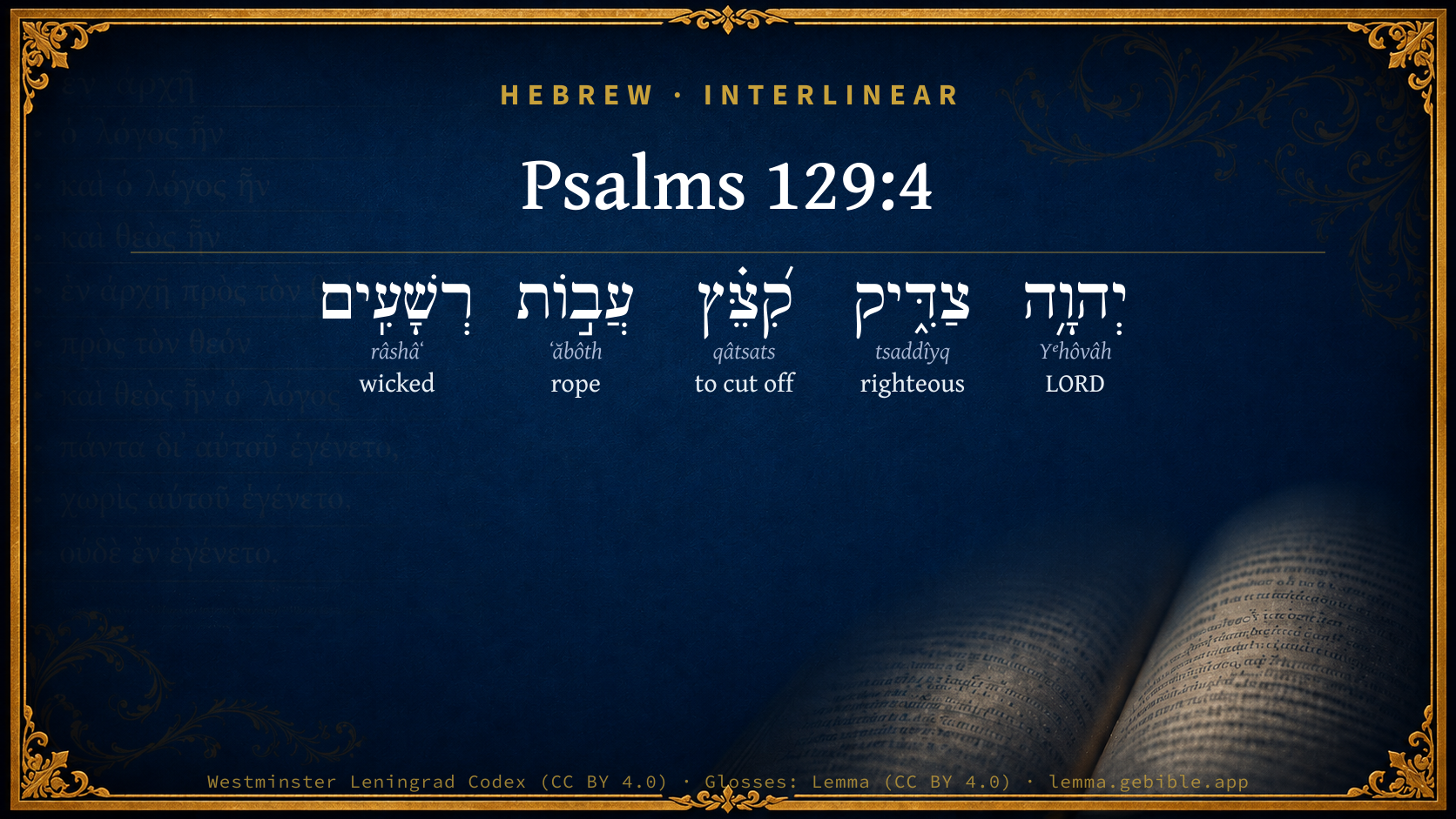
Psalms 129:4

Hebrew (Westminster Leningrad Codex) Psalms 129:4 appears in the Hebrew Old Testament. The text above is from the Westminster Leningrad Codex. Each word links to its Strong’s number, a concise gloss, and parsing drawn from the Open Scriptures Hebrew Bible morphology. Click any word for its full Brown-Driver-Briggs (BDB) entry.
Download image
Cite this verse

Psalms 129:4 (World English Bible). Public Domain. Lemma interlinear Bible study tool, https://lemma.gebible.app/v/psalms/129/4.

Show BibTeX & RIS
BibTeX
RIS
English Translation
Yahweh is righteous. He has cut apart the cords of the wicked.
World English Bible · Public Domain
Download a study sheet

One document with this verse’s original text, its word-by-word gloss line, the meaning frame, cross-references with their text, attributed commentary, and full source and license credits — printable, and it pastes into notes with its structure intact.

This verse Autodidact and up

Study sheet (.html) Plain text (.txt)

A passage Seminary Student

Up to 50 verses in one chapter. A passage sheet keeps up to 6 commentary sources and 12 cross-references per verse, in the order this page ranks them, and says so on the sheet whenever that leaves anything out. Ask for a single verse and you get the Autodidact verse sheet above.

Everything on this page stays free to read, with no account — the sheet is a download of what is already on screen, not access to it.

Want to remove ads? Support Godless Engineer
Compare translations 3

The same verse in 3 English versions, stacked beneath the original-language interlinear above. Click any original word for its lexicon entry.

Each is an independent rendering of the whole verse — the interlinear is not word-aligned to these translations.

Highlighted words mark where these versions differ — a whole-verse word diff, not a word-by-word alignment.

  • World English Bible Public Domain
    Yahweh is righteous. He has cut apart the cords of the wicked.
  • King James Version Public Domain
    The LORD is righteous: he hath cut asunder the cords of the wicked.
  • unfoldingWord Literal Text CC BY-SA 4.0
    Yahweh righteous; he has cut the cords of the wicked.

unfoldingWord Literal Text — © unfoldingWord, licensed CC BY-SA 4.0. Word-aligned USFM3 via Door43 (git.door43.org/unfoldingWord/en_ult).

Versions to compare (up to 4)

3 of 4 selected

Show all 18 translations

Every available English version of this verse, each an independent rendering of the whole verse.

  • World English Bible Public Domain
    Yahweh is righteous. He has cut apart the cords of the wicked.
  • Berean Standard Bible Public Domain
    The LORD is righteous; He has cut me from the cords of the wicked.
  • Majority Standard Bible Public Domain
    The LORD is righteous; He has cut me from the cords of the wicked.
  • King James Version Public Domain
    The LORD is righteous: he hath cut asunder the cords of the wicked.
  • American Standard Version (1901) Public Domain
    Jehovah is righteous: He hath cut asunder the cords of the wicked.
  • Revised Version (1885) Public Domain
    The LORD is righteous: he hath cut asunder the cords of the wicked.
  • Geneva Bible (1599) Public Domain
    But the righteous Lord hath cut the cordes of the wicked.
  • Douay-Rheims (1899) Public Domain
    Behold, thus shall the man be blessed that feareth the Lord.
  • Young's Literal Translation Public Domain
    Jehovah `is' righteous, He hath cut asunder cords of the wicked.
  • Literal Standard Version CC BY-SA 4.0
    YHWH [is] righteous, || He has cut apart cords of the wicked.
  • Unlocked Literal Bible CC BY-SA 4.0
    Yahweh is righteous; he has cut the ropes of the wicked.”
  • unfoldingWord Literal Text CC BY-SA 4.0
    Yahweh righteous; he has cut the cords of the wicked.
  • Darby Bible Public Domain
    Jehovah is righteous: he hath cut asunder the cords of the wicked.
  • World Messianic Bible Public Domain
    The LORD is righteous. He has cut apart the cords of the wicked.
  • Webster's Bible Public Domain
    The LORD is righteous: he hath cut asunder the cords of the wicked.
  • Free Bible Version CC BY-SA 4.0
    But the Lord does what is right: he has cut me free from the ropes of the wicked.
  • Bible in Basic English Public Domain
    The Lord is true: the cords of the evil-doers are broken in two.
  • JPS Tanakh (1917) Public Domain
    The LORD is righteous; He hath cut asunder the cords of the wicked.'

Literal Standard Version (2020), Covenant Press — licensed CC BY-SA 4.0. Text via the HelloAO Bible API (eBible.org). Unlocked Literal Bible (unfoldingWord) — licensed CC BY-SA 4.0. Text via the HelloAO Bible API (eBible.org). unfoldingWord Literal Text — © unfoldingWord, licensed CC BY-SA 4.0. Word-aligned USFM3 via Door43 (git.door43.org/unfoldingWord/en_ult). Free Bible Version, Dr. Jonathan Gallagher — licensed CC BY-SA 4.0. Text via the HelloAO Bible API (eBible.org).

Word by word

More ways to search: Search by grammar → Find every occurrence → Compare this word →

Practice this passage: Drill this verse → Learn its vocabulary →

About this verse

These counts appear in no published source. They are computed here, from the morphology-tagged text and Lemma’s own curated glosses. What Lemma adds →

5
words
5
distinct lemmas
Wisdom
section

Notable vocabulary

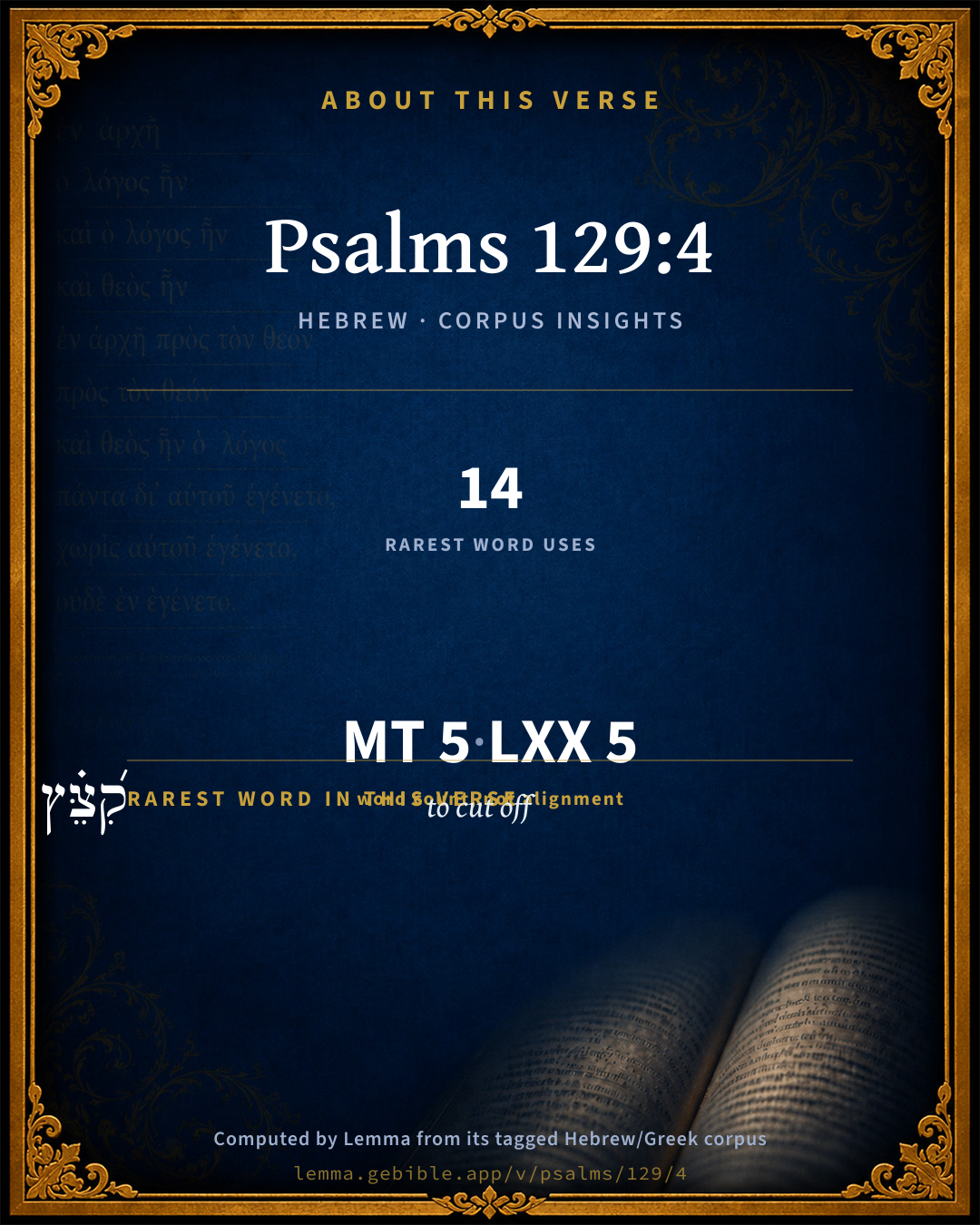
The rarest word here is קִ֝צֵּ֗ץ to cut off H7112 — appearing just 14 times in the whole Hebrew Bible.

Shared distinctive vocabulary

קִ֝צֵּ֗ץ to cut off H7112 occurs in 14 verses of the Hebrew Bible. Also found in:

Grammatical profile

  • 1 verb
  • 2 nouns
  • 2 adjectives

Verb forms

  • קִ֝צֵּ֗ץ Piel · Perfect

Hebrew & Septuagint length

In English translation the verse runs 12 words from the Hebrew and 10 from the Septuagint (LXX English) — closely comparable.

A rough comparison of the two English renderings, which tokenize alike — not a word-level alignment.

Word counts can differ between the Hebrew and the Greek without any difference in meaning — e.g. the Hebrew direct-object marker אֵת has no separate Greek word, and Greek often adds the article ὁ.

In the original languages it is 5 Hebrew tokens and 5 Greek tokens — but the two are counted differently (Hebrew bundles its prefixes and suffixes into one token; the Greek is in lemma form), so that isn’t a like-for-like length.

Cross-references

8

Topical passages linked to Psalms 129:4 in the Treasury of Scripture Knowledge — connected by theme and wording, ordered by reader-vote popularity; previews shown in the World English Bible.

  • Psalms 119:137 You are righteous, Yahweh. Your judgments are upright.
  • Lamentations 3:22 [It is of] Yahweh's loving kindnesses that we are not consumed, because his compassion doesn't fail.
  • Daniel 9:7 Lord, righteousness belongs to you, but to us confusion of face, as at this day; to the men of Judah, and to the inhabitants of Jerusalem, and to all Israel, who are near, and who are far off, through all the countries where you have driven them, because of their trespass that they have trespassed against you.
  • Nehemiah 9:33 However you are just in all that is come on us; for you have dealt truly, but we have done wickedly;
  • Psalms 124:6–7 Blessed be Yahweh, Who has not given us as a prey to their teeth.
  • Ezra 9:15 Yahweh, the God of Israel, you are righteous; for we are left a remnant that is escaped, as it is this day: behold, we are before you in our guiltiness; for none can stand before you because of this.
  • Psalms 140:5–11 The proud have hidden a snare for me, They have spread the cords of a net by the path. They have set traps for me. Selah.
  • Lamentations 1:18 Yahweh is righteous; for I have rebelled against his commandment: Please hear all you peoples, and see my sorrow: My virgins and my young men are gone into captivity.

Cross-references courtesy of OpenBible.info (CC BY 4.0).

Hebrew and Greek witnesses Masoretic Hebrew ↔ Greek Septuagint

The same verse in the two great witnesses to the Old Testament, shown verse-for-verse.

You’re reading Greek Psalm 128 (Hebrew Psalm 129). The Septuagint counts the superscription, so verse numbers can differ from the Hebrew — chapter-level alignment, not verse-by-verse. Numbering follows Rahlfs.

These are two independent witnesses, not word-aligned to each other, and the Septuagint is shown in lemma (dictionary) form.

Hebrew Psalms 129:4 Masoretic · Westminster Leningrad Codex

יְהוָ֥ה צַדִּ֑יק קִ֝צֵּ֗ץ עֲב֣וֹת רְשָׁעִֽים

Yahweh is righteous. He has cut apart the cords of the wicked.

World English Bible · Public Domain

Greek LXX Greek Psalm 128:4 Septuagint · lemma form

κύριος δίκαιος συνκόπτω αὐχήν ἁμαρτωλός

The righteous Lord has cut asunder the necks of sinners.

LXX2012 (modern English Septuagint) · Public Domain

Hebrew: Westminster Leningrad Codex (CC BY 4.0). Greek: Septuagint (public domain); English from LXX2012 (modern English Septuagint) (Public Domain). How the Septuagint differs from the Hebrew →

Commentary

Notes on Psalms 129:4 from classic Christian and Jewish commentators (each source and its license shown beneath its notes). The classic Christian expositions comment on the surrounding passage and are grouped to its opening verse, so a note may address several verses; the Jewish commentaries on the Tanakh (Rashi and others) are per-verse, so they appear only where the commentator wrote on this verse.

Lemma curates 59 commentaries, every one of them public domain or Creative Commons licensed, each selected and text-cleaned for this edition rather than reprinted as found. About our sources →

Trapp's Complete Commentary

John Trapp

Psa 129:4 The LORD [is] righteous: he hath cut asunder the cords of the wicked.

Ver. 4. The Lord is righteous] That is a ruled case, and must be held for a certain truth, whatever we are, or our persecutors.

He hath cut asunder the cords of the wicked] That is, their harness, their plough traces ( nam continuatur tropus rusticus), so that the plough is loose and the horses at liberty; all their forces and designs are broken.

John Trapp, A Commentary or Exposition upon All the Books of the Old and New Testament (1647–1656) — public domain. Text from a community e-Sword module.

The Biblical Illustrator

Joseph S. Exell

Psa_129:4

The cords of the wicked.

Cumulative power of cords of sin

The other day, says the Rev. F. B. Meyer, I had to address some two thousand children, and, fearing that I might fail to secure their attention, I called a lad of twelve into my pulpit, and proceeded to wind around him a long knotted entanglement, first cotton, then string, next twine, next small cord, afterwards rope, ending with a chain and padlock. Of course he could break the cotton, but this led swiftly to the string, and this to a stronger, and so on, till at last the clasp of the padlock made him fast, my prisoner, bound by the cords of his habits. And I think those boys and girls will never forget the lesson of the inevitable connection between thoughts--acts--habits--character--destiny.

The Biblical Illustrator, edited by Joseph S. Exell (c. 1880s–1900s) — public domain. Text from a community e-Sword module.

J. A. Alexander on Psalms

Joseph Addison Alexander

4. (Psa 129:4) Jehovah (is) righteous; he cut the cord of the wicked. He is righteous, and therefore faithful to his promise, and to his covenant engagements to his people. The cord (not cords) is that which fastened the ox to the plough. This continuation of the figure in Psa 129:3 is much more natural than the assumption of a new one, that of confinement by the tying of the limbs, as in Psa 2:3. According to the first translation above given, the meaning of the clause is, that Jehovah put an end to their inflictions by a violent separation from their victim.

Joseph Addison Alexander, The Psalms Translated and Explained (1850) — public domain. Text from a community e-Sword module.

Geneva Bible (1599)

Geneva Bible translators

Because God is righteous, he cannot but plague his adversary, and deliver his, as oxen out of the plough.

Geneva Bible (1599) marginal notes — public domain. Text via Bolls.life.

Adam Clarke's Commentary

Verse 4. The Lord-hath cut asunder the cords of the wicked.] The words have been applied to the sufferings of Christ; but I know not on what authority. No such scourging could take place in his case, as would justify the expression, -

"The ploughers made long furrows there,

Till all his body was one wound."

It is not likely that he received more than thirty-nine stripes. The last line is an unwarranted assertion.

Adam Clarke's Commentary on the Bible (1810–1826) — public domain. Text from a community e-Sword/MySword module.

Ellicott's Commentary for English Readers

(4) The Lord is righteous.—This expression of faith, introduced without any conjunction, is itself a revelation of the deeply-rooted religion of Israel.

Cords.—Literally, cord. As in Psa_124:7, the net was broken and the bird escaped, so here the cord binding the slave (comp. Psa_2:3) is severed and he goes free.

A Bible Commentary for English Readers, edited by Charles John Ellicott (1878–1897) — public domain. Text from a community e-Sword module.

The Cambridge Bible for Schools and Colleges

gen. ed. J. J. S. Perowne

4. The Lord is righteous: he &c.] Better, Jehovah the righteous hath cut asunder. The same attribute of righteousness which compels Him to punish (Neh_9:33) binds Him to deliver, for it involves faithfulness to His covenant. Cp. Psa_51:14 note; Isa_45:21.

cords] The word usually denotes the straps or bands by which the yoke was fastened on to the neck of the ox (Job_39:10). If the metaphor of the preceding verse is continued, the meaning is that the plower’s harness is broken so that they can no longer continue their work. But the figure may be changed; Israel may be the ox, and the cords those which fasten the yoke of servitude upon its neck. Or ‘cords’ may be used generally as a figure for subjection. Cp. Psa_2:3. The reference is to the deliverance of Israel from successive oppressions, but especially to the great deliverance from the captivity in Babylon, and to the escape which is the theme of Psalms 124.

The Cambridge Bible for Schools and Colleges (gen. ed. J. J. S. Perowne; Cambridge University Press, 1878–1918) — public domain. Text from a community e-Sword module.

John Gill's Exposition

The Lord is righteous,.... Or gracious and merciful; hence acts of mercy are called righteousness in the Hebrew language; the Lord has compassion on his people under their afflictions, and delivers them; or is faithful to his promises of salvation to them, and just and righteous to render tribulation to them that trouble them, and take vengeance upon them;

he hath cut asunder the cords of the wicked: alluding to the cords with which the plough is fastened to the oxen, which being cut, they cannot go on ploughing; or to the cords of whips, which when, cut cannot be used to any purpose: it designs the breaking of the confederacies of wicked men against the people of God; the confounding their counsels and schemes, and disappointing their devices; so that they cannot perform their enterprises, or carry their designs into execution, or go on with and finish their intentions. The Targum renders it,

"the chains of the wicked;''

see Isa 5:18.

John Gill's Exposition of the Whole Bible (1746–1763) — public domain (CC PDM 1.0). Text via the HelloAO Bible API.

Albert Barnes' Notes on the Bible

The Lord is righteous - Righteous in permitting this; righteous in what he has done, and will do, in the treatment of those who inflict such wrongs. We may now safely commit our cause to him in view of what he has done in the past. He was not indifferent then to our sufferings, or deaf to the eries of his people; he interposed and punished the oppressors of his people, and we may trust him still.

He hath cut asunder the cords of the wicked - By which they bound us. He did this in our “youth;” when we were oppressed and beaten in Egypt. Then he interposed, and set us free.

Albert Barnes' Notes on the Bible (1834–1885) — public domain. Text from a community e-Sword/MySword module.

Matthew Poole's English Annotations

Righteous; faithful or merciful, as that word is frequently used.

Cut asunder the cords wherewith the plough was drawn; by which means they were stopped in their course. So he persists in the same metaphor of a plough. By these

cords he understands all their plots and endeavours.

Matthew Poole's English Annotations on the Holy Bible (1683–1685) — public domain. Text from a community e-Sword/MySword module.

The Treasury of David

Charles H. Spurgeon

Ver. 4. The LORD is righteous. Whatever men may be, Jehovah remains just, and will therefore keep covenant with his people and deal out justice to their oppressors. Here is the hinge of the condition: this makes the turning point of Israel's distress. The Lord bears with the long furrows of the wicked, but he will surely make them cease from their ploughing before he has done with them. He hath cut asunder the cords of the wicked. The rope which binds the oxen to the plough is cut; the cord which bound the victim is broken; the bond which held the enemies in cruel unity has snapped. As in Ps 124:7 we read, "the snare is broken; we are escaped", so here the breaking of the enemies' instrument of oppression is Israel's release. Sooner or later a righteous God will interpose, and when he does so, his action will be most effectual; he does not unfasten, but cuts asunder, the harness which the ungodly use in their labour of hate. Never has God used a nation to chastise his Israel without destroying that nation when the chastisement has come to a close: he hates those who hurt his people even though lie permits their hate to triumph for a while for his own purpose. If any man would have his harness cut, let him begin to plough one of the Lord's fields with the plough of persecution. The shortest way to ruin is to meddle with a saint: the divine warning is, "He that toucheth you toucheth the apple of his eye."

Ver. 4. The LORD is righteous: he hath cut asunder the cords of the wicked; i.e., he has put an end to their domination and tyranny over us. In the Hebrew word which is rendered "cords" there is a reference to the harness with which the oxen were fastened to the plough; and so to the involved machinations and cruelties of the enemy. The Hebrew word properly denotes thick twisted cords;figuratively, intertwined wickedness; Mic 7:8. "The cords of the wicked", therefore, signify their power, dominion, tyranny, wickedness, and violence. These cords God is said "to have cut", so that he should have made an end; and, therefore "to have cut" for ever, so that they should never be reunited. Hermann Venema.

Ver. 4. He hath cut asunder the cords of the wicked. The enemies' power has been broken; God has cut asunder the cords of the wicked, has cut their gears, their traces, and so spoiled their ploughing; has cut their scourges, and so spoiled their lashing; has cut the bands of union, by which they were combined together; he has cut the bands of captivity, in which they held God's people. God has many ways of disabling Wicked men to do the mischief they design against his church, and shaming their counsels. Matthew Henry.

Ver. 4. He hath cut asunder the cords of the wicked. He repeateth the same praise of God in delivering his church from oppression of the enemy, under the similitude of cutting the cords of the plough, which tilleth up another man's field. Whence learn, 1. The enemies of the church do no more regard her than they do the earth under their feet, and do seek to make their own advantage of her, as usurpers use to do in possessing and labouring of another man's field. "The plowers plowed upon my back." 2. The Lord useth to suffer his enemies to break up the fallow ground of his people's proud and stiff hearts with the plough of persecution, and to draw deep and long furrows on them: "They made long their furrows." 3. What the enemies do against the church the Lord maketh use of for maturing the church, which is his field, albeit they intend no good to God's church, yet they serve in God's wisdom to prepare the Lord's people for receiving the seed of God's word; for the similitude speaketh of their tilling of the church, but nothing of their sowing, for that is reserved for the Lord himself, who is owner of the field. 4. When the wicked have performed so much of God's husbandry as he thinketh good to suffer them, then he stoppeth their design, and looseth their plough. "He Hath cut asunder the cords of the wicked." David Dickson.

Ver. 4. Israel's song of triumph.

1. The Lord is righteous in permitting these afflictions to come upon his people.

2. He is righteous in keeping his promise of deliverance to his people.

3. He is righteous in visiting the enemies of his people with judgment. W. H. J. P.

Psalms 129:5*

Charles H. Spurgeon's The Treasury of David (1869–1885) — public domain. Psalms only. Text from a community e-Sword/MySword module.

Whedon's Commentary on the Bible

Daniel D. Whedon

4. The Lord is righteous—In fulfilling his promises to his people, and rendering deserved retribution upon their persecutors. See Rev_15:3; Rev_16:7; Rev_19:2.

Cut asunder the cords—Resuming the figure of ploughing, as an image for inflicting misery, (Psa_129:3,) the cutting the cords would mean the severing the cords which connect the yoke to the plough; or it may refer to the cords by which captives were bound. In either case, it denotes that God had rendered futile for evil all the devices and boasted power of his enemies.

Daniel D. Whedon (gen. ed.), Commentary on the Old and New Testaments (1874–1909) — public domain. Text from a community e-Sword module.

The Pulpit Commentary

The Lord is righteous. Still, God is just. He allowed these sufferings to be inflicted on us because we deserved them; and he interposed on our behalf when we had been sufficiently punished, and cut asunder the cords of the wicked. Cut, i.e., the cords wherewith they had bound us. The "retrospect" here ends, and in the next verse the "anticipation" begins.

Righteousness may involve judgment.

The cutting asunder of cords figuratively presents the liberating of Israel from the Babylonian captivity, and also the yet earlier experience of the nation, when Jehovah cut the cords of Egypt, and set his people free. This is the consideration which relieves the psalmist"s strain in thinking how many Israel"s trials had been, and how greatly her enemies had enjoyed inflicting them. "Jehovah is righteous." There is always security and rest in that conviction. "He will not suffer us to be tempted above that we are able to bear." Men or circumstances may put cords about us. Whenever he sees it right to do so, our God can "cut the cords asunder." Men may "hate Zion," and gladly do her a mischief; but this we may always rely on God can "confound them and turn them back," as he did the Syrians in the days of Elisha. "If God be for us, who can be against us?" Righteousness is a many-sided and many-related thing.

I RIGHTEOUSNESS BEARS RELATION TO THE WORLD AS A WHOLE. It must be such as every one sooner or later can recognize. It must have in view the well-being of the whole; and this involves that it must not let evil go unpunished; it must bring judgment on the wicked. For the world"s sake the righteous God must be active against all unrighteousness.

II RIGHTEOUSNESS BEARS RELATION TO THE INDIVIDUAL. And in a life very various moral moods and conditions are represented. God must answer to all the moods if he is righteous; and this involves trial for reproof, and judgment for correction. God smiting his people is not only God acting in love, it is God acting in righteousness. "I know that in faithfulness thou hast afflicted me.

III RIGHTEOUSNESS BEARS RELATION TO THE AGENTS OF NATIONAL AND INDIVIDUAL AFFLICTION. This is symbolically taught in God"s prophecy concerning Egypt, as the oppressor of his people, "And also that nation whom they shall serve will I judge." And so Babylon, the agent of the Captivity, was to be judged. It needs to be seen that the fact of God"s using Balaam, or Egypt, for his purposes does not relieve them from the responsibility of their conduct. Hating Zion may lead to action which works out God"s purposes; but hating Zion surely brings a man or a nation into the judgment-vindication of the righteous God. R.T.

The Pulpit Commentary (1880–1919), ed. H.D.M. Spence-Jones & Joseph S. Exell — public domain. Text from a community e-Sword module.

John Wesley's Explanatory Notes

Righteous - Faithful or merciful. The cords - Wherewith the plow was drawn. By these cords he understands all their plots and endeavours.

John Wesley, Explanatory Notes Upon the Whole Bible (1754–1765) — public domain. Text via the GEBible commentary corpus.

unfoldingWord translationNotes

Door43 World Missions Community

he has cut the ropes of the wicked

Israel is spoken of as being bound by evil people. AT: "he has freed us from our enemies" (See: Metaphor)

May they all be put to shame and turned back

Yahweh is not explicitly mentioned as the one who does these things. This can be stated in active form. AT: "May Yahweh shame them and defeat them" (See: Active or Passive and Idiom)

translationWords

Yahweh

righteous

evil

shame

turn

Zion

unfoldingWord translationNotes — © Distant Shores Media and the Door43 World Missions Community, licensed CC BY-SA 4.0. Source: git.door43.org/Door43/en_tn.

Lesson kit

Teaching starters — assembled from the data on this page, not authored interpretation. Every prompt links to the verse data it draws on. Edit before teaching.

Psalms, in the Wisdom, opens this verse with 5 words (5 distinct Hebrew lemmas). Its most distinctive word is qâtsats (“to cut off”). A historical commentator’s framing appears above. Read the whole chapter for the surrounding context.

Discussion questions

  1. How does “to cut off” (qâtsats) shape what this verse is saying?
  2. Exodus 39:3 shares the word «to cut off» with this verse. How do the two illuminate each other?
  3. These translations render this verse differently. What is at stake in choosing one wording over another?
  4. The verb «קִ֝צֵּ֗ץ» is Piel Perfect. How does its form color the action?
  5. Reading how Trapp's Complete Commentary and The Biblical Illustrator read this verse, where do the two commentators agree and where do they part?

Things to notice

Reading settings

Reading text

Shown beneath each verse's original-language words.

Old Testament
Old Testament edition

Read the OT as the Masoretic Hebrew (MT) or the Greek Septuagint (LXX).

English shown for the Greek Septuagint (in the Hebrew ↔ Greek comparison).

Comparing translations? Open the Compare panel on any verse page to stack up to four side by side.