
Job 40:12

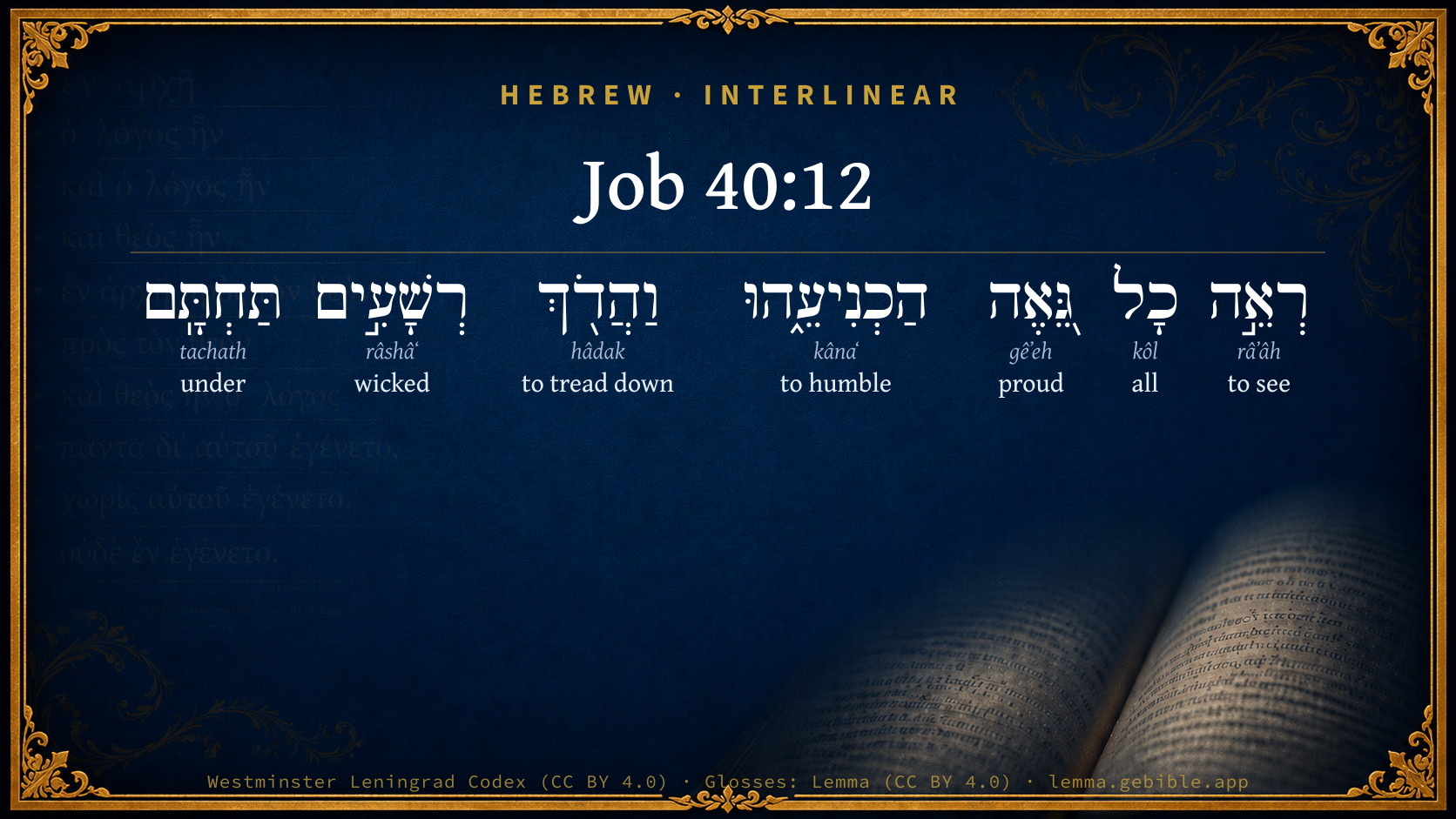
Hebrew (Westminster Leningrad Codex) Job 40:12 appears in the Hebrew Old Testament. The text above is from the Westminster Leningrad Codex. Each word links to its Strong’s number, a concise gloss, and parsing drawn from the Open Scriptures Hebrew Bible morphology. Click any word for its full Brown-Driver-Briggs (BDB) entry.
Download image
Cite this verse

Job 40:12 (World English Bible). Public Domain. Lemma interlinear Bible study tool, https://lemma.gebible.app/v/job/40/12.

Show BibTeX & RIS
BibTeX
RIS
English Translation
Look on everyone who is proud, and humble him. Crush the wicked in their place.
World English Bible · Public Domain
Highlights
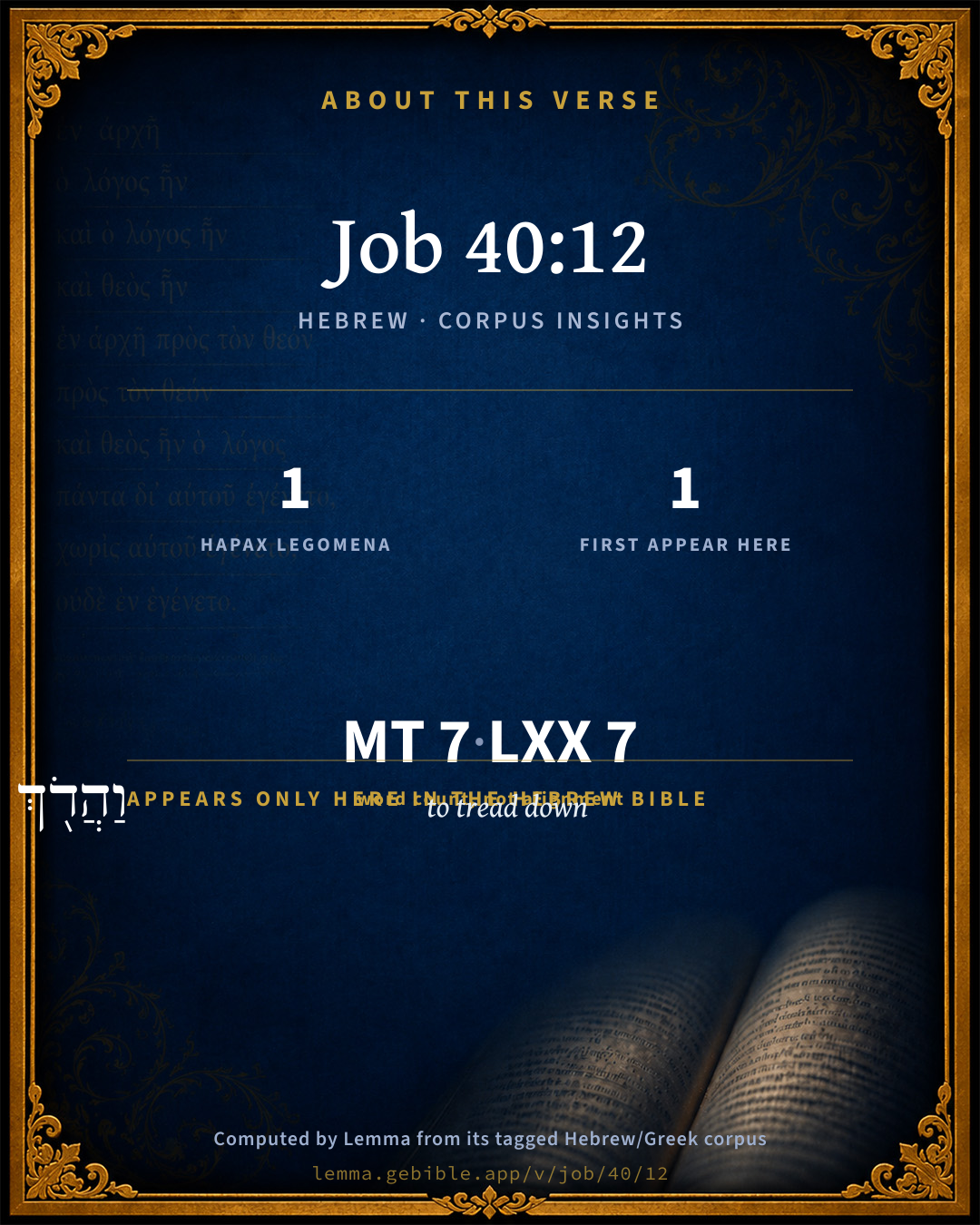
  • 1 hapax legomenon — only here in the Hebrew Bible
  • 1 first appearance in the Hebrew Bible
Full analysis ↓
Download a study sheet

One document with this verse’s original text, its word-by-word gloss line, the meaning frame, cross-references with their text, attributed commentary, and full source and license credits — printable, and it pastes into notes with its structure intact.

This verse Autodidact and up

Study sheet (.html) Plain text (.txt)

A passage Seminary Student

Up to 50 verses in one chapter. A passage sheet keeps up to 6 commentary sources and 12 cross-references per verse, in the order this page ranks them, and says so on the sheet whenever that leaves anything out. Ask for a single verse and you get the Autodidact verse sheet above.

Everything on this page stays free to read, with no account — the sheet is a download of what is already on screen, not access to it.

Want to remove ads? Support Godless Engineer
Compare translations 3

The same verse in 3 English versions, stacked beneath the original-language interlinear above. Click any original word for its lexicon entry.

Each is an independent rendering of the whole verse — the interlinear is not word-aligned to these translations.

Highlighted words mark where these versions differ — a whole-verse word diff, not a word-by-word alignment.

  • World English Bible Public Domain
    Look on everyone who is proud, and humble him. Crush the wicked in their place.
  • King James Version Public Domain
    Look on every one that is proud, and bring him low; and tread down the wicked in their place.
  • unfoldingWord Literal Text CC BY-SA 4.0
    Look at every proud one and subdue him, and trample the wicked under them.

unfoldingWord Literal Text — © unfoldingWord, licensed CC BY-SA 4.0. Word-aligned USFM3 via Door43 (git.door43.org/unfoldingWord/en_ult).

Versions to compare (up to 4)

3 of 4 selected

Show all 18 translations

Every available English version of this verse, each an independent rendering of the whole verse.

  • World English Bible Public Domain
    Look on everyone who is proud, and humble him. Crush the wicked in their place.
  • Berean Standard Bible Public Domain
    Look on every proud man and humble him; trample the wicked where they stand.
  • Majority Standard Bible Public Domain
    Look on every proud man and humble him; trample the wicked where they stand.
  • King James Version Public Domain
    Look on every one that is proud, and bring him low; and tread down the wicked in their place.
  • American Standard Version (1901) Public Domain
    Look on every one that is proud, `and' bring him low; And tread down the wicked where they stand.
  • Revised Version (1885) Public Domain
    Look on every one that is proud, and bring him low; and tread down the wicked where they stand.
  • Geneva Bible (1599) Public Domain
    When hee taketh pleasure, his taile is like a cedar: the sinews of his stones are wrapt together.
  • Douay-Rheims (1899) Public Domain
    He setteth up his tail like a cedar, the sinews of his testicles are wrapped together.
  • Young's Literal Translation Public Domain
    See every proud one -- humble him, And tread down the wicked in their place.
  • Literal Standard Version CC BY-SA 4.0
    See every proud one—humble him, || And tread down the wicked in their place.
  • Unlocked Literal Bible CC BY-SA 4.0
    Look at everyone who is proud and bring him low; trample down wicked people where they stand.
  • unfoldingWord Literal Text CC BY-SA 4.0
    Look at every proud one and subdue him, and trample the wicked under them.
  • Darby Bible Public Domain
    Look on every one that is proud, bring him low, and tread down the wicked in their place:
  • World Messianic Bible Public Domain
    Look at everyone who is proud, and humble him. Crush the wicked in their place.
  • Webster's Bible Public Domain
    \\40:17\\He moveth his tail like a cedar: the sinews of his male organs are wrapped together.
  • Free Bible Version CC BY-SA 4.0
    Bring down the proud with your gaze; tread the wicked underfoot right where they are.
  • Bible in Basic English Public Domain
    His tail is curving like a cedar; the muscles of his legs are joined together.
  • JPS Tanakh (1917) Public Domain
    Look on every one that is proud, and bring him low; and tread down the wicked in their place.

Literal Standard Version (2020), Covenant Press — licensed CC BY-SA 4.0. Text via the HelloAO Bible API (eBible.org). Unlocked Literal Bible (unfoldingWord) — licensed CC BY-SA 4.0. Text via the HelloAO Bible API (eBible.org). unfoldingWord Literal Text — © unfoldingWord, licensed CC BY-SA 4.0. Word-aligned USFM3 via Door43 (git.door43.org/unfoldingWord/en_ult). Free Bible Version, Dr. Jonathan Gallagher — licensed CC BY-SA 4.0. Text via the HelloAO Bible API (eBible.org).

Word by word

More ways to search: Search by grammar → Find every occurrence → Compare this word →

Practice this passage: Drill this verse → Learn its vocabulary →

About this verse

These counts appear in no published source. They are computed here, from the morphology-tagged text and Lemma’s own curated glosses. What Lemma adds →

7
words
7
distinct lemmas
Wisdom
section

Notable vocabulary

1 hapax legomenon — a word that appears only here in the entire Hebrew Bible:

  • וַהֲדֹ֖ךְ to tread down H1915

First appearance in Scripture

This word makes its first canonical appearance in the Hebrew Bible here:

  • וַהֲדֹ֖ךְ to tread down H1915

Shared distinctive vocabulary

גֵּ֭אֶה proud H1343 occurs in 8 verses of the Hebrew Bible. Also found in:

Grammatical profile

  • 3 verbs
  • 1 noun
  • 2 adjectives
  • 1 preposition

Verb forms

  • רְאֵ֣ה Qal · Imperative
  • הַכְנִיעֵ֑הוּ Hiphil · Imperative
  • וַהֲדֹ֖ךְ Qal · Imperative

Hebrew & Septuagint length

In English translation the verse runs 15 words from the Hebrew and 14 from the Septuagint (LXX English) — closely comparable.

A rough comparison of the two English renderings, which tokenize alike — not a word-level alignment.

Word counts can differ between the Hebrew and the Greek without any difference in meaning — e.g. the Hebrew direct-object marker אֵת has no separate Greek word, and Greek often adds the article ὁ.

In the original languages it is 7 Hebrew tokens and 7 Greek tokens — but the two are counted differently (Hebrew bundles its prefixes and suffixes into one token; the Greek is in lemma form), so that isn’t a like-for-like length.

Cross-references

12

Topical passages linked to Job 40:12 in the Treasury of Scripture Knowledge — connected by theme and wording, ordered by reader-vote popularity; previews shown in the World English Bible.

  • Isaiah 63:3 I have trodden the winepress alone; and of the peoples there was no man with me: yes, I trod them in my anger, and trampled them in my wrath; and their lifeblood is sprinkled on my garments, and I have stained all my clothing.
  • Malachi 4:3 You shall tread down the wicked; for they will be ashes under the soles of your feet in the day that I make," says Yahweh of Hosts.
  • 1 Samuel 2:7 Yahweh makes poor, and makes rich: He brings low, he also lifts up.
  • Job 36:20 Don't desire the night, When people are cut off in their place.
  • Psalms 60:12 Through God we shall do valiantly, For it is he who will tread down our adversaries.
  • Proverbs 15:25 Yahweh will uproot the house of the proud, But he will keep the widow's borders intact.
  • Ecclesiastes 11:3 If the clouds are full of rain, they empty themselves on the earth; And if a tree falls toward the south, or toward the north, In the place where the tree falls, there shall it be.
  • Isaiah 10:6 I will send him against a profane nation, and against the people of my wrath will I give him a charge, to take the spoil, and to take the prey, and to tread them down like the mire of the streets.
  • Isaiah 13:11 I will punish the world for [their] evil, and the wicked for their iniquity: and I will cause the arrogance of the proud to cease, and will lay low the haughtiness of the terrible.
  • Zechariah 10:5 They shall be as mighty men, Treading down muddy streets in the battle; And they shall fight, because Yahweh is with them; And the riders on horses will be confounded.
  • Acts 1:25 to take part in this ministry and apostleship from which Judas fell away, that he might go to his own place."
  • Romans 16:20 And the God of peace will quickly crush Satan under your feet. The grace of our Lord Jesus Christ be with you.

Cross-references courtesy of OpenBible.info (CC BY 4.0).

Hebrew and Greek witnesses Masoretic Hebrew ↔ Greek Septuagint

The same verse in the two great witnesses to the Old Testament, shown verse-for-verse.

These are two independent witnesses, not word-aligned to each other, and the Septuagint is shown in lemma (dictionary) form.

Hebrew Job 40:12 Masoretic · Westminster Leningrad Codex

רְאֵ֣ה כָל גֵּ֭אֶה הַכְנִיעֵ֑הוּ וַהֲדֹ֖ךְ רְשָׁעִ֣ים תַּחְתָּֽם

Look on everyone who is proud, and humble him. Crush the wicked in their place.

World English Bible · Public Domain

Greek LXX Job 40:12 Septuagint · lemma form

ὑπερήφανος δέ σβέννυμι σήπω δέ ἀσεβής παραχρῆμα

He sets up his tail like a cypress; and his nerves are wrapped together.

LXX2012 (modern English Septuagint) · Public Domain

On this verse, John Gill's Exposition discusses the Septuagint’s reading. Read the note in Commentary ↓

Hebrew: Westminster Leningrad Codex (CC BY 4.0). Greek: Septuagint (public domain); English from LXX2012 (modern English Septuagint) (Public Domain). How the Septuagint differs from the Hebrew →

Commentary

Notes on Job 40:12 from classic Christian and Jewish commentators (each source and its license shown beneath its notes). The classic Christian expositions comment on the surrounding passage and are grouped to its opening verse, so a note may address several verses; the Jewish commentaries on the Tanakh (Rashi and others) are per-verse, so they appear only where the commentator wrote on this verse.

Lemma curates 59 commentaries, every one of them public domain or Creative Commons licensed, each selected and text-cleaned for this edition rather than reprinted as found. About our sources →

Trapp's Complete Commentary

John Trapp

Job 40:12 Look on every one [that is] proud, [and] bring him low; and tread down the wicked in their place.

Ver. 12. Look on every one that is proud, and bring him low] This God doeth, Isa 2:11-12; Isa 2:17; Isa 5:15. The builders of Babel, Pharaoh, Sennacherib, Nebuchadnezzar, Herod, Dioclesian, Attilas, and others, for instances. Amurath III, king of Turks, in the pride of his heart, styled himself, God of the earth, governor of the whole world, the messenger of God, and faithful servant of the great prophet. This proud prince was slain by a half dead Christian soldier, who, coming to crave his life of him after a battle, stabbed him in the bottom of his belly with a short dagger, of which wound that king and conqueror presently died. {See Trapp on "Job 40:11"} (Turk. Hist.).

And tread down the wicked in their place] Heb. under them; lay them as low as may be. God putteth away all the wicked of the earth as dross, he treads them, as vile things, under his feet, Psa 110:1, till they bethink themselves, and humble their souls at his feet for mercy; for then he will make the place of his feet glorious, as he promiseth, Isa 60:13; and as, Exo 24:10, they saw uuder God’s feet, as it were, a paved work of sapphire stone; to show that he had now changed their condition, the bricks made in their bondage into sapphire. See Isa 54:11.

John Trapp, A Commentary or Exposition upon All the Books of the Old and New Testament (1647–1656) — public domain. Text from a community e-Sword module.

Jamieson, Fausset & Brown

Robert Jamieson, A. R. Fausset & David Brown

proud--high (Dan 4:37).

in their place--on the spot; suddenly, before they can move from their place. (See on Job 34:26; Job 36:20).

Jamieson, Fausset & Brown — Commentary Critical and Explanatory on the Whole Bible (1871) — public domain (CC PDM 1.0). Text via the HelloAO Bible API.

The Cambridge Bible for Schools and Colleges

gen. ed. J. J. S. Perowne

12. in their place] That is, where they stand; suddenly and on the spot, comp. ch. Job_34:26.

The Cambridge Bible for Schools and Colleges (gen. ed. J. J. S. Perowne; Cambridge University Press, 1878–1918) — public domain. Text from a community e-Sword module.

John Gill's Exposition

Look on everyone that is proud, and bring him low,.... As the Lord often does; see Isa 2:11; this is the same as before;

and tread down the wicked in their place; the same with the proud, for pride makes men wicked; it is a sin, and very odious in the sight of God, and is highly resented by him; he resists the proud: now Job is bid, when he has brought proud men low, and laid their honour in the dust, to keep them there, to trample upon them, and tread them as mire in the street; and that in their own place, or wherever he should find them; the Septuagint render it "immediately"; see Isa 28:3.

John Gill's Exposition of the Whole Bible (1746–1763) — public domain (CC PDM 1.0). Text via the HelloAO Bible API.

Albert Barnes' Notes on the Bible

And tread down the wicked in their place - Even in the very place where they are, crush them to the dust, as God can. It is implied that God was able to do this, and he appeals to it as a proof of his power.

Albert Barnes' Notes on the Bible (1834–1885) — public domain. Text from a community e-Sword/MySword module.

Haydock's Catholic Bible Commentary

Tail, which is very small, and without hair. (Calmet) --- Vavassor rather thinks "the trunk" is meant. (Du Hamel)

George Leo Haydock (1774–1849), Haydock's Catholic Family Bible and Commentary, 1859 edition — public domain. Excludes Psalms (Douay-Rheims chapter numbering differs from Protestant) and Deuterocanonical books (Catholic canon only).

Matthew Poole's English Annotations

Either,

1. Wheresoever they are. Or,

2. Where they are in their greatest strength and glory, and therefore are most secure and confident. Or,

3. Forthwith, upon the spot, that the quickness and immediateness of the strike may discover that it comes from a Divine hand.

Matthew Poole's English Annotations on the Holy Bible (1683–1685) — public domain. Text from a community e-Sword/MySword module.

Whedon's Commentary on the Bible

Daniel D. Whedon

12. In their place — Same as Job_36:20. See note.

Daniel D. Whedon (gen. ed.), Commentary on the Old and New Testaments (1874–1909) — public domain. Text from a community e-Sword module.

The Pulpit Commentary

Vers. 12, 13. Look on every one that is proud, and bring him low; and tread down the wicked in their place. Hide them in the dust together; and bind their faces in secret. The idea of ver. 11 is still further insisted on. Lot Job manifest himself as a power among men, if he cannot rival God in nature. Let him set the world to rights. Then he may claim to be heard with respect to the moral government of God.

The humiliation of the proud.

The idea is something like this: If Job can sit as a judge over what God does, he ought to be able to take God"s judgment-seat and execute justice among men. But can he do this? Can he humiliate the proud? If he is incapable of this act of justice, how small a creature he is before the great God who raises up and casts down!

I THE HUMILIATION OF THE PROUD IS GREATLY NEEDED, This particular act of justice is singled out as though it were pre-eminent in importance. It is important on many accounts.

1. For the sake of the proud. Pride is ruinous to the heart in which it has taken up its abode, eating up the better feelings and preparing for the incoming of other sins. The only hope for a proud man is that he should be brought low, and so emptied of self.

2. For the sake of others. The proud spirit is domineering. Pride is at the root of tyranny. If men are to have their rights, the pride of the exalted must be brought down.

3. For God"s sake. Pride is an insult to God, a usurpation of the Divine rights and honours. Before God man is small, weak, sinful. His only titling condition is one of humility and complete self-abasement in the sight of Heaven.

II THE HUMILIATION OF THE PROUD IS MOST DIFFICULT TO ACCOMPLISH, Can Job do this? It is not to be supposed that he can. Pride is doubly strong.

1. In its own character. It is of the nature of pride to induce self-confidence. Even while the world is pointing the finger of scorn at the proud man, he wraps himself in the mantle of his own self-importance, and despises contempt. Here is a great difference between pride and vanity, for vanity is easily cast down, because it lives on the admiration of the world, while pride is self-contained, and may be most intense when it is least honoured.

2. In its circumstances. There are poor and unfortunate proud men. But, as a rule, success and power are the temptations to pride. Thus the proud man is entrenched behind his good fortune, and he uses all the means that prosperity has given him to defend his position.

III THE HUMILIATION OF THE PROUD IS BROUGHT ABOUT BY GOD. This is most decidedly a Divine work. It is beyond the reach of Job or of any man. God humbles pride:

1. By his power. The proud man is helpless before his Maker. His resources are as poverty itself, and all his self-importance is but childish pretence. God lifts up the lowly, and sets down the mighty with a word.

2. In his justice. Man"s pride is not attacked simply because God is jealous of it, but because it is an evil thing. An insult to God, an injury to man, it needs to be cast out in order that a right spirit of humility and obedience may take the place of it.

3. For the sake of his love. God humbles the proud man because he loves him. The abasement is not a vindictive act, but a merciful preparation for salvation. The goodness of God leads him to cast down all pretence and self-importance, so that he may raise up a new and more stable structure of solid merit in place of these empty shows. The proud but useless forest is cleared that the precious grain of wheat may be sown in its place. God cuts down man"s pride to make room for Christ"s grace. W.F.A.

The Pulpit Commentary (1880–1919), ed. H.D.M. Spence-Jones & Joseph S. Exell — public domain. Text from a community e-Sword module.

unfoldingWord translationNotes

Door43 World Missions Community

their faces

The "face" represents the whole person. AT: "them" (See: Synecdoche)

the hidden place

a euphemism for the place where people's spirits go when they die (See: Euphemism)

translationWords

trample

evil

bury

face

right hand

save

unfoldingWord translationNotes — © Distant Shores Media and the Door43 World Missions Community, licensed CC BY-SA 4.0. Source: git.door43.org/Door43/en_tn.

Rashi

Rabbi Shlomo Yitzchaki (Rashi)

and crush Heb. והדך, an expression of (Num. 11:8), “or crushed (דכו) it in mortars.”

Rashi on the Tanakh — English translations: “The Judaica Press complete Tanach with Rashi, translated by A. J. Rosenberg” (CC BY 4.0); “Pentateuch with Rashi's commentary by M. Rosenbaum and A.M. Silbermann, 1929-1934” (public domain); “The Metsudah Tanach series, Lakewood, N.J” (CC BY 4.0); and “The Book of Joshua, Metsudah Publications, 1997” (CC BY 4.0). Text via Sefaria.

Lesson kit

Teaching starters — assembled from the data on this page, not authored interpretation. Every prompt links to the verse data it draws on. Edit before teaching.

Job, in the Wisdom, opens this verse with 7 words (7 distinct Hebrew lemmas). Its most distinctive word is hâdak (“to tread down”). A historical commentator’s framing appears above. Read the whole chapter for the surrounding context.

Discussion questions

  1. What does “to tread down” (hâdak) contribute to the verse as a whole?
  2. This verse holds 1 word here found nowhere else in the Hebrew Bible. What might the rare word draw attention to?
  3. The word “to tread down” first appears here in Scripture. What is being introduced at this debut?
  4. Job 40:11 shares the word «proud» with this verse. How do the two illuminate each other?
  5. These translations render this verse differently. What is at stake in choosing one wording over another?
  6. The verb «רְאֵ֣ה» is Qal Imperative. How does its form color the action?
  7. Reading how Trapp's Complete Commentary and Jamieson, Fausset & Brown read this verse, where do the two commentators agree and where do they part?

Things to notice

Reading settings

Reading text

Shown beneath each verse's original-language words.

Old Testament
Old Testament edition

Read the OT as the Masoretic Hebrew (MT) or the Greek Septuagint (LXX).

English shown for the Greek Septuagint (in the Hebrew ↔ Greek comparison).

Comparing translations? Open the Compare panel on any verse page to stack up to four side by side.