
Ezekiel 3:19

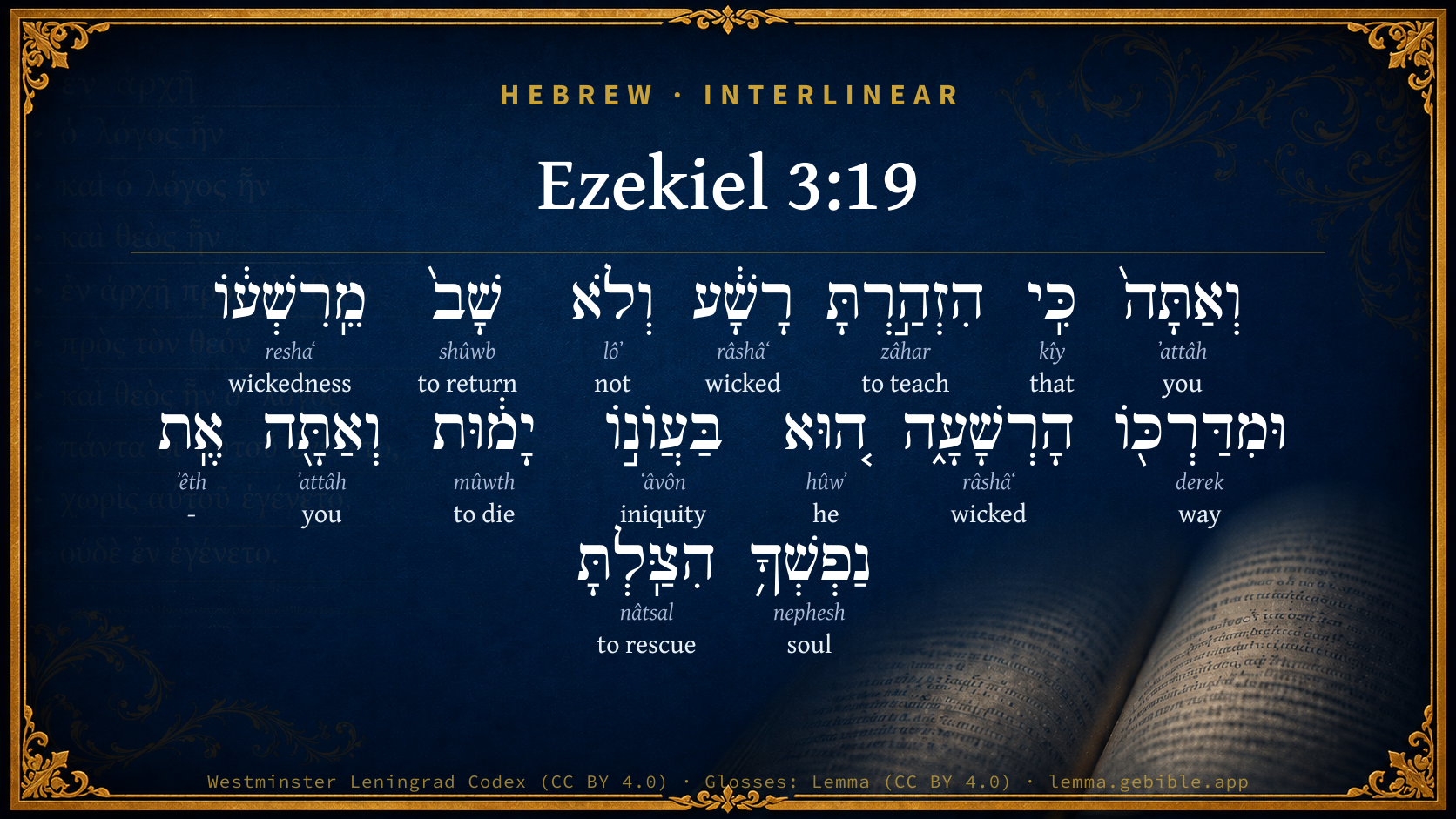
Hebrew (Westminster Leningrad Codex) Ezekiel 3:19 appears in the Hebrew Old Testament. The text above is from the Westminster Leningrad Codex. Each word links to its Strong’s number, a concise gloss, and parsing drawn from the Open Scriptures Hebrew Bible morphology. Click any word for its full Brown-Driver-Briggs (BDB) entry.
Download image
Cite this verse

Ezekiel 3:19 (World English Bible). Public Domain. Lemma interlinear Bible study tool, https://lemma.gebible.app/v/ezekiel/3/19.

Show BibTeX & RIS
BibTeX
RIS
English Translation
Yet if you warn the wicked, and he doesn't turn from his wickedness, nor from his wicked way, he shall die in his iniquity; but you have delivered your soul.
World English Bible · Public Domain
Download a study sheet

One document with this verse’s original text, its word-by-word gloss line, the meaning frame, cross-references with their text, attributed commentary, and full source and license credits — printable, and it pastes into notes with its structure intact.

This verse Autodidact and up

Study sheet (.html) Plain text (.txt)

A passage Seminary Student

Up to 50 verses in one chapter. A passage sheet keeps up to 6 commentary sources and 12 cross-references per verse, in the order this page ranks them, and says so on the sheet whenever that leaves anything out. Ask for a single verse and you get the Autodidact verse sheet above.

Everything on this page stays free to read, with no account — the sheet is a download of what is already on screen, not access to it.

Want to remove ads? Support Godless Engineer
Compare translations 3

The same verse in 3 English versions, stacked beneath the original-language interlinear above. Click any original word for its lexicon entry.

Each is an independent rendering of the whole verse — the interlinear is not word-aligned to these translations.

Highlighted words mark where these versions differ — a whole-verse word diff, not a word-by-word alignment.

  • World English Bible Public Domain
    Yet if you warn the wicked, and he doesn't turn from his wickedness, nor from his wicked way, he shall die in his iniquity; but you have delivered your soul.
  • King James Version Public Domain
    Yet if thou warn the wicked, and he turn not from his wickedness, nor from his wicked way, he shall die in his iniquity; but thou hast delivered thy soul.
  • unfoldingWord Literal Text CC BY-SA 4.0
    But if you warn the wicked, and he does not turn from his wickedness or from his wicked deeds, then he will die for his sin, but you will have rescued your own life.

unfoldingWord Literal Text — © unfoldingWord, licensed CC BY-SA 4.0. Word-aligned USFM3 via Door43 (git.door43.org/unfoldingWord/en_ult).

Versions to compare (up to 4)

3 of 4 selected

Show all 18 translations

Every available English version of this verse, each an independent rendering of the whole verse.

  • World English Bible Public Domain
    Yet if you warn the wicked, and he doesn't turn from his wickedness, nor from his wicked way, he shall die in his iniquity; but you have delivered your soul.
  • Berean Standard Bible Public Domain
    But if you warn a wicked man and he does not turn from his wickedness and his wicked way, he will die in his iniquity, but you will have saved yourself.
  • Majority Standard Bible Public Domain
    But if you warn a wicked man and he does not turn from his wickedness and his wicked way, he will die in his iniquity, but you will have saved yourself.
  • King James Version Public Domain
    Yet if thou warn the wicked, and he turn not from his wickedness, nor from his wicked way, he shall die in his iniquity; but thou hast delivered thy soul.
  • American Standard Version (1901) Public Domain
    Yet if thou warn the wicked, and he turn not from his wickedness, nor from his wicked way, he shall die in his iniquity; but thou hast delivered thy soul.
  • Revised Version (1885) Public Domain
    Yet if thou warn the wicked, and he turn not from his wickedness, nor from his wicked way, he shall die in his iniquity; but thou hast delivered thy soul.
  • Geneva Bible (1599) Public Domain
    Yet if thou warne the wicked, and he turne not from his wickednesse, nor from his wicked way, he shall die in his iniquitie, but thou hast deliuered thy soule.
  • Douay-Rheims (1899) Public Domain
    But if thou give warning to the wicked, and he be not converted from his wickedness, and from his evil way: he indeed shall die in his iniquity, but thou hast delivered thy soul.
  • Young's Literal Translation Public Domain
    And thou, because thou hast warned the wicked, and he hath not turned back from his wickedness, and from his wicked way, he in his iniquity dieth, and thou thy soul hast delivered.
  • Literal Standard Version CC BY-SA 4.0
    And you, because you have warned the wicked, and he has not turned back from his wickedness, and from his wicked way, he dies in his iniquity, and you have delivered your soul.
  • Unlocked Literal Bible CC BY-SA 4.0
    But if you warn the wicked, and he does not turn from his wickedness or from his wicked deeds, then he will die for his sin, but you will have rescued your own life.
  • unfoldingWord Literal Text CC BY-SA 4.0
    But if you warn the wicked, and he does not turn from his wickedness or from his wicked deeds, then he will die for his sin, but you will have rescued your own life.
  • Darby Bible Public Domain
    But if thou warn the wicked, and he turn not from his wickedness, nor from his wicked way, he shall die in his iniquity; but thou hast delivered thy soul.
  • World Messianic Bible Public Domain
    Yet if you warn the wicked, and he doesn’t turn from his wickedness, nor from his wicked way, he will die in his iniquity; but you have delivered your soul.”
  • Webster's Bible Public Domain
    Yet if thou shalt warn the wicked, and he shall not turn from his wickedness, nor from his wicked way, he shall die in his iniquity; but thou hast delivered thy soul.
  • Free Bible Version CC BY-SA 4.0
    But if you warn them, and they don't stop their wicked ways, they will die in their sins, but you will have saved yourself—you won't die.
  • Bible in Basic English Public Domain
    But if you give the evil-doer word of his danger, and he is not turned from his sin or from his evil way, death will overtake him in his evil-doing; but your life will be safe.
  • JPS Tanakh (1917) Public Domain
    Yet if thou warn the wicked, and he turn not from his wickedness, nor from his wicked way, he shall die in his iniquity; but thou hast delivered thy soul.

Literal Standard Version (2020), Covenant Press — licensed CC BY-SA 4.0. Text via the HelloAO Bible API (eBible.org). Unlocked Literal Bible (unfoldingWord) — licensed CC BY-SA 4.0. Text via the HelloAO Bible API (eBible.org). unfoldingWord Literal Text — © unfoldingWord, licensed CC BY-SA 4.0. Word-aligned USFM3 via Door43 (git.door43.org/unfoldingWord/en_ult). Free Bible Version, Dr. Jonathan Gallagher — licensed CC BY-SA 4.0. Text via the HelloAO Bible API (eBible.org).

Word by word

More ways to search: Search by grammar → Find every occurrence → Compare this word →

Practice this passage: Drill this verse → Learn its vocabulary →

הִזְהַ֣רְתָּ
zâhar
H2094
“to teach”
Verb, Hiphil, Perfect, 2nd Person, Masculine, Singular
Part of Speech
Verb
Stem
Hiphil
Form
Perfect
Person
2nd Person
Gender
Masculine
Number
Singular
Full BDB Definition

Origin: a primitive root

TWOT: 531 , 532

to admonish, warn, teach, shine, send out light, be light, be shining - (Niphal) to be taught, be admonished - (Hiphil) - to teach, warn - to shine, send out light (figuratively)
  1. וְאַתָּה֙ ʼattâh H859 “and · you” Conjunction + Pronoun, Personal, 2nd Person, Masculine, Singular
  2. כִּֽי kîy H3588 “that” Conjunction
  3. רָשָׁ֔ע râshâʻ H7563 “wicked” Adjective, Adjective, Masculine, Singular, Absolute
  4. וְלֹא lôʼ H3808 “and · not” Conjunction + Particle, Negative
  5. שָׁב֙ shûwb H7725 “to return” Verb, Qal, Perfect, 3rd Person, Masculine, Singular
  6. מֵֽרִשְׁע֔וֹ reshaʻ H7562 “from · wickedness · his” Preposition + Noun, Common, Masculine, Singular, Construct + Suffix, Personal, 3rd Person, Masculine, Singular
  7. וּמִדַּרְכּ֖וֹ derek H1870 “and · from · way · his” Conjunction + Preposition + Noun, Common, Both, Singular, Construct + Suffix, Personal, 3rd Person, Masculine, Singular
  8. הָרְשָׁעָ֑ה râshâʻ H7563 “the · wicked” Particle, Definite Article + Adjective, Adjective, Feminine, Singular, Absolute
  9. ה֚וּא hûwʼ H1931 “he” Pronoun, Personal, 3rd Person, Masculine, Singular
  10. בַּעֲוֺנ֣וֹ ʻâvôn H5771 “in/at · iniquity · his” Preposition + Noun, Common, Both, Singular, Construct + Suffix, Personal, 3rd Person, Masculine, Singular
  11. יָמ֔וּת mûwth H4191 “to die” Verb, Qal, Imperfect, 3rd Person, Masculine, Singular
  12. וְאַתָּ֖ה ʼattâh H859 “and · you” Conjunction + Pronoun, Personal, 2nd Person, Masculine, Singular
  13. אֶֽת ʼêth H853 “-” Particle, Direct Object
  14. נַפְשְׁךָ֥ nephesh H5315 “soul · your” Noun, Common, Both, Singular, Construct + Suffix, Personal, 2nd Person, Masculine, Singular
  15. הִצַּֽלְתָּ nâtsal H5337 “to rescue” Verb, Hiphil, Perfect, 2nd Person, Masculine, Singular

About this verse

These counts appear in no published source. They are computed here, from the morphology-tagged text and Lemma’s own curated glosses. What Lemma adds →

16
words
14
distinct lemmas
Prophets
section

Notable vocabulary

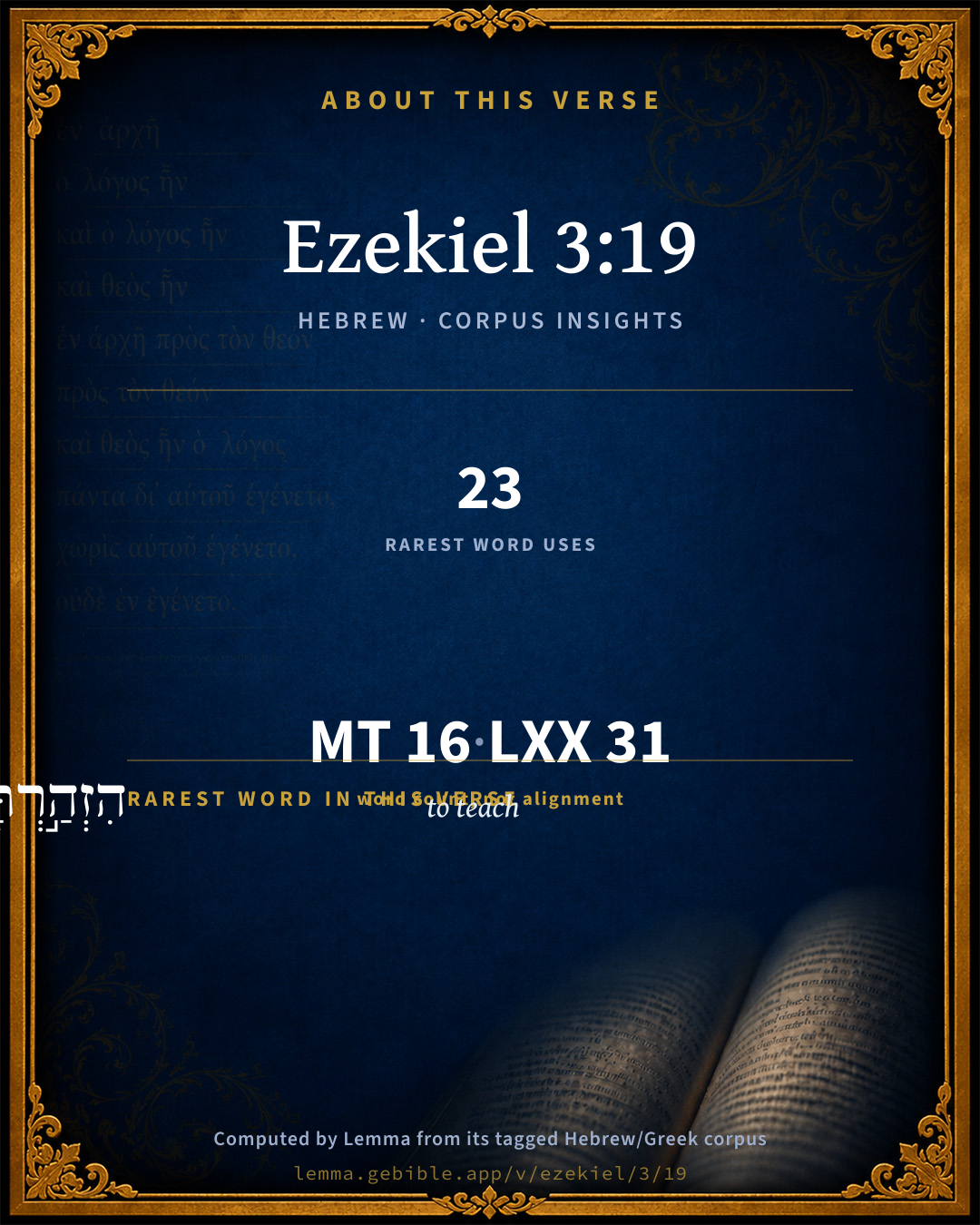
The rarest word here is הִזְהַ֣רְתָּ to teach H2094 — appearing just 23 times in the whole Hebrew Bible.

Shared distinctive vocabulary

הִזְהַ֣רְתָּ to teach H2094 occurs in 19 verses of the Hebrew Bible. Also found in:

Grammatical profile

  • 4 verbs
  • 4 nouns
  • 2 adjectives
  • 3 pronouns
  • 1 conjunction
  • 2 particles

Verb forms

  • הִזְהַ֣רְתָּ Hiphil · Perfect
  • שָׁב֙ Qal · Perfect
  • יָמ֔וּת Qal · Imperfect
  • הִצַּֽלְתָּ Hiphil · Perfect

Repetition

Words recur within this verse — often emphatic in Hebrew:

  • רָשָׁ֔ע wicked H7563 ×2
  • וְאַתָּה֙ you H859 ×2

Hebrew & Septuagint length

In English translation the verse runs 30 words from the Hebrew and 31 from the Septuagint (LXX English) — closely comparable.

A rough comparison of the two English renderings, which tokenize alike — not a word-level alignment.

Word counts can differ between the Hebrew and the Greek without any difference in meaning — e.g. the Hebrew direct-object marker אֵת has no separate Greek word, and Greek often adds the article ὁ.

In the original languages it is 16 Hebrew tokens and 31 Greek tokens — but the two are counted differently (Hebrew bundles its prefixes and suffixes into one token; the Greek is in lemma form), so that isn’t a like-for-like length.

Cross-references

23

Topical passages linked to Ezekiel 3:19 in the Treasury of Scripture Knowledge — connected by theme and wording, ordered by reader-vote popularity; previews shown in the World English Bible.

  • Ezekiel 33:9 Nevertheless, if you warn the wicked of his way to turn from it, and he doesn't turn from his way; he shall die in his iniquity, but you have delivered your soul.
  • Ezekiel 14:20 though Noah, Daniel, and Job, were in it, as I live, says the Lord Yahweh, they should deliver neither son nor daughter; they should but deliver their own souls by their righteousness.
  • 1 Timothy 4:16 Pay attention to yourself, and to your teaching. Continue in these things, for in doing this you will save both yourself and those who hear you.
  • Ezekiel 14:14 though these three men, Noah, Daniel, and Job, were in it, they should deliver but their own souls by their righteousness, says the Lord Yahweh.
  • 2 Thessalonians 1:8–9 giving vengeance to those who don't know God, and to those who don't obey the Gospel of our Lord Jesus,
  • Hebrews 12:25 See that you don't refuse him who speaks. For if they didn't escape when they refused him who warned on the Earth, how much more will we not escape who turn away from him who warns from heaven,
  • Proverbs 29:1 He who is often rebuked and stiffens his neck Will be destroyed suddenly, with no remedy.
  • Jeremiah 42:19–22 Yahweh has spoken concerning you, remnant of Judah, Don't you go into Egypt: know certainly that I have testified to you this day.
  • Acts 20:26 Therefore I testify to you this day that I am clean from the blood of all men,
  • Hebrews 10:26–27 For if we sin willfully after we have received the knowledge of the truth, there remains no more a sacrifice for sins,
  • 2 Kings 17:13–23 Yet Yahweh testified to Israel, and to Judah, by every prophet, and every seer, saying, Turn you from your evil ways, and keep my commandments and my statutes, according to all the law which I commanded your fathers, and which I sent to you by my servants the prophets.
  • 2 Chronicles 36:15–16 Yahweh, the God of their fathers, sent to them by his messengers, rising up early and sending, because he had compassion on his people, and on his dwelling-place:
  • Isaiah 49:4–5 But I said, I have labored in vain, I have spent my strength for nothing and vanity; yet surely the justice [due] to me is with Yahweh, and my recompense with my God.
  • Jeremiah 44:4–5 However I sent to you all my servants the prophets, rising up early and sending them, saying, Oh, don't do this abominable thing that I hate.
  • Ezekiel 3:18 When I tell the wicked, You shall surely die; and you give him no warning, nor speak to warn the wicked from his wicked way, to save his life; the same wicked man shall die in his iniquity; but his blood will I require at your hand.
  • Ezekiel 3:21 Nevertheless if you warn the righteous man, that the righteous not sin, and he does not sin, he shall surely live, because he took warning; and you have delivered your soul.
  • Ezekiel 33:5 He heard the sound of the trumpet, and didn't take warning; his blood shall be on him; whereas if he had taken warning, he would have delivered his soul.
  • Luke 10:10–11 But into whatever city you enter, and they don't receive you, go out into the streets of it and say,
  • Acts 13:45–46 But when the Jews saw the multitudes, they were filled with jealousy, and contradicted the things which were spoken by Paul, and blasphemed.
  • Acts 18:5–6 But when Silas and Timothy came down from Macedonia, Paul was compelled by the Spirit, testifying to the Jews that Jesus was the Christ.
  • 2 Corinthians 2:15–17 For we are a sweet aroma of Christ to God, in those who are saved, and in those who perish;
  • Hebrews 2:1–3 Therefore we ought to pay greater attention to the things that were heard, lest perhaps we drift away.
  • 1 Thessalonians 4:6 that no one should take advantage of and wrong a brother or sister in this matter; because the Lord is an avenger in all these things, as also we forewarned you and testified.

Cross-references courtesy of OpenBible.info (CC BY 4.0).

Hebrew and Greek witnesses Masoretic Hebrew ↔ Greek Septuagint

The same verse in the two great witnesses to the Old Testament, shown verse-for-verse.

These are two independent witnesses, not word-aligned to each other, and the Septuagint is shown in lemma (dictionary) form.

Hebrew Ezekiel 3:19 Masoretic · Westminster Leningrad Codex

וְאַתָּה֙ כִּֽי הִזְהַ֣רְתָּ רָשָׁ֔ע וְלֹא שָׁב֙ מֵֽרִשְׁע֔וֹ וּמִדַּרְכּ֖וֹ הָרְשָׁעָ֑ה ה֚וּא בַּעֲוֺנ֣וֹ יָמ֔וּת וְאַתָּ֖ה אֶֽת נַפְשְׁךָ֥ הִצַּֽלְתָּ

Yet if you warn the wicked, and he doesn't turn from his wickedness, nor from his wicked way, he shall die in his iniquity; but you have delivered your soul.

World English Bible · Public Domain

Greek LXX Ezekiel 3:19 Septuagint · lemma form

καί σύ ἐάν διαστέλλω ὁ ἄνομος καί μή ἀποστρέφω ἀπό ὁ ἀνομία αὐτός καί ὁ ὁδός αὐτός ὁ ἄνομος ἐκεῖνος ἐν ὁ ἀδικία αὐτός ἀποθνήσκω καί σύ ὁ ψυχή σύ ῥύομαι

But if you warn the wicked, and he turn not from his wickedness, and from his way, that wicked man shall die in his iniquity, and you shall deliver your soul.

LXX2012 (modern English Septuagint) · Public Domain

Hebrew: Westminster Leningrad Codex (CC BY 4.0). Greek: Septuagint (public domain); English from LXX2012 (modern English Septuagint) (Public Domain). How the Septuagint differs from the Hebrew →

Targum (Aramaic paraphrase)

1

The Targum is the ancient Jewish Aramaic paraphrase of the Hebrew Scriptures — an interpretive translation, not the Hebrew text itself. Onkelos (literal) and Pseudo-Jonathan (expansive) render the Torah, and Jonathan the Prophets. Coverage is partial: where no permissively-licensed English translation exists for a verse, only the Aramaic is shown. This is verse-level text, not a word-by-word alignment to the Hebrew.

  1. Targum Jonathan Prophets (Joshua–Malachi)
    וְאַתְּ אֲרֵי אַזְהַרְתָּא רַשִׁיעָא וְלָא תָב מֵחוֹבֵיהּ וּמֵאוֹרְחֵיהּ דְרִשְׁעָא הוּא בְּחוֹבֵיהּ יְמוּת וְאַתְּ יַת נַפְשָׁךְ שֵׁיזַבְתָּא:

    (no public-domain English translation for this verse)

    Targum Jonathan — Aramaic: “Mikraot Gedolot” (public domain). English: “Sefaria Community Translation” (CC0 1.0 (public-domain dedication)); “London "Chaldee Paraphrase," 1871” (public domain). Text via Sefaria.

Commentary

Notes on Ezekiel 3:19 from classic Christian and Jewish commentators (each source and its license shown beneath its notes). The classic Christian expositions comment on the surrounding passage and are grouped to its opening verse, so a note may address several verses; the Jewish commentaries on the Tanakh (Rashi and others) are per-verse, so they appear only where the commentator wrote on this verse.

Lemma curates 59 commentaries, every one of them public domain or Creative Commons licensed, each selected and text-cleaned for this edition rather than reprinted as found. About our sources →

Trapp's Complete Commentary

John Trapp

Eze 3:19 Yet if thou warn the wicked, and he turn not from his wickedness, nor from his wicked way, he shall die in his iniquity; but thou hast delivered thy soul.

Ver. 19. He shall die in his iniquity.] Because now he falleth with open eyes. Many sorrows shall be to such wicked as will not be warned. {Psa 32:9-10} {a}

But thou hast delivered thy soul,] scil., From thine other men’s sin. {1Ti 4:16}

{a} De Temp., 99.

John Trapp, A Commentary or Exposition upon All the Books of the Old and New Testament (1647–1656) — public domain. Text from a community e-Sword module.

Jamieson, Fausset & Brown

Robert Jamieson, A. R. Fausset & David Brown

wickedness . . . wicked way--internal wickedness of heart, and external of the life, respectively.

delivered thy soul-- (Isa 49:4-5; Act 20:26).

Jamieson, Fausset & Brown — Commentary Critical and Explanatory on the Whole Bible (1871) — public domain (CC PDM 1.0). Text via the HelloAO Bible API.

John Calvin's Commentaries

The Prophet is here taught how usefully he will lay out his labor, although he should appear to fail, for he ought to be satisfied with this alone, that God approves his efforts. Although, therefore, those who were to be brought back by holy exhortations remain obstinate, yet God’s servants ought not, through fastidiousness, to throw up their commission as if it were useless, for they free their own souls. It has been formerly said, that a necessity was imposed upon them, but if they are dumb dogs the destruction of souls will be imputed to them, but when they have executed their duty and satisfied the Almighty, ought not it to suffice them to be absolved in his opinion? We see then, that the Prophet was animated by this consolation, lest he should be weary of admonishing abandoned and obstinate men, because, if they were not profited by his teaching, yet its fruit should return to himself. That expression of Christ’s is well known, “Into whatsoever house ye enter, salute it: if the house be unworthy, your blessing shall return to yourselves.” (Matthew 10:12, 13; Luke 10:5, 6.) So also when the Prophets anxiously desired to reclaim the wandering sheep and to collect them within the fold, if they experienced such petulance that their labor did not profit them, yet their usefulness shall return to themselves. Now we understand the counsel of God in these words, Thou, therefore, hast freed thy soul. Here he does not put impiety only, but impious way, for the sake of explanation: unless any one had rather distinguish that impiety is the interior wickedness of the heart, but an impious way is the outward life and comprehends all actions, which is perhaps more probable, although there is no reason to object to add impious way as an explanation after the mention of impiety. Now it follows —

John Calvin's Commentaries (1540-1563) — public domain. Text from the Calvin Translation Society English edition (1840s-50s) via the Christian Classics Ethereal Library (ccel.org). Calvin's coverage is partial (roughly two-thirds of the Bible); uncommented books and verses are honest gaps, never fabricated. The 19th-century editor's footnotes and remarks are omitted so the notes are faithfully Calvin's own voice.

John Gill's Exposition

Yet if thou warn the wicked,.... Of his sin and danger; lay before him his evil, and show him the sad consequences of going on in a course of sin, and warn him to flee from wrath to come:

and he turn not from his wickedness, and from his wicked way; does not repent of it, nor abstain from it:

he shall die in his iniquity; and for it, and that very righteously:

but thou hast delivered thy soul; thou hast done the duty of thine office; thou art clear from the charge of negligence and sloth, and from being answerable for the death of the sinner; and shalt save thyself, though not the wicked man; see Ti1 4:16.

John Gill's Exposition of the Whole Bible (1746–1763) — public domain (CC PDM 1.0). Text via the HelloAO Bible API.

Matthew Poole's English Annotations

His wickedness: this may denote the sinfulness of his mind and heart, which is the spring of all.

His wicked way; his actual sinful courses; the practices of sin and the habits of sin must be left.

He shall die in his iniquity; the punishment of his unrepented sins shall be death, but there is no danger unto the watchman, the prophet and minister, who did his duty, and warned the sinner.

Matthew Poole's English Annotations on the Holy Bible (1683–1685) — public domain. Text from a community e-Sword/MySword module.

The Pulpit Commentary

Thou hast delivered thy soul, etc. This phrase is again an eminently characteristic one. (comp. Eze_33:9) Here also, though the words do not necessarily imply more than deliverance from bodily death, thought of as a judgment for negligence, it is, I think, scarcely possible to avoid finding in them a "springing and germinant" sense, analogous to that which we have found in the preceding verse. The dread warning has for its complement a message of comfort. The judgment passed on the prophet does not depend on the results of his ministry. "Whether men will bear, or whether they will forbear," he has "delivered his soul," i.e. saved his life, when he has done his duty as a watchman. The phrase is noticeable as having passed out of the language of Scripture into familiar use. A man can say, "Liberavi animam meam," when he has uttered his conviction on any question of importance affecting the well being of others.

The Pulpit Commentary (1880–1919), ed. H.D.M. Spence-Jones & Joseph S. Exell — public domain. Text from a community e-Sword module.

Lesson kit

Teaching starters — assembled from the data on this page, not authored interpretation. Every prompt links to the verse data it draws on. Edit before teaching.

Ezekiel, in the Prophets, opens this verse with 16 words (14 distinct Hebrew lemmas). Its most distinctive word is zâhar (“to teach”). A historical commentator’s framing appears above. Read the whole chapter for the surrounding context.

Discussion questions

  1. The word zâhar carries the sense “to teach.” How does it shape the verse?
  2. Exodus 18:20 shares the word «to teach» with this verse. How do the two illuminate each other?
  3. “wicked” occurs 2× in this one verse. What is the effect of the repetition?
  4. The translations on this page render this verse differently — a whole-verse word diff, not a word-by-word alignment. What might account for the different wordings?
  5. The verb «הִזְהַ֣רְתָּ» is Hiphil Perfect. How does its form color the action?
  6. Reading how Trapp's Complete Commentary and Jamieson, Fausset & Brown read this verse, where do the two commentators agree and where do they part?

Things to notice

Reading settings

Reading text

Shown beneath each verse's original-language words.

Old Testament
Old Testament edition

Read the OT as the Masoretic Hebrew (MT) or the Greek Septuagint (LXX).

English shown for the Greek Septuagint (in the Hebrew ↔ Greek comparison).

Comparing translations? Open the Compare panel on any verse page to stack up to four side by side.