
Proverbs 10:25

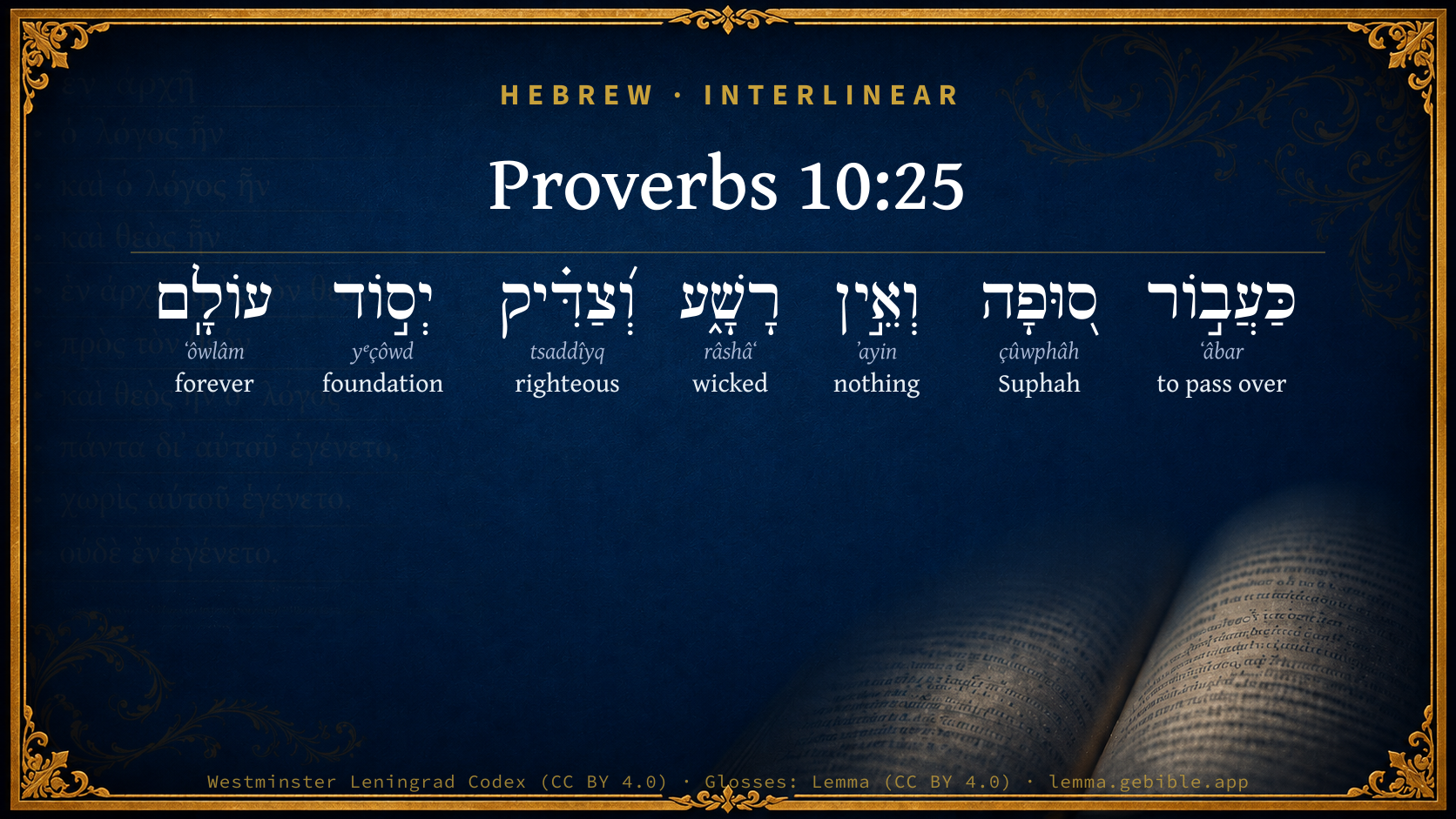
Hebrew (Westminster Leningrad Codex) Proverbs 10:25 appears in the Hebrew Old Testament. The text above is from the Westminster Leningrad Codex. Each word links to its Strong’s number, a concise gloss, and parsing drawn from the Open Scriptures Hebrew Bible morphology. Click any word for its full Brown-Driver-Briggs (BDB) entry.
Download image
Cite this verse

Proverbs 10:25 (World English Bible). Public Domain. Lemma interlinear Bible study tool, https://lemma.gebible.app/v/proverbs/10/25.

Show BibTeX & RIS
BibTeX
RIS
English Translation
When the whirlwind passes, the wicked is no more; But the righteous stand firm forever.
World English Bible · Public Domain
Download a study sheet

One document with this verse’s original text, its word-by-word gloss line, the meaning frame, cross-references with their text, attributed commentary, and full source and license credits — printable, and it pastes into notes with its structure intact.

This verse Autodidact and up

Study sheet (.html) Plain text (.txt)

A passage Seminary Student

Up to 50 verses in one chapter. A passage sheet keeps up to 6 commentary sources and 12 cross-references per verse, in the order this page ranks them, and says so on the sheet whenever that leaves anything out. Ask for a single verse and you get the Autodidact verse sheet above.

Everything on this page stays free to read, with no account — the sheet is a download of what is already on screen, not access to it.

Want to remove ads? Support Godless Engineer
Compare translations 3

The same verse in 3 English versions, stacked beneath the original-language interlinear above. Click any original word for its lexicon entry.

Each is an independent rendering of the whole verse — the interlinear is not word-aligned to these translations.

Highlighted words mark where these versions differ — a whole-verse word diff, not a word-by-word alignment.

  • World English Bible Public Domain
    When the whirlwind passes, the wicked is no more; But the righteous stand firm forever.
  • King James Version Public Domain
    As the whirlwind passeth, so is the wicked no more: but the righteous is an everlasting foundation.
  • unfoldingWord Literal Text CC BY-SA 4.0
    When a whirlwind passes over, then there is no wicked, but a righteous one a foundation of eternity.

unfoldingWord Literal Text — © unfoldingWord, licensed CC BY-SA 4.0. Word-aligned USFM3 via Door43 (git.door43.org/unfoldingWord/en_ult).

Versions to compare (up to 4)

3 of 4 selected

Show all 18 translations

Every available English version of this verse, each an independent rendering of the whole verse.

  • World English Bible Public Domain
    When the whirlwind passes, the wicked is no more; But the righteous stand firm forever.
  • Berean Standard Bible Public Domain
    When the whirlwind passes, the wicked are no more, but the righteous are secure forever.
  • Majority Standard Bible Public Domain
    When the whirlwind passes, the wicked are no more, but the righteous are secure forever.
  • King James Version Public Domain
    As the whirlwind passeth, so is the wicked no more: but the righteous is an everlasting foundation.
  • American Standard Version (1901) Public Domain
    When the whirlwind passeth, the wicked is no more; But the righteous is an everlasting foundation.
  • Revised Version (1885) Public Domain
    When the whirlwind passeth, the wicked is no more: but the righteous is an everlasting foundation.
  • Geneva Bible (1599) Public Domain
    As the whirlewinde passeth, so is the wicked no more: but the righteous is as an euerlasting foundation.
  • Douay-Rheims (1899) Public Domain
    As a tempest that passeth, so the wicked shall be no more: but the just is as an everlasting foundation.
  • Young's Literal Translation Public Domain
    As the passing by of a hurricane, So the wicked is not, And the righteous is a foundation age-during.
  • Literal Standard Version CC BY-SA 4.0
    As the passing by of a windstorm, || So the wicked is not, || And the righteous is a perpetual foundation.
  • Unlocked Literal Bible CC BY-SA 4.0
    The wicked are like the storm that passes by, and they are no more, but the righteous person is a foundation that lasts forever.
  • unfoldingWord Literal Text CC BY-SA 4.0
    When a whirlwind passes over, then there is no wicked, but a righteous one a foundation of eternity.
  • Darby Bible Public Domain
    As a whirlwind passeth, so is the wicked no [more]; but the righteous is an everlasting foundation.
  • World Messianic Bible Public Domain
    When the whirlwind passes, the wicked is no more; but the righteous stand firm forever.
  • Webster's Bible Public Domain
    As the whirlwind passeth, so is the wicked no more: but the righteous is an everlasting foundation.
  • Free Bible Version CC BY-SA 4.0
    When the storm hits, the wicked are no more, but the good are safe and secure forever.
  • Bible in Basic English Public Domain
    When the storm-wind is past, the sinner is seen no longer, but the upright man is safe for ever.
  • JPS Tanakh (1917) Public Domain
    When the whirlwind passeth, the wicked is no more; but the righteous is an everlasting foundation.

Literal Standard Version (2020), Covenant Press — licensed CC BY-SA 4.0. Text via the HelloAO Bible API (eBible.org). Unlocked Literal Bible (unfoldingWord) — licensed CC BY-SA 4.0. Text via the HelloAO Bible API (eBible.org). unfoldingWord Literal Text — © unfoldingWord, licensed CC BY-SA 4.0. Word-aligned USFM3 via Door43 (git.door43.org/unfoldingWord/en_ult). Free Bible Version, Dr. Jonathan Gallagher — licensed CC BY-SA 4.0. Text via the HelloAO Bible API (eBible.org).

Word by word

More ways to search: Search by grammar → Find every occurrence → Compare this word →

Practice this passage: Drill this verse → Learn its vocabulary →

About this verse

These counts appear in no published source. They are computed here, from the morphology-tagged text and Lemma’s own curated glosses. What Lemma adds →

7
words
7
distinct lemmas
Wisdom
section

Notable vocabulary

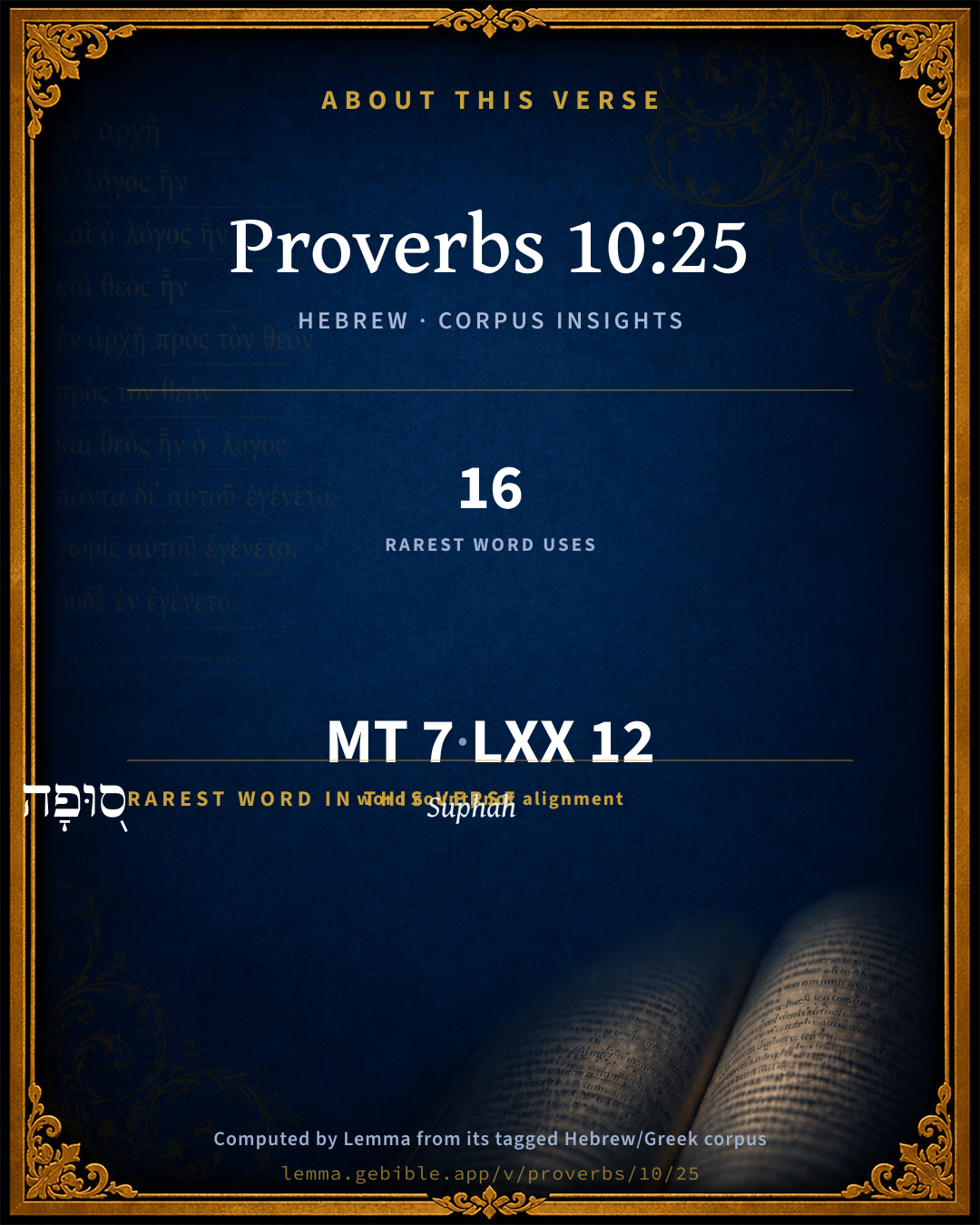
The rarest word here is ס֭וּפָה Suphah H5492 — appearing just 16 times in the whole Hebrew Bible.

Shared distinctive vocabulary

ס֭וּפָה Suphah H5492 occurs in 16 verses of the Hebrew Bible. Also found in:

Grammatical profile

  • 1 verb
  • 3 nouns
  • 2 adjectives
  • 1 particle

Verb forms

  • כַּעֲב֣וֹר Qal · Infinitive Construct

Hebrew & Septuagint length

In English translation the verse runs 15 words from the Hebrew and 18 from the Septuagint (LXX English) — closely comparable.

A rough comparison of the two English renderings, which tokenize alike — not a word-level alignment.

Word counts can differ between the Hebrew and the Greek without any difference in meaning — e.g. the Hebrew direct-object marker אֵת has no separate Greek word, and Greek often adds the article ὁ.

In the original languages it is 7 Hebrew tokens and 12 Greek tokens — but the two are counted differently (Hebrew bundles its prefixes and suffixes into one token; the Greek is in lemma form), so that isn’t a like-for-like length.

Cross-references

16

Topical passages linked to Proverbs 10:25 in the Treasury of Scripture Knowledge — connected by theme and wording, ordered by reader-vote popularity; previews shown in the World English Bible.

  • Psalms 15:5 He who doesn't lend out his money for usury, Nor take a bribe against the innocent. He who does these things shall never be shaken.
  • Psalms 58:9 Before your pots can feel the heat of the thorns, He will sweep away the green and the burning alike.
  • Proverbs 12:3 A man shall not be established by wickedness, But the root of the righteous shall not be moved.
  • Matthew 7:24–27 "Everyone therefore who hears these words of mine, and does them, I will liken him to a wise man, who built his house on a rock.
  • Job 21:18 That they are as stubble before the wind, As chaff that the storm carries away?
  • Proverbs 1:27 When calamity overtakes you like a storm, When your disaster comes on like a whirlwind; When distress and anguish come on you.
  • Proverbs 12:7 The wicked are overthrown, and are no more, But the house of the righteous shall stand.
  • Isaiah 40:24 Yes, they have not been planted; yes, they have not been sown; yes, their stock has not taken root in the earth: moreover he blows on them, and they wither, and the whirlwind takes them away as stubble.
  • Matthew 16:18 I also tell you that you are Peter, and on this rock I will build my assembly, and the gates of Hades will not prevail against it.
  • Ephesians 2:20 being built on the foundation of the apostles and prophets, Christ Jesus himself being the chief cornerstone;
  • 1 Timothy 6:19 laying up in store for themselves a good foundation against the time to come, that they may lay hold of eternal life.
  • 2 Timothy 2:19 However God's firm foundation stands, having this seal, "The Lord knows those who are his," and, "Let every one who names the name of the Lord depart from unrighteousness."
  • Job 27:19–21 He lies down rich, but he shall not do so again. He opens his eyes, and he is not.
  • Psalms 37:9–10 For evildoers shall be cut off, But those who wait for Yahweh shall inherit the land.
  • Psalms 73:18–20 Surely you set them in slippery places. You throw them down to destruction.
  • Proverbs 10:30 The righteous will never be removed, But the wicked will not dwell in the land.

Cross-references courtesy of OpenBible.info (CC BY 4.0).

Hebrew and Greek witnesses Masoretic Hebrew ↔ Greek Septuagint

The same verse in the two great witnesses to the Old Testament, shown verse-for-verse.

These are two independent witnesses, not word-aligned to each other, and the Septuagint is shown in lemma (dictionary) form.

Hebrew Proverbs 10:25 Masoretic · Westminster Leningrad Codex

כַּעֲב֣וֹר ס֭וּפָה וְאֵ֣ין רָשָׁ֑ע וְ֝צַדִּ֗יק יְס֣וֹד עוֹלָֽם

When the whirlwind passes, the wicked is no more; But the righteous stand firm forever.

World English Bible · Public Domain

Greek LXX Proverbs 10:25 Septuagint · lemma form

παραπορεύομαι καταιγίς ἀπο ἀναἵζω ἀσεβής δίκαιος δέ ἐκκλίνω σώζω εἰς ὁ αἰών

When the storm passes by, the ungodly vanishes away; but the righteous turns aside and escapes for ever.

LXX2012 (modern English Septuagint) · Public Domain

On this verse, The Pulpit Commentary discusses the Septuagint’s reading. Read the note in Commentary ↓

Hebrew: Westminster Leningrad Codex (CC BY 4.0). Greek: Septuagint (public domain); English from LXX2012 (modern English Septuagint) (Public Domain). How the Septuagint differs from the Hebrew →

Commentary

Notes on Proverbs 10:25 from classic Christian and Jewish commentators (each source and its license shown beneath its notes). The classic Christian expositions comment on the surrounding passage and are grouped to its opening verse, so a note may address several verses; the Jewish commentaries on the Tanakh (Rashi and others) are per-verse, so they appear only where the commentator wrote on this verse.

Lemma curates 59 commentaries, every one of them public domain or Creative Commons licensed, each selected and text-cleaned for this edition rather than reprinted as found. About our sources →

Trapp's Complete Commentary

John Trapp

Pro 10:25 As the whirlwind passeth, so [is] the wicked no [more]: but the righteous [is] an everlasting foundation.

Ver. 25. As the whirlwind passeth away.] The whirlwind is terrible for the time, but not durable. Lo, such is the rage of tyrants and persecutors. Nubecula est, cito transibit, said Athanasius of the Arian persecution. Our Richard III and Queen Mary had, as the bloodiest, so the shortest reigns of any since the Conquest. Bloody and deceitful men shall not live out half their days. Dioclesian, that cruel persecutor, giving over his empire, decreed to lead the rest of his life quietly, {a} But he escaped not so, for after that his house was wholly consumed with lightning and a flame of fire that fell from heaven. He, hiding himself for fear of the lightning, died within a little while after. "Then terrors take hold on him as waters, a tempest stealeth him away in the night. The east wind carrieth him away, and he departeth; and, as a storm, hurleth him out of his place. For God shall cast upon him, and not spare: he would fain flee out of his hand. Men shall clap their hands at him, and shall hiss him out of his place," as Job elegantly and emphatically sets it forth. {Pro 26:20-23}

But the righteous is an everlasting foundation.] Or, Is the foundation of the world; as firm as the world’s foundation, which remains unmoveable. The Hebrews sense it thus, - The righteous is the foundation of the world, which, but for their sakes, would soon shatter and fall to ruin. {b} Sanctum semen statumen terrae {Isa 6:13} "I bear up the pillars of it," saith David. {Psa 75:3}

{a} Euseb., De Vit. Const, lib. iii.

{b} Absque stationibus non staret mundus.

John Trapp, A Commentary or Exposition upon All the Books of the Old and New Testament (1647–1656) — public domain. Text from a community e-Sword module.

The Preacher's Complete Homiletical Commentary

Joseph S. Exell (gen. ed.)

CRITICAL NOTES.—

Pro_10:25. “When the whirlwind passeth, the wicked is no more.”

MAIN HOMILETICS OF Pro_10:25

THE WHIRLWIND AND THE SURE FOUNDATION

I. The resemblance of a wicked man to a whirlwind.

1. They are both destructive forces. A whirlwind passes over a district and everything that resists its advance is either overthrown, broken, or made to bend to its fury. Every wicked man in his sphere is a destroyer of human happiness and of moral life, but the image is especially applicable to tyrants who have been destroyers of the lives of thousands of their fellow-creatures, and have ruined the happiness of thousands more in their unscrupulous onward march to the attainment of their own selfish ends. Isaiah describes such a one when he says, “Is this the man that made the earth to tremble, that did shake kingdoms; that made the world as a wilderness, and destroyed the cities thereof?” (chap. Pro_14:16-17.)

2. They often burst forth with sudden fury, and seem beyond the control of ordinary laws and methods of operation. A whirlwind often descends upon a peaceful valley without any warning, and its fury is the more terrible by reason of its suddenness, and because of the impossibility of foretelling its course and where it will fall in its most destructive power. So a wicked man is a lawless man, he is not guided by principle but by passion and impulse, none of his fellow-creatures can foretell what will be his next act of violence, or who will be the next victims of his selfish ambition. It is this lawless, uncontrollable destructiveness which makes both the moral and the physical whirlwind the terror of the human race, and leads men instinctively to avoid them if possible.

3. The triumph of both is short. How soon nature rights herself after the passage of a whirlwind. She covers the broken rocks with verdure, the trees put forth fresh branches clothed with fresh leaves, others grow up in the places of those which were uprooted, grass and corn spring again, and all looks lovely as before the visitation. The whirlwind “passeth,” and so does the wicked man. It is soon written of him that he is “no more,” and men who have trembled at his name take heart, and nations and peoples whom he seemed to have annihilated spring into existence again, and the world rights itself. How many such instances stand recorded in history from the days of Nebuchadnezzar to those of Napoleon. How many times has the experience of the Psalmist been repeated: “I have seen the wicked in great power, and spreading himself like a green bay tree, yet he passed away, and lo, he was not: yea, I sought him, but he could not be found” (Psa_37:35-36). How often has the world had occasion to repeat the song, “How hath the oppressor ceased!… The Lord hath broken the staff of the wicked, and the sceptre of the rulers. He who smote the people in wrath with a continual stroke, he that ruled the nations in anger, is persecuted, and none hindereth. The whole earth is at rest, and is quiet: they break forth into singing. Yea, the fir trees rejoice at thee, and the cedars of Lebanon, saying, Since thou art laid down, no feller is come up against us” (Isa_14:4-8).

II. In what respects a righteous man is “an everlasting foundation.”

1. His character is something to build upon. Nothing can be built upon a whirlwind, but a substantial structure can be raised upon a good foundation. Men may build hope upon the word and character of a righteous man. A promise given by him is a solid ground of confidence upon which the heart of his brother-man may rest securely. Thus righteousness is a constructive force in the world—a foundation without which society cannot exist. Especially is this true of the ideal man, Christ Jesus. Because He is the Righteous One (Isa_11:4) His promises are as anchors of the soul to the children of men. In resting upon His word His disciples build upon a “sure foundation” (1Co_3:11). Upon His character rests all their hopes for their own blessedness in the future, and for the restoration of a fallen world. Every man is a foundation if “righteousness” is the chief element of his character.

2. Because for his sake the world stands. The owner of a house may let it stand if there is a good foundation of solid rock, although the superstructure may be comparatively worthless. Our Lord tells us concerning the tribulations which he foretold, that “except those days should be shortened, there should no flesh be saved; but for the elect’s sake those days shall be shortened” (Mat_24:22). This teaches us that the righteousness of the godly is the power which averts the destruction of the wicked, and keeps the world in existence. In this sense, therefore, the righteous are a foundation.

3. The righteous are an “everlasting” foundation, because righteousness is the basis of confidence in eternity as it is in time. The blessedness of the life to come is founded upon righteousness. The Kingdom of God in both worlds is “established in righteousness” (Isa_54:14). The immutable character of the heavenly world is founded upon the righteousness first of its righteous King, and then upon that of His righteous servants.

OUTLINES AND SUGGESTIVE COMMENTS

The righteous may be poor, and, in his sinful state, anything but a stately building to the Lord, but in his meanest infancy he is a “foundation.” Very little appears above the surface. But he is a basis of all that is to be built, and that basis is to be “eternal.”—Miller.

The proverb reminds us of the close of the Sermon on the Mount, and finds the final confirmation of its truth in this, that the death of the godless is a penal thrusting of them away, but the death of the righteous a lifting them up to their home. The righteous also often enough perish in times of war and of pestilence; but the proverb, as it is interpreted, verifies itself, even although not so as the poet, viewing it from his narrow Old Testament standpoint, understood it; for the righteous, let him die when and how he may, is preserved, while the godless perishes.—Delitzsch.

The continuance of the wicked is but while they dig the pit of their own destruction.—Jermin.

The Lord will lay “a sure foundation,” and “he that believeth shall not make haste” (Isa_28:16). These two promises lie together in the Scripture. When your heart’s hope is fixed on that precious corner-stone, you need not be thrown into a flutter by the fiercest onset of the world and its god.—Arnot.

The Preacher's Complete Homiletical Commentary (gen. ed. Joseph S. Exell; Funk & Wagnalls, c. 1892) — public domain (pre-1929). A full-Bible homiletical/sermon-outline anthology covering 65 of 66 books (2 John is absent from the source module). Text from a community e-Sword module.

Bridges on Proverbs

Charles Bridges

Thus suddenly, as the whirlwind,†1 does the fear of the wicked often come upon him. All his hopes, pleasures, and dependencies; all his opportunities of grace, and offers of mercy, are swept away in a moment for ever. Such a whirlwind was the destruction of the old world, of the cities of the plain (Luk 17:26-29 ); of Sennacherib’s army. (2Ki 19:35 .) And such a whirlwind, infinitely more terrible, will be the coming of the Lord. (Luk 17:30 . 1Th 5:2-3 .) "But he that doeth the will of God abideth ever" (1Jn 2:17 ), as an everlasting foundation. Faith hath fastened him to the Rock of Ages;†2 hath built his house upon this Rock; and no storm can root him up. (Mat 7:25 . Psa 112:7 .) But remember, this is the confidence of the righteous. Sin allowed and indulged will shake this foundation far more than all the outward assaults of earth and hell. "Hold fast then thy rejoicing" in a jealous godly fear. Thy portion is secure. Thy hopes, joys, and prospects are unchangeable. Thou canst look at trouble — yea, at death itself — without dismay, and feel — ’I am safe.’ But while "thou standest by faith, be not high-minded, but fear." (Rom 11:20 .)

Footnotes:

†1 See footnote from Pro 1:27 (below); Compare Jer 23:19 . Hos 13:3 ; also Job 20:8-9 ; Job 21:13, Job 21:19-21 . Psa 73:19-20 .

(This is the footnote from Pro 1:27 : " Pro 10:25. Psa 58:9 . Isa 17:13 ; Isa 40:24 . Eastern travellers furnish abundant illustration of this striking figure. Paxton’s Illustrations of Scripture Geography, pp. 412-416 — (Oliphant.)")

†2 Rock of Ages, Isa 26:4 .

Charles Bridges, An Exposition of the Book of Proverbs (1846) — public domain. Text from a community e-Sword module.

Tyndale Open Study Notes

Tyndale Open Resources

10:25 The wicked might enjoy the material blessings of life, but only temporarily, in contrast with the godly. Jesus also expressed this reality (Matt 7:24-27).

Tyndale Open Study Notes — © Tyndale Open Resources, licensed CC BY-SA 4.0. Text via the HelloAO Bible API.

Jamieson, Fausset & Brown

Robert Jamieson, A. R. Fausset & David Brown

(Compare Psa 1:4; Psa 37:9-10, Psa 37:36).

righteous . . . foundation--well laid and firm (Mat 7:24-25).

Jamieson, Fausset & Brown — Commentary Critical and Explanatory on the Whole Bible (1871) — public domain (CC PDM 1.0). Text via the HelloAO Bible API.

Adam Clarke's Commentary

Verse 25. As the whirlwind passeth] As tornadoes that sweep every thing away before them; so shall the wrath of God sweep away the wicked; it shall leave him neither branch nor root. But the righteous, being built on the eternal foundation, יסוד עולם yesod olam, shall never be shaken.

Adam Clarke's Commentary on the Bible (1810–1826) — public domain. Text from a community e-Sword/MySword module.

Ellicott's Commentary for English Readers

(25) As the whirlwind passeth.—Better, when the whirlwind, &c. (Comp. Wis_5:14-15; Job_21:18; Mat_7:24, ff.) Death is ruin to the wicked, and gain to the righteous (2Ti_1:12).

A Bible Commentary for English Readers, edited by Charles John Ellicott (1878–1897) — public domain. Text from a community e-Sword module.

The Cambridge Bible for Schools and Colleges

gen. ed. J. J. S. Perowne

25. As &c.] Rather, When the whirlwind passeth the wicked is no more. The parallelism is thus best preserved. Like the house on the sand when the whirlwind passes over it, the wicked shall be swept away (Psa_37:10): like the house on the rock unshaken by the storm, the righteous shall stand firm as “an everlasting foundation.”

The Cambridge Bible for Schools and Colleges (gen. ed. J. J. S. Perowne; Cambridge University Press, 1878–1918) — public domain. Text from a community e-Sword module.

John Gill's Exposition

As the whirlwind passeth, so is the wicked no more,.... The wicked themselves are like a whirlwind, noisy, boisterous, and blustering; such is the man of sin, who speaks like a dragon, breathing out slaughter and threatening against the saints; and so are his followers, fierce and heady, and like a whirlwind, pernicious and destructive, bearing down, carrying away, and destroying all before it; so the locusts of the bottomless pit, under their king Abaddon, or Apollyon, the destroyer; and all tyrannical persecutors, who are as the boar out of the forest, and the wild beast of the field: and these "pass away" like a whirlwind, swiftly, suddenly, and at once; now they are seen in great power and authority, and anon they are not any more, Jer 4:13; as the whirlwind, which digs up the earth, makes a circle and buries itself in it; so the wicked dig a pit for others and fall into it themselves, Psa 7:14; and as a whirlwind passes away to the joy of men, so when the wicked perish there is shouting; as will be at the destruction of antichrist more especially, Pro 11:10; and it is in the whirlwind and storm of divine wrath, which falls upon the head of the wicked, by which they are caused to pass away, Jer 23:19; so that they are "not": not that they are annihilated at death, they will rise again and come to judgment, and live in torment for ever; when they pass away, they are somewhere; they are "not" indeed in the land of the living, in their own houses, as formerly, which will know them no more; they are not in their grandeur and prosperity, enjoying their riches and honour; but they are in their own place, in hell they lift up their eyes, though they wish they had no being;

but the righteous is an everlasting foundation; he is in a firm and stable state here and hereafter; interested in everlasting love; in which he is rooted and grounded; secured in an everlasting covenant, ordered in all things and sure; having a share in everlasting salvation, and eternal redemption wrought out by Christ; being justified by his everlasting righteousness, which will answer for him in a time to come; and a partaker of those graces of the Spirit, faith, hope, and love, which are a well of living water springing up to everlasting life; and having everlasting strength and everlasting consolation in Christ, and a title to eternal life through him. Or, "but the righteous has an everlasting foundation" (t); the sense is the same; which foundation is not external privileges of birth and education, or a mere outward profession of religion, or works of righteousness done; these are not everlasting, but sandy foundations; but Christ is the righteous man's foundation, and he is the only one, Co1 3:11. Some take the sense to be, the "righteous", that is, Jesus Christ the righteous, "is an everlasting foundation"; he is the foundation of the church, the rock on which it is built; he is the foundation of the apostles and prophets, on which they were laid, and by whom they are saved; he is the foundation of every particular believer, they are rooted and built up on him; he is the foundation of their faith, hope, love, peace, joy, and comfort, and of their eternal glory and happiness: and an "everlasting one" he is; he is so in his person as God-man; in his offices of Prophet, Priest, and King; in the efficacy of his blood, righteousness, and sacrifice; and is a foundation which is sure, and will never fail: he has been the foundation of his people in all ages; and he is the same today, yesterday, and for ever. Hence, though the wicked pass away as the whirlwind, and by one, the righteous shall not; they are on a foundation, and cannot be blown off of it by the storms and tempests of Satan's temptations, their own corruptions, the persecutions of men, the errors of the wicked, or by the whirlwind of divine wrath and vengeance. Some render it, "the righteous is the foundation of the world" (u); the pillar and support of it; as the righteous are the salt of the earth, they are the stay of it: the whirlwind of God's wrath would tear up the course of nature, dissolve the earth, and all things in it, were it not for the sake of the righteous; and, when they are called and gathered in, there will be a general dissolution of all things, Pe2 3:9.

(t) "atjusti fandamentum perpetuum est", Tigurine versions; "justo vero sit, vel est fundamentum perpetuum", Junius & Tremellius, Piscator. (u) "Fundamentum mundi", Hebraei in Mercer. Maimonides apud Grotius.

John Gill's Exposition of the Whole Bible (1746–1763) — public domain (CC PDM 1.0). Text via the HelloAO Bible API.

Albert Barnes' Notes on the Bible

Or, when the whirlwind is passing, then the wicked is no more. Compare Mat 7:24-27.

The righteous ... - In the later rabbinic interpretation this was applied to the Messiah as being the Just One, the Everlasting Foundation, on whom the world was established.

Albert Barnes' Notes on the Bible (1834–1885) — public domain. Text from a community e-Sword/MySword module.

Matthew Poole's English Annotations

As the whirlwind passeth; which is suddenly gone, though with great noise and violence.

So is the wicked no more; his power and felicity is lost in an instant.

Is an everlasting foundation; or, hath an everlasting, &c. His hope and happiness is built upon a sure and unmovable foundation.

Matthew Poole's English Annotations on the Holy Bible (1683–1685) — public domain. Text from a community e-Sword/MySword module.

Whedon's Commentary on the Bible

Daniel D. Whedon

25. So is the wicked no more — Literally, then the wicked is not; that is, the whirlwind sweeps them away, or they pass away quickly like the whirlwind.

But the righteous — An everlasting foundation is theirs. The antithesis lies between the evanescence of the wicked and the stability of the righteous. Compare Psa_125:1; Psa_37:27; Psa_15:5; Job_1:19; Isa_28:18-19; Pro_1:27; Mat_7:24, etc. The rabbins applied the latter clause to the Messiah, as the Just One, the Everlasting Foundation, on whom the world was established.

Daniel D. Whedon (gen. ed.), Commentary on the Old and New Testaments (1874–1909) — public domain. Text from a community e-Sword module.

The Pulpit Commentary

As the whirlwind passeth. According to this rendering (which has the support of the Vulgate) the idea is the speed with which, under God"s vengeance, the sinner is consumed, as Isa_17:13Jo Isa 21:18. But it is better to translate, as the LXX, "when the whirlwind is passing," i.e. when the storm of judgment falls, as Christ represents the tempest beating on the ill-founded house and destroying it, while that which was built on the rock remains uninjured. (comp. Pro_12:3 Mat_7:25, etc.; comp. RAPC Wis 5:14, etc) Everlasting foundation; (Ver. 30; Ps 91 Psa_125:1) like the Cyclopean stones on which Solomon"s temple was built. It is natural to see here an adumbration of that Just One, the Messiah, the chief Cornerstone. The LXX gives, "But the righteous turning aside is saved forever."

The Pulpit Commentary (1880–1919), ed. H.D.M. Spence-Jones & Joseph S. Exell — public domain. Text from a community e-Sword module.

Keil & Delitzsch

C. F. Keil & F. Delitzsch

21 The lips of the righteous edify many;

But fools die through want of understanding.

Keil & Delitzsch — Biblical Commentary on the Old Testament (1861–1891) — public domain (CC PDM 1.0). Text via the HelloAO Bible API. (Old Testament only.)

Kretzmann's Popular Commentary

Paul E. Kretzmann

v. 25. As the whirlwind passeth, rather, "When a storm sweepeth by," so is the wicked no more, taken away like chaff; but the righteous is an everlasting foundation, set firmly against all storms of adversity.

Paul E. Kretzmann, Popular Commentary of the Bible (1921–1924) — public domain. Text from a community e-Sword module.

Rashi

Rabbi Shlomo Yitzchaki (Rashi)

When the whirlwind passes, the wicked man is no more Suddenly the fury of a whirlwind comes, and the wicked man is cut off from his place.

Rashi on the Tanakh — English translations: “The Judaica Press complete Tanach with Rashi, translated by A. J. Rosenberg” (CC BY 4.0); “Pentateuch with Rashi's commentary by M. Rosenbaum and A.M. Silbermann, 1929-1934” (public domain); “The Metsudah Tanach series, Lakewood, N.J” (CC BY 4.0); and “The Book of Joshua, Metsudah Publications, 1997” (CC BY 4.0). Text via Sefaria.

Lesson kit

Teaching starters — assembled from the data on this page, not authored interpretation. Every prompt links to the verse data it draws on. Edit before teaching.

Proverbs, in the Wisdom, opens this verse with 7 words (7 distinct Hebrew lemmas). Its most distinctive word is çûwphâh (“Suphah”). A historical commentator’s framing appears above. Read the whole chapter for the surrounding context.

Discussion questions

  1. How does “Suphah” (çûwphâh) shape what this verse is saying?
  2. How does Numbers 21:14, which shares the word «Suphah», read alongside this verse?
  3. The translations on this page render this verse differently — a whole-verse word diff, not a word-by-word alignment. What might account for the different wordings?
  4. «כַּעֲב֣וֹר» is a Qal Infinitive Construct verb. How does that grammatical form shape the action described?
  5. Compare how Trapp's Complete Commentary and The Preacher's Complete Homiletical Commentary read this verse. Where do they agree or differ?

Things to notice

Reading settings

Reading text

Shown beneath each verse's original-language words.

Old Testament
Old Testament edition

Read the OT as the Masoretic Hebrew (MT) or the Greek Septuagint (LXX).

English shown for the Greek Septuagint (in the Hebrew ↔ Greek comparison).

Comparing translations? Open the Compare panel on any verse page to stack up to four side by side.