
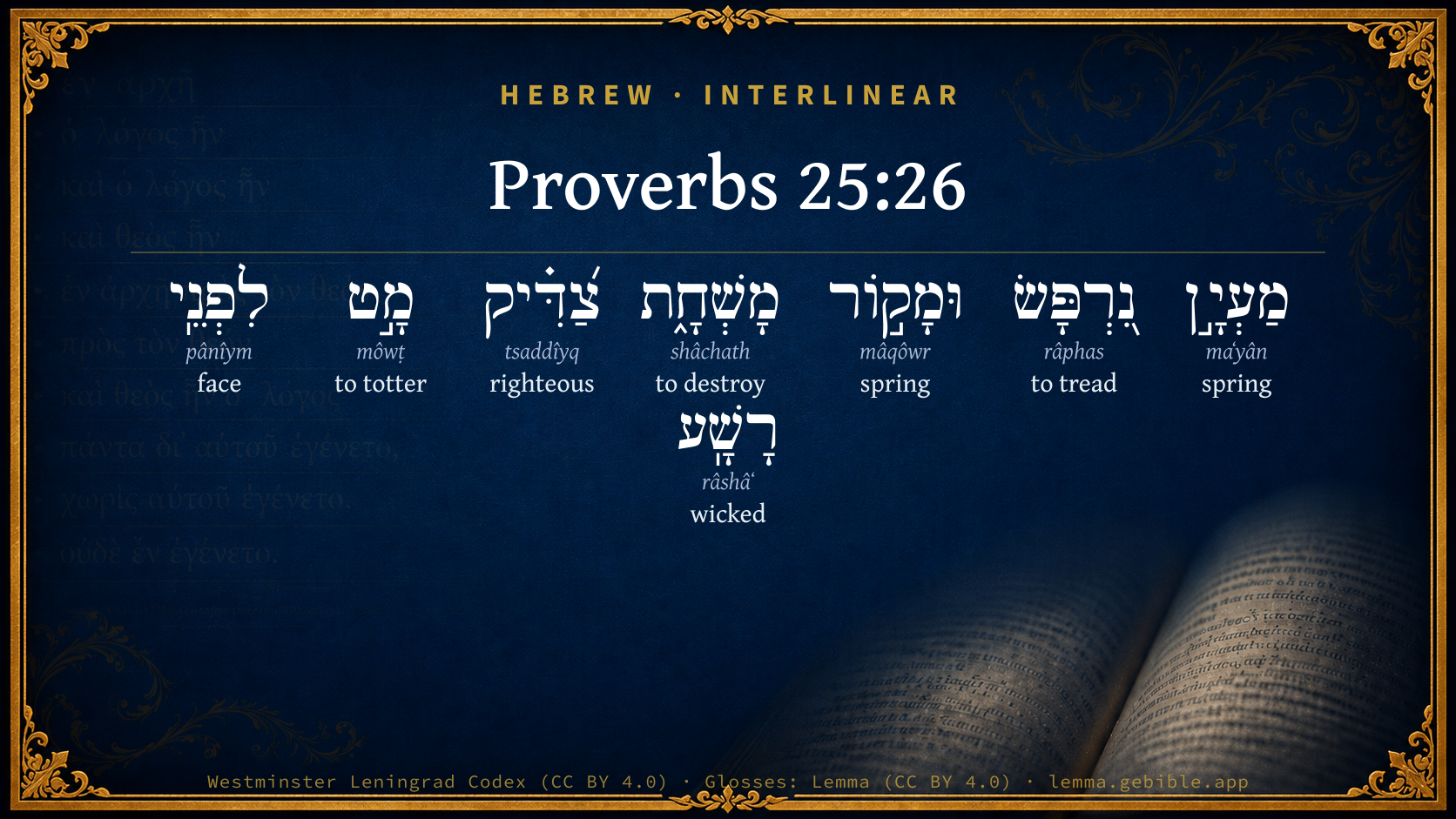
Proverbs 25:26

Hebrew (Westminster Leningrad Codex) Proverbs 25:26 appears in the Hebrew Old Testament. The text above is from the Westminster Leningrad Codex. Each word links to its Strong’s number, a concise gloss, and parsing drawn from the Open Scriptures Hebrew Bible morphology. Click any word for its full Brown-Driver-Briggs (BDB) entry.
Download image
Cite this verse

Proverbs 25:26 (World English Bible). Public Domain. Lemma interlinear Bible study tool, https://lemma.gebible.app/v/proverbs/25/26.

Show BibTeX & RIS
BibTeX
RIS
English Translation
Like a muddied spring, and a polluted well, So is a righteous man who gives way before the wicked.
World English Bible · Public Domain
Highlights Full analysis ↓
Download a study sheet

One document with this verse’s original text, its word-by-word gloss line, the meaning frame, cross-references with their text, attributed commentary, and full source and license credits — printable, and it pastes into notes with its structure intact.

This verse Autodidact and up

Study sheet (.html) Plain text (.txt)

A passage Seminary Student

Up to 50 verses in one chapter. A passage sheet keeps up to 6 commentary sources and 12 cross-references per verse, in the order this page ranks them, and says so on the sheet whenever that leaves anything out. Ask for a single verse and you get the Autodidact verse sheet above.

Everything on this page stays free to read, with no account — the sheet is a download of what is already on screen, not access to it.

Want to remove ads? Support Godless Engineer
Compare translations 3

The same verse in 3 English versions, stacked beneath the original-language interlinear above. Click any original word for its lexicon entry.

Each is an independent rendering of the whole verse — the interlinear is not word-aligned to these translations.

Highlighted words mark where these versions differ — a whole-verse word diff, not a word-by-word alignment.

  • World English Bible Public Domain
    Like a muddied spring, and a polluted well, So is a righteous man who gives way before the wicked.
  • King James Version Public Domain
    A righteous man falling down before the wicked is as a troubled fountain, and a corrupt spring.
  • unfoldingWord Literal Text CC BY-SA 4.0
    A spring muddied by trampling and a fountain spoiled a righteous swaying to the face of a wicked.

unfoldingWord Literal Text — © unfoldingWord, licensed CC BY-SA 4.0. Word-aligned USFM3 via Door43 (git.door43.org/unfoldingWord/en_ult).

Versions to compare (up to 4)

3 of 4 selected

Show all 18 translations

Every available English version of this verse, each an independent rendering of the whole verse.

  • World English Bible Public Domain
    Like a muddied spring, and a polluted well, So is a righteous man who gives way before the wicked.
  • Berean Standard Bible Public Domain
    Like a muddied spring or a polluted well is a righteous man who gives way to the wicked.
  • Majority Standard Bible Public Domain
    Like a muddied spring or a polluted well is a righteous man who gives way to the wicked.
  • King James Version Public Domain
    A righteous man falling down before the wicked is as a troubled fountain, and a corrupt spring.
  • American Standard Version (1901) Public Domain
    `As' a troubled fountain, and a corrupted spring, `So is' a righteous man that giveth way before the wicked.
  • Revised Version (1885) Public Domain
    As a troubled fountain, and a corrupted spring, so is a righteous man that giveth way before the wicked.
  • Geneva Bible (1599) Public Domain
    A righteous man falling downe before the wicked, is like a troubled well, and a corrupt spring.
  • Douay-Rheims (1899) Public Domain
    A just man falling down before the wicked, is as a fountain troubled with the foot, and a corrupted spring.
  • Young's Literal Translation Public Domain
    A spring troubled, and a fountain corrupt, `Is' the righteous falling before the wicked.
  • Literal Standard Version CC BY-SA 4.0
    A spring troubled, and a fountain corrupt, || [Is] the righteous falling before the wicked.
  • Unlocked Literal Bible CC BY-SA 4.0
    Like a fouled spring or a ruined fountain is a righteous person tottering before wicked people.
  • unfoldingWord Literal Text CC BY-SA 4.0
    A spring muddied by trampling and a fountain spoiled a righteous swaying to the face of a wicked.
  • Darby Bible Public Domain
    A troubled fountain, and a defiled well, is a righteous [man] that giveth way before the wicked.
  • World Messianic Bible Public Domain
    Like a muddied spring and a polluted well, so is a righteous man who gives way before the wicked.
  • Webster's Bible Public Domain
    A righteous man falling down before the wicked is as a turbid fountain, and a corrupt spring.
  • Free Bible Version CC BY-SA 4.0
    Good people who give in to the wicked are like a muddied spring or a polluted well.
  • Bible in Basic English Public Domain
    Like a troubled fountain and a dirty spring, is an upright man who has to give way before evil-doers.
  • JPS Tanakh (1917) Public Domain
    As a troubled fountain, and a corrupted spring, so is a righteous man that giveth way before the wicked.

Literal Standard Version (2020), Covenant Press — licensed CC BY-SA 4.0. Text via the HelloAO Bible API (eBible.org). Unlocked Literal Bible (unfoldingWord) — licensed CC BY-SA 4.0. Text via the HelloAO Bible API (eBible.org). unfoldingWord Literal Text — © unfoldingWord, licensed CC BY-SA 4.0. Word-aligned USFM3 via Door43 (git.door43.org/unfoldingWord/en_ult). Free Bible Version, Dr. Jonathan Gallagher — licensed CC BY-SA 4.0. Text via the HelloAO Bible API (eBible.org).

Word by word

More ways to search: Search by grammar → Find every occurrence → Compare this word →

Practice this passage: Drill this verse → Learn its vocabulary →

About this verse

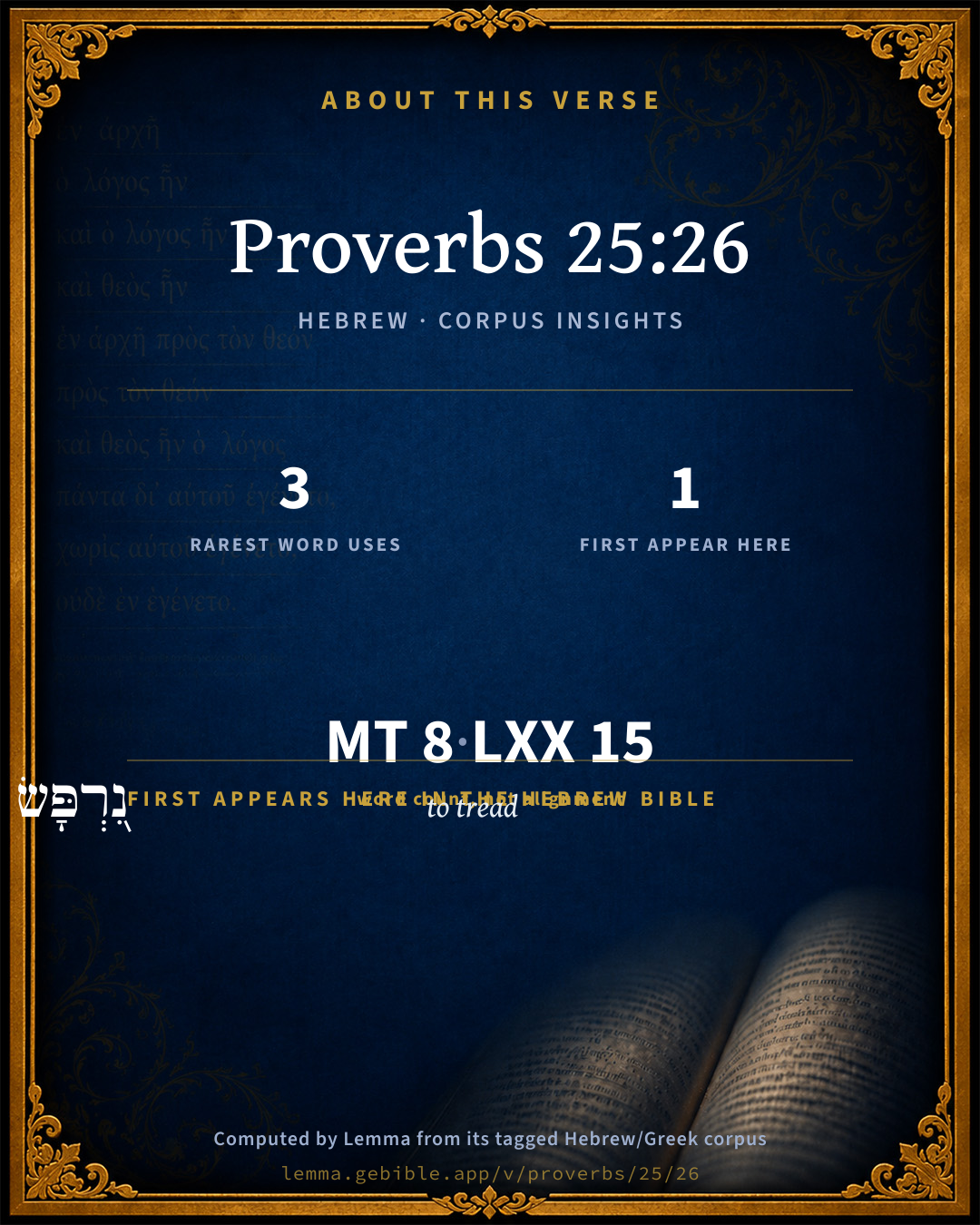
These counts appear in no published source. They are computed here, from the morphology-tagged text and Lemma’s own curated glosses. What Lemma adds →

8
words
8
distinct lemmas
Wisdom
section

Notable vocabulary

The rarest word here is נִ֭רְפָּשׂ to tread H7515 — appearing just 3 times in the whole Hebrew Bible.

First appearance in Scripture

This word makes its first canonical appearance in the Hebrew Bible here:

  • נִ֭רְפָּשׂ to tread H7515

Shared distinctive vocabulary

נִ֭רְפָּשׂ to tread H7515 occurs in 3 verses of the Hebrew Bible. Also found in:

Grammatical profile

  • 3 verbs
  • 3 nouns
  • 2 adjectives

Verb forms

  • נִ֭רְפָּשׂ Niphal · Participle Active
  • מָשְׁחָ֑ת Hophal · Participle Passive
  • מָ֣ט Qal · Participle Active

Hebrew & Septuagint length

In English translation the verse runs 19 words from the Hebrew and 27 from the Septuagint (LXX English) — the Septuagint runs noticeably longer here. See the side-by-side →

A rough comparison of the two English renderings, which tokenize alike — not a word-level alignment.

Word counts can differ between the Hebrew and the Greek without any difference in meaning — e.g. the Hebrew direct-object marker אֵת has no separate Greek word, and Greek often adds the article ὁ.

In the original languages it is 8 Hebrew tokens and 15 Greek tokens — but the two are counted differently (Hebrew bundles its prefixes and suffixes into one token; the Greek is in lemma form), so that isn’t a like-for-like length.

Cross-references

10

Topical passages linked to Proverbs 25:26 in the Treasury of Scripture Knowledge — connected by theme and wording, ordered by reader-vote popularity; previews shown in the World English Bible.

  • Ezekiel 34:18–19 Seems it a small thing to you to have fed on the good pasture, but you must tread down with your feet the residue of your pasture? and to have drunk of the clear waters, but you must foul the residue with your feet?
  • 1 Samuel 22:14–18 Then Ahimelech answered the king, and said, Who among all your servants is so faithful as David, who is the king's son-in-law, and is taken into your council, and is honorable in your house?
  • 1 Thessalonians 2:15 who killed both the Lord Jesus and their own prophets, and drove us out, and didn't please God, and are contrary to all men;
  • Genesis 4:8 Cain said to Abel, his brother, "Let's go into the field." It happened, when they were in the field, that Cain rose up against Abel, his brother, and killed him.
  • 2 Chronicles 24:21–22 They conspired against him, and stoned him with stones at the commandment of the king in the court of the house of Yahweh.
  • Ezekiel 32:2 Son of man, take up a lamentation over Pharaoh king of Egypt, and tell him, You were likened to a young lion of the nations: yet are you as a monster in the seas; and you did break forth with your rivers, and troubled the waters with your feet, and fouled their rivers.
  • Matthew 23:34–37 Therefore, behold, I send to you prophets, wise men, and scribes. Some of them you will kill and crucify; and some of them you will scourge in your synagogues, and persecute from city to city;
  • Matthew 26:69–74 Now Peter was sitting outside in the court, and a maid came to him, saying, "You were also with Jesus, the Galilean!"
  • Acts 7:52 Which of the prophets didn't your fathers persecute? They killed those who foretold the coming of the Righteous One, of whom you have now become betrayers and murderers.
  • Revelation 17:6 I saw the woman drunken with the blood of the saints, and with the blood of the martyrs of Jesus. When I saw her, I wondered with great amazement.

Cross-references courtesy of OpenBible.info (CC BY 4.0).

Hebrew and Greek witnesses Masoretic Hebrew ↔ Greek Septuagint

The same verse in the two great witnesses to the Old Testament, shown verse-for-verse.

Here the Septuagint runs noticeably longer than the Hebrew — LXX2012 (modern English Septuagint) 27 words vs World English Bible 19. A rough length comparison of the two English translations, not a word-level alignment — read both below.

These are two independent witnesses, not word-aligned to each other, and the Septuagint is shown in lemma (dictionary) form.

Hebrew Proverbs 25:26 Masoretic · Westminster Leningrad Codex

מַעְיָ֣ן נִ֭רְפָּשׂ וּמָק֣וֹר מָשְׁחָ֑ת צַ֝דִּ֗יק מָ֣ט לִפְנֵֽי רָשָֽׁע

Like a muddied spring, and a polluted well, So is a righteous man who gives way before the wicked.

World English Bible · Public Domain

Greek LXX Proverbs 25:26 Septuagint · lemma form

ὥσπερ εἰ τις πηγή φράσσω καί ὕδωρ ἔξοδος λυμαίνω οὕτως ἄκοσμος δίκαιος πίπτω ἐνώπιον ἀσεβής

As if one should stop a well, and corrupt a spring of water, so is it unseemly for a righteous man to fall before an ungodly man.

LXX2012 (modern English Septuagint) · Public Domain

On this verse, John Gill's Exposition discusses the Septuagint’s reading. Read the note in Commentary ↓

Hebrew: Westminster Leningrad Codex (CC BY 4.0). Greek: Septuagint (public domain); English from LXX2012 (modern English Septuagint) (Public Domain). How the Septuagint differs from the Hebrew →

Commentary

Notes on Proverbs 25:26 from classic Christian and Jewish commentators (each source and its license shown beneath its notes). The classic Christian expositions comment on the surrounding passage and are grouped to its opening verse, so a note may address several verses; the Jewish commentaries on the Tanakh (Rashi and others) are per-verse, so they appear only where the commentator wrote on this verse.

Lemma curates 59 commentaries, every one of them public domain or Creative Commons licensed, each selected and text-cleaned for this edition rather than reprinted as found. About our sources →

Trapp's Complete Commentary

John Trapp

Pro 25:26 A righteous man falling down before the wicked [is as] a troubled fountain, and a corrupt spring.

Ver. 26. A righteous man falling down before the wicked,] i.e., Doing anything, though by mere frailty, unbeseeming his profession, or that redounds not to the scandal of the weak only, {as Gal 2:11} but to the scorn of the wicked, {as 2Sa 12:14} "is as a troubled fountain," &c., is greatly disgraced and prejudiced. What a blemish was it for Abraham to fall under the reproof of Abimelech! for Samson to be taken by the Philistines in a whorehouse! for Josiah to be inminded of his duty by Pharaoh Necho! for Peter to be drawn by a silly wench to deny his master, &c.! Was not the fountain here troubled when trampled by the feet of these beasts? the spring corrupted when conscience is thus defiled and gashed? Let it be our care to cleanse this spring of all pollutions of flesh and spirit; as a troubled fountain will clear itself, and as sweet water made brackish by the coming in of the salt, yet if naturally it be sweet, at length it will work it out.

John Trapp, A Commentary or Exposition upon All the Books of the Old and New Testament (1647–1656) — public domain. Text from a community e-Sword module.

Joseph Benson's Commentary

Pro 25:26. A righteous man falling down before the wicked, &c. — When a righteous man is either allured or terrified into any sinful practice by wicked men, or into any base and servile compliance with their habits and customs, he, who by his excellent example and counsels was like a fountain, or well of life, (as the mouth of the righteous is termed, Pro 10:11,) sending forth refreshing streams for the benefit of many, is now corrupted and rendered useless. Or, the meaning may be, When righteous men are oppressed by the wicked, the state of that commonwealth is as deplorable as if the public fountains, from which all the people fetched their water, were corrupted, and it is a sign that the fountains of justice are poisoned.

Joseph Benson's Commentary on the Old and New Testaments (1811–1818) — public domain. Text from a community e-Sword module.

The Preacher's Complete Homiletical Commentary

Joseph S. Exell (gen. ed.)

CRITICAL NOTES.—

Pro_25:26. Falling down—i.e., “yielding” or “wavering.” Corrupt. Rather “Ruined.”

MAIN HOMILETICS OF Pro_25:26

THE EVIL RESULT OF MORAL COWARDICE

I. There can never be a good reason why a good man should waver or bow down before a bad man. Many reasons often exist why one bad man should fear another bad man, they are both on the wrong side, both arrayed againt the moral order of the universe, and therefore are on the weakest side, and cannot count upon the support of any superior and all-powerful force. Neither of them has conscience or God upon his side; each one has to fight his battle on his own charges, and can with no confidence foretell the result. But the want of firmness on the part of a righteous man in the presence of wickedness—even when that wickedness is allied with all the power that it can arrogate to itself—is contrary to reason. For as surely as light must defeat the darkness, so surely must right in the end prove itself victorious over wrong. A good man has the whole force of the moral universe upon his side, and is assured both by experience and by Divine promise that if he holds fast to the end he shall be more than conqueror.

II. The wavering of such a man pollutes the very sources of social morality. Unreasonable although it is, yet it is not out of the range of human experience. “The best men are but men at the best” says an old writer, and in times of great trial they often give evidence that it is so. Good and noble men have sometimes trembled and given way before the terrors of the stake, and far less terrible suffering has often sufficed to shake the constancy of true men who were less courageous. But whenever such a fall takes place it is a heavy blow to the cause of right and truth upon the earth. A good man is like a fountain of pure and living water. He is a source of moral life and health in the circle in which he moves; even if he does not put forth any direct or special effort for the advancement of morality, his life will as certainly have an influence for good as the lighted candle will illumine the darkness around it. But if he shows himself a coward when exposed to loss or danger for the sake of right, it will do as much harm to the moral health of the community in which he lives as would be done to its bodily health if the stream from which its members drink were polluted at the fountain head. The mischief done in each case may not show itself by any startling results. The poison in the water may not kill, but only lower the standard of health in those who partake of it, and so a moral fall in a good man may not lead other men to open apostacy from the right path, but it may make the walk of many unsteady. Christ tells His disciples this same truth when He calls them the “salt of the earth,” and asks “if the salt have lost its savour, wherewith shall it be salted” (Mat_5:13). In other words, the good are the conservators of the moral purity of the world, and if any one among them ceases to sustain this character he is not only a loser himself but a source of loss to others.

OUTLINES AND SUGGESTIVE COMMENTS

Lord Bacon gives this proverb political application: “It teaches that an unjust and scandalous judgment in any conspicuous and weighty cause is, above all things, to be avoided in the State;” and in his Essay

(56) of Judicature, he says: “One foul sentence doth more hurt than many foul examples; for these do but corrupt the stream, the other corrupteth the fountain”—Tr. of Lange’s Commentary.

Eastern fountain and springs (where the rains are only periodical, and at long intervals) are of no common price. The injury of corrupting them is proportionate. The well is therefore a blessing or a curse, according to the purity or impurity of the waters. A righteous man in his proper character is “a well of life, a blessing in the midst of the land.” But if he fall down before the wicked by his inconsistent profession, the blessing becomes a curse, the fountain is troubled, and the spring corrupt. What a degradation was it to Abraham to fall down under the rebuke of an heathen king; to Peter, to yield to a servant maid in denying his Lord! How did David’s sin trouble the fountain, both to his family and his people! How did the idolatry of his wise son corrupt the spring through successive generations!

When a minister of Christ apostatises from the faith (and mournfully frequent have been such spectacles) or compromises his principles from the fear of man, the springs and fountains of truth are fearfully corrupted. When a servant of God, of standing and influence, crouches and falls down under the wicked, the transparency of his profession is grievously tarnished. Satan thus makes more effective use of God’s people than of his own—Bridges.

The Preacher's Complete Homiletical Commentary (gen. ed. Joseph S. Exell; Funk & Wagnalls, c. 1892) — public domain (pre-1929). A full-Bible homiletical/sermon-outline anthology covering 65 of 66 books (2 John is absent from the source module). Text from a community e-Sword module.

Tyndale Open Study Notes

Tyndale Open Resources

25:26 A spring or fountain that yields fresh water gives life. When godly people allow the wicked to dominate them, what was life-giving becomes deadly.

Tyndale Open Study Notes — © Tyndale Open Resources, licensed CC BY-SA 4.0. Text via the HelloAO Bible API.

Matthew Henry's Commentary

It is here represented as a very lamentable thing, and a public grievance, and of ill consequence to many, like the troubling of a fountain and the corrupting of a spring, for the righteous to fall down before the wicked, that is, 1. For the righteous to fall into sin in the sight of the wicked - for them to do any thing unbecoming their profession, which is told in Gath, and published in the streets of Ashkelon, and in which the daughters of the Philistines rejoice. For those that have been in reputation for wisdom and honour to fall from their excellency, this troubles the fountains by grieving some, and corrupts the springs by infecting others and emboldening them to do likewise. 2. For the righteous to be oppressed, and run down, and trampled upon, by the violence or subtlety of evil men, to be displaced and thrust into obscurity, this is the troubling of the fountains of justice and corrupting the very springs of government, Pro 28:12, Pro 28:28; Pro 29:2. 3. For the righteous to be cowardly, to truckle to the wicked, to be afraid of opposing his wickedness and basely to yield to him, this is a reflection upon religion, a discouragement to good men, and strengthens the hands of sinners in their sins, and so is like a troubled fountain and a corrupt spring.

Matthew Henry's Commentary on the Whole Bible (1708–1710) — public domain (CC PDM 1.0). Text via the HelloAO Bible API.

Jamieson, Fausset & Brown

Robert Jamieson, A. R. Fausset & David Brown

From troubled fountains and corrupt springs no healthy water is to be had, so when the righteous are oppressed by the wicked, their power for good is lessened or destroyed.

Jamieson, Fausset & Brown — Commentary Critical and Explanatory on the Whole Bible (1871) — public domain (CC PDM 1.0). Text via the HelloAO Bible API.

Ellicott's Commentary for English Readers

(26) A righteous man falling down before the wicked . . .—The mouth of the righteous was described (Pro_10:11) as a “well of life,” from the comfort and refreshment it brings to the weary- through the just and kindly counsel it offers. But if the righteous man yields to the pressure put upon him by the wicked, and through fear or favour gives up his principles, then he can no longer give forth counsel out of a pure heart; he becomes like a fountain which has been fouled by the feet of cattle drinking at it (Eze_34:18), and like a corrupted spring.

A Bible Commentary for English Readers, edited by Charles John Ellicott (1878–1897) — public domain. Text from a community e-Sword module.

The Cambridge Bible for Schools and Colleges

gen. ed. J. J. S. Perowne

26. falling down] Better, with R.V., that giveth way, or (marg.) is moved. To see a righteous man moved from his stedfastness through fear or favour in the presence of the wicked is as disheartening, as to find the stream turbid and defiled, at which you were longing to quench your thirst.

Lord Bacon, quoted by Lange, gives the proverb a judicial application: “This proverb teaches that an unjust and scandalous judgement in any conspicuous and weighty cause is above all things to be avoided in the State.” And again, “One foul sentence doeth more hurt than many foul examples; for these do but corrupt the stream, the other corrupteth the fountain.”

troubled] Lit. trampled, i.e. fouled by the feet. Comp. Eze_34:18, where the same Heb. word is used of water, with the addition of “with your feet.”

corrupt] Better, corrupted, R.V.

The Cambridge Bible for Schools and Colleges (gen. ed. J. J. S. Perowne; Cambridge University Press, 1878–1918) — public domain. Text from a community e-Sword module.

John Gill's Exposition

It is not good to eat much honey,.... That is too much otherwise it is good to eat, Pro 24:13; but too much is hurtful, it surfeits the stomach increases choler (e) and creates loathing; and indeed, too much of anything is bad (f);

so for men to search their own glory is not glory: to set forth their own excellencies, to sound forth their own praises to seek honour of men, to use all methods to gain popular applause; this is not glorious and praiseworthy, but dishonourable; or it may be rendered as it literally lies in the original, "but to search out", or "the searching out of their glory is glory" (g); either the glory of righteous men, as Aben Ezra interprets it, such as stand and do not fall before the wicked; to search out their excellencies and virtues, and follow their example, is glorious and honourable: or to search the glory of the knowledge of divine things, comparable to honey, is commendable and glorious; for though a man may eat too much honey, yet he cannot have too much knowledge of divine and spiritual things, or be satiated and overfilled with them; to which the Septuagint version agrees, "but we ought to honour glorious words": the glorious truths of the word of God ought to be had in great esteem, and to search out the glory of them is honourable; our Lord directs to a search of the Scriptures, because they testify of him, Joh 5:39; and we can never know too much of him, or of the precious doctrines of the Gospel; unless this is to be understood of such things as should not be curiously inquired into; men should not be wise above what is written nor search into those things which God has concealed; as his own nature and perfections, the mode of subsisting of the three Persons in the Godhead, his secret purposes and decrees, and unsearchable judgments. To which sense agrees the Vulgate Latin version,

"so he who is the searcher of majesty shall be oppressed by glory;''

he shall be bore down by it, and not able to bear the glory of it: and the Targum is,

"to eat much honey is not good, nor to search glorious words.''

Jarchi takes the words in this sense; and illustrates them by the work of creation, Ezekiel's vision of the wheels, the decrees of God, and the reasons of them.

(e) Suidas in voce (f) "Vitiosum est ubique quod nimium est", Seneca de Tranquilitate, c. 9. (g) "investigatio gloriae illorum (est) gloria", Pagninus, Montanus, Michaelis; "scrutatio gloriae ipsorum est gloria", Cocceius.

John Gill's Exposition of the Whole Bible (1746–1763) — public domain (CC PDM 1.0). Text via the HelloAO Bible API.

Albert Barnes' Notes on the Bible

Falling down before - i. e., Yielding and cringing. To see this instead of stedfastness, is as grievous as for the traveler to find the spring at which he hoped to quench his thirst turbid and defiled.

Albert Barnes' Notes on the Bible (1834–1885) — public domain. Text from a community e-Sword/MySword module.

Haydock's Catholic Bible Commentary

Falling into disgrace, or sin, occasions the wicked to exult, as if there were no God or religion. (Calmet)

George Leo Haydock (1774–1849), Haydock's Catholic Family Bible and Commentary, 1859 edition — public domain. Excludes Psalms (Douay-Rheims chapter numbering differs from Protestant) and Deuterocanonical books (Catholic canon only).

Matthew Poole's English Annotations

Falling down; either,

1. Into sin. So the sense is, When a just man is either allured or terrified into any sinful practice before wicked men, or into any base and servile compliance with their lusts, he who by his excellent counsels was like a fountain or well of life, as his mouth is called, Pro 10:11, sending forth refreshing streams for the benefit of many, is now corrupted and rendered unserviceable. Or rather,

2. Into misery, of which kind of falling this word is constantly used, and never to my remembrance of falling into sin. And so the sense is this, When righteous men are oppressed and devoured by the wicked, the state of that commonwealth is as deplorable, as if the public fountains, from whence all the people fetch their water, were corrupted, and it is a sign that the fountains of justice are poisoned.

Matthew Poole's English Annotations on the Holy Bible (1683–1685) — public domain. Text from a community e-Sword/MySword module.

Whedon's Commentary on the Bible

Daniel D. Whedon

26. Falling down — Slipping, wavering, tottering, or ready to fall. It is used of persons whose affairs are not prosperous — who fail or are ruined in business. Some, however, understand it of moral lapses in the presence of the wicked.

Troubled fountain — As if trampled by the feet of beasts.

Corrupt spring — “A defiled well.” — Conant.

Daniel D. Whedon (gen. ed.), Commentary on the Old and New Testaments (1874–1909) — public domain. Text from a community e-Sword module.

The Pulpit Commentary

Hebrew (see on Ver. 11), A troubled fountain, and a corrupted spring a righteous man giving way to the wicked. A good man neglecting to assert himself and to hold his own m the face of sinners, is as useless to society and as harmful to the good cause as a spring that has been defiled by mud stirred up or extraneous matter introduced is unserviceable for drinking and prejudicial to those who use it. The mouth of the righteous should be "a well of life", (Pro_10:11) wholesome, refreshing, helpful; his conduct should be consistent and straightforward, fearless in upholding the right, (Isa_51:12, etc.) uncompromising in opposing sin. When such a man, for fear, or favour, or weakness, or weariness, yields to the wicked, compromises principle, no longer makes a stand for truth and purity and virtue, he loses his high character, brings a scandal on religion, and lowers his own spiritual nature. It is this moral cowardice which Christ so sternly rebukes, (Mat_10:33) "Whosoever shall deny me before men, him will I also deny before my Father which is in heaven." Some have assumed that the gnome is concerned with a good man"s fall into misfortune owing to the machinations of sinners; but in this case the comparison loses its force; such persecution would not disturb the purity or lower the character of the righteous man; it would rather enhance his good qualities, give occasion for their exercise and development, and therefore could not be described as fouling a pure spring.

See homily on Pro_26:1. C.

The Pulpit Commentary (1880–1919), ed. H.D.M. Spence-Jones & Joseph S. Exell — public domain. Text from a community e-Sword module.

John Wesley's Explanatory Notes

Falling - When righteous men are oppressed by the wicked, the state of that common-wealth is as deplorable, as if the publick fountains were corrupted.

John Wesley, Explanatory Notes Upon the Whole Bible (1754–1765) — public domain. Text via the GEBible commentary corpus.

Keil & Delitzsch

C. F. Keil & F. Delitzsch

26 A troubled fountain and a ruined spring -

A righteous man yielding to a godless man.

For the most part, in מט one thinks of a yielding in consequence of being forced. Thus e.g., Fleischer: as a troubled ruined spring is a misfortune for the people who drink out of it, or draw from it, so is it a misfortune for the surrounding of the righteous, when he is driven from his dwelling or his possession by an unrighteous man. And it is true: the righteous can be compared to a well (מעין, well-spring, from עין, a well, as an eye of the earth, and מקור, fountain, from קוּר, R. קר, כר, to round out, to dig out), with reference to the blessing which flows from it to its surroundings (cf. Pro 10:11 and Joh 7:38). But the words "yielding to" (contrast "stood before," Kg2 10:4, or Jos 7:12), in the phrase "yielding to the godless," may be understood of a spontaneous as well as of a constrained, forced, wavering and yielding, as the expression in the Psalm בּל־אמּוט [non movebor, Psa 10:6] affirms the certainty of being neither inwardly nor outwardly ever moved or shaken. The righteous shall stand fast and strong in God without fearing the godless (Isa 51:12.), unmoveable and firm as a brazen wall (Jer 1:17.). If, however, he is wearied with resistance, and from the fear of man, or the desire to please man, or from a false love of peace he yields before it, and so gives way - then he becomes like to a troubled fountain (רפשׂ, cogn. רמס, Eze 34:18; Isa 41:25; Jerome: fans turbatus pede), a ruined spring; his character, hitherto pure, is now corrupted by his own guilt, and now far from being a blessing to others, his wavering is a cause of sorrow to the righteous, and an offence to the weak - he is useful no longer, but only injurious. Rightly Lagarde: "The verse, one of the most profound of the whole book, does not speak of the misfortunate, but of the fall of the righteous, whose sin compromises the holy cause which he serves, Sa2 12:14." Thus also e.g., Lwenstein, with reference to the proverb Sanhedrin 92b: also in the time of danger let not a man disown his honour. Bachja, in his Ethics, referring to this figure, 26a, thinks of the possibility of restoration: the righteous wavers only for the moment, but at last he comes right (מתמוטט ועולה). But this interpretation of the figure destroys the point of the proverb.

Keil & Delitzsch — Biblical Commentary on the Old Testament (1861–1891) — public domain (CC PDM 1.0). Text via the HelloAO Bible API. (Old Testament only.)

Bridges on Proverbs

Charles Bridges

Eastern fountains and springs (where the rains are only periodical, and at long intervals) are of no common price.†1 The injury of corrupting them is proportionate.†2 The well is therefore a blessing or a curse, according to the purity or impurity of the waters. A righteous man in his proper character is "a well of life, a blessing in the midst of the land."†3 But if he fall down before the wicked by his inconsistent profession,†4 the blessing becomes a curse, the fountain is troubled, and the spring corrupt. What a degradation was it to Abraham to fall down under the rebuke of an heathen king;†5 to Peter, to yield to a servant-maid in denying his Lord!†6 How did David’s sin trouble the fountain, both to his family†7 and his people!†8 How did the idolatry of his wise son corrupt the spring through successive generations!†9

When a minister of Christ apostatizes from the faith†10 (and mournfully frequent have been such spectacles) or compromises his principles from the fear of man,†11 the springs and fountains of truth are fearfully corrupted. When a servant of God, of standing and influence, crouches and falls down under the wicked,†12 the transparency of his profession is grievously tarnished. Satan thus makes more effective use of God’s people than of his own. The gross wickedness of the ungodly passes in silence. But he makes the neighborhood ring with the failings of Christian professors. Godly consistency so grates upon the conscience of the world, that at any breach of it they clap their hands with Satanic joy; to see the Lord "wounded in the house of his friends." (Zec 13:6 .) Principles and practices are sanctioned, that wound our Divine Master. The consciences of the ungodly are lulled. "The lame," instead of being "healed," are "turned out of the way." (Heb 12:13 .) Thus ’the scandalous falls of good men are like a bag of poison cast by Satan into the spring, from whence the whole town is supplied with water.’†13

Nor let this be considered as the responsibility only of eminent Christians. All are by profession "the salt of the earth, and the light of the world." Let all therefore see to it, that "the salt does not lose its savor," and that the candlestick gives its clear light. (Mat 5:13-16 .) None of us stand or act alone. "None of us" — be it well pondered — "liveth unto himself" (Rom 14:7 .) The conduct of each has its measure of influence on the body. Each is the center of a circle more or less extended. Each is either a pure spring, or a troubled fountain. Lord! "cast the salt into the spring of the waters, that they may be healed." (2Ki 2:21-22 .)

Footnotes:

†1 Gen 26:18-22. Deu 8:7 . Jos 15:18-19 .

†2 See Eze 32:2 ; Eze 34:18 .

†3 Pro 10:11. Gen 12:3 .

†4 Falling down is to be taken in a moral sense (making a slip). Parkhurst.

†5 Gen 12:18-20. Compare Gen 20:10 ; Gen 26:10 .

†6 Mat 26:69-72.

†7 2Sa 11:2, with 2Sa 13:11-14 ; 2Sa 16:22 .

†8 2Sa 12:14

†9 1Ki 11:1-8 . 2Ki 23:13 .

†10 Phm 1:24, with 2Ti 4:10 .

†11 Gal 2:11 -14.

†12 2Ki 18:5-6, with 2Ki 18:13-16 . Contrast with these humbling instances of infirmity the great Confessor, who would not fall down before false Apostles — not even before a true Apostle. — Gal 2:4-5, Gal 2:11.

†13 Flavel’s Method of Grace. Sermon XXXV.

Charles Bridges, An Exposition of the Book of Proverbs (1846) — public domain. Text from a community e-Sword module.

Rashi

Rabbi Shlomo Yitzchaki (Rashi)

a muddied spring Muddied by the feet.

A righteous man slipping before a wicked man When a righteous man slips before a wicked man and is afraid to reprove him for his way to his face, the matter is hateful like a muddied spring and a ruined fountain.

Rashi on the Tanakh — English translations: “The Judaica Press complete Tanach with Rashi, translated by A. J. Rosenberg” (CC BY 4.0); “Pentateuch with Rashi's commentary by M. Rosenbaum and A.M. Silbermann, 1929-1934” (public domain); “The Metsudah Tanach series, Lakewood, N.J” (CC BY 4.0); and “The Book of Joshua, Metsudah Publications, 1997” (CC BY 4.0). Text via Sefaria.

Lesson kit

Teaching starters — assembled from the data on this page, not authored interpretation. Every prompt links to the verse data it draws on. Edit before teaching.

Proverbs, in the Wisdom, opens this verse with 8 words (8 distinct Hebrew lemmas). Its most distinctive word is râphas (“to tread”). The Greek Septuagint runs longer here. A historical commentator’s framing appears above. Read the whole chapter for the surrounding context.

Discussion questions

  1. The word râphas carries the sense “to tread.” How does it shape the verse?
  2. The word “to tread” first appears here in Scripture. What is being introduced at this debut?
  3. Ezekiel 32:2 shares the word «to tread» with this verse. How do the two illuminate each other?
  4. Compared with the Hebrew, the Septuagint runs longer here. What questions does that raise?
  5. These translations render this verse differently. What is at stake in choosing one wording over another?
  6. The verb «נִ֭רְפָּשׂ» is Niphal Participle Active. How does its form color the action?
  7. Reading how Trapp's Complete Commentary and Joseph Benson's Commentary read this verse, where do the two commentators agree and where do they part?

Things to notice

Reading settings

Reading text

Shown beneath each verse's original-language words.

Old Testament
Old Testament edition

Read the OT as the Masoretic Hebrew (MT) or the Greek Septuagint (LXX).

English shown for the Greek Septuagint (in the Hebrew ↔ Greek comparison).

Comparing translations? Open the Compare panel on any verse page to stack up to four side by side.