
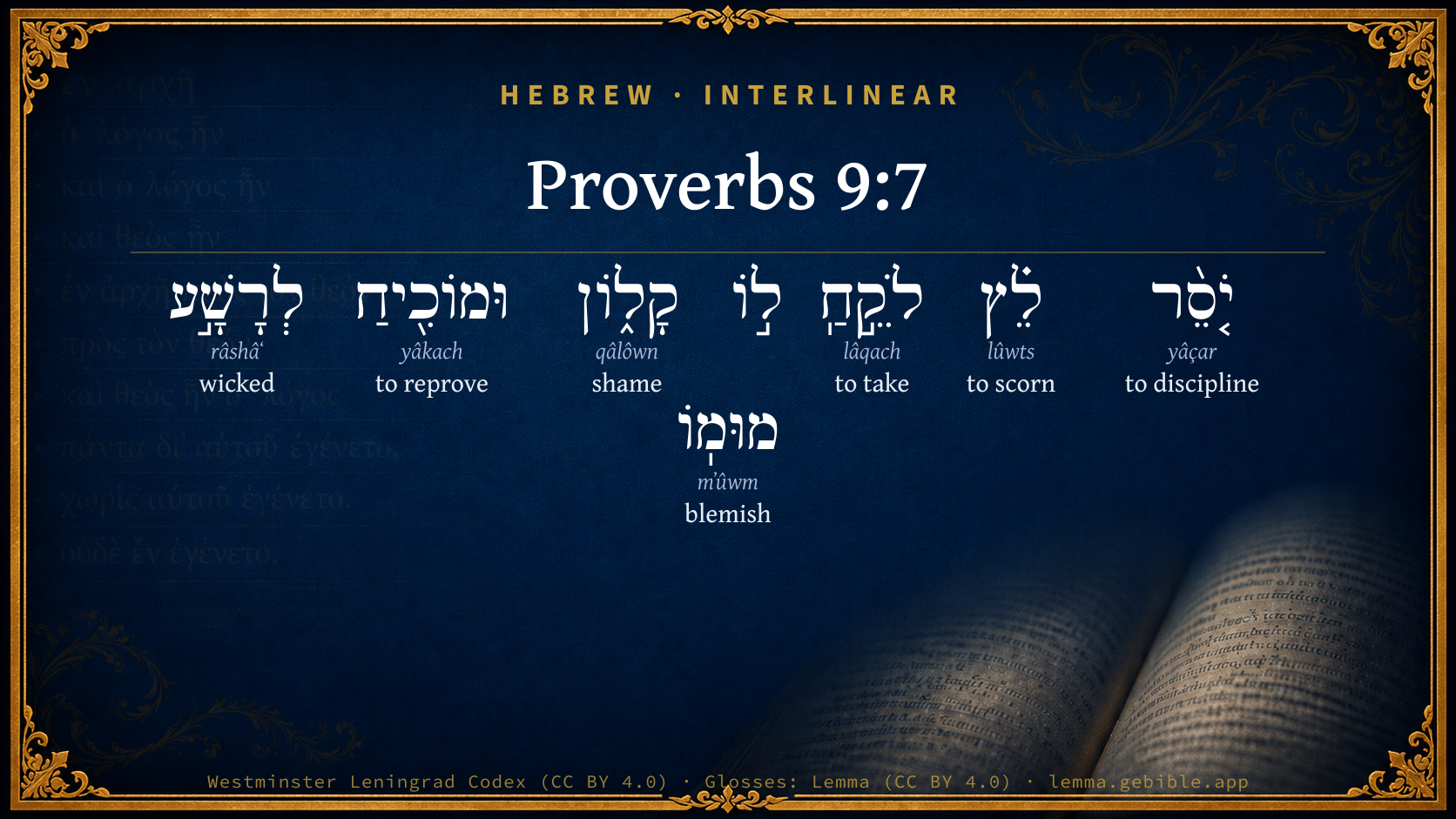
Proverbs 9:7

Hebrew (Westminster Leningrad Codex) Proverbs 9:7 appears in the Hebrew Old Testament. The text above is from the Westminster Leningrad Codex. Each word links to its Strong’s number, a concise gloss, and parsing drawn from the Open Scriptures Hebrew Bible morphology. Click any word for its full Brown-Driver-Briggs (BDB) entry.
Download image
Cite this verse

Proverbs 9:7 (World English Bible). Public Domain. Lemma interlinear Bible study tool, https://lemma.gebible.app/v/proverbs/9/7.

Show BibTeX & RIS
BibTeX
RIS
English Translation
He who corrects a mocker invites insult. He who reproves a wicked man invites abuse.
World English Bible · Public Domain
Download a study sheet

One document with this verse’s original text, its word-by-word gloss line, the meaning frame, cross-references with their text, attributed commentary, and full source and license credits — printable, and it pastes into notes with its structure intact.

This verse Autodidact and up

Study sheet (.html) Plain text (.txt)

A passage Seminary Student

Up to 50 verses in one chapter. A passage sheet keeps up to 6 commentary sources and 12 cross-references per verse, in the order this page ranks them, and says so on the sheet whenever that leaves anything out. Ask for a single verse and you get the Autodidact verse sheet above.

Everything on this page stays free to read, with no account — the sheet is a download of what is already on screen, not access to it.

Want to remove ads? Support Godless Engineer
Compare translations 3

The same verse in 3 English versions, stacked beneath the original-language interlinear above. Click any original word for its lexicon entry.

Each is an independent rendering of the whole verse — the interlinear is not word-aligned to these translations.

Highlighted words mark where these versions differ — a whole-verse word diff, not a word-by-word alignment.

  • World English Bible Public Domain
    He who corrects a mocker invites insult. He who reproves a wicked man invites abuse.
  • King James Version Public Domain
    He that reproveth a scorner getteth to himself shame: and he that rebuketh a wicked man getteth himself a blot.
  • unfoldingWord Literal Text CC BY-SA 4.0
    The instructor of a mocker receives disgrace for himself, and the rebuker of a wicked, his injury.

unfoldingWord Literal Text — © unfoldingWord, licensed CC BY-SA 4.0. Word-aligned USFM3 via Door43 (git.door43.org/unfoldingWord/en_ult).

Versions to compare (up to 4)

3 of 4 selected

Show all 18 translations

Every available English version of this verse, each an independent rendering of the whole verse.

  • World English Bible Public Domain
    He who corrects a mocker invites insult. He who reproves a wicked man invites abuse.
  • Berean Standard Bible Public Domain
    He who corrects a mocker brings shame on himself; he who rebukes a wicked man taints himself.
  • Majority Standard Bible Public Domain
    He who corrects a mocker brings shame on himself; he who rebukes a wicked man taints himself.
  • King James Version Public Domain
    He that reproveth a scorner getteth to himself shame: and he that rebuketh a wicked man getteth himself a blot.
  • American Standard Version (1901) Public Domain
    He that correcteth a scoffer getteth to himself reviling; And he that reproveth a wicked man `getteth' himself a blot.
  • Revised Version (1885) Public Domain
    He that correcteth a scorner getteth to himself shame: and he that reproveth a wicked man getteth himself a blot.
  • Geneva Bible (1599) Public Domain
    He that reproueth a scorner, purchaseth to himselfe shame: and he that rebuketh the wicked, getteth himselfe a blot.
  • Douay-Rheims (1899) Public Domain
    He that teacheth a scorner, doth an injury to himself: and he that rebuketh a wicked man, getteth himself a blot.
  • Young's Literal Translation Public Domain
    The instructor of a scorner Is receiving for it -- shame, And a reprover of the wicked -- his blemish.
  • Literal Standard Version CC BY-SA 4.0
    The instructor of a scorner || Is receiving for it—shame, || And a reprover of the wicked—his blemish.
  • Unlocked Literal Bible CC BY-SA 4.0
    Whoever disciplines a mocker receives abuse, and whoever rebukes a wicked person receives insults.
  • unfoldingWord Literal Text CC BY-SA 4.0
    The instructor of a mocker receives disgrace for himself, and the rebuker of a wicked, his injury.
  • Darby Bible Public Domain
    He that instructeth a scorner getteth to himself shame; and he that reproveth a wicked [man] [getteth] to himself a blot.
  • World Messianic Bible Public Domain
    One who corrects a mocker invites insult. One who reproves a wicked man invites abuse.
  • Webster's Bible Public Domain
    He that reproveth a scorner, getteth to himself shame: and he that rebuketh a wicked man getteth himself a blot.
  • Free Bible Version CC BY-SA 4.0
    If you correct a mocker all you get are insults; if you argue with the wicked all you get is abuse.
  • Bible in Basic English Public Domain
    He who gives teaching to a man of pride gets shame for himself; he who says sharp words to a sinner gets a bad name.
  • JPS Tanakh (1917) Public Domain
    He that correcteth a scorner getteth to himself shame, and he that reproveth a wicked man, it becometh unto him a blot.

Literal Standard Version (2020), Covenant Press — licensed CC BY-SA 4.0. Text via the HelloAO Bible API (eBible.org). Unlocked Literal Bible (unfoldingWord) — licensed CC BY-SA 4.0. Text via the HelloAO Bible API (eBible.org). unfoldingWord Literal Text — © unfoldingWord, licensed CC BY-SA 4.0. Word-aligned USFM3 via Door43 (git.door43.org/unfoldingWord/en_ult). Free Bible Version, Dr. Jonathan Gallagher — licensed CC BY-SA 4.0. Text via the HelloAO Bible API (eBible.org).

Word by word

More ways to search: Search by grammar → Find every occurrence → Compare this word →

Practice this passage: Drill this verse → Learn its vocabulary →

About this verse

These counts appear in no published source. They are computed here, from the morphology-tagged text and Lemma’s own curated glosses. What Lemma adds →

8
words
7
distinct lemmas
Wisdom
section

Notable vocabulary

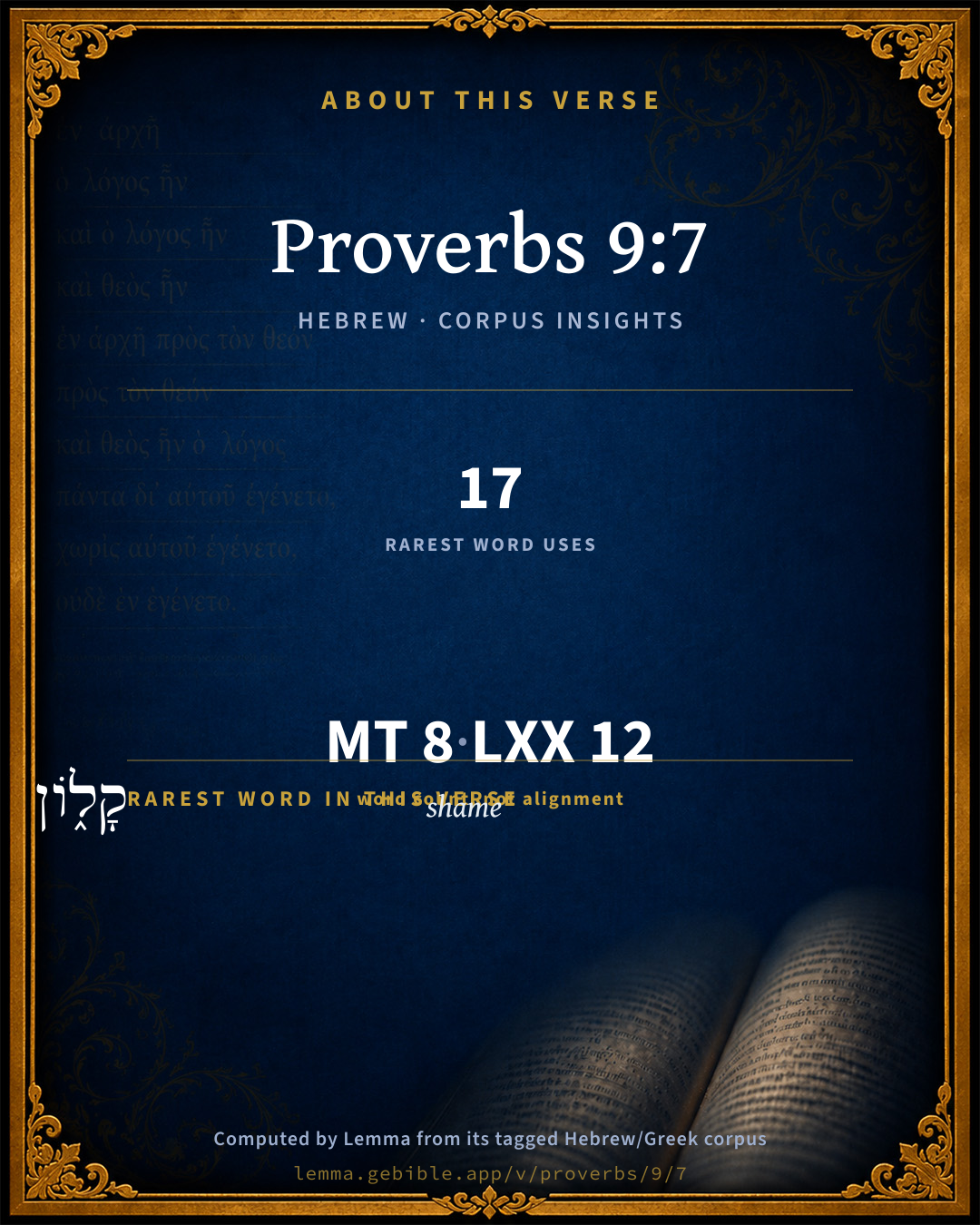
The rarest word here is קָל֑וֹן shame H7036 — appearing just 17 times in the whole Hebrew Bible.

Shared distinctive vocabulary

קָל֑וֹן shame H7036 occurs in 17 verses of the Hebrew Bible. Also found in:

Grammatical profile

  • 3 verbs
  • 2 nouns
  • 2 adjectives
  • 1 preposition

Verb forms

  • יֹ֤סֵ֨ר Qal · Participle Active
  • לֹקֵ֣חַֽ Qal · Participle Active
  • וּמוֹכִ֖יחַ Hiphil · Participle Active

Hebrew & Septuagint length

In English translation the verse runs 15 words from the Hebrew and 20 from the Septuagint (LXX English) — closely comparable.

A rough comparison of the two English renderings, which tokenize alike — not a word-level alignment.

Word counts can differ between the Hebrew and the Greek without any difference in meaning — e.g. the Hebrew direct-object marker אֵת has no separate Greek word, and Greek often adds the article ὁ.

In the original languages it is 8 Hebrew tokens and 12 Greek tokens — but the two are counted differently (Hebrew bundles its prefixes and suffixes into one token; the Greek is in lemma form), so that isn’t a like-for-like length.

Cross-references

10

Topical passages linked to Proverbs 9:7 in the Treasury of Scripture Knowledge — connected by theme and wording, ordered by reader-vote popularity; previews shown in the World English Bible.

  • Proverbs 15:12 A scoffer doesn't love to be reproved; He will not go to the wise.
  • Proverbs 23:9 Don't speak in the ears of a fool, For he will despise the wisdom of your words.
  • 2 Chronicles 36:16 but they mocked the messengers of God, and despised his words, and scoffed at his prophets, until the wrath of Yahweh arose against his people, until there was no remedy.
  • 2 Chronicles 24:20–22 The Spirit of God came on Zechariah the son of Jehoiada the priest; and he stood above the people, and said to them, Thus says God, Why disobey you the commandments of Yahweh, so that you can't prosper? because you have forsaken Yahweh, he has also forsaken you.
  • 2 Chronicles 25:15–16 Therefore the anger of Yahweh was kindled against Amaziah, and he sent to him a prophet, who said to him, Why have you sought after the gods of the people, which have not delivered their own people out of your hand?
  • Genesis 19:8–9 See now, I have two virgin daughters. Please let me bring them out to you, and do you to them as is good in your eyes. Only don't do anything to these men, because they have come under the shadow of my roof."
  • 1 Kings 18:17 It happened, when Ahab saw Elijah, that Ahab said to him, Is it you, you troubler of Israel?
  • 1 Kings 21:20 Ahab said to Elijah, Have you found me, my enemy? He answered, I have found you, because you have sold yourself to do that which is evil in the sight of Yahweh.
  • 1 Kings 22:24 Then Zedekiah the son of Chenaanah came near, and struck Micaiah on the cheek, and said, Which way went the Spirit of Yahweh from me to speak to you?
  • 1 Kings 22:27 and say, Thus says the king, Put this fellow in the prison, and feed him with bread of affliction and with water of affliction, until I come in peace.

Cross-references courtesy of OpenBible.info (CC BY 4.0).

Hebrew and Greek witnesses Masoretic Hebrew ↔ Greek Septuagint

The same verse in the two great witnesses to the Old Testament, shown verse-for-verse.

These are two independent witnesses, not word-aligned to each other, and the Septuagint is shown in lemma (dictionary) form.

Hebrew Proverbs 9:7 Masoretic · Westminster Leningrad Codex

יֹ֤סֵ֨ר לֵ֗ץ לֹקֵ֣חַֽ ל֣וֹ קָל֑וֹן וּמוֹכִ֖יחַ לְרָשָׁ֣ע מוּמֽוֹ

He who corrects a mocker invites insult. He who reproves a wicked man invites abuse.

World English Bible · Public Domain

Greek LXX Proverbs 9:7 Septuagint · lemma form

ὁ παιδεύω κακός λαμβάνω ἑαυτοῦ ἀτιμία ἐλέγχω δέ ὁ ἀσεβής μωμάομαι ἑαυτοῦ

He that reproves evil men shall get dishonor to himself; and he that rebukes an ungodly man shall disgrace himself.

LXX2012 (modern English Septuagint) · Public Domain

Hebrew: Westminster Leningrad Codex (CC BY 4.0). Greek: Septuagint (public domain); English from LXX2012 (modern English Septuagint) (Public Domain). How the Septuagint differs from the Hebrew →

Commentary

Notes on Proverbs 9:7 from classic Christian and Jewish commentators (each source and its license shown beneath its notes). The classic Christian expositions comment on the surrounding passage and are grouped to its opening verse, so a note may address several verses; the Jewish commentaries on the Tanakh (Rashi and others) are per-verse, so they appear only where the commentator wrote on this verse.

Lemma curates 59 commentaries, every one of them public domain or Creative Commons licensed, each selected and text-cleaned for this edition rather than reprinted as found. About our sources →

Trapp's Complete Commentary

John Trapp

Pro 9:7 He that reproveth a scorner getteth to himself shame: and he that rebuketh a wicked [man getteth] himself a blot.

Ver. 7. He that reproveth a scorner.] This, with the three next verses, may seem to come in by way of parenthesis; and they do not obscurely intimate what manner of hearers ministers mostly meet with - viz., such as our Saviour did, - "But the Pharisees that were covetous, derided," {Luk 16:14} or blew their noses at him, εξεμυκτηριζον, as one renders it, - and such as long before him the prophet Isaiah did, {Isa 28:10} "Precept upon precept, line upon line." One observeth that that was a scoff put upon the prophet; and is as if they should say, Here is nothing but line upon line, precept upon precept. The very sound of the words in the original - Zau le zau, kau lakau - carries a taunt, as scornful people by the tone of their voice, and rhyming words, scorn at such as they despise.

John Trapp, A Commentary or Exposition upon All the Books of the Old and New Testament (1647–1656) — public domain. Text from a community e-Sword module.

The Biblical Illustrator

Joseph S. Exell

Pro_9:7-9

Reprove not a scorner, lest he hate thee.

Reproof

How to give it, and how to take it. Reproofs are like sharp knives, very needful and very useful; but they should not be in the hands of children. Those who handle them rashly will wound themselves and their neighbours. Sometimes reproofs are unskilfully administered, and sometimes unfaithfully withheld. The scorner is the principal figure in the scene of the text. He is in a state of nature. He has no spiritual life or light. He is a blusterer. He is hollow-sounding brass. He magnifies himself. He laughs at the good and at goodness. Accustomed to exaggerate everything, he exaggerates even his own wickedness. He glories in his shame. If you reprove such a scorner, you will probably get to yourself shame. You have trampled on a snake, and it is his nature to spurt forth his venom on you. Your stroke has stirred up every motive within the scorner to redouble his blasphemy. If you could find the scorner alone, his courage would not be so great. Whisper softly into his ear your solemn reproof. Find a soft spot about him, or make one by deeds of kindness. H you gain a brother thus, it is a bloodless victory. The joy is of the purest kind that lies within our reach on earth. The second half of the lesson is, Rebuke a wise man, and he will love thee. There is a double blessing; one to him who gets reproof, and one to him who gives it. It is the mark of wise man that he loves the reprover who tells him his fault. (W. Arnot, D. D.)

Reproof

I. As injuriously administered. A scorner is a man distinguished by self-ignorance, audacity, callousness, vanity, and irreverence. His grand aim is, by little sallies of wit and ridicule to raise the laugh against his superiors. To reprove these is injurious. It does them no service, but it brings pain to yourself. There are men beyond the reach of elevating influences, and it is worse than waste of labour to endeavour improving them.

II. As usefully administered.

1. By rebuking a wise man you enlist his affection. Every true man will feel grateful for wise counsels.

2. By instructing a wise man you render him a benefit. Give instruction to a wise man, and he will be yet wiser. (David Thomas, D.D.)

Godly admonitions received by the wise

Iron, which is one of the baser metals, may be hammered, and subjected to the most intense heat of the furnace; but though you may soften it for the time, you can never make it ductile like the precious metals. But gold, which is the most excellent of all, is the most pliant and easily wrought on, being capable of being drawn out to a degree which exceeds belief. So the most excellent tempers are the most easily wrought on by spiritual counsel and godly admonitions, but the viler sort, like the iron, are stubborn, and cannot be made pliant. (H. G. Salter.)

The scorner left alone

The invitation of Wisdom is addressed only to the simple, not to the scorner. She lets the scorner pass by, because a word to him would recoil only in shame on herself, bringing a blush to her queenly face, and would add to the scorners wickedness by increasing his hatred of her. Her reproof would not benefit him, but it would bring a blot upon herself: it would exhibit her as ineffectual and helpless. The bitter words of a scorner can make wisdom appear foolish, and cover virtue with a confusion which should belong only to vice. Speak not in the hearing of a fool; for he will despise the wisdom of thy words. Indeed, there is no character so hopeless as that of the scorner; there proceeds from him, as it were, a fierce blast, which blows away all the reproaches which goodness makes to him. Reproof cannot come near him; he cannot find wisdom, though he seek it; and as a matter of fact, he never seeks it. If one attempts to punish him, it can only be with the hope that others may benefit by the example; it will have no effect upon him. To be rid of him must be the desire of every wise man, for he is an abomination to all, and with his departure contention disappears. They that scoff at things holy, and scorn the Divine Power, must be left to themselves until the beginnings of wisdom appear in them--the first sense of fear that there is a God who may not be mocked, the first recognition that there is a sanctity which they would do well at all events to reverence. (R. F. Horton, D.D.)

The Biblical Illustrator, edited by Joseph S. Exell (c. 1880s–1900s) — public domain. Text from a community e-Sword module.

Joseph Benson's Commentary

Pro 9:7. He that reproveth a scorner — “This and the following verse supply us with a reason for the conduct of wisdom, in addressing herself only to the simple. She invites not the pretendedly wise, those who think they are ignorant of nothing; to invite them to the feast of wisdom, would be to expose herself to their insults and censures. They would receive the invitation with disdain; they would despise the lessons of wisdom; they would reject with disgust her wine and her viands. The scorners admirably represent the genius of libertines and professed infidels.” — Dodd. But Solomon may also be considered as showing us, in these verses, whom he meant by the foolish, Pro 9:6, even scorners and wicked men; and here he presses the advice last given of forsaking them, because there was no good, but hurt, to be got from them. He that reproves such a one, he says, getteth to himself shame — Namely, both from the scorner himself, who will revile and deride him; and from others, because he is frustrated in his design and hope, and hath, by his imprudence, brought an inconvenience upon himself. He that rebuketh a wicked man — A man wilfully, obstinately, and determinedly wicked; getteth himself a blot — Censure or reproach. Instead, probably, of convincing or reforming such a one by his reproofs, he will find himself accused of the same, or of similar iniquities, by the person whom he endeavours to amend. “A scorner,” says Lord Bacon, “only makes us lose our labour, but a wicked man (that is, one obstinately wicked) repays us with a stain of dishonour; when a man instructs a scorner, his time, indeed, which he thus employs, is thrown away, and others deride his pains as a labour ill placed; and the scorner himself also despises the knowledge which he is taught; thus a man is put to shame. But the matter is transacted with greater danger in the reprehension of the other; because he not only gives no ear to the advice, but turns his head against his reprehender, now made odious to him; whom he either wounds presently with contumelies before his face, or traduces afterward to others behind his back.” — Advancement of Learning, 50. 8. chap. 2. par. 9.

Joseph Benson's Commentary on the Old and New Testaments (1811–1818) — public domain. Text from a community e-Sword module.

Keil & Delitzsch

C. F. Keil & F. Delitzsch

In what now follows the discourse of Wisdom is continued; wherefore she directs her invitation to the simple, i.e., those who have not yet decided, and are perhaps susceptible of that which is better:

7 "He who correcteth a scorner draweth upon himself insult;

And he who communicateth instruction to a scorner, it is a dishonour to him.

8 Instruct not a scorner, lest he hate thee;

Give instruction to the wise, so he will love thee.

9 Give to the wise, and he becomes yet wiser;

Give knowledge to the upright, and he gains in knowledge."

Zckler thinks that herewith the reason for the summons to the "simple" to forsake the fellowship of men of their own sort, is assigned (he explains 6a as Ahron b. Joseph: הפרדו מן הפתאים); but his remark, that, under the term "simple," mockers and wicked persons are comprehended as belonging to the same category, confounds two sharply distinguished classes of men. לץ is the freethinker who mocks at religion and virtue (vid., Pro 1:22), and רשׁע the godless who shuns restraint by God and gives himself up to the unbridled impulse to evil. The course of thought in Pro 9:7 and onwards shows why Wisdom, turning from the wise, who already are hers, directs herself only to the simple, and those who are devoid of understanding: she must pass over the לץ and רשׁע dna , because she can there hope for no receptivity for her invitation; she would, contrary to Mat 7:6, "give that which is holy to the dogs, and cast her pearls before swine." יסר, παιδεύειν (with the prevailing idea of the bitter lesson of reproof and punishment), and הוכיח, ἐλέγχειν, are interchangeable conceptions, Psa 94:10; the ל is here exponent of the object (to bring an accusation against any one), as Pro 9:8, Pro 15:12 (otherwise as Isa 2:4; Isa 11:4, where it is the dat. commodi: to bring unrighteousness to light, in favour of the injured). יסר לץ is pointed with Mahpach of the penultima, and thus with the tone thrown back. The Pasek, placed in some editions between the two words, is masoretically inaccurate. He who reads the moral to the mocker brings disgrace to himself; the incorrigible replies to the goodwill with insult. Similar to the לקח לו here, is מרים tollit = reportat, Pro 3:25; Pro 4:27. In 7b מוּמו is by no means the object governed by וּמוכיח: and he who shows to the godless his fault (Meri, Arama, Lwenstein: מומו = על־מומו, and thus also the Graec. Venet. μῶμον ἑαυτῷ, scil. λαμβάνει); plainly מומו is parallel with קלון. But מומו does not also subordinate itself to לקח as to the object. parallel קלון: maculam sibimet scil. acquirit; for, to be so understood, the author ought at least to have written לו מוּם. Much rather מומו is here, as at Deu 32:5, appos., thus pred. (Hitzig), without needing anything to be supplied: his blot it is, viz., this proceeding, which is equivalent to מוּמא הוּא ליהּ (Targ.), opprobrio ipsi est. Zckler not incorrectly compares Psa 115:7 and Ecc 5:16, but the expression (macula ejus = ipsi) lies here less remote from our form of expression. In other words: Whoever correcteth the mockers has only to expect hatred (אל־תוכח with the tone thrown back, according to rule; cf. on the contrary, Jdg 18:25), but on the other hand, love from the wise.

Pro 9:8

The ו in ויאהבך is that of consequence (apodosis imperativi): so he will love thee (as also Ewald now translates), not: that he may love thee (Syr., Targ.), for the author speaks here only of the consequence, not of something else, as an object kept in view. The exhortation influences the mocker less than nothing, so much the more it bears fruit with the wise. Thus the proverb is confirmed habenti dabitur, Mat 13:12; Mat 25:29.

Pro 9:9

If anything is to be supplied to תּן, it is לקח (Pro 4:2); but תן, tradere, παραδιδόναι, is of itself correlat. of לקח, accipere (post-bibl. קבּל), παραλαμβάνειν, e.g., Gal 1:9. הודיע ל = to communicate knowledge, דעת, follows the analogy of הוכיח ל, to impart instruction, תוכחת. Regarding the jussive form ויוסף in the apod. imper., vid., Gesen. 128, 2. Observe in this verse the interchange of חכם and צדיק! Wisdom is not merely an intellectual power, it is a moral quality; in this is founded her receptivity of instruction, her embracing of every opportunity for self-improvement. She is humble; for, without self-will and self-sufficiency, she makes God's will her highest and absolutely binding rule (Pro 3:7).

Keil & Delitzsch — Biblical Commentary on the Old Testament (1861–1891) — public domain (CC PDM 1.0). Text via the HelloAO Bible API. (Old Testament only.)

Tyndale Open Study Notes

Tyndale Open Resources

9:7-9 These verses seem to create an awkward break between the invitations of Wisdom and Folly, but perhaps the purpose is to caution that, in contrast with inviting the simple (9:4), inviting mockers and the wicked is futile at best. Such people have already chosen their path and respond to Wisdom’s advice with violence. By contrast, the wise appreciate corrective advice; they welcome it and benefit from it.

Tyndale Open Study Notes — © Tyndale Open Resources, licensed CC BY-SA 4.0. Text via the HelloAO Bible API.

Geneva Bible (1599)

Geneva Bible translators

For the wicked will contemn him and labor to defame him.

Geneva Bible (1599) marginal notes — public domain. Text via Bolls.life.

Jamieson, Fausset & Brown

Robert Jamieson, A. R. Fausset & David Brown

shame--(Compare Pro 3:35).

a blot--or, "stain on character." Both terms denote the evil done by others to one whose faithfulness secures a wise man's love.

Jamieson, Fausset & Brown — Commentary Critical and Explanatory on the Whole Bible (1871) — public domain (CC PDM 1.0). Text via the HelloAO Bible API.

Adam Clarke's Commentary

Verse 7. He that reproveth a scorner] לץ lets, the person who mocks at sacred things; the libertine, the infidel; who turns the most serious things into ridicule, and, by his wit, often succeeds in rendering the person who reproves him ridiculous. Wisdom seems here to intimate that it is vain to attempt by reproof to amend such: and yet we must not suffer sin upon our neighbour; at all hazards, we must deliver our own soul. But no reproof should be given to any, but in the spirit of love and deep concern; and when they contradict and blaspheme, leave them to God.

Adam Clarke's Commentary on the Bible (1810–1826) — public domain. Text from a community e-Sword/MySword module.

Ellicott's Commentary for English Readers

(7) He that reproveth a scorner . . .—Wisdom does not address the scoffer, nor the godless: this would be “giving that which is holy unto the dogs, and casting pearls before swine” (Mat_7:6). (Comp. our Lord’s own plan of teaching by parables, that His hearers might not understand (Luk_8:10).

Getteth to himself shame.—Or, insult.

A Bible Commentary for English Readers, edited by Charles John Ellicott (1878–1897) — public domain. Text from a community e-Sword module.

The Cambridge Bible for Schools and Colleges

gen. ed. J. J. S. Perowne

7. shame … a blot] because his failure convicts him of unwisdom in the attempt. Comp. Mat_7:6.

7–9. There is some abruptness in the introduction of these verses, which seem to interrupt the even flow of the invitation given by Wisdom. The majority of commentators regard them as the justification offered by Wisdom of her own course, in confining her invitation to the simple, and not extending it to the scorner and the wicked. This explanation, however, leaves us still to enquire why any such justification should here be called for. But if the cry “forsake” (Pro_9:6), be as it were the key-note of the appeal, then these verses shew cause alike why Wisdom should not reprove the scorners herself, and why the simple should not linger in their company in the delusive hope of winning them with themselves to Wisdom.

The Cambridge Bible for Schools and Colleges (gen. ed. J. J. S. Perowne; Cambridge University Press, 1878–1918) — public domain. Text from a community e-Sword module.

John Gill's Exposition

He that reproveth a scorner getteth to himself shame,.... Intimating, that though the simple, and such as want understanding, and of whom there is hope of doing them good, are to be invited into Wisdom's house; yet not the haughty scorner, the abandoned sinner, the scoffer at all religion, who walks after his own lusts, and is quite irreclaimable; it is but casting pearls before swine, and giving that which is holy to dogs, to reprove and exhort such persons; though the Gospel is to be preached to every creature, yet when men despise it, and make a mock at it, they are to be turned from, and no more is to be said to them; as the Jews of old, they were the first invited to the Gospel feast, the same that is described in the context; they made light of it, contradicted and blasphemed the word, and so judged themselves unworthy of it; wherefore Wisdom's maidens, or Christ's ministers, were bid to turn from them, and go to the Gentiles, and preach it to them; for it is to no purpose to address such persons; "shame" is the sure consequence of it, because a man is disappointed of the end he has in view, which is doing good;

and he that rebuketh a wicked man getteth himself a blot; this shows who is meant by a scorner, a very profligate man, bent on his wicked ways, and quite incorrigible; to rebuke such an one is not only labour lost, and in vain, but the rebuker getteth himself an ill name, and is sure to have the dirt of reproach and scandal cast upon him; though this a man might patiently bear, if there was any hope of doing good.

John Gill's Exposition of the Whole Bible (1746–1763) — public domain (CC PDM 1.0). Text via the HelloAO Bible API.

Albert Barnes' Notes on the Bible

These verses seem somewhat to interrupt the continuity of the invitation which Wisdom utters. The order of thought is, however, this: “I speak to you, the simple, the open ones, for you have yet ears to hear: but from the scorner or evil doer, as such, I turn away.” The words are illustrated by Mat 13:11 ff.

Albert Barnes' Notes on the Bible (1834–1885) — public domain. Text from a community e-Sword/MySword module.

Haydock's Catholic Bible Commentary

Scorner. This is the reason why wisdom speaks only to the simple. The conceited would only laugh at her instructions. These scoffers represent heretics and libertines, chap. i. 22. (Calmet) --- Where there is no hope of amendment, prudence and charity require us to be silent, as our rebukes would only procure us enmity, and make the sinner worse. (Worthington) --- Of such St. John was afraid, and therefore ceased from writing, 3 John 9. Yet St. Paul commands public reprehension, 1 Timothy v. 20. (Menochius) --- When there is any prospect of good, all, particularly superiors, are bound to correct. (St. Augustine, City of God i. 9.; and St. Basil, reg. fus. 158.) (Worthington)

George Leo Haydock (1774–1849), Haydock's Catholic Family Bible and Commentary, 1859 edition — public domain. Excludes Psalms (Douay-Rheims chapter numbering differs from Protestant) and Deuterocanonical books (Catholic canon only).

Matthew Poole's English Annotations

He that reproveth a scorner: the connexion may be conceived thus, Having invited the simple, he forbids the invitation of scorners; or thus, He showeth who he meant by the foolish, Pro 9:6, even scorners and wicked men, as they are here called; and he presseth his last advice of forsaking them, because there was no good, but hurt, to be got by conversation with them.

Getteth to himself shame; partly from the scorner, who will revile and deride him; and partly from others, because he is frustrated in his design and hope, and by his imprudence hath brought an inconvenience upon himself.

A blot; a censure or reproach.

Matthew Poole's English Annotations on the Holy Bible (1683–1685) — public domain. Text from a community e-Sword/MySword module.

Whedon's Commentary on the Bible

Daniel D. Whedon

7. Reproveth — Correcteth.

A scorner — This seemingly abrupt transition is like that in Pro_1:24, where see note. It probably implies a dramatic pause, in which certain things, readily imagined, are supposed to have taken place; namely, the acceptance of the invitation by some, the rejection of it, with contempt and scorn, by others. Hence the severe reflections that follow on the one hand, in this verse and the next, and the commendations and consoling ones on the other, in Pro_9:9, et seq. The words are evidently intended as the language of Wisdom, as appears from the 11th and 12th verses, and not of the writer in his own per-son.

Shame — Or, contempt; that is, from the scoffer.

A blot — Patrick, in his old-fashioned way, expresses the idea: “Whoever rebukes (warns) one of these impious wretches hath commonly all the dirt thrown upon him that their malice can rake together.” It is not probable that the “scorner” and the “wicked” here mean classes of persons very variant in their character, or of different degrees of baseness; nor that “shame” and “blot” are of different degrees of intensity. It is what is called the parallelism synonymous, wherein the idea of the first member is usually only slightly varied or modified in the second, for esthetic ends.

Daniel D. Whedon (gen. ed.), Commentary on the Old and New Testaments (1874–1909) — public domain. Text from a community e-Sword module.

The Pulpit Commentary

Vers. 7-10. These verses form a parenthesis, showing why Wisdom addresses only the simple and foolish. She giveth not that which is holy unto dogs, nor casteth pearls before swine. (Mat_7:6)

He that reproveth a scorner getteth to himself shame. He who tries to correct a scorner, (see on Pro_1:22 Pro_3:34) one who derides religion, loses his pains and meets with ribald mockery and insult. It is not the fault of messengers or message that this should be, but the hardness of heart and the pride of the hearer make him despise the teaching and hate the teacher. (Mat_24:9) He that rebuketh a wicked man getteth himself a blot; rather, he that reproveth a sinner, it is his blot. Such a proceeding results in disgrace to himself. This is not said to discourage the virtuous from reproving transgressors, but states the effect which experience proves to occur in such cases. Prudence, caution, and tact are needed in dealing with these characters. Evil men regard the reprover as a personal enemy, and treat him with contumely, and hence arise unseemly bickerings and disputes, injurious words and deeds. To have wasted teaching on such unreceptive and antagonistic natures is a shameful expenditure of power. St. Gregory thus explains this matter: "It generally happens that when they cannot defend the evils that are reproved in them, they are rendered worse from a feeling of shame, and carry themselves so high in their defence of themselves, that they take out bad points to urge against the life of the reprover, and so they do not account themselves guilty, if they fasten guilty deeds upon the heads of others also. And when they are unable to find true ones, they feign them, that they may also themselves have things they may seem to rebuke with no inferior degree of justice" ("Moral.," 10:3, Oxford transl.).

Vers. 7-9. Warnings against refusal.

So, in connection with the preceding section, we may take these words.

I EVERY REFUSAL OF WISDOM IMPLIES THE PREFERENCE OF THE OPPOSITE. It implies that the associations of folly are more congenial than those of sound sense (ver. 6), which is a preference of death to life, in its effect.

II THE SCOFFING HABIT IS AN INDICATION OF FOLLY. (Ver. 7) Under the general head of fools come scoffers and wicked men of every degree. The cynic may prefer to speak of evil men and actions as fools and folly worse than a crime, a blunder and he utters more truth in this than he intends.

III THE SCOFFER IS ABUSIVE, AND THIS IS SIGNIFICANT OF HIS TEMPER. (Vers. 7, 8; comp. Exo_5:16 Psa_115:7)

1. He neither has nor desires to have self-knowledge, and therefore hates the teacher who holds the mirror up to nature, and makes him see himself as he is.

2. He is the foil to the wise man, who is thankful for corrections, because he is set upon improvement and progress; and therefore loves the correcter, holding him creditor of his thanks, and recognizing the loyalty of the band which wounds.

3. The great distinction of the wise man from the fool is that the former has indefinite capacity of progress; the latter, qua fool, none.

4. As there is an indissoluble connection between folly and wickedness, so are wisdom and rectitude at one (ver. 9). J.

Vers. 7-9. The penalty and promise of instruction.

It is not only the function of the minister of Christ to "reprove, rebuke, and exhort"; (2Ti_4:2) the "man of God" is to be so furnished from Scripture as to be able to administer "reproof, correction, and instruction in righteousness". (2Ti_3:16, 2Ti_3:17) But instruction, especially when it takes the form of correction, has its penalty as well as its recompense.

I THE PENALTY OF INSTRUCTION. (Vers. 7, 8). It is in the heart of the wise to rebuke iniquity. Those who are upright and true, who hate evil even as God hates it, are stirred to a holy indignation when they behold the dark and shameful manifestations of sin, and remonstrance rises to their lips. It is as "fire in their bones" until they have "delivered their soul.

1. Rebuke is often decidedly advantageous. It not, only relieves the mind of the godly speaker, but it shames those who should be made to blush for their deeds. Even when it fails to impress the principal defaulter, the arch-criminal, it may produce a wholesome influence on the minds of those who witness it. A burning flame of righteous wrath will sometimes consume much unrighteousness.

2. Nevertheless, it is true that the wise must count on the contrary being the result. It may be that remonstrance will be thrown away, that it will come to nothing but shame on the part of him that reproves a "blot on the page," and nothing but provocation to him that is rebuked, inciting him to hatred (ver. 8). The likelihood must be reckoned, and the wise must act accordingly. If there is hope of doing good, some risk may well be run. All interposition is not here discountenanced. Good men must use their discretion. There is a time to speak, using the language of strong and even severe reproach. On the ether hand this is the truth of the text there is a time to be silent, to leave abandoned and guilty men to be condemned of God. Reproach would be lost upon them; it would only come back with a severe rebound, and wound the speaker. (see Mat_7:6)

II THE PROMISE OF INSTRUCTION. (Vers. 8, 9)

1. There are those in whom is the spirit of docility. They are ready to learn. Of these are the young. Our Lord commended the spirit of childhood partly for this reason, viz. that it is the spirit of docility. It has openness of mind, eagerness of heart to receive instruction. Of these, also, are those in whom the spirit of wisdom dwells, but who have fallen into error.

2. Instruction in these cases will be well repaid. If we rebuke a wise man, a man who is essentially good but accidentally wrong, we shall meet with appreciation: "he will love us." If we impart instruction to those already wise, we shall add to their excellency (ver. 9). So that intelligent, well timed instruction will do two things.

(1) It will restore the erring a most valuable and admirable action, on which the best of men may truly congratulate themselves.

(2) It will multiply the power of the good. It will add knowledge and wisdom to those who are already wise; it will make good men better, happier, worthier, in themselves; it will also make them more influential for good in the sphere in which they move. This, then, is the threefold lesson of the text:

1. Know when to be silent under provocation.

2. Speak the word of reproach in season.

3. Communicate knowledge to all who will welcome it. C.

The Pulpit Commentary (1880–1919), ed. H.D.M. Spence-Jones & Joseph S. Exell — public domain. Text from a community e-Sword module.

John Wesley's Explanatory Notes

A former - He shews whom he meant by the foolish, ver. 6, even scorners and wicked men, and presses his last advice of forsaking them because there was no good, but hurt to be got from them.

John Wesley, Explanatory Notes Upon the Whole Bible (1754–1765) — public domain. Text via the GEBible commentary corpus.

Bridges on Proverbs

Charles Bridges

Wisdom’s messengers must discriminate in the proclamation of their message. If the simple welcome it, the scorner and wicked will rebel. Yet we must distinguish between the ignorant and the willful scorner. Paul "did it ignorantly, in unbelief." (1Ti 1:13 .) His countrymen deliberately refused the blessing, and shut themselves out from the free offers of salvation. (Act 13:45-46, Act 13:50 ; Act 18:6 . Mat 10:14-15 .)

One cannot think of the scorner without compassion. He cannot bear to commune with himself. Under an assumed gaiety, he would envy — as did Colonel Gardiner — the dog his existence. "I hate life’ — said Voltaire — ’yet I am afraid to die.’ Such is the bitterness of soul linked with rebellion against God! Wretched indeed must he be, when the thought of God is an abomination, and when it is necessary to his peace to expunge all idea of him from his creed. (Psa 14:1 .)

Yet in dealing with him, Solomon here gives us the rule of Christian prudence. The gospel is a thing too holy to be exposed to scoffing fools. (Mat 7:6 .) Why should we reprove, where more harm than good may be occasioned? Avoid irritations. Await the favorable opportunity. Sometimes a sad, serious, intelligible silence is the most effective reproof. (Amo 5:13 ; Amo 6:10 .) Whereas open rebuke might stir up a torrent of hatred (Pro 15:12 ; Pro 23:9 . 1Ki 22:8 . 2Ch 25:16 ) and abuse (Gen 19:9 . Amo 7:10 . Mat 7:6 ); and under provocation of spirit, the reprover might get to himself a blot. (Isa 29:21 .)

Yet this prudence must not degenerate into cowardice, and compromise the primary obligation boldly to rebuke sin (Eph 5:11 . 1Th 5:14 . 1Ti 5:20 . Mat 14:3-4 ), and confess our Master. (Mat 10:32-33 . Act 4:19-20 .) Every sinner is not a scorner. And a "word spoken in due season, how good is it!" (Pro 15:23 .) That false delicacy, therefore, which recoils from an unflinching profession, is treachery to our Lord, and deep — perhaps eternal — injury to our fellow-sinners. Have not each of us a tongue to speak? To suffer any therefore to rush into perdition without opening our mouths to save them, is a sin of omission, which will cause a bitter pang to the awakened conscience.

The wise and just man gladly encourages well-timed reproof. (Pro 28:23 .) Conscious of his own failings, he loves his reprover as a friend to his best interest (Lev 19:17 . Psa 141:5 . 1Sa 25:33 . 2Sa 12:7-14 ); and he would receive instruction from the lowest, as a means of becoming yet wiser, and increasing in learning. (Pro 1:5 . Exo 18:17-24 . Act 18:26 .)

After all — wisely to give, and humbly to receive, reproof, requires much prayer, self-denial, love, and sincerity. But where the mind of Christ is mutually exhibited, it cements a bond of the warmest affection. (1Sa 25:32-42 .) "Faithful are the wounds of a friend." (Pro 27:6 .) Happy is that church which receives the loving admonitions of the Christian pastor with humility and thankfulness.†1

Footnotes:

†1 2Co 2:1-9 . Mr. Martyn — his Biographer observes — ’felt reproof to be ’a duty of unlimited extent and almost insuperable difficulty.’ But, said he, ’the way to know when to address men, and when to abstain, is to love.’ And as love is most genuine, where the heart is most abased, he resolved not to reprove others, when he could conscientiously be silent, except he experienced at the same time a peculiar contrition of spirit.’ — Life, chapter 2.

Charles Bridges, An Exposition of the Book of Proverbs (1846) — public domain. Text from a community e-Sword module.

unfoldingWord translationNotes

Door43 World Missions Community

General Information:

These verses continue the message of Wisdom.

Whoever disciplines ... whoever rebukes

These two phrases basically say the same thing. (See: Parallelism)

a mocker

Someone who habitually mocks people. AT: "someone who says insulting things about other people" or "someone who likes to make other people look bad"

receives abuse

"receives harsh treatment"

whoever rebukes

"whoever corrects"

Do not reprove

"Do not correct"

Give to a wise person, and he ... teach a righteous person, and he

These two commands actually represent conditional statements. AT: "If you give to a wise person, he ... if you teach a righteous person, he"

Give to a wise person ... teach a righteous person

These two phrases basically say the same thing. (See: Parallelism)

Give to a wise person

This refers to giving instruction to a wise person. (See: Assumed Knowledge and Implicit Information)

translationWords

evil

love

wise

righteous

unfoldingWord translationNotes — © Distant Shores Media and the Door43 World Missions Community, licensed CC BY-SA 4.0. Source: git.door43.org/Door43/en_tn.

Rashi

Rabbi Shlomo Yitzchaki (Rashi)

and he who reproves a wicked man, that is his blemish It is a blemish to the one who reproves [him], for this one berates him and does not heed him. This is a warning that it is forbidden to talk with those who entice to worship idols, even to reprove them and to draw them near.

Rashi on the Tanakh — English translations: “The Judaica Press complete Tanach with Rashi, translated by A. J. Rosenberg” (CC BY 4.0); “Pentateuch with Rashi's commentary by M. Rosenbaum and A.M. Silbermann, 1929-1934” (public domain); “The Metsudah Tanach series, Lakewood, N.J” (CC BY 4.0); and “The Book of Joshua, Metsudah Publications, 1997” (CC BY 4.0). Text via Sefaria.

Lesson kit

Teaching starters — assembled from the data on this page, not authored interpretation. Every prompt links to the verse data it draws on. Edit before teaching.

Proverbs, in the Wisdom, opens this verse with 8 words (7 distinct Hebrew lemmas). Its most distinctive word is qâlôwn (“shame”). A historical commentator’s framing appears above. Read the whole chapter for the surrounding context.

Discussion questions

  1. How does “shame” (qâlôwn) shape what this verse is saying?
  2. How does Job 10:15, which shares the word «shame», read alongside this verse?
  3. These translations render this verse differently; the difference is in the English rendering, not the original. What questions does that raise?
  4. «יֹ֤סֵ֨ר» is a Qal Participle Active verb. How does that grammatical form shape the action described?
  5. Compare how Trapp's Complete Commentary and The Biblical Illustrator read this verse. Where do they agree or differ?

Things to notice

Reading settings

Reading text

Shown beneath each verse's original-language words.

Old Testament
Old Testament edition

Read the OT as the Masoretic Hebrew (MT) or the Greek Septuagint (LXX).

English shown for the Greek Septuagint (in the Hebrew ↔ Greek comparison).

Comparing translations? Open the Compare panel on any verse page to stack up to four side by side.