
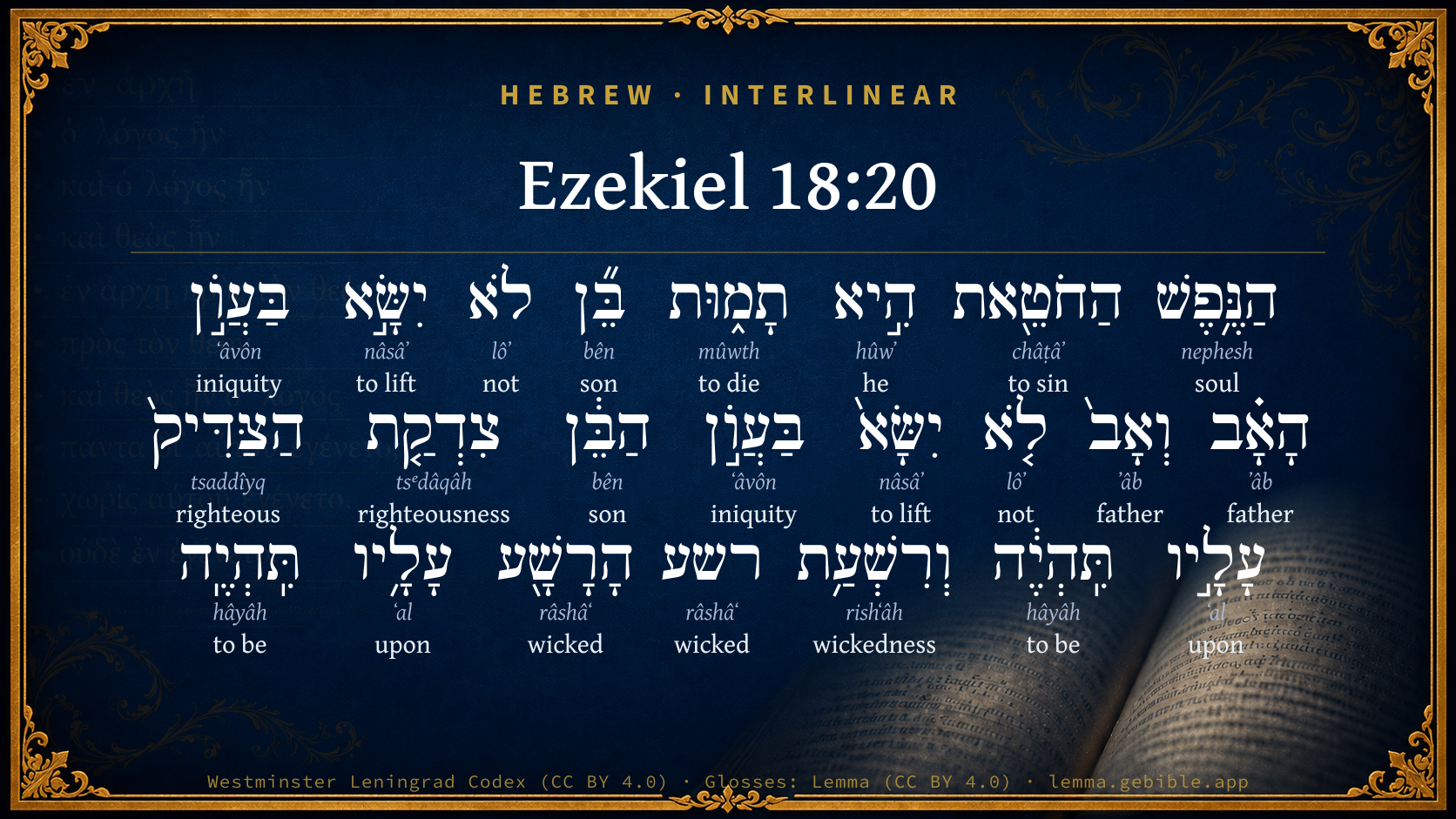
Ezekiel 18:20

Hebrew (Westminster Leningrad Codex) Ezekiel 18:20 appears in the Hebrew Old Testament. The text above is from the Westminster Leningrad Codex. Each word links to its Strong’s number, a concise gloss, and parsing drawn from the Open Scriptures Hebrew Bible morphology. Click any word for its full Brown-Driver-Briggs (BDB) entry.
Download image
Cite this verse

Ezekiel 18:20 (World English Bible). Public Domain. Lemma interlinear Bible study tool, https://lemma.gebible.app/v/ezekiel/18/20.

Show BibTeX & RIS
BibTeX
RIS
English Translation
The soul who sins, he shall die: the son shall not bear the iniquity of the father, neither shall the father bear the iniquity of the son; the righteousness of the righteous shall be on him, and the wickedness of the wicked shall be on him.
World English Bible · Public Domain
Download a study sheet

One document with this verse’s original text, its word-by-word gloss line, the meaning frame, cross-references with their text, attributed commentary, and full source and license credits — printable, and it pastes into notes with its structure intact.

This verse Autodidact and up

Study sheet (.html) Plain text (.txt)

A passage Seminary Student

Up to 50 verses in one chapter. A passage sheet keeps up to 6 commentary sources and 12 cross-references per verse, in the order this page ranks them, and says so on the sheet whenever that leaves anything out. Ask for a single verse and you get the Autodidact verse sheet above.

Everything on this page stays free to read, with no account — the sheet is a download of what is already on screen, not access to it.

Want to remove ads? Support Godless Engineer
Compare translations 3

The same verse in 3 English versions, stacked beneath the original-language interlinear above. Click any original word for its lexicon entry.

Each is an independent rendering of the whole verse — the interlinear is not word-aligned to these translations.

Highlighted words mark where these versions differ — a whole-verse word diff, not a word-by-word alignment.

  • World English Bible Public Domain
    The soul who sins, he shall die: the son shall not bear the iniquity of the father, neither shall the father bear the iniquity of the son; the righteousness of the righteous shall be on him, and the wickedness of the wicked shall be on him.
  • King James Version Public Domain
    The soul that sinneth, it shall die. The son shall not bear the iniquity of the father, neither shall the father bear the iniquity of the son: the righteousness of the righteous shall be upon him, and the wickedness of the wicked shall be upon him.
  • unfoldingWord Literal Text CC BY-SA 4.0
    The one who sins, he is the one who will die. A son will not bear his father’s iniquity, and a father will not bear his son’s iniquity. The righteousness of the one who acts rightly will be on himself, and the wickedness of the wicked will be on himself.

unfoldingWord Literal Text — © unfoldingWord, licensed CC BY-SA 4.0. Word-aligned USFM3 via Door43 (git.door43.org/unfoldingWord/en_ult).

Versions to compare (up to 4)

3 of 4 selected

Show all 18 translations

Every available English version of this verse, each an independent rendering of the whole verse.

  • World English Bible Public Domain
    The soul who sins, he shall die: the son shall not bear the iniquity of the father, neither shall the father bear the iniquity of the son; the righteousness of the righteous shall be on him, and the wickedness of the wicked shall be on him.
  • Berean Standard Bible Public Domain
    The soul who sins is the one who will die. A son will not bear the iniquity of his father, and a father will not bear the iniquity of his son. The righteousness of the righteous man will fall upon him, and the wickedness of the wicked man will fall upon him.
  • Majority Standard Bible Public Domain
    The soul who sins is the one who will die. A son will not bear the iniquity of his father, and a father will not bear the iniquity of his son. The righteousness of the righteous man will fall upon him, and the wickedness of the wicked man will fall upon him.
  • King James Version Public Domain
    The soul that sinneth, it shall die. The son shall not bear the iniquity of the father, neither shall the father bear the iniquity of the son: the righteousness of the righteous shall be upon him, and the wickedness of the wicked shall be upon him.
  • American Standard Version (1901) Public Domain
    The soul that sinneth, it shall die: the son shall not bear the iniquity of the father, neither shall the father bear the iniquity of the son; the righteousness of the righteous shall be upon him, and the wickedness of the wicked shall be upon him.
  • Revised Version (1885) Public Domain
    The soul that sinneth, it shall die: the son shall not bear the iniquity of the father, neither shall the father bear the iniquity of the son; the righteousness of the righteous shall be upon him, and the wickedness of the wicked shall be upon him.
  • Geneva Bible (1599) Public Domain
    The same soule that sinneth, shall die: the sonne shall not beare the iniquitie of the father, neither shall the father beare the iniquitie of the sonne, but the righteousnes of the righteous shall be vpon him, and the wickednesse of the wicked shall be vpon him selfe.
  • Douay-Rheims (1899) Public Domain
    The soul that sinneth, the same shall die: the son shall not bear the iniquity of the father, and the father shall not bear the iniquity of the son: the justice of the just shall be upon him, and the wickedness of the wicked shall be upon him.
  • Young's Literal Translation Public Domain
    The soul that doth sin -- it doth die. A son doth not bear of the iniquity of the father, And a father doth not bear of the iniquity of the son, The righteousness of the righteous is on him, And the wickedness of the wicked is on him.
  • Literal Standard Version CC BY-SA 4.0
    The soul that sins—it dies. A son does not bear of the iniquity of the father, || And a father does not bear of the iniquity of the son, || The righteousness of the righteous is on him, || And the wickedness of the wicked is on him.
  • Unlocked Literal Bible CC BY-SA 4.0
    The one who sins, he is the one who will die. A son will not bear his father's iniquity, and a father will not bear his son's iniquity. The righteousness of the one who acts rightly will be on himself, and the wickedness of the wicked will be on himself.
  • unfoldingWord Literal Text CC BY-SA 4.0
    The one who sins, he is the one who will die. A son will not bear his father’s iniquity, and a father will not bear his son’s iniquity. The righteousness of the one who acts rightly will be on himself, and the wickedness of the wicked will be on himself.
  • Darby Bible Public Domain
    The soul that sinneth, it shall die. The son shall not bear the iniquity of the father, neither shall the father bear the iniquity of the son; the righteousness of the righteous shall be upon him, and the wickedness of the wicked shall be upon him.
  • World Messianic Bible Public Domain
    The soul who sins, he shall die. The son shall not bear the iniquity of the father, neither shall the father bear the iniquity of the son. The righteousness of the righteous shall be on him, and the wickedness of the wicked shall be on him.
  • Webster's Bible Public Domain
    The soul that sinneth, it shall die. The son shall not bear the iniquity of the father, neither shall the father bear the iniquity of the son: the righteousness of the righteous shall be upon him, and the wickedness of the wicked shall be upon him.
  • Free Bible Version CC BY-SA 4.0
    It's the person who sins who will die. A son won't pay for his father's sins, and a father won't pay for his son's sins. The good consequences of living right will come to those who are good; the evil consequences of wickedness will come to those who are evil.
  • Bible in Basic English Public Domain
    The soul which does sin will be put to death: the son will not be made responsible for the evil-doing of the father, or the father for the evil-doing of the son; the righteousness of the upright will be on himself, and the evil-doing of the evil-doer on himself.
  • JPS Tanakh (1917) Public Domain
    The soul that sinneth, it shall die; the son shall not bear the iniquity of the father with him, neither shall the father bear the iniquity of the son with him; the righteousness of the righteous shall be upon him, and the wickedness of the wicked shall be upon him.

Literal Standard Version (2020), Covenant Press — licensed CC BY-SA 4.0. Text via the HelloAO Bible API (eBible.org). Unlocked Literal Bible (unfoldingWord) — licensed CC BY-SA 4.0. Text via the HelloAO Bible API (eBible.org). unfoldingWord Literal Text — © unfoldingWord, licensed CC BY-SA 4.0. Word-aligned USFM3 via Door43 (git.door43.org/unfoldingWord/en_ult). Free Bible Version, Dr. Jonathan Gallagher — licensed CC BY-SA 4.0. Text via the HelloAO Bible API (eBible.org).

Word by word

More ways to search: Search by grammar → Find every occurrence → Compare this word →

Practice this passage: Drill this verse → Learn its vocabulary →

וְרִשְׁעַ֥ת
rishʻâh
H7564
“and · wickedness of”
Conjunction + Noun, Common, Feminine, Singular, Construct
Part of Speech
Conjunction + Noun
Type
Common
Gender
Feminine
Number
Singular
State
Construct
Full BDB Definition

Origin: from H7562

TWOT: 2222c

wickedness, guilt - wickedness (in civil relations) - wickedness (of enemies) - wickedness (ethical and religious)
  1. הַנֶּ֥פֶשׁ nephesh H5315 “the · soul” Particle, Definite Article + Noun, Common, Both, Singular, Absolute
  2. הַחֹטֵ֖את châṭâʼ H2398 “the · sinning” Particle, Definite Article + Verb, Qal, Participle Active, Feminine, Singular, Absolute
  3. הִ֣יא hûwʼ H1931 “he” Pronoun, Personal, 3rd Person, Feminine, Singular
  4. תָמ֑וּת mûwth H4191 “to die” Verb, Qal, Imperfect, 3rd Person, Feminine, Singular
  5. בֵּ֞ן bên H1121 “son” Noun, Common, Masculine, Singular, Absolute
  6. לֹא lôʼ H3808 “not” Particle, Negative
  7. יִשָּׂ֣א nâsâʼ H5375 “to lift” Verb, Qal, Imperfect, 3rd Person, Masculine, Singular
  8. בַּעֲוֺ֣ן ʻâvôn H5771 “in/at · iniquity of” Preposition + Noun, Common, Both, Singular, Construct
  9. הָאָ֗ב ʼâb H1 “the · father” Particle, Definite Article + Noun, Common, Masculine, Singular, Absolute
  10. וְאָב֙ ʼâb H1 “and · father” Conjunction + Noun, Common, Masculine, Singular, Absolute
  11. לֹ֤א lôʼ H3808 “not” Particle, Negative
  12. יִשָּׂא֙ nâsâʼ H5375 “to lift” Verb, Qal, Imperfect, 3rd Person, Masculine, Singular
  13. בַּעֲוֺ֣ן ʻâvôn H5771 “in/at · iniquity of” Preposition + Noun, Common, Both, Singular, Construct
  14. הַבֵּ֔ן bên H1121 “the · son” Particle, Definite Article + Noun, Common, Masculine, Singular, Absolute
  15. צִדְקַ֤ת tsᵉdâqâh H6666 “righteousness of” Noun, Common, Feminine, Singular, Construct
  16. הַצַּדִּיק֙ tsaddîyq H6662 “the · righteous” Particle, Definite Article + Adjective, Adjective, Masculine, Singular, Absolute
  17. עָלָ֣יו ʻal H5921 “upon · him” Preposition + Suffix, Personal, 3rd Person, Masculine, Singular
  18. תִּֽהְיֶ֔ה hâyâh H1961 “to be” Verb, Qal, Imperfect, 3rd Person, Feminine, Singular
  19. רשע râshâʻ H7563 “wicked” Adjective, Adjective, Masculine, Singular, Absolute
  20. הָרָשָׁ֖ע râshâʻ H7563 “the · wicked” Particle, Definite Article + Adjective, Adjective, Masculine, Singular, Absolute
  21. עָלָ֥יו ʻal H5921 “upon · him” Preposition + Suffix, Personal, 3rd Person, Masculine, Singular
  22. תִּֽהְיֶֽה hâyâh H1961 “to be” Verb, Qal, Imperfect, 3rd Person, Feminine, Singular

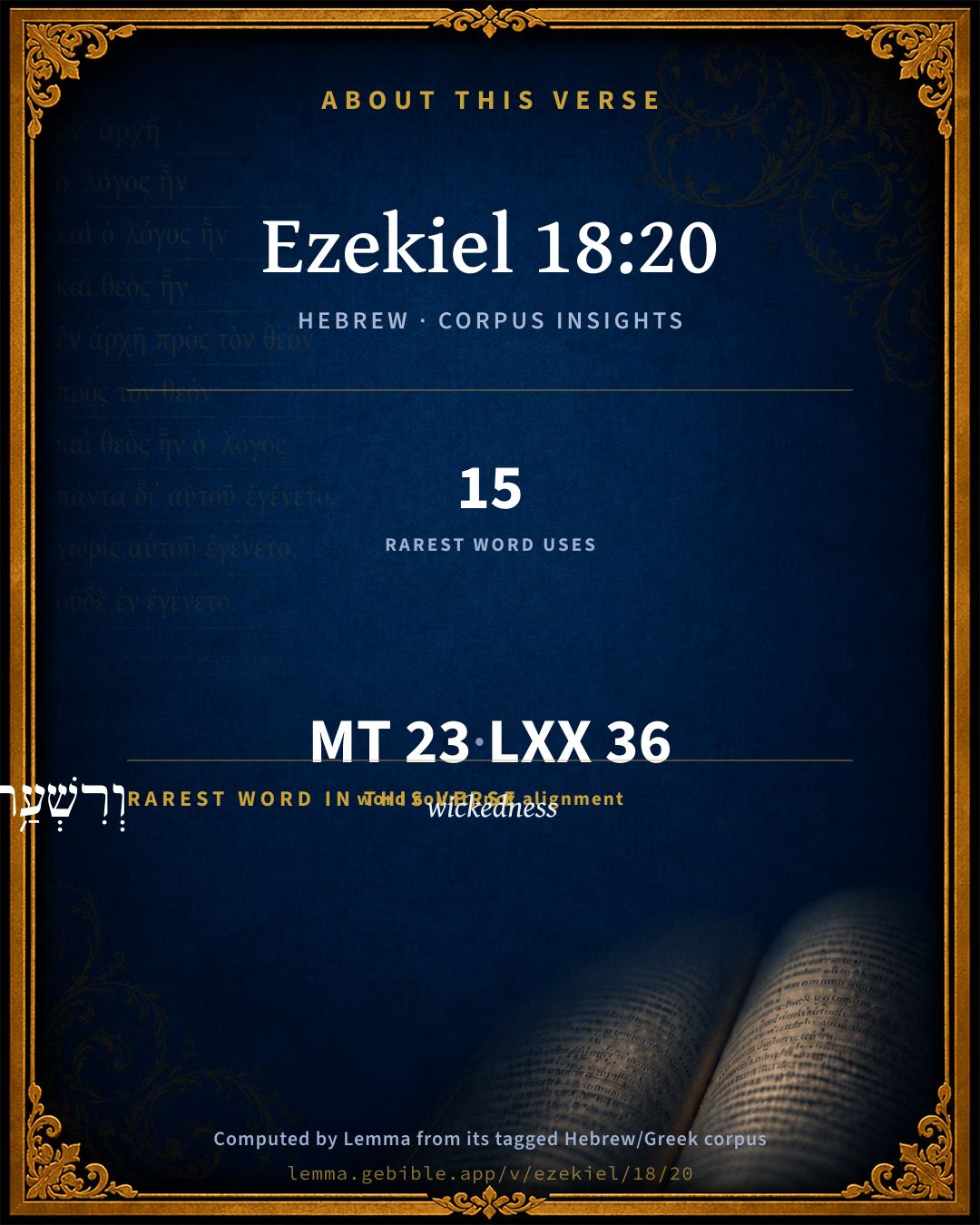
About this verse

These counts appear in no published source. They are computed here, from the morphology-tagged text and Lemma’s own curated glosses. What Lemma adds →

23
words
15
distinct lemmas
Prophets
section

Notable vocabulary

The rarest word here is וְרִשְׁעַ֥ת wickedness H7564 — appearing just 15 times in the whole Hebrew Bible.

Shared distinctive vocabulary

וְרִשְׁעַ֥ת wickedness H7564 occurs in 15 verses of the Hebrew Bible. Also found in:

Grammatical profile

  • 6 verbs
  • 9 nouns
  • 3 adjectives
  • 1 pronoun
  • 2 prepositions
  • 2 particles

Verb forms

  • הַחֹטֵ֖את Qal · Participle Active
  • תָמ֑וּת Qal · Imperfect
  • יִשָּׂ֣א Qal · Imperfect
  • יִשָּׂא֙ Qal · Imperfect
  • תִּֽהְיֶ֔ה Qal · Imperfect
  • תִּֽהְיֶֽה Qal · Imperfect

Repetition

Words recur within this verse — often emphatic in Hebrew:

  • בֵּ֞ן son H1121 ×2
  • יִשָּׂ֣א to lift H5375 ×2
  • בַּעֲוֺ֣ן iniquity H5771 ×2
  • הָאָ֗ב father H1 ×2
  • עָלָ֣יו upon H5921 ×2
  • תִּֽהְיֶ֔ה to be H1961 ×2
  • רשע wicked H7563 ×2
  • לֹא not H3808 ×2

Hebrew & Septuagint length

In English translation the verse runs 46 words from the Hebrew and 47 from the Septuagint (LXX English) — closely comparable.

A rough comparison of the two English renderings, which tokenize alike — not a word-level alignment.

Word counts can differ between the Hebrew and the Greek without any difference in meaning — e.g. the Hebrew direct-object marker אֵת has no separate Greek word, and Greek often adds the article ὁ.

In the original languages it is 23 Hebrew tokens and 36 Greek tokens — but the two are counted differently (Hebrew bundles its prefixes and suffixes into one token; the Greek is in lemma form), so that isn’t a like-for-like length.

Cross-references

29

Topical passages linked to Ezekiel 18:20 in the Treasury of Scripture Knowledge — connected by theme and wording, ordered by reader-vote popularity; previews shown in the World English Bible.

  • 2 Kings 14:6 but the children of the murderers he didn't put to death; according to that which is written in the book of the law of Moses, as Yahweh commanded, saying, The fathers shall not be put to death for the children, nor the children be put to death for the fathers; but every man shall die for his own sin.
  • Deuteronomy 24:16 The fathers shall not be put to death for the children, neither shall the children be put to death for the fathers: every man shall be put to death for his own sin.
  • Ezekiel 18:4 Behold, all souls are mine; as the soul of the father, so also the soul of the son is mine: the soul who sins, he shall die.
  • Jeremiah 31:29–30 In those days they shall say no more, The fathers have eaten sour grapes, and the children's teeth are set on edge.
  • 2 Chronicles 25:4 But he didn't put their children to death, but did according to that which is written in the law in the book of Moses, as Yahweh commanded, saying, The fathers shall not die for the children, neither shall the children die for the fathers; but every man shall die for his own sin.
  • Matthew 16:27 For the Son of Man will come in the glory of his Father with his angels, and then he will render to everyone according to his deeds.
  • 1 Kings 8:32 then hear you in heaven, and do, and judge your servants, condemning the wicked, to bring his way on his own head, and justifying the righteous, to give him according to his righteousness.
  • Romans 2:6–9 who "will pay back to everyone according to their works:"
  • 2 Chronicles 6:23 then hear from heaven, and do, and judge your servants, requiting the wicked, to bring his way on his own head; and justifying the righteous, to give him according to his righteousness.
  • Revelation 20:12 I saw the dead, the great and the small, standing before the throne, and they opened books. Another book was opened, which is the book of life. The dead were judged out of the things which were written in the books, according to their works.
  • Revelation 22:12–15 "Behold, I come quickly. My reward is with me, to repay to each man according to his work.
  • Numbers 18:1 Yahweh said to Aaron, You and your sons and your fathers' house with you shall bear the iniquity of the sanctuary; and you and your sons with you shall bear the iniquity of your priesthood.
  • Isaiah 3:10–11 Tell the righteous "Good!" For they shall eat the fruit of their deeds.
  • Leviticus 5:17 "If anyone sins, and does any of the things which Yahweh has commanded not to be done; though he didn't know it, yet he is guilty, and shall bear his iniquity.
  • Leviticus 5:1 "'If anyone sins, in that he hears the voice of adjuration, he being a witness, whether he has seen or known, if he doesn't report it, then he shall bear his iniquity.
  • Leviticus 19:8 but everyone who eats it shall bear his iniquity, because he has profaned the holy thing of Yahweh, and that soul shall be cut off from his people.
  • 2 Kings 22:18–20 But to the king of Judah, who sent you to inquire of Yahweh, thus shall you tell him, Thus says Yahweh, the God of Israel: As touching the words which you have heard,
  • Isaiah 53:11 He shall see of the travail of his soul, [and] shall be satisfied: by the knowledge of himself shall my righteous servant justify many; and he shall bear their iniquities.
  • Ezekiel 33:10 You, son of man, tell the house of Israel: Thus you speak, saying, Our transgressions and our sins are on us, and we pine away in them; how then can we live?
  • Hebrews 9:28 so Christ also, having been once offered to bear the sins of many, will appear a second time, without sin, to those who are eagerly waiting for him for salvation.
  • Revelation 2:23 I will kill her children with Death, and all the assemblies will know that I am he who searches the minds and hearts. I will give to each one of you according to your deeds.
  • Ezekiel 18:13 has given forth on interest, and has taken increase; shall he then live? he shall not live: he has done all these abominations; he shall surely die; his blood shall be on him.
  • 1 Peter 2:24 who his own self bore our sins in his body on the tree, that we, having died to sins, might live to righteousness; by whose stripes you were healed.
  • Ezekiel 18:30 Therefore I will judge you, house of Israel, everyone according to his ways, says the Lord Yahweh. Return you, and turn yourselves from all your transgressions; so iniquity shall not be your ruin.
  • 2 Chronicles 6:30 then hear from heaven, your dwelling-place and forgive, and render to every man according to all his ways, whose heart you know; (for you, even you only, know the hearts of the children of men;)
  • 1 Kings 14:13 All Israel shall mourn for him, and bury him; for he only of Jeroboam shall come to the grave, because in him there is found some good thing toward Yahweh, the God of Israel, in the house of Jeroboam.
  • Leviticus 10:17 "Why haven't you eaten the sin offering in the place of the sanctuary, seeing it is most holy, and he has given it you to bear the iniquity of the congregation, to make atonement for them before Yahweh?
  • Leviticus 16:22 The goat shall carry all their iniquities on himself to a solitary land, and he shall let the goat go in the wilderness.
  • Ezekiel 4:4 Moreover lie you on your left side, and lay the iniquity of the house of Israel on it; [according to] the number of the days that you shall lie on it, you shall bear their iniquity.

Cross-references courtesy of OpenBible.info (CC BY 4.0).

Hebrew and Greek witnesses Masoretic Hebrew ↔ Greek Septuagint

The same verse in the two great witnesses to the Old Testament, shown verse-for-verse.

These are two independent witnesses, not word-aligned to each other, and the Septuagint is shown in lemma (dictionary) form.

Hebrew Ezekiel 18:20 Masoretic · Westminster Leningrad Codex

הַנֶּ֥פֶשׁ הַחֹטֵ֖את הִ֣יא תָמ֑וּת בֵּ֞ן לֹא יִשָּׂ֣א בַּעֲוֺ֣ן הָאָ֗ב וְאָב֙ לֹ֤א יִשָּׂא֙ בַּעֲוֺ֣ן הַבֵּ֔ן צִדְקַ֤ת הַצַּדִּיק֙ עָלָ֣יו תִּֽהְיֶ֔ה וְרִשְׁעַ֥ת רשע הָרָשָׁ֖ע עָלָ֥יו תִּֽהְיֶֽה

The soul who sins, he shall die: the son shall not bear the iniquity of the father, neither shall the father bear the iniquity of the son; the righteousness of the righteous shall be on him, and the wickedness of the wicked shall be on him.

World English Bible · Public Domain

Greek LXX Ezekiel 18:20 Septuagint · lemma form

ὁ δέ ψυχή ὁ ἁμαρτάνω ἀποθνήσκω ὁ δέ υἱός οὐ λαμβάνω ὁ ἀδικία ὁ πατήρ αὐτός οὐδέ ὁ πατήρ λαμβάνω ὁ ἀδικία ὁ υἱός αὐτός δικαιοσύνη δίκαιος ἐπί αὐτός εἰμί καί ἀνομία ἄνομος ἐπί αὐτός εἰμί

But the soul that sins shall die: and the son shall not bear the iniquity of the father, nor shall the father bear the iniquity of the son: the righteousness of the righteous shall be upon him, and the iniquity of the transgressor shall be upon him.

LXX2012 (modern English Septuagint) · Public Domain

Hebrew: Westminster Leningrad Codex (CC BY 4.0). Greek: Septuagint (public domain); English from LXX2012 (modern English Septuagint) (Public Domain). How the Septuagint differs from the Hebrew →

Targum (Aramaic paraphrase)

1

The Targum is the ancient Jewish Aramaic paraphrase of the Hebrew Scriptures — an interpretive translation, not the Hebrew text itself. Onkelos (literal) and Pseudo-Jonathan (expansive) render the Torah, and Jonathan the Prophets. Coverage is partial: where no permissively-licensed English translation exists for a verse, only the Aramaic is shown. This is verse-level text, not a word-by-word alignment to the Hebrew.

  1. Targum Jonathan Prophets (Joshua–Malachi)
    אֱנַשׁ דְיֵחוֹב הוּא יְמוּת בְּרָא לָא לָקֵי בְּחוֹבֵי אַבָּא וְאַבָּא לָא לָקֵי בְּחוֹבֵי בְרָא זְכוּת זַכָּאָה בֵּיהּ יִתְקַיֵם וְחוֹבַת חַיָבָא עֲלוֹהִי תְהֵא:

    (no public-domain English translation for this verse)

    Targum Jonathan — Aramaic: “Mikraot Gedolot” (public domain). English: “Sefaria Community Translation” (CC0 1.0 (public-domain dedication)); “London "Chaldee Paraphrase," 1871” (public domain). Text via Sefaria.

Commentary

Notes on Ezekiel 18:20 from classic Christian and Jewish commentators (each source and its license shown beneath its notes). The classic Christian expositions comment on the surrounding passage and are grouped to its opening verse, so a note may address several verses; the Jewish commentaries on the Tanakh (Rashi and others) are per-verse, so they appear only where the commentator wrote on this verse.

Lemma curates 59 commentaries, every one of them public domain or Creative Commons licensed, each selected and text-cleaned for this edition rather than reprinted as found. About our sources →

Trapp's Complete Commentary

John Trapp

Eze 18:20 The soul that sinneth, it shall die. The son shall not bear the iniquity of the father, neither shall the father bear the iniquity of the son: the righteousness of the righteous shall be upon him, and the wickedness of the wicked shall be upon him.

Ver. 20. The son shall not bear the iniquity of the father.] The innocent son shall not, unless it be in temporals only, and that in some cases. {Deu 24:16 2Ki 14:6 2Ch 15:4} It was the cruel manner of Uladus, prince of Valachia, together with the offender, to execute the whole family, yea, sometimes the whole kindred. {a} A like cruelty was used in Scotland by the Pope’s appointment upon the kindred of those that had slain David Beaton, in revenge of the death of that butcherly bishop. {b} Lavater {c} telleth us here, out of the annals of the Switzers, his countrymen, that when Albertus, the son of Rodolphus Caesar, was slain by his nephew John Hapsburg and some other nobles, his children, Duke Leopold and Agnes Queen of Hungary, put to death not the murderers only, but their children and kinsfolk also not a few, and utterly overturned divers strongholds in Switzerland. But this was not the way of God, nor did it prosper in their hand. Cruelty calleth aloud for vengeance.

The righteousness,] i.e., It shall be well with the righteous, and woe with the wicked. {Isa 3:10-11}

{a} Turkish History.

{b} Acts and Mon.

{c} Lav. in loc.

John Trapp, A Commentary or Exposition upon All the Books of the Old and New Testament (1647–1656) — public domain. Text from a community e-Sword module.

Jamieson, Fausset & Brown

Robert Jamieson, A. R. Fausset & David Brown

son shall not bear . . . iniquity of . . . father-- (Deu 24:16; Kg2 14:6).

righteousness . . . wickedness--that is, the reward for righteousness . . . the punishment of wickedness. "Righteousness" is not used as if any were absolutely righteous; but, of such as have it imputed to them for Christ's sake, though not under the Old Testament themselves understanding the ground on which they were regarded as righteous, but sincerely seeking after it in the way of God's appointment, so far as they then understood this way.

Jamieson, Fausset & Brown — Commentary Critical and Explanatory on the Whole Bible (1871) — public domain (CC PDM 1.0). Text via the HelloAO Bible API.

Adam Clarke's Commentary

Verse 20. The soul that sinneth, it shall die.] Hitherto we have had to do with the simple cases of the righteous and the wicked; of him who lived and died a holy man, and of him who lived and died a wicked man. But there are two cases behind:

1. That of the wicked man, who repents and turns to God.

2. That of the righteous man, who backslides, and does not return to God by repentance. On both these cases God decides thus:-

Adam Clarke's Commentary on the Bible (1810–1826) — public domain. Text from a community e-Sword/MySword module.

John Calvin's Commentaries

Ezekiel still pursues the sentiment which we have explained, namely, that God is a just judge and treats every one according to his conduct; as Paul says, As each has lived in the flesh, so God lays up a reward for him. (Romans 8:13.) But he more clearly refuted the proverb, that the sons should suffer for their fathers’ sins. He says, then, that each when he comes before God’s tribunal should be judged by his works. As far then as the general sentiment is concerned, it is in accordance with common sense that God should exact punishment of the wicked, and that they should receive the just reward of their works. But in the next clause, the question arises how the Spirit here pronounces that the son should not pay the penalty due to the father, when God so often declares that he visits the sins of the fathers upon the children unto the third and fourth generation. (Exodus 20:5.) That sentiment often occurs: but there are two passages peculiarly remarkable, where it is annexed to the second precept of the law, (Deuteronomy 5:9,) and then in that remarkable vision which occurred to Moses, God pronounces the same thing as before, namely, that the iniquity of the fathers should fall upon the sons. (Exodus 34:7.) These passages seem opposed to each other, but it will be easy to remove the contradiction by beginning with the fall of Adam, since if we do not consider the whole race fallen in Adam, we can scarcely extricate ourselves from that difficulty which we often feel as causing pungent scruples. But the principle of one universal fall in Adam removes all doubts. For when we consider the perishing of the whole human race, it is said with truth that we perish through another’s fault: but it is added at the same time, that every one perishes through his own iniquity. If then we inquire into the cause of the curse which presses upon all the posterity of Adam, it may be said to be partly another’s and partly our own: another’s, through Adam’s declension from God, in whose person the whole human race was spoiled of righteousness and intelligence, and all parts of the soul utterly corrupted. So that every one is lost in himself, and if he wishes to contend with God, he must always acknowledge that the fountain of the curse flows from himself. For before the child was born into the world, it was corrupt, since its menial intelligence was buried in darkness, and its will was perverse and rebellious against God. As soon as infants are born they contract pollution from their father Adam: their reason is blinded, their appetites perverted, and their senses entirely vitiated. This does not immediately show itself in the young child, but before God, who discerns things more acutely than we do, the corruption of our whole nature is rightly treated as sin. There is no one who during the course of his life does not perceive himself liable to punishment through his own works; but original sin is sufficient for the condemnation of all men. When men grow up they acquire for themselves the new curse of what is called actual sin: so that he who is pure with reference to ordinary observation, is guilty before God: hence Scripture pronounces us all naturally children of wrath: these are Paul’s words in the second chapter of the epistle to the Ephesians, (Ephesians 2:3.) If then we are children of wrath, it follows that we are polluted from our birth: this provokes God’s anger and renders him hostile to us: in this sense David confesses himself conceived in sin. (Psalm 51:5.) He does not here accuse either his father or his mother so as to extenuate his own wickedness; but, when he abhors the greatness of his sin in provoking the wrath of God, he is brought back to his infancy, and acknowledges that he was even then guilty before God. We see then that David, being reminded of a single sin, acknowledges himself a sinner before he was born; and since we are all under the curse, it follows that we are all worthy of death. Thus, the son properly speaking shall not die through the iniquity of his father, but is considered guilty before God through his own fault.

Now let us proceed further. When God pronounces that the iniquity of the father returns into the bosom of the son, we must remember that when God involves the son in the same death with the father, he does so principally because the son of the impious is destitute of his Spirit: whence it happens that he remains in the death in which he was born. For if we do not consider any other punishments than those which are openly inflicted, a new scruple will again arise from which we cannot free ourselves, since this inquiry will always recur, how can the son perish by his own fault, if he can produce good fruit and so reconcile himself to God? But the first punishment with which God threatens the reprobate is that which I have mentioned, namely, that their offspring are destitute and deprived of spiritual gifts, so that they sink deeper and deeper into destruction: for there are two kinds of punishment, the one outward and the other inward, as we express it. God punishes the transgressors of his law by either the sword, or by famine, or by pestilence, as he everywhere denounces: he is also armed with other means of slaughter for executing his wrath, and all these punishments are outward and openly apparent. But there is another sort inward and hidden, when God takes away the spirit of rectitude from the reprobate, when he gives them up to a reprobate mind, subjects them to foul desires, and deprives them of all his gifts hence God is said to cause the fathers’ iniquity to recoil upon the children not only when he outwardly punishes the little ones, but because he devotes a cursed offspring to eternal destruction, through being destitute of all the gifts of the Spirit,. Now we know that God is the fountain of life, (Psalm 36:9,) whence it follows that all who are separated from him are dead. Now therefore it is evident how God throws the iniquity of the fathers upon the children, since when he devotes both father and son to eternal destruction, he deprives them of all his gifts, blinds their minds, and enslaves all their appetites to the devil. Although we may, in one word, embrace the whole matter of the children suffering for the fathers when he leaves them to simple nature, as the phrase is, since in this way he drowns them in death and destruction. But outward punishments also follow afterwards, as when God sends lightning upon Sodom many young children perished, and all were absorbed with their parents. (Genesis 19:24.) If any one asks by what right they perished, first they were sons of Adam and so were accursed, and then God wished to punish the Sodomites through their offspring, and he could do so deservedly. Concerning the young who thus perished with their fathers, it is said, happy is he who dashes thy young ones against the stones or the pavement. (Psalm 137:9.) At first sight, indeed, that atrocity seems intolerable that a child whose age and judgment is thus tender should be so cruelly slain: but as we have already said, all are naturally children of wrath. (Ephesians 2:2.) No wonder, therefore, that God withdraws his favor from the offspring of the reprobate, even if he executes these outward judgments. But how will this now be suitable, shall not the son bear the iniquity of the father? for Ezekiel here speaks of adults, for he means that the son shall not bear his father’s iniquity, since he shall receive the reward due to himself and sustain his own burden. Should any one wish to strive with God, he can be refuted in a single word: for who can boast himself innocent? Since therefore all are guilty through their own fault, it follows that the son does not bear his father’s iniquity, since he has to bear his own at the same time. Now that question is solved.

He now adds, the righteousness of the righteous shall be upon him, and the impiety of the impious shall be upon him. We said that this was the legal sentence: if God used the same language everywhere, no hope of safety would be left to us. For who would be found just if his life were judged strictly by the law? But it has already been said, speaking accurately, that God rewards those worshipers who observe his law, and punish those who transgress it. But since we are all far from perfect obedience, Christ is offered to us, from whom we may partake of righteousness, and in this way be justified by faith. Meanwhile it is true, according to the rule of the law, that the righteousness of the righteous shall be upon him, since God will not disappoint any, but will really perform what he has promised. But he promises a reward to all who observe his law. If any one object that this doctrine is useless and superfluous, we have an answer at hand, that it is in many ways useful, since, first of all, we acknowledge that God, although he owes us nothing, yet willingly binds himself to be reconciled to us; and thus his surprising liberality appears. Then we again collect, that by transgression we cannot profit or obtain any advantage when God offers a reward to all who observe his law. For what can we demand more equitable than that God should of his own accord be our debtor? and should reward us while he holds us bound to himself, and completely subject to him with all our works? And that pattern of Christ must be considered, When you have done all that was commanded you, say, We are unprofitable servants. (Luke 17:10.) Why so? for we return nothing but what God has justly required of us. We gather, then, from this sentence, that we cannot expostulate with God, or complain of anything while the fault of our own condemnation resides in us for not keeping the law. Thirdly, we acknowledge another instance of God’s mercy in his clothing us in the righteousness of his Son, when he sees us in want of a righteousness of our own, and altogether destitute of everything good. Fourthly, we said that they are esteemed just who do not satisfy the law, since God does not impute their sins to them. Hence the righteousness of the law is not without fruit among the faithful; since on account of that blessedness which is described in Psalm 32:2, their works are taken into account and remunerated by God. So the righteousness of the righteous is upon him, just as the impiety of the impious is upon him, and it shall recoil upon his own head. It follows —

John Calvin's Commentaries (1540-1563) — public domain. Text from the Calvin Translation Society English edition (1840s-50s) via the Christian Classics Ethereal Library (ccel.org). Calvin's coverage is partial (roughly two-thirds of the Bible); uncommented books and verses are honest gaps, never fabricated. The 19th-century editor's footnotes and remarks are omitted so the notes are faithfully Calvin's own voice.

John Gill's Exposition

But if the wicked,.... So far is the Lord from punishing the sins of one man upon another, that he will not punish a man for his own sins: if he

will turn from all his sins that he hath committed: if he truly repents of them, and thoroughly forsakes them; for it must not be one sin only, but all; every sin is to be loathed and mourned over, and sorrow expressed for it, and to be forsaken; not one sin is to cherished and retained, but all to be relinquished: or the repentance and conversion may be justly questioned whether they be sincere:

and keep all my statutes, and do that which is lawful and right; as the repentance and turning from sin must be general, so also obedience to the commands of God, both moral and positive; respect is to be had to all his ordinances, which are all of them to be esteemed as right and lawful, and to be observed: this is bringing forth fruits meet for repentance:

he shall surely live, he shall not die; he shall live in his own land, and not go into captivity. Kimchi's note is, he shall live in this world, and not die in the world to come; so Ben Melech.

John Gill's Exposition of the Whole Bible (1746–1763) — public domain (CC PDM 1.0). Text via the HelloAO Bible API.

Haydock's Catholic Bible Commentary

Sinneth. God never acted otherwise, though the Jews seem to have thought so. Temporal afflictions are the source of merit, and generally fall to the share of the saints, particularly under the new law.

George Leo Haydock (1774–1849), Haydock's Catholic Family Bible and Commentary, 1859 edition — public domain. Excludes Psalms (Douay-Rheims chapter numbering differs from Protestant) and Deuterocanonical books (Catholic canon only).

Matthew Poole's English Annotations

See Eze 18:4.

The son shall not bear the iniquity of the father, neither shall the father bear the iniquity of the son: this is a most unquestionable truth, and though perhaps it may seem otherwise in some cases, yet could we see perfectly the connexion between persons and persons, and how they are one, could we see the connexion of sins and sins, and how easily, secretly, and undiscerned men become guilty of the same sins, we should, it is likely, see father and son, though perhaps one of them might not do the evil, both guilty, and neither punished for the sin further than the sin was his own; nor do the scriptures, Exo 20:5; Deu 28:18, menace innocent children, nor doom persons to punishment, for sins from which they are fully and wholly free; but if children shall follow their fathers in sin, or justify them in it, or not mourn for it, or not deprecate, or whatever way there is by which children may make the sins of progenitors become their own; then if they die for those sins, it is for them as they are their own sins, not as they are their fathers’.

The righteousness of the righteous shall be upon him: Isa 3:10 will fully explain this passage; it shall be well with the righteous, for he shall eat the fruit of his doing, he shall be rewarded as a righteous one.

The wickedness of the wicked shall be upon him; the reward of wickedness, i.e. woeful punishment, shall be executed upon the wicked, as Isa 3:11.

Matthew Poole's English Annotations on the Holy Bible (1683–1685) — public domain. Text from a community e-Sword/MySword module.

Whedon's Commentary on the Bible

Daniel D. Whedon

20. Righteousness… shall be upon him — A man’s personal righteousness or wickedness is the measure of his reward or punishment. Both shall “eat the fruit of their doings” (Isa_3:10-11; Eze_11:21).

Daniel D. Whedon (gen. ed.), Commentary on the Old and New Testaments (1874–1909) — public domain. Text from a community e-Sword module.

John Wesley's Explanatory Notes

Shall not bear - This is a most unquestionable truth; and tho' perhaps it may seem otherwise in some cases, yet could we see perfectly the connection between persons and persons; could we see the connection of sins and sins, and how easily, secretly, and undiscerned men become guilty of the same sins, we should see father and son, though perhaps one of them might not do the evil, both guilty, and neither punished for the sin farther than if it was his own: nor do the scriptures, Exod. xx, 5 Deut. xxviii, 18, doom persons to punishment for sins from which they are wholly free; but if children shall follow their fathers in sin, then if they die for those sins, 'tis because these are their own, not as they are their fathers. The righteousness - It shall be well with the righteous, for he shall eat the fruit of his doing, he shall be rewarded as a righteous one. The wickedness - The reward of wickedness. "The son shall not die, not die eternally, for the iniquity of the father, if he do not tread in the steps of it: nor the father for the iniquity of the son, if he do all he can to prevent it.

John Wesley, Explanatory Notes Upon the Whole Bible (1754–1765) — public domain. Text via the GEBible commentary corpus.

Lesson kit

Teaching starters — assembled from the data on this page, not authored interpretation. Every prompt links to the verse data it draws on. Edit before teaching.

Ezekiel, in the Prophets, opens this verse with 23 words (15 distinct Hebrew lemmas). Its most distinctive word is rishʻâh (“wickedness”). A historical commentator’s framing appears above. Read the whole chapter for the surrounding context.

Discussion questions

  1. What does “wickedness” (rishʻâh) contribute to the verse as a whole?
  2. Deuteronomy 9:4 shares the word «wickedness» with this verse. How do the two illuminate each other?
  3. “son” occurs 2× in this one verse. What is the effect of the repetition?
  4. These translations render this verse differently; the difference is in the English rendering, not the original. What questions does that raise?
  5. The verb «הַחֹטֵ֖את» is Qal Participle Active. How does its form color the action?
  6. Reading how Trapp's Complete Commentary and Jamieson, Fausset & Brown read this verse, where do the two commentators agree and where do they part?

Things to notice

Reading settings

Reading text

Shown beneath each verse's original-language words.

Old Testament
Old Testament edition

Read the OT as the Masoretic Hebrew (MT) or the Greek Septuagint (LXX).

English shown for the Greek Septuagint (in the Hebrew ↔ Greek comparison).

Comparing translations? Open the Compare panel on any verse page to stack up to four side by side.