
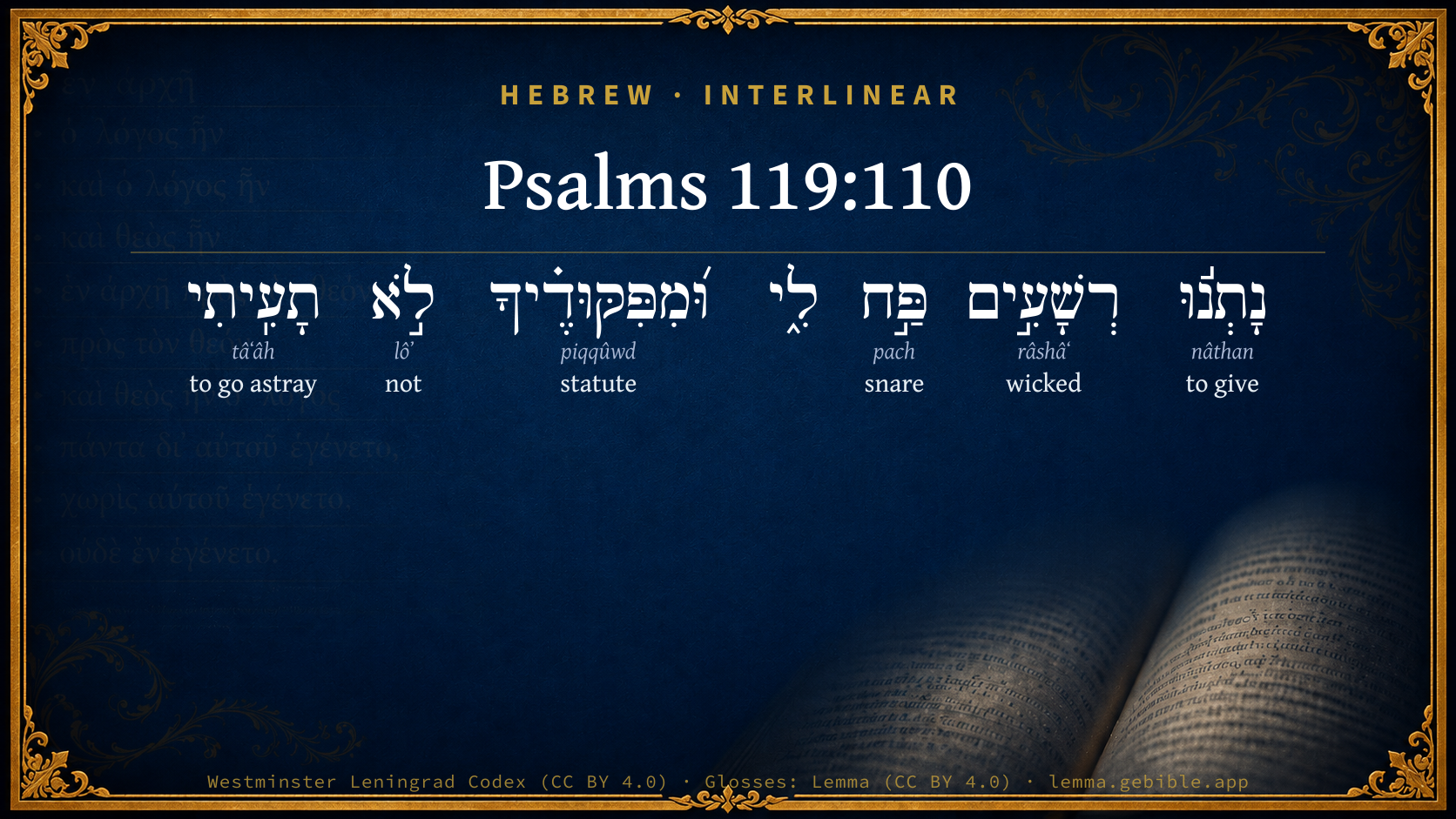
Psalms 119:110

Hebrew (Westminster Leningrad Codex) Psalms 119:110 appears in the Hebrew Old Testament. The text above is from the Westminster Leningrad Codex. Each word links to its Strong’s number, a concise gloss, and parsing drawn from the Open Scriptures Hebrew Bible morphology. Click any word for its full Brown-Driver-Briggs (BDB) entry.
Download image
Cite this verse

Psalms 119:110 (World English Bible). Public Domain. Lemma interlinear Bible study tool, https://lemma.gebible.app/v/psalms/119/110.

Show BibTeX & RIS
BibTeX
RIS
English Translation
The wicked have laid a snare for me, Yet I haven't gone astray from your precepts.
World English Bible · Public Domain
Download a study sheet

One document with this verse’s original text, its word-by-word gloss line, the meaning frame, cross-references with their text, attributed commentary, and full source and license credits — printable, and it pastes into notes with its structure intact.

This verse Autodidact and up

Study sheet (.html) Plain text (.txt)

A passage Seminary Student

Up to 50 verses in one chapter. A passage sheet keeps up to 6 commentary sources and 12 cross-references per verse, in the order this page ranks them, and says so on the sheet whenever that leaves anything out. Ask for a single verse and you get the Autodidact verse sheet above.

Everything on this page stays free to read, with no account — the sheet is a download of what is already on screen, not access to it.

Want to remove ads? Support Godless Engineer
Compare translations 3

The same verse in 3 English versions, stacked beneath the original-language interlinear above. Click any original word for its lexicon entry.

Each is an independent rendering of the whole verse — the interlinear is not word-aligned to these translations.

Highlighted words mark where these versions differ — a whole-verse word diff, not a word-by-word alignment.

  • World English Bible Public Domain
    The wicked have laid a snare for me, Yet I haven't gone astray from your precepts.
  • King James Version Public Domain
    The wicked have laid a snare for me: yet I erred not from thy precepts.
  • unfoldingWord Literal Text CC BY-SA 4.0
    The wicked have set a snare for me, but I have not wandered from your precepts.

unfoldingWord Literal Text — © unfoldingWord, licensed CC BY-SA 4.0. Word-aligned USFM3 via Door43 (git.door43.org/unfoldingWord/en_ult).

Versions to compare (up to 4)

3 of 4 selected

Show all 17 translations

Every available English version of this verse, each an independent rendering of the whole verse.

  • World English Bible Public Domain
    The wicked have laid a snare for me, Yet I haven't gone astray from your precepts.
  • Berean Standard Bible Public Domain
    The wicked have set a snare for me, but I have not strayed from Your precepts.
  • Majority Standard Bible Public Domain
    The wicked have set a snare for me, but I have not strayed from Your precepts.
  • King James Version Public Domain
    The wicked have laid a snare for me: yet I erred not from thy precepts.
  • American Standard Version (1901) Public Domain
    The wicked have laid a snare for me; Yet have I not gone astray from thy precepts.
  • Revised Version (1885) Public Domain
    The wicked have laid a snare for me; yet went I not astray from thy precepts.
  • Geneva Bible (1599) Public Domain
    The wicked haue layed a snare for mee: but I swarued not from thy precepts.
  • Young's Literal Translation Public Domain
    The wicked have laid a snare for me, And from thy precepts I wandered not.
  • Literal Standard Version CC BY-SA 4.0
    The wicked have laid a snare for me, || And I did not wander from your precepts.
  • Unlocked Literal Bible CC BY-SA 4.0
    The wicked have set a snare for me, but I have not strayed from your instructions.
  • unfoldingWord Literal Text CC BY-SA 4.0
    The wicked have set a snare for me, but I have not wandered from your precepts.
  • Darby Bible Public Domain
    The wicked have laid a snare for me; but I have not wandered from thy precepts.
  • World Messianic Bible Public Domain
    The wicked have laid a snare for me, yet I haven’t gone astray from your precepts.
  • Webster's Bible Public Domain
    The wicked have laid a snare for me: yet I erred not from thy precepts.
  • Free Bible Version CC BY-SA 4.0
    Wicked people have set a trap for me, but I will not stray from your commandments.
  • Bible in Basic English Public Domain
    Sinners have put a net to take me; but I was true to your orders.
  • JPS Tanakh (1917) Public Domain
    The wicked have laid a snare for me; yet went I not astray from Thy precepts.

Literal Standard Version (2020), Covenant Press — licensed CC BY-SA 4.0. Text via the HelloAO Bible API (eBible.org). Unlocked Literal Bible (unfoldingWord) — licensed CC BY-SA 4.0. Text via the HelloAO Bible API (eBible.org). unfoldingWord Literal Text — © unfoldingWord, licensed CC BY-SA 4.0. Word-aligned USFM3 via Door43 (git.door43.org/unfoldingWord/en_ult). Free Bible Version, Dr. Jonathan Gallagher — licensed CC BY-SA 4.0. Text via the HelloAO Bible API (eBible.org).

Word by word

More ways to search: Search by grammar → Find every occurrence → Compare this word →

Practice this passage: Drill this verse → Learn its vocabulary →

About this verse

These counts appear in no published source. They are computed here, from the morphology-tagged text and Lemma’s own curated glosses. What Lemma adds →

7
words
6
distinct lemmas
Wisdom
section

Notable vocabulary

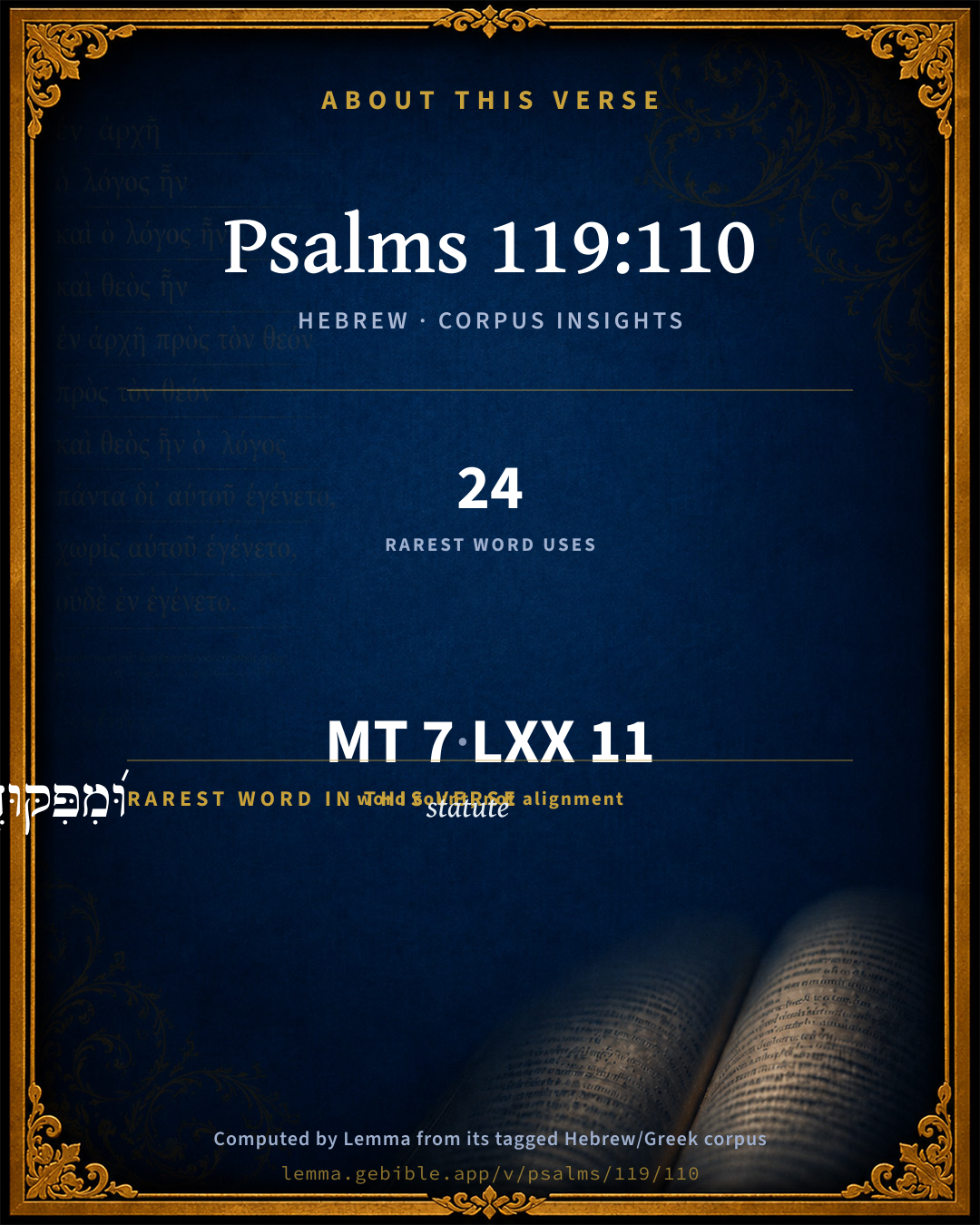
The rarest word here is וּ֝מִפִּקּוּדֶ֗יךָ statute H6490 — appearing just 24 times in the whole Hebrew Bible.

Shared distinctive vocabulary

וּ֝מִפִּקּוּדֶ֗יךָ statute H6490 occurs in 24 verses of the Hebrew Bible. Also found in:

Grammatical profile

  • 2 verbs
  • 2 nouns
  • 1 adjective
  • 1 preposition
  • 1 particle

Verb forms

  • נָתְנ֬וּ Qal · Perfect
  • תָעִֽיתִי Qal · Perfect

Hebrew & Septuagint length

In English translation the verse runs 16 words from the Hebrew and 13 from the Septuagint (LXX English) — closely comparable.

A rough comparison of the two English renderings, which tokenize alike — not a word-level alignment.

Word counts can differ between the Hebrew and the Greek without any difference in meaning — e.g. the Hebrew direct-object marker אֵת has no separate Greek word, and Greek often adds the article ὁ.

In the original languages it is 7 Hebrew tokens and 11 Greek tokens — but the two are counted differently (Hebrew bundles its prefixes and suffixes into one token; the Greek is in lemma form), so that isn’t a like-for-like length.

Cross-references

14

Topical passages linked to Psalms 119:110 in the Treasury of Scripture Knowledge — connected by theme and wording, ordered by reader-vote popularity; previews shown in the World English Bible.

  • Psalms 119:95 The wicked have waited for me, to destroy me. I will consider your statutes.
  • Psalms 140:5 The proud have hidden a snare for me, They have spread the cords of a net by the path. They have set traps for me. Selah.
  • Psalms 141:9 Keep me from the snare which they have laid for me, From the traps of the workers of iniquity.
  • Psalms 119:10 With my whole heart, I have sought you. Don't let me wander from your commandments.
  • Psalms 119:85 The proud have dug pits for me, Contrary to your law.
  • Psalms 10:8–18 He lies in wait near the villages. From ambushes, he murders the innocent. His eyes are secretly set against the helpless.
  • Psalms 124:6–7 Blessed be Yahweh, Who has not given us as a prey to their teeth.
  • Jeremiah 18:22 Let a cry be heard from their houses, when you shall bring a troop suddenly on them; for they have dug a pit to take me, and hid snares for my feet.
  • Psalms 119:21 You have rebuked the proud who are cursed, Who wander from your commandments.
  • Psalms 119:51 The arrogant mock me excessively, But I don't swerve from your law.
  • Psalms 119:87 They had almost wiped me from the earth, But I didn't forsake your precepts.
  • Daniel 6:10 When Daniel knew that the writing was signed, he went into his house (now his windows were open in his chamber toward Jerusalem) and he kneeled on his knees three times a day, and prayed, and gave thanks before his God, as he did before.
  • Luke 20:19–26 The chief priests and the scribes sought to lay hands on Him that very hour, but they feared the people--for they knew He had spoken this parable against them.
  • Proverbs 1:11–12 If they say, "Come with us, Let's lay in wait for blood; Let's lurk secretly for the innocent without cause;

Cross-references courtesy of OpenBible.info (CC BY 4.0).

Hebrew and Greek witnesses Masoretic Hebrew ↔ Greek Septuagint

The same verse in the two great witnesses to the Old Testament, shown verse-for-verse.

You’re reading Greek Psalm 118 (Hebrew Psalm 119). The Septuagint counts the superscription, so verse numbers can differ from the Hebrew — chapter-level alignment, not verse-by-verse. Numbering follows Rahlfs.

These are two independent witnesses, not word-aligned to each other, and the Septuagint is shown in lemma (dictionary) form.

Hebrew Psalms 119:110 Masoretic · Westminster Leningrad Codex

נָתְנ֬וּ רְשָׁעִ֣ים פַּ֣ח לִ֑י וּ֝מִפִּקּוּדֶ֗יךָ לֹ֣א תָעִֽיתִי

The wicked have laid a snare for me, Yet I haven't gone astray from your precepts.

World English Bible · Public Domain

Greek LXX Greek Psalm 118:110 Septuagint · lemma form

τίθημι ἁμαρτωλός παγίς ἐγώ καί ἐκ ὁ ἐντολή σύ οὐ πλανάω

Sinners spread a snare for me; but I erred not from your commandments.

LXX2012 (modern English Septuagint) · Public Domain

Hebrew: Westminster Leningrad Codex (CC BY 4.0). Greek: Septuagint (public domain); English from LXX2012 (modern English Septuagint) (Public Domain). How the Septuagint differs from the Hebrew →

Commentary

Notes on Psalms 119:110 from classic Christian and Jewish commentators (each source and its license shown beneath its notes). The classic Christian expositions comment on the surrounding passage and are grouped to its opening verse, so a note may address several verses; the Jewish commentaries on the Tanakh (Rashi and others) are per-verse, so they appear only where the commentator wrote on this verse.

Lemma curates 59 commentaries, every one of them public domain or Creative Commons licensed, each selected and text-cleaned for this edition rather than reprinted as found. About our sources →

Trapp's Complete Commentary

John Trapp

Psa 119:110 The wicked have laid a snare for me: yet I erred not from thy precepts.

Ver. 110. The wicked have laid a snare for me] Such as, rather than their lives, would have had mine; such as sought and fain would have sucked my blood.

Yet I erred not from thy preeepts] I held the king’s highway, and leaped not over the hedge to avoid a piece of foul way.

John Trapp, A Commentary or Exposition upon All the Books of the Old and New Testament (1647–1656) — public domain. Text from a community e-Sword module.

The Biblical Illustrator

Joseph S. Exell

Psa_119:110

The wicked have laid a snare for me: yet I erred not from Thy precepts.

The snares laid for a good man

I. Here is a particular proof of the worlds hatred to the godly--they have laid snares for me.

1. The instigation to this injurious practice. Unquestionably it originates in the enmity of the heart against God. For it is this, in the persons and character of the pious, which the impious dislike. They are also instigated by Satan, the common enemy of the people of God. Besides these excitements, there are others of a somewhat subordinate character. Not unfrequently the wicked are actuated with envy, when they see the righteous exalted to stations of honour and influence; this is illustrated by the case of Haman. It sometimes happens, too, that the righteous have offended the profligate in reproving them for their sins, and this has roused their enmity, as was the case with Herodias.

2. The various forms in which this practice appears. Sometimes it is by specious temptations to sin. Thus, the Scribes and Sadducees endeavoured to entangle Christ in His talk. There have been instances, too, where wicked rulers have laid a snare for the righteous (Dan_6:7-8). The wicked have aimed at corrupting the principles of the pious by offering to bribe them with the honours and riches of the world. They have thus resembled their father the devil, who took our Saviour up into the mountain, etc.

3. The agents in these temptations--they are called, the wicked. And are not these acts flagrantly wicked? For they are contrary to the law of our creation. They are chargeable with double guilt--not that of their own sin only, but that of those who by the snares they have laid for their feet have been entangled and brought into bondage.

4. The effects of their ensnaring machinations. In many cases, alas, they are successful, for they have caught the righteous in their net, and tormented them by their persecutions even unto death. But their moral success has to be far more deplored. Many a youth, ere his understanding has been established in the first principles of truth, has been led away by their errors, the cunning craftiness whereby they lie in wait to deceive. But, happily, there are many instances in which their artifices are altogether unsuccessful. Yet, said David, I erred not from Thy precepts.

II. The means of his preservation. Instead of being seduced by the smiling enticement of some, or terrified by the frowns and oppressions of others, he had not departed from the path of duty laid down for him in that Word which was the rule of his life.

1. A pious man cannot but be conscious of his determination to adhere to the path of duty, and of the degree of that adherence.

2. A subject of genuine godliness may sometimes hold up his own example to imitation (Php_3:12-14; Php_3:17).

3. A possessor of piety may and ought to acknowledge his obligations to preserving grace. Can you say, I know whom I have believed? Then how much you are indebted to your Lord. Raise your memorial pillar on this spot and write upon it, Hitherto the Lord hath helped me.

4. One principal means of this preservation was the Word of God. (Evangelical Preacher.)

The Biblical Illustrator, edited by Joseph S. Exell (c. 1880s–1900s) — public domain. Text from a community e-Sword module.

J. A. Alexander on Psalms

Joseph Addison Alexander

110. (Psa 119:110) Wicked (men) have laid a snare for me, and (yet) from thy precepts I have not strayed. Laid for me, literally given to me, as we might speak of a snare as presented to a person, i.e. set before him. The devices and temptations of the wicked were as powerless as all the other causes previ ously mentioned, in leading him away from the path of truth and safety.

Joseph Addison Alexander, The Psalms Translated and Explained (1850) — public domain. Text from a community e-Sword module.

Adam Clarke's Commentary

Verse 110. The wicked have laid a snare] Thus their lives were continually exposed to danger.

Adam Clarke's Commentary on the Bible (1810–1826) — public domain. Text from a community e-Sword/MySword module.

John Calvin's Commentaries

110. The wicked have laid a snare for me The meaning of this verse is similar to that of the preceding. The prophet shows more definitely in what respect he carried his life in his hand; namely, because, being hemmed in on all sides by the snares of the wicked, he saw scarcely any hope of life. We have previously observed how difficult it is to avoid wandering from the ways of the Lord, when our enemies, by their subtle arts, endeavor to effect our destruction. The depraved desire of our fallen nature incites us to retaliate, nor do we see any way of preserving our life, unless we employ the same arts by which they assail us; and we persuade ourselves that it is lawful for us to howl among wolves. Such being the ease, we ought, with the more attention, to meditate upon this doctrine, That, when the wicked environ and besiege us by their wiles, the best thing we can do is to follow whither God calls us, and to attempt nothing but what is agreeable to his will.

John Calvin's Commentaries (1540-1563) — public domain. Text from the Calvin Translation Society English edition (1840s-50s) via the Christian Classics Ethereal Library (ccel.org). Calvin's coverage is partial (roughly two-thirds of the Bible); uncommented books and verses are honest gaps, never fabricated. The 19th-century editor's footnotes and remarks are omitted so the notes are faithfully Calvin's own voice.

The Cambridge Bible for Schools and Colleges

gen. ed. J. J. S. Perowne

110. An explanation of the preceding verse. His life is threatened by enemies, apparently because of his devotion to the law, but no dangers or persecutions tempt him to indifference or apostasy. Cp. Psa_119:85-87.

yet I erred not] Yet went I not astray, as Psa_119:176.

The Cambridge Bible for Schools and Colleges (gen. ed. J. J. S. Perowne; Cambridge University Press, 1878–1918) — public domain. Text from a community e-Sword module.

John Gill's Exposition

Thou art my hiding place,.... From temporal calamities. The perfections of God are chambers of retreat and safety to his people, where they may hide themselves and be safe, till such calamities are over, Isa 26:20. And from spiritual evils; from avenging justice, from divine wrath, from the rage of Satan, and the fury of men, Isa 32:2; and from eternal death, and being hurt by it; the spiritual and eternal life of saints being hid with Christ in God, Col 3:3; see Psa 32:7;

and my shield; to protect from all dangers, and preserve from every enemy: such are the love and grace, the power and strength, the truth and faithfulness of God; which are the saints' shield and buckler, Psa 5:12; such also the person, blood, righteousness, and salvation of Christ, who is a sun and shield; the shield of faith, or which faith holds up and defends the soul against the attacks of a powerful enemy, Psa 84:11;

I hope in thy Word; in Christ the Word, for acceptance and justification, for peace, pardon, and eternal salvation; all which are in him: in the word of promise, for all supplies of grace, strength, light, life, and comfort here, and for glory hereafter, contained therein; see Psa 119:74.

John Gill's Exposition of the Whole Bible (1746–1763) — public domain (CC PDM 1.0). Text via the HelloAO Bible API.

Albert Barnes' Notes on the Bible

The wicked have laid a snare for me - As men do to take wild beasts or birds. See the notes at Psa 119:85. Compare Job 18:8, note; Job 18:10, note; Psa 9:15, note; Psa 69:22, note. See also Psa 119:61, Psa 119:69.

Yet I erred not from thy precepts - Notwithstanding the danger to which I was exposed, I maintained a steadfast adherence to thy commandments. I was not deterred from obeying them by any peril which beset me.

Albert Barnes' Notes on the Bible (1834–1885) — public domain. Text from a community e-Sword/MySword module.

The Treasury of David

Charles H. Spurgeon

Ver. 110. The wicked have laid a snare for me. Spiritual life is the scene of constant danger: the believer lives with his life in his hand, and meanwhile all seem plotting to take it from him, by cunning if they cannot by violence. We shall not find it an easy thing to live the life of the faithful. Wicked spirits and wicked men will leave no stone unturned for our destruction. If all other devices fail, and even hidden pits do not succeed, the wicked still persevere in their treacherous endeavours, and, becoming craftier still, they set snares for the victim of their hate. The smaller species of game are usually taken by this method, by gin, or trap, or net, or noose. Wicked men are quite indifferent as to the manner in which they can destroy the good man they think no more of him than if he were a rabbit or a rat: cunning and treachery are always the allies of malice, and everything like a generous or chivalrous feeling is unknown among the graceless, who treat the godly as if they were vermin to be exterminated. When a man knows that he is thus assailed, he is too apt to become timorous, and rush upon some hasty device for deliverance, not without sin in the endeavour; but David calmly kept his way, and was able to write,

Yet I erred not from thy precepts. He was not snared, for he kept his eyes open, and kept near his God. He was not entrapped and robbed, for he followed the King's highway of holiness, where God secures safety to every traveller. He did not err from the right, and he was not deterred from following it, because he referred to the Lord for guidance, and obtained it. If we err from the precepts, we part with the promises; if we get away from God's presence, we wander into the wilds where the fowlers freely spread their nets. From this verse let us learn to be on our guard, for we, too, have enemies both crafty and wicked. Hunters set their traps in the animals usual runs, and our worst snares are laid in our own ways. By keeping to the ways of the Lord we shall escape the snares of our adversaries, for his ways are safe and free from treachery.

Ver. 110. The wicked. He calls them wicked men; which imports three things. First, they work wickedness. Secondly, they love it. Thirdly, they persevere in it. William Cowper.

Ver. 110. A snare. One manner of catching wild animals, such as lions, bears, jackals, foxes, hart, roebuck, and fallow deer, was by a trap (paeh), which is the word used in this place; this was set under ground (Job 18:10), in the run of the animal (Pr 22:5), and caught it by the leg (Job 18:9). William Latham Bevan, in Smith's Dictionary of the Bible,

1863.

Ver. 110. The wicked have laid a snare for me. In eating, he sets before us gluttony; in love he impels to lust; in labour, sluggishness; in conversing, envy; in governing, covetousness; in correcting, anger; in honour, pride; in the heart, he sets evil thoughts; in the mouth evil words; in actions, evil works; when awake, he moves us to evil actions; when asleep, to filthy dreams. Girolamo Savonarola, 1452-1498.

Ver. 110. Laid a snare for me: yet I erred not, etc. It is not the laying the bait hurts the fish, if the fish do not bite. Thomas Watson.

Ver. 110. Various kinds of snares, and the one way of escaping them.

Ver. 110. Consider,

1. Some of the snares set for saints by sinners.

(a) Doctrinal snares, by intellectual sinners.

(b) False accusations, by malignant sinners.

(c) False flatteries, by deceitful sinners.

(d) False charity, by a large number of sinners nowadays.

2. The secure safeguard for a saint's safety: "I erred not from thy precepts." Obedience to God gives security, because

(a) The snares are then suspected and watched against.

(b) The feet cannot become entangled by them.

(c) God keeps him who keeps his word. J.F.

Psalms 119:111*

Charles H. Spurgeon's The Treasury of David (1869–1885) — public domain. Psalms only. Text from a community e-Sword/MySword module.

The Pulpit Commentary

The wicked have laid a snare for me (comp. vers. 85, 95). Yet I erred not from thy precepts. I have not allowed their machinations to interfere with my obedience.

God"s Word the safer for the tempted.

"The ungodly have laid a snare for me; but yet I swerved not from thy commandments." Temptations are sometimes open and manifest, and we know what we are doing when we resist them. But often they are secret and subtle, and we have nothing evidently to oppose. Then our safety depends on our moral and spiritual health and vigor, which in a natural way resists the encroachment of spiritual disease. The secrecy and trickiness of much of our temptation to evil is indicated by the psalmist"s calling it a snare. Illustration may be taken from our physical relation to infectious disease. A man may, in the way of his duty, have to go where there is infectious disease. Then he braces up his will to a positive resistance, and so is in great measure guarded. But a man may, in the ordinary course of life, without knowing it, be subject to infection; then his safety absolutely depends on the measure of his vitality. Vital force is resistance of disease. Fungus grows on the parts of trees in which the life is flagging. The psalmist here declares that the resolute will and persistent effort to keep God"s commandments, had proved to be a power of moral health and life which had kept him from insidious temptations that were like snares.

I EVIL CANNOT PUT ITS SNARES IN THE GOOD MAN"S PATH. Not actually in the path. The highway of holiness God keeps, and makes a plain path. It is a well-kept road; he allows no obstructions, and removes all perils. If a man will only keep in the way of righteousness, his path shall be clear right through, his life shall be like the light which "shineth more and more unto the perfect day." It is God"s narrow way, and nobody and nothing can put obstacles or snares into it.

II EVIL CAN PUT ITS SNARES JUST ON ONE SIDE OF THE GOOD MAN"S PATH. There is a line which it may not pass, but it puts its snares as near to the line as it possibly can. They are well in the good man"s sight, and always most attractively disguised. But the good man must swerve a little from the right, and step over the line, before he can possibly fall into the snare. The man is in the wrong before he does the wrong.

III THE GOOD MAN"S SAFETY LIES IN GOING STRAIGHT ON. Swerving is the peril; looking about is the mistake. We know God"s will; then let us keep on doing it. "Let thine eyes look straight on. R.T.

The Pulpit Commentary (1880–1919), ed. H.D.M. Spence-Jones & Joseph S. Exell — public domain. Text from a community e-Sword module.

Lesson kit

Teaching starters — assembled from the data on this page, not authored interpretation. Every prompt links to the verse data it draws on. Edit before teaching.

Psalms, in the Wisdom, opens this verse with 7 words (6 distinct Hebrew lemmas). Its most distinctive word is piqqûwd (“statute”). A historical commentator’s framing appears above. Read the whole chapter for the surrounding context.

Discussion questions

  1. The word piqqûwd carries the sense “statute.” How does it shape the verse?
  2. How does Psalms 19:8, which shares the word «statute», read alongside this verse?
  3. These translations render this verse differently; the difference is in the English rendering, not the original. What questions does that raise?
  4. «נָתְנ֬וּ» is a Qal Perfect verb. How does that grammatical form shape the action described?
  5. Compare how Trapp's Complete Commentary and The Biblical Illustrator read this verse. Where do they agree or differ?

Things to notice

Reading settings

Reading text

Shown beneath each verse's original-language words.

Old Testament
Old Testament edition

Read the OT as the Masoretic Hebrew (MT) or the Greek Septuagint (LXX).

English shown for the Greek Septuagint (in the Hebrew ↔ Greek comparison).

Comparing translations? Open the Compare panel on any verse page to stack up to four side by side.