
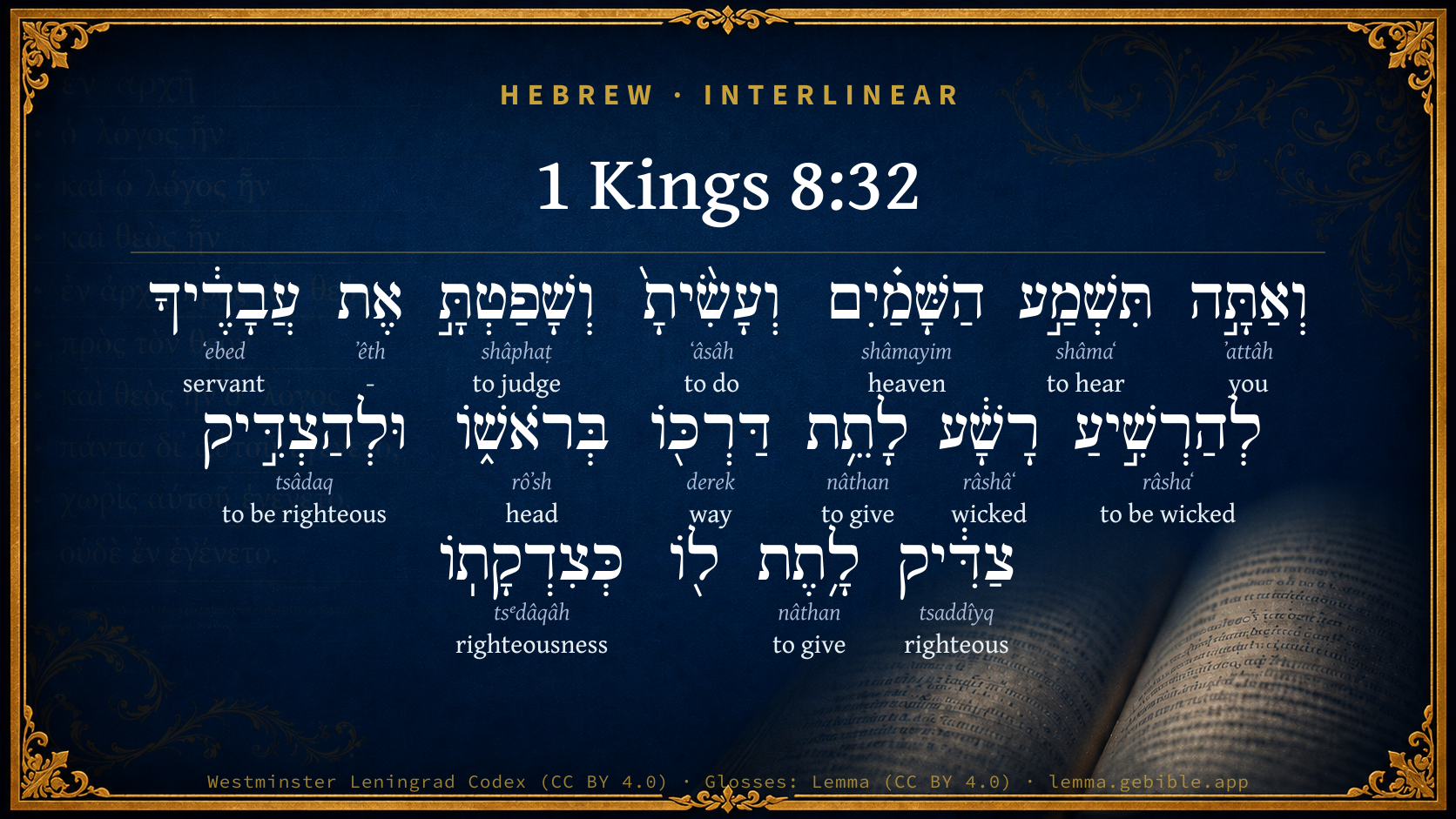
1 Kings 8:32

Hebrew (Westminster Leningrad Codex) 1 Kings 8:32 appears in the Hebrew Old Testament. The text above is from the Westminster Leningrad Codex. Each word links to its Strong’s number, a concise gloss, and parsing drawn from the Open Scriptures Hebrew Bible morphology. Click any word for its full Brown-Driver-Briggs (BDB) entry.
Download image
Cite this verse

1 Kings 8:32 (World English Bible). Public Domain. Lemma interlinear Bible study tool, https://lemma.gebible.app/v/1-kings/8/32.

Show BibTeX & RIS
BibTeX
RIS
English Translation
then hear you in heaven, and do, and judge your servants, condemning the wicked, to bring his way on his own head, and justifying the righteous, to give him according to his righteousness.
World English Bible · Public Domain
Download a study sheet

One document with this verse’s original text, its word-by-word gloss line, the meaning frame, cross-references with their text, attributed commentary, and full source and license credits — printable, and it pastes into notes with its structure intact.

This verse Autodidact and up

Study sheet (.html) Plain text (.txt)

A passage Seminary Student

Up to 50 verses in one chapter. A passage sheet keeps up to 6 commentary sources and 12 cross-references per verse, in the order this page ranks them, and says so on the sheet whenever that leaves anything out. Ask for a single verse and you get the Autodidact verse sheet above.

Everything on this page stays free to read, with no account — the sheet is a download of what is already on screen, not access to it.

Want to remove ads? Support Godless Engineer
Compare translations 3

The same verse in 3 English versions, stacked beneath the original-language interlinear above. Click any original word for its lexicon entry.

Each is an independent rendering of the whole verse — the interlinear is not word-aligned to these translations.

Highlighted words mark where these versions differ — a whole-verse word diff, not a word-by-word alignment.

  • World English Bible Public Domain
    then hear you in heaven, and do, and judge your servants, condemning the wicked, to bring his way on his own head, and justifying the righteous, to give him according to his righteousness.
  • King James Version Public Domain
    Then hear thou in heaven, and do, and judge thy servants, condemning the wicked, to bring his way upon his head; and justifying the righteous, to give him according to his righteousness.
  • unfoldingWord Literal Text CC BY-SA 4.0
    then you, may you hear the heavens and act and judge your servants, to condemn the wicked, to put his way on his head, and to acquit the righteous, to give to him according to his righteousness.

unfoldingWord Literal Text — © unfoldingWord, licensed CC BY-SA 4.0. Word-aligned USFM3 via Door43 (git.door43.org/unfoldingWord/en_ult).

Versions to compare (up to 4)

3 of 4 selected

Show all 18 translations

Every available English version of this verse, each an independent rendering of the whole verse.

  • World English Bible Public Domain
    then hear you in heaven, and do, and judge your servants, condemning the wicked, to bring his way on his own head, and justifying the righteous, to give him according to his righteousness.
  • Berean Standard Bible Public Domain
    then may You hear from heaven and act. May You judge Your servants, condemning the wicked man by bringing down on his own head what he has done, and justifying the righteous man by rewarding him according to his righteousness.
  • Majority Standard Bible Public Domain
    then may You hear from heaven and act. May You judge Your servants, condemning the wicked man by bringing down on his own head what he has done, and justifying the righteous man by rewarding him according to his righteousness.
  • King James Version Public Domain
    Then hear thou in heaven, and do, and judge thy servants, condemning the wicked, to bring his way upon his head; and justifying the righteous, to give him according to his righteousness.
  • American Standard Version (1901) Public Domain
    then hear thou in heaven, and do, and judge thy servants, condemning the wicked, to bring his way upon his own head, and justifying the righteous, to give him according to his righteousness.
  • Revised Version (1885) Public Domain
    then hear thou in heaven, and do, and judge thy servants, condemning the wicked, to bring his way upon his own head; and justifying the righteous, to give him according to his righteousness.
  • Geneva Bible (1599) Public Domain
    Then heare thou in heauen, and doe and iudge thy seruants, that thou condemne the wicked to bring his way vpon his head, and iustifie the righteous, to giue him according to his righteousnesse.
  • Douay-Rheims (1899) Public Domain
    Then hear thou in heaven: and do, and judge thy servants, condemning the wicked, and bringing his way upon his own head, and justifying the just, and rewarding him according to his justice.
  • Young's Literal Translation Public Domain
    then Thou dost hear in the heavens, and hast done, and hast judged Thy servants, to declare wicked the wicked, to put his way on his head, and to declare righteous the righteous, to give him according to his righteousness.
  • Literal Standard Version CC BY-SA 4.0
    then You hear in the heavens, and have done, and have judged Your servants, to declare wicked the wicked, to put his way on his [own] head, and to declare righteous the righteous, to give him according to his righteousness.
  • Unlocked Literal Bible CC BY-SA 4.0
    listen from the heavens and act. Judge your servants, condemning the guilty and bringing what he has done upon his own head. Declare the innocent not guilty and give to him according to his righteousness.
  • unfoldingWord Literal Text CC BY-SA 4.0
    then you, may you hear the heavens and act and judge your servants, to condemn the wicked, to put his way on his head, and to acquit the righteous, to give to him according to his righteousness.
  • Darby Bible Public Domain
    then hear thou in the heavens, and do, and judge thy servants, condemning the wicked, to bring his way upon his own head; and justifying the righteous, giving him according to his righteousness.
  • World Messianic Bible Public Domain
    then hear in heaven, and act, and judge your servants, condemning the wicked, to bring his way on his own head, and justifying the righteous, to give him according to his righteousness.
  • Webster's Bible Public Domain
    Then hear thou in heaven, and do, and judge thy servants, condemning the wicked, to bring his way upon his head; and justifying the righteous, to give him according to his righteousness.
  • Free Bible Version CC BY-SA 4.0
    listen from heaven—act and judge your servants. Pay back the guilty; vindicate and reward those who do right.
  • Bible in Basic English Public Domain
    Then let your ear be open in heaven, and be the judge of your servants, giving your decision against the wrongdoer, so that punishment for his sins may come on his head; and, by your decision, keeping from evil him who has done no wrong.
  • JPS Tanakh (1917) Public Domain
    then hear Thou in heaven, and do, and judge Thy servants, condemning the wicked, to bring his way upon his own head; and justifying the righteous, to give him according to his righteousness.

Literal Standard Version (2020), Covenant Press — licensed CC BY-SA 4.0. Text via the HelloAO Bible API (eBible.org). Unlocked Literal Bible (unfoldingWord) — licensed CC BY-SA 4.0. Text via the HelloAO Bible API (eBible.org). unfoldingWord Literal Text — © unfoldingWord, licensed CC BY-SA 4.0. Word-aligned USFM3 via Door43 (git.door43.org/unfoldingWord/en_ult). Free Bible Version, Dr. Jonathan Gallagher — licensed CC BY-SA 4.0. Text via the HelloAO Bible API (eBible.org).

Word by word

More ways to search: Search by grammar → Find every occurrence → Compare this word →

Practice this passage: Drill this verse → Learn its vocabulary →

לְהַרְשִׁ֣יעַ
râshaʻ
H7561
“to be wicked”
Preposition + Verb, Hiphil, Infinitive Construct
Part of Speech
Preposition + Verb
Stem
Hiphil
Form
Infinitive Construct
Full BDB Definition

Origin: a primitive root

TWOT: 2222

to be wicked, act wickedly - (Qal) - to be wicked, act wickedly - to be guilty, be condemned - (Hiphil) - to condemn as guilty (in civil relations) - to condemn as guilty (in ethical or religious relations) - to act wickedly (in ethics and religion)
  1. וְאַתָּ֣ה ʼattâh H859 “and · you” Conjunction + Pronoun, Personal, 2nd Person, Masculine, Singular
  2. תִּשְׁמַ֣ע shâmaʻ H8085 “to hear” Verb, Qal, Imperfect, 2nd Person, Masculine, Singular
  3. הַשָּׁמַ֗יִם shâmayim H8064 “the · heaven(s)” Particle, Definite Article + Noun, Common, Masculine, Plural, Absolute
  4. וְעָשִׂ֨יתָ֙ ʻâsâh H6213 “and · to do” Conjunction + Verb, Qal, Sequential Perfect, 2nd Person, Masculine, Singular
  5. וְשָׁפַטְתָּ֣ shâphaṭ H8199 “and · to judge” Conjunction + Verb, Qal, Sequential Perfect, 2nd Person, Masculine, Singular
  6. אֶת ʼêth H853 “-” Particle, Direct Object
  7. עֲבָדֶ֔יךָ ʻebed H5650 “servants · your” Noun, Common, Masculine, Plural, Construct + Suffix, Personal, 2nd Person, Masculine, Singular
  8. רָשָׁ֔ע râshâʻ H7563 “wicked” Adjective, Adjective, Masculine, Singular, Absolute
  9. לָתֵ֥ת nâthan H5414 “to give” Preposition + Verb, Qal, Infinitive Construct
  10. דַּרְכּ֖וֹ derek H1870 “way · his” Noun, Common, Both, Singular, Construct + Suffix, Personal, 3rd Person, Masculine, Singular
  11. בְּרֹאשׁ֑וֹ rôʼsh H7218 “in/at · head · his” Preposition + Noun, Common, Masculine, Singular, Construct + Suffix, Personal, 3rd Person, Masculine, Singular
  12. וּלְהַצְדִּ֣יק tsâdaq H6663 “and · to be righteous” Conjunction + Preposition + Verb, Hiphil, Infinitive Construct
  13. צַדִּ֔יק tsaddîyq H6662 “righteous” Adjective, Adjective, Masculine, Singular, Absolute
  14. לָ֥תֶת nâthan H5414 “to give” Preposition + Verb, Qal, Infinitive Construct
  15. כְּצִדְקָתֽוֹ tsᵉdâqâh H6666 “like/as · righteousness · his” Preposition + Noun, Common, Feminine, Singular, Construct + Suffix, Personal, 3rd Person, Masculine, Singular

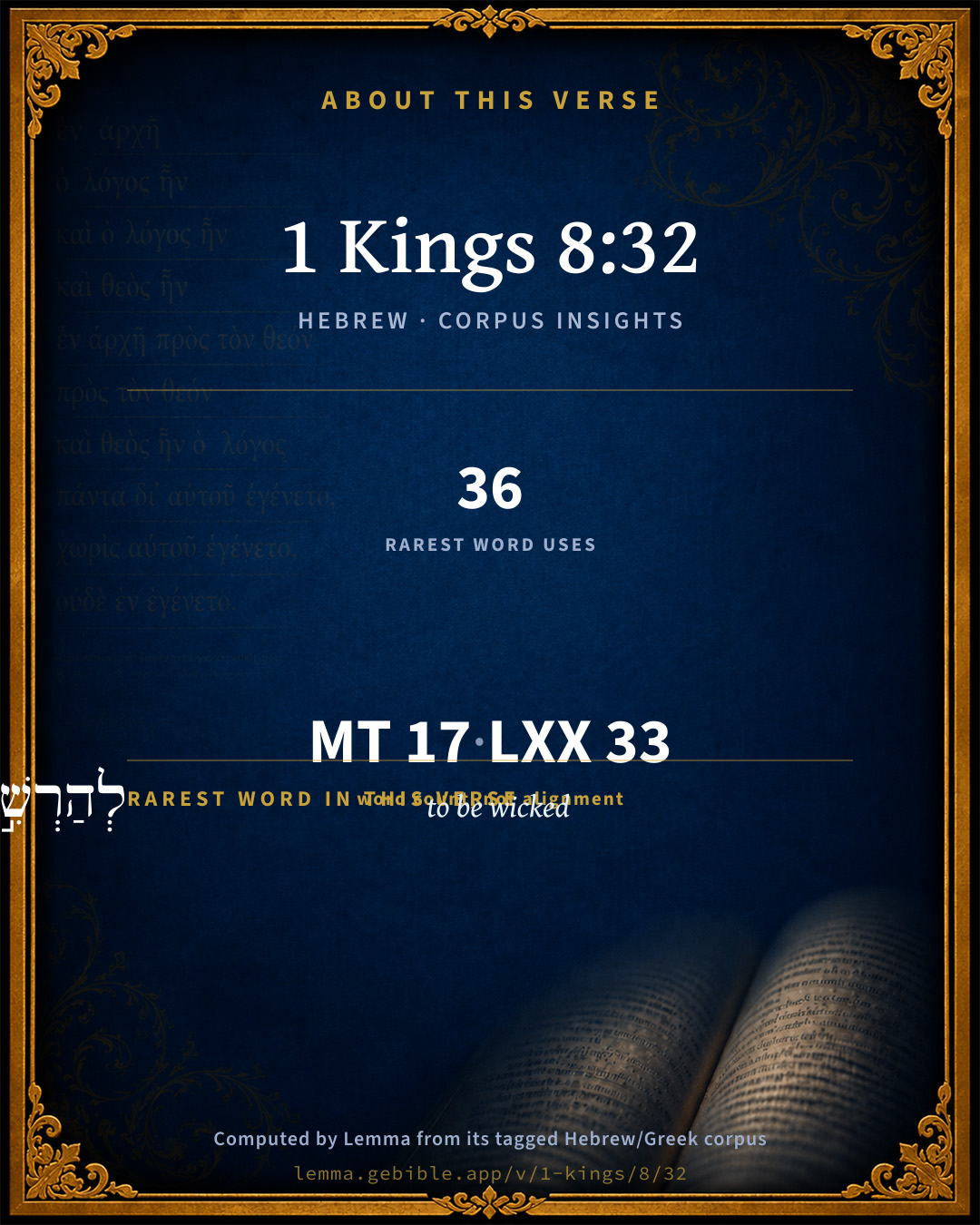
About this verse

These counts appear in no published source. They are computed here, from the morphology-tagged text and Lemma’s own curated glosses. What Lemma adds →

17
words
15
distinct lemmas
Historical
section

Shared distinctive vocabulary

לְהַרְשִׁ֣יעַ to be wicked H7561 occurs in 35 verses of the Hebrew Bible. Also found in:

Grammatical profile

  • 7 verbs
  • 5 nouns
  • 2 adjectives
  • 1 pronoun
  • 1 preposition
  • 1 particle

Verb forms

  • תִּשְׁמַ֣ע Qal · Imperfect
  • וְעָשִׂ֨יתָ֙ Qal · Sequential Perfect
  • וְשָׁפַטְתָּ֣ Qal · Sequential Perfect
  • לְהַרְשִׁ֣יעַ Hiphil · Infinitive Construct
  • לָתֵ֥ת Qal · Infinitive Construct
  • וּלְהַצְדִּ֣יק Hiphil · Infinitive Construct
  • לָ֥תֶת Qal · Infinitive Construct

Repetition

A word recurs within this verse — often emphatic in Hebrew:

  • לָתֵ֥ת to give H5414 ×2

Hebrew & Septuagint length

In English translation the verse runs 33 words from the Hebrew and 41 from the Septuagint (LXX English) — closely comparable.

A rough comparison of the two English renderings, which tokenize alike — not a word-level alignment.

Word counts can differ between the Hebrew and the Greek without any difference in meaning — e.g. the Hebrew direct-object marker אֵת has no separate Greek word, and Greek often adds the article ὁ.

In the original languages it is 17 Hebrew tokens and 33 Greek tokens — but the two are counted differently (Hebrew bundles its prefixes and suffixes into one token; the Greek is in lemma form), so that isn’t a like-for-like length.

Cross-references

13

Topical passages linked to 1 Kings 8:32 in the Treasury of Scripture Knowledge — connected by theme and wording, ordered by reader-vote popularity; previews shown in the World English Bible.

  • Deuteronomy 25:1 If there be a controversy between men, and they come to judgment, and [the judges] judge them; then they shall justify the righteous, and condemn the wicked;
  • Exodus 34:7 keeping loving kindness for thousands, forgiving iniquity and disobedience and sin; and that will by no means clear the guilty, visiting the iniquity of the fathers on the children, and on the children's children, on the third and on the fourth generation."
  • Isaiah 3:10–11 Tell the righteous "Good!" For they shall eat the fruit of their deeds.
  • Ezekiel 18:13 has given forth on interest, and has taken increase; shall he then live? he shall not live: he has done all these abominations; he shall surely die; his blood shall be on him.
  • Ezekiel 18:20 The soul who sins, he shall die: the son shall not bear the iniquity of the father, neither shall the father bear the iniquity of the son; the righteousness of the righteous shall be on him, and the wickedness of the wicked shall be on him.
  • Romans 2:6–10 who "will pay back to everyone according to their works:"
  • Exodus 23:7 "Keep far from a false charge, and don't kill the innocent and righteous: for I will not justify the wicked.
  • Numbers 5:27 When he has made her drink the water, then it shall happen, if she is defiled, and has committed a trespass against her husband, that the water that causes the curse will enter into her and become bitter, and her body will swell, and her thigh will fall away: and the woman will be a curse among her people.
  • Proverbs 1:31 Therefore they will eat of the fruit of their own way, And be filled with their own schemes.
  • Proverbs 17:15 He who justifies the wicked, and he who condemns the righteous, Both of them alike are an abomination to Yahweh.
  • Ezekiel 18:30 Therefore I will judge you, house of Israel, everyone according to his ways, says the Lord Yahweh. Return you, and turn yourselves from all your transgressions; so iniquity shall not be your ruin.
  • Romans 2:13 For it isn't the hearers of the law who are righteous before God, but the doers of the law will be justified
  • Romans 7:9 I was alive apart from the law once, but when the commandment came, sin revived, and I died.

Cross-references courtesy of OpenBible.info (CC BY 4.0).

Hebrew and Greek witnesses Masoretic Hebrew ↔ Greek Septuagint

The same verse in the two great witnesses to the Old Testament, shown verse-for-verse.

These are two independent witnesses, not word-aligned to each other, and the Septuagint is shown in lemma (dictionary) form.

Hebrew 1 Kings 8:32 Masoretic · Westminster Leningrad Codex

וְאַתָּ֣ה תִּשְׁמַ֣ע הַשָּׁמַ֗יִם וְעָשִׂ֨יתָ֙ וְשָׁפַטְתָּ֣ אֶת עֲבָדֶ֔יךָ לְהַרְשִׁ֣יעַ רָשָׁ֔ע לָתֵ֥ת דַּרְכּ֖וֹ בְּרֹאשׁ֑וֹ וּלְהַצְדִּ֣יק צַדִּ֔יק לָ֥תֶת ל֖וֹ כְּצִדְקָתֽוֹ

then hear you in heaven, and do, and judge your servants, condemning the wicked, to bring his way on his own head, and justifying the righteous, to give him according to his righteousness.

World English Bible · Public Domain

Greek LXX 1 Kings 8:32 Septuagint · lemma form

καί σύ εἰςἀκούω ἐκ ὁ οὐρανός καί ποιέω καί κρίνω ὁ λαός σύ ἰσραήλ ἀνομέω ἄνομος δίδωμι ὁ ὁδός αὐτός εἰς κεφαλή αὐτός καί ὁ δικαιόω δίκαιος δίδωμι αὐτός κατά ὁ δικαιοσύνη αὐτός

then shall you hear from heaven, and do, and you shall judge your people Israel, that the wicked should be condemned, to recompense his way upon his head; and to justify the righteous, to give to him according to his righteousness.

LXX2012 (modern English Septuagint) · Public Domain

Hebrew: Westminster Leningrad Codex (CC BY 4.0). Greek: Septuagint (public domain); English from LXX2012 (modern English Septuagint) (Public Domain). How the Septuagint differs from the Hebrew →

Targum (Aramaic paraphrase)

1

The Targum is the ancient Jewish Aramaic paraphrase of the Hebrew Scriptures — an interpretive translation, not the Hebrew text itself. Onkelos (literal) and Pseudo-Jonathan (expansive) render the Torah, and Jonathan the Prophets. Coverage is partial: where no permissively-licensed English translation exists for a verse, only the Aramaic is shown. This is verse-level text, not a word-by-word alignment to the Hebrew.

  1. Targum Jonathan Prophets (Joshua–Malachi)
    וְאַתְּ תְּקַבֵּל מִן שְׁמַיָא וְתַעְבֵּיד וּתְדִין יַת עַבְדָךְ לְחַיָבָא חַיָבָא לְמִתַּן אוֹרְחֵיהּ בְּרֵישֵׁיהּ וּלְזַכָּאָה זַכָּאָה לְמִתַּן לֵיהּ כִּזְכוּתֵיהּ:

    (no public-domain English translation for this verse)

    Targum Jonathan — Aramaic: “Mikraot Gedolot” (public domain). English: “Sefaria Community Translation” (CC0 1.0 (public-domain dedication)); “London "Chaldee Paraphrase," 1871” (public domain). Text via Sefaria.

Commentary

Notes on 1 Kings 8:32 from classic Christian and Jewish commentators (each source and its license shown beneath its notes). The classic Christian expositions comment on the surrounding passage and are grouped to its opening verse, so a note may address several verses; the Jewish commentaries on the Tanakh (Rashi and others) are per-verse, so they appear only where the commentator wrote on this verse.

Lemma curates 59 commentaries, every one of them public domain or Creative Commons licensed, each selected and text-cleaned for this edition rather than reprinted as found. About our sources →

Trapp's Complete Commentary

John Trapp

1Ki 8:32 Then hear thou in heaven, and do, and judge thy servants, condemning the wicked, to bring his way upon his head; and justifying the righteous, to give him according to his righteousness.

Ver. 32. Condemning the wicked, to bring his way upon his head.] This God hath done on those who have taken false oaths of execration, as were easy to instance in the three false accusers of Narcissus, bishop of Jerusalem; {a} in Earl Godwin; and in Anne Averies, who, forswearing herself, A.D. 1575, Feb. 11, at a shop of Wood Street in London, praying God she might sink where she stood if she had not paid for the wares she took, fell down presently speechless, and with horrible stink died.

{a} Euseb.

John Trapp, A Commentary or Exposition upon All the Books of the Old and New Testament (1647–1656) — public domain. Text from a community e-Sword module.

Joseph Benson's Commentary

1Ki 8:32. Then hear thou in heaven, and do, and judge — Discover the truth, and judge between the contending parties. He prays that in difficult matters his throne of grace might be a throne of judgment, from which God would right the injured that believingly appealed to it; and punish the injurious that presumptuously appealed to it. To bring his way upon his head — The just recompense of his wicked action and course. And justifying the righteous, to give him, &c. — To vindicate him, and manifest his integrity.

Joseph Benson's Commentary on the Old and New Testaments (1811–1818) — public domain. Text from a community e-Sword module.

Geneva Bible (1599)

Geneva Bible translators

That is, make it known.

Geneva Bible (1599) marginal notes — public domain. Text via Bolls.life.

The Cambridge Bible for Schools and Colleges

gen. ed. J. J. S. Perowne

32. then hear thou in heaven] As the truth in such a case as is supposed can be known to God alone, He is prayed to act the part assigned to judges in the Law (cf. Deu_25:1) and to make known in His own way which persons take the oath justly, and which unjustly. The close imitation of the language of Deuteronomy deserves to be noticed.

The Cambridge Bible for Schools and Colleges (gen. ed. J. J. S. Perowne; Cambridge University Press, 1878–1918) — public domain. Text from a community e-Sword module.

John Gill's Exposition

Then hear thou in heaven,.... When the injured person makes supplication to have justice done him:

and do, and judge thy servants; contending with one another, the one affirming, the other denying

condemning the wicked, by bringing his way upon his head: inflicting upon him the punishment imprecated by him in his oath:

and justifying the righteous, to give him according to his righteousness; by making it appear that his cause is just.

John Gill's Exposition of the Whole Bible (1746–1763) — public domain (CC PDM 1.0). Text via the HelloAO Bible API.

Haydock's Catholic Bible Commentary

Justice. A reward is clearly promised to good works. (Worthington)

George Leo Haydock (1774–1849), Haydock's Catholic Family Bible and Commentary, 1859 edition — public domain. Excludes Psalms (Douay-Rheims chapter numbering differs from Protestant) and Deuterocanonical books (Catholic canon only).

Matthew Poole's English Annotations

To bring his way, i.e. the just recompence of his wicked action and course.

Justifying the righteous, to give him according to his righteousness; to vindicate him, and to manifest his integrity.

Matthew Poole's English Annotations on the Holy Bible (1683–1685) — public domain. Text from a community e-Sword/MySword module.

Whedon's Commentary on the Bible

Daniel D. Whedon

32. Judge thy servants — Human tribunals often clear the guilty and condemn the righteous, but Solomon prays that in every case of oaths concerning trespass brought before that altar, the right may be vindicated.

Daniel D. Whedon (gen. ed.), Commentary on the Old and New Testaments (1874–1909) — public domain. Text from a community e-Sword module.

The Pulpit Commentary

Then hear thou in heaven Heb. and thou, thou wilt hear the heavens. The same expression, mvT, is found in vers. 34, 36, 39. See Ewald, 300 a. Keil sees in it the adverbial use of the accusative. Most of the versions read "from heaven," as does the Chronicles and one MS., and do i.e., act and judge thy servants, condemning Heb. to make (i.e., prove) wicked the wicked, to bring Heb. give, same word as below his way i.e., works, fruits upon his head cf. Eze_9:10 Eze_11:21; same expression and justifying Heb. to make righteous. Cf. dikaioun in N.T. and justum facere the righteous cognate words are used in both cases, to give him according to his righteousness.

The second special petition contemplates the case, which was morally certain to occur, of Hebrews taken captive in war and carried to a foreign land. To be separated from the commonwealth, the rites and the blessings of Israel, was one of the greatest calamities which could befal a Jew, (Deu_4:27, 28 Lev_26:33 Ps 137) and as such Solomon gives it a prominent place in his prayer. The connexion, how. ever which some have imagined to exist between this prayer and the preceding, viz., that that referred to internal, this to external dangers, is too artificial to have found a place in Solomon"s thoughts.

The Pulpit Commentary (1880–1919), ed. H.D.M. Spence-Jones & Joseph S. Exell — public domain. Text from a community e-Sword module.

John Wesley's Explanatory Notes

His way - The just recompence of his wicked action. Give him, &c. - To vindicate him, and manifest his integrity.

John Wesley, Explanatory Notes Upon the Whole Bible (1754–1765) — public domain. Text via the GEBible commentary corpus.

Rashi

Rabbi Shlomo Yitzchaki (Rashi)

To set his [evil] way upon his head. “And her abdomen will swell, etc.”

And to justify the righteous one. “Then she will be cleared, and shall bear seed.” Thus it is expounded in the Tosefta of Maseches Sotah.

Rashi on the Tanakh — English translations: “The Judaica Press complete Tanach with Rashi, translated by A. J. Rosenberg” (CC BY 4.0); “Pentateuch with Rashi's commentary by M. Rosenbaum and A.M. Silbermann, 1929-1934” (public domain); “The Metsudah Tanach series, Lakewood, N.J” (CC BY 4.0); and “The Book of Joshua, Metsudah Publications, 1997” (CC BY 4.0). Text via Sefaria.

Lesson kit

Teaching starters — assembled from the data on this page, not authored interpretation. Every prompt links to the verse data it draws on. Edit before teaching.

1 Kings, in the Historical, opens this verse with 17 words (15 distinct Hebrew lemmas). Its most distinctive word is râshaʻ (“to be wicked”). A historical commentator’s framing appears above. Read the whole chapter for the surrounding context.

Discussion questions

  1. How does “to be wicked” (râshaʻ) shape what this verse is saying?
  2. Exodus 22:9 shares the word «to be wicked» with this verse. How do the two illuminate each other?
  3. “to give” occurs 2× in this one verse. What is the effect of the repetition?
  4. The translations on this page render this verse differently — a whole-verse word diff, not a word-by-word alignment. What might account for the different wordings?
  5. The verb «תִּשְׁמַ֣ע» is Qal Imperfect. How does its form color the action?
  6. Reading how Trapp's Complete Commentary and Joseph Benson's Commentary read this verse, where do the two commentators agree and where do they part?

Things to notice

Reading settings

Reading text

Shown beneath each verse's original-language words.

Old Testament
Old Testament edition

Read the OT as the Masoretic Hebrew (MT) or the Greek Septuagint (LXX).

English shown for the Greek Septuagint (in the Hebrew ↔ Greek comparison).

Comparing translations? Open the Compare panel on any verse page to stack up to four side by side.