Job 21:17

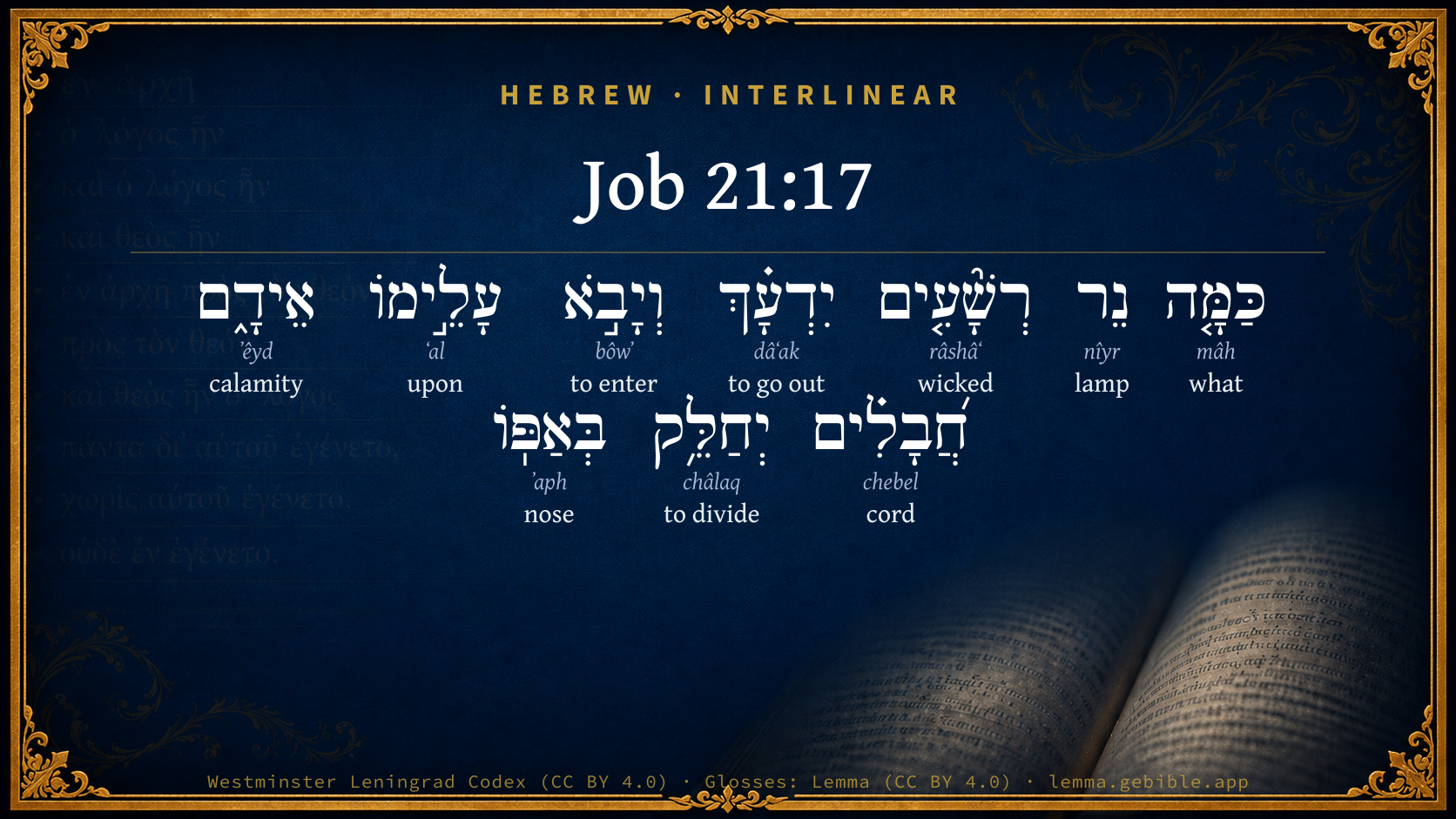
Hebrew (Westminster Leningrad Codex) Job 21:17 appears in the Hebrew Old Testament. The text above is from the Westminster Leningrad Codex. Each word links to its Strong’s number, a concise gloss, and parsing drawn from the Open Scriptures Hebrew Bible morphology. Click any word for its full Brown-Driver-Briggs (BDB) entry.
Download image
Cite this verse

Job 21:17 (World English Bible). Public Domain. Lemma interlinear Bible study tool, https://lemma.gebible.app/v/job/21/17.

Show BibTeX & RIS
BibTeX
RIS
English Translation
"How often is it that the lamp of the wicked is put out? That their calamity comes on them? That God distributes sorrows in his anger?
World English Bible · Public Domain
Download a study sheet

One document with this verse’s original text, its word-by-word gloss line, the meaning frame, cross-references with their text, attributed commentary, and full source and license credits — printable, and it pastes into notes with its structure intact.

This verse Autodidact and up

Study sheet (.html) Plain text (.txt)

A passage Seminary Student

Up to 50 verses in one chapter. A passage sheet keeps up to 6 commentary sources and 12 cross-references per verse, in the order this page ranks them, and says so on the sheet whenever that leaves anything out. Ask for a single verse and you get the Autodidact verse sheet above.

Everything on this page stays free to read, with no account — the sheet is a download of what is already on screen, not access to it.

Want to remove ads? Support Godless Engineer
Compare translations 3

The same verse in 3 English versions, stacked beneath the original-language interlinear above. Click any original word for its lexicon entry.

Each is an independent rendering of the whole verse — the interlinear is not word-aligned to these translations.

Highlighted words mark where these versions differ — a whole-verse word diff, not a word-by-word alignment.

  • World English Bible Public Domain
    "How often is it that the lamp of the wicked is put out? That their calamity comes on them? That God distributes sorrows in his anger?
  • King James Version Public Domain
    How oft is the candle of the wicked put out! and how oft cometh their destruction upon them! God distributeth sorrows in his anger.
  • unfoldingWord Literal Text CC BY-SA 4.0
    How often does the lamp of the wicked go out, or does their calamity come upon them? in his nose, does he distribute pains?

unfoldingWord Literal Text — © unfoldingWord, licensed CC BY-SA 4.0. Word-aligned USFM3 via Door43 (git.door43.org/unfoldingWord/en_ult).

Versions to compare (up to 4)

3 of 4 selected

Show all 18 translations

Every available English version of this verse, each an independent rendering of the whole verse.

  • World English Bible Public Domain
    "How often is it that the lamp of the wicked is put out? That their calamity comes on them? That God distributes sorrows in his anger?
  • Berean Standard Bible Public Domain
    How often is the lamp of the wicked put out? Does disaster come upon them? Does God, in His anger, apportion destruction?
  • Majority Standard Bible Public Domain
    How often is the lamp of the wicked put out? Does disaster come upon them? Does God, in His anger, apportion destruction?
  • King James Version Public Domain
    How oft is the candle of the wicked put out! and how oft cometh their destruction upon them! God distributeth sorrows in his anger.
  • American Standard Version (1901) Public Domain
    How oft is it that the lamp of the wicked is put out? That their calamity cometh upon them? That `God' distributeth sorrows in his anger?
  • Revised Version (1885) Public Domain
    How oft is it that the lamp of the wicked is put out? that their calamity cometh upon them? that God distributeth sorrows in his anger?
  • Geneva Bible (1599) Public Domain
    How oft shall the candle of the wicked be put out? and their destruction come vpon them? he wil deuide their liues in his wrath.
  • Douay-Rheims (1899) Public Domain
    How often shall the lamp of the wicked be put out, and a deluge come upon them, and he shall distribute the sorrows of his wrath?
  • Young's Literal Translation Public Domain
    How oft is the lamp of the wicked extinguished, And come on them doth their calamity? Pangs He apportioneth in His anger.
  • Literal Standard Version CC BY-SA 4.0
    How often is the lamp of the wicked extinguished, || And their calamity comes on them? He apportions pangs in His anger.
  • Unlocked Literal Bible CC BY-SA 4.0
    How often is it that the lamp of wicked people is put out, or that their calamity comes upon them? How often does it happen that God distributes sorrows to them in his anger?
  • unfoldingWord Literal Text CC BY-SA 4.0
    How often does the lamp of the wicked go out, or does their calamity come upon them? in his nose, does he distribute pains?
  • Darby Bible Public Domain
    How often is the lamp of the wicked put out, and cometh their calamity upon them? Doth he distribute sorrows [to them] in his anger?
  • World Messianic Bible Public Domain
    “How often is it that the lamp of the wicked is put out, that their calamity comes on them, that God distributes sorrows in his anger?
  • Webster's Bible Public Domain
    How oft is the candle of the wicked put out? and how oft cometh their destruction upon them? God distributeth sorrows in his anger.
  • Free Bible Version CC BY-SA 4.0
    How often is the lamp of the wicked snuffed out? How often does disaster come upon them? How often does God punish the wicked in his anger?
  • Bible in Basic English Public Domain
    How frequently is the light of the evil-doers put out, or does trouble come on them? how frequently does his wrath take them with cords?
  • JPS Tanakh (1917) Public Domain
    How oft is it that the lamp of the wicked is put out? that their calamity cometh upon them? that He distributeth pains in His anger?

Literal Standard Version (2020), Covenant Press — licensed CC BY-SA 4.0. Text via the HelloAO Bible API (eBible.org). Unlocked Literal Bible (unfoldingWord) — licensed CC BY-SA 4.0. Text via the HelloAO Bible API (eBible.org). unfoldingWord Literal Text — © unfoldingWord, licensed CC BY-SA 4.0. Word-aligned USFM3 via Door43 (git.door43.org/unfoldingWord/en_ult). Free Bible Version, Dr. Jonathan Gallagher — licensed CC BY-SA 4.0. Text via the HelloAO Bible API (eBible.org).

Word by word

More ways to search: Search by grammar → Find every occurrence → Compare this word →

Practice this passage: Drill this verse → Learn its vocabulary →

יִדְעָ֗ךְ
dâʻak
H1846
“to go out”
Verb, Qal, Imperfect, 3rd Person, Masculine, Singular
Part of Speech
Verb
Stem
Qal
Form
Imperfect
Person
3rd Person
Gender
Masculine
Number
Singular
Full BDB Definition

Origin: a primitive root

TWOT: 445

to go out, be extinguished, dry up - (Qal) to go out, be extinguished - (Niphal) to be made extinct, be dried up - (Pual) to be extinguished, be quenched
  1. כַּמָּ֤ה mâh H4100 “like/as · what” Preposition + Particle, Interrogative
  2. נֵר nîyr H5216 “lamp of” Noun, Common, Masculine, Singular, Construct
  3. רְשָׁ֘עִ֤ים râshâʻ H7563 “wicked” Adjective, Adjective, Masculine, Plural, Absolute
  4. וְיָבֹ֣א bôwʼ H935 “and · to enter” Conjunction + Verb, Qal, Imperfect, 3rd Person, Masculine, Singular
  5. עָלֵ֣ימוֹ ʻal H5921 “upon · them” Preposition + Suffix, Personal, 3rd Person, Masculine, Plural
  6. אֵידָ֑ם ʼêyd H343 “calamity · their” Noun, Common, Masculine, Singular, Construct + Suffix, Personal, 3rd Person, Masculine, Plural
  7. חֲ֝בָלִ֗ים chebel H2256 “cords” Noun, Common, Masculine, Plural, Absolute
  8. יְחַלֵּ֥ק châlaq H2505 “to divide” Verb, Piel, Imperfect, 3rd Person, Masculine, Singular
  9. בְּאַפּֽוֹ ʼaph H639 “in/at · nose · his” Preposition + Noun, Common, Masculine, Singular, Construct + Suffix, Personal, 3rd Person, Masculine, Singular

About this verse

These counts appear in no published source. They are computed here, from the morphology-tagged text and Lemma’s own curated glosses. What Lemma adds →

10
words
10
distinct lemmas
Wisdom
section

Notable vocabulary

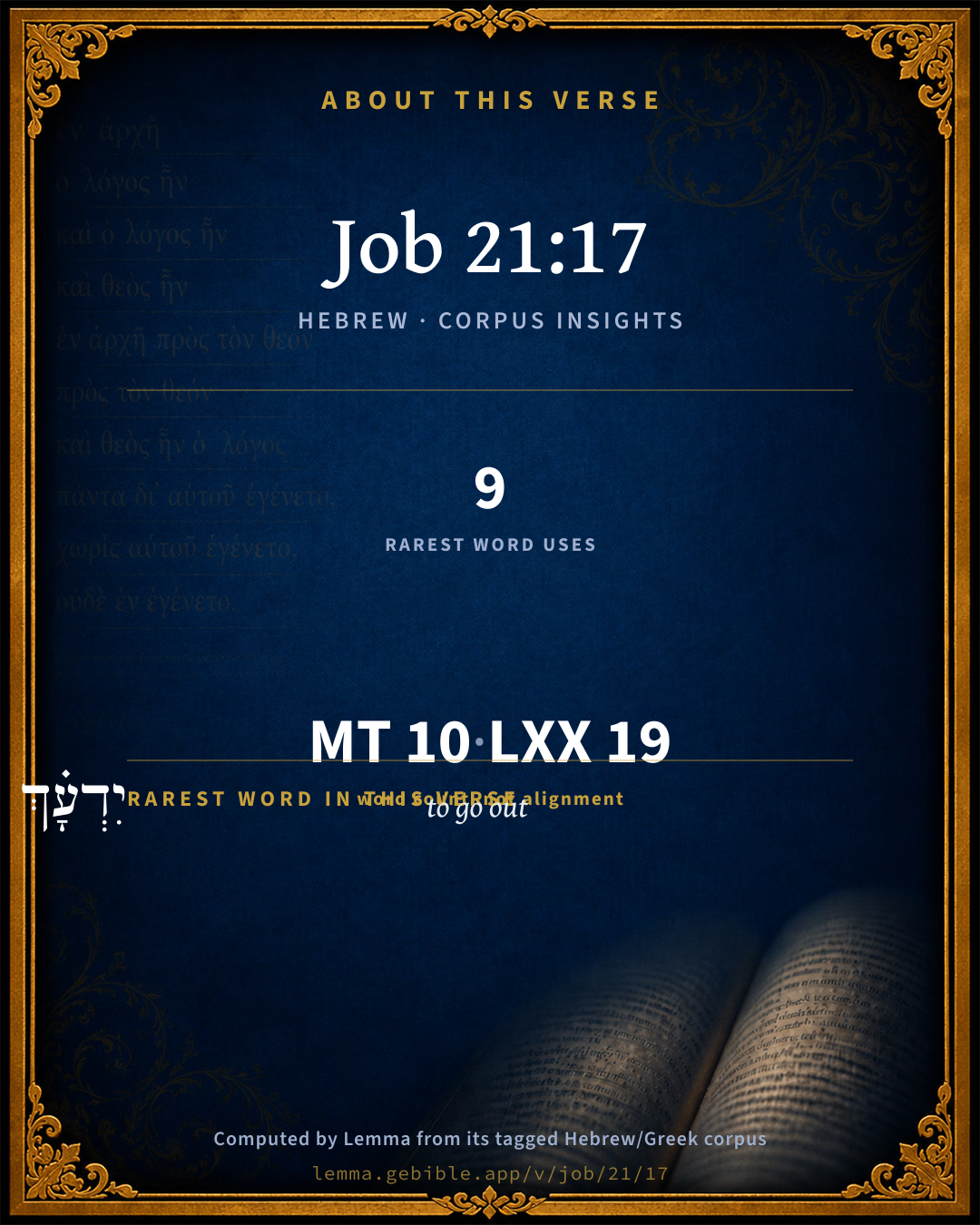
The rarest word here is יִדְעָ֗ךְ to go out H1846 — appearing just 9 times in the whole Hebrew Bible.

Shared distinctive vocabulary

יִדְעָ֗ךְ to go out H1846 occurs in 9 verses of the Hebrew Bible. Also found in:

Grammatical profile

  • 3 verbs
  • 4 nouns
  • 1 adjective
  • 1 preposition
  • 1 particle

Verb forms

  • יִדְעָ֗ךְ Qal · Imperfect
  • וְיָבֹ֣א Qal · Imperfect
  • יְחַלֵּ֥ק Piel · Imperfect

Hebrew & Septuagint length

In English translation the verse runs 26 words from the Hebrew and 24 from the Septuagint (LXX English) — closely comparable.

A rough comparison of the two English renderings, which tokenize alike — not a word-level alignment.

Word counts can differ between the Hebrew and the Greek without any difference in meaning — e.g. the Hebrew direct-object marker אֵת has no separate Greek word, and Greek often adds the article ὁ.

In the original languages it is 10 Hebrew tokens and 19 Greek tokens — but the two are counted differently (Hebrew bundles its prefixes and suffixes into one token; the Greek is in lemma form), so that isn’t a like-for-like length.

Cross-references

10

Topical passages linked to Job 21:17 in the Treasury of Scripture Knowledge — connected by theme and wording, ordered by reader-vote popularity; previews shown in the World English Bible.

  • Job 18:5–6 "Yes, the light of the wicked shall be put out, The spark of his fire shall not shine.
  • Proverbs 13:9 The light of the righteous shines brightly, But the lamp of the wicked is snuffed out.
  • Proverbs 20:20 Whoever curses his father or his mother, His lamp shall be put out in blackness of darkness.
  • Job 18:18 He shall be driven from light into darkness, And chased out of the world.
  • Psalms 32:10 Many sorrows shall be to the wicked, But he who trusts in Yahweh, loving kindness shall surround him.
  • Psalms 90:7–9 For we are consumed in your anger. We are troubled in your wrath.
  • Proverbs 24:20 For there will be no reward to the evil man; And the lamp of the wicked shall be snuffed out.
  • Matthew 25:8 The foolish said to the wise, 'Give us some of your oil, for our lamps are going out.'
  • Luke 12:46 then the lord of that servant will come in a day when he isn't expecting him, and in an hour that he doesn't know, and will cut him in two, and place his portion with the unfaithful.
  • Romans 2:8–9 but to those who are self-seeking, and don't obey the truth, but obey unrighteousness, will be wrath and indignation,

Cross-references courtesy of OpenBible.info (CC BY 4.0).

Hebrew and Greek witnesses Masoretic Hebrew ↔ Greek Septuagint

The same verse in the two great witnesses to the Old Testament, shown verse-for-verse.

These are two independent witnesses, not word-aligned to each other, and the Septuagint is shown in lemma (dictionary) form.

Hebrew Job 21:17 Masoretic · Westminster Leningrad Codex

כַּמָּ֤ה נֵר רְשָׁ֘עִ֤ים יִדְעָ֗ךְ וְיָבֹ֣א עָלֵ֣ימוֹ אֵידָ֑ם חֲ֝בָלִ֗ים יְחַלֵּ֥ק בְּאַפּֽוֹ

"How often is it that the lamp of the wicked is put out? That their calamity comes on them? That God distributes sorrows in his anger?

World English Bible · Public Domain

Greek LXX Job 21:17 Septuagint · lemma form

οὐ μήν δέ ἀλλά καί ἀσεβής λύχνος σβέννυμι ἐπιἔρχομαι δέ αὐτός ὁ καταστροφή ὠδίν δέ αὐτός ἔχω ἀπό ὀργή

Nevertheless, the lamp of the ungodly also shall be put out, and destruction shall come upon them, and pangs of vengeance shall seize them.

LXX2012 (modern English Septuagint) · Public Domain

On this verse, Keil & Delitzsch discusses the Septuagint’s reading. Read the note in Commentary ↓

Hebrew: Westminster Leningrad Codex (CC BY 4.0). Greek: Septuagint (public domain); English from LXX2012 (modern English Septuagint) (Public Domain). How the Septuagint differs from the Hebrew →

Commentary

Notes on Job 21:17 from classic Christian and Jewish commentators (each source and its license shown beneath its notes). The classic Christian expositions comment on the surrounding passage and are grouped to its opening verse, so a note may address several verses; the Jewish commentaries on the Tanakh (Rashi and others) are per-verse, so they appear only where the commentator wrote on this verse.

Lemma curates 59 commentaries, every one of them public domain or Creative Commons licensed, each selected and text-cleaned for this edition rather than reprinted as found. About our sources →

Matthew Henry's Commentary

Job had largely described the prosperity of wicked people; now, in these verses,

I. He opposes this to what his friends had maintained concerning their certain ruin in this life. "Tell me how often do you see the candle of the wicked put out? Do you not as often see it burnt down to the socket, until it goes out of itself? Job 21:17. How often do you see their destruction come upon them, or God distributing sorrows in his anger among them? Do you not as often see their mirth and prosperity continuing to the last?" Perhaps there are as many instances of notorious sinners ending their days in pomp as ending them in misery, which observation is sufficient to invalidate their arguments against Job and to show that no certain judgment can be made of men's character by their outward condition.

II. He reconciles this to the holiness and justice of God. Though wicked people prosper thus all their days, yet we are not therefore to think that God will let their wickedness always go unpunished. No, 1. Even while they prosper thus they are as stubble and chaff before the stormy wind, Job 21:18. They are light and worthless, and of no account either with God or with wise and good men. They are fitted to destruction, and continually lie exposed to it, and in the height of their pomp and power there is but a step between them and ruin. 2. Though they spend all their days in wealth God is laying up their iniquity for their children (Job 21:19), and he will visit it upon their posterity when they are gone. The oppressor lays up his goods for his children, to make them gentlemen, but God lays up his iniquity for them, to make them beggars. He keeps an exact account of the fathers' sins, seals them up among his treasures (Deu 32:34), and will justly punish the children, while the riches, to which the curse cleaves, are found as assets in their hands. 3. Though they prosper in this world, yet they shall be reckoned with in another world. God rewards him according to his deeds at last (Job 21:19), though the sentence passed against his evil works be not executed speedily. Perhaps he may not now be made to fear the wrath to come, but he may flatter himself with hopes that he shall have peace though he go on; but he shall be made to feel it in the day of the revelation of the righteous judgment of God. He shall know it (Job 21:20): His eyes shall see his destruction which he would not be persuaded to believe. They will not see, but they shall see, Isa 26:11. The eyes that have been wilfully shut against the grace of God shall be opened to see his destruction. He shall drink of the wrath of the Almighty; that shall be the portion of his cup. Compare Psa 11:6 with Rev 14:10. The misery of damned sinners is here set forth in a few words, but very terrible ones. They lie under the wrath of an Almighty God, who, in their destruction, both shows his wrath and makes known his power; and, if this will be his condition in the other world, what good will his prosperity in this world do him? What pleasure has he in his house after him? Job 21:21. Our Saviour has let us know how little pleasure the rich man in hell had in his house after him, when the remembrance of the good things he had received in his life-time would not cool his tongue, but added much to his misery, as did also the sorrow he was in lest his five brethren, whom he left in his house after him, should follow him to that place of torment, Luk 16:25-28. So little will the gain of the world profit him that has lost his soul.

III. He resolves this difference which Providence makes between one wicked man and another into the wisdom and sovereignty of God (Job 21:22): Shall any pretend to teach God knowledge? Dare we arraign God's proceedings or blame his conduct? Shall we take upon us to tell God how he should govern the world, what sinner he should spare and whom he should punish? He has both authority and ability to judge those that are high. Angels in heaven, princes and magistrates on earth, are accountable to God, and must receive their doom from him. He manages them, and makes what use he pleases of them. Shall he then be accountable to us, or receive advice from us? He is the Judge of all the earth, and therefore no doubt he will do right (Gen 18:25, Rom 3:6), and those proceedings of his providence which seem to contradict one another he can make, not only mutually to agree, but jointly to serve his own purposes. The little difference there is between one wicked man's dying so in pain and misery, when both will at last meet in hell, he illustrates by the little difference there is between one man's dying suddenly and another's dying slowly, when they will both meet shortly in the grave. So vast is the disproportion between time and eternity that, if hell be the lot of every sinner at last, it makes little difference if one goes singing thither and another sighing. See,

1. How various the circumstances of people's dying are. There is one way into the world, we say, but many out; yet, as some are born by quick and easy labour, others by that which is hard and lingering, so dying is to some much more terrible than to others; and, since the death of the body is the birth of the soul into another world, death-bed agonies may not unfitly be compared to child-bed throes. Observe the difference. (1.) One dies suddenly, in his full strength, not weakened by age or sickness (Job 21:23), being wholly at ease and quiet, under no apprehension at all of the approach of death, nor in any fear of it; but, on the contrary, because his breasts are full of milk and his bones moistened with marrow (Job 21:24), that is, he is healthful and vigorous, and of a good constitution (like a milch cow that is fat and in good liking), he counts upon nothing but to live many years in mirth and pleasure. Thus fair does he bid for life, and yet he is cut off in a moment by the stroke of death. Note, It is a common thing for persons to be taken away by death when they are in their full strength, in the highest degree of health, when they least expect death, and think themselves best armed against it, and are ready not only to set death at a distance, but to set it at defiance. Let us therefore never be secure; for we have known many well and dead in the same week, the same day, the same hour, nay, perhaps, the same minute. Let us therefore be always ready. (2.) Another dies slowly, and with a great deal of previous pain and misery (Job 21:25), in the betterness of his soul, such as poor Job was himself now in, and never eats with pleasure, has no appetite to his food nor any relish of it, through sickness, or age, or sorrow of mind. What great reason have those to be thankful that are in health and always eat with pleasure! And what little reason have those to complain who sometimes do not eat thus, when they hear of many that never do!

2. How undiscernible this difference is in the grave. As rich and poor, so healthful and unhealthful, meet there (Job 21:26): They shall lie down alike in the dust, and the worms shall cover them, and feed sweetly on them. Thus, if one wicked man die in a palace and another in a dungeon, they will meet in the congregation of the dead and damned, and the worm that dies not, and the fire that is not quenched, will be the same to them, which makes those differences inconsiderable and not worth perplexing ourselves about.

Matthew Henry's Commentary on the Whole Bible (1708–1710) — public domain (CC PDM 1.0). Text via the HelloAO Bible API.

The Cambridge Bible for Schools and Colleges

gen. ed. J. J. S. Perowne

17–21. The negative side of his theme is now illustrated by Job. In Job_21:7-16 he shewed that the wicked enjoy great, life-long prosperity; now he shews that they are free from calamity; such sudden and disastrous visitations of God do not come upon them as the friends incessantly insisted on. The interrogation, How often? means, What examples can be produced of such a thing? and goes to the end of Job_21:18.

17. How often is the lamp of the wicked put out?

And how often doth their destruction come upon them,

And God distribute sorrows in his anger?

18. How often are they as stubble before the wind

And as chaff that the storm carrieth away?

The A. V., by making How oft! an exclamation, gives a sense the opposite of that expressed by the speaker. The question in the first clause of Job_21:17 runs athwart Bildad’s assertions ch. Job_18:5-6, The light of the wicked shall be put out; the second clause contradicts ch. Job_18:12; with the third clause compare ch. Job_20:23.

The images in Job_21:18 are familiar for utter destruction. They are taken from the threshing-floor, which was high and open that the force of the wind might be caught in winnowing, cf. Psa_1:4; Isa_17:13.

The Cambridge Bible for Schools and Colleges (gen. ed. J. J. S. Perowne; Cambridge University Press, 1878–1918) — public domain. Text from a community e-Sword module.

Trapp's Complete Commentary

John Trapp

Job 21:17 How oft is the candle of the wicked put out! and [how oft] cometh their destruction upon them! [God] distributeth sorrows in his anger.

Ver. 17. How oft is the candle of the wicked put out!] q.d. I confess that which you say concerning God’s judgments upon the wicked to be sometimes true in this world (Diod.); yet it is not so continually nor ordinarily, but very oft their lamp is extinguished, their comforts damped, and hopes of better dashed; they are all on the sudden left in the dark, cast into straits inextricable, plunged into sorrows inexplicable, and yet all these are but the "beginning of sorrows." For

How oft cometh destruction upon them!] Utmost destruction, irresistible ruin, that comes on in manner of a black cloud or fierce storm, undoing calamity, overflowing scourge, a tempest from which there is no covert. The Vulgate renders it thus, How oft is there an inundation upon the wicked!

God distributeth sorrows in his anger] Gives them their lot of greatest sorrows, as by a line, Luk 12:46, such sorrows as a travailing woman suffereth; or such as were those of Monsieur Mylius, an old minister at Heidelberg, when taken by the Spaniard; first they abused his daughter before his eyes, and then they tied a small cord about his head, which with truncheons they wreathed about till they squeezed out his brains (Spec. bell. fac.). The text implieth that though in this world many sorrows are to the wicked, yet these do not supersede their sufferings in hell, Psa 32:10; but now they receive only a small portion or part of their punishments, there they shall be paid to the full; here they sip of the top only of God’s cup, there they shall suck up the dregs thereof, though they have eternity to the bottom. This shall be the portion of their cup, and but a portion, Psa 11:6.

John Trapp, A Commentary or Exposition upon All the Books of the Old and New Testament (1647–1656) — public domain. Text from a community e-Sword module.

Matthew Poole's English Annotations

How oft! this phrase notes either,

1. The rarity and seldomness of it. This. I confess, sometimes happens, but not oft. Or rather,

2. The frequency of it. I grant that this happens oft, though not constantly, as you affirm. And this seems best to agree both with the use of this phrase in Scripture, where it notes frequency, as Psa 78:40; Mat 18:21; Luk 13:34, and never seldomness; and with the foregoing words, as a reason why the counsel of the wicked was far from him, because they ofttimes pay dear for it in this life, and always in the next life; and with the following verses, wherein he discourseth largely, not of the prosperity of the wicked, (as he should have done, if the sense of these words were this, that such were but seldom afflicted,) but of their calamities. The candle, or lamp, i. e. their glory and outward happiness; as Job 8:6; 2Sa 21:17; Psa 132:17.

God distributeth: God is manifestly understood out of the following words, this being God’s work, and proceeding from God’s anger.

Matthew Poole's English Annotations on the Holy Bible (1683–1685) — public domain. Text from a community e-Sword/MySword module.

Joseph Benson's Commentary

Job 21:17. How oft is the candle of the wicked put out! — Or, lamp, that is, their glory or outward happiness. I grant that this happens often, though not constantly, as you affirm. This certainly best agrees, both with the use of this phraseology in Scripture, in which it always signifies that a thing is done frequently, and never that it is done but seldom; and with the foregoing words, which contain a reason why the counsel of the wicked was far from him, namely, because they often pay dear for their wickedness in this life, and always in the life to come. This sense of the words also agrees best with the following verses, in which he discourses largely, not of the prosperity of the wicked, (as he should have done, if he had intended to say that such were but seldom afflicted,) but of their calamities.

Joseph Benson's Commentary on the Old and New Testaments (1811–1818) — public domain. Text from a community e-Sword module.

Whedon's Commentary on the Bible

Daniel D. Whedon

Second half of main division — ANTITHETIC DEMONSTRATION OF THE PRECEDING PROPOSITION, DERIVED FROM EXPERIENCE, (Zockler,) Job_21:17-26.

First strophe — Even if the pitiable pretence of the friends be true, that the children of the wicked suffer if the parent himself does not, it does not meet the difficulty, since it is no punishment for the wicked man in his supreme selfishness, Job_21:17-21.

17. How oft — Bildad’s assertion. (Job_18:5-6; see note,) that the light of the wicked is put out, is answered by a question of doubt, (How oft?) in the sense of not often, seldom. Bildad also had spoken of destruction “ready at his side.” God distributeth, etc. — Better, doth he in his anger distribute sorrows?

Sorrows — Delitzsch and Umbreit render snares, in allusion to the great variety of snares Bildad describes: (Job_18:8-10) but better as in the text.

Daniel D. Whedon (gen. ed.), Commentary on the Old and New Testaments (1874–1909) — public domain. Text from a community e-Sword module.

Keil & Delitzsch

C. F. Keil & F. Delitzsch

17 How rarely is the light of the wicked put out,

And their calamity breaketh in upon them,

That He distributeth snares in his wrath,

18 That they become as straw before the wind,

And as chaff which the storm sweepeth away!?

19 "Eloah layeth up his iniquity for his children!"

May He recompense it to him that he may feel it.

20 May his own eyes see his ruin,

And let him drink of the glowing wrath of the Almighty.

21 For what careth he for his house after him,

When the number of his months is cut off?

The interrogative כּמּה has here the same signification as in Psa 78:40 : how often (comp. Job 7:19, how long? Job 13:23, how many?), but in the sense of "how seldom?!" How seldom does what the friends preach to him come to pass, that the lamp of the wicked is put out (thus Bildad, Job 13:5), and their misfortune breaks in upon them (יבא, ingruit; thus Bildad, Job 18:12 : misfortune, איד, prop. pressure of suffering, stands ready for his fall), that He distributes (comp. Zophar's "this is the portion of the wicked man," i.e., what is allotted to him, Job 20:29) snares in His wrath. Hirz., Ew., Schlottm., and others, translate הבלים, after the precedent of the Targ. (עדבין, sortes), "lots," since they understand it, after Psa 16:6, of visitations of punishment allotted, and as it were measured out with a measuring-line; but that passage is to be translated, "the measuring-lines have fallen to me in pleasant places," and indeed חבל can signify the land that is allotted to one (Jos 17:14, comp. Jos 17:5); but the plural does not occur in that tropical sense, and if it were so intended here, חבליהם or חבלים להם might at least be expected. Rosenm., Ges., Vaih., and Carey transl. with lxx and Jer. (ὠδῖνες, dolores) "pains," but הבלים is the peculiar word for the writhings of those in travail (Job 39:3), which is not suited here. Schnurr. and Umbr. are nearer to the correct interpretation when they understand חבלים like פחים, Psa 11:6, of lightning, as it were fiery strings cast down from above. If we call to mind in how many ways Bildad, Job 18:8-10, has represented the end of the godless as a divinely decreed seizure, it is certainly the most natural, with Stick. and Hahn, to translate (as if it were Arabic ḥabâ'ilin) "snares," to be understood after the idea, however, not of lightning, but generally of ensnaring destinies (e.g., חבלי עני, Job 36:8).

Both Job 21:17 with its three members and Job 21:18 with two, are under the control of כמה. The figure of straw, or rather chopped straw (Arab. tibn, tabn), occurs only here. The figure of chaff is more frequent, e.g., Psa 1:4. Job here puts in the form of a question what Psa 1:1-6 maintains, being urged on by Zophar's false application and superficial comprehension of the truth expressed in the opening of the Psalter. What next follows in Job 21:19 is an objection of the friends in vindication of their thesis, which he anticipates and answers; perhaps the clause is to be spoken with an interrogative accent: Eloah will - so ye object - reserve his evil for his children? אונו, not from און, strength, wealth, as Job 18:7, Job 18:12; Job 20:10; Job 40:16, but from און, wickedness (Job 11:11) and evil (Job 15:35), here (without making it clear which) of wickedness punishing itself by calamity, or of calamity which must come forth from the wickedness as a moral necessity comp. on Job 15:31. That this is really the opinion of the friends: God punishes the guilt of the godless, if not in himself, at least in his children, is seen from Job 20:10; Job 5:4. Job as little as Ezekiel, ch. 18, disputes the doctrine of retribution in itself, but that imperfect apprehension, which, in order that the necessary satisfaction may be rendered to divine justice, maintains a transfer of the punishment which is opposed to the very nature of personality and freedom: may He recompense him himself, וידע, that he may feel it, i.e., repent (which would be in Arab. in a similar sense, faja'lamu; ידע as Isa 9:8; Hos 9:7; Eze 25:14).

Job 21:20 continues in the same jussive forms; the ἅπ. γεγρ. כּיד signifies destruction (prop. a thrust, blow), in which sense the Arab. caid (commonly: cunning) is also sometimes used. The primary signification of the root כד, Arab. kd, is to strike, push; from this, in the stems Arab. kâd, med. Wau and med. Je, Arab. kdd, kdkd, the most diversified turns and applications are developed; from it the signif. of כּידוד, Job 41:11, כּידון, Job 39:23, and according to Fleischer (vid., supra, pp. 388) also of כּידור, are explained. Job 21:20, as Psa 60:5; Oba 1:16, refers to the figure of the cup of the wrath of God which is worked out by Asaph, Psa 75:9, and then by the prophets, and by the apocalyptic seer in the New Testament. The emphasis lies on the signs of the person in עינו (עיניו) and ישׁתּה. The rather may his own eyes see his ruin, may he himself have to drink of the divine wrath; for what is his interest (what interest has he) in his house after him? מה puts a question with a negative meaning (hence Arab. mâ is directly used as non); חפץ, prop. inclination, corresponds exactly to the word "interest" (quid ejus interest), as Job 22:3, comp. Isa 58:3, Isa 58:13 (following his own interest), without being weakened to the signification, affair, πραγμα, a meaning which does not occur in our poet or in Isaiah. Job 21:21 is added as a circumstantial clause to the question in Job 21:21: while the number of his own months ... , and the predicate, as in Job 15:20 (which see), is in the plur. per attractionem. Schnurr., Hirz., Umbr., and others explain: if the number of his months is drawn by lot, i.e., is run out; but חצץ as v. denom. from חץ morf, in the signification to shake up arrows as sticks for drawing lots (Arab. sahm, an arrow and a lot, just so Persian tı̂r) in the helmet or elsewhere (comp. Eze 21:26), is foreign to the usage of the Hebrew language (for מחצצים, Jdg 5:11, signifies not those drawing lots, but the archers); besides, חצּץ (pass. חצּץ) would signify "to draw lots," not "to dispose of by lot," and "disposed of by lot" is an awkward metaphor for "run out." Cocceius also gives the choice of returning to חצץ, ψῆφος, in connection with this derivation: calculati sive ad calculum, i.e., pleno numero egressi, which has still less ground. Better Ges., Ew., and others: if the number of his months is distributed, i.e., to him, so that he (this is the meaning according to Ew.) can at least enjoy his prosperity undisturbed within the limit of life appointed to him. By this interpretation one misses the לו which is wanting, and an interpretation which does not require it to be supplied is therefore to be preferred. All the divers significations of the verbs חצץ (to divide, whence Pro 30:27, חצץ, forming divisions, i.e., in rank and file, denom. to shoot with the arrow, Talm. to distribute, to halve, to form a partition), חצה (to divide, Job 40:20; to divide in two equal parts), Arab. hṣṣ (to divide, whence Arab. hṣṣah, portio), and Arab. chṣṣ (to separate, particularize) - to which, however, Arab. chṭṭ (to draw, write), which Ew. compares here, does not belong - are referable to the primary signification scindere, to cut through, split (whence חץ, an arrow, lxx Sa1 20:20, σχίζα); accordingly the present passage is to be explained: when the number of his months is cut off (Hlgst., Hahn), or cut through, i.e., when a bound is set to the course of his life at which it ends (comp. בּצּע, of the cutting off of the thread of life, Job 6:9; Job 27:8, Arab. ṣrm). Job 14:21., Ecc 3:22, are parallels to Job 21:21. Death is the end of all clear thought and perception. If therefore the godless receives the reward of his deeds, he should receive it not in his children, but in his own body during life. But this is the very thing that is too frequently found to be wanting.

Keil & Delitzsch — Biblical Commentary on the Old Testament (1861–1891) — public domain (CC PDM 1.0). Text via the HelloAO Bible API. (Old Testament only.)

Tyndale Open Study Notes

Tyndale Open Resources

21:17 light of the wicked never seems to be extinguished: Job countered Bildad (18:5-6, 18) and standard wisdom (Prov 13:9; 20:20; 24:20; see God’s remarks, Job 38:15).

Tyndale Open Study Notes — © Tyndale Open Resources, licensed CC BY-SA 4.0. Text via the HelloAO Bible API.

Jamieson, Fausset & Brown

Robert Jamieson, A. R. Fausset & David Brown

Job in this whole passage down to Job 21:21 quotes the assertion of the friends, as to the short continuance of the sinner's prosperity, not his own sentiments. In Job 21:22 he proceeds to refute them. "How oft is the candle" (lamp), &c., quoting Bildad's sentiment (Job 18:5-6), in order to question its truth (compare Mat 25:8).

how oft--"God distributeth," &c. (alluding to Job 20:23, Job 20:29).

sorrows--UMBREIT translates "snares," literally, "cords," which lightning in its twining motion resembles (Psa 11:6).

Jamieson, Fausset & Brown — Commentary Critical and Explanatory on the Whole Bible (1871) — public domain (CC PDM 1.0). Text via the HelloAO Bible API.

Adam Clarke's Commentary

Verse 17. How oft is the candle of the wicked put out?] The candle or lamp is often used, both as the emblem of prosperity and of posterity. Oftentimes the rejoicing of the wicked is short; and, not unfrequently, his seed is cut off from the earth. The root is dried up, and the branch is withered.

God distributeth sorrows in his anger.] He must be incensed against those who refuse to know, serve, and pray unto him. In his anger, therefore, he portions out to each his due share of misery, vexation, and wo.

Adam Clarke's Commentary on the Bible (1810–1826) — public domain. Text from a community e-Sword/MySword module.

Ellicott's Commentary for English Readers

(17) How oft is the candle of the wicked put out?—This and the following verse are either a concession on the part of Job, as much as to say, “I admit that it is as you say with the wicked;” or else they should be read interrogatively, “How often is it that we do see this? “

A Bible Commentary for English Readers, edited by Charles John Ellicott (1878–1897) — public domain. Text from a community e-Sword module.

John Gill's Exposition

They are as stubble before the wind,.... Or how oft "are they as stubble?" &c. or how oft does God do the above things, "so that they are", or "become, as stubble before the wind" (u),

and as chaff that the storm carrieth, or "steals away" (x)? hastily, suddenly, at an unawares like a thief: wicked men are comparable to stubble and chaff; for the vanity of their minds, their emptiness of all good things; for their lightness, the levity and inconstancy of their hearts, their principles and practices; for their uselessness and unprofitableness to God and men, to themselves and their fellow creatures; for their being fit fuel for everlasting burnings, their end like these being to be burned; and whose destruction is inevitable and irresistible, and can no more be withstood and prevented than stubble and chaff can stand before a strong wind and a stormy tempest: but is this their common case now? are they usually tossed to and fro with the wind of adversity, and the storms of desolating judgments? are they not, on the other hand, seen in great power, and spreading themselves like a green bay tree; taking root, increasing in outward prosperity, and bringing forth the fruit of it? see Psa 37:35.

(u) "ut sint velut palea", Tigurine version; so Broughton, "quoties sunt", Junius & Tremellius; "quoties fiunt", Piscator, Michaelis. (x) "furatus est eam", Montanus; "suffuratur", Vatablus; "furatur", Drusius, Cocceius, Schultens.

John Gill's Exposition of the Whole Bible (1746–1763) — public domain (CC PDM 1.0). Text via the HelloAO Bible API.

Albert Barnes' Notes on the Bible

How oft is the candle of the wicked put out? - Margin, “lamp.” A light, or a lamp, was an image of prosperity. There is, probably, an allusion here to what had been maintained by Bildad, Job 18:5-6, that the light of the wicked would be extinguished, and their dwellings made dark; see the notes at those verses. Job replies to this by asking how often it occurred. He inquires whether it was a frequent thing. By this, he implies that it was not universal; that it was a less frequent occurrence than they supposed. The meaning is, “How often does it, in fact, happen that the light of the wicked is extinguished, and that God distributes sorrows among them in his anger? Much less frequently than you suppose, for he bestows upon many of them tokens of abundant prosperity.” In this manner, by an appeal to “fact” and “observation,” Job aims to convince them that their position was wrong, and that it was not true that the wicked were invariably overwhelmed with calamity, as they had maintained.

God distributeth sorrows - The word “God” here, is understood, but there can be no doubt that it is correct. Job means to ask, how often it was true in fact that God “apportioned” the sorrows which he sent on men in accordance with their character. How often, in fact, did he treat the wicked as they deserved, and overwhelm them with calamity. It was not true that he did it, by any means, as often as they maintained, or so as to make it a certain rule in judging of character.

Albert Barnes' Notes on the Bible (1834–1885) — public domain. Text from a community e-Sword/MySword module.

Haydock's Catholic Bible Commentary

How often. When do we witness the downfall of the wicked? (Mercer.) --- Or, in a contrary sense, how often are they miserable as well as the just? Such things are, therefore, a very equivocal argument, to prove either side of the question. Those who are afflicted, and cling closer to God, must be accounted virtuous and happy; while that prosperity is fatal which is an occasion of our neglecting his service. (Calmet) --- Job answers his own questions, ver. 7. If the wicked be happy for a time, their future state is deplorable, and often they forfeit even their temporal advantages. (Menochius)

George Leo Haydock (1774–1849), Haydock's Catholic Family Bible and Commentary, 1859 edition — public domain. Excludes Psalms (Douay-Rheims chapter numbering differs from Protestant) and Deuterocanonical books (Catholic canon only).

The Pulpit Commentary

How oft is the candle of the wicked put out? This is not an exclamation, but a question, and is well rendered in the Revised Version, "How oft is it that the lamp of the wicked is put out?" Is not the signal downfall of the wicked prosperous man a comparatively rare occur-fence? How oft cometh their destruction upon them. When the problem here propounded came before Asaph, he seems to have solved it by the supposition that in all cases retribution visited the wicked in this life, and that they were cast down from their prosperity. "I went," he says, "into the sanctuary of God; then understood I the end of these men. Surely thou didst set them in slippery places; thou castedst them down into destruction. How are they brought into desolation, as in a moment! They are utterly consumed with terrors. As a dream when one awaketh; so, O Lord, when thou awakest, thou shalt despise their image". (Psa_73:17-20) Job maintains that such a catastrophe happens but seldom, and that for the most part the wicked go down to the grave in peace. God distributeth sorrows in his anger. This is hot an independent clause. The sense runs on: How off is it that the candle of the wicked is put out" and that destruction cometh upon themand God showers sorrows upon them in his anger? (compare the comment on the next verse).

The Pulpit Commentary (1880–1919), ed. H.D.M. Spence-Jones & Joseph S. Exell — public domain. Text from a community e-Sword module.

John Wesley's Explanatory Notes

Often - I grant that this happens often though not constantly, as you affirm. Lamp - Their glory and outward happiness.

John Wesley, Explanatory Notes Upon the Whole Bible (1754–1765) — public domain. Text via the GEBible commentary corpus.

Rashi

Rabbi Shlomo Yitzchaki (Rashi)

How long? May the lamp of the wicked be snuffed out This refers back to the above, to (verse 7) “Why do the wicked live on?” How long will You lengthen this time [the lifetime of the wicked]? Then he continues and curses them, “May the lamp of the wicked be snuffed out...”

lots Heb. חבלים, the lot that they deserve.

Rashi on the Tanakh — English translations: “The Judaica Press complete Tanach with Rashi, translated by A. J. Rosenberg” (CC BY 4.0); “Pentateuch with Rashi's commentary by M. Rosenbaum and A.M. Silbermann, 1929-1934” (public domain); “The Metsudah Tanach series, Lakewood, N.J” (CC BY 4.0); and “The Book of Joshua, Metsudah Publications, 1997” (CC BY 4.0). Text via Sefaria.

Lesson kit

Teaching starters — assembled from the data on this page, not authored interpretation. Every prompt links to the verse data it draws on. Edit before teaching.

Job, in the Wisdom, opens this verse with 10 words (10 distinct Hebrew lemmas). Its most distinctive word is dâʻak (“to go out”). A historical commentator’s framing appears above. Read the whole chapter for the surrounding context.

Discussion questions

  1. What does “to go out” (dâʻak) contribute to the verse as a whole?
  2. Job 6:17 shares the word «to go out» with this verse. How do the two illuminate each other?
  3. These translations render this verse differently. What is at stake in choosing one wording over another?
  4. The verb «יִדְעָ֗ךְ» is Qal Imperfect. How does its form color the action?
  5. Reading how Matthew Henry's Commentary and The Cambridge Bible for Schools and Colleges read this verse, where do the two commentators agree and where do they part?

Things to notice

Reading settings

Reading text

Shown beneath each verse's original-language words.

Old Testament
Old Testament edition

Read the OT as the Masoretic Hebrew (MT) or the Greek Septuagint (LXX).

English shown for the Greek Septuagint (in the Hebrew ↔ Greek comparison).

Comparing translations? Open the Compare panel on any verse page to stack up to four side by side.